<?xml version="1.0" encoding="UTF-8"?>
<feed xmlns="http://www.w3.org/2005/Atom">
  <title type="text">Cleveland Historical</title>
  <updated>2026-05-02T03:59:13+00:00</updated>
  <generator uri="http://framework.zend.com" version="1.12.20">Zend_Feed_Writer</generator>
  <link rel="alternate" type="text/html" href="https://clevelandhistorical.org/"/>
  <link rel="self" type="application/atom+xml" href="https://clevelandhistorical.org/items/browse?output=rss2"/>
  <id>https://clevelandhistorical.org/</id>
  <author>
    <name>Cleveland Historical</name>
    <uri>https://clevelandhistorical.org</uri>
  </author>
  <link rel="hub" href="http://pubsubhubbub.appspot.com/"/>
  <entry>
    <title type="html"><![CDATA[Landmark Office Towers: The Professional and Corporate Heart of the Terminal Group]]></title>
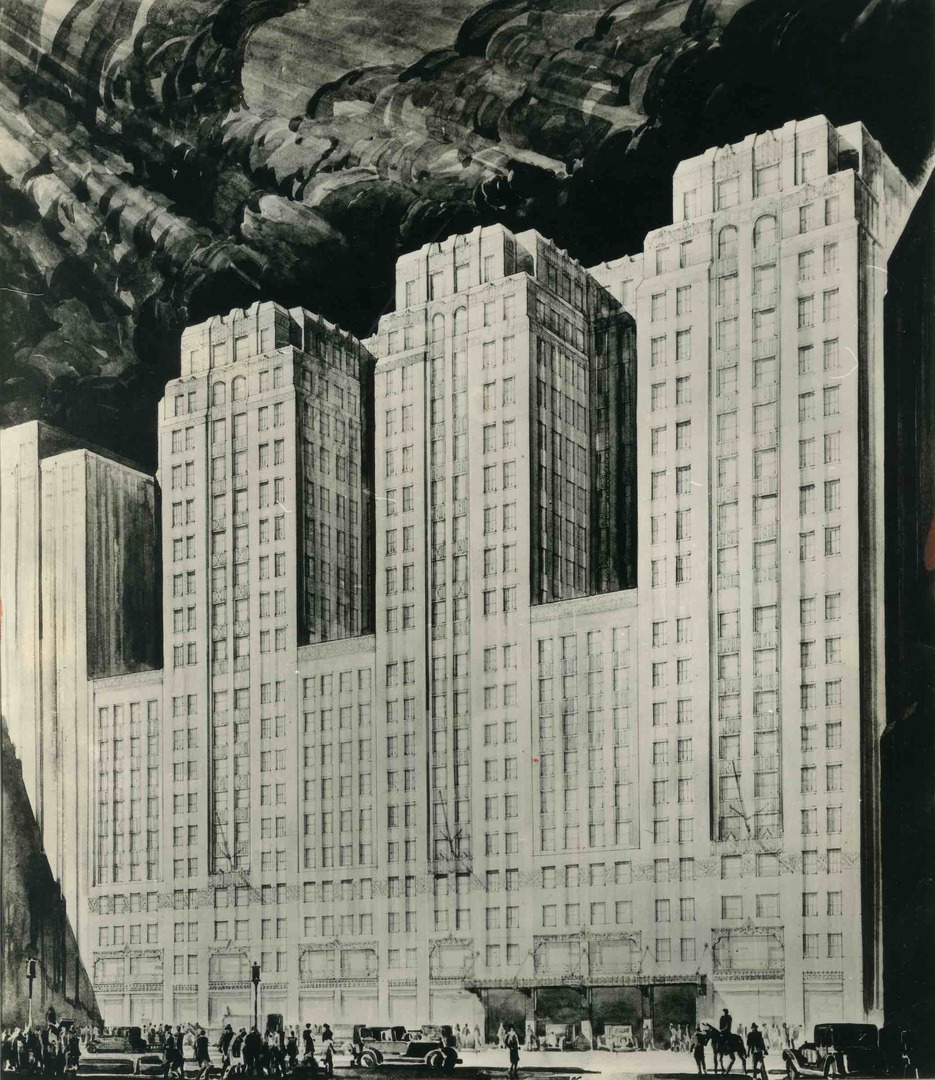
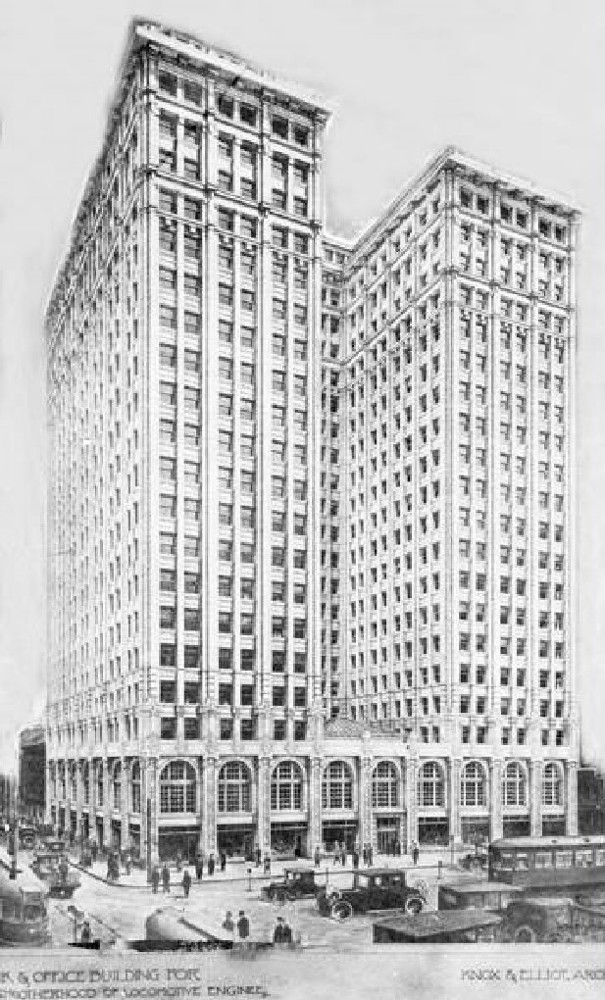
    <summary type="html"><![CDATA[<p><strong><em>Tower City Center, with its Public Square entrance, iconic tower, and flanking hotel and casino, has long overshadowed the office buildings to its rear despite their shared lineage as heirs of the Van Sweringen brothers’ vision. Yet the Landmark Office Towers complex on West Prospect Avenue deserves more attention for its splendid architectural details, novel interior features, and place in the history of some of Cleveland’s most significant corporate giants. </em></strong></p><img src="https://clevelandhistorical.org/files/fullsize/cf17bb9783a0e01e8bcbc10cdc20b577.jpg" alt="Original Rendering of Builders Exchange Building" /><br/><p>The three adjoining buildings that comprise Landmark Office Towers were originally conceived as part of Oris P. and Mantis J. Van Sweringen’s Cleveland Union Terminal complex, the “city within a city” the brothers launched in the 1920s. Designed by Graham, Anderson, Probst & White of Chicago and built between 1929 and 1930, the buildings occupied an entire city block bounded by Prospect Avenue, Huron Road, Ontario Street, and West 2nd Street, all of which were built as viaducts above the railroad tracks entering the Union Terminal. </p><p>In keeping with the idea of a city within a city, each building focused on a different sector: the Medical Arts Building was built for physicians’ and dentists’ offices; the Builders Exchange Building was devoted to businesses associated with the building trades; and the Midland Bank Building was dedicated to banking institutions and other business firms. The buildings included passageways connecting them with each other and with other components of the Terminal complex. A skybridge over Prospect, planned to link the Medical Arts Building with Higbee’s department store, was never added. </p><p>The three buildings were all built with structural steel frames clad with gray limestone on the lower four floors, cream face brick above, and terra-cotta trim near the tops. Detailed Art Deco motifs graced each facade, and the complex featured setbacks and light wells to break their bulk and provide ventilation. Inside, they featured travertine marble floors, fluted pilasters, plaster ceilings with ornamental friezes, and bronze elevator doors. The three-story lobby of the Midland Bank Building featured a wood-burning fireplace, a mezzanine, and pillars and panels carved from the trunks of seven giant oak trees. The trees were selected from an English estate and transported by steamship from Liverpool. The Builders Exchange Building included Guildhall, a tenth-floor restaurant inspired by a 15th-century London namesake, and a two-story demonstration house called the <a href="https://clevelandhistorical.org/admin/items/show/1028">Home in the Sky</a> on its two top levels.</p><p>The introduction of such an expansive block of choice office space soon after the onset of the Great Depression had a profound impact on downtown, precipitating a consolidation of business and professional activity around the Terminal and leaving older office buildings with hard-to-fill vacancies. Four major corporate headquarters relocated to the complex between 1930 and 1935. Two were local: Sherwin-Williams moved its offices from its Canal Road property into portions of the Midland Building and Builders Exchange Building, while Standard Oil Co. of Ohio (Sohio) left the East Ohio Gas Building on East 6th for the Midland Building. The Midland Building also attracted the Erie Railroad headquarters away from New York City in 1931 and Republic Steel from Youngstown in 1935. The arrival of the latter led the Medical Arts Building to be renamed the Republic Building. </p><p>Yet the Depression also forced the complex to grapple with challenges. In 1932, Midland Bank went bankrupt and merged into Cleveland Trust, closing its offices in its namesake building. Three years later, the Van Sweringen Company went bankrupt. Thereafter, ownership of the towers complex was administered by the Prospect Terminals Building Co., a subsidiary of Cleveland Terminal Building Co. In 1940, the Cleveland Builders Exchange left for a new headquarters on Euclid Avenue, and Sherwin-Williams expanded to the floors that had housed the Exchange's Home in the Sky. At that time, the building was named the Guildhall Building.</p><p>In 1950, Cleveland Terminal Building Co. sold the entirety of the Union Terminal group except the rail station in 1950 to the 66 Trust of Philadelphia. That same year, the four main tenants of the towers complex — Republic Steel, Erie Railroad, Sohio, and Sherwin-Williams — formed RESS Realty (a portmanteau of their names) to coordinate leasing of office space in the three conjoined towers. For the 35 years that followed, the complex harbored a workforce of around 5,000 people. </p><p>In 1986, ten years after the Erie-Lackawanna Railroad (formerly Erie Railroad) closed its Cleveland headquarters following its merger into Philadelphia-based Conrail, Sohio completed its move from the Midland Building to its new 45-story headquarters on Public Square. Following the departures of these firms and Republic’s recent merger into LTV Steel, RESS Realty was administered by only LTV and Sherwin-Williams. In the year preceding Sohio’s exit, RESS Realty renovated and rebranded the LTV-Guildhall-Midland Building complex as Landmark Office Towers. </p><p>During the renovations, Sherwin-Williams bought the complex, bringing its ownership back to Cleveland. Changes included a central lobby for the elevator banks serving all three buildings, along with the revitalization of the Midland Building’s lobby, which Sohio had modernized into offices with dropped ceilings in 1970, as the Van Sweringen Arcade. The bank’s vault became Haymarket Restaurant, later Piperade, and then Hyde Park Chophouse until the space closed in 2011. </p><p>The renovation and promotion succeeded in turning around the towers at a critical time. After Sohio moved out, the complex’s occupancy dropped from 100% to 62%, but upon completion of the renovations, it bounced back to 90%. Landmark Office Towers had a nearly four-decade run until its owner, Sherwin-Williams, sold the complex to Detroit-based Bedrock in 2023 ahead of the paint and coatings company’s move to its new 36-story headquarters tower on Public Square. Today, the future of the complex seems tied to Bedrock’s Riverfront Cleveland project, but its precise use is uncertain. Office demand in downtown districts has not recovered from the pandemic collapse of 2020, and conversion of such a massive structure to residential use is costly. But the towers — with their Art Deco flourishes, contribution to a big-city atmosphere, and central location in an evolving downtown — deserve a new, bold vision.</p><p><em><strong><a href="https://clevelandhistorical.org/items/show/1084">For more (including 21 images) view the original article</a></strong></em></p>]]></summary>
    <published>2026-04-03T13:57:15+00:00</published>
    <updated>2026-04-17T19:17:44+00:00</updated>
    <link rel="alternate" type="text/html" href="https://clevelandhistorical.org/items/show/1084"/>
    <id>https://clevelandhistorical.org/items/show/1084</id>
    <author>
      <name>J. Mark Souther</name>
    </author>
  </entry>
  <entry>
    <title type="html"><![CDATA[Cleveland Athletic Club: The Star-Studded History Behind the Athlon ]]></title>
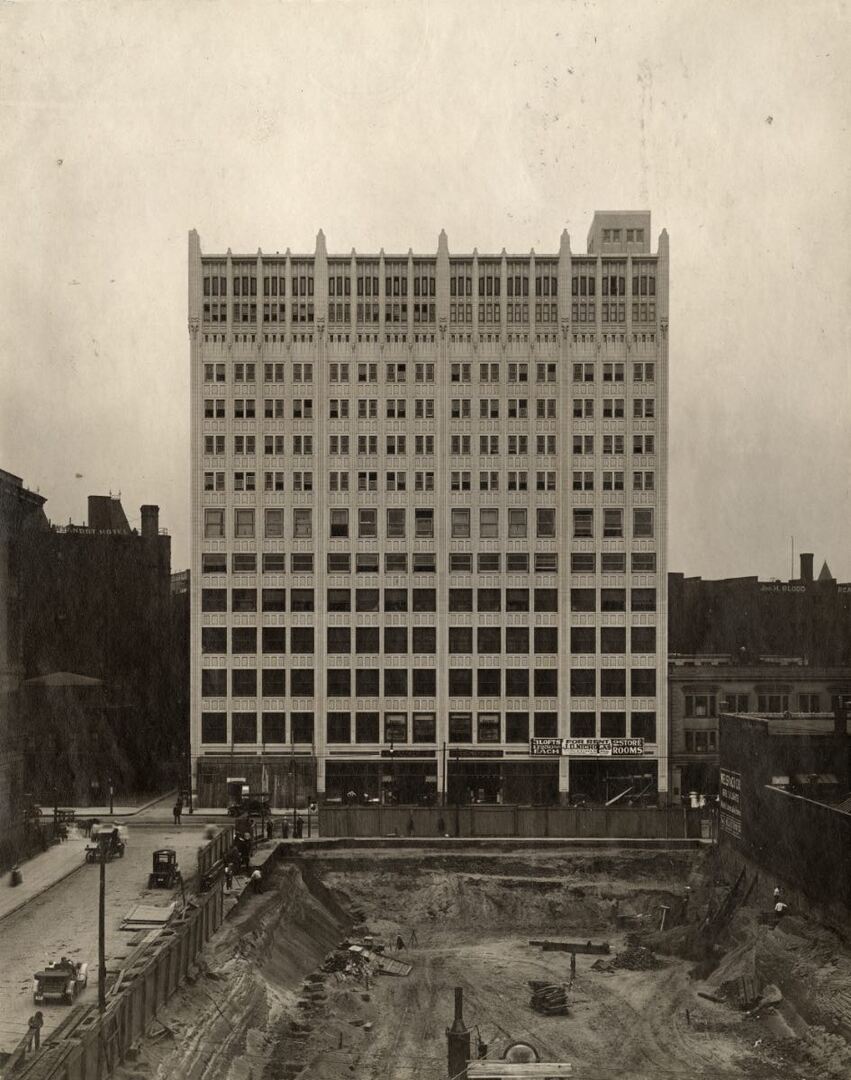
    <summary type="html"><![CDATA[<p><strong><em>The Cleveland Athletic Club was an epicenter of sports culture in Cleveland  for almost a century. Athletes from home and abroad used the CAC's state-of-the-art training facilities and amenities, including a large gymnasium, an indoor track, and an Olympic-sized swimming pool, some of them making sports history in the process.</em></strong></p><img src="https://clevelandhistorical.org/files/fullsize/3045ffb5f072f18bc25d854d4ddf7bba.jpg" alt="CAC under Construction " /><br/><p>For much of the twentieth century, sports and physical fitness were interwoven with Cleveland’s civic life. One place where this sporting culture took shape was the Cleveland Athletic Club (CAC) Building on Euclid Avenue, designed by architect J. Milton Dyer, who also held other notable local commissions, including for the design of Cleveland City Hall. The architectural contract awarded to Dyer totaled $150,000, marking the building as a significant investment for its time. Operating from 1908 until its closure in 2007, the Cleveland Athletic Club served generations of members and offered state-of-the-art athletic facilities that reflected the growing interest in organized recreation and physical training in the early twentieth century. </p><p>The CAC’s origins date to the night of August 10, 1907, when a group of founding members held their first preliminary meeting in the rooms of the Cleveland Auto Club. At that meeting, they elected a temporary president, secretary, and treasurer, and began organizing what would become one of Cleveland’s leading private athletic institutions. Most of these early members were affluent businessmen and professionals who contributed their own funds to establish the club and recruit additional members. Membership grew steadily during the club’s early years, even as members debated the final location of the clubhouse. </p><p>Formal elections were held in 1908. W. P. Murray was once again elected president. Also elected that evening were A. J. Huston as vice president, George A. Schneider as secretary, and A. H. Bedell as treasurer. After two more years of discussion, members decided on a site on Euclid Avenue in 1910. The finished clubhouse occupied the upper ten floors of the 15-story Cleveland Athletic Club Building, which opened in November 1911, giving the CAC a permanent home. </p><p>From its earliest years, the Cleveland Athletic Club distinguished itself through its facilities, which included multiple gymnasiums, boxing rings, handball courts, and a large indoor swimming pool, as well as dining rooms, meeting spaces, and social areas. These amenities made the club both a center for athletic training and a favored spot for Cleveland’s business and professional community to gather. </p><p>The clubhouse attracted many prominent athletes to its facilities for training exercises. Boxing legend Joe Louis trained for several days at the CAC during a visit to Cleveland in 1936. Swimming exhibitions and competitions were also held in the club’s twelfth-floor natatorium, attracting many skilled swimmers. The most illustrious was Johnny Weissmuller, who set the world record for 150-yard backstroke in the club pool in 1922 before going on to win five gold medals in the next two summer Olympics and, later, starring in the <i>Tarzan</i> films. </p><p>Track meets hosted by the club marked another contribution to the city’s sporting culture and gave young athletes a place to develop their skill during the winter months. Among them was Jesse Owens, who participated in meets there during his school years. At the time, Owens was already gaining recognition locally for his remarkable speed, shattering several records—some of them his own—on the club’s track. </p><p>The Cleveland Athletic Club remained a strong institution for nearly a century, serving as one of a number of prestigious anchors on the city’s most celebrated street. Although the CAC closed in 2007, the building continues to offer a reminder of the era when large cities’ athletic clubs were prominent features of urban civic life. When it was converted into apartments in 2019, the CAC Building got new name—The Athlon—that commemorates its history as a place that connected the city to regional and national athletic networks and gave Clevelanders an opportunity to see some of the great athletes of their time.</p><p><em><strong><a href="https://clevelandhistorical.org/items/show/1075">For more (including 8 images) view the original article</a></strong></em></p>]]></summary>
    <published>2025-12-01T17:13:53+00:00</published>
    <updated>2026-04-17T19:17:43+00:00</updated>
    <link rel="alternate" type="text/html" href="https://clevelandhistorical.org/items/show/1075"/>
    <id>https://clevelandhistorical.org/items/show/1075</id>
    <author>
      <name>Clark Helm</name>
    </author>
  </entry>
  <entry>
    <title type="html"><![CDATA[Caxton Building: Cleveland’s Historic Printing and Publishing Hub]]></title>
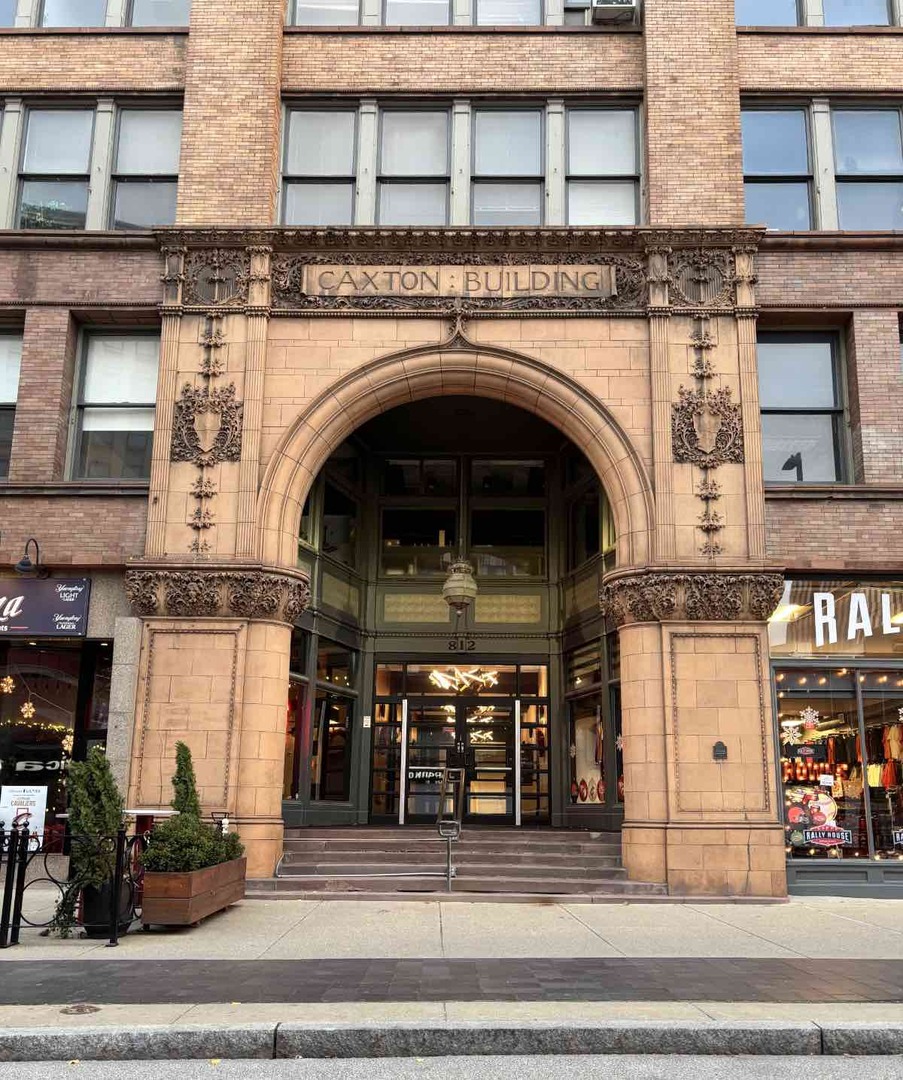
    <summary type="html"><![CDATA[<p><strong><em>The Caxton Building, located in downtown Cleveland, is a historic landmark that embodies the city's industrial past. Constructed in 1898-1900, the eight-story structure was designed by the architect F. S. Barnum as one of the nation’s earliest fireproof office buildings, tailored for printing and publishing businesses. Today, the Caxton Building stands as a testament to Cleveland’s rich history, housing a variety of modern offices while maintaining its vintage character through preserved architectural details.</em></strong></p><img src="https://clevelandhistorical.org/files/fullsize/1494a8988e3d83f1bc0ace442fef0381.jpg" alt="Caxton Building Entrance" /><br/><p><span>The Caxton Building is named after William Caxton, a 15th-century British printer who was the first person to introduce the printing press to England. Caxton was known for printing the earliest English-language version of the Bible, along with other classical works. The Caxton Building’s namesake reflected the original motivation for its construction. Stockholders of the Caxton Building Co., Worcester R. Warner, Ambrose Swasey, Samuel T. Wellman, Rollin C. White, Luther Allen, and Wilson M. Day were behind the building's planning and construction. (Warner and Swasey were already widely known as the principals of a major Cleveland machine-tool and telescope manufacturing company bearing their name; Allen was a founder of Cleveland's White Motor Corp.) Their leadership and vision helped the Caxton Building develop as an aggregated space for printing and publishing businesses by providing the necessary infrastructure to attract such firms. The creation of nodes or hubs of aligned businesses, including so-called "power block" buildings like the Caxton, was a common practice during the rise of American downtowns.</p><p>Designed by architect Frank Seymour Barnum, the Caxton Building is an outstanding example of Chicago School architecture, which was popular in the late 19th and early 20th centuries. Completed in 1900, the building stands eight stories tall and is noted for its steel-frame construction, one of the earliest uses of this Chicago-born technology in Cleveland. This architectural style allowed for larger windows, a lighter appearance, and more flexibility in interior space, and the building’s reinforced concrete floors were especially suited to support the heavy equipment used by printing, publishing, and graphic design firms.</p><p>The arrival of enterprise publishers establishing their quarters in the Caxton Building soon fulfilled its developers’ hopes for it to become the recognized center for printing and publishing in Cleveland. The movement of the Chautauqua Assembly’s headquarters and publication office from Buffalo, New York, to the Caxton Building was a major milestone in the building's history and it brought a unique book publishing and magazine business in the city. Among the famous products developed at the Caxton Building were the <em>Chautauquan </em>(magazine), <em>Engineers’ Magazine</em>, <em>Iron Trade Review</em>, and the <em>Jesuit Relations</em> book series. Other notable printing businesses located there were the Cleveland Printing and Publishing Company and Arthur H. Clark Company, which specialized in historical and geographical publications. Perhaps the most famous Caxton Building business was the World Publishing Company, a major publisher of Bibles, dictionaries, and children's books, which was begun in 1902 by Alfred H. Cahen.</p><p>The Caxton Building was listed in the National Register of Historic Places in 1973 and a Cleveland Landmark three years later, solidifying its reputation as a historic building. As many publishing and printing firms closed or moved away, however, the building became largely vacant by the early 1990s. When the Gateway sports and entertainment complex arrived soon afterward, it spurred new business interest in the surrounding blocks. A well-timed renovation in 1994 gave the Caxton Building many much-needed modern updates while preserving its historic architectural features and well-lit interiors. In the years since, the building’s adaptability has enabled it to attract and new tenants, including architectural firms, law offices, digital media firms, design studios, and civic organizations. The Caxton Building is an excellent but rare example of how a building constructed for a specialized purpose adapted to changing needs while remaining a commercial and civic hub.</p></p><p><em><strong><a href="https://clevelandhistorical.org/items/show/1041">For more (including 5 images) view the original article</a></strong></em></p>]]></summary>
    <published>2024-11-26T07:51:18+00:00</published>
    <updated>2026-04-17T19:17:43+00:00</updated>
    <link rel="alternate" type="text/html" href="https://clevelandhistorical.org/items/show/1041"/>
    <id>https://clevelandhistorical.org/items/show/1041</id>
    <author>
      <name>Ansh Doshi</name>
    </author>
  </entry>
  <entry>
    <title type="html"><![CDATA[Western Reserve Building: Weathering the Shifting Winds of Downtown Property Markets]]></title>
    <summary type="html"><![CDATA[<p><strong><em>Samuel L. Mather perched his offices in the Western Reserve Building above the river harbor where he plied his iron-mining and shipping business. At the time, he probably never imagined how the brick and stone edifice would fare as downtown and the city's economy evolved, but his onetime headquarters defied the odds, managing to retain its original function as an office building long after most other first-generation skyscrapers were demolished or converted to other uses.</em></strong></p><img src="https://clevelandhistorical.org/files/fullsize/b24eb52bdd6ec25243308a1cd22ba2a4.jpg" alt="Romanesque Arch Entrance" /><br/><p>Samuel L. Mather, the grandson of one of the founding fathers of the Connecticut Land Company whose investment had led to the establishment of Cleveland, co-founded the iron-ore mining and shipping firm of Pickands, Mather & Co. in 1883, which helped him amass a new fortune on top of his already formidable wealth. Pickands Mather had kept offices for only a short time in the <a href="https://clevelandhistorical.org/items/show/1029">Perry-Payne Building</a> on Superior Avenue when Mather commissioned the Chicago architectural firm of Burnham & Root (already known locally for its <a href="https://clevelandhistorical.org/items/show/305">Society for Savings Building</a>) to design a headquarters office building on land that he and John Hay had purchased on the northwest corner of Superior and Water Street (now W. 9th).</p><p>The aptly named Western Reserve Building occupied a triangular parcel on the crest of a steep hill descending into the flats along the river. The land had once been home to the Carter Tavern, a hewn-log inn that early Western Reserve of Connecticut settler Lorenzo Carter had built in 1803. Following Carter's death in 1814, Phineas Shepard operated the inn for an unknown span of time, and it was the site of the meeting in 1816 that organized Trinity Parish, later <a href="https://clevelandhistorical.org/items/show/81">Trinity Episcopal Cathedral</a>. After it closed, deeds show that Carter's children Alonzo and Laura sold the land to the Oviatt family in two transactions in 1825 and 1830. By 1828, the Oviatts had replaced the old two-story inn with a three-story brick building that stood until Orson M. Oviatt razed it for a new four-story commercial block called the Franklin Buildings in 1835. The Franklin Buildings housed various dry-goods houses and professional offices, including the men's clothing store of George A. Davis, who owned the block from 1851 until his death ten years later. </p><p>The Franklin Buildings later housed Western Union Telegraph Company, which added "innumerable adornments of fencing and wires which surmount[ed] the electric ridden structure," according to an account in the <em>Plain Dealer</em> in 1886. Three years later, Hay and Mather, the executors of Amasa Stone's estate, purchased the property in the estate's name and set out to redevelop it. (Hay's and Mather's wives Clara and Flora were Stone's daughters.) Following on the heels of the Perry-Payne Building, the announcement of a new building to replace the Western Union block was a welcome news to those who feared Euclid Avenue's inroads. As the <em>Plain Dealer</em> pointed out in 1889, "Enough is now promised in the way of new buildings to save the street from becoming what it had at one time threatened to do—a street for banks and the wholesale trade plentifully mixed up with saloons."</p><p>Mather’s new eight-story pressed-brick and sandstone Western Reserve Building, which opened in 1892, is considered a transitional skyscraper. Like Burnham & Root’s Monadnock Building in Chicago and Cudell & Richardson's Perry-Payne Building, it had traditional load-bearing masonry exterior walls but also incorporated some interior steel framing, a recent innovation. On the ground floor, the Western Reserve Building featured pink sandstone piers capped by Romanesque capitals and a large Romanesque arch framing its Water Street entrance. Its upper floors had either rectangular, segment arch, or full arch windows, some of them in oriel bays. Samuel Mather had an elaborate cherry-paneled office inside. </p><p>In addition to Pickands Mather, the Western Reserve Building housed American Steel & Wire, Cleveland-Cliffs Iron, Island Creek Coal, and other shipping, mining, and manufacturing concerns. The building’s uses reflected business leaders’ desire to locate offices in the Wholesale District (later renamed the Warehouse District) close to Cleveland’s harbor. The riverside location was also attractive to the U.S. Weather Bureau. On May 1, 1892, Cleveland’s weather observatory and signal station opened there, 135 feet above the street, giving it a commanding view of the lake and river. From this lofty perch, signalman and weather observer W. B. Stockman hoisted flags to alert ship captains and downtown pedestrians to impending changes in the weather. The station had previously operated on top of the six-story Wilshire Block on Superior Avenue a block and a half west of Public Square. Now it was another beneficiary of Mather’s eagerness to be closer to the harbor. </p><p>In 1903, the Western Reserve Building was expanded northward along Water Street with an interior lightwell that may have drawn inspiration from Burnham & Root’s Rookery Building in Chicago or perhaps from a similar feature inside the Perry-Payne Building. The expansion increased the original building's size by about 40 percent. The building flourished into the 1920s, but like other buildings west of Public Square, it faced increasing competition from newer ones that rose to the east along Euclid Avenue. In 1924, Mather sold his interest in the Western Reserve Building to the Union Lennox Company, a firm named for the mammoth Union Trust Building that had recently replaced the Lennox Building on the northeast corner of Euclid and East 9th. Soon after, Pickands Mather moved its headquarters into the Union Trust Building. With the loss of its identity as a hub of the city's iron-ore business and the rise of newer, larger skyscrapers, the Western Reserve Building's future was in question.</p><p>The Western Reserve Building changed hands twice during World War II and, under Louis E. Goldman, it underwent a modernization in 1947 that covered its Romanesque arch entrance with a blocky granite façade. Despite this effort to renew its appeal, over the next three decades, the building stood sentinel over a part of downtown that was gradually decaying and receding in civic importance. Toward the end of that time, Goldman was no longer able to attract tenants, so the building sat mostly vacant. The exception to the rule was the opening in 1970 of the Cleveland Urban Learning Community, an experiment by St. Ignatius High School that took advantage of cheap rent to place its headquarters in the Western Reserve Building.</p><p>The Cuyahoga River’s east bank had been a natural place for Samuel Mather to envision an office building housing his iron mining and shipping business in the early 1890s. Although seemingly less natural, Herbert W. Strawbridge, chairman of the Higbee Company department store, felt a similar pull toward the western edge of the derelict Warehouse District nine decades later. Several years earlier, Strawbridge had visited San Francisco’s Ghirardelli Square, a shopping, dining, and entertainment complex filling the shell of its namesake chocolate manufacturer’s former factory. As Higbee’s downtown store sales slipped, Strawbridge recalled Ghirardelli Square. Then he hatched a daring plan to buy a swath of property overlooking the river and create a similar venue. Settlers’ Landing, as it would be named, would evoke Cleveland’s start along its river and, like Ghirardelli Square, reuse existing buildings as much as possible. More importantly, Strawbridge reasoned, Settlers’ Landing could draw large numbers of tourists and suburbanites back to a sagging downtown—and hopefully to Higbee’s.</p><p>Among the properties that the newly formed Higbee Development Corporation bought through agent John H. Bustamante was the Western Reserve Building, which Goldman was doubtless thrilled to unload in 1973. Strawbridge then hired Lawrence Halprin, the man behind Ghirardelli Square, to plan Settlers’ Landing. Higbee Development sank $4.5 million into a full renovation of the Western Reserve Building in 1974-76. The results drew a mixed response locally. Some decried the sandblasting that pitted the delicate sandstone facade. Others looked askance at the similarly insensitive treatment of the building’s interior. To avoid removing any leasable space, Higbee Development enclosed the historic lightwell to add an interior fire escape, heating and cooling ducts, and new restrooms on each floor. Halprin’s designer Angela Tzvetin created a modern lobby with “domed brick vaults” and spiderweb-like iron designs between their pillars, leading one architectural critic to dub the “corny” concept “early wine cellar.” The same critic went so far as to suggest that the Western Reserve Building was “second-rate Burnham and Root” that would have been better off bulldozed.</p><p>When the Western Reserve Building reopened in 1976, it seemed that the building had a new relevance as the Flats transitioned from maritime to leisure uses, but renewal was slow and difficult. Higbee’s operated a sandwich shop off the lobby while it searched (ultimately in vain) for a full-service restaurant to assume the space. At the time of the opening, only 1,220 of 53,840 square feet of office space was leased. Then Higbee’s plans for Settlers’ Landing collapsed after a major fire consumed some of the buildings the company had hoped to renovate. Despite efforts to promote the building, including hosting an exhibit and slideshow as part of the 1977 sesquicentennial of the opening of the Ohio Canal, the Western Reserve Building underperformed expectations. Coupled with Higbee’s expenses from opening new stores at Euclid Square and Randall Park malls, its renovation of Pickands Mather’s onetime headquarters building contributed to record quarterly losses that year. By 1981, the building was reportedly at 97 percent occupancy, but Higbee’s needed an infusion of cash, so it sold the building to another syndicate headed by developer John Ferchill.</p><p>Though Settlers’ Landing had flopped, the Flats and Warehouse District boomed in the 1980s. Nightspots, restaurants, and loft apartment conversions reinvigorated an area that earlier downtown planners had largely forsaken in their fixation on <a href="https://clevelandhistorical.org/items/show/909">Erieview</a>. It was too late for Higbee’s, which sold out to Youngstown developer Edward J. DeBartolo and the Little Rock-based Dillard’s chain in 1987 (though the Higbee’s name survived another five years). As for the Western Reserve Building, it flourished anew. Among the firms based there was Those Characters from Cleveland (now CloudCo Entertainment), a subsidiary of Cleveland-based American Greetings that formed in 1981 to develop and license characters developed by the card company such as Holly Hobbie and Strawberry Shortcake. That year saw Cleveland artist Elena Kucharik’s creation of the Care Bears, making the Western Reserve Building the birthplace of one of the 1980s’ popular culture icons. </p><p>Ferchill and his partners undertook yet another renovation in 1990 and built an eight-story addition to the north that doubled the size of the 1892/1903 building. The sandstone- and microcotta-faced addition featured a new arched entry, while the syndicate uncovered and restored the long-hidden one on the original building. After initial success, the enlarged building gradually languished again. By 2016, it was two-thirds vacant and in foreclosure, leading Ferchill to sell it the following year to WRB Partners (comprised of developer Fred Geis, real estate firm Cushman & Wakefield, and others). During the COVID-19 pandemic, the Western Reserve Building clung to its original function as an office building in a new era marked by the loss of downtown office-based work and a spate of office to residential conversions. In addition to attracting a global co-working company, WRB Partners added to its amenity-driven approach to combatting the loss of traditional dedicated office work by doing what Higbee’s had tried and failed to do fifty years earlier: entice a restaurant operator. In 2023, the popular Cleveland Heights-based Luna Bakery opened its third cafe on the building’s ground floor.</p><p><em><strong><a href="https://clevelandhistorical.org/items/show/1030">For more (including 19 images) view the original article</a></strong></em></p>]]></summary>
    <published>2024-09-10T21:00:07+00:00</published>
    <updated>2026-04-17T19:17:43+00:00</updated>
    <link rel="alternate" type="text/html" href="https://clevelandhistorical.org/items/show/1030"/>
    <id>https://clevelandhistorical.org/items/show/1030</id>
    <author>
      <name>J. Mark Souther</name>
    </author>
  </entry>
  <entry>
    <title type="html"><![CDATA[Perry-Payne Building: Standing at a Place of Historic Memory]]></title>
    <summary type="html"><![CDATA[<p><strong><em>In the Spring of 1887, workmen tore down a number of three-story commercial buildings that had long stood on the north side of Superior Street between the National Bank Building on the northeast corner of Superior and Water (West 9th) Street and the Scovill Building (formerly the Franklin House), located midway up the block. The site was cleared to make room for the construction of the eight-story Perry-Payne Building. A little less than a year later, while the new Perry-Payne Building was going up, an article appeared in the <em>Plain Dealer</em> on April 15, 1888 recalling those earlier buildings and noting that "while the old must give way to the new," a number of Cleveland's most prominent pioneer merchants, including William Bingham and George Worthington, had started their businesses in the old buildings and that therefore "the place is of historic memory."</em></strong></p><img src="https://clevelandhistorical.org/files/fullsize/cdb5ba97d0c460c22c2c6b53c94355bd.jpg" alt="Perry-Payne Building, 740 W. Superior Avenue" /><br/><p><span style="font-weight:400;">The historic land upon which the Perry-Payne Building at 740 W. Superior Avenue stands, and much of the land that surrounds it in Cleveland's Warehouse District, was first commercially developed by the Nathan Perry family. Nathan Perry Sr. (1760-1813) was an innkeeper in western New York's Genesee County when, in 1796, he was hired by Moses Cleaveland to provide food supplies to the surveying party that founded Cleveland. Almost a decade later, he, his wife Sophia, and their children moved here. In 1806, Perry purchased six acres of land northwest of the Public Square. On that land, which had frontage on Superior, St. Clair and Water (West 9th) Streets, Perry opened a trading post in a cabin that stood less than fifty feet from where the Perry-Payne Building stands today. </p><p>Nathan Perry, Sr. was one of Cleveland's first merchants. Less than a decade after arriving in Cleveland, however, he died unexpectedly. Four of his six acres, including the land upon which the Perry-Payne Building stands, passed to his son Nathan Perry Jr. (1786-1865), who transformed his father's trading post into a dry goods store and, in 1819, replaced the cabin with a two-story brick commercial building, one of Cleveland's first. Nathan Jr. operated his dry goods business in that building until 1826, when he sold the business but retained ownership of the building and the land upon which it stood. </p><p>In addition to running his dry goods business, Nathan Perry Jr., as early as 1814, had been making shrewd purchases of land in Cleveland, and, by 1830, he had become one of the city's wealthiest landowners. In that latter year, he moved his family from the simple frame house they had lived in on Water Street, just north of his dry goods store, into an early-era mansion on Euclid Avenue. It stood where Berkman Hall stands today on Cleveland State University's campus, just east of East 22nd Street.</p><p>In 1835, Perry decided to lease some of his land near the corner of Superior and Water to two hardware merchants, William Cleveland and Elisha Sterling. The terms of their two leases—drawn up by a young Cleveland lawyer named Henry B. Payne—required them to construct two three-story brick commercial buildings on the land they leased. Each of the two brick buildings they built had two storefronts. The buildings with their four storefronts became known as the "Central Buildings" because the corner of Superior and Water was then the center of Cleveland's commercial business district. It was in these buildings that William Bingham, George Worthington, and other prominent early Cleveland merchants, who were mentioned in the <em>Plain Dealer</em> article of April 15, 1888, got their business start.</p><p>As important as the Central Buildings were to the enlargement of Nathan Perry Jr.'s real estate portfolio, lawyer Henry B. Payne, who drafted the leases that required they be built, would soon become even more important. In 1833, Henry B. Payne was a law student in Hamilton, New York, when he was impelled to travel to Cleveland to help nurse his best friend, Stephen A. Douglas, who was suffering from a severe illness. Douglas, who later became the Illinois Senator whom Abraham Lincoln famously debated in 1858, left Cleveland after recovering. Henry Payne chose to stay. Payne completed his law studies here and, in 1836, when Cleveland officially became a city, Henry Payne became its first solicitor. In August 1836, Payne, who had in 1835, as noted above, served as Nathan Perry's lawyer, married Perry's only daughter, Mary, who thereafter became known to all in Cleveland as Mary Perry Payne. </p><p>Henry Payne practiced law in Cleveland for more than a decade before he decided to leave the practice. In 1849 he joined forces with Alfred Kelley and Richard Hilliard to build Cleveland's first railroad, the Cleveland, Columbus and Cincinnati ("CCC"). In the process, he became that railroad's first president. In 1855, Payne turned his attention to government service and was appointed to the City Waterworks Commission. It built Cleveland's first waterworks system. Then, in 1862, he took on the work of chairing a city sinking fund board which reportedly stabilized Cleveland's finances for years. Henry Payne also became active in local and state politics. He served in a number of Democrat party positions, before being elected in 1874 to the United States House of Representatives. A decade later, in 1885, he was elected Ohio's first United States Senator from Cleveland. </p><p>It was during the second year of Henry Payne's term as a United States Senator that local newspapers reported that Senator Payne was planning to build a new commercial building on Superior Avenue that would be named the Perry-Payne Building.  Different reporters and different historians writing in different eras have speculated differently as to the reason why Henry Payne named the Perry-Payne Building as he did. They all, however, may have been looking to the wrong person for an answer to their question. </p><p>When plans were made to build the Perry-Payne Building, the land upon which it was to be built was owned by Mary Perry Payne. The decade of the 1880s was one in which American women were beginning to acquire greater property rights, including the right to own, develop and dispose of real property in their own name. Henry B. Payne was uniformly said to be a progressive person of kind disposition who had a very loving marriage with Mary Perry Payne. Given all of the foregoing, there is no reason not to believe that Mary Perry Payne, probably with her husband's full support, was the person who chose the name of the building that was to be built upon her land. So perhaps the question that we should ask today, even if it was not asked by newsmen in 1887, or by historians thereafter, is: Why did Mary Perry Payne choose to so name her building? While we do not know the answer to that question with any degree of certainty, it might be as simple as that was where she first met Henry Payne.</p><p>In proceeding with their plans to build the Perry-Payne Building, Henry and Mary Perry Payne selected Cudell & Richardson, one of Cleveland's most prominent late nineteenth-century architectural firms, to design it. Cudell & Richardson, in additional to this historic building, also notably designed the following buildings still standing in Cleveland: St. Stephen Roman Catholic Church on West 54th Street; Franklin Circle Christian Church at 1688 Fulton Road; Belden Seymour Block at 2513-2525 Detroit Avenue; Franklin Castle at 4318 Franklin Boulevard; the George Worthington Company Building at 802-832 W. St. Clair Avenue; the Root and McBride Building at 1220 West 6th Street; and the Bradley Building at 1212-1224 West 6th Street. Additionally, Cleveland's Cudell Commons Park and the city's Cudell neighborhood are both named after Frank Cudell, one of the two named partners in that architectural firm.</p><p>The building Cudell & Richardson designed for Henry and Mary Perry Payne was described in a June 19, 1887 <em>Cleveland Leader</em> article. It was to be constructed "of brown stone and granite, in the Rennaissance style of architecture. The side and rear walls will be of brick. . . . The floor joists will be of iron and the floors fire clay tile. . . . [T]he stairs will be made of iron and cement or marble. Iron balconies will be provided on the fifth and seventh floors." The article stated that the building would be "eight stories high in the middle and seven on either side, with a basement. It will have a frontage of 138 feet, a depth of 100 feet, and will be 120 feet high." The article noted that the first floor of the building would be designed for the offices of banks, and the upper floors would have a total of 46 offices with an average size of 18 x 26 feet. </p><p>Other articles noted that the interior of the building would feature an eight-story interior court illuminated by a sky light. (The design of this light court, as well as the building's front facade, were reminiscent of Chicago's Rookery Building designed by Burhnam and Roots.) Other interior features of the Perry-Payne Building were its modern elevators and mail chutes that carried mail from all of the building's upper floors down to a first floor mail room. Designed with interior iron support columns, the Perry-Payne Building is notable architecturally as a transitional building between earlier buildings with masonry support walls and later buildings, including the Society for Savings Building erected just one year later, having interior steel support beams which enabled them to be built to great heights and led to them becoming known as "skyscrapers."</p><p>Construction of the Perry-Payne building commenced in the summer of 1887 after all of the old commercial buildings on the site had been razed. While construction was expected to be completed in 1888, financing difficulties encountered by Henry and Mary Perry Payne appear to have delayed completion of construction until the summer of 1889. The first tenants of the Perry-Payne Building included Bingham Hardware and National City Bank, who opened their offices in the new building on July 1, 1889.  When the Perry-Payne Building opened, it was the tallest and most grand commercial building in Cleveland, and it attracted many of the largest iron ore, coal, and shipping companies in Cleveland as tenants. It also attracted a number of Cleveland law firms, including a new firm named Squire, Sanders and Dempsey (today, Squire, Patton and Boggs), which has since become one of the city's largest and most historic law firms. </p><p>In the first two decades of its existence, even as larger and grander commercial building went up in downtown Cleveland, the Perry-Payne Building continued to attract more than its fair share of Cleveland's coal, iron, and shipping-related businesses, as well as a number of law firms and insurance companies. However, almost all of its core tenants departed after 1913 when Marcus Hanna's son Dan completed his construction of the enormous 15-story Leader Building on the corner of Superior Avenue and East 6th Street. Thereafter, for decades, the Perry-Payne Building survived with much less than full occupancy.</p><p>During its early years, ownership of the Perry-Payne Building remained with the Perry-Payne family and their descendants through the Perry-Payne Company formed in 1899, several years after the deaths of Henry and Mary Perry Payne. However, in 1945, that company sold the Perry-Payne Building to another corporation that was unrelated to the family. The building had many new owners in the years that followed and these new owners struggled to find and hold onto tenants. Then, in 1965, the State of Ohio leased the entire building for a number of its agencies with offices in Cleveland. This, however, only temporarily solved the building's occupancy problems for, in the summer of 1979, the State agencies departed when the new <span>Frank J. Lausche State Office Building, directly across the street, opened</span>.</p><p>In the 1980s and early 1990s, the owners of the Perry-Payne Building struggled anew with occupancy problems. In 1994, however, a new partnership purchased the building, hired an architectural firm known for its restoration work, and proceeded to restore the front facade of the Perry-Payne Building; renovate the remainder of it; and convert it into an apartment building with 91 apartments and 8,000 square feet of retail space. As of the writing of this story in 2024, the Perry-Payne Apartments remain a prestigious address in downtown Cleveland's Warehouse District.</p><p>If Mary Perry Payne were alive today and learned that her Perry-Payne Building had been converted into an apartment building, she might say that it really didn't matter, so long as Clevelanders today believe, as she and her husband and Clevelanders of her generation more than a century ago believed, that the Perry-Payne Building stands at a place of historic memory.</p><p> </p>
</p><p><em><strong><a href="https://clevelandhistorical.org/items/show/1029">For more (including 19 images) view the original article</a></strong></em></p>]]></summary>
    <published>2024-08-06T01:52:23+00:00</published>
    <updated>2026-04-17T19:17:43+00:00</updated>
    <link rel="alternate" type="text/html" href="https://clevelandhistorical.org/items/show/1029"/>
    <id>https://clevelandhistorical.org/items/show/1029</id>
    <author>
      <name>Jim Dubelko</name>
    </author>
  </entry>
  <entry>
    <title type="html"><![CDATA[Rose Building: &quot;The New Center&quot;]]></title>
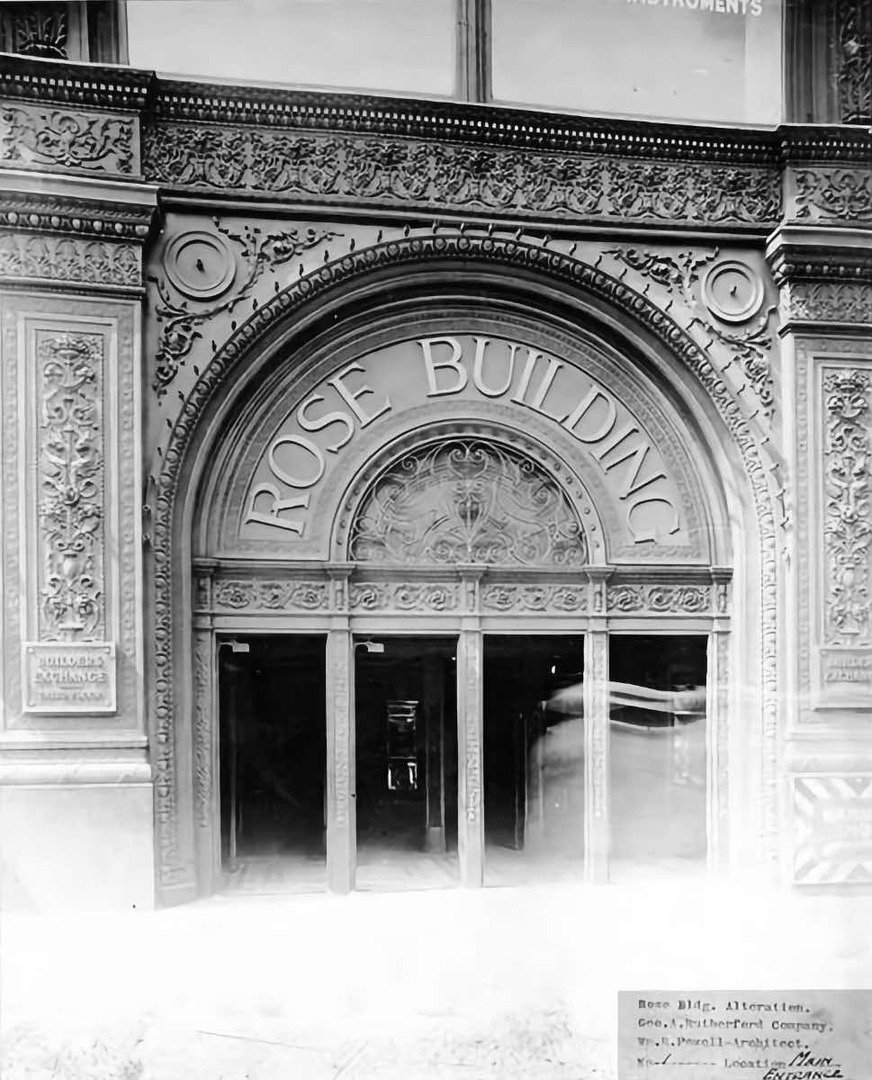
    <summary type="html"><![CDATA[<p><strong><em>In 1898-1900, Benjamin Rose financed the construction of the largest office building ever built in Ohio up to that time. At a time when conventional wisdom dictated a Euclid Avenue address, Rose did the unthinkable, selecting a spot at the corner of Prospect Avenue and Erie Street. Naysayers were convinced Rose's daring venture was doomed to fail, but they were wrong.</em></strong></p><img src="https://clevelandhistorical.org/files/fullsize/1e18dd70994fd06dc46874a9b5534ab0.jpg" alt="Main Entrance" /><br/><p>The ten-story Rose Building took its name from its developer, an English immigrant and pioneer in the meatpacking industry. In 1854 Benjamin Rose and Chauncey Prentiss established Rose & Prentiss, later renamed Cleveland Provision Company, which embraced refrigeration and other innovations early and was the city’s largest packinghouse for more than a century. With the fortune he amassed selling cuts of meat, in 1898 Rose commissioned architect George Horatio Smith to design what would become Ohio’s largest office building.</p><p>When the Rose Building was constructed, Erie Street (now East 9th), was on the eastern fringe of downtown, but Rose cleverly dubbed the intersection “The New Center” and used this slogan to entice businesses that might otherwise have considered the location too distant. Indeed, the Rose Building stood out. Its first five stories were sixteen feet high, while floors six to ten were eleven feet high. The choice to make the ceiling height of the lower floors so much higher than usual was reportedly Rose’s wish. </p><p>Upon its opening in 1900, the building’s primary tenants on the lower floors included Lederer Furniture, Scott Dry Goods, and offices of the White Sewing Machine and Cleveland Gas & Electrical Fixture companies. The upper floors contained doctors’ and dentists’ offices, an artist’s studio, a correspondence school, and the offices of fifteen oil companies. In its early years the Rose Building also hosted many exhibitions, including the works of Cleveland artists, a Slavic craft fair, and even a mock Congressional session. </p><p>In 1908 Rose was poised to stake out the next speculative “new center” of downtown. He bought out the St. John’s African Methodist Episcopal Church on East 9th across from Erie Street Cemetery with plans to build a twelve-story office building, but before he could carry out the plan, he died during a trip to England. Instead of burnishing his reputation in life as a visionary developer, in death Rose seeded the legacy for which he is known today. In 1909, the Rose Building gained a new tenant. Tucked away in small, sparely furnished office on the tenth floor was the Benjamin Rose Institute. Funded by Rose’s $3 million bequest, it used the office to review applications for small pensions to enable elderly men and women to afford to remain in their own homes.</p><p>In 1984, the Institute sold the Rose Building to Medical Mutual of Ohio, which had located its headquarters there in 1947. Medical Mutual owned the building until 2000, when it sold it to California-based BentleyForbes and leased its space. When the owner fell into foreclosure, Medical Mutual bought the building back in 2017, but its future in downtown was anything but certain. After much deliberation, Medical Mutual vacated the Rose Building in 2023 and merged its operations in its Brooklyn, Ohio, offices in the former American Greetings headquarters. While pessimists might quip that Benjamin Rose's doubters were ultimately proven right, the Rose Building's now much more central location makes it a likely candidate for a new lease on life.</p><p><em><strong><a href="https://clevelandhistorical.org/items/show/1012">For more (including 12 images) view the original article</a></strong></em></p>]]></summary>
    <published>2024-01-11T16:07:38+00:00</published>
    <updated>2026-04-17T19:17:43+00:00</updated>
    <link rel="alternate" type="text/html" href="https://clevelandhistorical.org/items/show/1012"/>
    <id>https://clevelandhistorical.org/items/show/1012</id>
    <author>
      <name>J. Mark Souther</name>
    </author>
  </entry>
  <entry>
    <title type="html"><![CDATA[Anthony J. Celebrezze Federal Building: Federal Modernism Comes to Cleveland]]></title>
    <summary type="html"><![CDATA[<p><strong><em>When the federal government began planning its new building as part of the Erieview Plan, it departed from I. M. Pei’s original vision and chose a stunning new design that drew from the latest in Modernist thought. Forty years later, that building was showing its age and required a dramatic intervention. The solution was an innovative facade overclad system that changed the building’s appearance but maintained its original purpose and function.</em></strong></p><img src="https://clevelandhistorical.org/files/fullsize/08179223f0e96be7ec08765e524e5ec3.jpg" alt="The Anthony J. Celebrezze Federal Building" /><br/><p>The 1960s were a very active period for the construction of federal buildings in cities across the country, and Cleveland was no exception. As early as 1957, area members of Congress began pushing for the construction of a centrally located downtown federal office building that would consolidate federal services in the city. The site of the building was determined in 1960 as an integral part of the Erieview Urban Renewal Project in downtown Cleveland. This large scale, multi-phased urban planning project was led by renowned architecture firm I. M. Pei and Associates.</p><p>Pei’s 1960 master plan for the Erieview development included a mix of high- and low-rise commercial and residential buildings with more than fifty percent of the land left open for parks and malls. The plan was designed to be completed in two phases; a western area of 96 acres to be designated for primarily commercial use and an eastern area of 67 acres to be designated for residential buildings. The focal point, at the center of the development, was a forty-story office tower. Completed in 1964 and dubbed the Erieview Tower, this was the first part of the Erieview plan to be built. A new six-story federal building that was to occupy an entire city block was also a key part of Pei’s plan. In preparation for the Erieview redevelopment, more than 200 buildings were demolished, including the old Armory that was located on the site of the current Federal Building.</p><p>While I. M. Pei developed the master plan for the Erieview development, other architects were brought in to design the individual buildings, including the new federal building. The General Services Administration (GSA), established in 1949 to meet the needs of the growing federal government, selected three local architecture firms to work together on the design of the federal building: Outcalt, Guenther, Rode, Toguchi & Bonebrake; Schafer, Flynn & Associates; and Dalton & Dalton Associates. However, the GSA did not choose a lead designer for the project and left the three firms to resolve the issue. All three firms wanted to lead the project, so a compromise was reached that they would bring in an outside architect to be the lead designer. The firm principals originally thought about bringing in a famous architect to lead the project, but eventually decided to find an architect that worked for one of these significant architects. Peter van Dijk was working for Eero Saarinen and Associates in Bloomfield Hills, Michigan, at the time and was selected based on a suggestion by one of Calvin Dalton’s employees. Upon speaking with van Dijk, the principals at the three firms quickly decided he was the right person to lead the design of the Federal Building project.</p><p>The design process began in 1961 and continued through 1962. The architectural team was charged with designing a one million square foot federal office building with an “open, flexible, well-planned loft space for offices.” GSA also requested that a two-level parking garage, large cafeteria, and loading dock be included. According to van Dijk, the goal was “to produce a most elegant steel cage. A façade executed with strength and precision. A stressed skin smoothness with machine-like clarity. Good proportion, scale, detail and choice of appropriate materials and colors.”</p><p>After careful consideration and study of the site and GSA programmatic requirements, it was decided that the team would design a tall building, which was in direct contradiction to the concept design in Pei’s Erieview Master Plan. The designers’ decision to abandon the Pei design was based on their belief that a tall structure would relate to the existing Terminal Tower and the other buildings being designed in proximity at the time. In their opinion, the large donut-shaped plan did not conform with the “plans for open space and plazas.” They believed a tall building would provide for more space for outdoor plazas, as well as views of the downtown and lake from the upper floor offices. Following their conclusion, the team convinced Pei and GSA that “a tall, slim structure would be more in keeping” with the other high structures planned in the renewal area. </p><p>The building was designed as a simple rectangular shape and had the proportions of a golden rectangle. The design also contained a definite base, middle, and top and was intended to utilize simple materials (glass and stainless steel). Furthermore, according to van Dijk, the steel frame of the building became “the basis of the architectural expression of the façade.” The siting was also important to the designers. The building was purposely set back from East Ninth Street to provide room for a plaza at the main entrance and set back even farther on East Sixth Street to create a “garden plaza.”</p><p>The design was substantially completed by June 1962 when GSA issued an official press release regarding the new federal building in Cleveland. In the press release, GSA described the thirty-two story building as “an important element in the city’s Erieview Redevelopment Plan” that would “provide the lake-shore metropolis with an imposing landmark.” They also estimated that the building would cost $41.2 million to complete. </p><p>The Celebrezze Building was designed during a period of growing public acceptance of Modernist design. The Modernist movement in architecture, which had roots in Europe, began to flourish in the United States following World War II as architects like Walter Gropius and Mies van der Rohe expanded their influence. As the movement continued to thrive throughout the 1950s and into the 1960s, Modernism became the preferred style of architecture for office buildings across the country. Buildings such as the Seagram Building (1958) in New York City by Mies van der Rohe and Philip Johnson, as well as the Inland Steel Building (1957) in Chicago, Illinois by Bruce Graham and Walter Netsch of SOM, continued to push the envelope in Modernist design. Significant Modernist skyscrapers in Cleveland include the McDonald Investment Center (1968) by Charles Luckman; the Cleveland Trust Tower/Ameritrust Tower (1971) by Marcel Breuer; Earnest J. Bohn Housing Tower (1972) by William Dorsky Associates; the Diamond Building (1972) by SOM; the Holiday Inn Lakeside (1974) by William Bond; and the Sheraton City Centre Hotel (1975) – now the Crowne Plaza Hotel – by Bialosky and Manders.</p><p>The policies of the federal government also reflected the shift toward Modernist design. When John F. Kennedy assumed the presidency in 1961, he found many federal buildings to be lacking in efficient office space and inadequate for modern use. As a result, he requested that an Ad Hoc Committee on Federal Office Space be formed to develop solutions for short- and long-term space needs in federal buildings. In 1962 the committee issued its report, which included the “Guiding Principles for Federal Architecture.” In the “Guiding Principles” the committee recommended new mandates for “high quality architectural designs” for all new federal buildings across the country and developed a three-point system for federal architecture standards. They also encouraged modern principles of architecture through choice words within the standards, such as “contemporary,” “functional,” and “economical.” With the adoption of the new principles, the monotonous architecture of the previous decade gave way to new, innovative, quality design. Although the design of the Celebrezze Building was initiated before the Principles were published, it clearly exemplifies the Principles’ embrace of high-quality modern design.</p><p>The building’s expression of structure on the exterior façade follows the design principles of Mies van der Rohe, which can be seen in many of his works, including the Dirksen Federal Courthouse in Chicago completed in 1965. However, unlike Mies who used protruding mullions on his buildings, Peter van Dijk used only contrasting materials – stainless steel and glass – to emphasize the grid of columns and floor plates. According to van Dijk, the solid of the stainless steel and the void of the glass created a solid and void effect that clearly emphasized the building’s skeletal structure. The idea of an exterior skin with no protruding mullions was a concept van Dijk learned in the office of Eero Saarinen from projects such as the General Motors Technical Center in Warren, MI, and Bell Labs in Holmdel, NJ. It continued to be the subject of experimentation with other Saarinen followers, most notably Anthony Lumsden and Cesar Pelli. </p><p>In 1965, in the midst of the Civil Rights era, the construction of the new federal building in Cleveland became the subject of protests that received nationwide attention. Led by the National Association for the Advancement of Colored People (NAACP), picketers protested discriminatory hiring practices among the predominantly white trades unions involved in the construction of the building. The protest’s leadership also targeted the federal government “for its failure to enforce civil rights laws.” The Erieview plan, of which the federal building was a part, also appears to have strained community relations. Across the country at this time, many cities had undertaken similar projects that resulted in the displacement of their most vulnerable residents and the destruction of their homes, with disproportionate effects being felt by the African American population. In Cleveland, many poor Black residents perceived that the Erieview project, which was located in the heart of the downtown area and treated as a showpiece by politicians and government officials, was diverting badly needed resources from projects in critically underserved east side neighborhoods. This resentment, combined with myriad other factors, burst out into the open the following summer in the Hough Uprisings, an episode of violent unrest comparable to the riots that occurred in Harlem, Watts, and other urban areas during the 1960s. </p><p>The Cleveland Federal Building was substantially completed in the fall of 1966 at a cost of $31,968,000 (substantially less than the budgeted $41.2 million) and officially opened in early 1967. The new building housed more than fifty government agencies that had previously been spread out in buildings throughout the city. In 1973, the building was renamed in dedication of Anthony J. Celebrezze, former Mayor of Cleveland, Ohio Congressman, Secretary of Health, Education and Welfare in the Kennedy Administration, and U.S. Appeals Court Judge. As mayor, Celebrezze was an early proponent of the Erieview Urban Redevelopment Project and helped in the process of bringing the Federal Building project to realization. </p><p>Following its completion, the building underwent relatively few significant alterations until 2009, when GSA utilized funds available through the American Recovery and Reinvestment Act (ARRA) to begin a massive intervention addressing the condition of the curtain wall. Flaws in the original detailing and installation, water infiltration, the action of wind forces, and the harsh Cleveland winters had resulted in advanced deterioration on the façade’s various components. Additional assessments found the curtain wall to be strikingly deficient in terms of modern energy efficiency and security standards. Ultimately GSA decided to install a second skin on top of the existing façade, effectively overcladding the original building with an entirely new window wall system. </p><p>Pursuing this innovative approach allowed GSA to retain the existing building, thereby avoiding the expense and inefficiency of constructing an entirely new building and relocating the current building’s occupants. Additionally, it allowed the agency to preserve a historic asset. In 2011, the Celebrezze Building was determined eligible for listing in the National Register of Historic Places for its exceptional local historic and architectural significance. This determination rests on the Celebrezze Building’s distinguished modernist design and its role in the history of the Erieview plan and the development of the modern Cleveland skyline. It also recognizes Peter van Dijk as a master architect. Comparatively unknown at the time that he designed the Celebrezze Building, van Dijk went on to become one of the Cleveland area’s most celebrated designers. Following the Celebrezze Building, he designed the Blossom Music Center (1968) in Cuyahoga Falls. Subsequently, his firm developed a global reputation for expertise in the design of performance venues. A committed preservationist, van Dijk was also a driving force behind the plan to save Cleveland’s Playhouse Square theaters. Recognizing the need to address issues with the original design and construction of the Celebrezze Building, van Dijk supported and participated in the façade renewal project. Peter van Dijk passed away in 2019 at age 90.</p><p>Following the completion of the facade overcladding, the Celebrezze Building was identified as a contributor to the Erieview Historic District, which was listed in the National Register of Historic Places in 2021.</p><p><em><strong><a href="https://clevelandhistorical.org/items/show/1004">For more (including 13 images) view the original article</a></strong></em></p>]]></summary>
    <published>2023-06-10T14:32:46+00:00</published>
    <updated>2026-04-17T19:17:43+00:00</updated>
    <link rel="alternate" type="text/html" href="https://clevelandhistorical.org/items/show/1004"/>
    <id>https://clevelandhistorical.org/items/show/1004</id>
    <author>
      <name>Jorgen Cleemann</name>
    </author>
  </entry>
  <entry>
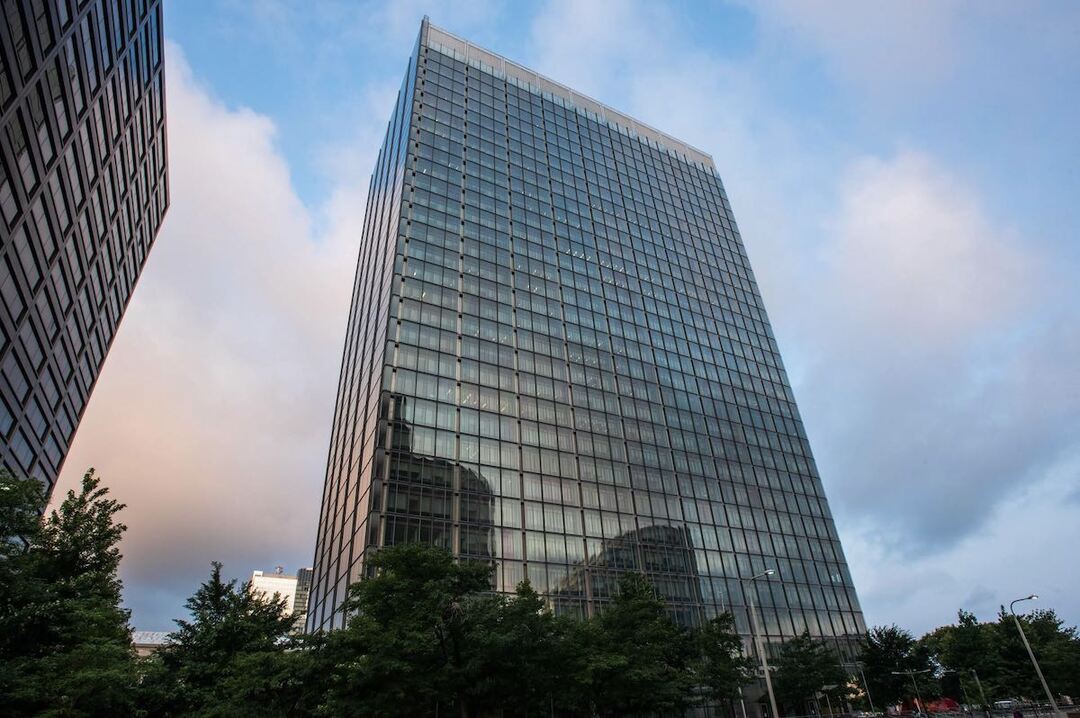
    <title type="html"><![CDATA[Cleveland Trust Tower: Marcel Breuer&#039;s Only Skyscraper]]></title>
    <summary type="html"><![CDATA[<img src="https://clevelandhistorical.org/files/fullsize/e8976666b8329c5668f39b5d0ae0874e.jpg" alt="Architect Rendering " /><br/><p>The 9, originally called Cleveland Trust Tower and then Ameritrust Tower, is the only skyscraper designed by one of the most eminent Modernist architects of the 20th century, Marcel Breuer. But like a number of projects Breuer designed in his career, this Brutalist tower did not win universal praise and was nearly destroyed in the early 2000s. </p><p>Marcel Breuer was a Bauhaus-trained architect and furniture designer. A native of Hungary and a protege of the eminent Modernist architect Walter Gropius, Breuer earned a reputation for designing furniture and tubular steel chairs such as the Model B3 or Wassily Chair in the 1920s. In 1938 he joined Gropius on the faculty at Harvard's Graduate School of Design. For the next three years, Breuer and Gropius collaborated on several residential designs, including Aluminum City Terrace, an International Style defense housing project near Pittsburgh in 1941. The 240-unit "ultra-utilitarian" compound of prefabricated multifamily and semi-detached dwellings immediately drew "intense antagonism from surrounding economically well-off private residential property owners" who decried the project's design. It would not be the last time Breuer's designs produced strong feelings.</p><p>In the 1950s, Breuer continued in domestic architecture but also moved into institutional building design, notably in his UNESCO headquarters and I.B.M. Research Center in France. He went on to design the Whitney Museum of American Art in New York in 1966, which earned him accolades, but when he produced a design for the proposed FDR Memorial that same year in Washington, D.C., the U.S. Commission of Fine Arts rejected his creation as a "disrespectful" "pop art sculpture." Breuer found a better reception with his design of the Department of HUD headquarters in the Southwest Washington, D.C. urban renewal project, and he enjoyed commissions for a number of laboratories, university and museum buildings, including the Education Wing at the Cleveland Museum of Art, completed in 1971.</p><p>The latter commission, received in 1967, led Cleveland Trust Company to turn to Breuer to steer the expansion of its downtown offices at Euclid and East 9th Street, where <a href="https://clevelandhistorical.org/items/show/761">George B. Post's early-1900s rotunda</a> was too small for the bank's needs. Breuer was no stranger to Modernist additions to historic buildings. He had recently designed a proposed pair of skyscrapers to rise above Manhattan's Grand Central Terminal, but the project foundered because it underestimated the groundswell of commitment to historic preservation among New Yorkers who were still reeling from the loss of the grand Penn Station. </p><p>In Cleveland, Breuer planned twin 29-story towers that together would frame the old rotunda with frontage on Euclid and East 9th. Elements of the building's design evoked Breuer's HUD headquarters. The first tower, clad in black granite with cast concrete window frames, was completed on the East 9th side in 1971. Bank president George Karch was quick to assert that it reflected Cleveland Trust's dissent from the prevailing "gloomy predictions" about downtown's future. However, by that time, the second tower's expected construction was not expected to start before 1975. Not only was the second tower ultimately not built, its twin and the rotunda were abandoned in 1996 after Ameritrust (as Cleveland Trust had renamed itself in 1971) merged in 1991 with Society for Savings, which had recently invested in expanding its footprint on Public Square, leading to the construction of the Society Center. Society and KeyCorp, which acquired it three years later, had no need for the old Cleveland Trust complex.</p><p>The tower sat empty for nearly a decade before Cuyahoga County purchased it in 2005. County commissioners tried to convince the public to support demolishing it for a new county administration center because it was purportedly beyond saving. The threat of demolition hung over the tower for several years, stimulating considerable efforts to highlight the building's many merits, including its build quality, the renown of its architect, the fact that this was Breuer's only skyscraper. </p><p>After the county commissioners' failure to assemble the needing financing for a new county complex and their becoming embroiled in scandal, the Geis Companies, a Northeast Ohio real estate development firm, stepped in and offered to purchase the skyscraper and rotunda and undertake their adaptive reuse. Completed in 2015, the rotunda opened as a distinctive Heinen's supermarket, while the tower became the 156-room Metropolitan Hotel and 105 apartments, and the adjacent Swetland Building contained part of Heinen's on the first floor and more apartments on upper floors. The project did much to reenliven a forlorn corner of downtown and ensured that Cleveland did not destroy what was possibly the boldest expression of one of the 20th century's greatest Modernist designers.</p><p><em><strong><a href="https://clevelandhistorical.org/items/show/962">For more (including 12 images&#32;&amp;&#32;2 audio files) view the original article</a></strong></em></p>]]></summary>
    <published>2022-07-08T13:57:48+00:00</published>
    <updated>2026-04-17T19:17:42+00:00</updated>
    <link rel="alternate" type="text/html" href="https://clevelandhistorical.org/items/show/962"/>
    <id>https://clevelandhistorical.org/items/show/962</id>
    <author>
      <name>J. Mark Souther</name>
    </author>
  </entry>
  <entry>
    <title type="html"><![CDATA[Key Tower: Cesar Pelli&#039;s Nod to Art Deco-Era Manhattan]]></title>
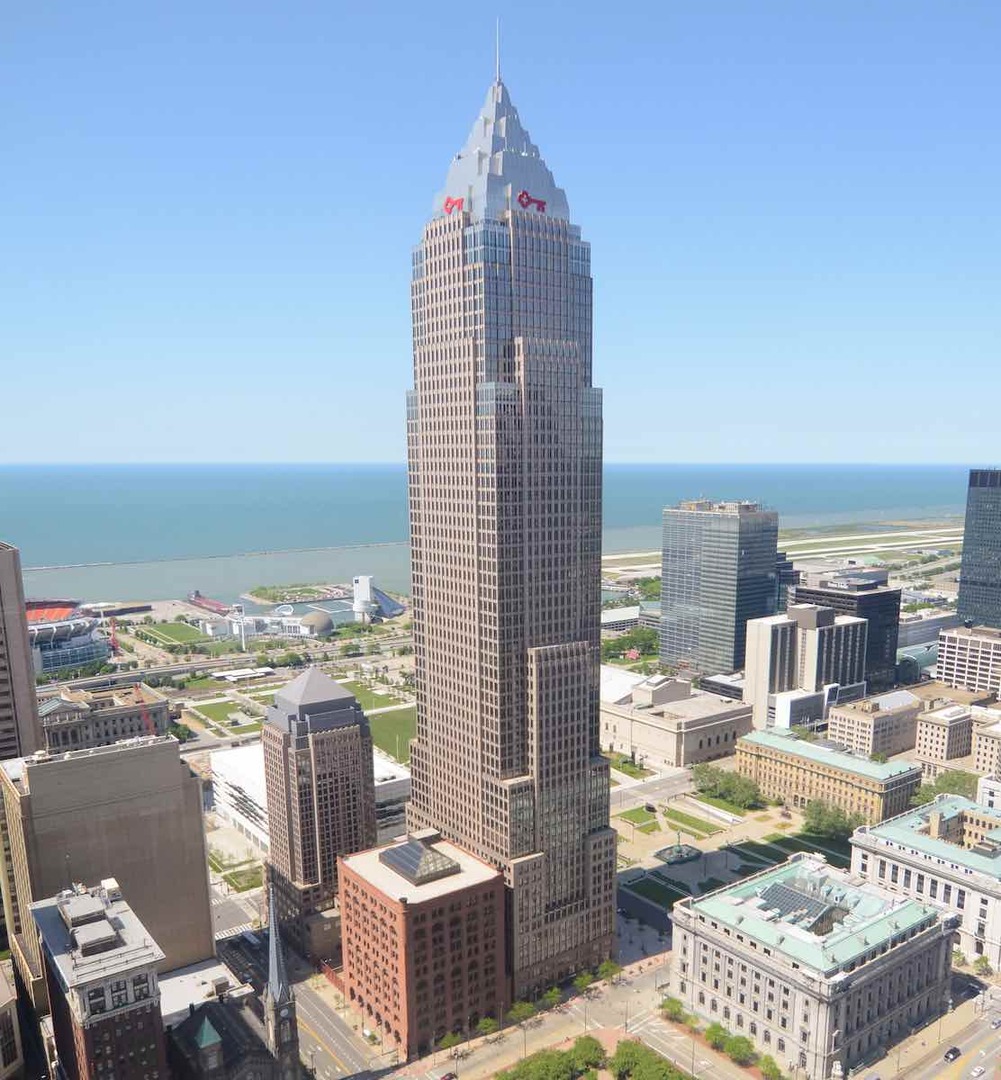
    <summary type="html"><![CDATA[<p><strong><em>When <em>Plain Dealer</em> architecture writer Wilma Salisbury interviewed Cesar Pelli about his plan for Cleveland's newest and tallest skyscraper in 1988, he cited not only the geometrical Art Deco designs of 1920s-30s New York but even the ancient Egyptian obelisk, biblical Tower of Babel, and Renaissance Italian campanile as inspirations. Indeed, the new tower needed to be inspiring because it was going to eclipse the beloved Terminal Tower as the city's visual reference point.</em></strong></p><img src="https://clevelandhistorical.org/files/fullsize/b0ef2a95e15de459bed82752f7e2daee.jpg" alt="Key Tower, Looking Northeast to Lake" /><br/><p>On October 30, 1990, Cleveland’s skyline became the backdrop for a symbolic transfer of power and prestige: the frame of Society Corporation's new headquarters surpassed the Terminal Tower in height. Cleveland was now looking forward instead of backward—no longer defined by the iconic 1930 building. The moment also was a reflection of larger changes: a redefining of downtown's purpose and image. Society Tower spoke to a new future for a struggling city.</p><p>The Terminal Tower had been Cleveland’s tallest building since its completion: in fact, the tallest structure in the United States outside of Manhattan until 1967. The architectural landmark represented an era of growth and affluence in Cleveland, the name speaking to its long-time role as the destination of all inbound trains to the city. In 1981, a design for Sohio's headquarters had initially sought to exceed the Terminal Tower's height. But city officials objected to the proposal, citing the Terminal Tower’s historic role in the city’s landscape. Thus the Sohio building (later called the BP building and now 200 Public Square) came up short of the Terminal Tower's peak.</p><p>In 1988, Society Corporation (now Key Bank) announced that it would be the major tenant in a new skyscraper and office complex to be built on the northeast corner of Public Square. The new headquarters would display the company's strength and competitiveness as a financial institution, and demonstrate its commitment to Cleveland. The project was headed by Richard and David Jacobs, who had recently opened the Galleria at Erieview Tower. The previous year, Cleveland City Planning Commission changed the height restrictions on the Society site from 250 to 900 feet. The Terminal Tower's era of visual dominance was over.</p><p>Plans for Society Center's new tower were enthusiastically received by the press and public. Comparisons were drawn between the influence of the Jacobs brothers and the Van Sweringens in defining a new identity for the city of Cleveland. The New York–style skyscraper (the tallest structure between New York City and Chicago) would symbolize the city's recovery. It would change the skyline and bridge the space between Public Square and the Mall. And not only would the project attract workers and businesses to the core of downtown, it would include a first-class hotel—a potential boon to Cleveland’s struggling convention business.</p><p>The tower's mast reached 948 feet (60 feet above the peak of the 57-story building's aluminum-capped spire) when Society Center was completed in 1991. The complex contains more than 1.5 million square feet of office space as well as a 385-room Marriott Hotel and a massive parking garage underneath the Mall. The century-old <a href="https://clevelandhistorical.org/items/show/305">Society for Savings Building</a> just to the west was also renovated. Upgrades were made to Mall A (the southern-most of the Mall’s three segments) and its War Memorial centerpiece.</p><p>While Cleveland would witness a resurgence of downtown construction in the late 1980s and early 1990s, there was soon a glut of available office space. Construction of new buildings ceased. In the second decade of the 21st century, however, things are looking up (more figuratively than literally): Scores of older office complexes and warehouses are being converted to hotels and residences. Developers can barely keep up with the demand for downtown residential living. The net effect is that, with a great deal of less-desirable office space off the market, there are fewer options and thus more demand. Through it all, Key Center continues to speak to the possibilities of Cleveland's future.</p><p><em><strong><a href="https://clevelandhistorical.org/items/show/961">For more (including 6 images&#32;&amp;&#32;1 audio file) view the original article</a></strong></em></p>]]></summary>
    <published>2022-07-07T20:12:04+00:00</published>
    <updated>2026-04-17T19:17:42+00:00</updated>
    <link rel="alternate" type="text/html" href="https://clevelandhistorical.org/items/show/961"/>
    <id>https://clevelandhistorical.org/items/show/961</id>
    <author>
      <name>Richard Raponi</name>
    </author>
  </entry>
  <entry>
    <title type="html"><![CDATA[Halle Building: Alfred Pope&#039;s Terra-Cotta Showcase for Downtown Shopping]]></title>
    <summary type="html"><![CDATA[<p><strong><em>In 1907 a New York industrialist acquired a rooming house on the south side of Euclid Avenue with rear frontage on Huron Road. At the time, downtown scarcely reached east of East Ninth Street, and this section of Millionaires' Row remained largely residential. Undeterred, the man imagined a tall building that might entice downtown development eastward. Appropriately enough, he selected an architect who was no stranger to big plans.</em></strong></p><img src="https://clevelandhistorical.org/files/fullsize/0d988b9998d31b9ae3413f9581728ae0.jpg" alt="The Halle Building, Euclid Avenue Facade" /><br/><p>Alfred Atmore Pope had left his Millionaires' Row mansion in Cleveland in 1901 and moved to New York, but he remained keenly interested in the Forest City. After all, his parents had moved there from Maine on the eve of the Civil War, and it was there that he had struck out on his own as a young man, leaving his father's wool business to invest in the burgeoning iron industry. In only a decade he had risen to the helm of Cleveland Malleable Castings Company. Now he wanted to build a monument to his success. Even the Panic of 1907 did not deter Pope, who doubled down on his commitment, which he now also billed as a show of faith in Cleveland's future during an uncertain time.</p><p>Pope's "monument" would take the form of a skyscraper that he undertook on speculation. He turned to Henry Bacon to design this tribute to himself. The New York architect had prepared initial drawings for the Lincoln Memorial about a decade earlier, but the project's implementation still awaited congressional approval. Unlike in Washington, in Cleveland, backed by a "millionaire rolling mill master" on a mission, Bacon knew he wouldn't have to wait long to see the fruits of his labor.</p><p>Pope's monument began with a 42-foot-deep hole in the ground because he believed Euclid Avenue would eventually have a subway, and he wanted to have an underground entrance when that day came. To hold back the "quicksand" that reflected the site's nearness to Lake Erie, Pope's construction crews had to build a cofferdam and then pour thick reinforced concrete walls to keep the basement and subbasement dry. Above, they quickly assembled the building's steel superstructure and clad it with elaborately ornamented, white-glazed terra-cotta tile and enamel brick that would enable periodically washing off Cleveland's industrial soot.</p><p>Originally intending his monument to have two floors of retail space with eight floors of office space above, Pope instead found a single tenant to lease the entire $1 million Pope Building, a lessee that had a grand vision of its own that even a financial depression couldn't subdue. Who would make such a bold move during an economic depression and in a space so far east of Cleveland's business core? Samuel and <a href="https://clevelandhistorical.org/items/show/424">Salmon Halle</a>. The Halle Bros. Co. had started when its namesakes bought out a small furrier on Superior Avenue just west of Public Square in 1891. The Halles joined the shift of retailers eastward across Public Square to a Euclid Avenue storefront near the Arcade the next year, but with a growing mail-order and home-delivery business in addition to expanding into a full department store, they soon outgrew this space too. </p><p>With the lease of the 140,000-square-foot Pope Building in 1908, the Halles now had three times the space of their former location. Their move also influenced two other large stores to move eastward to upper Euclid Avenue. Within a year of Halle Bros.'s announcement, the Higbee Co. and Sterling & Welch Co. announced their own new stores on the sites of former Millionaires' Row homes across from the Pope Building. The Halle store's continued expansion led to the purchase of the building and plans to expand onto the adjacent lot following Pope's death in 1913. The Halles commissioned Bacon again, and he designed a mirror-image addition that was completed the following year. Close observers will note the vertical seam that marks where the newer building rose alongside the original one.</p><p>Halle's continued to grow in the 1920s, adding an identically styled terra-cotta clad Huron-Prospect Building (designed by Walker & Weeks) to the south of the main store that housed the Men's Store for the next three decades. Near the end of the '20s it also opened branches in Erie and New Castle, Pennsylvania, and Canton, Ohio. After weathering the Depression and War years, Halle's continued to grow, investing in its first suburban branch (at Shaker Square) and undertaking a modernization program that included the addition of escalators. </p><p>Downtown's fortunes began to turn in the second half of the 1950s, forcing Halle's to continue its aggressive planning to maintain its enormous downtown store's profitability. Walter M. Halle, Samuel Halle's son and by then the store's president, grew concerned about the impact of the CTS rapid transit line, which opened in 1954-55 and served downtown with a single station beneath the Terminal Tower (which incidentally benefitted Higbee's after its move to Public Square in 1930). Halle Bros. added its own free bus service from the Terminal on Public Square in 1956 and converted its Huron-Prospect annex into a parking garage in 1957, all while actively lobbying for a downtown subway to carry suburban shoppers closer to its store.  This hope — an echo of Mr. Pope's vision of a subway six decades earlier — collapsed once and for all after county commissioners twice rejected the plan in the late '50s. </p><p>Nevertheless, through ongoing effort, Halle's continued to hold its own into the late 1960s. In fact, for many Clevelanders born after midcentury, the 1950s and 1960s shaped their relationship with Halle's. The store introduced <a href="https://clevelandhistorical.org/items/show/828">Mr. Jingeling</a>, said to be Santa's keeper of the keys, as a popular Christmastime character who joined other child-friendly features such as the toy department, playground, and miniature golf course. Still, by the latter half of the 1960s, the convenience of suburban malls and inconvenience or even trepidation about trekking downtown led Halle's to press for new downtown apartments to create a captive market. </p><p>Although the Chesterfield Apartments opened in 1967 and Park Centre (Reserve Square) in 1969, the future of Halle's seemed shaky. Sterling Lindner, the successor to Sterling & Welch, closed in 1968 and the Allen, Ohio, State, and Palace Theaters fell dark the next year. In the decade after Chicago-based Marshall Field's scooped up Halle's in 1970, it made changes that irked some longtime tradition-minded customers—dropping the signature Halle Bros. logo in Old English font with a script font Halle's matching that of the Chicago store; ending the Mr. Jingeling tradition; and introducing cheaper lines of merchandise. </p><p>Ultimately, Field's dumped Halle's in 1981, and the store closed permanently the following year. Just as suddenly as Samuel and Salmon Halle had justified Alfred Pope's big gamble at a time when downtown had not yet "arrived," the building emptied. In the decades that followed, the Halle Building became what Pope had originally envisioned—an office building with a few small retailers (a food court and sundry services for office workers). It lived on as a department store only in public memory and, for a decade in the 1990s-2000s, as the fictional Winfred-Louder on ABC's <em>The Drew Carey Show</em>. Today it is an apartment building.</p><p><em><strong><a href="https://clevelandhistorical.org/items/show/960">For more (including 17 images) view the original article</a></strong></em></p>]]></summary>
    <published>2022-07-07T01:24:38+00:00</published>
    <updated>2026-04-17T19:17:42+00:00</updated>
    <link rel="alternate" type="text/html" href="https://clevelandhistorical.org/items/show/960"/>
    <id>https://clevelandhistorical.org/items/show/960</id>
    <author>
      <name>J. Mark Souther</name>
    </author>
  </entry>
  <entry>
    <title type="html"><![CDATA[Erieview: Cleveland&#039;s &quot;Surrogate Downtown&quot;]]></title>
    <summary type="html"><![CDATA[<p><strong><em>It was not the first time Cleveland saw a grand scheme to reorient its downtown toward the lakefront. I. M. Pei’s conception reprised, updated, and extended eastward the early 20th-century Group Plan designed by the “City Beautiful” architect Daniel Burnham of Chicago.</em></strong></p><img src="https://clevelandhistorical.org/files/fullsize/e70db4101b8c2844f1cba6f7aea5a203.jpg" alt="Erieview Plan Bird&#039;s-eye View" /><br/><p>In 1973, architectural critic Ada Louise Huxtable described "a huge, bleak, near empty plaza with a complete set of non-working fountains and drained pools, focusing on a routine glass tower by New York architects Harrison and Abramovitz, known to Clevelanders as the 'jolly green giant.'" She lamented that the plaza was flanked by "vast, open parking lots." Huxtable was referring to Erieview Plaza and Erieview Tower, together the focus of the Erieview urban renewal project, which she derided as a "monument to everything that was wrong with urban renewal thinking in America in the 1960s." Erieview attracted more than architectural criticism. Some Clevelanders also argued that the project set back the downtown district it was intended to revitalize. <em>Plain Dealer</em> columnist Philip W. Porter called Erieview "the mistake that ruined downtown." Porter wasn't alone. Even in the 1960s, some downtown interests worried that Erieview, which some considered a "surrogate downtown," might siphon energy away from the downtown shopping district. Would Erieview workers continue to walk several blocks to Euclid Avenue to shop on their lunch break, or would they demand amenities in a new, self-contained city-within-a-city?</p><p>Erieview was born of the same concerns about downtown stagnation that gripped many U.S. cities by the 1950s. Pittsburgh’s Gateway Center became a national model for downtown renewal, and Cleveland leaders formed the Cleveland Development Foundation (CDF) in 1954 to emulate Pittsburgh’s Allegheny Conference on Community Development. CDF weighed whether to launch its urban renewal effort (with federal dollars matching municipal expenditures in a 2:1 ratio) in downtown in a subsidized version of Pittsburgh's privately financed downtown renewal or start in east-side neighborhoods. Local architect Richard Hawley Cutting even drew a plan, pro bono, that he pitched to CDF. Called Erie View, it featured a geometric assemblage of modernist towers and plazas along the lakefront to the east of East 9th Street. CDF, whose chairman was Republic Steel president Tom Patton, rejected that urban renewal and, in 1956, proceeded instead with another, dumping Republic Steel slag in Kingsbury Run and building the euphemistically named Garden Valley, which offered substandard housing and exacerbated residential segregation. </p><p>A succession of failed downtown projects (among them the collapse of a plan for underground parking beneath <a href="https://clevelandhistorical.org/items/show/312">the Mall</a>, voters' rejections of a convention center expansion, and county commissioners' denial of a downtown subway) led to a series of secret meetings in the spring of 1959. Weary of the slow pace of neighborhoods-first renewal and impatient with the CDF-commissioned $100,000 downtown plan due out later that year, CDF president Upshur Evans, Cleveland Chamber of Commerce president Curtis Lee Smith, and Cleveland Urban Renewal and Housing Director James M. Lister convened to strategize how to catalyze downtown revitalization. They consulted with Chase Manhattan Bank's David Rockefeller in the hope he might invest in Cleveland. He refused but reinforced their belief that only a large, coordinated plan was worthwhile. They turned to Newark-based Prudential Insurance to try to interest the company in a regional headquarters along Lake Erie. They too demurred.  </p><p>Undeterred, the trio bypassed the Cleveland Planning Commission and went straight to Mayor Anthony Celebrezze, who saw in their idea a project he could sell. Unveiled in January 1960, the plan, christened Erieview, promised the nation's largest downtown urban renewal project, a reflection of city leaders' desire to make up for lost time. They pronounced the 125-acre renewal area (roughly bounded by the Memorial Shoreway, East 9th Street, Chester Avenue, and East 17th Street) “blighted,” sealing the fate of many small businesses and manufacturers and some single-room-occupancy hotels. The city commissioned prominent modernist architect I. M. Pei to design the Erieview plan, which looked like many other plans of its era – a Tetris board of low-slung, interlocking buildings wrapping around open plazas punctuated by taller towers. The tallest of them was plotted between East 9th and 12th Streets with an open plaza and reflecting pool. It was not the first time Cleveland saw a grand scheme to reorient its downtown toward the lakefront. Pei’s conception reprised, updated, and extended eastward the early 20th-century Group Plan designed by the “City Beautiful” architect Daniel Burnham of Chicago.</p><p>Developers John Galbreath and Peter Ruffin planned to build one or more office towers in Erieview, including the focal building at its heart. The 529-foot-tall, 40-story Erieview Tower was designed by the New York firm of Harrison and Abramovitz. Firm partner Wallace Harrison was best known for his work on Rockefeller Center and the United Nations, but the Erieview design more closely resembled the firm's 45-story Socony-Mobil Building (1956) in New York, also developed by Galbreath and Ruffin. Erieview Tower was a simplified version of its predecessor, substituting black and green glass curtain walls for black windows and silver patterned aluminum walls. Yet both buildings were later panned by some as "ugly" designs. True to its nickname, the greenish tower did loom, giant-like, over the wide-open expanse of Erieview Plaza whose fountains and reflecting pool doubled as an ice rink in winter. Widespread clearance left mostly parking lots surrounding Erieview Plaza for years.</p><p>Erieview was billed as an antidote for an ailing downtown, on one hand, and as an outlet for downtown's expected office boom, on the other. While these aims may appear contradictory – one intended to reverse decline and another to accommodate anticipated growth – they actually reflected the complex situation facing downtowns in the 1960s. Suburban retail competition was causing downtown shopping to wither, but at the same time many firms were eager for more spacious, modern office space. Erieview initially spurred overdue renovations by several leading downtown department stores. That their efforts ultimately failed to save them owed less to Erieview than to the effects of population decline, suburban retail growth, and the city's failure to cultivate a strong convention trade. Office expansion promised a counterpoint to retail slippage. After Erieview Tower, the 32-story Federal Building (1967), two major hotels (today’s Westin and Doubletree) and a half-dozen major office towers, including headquarters for Diamond Shamrock (1972) and Eaton (1983), opened incrementally over the next two decades.  </p><p>No sooner had Erieview been fleshed out than it started to clear out. Downtown employment dropped by one-third in the forty years after 1970, and by the 21st century the main demand was for more living space. Boosters had long predicted a return to the central city. Erieview added three apartment towers (including Reserve Square) between 1967 and 1973, but it would take another four decades before downtown became a true residential magnet, aided by conversions of old office buildings using historic preservation tax credits. In 2010, the Downtown Cleveland Alliance rebranded the Erieview area, nearly one-third vacant, as a "live–work–play" concept dubbed the Nine-Twelve District. As renovators exhausted the supply of historic buildings, midcentury properties were just crossing the fifty-year threshold to qualify as "historic." In 2018, developer James Kassouf bought Erieview Tower, newly listed on the National Register, with plans to convert twelve vacant floors into apartments. Downtown's northeastern quadrant once had hundreds of units of low-rent housing, but these held no place in the vision of Cleveland’s boosters. They yielded to civic aspirations for a new downtown of gleaming office towers. Although Erieview, recast as Nine-Twelve, is reemerging as a neighborhood, its upmarket housing inventory ensures that it can’t rightly be said to have come full circle.</p><p><em><strong><a href="https://clevelandhistorical.org/items/show/909">For more (including 14 images&#32;&amp;&#32;3 audio files) view the original article</a></strong></em></p>]]></summary>
    <published>2020-05-10T21:26:19+00:00</published>
    <updated>2026-04-17T19:17:42+00:00</updated>
    <link rel="alternate" type="text/html" href="https://clevelandhistorical.org/items/show/909"/>
    <id>https://clevelandhistorical.org/items/show/909</id>
    <author>
      <name>J. Mark Souther</name>
    </author>
  </entry>
  <entry>
    <title type="html"><![CDATA[New England Building: a.k.a. Guardian Building and National City Bank Building]]></title>
    <summary type="html"><![CDATA[<img src="https://clevelandhistorical.org/files/fullsize/ca52c443355f97d2c6299bfba9b9de0c.jpg" alt="New England Building" /><br/><p>In the late nineteenth century, downtowns in the United States were the center of major commercial expansion and industrial growth. The construction of skyscrapers and tall business buildings was exploding and replacing old structures located in central cities. The New England Building is an example of this trend in the late 1800s. The New England Building, also known as the Guardian Building and the National City Bank Building, was built in 1896 on the property that had formerly held a mansion owned by Henry Chrisholm. The structure was initially called the New England Building after the company constructing it. Still, the plan was for the building to be officially named the Ohio Building with the title throughout the structure. However, this name did not seem to catch on as the building continued to be commonly referred to as the New England Building until about 1916.</p><p>At the time of the New England Building's completion, it was the tallest building in Cleveland, and one of the tallest in the country, with fifteen floors. However, it lost its distinction as the city's tallest building in 1905 when the Rockefeller Building was built. The architects of the original design of the New England Building, Shepley, Rutan and Coolidge, were an out-of-state firm located in Boston. Shepley, Rutan and Coolidge's plan was a "sandstone-faced structure" that was "designed with restrained Renaissance detail." Because of its status as the tallest building in the 1890s and its impressive architecture, many businesses and architects moved their offices to the impressive new skyscraper. Many members of the Cleveland Architectural Club, like Charles F. Schweinfurth, relocated to the floors of the New England Building. For about twenty years, the New England Building stood with its original design, with the majority of the floors occupied by business offices.</p><p>In 1915, the New England Building was bought by the Guardian Savings and Trust Company for $2,000,000. The Guardian Savings and Trust Company was a widely successful and expanding banking business during the early 1910s. When the leases held by other companies in the New England Building expired, the Guardian Savings and Trust Company hired architects Walker and Weeks, at that time, a relatively new firm, to design rooms for a bank. Walker and Weeks designed an addition added to the back that added 250 rooms, and a new design for the front of the building. Walker and Weeks added the distinctive Corinthian columns to the front of the bank, standing out from the original design of the top of the building. After their role in the redesign of the New England Building, now being called the Guardian Building, Walker and Weeks went on to design more than sixty banks across Ohio.</p><p>The New England Building stayed in the hands of the Guardian Savings and Trust Company for close to thirty years. The corporation grew widely in Ohio through the 1920s and was made up of "26 corporations, including investment and real estate firms." However, in March 1933, the Guardian Savings and Trust Company was forced to liquidate. It was discovered that the company mismanaged its customers' money by giving insider loans to members of the company. The National City Bank leased the banking part of the New England Building after the Guardian Savings and Trust Company vacated it, and officially bought the building from the Guardian liquidator for $300,000 on March 28, 1944. From 1944 to 1948, after the National City Bank purchased the New England Building, the third floor housed tenants such as the Veterans Administration and the War Labor Board. After the Veterans Administration and the War Labor Board vacated the New England Building, the National City Bank took up many of the floors for their departments and the banking lobby on the first floor. Beginning June 1, 1949, the National City Bank formally renamed the building, the National City Bank Building.</p><p>The National City Bank occupied the banking floor of the New England Building until 2008, when the PNC Bank absorbed the National City Bank. However, the National City Bank moved its executives and departments to a new headquarters that had begun to be built in 1978 and was finished in 1980. In the late twentieth century, the New England Building, like many historic buildings in downtown areas, was not being fully used. The use of historic office buildings fell because of the rising demand for newer office space. The downtown buildings were frequently losing the competition to new office spaces developed in the suburbs. </p><p>In an effort to revitalize the building in the late 1990s, a bid was put in for the competition of turning a downtown building into a Holiday Inn Express hotel. In 1997, “Richard Maron, a specialist at bringing old buildings back to life,” bid two-thirds of the New England Building to be converted into the Holiday Inn Express. Despite the competition, Richard Maron won the bid, and to this day, the New England Building is occupied by the Holiday Inn Express. </p><p>After the National City Bank was absorbed into the PNC Bank in 2008, the National City Bank located in the New England Building vacated the structure. The bank lobby was empty for many years until the Marble Room converted the old banking rooms into an upscale restaurant and bar. The Marble Room followed the current trend of turning old banking locations into businesses "related to food and dining."</p><p>It has been more than 100 years since the New England Building was constructed, and, like most of the historic buildings still standing in downtown Cleveland, it has proved conducive to adaptive reuse. While the New England Building was an important and record-breaking building at the time of its construction, it is now a historic building that continuously revitalizes itself with the current trends of downtown life.      </p><p><em><strong><a href="https://clevelandhistorical.org/items/show/881">For more (including 8 images) view the original article</a></strong></em></p>]]></summary>
    <published>2019-11-20T20:08:13+00:00</published>
    <updated>2026-04-17T19:17:38+00:00</updated>
    <link rel="alternate" type="text/html" href="https://clevelandhistorical.org/items/show/881"/>
    <id>https://clevelandhistorical.org/items/show/881</id>
    <author>
      <name>Cecelia Brunecz</name>
    </author>
  </entry>
  <entry>
    <title type="html"><![CDATA[Union Trust Building: Built to Send a Message to the Banking World]]></title>
    <summary type="html"><![CDATA[<p><strong><em>It wasn't by accident that Union Trust Bank erected a building on the northeast corner of East Ninth Street and Euclid Avenue that, when completed in 1924, was reputedly the second or third largest office building in the world with the largest bank lobby in the world.</em></strong></p><img src="https://clevelandhistorical.org/files/fullsize/d46fb24a771a1becc3c70fe6208e3169.jpg" alt="The Union Trust Building" /><br/><p>You might say that the mammoth Union Trust Building on the northeast corner of East Ninth Street and Euclid Avenue--which over the years has also been known as the Union Commerce Building, the Huntington Bank Building, the 925 Building and, since 2018, the Centennial--was built as the result of an Act of Congress.  When Congress passed the Act of November 7, 1918, which created a simplified process for national and state bank mergers, it instituted an era of bank mergers in the United States that did not end until the Great Depression.  In Cleveland, the Act produced two significant mergers in 1919--one between Union Commerce National Bank (founded in 1884 by Marcus A. Hanna) and Citizens Savings and Trust Co. (founded in 1868 by Jeptha H. Wade) and the other between First National Bank (founded in 1863 by George Worthington) and the more recently founded First Trust and Savings Co.  Then, just one year later, came the announcement that these two pairs of merged financial institutions had decided to merge again, this time with each other.  In December 1920, they formed the Union Trust Co., which immediately became the  largest bank in Ohio, and one of the largest in the United States.  And the first order of business for this new financial behemoth?  It was to erect a suitably large and grand edifice on the northeast corner of East Ninth Street and Euclid Avenue for its banking needs.</p><p>Even before Union Trust Bank was formed in 1920, two of its component banks--Union Commerce National, whose offices were in the Union National Bank building on the corner of Euclid Avenue and East 3rd Street, and Citizens Savings and Trust, whose offices were in the Citizens Building next door to the Schofield Building--had turned their eyes in 1919 to the northeast corner of Euclid Avenue and East Ninth Street as the future site for their new bank building.  Toward that end, in April 1920 they had purchased from the Lennox Company three large adjoining lots on or near that corner, including the lot upon which the historic Lennox Building sat.  With the creation of Union Trust that same year, the scope of their anticipated building project on that corner simply increased in size.  The following year, Union Trust selected the Chicago architectural firm of Graham, Anderson, Probst and White to design a building  large enough and grand enough to meet the bank's present needs as well as its anticipated future growth. It was a good choice.  Graham, Anderson, Probst and White, had ties to Daniel Burnham who two decades earlier had been the lead architect for Cleveland's Group Plan.  The firm itself more recently had completed design work for the new Cleveland Hotel (today, the Renaissance Cleveland Hotel) on Public Square.  And, in just a few short years it would begin designing Cleveland's most iconic building of all, the Terminal Tower.  </p><p>The Union Trust Building was erected on the northeast corner of Euclid and East Ninth during the period 1922-1924.  It displaced the Lennox Building, the Euclid Theater and a number of other smaller commercial buildings. Twenty-one stories tall (including the rooftop penthouse), the building has 146 feet of frontage on Euclid Avenue, 258 feet on East Ninth Street and 513 feet on Chester Avenue, and has more than one million square feet of office space.  Its four-story L-shaped bank lobby--at the time the largest in the world-- is fifty feet wide and extends 224 feet parallel to East 9th Street and then 304 feet parallel to Chester Avenue.  The lobby has Corinthian columns, vaulted ceilings, skylights, and murals by  Jules Guerin, a famous twentieth-century artist noted for the murals he created for the Lincoln Memorial in Washington, D.C.  The huge building transformed the intersection of East Ninth and Euclid Avenue, making it the center of the city's financial district and one of the more important commercial addresses in the United States.  It opened to the public, during a week of gala events, in May 1924.</p><p>The building had other notable features when it opened, including a retail arcade on the first floor near Chester Avenue, a section of which became known as "Steamship Row," because of the travel agencies that located there and placed in their windows pictures of enticing overseas destinations.  The penthouse became home to the Midday Club, a private men's club with a grand dining room and smaller meeting rooms for members. (After the Midday Club closed in 1990, the penthouse a few years later became home to Sammy's Metropolitan Ballroom and Restaurant.)  Outside the penthouse on the roof of the building near East Ninth Street were two 125-foot towers between which was stretched an antenna wire.  The towers and antenna were part of radio station WJAX which broadcast financial news from the 20th floor of the buildng.  There was a legend that the roof was also designed for a dirigible docking station, but the rooftop plans prepared by Graham, Anderson, Probst and White show no such station planned for the building, and no contemporary news articles or other primary sources have been discovered that prove the existence of, or plans for, either the station itself or any accessory buildings on the rooftop.</p><p>The Union Trust Building at 925 Euclid Avenue quickly became one of the most desirable business locations in Cleveland.  Among other prominent tenants, it was home to two of the city's largest and most recognizable law firms, Squires, Sanders and Dempsey, and Baker and Hostetler.  Squires occupied the entire 18th floor of the building from 1924, when it opened, until 1992 when the firm left, taking its 400-plus employees to Key Tower.  Another long-time tenant in the building was Rickey C. Tanno Jewelers, which moved into the Arcade in 1949 and was the last retail tenant to leave in late 2018.  While these and other tenants occupied space in the building for decades, Union Trust Bank itself had a much shorter stay in the building.  After operating there for less than ten years, it failed in 1933, during the Great Depression.  Its collapse was reportedly fueled by a run on its deposits caused by the disclosure that bank officials with ties to the Van Sweringen real estate empire had lied about a $10 million sale of government bonds by Van Sweringen to the bank.  Two Union Trust bank officials--Joseph R. Nutt, chairman of the board, and Wilbur Baldwin, its president--were indicted along with Oris P. Van Sweringen in Cuyahoga County Common Pleas Court for creating false bank records. While the state charges were eventually dismissed after the three were found innocent in a related federal court proceeding, Union Trust Bank never recovered.   It underwent a liquidation process that lasted for several years before a reorganization plan was approved that created new Union Commerce Bank in 1938.  That same year, the Union Trust Building became the Union Commerce Building.</p><p>For many older Clevelanders, the Union Commerce Building was the only name of the building they ever knew while growing up.  The building carried that bank's name for 45 years until 1983 when the bank was purchased by Huntington Bank.  During the years that it was owned by Union Commerce, the grand bank lobby underwent several restorations, including most notably the one architect Peter van Dijk led in 1975.  Van Dijk literally saved the bank lobby from what would have been a disastrous remodelling.  Additionally, in 1968 as part of the Erieview project, Union Commerce erected a five-story parking garage on the north side of Chester Avenue that is connected to the building's arcade by a tunnel  under Chester Avenue.  </p><p>Following the  purchase of the building by Huntington Bank in 1983, it  became the Huntington Building, once again taking the name of the bank that occupied its grand lobby.  That tradition ended in 2011 after Huntington Bank sold the building and  moved to the BP Building on Public Square.  Following Huntington's departure, the building became known as the 925 Building.  According to a July 31, 2015, article in the Cleveland Jewish News, it was at the time that Huntington Bank left that the building began to "hemorrhage" tenants, but it likely had been losing tenants for years before that to the newer Cleveland skyscrapers built in the last decades of the twentieth century.  In 2015, a new owner acquired the 925 Building with plans to redevelop it with apartments, a hotel, and retail, banquet and office space.  However, that developer's plans never materialized and, in 2017, it sold the building to Millennia Cos., a local developer which had already successfully redeveloped several other historic buildings in downtown Cleveland, including the Statler and Garfield Buildings.  As of the Fall of 2019, Millennia has plans to redevelop the originally-named Union Trust Building with apartments, retail stores and possibly some office space.  And, as for the new name it decided to give the building--The Centennial?  Well, it's not a bad one for a grand edifice nearing its 100th birthday.  </p><p><em><strong><a href="https://clevelandhistorical.org/items/show/876">For more (including 13 images&#32;&amp;&#32;4 audio files) view the original article</a></strong></em></p>]]></summary>
    <published>2019-10-15T20:05:08+00:00</published>
    <updated>2026-04-17T19:17:39+00:00</updated>
    <link rel="alternate" type="text/html" href="https://clevelandhistorical.org/items/show/876"/>
    <id>https://clevelandhistorical.org/items/show/876</id>
    <author>
      <name>Jim Dubelko</name>
    </author>
  </entry>
  <entry>
    <title type="html"><![CDATA[Park Building: A Sensory Attraction on Public Square]]></title>
    <summary type="html"><![CDATA[<p><strong><em>One of Cleveland’s early skyscrapers goes frequently unseen amidst the hustle and bustle of Public Square. But ask any long-term resident to conjure up an olfactory memory, and all of a sudden the place becomes crystal clear.</em></strong></p><img src="https://clevelandhistorical.org/files/fullsize/5766e7eb4eec487657d29b3d7d70bec3.jpg" alt="Park Building at Night" /><br/><p>One of Cleveland’s most overlooked structures overlooks one of Cleveland’s most bustling intersections. Located on the southeast corner of Public Square—with the May Company building to the east and Jack Casino across Ontario Street to the west—the Park Building is hardly unattractive; it’s just lower profile. For one thing, it is nine stories high, significantly shorter than most area structures. And for most of its long existence, it was a multi-tenant building (railroad offices were particularly common) which might further explain its unassuming presence.</p><p>But here’s one really memorable thing about the Park Building. Thousands of longtime Cleveland residents remember it by smell! That’s because, for decades, much of the Park’s ground-floor retail space was occupied by the legendary Morrow’s Nut House. And the geniuses who ran Morrow’s went to great lengths to keep the product warm (and thus aromatic) and to pipe that marvelous odor out into the street. The scent could be detected blocks away. Adding to the Park Building’s olfactory ambiance were neighbors Fanny Farmer Candies and Hough Bakery, the latter a purveyor of the finest glazed doughnuts in the galaxy.</p><p>Sadly, Morrow’s, Fanny Farmer and Hough are now closed—replaced by less pungent storefronts. And the Park Building is now filled with condominiums—the first Public Square building in more than a century to house private residences. </p><p>At the time it was built in 1904—21 years before the Terminal Tower—the Park Building was a true skyscraper. It also featured innovations that were novel at the time, such as steel-cable-reinforced concrete floors. Oversize windows (round on the top floor) and bronze and granite facings continue to grace the exterior, complemented inside by maple and terrazzo flooring, oak trim, tall ceilings, and globular wall sconces. </p><p>In the late 1800s, a W. P. Southworth Grocery Store occupied the corner where the Park Building now stands. William Palmer Southworth was a prominent area businessman. The structure just south of the Park Building on Ontario Street is named after him, and his 1879 Classical Revival home at 3334 Prospect Avenue is on the National Register of Historic Places. </p><p>By the end of the century, the corner was occupied by a candy store owned by T. M. Swetland and his wife Carrie. Recognizing the location’s increasingly high potential, the Swetlands engaged architect Frank Seymour Barnum to create the Park Building. Barnum already had designed several Cleveland structures, including the <a href="https://clevelandhistorical.org/items/show/1041">Caxton Building</a> (completed in 1900). For about 100 years, members of the Swetland family maintained control of the building, hosting tenants ranging from doctors, dentists and insurance companies to less-mainstream occupants such as the American Commission on Irish Independence, the National Window Glass Workers Association and the Eagle Discount Stamp Company. </p><p>In 2006 Matthew Howells became the building’s second owner. Under Howell’s stewardship the Park Building began its second century as a residential space with great views of Public Square but, sadly, no upward-wafting scents of cashews, chocolates or glazed donuts.</p><p><em><strong><a href="https://clevelandhistorical.org/items/show/865">For more (including 9 images) view the original article</a></strong></em></p>]]></summary>
    <published>2019-02-05T16:31:20+00:00</published>
    <updated>2026-04-17T19:17:42+00:00</updated>
    <link rel="alternate" type="text/html" href="https://clevelandhistorical.org/items/show/865"/>
    <id>https://clevelandhistorical.org/items/show/865</id>
    <author>
      <name>Chris Roy</name>
    </author>
  </entry>
  <entry>
    <title type="html"><![CDATA[Hanna Building : Business Hub in a Theater District]]></title>
    <summary type="html"><![CDATA[<img src="https://clevelandhistorical.org/files/fullsize/d3d16c37928e1a115681261ebd45fc8a.jpg" alt="Hanna Building" /><br/><p>The Hanna Building was named after the famous U.S. senator from Ohio and oil and coal baron Marcus Alonzo Hanna and built by his son Daniel Rhodes Hanna. Hanna is perhaps best known for having endorsed William McKinley for president in 1896, spending $100,000 of his personal funds to support McKinley's campaign. McKinley won the election, and as a token of gratitude, McKinley aided Hanna in becoming a senator. Hanna's bronze bust is a prominent feature in the building's lobby.</p><p>The building, whose architect was Charles A. Platt, was built from 1919 to 1922, cost $5 million, and occupied land that previously held the Euclid Avenue Presbyterian Church at the corner of East 14th Street and Euclid Avenue. The building's unique interior featured a semicircular lobby with entrances on both streets and stylized silver-and-gold decorative elements. The building's restaurant on the first floor was fashioned in a beautiful Pompeian style, and the rest of the building was used for offices. It is said that the building contained all the variety of businesses required to build a city and maintain it. </p><p>The Hanna Building of the 1920s demonstrated that Cleveland had its own version of Broadway. The building opened around the same time that the Playhouse Square movie palaces started operating, and its restaurant catered to Jazz-Age theater goers and nightlife seekers. As much as it served the emerging entertainment scene, the Hanna Building was an anchor of business. Soon after opening, it ranked second in Cleveland in elevator use with 8,223 people using its lifts on a single day when a citywide count was taken.  </p><p>The 1930s were a difficult time with the building losing half of its value and much of its occupancy. The average vacancy rates for office buildings nationally before and during the Great Depression were 8% in 1926, 12% in 1929, 20% in 1932, and 28% by 1934. The situation at the Hanna was so bad at one point that the owners contemplated turning the building into a warehouse before reconsidering. The Hanna Building Corporation also reduced the Cleveland Railway Company's rent from $123,000 to $108,000 in 1930 as an incentive to keep the company as a tenant. However, in the second half of the 1930s, vacancy began to decrease to 11.4% by the end of 1938 and the situation began to stabilize.  So while the Hanna saw an increase in vacancy during the early 1930s, by the end of the 1930s vacancy rates declined to just above the national average of 10%. T.W. Grogan became the building's manager by 1939 and would later become its owner. </p><p>In contrast to the holding pattern of the 1930s, the 1940s saw new improvements, with the Hanna Building receiving ten brand-new elevators costing $600,000 and taking slightly more than eighteen months to install. The new elevators symbolized a renewed faith in economic development and growth. By 1951, the Hanna reached peak occupancy at 98%, making that the most prosperous year for the building since it opened. Furthermore, T.W. Grogan became the building's owner after purchasing it for $5 million in 1958. </p><p>The 1960s saw the Hanna Building become the unofficial travel capital of the area.  This is due to the rise of commercial jets, which were much faster than commercial aircraft driven by props and thus became popular very quickly. In the early 1960s, the T.W. Grogan Company adopted the slogan  "Come to the Hanna building and go any place in the world." By 1967, travel related companies had a combined 25,000 square feet of office space out of a total 247,000 square feet, which meant that these firms had the largest amount of office space rented by any group of related businesses. By the end of the decade, the building was home to 16 airline offices, 5 travel agencies, 2 car rental agencies, a steamship line office, and even a Vermont tourist information center.</p><p>Although Cleveland's downtown was beginning to decline as a business hub, the Hanna continued to enjoy attentive ownership. In 1980, the building was modified with the original light fixtures that it was supposed to have but was never outfitted with due to Daniel R. Hanna's divorce. In 1985, Cuisines took over the Hanna Pub restaurant on the first floor and decided to return the restaurant to its original Pompeian style as a result of a newfound appreciation for 1920s-style architecture. The first floor of the Hanna Building always had a restaurant with the Hanna Restaurant being there in the 1920s, followed by Monaco's in the 1930s. The Continental Room and Child's in the 1940s, Clark's in the 1950s, The Hanna Pub in the 1960s, and finally Cuisines. With each switch, the restaurant's style was changed to reflect the decade but now it was back to what it was when it was first built. </p><p>The Hanna Building was built almost a century ago, with the intention that it would be an office building, which it remains to this day. Many office buildings built around the same time as the Hanna have been transformed into hotels or apartments in recent years, but apart from the transformation of the Hanna Building Annex to apartments, the Hanna is used for the same purpose that it was built to serve. Such continuation is a testament to the building's maintenance, as it was never left to deteriorate and lose its attractiveness for offices. With so many downtown properties having been converted to other uses, it seems that the Hanna, now owned by Playhouse Square Real Estate Services, appears well-positioned to retain its longtime focus as demand for downtown offices begins to rebound. </p><p><em><strong><a href="https://clevelandhistorical.org/items/show/827">For more (including 9 images) view the original article</a></strong></em></p>]]></summary>
    <published>2017-12-07T08:15:00+00:00</published>
    <updated>2026-04-17T19:17:41+00:00</updated>
    <link rel="alternate" type="text/html" href="https://clevelandhistorical.org/items/show/827"/>
    <id>https://clevelandhistorical.org/items/show/827</id>
    <author>
      <name>Christian Smith</name>
    </author>
  </entry>
  <entry>
    <title type="html"><![CDATA[Schofield Building: Recovering the Original Façade]]></title>
    <summary type="html"><![CDATA[<p><strong><em>Who would have guessed that underneath an ugly, polished granite exterior was a beautiful Victorian style building designed by Levi Schofield? </em></strong></p><img src="https://clevelandhistorical.org/files/fullsize/30963917b99f0fa6b569463208285614.jpg" alt="The Kimpton-Schofield Hotel" /><br/><p>For 30 years the beautiful red brick and terra cotta Schofield Building lay hidden underneath under a gray sequoia granite façade. In an effort to modernize the Schofield Building, part of Cleveland’s history had been buried. Luckily, historic preservation brought the original beauty of the Schofield Building back to Cleveland.</p><p>From the very beginning, the construction of the Schofield Building was wrought with impediments. Levi Schofield designed the Schofield Building to be built on the site of Schofield family residence located on East Ninth Street and Euclid Avenue. In August of 1900, Levi Schofield’s sister Mary E. Field objected to the use of the deeds belonging to property, claiming that the Schofield Building Co. was using the deeds without her authority. The common pleas court case had little effect on the construction as Schofield’s plan to build a fourteen story office building on the property attracted the attention of several banking and trust firms.</p><p>The construction of the Schofield Building began in April of 1901. On April 16th a laborer on the Schofield construction site named William O’Neal was badly injured when he fell from the first story and was buried under the debris of a toppled wall. Schofield was arrested on September 16, 1901 for violating the building ordinance by not providing temporary floors in the Schofield Building during construction. Schofield informed the Plain Dealer that he was humiliated by the police who treated him as if he were a “common pickpocket” and a “rogue.” Schofield explained that it was not his responsibility to put the temporary floors into the Schofield Building, but that of Building Inspector Harks. During Schofield’s September 27th trial, Inspector Harks testified that the Schofield Building was ready to install temporary floors, but Schofield refused to install them because they would be in the way. Schofield testified that the building was not ready for the temporary floors, and it would be dangerous to install them. Schofield was acquitted when Judge Woolf dismissed the case due to insufficient evidence.</p><p>In October of 1901, another man fell from the Schofield Building. Inspector Harks attempted to obtain another warrant for Schofield’s arrest. Mayor Tom L. Johnson advised Police Director Dunn not to serve the warrant. Mayor Johnson threatened to revoke Harks’ building inspector certification and insisted that Harks have the contractor arrested instead of Schofield. Regardless of warrants, the unsafe conditions continued on the Schofield Building construction site. Another incident occurred on October 29th when a lumber derrick broke two stories up, sending lumber crashing to the ground. Luckily there were no workmen directly under the derrick and there were no injuries.</p><p>As the 429-room, fourteen story Schofield Building  neared completion in 1902, its red-brick masonry and terra cotta moldings covered its steel skeleton, also consigning to fading memory the tumultuousness of its construction. In 1969, another layer then consigned even the building itself to fading memory as the Nelson Façade Company put new facing on the upper floors made of fiberglass panels and metal trim. When the Citizens Federal Savings & Loan Association became the new owners in 1980, they began to renovate the Schofield Building. The new design by Hoag-Wismar Partnership’s architect Raymond S. Febo intended to blend the Schofield Building into the architectural landscape of the area. Febo chose a polished gray sequoia granite to complement the three surrounding banking institutions. The lower-level columns of the Schofield Building were sheathed by the granite and panoramic windows were installed. The result was a building that not only lost its original appearance but also its very name: The Schofield Building was now Euclid-Ninth Tower!</p><p>A historic restoration of the Schofield Building was promised in 2009. The metal façade was removed to investigate the brickwork and terra cotta underneath. The remaining historic material qualified the Schofield Building for federal and state tax credits, but the recession kept the renovation from going forward. The Schofield Building sat windowless and surrounded by scaffolding for three years.</p><p>The Schofield Building has proven to be an adaptable home to many Cleveland businesses and professionals. Some tenants of the Schofield Building include manufacturing companies, advertising firms, printing companies, investment security companies, brokers, lawyers, bankers, treasurers, engineers, stenographers, and tailors. The Schofield building was also home to Cleveland's first gay-friendly bar, the Cadillac Lounge. The Cadillac Lounge was a small piano bar in business from 1946 to the 1960s.</p><p>J. B. Robinson Co., Inc. was a wholesale diamond operation located on the 8th floor of the Schofield Building. It was founded in 1946 by Joseph B. Robinson and became one of the largest jewelers in the country. Robinson's son, Lawrence, changed the company to a retail jewelry firm, and became the "Diamond Man" spokesman for the company in the 1960s. Currently, the Schofield Building has transformed into a four-star boutique hotel.</p><p>In 2013 Kimpton Hotels & Restaurants promised to turn the Schofield Building into a 122 room hotel below 52 luxury apartments. The brick and terra cotta of the exterior along with the decorative cornices and Corinthian columns were repaired or recreated. The interior was completely rebuilt, only the original marble and iron staircase remain imprinted with an “S” for “Schofield.” The Kimpton Schofield Hotel opened in March of 2016, decorated with artwork that reflects Cleveland’s industrial roots. The Schofield Building celebrates over a hundred years of Cleveland’s local history, highlighting the importance of historical preservation.</p><p><em><strong><a href="https://clevelandhistorical.org/items/show/812">For more (including 11 images) view the original article</a></strong></em></p>]]></summary>
    <published>2017-09-26T22:55:39+00:00</published>
    <updated>2026-04-17T19:17:41+00:00</updated>
    <link rel="alternate" type="text/html" href="https://clevelandhistorical.org/items/show/812"/>
    <id>https://clevelandhistorical.org/items/show/812</id>
    <author>
      <name>Natalie Neale</name>
    </author>
  </entry>
  <entry>
    <title type="html"><![CDATA[Ohio Bell Telephone Building: &quot;Super Switcher&quot; on the &quot;Voice Highways&quot;]]></title>
    <summary type="html"><![CDATA[<p><strong><em>Although many Clevelanders may want to believe the oft-told but never-verified story that it inspired the <em>Daily Planet</em> building made famous by the Cleveland-born <em>Superman</em> comics, this Art Deco skyscraper has more demonstrable contributions to telecommunications advances. While these may seem mundane today, they made the Ohio Bell skyscraper a marvel in their day.</em></strong></p><img src="https://clevelandhistorical.org/files/fullsize/bae88a0096f0f2199746392e465b3072.jpg" alt="Ohio Bell Building Soon After Completion" /><br/><p>The Ohio Bell Telephone Building, now known as the AT&T Huron Road Building is one of the of the most recognizable buildings in the city of Cleveland. The building was the tallest in Cleveland upon its completion in 1927, towering over all other buildings in the downtown area. The building would be the tallest in Cleveland until the completion of the Terminal Tower in 1929. Designed by the Cleveland architectural firm Hubbell & Benes, the Ohio Bell Telephone Building is well known as one of Cleveland's most recognizable examples of an Art Deco architecture. This architectural artistic style started gaining traction in the 1920s and remained prevalent throughout the 1930s. With its great height and modern, angular appearance that exemplify the Art Deco style of architecture so popular at the time, the Ohio Bell Telephone Building stood tall as a symbol of pride for the citizens of Cleveland. </p><p>The building faced a tumultuous construction period. One strike after another threatened to prevent the building from ever being finished. One of the most notable strikes during construction occurred in October of 1926. When all was said and done, workers had halted work on the building for a total of three weeks. This strike could have very easily marked the end of construction completely, had there not been a court order from a common pleas judge in Washington, ordering the striking workers to return to work immediately. Not long after, the building was finally completed. </p><p>The Ohio Bell Telephone Building was the site of many innovations in the following decades. In 1949, a new relay system was underway that would allow long distance calls to be made from Cleveland to New York or Miami. This new system was installed in the Ohio Bell Telephone Building at a cost of $6.5 million. It was estimated at the time that this new system would be able to connect every major center in the country. The system utilized relay point towers that were constructed throughout the countryside. These “voice highways” were spaced roughly 25 miles apart and permited very high frequency radio waves to skip above obstructions to connect telephone calls. This system paved the way for further innovations in how we communicate with one another across the world. </p><p>Methods of call transmission continued to evolve in the 1970s. In December 1979, the Ohio Bell Telephone Building was having a new $40 million switching system installed. The “Super Switcher” occupied two floors of the building and was designed to route up to 550,000 calls an hour. This was far larger than the previous 60-minute record of 160,000 calls. Ohio Bell stated that the new system would speed up long distance connections and open up the ability to install new services in the next decade. Of the many innovations in telecommunications that occurred in the Ohio Bell Telephone Building, the Super Switcher was its most significant contribution. </p><p>Beyond its rather utilitarian history, the Ohio Bell Telephone Building also has a rich cultural history in the minds of Clevelanders. The creators of <em>Superman</em>, Jerry Siegel and Joe Shuster, grew up in Cleveland’s Glenville neighborhood. This local connection has caused many people in Cleveland to believe that the inspiration for the iconic <em>Daily Planet</em> skyscraper of comic book fame stemmed from the Ohio Bell Telephone Building. While true that the buildings are similar in appearance, there is little evidence to support this theory, and Siegel and Shuster have denied the connection. </p><p>Despite the fact that it could very possibly never have been constructed, the Ohio Bell Telephone Building is a repository of the history of advances in telecommunications. Even if its <em>Superman</em> credentials can't been verified, all who pass by and look up at this Art Deco landmark can know the Super Switcher and other Cleveland contributions to long-distance telecommunication.</p><p><em><strong><a href="https://clevelandhistorical.org/items/show/794">For more (including 8 images) view the original article</a></strong></em></p>]]></summary>
    <published>2017-05-13T21:51:07+00:00</published>
    <updated>2026-04-17T19:17:41+00:00</updated>
    <link rel="alternate" type="text/html" href="https://clevelandhistorical.org/items/show/794"/>
    <id>https://clevelandhistorical.org/items/show/794</id>
    <author>
      <name>Brandon Stanek</name>
    </author>
  </entry>
  <entry>
    <title type="html"><![CDATA[Standard Building: Warren S. Stone&#039;s Crowning Achievement]]></title>
    <summary type="html"><![CDATA[<p><strong><em>The Brotherhood of Locomotive Engineers had never before had a leader quite like Warren Sanford Stone.  In 1910, with Stone at the helm as their Grand Chief, the Brotherhood built the 14-story Engineers Building on the southeast corner of Ontario Street and St. Clair Avenue in downtown Cleveland.  It was the first skyscraper in the country built by a union.  That might have been achievement enough for most men, but Stone was just getting started.</em></strong></p><img src="https://clevelandhistorical.org/files/fullsize/a6e8224f8218548bc297cde3527eca53.jpg" alt="Standard Building, ca. 1921" /><br/><p>On July 20, 1925, its formal opening was held.  The Brotherhood of Locomotive Engineers (BLE) Bank Building--known to us today as the Standard Building.  That beautiful 21-story pale cream terra cotta building located on the southwest corner of Ontario Street and St. Clair Avenue, in downtown Cleveland.  Built by the union whose name it originally bore and designed by the well-regarded architectural firm of Knox and Elliot, whose other works included the Rockefeller Building (1905), the Hippodrome Theater (1908), and the Engineers Building (1910) downtown, and the Breakers Hotel (1905) at Cedar Point.   At 282 feet, it was taller than any other in Cleveland to that date, except for the Union Trust Building (in 2022, the Centennial Building), at the corner of Euclid Avenue and East Ninth Street.  And even that building--also with 21 stories-- was only 7 feet taller.</p><p>The opening of such a building should have been a festive event for the BLE, which had been headquartered in Cleveland since 1870.  The union claimed the distinction of being the oldest in the country and, with 80,000 members, it was also one of the largest.  And, since 1903, it had been led by one of the most capitalist--yes, capitalist--union leaders ever, Warren Sanford Stone.   In 1910, under his leadership, the union had constructed the 14-story tall Engineers Building just across Ontario Street from where the BLE Bank Building would go up 15 years later.  It was the first skyscraper in the country built by an employee organization.  Ten years later, in 1920, the BLE, again, with Stone at its helm, founded the country's first labor bank.  Officially incorporated as the Brotherhood of Locomotive Engineers National Cooperative Bank, it was from the start known to all simply as the Engineers Bank.  And then, in the first five years following the founding of that bank, Stone, who also served as its president, opened 15 branch offices in cities all across the country, including New York, Philadelphia, Boston, Minneapolis and Portland, Oregon. By 1925, the BLE was invested in banks, real estate, businesses and other holdings with a total value in excess of $150 million, a huge figure in that era.  When asked why he had led his union into so many capital ventures, Stone responded, "When there is trouble the owners have been inaccessible to us.  They were to be found on Wall Street, no matter where the [rail]road in question was located.  So we decided to buy into 'Wall Street.'  Now we can sit at the same table with these men and talk things over."</p><p>And now Stone's growing labor bank was preparing to move into its new headquarters in the second tallest building in downtown Cleveland.  And so, by all accounts, July 20, 1925 should have been a festive day.  But the mood that day was  not, because Warren Sanford Stone, Grand Chief of the Brotherhood of Locomotive Engineers since 1903 and the driving force behind all of these capitalist projects, had one month earlier, after returning from a business trip to New York, died suddenly on June 12 from kidney disease.  His death had been mourned not just by union members, and not just in Cleveland, but, according to newspaper accounts, all across the country.  So tragic a loss it was that the opening of the union's new bank building, which had been scheduled to open in June, was delayed to July 20.  The crowd that turned out for the rescheduled event was still a large one as originally expected, but, as one reporter noted, many who attended first stood for a moment in the bank lobby of the building, gazing up reverently at the large portrait of Warren S. Stone, before moving on to see the rest of the building.</p><p>In the early years of the Engineers Bank Building's history, the bank itself occupied the two-story skylighted lobby and mezzanine in the center of the U-shaped building, as well as the basement.  The next 18 floors held a variety of government and private sector tenants.  The federal Treasury Department had offices on the sixth floor, and for several years Elliot Ness, who was investigator in charge of the Alcohol Tax Unit in Cleveland, had an office in the building before Mayor Harold Burton hired him to become the city's Safety Director in 1935.  Other prominent tenants in the building over the years included Dyke College, Sherwin Williams, and the U.S. Army Induction Center.  From the start, many lawyers also had offices in the building because of its proximity to the County Court House and City Hall, both located on Lakeside Avenue.  (The number of lawyers in the building later grew even more when, in 1976, the massive Justice Center complex opened just across the street on the northwest corner of St. Clair Avenue and Ontario Street.) The 20th floor of the building originally featured a glass-enclosed garden and promenade, as well as a "sky-top" restaurant, ballroom and health club.  Ness was known, even as Safety Director, to return to the health club from time to time to play a very competitive game of badminton.</p><p>It was in the 1930s that the building acquired the name by which it is known today.  When the Engineers Bank merged with several other small banks in 1930 to form the Standard Trust bank, the building was renamed the Standard Trust Building.  However, as so many other banks did during the Great Depression, the Standard Trust Bank soon failed, and the building then became known simply as the Standard Building.  It was so known until 1974 when it was renamed the Northern Ohio Bank Building after the bank that opened offices there.  However, that bank went out of business in 1975, and, on January 1, 1976, the building reverted to the name, Standard Building. It has been known as that ever since.</p><p>In 1989, the Standard Building became the headquarters of the Brotherhood of Locomotive Engineers and Trainmen (BLE-T), the successor organization to the BLE, the original owner of the building.  The union had been headquartered in the Engineers Building across Ontario Street since 1910, but had been forced to move from that building in 1989 when the building was razed in order to make room for the Key Center complex.  The BLE-T kept its headquarters in the Standard Building until 2014, when it moved to its new headquarters in Independence, Ohio, and sold the Standard Building to a subsidiary of Weston Inc., a local real estate development firm owned by the Asher family.  Weston soon announced that it planned to convert the Standard Building, which was designated a Cleveland Landmark in 1979, into a luxury apartment building to be known as "The Standard."  </p><p><em><strong><a href="https://clevelandhistorical.org/items/show/789">For more (including 15 images) view the original article</a></strong></em></p>]]></summary>
    <published>2017-04-27T16:23:11+00:00</published>
    <updated>2026-04-17T19:17:41+00:00</updated>
    <link rel="alternate" type="text/html" href="https://clevelandhistorical.org/items/show/789"/>
    <id>https://clevelandhistorical.org/items/show/789</id>
    <author>
      <name>Jim Dubelko</name>
    </author>
  </entry>
  <entry>
    <title type="html"><![CDATA[200 Public Square: Built as the Standard Oil of Ohio Headquarters]]></title>
    <summary type="html"><![CDATA[<img src="https://clevelandhistorical.org/files/fullsize/12b68501b5d5b725598f95013f363145.jpg" alt="200 Public Square, Exterior" /><br/><p>In November 1981, Standard Oil announced that it would build its new headquarters overlooking Cleveland's Public Square. The timing could not have been better. The city of Cleveland was financially troubled, the population was declining sharply, and businesses throughout the city were closing their doors. </p><p>The choice to build on the historic Public Square seemed fitting for the corporation.  Under the leadership of John D. Rockefeller, the growth of Standard Oil (the progenitor of Sohio) had helped make Cleveland a center for manufacturing and industry.  The new structure would firmly plant the corporation's Ohio company at the heart of the city, a sign of hope for a city that was losing its industrial and manufacturing base.</p><p>Standard Oil, founded in 1870, had long been one of Cleveland's most powerful and infamous companies. Within only two years of its establishment, the company had either absorbed or driven its Cleveland competitors out of business. Standard Oil would continue to expand, and eventually moved its headquarters to New York in 1885.  By 1890, the 40 companies that made up the corporation controlled nearly 90% of the oil refining capacity in the United States. Many of the business tactics used to achieve these ends were suspect, and the companies' control over the oil supply and influence on the railroad industry was apparent. In 1911, the U.S. Supreme Court forced Standard Oil to dissolve into independent companies, out of which Standard Oil of Ohio was formed. Sohio, as it was named in 1929, remained an economic force in the region, dominating the refined products market in Ohio from 1930 until the middle of the century. Sohio continued to expand its markets outside of Ohio and investing in new products and services.</p><p>By the end of the 1970s, Sohio was the largest corporation in the city. With offices scattered throughout downtown, the industrial giant developed plans to construct a suitable symbol of its prominence. Designed by Gyo Obata of the St. Louis firm Hellmuth, Obata & Kassabaum, final plans for the hulking structure incorporated elements of postmodern architecture while maintaining a solid, functional appearance. When completed, the $200 million structure offered over 1.2 million square feet of office space. The building ran perpendicular to both Superior and Euclid Avenue, but curved inward and employed setbacks toward the top to help downplay its bulk. Although Sohio had initially planned for its headquarters to surpass the Terminal Tower in height, it met with resistance from city officials. As a result, upon completion the building fell short of the tower's peak by 55 feet. </p><p>Dedicated in April 1986, the building would soon be renamed the British Petroleum Building.  British Petroleum (BP), a company that had merged with Sohio in 1969, purchased all of Sohio's stocks in 1987. Sohio ceased to exist, and BP slowly began to draw back its presence in Cleveland. In 1998, BP sold the building and moved its headquarters to Chicago. Since then, the building has been called by its address, 200 Public Square. As one of a relatively few Class-A office buildings, it has enjoyed success in attracting other major tenants such as Huntington Bank and Cliffs (formerly Cleveland Cliffs).</p><p><em><strong><a href="https://clevelandhistorical.org/items/show/306">For more (including 11 images) view the original article</a></strong></em></p>]]></summary>
    <published>2011-07-28T23:31:27+00:00</published>
    <updated>2026-04-17T19:17:38+00:00</updated>
    <link rel="alternate" type="text/html" href="https://clevelandhistorical.org/items/show/306"/>
    <id>https://clevelandhistorical.org/items/show/306</id>
    <author>
      <name>Richard Raponi</name>
    </author>
  </entry>
  <entry>
    <title type="html"><![CDATA[Society for Savings Building: Cleveland&#039;s First Skyscraper]]></title>
    <summary type="html"><![CDATA[<p><strong><em>"All that heap of lath, plaster, bricks and mortar being cleared away indicates that the old buildings are things of the past. Here will rise a ten story block, finished in the highest style of modern times." –"From a Housetop; A Birdseye View of Cleveland's Improvements," <em>Cleveland Plain Dealer</em>, April 15, 1888</em></strong></p><img src="https://clevelandhistorical.org/files/fullsize/a6b8cacafa92572cee6cb4cbe4fb47b3.jpg" alt="Society For Savings Centennial, 1949" /><br/><p>The Society for Savings Building opened in 1890 on the north side of Public Square. Designed by John Wellborn Root of the famed Chicago architectural firm Burnham & Root, The Society for Savings Building combines Gothic and Romanesque styles rendered in red sandstone. The 152-foot-tall, ten-story bank building is generally regarded as Cleveland's first skyscraper, but its construction reflects a time of technological transition. Behind its sandstone edifice of thick load-bearing masonry walls similar to those of Burnham's Monadnock Building in Chicago is an independently constructed steel frame for the center of the building that reflects the modern method of skyscraper building pioneered in the 1880s by William LeBaron Jenney of Chicago. </p><p>The building's exterior includes interesting details such as a replica on the building's southwest corner of the arc lamps used in Charles Brush's lighting demonstration on Public Square in 1879. Its interior features a soaring banking hall flanked by arched windows and supported by dark varnished Corinthian columns beneath a coffered stained-glass skylight. Ornate, colorful wallpaper and murals by English illustrator William Crane depicting proverbs encouraging thrift and industry add to the grandeur.</p><p>The Society building was Cleveland's tallest until the New England (Guardian) Building on Euclid Avenue eclipsed it in 1896. It was the first of several buildings by the Burnham & Root firm. The Western Reserve Building on Superior Avenue in the Warehouse District, built in 1891, used the same hybrid of masonry walls bolted to an inner steel skeleton. Two years later, the firm added the Cuyahoga Building on the east side of Public Square (demolished in 1982 to build the Sohio/BP Building), which was Cleveland's first completely steel-frame skyscraper. Both buildings incorporated the same Romanesque style used in Chicago's Rookery Building and Cleveland's Society for Savings. Burnham returned a decade later to design the Group Plan, an expression of the City Beautiful movement that he popularized, and again ten years after that to design the <a href="https://clevelandhistorical.org/items/show/241">May Company</a>'s new building on the south side of Public Square.</p><p>When Cesar Pelli designed the Society Center (now <a href="https://clevelandhistorical.org/items/show/961">Key Tower</a>) building adjacent to the original Society building, he carried some of the older building's horizontal lines over into the new tower's design. In 1990, as the tower was rising, the bank cleaned the sandstone exterior and restored the banking lobby but otherwise modernized the upper floors except for the board room on the mezzanine level. The juxtaposition of Cleveland's first skyscraper with its tallest skyscraper makes Key Center a an object lesson in the city's downtown architectural development.</p><p><em><strong><a href="https://clevelandhistorical.org/items/show/305">For more (including 8 images) view the original article</a></strong></em></p>]]></summary>
    <published>2011-07-28T23:30:44+00:00</published>
    <updated>2026-04-17T19:17:38+00:00</updated>
    <link rel="alternate" type="text/html" href="https://clevelandhistorical.org/items/show/305"/>
    <id>https://clevelandhistorical.org/items/show/305</id>
    <author>
      <name>J. Mark Souther&amp;#32;&amp;amp;&amp;#32;Richard Raponi</name>
    </author>
  </entry>
  <entry>
    <title type="html"><![CDATA[Weddell House and Rockefeller Building: A President&#039;s Shrine and an Industrialist&#039;s Investment]]></title>
    <summary type="html"><![CDATA[<img src="https://clevelandhistorical.org/files/fullsize/823875ad8a7ceb18b176d8d1104277e2.jpg" alt="Ironwork Detail" /><br/><p>On February 15, 1861, the streets surrounding the Weddell House, as well as the windows, porches and even rooftops that looked upon the hotel, were dense with faces eager to see the newly elected president, Abraham Lincoln. Once inside his overnight lodgings on the corner of Superior Avenue and Bank (now W. 6th) Street, Lincoln walked onto the second floor balcony to greet the crowd of Clevelanders: "To all of you, then, who have done me the honor to participate in this cordial welcome, I return most sincerely, my thanks, not for myself, but for Liberty, the Constitution and Union." In 1931, the room in which Lincoln stayed during his visit was turned into a shrine to the late president. The public was welcome to visit, and fifteen presidents were among the many who visited the room. Other notable people who stepped through the Weddell House doors include the General Philip H. Sheridan, General George A. Custer, Swedish opera singer Jenny Lind, and many others.</p><p>The famous Weddell House opened in 1847. Its 200 rooms were used for offices, stores, parlors, dining, a tavern, and overnight lodgings. Important and historical events took place in the five-story, brick and sandstone structure. In August 1851, the Weddell House exhibited the first sewing machine, an invention that would soon help expedite Cleveland's industrialization. Another example of the hotel's historic significance occurred on November 13, 1869. An organization for teachers that promoted educational and professional improvements — the North Eastern Ohio Teachers Association (NEOTA) — was formed and still operates today. By 1853 the popularity of the Weddell House was so great that a four-story addition was built on Bank Street to accommodate for the high demand for rooms. </p><p>In 1903, <a href="https://clevelandhistorical.org/items/show/328">John D. Rockefeller</a> became owner of the Superior Avenue portion of the Weddell House. After two years of construction, the original section of the historic hotel had been replaced by the Rockefeller Building, a design by Knox & Elliott, a local firm whose partners got their start working for Daniel Burnham in Chicago. The design emulated the celebrated Chicago School skyscrapers of Louis H. Sullivan. In 1910, four more sections were added in the same "Sullivanesque" architectural style. Offices in the new seventeen-story building were dedicated to iron, coal, and lake shipping. John D. Rockefeller Jr. bought the million-dollar Rockefeller Building from his father for one dollar. It was later passed into the hands of Josiah Kirby in 1920 who renamed the building after himself. The Kirby Building did not keep its new name for long. Rockefeller repurchased the property simply to change it back to its original name.</p><p>In recent years, the vacant Rockefeller Building has suffered from repeated vandalism and break-ins. The forlorn skyscraper is in desperate need of investors who see its historic value and adaptive reuse potential.</p><p><em><strong><a href="https://clevelandhistorical.org/items/show/247">For more (including 12 images) view the original article</a></strong></em></p>]]></summary>
    <published>2011-07-12T21:27:32+00:00</published>
    <updated>2026-05-01T01:54:36+00:00</updated>
    <link rel="alternate" type="text/html" href="https://clevelandhistorical.org/items/show/247"/>
    <id>https://clevelandhistorical.org/items/show/247</id>
    <author>
      <name>Heidi Fearing&amp;#32;&amp;amp;&amp;#32;J. Mark Souther</name>
    </author>
  </entry>
  <entry>
    <title type="html"><![CDATA[Fenn Tower: &quot;The Campus in the Clouds&quot;]]></title>
    <summary type="html"><![CDATA[<img src="https://clevelandhistorical.org/files/fullsize/297fec656bd9767cd0df86a03e24c740.jpg" alt="Fenn Tower ca. 1955-60" /><br/><p>The origins of Cleveland State University date to 1870, when the Cleveland Young Men's Christian Association began offering free evening classes in French and German. After a decade of sporadic course offerings, the YMCA's evening educational program became firmly established in 1881. In 1906, the YMCA combined its newly created day school with the evening program under the name Association Institute. Fifteen years later, it was renamed the Cleveland YMCA School of Technology.</p><p>The need to achieve accreditation led the YMCA to reorganize its educational program in 1930. At that time, the school was renamed Fenn College, in honor of Sereno Peck Fenn, who had served as president of the Cleveland YMCA for 25 years and as a board director between 1868 and 1920. College lore holds that another motivation for the name change was students’ desire for a more prestigious-sounding diploma.</p><p>With several private colleges in Cleveland, including Case Institute of Technology and Western Reserve University, Fenn College focused on serving students for whom college otherwise would be financially unattainable. It offered a low-cost, high-quality education and became the second college in Ohio, after the University of Cincinnati, to adopt a cooperative education program. This model of alternating classroom study with paid employment was required for all day students and optional for evening students. Fenn also operated Nash Junior College, the first such program in the state, for a few years in the 1930s.</p><p>In 1937, Fenn College purchased the 22-story National Town and Country Club building at Euclid Avenue and East 24th Street. The tower had been conceived during the height of Cleveland’s Roaring Twenties prosperity. Composed of many of the city’s leading businessmen and professionals, the club broke ground only days after the 1929 stock market crash. Designed by George B. Post—the architect of the New York Stock Exchange and the Cleveland Trust Company—the building reflected the Art Deco style with strong Mayan motifs. </p><p>Its lower floors contained resort-like amenities, including six bowling alleys, an English pub, formal dining rooms (one of them paneled with Macacauba wood from East Africa), a Turkish bath, a natatorium, a gymnasium, and handball and squash courts. Upper floors served as guest rooms for members and their guests from out of town. The tower’s crown featured a terrazzo-tiled solarium that even provided “ultraviolet ray equipment” to counter Cleveland’s dreary winters.</p><p>The club held only one event in the building before the Great Depression forced its dissolution, leaving the tower vacant until Fenn College acquired it. Renamed Fenn Tower in 1939, the former club provided much-needed classroom and office space and gave the college a prestigious Euclid Avenue address. Variously nicknamed the "Skyscraper Schoolhouse" and the "Campus in the Clouds,” the reconfigured Fenn Tower contained classrooms, a library, a gymnasium, a pool, student lounges, and other amenities—all within its vertical confines.</p><p>Throughout its history, Fenn College never operated at a deficit. By 1963, however, increasing operating costs, competition from the new Cuyahoga Community College, and rumors of a possible state takeover placed the institution under severe financial strain. That year, the college released <i>A Plan for Unified Higher Education in Cleveland–Northeastern Ohio</i>, calling upon the state to charter a public university in Cleveland, using Fenn College as its nucleus.</p><p>In his 1962 campaign for governor, James A. Rhodes proposed that every Ohioan should live within 30 miles of a state university. At the time, the nearest such institution to Cleveland was Kent State. On December 18, 1964, Governor Rhodes signed legislation creating Ohio's seventh state university, Cleveland State University, and announced the appointment of a board of trustees with James Nance as its first chairman.</p><p>For the next forty years, as CSU expanded westward along Euclid Avenue, Fenn Tower continued to serve a variety of functions, including classrooms, offices, and a class-registration and health center. In 2006, this once self-contained skyscraper “campus” for commuters became a residence hall, marking CSU’s first step toward developing a substantial residential student population.</p><p><em><strong><a href="https://clevelandhistorical.org/items/show/54">For more (including 17 images, 2 audio files,&#32;&amp;&#32;2 videos) view the original article</a></strong></em></p>]]></summary>
    <published>2010-09-22T10:45:14+00:00</published>
    <updated>2026-04-17T19:17:37+00:00</updated>
    <link rel="alternate" type="text/html" href="https://clevelandhistorical.org/items/show/54"/>
    <id>https://clevelandhistorical.org/items/show/54</id>
    <author>
      <name>J. Mark Souther</name>
    </author>
  </entry>
  <entry>
    <title type="html"><![CDATA[Hippodrome: Once Downtown&#039;s Premier Cinema House]]></title>
    <summary type="html"><![CDATA[<img src="https://clevelandhistorical.org/files/fullsize/59a06b7879adf43b962c637753394bb7.jpg" alt="Marquee Months Before Demolition" /><br/><p>Eighteen months of planning and preparation preceded the opening of the massive Hippodrome Theater on December 31, 1907, with seating for 3,548 and the world's second largest stage. Architect John Eliot of Knox and Eliot designed the building to span the lot at 720 Euclid Avenue through to Prospect Avenue to the south. Ensconced in an eleven-story office building with theatre marquees and entrances on both streets, “The Hipp” was originally designed to host operas, plays, and vaudeville shows and prospered for two decades with a variety of live theater events. It hosted performances by the most famous performers of the early twentieth century, including Enrico Caruso, W. C. Fields, Will Rogers, Lillian Russel, John Phillip Sousa, and Al Jolson. </p><p>Modeled after the Hippodrome in New York, Cleveland’s version reflected developer Max Faetkenheuer’s dream of a theater that could house any size of production and staging. The central area in front of the stage held a pool which splashed the orchestra when horses paraded past. One backstage area was created that could dress up to 1,500 actors or be used for scenery staging. Faetkenheuer staged Aida with the Triumphant March to include elephants, horses, troops, and dancers. They continued circling onto and off the stage, “refreshed” by stage hands to look different for each circuit. The illusion supported the image of the largest theater to house so many animals and characters. Management evolved in 1912 when the B.F. Keith family of motion picture theaters leased the Hipp and managed it for the next decade of live theater operations.</p><p>The advent of projected film began to take popular hold during the 1920s, and the Hipp was primed to welcome and accommodate the new technology in 1922. Remodeling proceeded in 1931 with expanded seating for over 4,000 and an air-conditioning system utilizing water from Lake Erie. The Hipp became the nation's largest theater devoted exclusively to showing films and prospered for the next four decades, enjoying large movie crowds as Cleveland’s premier downtown movie house. The theater continued to show movies until the late 1970s, when declining attendance no longer supported the business. </p><p>The eleven-story office building to which the theater was attached became home to several tenants, including the longstanding street-level Green’s Jewelers, a haberdashery, and a shoe store. During its 73-year lifespan, the Hipp also was home to the Downtown Health Club and Danny Vegh’s Billiards and Table Tennis Center in the basement level between 1965 and 1980. The late 1960s brought increased challenges to maintain the building as tenants and visitors diminished. The Hippodrome closed all but its street-level operations by 1978. In 1979, a giant complex was proposed for the site to meet a perceived need for office space downtown. However, no tenants signed up and financing was not achieved. Similar to the campaign to rescue the theaters of Playhouse Square, the Cleveland Landmarks Commission was approached to initiate action to preserve the Hippodrome as an historic site, but the building’s condition was judged insufficient to warrant repair or restoration. In the summer of 1980, the Hippodrome fell to the wrecking ball to make way for a parking lot. In 2023, a 23-story tower called City Club Apartments replaced the surface lot.</p><p><em><strong><a href="https://clevelandhistorical.org/items/show/25">For more (including 11 images&#32;&amp;&#32;2 audio files) view the original article</a></strong></em></p>]]></summary>
    <published>2010-09-16T11:38:39+00:00</published>
    <updated>2026-04-17T19:17:36+00:00</updated>
    <link rel="alternate" type="text/html" href="https://clevelandhistorical.org/items/show/25"/>
    <id>https://clevelandhistorical.org/items/show/25</id>
    <author>
      <name>Heidi Fearing</name>
    </author>
  </entry>
</feed>