<?xml version="1.0" encoding="UTF-8"?>
<feed xmlns="http://www.w3.org/2005/Atom">
  <title type="text">Cleveland Historical</title>
  <updated>2026-05-02T02:55:45+00:00</updated>
  <generator uri="http://framework.zend.com" version="1.12.20">Zend_Feed_Writer</generator>
  <link rel="alternate" type="text/html" href="https://clevelandhistorical.org/"/>
  <link rel="self" type="application/atom+xml" href="https://clevelandhistorical.org/items/browse?output=rss2"/>
  <id>https://clevelandhistorical.org/</id>
  <author>
    <name>Cleveland Historical</name>
    <uri>https://clevelandhistorical.org</uri>
  </author>
  <link rel="hub" href="http://pubsubhubbub.appspot.com/"/>
  <entry>
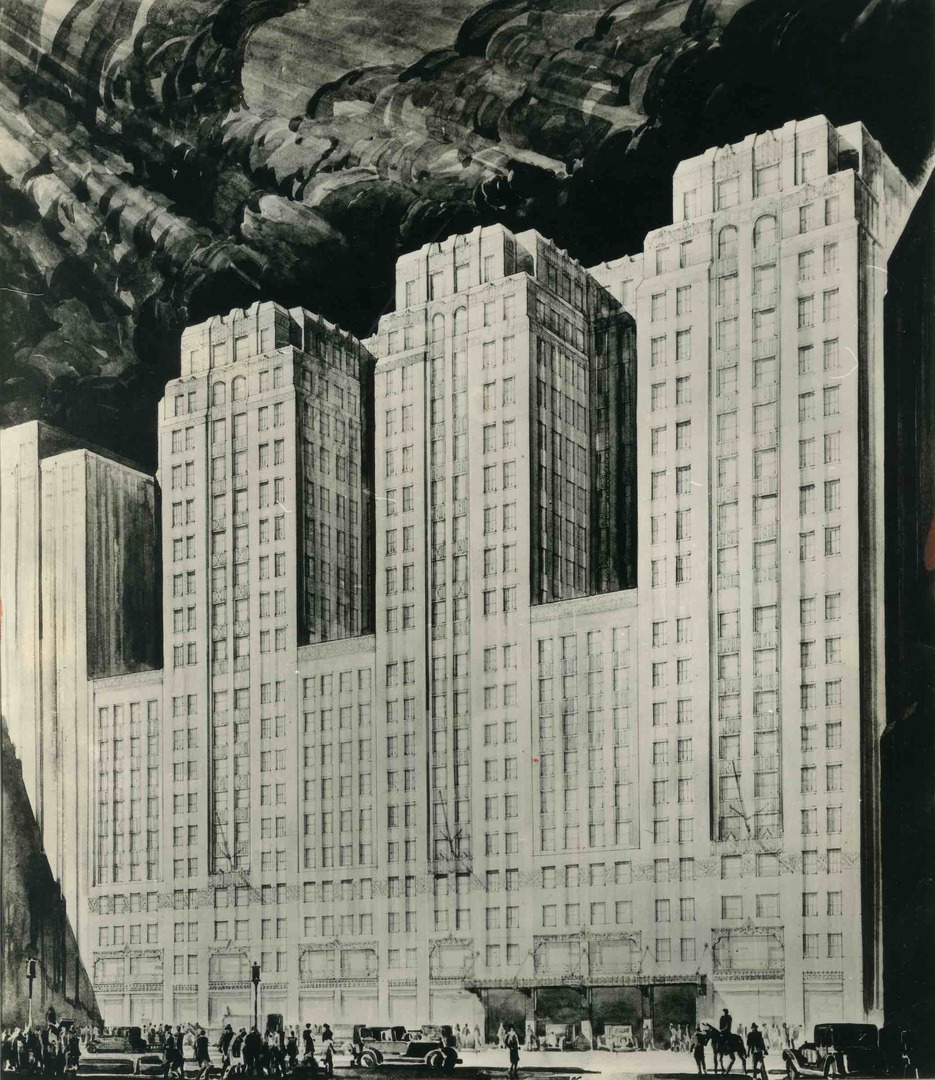
    <title type="html"><![CDATA[Landmark Office Towers: The Professional and Corporate Heart of the Terminal Group]]></title>
    <summary type="html"><![CDATA[<p><strong><em>Tower City Center, with its Public Square entrance, iconic tower, and flanking hotel and casino, has long overshadowed the office buildings to its rear despite their shared lineage as heirs of the Van Sweringen brothers’ vision. Yet the Landmark Office Towers complex on West Prospect Avenue deserves more attention for its splendid architectural details, novel interior features, and place in the history of some of Cleveland’s most significant corporate giants. </em></strong></p><img src="https://clevelandhistorical.org/files/fullsize/cf17bb9783a0e01e8bcbc10cdc20b577.jpg" alt="Original Rendering of Builders Exchange Building" /><br/><p>The three adjoining buildings that comprise Landmark Office Towers were originally conceived as part of Oris P. and Mantis J. Van Sweringen’s Cleveland Union Terminal complex, the “city within a city” the brothers launched in the 1920s. Designed by Graham, Anderson, Probst & White of Chicago and built between 1929 and 1930, the buildings occupied an entire city block bounded by Prospect Avenue, Huron Road, Ontario Street, and West 2nd Street, all of which were built as viaducts above the railroad tracks entering the Union Terminal. </p><p>In keeping with the idea of a city within a city, each building focused on a different sector: the Medical Arts Building was built for physicians’ and dentists’ offices; the Builders Exchange Building was devoted to businesses associated with the building trades; and the Midland Bank Building was dedicated to banking institutions and other business firms. The buildings included passageways connecting them with each other and with other components of the Terminal complex. A skybridge over Prospect, planned to link the Medical Arts Building with Higbee’s department store, was never added. </p><p>The three buildings were all built with structural steel frames clad with gray limestone on the lower four floors, cream face brick above, and terra-cotta trim near the tops. Detailed Art Deco motifs graced each facade, and the complex featured setbacks and light wells to break their bulk and provide ventilation. Inside, they featured travertine marble floors, fluted pilasters, plaster ceilings with ornamental friezes, and bronze elevator doors. The three-story lobby of the Midland Bank Building featured a wood-burning fireplace, a mezzanine, and pillars and panels carved from the trunks of seven giant oak trees. The trees were selected from an English estate and transported by steamship from Liverpool. The Builders Exchange Building included Guildhall, a tenth-floor restaurant inspired by a 15th-century London namesake, and a two-story demonstration house called the <a href="https://clevelandhistorical.org/admin/items/show/1028">Home in the Sky</a> on its two top levels.</p><p>The introduction of such an expansive block of choice office space soon after the onset of the Great Depression had a profound impact on downtown, precipitating a consolidation of business and professional activity around the Terminal and leaving older office buildings with hard-to-fill vacancies. Four major corporate headquarters relocated to the complex between 1930 and 1935. Two were local: Sherwin-Williams moved its offices from its Canal Road property into portions of the Midland Building and Builders Exchange Building, while Standard Oil Co. of Ohio (Sohio) left the East Ohio Gas Building on East 6th for the Midland Building. The Midland Building also attracted the Erie Railroad headquarters away from New York City in 1931 and Republic Steel from Youngstown in 1935. The arrival of the latter led the Medical Arts Building to be renamed the Republic Building. </p><p>Yet the Depression also forced the complex to grapple with challenges. In 1932, Midland Bank went bankrupt and merged into Cleveland Trust, closing its offices in its namesake building. Three years later, the Van Sweringen Company went bankrupt. Thereafter, ownership of the towers complex was administered by the Prospect Terminals Building Co., a subsidiary of Cleveland Terminal Building Co. In 1940, the Cleveland Builders Exchange left for a new headquarters on Euclid Avenue, and Sherwin-Williams expanded to the floors that had housed the Exchange's Home in the Sky. At that time, the building was named the Guildhall Building.</p><p>In 1950, Cleveland Terminal Building Co. sold the entirety of the Union Terminal group except the rail station in 1950 to the 66 Trust of Philadelphia. That same year, the four main tenants of the towers complex — Republic Steel, Erie Railroad, Sohio, and Sherwin-Williams — formed RESS Realty (a portmanteau of their names) to coordinate leasing of office space in the three conjoined towers. For the 35 years that followed, the complex harbored a workforce of around 5,000 people. </p><p>In 1986, ten years after the Erie-Lackawanna Railroad (formerly Erie Railroad) closed its Cleveland headquarters following its merger into Philadelphia-based Conrail, Sohio completed its move from the Midland Building to its new 45-story headquarters on Public Square. Following the departures of these firms and Republic’s recent merger into LTV Steel, RESS Realty was administered by only LTV and Sherwin-Williams. In the year preceding Sohio’s exit, RESS Realty renovated and rebranded the LTV-Guildhall-Midland Building complex as Landmark Office Towers. </p><p>During the renovations, Sherwin-Williams bought the complex, bringing its ownership back to Cleveland. Changes included a central lobby for the elevator banks serving all three buildings, along with the revitalization of the Midland Building’s lobby, which Sohio had modernized into offices with dropped ceilings in 1970, as the Van Sweringen Arcade. The bank’s vault became Haymarket Restaurant, later Piperade, and then Hyde Park Chophouse until the space closed in 2011. </p><p>The renovation and promotion succeeded in turning around the towers at a critical time. After Sohio moved out, the complex’s occupancy dropped from 100% to 62%, but upon completion of the renovations, it bounced back to 90%. Landmark Office Towers had a nearly four-decade run until its owner, Sherwin-Williams, sold the complex to Detroit-based Bedrock in 2023 ahead of the paint and coatings company’s move to its new 36-story headquarters tower on Public Square. Today, the future of the complex seems tied to Bedrock’s Riverfront Cleveland project, but its precise use is uncertain. Office demand in downtown districts has not recovered from the pandemic collapse of 2020, and conversion of such a massive structure to residential use is costly. But the towers — with their Art Deco flourishes, contribution to a big-city atmosphere, and central location in an evolving downtown — deserve a new, bold vision.</p><p><em><strong><a href="https://clevelandhistorical.org/items/show/1084">For more (including 21 images) view the original article</a></strong></em></p>]]></summary>
    <published>2026-04-03T13:57:15+00:00</published>
    <updated>2026-04-17T19:17:44+00:00</updated>
    <link rel="alternate" type="text/html" href="https://clevelandhistorical.org/items/show/1084"/>
    <id>https://clevelandhistorical.org/items/show/1084</id>
    <author>
      <name>J. Mark Souther</name>
    </author>
  </entry>
  <entry>
    <title type="html"><![CDATA[Central National Bank Euclid Avenue Office: &quot;Modernity Prevails&quot;]]></title>
    <summary type="html"><![CDATA[<p><strong><em>In 2019, the 28-story Beacon opened on the northwest corner of Euclid Avenue and East 6th Street as the first newly constructed apartment tower in downtown Cleveland since the 1970s. The Beacon’s undulating, checkered geometrical pattern of dark glass and light metal creates what is known as the “Cafe Wall” illusion. Seven decades before the Beacon and within its giant footprint, another modernist building made its own striking geometrical statement.</em></strong></p><img src="https://clevelandhistorical.org/files/fullsize/02cb12ddae0122cb2d66ebb947c0ad64.jpg" alt="Postcard of CNB Euclid Avenue Office" /><br/><p>In 1943, Central National Bank sold its slender 17-story headquarters building at 308 Euclid Avenue to the F. W. Woolworth Co., which later demolished the building for a much shorter retail store (now the House of Blues). The bank continued to lease space in the “matchstick” building until it opened its new headquarters in 1949 in five floors of the Midland Building at West Prospect Avenue and West 2nd Street. Central National also acquired property at 509 Euclid near the northwest corner of East 6th Street to build a “service bank” convenient for downtown shoppers. The separation of main operations from transient services was part of an emerging postwar banking trend in large cities. The bank's purchase of 509 Euclid prompted the termination of Clark's Paul Revere Restaurant's lease, ending the eleven-year run of this replica of the silversmith and Patriot Revere's Boston home. </p><p>The new five-story, air-conditioned Central National Bank Euclid Avenue Office, designed by Conrad, Hays, Simpson & Ruth of Cleveland, opened with fanfare in November 1948. With its facade of imperial red Swedish granite, stainless-steel geometric panels, plate-glass windows, and six-foot electric clock, it could not have been more different from the rustic, log-sided Paul Revere Restaurant. As a <i>Cleveland Press</i> reporter observed, “modernity prevail[ed]” inside as well. The ultra-modern building featured the first “moving stairway” (escalators) to be installed in a Cleveland bank. Its first and second floor lobbies featured terrazzo floors, white oak paneling and furniture, and formica counters in the tellers’ cages under a "luminous ceiling" like that in the United Nations Security Council chamber at Lake Success, New York.</p><p>The new building’s cost ultimately exceeded its million-dollar budget by a quarter, leading Central National to lease most of the three upper floors to other firms to offset its expense. Less than four decades after it opened, Central National’s Euclid Avenue branch closed quietly in 1986 after being sold to Ohio Savings Association as a real estate investment. Ohio Savings also acquired adjacent buildings, giving it control of everything between the Arcade and East 6th. Ohio Savings in turn sold to developers who built a parking garage in 2005 and, in 2019, completed the Beacon apartments above it, lending a new ultra-modern look to the block.</p><p><em><strong><a href="https://clevelandhistorical.org/items/show/1060">For more (including 16 images) view the original article</a></strong></em></p>]]></summary>
    <published>2025-08-23T16:00:07+00:00</published>
    <updated>2026-04-17T19:17:43+00:00</updated>
    <link rel="alternate" type="text/html" href="https://clevelandhistorical.org/items/show/1060"/>
    <id>https://clevelandhistorical.org/items/show/1060</id>
    <author>
      <name>J. Mark Souther</name>
    </author>
  </entry>
  <entry>
    <title type="html"><![CDATA[Western Reserve Building: Weathering the Shifting Winds of Downtown Property Markets]]></title>
    <summary type="html"><![CDATA[<p><strong><em>Samuel L. Mather perched his offices in the Western Reserve Building above the river harbor where he plied his iron-mining and shipping business. At the time, he probably never imagined how the brick and stone edifice would fare as downtown and the city's economy evolved, but his onetime headquarters defied the odds, managing to retain its original function as an office building long after most other first-generation skyscrapers were demolished or converted to other uses.</em></strong></p><img src="https://clevelandhistorical.org/files/fullsize/b24eb52bdd6ec25243308a1cd22ba2a4.jpg" alt="Romanesque Arch Entrance" /><br/><p>Samuel L. Mather, the grandson of one of the founding fathers of the Connecticut Land Company whose investment had led to the establishment of Cleveland, co-founded the iron-ore mining and shipping firm of Pickands, Mather & Co. in 1883, which helped him amass a new fortune on top of his already formidable wealth. Pickands Mather had kept offices for only a short time in the <a href="https://clevelandhistorical.org/items/show/1029">Perry-Payne Building</a> on Superior Avenue when Mather commissioned the Chicago architectural firm of Burnham & Root (already known locally for its <a href="https://clevelandhistorical.org/items/show/305">Society for Savings Building</a>) to design a headquarters office building on land that he and John Hay had purchased on the northwest corner of Superior and Water Street (now W. 9th).</p><p>The aptly named Western Reserve Building occupied a triangular parcel on the crest of a steep hill descending into the flats along the river. The land had once been home to the Carter Tavern, a hewn-log inn that early Western Reserve of Connecticut settler Lorenzo Carter had built in 1803. Following Carter's death in 1814, Phineas Shepard operated the inn for an unknown span of time, and it was the site of the meeting in 1816 that organized Trinity Parish, later <a href="https://clevelandhistorical.org/items/show/81">Trinity Episcopal Cathedral</a>. After it closed, deeds show that Carter's children Alonzo and Laura sold the land to the Oviatt family in two transactions in 1825 and 1830. By 1828, the Oviatts had replaced the old two-story inn with a three-story brick building that stood until Orson M. Oviatt razed it for a new four-story commercial block called the Franklin Buildings in 1835. The Franklin Buildings housed various dry-goods houses and professional offices, including the men's clothing store of George A. Davis, who owned the block from 1851 until his death ten years later. </p><p>The Franklin Buildings later housed Western Union Telegraph Company, which added "innumerable adornments of fencing and wires which surmount[ed] the electric ridden structure," according to an account in the <em>Plain Dealer</em> in 1886. Three years later, Hay and Mather, the executors of Amasa Stone's estate, purchased the property in the estate's name and set out to redevelop it. (Hay's and Mather's wives Clara and Flora were Stone's daughters.) Following on the heels of the Perry-Payne Building, the announcement of a new building to replace the Western Union block was a welcome news to those who feared Euclid Avenue's inroads. As the <em>Plain Dealer</em> pointed out in 1889, "Enough is now promised in the way of new buildings to save the street from becoming what it had at one time threatened to do—a street for banks and the wholesale trade plentifully mixed up with saloons."</p><p>Mather’s new eight-story pressed-brick and sandstone Western Reserve Building, which opened in 1892, is considered a transitional skyscraper. Like Burnham & Root’s Monadnock Building in Chicago and Cudell & Richardson's Perry-Payne Building, it had traditional load-bearing masonry exterior walls but also incorporated some interior steel framing, a recent innovation. On the ground floor, the Western Reserve Building featured pink sandstone piers capped by Romanesque capitals and a large Romanesque arch framing its Water Street entrance. Its upper floors had either rectangular, segment arch, or full arch windows, some of them in oriel bays. Samuel Mather had an elaborate cherry-paneled office inside. </p><p>In addition to Pickands Mather, the Western Reserve Building housed American Steel & Wire, Cleveland-Cliffs Iron, Island Creek Coal, and other shipping, mining, and manufacturing concerns. The building’s uses reflected business leaders’ desire to locate offices in the Wholesale District (later renamed the Warehouse District) close to Cleveland’s harbor. The riverside location was also attractive to the U.S. Weather Bureau. On May 1, 1892, Cleveland’s weather observatory and signal station opened there, 135 feet above the street, giving it a commanding view of the lake and river. From this lofty perch, signalman and weather observer W. B. Stockman hoisted flags to alert ship captains and downtown pedestrians to impending changes in the weather. The station had previously operated on top of the six-story Wilshire Block on Superior Avenue a block and a half west of Public Square. Now it was another beneficiary of Mather’s eagerness to be closer to the harbor. </p><p>In 1903, the Western Reserve Building was expanded northward along Water Street with an interior lightwell that may have drawn inspiration from Burnham & Root’s Rookery Building in Chicago or perhaps from a similar feature inside the Perry-Payne Building. The expansion increased the original building's size by about 40 percent. The building flourished into the 1920s, but like other buildings west of Public Square, it faced increasing competition from newer ones that rose to the east along Euclid Avenue. In 1924, Mather sold his interest in the Western Reserve Building to the Union Lennox Company, a firm named for the mammoth Union Trust Building that had recently replaced the Lennox Building on the northeast corner of Euclid and East 9th. Soon after, Pickands Mather moved its headquarters into the Union Trust Building. With the loss of its identity as a hub of the city's iron-ore business and the rise of newer, larger skyscrapers, the Western Reserve Building's future was in question.</p><p>The Western Reserve Building changed hands twice during World War II and, under Louis E. Goldman, it underwent a modernization in 1947 that covered its Romanesque arch entrance with a blocky granite façade. Despite this effort to renew its appeal, over the next three decades, the building stood sentinel over a part of downtown that was gradually decaying and receding in civic importance. Toward the end of that time, Goldman was no longer able to attract tenants, so the building sat mostly vacant. The exception to the rule was the opening in 1970 of the Cleveland Urban Learning Community, an experiment by St. Ignatius High School that took advantage of cheap rent to place its headquarters in the Western Reserve Building.</p><p>The Cuyahoga River’s east bank had been a natural place for Samuel Mather to envision an office building housing his iron mining and shipping business in the early 1890s. Although seemingly less natural, Herbert W. Strawbridge, chairman of the Higbee Company department store, felt a similar pull toward the western edge of the derelict Warehouse District nine decades later. Several years earlier, Strawbridge had visited San Francisco’s Ghirardelli Square, a shopping, dining, and entertainment complex filling the shell of its namesake chocolate manufacturer’s former factory. As Higbee’s downtown store sales slipped, Strawbridge recalled Ghirardelli Square. Then he hatched a daring plan to buy a swath of property overlooking the river and create a similar venue. Settlers’ Landing, as it would be named, would evoke Cleveland’s start along its river and, like Ghirardelli Square, reuse existing buildings as much as possible. More importantly, Strawbridge reasoned, Settlers’ Landing could draw large numbers of tourists and suburbanites back to a sagging downtown—and hopefully to Higbee’s.</p><p>Among the properties that the newly formed Higbee Development Corporation bought through agent John H. Bustamante was the Western Reserve Building, which Goldman was doubtless thrilled to unload in 1973. Strawbridge then hired Lawrence Halprin, the man behind Ghirardelli Square, to plan Settlers’ Landing. Higbee Development sank $4.5 million into a full renovation of the Western Reserve Building in 1974-76. The results drew a mixed response locally. Some decried the sandblasting that pitted the delicate sandstone facade. Others looked askance at the similarly insensitive treatment of the building’s interior. To avoid removing any leasable space, Higbee Development enclosed the historic lightwell to add an interior fire escape, heating and cooling ducts, and new restrooms on each floor. Halprin’s designer Angela Tzvetin created a modern lobby with “domed brick vaults” and spiderweb-like iron designs between their pillars, leading one architectural critic to dub the “corny” concept “early wine cellar.” The same critic went so far as to suggest that the Western Reserve Building was “second-rate Burnham and Root” that would have been better off bulldozed.</p><p>When the Western Reserve Building reopened in 1976, it seemed that the building had a new relevance as the Flats transitioned from maritime to leisure uses, but renewal was slow and difficult. Higbee’s operated a sandwich shop off the lobby while it searched (ultimately in vain) for a full-service restaurant to assume the space. At the time of the opening, only 1,220 of 53,840 square feet of office space was leased. Then Higbee’s plans for Settlers’ Landing collapsed after a major fire consumed some of the buildings the company had hoped to renovate. Despite efforts to promote the building, including hosting an exhibit and slideshow as part of the 1977 sesquicentennial of the opening of the Ohio Canal, the Western Reserve Building underperformed expectations. Coupled with Higbee’s expenses from opening new stores at Euclid Square and Randall Park malls, its renovation of Pickands Mather’s onetime headquarters building contributed to record quarterly losses that year. By 1981, the building was reportedly at 97 percent occupancy, but Higbee’s needed an infusion of cash, so it sold the building to another syndicate headed by developer John Ferchill.</p><p>Though Settlers’ Landing had flopped, the Flats and Warehouse District boomed in the 1980s. Nightspots, restaurants, and loft apartment conversions reinvigorated an area that earlier downtown planners had largely forsaken in their fixation on <a href="https://clevelandhistorical.org/items/show/909">Erieview</a>. It was too late for Higbee’s, which sold out to Youngstown developer Edward J. DeBartolo and the Little Rock-based Dillard’s chain in 1987 (though the Higbee’s name survived another five years). As for the Western Reserve Building, it flourished anew. Among the firms based there was Those Characters from Cleveland (now CloudCo Entertainment), a subsidiary of Cleveland-based American Greetings that formed in 1981 to develop and license characters developed by the card company such as Holly Hobbie and Strawberry Shortcake. That year saw Cleveland artist Elena Kucharik’s creation of the Care Bears, making the Western Reserve Building the birthplace of one of the 1980s’ popular culture icons. </p><p>Ferchill and his partners undertook yet another renovation in 1990 and built an eight-story addition to the north that doubled the size of the 1892/1903 building. The sandstone- and microcotta-faced addition featured a new arched entry, while the syndicate uncovered and restored the long-hidden one on the original building. After initial success, the enlarged building gradually languished again. By 2016, it was two-thirds vacant and in foreclosure, leading Ferchill to sell it the following year to WRB Partners (comprised of developer Fred Geis, real estate firm Cushman & Wakefield, and others). During the COVID-19 pandemic, the Western Reserve Building clung to its original function as an office building in a new era marked by the loss of downtown office-based work and a spate of office to residential conversions. In addition to attracting a global co-working company, WRB Partners added to its amenity-driven approach to combatting the loss of traditional dedicated office work by doing what Higbee’s had tried and failed to do fifty years earlier: entice a restaurant operator. In 2023, the popular Cleveland Heights-based Luna Bakery opened its third cafe on the building’s ground floor.</p><p><em><strong><a href="https://clevelandhistorical.org/items/show/1030">For more (including 19 images) view the original article</a></strong></em></p>]]></summary>
    <published>2024-09-10T21:00:07+00:00</published>
    <updated>2026-04-17T19:17:43+00:00</updated>
    <link rel="alternate" type="text/html" href="https://clevelandhistorical.org/items/show/1030"/>
    <id>https://clevelandhistorical.org/items/show/1030</id>
    <author>
      <name>J. Mark Souther</name>
    </author>
  </entry>
  <entry>
    <title type="html"><![CDATA[The Grand Arcade: W. C. Scofield&#039;s Enduring Building]]></title>
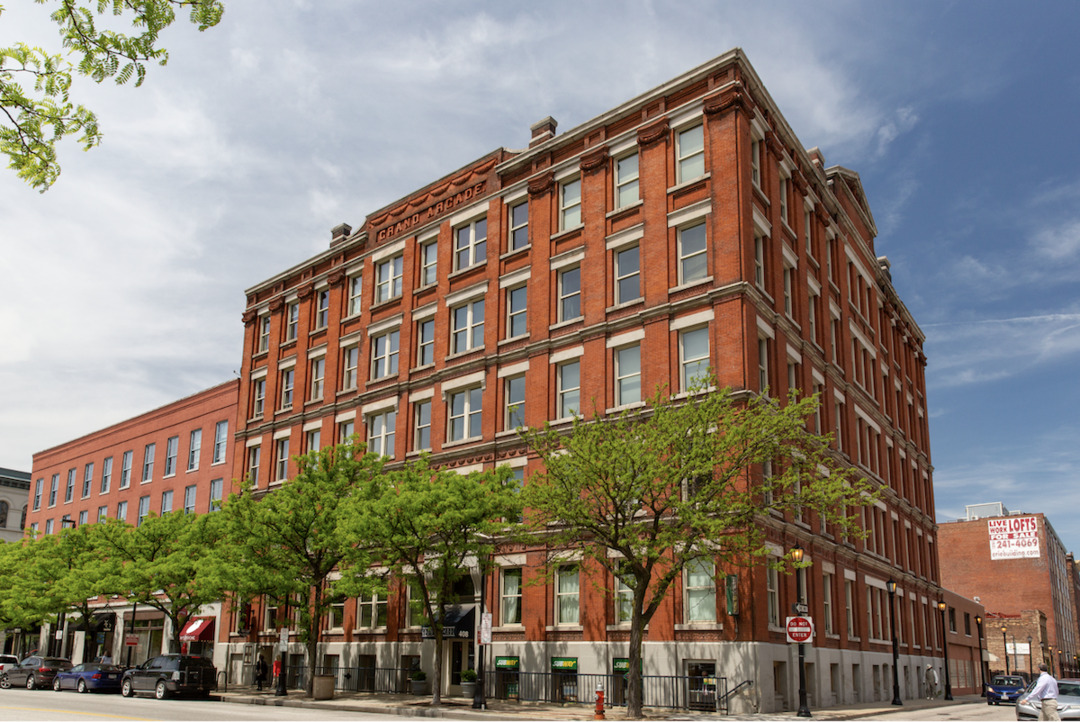
    <summary type="html"><![CDATA[<p><strong><em>When its construction was completed in 1883, the six-story Grand Arcade on the northwest corner of St. Clair and West 4th was the tallest commercial building and most prestigious business address in Cleveland.  Iron works, oil refineries and other industrial businesses rushed to lease offices in it.  However, when the even taller and more prestigious Perry-Payne Building opened on Superior Avenue  six years later, these businesses just as quickly left the Grand Arcade.  This wouldn't be the last occupancy challenge this historic building would face .</em></strong></p><img src="https://clevelandhistorical.org/files/fullsize/d392fd4e40264971599e4ebad93b154c.jpg" alt="The Grand Arcade" /><br/><p>William Charles Scofield, the person for whom the Grand Arcade Building at 408 West St. Clair Avenue was built, was one of Cleveland's most prominent industrialists in the second half of the nineteenth century.  He and John Alexander, reputedly the first person to refine oil in Cleveland, co-founded the Great Western Oil  Works which, in the 1860s, was one of the chief competitors of John D. Rockefeller's Standard Oil  Company.  When, in 1872,  Standard Oil Company engaged in anti-competitive acts and forced virtually all of Cleveland's oil refiners, including John Alexander and William Scofield, to sell their refineries to it at discounted prices, Alexander retired from the refinery business and returned to England. Scofield, however, did not.  He not only survived the so-called "Cleveland Massacre," but thrived after it.</p><p>In 1872,  the same year that he was forced out of the oil refining industry by Rockefeller's Standard Oil Company, W. C., as Scofield was known, entered the iron manufacturing industry, purchasing the historic Otis Iron Works on Whiskey Island.  He renamed it Lake Erie Iron Company, expanded its operations to include a new facility for the manufacture of nuts and bolts on land located between East 63rd Street and Addison Avenue close to the tracks of the Lake Shore and Michigan Southern Railroad, and made it a very successful business.  In 1874, two years after the Cleveland Massacre, Scofield formed a new partnership, built a new oil refinery on Willson Avenue (East 55th Street), north of Broadway and near the tracks of the Atlantic and Great Western Railroad, and re-entered the oil refining business, operating once again as Great Western Oil. </p><p>In 1882, W. C. Scofield decided to construct the Grand Arcade.  Yet, it wasn't his first presence on St. Clair or even the first building he had erected on that street.  After immigrating from England and arriving in Cleveland in about 1844, he and his wife Ann had settled on St.  Clair Street, where their first two children were born. In 1850, they had moved  east to Hamilton Street as the neighborhood northwest of Public Square (today known as the Warehouse District) began its mid nineteenth century transformation into a commercial district. Despite moving his residence, Scofield retained a presence on St. Clair, starting up several small manufacturing businesses there in the 1850s and early 1860s.</p><p>In 1864, the same year in which he formed his partnership with John Alexander, William Scofield had  expanded his business presence on St. Clair by purchasing the former homestead of pioneer Cleveland grocer and wholesale liquor merchant Nelson Monroe, which was located nearly directly across the street from where the Grand Arcade would be built almost two decades later.  The offices of the Great Western Oil  Company were located on this property from 1864 to 1868. In 1878, Scofield had further solidified his presence on St Clair by building the four-story brick and stone Scofield Block on the property.  A number of industrial tenants, including Scofield's Lake Erie Iron Company, soon moved their offices into that building.</p><p>So why did W. C. Scofield decide in 1882 to build the Grand Arcade across the street from the Scofield Block built just four years earlier?   It is not clear from recorded sources why he did so, but it may have been to expand his influence in the industry in which he was most personally and financially invested—coal and iron.  Whatever the reason, in February 1882, Scofield purchased the lot on the northwest corner of St. Clair and Academy (West 4th) and hired Cleveland architect Levi T. Scofield to design an office building for that lot which had 100 feet of frontage on St. Clair and 97 feet of frontage on Academy. Levi Scofield, who does not appear to have been a relative of W. C. Scofield—at least not a close relative—is best known to Clevelanders today as the architect of both the Soldiers and Sailors Monument on Public Square and the Schofield Building on the southwest corner of East 9th Street and Euclid Avenue. </p><p>Like some of the  other buildings Levi Scofield designed, the Grand Arcade was designed to be grand and notable.  Years after it was built, it was referred to by at least one newspaper as Cleveland 's first "modern" office building.  Designed in the Neoclassical Revival style with elements of Neo-Grec, it is a brick and stone building that stands six stories tall (five floors above ground with a raised basement).  Its exterior walls fronting St. Clair Avenue and West 4th Street are decorated with  pilasters, capitals, belt courses, entablatures, ornamental swags and other details formed from cut sandstone and unglazed terra cotta. The construction cost of the building was $100,000 ($3 million+ in 2024 dollars).</p><p>One of the most notable features of the Grand Arcade's original design was its approximately 100 by 20 foot,  five-story-tall interior court which had an ornate triangular prism-shaped glass skylight above it.  All of the building's interior offices had direct access to this court from iron balconies and descending stairs.  Regrettably, that interior court no longer exists.  Although no record has been found that documents when it was removed, it likely occurred during one of the several renovations of the building that took place between 1902 and 1962.</p><p>Another mystery associated with the Grand Arcade is: Why did W. C. Scofield decide to call this building an "arcade?"  That term traditionally refers to a building with a covered passageway lined with retail shops on both sides.  An article in the Cleveland Leader, on December 7, 1912, noted that "the building actually is not an arcade and received its name from  the court and its many balconies opening from the inner office suites."  However, there is no indication that the newspaper had obtained that explanation from W. C. Scofield who was still living at the time the article was published, and there may have been a reason, other than the explanation offered by the Leader, why Scofield used the term.  There were, in fact, retail shops located on the first floor of the building  in the decades of the 1880s and 1890s and some of these could have had interior storefronts and entrance ways on the court.</p><p>When the Grand Arcade opened in 1883, it notably drew as its first tenants a large number of companies from the coal and iron industries, some of which had previously been tenants in the Hilliard Building on Water (West 9th) Street which had been known since 1875 as the Coal and Iron Exchange Building.  According to information gleaned from the 1884-1885 Cleveland Directory,  the Grand Arcade in its first full year leased office suites to 14  iron manufacturing  companies and five coal companies.  However, when the Perry-Payne building opened in 1889, all of the iron manufacturing tenants, except Scofield's Lake Erie Iron Company, and all but two of the coal tenants left the Grand Arcade. </p><p>It appears, again from a survey of tenant listings in Cleveland directories, that W. C. Scofield attempted to address the departure of coal and iron companies from his building by seeking, in the 1890s, to attract  oil and railroad companies.  For a time he was successful in that effort, helped by the fact that so many railroads and streetcar companies had located their offices in buildings on St. Clair between Seneca (West 3rd) and Water (West 9th) that that stretch of St. Clair was known as Railroaders' Row.  But just as the opening of the Perry-Payne Building in 1889 had impacted the Grand Arcade's efforts to attract and keep coal and iron companies as tenants, the opening of additional new downtown office buildings in the 1890s, including the Society for Savings Building and the Arcade in 1890, the Western Reserve Building in 1892, the Garfield Building in 1893 and the New England Building in 1896, similarly impacted the Grand Arcades's efforts to attract tenants from other industries.  By 1899, only one oil company and just three railroad companies remained as tenants in the Grand Arcade.  In that same year, W. C. Scofield, who was already in his late seventies—although he would live to be 95 years old—turned over ownership and control of the building to his sons Charles and Frank.  They, likely with their father's blessing, took a new approach to dealing with the building's growing occupancy problem.</p><p>In 1902, the Grand Arcade was remodeled and transformed from an office building into what was then called a "power block," i.e., a building occupied by a single tenant.  It was a good decision for the Scofield family which would continue to own the Grand Arcade and lease it to a series of single tenants until they sold the property in 1955.  From 1902 until 1912, the building was leased to North Electric Company,  a telephone manufacturing company.  Then, from 1913 until 1926, it was leased to Clawson and Wilson, a wholesale drug company headquartered in Buffalo, New York. Finally, from 1926 until 1961, the building was occupied by the Standard Drug Company, a Cleveland  retail and wholesale company, which used it as a warehouse and  purchased the building from the Scofield family in 1955.  Standard Drug sold the Grand Arcade in 1961  to a realty company.  The following year, the building was purchased by the non-profit City Mission which remodeled  and converted it into a homeless shelter.  </p><p>After occupying the building for almost three decades, the City Mission sold the Grand Arcade  in 1991 to a for-profit limited partnership which restored and renovated the building, converting it to a new  residential use, first as market-rate apartments and later as condominiums. In the second phase of the project, three other historic Warehouse District buildings were added to the Grand Arcade condominium development—the Waring Building, built in 1855 and located on St. Clair adjacent to the Grand Arcade;  the Klein-Marks Building, built in 1881 and located on West 6th Street just north of the Waring Building; and the Blair Building, built circa 1868 and located just north of the Klein-Marks Building.</p><p>From Cleveland's tallest office building and most prestigious address; to a "power block" for single commercial tenants; to a wholesale drug warehouse; to a shelter for Cleveland's homeless; to market-rate apartments; and finally to residential condominiums, the Grand Arcade has endured more use changes than most  of Cleveland's other historic buildings. Through it all, the Grand Arcade, much like the nineteenth century industrialist who built it, has not only survived, but has thrived.</p><p><em><strong><a href="https://clevelandhistorical.org/items/show/1023">For more (including 17 images) view the original article</a></strong></em></p>]]></summary>
    <published>2024-04-16T16:33:30+00:00</published>
    <updated>2026-04-17T19:17:43+00:00</updated>
    <link rel="alternate" type="text/html" href="https://clevelandhistorical.org/items/show/1023"/>
    <id>https://clevelandhistorical.org/items/show/1023</id>
    <author>
      <name>Jim Dubelko</name>
    </author>
  </entry>
  <entry>
    <title type="html"><![CDATA[Rose Building: &quot;The New Center&quot;]]></title>
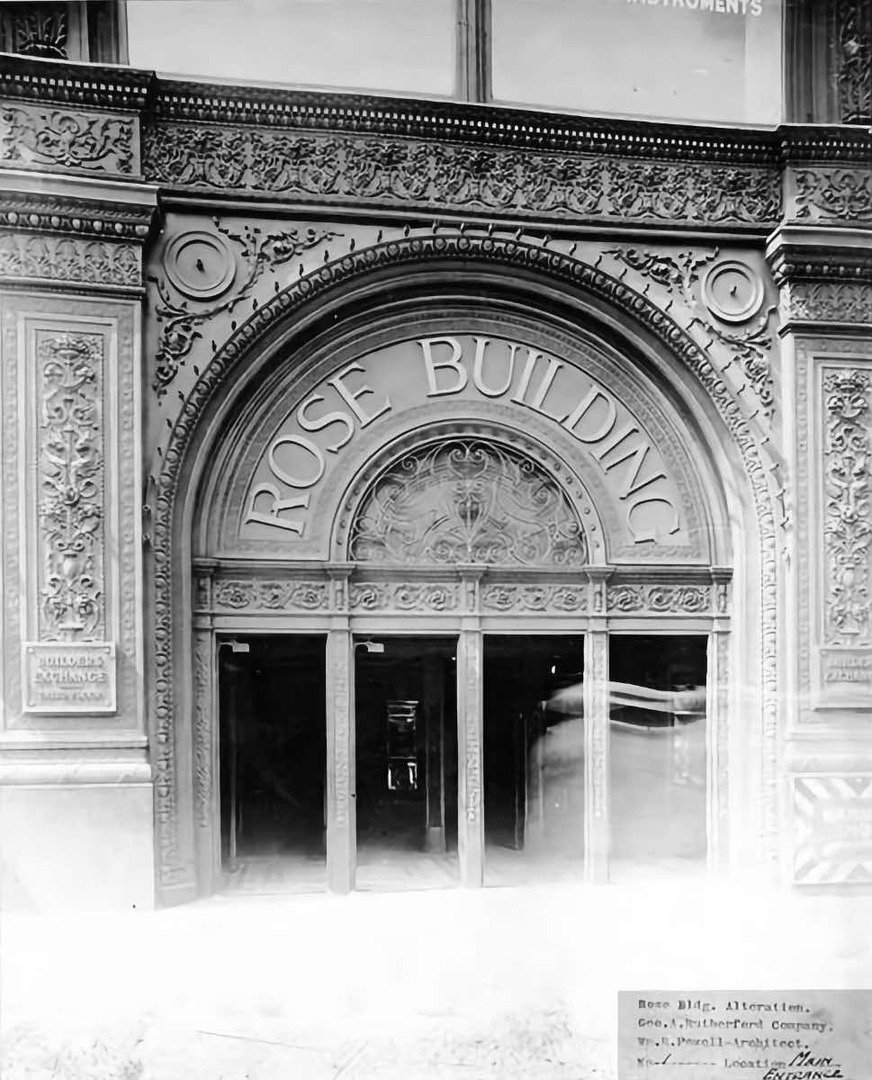
    <summary type="html"><![CDATA[<p><strong><em>In 1898-1900, Benjamin Rose financed the construction of the largest office building ever built in Ohio up to that time. At a time when conventional wisdom dictated a Euclid Avenue address, Rose did the unthinkable, selecting a spot at the corner of Prospect Avenue and Erie Street. Naysayers were convinced Rose's daring venture was doomed to fail, but they were wrong.</em></strong></p><img src="https://clevelandhistorical.org/files/fullsize/1e18dd70994fd06dc46874a9b5534ab0.jpg" alt="Main Entrance" /><br/><p>The ten-story Rose Building took its name from its developer, an English immigrant and pioneer in the meatpacking industry. In 1854 Benjamin Rose and Chauncey Prentiss established Rose & Prentiss, later renamed Cleveland Provision Company, which embraced refrigeration and other innovations early and was the city’s largest packinghouse for more than a century. With the fortune he amassed selling cuts of meat, in 1898 Rose commissioned architect George Horatio Smith to design what would become Ohio’s largest office building.</p><p>When the Rose Building was constructed, Erie Street (now East 9th), was on the eastern fringe of downtown, but Rose cleverly dubbed the intersection “The New Center” and used this slogan to entice businesses that might otherwise have considered the location too distant. Indeed, the Rose Building stood out. Its first five stories were sixteen feet high, while floors six to ten were eleven feet high. The choice to make the ceiling height of the lower floors so much higher than usual was reportedly Rose’s wish. </p><p>Upon its opening in 1900, the building’s primary tenants on the lower floors included Lederer Furniture, Scott Dry Goods, and offices of the White Sewing Machine and Cleveland Gas & Electrical Fixture companies. The upper floors contained doctors’ and dentists’ offices, an artist’s studio, a correspondence school, and the offices of fifteen oil companies. In its early years the Rose Building also hosted many exhibitions, including the works of Cleveland artists, a Slavic craft fair, and even a mock Congressional session. </p><p>In 1908 Rose was poised to stake out the next speculative “new center” of downtown. He bought out the St. John’s African Methodist Episcopal Church on East 9th across from Erie Street Cemetery with plans to build a twelve-story office building, but before he could carry out the plan, he died during a trip to England. Instead of burnishing his reputation in life as a visionary developer, in death Rose seeded the legacy for which he is known today. In 1909, the Rose Building gained a new tenant. Tucked away in small, sparely furnished office on the tenth floor was the Benjamin Rose Institute. Funded by Rose’s $3 million bequest, it used the office to review applications for small pensions to enable elderly men and women to afford to remain in their own homes.</p><p>In 1984, the Institute sold the Rose Building to Medical Mutual of Ohio, which had located its headquarters there in 1947. Medical Mutual owned the building until 2000, when it sold it to California-based BentleyForbes and leased its space. When the owner fell into foreclosure, Medical Mutual bought the building back in 2017, but its future in downtown was anything but certain. After much deliberation, Medical Mutual vacated the Rose Building in 2023 and merged its operations in its Brooklyn, Ohio, offices in the former American Greetings headquarters. While pessimists might quip that Benjamin Rose's doubters were ultimately proven right, the Rose Building's now much more central location makes it a likely candidate for a new lease on life.</p><p><em><strong><a href="https://clevelandhistorical.org/items/show/1012">For more (including 12 images) view the original article</a></strong></em></p>]]></summary>
    <published>2024-01-11T16:07:38+00:00</published>
    <updated>2026-04-17T19:17:43+00:00</updated>
    <link rel="alternate" type="text/html" href="https://clevelandhistorical.org/items/show/1012"/>
    <id>https://clevelandhistorical.org/items/show/1012</id>
    <author>
      <name>J. Mark Souther</name>
    </author>
  </entry>
  <entry>
    <title type="html"><![CDATA[Cleveland Trust Tower: Marcel Breuer&#039;s Only Skyscraper]]></title>
    <summary type="html"><![CDATA[<img src="https://clevelandhistorical.org/files/fullsize/e8976666b8329c5668f39b5d0ae0874e.jpg" alt="Architect Rendering " /><br/><p>The 9, originally called Cleveland Trust Tower and then Ameritrust Tower, is the only skyscraper designed by one of the most eminent Modernist architects of the 20th century, Marcel Breuer. But like a number of projects Breuer designed in his career, this Brutalist tower did not win universal praise and was nearly destroyed in the early 2000s. </p><p>Marcel Breuer was a Bauhaus-trained architect and furniture designer. A native of Hungary and a protege of the eminent Modernist architect Walter Gropius, Breuer earned a reputation for designing furniture and tubular steel chairs such as the Model B3 or Wassily Chair in the 1920s. In 1938 he joined Gropius on the faculty at Harvard's Graduate School of Design. For the next three years, Breuer and Gropius collaborated on several residential designs, including Aluminum City Terrace, an International Style defense housing project near Pittsburgh in 1941. The 240-unit "ultra-utilitarian" compound of prefabricated multifamily and semi-detached dwellings immediately drew "intense antagonism from surrounding economically well-off private residential property owners" who decried the project's design. It would not be the last time Breuer's designs produced strong feelings.</p><p>In the 1950s, Breuer continued in domestic architecture but also moved into institutional building design, notably in his UNESCO headquarters and I.B.M. Research Center in France. He went on to design the Whitney Museum of American Art in New York in 1966, which earned him accolades, but when he produced a design for the proposed FDR Memorial that same year in Washington, D.C., the U.S. Commission of Fine Arts rejected his creation as a "disrespectful" "pop art sculpture." Breuer found a better reception with his design of the Department of HUD headquarters in the Southwest Washington, D.C. urban renewal project, and he enjoyed commissions for a number of laboratories, university and museum buildings, including the Education Wing at the Cleveland Museum of Art, completed in 1971.</p><p>The latter commission, received in 1967, led Cleveland Trust Company to turn to Breuer to steer the expansion of its downtown offices at Euclid and East 9th Street, where <a href="https://clevelandhistorical.org/items/show/761">George B. Post's early-1900s rotunda</a> was too small for the bank's needs. Breuer was no stranger to Modernist additions to historic buildings. He had recently designed a proposed pair of skyscrapers to rise above Manhattan's Grand Central Terminal, but the project foundered because it underestimated the groundswell of commitment to historic preservation among New Yorkers who were still reeling from the loss of the grand Penn Station. </p><p>In Cleveland, Breuer planned twin 29-story towers that together would frame the old rotunda with frontage on Euclid and East 9th. Elements of the building's design evoked Breuer's HUD headquarters. The first tower, clad in black granite with cast concrete window frames, was completed on the East 9th side in 1971. Bank president George Karch was quick to assert that it reflected Cleveland Trust's dissent from the prevailing "gloomy predictions" about downtown's future. However, by that time, the second tower's expected construction was not expected to start before 1975. Not only was the second tower ultimately not built, its twin and the rotunda were abandoned in 1996 after Ameritrust (as Cleveland Trust had renamed itself in 1971) merged in 1991 with Society for Savings, which had recently invested in expanding its footprint on Public Square, leading to the construction of the Society Center. Society and KeyCorp, which acquired it three years later, had no need for the old Cleveland Trust complex.</p><p>The tower sat empty for nearly a decade before Cuyahoga County purchased it in 2005. County commissioners tried to convince the public to support demolishing it for a new county administration center because it was purportedly beyond saving. The threat of demolition hung over the tower for several years, stimulating considerable efforts to highlight the building's many merits, including its build quality, the renown of its architect, the fact that this was Breuer's only skyscraper. </p><p>After the county commissioners' failure to assemble the needing financing for a new county complex and their becoming embroiled in scandal, the Geis Companies, a Northeast Ohio real estate development firm, stepped in and offered to purchase the skyscraper and rotunda and undertake their adaptive reuse. Completed in 2015, the rotunda opened as a distinctive Heinen's supermarket, while the tower became the 156-room Metropolitan Hotel and 105 apartments, and the adjacent Swetland Building contained part of Heinen's on the first floor and more apartments on upper floors. The project did much to reenliven a forlorn corner of downtown and ensured that Cleveland did not destroy what was possibly the boldest expression of one of the 20th century's greatest Modernist designers.</p><p><em><strong><a href="https://clevelandhistorical.org/items/show/962">For more (including 12 images&#32;&amp;&#32;2 audio files) view the original article</a></strong></em></p>]]></summary>
    <published>2022-07-08T13:57:48+00:00</published>
    <updated>2026-04-17T19:17:42+00:00</updated>
    <link rel="alternate" type="text/html" href="https://clevelandhistorical.org/items/show/962"/>
    <id>https://clevelandhistorical.org/items/show/962</id>
    <author>
      <name>J. Mark Souther</name>
    </author>
  </entry>
  <entry>
    <title type="html"><![CDATA[Key Tower: Cesar Pelli&#039;s Nod to Art Deco-Era Manhattan]]></title>
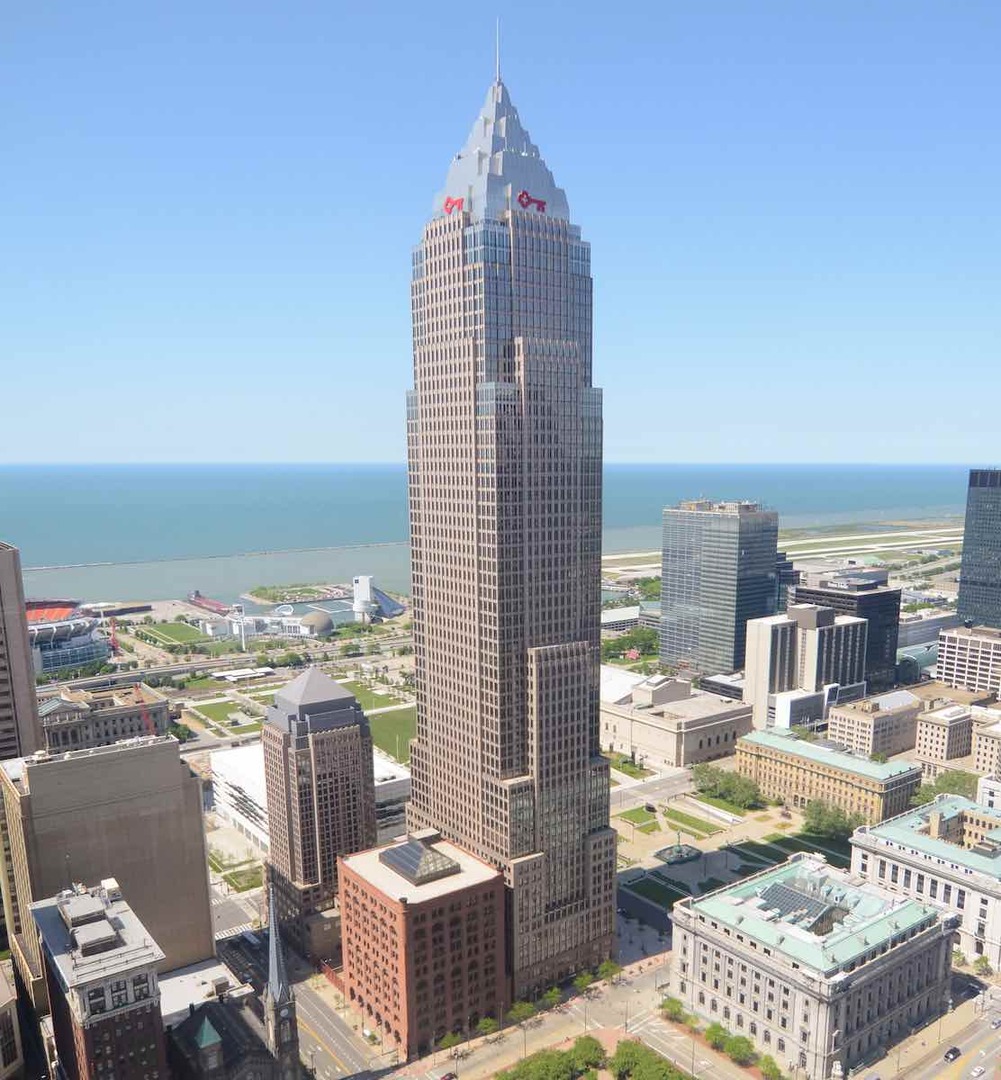
    <summary type="html"><![CDATA[<p><strong><em>When <em>Plain Dealer</em> architecture writer Wilma Salisbury interviewed Cesar Pelli about his plan for Cleveland's newest and tallest skyscraper in 1988, he cited not only the geometrical Art Deco designs of 1920s-30s New York but even the ancient Egyptian obelisk, biblical Tower of Babel, and Renaissance Italian campanile as inspirations. Indeed, the new tower needed to be inspiring because it was going to eclipse the beloved Terminal Tower as the city's visual reference point.</em></strong></p><img src="https://clevelandhistorical.org/files/fullsize/b0ef2a95e15de459bed82752f7e2daee.jpg" alt="Key Tower, Looking Northeast to Lake" /><br/><p>On October 30, 1990, Cleveland’s skyline became the backdrop for a symbolic transfer of power and prestige: the frame of Society Corporation's new headquarters surpassed the Terminal Tower in height. Cleveland was now looking forward instead of backward—no longer defined by the iconic 1930 building. The moment also was a reflection of larger changes: a redefining of downtown's purpose and image. Society Tower spoke to a new future for a struggling city.</p><p>The Terminal Tower had been Cleveland’s tallest building since its completion: in fact, the tallest structure in the United States outside of Manhattan until 1967. The architectural landmark represented an era of growth and affluence in Cleveland, the name speaking to its long-time role as the destination of all inbound trains to the city. In 1981, a design for Sohio's headquarters had initially sought to exceed the Terminal Tower's height. But city officials objected to the proposal, citing the Terminal Tower’s historic role in the city’s landscape. Thus the Sohio building (later called the BP building and now 200 Public Square) came up short of the Terminal Tower's peak.</p><p>In 1988, Society Corporation (now Key Bank) announced that it would be the major tenant in a new skyscraper and office complex to be built on the northeast corner of Public Square. The new headquarters would display the company's strength and competitiveness as a financial institution, and demonstrate its commitment to Cleveland. The project was headed by Richard and David Jacobs, who had recently opened the Galleria at Erieview Tower. The previous year, Cleveland City Planning Commission changed the height restrictions on the Society site from 250 to 900 feet. The Terminal Tower's era of visual dominance was over.</p><p>Plans for Society Center's new tower were enthusiastically received by the press and public. Comparisons were drawn between the influence of the Jacobs brothers and the Van Sweringens in defining a new identity for the city of Cleveland. The New York–style skyscraper (the tallest structure between New York City and Chicago) would symbolize the city's recovery. It would change the skyline and bridge the space between Public Square and the Mall. And not only would the project attract workers and businesses to the core of downtown, it would include a first-class hotel—a potential boon to Cleveland’s struggling convention business.</p><p>The tower's mast reached 948 feet (60 feet above the peak of the 57-story building's aluminum-capped spire) when Society Center was completed in 1991. The complex contains more than 1.5 million square feet of office space as well as a 385-room Marriott Hotel and a massive parking garage underneath the Mall. The century-old <a href="https://clevelandhistorical.org/items/show/305">Society for Savings Building</a> just to the west was also renovated. Upgrades were made to Mall A (the southern-most of the Mall’s three segments) and its War Memorial centerpiece.</p><p>While Cleveland would witness a resurgence of downtown construction in the late 1980s and early 1990s, there was soon a glut of available office space. Construction of new buildings ceased. In the second decade of the 21st century, however, things are looking up (more figuratively than literally): Scores of older office complexes and warehouses are being converted to hotels and residences. Developers can barely keep up with the demand for downtown residential living. The net effect is that, with a great deal of less-desirable office space off the market, there are fewer options and thus more demand. Through it all, Key Center continues to speak to the possibilities of Cleveland's future.</p><p><em><strong><a href="https://clevelandhistorical.org/items/show/961">For more (including 6 images&#32;&amp;&#32;1 audio file) view the original article</a></strong></em></p>]]></summary>
    <published>2022-07-07T20:12:04+00:00</published>
    <updated>2026-04-17T19:17:42+00:00</updated>
    <link rel="alternate" type="text/html" href="https://clevelandhistorical.org/items/show/961"/>
    <id>https://clevelandhistorical.org/items/show/961</id>
    <author>
      <name>Richard Raponi</name>
    </author>
  </entry>
  <entry>
    <title type="html"><![CDATA[Materials Park: The Inventive Headquarters of the American Society for Metals]]></title>
    <summary type="html"><![CDATA[<img src="https://clevelandhistorical.org/files/fullsize/0495f8370e24dd460dbe38ac3af7513a.jpg" alt="The Geodesic Dome As It Appears Today" /><br/><p>Just 20 miles east of Cleveland, in Novelty, Ohio, a massive architectural marvel sits, enveloping an office building. An immense open-lattice geodesic dome covers the headquarters of ASM International. ASM, which stands for the American Society of Metals (originally known as the Steel Treaters’ Club), was founded in 1913 in Detroit, Michigan. The Society would subsequently grow into one of the largest scientific societies in the world, with over 50,000 members internationally. Known as ASM International today, the headquarters are situated on a campus called Materials Park that sits on land originally belonging to one of the founding members of the American Society of Metals, William Hunt Eisenman.</p><p>The dome and grounds are the culmination of the work of four men: the aforementioned Eisenman, John Terence Kelly, Thomas C. Howard, and R. Buckminster Fuller. Eisenman was not only a founding member of ASM but served as its National Secretary and first Managing Director; Fuller, a futurist and creator of the geodesic dome; Kelly, a modernist architect; and Howard, an engineer. Each was skilled in their respective crafts.</p><p>R. Buckminster Fuller was born in Milton, Massachusetts, in 1895. He began his studies at Harvard University in 1913 but was ultimately expelled for excessive socializing and missing his midterm exams. He then moved to Canada to work at a mill, where he showed an aptitude for working with machinery. During the course of his lifetime, he went on to hold 28 patents, author 28 books, and receive 47 honorary degrees. </p><p>The geodesic dome became Fuller's focus in 1947. The geodesic dome, which Fuller patented in 1954, uses tension to hold its shape; the structures need no support internally and are some of the strongest and lightest made of metal. ASM's dome, also called a space lattice, is 103 feet high and 274 feet in diameter. It weighs 80 tons and has 65,000 parts. Fuller's ASM dome anticipated the internationally famous geodesic sphere, Spaceship Earth at Disney's Epcot Center in Florida by more than two decades. This attraction not only built upon Fuller's innovation but even its name owes a debt to him. Indeed, Fuller argued in the 1960s, "We are all astronauts on a little spaceship called Earth," and he believed that by being better able to visualize the entire planet, humans might better address the global challenges of life on this “Spaceship Earth.”</p><p>Cleveland architect John Terence Kelly, born in 1922, grew up in Elyria, Ohio. He received a B.A. in Architecture from the Carnegie Institute of Technology and an M.A. in Landscape Architecture from Harvard University. Kelly was inspired by Fuller’s geodesic dome and used Fuller’s model in his design. He enlisted the help of Fuller to design the dome. Thomas C. Howard, born in 1931, had worked with Fuller and others at Synergetics, a firm founded in Raleigh, NC's Research Triangle Park in 1955. After his work on the ASM dome, Howard designed the Climatron at the Missouri Botanical Garden (1960) and Churchill Pavilion at the New York World's Fair (1964), now the Queens Zoo Aviary.</p><p>Completed in 1959, ASM’s headquarters design was regarded not only as modern but state of the art. ASM International is known for its innovation in science and engineering. This is extremely evident not only in ASM’s mission and achievements, but also in its physical office building. The design of the office building echoes the very nature of ASM International’s vision: “We are dedicated to informing, educating, and connecting the materials community to solve problems and stimulate innovation around the world.” The building showcases various types of metals in many aspects of its design. The three-level office building houses 90 staff members in its 50,000 square feet. The building uses an emphasis on metal in many aspects of its design. As noted by ASM, “Every door on the lobby level is stainless steel; the ‘floating’ main stairway is also of stainless steel, hung dramatically by the use of steel rods running the height of the three levels. Copper sheeting frames the elevator.”</p><p>The designers and builders of ASM’s headquarters were ahead of their time in terms of sustainability and green building practices. Many of the features the architects incorporated into the project would be recognized today within the “green” (environmentally sound) design field. The focus on environmental impact truly shaped the way ASM International designed and built its office building. While environmentally conscious and sustainable design may be at the forefront of today’s architectural achievements, this was not necessarily true at the time of the campus’s construction.</p><p>Incorporating sustainable building materials like those made from recycled resources, creating indoor environments by reducing air pollution and lowering emissions, and featuring landscaping options that reduce water usage by using plants that can survive with limited watering are all features that may be commonplace now. Environmental awareness in the 1950s and 1960s, while just barely starting to blossom in the minds of the public, was not what it is today. There wasn’t as much knowledge, and there certainly wasn’t as much data. </p><p>These facets of ecologically and environmentally conscious design can be seen in many features in ASM International’s office building and Materials Park. The office building is heated during the winter months using hot water carried through metal tubes near the windows and it is kept cool during the summer using aluminum screens. The building also features a roof covered in grass. </p><p>The building was registered as a historic landmark in the state of Ohio and was listed on the National Register of Historic Places in 2009. It went through a major renovation project, completed in 2011, but “because of the Historic Landmark designation, the building had to be returned as closely as possible to its original design.” Original features, “including 32 original Steelcase chairs, brass metal screens, a conference room table with stainless steel ASM medallion inlays, and door handles and hinges designed by Kelly,” as well as light fixtures also designed by Kelly, had to be refurbished. Updates in regard to sustainability were also considered, with lighting fixtures being retrofitted with LED lightbulbs.</p><p>The designers and architects behind the Materials Park, office building, and the land surrounding ASM International’s headquarters knew exactly how to embody the vision of the Society in their construction. The four men responsible for creating such a marvel established a legacy that has truly made its mark east of Cleveland. The use of green building practices was not typical of the time period, but that didn’t stop the creators from utilizing things like water-based heating, sunshields for cooling, and arranging for protection of the land around the building. </p><p>More than fifty years on, with a National Register of Historic Places accreditation in its possession, and a recent renovation of the office building, ASM International’s headquarters is set to continue its legacy far into the future. A hidden gem, only 20 miles east of Cleveland, the Materials Park of ASM International’s novel headquarters is a wonderful example of the geodesic dome and its connections to the greater world surrounding it. </p><p><em><strong><a href="https://clevelandhistorical.org/items/show/925">For more (including 9 images) view the original article</a></strong></em></p>]]></summary>
    <published>2020-12-13T14:56:04+00:00</published>
    <updated>2026-04-17T19:17:42+00:00</updated>
    <link rel="alternate" type="text/html" href="https://clevelandhistorical.org/items/show/925"/>
    <id>https://clevelandhistorical.org/items/show/925</id>
    <author>
      <name>Ally Jagoda</name>
    </author>
  </entry>
  <entry>
    <title type="html"><![CDATA[Union Trust Building: Built to Send a Message to the Banking World]]></title>
    <summary type="html"><![CDATA[<p><strong><em>It wasn't by accident that Union Trust Bank erected a building on the northeast corner of East Ninth Street and Euclid Avenue that, when completed in 1924, was reputedly the second or third largest office building in the world with the largest bank lobby in the world.</em></strong></p><img src="https://clevelandhistorical.org/files/fullsize/d46fb24a771a1becc3c70fe6208e3169.jpg" alt="The Union Trust Building" /><br/><p>You might say that the mammoth Union Trust Building on the northeast corner of East Ninth Street and Euclid Avenue--which over the years has also been known as the Union Commerce Building, the Huntington Bank Building, the 925 Building and, since 2018, the Centennial--was built as the result of an Act of Congress.  When Congress passed the Act of November 7, 1918, which created a simplified process for national and state bank mergers, it instituted an era of bank mergers in the United States that did not end until the Great Depression.  In Cleveland, the Act produced two significant mergers in 1919--one between Union Commerce National Bank (founded in 1884 by Marcus A. Hanna) and Citizens Savings and Trust Co. (founded in 1868 by Jeptha H. Wade) and the other between First National Bank (founded in 1863 by George Worthington) and the more recently founded First Trust and Savings Co.  Then, just one year later, came the announcement that these two pairs of merged financial institutions had decided to merge again, this time with each other.  In December 1920, they formed the Union Trust Co., which immediately became the  largest bank in Ohio, and one of the largest in the United States.  And the first order of business for this new financial behemoth?  It was to erect a suitably large and grand edifice on the northeast corner of East Ninth Street and Euclid Avenue for its banking needs.</p><p>Even before Union Trust Bank was formed in 1920, two of its component banks--Union Commerce National, whose offices were in the Union National Bank building on the corner of Euclid Avenue and East 3rd Street, and Citizens Savings and Trust, whose offices were in the Citizens Building next door to the Schofield Building--had turned their eyes in 1919 to the northeast corner of Euclid Avenue and East Ninth Street as the future site for their new bank building.  Toward that end, in April 1920 they had purchased from the Lennox Company three large adjoining lots on or near that corner, including the lot upon which the historic Lennox Building sat.  With the creation of Union Trust that same year, the scope of their anticipated building project on that corner simply increased in size.  The following year, Union Trust selected the Chicago architectural firm of Graham, Anderson, Probst and White to design a building  large enough and grand enough to meet the bank's present needs as well as its anticipated future growth. It was a good choice.  Graham, Anderson, Probst and White, had ties to Daniel Burnham who two decades earlier had been the lead architect for Cleveland's Group Plan.  The firm itself more recently had completed design work for the new Cleveland Hotel (today, the Renaissance Cleveland Hotel) on Public Square.  And, in just a few short years it would begin designing Cleveland's most iconic building of all, the Terminal Tower.  </p><p>The Union Trust Building was erected on the northeast corner of Euclid and East Ninth during the period 1922-1924.  It displaced the Lennox Building, the Euclid Theater and a number of other smaller commercial buildings. Twenty-one stories tall (including the rooftop penthouse), the building has 146 feet of frontage on Euclid Avenue, 258 feet on East Ninth Street and 513 feet on Chester Avenue, and has more than one million square feet of office space.  Its four-story L-shaped bank lobby--at the time the largest in the world-- is fifty feet wide and extends 224 feet parallel to East 9th Street and then 304 feet parallel to Chester Avenue.  The lobby has Corinthian columns, vaulted ceilings, skylights, and murals by  Jules Guerin, a famous twentieth-century artist noted for the murals he created for the Lincoln Memorial in Washington, D.C.  The huge building transformed the intersection of East Ninth and Euclid Avenue, making it the center of the city's financial district and one of the more important commercial addresses in the United States.  It opened to the public, during a week of gala events, in May 1924.</p><p>The building had other notable features when it opened, including a retail arcade on the first floor near Chester Avenue, a section of which became known as "Steamship Row," because of the travel agencies that located there and placed in their windows pictures of enticing overseas destinations.  The penthouse became home to the Midday Club, a private men's club with a grand dining room and smaller meeting rooms for members. (After the Midday Club closed in 1990, the penthouse a few years later became home to Sammy's Metropolitan Ballroom and Restaurant.)  Outside the penthouse on the roof of the building near East Ninth Street were two 125-foot towers between which was stretched an antenna wire.  The towers and antenna were part of radio station WJAX which broadcast financial news from the 20th floor of the buildng.  There was a legend that the roof was also designed for a dirigible docking station, but the rooftop plans prepared by Graham, Anderson, Probst and White show no such station planned for the building, and no contemporary news articles or other primary sources have been discovered that prove the existence of, or plans for, either the station itself or any accessory buildings on the rooftop.</p><p>The Union Trust Building at 925 Euclid Avenue quickly became one of the most desirable business locations in Cleveland.  Among other prominent tenants, it was home to two of the city's largest and most recognizable law firms, Squires, Sanders and Dempsey, and Baker and Hostetler.  Squires occupied the entire 18th floor of the building from 1924, when it opened, until 1992 when the firm left, taking its 400-plus employees to Key Tower.  Another long-time tenant in the building was Rickey C. Tanno Jewelers, which moved into the Arcade in 1949 and was the last retail tenant to leave in late 2018.  While these and other tenants occupied space in the building for decades, Union Trust Bank itself had a much shorter stay in the building.  After operating there for less than ten years, it failed in 1933, during the Great Depression.  Its collapse was reportedly fueled by a run on its deposits caused by the disclosure that bank officials with ties to the Van Sweringen real estate empire had lied about a $10 million sale of government bonds by Van Sweringen to the bank.  Two Union Trust bank officials--Joseph R. Nutt, chairman of the board, and Wilbur Baldwin, its president--were indicted along with Oris P. Van Sweringen in Cuyahoga County Common Pleas Court for creating false bank records. While the state charges were eventually dismissed after the three were found innocent in a related federal court proceeding, Union Trust Bank never recovered.   It underwent a liquidation process that lasted for several years before a reorganization plan was approved that created new Union Commerce Bank in 1938.  That same year, the Union Trust Building became the Union Commerce Building.</p><p>For many older Clevelanders, the Union Commerce Building was the only name of the building they ever knew while growing up.  The building carried that bank's name for 45 years until 1983 when the bank was purchased by Huntington Bank.  During the years that it was owned by Union Commerce, the grand bank lobby underwent several restorations, including most notably the one architect Peter van Dijk led in 1975.  Van Dijk literally saved the bank lobby from what would have been a disastrous remodelling.  Additionally, in 1968 as part of the Erieview project, Union Commerce erected a five-story parking garage on the north side of Chester Avenue that is connected to the building's arcade by a tunnel  under Chester Avenue.  </p><p>Following the  purchase of the building by Huntington Bank in 1983, it  became the Huntington Building, once again taking the name of the bank that occupied its grand lobby.  That tradition ended in 2011 after Huntington Bank sold the building and  moved to the BP Building on Public Square.  Following Huntington's departure, the building became known as the 925 Building.  According to a July 31, 2015, article in the Cleveland Jewish News, it was at the time that Huntington Bank left that the building began to "hemorrhage" tenants, but it likely had been losing tenants for years before that to the newer Cleveland skyscrapers built in the last decades of the twentieth century.  In 2015, a new owner acquired the 925 Building with plans to redevelop it with apartments, a hotel, and retail, banquet and office space.  However, that developer's plans never materialized and, in 2017, it sold the building to Millennia Cos., a local developer which had already successfully redeveloped several other historic buildings in downtown Cleveland, including the Statler and Garfield Buildings.  As of the Fall of 2019, Millennia has plans to redevelop the originally-named Union Trust Building with apartments, retail stores and possibly some office space.  And, as for the new name it decided to give the building--The Centennial?  Well, it's not a bad one for a grand edifice nearing its 100th birthday.  </p><p><em><strong><a href="https://clevelandhistorical.org/items/show/876">For more (including 13 images&#32;&amp;&#32;4 audio files) view the original article</a></strong></em></p>]]></summary>
    <published>2019-10-15T20:05:08+00:00</published>
    <updated>2026-04-17T19:17:39+00:00</updated>
    <link rel="alternate" type="text/html" href="https://clevelandhistorical.org/items/show/876"/>
    <id>https://clevelandhistorical.org/items/show/876</id>
    <author>
      <name>Jim Dubelko</name>
    </author>
  </entry>
  <entry>
    <title type="html"><![CDATA[Park Building: A Sensory Attraction on Public Square]]></title>
    <summary type="html"><![CDATA[<p><strong><em>One of Cleveland’s early skyscrapers goes frequently unseen amidst the hustle and bustle of Public Square. But ask any long-term resident to conjure up an olfactory memory, and all of a sudden the place becomes crystal clear.</em></strong></p><img src="https://clevelandhistorical.org/files/fullsize/5766e7eb4eec487657d29b3d7d70bec3.jpg" alt="Park Building at Night" /><br/><p>One of Cleveland’s most overlooked structures overlooks one of Cleveland’s most bustling intersections. Located on the southeast corner of Public Square—with the May Company building to the east and Jack Casino across Ontario Street to the west—the Park Building is hardly unattractive; it’s just lower profile. For one thing, it is nine stories high, significantly shorter than most area structures. And for most of its long existence, it was a multi-tenant building (railroad offices were particularly common) which might further explain its unassuming presence.</p><p>But here’s one really memorable thing about the Park Building. Thousands of longtime Cleveland residents remember it by smell! That’s because, for decades, much of the Park’s ground-floor retail space was occupied by the legendary Morrow’s Nut House. And the geniuses who ran Morrow’s went to great lengths to keep the product warm (and thus aromatic) and to pipe that marvelous odor out into the street. The scent could be detected blocks away. Adding to the Park Building’s olfactory ambiance were neighbors Fanny Farmer Candies and Hough Bakery, the latter a purveyor of the finest glazed doughnuts in the galaxy.</p><p>Sadly, Morrow’s, Fanny Farmer and Hough are now closed—replaced by less pungent storefronts. And the Park Building is now filled with condominiums—the first Public Square building in more than a century to house private residences. </p><p>At the time it was built in 1904—21 years before the Terminal Tower—the Park Building was a true skyscraper. It also featured innovations that were novel at the time, such as steel-cable-reinforced concrete floors. Oversize windows (round on the top floor) and bronze and granite facings continue to grace the exterior, complemented inside by maple and terrazzo flooring, oak trim, tall ceilings, and globular wall sconces. </p><p>In the late 1800s, a W. P. Southworth Grocery Store occupied the corner where the Park Building now stands. William Palmer Southworth was a prominent area businessman. The structure just south of the Park Building on Ontario Street is named after him, and his 1879 Classical Revival home at 3334 Prospect Avenue is on the National Register of Historic Places. </p><p>By the end of the century, the corner was occupied by a candy store owned by T. M. Swetland and his wife Carrie. Recognizing the location’s increasingly high potential, the Swetlands engaged architect Frank Seymour Barnum to create the Park Building. Barnum already had designed several Cleveland structures, including the <a href="https://clevelandhistorical.org/items/show/1041">Caxton Building</a> (completed in 1900). For about 100 years, members of the Swetland family maintained control of the building, hosting tenants ranging from doctors, dentists and insurance companies to less-mainstream occupants such as the American Commission on Irish Independence, the National Window Glass Workers Association and the Eagle Discount Stamp Company. </p><p>In 2006 Matthew Howells became the building’s second owner. Under Howell’s stewardship the Park Building began its second century as a residential space with great views of Public Square but, sadly, no upward-wafting scents of cashews, chocolates or glazed donuts.</p><p><em><strong><a href="https://clevelandhistorical.org/items/show/865">For more (including 9 images) view the original article</a></strong></em></p>]]></summary>
    <published>2019-02-05T16:31:20+00:00</published>
    <updated>2026-04-17T19:17:42+00:00</updated>
    <link rel="alternate" type="text/html" href="https://clevelandhistorical.org/items/show/865"/>
    <id>https://clevelandhistorical.org/items/show/865</id>
    <author>
      <name>Chris Roy</name>
    </author>
  </entry>
  <entry>
    <title type="html"><![CDATA[Hanna Building : Business Hub in a Theater District]]></title>
    <summary type="html"><![CDATA[<img src="https://clevelandhistorical.org/files/fullsize/d3d16c37928e1a115681261ebd45fc8a.jpg" alt="Hanna Building" /><br/><p>The Hanna Building was named after the famous U.S. senator from Ohio and oil and coal baron Marcus Alonzo Hanna and built by his son Daniel Rhodes Hanna. Hanna is perhaps best known for having endorsed William McKinley for president in 1896, spending $100,000 of his personal funds to support McKinley's campaign. McKinley won the election, and as a token of gratitude, McKinley aided Hanna in becoming a senator. Hanna's bronze bust is a prominent feature in the building's lobby.</p><p>The building, whose architect was Charles A. Platt, was built from 1919 to 1922, cost $5 million, and occupied land that previously held the Euclid Avenue Presbyterian Church at the corner of East 14th Street and Euclid Avenue. The building's unique interior featured a semicircular lobby with entrances on both streets and stylized silver-and-gold decorative elements. The building's restaurant on the first floor was fashioned in a beautiful Pompeian style, and the rest of the building was used for offices. It is said that the building contained all the variety of businesses required to build a city and maintain it. </p><p>The Hanna Building of the 1920s demonstrated that Cleveland had its own version of Broadway. The building opened around the same time that the Playhouse Square movie palaces started operating, and its restaurant catered to Jazz-Age theater goers and nightlife seekers. As much as it served the emerging entertainment scene, the Hanna Building was an anchor of business. Soon after opening, it ranked second in Cleveland in elevator use with 8,223 people using its lifts on a single day when a citywide count was taken.  </p><p>The 1930s were a difficult time with the building losing half of its value and much of its occupancy. The average vacancy rates for office buildings nationally before and during the Great Depression were 8% in 1926, 12% in 1929, 20% in 1932, and 28% by 1934. The situation at the Hanna was so bad at one point that the owners contemplated turning the building into a warehouse before reconsidering. The Hanna Building Corporation also reduced the Cleveland Railway Company's rent from $123,000 to $108,000 in 1930 as an incentive to keep the company as a tenant. However, in the second half of the 1930s, vacancy began to decrease to 11.4% by the end of 1938 and the situation began to stabilize.  So while the Hanna saw an increase in vacancy during the early 1930s, by the end of the 1930s vacancy rates declined to just above the national average of 10%. T.W. Grogan became the building's manager by 1939 and would later become its owner. </p><p>In contrast to the holding pattern of the 1930s, the 1940s saw new improvements, with the Hanna Building receiving ten brand-new elevators costing $600,000 and taking slightly more than eighteen months to install. The new elevators symbolized a renewed faith in economic development and growth. By 1951, the Hanna reached peak occupancy at 98%, making that the most prosperous year for the building since it opened. Furthermore, T.W. Grogan became the building's owner after purchasing it for $5 million in 1958. </p><p>The 1960s saw the Hanna Building become the unofficial travel capital of the area.  This is due to the rise of commercial jets, which were much faster than commercial aircraft driven by props and thus became popular very quickly. In the early 1960s, the T.W. Grogan Company adopted the slogan  "Come to the Hanna building and go any place in the world." By 1967, travel related companies had a combined 25,000 square feet of office space out of a total 247,000 square feet, which meant that these firms had the largest amount of office space rented by any group of related businesses. By the end of the decade, the building was home to 16 airline offices, 5 travel agencies, 2 car rental agencies, a steamship line office, and even a Vermont tourist information center.</p><p>Although Cleveland's downtown was beginning to decline as a business hub, the Hanna continued to enjoy attentive ownership. In 1980, the building was modified with the original light fixtures that it was supposed to have but was never outfitted with due to Daniel R. Hanna's divorce. In 1985, Cuisines took over the Hanna Pub restaurant on the first floor and decided to return the restaurant to its original Pompeian style as a result of a newfound appreciation for 1920s-style architecture. The first floor of the Hanna Building always had a restaurant with the Hanna Restaurant being there in the 1920s, followed by Monaco's in the 1930s. The Continental Room and Child's in the 1940s, Clark's in the 1950s, The Hanna Pub in the 1960s, and finally Cuisines. With each switch, the restaurant's style was changed to reflect the decade but now it was back to what it was when it was first built. </p><p>The Hanna Building was built almost a century ago, with the intention that it would be an office building, which it remains to this day. Many office buildings built around the same time as the Hanna have been transformed into hotels or apartments in recent years, but apart from the transformation of the Hanna Building Annex to apartments, the Hanna is used for the same purpose that it was built to serve. Such continuation is a testament to the building's maintenance, as it was never left to deteriorate and lose its attractiveness for offices. With so many downtown properties having been converted to other uses, it seems that the Hanna, now owned by Playhouse Square Real Estate Services, appears well-positioned to retain its longtime focus as demand for downtown offices begins to rebound. </p><p><em><strong><a href="https://clevelandhistorical.org/items/show/827">For more (including 9 images) view the original article</a></strong></em></p>]]></summary>
    <published>2017-12-07T08:15:00+00:00</published>
    <updated>2026-04-17T19:17:41+00:00</updated>
    <link rel="alternate" type="text/html" href="https://clevelandhistorical.org/items/show/827"/>
    <id>https://clevelandhistorical.org/items/show/827</id>
    <author>
      <name>Christian Smith</name>
    </author>
  </entry>
  <entry>
    <title type="html"><![CDATA[Schofield Building: Recovering the Original Façade]]></title>
    <summary type="html"><![CDATA[<p><strong><em>Who would have guessed that underneath an ugly, polished granite exterior was a beautiful Victorian style building designed by Levi Schofield? </em></strong></p><img src="https://clevelandhistorical.org/files/fullsize/30963917b99f0fa6b569463208285614.jpg" alt="The Kimpton-Schofield Hotel" /><br/><p>For 30 years the beautiful red brick and terra cotta Schofield Building lay hidden underneath under a gray sequoia granite façade. In an effort to modernize the Schofield Building, part of Cleveland’s history had been buried. Luckily, historic preservation brought the original beauty of the Schofield Building back to Cleveland.</p><p>From the very beginning, the construction of the Schofield Building was wrought with impediments. Levi Schofield designed the Schofield Building to be built on the site of Schofield family residence located on East Ninth Street and Euclid Avenue. In August of 1900, Levi Schofield’s sister Mary E. Field objected to the use of the deeds belonging to property, claiming that the Schofield Building Co. was using the deeds without her authority. The common pleas court case had little effect on the construction as Schofield’s plan to build a fourteen story office building on the property attracted the attention of several banking and trust firms.</p><p>The construction of the Schofield Building began in April of 1901. On April 16th a laborer on the Schofield construction site named William O’Neal was badly injured when he fell from the first story and was buried under the debris of a toppled wall. Schofield was arrested on September 16, 1901 for violating the building ordinance by not providing temporary floors in the Schofield Building during construction. Schofield informed the Plain Dealer that he was humiliated by the police who treated him as if he were a “common pickpocket” and a “rogue.” Schofield explained that it was not his responsibility to put the temporary floors into the Schofield Building, but that of Building Inspector Harks. During Schofield’s September 27th trial, Inspector Harks testified that the Schofield Building was ready to install temporary floors, but Schofield refused to install them because they would be in the way. Schofield testified that the building was not ready for the temporary floors, and it would be dangerous to install them. Schofield was acquitted when Judge Woolf dismissed the case due to insufficient evidence.</p><p>In October of 1901, another man fell from the Schofield Building. Inspector Harks attempted to obtain another warrant for Schofield’s arrest. Mayor Tom L. Johnson advised Police Director Dunn not to serve the warrant. Mayor Johnson threatened to revoke Harks’ building inspector certification and insisted that Harks have the contractor arrested instead of Schofield. Regardless of warrants, the unsafe conditions continued on the Schofield Building construction site. Another incident occurred on October 29th when a lumber derrick broke two stories up, sending lumber crashing to the ground. Luckily there were no workmen directly under the derrick and there were no injuries.</p><p>As the 429-room, fourteen story Schofield Building  neared completion in 1902, its red-brick masonry and terra cotta moldings covered its steel skeleton, also consigning to fading memory the tumultuousness of its construction. In 1969, another layer then consigned even the building itself to fading memory as the Nelson Façade Company put new facing on the upper floors made of fiberglass panels and metal trim. When the Citizens Federal Savings & Loan Association became the new owners in 1980, they began to renovate the Schofield Building. The new design by Hoag-Wismar Partnership’s architect Raymond S. Febo intended to blend the Schofield Building into the architectural landscape of the area. Febo chose a polished gray sequoia granite to complement the three surrounding banking institutions. The lower-level columns of the Schofield Building were sheathed by the granite and panoramic windows were installed. The result was a building that not only lost its original appearance but also its very name: The Schofield Building was now Euclid-Ninth Tower!</p><p>A historic restoration of the Schofield Building was promised in 2009. The metal façade was removed to investigate the brickwork and terra cotta underneath. The remaining historic material qualified the Schofield Building for federal and state tax credits, but the recession kept the renovation from going forward. The Schofield Building sat windowless and surrounded by scaffolding for three years.</p><p>The Schofield Building has proven to be an adaptable home to many Cleveland businesses and professionals. Some tenants of the Schofield Building include manufacturing companies, advertising firms, printing companies, investment security companies, brokers, lawyers, bankers, treasurers, engineers, stenographers, and tailors. The Schofield building was also home to Cleveland's first gay-friendly bar, the Cadillac Lounge. The Cadillac Lounge was a small piano bar in business from 1946 to the 1960s.</p><p>J. B. Robinson Co., Inc. was a wholesale diamond operation located on the 8th floor of the Schofield Building. It was founded in 1946 by Joseph B. Robinson and became one of the largest jewelers in the country. Robinson's son, Lawrence, changed the company to a retail jewelry firm, and became the "Diamond Man" spokesman for the company in the 1960s. Currently, the Schofield Building has transformed into a four-star boutique hotel.</p><p>In 2013 Kimpton Hotels & Restaurants promised to turn the Schofield Building into a 122 room hotel below 52 luxury apartments. The brick and terra cotta of the exterior along with the decorative cornices and Corinthian columns were repaired or recreated. The interior was completely rebuilt, only the original marble and iron staircase remain imprinted with an “S” for “Schofield.” The Kimpton Schofield Hotel opened in March of 2016, decorated with artwork that reflects Cleveland’s industrial roots. The Schofield Building celebrates over a hundred years of Cleveland’s local history, highlighting the importance of historical preservation.</p><p><em><strong><a href="https://clevelandhistorical.org/items/show/812">For more (including 11 images) view the original article</a></strong></em></p>]]></summary>
    <published>2017-09-26T22:55:39+00:00</published>
    <updated>2026-04-17T19:17:41+00:00</updated>
    <link rel="alternate" type="text/html" href="https://clevelandhistorical.org/items/show/812"/>
    <id>https://clevelandhistorical.org/items/show/812</id>
    <author>
      <name>Natalie Neale</name>
    </author>
  </entry>
  <entry>
    <title type="html"><![CDATA[Standard Building: Warren S. Stone&#039;s Crowning Achievement]]></title>
    <summary type="html"><![CDATA[<p><strong><em>The Brotherhood of Locomotive Engineers had never before had a leader quite like Warren Sanford Stone.  In 1910, with Stone at the helm as their Grand Chief, the Brotherhood built the 14-story Engineers Building on the southeast corner of Ontario Street and St. Clair Avenue in downtown Cleveland.  It was the first skyscraper in the country built by a union.  That might have been achievement enough for most men, but Stone was just getting started.</em></strong></p><img src="https://clevelandhistorical.org/files/fullsize/a6e8224f8218548bc297cde3527eca53.jpg" alt="Standard Building, ca. 1921" /><br/><p>On July 20, 1925, its formal opening was held.  The Brotherhood of Locomotive Engineers (BLE) Bank Building--known to us today as the Standard Building.  That beautiful 21-story pale cream terra cotta building located on the southwest corner of Ontario Street and St. Clair Avenue, in downtown Cleveland.  Built by the union whose name it originally bore and designed by the well-regarded architectural firm of Knox and Elliot, whose other works included the Rockefeller Building (1905), the Hippodrome Theater (1908), and the Engineers Building (1910) downtown, and the Breakers Hotel (1905) at Cedar Point.   At 282 feet, it was taller than any other in Cleveland to that date, except for the Union Trust Building (in 2022, the Centennial Building), at the corner of Euclid Avenue and East Ninth Street.  And even that building--also with 21 stories-- was only 7 feet taller.</p><p>The opening of such a building should have been a festive event for the BLE, which had been headquartered in Cleveland since 1870.  The union claimed the distinction of being the oldest in the country and, with 80,000 members, it was also one of the largest.  And, since 1903, it had been led by one of the most capitalist--yes, capitalist--union leaders ever, Warren Sanford Stone.   In 1910, under his leadership, the union had constructed the 14-story tall Engineers Building just across Ontario Street from where the BLE Bank Building would go up 15 years later.  It was the first skyscraper in the country built by an employee organization.  Ten years later, in 1920, the BLE, again, with Stone at its helm, founded the country's first labor bank.  Officially incorporated as the Brotherhood of Locomotive Engineers National Cooperative Bank, it was from the start known to all simply as the Engineers Bank.  And then, in the first five years following the founding of that bank, Stone, who also served as its president, opened 15 branch offices in cities all across the country, including New York, Philadelphia, Boston, Minneapolis and Portland, Oregon. By 1925, the BLE was invested in banks, real estate, businesses and other holdings with a total value in excess of $150 million, a huge figure in that era.  When asked why he had led his union into so many capital ventures, Stone responded, "When there is trouble the owners have been inaccessible to us.  They were to be found on Wall Street, no matter where the [rail]road in question was located.  So we decided to buy into 'Wall Street.'  Now we can sit at the same table with these men and talk things over."</p><p>And now Stone's growing labor bank was preparing to move into its new headquarters in the second tallest building in downtown Cleveland.  And so, by all accounts, July 20, 1925 should have been a festive day.  But the mood that day was  not, because Warren Sanford Stone, Grand Chief of the Brotherhood of Locomotive Engineers since 1903 and the driving force behind all of these capitalist projects, had one month earlier, after returning from a business trip to New York, died suddenly on June 12 from kidney disease.  His death had been mourned not just by union members, and not just in Cleveland, but, according to newspaper accounts, all across the country.  So tragic a loss it was that the opening of the union's new bank building, which had been scheduled to open in June, was delayed to July 20.  The crowd that turned out for the rescheduled event was still a large one as originally expected, but, as one reporter noted, many who attended first stood for a moment in the bank lobby of the building, gazing up reverently at the large portrait of Warren S. Stone, before moving on to see the rest of the building.</p><p>In the early years of the Engineers Bank Building's history, the bank itself occupied the two-story skylighted lobby and mezzanine in the center of the U-shaped building, as well as the basement.  The next 18 floors held a variety of government and private sector tenants.  The federal Treasury Department had offices on the sixth floor, and for several years Elliot Ness, who was investigator in charge of the Alcohol Tax Unit in Cleveland, had an office in the building before Mayor Harold Burton hired him to become the city's Safety Director in 1935.  Other prominent tenants in the building over the years included Dyke College, Sherwin Williams, and the U.S. Army Induction Center.  From the start, many lawyers also had offices in the building because of its proximity to the County Court House and City Hall, both located on Lakeside Avenue.  (The number of lawyers in the building later grew even more when, in 1976, the massive Justice Center complex opened just across the street on the northwest corner of St. Clair Avenue and Ontario Street.) The 20th floor of the building originally featured a glass-enclosed garden and promenade, as well as a "sky-top" restaurant, ballroom and health club.  Ness was known, even as Safety Director, to return to the health club from time to time to play a very competitive game of badminton.</p><p>It was in the 1930s that the building acquired the name by which it is known today.  When the Engineers Bank merged with several other small banks in 1930 to form the Standard Trust bank, the building was renamed the Standard Trust Building.  However, as so many other banks did during the Great Depression, the Standard Trust Bank soon failed, and the building then became known simply as the Standard Building.  It was so known until 1974 when it was renamed the Northern Ohio Bank Building after the bank that opened offices there.  However, that bank went out of business in 1975, and, on January 1, 1976, the building reverted to the name, Standard Building. It has been known as that ever since.</p><p>In 1989, the Standard Building became the headquarters of the Brotherhood of Locomotive Engineers and Trainmen (BLE-T), the successor organization to the BLE, the original owner of the building.  The union had been headquartered in the Engineers Building across Ontario Street since 1910, but had been forced to move from that building in 1989 when the building was razed in order to make room for the Key Center complex.  The BLE-T kept its headquarters in the Standard Building until 2014, when it moved to its new headquarters in Independence, Ohio, and sold the Standard Building to a subsidiary of Weston Inc., a local real estate development firm owned by the Asher family.  Weston soon announced that it planned to convert the Standard Building, which was designated a Cleveland Landmark in 1979, into a luxury apartment building to be known as "The Standard."  </p><p><em><strong><a href="https://clevelandhistorical.org/items/show/789">For more (including 15 images) view the original article</a></strong></em></p>]]></summary>
    <published>2017-04-27T16:23:11+00:00</published>
    <updated>2026-04-17T19:17:41+00:00</updated>
    <link rel="alternate" type="text/html" href="https://clevelandhistorical.org/items/show/789"/>
    <id>https://clevelandhistorical.org/items/show/789</id>
    <author>
      <name>Jim Dubelko</name>
    </author>
  </entry>
  <entry>
    <title type="html"><![CDATA[Leader Building: Cleveland&#039;s  Last Standing Historic Newspaper Building]]></title>
    <summary type="html"><![CDATA[<img src="https://clevelandhistorical.org/files/fullsize/85c2fc1085e7d4b25a2ccda862d25e80.jpg" alt="Grand Superior Avenue." /><br/><p>In 1910, Daniel Rhodes Hanna, a wealthy industrialist and son of legendary political kingmaker Marcus Hanna, bought the <em>Cleveland Leader</em>, an historic, but struggling, daily newspaper. The <em>Leader</em>'s offices were at the time located in a small two-story building on the south side of Superior Avenue, just west of that street's intersection with East Sixth Street. Directly across Superior, a massive five-story building was slowly going up.  Built in two phases, and stretching all the way from Superior Avenue to Rockwell Avenue, it was the new home of the <em>Cleveland Plain Dealer</em>, the city's leading morning newspaper. </p><p>Over the next three years, "Dan" Hanna would invest heavily in the newspaper industry in an attempt to increase the circulation of the <em>Leader</em> and make it, as it had once been in the nineteenth century, a viable competitor of the <em>Plain Dealer</em>. In 1912, he purchased the <em>Cleveland News</em>, giving him control of an afternoon, as well as a morning, daily. Then, from 1913 to 1914, he engaged in a nasty and costly <a title="Cleveland Circulation War" href="https://clevelandhistorical.org/items/show/733" target="_blank" rel="noreferrer noopener">circulation war </a>with the <em>Plain Dealer</em>.  And finally in 1913, he tore down the <em>Leader</em>'s two-story building and replaced it with an elegant, state-of-the-art 14-story building, which not only dwarfed the new <em>Plain Dealer</em> building across the street, but became the largest office building erected in Cleveland to date.  </p><p>Despite the magnitude of Hanna's efforts, and the long shadow which the new Leader-News Building cast — literally — on its competitor across the street, the <em>Cleveland Leader</em> continued to struggle in the newspaper industry and, in 1917, it went out of business. But, though the newspaper itself disappeared from the city, the building Hanna erected did not. Later renamed "The Leader Building," it has now stood on the corner of East Sixth and Superior for more than a century, and, though no longer downtown Cleveland's largest office building, it remains one of its most elegant and historic. </p><p>The Leader Building was erected in 1912-1913 on grounds that were already steeped in Cleveland history. Since 1854, most of the site had been home to Trinity Episcopal Cathedral, the place where many of the city's pioneer merchants and industrialists first worshiped. In 1902, after the Episcopal Diocese had relocated to its present-day site on the corner of Euclid Avenue and East 22nd Street, the Wardens and Vestrymen of Trinity sold the church's property on Superior Avenue to Ralph King, then downtown's largest real estate developer and a patron and future President of the Board of Trustees of the Cleveland Museum of Art. </p><p>In 1905, King built a small two-story structure — call it the first Leader Building — on the site of the old Trinity Cathedral, wedging it in between the Arcade Building to the west and the Samuel Raymond mansion, by this time a boarding house with a one-story commercial addition attached to its front, to the east. This first Leader Building was standing for only five years when Dan Hanna bought the <em>Cleveland Leader</em> and then arranged for the construction of the second and much larger Leader Building, which would cover all of the grounds once occupied by Trinity Cathedral and its Parish House, as well as those of the Samuel Raymond mansion on the corner. </p><p>The new Leader Building was designed by Charles A. Platt, a New York architect whom Eleanor Roosevelt once referred to as "an architect of great taste." Platt designed the Sara Delano Roosevelt townhouse in New York, which is now an historic landmark, as well as many other buildings across the country, a number of which remain standing, including the Smithsonian's Freer Art Gallery in Washington, D.C. Platt's plan called for the Leader Building to occupy nearly all of the large site at the corner of Superior Avenue and East Sixth Street. The rectangular-shaped Beaux-Arts style building with a limestone block exterior takes up 150 feet of the site's 160 feet of frontage on Superior Avenue and 215 feet of the 220 feet of depth on East Sixth Street. It has a total of more than 300,000 square feet of interior space, almost 250,000 square feet of which over the years has been built-out for offices. The interior of the building is constructed with many notable quality materials, and features marble walls, maple wood floors, a grand lobby with columns, wrought iron screens and other ornamentation, and bronze elevators said to have been designed by Tiffany. </p><p>When the Leader Building first opened in 1913, it housed the presses of the <em>Cleveland Leader</em> and the <em>Cleveland News</em> in its basement. Its first floor was entirely occupied by the business offices of the two newspapers and the fourteenth (top) floor by the staffs of the two separate editorial departments. The remaining 12 floors were leased to a variety of business tenants, including the prestigious law firm of Squires, Sanders and Dempsey, which rented the entire 12th floor. After the <em>Cleveland Leader</em> went out of business in 1917, the <em>Cleveland News</em> continued to occupy the basement, and first and 14th floors of the Leader Building until 1926, when it moved to a new and more modern newspaper plant building at East 18th Street and Superior Avenue. The basement, which formerly held printing presses, became home to the Colonnade Cafeteria, which served building tenants and others working downtown for the next 60 years. </p><p>As the years passed, the Leader Building became known not for the newspapers once printed there, but instead for the many law firms that continued to locate there. In the early years of the twenty-first century, however, a glut of available office space in the downtown area developed and tenants began to leave older buildings like the Leader Building. In 2014, with its occupancy rate declining, the building was sold to K & D Properties, a local company specializing in real property management. In 2016, K & D, in response to a demand for more residential units in downtown Cleveland, restored the Leader building and converted its upper floors into luxury apartments. It was a process that, in the last decades of the twentieth century and the early decades of the twenty first century, gave new life to many of the city's historic downtown buildings, including the historic Leader Building.</p><p><em><strong><a href="https://clevelandhistorical.org/items/show/770">For more (including 12 images) view the original article</a></strong></em></p>]]></summary>
    <published>2016-10-16T08:24:55+00:00</published>
    <updated>2026-04-17T19:17:41+00:00</updated>
    <link rel="alternate" type="text/html" href="https://clevelandhistorical.org/items/show/770"/>
    <id>https://clevelandhistorical.org/items/show/770</id>
    <author>
      <name>Jim Dubelko</name>
    </author>
  </entry>
  <entry>
    <title type="html"><![CDATA[200 Public Square: Built as the Standard Oil of Ohio Headquarters]]></title>
    <summary type="html"><![CDATA[<img src="https://clevelandhistorical.org/files/fullsize/12b68501b5d5b725598f95013f363145.jpg" alt="200 Public Square, Exterior" /><br/><p>In November 1981, Standard Oil announced that it would build its new headquarters overlooking Cleveland's Public Square. The timing could not have been better. The city of Cleveland was financially troubled, the population was declining sharply, and businesses throughout the city were closing their doors. </p><p>The choice to build on the historic Public Square seemed fitting for the corporation.  Under the leadership of John D. Rockefeller, the growth of Standard Oil (the progenitor of Sohio) had helped make Cleveland a center for manufacturing and industry.  The new structure would firmly plant the corporation's Ohio company at the heart of the city, a sign of hope for a city that was losing its industrial and manufacturing base.</p><p>Standard Oil, founded in 1870, had long been one of Cleveland's most powerful and infamous companies. Within only two years of its establishment, the company had either absorbed or driven its Cleveland competitors out of business. Standard Oil would continue to expand, and eventually moved its headquarters to New York in 1885.  By 1890, the 40 companies that made up the corporation controlled nearly 90% of the oil refining capacity in the United States. Many of the business tactics used to achieve these ends were suspect, and the companies' control over the oil supply and influence on the railroad industry was apparent. In 1911, the U.S. Supreme Court forced Standard Oil to dissolve into independent companies, out of which Standard Oil of Ohio was formed. Sohio, as it was named in 1929, remained an economic force in the region, dominating the refined products market in Ohio from 1930 until the middle of the century. Sohio continued to expand its markets outside of Ohio and investing in new products and services.</p><p>By the end of the 1970s, Sohio was the largest corporation in the city. With offices scattered throughout downtown, the industrial giant developed plans to construct a suitable symbol of its prominence. Designed by Gyo Obata of the St. Louis firm Hellmuth, Obata & Kassabaum, final plans for the hulking structure incorporated elements of postmodern architecture while maintaining a solid, functional appearance. When completed, the $200 million structure offered over 1.2 million square feet of office space. The building ran perpendicular to both Superior and Euclid Avenue, but curved inward and employed setbacks toward the top to help downplay its bulk. Although Sohio had initially planned for its headquarters to surpass the Terminal Tower in height, it met with resistance from city officials. As a result, upon completion the building fell short of the tower's peak by 55 feet. </p><p>Dedicated in April 1986, the building would soon be renamed the British Petroleum Building.  British Petroleum (BP), a company that had merged with Sohio in 1969, purchased all of Sohio's stocks in 1987. Sohio ceased to exist, and BP slowly began to draw back its presence in Cleveland. In 1998, BP sold the building and moved its headquarters to Chicago. Since then, the building has been called by its address, 200 Public Square. As one of a relatively few Class-A office buildings, it has enjoyed success in attracting other major tenants such as Huntington Bank and Cliffs (formerly Cleveland Cliffs).</p><p><em><strong><a href="https://clevelandhistorical.org/items/show/306">For more (including 11 images) view the original article</a></strong></em></p>]]></summary>
    <published>2011-07-28T23:31:27+00:00</published>
    <updated>2026-04-17T19:17:38+00:00</updated>
    <link rel="alternate" type="text/html" href="https://clevelandhistorical.org/items/show/306"/>
    <id>https://clevelandhistorical.org/items/show/306</id>
    <author>
      <name>Richard Raponi</name>
    </author>
  </entry>
  <entry>
    <title type="html"><![CDATA[Weddell House and Rockefeller Building: A President&#039;s Shrine and an Industrialist&#039;s Investment]]></title>
    <summary type="html"><![CDATA[<img src="https://clevelandhistorical.org/files/fullsize/823875ad8a7ceb18b176d8d1104277e2.jpg" alt="Ironwork Detail" /><br/><p>On February 15, 1861, the streets surrounding the Weddell House, as well as the windows, porches and even rooftops that looked upon the hotel, were dense with faces eager to see the newly elected president, Abraham Lincoln. Once inside his overnight lodgings on the corner of Superior Avenue and Bank (now W. 6th) Street, Lincoln walked onto the second floor balcony to greet the crowd of Clevelanders: "To all of you, then, who have done me the honor to participate in this cordial welcome, I return most sincerely, my thanks, not for myself, but for Liberty, the Constitution and Union." In 1931, the room in which Lincoln stayed during his visit was turned into a shrine to the late president. The public was welcome to visit, and fifteen presidents were among the many who visited the room. Other notable people who stepped through the Weddell House doors include the General Philip H. Sheridan, General George A. Custer, Swedish opera singer Jenny Lind, and many others.</p><p>The famous Weddell House opened in 1847. Its 200 rooms were used for offices, stores, parlors, dining, a tavern, and overnight lodgings. Important and historical events took place in the five-story, brick and sandstone structure. In August 1851, the Weddell House exhibited the first sewing machine, an invention that would soon help expedite Cleveland's industrialization. Another example of the hotel's historic significance occurred on November 13, 1869. An organization for teachers that promoted educational and professional improvements — the North Eastern Ohio Teachers Association (NEOTA) — was formed and still operates today. By 1853 the popularity of the Weddell House was so great that a four-story addition was built on Bank Street to accommodate for the high demand for rooms. </p><p>In 1903, <a href="https://clevelandhistorical.org/items/show/328">John D. Rockefeller</a> became owner of the Superior Avenue portion of the Weddell House. After two years of construction, the original section of the historic hotel had been replaced by the Rockefeller Building, a design by Knox & Elliott, a local firm whose partners got their start working for Daniel Burnham in Chicago. The design emulated the celebrated Chicago School skyscrapers of Louis H. Sullivan. In 1910, four more sections were added in the same "Sullivanesque" architectural style. Offices in the new seventeen-story building were dedicated to iron, coal, and lake shipping. John D. Rockefeller Jr. bought the million-dollar Rockefeller Building from his father for one dollar. It was later passed into the hands of Josiah Kirby in 1920 who renamed the building after himself. The Kirby Building did not keep its new name for long. Rockefeller repurchased the property simply to change it back to its original name.</p><p>In recent years, the vacant Rockefeller Building has suffered from repeated vandalism and break-ins. The forlorn skyscraper is in desperate need of investors who see its historic value and adaptive reuse potential.</p><p><em><strong><a href="https://clevelandhistorical.org/items/show/247">For more (including 12 images) view the original article</a></strong></em></p>]]></summary>
    <published>2011-07-12T21:27:32+00:00</published>
    <updated>2026-05-01T01:54:36+00:00</updated>
    <link rel="alternate" type="text/html" href="https://clevelandhistorical.org/items/show/247"/>
    <id>https://clevelandhistorical.org/items/show/247</id>
    <author>
      <name>Heidi Fearing&amp;#32;&amp;amp;&amp;#32;J. Mark Souther</name>
    </author>
  </entry>
  <entry>
    <title type="html"><![CDATA[Terminal Tower: Cleveland&#039;s Signature Skyscraper]]></title>
    <summary type="html"><![CDATA[<img src="https://clevelandhistorical.org/files/fullsize/1dc25e5ec5be8090d9d137bf06dfe245.jpg" alt="West Approach to Cleveland Union Terminal" /><br/><p>Although today the first sign of downtown that a motorist is sure to spot from any direction is the Key Tower, prior to its completion in the early 1990s the first sight was the Terminal Tower. Despite its eclipse by a later, taller skyscraper, the 52-story, 708-foot-tall Terminal Tower was an instant icon and has arguably remained Cleveland’s most potent symbol. The Terminal Tower, at least as a plan, didn’t start as a tower at all, but instead as a railway station known as the Cleveland Union Terminal. In the early 20th century, as Cleveland grew as an industrial powerhouse, many Northeast Ohioans used railway lines to get to their destinations. Ohio had one of the most extensive interurban networks, with over 2,000 miles of track. However, it was not commuter railways but rather intercity passenger trains that led to the creation of the Terminal. Steam locomotives produced excessive amounts of pollutants when converging downtown, hampering Cleveland’s goal of becoming a modern, attractive city. In the interest of smoke abatement, the Union Terminal project would rely on switching trains to electric engines at outlying rail yards before passing through the city, including its central rail terminal.
The only problem was where to place this symbol of Cleveland’s progress. Inspired by Chicago’s Columbian Exposition of 1893, Cleveland Mayor Tom Johnson and the Group Plan Commission began planning a “civic center” that would run from Superior Avenue all the way to the lakefront. This civic center centered on the <a href="https://clevelandhistorical.org/items/show/312">Mall</a> and was Cleveland’s dominant expression of the City Beautiful. But the plan to make a new railway along the lakefront as the grand point of entry to the city came to a halt because of unexpected developments. Enter the <a href="https://clevelandhistorical.org/items/show/66">Van Sweringen brothers</a>, Mantis J. and Oris P., a duo of real estate and railroad tycoons who were keen on connecting their master-planned suburb of Shaker Heights to downtown via a new rapid transit rail line. </p><p>While the Van Sweringens originally planned the Shaker Heights line, their ambition expanded. The brothers realized that for the station for Public Square to succeed, they needed to include railways and facilities next to it. After heated debates that lasted a few years, the Terminal cornerstone was set on March 16, 1927, tilting downtown Cleveland’s center of gravity decidedly back to Public Square and ending the concept of a Mall anchored by an imposing rail station. The project was estimated at around $170 million and the Union Terminal had its grand opening in 1930. Travelers to Cleveland found many shops and services inside the Terminal’s concourses without having to step outside, including the elegant English Oak Room, Fred Harvey Company concessions, Higbee Bros. department store, and the preexisting adjacent <a href="https://clevelandhistorical.org/items/show/465">Hotel Cleveland</a>. The 42nd floor was used as an observation deck, allowing a bird's-eye view of the city. The Terminal’s concept of a multiuse “city within a city” anticipated New York’s Rockefeller Center. The Van Sweringen brothers, never comfortable in the spotlight, did not attend the 1930 dedication, instead spending the day at Roundwood Manor, their country estate in Hunting Valley. </p><p>The Terminal Tower itself was built toward the end of the skyscraper craze of the 1920s. When completed in 1930, it was the tallest tower in the world outside New York City. If the “Vans” wouldn’t toot their own horn, there were plenty of others ready to trumpet the Terminal’s superlative status. Walter Ross, president of the Nickel Plate Railroad, effused that the tower was “the symbol of the city’s progress and the prophecy of its future. … Cleveland may be sixth in the census list of cities, but so far as its Union Station is concerned, if that is any consolation, it may regard itself as on a parity with the leading city.” </p><p>However, the completion of taller buildings in other cities periodically whittled down this superlative: to tallest in North America outside New York after 1953 and tallest between New York and Chicago after 1964. When Key Bank Tower was completed in 1991, the Terminal Tower became the second tallest in Cleveland and second tallest between the Big Apple and the Windy City. Nevertheless, the Tower’s architecture is something to behold, with the upper portion closely resembling New York’s Municipal Building. Both were modeled on ancient Roman types called sepulchral monuments, a favorite classical nod associated with the Beaux-Arts architectural movement of the late 19th and early 20th centuries. Ironically, by the time Cleveland’s iconic tower was built, even the Beaux-Arts style was antiquated as more architects embraced the emerging Art Deco and other modernist modes. </p><p>The choice of an older style of architecture may have reflected a desire to make downtown Cleveland appear more well-established. After all, despite the steady rise of skyscrapers on the skyline since the 1890s, Cleveland’s skyline had fallen further behind a handful of the nation’s other largest cities by the late 1920s. Although it was hardly an original and audacious design apart from its towering height, over the next few decades, the Terminal Tower grew to be a defining status symbol for Cleveland. The self-contained “city within a city” of interconnected buildings—all linked to the same central transit station—made for daily interactions with those who worked there. In 1970, the president of Terminal Management, Homer Guren, mentioned how his employees became “sort of a Tower family.” </p><p>Perhaps unsurprisingly, the Terminal Tower became a symbolic place in many other ways as well. To support the Cleveland Indians, twelve baseballs were dropped from the roof to the ground below. Only two of the balls thrown by third baseman Ken Keltner were caught by catchers Hank Helf and Frankie Pytlak. The Indians’ special treatment didn’t stop there, as the team’s flag flew atop the Tower during home games. In 1980, after Mayor George Voinovich’s election amid Cleveland’s long, painful slide in the 1970s, the Terminal Tower was illuminated from base to crown at night to symbolize the city’s comeback. The building adorned the logo for Yellow Cab taxis for many years, frequently found its way into Harvey Pekar's comic books, and was featured in the background of many television shows and movies, most notably the 2012 hit <i>The Avengers</i>. </p><p>More recently, the Terminal Tower has taken on a modern aesthetic, not just for the look, but to show support for the community. Thanks to the addition of LED lights in 2014, the Tower is lit up every night in a range of different colors: for the Cleveland Cavaliers, wine and gold; for the annual Pride celebration, rainbow; and even colored images like the Leg Lamp from <i>A Christmas Story</i>, which was filmed in Cleveland. During the 2020 Covid-19 pandemic, the Tower staged a special light show to signal hope for the city. The ever-changing colors of these lights keep Clevelanders’ eyes focused on the skyline, helping reinforce the Terminal Tower as an enduring symbol of the city.</p><p><em><strong><a href="https://clevelandhistorical.org/items/show/21">For more (including 18 images, 3 audio files,&#32;&amp;&#32;1 video) view the original article</a></strong></em></p>]]></summary>
    <published>2010-09-15T17:35:24+00:00</published>
    <updated>2026-04-17T19:17:36+00:00</updated>
    <link rel="alternate" type="text/html" href="https://clevelandhistorical.org/items/show/21"/>
    <id>https://clevelandhistorical.org/items/show/21</id>
    <author>
      <name>Katherine Gerchak&amp;#32;&amp;amp;&amp;#32;J. Mark Souther</name>
    </author>
  </entry>
</feed>