<?xml version="1.0" encoding="UTF-8"?>
<feed xmlns="http://www.w3.org/2005/Atom">
  <title type="text">Cleveland Historical</title>
  <updated>2026-05-02T03:17:12+00:00</updated>
  <generator uri="http://framework.zend.com" version="1.12.20">Zend_Feed_Writer</generator>
  <link rel="alternate" type="text/html" href="https://clevelandhistorical.org/"/>
  <link rel="self" type="application/atom+xml" href="https://clevelandhistorical.org/items/browse?output=rss2"/>
  <id>https://clevelandhistorical.org/</id>
  <author>
    <name>Cleveland Historical</name>
    <uri>https://clevelandhistorical.org</uri>
  </author>
  <link rel="hub" href="http://pubsubhubbub.appspot.com/"/>
  <entry>
    <title type="html"><![CDATA[La Cave: From Espresso Café to &quot;Cleveland&#039;s House of Folk Music&quot;]]></title>
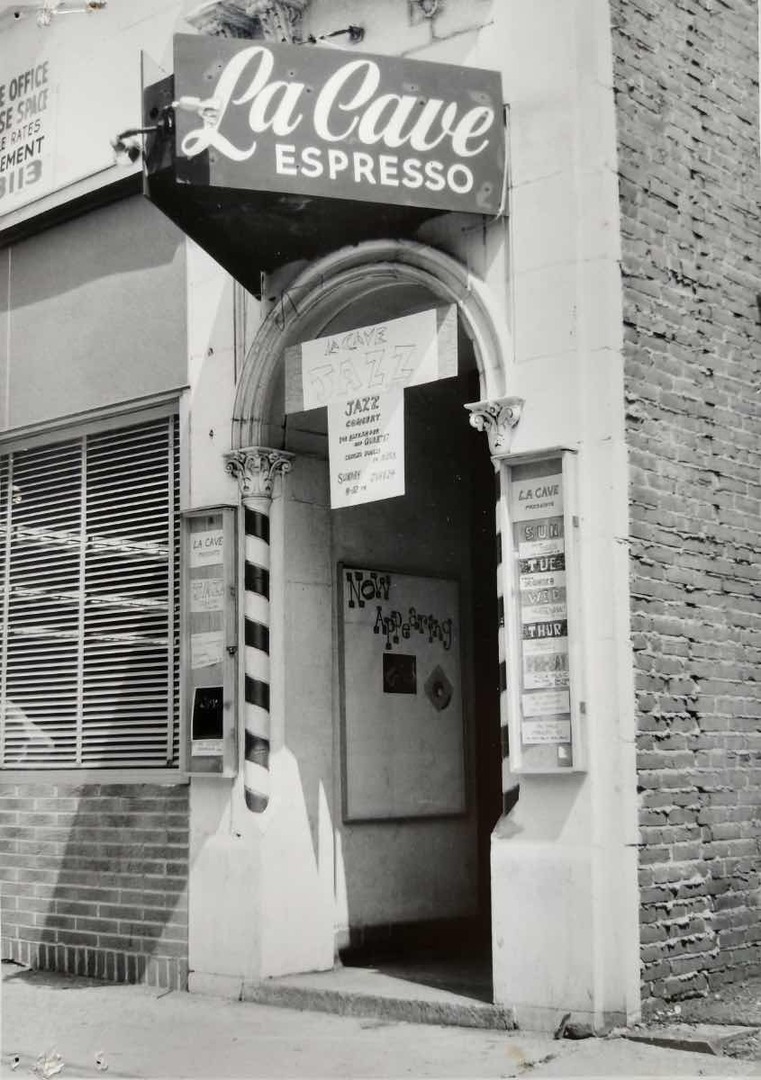
    <summary type="html"><![CDATA[<p><strong><em>Entering the door marked 10615 from the sidewalk on the north side of Euclid Avenue near East 105th Street in the late 1960s, you would have descended a staircase and entered a large, dim room with tables surrounding a stage. Posters and artwork glowed purple on the walls, thanks to the black lights overhead. As one Western Reserve University student observed, the room’s layout created “an intimacy between audience and performer that [was] impossible in a large auditorium.” The atmosphere of this basement venue reflected a transformation from its early ’60s start that was every bit as dizzying as the metamorphosis of popular music in the same years. </em></strong></p><img src="https://clevelandhistorical.org/files/fullsize/5c9b73888d79cc67806fabdcc9a2d36d.jpg" alt="La Cave Entrance " /><br/><p><span>Into the early 1960s, Cleveland nightlife opportunities for students and young adults were limited until the opening of La Cave, a coffeehouse turned folk music club within walking distance of University Circle. La Cave provided an affordable and eclectic local music venue that enhanced the nightlife for younger crowds and helped establish Cleveland’s future reputation in rock music culture. </span><span> </span>
<span>La Cave opened in 1962 in Cleveland’s “<a href="https://clevelandhistorical.org/items/show/49">second downtown</a>” area, which was centered at Euclid Avenue and East 105</span><span>th Street</span><span>. Taking its place alongside movie theaters, bars, restaurants, and stores, La Cave opened as a coffee and folk music house but was not initially successful, at least not until Stan Kain, an eager businessman and folk music lover, took charge of the business with a plan to bring popular folk artists to the Cleveland area. </span><span> </span>
<span>Kain brought acts like</span><span> Phil Ochs, Simon & Garfunkel, Janis Ian, Tim Buckley, and countless more successful folk artists to La Cave in its earlier years.</span><span> A mixture of the artists who played at La Cave and the accessible location drew in a young clientele from nearby schools such as Western Reserve University, the Case Institute of Technology, and the Cleveland Institute of Art.</span><span> </span><span>Overall, the music and atmosphere was something</span><span> fresh</span><span>, making La Cave popular for the younger generation.</span><span> </span><span> </span>
<span>La Cave truly filled a void. College students' concerns about a lack of on-campus entertainment in the early 1960s were especially pronounced where music was concerned. </span><span>As the <em>Case Tech</em> newspaper reported, students leaned towards blaming the “lack of adequate facilities.” </span><span>However, this issue came not from the university but from the performers. The Case Student Congress president noted that “big-name performers would ask exorbitant rates due to the seating capacity problem.”</span><span>Cleveland lacked small clubs like La Cave that offered affordable tickets, high-value performances, and a unique listening experience.</span><span> Students were unhappy with the prices of higher profile groups, but also dissatisfield when less well-known groups performed (even with cheaper ticket costs). </span>
<span>Despite the rapid growth of La Cave’s popularity, Stan Kain managed to maintain a business that suited the younger generation. With costs and types of food, drinks, and a consistent yet different atmosphere, La Cave still drew in college students as its main demographic. Examples of these aspects include food such as </span><span>“nibbles” like sandwiches, pastries, seafood, and pretzels, and drinks like beer, coffee, tea, and soft drinks. </span><span>La Cave’s advertisements emphasized the affordability of these offerings. A central line for most of its advertisements was, “BEER and FOOD TO FIT A COLLEGE BUDGET.” </span><span>Advertisements also made sure to include ticket prices (starting at $2.00), new hours, and in-house activities like bridge, darts, and pool.</span><span> </span>
<span>Kain worked hard to maintain the La Cave experience through the performers he booked to play there and the events he hosted. One of these events was a folk festival featuring Bob Gibson, Josh White, Tom Pasle, and the Knob Lick Upper 10000. By booking bands like the Knob Lick Upper 10000, a pure bluegrass group, the festival allowed listeners to see the typical La Cave performance while also engaging with what was for many patrons an unfamiliar genre. This festival gave Kain an opportunity to explore the idea of venturing beyond just folk music.</span><span> </span>
<span>Over time these acts built La Cave’s popularity and helped the club change alongside the evolving rock music scene of the mid to late ’60s,</span><span> potentially jeopardizing their reputation and integrating unconventional music in Cleveland. </span><span>One of the main acts that brought a new wave of popularity to La Cave was the Velvet Underground, whose shows — especially “La Cave 1968: Problems In Urban Living” — were some of the most influential concerts in La Cave’s history. The Velvet Underground’s shows at La Cave opened doors for other rock performers to test out the crowds in Cleveland.</span><span> The reputation of La Cave changed from a folk cafe to a rock 'n' roll venue where managers and agents of big acts (such as Jefferson Airplane, Hello People, Jeff Beck Group, etc.) were now contacting Kain to have their performers play while hooking the younger generation on rock 'n' roll sound</span><span>.</span>
<span>Although a big reason for La Cave’s popularity was its affordability, it was harder to maintain as the years went on. Many artists that regularly played at La Cave began to outgrow the small venue, and it was harder to get replacements or new performers in general. Price rises in tickets and food heavily affected the turnout at shows and diminished its draw for students. </span>As the Cleveland underground newspaper <i>The Buddhist Third Class Junkmail Oracle </i>observed in 1969, “The major source of problems seems to be a conflict between the kind of concerts students want, and what can be afforded.”<span class="Apple-converted-space"> Ultimately, Kain was unable to overcome the challenges and the financial problems they caused, forcing him to close down in July 1969. </span>
<span>La Cave’s journey from a small bohemian café to one of the most influential rock venues in Cleveland assured its status as one of Cleveland's most impactful music venues. </span><span>Despite its short run, </span><span>La Cave enhanced the college experience in University Circle while simultaneously pointing to Cleveland’s future reputation as the nation’s “Rock and Roll Capital.”</span><span> </span></p><p><em><strong><a href="https://clevelandhistorical.org/items/show/1049">For more (including 6 images) view the original article</a></strong></em></p>]]></summary>
    <published>2024-12-03T04:25:15+00:00</published>
    <updated>2026-04-17T19:17:43+00:00</updated>
    <link rel="alternate" type="text/html" href="https://clevelandhistorical.org/items/show/1049"/>
    <id>https://clevelandhistorical.org/items/show/1049</id>
    <author>
      <name>Caroline J. Sullivan</name>
    </author>
  </entry>
  <entry>
    <title type="html"><![CDATA[The Sisters of Notre Dame : A Century of Devotion to Education in Cleveland ]]></title>
    <summary type="html"><![CDATA[<img src="https://clevelandhistorical.org/files/fullsize/638eacb9b17ce16e346da058fa6da22b.jpg" alt="First Wing of Administration Building" /><br/><p>Notre Dame College, a cornerstone of higher education in South Euclid, Ohio, concluded its 102-year journey in 2024. Founded in 1922 by the Sisters of Notre Dame, the college was renowned for its strong academic programs, dedicated faculty, and vibrant campus life. The college's beautiful campus, designed by architect Thomas D. McLaughlin, is a testament to its rich history and commitment to providing a quality education. However, in more recent years, Notre Dame College faced numerous challenges that ultimately led to its closure. Declining enrollment, rising costs, and changing student expectations put significant strain on the institution's finances. Despite efforts to revitalize the college, these challenges proved insurmountable. The closure of Notre Dame College has had a profound impact on the South Euclid community. The college was a major employer, a cultural hub, and a source of pride for the community. Its loss is deeply felt by alumni, faculty, staff, and students.</p><p>The Sisters of Notre Dame trace their roots back to the Netherlands and Belgium, where the order was founded in 1816. In 1850, they became a separate order and began their mission in Germany. In 1874, the Sisters of Notre Dame arrived in Cleveland to teach at St. Peter’s Church. In 1877, they established Notre Dame Academy for girls, providing young women with quality education. The Sisters also served as the Notre Dame Motherhouse, a convent that housed a mother superior of their community, until 1888, further adding to the prestige and legitimacy of the sisters. The Sisters of Notre Dame and <a href="https://clevelandhistorical.org/items/show/304">St. Peter’s Church</a> share a deep-rooted connection to the Catholic faith and a common mission of serving the community. Both institutions have been integral parts of Cleveland’s Catholic community for over a century, contributing to the city’s rich history and cultural fabric. </p><p>One of their most notable contributions was the founding of Notre Dame College for Women in 1922. Initially located in the Notre Dame Academy that had moved to Ansel Road seven years earlier, the college quickly outgrew the space and moved to a forty-acre farm on Green Road in South Euclid, where it built the iconic Administration Building, a five-story structure that has stood as a prominent landmark in South Euclid since its completion in 1927. Its classrooms, spacious halls, and serene chapel provided an ideal learning environment for generations of women. The building's Gothic Revival architecture, with its arches and pointed windows, created an atmosphere of academic strictness and spiritual contemplation. </p><p>In addition to Notre Dame College, the Sisters went on to provide other educational opportunities, further expanding their commitment to Catholic education. They established Regina High School adjacent to the Notre Dame campus in 1953, Julie Billiart School in Lyndhurst in 1954, and Notre Dame Elementary School in Chardon in 1957. As the educational landscape shifted along with the movement of Catholics to the suburbs, the Sisters sold the old Notre Dame Academy building on Ansel in 1962, and it transitioned into a public junior high school. Notre Dame Academy (now Notre Dame-Cathedral Latin School) then relocated to Chardon.</p><p>Beyond their educational endeavors, the Sisters of Notre Dame have been dedicated to serving the needs of the community. They established Mt. St. Mary’s Institute to care for half-orphans and homeless children, operated a health center for the elderly and ill, and engaged in publishing, early childhood and adult education, and pastoral work. Through their dedication to education, community service, and religious life, the Sisters of Notre Dame have left a lasting legacy on the Cleveland area and beyond. </p><p>Meanwhile, Notre Dame College experienced significant growth and expansion. The South Euclid campus grew to include multiple buildings and sports fields, providing students with a modern and conducive learning environment. The college offered traditional on-campus learning, expanding to include Weekend College for teachers and non-traditional students in 1978 and eventually online courses. The college's commitment to student-centered learning was evident in its supportive academic centers, which provided resources and assistance to help students succeed. Beyond academics, Notre Dame College offered a vibrant campus life with a variety of arts and athletic programs, eventually competing in NCAA Division II. </p><p>However, the combination of declining enrollment and rising costs created a perfect storm for Notre Dame College. Despite efforts to cut costs and increase enrollment, the college was unable to overcome these challenges. Notre Dame, a cornerstone of higher education in South Euclid, Ohio, concluded its 102-year journey in 2024. While Notre Dame College may no longer exist, its legacy lives on. The college's alumni continue to make significant contributions to society, carrying forward the values and knowledge they gained during their time at the institution. The former campus, with its distinctive architecture, stands as a reminder of the college’s rich history and its impact on the community. The closure of Notre Dame College serves as a cautionary tale for other small liberal arts colleges. It highlights the challenges they face in an increasingly competitive higher education landscape. As we move forward, it is important to learn from the past and work to ensure the future of these institutions. All-in-all, it is evident that the sisters had such a rich history of education in the area with the college being the main example of their impact.</p><p><em><strong><a href="https://clevelandhistorical.org/items/show/1043">For more (including 20 images) view the original article</a></strong></em></p>]]></summary>
    <published>2024-11-26T21:26:33+00:00</published>
    <updated>2026-04-17T19:17:43+00:00</updated>
    <link rel="alternate" type="text/html" href="https://clevelandhistorical.org/items/show/1043"/>
    <id>https://clevelandhistorical.org/items/show/1043</id>
    <author>
      <name>Michael Griffin </name>
    </author>
  </entry>
  <entry>
    <title type="html"><![CDATA[Van Horn and Clarke Fields: Pre-Merger Football at Case Western Reserve University]]></title>
    <summary type="html"><![CDATA[<p><strong><em>Case School of Applied Sciences and Western Reserve University grew up as next-door neighbors and friends — until it was time to compete on the athletic field. Seventy-five years of competition ended as the Case Rough Riders and Western Reserve Red Cats  joined forces as the CWRU Spartans.</em></strong></p><img src="https://clevelandhistorical.org/files/fullsize/9cd012990a06ef39581119ed226c2c2b.jpg" alt="Football Players on Van Horn Field" /><br/><p>The blending of Case School of Applied Sciences and Western Reserve University (Adelbert College) began in 1882 as the schools relocated from downtown Cleveland and Hudson, respectively, to adjoining land plots in University Circle. Amasa Stone donated money to acquire land for Adelbert College, and other donors stepped up to contribute funds to acquire adjoining property for Case. The concept of cooperation and collaboration of the two schools appealed to the donors and trustees of both institutions. The northwest-southeast campus spaces were bounded by Euclid Avenue, a railroad line, Adelbert Road, and Doan Brook. Adelbert College faced Case School of Applied Sciences with a shared “front yard” delineated by a sidewalk and, at times, a fence. The faculties and school administrations began a friendly relationship to complement each school’s programs which also manifested the sharing of space and facilities over time as needed. Despite the boundary, students and faculty shared experiences on campus at both institutions. </p><p>So, the story begins with buildings as Case began developing the southwestern ’stripe’ of campus land with one building in 1886 while Adelbert built five buildings on the northeastern ‘stripe’. By 1900, the Case campus occupied six buildings and WRU had nineteen. A center sidewalk marked the schools’ property line. Both schools dedicated space on the south side of campus to athletic fields which mirrored each other. Athletics in colleges in the later 1800s were typified by “pickup” games among students and faculty (intramural games) or “club” games with neighborhood teams involving track and field sports, baseball and, the newcomer, football. Two of Adelbert’s opponents in 1890 were Cleveland high school teams. By 1900, football had grown in national popularity among high school and college sports to the top of the scholastic sporting list. Case and Western Reserve were growing as well. Interscholastic competition was becoming popular and both schools sought to enter the competition. It is noteworthy that collegiate athletics and competition were generally governed not by the schools’ administrations, but by organizations of students, faculty, and patrons (boosters) to support sports programs.</p><p>Frank R. Van Horn was hired to the Case faculty in 1897 as a professor of assaying (geology) but was also assigned extra-curricular duties with the Case Athletic Association, the campus sports organization. Dr. Van Horn took a keen interest in the growing interscholastic scene and its demands upon the community to support the teams with both spirit and financial resources. He began a campaign to raise funds via ticket sales by fencing the field and building grandstands to accommodate spectators at the events in 1903. His planning succeeded with Case ‘Rough Rider’ football thriving for 36 seasons playing 167 home games on Van Horn Field and occasionally hosting 34 Reserve home games as well through 1939. Case, like Reserve, played area teams; the two schools hosted games in Cleveland nearly every week to the pleasure of local fans. Van Horn Field was the campus home field during these four decades, but many of both schools’ games were played at local venues — <a href="https://clevelandhistorical.org/items/show/16" title="League Park">League Park</a>, Shaw High Stadium, and Cleveland<a href="https://clevelandhistorical.org/items/show/149" title="Cleveland Municipal Stadium"> Municipal Stadium</a> — to accommodate larger crowds.</p><p>At Reserve, the blend of alumni and students to organize and ‘administer’ intercollegiate sports began during the 1890s and remained in force until 1919 when an unscrupulous alumnus absconded with the athletic treasury. The school ‘enrolled’ the sports program administration into the physical education department. Reserve ‘Red Cat’ football adopted and maintained a seven- to nine-game schedule in each season between 1891 and 1903 with opponents from around Ohio, Pennsylvania, and New York. Reserve home games were played on Justice John H. Clarke Field on campus as well as other local venues. The development of Van Horn Field provided shared facilities for Reserve as well. Improvements and additions to Clarke Field at mid-century made it the primary home site for WRU with 70 games and Case with 43 games between 1952 and 1966. Each season ended with Case as the opponent on a campus field or at the local League Park.</p><p>Both Case and Reserve scheduled annual opponents that also included Ohio State, Penn State, Cornell, Syracuse, Michigan, Notre Dame, Navy, and once with Alabama along with smaller neighboring college and university teams from the multi-state region during the first four decades decades of the 20th century. The allure of college football grew throughout the first half of the century and both schools maintained healthy fan bases and local attendance on fall Saturdays. Attendance at Saturday football began to diminish in the early 1950s signaling declining interest among students and fans. </p><p>By the end of the 1953 season, Case President T. Keith Glennan assembled a committee to review the athletic program. In December, he announced that football would be dropped from the athletic program. Reactions were strong on both sides of the issue; the loss of tradition and a popular sport versus the increasingly competitive and costly circumstances of intercollegiate football. A “funeral” was held on campus complete with a coffin, deflated football, and one-ton gravestone. Meanwhile, Glennan instructed the Case committee to draft a proposal to assemble a league of schools using Ivy League guidelines for athletics: no athletic scholarships and an emphasis on academics as the primary focus for all students. </p><p>Football continued unabated in 1954. Two years later, both schools became members of the newly formed Presidents Athletic Conference (PAC), which fielded between four and eleven teams over the years. The newly renovated Clarke Field was home to both schools through 1966 while space on campus north of Euclid Avenue was developed for Ed Finnigan athletic fields. Case and Western Reserve cooperated in several ways for the 70+ years they shared space in and around University Circle. On July 1, 1966, the schools announced a federation agreement to become Case Western Reserve University under a single Board of Directors and President. Presidents Glennan of Case and John Millis of WRU had worked towards this merger for several years. The merging of institutional programs would ensue for about four years, but meanwhile the two football teams maintained separate annual schedules through the 1969 season ending with their annual rivalry, a 28–14 victory for WRU on November 15, 1969, played on Finnigan Field. The 1970 CWRU team continued as the Spartans with student athletes from the new federated university. Teams maintained home schedules on Finnigan Field through the 2004 season. In 2005, the new $126 million DiSanto Field opened to host home football and soccer games and house the Bill Sudeck Track. The state-of-the-art facility is nestled among seven dormitory buildings between East 115th and 117th Streets north of Euclid Avenue. </p><p>Meanwhile, Van Horn Field and Clarke Field remained next-door neighbors for 75 years serving intercollegiate and intramural athletics at both institutions in different phases of growth and development. Van Horn remains today, realigned with new facilities as a recreational field in the original location of Van Horn and Clarke Fields on the Case Western Reserve University campus.</p><p><em><strong><a href="https://clevelandhistorical.org/items/show/1034">For more (including 19 images) view the original article</a></strong></em></p>]]></summary>
    <published>2024-10-27T16:08:27+00:00</published>
    <updated>2026-04-17T19:17:43+00:00</updated>
    <link rel="alternate" type="text/html" href="https://clevelandhistorical.org/items/show/1034"/>
    <id>https://clevelandhistorical.org/items/show/1034</id>
    <author>
      <name>Jim Lanese</name>
    </author>
  </entry>
  <entry>
    <title type="html"><![CDATA[Fenn Hall: From Auto Dealership to Engineering School]]></title>
    <summary type="html"><![CDATA[<img src="https://clevelandhistorical.org/files/fullsize/f15be4d9de4345f41e241075b688b3cc.jpg" alt="Stilwell Hall - Entranceway" /><br/><p>Imagine walking into this building located on Cleveland State University's campus near East 24th Street and Chester Avenue, and negotiating with a salesman to buy a Buick! Before it saw institutional use, this building constructed in 1924 was the Ohio Motors Building. It was a car showroom and service building, which sold and serviced Buick automobiles and, later, Lincoln-Mercury automobiles.  </p><p>In the early 1940s, one year after Pearl Harbor was bombed and the United States entered World War II, the building's top floor was converted to a school to teach women hired by two local aircraft factories how to "help build the bombing planes that will rain destruction on Berlin and Tokyo." </p><p>In the 1950s, Fenn College, CSU's predecessor, bought the Ohio Motors building, renovated it, and renamed it Stilwell Hall in honor of Fenn College Board of Trustees' chairman Charles J. Stilwell. Ever since its acquisition by Fenn College, the building has been home to the Fenn School of Engineering. When the school was renamed the Washkewicz College of Engineering in 2013, Stilwell Hall was rechristened Fenn Hall to preserve the Fenn name's long association with the engineering program. The "Foxes' Den Lounge" located in Fenn Hall in what was formerly the auto showroom is the lone reminder of a time when the campus mascot was the Fenn "Foxes" rather than the CSU "Vikings."  </p><p>For over half a century, Fenn Hall has provided training for area engineers and provided Fenn College — and now Cleveland State University — with much-needed classrooms, labs, a library, and an auditorium.</p><p>While Fenn Hall is located closer to Chester Avenue than to Euclid Avenue, it nonetheless is connected not only to Cleveland's early retail automobile industry, but also to Cleveland's nineteenth-century millionaires. Fenn Hall sits on a portion of what formerly were the grounds of the Tom L. Johnson mansion.</p><p><em><strong><a href="https://clevelandhistorical.org/items/show/529">For more (including 8 images) view the original article</a></strong></em></p>]]></summary>
    <published>2012-07-29T12:45:08+00:00</published>
    <updated>2026-04-17T19:17:39+00:00</updated>
    <link rel="alternate" type="text/html" href="https://clevelandhistorical.org/items/show/529"/>
    <id>https://clevelandhistorical.org/items/show/529</id>
    <author>
      <name>Jim Dubelko</name>
    </author>
  </entry>
  <entry>
    <title type="html"><![CDATA[CSU Student Center]]></title>
    <summary type="html"><![CDATA[<img src="https://clevelandhistorical.org/files/fullsize/6fd24196d7afa7858e10bb5a589c2512.jpg" alt="The New CSU Student Center" /><br/><p>The Cleveland State University Student Center is located on land that was in the nineteenth century the site of the Perry-Payne homestead. The property consisted of two mansions. One directly across the street from Trinity Cathedral was owned by Nathan Perry. The other immediately to the west was owned by Henry B. Payne, the first U.S. Senator from Cleveland.</p><p>Cleveland State University has had two student centers since it opened in 1966. The first student center, known simply as University Center or "UC," opened in 1974. Designed by the noted Cleveland modernist architect Don Hisaka, the building was an L-shaped concrete structure embracing a tall glass atrium whose noisiness led students to nickname it the Birdcage. </p><p>But it was another feature of the UC that proved to be its undoing: its fortress-like concrete wall overlooking Euclid Avenue. In the wake of the tumultuous late Sixties, with its antiwar protests and urban riots, it is hardly surprising that Cleveland State, like many other universities, opted to build bunker-like campus buildings atop solid concrete platforms. In facing inward on the central plaza and turning its back to Euclid Avenue, the UC symbolized the worries of its time. </p><p>The passage of three decades created a fresh approach to the campus. The University spoke of the city as its campus and began to undo the insularity of its 1970s campus by envisioning new or renovated buildings that would turn welcoming, glassy faces toward the street. To that end, the renowned firm Gwathmey Siegel & Associates Architects LLC of New York designed CSU's curvy new Student Center, which opened in 2010. The same firm planned major projects for many American universities, including Cincinnati, Cornell, Duke, Harvard, and Yale; oversaw the renovation of the Guggenheim Museum; and even built Hollywood icon Stephen Spielberg's home in East Hampton, New York. </p><p>For CSU's Student Center, Gwathmey Siegel arrayed the bookstore, dining, lounge, computer access, and conference spaces around a bright, airy, three-story atrium. The one nod to the past in this otherwise futuristic building is its inclusion of two 1930s murals created for the Valleyview Homes in Tremont by Federal Art Project artists during the Great Depression and saved by the late CSU art professor Walter Leedy when the housing project was facing demolition. From top to bottom, the forward-looking Student Center is now the center of life on the Cleveland State University campus.</p><p><em><strong><a href="https://clevelandhistorical.org/items/show/527">For more (including 9 images&#32;&amp;&#32;1 audio file) view the original article</a></strong></em></p>]]></summary>
    <published>2012-07-29T07:31:27+00:00</published>
    <updated>2026-04-17T19:17:39+00:00</updated>
    <link rel="alternate" type="text/html" href="https://clevelandhistorical.org/items/show/527"/>
    <id>https://clevelandhistorical.org/items/show/527</id>
    <author>
      <name>Jim Dubelko</name>
    </author>
  </entry>
  <entry>
    <title type="html"><![CDATA[Fairmount Circle: A Second &quot;University Circle&quot;]]></title>
    <summary type="html"><![CDATA[<img src="https://clevelandhistorical.org/files/fullsize/252609c029a65446d14a4df4b8f76ab7.jpg" alt="University School, Shaker campus" /><br/><p>In January 1925, the Van Sweringen Company conveyed 113 acres of land to the University Realty Company.  The land conveyed was located in in the villages of Shaker Heights and Idlewood--in the vicinity of the intersection of Fairmount Boulevard and Warrensville Center Road.  This transfer of land completed a complex real estate deal that created the Fairmount Circle neighborhood.  The Van Sweringens believed that this new neighborhood would one day become the Cleveland area's second "University Circle."   </p><p>The official plat of the Fairmount Circle neighborhood, prepared by Harry Gallimore of the F.A. Pease Engineering Company, featured a prominent traffic circle at the intersection of four roads--Fairmount Boulevard, Warrensville Center Road, North Park Boulevard, and Meadowbrook Boulevard.  The traffic circle was designed to have a 900 foot circumference.  It was to provide, according to a January 18, 1925 article in the Cleveland Plain Dealer, "eight imposing corner sites" for "artistic buildings."</p><p>Fairmount Circle arguably never evolved into the second University Circle that the Van Sweringens believed it would.  However, its development did induce several excellent educational institutions to relocate to the Circle neighborhood during the period 1925-1927.  </p><p>In 1925, John Carroll University (formerly St. Ignatius College) moved from West 30th Street on the near west side of Cleveland to the northeast quadrant of Fairmount Circle located in Idlewood Village.  The Village subsequently changed its name to "University Heights" in honor of John Carroll University's new campus. In addition to John Carroll, two old and well-established Cleveland private academies moved to sites on other quadrants of Fairmount Circle that were located in the City of Shaker Heights.  </p><p>University School, one of the two prestigious academies that moved to Shaker Heights, was founded in 1876 and had been located on Hough Avenue in Cleveland for 50 years.  In 1926, University School moved to a new site on a southeast quadrant of Fairmount circle. One year later, in 1927, Hathaway Brown moved to a location on a southwest quadrant of the circle.  Hathaway Brown, like University School, was founded in 1876.  Before moving to its new Shaker Heights campus, it had been located in Cleveland on East 97th Street near Euclid Avenue.</p><p>Today, nearly 90 years later, these three educational institutions still call Fairmount Circle their home. Fairmount Circle remains a pleasant residential neighborhood on the north side of Shaker Heights.  </p><p><em><strong><a href="https://clevelandhistorical.org/items/show/417">For more (including 7 images) view the original article</a></strong></em></p>]]></summary>
    <published>2012-03-05T21:47:04+00:00</published>
    <updated>2026-04-17T19:17:38+00:00</updated>
    <link rel="alternate" type="text/html" href="https://clevelandhistorical.org/items/show/417"/>
    <id>https://clevelandhistorical.org/items/show/417</id>
    <author>
      <name>Jim Dubelko</name>
    </author>
  </entry>
  <entry>
    <title type="html"><![CDATA[Saint Ignatius High School]]></title>
    <summary type="html"><![CDATA[<img src="https://clevelandhistorical.org/files/fullsize/ignatius-circa1890low_dc44d019fe.jpg" alt="St. Ignatius, circa 1890s" /><br/><p>Cleveland's Catholic schoolchildren began attending parochial schools in their neighborhoods during the 1850s, opting to avoid the public school system which many saw as being anti-Catholic.  These first Catholic schools were merely grammar schools, however, and did not offer advanced education. Cleveland's Catholic population continued to grow in the last quarter of the 19th-century with an influx of Catholic immigrants from southern and eastern Europe joining the Irish and Germans already in town. Recognizing the growing need for better and more extensive Catholic education in the city, Bishop Richard Gilmour invited a group of Jesuits priests from Buffalo to start a Catholic college on the city's near west side.</p><p>St. Ignatius College opened with 76 students in 1886 in a wood-framed building at West 30th Street and Carroll Avenue. Its five-story brick main building (which remains standing today) did not open until 1890. Initially, St. Ignatius offered a seven year course of study which ended with the granting of a Bachelor of Arts degree.  A 1905 book on education in Cleveland explained that a student at the college could expect to take courses on "Christian doctrine, the Latin, Greek, and English languages; rhetoric, poetry, elocution, and English literature; mathematics, physics, and chemistry; history and geography; bookkeeping and penmanship."  The seventh year of instruction was dedicated exclusively to the study of philosophy. </p><p>In 1902, the high school and college became separate entities, resulting in a more modern arrangement.  In 1935 the college, which switched its name to John Carroll University in 1923, moved to its own campus in suburban University Heights.  St. Ignatius High School remained in Ohio City and has since expanded outward from its original building, with its campus now clustered along both sides of Lorain Avenue between West 28th and West 32nd Streets.  It is known for its excellent academics, championship-winning sports teams, and community service within Ohio City.  </p><p><em><strong><a href="https://clevelandhistorical.org/items/show/157">For more (including 6 images&#32;&amp;&#32;1 video) view the original article</a></strong></em></p>]]></summary>
    <published>2011-03-08T08:50:44+00:00</published>
    <updated>2026-04-17T19:17:37+00:00</updated>
    <link rel="alternate" type="text/html" href="https://clevelandhistorical.org/items/show/157"/>
    <id>https://clevelandhistorical.org/items/show/157</id>
    <author>
      <name>Mark Pecot</name>
    </author>
  </entry>
  <entry>
    <title type="html"><![CDATA[CSU College of Law]]></title>
    <summary type="html"><![CDATA[<img src="https://clevelandhistorical.org/files/fullsize/a2a690ce1c6df9c27b5236e1d6121109.jpg" alt="Law Library" /><br/><p>While the CSU College of Law has been a part of Cleveland State University since 1969, its history as a Cleveland-area law school dates back to the late nineteenth century. In 1897, Cleveland Law School was established, becoming Ohio's first evening law school. It also became the first law school in Ohio to admit women and one of the first in the state to admit minority students.  </p><p>In 1946, Cleveland Law School merged with John Marshall School of Law, which had been founded in 1916 by several Cleveland attorneys. The new Cleveland-Marshall Law School moved into the Ontario Building at 1240 Ontario Street, where it remained for several decades until the law school building was demolished to make room for the Cuyahoga County Justice Center. </p><p>In 1969, Cleveland-Marshall officially affiliated itself with Cleveland State University, becoming the Cleveland-Marshall College of Law.  The new CSU college held classes in several buildings on campus, including Rhodes Tower and the Chester Building, before it moved into its own building on the corner of East 18th Street and Euclid Avenue in 1977.  The building was dedicated that year by Prince Charles of England.  A major addition to the building, including a state of the art law library, was added in 1997. In 2022, the CSU  Board of Trustees voted to approve changing the school's name, dropping its namesake, who was a U.S. Supreme Court Chief Justice John Marshall but also a slaveholder.</p><p>The Cleveland-Marshall College of Law sits on grounds that were at one time occupied by the Millionaire Row mansions of two of Cleveland's most prominent nineteenth-century businessmen—E.W. Oglebay, the co-founder of Oglebay-Norton Mining Co., and Truman Handy, president of Mercantile Bank and promoter of the early railroad industry in midwest America.   </p><p><em><strong><a href="https://clevelandhistorical.org/items/show/88">For more (including 8 images&#32;&amp;&#32;5 audio files) view the original article</a></strong></em></p>]]></summary>
    <published>2010-11-16T12:08:24+00:00</published>
    <updated>2026-04-17T19:17:37+00:00</updated>
    <link rel="alternate" type="text/html" href="https://clevelandhistorical.org/items/show/88"/>
    <id>https://clevelandhistorical.org/items/show/88</id>
    <author>
      <name>Jim Dubelko</name>
    </author>
  </entry>
  <entry>
    <title type="html"><![CDATA[Mather Mansion: A Remnant of Millionaires&#039; Row]]></title>
    <summary type="html"><![CDATA[<img src="https://clevelandhistorical.org/files/fullsize/mathermansion1_4c070c97d1.jpg" alt="Mather Mansion, Exterior" /><br/><p>In the days of horse-drawn carriages and booming industry, one street in Cleveland showcased the elite among the city's citizens. Millionaires' Row, a length of Euclid Avenue, was where prominent figures such as John D. Rockefeller, Marcus Hanna, and Charles F. Brush built their mansions. The largest among them was built for Samuel Mather, chairman of Pickands, Mather & Company, one of the four largest shippers of iron ore in the country. He held the position of officer or director for over two dozen iron, banking, and transportation corporations. For years Mather was among the richest citizens in Cleveland and contributed more than $8 million to community-based organizations. </p><p>When it was completed in 1910, the 45-room Mather Mansion  was the most expensive home in Cleveland and was the largest home ever built on Euclid Avenue. It was among the street's most luxurious mansions, with handcrafted stone, brick and woodwork and a third-floor ballroom with a 16-foot ceiling that could easily hold 300 guests. Mather Mansion's scale and opulence reflected its owner's attempt to arrest the declining desirability of Millionaires' Row as commercial and industrial buildings encroached. Mather commissioned Charles Schweinfurth, who had previously designed the Rockefeller Park Bridges and at least twelve homes on the street, to design the mansion. Mather was already a supporter of Schweinfurth's work, having given the architect $1 million to cover the cost of building nearby Trinity Cathedral. </p><p>As the commercial district of Cleveland pressed further down Euclid Avenue, the elaborate homes began to lose their grandeur in the wake of skyscrapers and large retail stores, and Mather's home proved to be the last built on the storied street. Between 1923 and 1951, many of the homes on Millionaire's Row were demolished to make way for parking lots and commercial buildings. In the mid-1950s, the homes between Mather Mansion and East 30th Street were demolished to make way for the Innerbelt Freeway. Even more homes were torn down in the following decades to accommodate the expansion of Cleveland State University's campus. </p><p>Yet, lying just out of the way of the interstate highway and at some distance from the core of CSU's emerging campus, Mather Mansion survived. Upon Samuel Mather's death in 1931, the residence passed to the Cleveland Institute of Music and in 1940 the property was transferred to the Cleveland Automobile Club (an affiliate of AAA). In 1967 Cleveland State University acquired and renovated Mather Mansion, and six years later the house became one of the first Cleveland buildings to be listed on the National Register of Historic Places. By 1975, Mather Mansion was among only seven remaining Millionaire Row's homes, allowing a rare glimpse of the magnificence that once dominated Euclid Avenue. In 2009-10 it served as the temporary home of the University's History and Philosophy departments.  </p><p>In 2014, the university abandoned plans to renovate the Tudor mansion into a boutique hotel and instead allocated $2.7 million to renovate the mansion into the new home for the Center for International Services and Programs, a program to teach English as a second language. </p><p><em><strong><a href="https://clevelandhistorical.org/items/show/87">For more (including 8 images&#32;&amp;&#32;4 audio files) view the original article</a></strong></em></p>]]></summary>
    <published>2010-11-16T11:22:26+00:00</published>
    <updated>2026-04-17T19:17:37+00:00</updated>
    <link rel="alternate" type="text/html" href="https://clevelandhistorical.org/items/show/87"/>
    <id>https://clevelandhistorical.org/items/show/87</id>
    <author>
      <name>Danielle Rose</name>
    </author>
  </entry>
  <entry>
    <title type="html"><![CDATA[Cleveland State University: Established 1964]]></title>
    <summary type="html"><![CDATA[<img src="https://clevelandhistorical.org/files/fullsize/45f57f5f456aa5b2775710108bf926e2.jpg" alt="Along Euclid Avenue" /><br/><p>Desiring to place a public institution of higher learning within thirty miles of every Ohio resident, Governor James Rhodes proposed the establishment of a state university in Cleveland following a unanimous recommendation from the Ohio Board of Regents in June 1964. The result was House Bill No. 2, a bipartisan effort introduced to the House during a special session convened by Rhodes in November. The bill easily passed through the legislature and on December 18, 1964, Rhodes signed it into law. The new university assumed responsibility for Fenn College, making the campus its nucleus, and on September 27, 1965, classes officially began at Cleveland State University.</p><p>Fenn College was a small institution of 1,675 full-time students with only a few buildings comprising its campus including the 22-story Fenn Tower. CSU's first year saw enrollment jump to 3,416 full-time scholars and in order to accommodate the dramatic influx of students, military-style Quonset huts were erected for class instruction. Recognizing the need to expand, in March 1966 the Board of Trustees announced design plans for University Tower, Main Classroom, and the Science Building. Three years later under President Harold Enarson the Cleveland-Marshall Law School became part of Cleveland State, remaining at its location on Ontario Street until 1972 when the building was sold to make way for the new Justice Center. In 1977 Cleveland-Marshall's permanent building was completed on campus with Prince Charles presiding over the dedication of the school's new home. That same year CSU's second President, Walter Waetjen, announced the College of Urban Affairs would replace the Institute of Urban Studies, becoming the university's seventh college when its doors opened. Now called the Maxine Goodman Levin College of Urban Affairs, it ranks #2 among schools of its kind in the country.</p><p>The 1980s in many ways proved to be a turbulent time for the young university. Over a period of several months in 1982 three people were slain on campus by Frank Spisak Jr. who was eventually apprehended in September and sentenced to death the following summer. The decade would close in controversy after a salary dispute led to the firing of administrator Raymond Winbush. The incident heightened racial tensions on campus and led to the student occupation of Fenn Tower in protest of his dismissal. Recruiting violations by the Men's Basketball program and the eventual demise of head coach Kevin Mackey added to the decade's despair, though the team would become a rallying point for the university in 1986. That year Mackey's Cinderella squad took the NCAA tournament by storm, advancing to the Sweet 16 before falling to Navy.</p><p>CSU had more to cheer about in 1991 as the long-awaited 13,610-seat Convocation Center was finally completed. Later renamed the Bert L. & Iris S. Wolstein Convocation Center, the venue has hosted a diverse array of events ranging from monster truck shows to a presidential debate. The new Convocation Center, however, could not prevent the turmoil that plagued the 1980s from spilling over into the 1990s as disputes between the administration and faculty led to the faculty unionizing while declining enrollment numbers forced the Board of Trustees to consider major cutbacks. Then, as the decade wound down and the world braced for Y2K, the PeopleSoft program the university used to manage financial aid records crashed unexpectedly. The fallout from this episode nearly forced CSU to close its doors and it took a number of years for the university to fully recover.</p><p>A new era was ushered in at CSU in 2001, however, when Michael Schwartz became Cleveland State's fifth  president. Under President Schwartz the university moved away from its open enrollment policy in implementing admissions standards, the honors program was established, and campus revitalization efforts commenced. These efforts included the construction of a new student center, increased campus housing, renovation of the law school building, and installation of the now iconic "CSU" letters on Rhodes Tower. Schwartz stepped down in 2009 with Ronald Berkman picking up the torch in his place. President Berkman, a unanimous selection by the Board of Trustees, has continued to improve CSU, notably orchestrating the construction of The Center for Innovation and Entrepreneurship.</p><p>In 2014 Cleveland State celebrated its 50th  anniversary and while the first five decades may have been trying at times, CSU has transformed itself from an inward facing commuter campus to an outwardly directed anchor of the emerging Campus District. Beginning with a handful of buildings tucked away between East 24th  Street and the Innerbelt Freeway, Cleveland State now boasts eight colleges, over 200 academic programs, and an enrollment of some 17,000 students.</p><p><em><strong><a href="https://clevelandhistorical.org/items/show/77">For more (including 14 images&#32;&amp;&#32;8 audio files) view the original article</a></strong></em></p>]]></summary>
    <published>2010-11-03T13:18:38+00:00</published>
    <updated>2026-04-17T19:17:37+00:00</updated>
    <link rel="alternate" type="text/html" href="https://clevelandhistorical.org/items/show/77"/>
    <id>https://clevelandhistorical.org/items/show/77</id>
    <author>
      <name>Joseph Wickens</name>
    </author>
  </entry>
  <entry>
    <title type="html"><![CDATA[Fenn Tower: &quot;The Campus in the Clouds&quot;]]></title>
    <summary type="html"><![CDATA[<img src="https://clevelandhistorical.org/files/fullsize/297fec656bd9767cd0df86a03e24c740.jpg" alt="Fenn Tower ca. 1955-60" /><br/><p>The origins of Cleveland State University date to 1870, when the Cleveland Young Men's Christian Association began offering free evening classes in French and German. After a decade of sporadic course offerings, the YMCA's evening educational program became firmly established in 1881. In 1906, the YMCA combined its newly created day school with the evening program under the name Association Institute. Fifteen years later, it was renamed the Cleveland YMCA School of Technology.</p><p>The need to achieve accreditation led the YMCA to reorganize its educational program in 1930. At that time, the school was renamed Fenn College, in honor of Sereno Peck Fenn, who had served as president of the Cleveland YMCA for 25 years and as a board director between 1868 and 1920. College lore holds that another motivation for the name change was students’ desire for a more prestigious-sounding diploma.</p><p>With several private colleges in Cleveland, including Case Institute of Technology and Western Reserve University, Fenn College focused on serving students for whom college otherwise would be financially unattainable. It offered a low-cost, high-quality education and became the second college in Ohio, after the University of Cincinnati, to adopt a cooperative education program. This model of alternating classroom study with paid employment was required for all day students and optional for evening students. Fenn also operated Nash Junior College, the first such program in the state, for a few years in the 1930s.</p><p>In 1937, Fenn College purchased the 22-story National Town and Country Club building at Euclid Avenue and East 24th Street. The tower had been conceived during the height of Cleveland’s Roaring Twenties prosperity. Composed of many of the city’s leading businessmen and professionals, the club broke ground only days after the 1929 stock market crash. Designed by George B. Post—the architect of the New York Stock Exchange and the Cleveland Trust Company—the building reflected the Art Deco style with strong Mayan motifs. </p><p>Its lower floors contained resort-like amenities, including six bowling alleys, an English pub, formal dining rooms (one of them paneled with Macacauba wood from East Africa), a Turkish bath, a natatorium, a gymnasium, and handball and squash courts. Upper floors served as guest rooms for members and their guests from out of town. The tower’s crown featured a terrazzo-tiled solarium that even provided “ultraviolet ray equipment” to counter Cleveland’s dreary winters.</p><p>The club held only one event in the building before the Great Depression forced its dissolution, leaving the tower vacant until Fenn College acquired it. Renamed Fenn Tower in 1939, the former club provided much-needed classroom and office space and gave the college a prestigious Euclid Avenue address. Variously nicknamed the "Skyscraper Schoolhouse" and the "Campus in the Clouds,” the reconfigured Fenn Tower contained classrooms, a library, a gymnasium, a pool, student lounges, and other amenities—all within its vertical confines.</p><p>Throughout its history, Fenn College never operated at a deficit. By 1963, however, increasing operating costs, competition from the new Cuyahoga Community College, and rumors of a possible state takeover placed the institution under severe financial strain. That year, the college released <i>A Plan for Unified Higher Education in Cleveland–Northeastern Ohio</i>, calling upon the state to charter a public university in Cleveland, using Fenn College as its nucleus.</p><p>In his 1962 campaign for governor, James A. Rhodes proposed that every Ohioan should live within 30 miles of a state university. At the time, the nearest such institution to Cleveland was Kent State. On December 18, 1964, Governor Rhodes signed legislation creating Ohio's seventh state university, Cleveland State University, and announced the appointment of a board of trustees with James Nance as its first chairman.</p><p>For the next forty years, as CSU expanded westward along Euclid Avenue, Fenn Tower continued to serve a variety of functions, including classrooms, offices, and a class-registration and health center. In 2006, this once self-contained skyscraper “campus” for commuters became a residence hall, marking CSU’s first step toward developing a substantial residential student population.</p><p><em><strong><a href="https://clevelandhistorical.org/items/show/54">For more (including 17 images, 2 audio files,&#32;&amp;&#32;2 videos) view the original article</a></strong></em></p>]]></summary>
    <published>2010-09-22T10:45:14+00:00</published>
    <updated>2026-04-17T19:17:37+00:00</updated>
    <link rel="alternate" type="text/html" href="https://clevelandhistorical.org/items/show/54"/>
    <id>https://clevelandhistorical.org/items/show/54</id>
    <author>
      <name>J. Mark Souther</name>
    </author>
  </entry>
  <entry>
    <title type="html"><![CDATA[University Hospitals]]></title>
    <summary type="html"><![CDATA[<img src="https://clevelandhistorical.org/files/fullsize/universityhospitals2_47a0028091.jpg" alt="Hanna House, 1930" /><br/><p>University Hospitals of Cleveland is a world-class, not-for-profit medical institution with close ties to Case Western Reserve University. Its roots go back to 1866, with the formation of the Cleveland City Hospital Association, a charitable society designed to provide medical care to Cleveland's poor. The association's hospital quickly outgrew its original facilities and in 1876 moved into the Marine Hospital at East 9th Street and Lakeside Avenue. Eventually it became known as Lakeside Hospital and, in 1895, was affiliated with Western Reserve University's Medical Department.</p><p>In 1925, Lakeside Hospital formally merged with Maternity Hospital and Babies & Children's Hospital - two other Cleveland medical institutions that formed around the turn of the century with the aid of charitable contributions. This merger created University Hospitals of Cleveland and led to the development of new medical programs, services, and facilities throughout the greater Cleveland area. Much of the new construction occurred in University Circle, where University Hospital's main campus remains today.  </p><p><em><strong><a href="https://clevelandhistorical.org/items/show/45">For more (including 7 images&#32;&amp;&#32;3 audio files) view the original article</a></strong></em></p>]]></summary>
    <published>2010-09-19T10:23:48+00:00</published>
    <updated>2026-04-17T19:17:36+00:00</updated>
    <link rel="alternate" type="text/html" href="https://clevelandhistorical.org/items/show/45"/>
    <id>https://clevelandhistorical.org/items/show/45</id>
    <author>
      <name>CSU Center for Public History and Digital Humanities</name>
    </author>
  </entry>
  <entry>
    <title type="html"><![CDATA[Peter B. Lewis Building: Frank Gehry Designs a Home for the Case Weatherhead School]]></title>
    <summary type="html"><![CDATA[<img src="https://clevelandhistorical.org/files/fullsize/peterblewis2_643a0a2cfd.jpg" alt="Entrance " /><br/><p>Designed by world-famous architect Frank Gehry, the Peter B. Lewis Building's unique architectural features symbolize the Case Western Reserve University Weatherhead School of Management's innovative approach to management education. Opened in 2002, the wavy, stainless-steel sheathed landmark takes its name from Peter B. Lewis, Chairman of the Progressive Insurance Company, whose vision and support made the building possible. Lewis had previously commissioned Gehry to design an iconic downtown lakefront skyscraper as a new headquarters for Progressive and a home for himself in Lyndhurst. Neither was built, and cost overruns threatened to nix the new Weatherhead project until Lewis followed his original gift with an even larger one. The building continues in its original purpose of providing workspaces and classrooms to Weatherhead School of Management's students and faculty. In 2018, the demolition of the adjacent former home of the Cleveland Institute of Art opened a parklike expanse to the west that provides a better vista of the building, which was previously difficult to see except from the streets that line its southern and eastern flanks.</p><p><em><strong><a href="https://clevelandhistorical.org/items/show/39">For more (including 6 images&#32;&amp;&#32;3 audio files) view the original article</a></strong></em></p>]]></summary>
    <published>2010-09-18T15:46:25+00:00</published>
    <updated>2026-04-17T19:17:36+00:00</updated>
    <link rel="alternate" type="text/html" href="https://clevelandhistorical.org/items/show/39"/>
    <id>https://clevelandhistorical.org/items/show/39</id>
    <author>
      <name>CSU Center for Public History and Digital Humanities</name>
    </author>
  </entry>
  <entry>
    <title type="html"><![CDATA[Case Western Reserve University: The Evolution of a Renowned University]]></title>
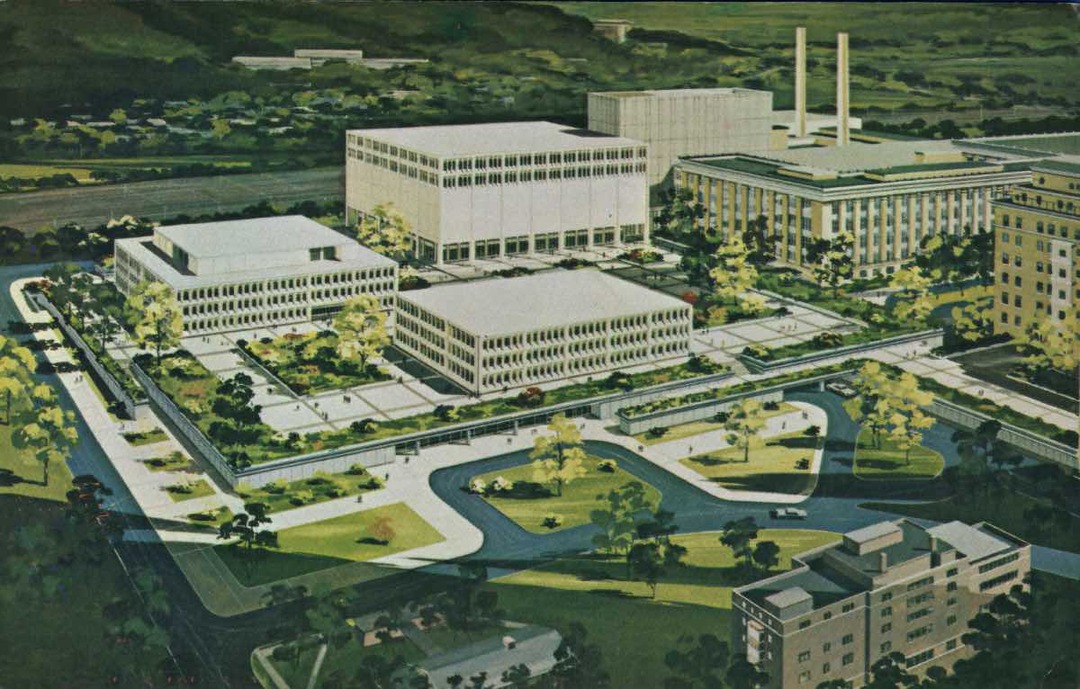
    <summary type="html"><![CDATA[<p><strong><em>Two colleges growing in parallel through the nineteenth century achieved a cooperative union in 1967 and emerged as a premier educational institution in Cleveland and beyond.</em></strong></p><img src="https://clevelandhistorical.org/files/fullsize/ba8a3ad4174ab34278f7d98d8eb8d28c.jpg" alt="Health Science Center" /><br/><p>Case Western Reserve University traces its roots to Western Reserve College, founded in Hudson, Ohio, in 1826.  Three faculty members began instruction in theology, ancient languages, and mathematics/natural philosophy and began to graduate students in 1830. Western Reserve grew up in Hudson through national economic hardships and many political and academic challenges. Abolitionism, the Civil War, and the education of women were among the issues that shaped the College in the mid to late 19th century. Presidents George Pierce, Henry Hitchcock, and Carroll Cutler guided the development and logistics of Western Reserve’s curriculum, facilities, and finances from 1834 to 1886. The Cleveland Medical College was founded in 1843 in downtown Cleveland as an autonomous department of Western Reserve College. Among the growth in faculty during this time, Edward Morley was appointed as a Professor of Chemistry in 1869 (remaining until 1906) as a leader in chemistry and physics instruction. Economic and population growth in northern Ohio encouraged the school’s leaders to consider the metropolitan area and its resources for a relocation of the College from Hudson to Cleveland. Industrialist Amasa Stone financed the college’s move to Cleveland’s University Circle in 1880. The College moved its programs to newly constructed buildings along Euclid Avenue adjacent to the Case School of Applied Science and within six years established Adelbert College (for men), the College for Women and embraced affiliation with Music and Art programs in the locale.   </p><p>The Case School of Applied Science was the brainchild of philanthropist Leonard Case, Jr. He financed the founding of the school in 1880 originally holding classes in the family home near Cleveland’s Public Square until construction of buildings along Glenwood Street (later becoming East Boulevard, then Martin Luther King Drive) in University Circle were completed. Western Reserve and Case became neighbors in 1882, and the schools began to share relationships through faculty research and program cooperation. CWRU historian, C. H. Cramer noted that in 1880, “the two schools agreed on ‘friendly cooperation’ —and for some time there was good will and good spirit between the institutions.”  A fire at Case Main building prompted Adelbert College to provide rooms and equipment for Case programs. One of the first appointments to the Case faculty was physicist Albert Michelson. The two schools’ relationship became the setting for the groundbreaking Michelson-Morley Experiment, an 1887 study which laid the groundwork for modern theories of physics involving the measurement of light. Four presidents: Cady Staley, Charles Howe, William Wickenden, and T. Keith Glennan guided Case School Applied Science into Case Institute of Technology by 1947. Increased cooperation and federation with Western Reserve University from 1886 to 1966 was evident despite faculty, student, and alumni resistance to any discussions of an institutional merger. </p><p>Meanwhile, WRU continued growing through the decades and into the 20th century with the addition of Schools of Law, Dentistry, Graduate Programs, Pharmacy, Applied Social Sciences, Nursing, Education, Architecture, Business/Management, and Library Science by 1941. Cleveland College of Western Reserve University (and affiliated with Case) was established on Public Square in the Chamber of Commerce Building to provide downtown access to programs during days and evenings. At Case, under President Wickenden, the curriculum was molded to include humanities as part of the engineering program. Also notable was the admission of women into undergraduate programs in the sciences at Case during 1943 to bolster the Army and Navy workforce during the war. Women continued to earn degrees through 1954 when admissions ceased until 1960 at which time women were welcomed to all science and engineering programs permanently. Upon the aftermath of World War II, Keith Glennan, a businessman, assumed the presidency of Case Institute of Technology. He guided an era of unprecedented growth and expansion of the school and its programs via newfound support from foundations and government contracts. Glennan twice used leaves of absence to join the Atomic Energy Commission and to head NASA during his tenure which expanded his university’s exposure and engagement. Glennan also endorsed the notion that engineers and technologists needed to broaden their knowledge of human and social behavior and, consequently, expanded the curricula to that end. He noted that one economical method to implement this educational approach was to federate with “the complementary institution that was within eyesight of the Case administration building.” Glennan was also influenced by the merger of Fenn College of Engineering with Cleveland State University which eliminated a private engineering school in Cleveland and by the insights of the Carnegie Foundation president John Gardner concerning the advantages of a merged university in Cleveland. He and WRU president John Millis began regular meetings to discuss the possibilities of a federation or merger and sought consultant studies and expert input concerning the prospect.</p><p>The name Case Western Reserve University was derived from the merger of Western Reserve University and Case Institute of Technology. The process culminated a year-long administrative consolidation after both institutions' trustees’ approved merger plans. The plan required equal partnership and status of Case and WRU, despite their respective size differences and renewed vocalized resistance by faculty and alumni. Robert Morse succeeded Glennan as president of Case on July 1, 1966, and one year later became president of Case Western Reserve University. Eight more presidents would lead the institution through 2017 which marked the 50th anniversary of the merger and a celebration of the benefits and growth of the University and its developmental impact upon the University Circle region of Cleveland. </p><p><em><strong><a href="https://clevelandhistorical.org/items/show/37">For more (including 12 images&#32;&amp;&#32;4 audio files) view the original article</a></strong></em></p>]]></summary>
    <published>2010-09-18T14:21:26+00:00</published>
    <updated>2026-04-17T19:17:36+00:00</updated>
    <link rel="alternate" type="text/html" href="https://clevelandhistorical.org/items/show/37"/>
    <id>https://clevelandhistorical.org/items/show/37</id>
    <author>
      <name>Jim Lanese</name>
    </author>
  </entry>
  <entry>
    <title type="html"><![CDATA[University Circle: Cleveland&#039;s Cultural Heart and Ed-Med District]]></title>
    <summary type="html"><![CDATA[<img src="https://clevelandhistorical.org/files/fullsize/eece50a1416520cc1cbfb6739796e3b8.jpg" alt="University Circle, 1929" /><br/><p>Parklike University Circle is the cultural, medical, and educational center of Cleveland's east side. Named after a streetcar turnaround on Euclid Avenue just east of East 107th Street, University Circle attracted Western Reserve University from Hudson, Ohio in the 1880s. The university was soon joined by a number of other major institutions such as the Cleveland Museum of Art and the Cleveland Institutes of Art and Music. By the early 1900s, many of the wealthy benefactors of University Circle moved to the surrounding Wade Park neighborhood. </p><p>The area began to experience slow decline after World War II in the face of suburbanization. Following a gift from Elizabeth Ring Mather, who consulted with famed New York planner Robert Moses, University Circle institutions rededicated themselves to remaining in place rather than fleeing to the suburbs and commissioned a master plan in 1957 to guide the orderly development of the Circle. Although not all features of the plan were adopted (notably a controversial multilane loop road that drew student protests in the 1960s), University Circle Development Foundation (UCDF) formed in response to the plan's call to create an entity that could coordinate future institutional needs. As the Hough Uprising and Glenville Shootout broke out in the second half of the 1960s in the neighborhoods to the north and west, UCDF and its member institutions finally grasped the depth of resentment felt by neighbors who saw the Circle as an insular and exclusive island controlled by affluent suburbanites. By 1970, UCDF reorganized itself as University Circle Inc. (UCI) and attempted to recast the district's image.</p><p>Ironically, in recent years, UCI has labored to undo decades of attempts to erase the Circle's urban setting by doing what would have been unthinkable in the 1950s-60s--building "Uptown," a second downtown of sorts, along Euclid Avenue. Yet, the mix of carefully selected businesses in some ways shares more in common with suburbia than with onetime college hangouts like <a href="https://clevelandhistorical.org/items/show/984">Adele's</a> and the <a href="https://clevelandhistorical.org/items/show/811">Jazz Temple</a>, whose independence and, sometimes, disorder were, like the riots, uneasy reminders of the Circle's place in the city.</p><p><em><strong><a href="https://clevelandhistorical.org/items/show/30">For more (including 8 images, 4 audio files,&#32;&amp;&#32;1 video) view the original article</a></strong></em></p>]]></summary>
    <published>2010-09-17T10:49:00+00:00</published>
    <updated>2026-04-17T19:17:36+00:00</updated>
    <link rel="alternate" type="text/html" href="https://clevelandhistorical.org/items/show/30"/>
    <id>https://clevelandhistorical.org/items/show/30</id>
    <author>
      <name>CSU Center for Public History and Digital Humanities</name>
    </author>
  </entry>
</feed>