<?xml version="1.0" encoding="UTF-8"?>
<feed xmlns="http://www.w3.org/2005/Atom">
  <title type="text">Cleveland Historical</title>
  <updated>2026-05-02T03:58:21+00:00</updated>
  <generator uri="http://framework.zend.com" version="1.12.20">Zend_Feed_Writer</generator>
  <link rel="alternate" type="text/html" href="https://clevelandhistorical.org/"/>
  <link rel="self" type="application/atom+xml" href="https://clevelandhistorical.org/items/browse?output=rss2"/>
  <id>https://clevelandhistorical.org/</id>
  <author>
    <name>Cleveland Historical</name>
    <uri>https://clevelandhistorical.org</uri>
  </author>
  <link rel="hub" href="http://pubsubhubbub.appspot.com/"/>
  <entry>
    <title type="html"><![CDATA[Maplewood Beach Hotel: Euclid’s Short-lived Shore Resort]]></title>
    <summary type="html"><![CDATA[<p><strong><em>“The ideal resort for Cleveland Business Men. Give your family the benefits of the country, at the same time attend your business without inconvenience.” This was the pitch to convince Clevelanders to make the Lake Erie shore at Euclid into a retreat from the city bustle, one where they might enjoy a taste of the amenities that usually required much longer trips. Electric interurban railcars departed Public Square every 15 minutes, so they could leave their office building and, in little more than an hour, wade in crystalline blue-green water. </em></strong></p><img src="https://clevelandhistorical.org/files/fullsize/4234d58753ca1db5b1c60b6594800226.jpg" alt="Original Hotel Design" /><br/><p>In 1903, the same year that Euclid was incorporated as a village, Cleveland streetcar magnates Henry Everett and Edward Moore formed the Cleveland, Painesville & Eastern (CP&E) Railroad. The CP&E operated a line from Public Square to Painesville and, through a subsidiary, all the way out to Ashtabula. A parallel CP&E route, the Shore Line, ran from Cleveland to Willough Beach before merging with the main line in Willoughby. As extensive as the CP&E was, it comprised only a fraction of the hundreds of miles of electric railway lines owned by Clevelanders. Indeed, Cleveland and Buffalo investors’ tracks did much to forge a continuous electrified system from Chicago to New York and New England. </p><p>The CP&E’s Shore Line — along with a Lake Shore Boulevard newly paved and lined with arc lights every 500 feet to the county line — also enticed lakefront real estate speculation between <a href="https://clevelandhistorical.org/items/show/82">Euclid Beach</a> and Willough Beach Park in western Lake County. Among the Cleveland investors was German immigrant and building contractor Isaac Stein. Not only did he buy a summer lake home in Wickliffe for his own family; he also opened two residential allotments in the village of Euclid. The first, Aronda Beach, opened near Stop 131 on the CP&E Shore Line in 1907 and was said to be “modeled after a famous California resort” (perhaps Redondo Beach). The second, Maplewood-on-the-Lake, opened at Stop 136–1/2 in 1911 with 66 building lots. There, Stein built five- and six-room cobblestone cottages that the A. E. Robinson realty firm marketed. </p><p>In keeping with Stein’s intent to fashion a resort on the lake, he opened the Maplewood Beach Hotel the following year. Originally envisioned as a five-story, 100-room hotel (with the lower two floors built below the level of the bluff but visible from the shoreline), the Maplewood Beach Hotel ended up being only three stories with one below the bluff. Built of white concrete with cobblestone trim and a red-tile roof with understated towers on either end, the resort hotel faced west, perpendicular to the beach. It featured 80 guest rooms, a large lobby and dining room/ballroom decorated in green and white and opening through French doors onto a spacious veranda, and a grill room, as well as six separate cottages.</p><p>Maplewood Beach Hotel billed itself as a well-to-do resort and touted the fact that its manager, H. M. Stanford, managed the prestigious Tampa Bay Hotel in the winter months. It advertised its wide beach, bathing, boating, fishing, and tennis. In an early ad, it promised: “No matter how hot, close, stuffy, dusty and disagreeable it is in the city, you will find it cool, clean, breezy, comfortable and restful at Maplewood Beach.”</p><p>Despite its attractiveness, the hotel proved short-lived. By its second season (1913), Stanford was no longer manager, having yielded to Cleveland’s L. J. Noble, who had previously run a small hotel overlooking University Circle. No ads appeared after 1915 (the fourth season), suggesting that the Maplewood Beach Hotel proved unprofitable. The next year, the new Cleveland Country Club opened at the former resort. The club, headed by an Akron attorney, renovated the hotel as its clubhouse. It, too, proved unsuccessful, leading to leasing the property in 1917 to the East Shore Country Club. The club increased its membership more than tenfold to 2,500 in 1919 and reopened as the Maplewood Shore Club. </p><p>In the ensuing years, the Maplewood Shore Club hosted a number of large tennis tournaments, swimming competitions, and other sporting events. Notably among these were long-distance swimming races from Euclid Beach to Maplewood Beach. Cleveland firms such as M. A. Hanna & Company and Central National Bank held their annual outings at the club. In 1926, the same year that the interurban ceased operation, a fire shuttered the former hotel, and it sat vacant in its damaged state for about a decade before being demolished. The site of the onetime resort lies immediately west of the two 18-story towers of Harbor Crest apartments that now stand on Lake Shore Boulevard at East 242nd Street.</p><p><em><strong><a href="https://clevelandhistorical.org/items/show/1061">For more (including 10 images) view the original article</a></strong></em></p>]]></summary>
    <published>2025-09-26T19:37:13+00:00</published>
    <updated>2026-04-17T19:17:43+00:00</updated>
    <link rel="alternate" type="text/html" href="https://clevelandhistorical.org/items/show/1061"/>
    <id>https://clevelandhistorical.org/items/show/1061</id>
    <author>
      <name>J. Mark Souther</name>
    </author>
  </entry>
  <entry>
    <title type="html"><![CDATA[Sheraton-Cleveland&#039;s Kon-Tiki Restaurant : Cleveland&#039;s Favorite Exotic Getaway ]]></title>
    <summary type="html"><![CDATA[<p><strong><em>On its opening day in January 1961, Sheraton-Cleveland’s Kon-Tiki restaurant welcomed more than 2,000 visitors to Cleveland's first new Tiki bar in twenty years. Whether they were tired of a dreary Cleveland winter or were simply interested in the city’s newest restaurant, these visitors experienced what many could never have imagined, an exotic Polynesian paradise just off Public Square in downtown Cleveland.</em></strong></p><img src="https://clevelandhistorical.org/files/fullsize/efbbd7972e4b22ff9fb07b591e9d90b6.jpg" alt="Sheraton-Cleveland&#039;s Kon-Tiki restaurant on Superior Avenue" /><br/><p>In late 1933 former bootlegger and globe traveler Ernie Gantt opened the world’s first Tiki bar in Hollywood, California, naming it “Don the Beachcomber.” Gantt decorated the interior with masks, totems, and idols he collected during his Polynesian adventures and served his exotically named, high-strength rum cocktails to an enthusiastic post-prohibition crowd. Soon after opening, the laid-back island vibe and convenient location just off Hollywood Boulevard drew the attention of Hollywood stars looking for an alternative to the stuffy and formal nightclubs of the era, causing the bar’s popularity to skyrocket. Word of the Beachcomber spread, causing countless imitators to open copycat bars. The most notable was Vic Bergeron’s Trader Vic’s in Oakland, California, which invented many Tiki mainstays like the Mai-Tai and Crab Rangoon.</p><p>Seven years after Gantt opened the Beachcomber in Hollywood, Sammy Brin introduced Tiki to Cleveland by opening Club Zombie inside the Hawley House Hotel on West 3rd and St. Clair. Featuring tropical-themed decorations with fake palm trees disguising the supporting columns and split-bamboo-covered walls, Club Zombie quickly became Cleveland’s most popular nightclub and laid the groundwork for the Kon-Tiki and other Tiki bars across the city.</p><p>Tiki’s popularity rose exponentially following World War II when veterans who returned home from the Pacific spread stories and memories of the tropical shores they enjoyed while on leave. They and those who grew weary of their daily routine looked to Tiki, which allowed them to temporarily escape their daily grind to a distant, imaginary tropical paradise for a drink or two at happy hour or a backyard cookout. Another reason for the rise of Tiki was the excitement regarding the addition of Hawai’i as the 50th state in the union. Tiki culture emerged and evolved into a distinctly American blend of the global sounds of Exotica music, westernized Chinese food, Caribbean rum, and Polynesian-inspired décor that dominated American culture in the mid-20th century.</p><p>In 1958 the Sheraton Corporation purchased the four-decade-old <a href="https://clevelandhistorical.org/items/show/465">Hotel Cleveland</a> on the southwest side of Public Square for $10 million and embarked on a $5 million renovation and modernization project. An essential part of the project was a 3,000-person capacity ballroom atop a large parking garage designed to entice suburbanites to return to the downtown nightlife scene. The second significant aspect of the project was the closure of Hotel Cleveland’s flagship restaurant, the Bronze Room. For over forty years, the formal and stately Bronze Room allowed politicians, executives, and other high-echelon Clevelanders to dine and dance in luxury; however by the late 1950s, consumers began to want more than just a meal when they went to a restaurant. They now wanted an exciting and entertaining experience, and the stiff and formal atmosphere of the Bronze Room offered little to these new discerning patrons. In response to this nationwide shift in consumer demand, Sheraton’s management partnered with former actor Stephen Crane, owner of Hollywood’s standout Tiki restaurant the Luau, and replaced the aged Bronze Room with the third restaurant in a new, national chain of Tiki restaurants named Kon-Tiki. This new chain joined two other major Tiki chains, Don the Beachcomber and Trader Vic’s, and soon every major American city would host at least one Tiki bar.</p><p>Sheraton named the Kon-Tiki chain after the primitive balsawood raft that explorer and anthropologist Thor Heyerdahl used to travel over 4,000 miles across the Pacific Ocean in 1947. Heyerdahl’s voyage atop his raft, the <em>Kon-Tiki</em>, was an experiment hoping to prove his radical theory that refugees fleeing South America arrived and populated Polynesia rather than migrants sailing from the Asian mainland. Heyerdahl’s voyage on the primitive raft enraptured the American public, who kept apprised of his progress via long-range radio transmissions. The book and subsequent documentary film he produced about the trip became a massive success, topping Cleveland’s bestseller list in 1950, eventually selling over fifty million copies in more than seventy languages. </p><p>On January 23, 1961, the 230-seat Kon-Tiki restaurant opened its doors, welcoming Cleveland to the Tiki heyday. Keeping with the idea of an exciting dining experience, Crane designed the restaurant with the diner’s experience in mind. After passing through the large wooden doors beneath the prow-shaped awning, guests waiting to be seated had their view of the restaurant’s dining room obstructed by panels and rock-lined walls; this allowed their anticipation to build and lent an aura of mystery to the restaurant. When it was time to be seated, guests went to one of six individually themed rooms after crossing a running stream that fed rock-lined ponds from a waterfall and a wooden bridge with intricately carved balusters featuring Tiki idols. Whether they sat at the bar in the Aikane room, the intimate patio room, or the large Māori Long Hut with room for fifty, diners at the Kon-Tiki would experience what, at the time, people considered an authentic Polynesian atmosphere while eating dishes with exotic names such as opiopioi moa, kalua maia, laiki, kihapai, and omaomao prepared by a chef brought in from Hong Kong. </p><p>The food menu was undoubtedly important, but the cocktails set the Kon-Tiki apart from competing restaurants. Drinks such as the Tahiti, Luau Grog, Zombie, Jamaica Sangaree, and Guatemala Cooler showcased Tiki’s international influences, while their vague descriptions in the menu ensured patrons would experience the unknown. The drinks served by the Kon-Tiki were a blend of house-made syrups, fresh fruit, and various spirits served in unique mugs, stemware, and hollowed-out pineapples that distinguished them from traditional American cocktails. Adding to the entertaining atmosphere, some were even lit aflame before being presented to the customer. </p><p>Tiki resonated in American pop culture mainly because of its sense of escape. However, the late 1960s ushered in the arrival of jet-powered passenger planes that offered an actual escape to a tropical island. Additionally, worldwide decolonization struggles and the increased availability of modern media began to educate the American public that Tiki’s agglomeration of so many distinct cultures masked a more sobering reality. A group of white men developed Tiki culture by taking sacred symbols from peoples across the world, using them as mugs to hold cocktails. They did so while yearning for a wholly manufactured version of a culture that just a few generations earlier had been the target of a campaign of cultural genocide led by missionaries and imperial powers to force “civilization” onto the island inhabitants and now was a target for nuclear tests, military occupations, and hordes of tourists.</p><p>The Kon-Tiki closed its doors in early 1976, portending the end of Cleveland’s Tiki era until the resurgence of high-quality crafted cocktails led Stefan Was to open Porco, now Cleveland’s only Tiki bar on West 25th that, like other modern tropical bars, has shifted away from cultural exploitation while retaining the focus on well-crafted fruit-based drinks. Was managed to find the wooden exterior doors and other decorations from the Cleveland Kon-Tiki and incorporated them into Porco’s interior design. As fate would have it, patrons who are looking for a well-crafted tropical drink pass through the very same doors that welcomed 2,000 curious Clevelanders to the Sheraton-Cleveland Kon-Tiki more than sixty years ago.</p><p><em><strong><a href="https://clevelandhistorical.org/items/show/977">For more (including 15 images) view the original article</a></strong></em></p>]]></summary>
    <published>2022-11-21T22:21:51+00:00</published>
    <updated>2026-04-17T19:17:42+00:00</updated>
    <link rel="alternate" type="text/html" href="https://clevelandhistorical.org/items/show/977"/>
    <id>https://clevelandhistorical.org/items/show/977</id>
    <author>
      <name>Benjamin King</name>
    </author>
  </entry>
  <entry>
    <title type="html"><![CDATA[Cleveland Trust Tower: Marcel Breuer&#039;s Only Skyscraper]]></title>
    <summary type="html"><![CDATA[<img src="https://clevelandhistorical.org/files/fullsize/e8976666b8329c5668f39b5d0ae0874e.jpg" alt="Architect Rendering " /><br/><p>The 9, originally called Cleveland Trust Tower and then Ameritrust Tower, is the only skyscraper designed by one of the most eminent Modernist architects of the 20th century, Marcel Breuer. But like a number of projects Breuer designed in his career, this Brutalist tower did not win universal praise and was nearly destroyed in the early 2000s. </p><p>Marcel Breuer was a Bauhaus-trained architect and furniture designer. A native of Hungary and a protege of the eminent Modernist architect Walter Gropius, Breuer earned a reputation for designing furniture and tubular steel chairs such as the Model B3 or Wassily Chair in the 1920s. In 1938 he joined Gropius on the faculty at Harvard's Graduate School of Design. For the next three years, Breuer and Gropius collaborated on several residential designs, including Aluminum City Terrace, an International Style defense housing project near Pittsburgh in 1941. The 240-unit "ultra-utilitarian" compound of prefabricated multifamily and semi-detached dwellings immediately drew "intense antagonism from surrounding economically well-off private residential property owners" who decried the project's design. It would not be the last time Breuer's designs produced strong feelings.</p><p>In the 1950s, Breuer continued in domestic architecture but also moved into institutional building design, notably in his UNESCO headquarters and I.B.M. Research Center in France. He went on to design the Whitney Museum of American Art in New York in 1966, which earned him accolades, but when he produced a design for the proposed FDR Memorial that same year in Washington, D.C., the U.S. Commission of Fine Arts rejected his creation as a "disrespectful" "pop art sculpture." Breuer found a better reception with his design of the Department of HUD headquarters in the Southwest Washington, D.C. urban renewal project, and he enjoyed commissions for a number of laboratories, university and museum buildings, including the Education Wing at the Cleveland Museum of Art, completed in 1971.</p><p>The latter commission, received in 1967, led Cleveland Trust Company to turn to Breuer to steer the expansion of its downtown offices at Euclid and East 9th Street, where <a href="https://clevelandhistorical.org/items/show/761">George B. Post's early-1900s rotunda</a> was too small for the bank's needs. Breuer was no stranger to Modernist additions to historic buildings. He had recently designed a proposed pair of skyscrapers to rise above Manhattan's Grand Central Terminal, but the project foundered because it underestimated the groundswell of commitment to historic preservation among New Yorkers who were still reeling from the loss of the grand Penn Station. </p><p>In Cleveland, Breuer planned twin 29-story towers that together would frame the old rotunda with frontage on Euclid and East 9th. Elements of the building's design evoked Breuer's HUD headquarters. The first tower, clad in black granite with cast concrete window frames, was completed on the East 9th side in 1971. Bank president George Karch was quick to assert that it reflected Cleveland Trust's dissent from the prevailing "gloomy predictions" about downtown's future. However, by that time, the second tower's expected construction was not expected to start before 1975. Not only was the second tower ultimately not built, its twin and the rotunda were abandoned in 1996 after Ameritrust (as Cleveland Trust had renamed itself in 1971) merged in 1991 with Society for Savings, which had recently invested in expanding its footprint on Public Square, leading to the construction of the Society Center. Society and KeyCorp, which acquired it three years later, had no need for the old Cleveland Trust complex.</p><p>The tower sat empty for nearly a decade before Cuyahoga County purchased it in 2005. County commissioners tried to convince the public to support demolishing it for a new county administration center because it was purportedly beyond saving. The threat of demolition hung over the tower for several years, stimulating considerable efforts to highlight the building's many merits, including its build quality, the renown of its architect, the fact that this was Breuer's only skyscraper. </p><p>After the county commissioners' failure to assemble the needing financing for a new county complex and their becoming embroiled in scandal, the Geis Companies, a Northeast Ohio real estate development firm, stepped in and offered to purchase the skyscraper and rotunda and undertake their adaptive reuse. Completed in 2015, the rotunda opened as a distinctive Heinen's supermarket, while the tower became the 156-room Metropolitan Hotel and 105 apartments, and the adjacent Swetland Building contained part of Heinen's on the first floor and more apartments on upper floors. The project did much to reenliven a forlorn corner of downtown and ensured that Cleveland did not destroy what was possibly the boldest expression of one of the 20th century's greatest Modernist designers.</p><p><em><strong><a href="https://clevelandhistorical.org/items/show/962">For more (including 12 images&#32;&amp;&#32;2 audio files) view the original article</a></strong></em></p>]]></summary>
    <published>2022-07-08T13:57:48+00:00</published>
    <updated>2026-04-17T19:17:42+00:00</updated>
    <link rel="alternate" type="text/html" href="https://clevelandhistorical.org/items/show/962"/>
    <id>https://clevelandhistorical.org/items/show/962</id>
    <author>
      <name>J. Mark Souther</name>
    </author>
  </entry>
  <entry>
    <title type="html"><![CDATA[Hotel Winton: Carter Hotel / Carter Manor]]></title>
    <summary type="html"><![CDATA[<img src="https://clevelandhistorical.org/files/fullsize/becc224a2b29d1cc9d5ce8fd64ceee5a.jpg" alt="Early Postcard of Hotel Winton" /><br/><p>Hotel Winton was a twelve-story hotel designed by architect Max Dunning of Chicago and built at a cost of nearly $2.5 million. Named after Cleveland’s automotive pioneer, Alexander Winton, the hotel opened its doors on December 20, 1917, on Prospect Avenue just east of East 9th Street on the edge of what would become the theater district of Cleveland’s downtown. The hotel had 600 rooms with 600 private baths, available for just $1.50 a day and up. Each room featured a large bed, writing desk, dresser, grip stand, and easy chair. Additionally, each room was air-conditioned and offered a beautiful view of Cleveland’s city life. The hotel featured various amenities, including a coffee shop, grill and bar, barbershop, retail shops, and private dining rooms. </p><p>The hotel's most notable feature was the Rainbow Room. Located underground, it could host up to 900 people and attracted local, regional, and national celebrities. It featured a large section for the Rainbow Room Orchestra, which performed regularly for the hotel patrons. One of the highlights of the Rainbow Room was the large ice skating rink that was built inside. Many professional ice skaters entertained the guests. Decades later, the Rainbow Room was destroyed in order to make room for a parking garage. </p><p>In 1917, Chef Hector (Ettore) Boiardi, more commonly known as Chef Boyardee, moved to Cleveland to work as the head chef at Hotel Winton. As head chef, he specialized in Italian fare, attracting many with his spaghetti dinners. His dishes quickly became the talk of the town as many requested take home bags and recipes, so they could prepare the same meals at home. Chef Boiardi worked at the hotel until 1924, when he left to open his own restaurant on the corner of East 9th and Woodland Avenue. In 1932, Boiardi opened a second restaurant on Alpha Court off East 9th between Euclid and Prosect Avenues. </p><p>In 1931, the Great Depression hurt the hotel, leading to its sale to the Metropolitan Life Insurance Company. The company ordered a sweeping $700,000 renovation of the hotel. Renamed in honor of Lorenzo Carter, the city's first permanent white settler and first inn-keeper, who arrived in Cleveland in 1797, the new Carter Hotel opened its doors on December 16, 1932. In 1942 Met Life sold the Carter to Albert Pick Hotels of Chicago, a chain that already operated sixteen hotels nationwide.</p><p>In 1969, the Pick-Carter Hotel underwent a $1 million renovation, which lowered the room count but brought in more business. However, things took a turn for the worse when a tragic fire occurred at the hotel in 1971, which killed seven people and injured many families and firefighters. It took nearly 135 firefighters to tame this flame. Sadly, the hotel never reopened its doors. Eventually, the building was sold and redeveloped as federally-subsidized affordable housing for seniors and people with disabilities. This building is now known as Carter Manor, a 270-unit apartment complex. </p><p><em><strong><a href="https://clevelandhistorical.org/items/show/934">For more (including 12 images) view the original article</a></strong></em></p>]]></summary>
    <published>2020-12-25T00:03:36+00:00</published>
    <updated>2026-04-17T19:17:42+00:00</updated>
    <link rel="alternate" type="text/html" href="https://clevelandhistorical.org/items/show/934"/>
    <id>https://clevelandhistorical.org/items/show/934</id>
    <author>
      <name>Allison V. Newbold </name>
    </author>
  </entry>
  <entry>
    <title type="html"><![CDATA[Wade Park Manor: Judson Manor]]></title>
    <summary type="html"><![CDATA[<img src="https://clevelandhistorical.org/files/fullsize/fe96dd69dc4b643163530918f8b560d2.jpg" alt="Wade Park Manor Postcard" /><br/><p>On September 15, 1921, Martin Daly used a silver spade to break ground near East 107th Street signifying the start of construction on Wade Park Manor, a high-end residential hotel. The announcement of plans for the hotel were made a year earlier by Daly, George Schneider, and Edwin Henn. Projected to cost $4,000,000 and contain 150 suites and 500 rooms, the hotel, its promoters predicted, would be “the last word in family hotel construction, equipment and service.”   </p><p>Residential hotels were built to serve the same purpose as a home or apartment but with the addition of different amenities and a community. Unlike transient hotels they were meant for semi-permanent or permanent stays. The first floor had public spaces and included a dining area for residents and visitors. Residential hotels were occupied by singles, widows and widowers, or young couples more so than families due to room sizing. Wade Park Manor followed this same pattern, catering to the middle and upper classes. </p><p>Headed by Daly, Henn, and Schneider, the Wade Park Manor Company commissioned George B. Post & Sons to design the hotel and John Gill & Sons as building contractors. Post & Sons was a well-known architecture firm that had designed The New York Stock Exchange, College of the City of New York, and the Cleveland Trust Company. They had their hand in the creation of other Cleveland hotels including <a href="https://clevelandhistorical.org/items/show/923">Hotel Statler</a> and <a href="https://clevelandhistorical.org/items/show/918">Fenway Hall</a>. The lead architect, Sydney Wagner, designed the building in the Georgian Revival style. The exterior was built of red brick in a U-shape that helped maximize lighting through the building. The lobby, made of stone and marble, was in the small vestibule that projected from the curve of the U at the center of the building. Attached at the back of the hotel was a three-story garage. Wade Park Manor boasted a variety of public spaces including a ballroom, dining room, library lounge, sun parlor, porches, and an enclosed heated sunroom on the roof.  </p><p>The interior was as well thought out as the exterior with the winning contract for furnishing going to Albert Pick and Company at over $500,000. Albert Pick and Company, once the third-largest hotel chain in the United States, had since become a hotel equipment supplier. The furnishings for Wade Park Manor were designed in the English style best exemplified by the grand fireplace and paneled walls found in the first-floor library lounge. Some of the rooms were outfitted with small kitchenettes including a sink, storage space, an outlet for appliances, and an electrical cabinet. Residential hotels provided dining services so it was expected that most residents would eat food made by hotel staff, but Schneider recommended small kitchens for cases when the hotel food was insufficient.   </p><p>Wade Park Manor opened on January 4, 1923, welcoming residents and visitors alike. Not only was it home to many Clevelanders, but the first floor acted as a social gathering place accessible to the public. Wade Park Manor soon became the exclusive, luxury place to be. There were conventions, weddings, small group meetings, and women’s events hosted at the Manor over the years. The hotel hosted some well-known guests including former president Dwight D. Eisenhower, Walt Disney, and Jack Benny. With its proximity to Severance Hall, Wade Park Manor also often housed several Cleveland Orchestra musicians. Outside famous individuals and large events, many people from the surrounding area also came and enjoyed dining at Wade Park Manor. The Lincoln Room, which opened at Wade Park Manor in 1942, was marketed as “the ultimate in dining facilities” and often the go-to spot for wedding anniversaries and celebrations. Others recount visiting Wade Park Manor for Sunday breakfast. </p><p>Although seen as the go-to place, there were multiple controversies around racial discrimination when it came to events being held at Wade Park Manor in the late 1940s and early 1950s. In 1947 there were claims that the management at Wade Park Manor had asked the Jewish Children's Bureau not to hold events there after discovering that there were black teachers in attendance. A second incident occurred in 1951 when the Delta Sigma Theta sorority was asked to cancel a dance at Wade Park Manor; the Manor had belatedly discovered Delta Sigma Theta were a group of African American women. In 1952, facing years of public backlash, management finally changed course, approving an application for the Boule Affair, a black men’s fraternity meeting. <em>Cleveland Call and Post</em> was prompted to publish an article with the headline "Wade Pk. Manor Quits Jim-Crow for Boule Meet."</p><p>Wade Park Manor remained a residential hotel for the upper and upper-middle classes until June 1964 when it was purchased by the Christian Residence Foundation. After purchasing the Manor, the Christian Residence Foundation renovated and transformed the hotel into a “full-service apartment house for single and married retired persons.”  Wade Park Manor, having lost its residential hotel status, lost its name in 1984 when Judson took ownership in 1983 from the Christian Residence Foundation. Newly named Judson Manor, the building underwent $7.3 million in renovations that were completed in 1985.</p><p><em><strong><a href="https://clevelandhistorical.org/items/show/932">For more (including 7 images) view the original article</a></strong></em></p>]]></summary>
    <published>2020-12-14T16:23:21+00:00</published>
    <updated>2026-04-17T19:17:42+00:00</updated>
    <link rel="alternate" type="text/html" href="https://clevelandhistorical.org/items/show/932"/>
    <id>https://clevelandhistorical.org/items/show/932</id>
    <author>
      <name>Jasmine Prezenkowski</name>
    </author>
  </entry>
  <entry>
    <title type="html"><![CDATA[Hotel Statler: The Hotel That Made Statler a Chain]]></title>
    <summary type="html"><![CDATA[<p><strong><em>Ellsworth Milton Statler masterfully crafted a luxurious hotel experience in downtown Cleveland. Thanks to his fine attention to detail, creative touch, and modern amenities for the time period, the Statler exuded grandeur and excelled in service.</em></strong></p><img src="https://clevelandhistorical.org/files/fullsize/76ae9faa59521269e44f355027885b1b.jpg" alt="The Statler at Night" /><br/><p>When the Hotel Statler opened in October 1912, it quickly established itself as the ultimate place for visitors to stay and for Clevelanders to see and be seen. Impressive architecture, modern amenities, and attention to detail made the Statler a modern-day work of art. Not only was the hotel impressive from an architectural standpoint, the hotel’s founder and namesake pioneered effective hotel techniques. While the Statler’s Service Code for employees is still noteworthy today, the hotel company also forged a symbiotic relationship with guests and created a code of conduct for them as well. </p><p>The Statler owes its creation to Ellsworth M. Statler, “a plain, rugged self-made man who started to work at the age of nine” hauling coal buckets in a glass factory and went on to build himself into a premier hotelier and businessman. He was a quick study of hotel operations, working his way up from bellboy to hotel manager by the age of nineteen. Statler spearheaded a number of ventures, some successful, some not, but in 1907 he realized his dream to own a hotel. Statler’s first hotel opened in Buffalo, New York. The eponymous hotel was the launching pad for what emerged as a chain once his Cleveland hotel opened five years later. While Statler’s main focus was to establish hotels for the middle class, he also focused on setting high standards in both design and service standards.</p><p>The 14-story, 700-room Hotel Statler was an enormous task to construct under the best of circumstances. Making it even more difficult, the contractor had about fourteen months from start to finish and a firm budget not to exceed $1,750,000, complete with all the furnishings and fixtures in the hotel. There was also an eye to the safety of the structure, with the design of the hotel ensuring that the building was completely fireproofed. While the budget may have been firm, Statler paid attention to detail and was unwilling to skimp on luxurious features.  </p><p>Statler planned every detail of this hotel to exude luxury and opulence. The exterior of the hotel boasts wire-cut red brick, granite and limestone. Designed by the architecture firm of George B. Post & Sons, the Statler was patterned after the Adams period of architecture while incorporating details of both the English renaissance and Italian lines. The Adams period of architecture is characterized by lots of detailed ornamental work and was balanced and symmetrical. The combination of these three styles created an impressive exterior of the hotel. The Statler, while impressive, soon typified hotel architecture. Looking from the outside, it could very well be another hotel, but for the name on the outside. <a href="https://clevelandhistorical.org/items/show/465">Hotel Cleveland</a>, built in 1918, had similar exterior features, with the exception of the red brick. However, the Statler was just as impressive on the inside.</p><p>As you entered the hotel and walk into the grand lobby, your eyes would be drawn to the expansive ceilings and long marble halls. You could not have helped but be impressed. “Indeed one of the architects glowingly exclaimed that he considered it one of the finest ceilings in the world.” The lobby was not to be outdone by the nine murals throughout the hotel. But the luxury of this hotel did not stop at the lobby. E. M. Statler wanted all of his guests to be impressed from start to finish in his hotel. Built into the specifications of the hotel, there was thermostatic control for the temperature of each of the guest rooms, so that each guest could set it at their own optimal temperature. A private bathroom was built for every room, complete with a hot and cold mixing of water for the bath and shower.</p><p>The attention to detail also showed in the furnishing of the guest rooms. These varied in layout and styles with coordinating furniture and linens, giving a welcoming, homey feel. Some rooms had fireplaces, but all rooms had comfortable chairs and sofas. Each room had a signature embroidered pillow matching the theme of the room and coordinating pincushions embroidered with the Statler logo, complete with black and white thread, and an assortment of needles were placed each room in case there needed to be an emergency stitch job. If you lost a button, not to worry, the hotel stocked a variety of buttons. There was also a pen with the Statler logo and stationery in each room, generally located beside the telephone on the desk. These personal touches, which were trailblazing in the early 1900s and considered luxury items, are now standard fare in most hotels. </p><p>These luxuries extended well beyond the confines of the Statler guest rooms. Statler had installed fire and burglar-proof vaults and safes. The locks were considered non-pickable, and were similar to safety deposit boxes in banks, requiring two keys to open. This gave Statler guests peace of mind for their valuables while traveling in Cleveland. Statler also had purchased two thousand books for the use of guests, stocked in the library, but guests could request volumes brought to their rooms for their personal use and to help pass the time if they were caught waiting for the next train. </p><p>E. M. Statler’s high standards that brandished both quality and opulence throughout his hotels, and combined with his Service Code for employees, ensured that the newly constructed Hotel Statler was the place to be and be seen. For decades after the doors were opened, the Statler took its rightful place in the hotel industry and rapidly became a regular in the society columns of Cleveland, boasting charity events and society weddings. The Statler had all of the glitz and glamour from these spectacular events, and they had the ability to host large social events with banquet room capacity seating between 1,200 and 1,300 diners. This space could easily be converted to a grandiose ballroom that could accommodate even the largest of society events.   </p><p>The Statler seemed destined to be great from the moment that the first shovel hit the ground. Every detail was carefully considered, from its style and design to its exceptional customer service. Statler wanted all of his guests to feel welcome and want to return. While many of the Statler features were similar to other hotels, the total experience was not easily matched. Statler and his chain of hotels are still the standard for service today. After expanding to 1,000 rooms in 1930 and becoming part of the Hilton chain from 1954 to 1971, the Statler underwent four overhauls – twice as an office building and twice as apartments – but in spite of the changes, the architecture and opulence of this building and its rich history still shine through.</p><p><em><strong><a href="https://clevelandhistorical.org/items/show/923">For more (including 10 images) view the original article</a></strong></em></p>]]></summary>
    <published>2020-12-13T01:20:37+00:00</published>
    <updated>2026-04-17T19:17:42+00:00</updated>
    <link rel="alternate" type="text/html" href="https://clevelandhistorical.org/items/show/923"/>
    <id>https://clevelandhistorical.org/items/show/923</id>
    <author>
      <name>Michael Harris</name>
    </author>
  </entry>
  <entry>
    <title type="html"><![CDATA[Fenway Hall Hotel: Hotel Living in University Circle]]></title>
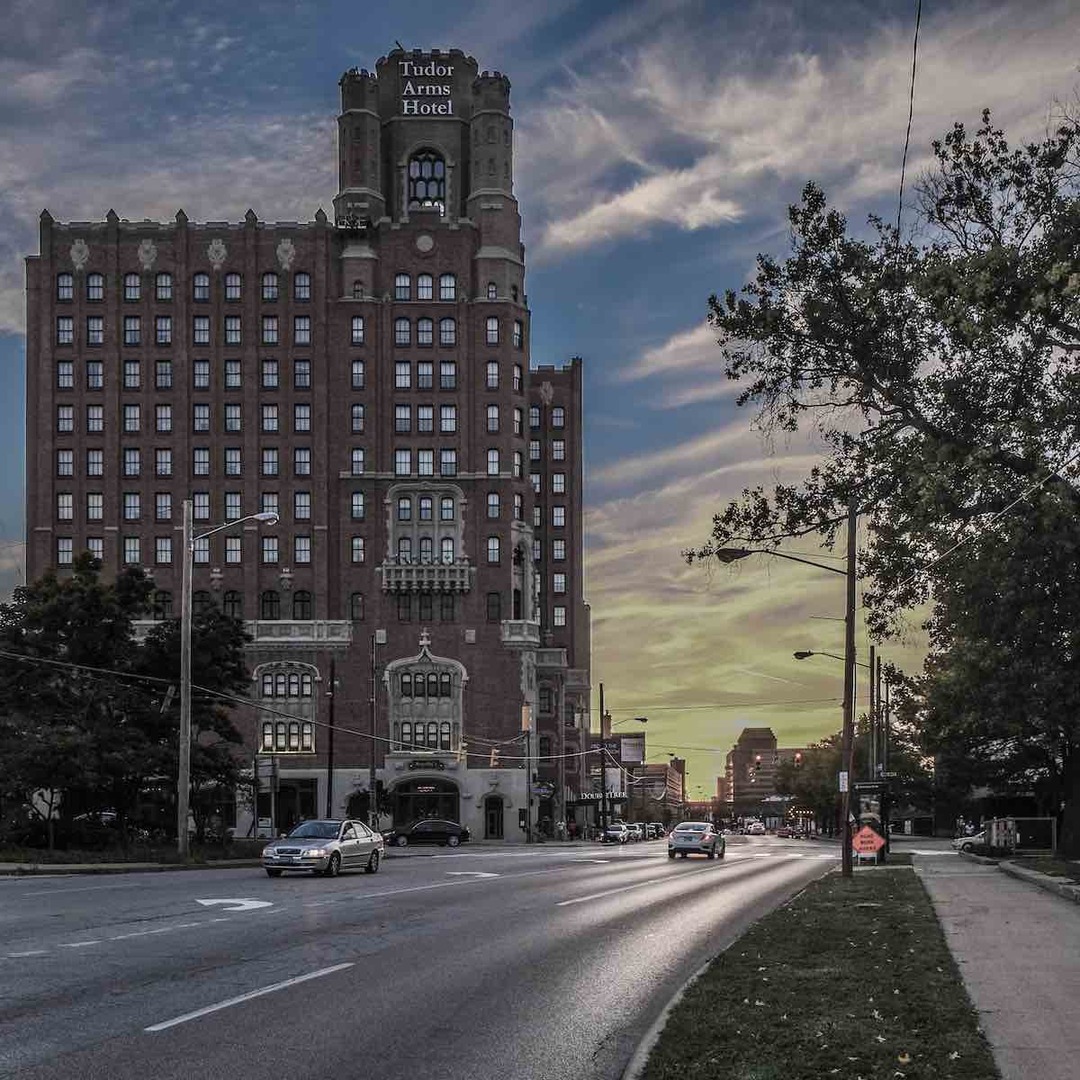
    <summary type="html"><![CDATA[<img src="https://clevelandhistorical.org/files/fullsize/74949a1564510026d75c58db09bee4ab.jpg" alt="Fenway Hall, East Facade" /><br/><p>On a chilly evening in November 1923, hundreds of Clevelanders gathered for a tour of Fenway Hall, “Cleveland’s New Exclusive Apartment Hotel.” The delegation “inspected everything from the Florentine furniture in the lobby to the nutmeg grater in the kitchen of an eleventh-floor suite” and “chatted in Peacock Alley,” a corridor offering interior access to a row of shops and services. Along with nearby Park Lane Villa and <a href="https://clevelandhistorical.org/items/show/932">Wade Park Manor</a>, Fenway Hall was one of three residential hotels that opened that year on the border between the Doan’s Corners business and entertainment district and the University Circle educational and cultural district. </p><p>Doan’s Corners had long been a focal point for development in what was East Cleveland Township. In 1799, Nathaniel Doan built a cabin with a pond for watering horses along the stage road between Cleveland and Buffalo, later named Euclid Avenue, just east of its intersection with Doan (later East 105th) Street. In 1817, Doan’s son Job replaced the structure with a larger tavern, later known as Jim Wright’s Tavern. In 1876, Liberty E. Holden and other investors erected the four-story, mansard-roofed Fairmount Court Hotel on the old tavern site. The hotel stood on the northwest corner of Euclid Avenue and the newly cut Fairmount (later East 107th) Street. </p><p>After World War I, dozens of storefronts, theaters, and apartment buildings sprouted along Euclid Avenue, turning Doan’s Corners into a veritable “<a href="https://clevelandhistorical.org/items/show/49">second downtown</a>.” In 1922 the Euclid-Fairmount Co. purchased the former Holden property (by that time owned by the nearby Case School of Applied Science) and commissioned George B. Post and Sons to design a new residential hotel. The New York-based firm had designed the Hotel Statler in downtown a decade before and was also designing Wade Park Manor just to the north. Post’s Georgian Revival design, prepared in collaboration with Reynold H. Hinsdale of Cleveland, guided construction of the thirteen-story, brick and limestone faced, steel-framed, “fireproof” Fenway Hall. </p><p>Like other residential hotels, Fenway Hall promised an elegant, convenient lifestyle, free of the burdens of housekeeping. Early ads contrasted its advantages with the headaches of owning a suburban home. “When you pay your rent at Fenway Hall,” one ad observed, “you have also paid the coal man, the ice man, the gas and electric light men, the plumber, the repair man and the electrician, as well as the maid, the flat laundry, etc.” Indeed, Fenway Hall offered all the services that defined hotel living. On its ground floor were a dining room, delicatessen, coffee shop, beauty and barber shops, haberdashery, and, by 1924, Fenway Hall Golf School, staffed by Canterbury Golf Club instructor Jack Way. What’s more, each of its 192 one- to three-bedroom “Bachelor and Light Housekeeping Suites” was amply furnished—right down to linen, silver, china, glassware, and kitchen utensils—by Albert Pick and Co. of Chicago, which did the same for Wade Park Manor. </p><p>More than an address for Clevelanders seeking an alternative to a home in suburban Shaker Heights, Fenway Hall was a part-time residence for some wealthy locals who summered in lakefront estates or wintered in Florida, as well as a fashionable destination for out-of-town guests. One hotel ad noted, “transient guests over the holidays are accepted,” adding, “their nearness to your home, while at Fenway, and the completeness of our facilities make this service of real value to those entertaining friends from out-of-town.” Hotel residents shared Fenway Hall’s dining spots with those from across Cleveland and afar. For its part, the dining room advertised Sunday dinners for $1.50 and, in one very detailed ad, highlighted its commitment to locally sourced foods: milk and cream from Maple Leaf Dairy, seafoods from Edward J. Metzger and fruits and vegetables from De Gaetano & Parrino (both in the nearby Euclid-East 105th Street Market), and meats and poultry from Brandt Co. in the Sheriff Street Market. </p><p>Within a few years, the dining room was remodeled as the Jade Room. Billed as a “metropolitan supper club,” the Jade Room, with its green walls, yellow tables and chairs, and blend of “Georgian style” and “Chinese ornament,” featured nightly dance band concerts broadcast on radio station WTAM. The Jade Room, later restyled the Coral Room and then the Conga Room, was a popular stop before or after vaudeville shows and movies at the nearby Alhambra, Keith’s 105th, and Circle Theaters. In addition, Fenway Hall welcomed conventions and numerous local club meetings and weddings, and it housed some of the players on the Cleveland Falcons hockey team, which played in the Elysium, a giant indoor ice rink across East 107th Street from the hotel. </p><p>In the hotel’s early years, ads had promised jobs for white bellboys, maids, and other staff positions, with the first apparent job open to African Americans—dishwasher—only appearing after three years. Although references to racial qualifications for hotel jobs disappeared by the 1930s, Fenway Hall continued to target the patronage of well-heeled whites. In 1942 the hotel manager grudgingly accepted eleven Black physicians and their wives from Philadelphia as guests while they were in town for a medical convention. But the hotel’s days of exclusivity and exclusionary practices were drawing to a close. The former Doan’s Corners, more commonly called the Euclid–East 105th area, stood on the northeastern fringe of Cedar-Central (later Fairfax), Cleveland’s largest African American neighborhood, and by the 1950s the business district was simultaneously becoming a rare nexus for interracial nightlife and facing the leading edge of disinvestment. </p><p>These changes added to the growing challenges residential hotels faced. Affluent Clevelanders’ preference for suburban homes meant that University Circle would not see its Wade Park become Cleveland’s answer to Central Park West. After having been operated by the same company for its first quarter century, Fenway Hall changed hands repeatedly in the two decades after World War II. Despite the modernizations made by each new operator, the hotel was no longer a fashionable address but it remained an anchor for an evolving district. In 1960, E. L. Koenemann, president of Carnegie College at 4707 Euclid Avenue (a training school for medical technologists, assistants, and secretaries), bought the Fenway with the vision of relocating the college to University Circle and housing its students in the old hotel. Instead, under the name Fenway Motor Inn, the property became an economy accommodation for overnight and transient residents. </p><p>In November 1966, Marjorie Winbigler, a Cleveland Orchestra chorister who lived in Shaker Heights, disembarked at the bus stop outside Fenway Hall. Before she could reach Severance Hall on foot, she was assaulted and murdered in Wade Park. Combining with white racial fears elevated by the Hough rebellion earlier that year, the crime alarmed University Circle leaders. Case Institute of Technology and Western Reserve University purchased Fenway Hall and the nearby Tudor Arms Hotel months before the schools merged in 1967. They sought these buildings to provide graduate student housing but also to remake the western fringe of University Circle. However, following a subsequent decision to build new dormitories on Cedar Hill, Case Western Reserve University divested itself of Fenway Hall in 1975. The City of Cleveland paid CWRU $840,000 for the hotel and then resold it to University Circle Inc. (UCI), for $710,000, thereby letting the university avoid a loss. UCI hired the Orlean Co. to turn the building into a federally subsidized elderly housing development named Fenway Manor, which reopened in 1978. </p><p>Today Fenway Hall sits in a very different context. The Euclid–East 105th district yielded to the transformation wrought by the Cleveland Clinic’s relentless expansion, leaving the old hotel as the lone survivor from the district’s heyday, although recent and planned high-rise apartment developments promise to create the apartment row that never fully materialized along Cleveland’s Doan Brook park belt a century before.</p><p><em><strong><a href="https://clevelandhistorical.org/items/show/918">For more (including 15 images) view the original article</a></strong></em></p>]]></summary>
    <published>2020-11-13T21:52:04+00:00</published>
    <updated>2026-04-17T19:17:42+00:00</updated>
    <link rel="alternate" type="text/html" href="https://clevelandhistorical.org/items/show/918"/>
    <id>https://clevelandhistorical.org/items/show/918</id>
    <author>
      <name>J. Mark Souther</name>
    </author>
  </entry>
  <entry>
    <title type="html"><![CDATA[Swingos Keg &amp; Quarter: Chaos and Class in Downtown Cleveland]]></title>
    <summary type="html"><![CDATA[<img src="https://clevelandhistorical.org/files/fullsize/47849aad34385d41a749384af343f085.jpg" alt="Not Shelly Fabares" /><br/><p>Two things about iconic hostelries. First, many had larger-than-life owners (consider Mushy Wexler’s Theatrical or Herman Pirchner’s Alpine Village). Second, their repute often was magnified by the renown of their customers (politicians, rock stars, actors, gangsters, etc.). Jim Swingos Keg & Quarter fits both bills. From 1968 to 1984, this eatery and adjoining hotel were the raucous hub of an otherwise moribund downtown. </p><p>Jim Swingos (1941-2015) was born into a Greek immigrant family. After graduating from Benedictine High School (the first non-Catholic ever to do so) he matriculated to Ohio State University as a Criminology major. Swingos ultimately found this too depressing a career path and joined his father in the bar business. Numerous restaurant-management positions followed until, in 1968, he purchased the faltering Downtowner Restaurant at East 18th Street and Euclid Avenue. The price was a pittance: 16 months in back rent. </p><p>Thus the Downtowner Restaurant became Swingos Keg & Quarter, serving garlic-drenched food to businessmen staying at the adjoining Downtowner Hotel. In 1971 Swingos bought the hotel—a dicey move given that Cleveland was hardly the world’s destination of choice. "Cleveland's hotel business was dead,” Swingos once recalled. “And I was trying to support a hotel with a restaurant. Then I got a call from a promoter wanting to make a booking for Elvis." </p><p>Suddenly no-one was singing Are You Lonely Tonight? at the Heartbreak Hotel. Elvis’ advance men blew in, liked what they saw and booked four floors. Moreover, Elvis wanted to use the hotel as the base of operations for a Midwest tour. Swingos quickly renamed the place Swingos’ Celebrity Inn and from then on, it was Shake, Rattle and Roll. “We were booked by every big name, little name and everyone in between. The one exception was business travelers: You get someone like Led Zeppelin in town for a concert. They stay with us. They get done with the concert and they want to party and make noise. Below them may be a businessman who needs his sleep for a big meeting the next day. We lost the businessmen in the commotion."</p><p>Swingos’ restaurant and hotel thrived without the suits, catering to a near-continuous parade of actors, musicians, athletes and the almost famous. In fact, the place was featured in Cameron Crowe’s 2000 movie "Almost Famous," which told the story of an uber-groupie whose real-life counterpart once plied Swingos’ halls and rooms. More publicity came courtesy of the Rolling Stones, who wore their "Swingos: Have you slept there lately?" T-shirts for a spread in Rolling Stone magazine.</p><p>Naturally, the rockers were a handful. Ian Hunter, leader of the British group Mott the Hoople, noted that Swingos was "a place you remember checking in and out of, but you can't remember anything in between.” The Who’s Keith Moon once walked up to female patron in the K&Q bar, slapped a pair of handcuffs on her and casually walked away. Deep Purple’s Ritchie Blackmore engaged in a late-night screaming match with Yul Brenner. Members of Kiss flaunted 10-inch heels and 10-foot tongues. Led Zeppelin, the four horsemen of havoc, were among Swingos’ favorite guests. "I loved Led Zeppelin, because they always traveled with their accountant," Swingos remembered. "Whatever damage they did to their rooms, the accountant always took out his checkbook and paid for everything down to the penny. I didn't mind because I always got new stuff for whatever rooms they stayed in after they left." </p><p>But the game changer was Elvis: “Always our biggest draw,” according to Swingos. “[The first time Elvis came] he ordered a chopped steak and a Boston strip steak. They had to be cooked well-done. He requested that I bring the meal up and that I cut the strip into tiny pieces for him. Then he inspected the cut-up steak and asked me to put it back together like a jigsaw puzzle before he would touch it.”</p><p>Which is not to say that non-rockers didn’t add to the commotion. Sports stars and carousers like Muhammad Ali, Wilt Chamberlain and Billy Martin were frequent patrons. Basketball legend Dave Cowens once accosted a bartender. Jerry Lewis would make bizarre noises into the PA system and regularly change the locks on the door of his room. “He drilled them out himself,” recalled Swingos. Frank Sinatra—consistently generous and courteous (but also demanding)—became Swingos’ close friend. Down at the bar, a cacophony of locals mingled with celebrities. “The FBI would be in one corner; Hells Angels in another; mob guys at the bar; and George Forbes and the Stokes brothers at a table.”</p><p>Through it all, the Keg & Quarter restaurant managed to maintain not only dignity but quality. Its food received consistently high ratings from critics and customers. Male waiters—exceptionally well-trained and always dressed in tuxedos—buzzed around, consistently adhering to Swingos’ mantra that customers are always right, even when they aren’t. </p><p>Swingos expanded his foodservice empire. He opened two additional restaurants at Nick Mileti’s Coliseum (where he was listed on the Cavaliers roster as “team dietician”). He also took over Marie Shriver's at the Statler Hotel, renaming it Swingos at the Statler. And when he cashed out at 18th and Euclid in 1984, he opened the moderately successful Swingos on the Lake in the Carlyle Apartment (now condo) complex on Lakewood’s Gold Coast.</p><p>But none of Swingos’ other endeavors matched the success or notoriety he achieved at East 18th and Euclid. For more than 15 years, Swingos was the shining center of a comatose universe. "In the 1970s,” explained former WMMS program director John Gorman, “downtown was dead. There was no reason to come. That is, until Jim Swingos gave them a reason."</p><p><em><strong><a href="https://clevelandhistorical.org/items/show/907">For more (including 7 images) view the original article</a></strong></em></p>]]></summary>
    <published>2020-04-21T16:13:51+00:00</published>
    <updated>2026-04-17T19:17:42+00:00</updated>
    <link rel="alternate" type="text/html" href="https://clevelandhistorical.org/items/show/907"/>
    <id>https://clevelandhistorical.org/items/show/907</id>
    <author>
      <name>Chris Roy</name>
    </author>
  </entry>
  <entry>
    <title type="html"><![CDATA[New England Building: a.k.a. Guardian Building and National City Bank Building]]></title>
    <summary type="html"><![CDATA[<img src="https://clevelandhistorical.org/files/fullsize/ca52c443355f97d2c6299bfba9b9de0c.jpg" alt="New England Building" /><br/><p>In the late nineteenth century, downtowns in the United States were the center of major commercial expansion and industrial growth. The construction of skyscrapers and tall business buildings was exploding and replacing old structures located in central cities. The New England Building is an example of this trend in the late 1800s. The New England Building, also known as the Guardian Building and the National City Bank Building, was built in 1896 on the property that had formerly held a mansion owned by Henry Chrisholm. The structure was initially called the New England Building after the company constructing it. Still, the plan was for the building to be officially named the Ohio Building with the title throughout the structure. However, this name did not seem to catch on as the building continued to be commonly referred to as the New England Building until about 1916.</p><p>At the time of the New England Building's completion, it was the tallest building in Cleveland, and one of the tallest in the country, with fifteen floors. However, it lost its distinction as the city's tallest building in 1905 when the Rockefeller Building was built. The architects of the original design of the New England Building, Shepley, Rutan and Coolidge, were an out-of-state firm located in Boston. Shepley, Rutan and Coolidge's plan was a "sandstone-faced structure" that was "designed with restrained Renaissance detail." Because of its status as the tallest building in the 1890s and its impressive architecture, many businesses and architects moved their offices to the impressive new skyscraper. Many members of the Cleveland Architectural Club, like Charles F. Schweinfurth, relocated to the floors of the New England Building. For about twenty years, the New England Building stood with its original design, with the majority of the floors occupied by business offices.</p><p>In 1915, the New England Building was bought by the Guardian Savings and Trust Company for $2,000,000. The Guardian Savings and Trust Company was a widely successful and expanding banking business during the early 1910s. When the leases held by other companies in the New England Building expired, the Guardian Savings and Trust Company hired architects Walker and Weeks, at that time, a relatively new firm, to design rooms for a bank. Walker and Weeks designed an addition added to the back that added 250 rooms, and a new design for the front of the building. Walker and Weeks added the distinctive Corinthian columns to the front of the bank, standing out from the original design of the top of the building. After their role in the redesign of the New England Building, now being called the Guardian Building, Walker and Weeks went on to design more than sixty banks across Ohio.</p><p>The New England Building stayed in the hands of the Guardian Savings and Trust Company for close to thirty years. The corporation grew widely in Ohio through the 1920s and was made up of "26 corporations, including investment and real estate firms." However, in March 1933, the Guardian Savings and Trust Company was forced to liquidate. It was discovered that the company mismanaged its customers' money by giving insider loans to members of the company. The National City Bank leased the banking part of the New England Building after the Guardian Savings and Trust Company vacated it, and officially bought the building from the Guardian liquidator for $300,000 on March 28, 1944. From 1944 to 1948, after the National City Bank purchased the New England Building, the third floor housed tenants such as the Veterans Administration and the War Labor Board. After the Veterans Administration and the War Labor Board vacated the New England Building, the National City Bank took up many of the floors for their departments and the banking lobby on the first floor. Beginning June 1, 1949, the National City Bank formally renamed the building, the National City Bank Building.</p><p>The National City Bank occupied the banking floor of the New England Building until 2008, when the PNC Bank absorbed the National City Bank. However, the National City Bank moved its executives and departments to a new headquarters that had begun to be built in 1978 and was finished in 1980. In the late twentieth century, the New England Building, like many historic buildings in downtown areas, was not being fully used. The use of historic office buildings fell because of the rising demand for newer office space. The downtown buildings were frequently losing the competition to new office spaces developed in the suburbs. </p><p>In an effort to revitalize the building in the late 1990s, a bid was put in for the competition of turning a downtown building into a Holiday Inn Express hotel. In 1997, “Richard Maron, a specialist at bringing old buildings back to life,” bid two-thirds of the New England Building to be converted into the Holiday Inn Express. Despite the competition, Richard Maron won the bid, and to this day, the New England Building is occupied by the Holiday Inn Express. </p><p>After the National City Bank was absorbed into the PNC Bank in 2008, the National City Bank located in the New England Building vacated the structure. The bank lobby was empty for many years until the Marble Room converted the old banking rooms into an upscale restaurant and bar. The Marble Room followed the current trend of turning old banking locations into businesses "related to food and dining."</p><p>It has been more than 100 years since the New England Building was constructed, and, like most of the historic buildings still standing in downtown Cleveland, it has proved conducive to adaptive reuse. While the New England Building was an important and record-breaking building at the time of its construction, it is now a historic building that continuously revitalizes itself with the current trends of downtown life.      </p><p><em><strong><a href="https://clevelandhistorical.org/items/show/881">For more (including 8 images) view the original article</a></strong></em></p>]]></summary>
    <published>2019-11-20T20:08:13+00:00</published>
    <updated>2026-04-17T19:17:38+00:00</updated>
    <link rel="alternate" type="text/html" href="https://clevelandhistorical.org/items/show/881"/>
    <id>https://clevelandhistorical.org/items/show/881</id>
    <author>
      <name>Cecelia Brunecz</name>
    </author>
  </entry>
  <entry>
    <title type="html"><![CDATA[Stillman Theater: The Playhouse Square Theater That Wasn&#039;t Saved]]></title>
    <summary type="html"><![CDATA[<img src="https://clevelandhistorical.org/files/fullsize/c386fc7974ccf6303eeda12871278d44.jpg" alt="The Stillman Theater" /><br/><p>The beginning of Cleveland's Playhouse Square is almost universally acknowledged to be February 5, 1921, when Loew's State Theater opened, showing the photo play (silent film) <em>Polly with a Past</em>. According to an article which appeared in the <em>Plain Dealer</em>, it was a gala event, attended by Ohio governor Harry L. Davis, Cleveland mayor William S. Fitzgerald, a host of other city and state officials and businessmen, and a contingent of silent film stars led by Marcus Loew, the owner of the new theater and the man who, in the early twentieth century, revolutionized the film entertainment industry in the United States. The day's agenda also included a parade in the afternoon, which stopped at City Hall, where Mayor Fitzgerald presented Loew with a key to the city, and then proceeded to the luxurious Statler Hotel. There, the Rotary Club feted its guests with a luncheon in the hotel's grand ballroom. Conspicuously omitted, however, from the <em>Plain Dealer</em>'s reporting that day was any mention of Loew's Stillman Theater located in the Statler, right next to the ballroom where the luncheon was held. Whatever the reason for this omission, looking back today, almost a century later, you can make a good argument that, without the Stillman Theater--Loew's first downtown theater, there would never have been a gala opening of the State Theater on February 5, 1921, and perhaps no Playhouse Square at all, or at least not on Cleveland's upper Euclid Avenue. </p><p>The Stillman Theater, which was built in 1915-1916, more than five years before the 1921 gala Playhouse Square event, did not start out as a Loew theater. It was the brainchild of Emanuel Mandelbaum, the visionary owner of the Knickerbocker Theater at East 83rd Street and Euclid Avenue, who wanted to open a theater downtown which would be designed and built primarily to show silent films rather than vaudeville performances. In 1915, he obtained a lease on property just to the west of the Statler Hotel and entered into a partnership with the hotel's owners, which enabled the Statler to build an addition onto the west side of their hotel and for Mandelbaum to build his theater behind the hotel, with access to it from a lobby in the hotel. </p><p>Mandelbaum decided to call his new theater the Stillman Theater. "Stillman" was the first name of Stillman Witt, a Civil War era Cleveland railroad baron, known for his business integrity and charitable giving. In 1884, nine years after his death in 1875, Witt's family built a luxury hotel on the westernmost grounds of his former estate. They called it the Stillman in his honor. It was the first hotel built in downtown east of Public Square. While a favorite hotel for Cleveland's elite in the late nineteenth century, it, as well as the nearby Stillman Witt mansion, were razed in or about 1902, as upper Euclid Avenue began to intensely commercialize under the vision of Cleveland businessmen like John Hartness Brown, Charles Pack, and others. By so naming his theater, which would sit on the former site of the Stillman Hotel, as well as that of the estate of Stillman Witt, Emanuel Mandelbaum clearly wanted Clevelanders to identify the new theater with a luxurious place of the past as well as with one of the city's early admired elites. </p><p>While the new addition to the Statler Hotel was designed by George B. Post & Sons, the same architects who designed the beautiful Cleveland Trust bank building on the corner of East 9th Street and Euclid Avenue, the Stillman Theater itself was designed primarily by Thomas W. Lamb, an architect noted for the beautiful theaters he built in American cities in the early twentieth century. As designed, the new theater could comfortably seat 1,800 patrons, with 1,200 in the main auditorium and 600 more in the balcony above. It was so elegant that one architectural critic compared it favorably to the remodeled Theatre Royal in Drury Lane, London, the Scala Regia of the Vatican, and the Strand Theater in New York City. In addition to its elegance, the new theater had an innovative type of satin movie screen, which was set at the rear of the theater's stage, and an orchestra pit directly in front of the stage, all designed to improve the visual and auditory experiences of the audience. The Stillman Theater, which local author Alan Dutka called Cleveland's "first true movie palace," opened in September 1916 with a showing of <em>Snow White</em>, a silent film produced in Cleveland and filmed at the estate of H. A. Tremaine on Fairmount Boulevard in Cleveland Heights, and at other area locations, using local actors. </p><p>Despite its beauty and elegance, and its innovative theater improvements, the Stillman Theater did not get off to a good start financially. After struggling with low attendance figures for two years, Mandelbaum, in 1918, sold the theater to Marcus Loew who reduced prices, advertised better, and brought higher quality films to the theater. Under his ownership, the Stillman Theater soon became one of Cleveland's most popular entertainment places, and was especially noted over the years for premiering almost all of the greatest movies of the first half of the twentieth century that came to Cleveland, including the first "talking" movie, <em>The Jazz Singer</em>, in 1928, and the blockbuster <em>Gone with the Wind</em> in 1940. On August 10, 1936, it featured the first newsreel showing here of the historic track performances of Clevelander Jesse Owens at the 1936 Olympics in Munich, Germany, just one day after the hometown hero won his fourth gold medal there. </p><p>Shortly after purchasing the Stillman Theater, Marcus Loew began undertaking efforts to consolidate movie houses across the United States, including in Cleveland, his Midwest headquarters. In 1919, he entered into an arrangement here with the owners of four other theaters, and formed a corporation called Loew's Ohio Theaters, Inc. Among the theaters that became part of the new corporation were the Upper and Lower Mall Theaters near Public Square and the Alhambra Theater on Euclid Avenue, near East 105th Street, which were owned, in part, by Joseph Laronge, also the owner of a real estate company in Cleveland. Laronge became Loew's vice-president in the new corporation. At this time, some of Cleveland's grandest entertainment places, including the Alhambra Theater and the Elysium, a popular ice skating rink owned by the Humphrey family, were located in the East 105th Street-Euclid Avenue neighborhood, an area which was then often referred to as <a href="https://clevelandhistorical.org/items/show/49">Cleveland's second downtown</a>. Loew had his eye on that neighborhood in 1919, when the press reported his intention to build Cleveland's largest movie theater there. However, and very possibly at the urging of Joseph Laronge, Loew the following year announced his intention to instead build his large theater on upper Euclid Avenue near East 14th Street, just several blocks from his Stillman Theater. Loew's revised plan led to the founding of Playhouse Square a year later when the 3,446-seat State Theater opened. And the rest, as people are apt to say, is history. </p><p>While most Clevelanders today do not even remember the Stillman Theater, much less engage in debate over whether its opening in 1916 led inexorably to the establishment of Playhouse Square on upper Euclid Avenue, it was clearly a Playhouse Square theater from the early 1920s on, was advertised as such, and remained so until it closed in 1963. Had it been located just a block or so to the east, away from the Statler Hotel and closer to where the other Playhouse Square theaters were located, perhaps it could have been, like those others, saved by Ray Shepardson in the 1970s. However, its location next to a hotel with expansion plans doomed it. Even before the last showing of the last movie at the Stillman Theater--the epic historical drama, <em>Lawrence of Arabia</em>, rumors were circulating in Cleveland that it was going to be razed so that the Statler could build a parking garage on the site. This came as a shock to many Clevelanders including <em>Plain Dealer</em> movie critic W. Ward Marsh, who reported the rumor in his June 9, 1963 column. After sharing his personal memories of the theater, Marsh encouraged people who, like himself, did not want to see the theater torn down to "keep their fingers crossed" and just maybe the parking garage wouldn't come "for a long time." Unfortunately for Marsh and other lovers of the Stillman Theater, his suggested finger-crossing didn't work, and the theater was torn down the following year.</p><p><em><strong><a href="https://clevelandhistorical.org/items/show/848">For more (including 12 images) view the original article</a></strong></em></p>]]></summary>
    <published>2018-08-10T10:39:42+00:00</published>
    <updated>2026-04-17T19:17:39+00:00</updated>
    <link rel="alternate" type="text/html" href="https://clevelandhistorical.org/items/show/848"/>
    <id>https://clevelandhistorical.org/items/show/848</id>
    <author>
      <name>Jim Dubelko</name>
    </author>
  </entry>
  <entry>
    <title type="html"><![CDATA[Colonial Hotel]]></title>
    <summary type="html"><![CDATA[<img src="https://clevelandhistorical.org/files/fullsize/45aede22394e0d51e961ccfb60c9bd60.jpg" alt="Colonial Hotel Cleveland" /><br/><p>The Colonial Hotel, now called the Residence Inn, is located on Prospect Avenue next to Cleveland’s historic East 4th Street. The hotel was built in 1898 in combination with the Colonial Arcade by designer George H. Smith, who was also the architect of “The Arcade,” Cleveland’s more famous shopping street under glass which was built in 1890. The Colonial Hotel opened on October 21, 1898, with an informal ceremony, which was attributed to the fact that it opened a day earlier than scheduled. The Colonial Arcade, however, was not fully complete until 1911, when John F. Rust hired architect Franz Warner. Warner was able to design an adjacent arcade that would link the William and Rodgers buildings on Euclid Avenue (one block to the north) with the Colonial Hotel, thus creating the Euclid Arcade. Today the interconnected Colonial and Euclid Arcades are known together as the <a href="https://clevelandhistorical.org/items/show/236">5th Street Arcades</a>.</p><p>Within a year after opening, the hotel was already being improved with the addition of a 100-room wing on the Prospect Avenue side and parallel to the Colonial Arcade. Another expansion occurred in 1901, adding nearly one hundred rooms and expanding the hotel’s restaurant. The hotel during this period occupied a considerable amount of property on the Euclid side of the street, but the side facing Prospect Avenue was shallow in comparison. With this enlargement, the Colonial Hotel would be one of the largest hotels in the city. This renovation was started so the Colonial could keep up with the accommodations and luxuries that other hotels in the city were offering. In fact, it was speculated that the Colonial only decided to attempt this expansion to keep pace with the Hollenden Hotel, which, at this period, was one of the most luxurious hotels in the city. </p><p>In the 1930s, however, during the Great Depression, Cleveland’s unemployment rate rose to encompass nearly a third of its population, which impacted the hotel industry drastically. The Colonial dealt with this problem rather well, and in fact, some of their only concerns were simply competing with other hotels in Cleveland and attempting to attract more patrons with fresh new ideas and amenities.</p><p>Though the Colonial had survived the worst economic period in the nation’s history, the hotel eventually began to decline in later years as Cleveland took a turn for the worse. This occurred in the 1970s and the 1980s, a time when Cleveland lost close to twenty-five percent of its entire population. By 1975, Cleveland stood in the nation’s highest quintile among cities in terms of poverty, unemployment, poor housing, violent crime, and municipal debt. The Colonial Hotel also felt this pressure, first by changing ownership to the Milner Hotel Company, which was based in Detroit, Michigan. This transfer was all the Colonial could do to keep alive during this tough economic time. After this exchange, things seemingly got worse for the Colonial. The Colonial kept getting devastatingly bad luck, which reflected in the <em>Plain Dealer</em>, most notable being two deaths that occurred within five years of each other. The first death being Dan Duffy, a popular lawyer in Cleveland and a beloved patron to the Colonial Hotel. The second death was a John B. Caduff, whom tragically died in a fire, caused by Caduff carelessly smoking. Finally, however, to finish off these hard economic times, the Colonial Hotel closed in 1978. </p><p>This was not the end of the Colonial Hotel, however. Twenty years after the hotel's closing, an idea to re-open the hotel came into the minds of businessmen as part of broader attempts to preserve and revitalize Cleveland’s historic downtown area. This project finally got underway in 1998, when investors partnered with Marriott, a thriving hotel company, and wanted to open a Residence Inn in the former Colonial Hotel. The project would not only put a new hotel in the heart of downtown, it would also revitalize the Cleveland arcades. This eventually led to a $30 million project to renovate the space into extended stay lodging with 144 rooms of a Marriott Residence Inn and nearly 60,000 square feet of shopping. This hotel eventually opened in 2000 and would thrive amid a reemerging entertainment district.</p><p><em><strong><a href="https://clevelandhistorical.org/items/show/819">For more (including 8 images) view the original article</a></strong></em></p>]]></summary>
    <published>2017-11-26T15:38:17+00:00</published>
    <updated>2026-04-17T19:17:41+00:00</updated>
    <link rel="alternate" type="text/html" href="https://clevelandhistorical.org/items/show/819"/>
    <id>https://clevelandhistorical.org/items/show/819</id>
    <author>
      <name>Keanu Hallowell</name>
    </author>
  </entry>
  <entry>
    <title type="html"><![CDATA[Hollenden Hotel]]></title>
    <summary type="html"><![CDATA[<img src="https://clevelandhistorical.org/files/fullsize/442ea5dee2c49bd9d1894a168e367933.jpg" alt="The Hollenden" /><br/><p>Thousands of stories emanated from the venerable Hollenden Hotel. This hotel, located in downtown Cleveland on Superior, Bond, and Vincent Streets, was considered one of the city's most luxurious hotels. It attracted many diverse people, including several presidents of the United States, celebrities, and professional athletes, as well as prominent local organizations. As a luxury hotel, the Hollenden served many purposes; it was a place where local organizations hosted meetings, a place for politicians to host speeches and gatherings, and a place for the locals to grab a drink and socialize at one of its several bars. The hotel also featured local artists as entertainers regularly, contributing to the nightlife of downtown Cleveland. </p><p>When Liberty E. Holden opened the Hollenden Hotel in 1885, it quickly became an important part of the city.  This massive building was designed by architect George F. Hammond and originally was eight stories tall, with 1,000 rooms and 100 private bathrooms. For its time, the Hollenden was a technological marvel with fireproof construction and electric lighting. The hotel had beautiful chandeliers illuminating the lobby and the hotel rooms were brightened by electric lamps throughout the hotel, which was sensational for its time. In addition, the hotel offered many amenities, such as a prestigious barbershop, a theater, a restaurant, and popular clubs. </p><p>The Hollenden Hotel was the home to one of the most magnificent barbershops in the city and in the world during this period. What made this barbershop unique was the telephones that it had at each of the barbershop chairs. This barbershop at the Hollenden Hotel was said to be the best in the country. Sought out by Liberty E. Holden himself, George Myers became the owner of the Hollenden Barbershop, regardless of his lack of financial stability. Myers learned the barber trade after being denied entrance into a college in Baltimore, Maryland. The barbershop was the place to be and a popular location to get a shave in downtown Cleveland. It not only enticed the local politicians, industrialists, and financiers of the city but appealed to eight presidents and cultural celebrities as well.  </p><p>One of the most bizarre events that happened at the Hollenden Hotel received national recognition from the New York Times. In March of 1905, a lawyer of New York named Henry L. Woodward and Charles A. Brouse, who was a traveling salesman from Toledo, Ohio committed suicide by shooting themselves during the night.  Woodward had been a guest at the hotel for a few weeks and was known for drinking heavily while in Cleveland.  Woodward had left an un-mailed letter, while Brouse did not. This double suicide was extremely peculiar because these men did not know each other, yet they both killed themselves in the same manner during the night at the same hotel.  There was no evidence presented to connect or link these two deaths. Interesting enough, the revolvers with which the deeds were done were of the same caliber.</p><p>In its prime, Cleveland was one of the largest cities in the United States as well as one of the wealthiest. It was a major industrial city and was home to the richest man known in American history, John D. Rockefeller, who initiated Standard Oil in Cleveland. Local, regional, and national organizations held conferences and events at the Hollenden. Political parties and leaders hosted speeches and dinners at the restaurants of the Hollenden. Its location on Superior, Bond and Vincent Streets in downtown Cleveland played a major role in the types of characters that were attracted to the Hollenden; from celebrities performing at the elegant Vogue Room to mobsters making deals in the suites of the hotel, the Hollenden Hotel offered a place for everyone. </p><p>After living gloriously and proudly through its first sixty years, the hotel had already begun to give up to the natural laws of physical desuetude; its financial position was declining because of the Great Depression and the hotel fell into the hands of a succession of hit-and-run operators who were completely lacking respect for the Hollenden’s traditions of class and without pride in its history. Unfortunately, the Hollenden Hotel could not be preserved.  Former daily general columnist at Cleveland’s Plain Dealer, George E. Condon commented, “even in the rundown condition in which it found itself at the end, it was a magnificent building and it still enjoyed the loyalty, if not affection, of thousands of regular patrons who sentimentally insisted on the Hollenden address whenever they visited Cleveland.” </p><p>In 1963, the Hollenden Hotel was demolished and the Hollenden House, a new 14-story hotel with 400 rooms opened on March 1, 1965. Due to poor economic conditions throughout the 1980s in Cleveland, the Hollenden House closed its doors on May 1989. Shortly after it was demolished, developer John Galbreath purchased the land and the Fifth Third Center (formerly known as Bank One Center) was constructed by 1992. </p><p><em><strong><a href="https://clevelandhistorical.org/items/show/818">For more (including 13 images) view the original article</a></strong></em></p>]]></summary>
    <published>2017-11-26T10:38:53+00:00</published>
    <updated>2026-04-17T19:17:41+00:00</updated>
    <link rel="alternate" type="text/html" href="https://clevelandhistorical.org/items/show/818"/>
    <id>https://clevelandhistorical.org/items/show/818</id>
    <author>
      <name>Allison V. Newbold</name>
    </author>
  </entry>
  <entry>
    <title type="html"><![CDATA[Eells Mansion and the Sahara Motor Hotel: From Millionaires&#039; Row to Resort Motel]]></title>
    <summary type="html"><![CDATA[<p><strong><em>The structures at 3201 Euclid Avenue were an evolving site of entertainment and hospitality for nearly a century.</em></strong></p><img src="https://clevelandhistorical.org/files/fullsize/27823f2b250397018675bf36b2995852.jpg" alt="Scenic View of Eells Mansion at 3201 Euclid Avenue" /><br/><p>Extending four miles along Euclid Avenue between Public Square and East 105th Street, Millionaires’ Row stood as an unbroken row of stone, brick, and shingle-sided extravagance of more than 300 mansions. One of these grand homes belonged to the banker, financier, and philanthropist Daniel Parmelee Eells. Born in 1825, Eells became the president of the Commercial National Bank and was worth $3 million by 1885. Over the course of his life, Eells served as a director of thirty-two companies. Eells’ commercial interests included railways, iron mining, manufactures, oil, steel, cement, coke, and gas.</p><p>The Eells mansion was built in 1876 at 3201 Euclid Avenue. The Eells mansion’s High Victorian style was influenced by the 1876 Centennial Exposition in Philadelphia. The Victorian villa was designed by architect Joseph Ireland, a New York émigré who opened his Cleveland office in 1865. Eells mansion featured a central tower, tile roof, and carved window ornaments. There were pointed towers, decorative eaves, spacious porches, and arched windows and doors that set the mansion apart from other Millionaires’ Row residences. The interior was fireproof and included notable rooms such as a library paneled in black ebony with white ivory insets, and a center hall lit by gas jets and a colorful skylight.</p><p>Eells was an influential man and used his home to entertain powerful politicians. Daniel and his wife Mary threw a supper party for the 100 craftsmen who worked on the mansion during its construction. Attendees at Eells’ daughter’s wedding reception included both President-elect James A. Garfield and Ohio governor Charles Foster. President Benjamin Harrison also visited Eells Mansion. Eells and Mark Hanna, a Republican politician, convinced William McKinley to run for president in the mansion’s library. Around a decade after completing the mansion, the Eells built their Beach Cliff country estate in Rocky River. They spent most of the year living ten miles away from their downtown residence. Eells died in 1903 and is buried in Lake View Cemetery in Cleveland. </p><p>The 1920s marked the decline of Millionaires’ Row as homes gave way to commercial structures. The rise of the automobile allowed the wealthy to relocate and still access Public Square from their new residences. Many of the mansions were sold and subdivided during the 1920s. Eells mansion remained a private residence until 1922. The Eells family sold the mansion to Warren Corning, who then sold it to Price McKinney. Schultz Bros. & Co. purchased a 90-year lease on the “Corning Homestead” at 3201 Euclid Avenue, transforming it into the Spencerian Business College. The Cleveland Bible College occupied the Eells mansion site between 1942 and 1957. The mansion was repurposed into the administration building. The Cleveland Bible College, renamed Malone College, moved to a Canton in 1957. The mansion stood empty for two years until it was torn down in 1959 to begin construction of the Sahara Motor Hotel.</p><p>With the rise of automobiles, the motel had evolved by the end of the twentieth century, going beyond just a simple place to sleep between stops. In some cases, it became the destination. The $4 million Sahara Motor Hotel was built by Mintz Construction Co. Mintz Construction Co. Vice President and hotel developer Marvin M. Mintz joked that Euclid Avenue seemed “miles away” from the Sahara Motor Hotel. The Sahara Motor Hotel, which opened on July 28, 1960, was styled after resorts in Las Vegas and the Edgewater Beach Hotel in Chicago. </p><p>Mintz hired Borge Neilson as the general manager of the Sahara. Prior to coming to Cleveland, Neilson managed the Nordland Hotel in Copenhagen, where he served many of Europe’s royalty, and the Park Hotel in Niagara Falls. Heading a staff of 120 people, Neilson aimed to combine the efficient qualities of American hotels with the esteemed cuisine and service of European traditions. Carl Thiss, manager and host of the dining room, and Chef Joseph Bartoff, serving international cuisine, also worked at the Sahara Motor Hotel. Before working at the Sahara Motor Hotel, both Thiss and Bartoff had gained their fame working at Gruber’s Restaurant in Shaker Heights.</p><p>The four-story hotel had 150 rooms, all of which featured a television, air conditioning, piped-in hi-fi music, and automatic dial phones, the first of their kind in northern Ohio. Room rates ranged from $10 to $32 a night for the executive suites. There were three presidential suites and three bridal suites available in the hotel as well. The rectangular building of the Sahara Motor Hotel had an inner court three-quarters of an acre in size. The second-floor court contained a patio and play area complete with a heated swimming pool, a round terrazzo dance floor, and outdoor furniture.</p><p>The Sahara Motor Hotel was designed to symbolize an oasis in the "desert" of a big city. It offered a continental dining room, nightclub, gift shop, coffee shop, six banquet or meeting rooms, and an arcade with a barber shop and drugstore. Palm trees from Florida were planted in the Sahara Motor Hotel’s lobby, along with red geraniums, mountain laurel, and rhododendrons. Fifty-eight panels of mosaic glass were fitted in Egyptian murals. This exotic theme was carried further by four cocktail lounges along the arcade that Mintz nicknamed “the Four Oases.” The individual lounges were called the Flame Room, the Garden Room, the Date Bar, and the Music Room. The waitresses wore Egyptian costumes and the waiters wore fezzes as they served patrons. Additionally, the Cleopatra Lounge was decorated with back-lit Egyptian murals and the dining room boasted a starlight ceiling. The hotel included luxuries such as real mother-of-pearl tabletops, a waterfall in one of the bars, velvet armchairs in the dining room, and stained glass lighting fixtures. The lobby was adorned with three eight-foot paintings of Cleopatra, King Tut, and Queen Nefertiti on white marble. The Sahara Motor Hotel was an exotic sight to see on the edge of downtown Cleveland.</p><p>As the first new hotel built in thirty years, it catered to business meetings, luncheons, conventions, weddings and parties. As a vacation resort, the hotel hoped to attract local families, but the hotel attracted more than that. Forty actors and production technicians of CBS’s American television drama “Route 66” stayed in the Sahara Motor Hotel for three weeks in 1962. A few episodes of the TV show were set in Cleveland and was named after the iconic Route 66 that extends from Illinois to California. The executive in charge of production, Sam Manners, and his wife Joyce were both former Clevelanders. Besides Manners’ family ties, Cleveland was chosen because the area offered scenic background possibilities for “Route 66.” The Sahara Motor Hotel can be seen in three “Route 66” episodes: “Only By Cunning Glimpses,” “Every Father’s Daughter,” and “Incident On A Bridge.”</p><p>In 1966 the Sahara Motor Hotel obtained a substantial cut in tax valuation. The occupancy rate of the hotel dropped from 80 percent to 60 percent when the Versailles and Holiday Inn motels opened nearby. The Sahara Motor Hotel also suffered a yearly income loss in addition to a loss in food and beverage sales. The economic hardships led its owners to sell the motel to the Sheraton Corporation of America for $3 million. Sheraton planned to make $1 million in improvements to the Sahara Motor Hotel, but after less than a decade, the Sheraton Sahara Motor Hotel closed its doors. Sheraton sold the building to the Cleveland YWCA for $2 million in 1969. The YWCA abandoned plans to construct a new building downtown, closed its old building on East 18th, and moved into the former hotel.</p><p>What began as the home of millionaire Eells was repurposed as a place of learning for those that went to both the Spencerian Business College and the Cleveland Bible College. Then, with the rise of tourism in Cleveland, that building was torn down to offer a commercial form of private entertainment: the motor hotel. The Sahara Motor Hotel advertised to both travelers and locals, offering entertainment and relaxation to its visitors. Apart from its interlude as a college campus, 3201 Euclid Avenue served as an evolving site of entertainment and hospitality for nearly a century.</p><p><em><strong><a href="https://clevelandhistorical.org/items/show/817">For more (including 9 images) view the original article</a></strong></em></p>]]></summary>
    <published>2017-11-25T19:33:18+00:00</published>
    <updated>2026-04-29T19:32:46+00:00</updated>
    <link rel="alternate" type="text/html" href="https://clevelandhistorical.org/items/show/817"/>
    <id>https://clevelandhistorical.org/items/show/817</id>
    <author>
      <name>Natalie Neale</name>
    </author>
  </entry>
  <entry>
    <title type="html"><![CDATA[Schofield Building: Recovering the Original Façade]]></title>
    <summary type="html"><![CDATA[<p><strong><em>Who would have guessed that underneath an ugly, polished granite exterior was a beautiful Victorian style building designed by Levi Schofield? </em></strong></p><img src="https://clevelandhistorical.org/files/fullsize/30963917b99f0fa6b569463208285614.jpg" alt="The Kimpton-Schofield Hotel" /><br/><p>For 30 years the beautiful red brick and terra cotta Schofield Building lay hidden underneath under a gray sequoia granite façade. In an effort to modernize the Schofield Building, part of Cleveland’s history had been buried. Luckily, historic preservation brought the original beauty of the Schofield Building back to Cleveland.</p><p>From the very beginning, the construction of the Schofield Building was wrought with impediments. Levi Schofield designed the Schofield Building to be built on the site of Schofield family residence located on East Ninth Street and Euclid Avenue. In August of 1900, Levi Schofield’s sister Mary E. Field objected to the use of the deeds belonging to property, claiming that the Schofield Building Co. was using the deeds without her authority. The common pleas court case had little effect on the construction as Schofield’s plan to build a fourteen story office building on the property attracted the attention of several banking and trust firms.</p><p>The construction of the Schofield Building began in April of 1901. On April 16th a laborer on the Schofield construction site named William O’Neal was badly injured when he fell from the first story and was buried under the debris of a toppled wall. Schofield was arrested on September 16, 1901 for violating the building ordinance by not providing temporary floors in the Schofield Building during construction. Schofield informed the Plain Dealer that he was humiliated by the police who treated him as if he were a “common pickpocket” and a “rogue.” Schofield explained that it was not his responsibility to put the temporary floors into the Schofield Building, but that of Building Inspector Harks. During Schofield’s September 27th trial, Inspector Harks testified that the Schofield Building was ready to install temporary floors, but Schofield refused to install them because they would be in the way. Schofield testified that the building was not ready for the temporary floors, and it would be dangerous to install them. Schofield was acquitted when Judge Woolf dismissed the case due to insufficient evidence.</p><p>In October of 1901, another man fell from the Schofield Building. Inspector Harks attempted to obtain another warrant for Schofield’s arrest. Mayor Tom L. Johnson advised Police Director Dunn not to serve the warrant. Mayor Johnson threatened to revoke Harks’ building inspector certification and insisted that Harks have the contractor arrested instead of Schofield. Regardless of warrants, the unsafe conditions continued on the Schofield Building construction site. Another incident occurred on October 29th when a lumber derrick broke two stories up, sending lumber crashing to the ground. Luckily there were no workmen directly under the derrick and there were no injuries.</p><p>As the 429-room, fourteen story Schofield Building  neared completion in 1902, its red-brick masonry and terra cotta moldings covered its steel skeleton, also consigning to fading memory the tumultuousness of its construction. In 1969, another layer then consigned even the building itself to fading memory as the Nelson Façade Company put new facing on the upper floors made of fiberglass panels and metal trim. When the Citizens Federal Savings & Loan Association became the new owners in 1980, they began to renovate the Schofield Building. The new design by Hoag-Wismar Partnership’s architect Raymond S. Febo intended to blend the Schofield Building into the architectural landscape of the area. Febo chose a polished gray sequoia granite to complement the three surrounding banking institutions. The lower-level columns of the Schofield Building were sheathed by the granite and panoramic windows were installed. The result was a building that not only lost its original appearance but also its very name: The Schofield Building was now Euclid-Ninth Tower!</p><p>A historic restoration of the Schofield Building was promised in 2009. The metal façade was removed to investigate the brickwork and terra cotta underneath. The remaining historic material qualified the Schofield Building for federal and state tax credits, but the recession kept the renovation from going forward. The Schofield Building sat windowless and surrounded by scaffolding for three years.</p><p>The Schofield Building has proven to be an adaptable home to many Cleveland businesses and professionals. Some tenants of the Schofield Building include manufacturing companies, advertising firms, printing companies, investment security companies, brokers, lawyers, bankers, treasurers, engineers, stenographers, and tailors. The Schofield building was also home to Cleveland's first gay-friendly bar, the Cadillac Lounge. The Cadillac Lounge was a small piano bar in business from 1946 to the 1960s.</p><p>J. B. Robinson Co., Inc. was a wholesale diamond operation located on the 8th floor of the Schofield Building. It was founded in 1946 by Joseph B. Robinson and became one of the largest jewelers in the country. Robinson's son, Lawrence, changed the company to a retail jewelry firm, and became the "Diamond Man" spokesman for the company in the 1960s. Currently, the Schofield Building has transformed into a four-star boutique hotel.</p><p>In 2013 Kimpton Hotels & Restaurants promised to turn the Schofield Building into a 122 room hotel below 52 luxury apartments. The brick and terra cotta of the exterior along with the decorative cornices and Corinthian columns were repaired or recreated. The interior was completely rebuilt, only the original marble and iron staircase remain imprinted with an “S” for “Schofield.” The Kimpton Schofield Hotel opened in March of 2016, decorated with artwork that reflects Cleveland’s industrial roots. The Schofield Building celebrates over a hundred years of Cleveland’s local history, highlighting the importance of historical preservation.</p><p><em><strong><a href="https://clevelandhistorical.org/items/show/812">For more (including 11 images) view the original article</a></strong></em></p>]]></summary>
    <published>2017-09-26T22:55:39+00:00</published>
    <updated>2026-04-17T19:17:41+00:00</updated>
    <link rel="alternate" type="text/html" href="https://clevelandhistorical.org/items/show/812"/>
    <id>https://clevelandhistorical.org/items/show/812</id>
    <author>
      <name>Natalie Neale</name>
    </author>
  </entry>
  <entry>
    <title type="html"><![CDATA[Bond Court: A Prescription for an Ailing Convention Trade]]></title>
    <summary type="html"><![CDATA[<img src="https://clevelandhistorical.org/files/fullsize/33b64baffa334cd9cb8d88343e6ac9d9.jpg" alt="Bond Court Rendering, 1965" /><br/><p>The Bond Court hotel and office complex project plans were first announced in 1966. The project site at East 6th Street and St. Clair Avenue was in the urban renewal area known as Erieview. The project’s name was inspired by the alley of the same name that ran directly behind the site. Downtown’s alleys use the name “Court,” and this one was so named because one of the streets it intersects—East 6th Street—was known as Bond Street before Cleveland adopted a street numbering system more than a century ago.</p><p>Bond Court was an answer to a long-developing problem: Cleveland’s convention trade had slipped alarmingly since its heyday in the 1920s. Although a 1963 expansion of the four-decade-old Public Auditorium helped, Cleveland had not built a new convention hotel since the onset of the Great Depression. In addition, what hotels it had were mostly outdated. A Hilton hotel on the Mall, proposed in 1958, was successfully defeated the following year by voters who did not like Hilton’s demand for a public subsidy and the forfeiture of public-owned land. Bond Court seemed to be what the city’s convention reputation needed for a revival. </p><p>Prior to 1966, the Bond Court site was home to the careworn Hotel Auditorium and Gilman Building, which were eventually razed to implement Bond Court. In May 1967, plans were officially approved by city officials to be undertaken as proposed. Irwin Management Co. of Columbus Industries and developer James M. Carney led the construction of the complex. Plans originally projected a $25-million complex with a 520-room hotel, 22-story office building, and five-story parking garage. However, these plans would have required federal aid, and on October 25, 1967, it was announced that the federal government refused to help. A casualty of federal dismay over Cleveland’s lackluster use of urban renewal funds, the Bond Court plans were left at a standstill for months. </p><p>In May 1969, almost five years after initial urban renewal-dependent plans were introduced for Bond Court, Mayor Carl Stokes announced a revised plan. The Hotel Auditorium and Gilman Building were now firmly slated for demolition. However, numerous roadblocks set back the Bond Court complex plans even further. In November 1973, Cleveland announced a scheduled completion date of early 1975, four years later than originally planned by developer James M. Carney. Amendments to the plans included an interior passageway leading to the office building, which had already been constructed. </p><p>By 1974, workers had completed eighteen floors of the Bond Court hotel. A fire in February of that year caused damage to the hotel and the adjacent parking garage. Construction resumed in April 1974, and in August 1975, the Bond Court Hotel finally made its debut. Its décor was reminiscent of modern European hotels. Elegant suites like the Copenhagen, Nairobi, Barcelona, and Kowloon were named after the areas they evoked. Most suites melded traditional and contemporary moods. Each included a color TV and radio, a continental table with two party chairs, and a desk with a chair. The hotel promised old-fashioned European hospitality and service, providing a rich experience for those who stayed there.</p><p>The Bond Court Hotel later became known as the Sheraton City Center. Thereafter, it became Crowne Plaza. More recently, the hotel closed for renovations and its 2014 reopening came with a new layout and a new name, the Westin Cleveland Downtown hotel.</p><p><em><strong><a href="https://clevelandhistorical.org/items/show/793">For more (including 6 images) view the original article</a></strong></em></p>]]></summary>
    <published>2017-05-13T21:49:42+00:00</published>
    <updated>2026-04-17T19:17:41+00:00</updated>
    <link rel="alternate" type="text/html" href="https://clevelandhistorical.org/items/show/793"/>
    <id>https://clevelandhistorical.org/items/show/793</id>
    <author>
      <name>Taylor Pratt</name>
    </author>
  </entry>
  <entry>
    <title type="html"><![CDATA[Majestic Hotel: &quot;America&#039;s Finest Colored Hostelry&quot;]]></title>
    <summary type="html"><![CDATA[<img src="https://clevelandhistorical.org/files/fullsize/66e6a7bad6f35262c81350cfa7c096b4.jpg" alt="Majestic Hotel Postcard" /><br/><p>Opened in 1902 as a five-story, 250-room residential hotel known as the Majestic Apartments, the Majestic Hotel emerged after the Great Migration as Cleveland's primary African American hotel, a role it played until integration eased the need for hotels catering primarily to a black clientele. From the mid-1920s to mid-1940s it was owned by Josef Weiss, who was Jewish of Hungarian descent, and managed by an African American man named Ted Witbeck. The imposing brick structure on the corner of East 55th Street and Central Avenue in the heart of the city's Cedar-Central neighborhood provided African Americans with a quality place to stay on a visit or to call home. Although the Majestic was listed as apartments in the city directory from 1907 to 1929, its primary function became that of a hotel, and it was the largest Cleveland hostelry listed perennially in the <em>Negro Motorist Green Book</em>, a guide for Black motorists during the Jim Crow era. Not only did the Majestic provide a place for Blacks to stay, it gave them a place to eat, relax, and enjoy musical entertainment free from discrimination.</p><p>As early as 1931 the Majestic Hotel had a jazz club originally named the Furnace Room. There, one would find the owners and operators of other local clubs along with musicians who had finished their night's work at other establishments. Patrons enjoyed entertainment from various crooners, dancers and even an accordion player while enjoying the house specialty of barbecue and spare ribs. In 1934 "Mammy" Louise Brooks served New Orleans Creole fare in the Majestic Grill, which also operated inside the Majestic Hotel until it changed hands in 1936 and became Sadie's.</p><p>In 1934 the Furnace Room changed its name to the Heat Wave. Once the Heat Wave closed three years later, the spot within the hotel it vacated did not stay empty for long. By the end of September 1938 a new hot spot emerged at the location. Elmer Waxman's Ubangi Club enjoyed a very lively first week of existence according to the <em>Cleveland Plain Dealer</em>. After only a short run, the Ubangi Club joined the ranks of the Furnace Room and the Heat Wave in closing its doors for good. However, the next club to emerge from the location within the Majestic would enjoy more fame than any of its predecessors. The new club emerged near the end of World War II after Weiss sold the hotel to Black investors led by former Sohio gasoline station franchisee Alonzo G. Wright. </p><p>While the Majestic may have been a Black hotel located in a largely African American section of Cleveland, the audiences drawn to the hotel's Rose Room Cocktail Lounge in the 1950s were anything but segregated. Indeed, the Majestic and the Log Cabin across the street, were fixtures in the "Black and Tan" scene in Cleveland's version of Harlem. The largest attractions for jazz lovers, according to jazz historian Joe Mosbrook, were "Blue Monday" parties, which featured pianist Duke Jenkins and his band, along with many other jazzmen. These jam sessions made the Rose Room a preeminent venue through the 1950s. </p><p>Although Wright was committed to running a thoroughly modern and fashionable hotel and poured hundreds of thousands of dollars into updates in the mid-1940s and again in the late 1950s, like countless Black-owned hotels across the nation, the Majestic lost its reason for being as Jim Crow practices receded. When it reported on May 27, 1967, on the impending demolition of the Majestic to build the Goodwill Industries Rehabilitation Center, the <em>Call and Post</em>, Cleveland's leading Black newspaper, took a bittersweet tone. Observing that the new center would be "a tremendous community development in a slum area," it also concluded, "With the Majestic goes the sounds of music, the voices of the great, and a bright era of Negro community life."</p><p><em><strong><a href="https://clevelandhistorical.org/items/show/636">For more (including 5 images&#32;&amp;&#32;3 audio files) view the original article</a></strong></em></p>]]></summary>
    <published>2013-12-04T21:46:24+00:00</published>
    <updated>2026-04-17T19:17:40+00:00</updated>
    <link rel="alternate" type="text/html" href="https://clevelandhistorical.org/items/show/636"/>
    <id>https://clevelandhistorical.org/items/show/636</id>
    <author>
      <name>Shawn Morris</name>
    </author>
  </entry>
  <entry>
    <title type="html"><![CDATA[Unionville Tavern]]></title>
    <summary type="html"><![CDATA[<img src="https://clevelandhistorical.org/files/fullsize/a82b776ca96ebc62b97627d03c51d1ca.jpg" alt="The Old Tavern Sign" /><br/><p>This historic tavern was far more than a resting place for weary travelers. It held the title as the first tavern in Ohio. Additionally, it was the heart of antebellum and Civil War era merriment and suspicion. Originally built as two separate log cabins in 1798 long before Ohio was admitted as a state, it served as an inn first known as the Webster House, then New England House, before becoming known simply as the "Old Tavern." It is now named after the community wherein it resides, Unionville, though many locals know it as the "Old Tavern."</p><p>Strategically located along the County Line Road and the Cleveland-Buffalo Road, today's Route 84, Unionville Tavern benefited from frequent traffic. By 1818, as the Cleveland-Buffalo Road became a major thoroughfare and the tavern was designated as a stagecoach and mailstop on the Warren-Cleveland mail route, the log cabins were expanded into the two-story saltbox style inn. A covered carriage entrance and ballroom were added as well. The tavern enjoyed a steady stream of patrons that included travelers, revelers, and runaway slaves. Many travelers would stop here to rest as they made their way down the Cleveland-Buffalo Road or County Line Road in their covered wagons. </p><p>By the mid-nineteenth century, Unionville Tavern was an active Underground Railroad Station. While lavish dances dominated the scene in the second floor parlor, the first floor was a hideout for fugitive slaves on their way to freedom. After leaving the safe house at the tavern, the slaves would be taken to the Ellensburgh docks to cross Lake Erie into Canada. It was rumored that a series of tunnels used by escaped slaves led from the tavern's basement under the Cleveland-Buffalo Road to the local Unionville cemetery. In August of 1843, the tavern witnessed a spectacle, infamously known as the "County Line Road Incident." When Lewis and Milton Clarke, two fugitive slave brothers, spoke at an antislavery rally, Milton was captured and beaten. Local abolitionists and anti-slavery proponents fought successfully to free him. They then vowed that no runaway slave would ever be captured and returned to captivity in Lake County. Years later, when Harriet Beecher Stowe lodged at the Unionville Tavern on her way to Buffalo, she heard the Clarke brothers' story of the "County Line Road Incident." Many believe that the character George Harris in her famous novel Uncle Tom's Cabin was based on Milton Clarke. </p><p>Unionville Tavern remained a functioning inn until the early-twentieth century. After a decade-long close, the tavern was restored and reopened in 1926. Sixty years later a pub was added, and the tavern functioned primarily as a restaurant and bar. Another landmark occurred in 1973 when the tavern was included in the National Register of Historic Places. Yet by 2003, the tavern was auctioned for $280,000, and in 2006 Unionville Tavern closed to the public. In 2011 after years of disrepair, the Madison Historical Society began a "Save the Tavern Campaign" to protect and preserve the historic building. The campaign evolved into the Unionville Tavern Preservation Society, which now cares for the former inn and keeps its reputation alive. The tavern is no longer open to the public, but those interested can still see the building and its historical markers.</p><p><em><strong><a href="https://clevelandhistorical.org/items/show/570">For more (including 7 images) view the original article</a></strong></em></p>]]></summary>
    <published>2013-01-31T16:03:15+00:00</published>
    <updated>2026-04-17T19:17:39+00:00</updated>
    <link rel="alternate" type="text/html" href="https://clevelandhistorical.org/items/show/570"/>
    <id>https://clevelandhistorical.org/items/show/570</id>
    <author>
      <name>Adena Muskin</name>
    </author>
  </entry>
  <entry>
    <title type="html"><![CDATA[Tudor Arms Hotel: Originally the Cleveland Club]]></title>
    <summary type="html"><![CDATA[<p><strong><em>At the corner of Carnegie Avenue and Stokes Boulevard stands a baronial fortress of a building that looks as though it would be perfectly at home on Manhattan's Upper West Side. A closer inspection reveals city founder Moses Cleaveland in bas-relief, his stone likeness peering down on the corner of Carnegie and Stokes. The Cleaveland carving offers a clue to the building's origin.</em></strong></p><img src="https://clevelandhistorical.org/files/fullsize/b59490fa334baa2a1d6f5c67b384de71.jpg" alt="Looking West Toward Tudor Arms " /><br/><p>Constructed in 1926-30, the Tudor Arms opened in 1930 as the swanky, exclusive Cleveland Club. The enormous Gothic Revival structure, designed by Frank Meade (who also designed countless extravagant homes in Cleveland Heights and Shaker Heights), was the tallest and grandest in the University Circle area. The twelve-story building boasted ballrooms, a swimming pool, a bowling alley, tall ceilings, huge leaded windows, intricate and expensive detailing including gargoyles and even a sculpture of Moses Cleaveland, whose presence reflects the club's intent to represent his namesake city. Over the years, the Cleveland Club rented out its ballrooms and also hosted lavish parties and events. But the club could not sustain the building for very long. The tough economy finally forced the Cleveland Club to forfeit its lease on the building in 1939. </p><p>On July 1, 1939, hotel operator Torrance C. Melrose assumed the lease, opening the Tudor Arms Hotel with rooms on the upper seven floors and sub-leasing existing club spaces to the Cleveland Club. The Tudor Arms soon became a noted entertainment venue. Jazz musicians kept its grand ballroom, the Empress Room, swinging well into the night. The ballroom functioned as a supper club and offered dinner along with the entertainment, which included jazz as well as many types of performances, from the conservative Lawrence Welk to the flamboyant Patrice Wymore. The Plain Dealer described one of Wymore's performances at the Tudor Arms in the following way: "Patrice Wymore, the singer and dancer [who] beats up no small storm of entertainment performed in the Empress Room. Her rhinestone studded hosiery, by the way, retails at $75 a pair, and on her they're worth it!" At the time, many frowned upon Wymore's provocative performance believed such acts at the hotel tarnished the neighborhood's respectability. </p><p>In 1960, as racial tensions began to sweep the city's east side, University Circle institutions regarded the flashy hotel nightclub as an undesirable tenant in the neighborhood. Accordingly, Western Reserve University and the Case Institute of Technology took over the property for use as a graduate student dormitory. They started the process by slowly changing some of the rooms into dormitories, while others continued to be rented nightly. The process was successful, and by 1963 the building had been fully converted for student use. During the conversion, the Tudor Arms got a $500,000 facelift, but it was not an extensive remodel. Eventually, the newly federated Case Western Reserve University leased the building to Cleveland Job Corps, which occupied the Tudor Arms until the building was sold in 2007.</p><p>After years of neglect, the Tudor Arms Hotel needed restoration. Minimal updates over the years had kept the building running, but it was a far cry from the glory days of the 1930s. In 2011, four years after Cleveland developers MRN Ltd purchased the property and undertook a $22 million restoration plan, the Tudor Arms reopened as a Doubletree hotel. </p><p><em><strong><a href="https://clevelandhistorical.org/items/show/466">For more (including 13 images&#32;&amp;&#32;1 audio file) view the original article</a></strong></em></p>]]></summary>
    <published>2012-05-21T20:29:26+00:00</published>
    <updated>2026-04-17T19:17:39+00:00</updated>
    <link rel="alternate" type="text/html" href="https://clevelandhistorical.org/items/show/466"/>
    <id>https://clevelandhistorical.org/items/show/466</id>
    <author>
      <name>Eleanor Kaiser</name>
    </author>
  </entry>
  <entry>
    <title type="html"><![CDATA[Hotel Cleveland: Cornerstone of the Union Terminal]]></title>
    <summary type="html"><![CDATA[<img src="https://clevelandhistorical.org/files/fullsize/ac13857ba82613efeace6c3b7f3c9354.jpg" alt="Before the Terminal Tower" /><br/><p>Shaped like an "E" opening onto Superior Avenue, Hotel Cleveland was built in 1918 by the Van Sweringen brothers on the corner of Superior and Public Square. The hotel was built long before the construction of the adjacent Cleveland Union Terminal (dedicated in 1930). The site where the new Hotel Cleveland was built already had a long and proud history of lodging and hospitality. A popular tavern and hotel had existed on this site since 1812, the year that Phinney Mowrey opened Mowrey's Tavern. Mowrey sold the inn in 1820, and it was renamed twice (Cleveland Hotel and then City Hotel) before being destroyed by a fire in 1845. </p><p>City Hotel was rebuilt in 1848 as the Dunham House, and in 1852 it underwent an expansion and assumed the name Forest City House and then remained largely unaltered for the next six decades. By 1915, the aging building was run down. In an attempt to revitalize the Public Square area, investors closed the old hotel and built a new 1,000-room Hotel Cleveland at a cost of $4.5 million. The Van Sweringen brothers purchased the hotel to make it part of their Cleveland Union Terminal complex in the 1920s. They reinforced the structure and dug a tunnel underneath the building to accommodate their rapid transit project. Subsequently, Hotel Cleveland became an integral part of the Union Terminal complex. The exterior of the hotel also served to balance the <a href="https://clevelandhistorical.org/items/show/21">Terminal Tower</a> building which was set at an angle on Public Square. </p><p>The fortunes of both the hotel and the Van Sweringen brothers diminished during the Great Depression. Whereas the Vans' empire fell apart, Hotel Cleveland and the Terminal Tower both survived the economic tempest. In 1958, the Sheraton chain acquired the hotel. The new owner promptly renamed the hotel the Sheraton-Cleveland and installed a new $5.2 million ballroom as part of its renovation. New owners and a new name did not guarantee success, however. The changing nature of Cleveland's downtown — transitioning from a retail focus toward offices and services — soon began to take its toll, causing the hotel to falter during the 1960s. </p><p>The hotel kept up its tradition of changing names and owners. Beginning in 1978, and managed by Stouffer Corp., the refurbished hotel reopened as Stouffer's Inn on the Square. In 1989, anticipating the opening of a new shopping mall in the old Terminal concourses, it was renamed the Stouffer-Tower City Plaza. Only four years later, in 1993, the hotel changed hands yet again. Purchased by Renaissance International, it became known as the Stouffer Renaissance Cleveland Hotel. In early 1996, the hotel dropped the Stouffer affiliation and became simply the Renaissance Cleveland, part of Marriott's Renaissance brand. After losing this affiliation for a few years, it underwent an extensive remodeling before reopening in 2024 as part of Marriott's Autograph Collection under its original name, Hotel Cleveland.</p><p><em><strong><a href="https://clevelandhistorical.org/items/show/465">For more (including 13 images) view the original article</a></strong></em></p>]]></summary>
    <published>2012-05-21T15:26:09+00:00</published>
    <updated>2026-04-17T19:17:39+00:00</updated>
    <link rel="alternate" type="text/html" href="https://clevelandhistorical.org/items/show/465"/>
    <id>https://clevelandhistorical.org/items/show/465</id>
    <author>
      <name>Lisa Alleman&amp;#32;&amp;amp;&amp;#32;F.X. O&amp;#039;Grady</name>
    </author>
  </entry>
  <entry>
    <title type="html"><![CDATA[American Hotel]]></title>
    <summary type="html"><![CDATA[<img src="https://clevelandhistorical.org/files/fullsize/38d05a1c80492338c42cad293387ab14.jpg" alt="American Hotel, ca. 1872" /><br/><p>During the 19th Century, the American Hotel was a location for stage coach travelers to stop as they traveled on the Wooster Pike between Cleveland and Columbus.  There they had lodging and a hot meal.  They could also get fresh horses to continue on their journey.  In the early 1900s, this Victorian-style hotel served as a center for travel, social life, and business in Medina.</p><p>From the 1930s forward, however, the hotel was no longer a central part of Medina.  Like many small towns in America, the automobile changed the way people moved and lived.  In 1954, the Savings Deposit Bank bought the American Hotel and proceeded to knock down the historic building to make a parking lot.  The bank's monthly newsletter from August 1954 described it as a parking lot that "will appear different than any other you have ever seen."   The property remained a parking lot for the remainder of the century.  </p><p>In 2003, the location changed again as the parking lot became a coffee shop named Cool Beans. Its location on the square is ideal for serving the community coffee and snacks. The story of the location of the American Hotel is a good example of how a place can change over time to serve the evolving needs of the community in which it is located.     </p><p><em><strong><a href="https://clevelandhistorical.org/items/show/295">For more (including 5 images) view the original article</a></strong></em></p>]]></summary>
    <published>2011-07-24T20:36:36+00:00</published>
    <updated>2026-04-17T19:17:38+00:00</updated>
    <link rel="alternate" type="text/html" href="https://clevelandhistorical.org/items/show/295"/>
    <id>https://clevelandhistorical.org/items/show/295</id>
    <author>
      <name>Shannon Conley</name>
    </author>
  </entry>
  <entry>
    <title type="html"><![CDATA[Weddell House and Rockefeller Building: A President&#039;s Shrine and an Industrialist&#039;s Investment]]></title>
    <summary type="html"><![CDATA[<img src="https://clevelandhistorical.org/files/fullsize/823875ad8a7ceb18b176d8d1104277e2.jpg" alt="Ironwork Detail" /><br/><p>On February 15, 1861, the streets surrounding the Weddell House, as well as the windows, porches and even rooftops that looked upon the hotel, were dense with faces eager to see the newly elected president, Abraham Lincoln. Once inside his overnight lodgings on the corner of Superior Avenue and Bank (now W. 6th) Street, Lincoln walked onto the second floor balcony to greet the crowd of Clevelanders: "To all of you, then, who have done me the honor to participate in this cordial welcome, I return most sincerely, my thanks, not for myself, but for Liberty, the Constitution and Union." In 1931, the room in which Lincoln stayed during his visit was turned into a shrine to the late president. The public was welcome to visit, and fifteen presidents were among the many who visited the room. Other notable people who stepped through the Weddell House doors include the General Philip H. Sheridan, General George A. Custer, Swedish opera singer Jenny Lind, and many others.</p><p>The famous Weddell House opened in 1847. Its 200 rooms were used for offices, stores, parlors, dining, a tavern, and overnight lodgings. Important and historical events took place in the five-story, brick and sandstone structure. In August 1851, the Weddell House exhibited the first sewing machine, an invention that would soon help expedite Cleveland's industrialization. Another example of the hotel's historic significance occurred on November 13, 1869. An organization for teachers that promoted educational and professional improvements — the North Eastern Ohio Teachers Association (NEOTA) — was formed and still operates today. By 1853 the popularity of the Weddell House was so great that a four-story addition was built on Bank Street to accommodate for the high demand for rooms. </p><p>In 1903, <a href="https://clevelandhistorical.org/items/show/328">John D. Rockefeller</a> became owner of the Superior Avenue portion of the Weddell House. After two years of construction, the original section of the historic hotel had been replaced by the Rockefeller Building, a design by Knox & Elliott, a local firm whose partners got their start working for Daniel Burnham in Chicago. The design emulated the celebrated Chicago School skyscrapers of Louis H. Sullivan. In 1910, four more sections were added in the same "Sullivanesque" architectural style. Offices in the new seventeen-story building were dedicated to iron, coal, and lake shipping. John D. Rockefeller Jr. bought the million-dollar Rockefeller Building from his father for one dollar. It was later passed into the hands of Josiah Kirby in 1920 who renamed the building after himself. The Kirby Building did not keep its new name for long. Rockefeller repurchased the property simply to change it back to its original name.</p><p>In recent years, the vacant Rockefeller Building has suffered from repeated vandalism and break-ins. The forlorn skyscraper is in desperate need of investors who see its historic value and adaptive reuse potential.</p><p><em><strong><a href="https://clevelandhistorical.org/items/show/247">For more (including 12 images) view the original article</a></strong></em></p>]]></summary>
    <published>2011-07-12T21:27:32+00:00</published>
    <updated>2026-05-01T01:54:36+00:00</updated>
    <link rel="alternate" type="text/html" href="https://clevelandhistorical.org/items/show/247"/>
    <id>https://clevelandhistorical.org/items/show/247</id>
    <author>
      <name>Heidi Fearing&amp;#32;&amp;amp;&amp;#32;J. Mark Souther</name>
    </author>
  </entry>
  <entry>
    <title type="html"><![CDATA[New Amsterdam Hotel: A Lost Monument to Cleveland&#039;s &quot;Chewing Gum King&quot;]]></title>
    <summary type="html"><![CDATA[<img src="https://clevelandhistorical.org/files/fullsize/f36a59733b3f865b6dd74b2539e8b77f.jpg" alt="New Amsterdam Hotel, 1965" /><br/><p>The New Amsterdam Hotel was a seven-story brick and stone residential hotel built in 1901 by "Chewing Gum King" William J. White. It stood on the southwest corner of Euclid Avenue and East 22nd Street until being razed in 1969 to build a Holiday Inn that in turn became CSU's Viking Hall dorm before it was demolished to build the university's Center for Innovation in Health Professions. </p><p>The hotel was but a small expression of one of the city's most flamboyant characters. Born in Canada, White came to Cleveland with his parents at age six. He became a candy maker and, around 1880, made his mark as the inventor of modern chewing gum. Earlier gums had been flavored, but White discovered a brilliant new way to keep flavor in gum long enough to make it commercially viable to sell it for other than purported medicinal uses. His first flavor was peppermint, which he learned stayed in the gum longer than any other flavor. Ever the eager salesman, White gave a box of his Yucatan brand gum (made in his factory on Detroit Avenue) to every U.S. congressman. He even sailed to England on his own purpose-built steam yacht and presented his gum to King Edward VII. Eventually his company became a subsidiary of the Trenton-based American Chicle Company.</p><p>White was apparently as adept in marketing himself as he was in marketing chewing gum. In the 1890s he became one of Ohio's representatives in Congress, serving from 1893 to 1895. The energetic and versatile White also had his less fortunate experiences. He went broke not once but twice. Perhaps the yacht and his 52-room Thornwood mansion on Cleveland's lakefront had something to do with that. Even more unfortunate, in 1923 "the Chewing Gum King" slipped on ice outside his factory. He died not long after.</p><p><em><strong><a href="https://clevelandhistorical.org/items/show/239">For more (including 6 images) view the original article</a></strong></em></p>]]></summary>
    <published>2011-06-29T21:14:46+00:00</published>
    <updated>2026-04-17T19:17:37+00:00</updated>
    <link rel="alternate" type="text/html" href="https://clevelandhistorical.org/items/show/239"/>
    <id>https://clevelandhistorical.org/items/show/239</id>
    <author>
      <name>J. Mark Souther</name>
    </author>
  </entry>
  <entry>
    <title type="html"><![CDATA[Alcazar Hotel: St. Augustine on the Heights]]></title>
    <summary type="html"><![CDATA[<img src="https://clevelandhistorical.org/files/fullsize/1373344f18e7d35c840e1b367f6362d8.jpg" alt="Alcazar, ca. 1930" /><br/><p>The Alcazar Hotel was built in the Spanish-Moorish style in 1923 and mimicked the architecture of two hotels in St. Augustine, Florida. The Alcazar (which translates as "home in a fortress") is built in the shape of an irregular pentagon, and features a central courtyard which centers on a circular fountain that is a replica of the one at the Hotel Ponce de Leon in St. Augustine. Its stunning interior features a goldfish pond surrounded by a large hexagonal lounge adorned with colorful mosaic tiles.  Cleveland architect Harry T. Jeffrey designed the hotel, which took nearly two years to construct at and cost over $2 million. </p><p>The Alcazar was one of the Cleveland area's grandest residential apartment hotels and among the first such buildings in the suburbs. The hotel owners appealed to wealthy Clevelanders in a 1923 advertisement by asking, "The new Alcazar hotel provides an economical home for those wishing to be relieved of housekeeping and servant problems... Why keep house when you can secure homelike accommodations at a much lower cost?" The hotel appealed not only to upper-class couples and families, but also to celebrities, attracting the likes of George Gershwin, Jack Benny, Cole Porter, Bob Hope, and other popular entertainers. Its restaurant and cocktail lounge drew the city's social elite as well as visiting VIPs, and its grand ballroom and courtyard were the site of a number of weddings and lavish events.</p><p>By the late 1950s, however, the building was falling into disrepair, and big houses in the area's growing suburbs attracted wealthy families who might have otherwise lived at places like the Alcazar. In 1963, Christian Scientists purchased the Alcazar for use as a retirement home for members of their faith. They soon opened up the hotel to the elderly of all faiths, and today the Alcazar remains primarily a place for seniors, though a few suites are used for corporate housing and by regular hotel guests. Special events are still held there as well, and the building has benefited from improved upkeep which helps maintain its charm and elegant appeal.  It was added to the National Register of Historic Places in 1979.</p><p><em><strong><a href="https://clevelandhistorical.org/items/show/196">For more (including 7 images&#32;&amp;&#32;1 video) view the original article</a></strong></em></p>]]></summary>
    <published>2011-04-21T14:11:09+00:00</published>
    <updated>2026-04-17T19:17:37+00:00</updated>
    <link rel="alternate" type="text/html" href="https://clevelandhistorical.org/items/show/196"/>
    <id>https://clevelandhistorical.org/items/show/196</id>
    <author>
      <name>Michael Rotman</name>
    </author>
  </entry>
  <entry>
    <title type="html"><![CDATA[Leo&#039;s Casino: Cleveland&#039;s Motown Outpost]]></title>
    <summary type="html"><![CDATA[<img src="https://clevelandhistorical.org/files/fullsize/a70964832d3eacfe9272536cc9d27a18.jpg" alt="Gladys Knight &amp; The Pips" /><br/><p>In 1963, business partners Leo Frank and Jules Berger opened Leo's Casino in the lounge of the old Quad Hall Hotel at 7500 Euclid Avenue. The club could host 700 people and regularly booked the top jazz and R&B acts of its era. The Supremes, Marvin Gaye, John Coltrane, Ray Charles and The Temptations all performed at Leo's Casino, as did comedians Richard Pryor and Flip Wilson. Otis Redding played his final concert there on December 9, 1967, dying in a plane crash in Wisconsin the following afternoon.</p><p>Co-owner Leo Frank opened his first club - Leo's - in 1952 at East 49th Street and Central Avenue. Leo's attracted the nation's leading jazz and R&B acts, but burned down in 1962, leading to the opening of Leo's Casino the following year. The new club, which quickly established itself as a key stop for touring Motown artists, was one of the most racially integrated nightlife spots in Cleveland. In July 1966 The Supremes played to a packed house of blacks and whites at Leo's not long after the Hough Uprising broke out mere blocks away from the club. </p><p>Eventually, bigger venues offering bigger paydays began to lure the most popular performers away from Leo's Casino. Continued population decline and disinvestment in Cleveland's east side after the Hough Uprising further hurt the club's fortunes. Leo's Casino closed in 1972 and was later torn down.  In 1999, the Rock and Roll Hall of Fame named it a historic landmark, placing a plaque on the site where Leo's Casino once stood.</p><p><em><strong><a href="https://clevelandhistorical.org/items/show/5">For more (including 10 images&#32;&amp;&#32;5 audio files) view the original article</a></strong></em></p>]]></summary>
    <published>2010-09-09T21:06:55+00:00</published>
    <updated>2026-04-17T19:17:36+00:00</updated>
    <link rel="alternate" type="text/html" href="https://clevelandhistorical.org/items/show/5"/>
    <id>https://clevelandhistorical.org/items/show/5</id>
    <author>
      <name>CSU Center for Public History and Digital Humanities</name>
    </author>
  </entry>
</feed>