<?xml version="1.0" encoding="UTF-8"?>
<feed xmlns="http://www.w3.org/2005/Atom">
  <title type="text">Cleveland Historical</title>
  <updated>2026-05-02T04:42:25+00:00</updated>
  <generator uri="http://framework.zend.com" version="1.12.20">Zend_Feed_Writer</generator>
  <link rel="alternate" type="text/html" href="https://clevelandhistorical.org/"/>
  <link rel="self" type="application/atom+xml" href="https://clevelandhistorical.org/items/browse?output=rss2"/>
  <id>https://clevelandhistorical.org/</id>
  <author>
    <name>Cleveland Historical</name>
    <uri>https://clevelandhistorical.org</uri>
  </author>
  <link rel="hub" href="http://pubsubhubbub.appspot.com/"/>
  <entry>
    <title type="html"><![CDATA[Hart Building: A Cast-iron Landmark of the Furniture Trade]]></title>
    <summary type="html"><![CDATA[<p><strong><em>At the center of one of two remaining clusters of nineteenth-century commercial buildings on West 9th Street, a slender gray facade stands out in a row of brick-faced buildings. The five-story Hart Building is only nine feet wide, making it Cleveland’s narrowest downtown building. Named for William Hart, a Connecticut-born cabinetmaker turned furniture manufacturer-merchant, it exemplifies Cleveland’s golden age of cast-iron facades and Hart’s gradual rise from a poor teenage orphan to one of the city’s prominent business and civic leaders.</em></strong></p><img src="https://clevelandhistorical.org/files/fullsize/839cd3f2260d0ebef88c4fdd293c40ca.jpg" alt="Hart Building" /><br/><p>William Hart (1811–1892) was born in Norwich, Connecticut, and migrated to the former Western Reserve with his parents and seven siblings in 1821 or 1822. Hart’s first experience in Cleveland was sleeping in the family’s covered wagon a couple of blocks west of Public Square, where they stopped on their way to the place they settled in Lorain County. About two years later, Hart’s parents both died within days of each other, orphaning eight children. In 1825, the same year that the Ohio & Erie Canal construction began, 14-year-old William moved to Cleveland to work as a cabinetmaking apprentice to Asabel Abel. After his apprenticeship ended, he opened his own small workshop and store at 49 Water Street near present-day Lakeside Avenue in 1834. That same year, he married and took up residence a block east of the shop on Bank Street. </p><p>The young cabinetmaker worked hard to provide for his younger siblings as well as for nieces and nephews that he and his wife adopted. Hart’s fortunes rose alongside Cleveland’s in the years after the canal launched the city’s upward arc of development, and in 1843 he moved just south to a larger building at 59 Water Street. By mid-century, William Hart & Co. was one of the six furniture wholesale houses that lined Water Street. However, soon thereafter, he suffered some setbacks. First, he nearly severed his arm in a circular saw accident in 1850, leading sympathetic voters to elect him City Treasurer, then a light job that enabled him to remain focused on his furniture business. Two years later, a fire destroyed his building and entire stock. </p><p>Undeterred, in 1853 Hart reopened briefly on Bank Street while he completed a larger four-story building at 103-105 Water Street (today 1370 West 9th Street). In 1868, two years after partnering with his son-in-law Hezekiah P. Malone to become Hart & Malone, he expanded to encompass the nine-foot-wide space between his building and the newly built Crittenden Block to its south. This became 107 Water Street (now 1374 West 9th Street). To match its cast-iron facade, he covered the old building with ornamental tinwork. This was at the height of the popularity of cast-iron facades, which also covered similar buildings erected in other cities in the 1850s-80s, perhaps most notably in New York’s SoHo and Tribeca districts. Hart also added a mansard roof on the fifth floor that further unified the two buildings. Today the facades appear more distinct because the older building’s tin facade was later removed to expose the brick.</p><p>In 1874, Hart & Malone was on the leading edge of an eastward shift of retailing when it moved from Water Street to 2 & 4 Euclid Avenue at the southeast corner of Public Square, lending higher visibility in what was on the cusp of becoming the heart of downtown. Hart & Malone probably struggled amid the economic downturn after the Panic of 1873. In 1875, Hart, who had already retired a few years before, left the business in the hands of an assignee and moved to Bradford, Pennsylvania, where he invested in the oil business, only to lose much of what remained of his onetime fortune. Meanwhile, his furniture store moved a block south to 15 & 17 Prospect Street just east of Ontario Street, where it continued to unload its remaining stock until it closed in 1877. </p><p>After the departure of the furniture business, the Hart Building saw a succession of business uses. Among the longest-running was the Cleveland office of Chicago-based Fairbanks, Morse & Co., a manufacturer of scales, engines, pumps, and windmills, which occupied the building in the 1880s to 1910s. After business declined on and around West 9th Street following World War II, the Hart Building became a part of efforts in the 1970s and '80s to revamp Cleveland’s so-called Warehouse District, including the ill-fated Lawrence A. Halprin plan for Settlers Landing. Jacobs Investments bought the Hart Building in 1984 and renovated its upper floors as apartments. As the district revitalized, the ground-floor space at 1370 West 9th became an antique store in 1988 and then housed two art galleries in succession in the 1990s to 2010s. Since 1995 the Hart Building’s five residential units have been condominiums. Its 1868 addition remains as a rare remnant of a time when the Warehouse District had many tall, narrow commercial blocks.</p><p><em><strong><a href="https://clevelandhistorical.org/items/show/1062">For more (including 13 images) view the original article</a></strong></em></p>]]></summary>
    <published>2025-10-05T21:56:34+00:00</published>
    <updated>2026-04-17T19:17:43+00:00</updated>
    <link rel="alternate" type="text/html" href="https://clevelandhistorical.org/items/show/1062"/>
    <id>https://clevelandhistorical.org/items/show/1062</id>
    <author>
      <name>J. Mark Souther</name>
    </author>
  </entry>
  <entry>
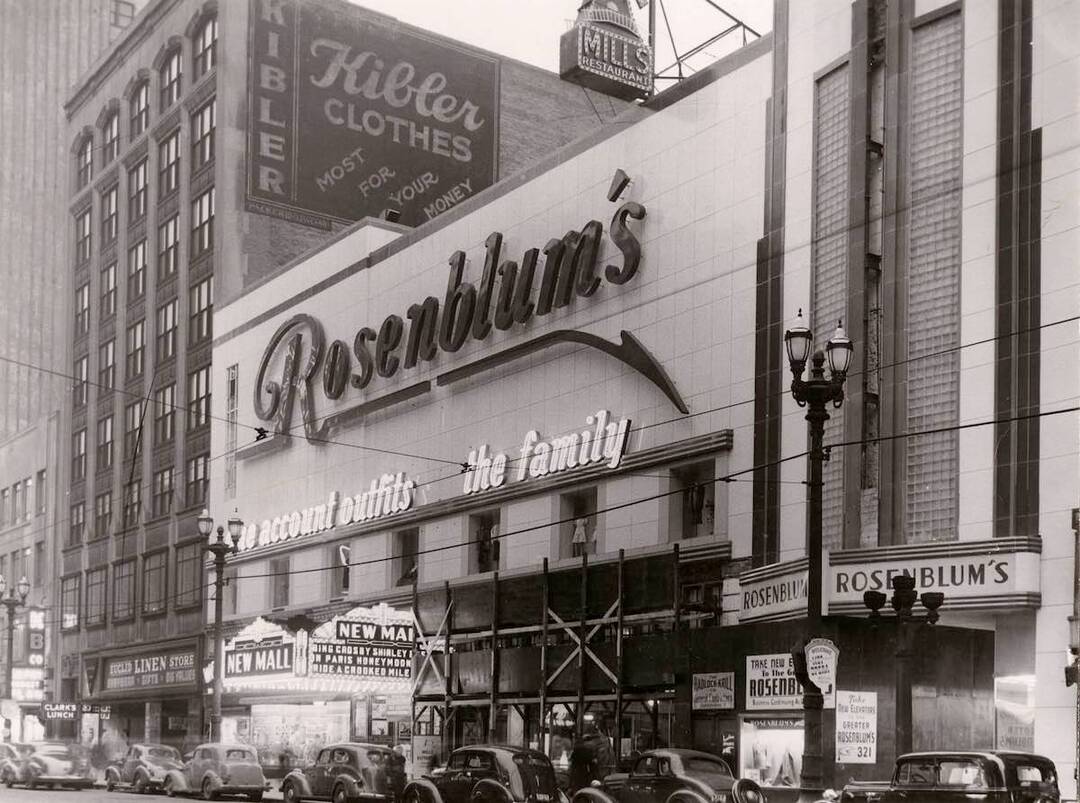
    <title type="html"><![CDATA[Rosenblum&#039;s: &quot;One Account Outfits the Family&quot;]]></title>
    <summary type="html"><![CDATA[<p><strong><em>When most people think about Cleveland’s downtown department stores, they think about Higbee’s or the May Company. There were, however, many other significant stores that contributed to the iconic image of downtown Cleveland, especially the many stores along Euclid Avenue. Among those stores was Rosenblum’s, a popular clothing store that was a shopping staple in Cleveland for close to a century. </em></strong></p><img src="https://clevelandhistorical.org/files/fullsize/8d222439b3d92080b893c291a533d464.jpg" alt="Rosenblum&#039;s" /><br/><p>Max Rosenblum was born in Austria-Hungary on December 5, 1877, and at the age of six he and his family immigrated to the United States, arriving in Cleveland not long after. Rosenblum attended grammar school in Cleveland, but left school after the sixth grade. As a child, at 3:30 every morning he would grab as many Plain Dealers as he could, bringing them down to Union Station and selling them before serving regular customers and then going to school. After leaving school, Max Rosenblum continued to sell papers and shined shoes at Superior Avenue and West 3rd Street (then known as Seneca Street). At 17, Rosenblum was given a job at a clothing concern where he worked in every department and went on to work at other businesses as well. In 1910, at the age of 32, he decided to go into business for himself, and open up his own clothing store on Public Square with the motto “New ideas, new methods, new policies.”
Rosenblum’s first store was located at 2014 Ontario Street on the second floor of a building that predated the Terminal Tower and the Higbee building where JACK Casino now operates. Rosenblum poured all that he had into opening the store. In order to put up the sign for his new business, he even had to borrow a month of rent from an uncle. Rosenblum was an early adopter of ready-to-wear clothing, much like what is seen in today's clothing stores. Rosenblum’s sold clothes for men, women, and children, and in addition to the ready-to-wear clothing, Rosenblum’s also made tailored suits to order for both men and women. Rosenblum also believed in easy credit. Newspaper ads for Rosenblum’s carried the motto as advertised was “It’s easy to pay the Rosenblum way.” In 1910 just one dollar per week paid over a period of forty weeks would buy any article of clothing at the store. Rosenblum’s also offered Eagle or Merchants stamps with all sales. These stamps, which were redeemable for cash or merchandise, were introduced by the May Company in 1903.
With Rosenblum’s business thriving, in 1920 Max Rosenblum moved the store just down the street to 321 Euclid Avenue. The new Rosenblum’s was located on the second floor of the building, later above Mills Restaurant, with private elevator service to bring customers up to the store. Once a customer stepped off the elevator, they were greeted by a large, eleven thousand square-foot store filled with clothes for men, women, boys, and girls of all ages and sizes. By 1922 the Rosenblum’s department store employed over one hundred employees and had a reputation as one of Cleveland’s oldest and most reliable business institutions. Rosenblum’s was open from 8:00 to 5:30 most days and on Saturdays closed at 6:00. Advertisements, however, stressed that shopping in the morning had greater benefits than other times of the day. Salespeople were fuller of vigor and, with fewer customers in the store, they were able to provide better one-on-one service. Fewer customers in the store also meant there were no crowds to contend with, making shopping less stressful and more comfortable.
Rosenblum’s department store prided itself on many things: high-quality products, wide array of styles in all sizes, stellar customer service, low prices, and easy pay-as-you-go credit that allowed customers to pay the price of an item over a period of forty weeks. Payments could be made weekly, semi-monthly, or monthly without paying interest or carrying charges. While customers might not get the product right away, this style of charge account allowed for greater flexibility for the shopper to make purchases. While this form of payment, which is similar to layaway, has fallen out of favor for most retailers today, one hundred years ago it was a popular and convenient way to purchase products.
What sort of products could you expect to find at Rosenblum’s? Much like any clothing retailer, Rosenblum’s, had a wide array of varying products for all ages and in all sizes. In the 1920s Rosenblum’s primarily sold women’s dresses, suits and fur coats, and for men they sold suits, dress shirts, slacks, and overcoats. Rosenblum’s also offered free tailoring service on all clothing, and for both men’s and women’s clothing Rosenblum's offered tailor made clothing as well. Rosenblum’s also had an extensive children’s section, and every year, much like now, they would advertise for back-to-school shopping. Everything they sold came in a variety of styles and fabrics. Women’s fur coats were a popular product at Rosenblum’s and were made from materials such as raccoon, muskrat, marmot, mink and more, while dresses were made from various types of silk and twill.
Rosenblum’s downtown store was a success, but after World War II shopping gradually began moving from downtown to the suburbs. Although it was relatively late in embracing suburban expansion, Rosenblum’s eventually opened stores in Cleveland's growing southern suburbs. Rosenblum’s second store opened in December of 1967 in the Parmatown Mall in Parma, and a third location was opened in October of 1980 in the Southgate Shopping Center in Maple Heights. These new branches sold kitchen wares and household appliances in addition to clothing. Sadly, at the end of May 1981, less than 8 months after their most recent suburban expansion, the downtown Rosenblum’s closed its doors for the last time. Rosenblum’s Parmatown store continued successful operations into the latter half of the 1990s. Rosenblum’s final remaining location at Southgate closed in 2006.</p><p><em><strong><a href="https://clevelandhistorical.org/items/show/1000">For more (including 6 images) view the original article</a></strong></em></p>]]></summary>
    <published>2023-04-07T21:12:27+00:00</published>
    <updated>2026-04-17T19:17:43+00:00</updated>
    <link rel="alternate" type="text/html" href="https://clevelandhistorical.org/items/show/1000"/>
    <id>https://clevelandhistorical.org/items/show/1000</id>
    <author>
      <name>Matthew Steenbergh</name>
    </author>
  </entry>
  <entry>
    <title type="html"><![CDATA[Lorain-Fulton Square: Once the &quot;Hub of the West Side&quot;]]></title>
    <summary type="html"><![CDATA[<img src="https://clevelandhistorical.org/files/fullsize/2e69c04a06dba37e0b0aba310b4f2ca6.jpg" alt="&quot;Next Stop . . .  Lorain-Fulton Square!&quot;" /><br/><p>Fulton Road is one of seven streets that were originally designed to radiate from Franklin Circle in accordance with the 1836 subdivision plat created by Ohio City pioneer real estate developers Josiah Barber and Richard Lord.  Starting at the Circle, it runs for one-half mile in a southwesterly direction, intersecting several grid streets at sharp angles, before terminating--at least until 1905--at Lorain Avenue  (then, Lorain Street).  It is unknown whether Barber or Lord envisioned it, but the original terminus of Fulton Road was destined to become one of the most commercially important corners on the west side of Cleveland in the late nineteenth and early twentieth centuries.</p><p>Eighteen years after Barber and Lord recorded their 1836 subdivision plat, Ohio City was annexed to Cleveland, becoming that city's west side.  At about the same time, German immigrants began arriving in Cleveland in large numbers and moving  onto streets in the Barber and Lord  and other  residential subdivisions located on lands north and south of Lorain, and west of West 25th Street (then, Pearl Street).  As the immigrant population swelled in these subdivisions, a neighborhood emerged and Lorain  Street  transformed into its commercial corridor.  Retail merchants of German origin built and occupied store fronts along the street's north and south sides, and, before long, both sides of Lorain Street were lined  with retail stores all the way to Cleveland's western corporation line which, in the post Civil War period, was just west of West 59th Street (then, Purdy Street).  </p><p>A number of these early west side retail stores were built at or near corners of the intersection of Lorain with Fulton and nearby Willett Street, a north-south grid street which began on the south side of Lorain just across the street from Fulton Road's terminus. (In 1905, Willett Street would be renamed Fulton Road, creating the much longer version of the latter road that Clevelanders know today.)  These two intersections (hereinafter, simply referred to as the Lorain-Fulton intersection) were from the start likely viewed by merchants as favorable places to conduct retail business.  As noted above, the Lorain-Fulton intersection was just a half mile down Fulton from Franklin Circle, where the west side's elite were already beginning to build the mansions that would one day make Franklin Boulevard (then, "Franklin Street") the "West Side's Euclid Avenue."  Moreover, the intersection was also just one-half mile down Lorain from the West Side Market, which had become, since it relocated to the northwest corner of Lorain and Pearl in 1859, a popular place where west siders gathered and shopped for their meat and produce.  </p><p>The early retail merchants who located their businesses at or near the Lorain-Fulton intersection included grocers,  butchers, shoe makers, saloon keepers, tobacconists, bakers, confectioners, milliners and tailors, to name just a few.  A survey of period directories suggests that business failures among these merchants  were frequent and it wasn't unusual for a merchant to sell one type of product one year and then an entirely different one the next.  Two of the early merchants who located at or near the intersection, however, are noteworthy for establishing retail businesses that thrived for decades.  One was Henry Leopold, a German immigrant from Hanover, who, in 1859, opened up a store near the southeast corner of the  intersection where he initially manufactured and sold furniture and caskets.  Eventually, his company would leave the casket business and devote its full attention to making and selling furniture.  Leopold's store was a neighborhood fixture until the 1940s when it relocated to Cleveland's West Park neighborhood and, after that, to the suburb of Brecksville where it is still in business today.   The other notable early merchant at this intersection was George Tinnerman, a German immigrant from Bavaria, who opened a hardware and stove store on the northeast corner in 1868.  Tinnerman later developed a steel range stove which  became so popular that, after operating his retail business at the Lorain-Fulton intersection for almost four decades, he  finally closed it  in 1915 to focus exclusively on manufacturing steel range stoves at a factory he built on Fulton Road just south of the Lorain-Fulton intersection.</p><p>In 1879, the businesses of Henry Leopold, George Tinnerman and the other merchants engaged in the retail sale of products or services at or near the Lorain-Fulton intersection were boosted when the West Side Street Railway (WSSR), then controlled by Marcus Hanna, bested Tom Johnson's Brooklyn Street Railway and secured a license from Cleveland City Council to build and operate a new branch of the WSSR streetcar system on tracks which soon ran south on Fulton from Franklin Circle to Lorain and then west on Lorain Chestnut Ridge (today, West 73rd) Street. Later, that new branch was additionally connected to the WSSR main line by a separate track which ran from the Lorain-Fulton intersection to Pearl Street.  As more and more streetcar riders hopped on, got off or waited for a transfer at the Lorain-Fulton intersection, the businesses of nearby merchants grew as evidenced by the construction  of many larger and more grand commercial buildings at or near the intersection in the decades that followed.</p><p>In the early twentieth century, another change came to the Lorain-Fulton intersection that reflected its continued vitality and key location on Cleveland's west side.   Between 1903 and 1905, the Cleveland Public Library, armed with a promise of funding from Andrew Carnegie, conducted a search for a site for its new West Side branch library.  A number of sites at or near prominent West Side intersections were considered, including one at the intersection of Lorain and West 25th near the West Side Market and another at the junction of Lorain and Clark Avenues.  The Board, however, ultimately chose a site  on Fulton Road less than a tenth of a mile north of the Lorain-Fulton intersection.  The new Carnegie West branch library opened in 1910.  It was then, and still is today, the largest of Cleveland Public Library's branch libraries.  </p><p>In the same year that the new library opened, the City of Cleveland, spurred by the example of New York City, began naming a number of its more notable diagonal intersections "squares." (For example, the diagonal intersection of Huron Road and Euclid Avenue in downtown Cleveland was named "Euclid Square" in1910. It was later renamed "Playhouse Square" in 1921 when theaters began to locate there.)  While it is not known whether the City of Cleveland ever officially named it a square, the Lorain-Fulton intersection became popularly known on the West Side as "Lorain-Fulton Square" in this decade, likely as the result of a number of actions taken by merchants with stores located at or near the intersection.  In 1914, a number of these merchants, including George Tinnerman and Henry Leopold's son August, formed the Lorain-Fulton Square Business Association to further their mutual business interests and promote the area as a great place for west siders, including those on west side street cars, to shop for all of their family and other needs.  In 1915, the merchants sponsored a contest to create a slogan for their business area.  The winning slogan was "The Hub of the West Side." The merchants later used that slogan repeatedly in "Opportunity Ads" that promoted their stores and advertised their "bargain" sales.</p><p>The 1920s opened with another sign  of the continuing commercial vibrancy of  the Lorain-Fulton intersection. On December 25,1921, John and Bertha Urbansky opened their beautiful new Lorain-Fulton Theater at 3321-3409 Lorain Avenue, adjacent to Leopold's four-story furniture store on the intersection's southeast corner.  The theater seated 1,400 patrons; had a dance hall on the second floor; and had  storefronts for retail businesses.   In the years that followed, the intersection remained an active and busy commercial area, but as streetcars declined and automobile traffic increased, as upper- and middle-class residents (and the businesses that catered to them) moved to the suburbs, and as the city's deindustrialization began in the post World War II era, Lorain-Fulton Square began to lose many of its shoppers. By the 1950s, historic commercial buildings at or near the intersection were already beginning to show signs of  deterioration and neglected maintenance.   A number of them were torn down and replaced by parking lots, gas stations or fast-food restaurants which better served the needs of the more mobile--and more transient--population now frequenting  Lorain-Fulton Square.</p><p>At least since 1993, when the Cleveland Landmarks Commission cataloged historic buildings on Lorain Avenue between West 32nd and West 58th Streets during the process that created the Lorain Avenue Commercial Historic District, the City has been aware of the extent of the deterioration and loss of historic buildings at or near Lorain-Fulton Square.  Before Landmarks Commission intern Don Petit walked up and down Lorain Avenue in that year, snapping photos of the historic buildings, many historic buildings were already lost--burned down, torn down or perhaps blown down in the 1953 Tornado.  The photos he took were part of a City effort to save  the remaining historic buildings. Many of the buildings that were still standing at or near the intersection of Lorain and Fulton when Petit walked the area in 1993, no longer are.  Lorain Fulton Square has become a very different place than it was one hundred or even thirty years ago.  </p><p>While other prominent West Side intersections such as Detroit Avenue -West 25th Street and Lorain Avenue -West 25th Street have for decades  garnered  attention from redevelopers resulting in the preservation of a number of historic buildings in those areas being saved, Lorain-Fulton Square has not.  In 2022,  however, there is reason for hope as Lorain Avenue west of West 25th Street is beginning to get redevelopment attention.  While little of that attention has yet come to  Lorain-Fulton Square itself, it seems inevitable that it soon will.  It would be fitting to honor the rich commercial history of this historic intersection with redevelopment that recalls and reflects some of the height, massing and location of significant historic buildings.  This would seem to be good for business branding. It would also instill some pride in new business owners operating there, as well as new residents choosing to live there, as they came to learn that Lorain-Fulton Square was at one time, and for good reason, known as the "Hub of the West Side." </p><p><em><strong><a href="https://clevelandhistorical.org/items/show/966">For more (including 21 images) view the original article</a></strong></em></p>]]></summary>
    <published>2022-09-30T14:36:48+00:00</published>
    <updated>2026-04-17T19:17:42+00:00</updated>
    <link rel="alternate" type="text/html" href="https://clevelandhistorical.org/items/show/966"/>
    <id>https://clevelandhistorical.org/items/show/966</id>
    <author>
      <name>Jim Dubelko</name>
    </author>
  </entry>
  <entry>
    <title type="html"><![CDATA[Fridrich Bicycle: Once Cleveland&#039;s Oldest Bike Shop]]></title>
    <summary type="html"><![CDATA[<p><strong><em>Until it closed in 2024, Fridrich Bicycle was Cleveland's oldest retail bicycle shop and  one of the oldest in the United States.  The Fridrich family had been selling bicycles in Cleveland for well over 100 years.  The family's roots in the Lorain Avenue Commercial Historic District, however, extended even deeper than that.</em></strong></p><img src="https://clevelandhistorical.org/files/fullsize/04db346c2bc5a56681c7300fc5141dbf.jpg" alt="Fridrich Bicycle Store - 1993" /><br/><p>As in many other American families, the Fridrich family story begins with an immigrant.  In 1847, 36 year-old Joseph Friedrich, the unmarried son of a restaurant owner in Pirkensee, Bavaria, emigrated from his homeland. At the time, revolution and war in central Europe were pushing large numbers of ethnic Germans out of their principalities which became parts of a unified German state in 1871. Many immigrated to the United States, and to Cleveland, then a young, but growing, industrial city in the Midwest.  Friedrich--who would later change his surname to "Fridrich"--may have traveled directly to Cleveland from Europe, but there is no record of his presence until May 1853 when County records reveal that he married Margarete Schaefer, also a German immigrant.  </p><p>Margarete Schaefer Friedrich was the mother of three young boys--John, Anton and August Schmidt--all under the age of eight.  When he married her, Joseph Friedrich became a father to all of them. Over the course of the next ten years, he worked as a laborer--for at least some of that time employed by the Cleveland and Erie Railroad.  Margarete gave birth to three more boys, Joseph W., George, and William Friedrich.  In 1863, the year their youngest son William was born, the Friedrich family was residing in a house near the intersection of Old River and Mulberry Streets on the West Bank of the Flats.  The surrounding neighborhood was fast developing into an Irish-American enclave which became known as the Triangle, later shortened to "the Angle," and today nostalgically referred to by the Cleveland Irish community as "the Old Angle."</p><p>In 1864, the Friedrichs moved from the Angle about a mile south to a growing and predominantly German-American neighborhood that was centered around Lorain Street (Avenue) and located primarily west of Pearl (West 25th) Street.   Joseph purchased a new house on Branch (later renamed China, then Elvira and finally West 37th), a street south of Lorain and just west of Willet (Fulton) Road.  It was one of several streets in a new residential subdivision platted in 1860 by real estate developers John H. Sargent and Thomas Dixon.   Sargent & Dixon's subdivision was just one of a number built north and south of Lorain Street in the 1850s and 1860s that together grew into a neighborhood that was centered around a commercial corridor on Lorain Street. </p><p>Growing up in this neighborhood, the Schmidt and Friedrich boys would have had ample opportunity to explore Lorain Street, located less than a quarter mile from their doorstep.  When the family first arrived, most buildings on Lorain were one or two stories and made of wood.  Later, by the 1880s, many of the earlier era buildings had been razed and replaced by taller, more ornate buildings often built of brick.  When the boys made their first trips up to the corner of Mechanic (West 38th) Street and Lorain, possibly the first building that would catch their eyes was the livery and stable of Andrew Steinmetz which was built circa 1871. It was located almost directly across Lorain from Mechanic Street, and it clearly stood out from other nearby buildings because of its unusual mansard roof and because of the constant stream of horses, wagons and carriages going into or out of the building.  </p><p>Over the years as they grew up in their house on Branch which was renamed China Street in 1873, the Schmidt and Friedrich boys likely made many trips up to the corner and then up or down Lorain Street.  By 1880, this corridor was lined with commercial buildings that stretched westward from near Columbus Road almost all the way to Gordon Avenue (West 65th Street)  near Cleveland's border with the suburb of West Cleveland.  Some of those trips likely took them to the Pearl Street Market on the northwest corner of Lorain and Pearl (West 25th) Street,  just a half mile east of Mechanic Street.  When the Friedrich family moved into the neighborhood in 1864, there was an open-air market on that corner that was known as the West Side Market.  Four years later, the City of Cleveland built a one-story wooden market house on the site which it named after nearby Pearl Street.  (Forty-four years later in 1912, the market house that we know today as the West Side Market would open across the street, and the Pearl Street Market would shortly afterwards be razed.)  </p><p>Walking or riding to the Market, the Schmidt and Friedrich boys would have passed a number of thriving shops in the second half of the nineteenth century that became well-known to them, like Julius Grothe's cabinet shop at 265 (today, 3704) Lorain, John Kraus's boots and shoe shop at 257 (3622) Lorain, the Koblenzer family's butcher shop at 246 (3613) Lorain, and Heidenger's Bakery at 234 (3601) Lorain, just to name a few.  As they crossed Fulton Road, they would also have noted the rest of the nearly two dozen saloons that dotted the corners of Lorain from Mechanic Street to the Market, some sharing space with early grocery stores, others located in boarding houses.  The boys would take in all the sights, sounds and smells of the commercial businesses of Lorain Street, including the pungent aromas from the Dahlheimer cigar and tobacco factory and retail shop at 199 (3228) Lorain. In 1875, it was purchased by new owner Charles Sauer who, some two decades later, would build a new and larger factory and retail shop on the premises, one still standing today and recently renovated and restored. As the boys neared the Pearl Street Market, they might have noticed the millinery shop of Matilda and Julia Chubb at 96 (2615) Lorain, diagonally across the street.  The two sisters operated their retail business on the southwest corner of McLean (West 26th) Street and Lorain for nearly 20 years in the second half of the nineteenth century before retiring and moving to Lakewood.  As the boys passed the store, they may have turned their heads to better admire a fashionably dressed young woman leaving the Chubb sisters' store with a new hat atop her head.</p><p>The Schmidt and Friedrich boys were undoubtedly influenced by interactions with the Lorain Street commercial corridor like those imagined above.  While the two oldest Schmidt boys worked in traditional trades (one becoming a stone cutter and the other a bookkeeper), the younger four, after they became old enough, by nineteenth-century standards, to work for a living, all started new retail businesses on Lorain Street. This development within the second generation of the Fridrich family living in America would lead not only to the 1909 establishment of Fridrich Bicycle, but also to Fridrich Moving and Storage Co., another Fridrich family business that was founded by youngest brother William in 1915 and which has, like the bicycle shop, now operated in the Cleveland area for more than a century.</p><p>Fridrich Bicycle grew out of an early business partnership between August Schmidt, the youngest of the Schmitt brothers, and Joseph W. Friedrich, the oldest of the Friedriches.  In 1884, 34 year-old Schmidt, who by this time was spelling his last name "Schmitt," and 26 year-old Friedrich (whose immigrant father, a short time before his death in 1888, would change the spelling of their family's last name to "Fridrich") started a retail coal business under the name of "Schmitt and Friedrich." Originally operating out of the family house at 19 China (2000 West 37th) Street, the two moved their business in 1885 into a storefront at 840 (3817) Lorain Street.  Why they decided to start a retail coal business is unknown, but it may have been prompted by contacts their father developed while working for the Cleveland and Erie Railroad.   Meanwhile, the two youngest Friedrich boys, William and George, had also pooled their resources together and, in 1891, started a retail flour and feed business up the street from their older brothers' retail coal store at 924 (4209) Lorain.)</p><p>After operating their retail coal store together for 15 years, August Schmitt and Joseph W. Fridrich closed it in 1900, with each starting new retail coal businesses in their individual names.  While it is unknown why they ended their partnership, it may have been related to their different family statuses.  Joseph W. Fridrich had married in 1881 and, by 1900, had two sons--one of whom, Joseph Aloysius Fridrich, was 17 years old and already working in the family coal business.  August Schmitt, on the other hand, though eight years older than his brother, had not married until 1891 and had children who in 1900 were just  3 and 7 years old.  Schmitt operated his new business out of a store at 750 (3207) Lorain, while Fridrich took over the storefront of their former partnership business at 840 Lorain.  </p><p>While August Schmitt's new business was apparently successful--he operated it until his retirement in 1915, Joseph W. Fridrich's appeared to have been less so, as he faced the challenge of bringing two sons into the business.  In 1902, he opened a flour and feed store at 842 (3821) Lorain, right next door to his retail coal store, but that business closed by 1904.   He then formed a new partnership in the retail coal business with August Schmitt and his younger brother William Fridrich, but both August and William appear to have withdrawn from this association by 1907.  Joseph might have attempted other changes to his business model had not a new business opportunity suddenly come his way in 1908.  After his flour and feed store at 842 Lorain had closed in 1904, that storefront had been rented to a Walter J. Meyers, who opened a retail bicycle store there that same year.  Sometime in late 1908 or early 1909, however, Meyers closed his shop.  It is likely that Joseph's younger son, Alphonse, who, probably more so than his father, was aware of the bicycle "craze" going on in the United States in the early twentieth century, successfully lobbied his father to take over Meyer's bicycle shop.  It was the beginning of Fridrich Bicycle and the end of Joseph Fridrich's retail coal shop, which closed the same year. </p><p>While Alphonse Fridrich was the first manager of Fridrich Bicycle, the business was later largely operated by Joseph W. Fridrich and his older son Joseph Aloysius.  The Fridrich family continued to lease space for their shop at 3821 Lorain until 1915 when they purchased the building. In 1919, they added a retail auto parts business to their store and changed the name of the business to Fridrich Bicycle and Auto Supply Co.  In 1925, as the result of the successful growth of these two businesses, the Fridrich family purchased a building across Lorain Avenue which had originally been  Andrew Steinmetz's livery and stable.  It must have given Joseph W. Fridrich some pause the day he vacated the storefront at 3821 Lorain and  moved the business across the street into the historic building which had likely captured his imagination as a child.  </p><p>Seven years later, in 1932, Joseph W. Fridrich died and a new era in the family began when his son Joseph Aloysius took over operation of the store.  He was helped by his son Joseph J.  who had dropped out of high school  to work in the family business.  Continuing to thrive on Lorain Avenue, even in the wake of the Great Depression, Fridrich Bicycle and Auto Supply expanded again in 1942, purchasing  the three-story Schenck Building at 3806-3808 Lorain.  The business's address for its combined retail operations in the two  buildings would soon be changed to simply 3800 Lorain.  In 1947, when he was just 64 years old, Joseph Aloysius Fridrich died  and this ushered in yet another new era for the family business.  </p><p>Joseph J. Fridrich, known in the family as "J.J.," took over the operations of the store.  He is remembered by members of the Fridrich family today for the "Cadillac" bicycles which he and staff built in the store's basement, and which he passionately promoted as the store's owner and manager.  J.J. Fridrich also built a new building on Lorain Avenue to the west and adjacent to the Schenck Building, which soon became known in the family as "Schwinn Hall," because its first floor was used  to display the company's inventory of Schwinn bicycles.  In the 1960s, he made the decision to close the retail auto parts business and to concentrate exclusively on selling bicycles of all types.  In 1966, the name of the company was accordingly changed to Fridrich Bicycle, Inc.</p><p>J. J. Fridrich owned and operated Fridrich Bicycle until his death in 1992.  According to an article appearing in the Plain Dealer on April 14, 1992, when the store closed for a day in his memory, it was the first time it had closed on a day other than Christmas in the memory of anyone then working at the store.  After J. J. Fridrich's death, the store was owned and the business operated by J.J's son, Charles "Chuck" Fridrich.  Day-to-day operations later were handled by Jane Alley, the store's general manager, and a staff of nine employees.  Cleveland's oldest retail bicycle store remained an important business in the Lorain Avenue Commercial Historic District, as well as a custodian of two of that District's most historic buildings, until it closed in 2024.</p><p><em><strong><a href="https://clevelandhistorical.org/items/show/964">For more (including 14 images) view the original article</a></strong></em></p>]]></summary>
    <published>2022-08-22T03:31:47+00:00</published>
    <updated>2026-04-17T19:17:42+00:00</updated>
    <link rel="alternate" type="text/html" href="https://clevelandhistorical.org/items/show/964"/>
    <id>https://clevelandhistorical.org/items/show/964</id>
    <author>
      <name>Jim Dubelko</name>
    </author>
  </entry>
  <entry>
    <title type="html"><![CDATA[Malley&#039;s Chocolates]]></title>
    <summary type="html"><![CDATA[<img src="https://clevelandhistorical.org/files/fullsize/209758ed4fd81c9d151185737a136c1c.jpg" alt="Second Lakewood Store" /><br/><p>Malley’s Chocolates has been a family-owned and operated Cleveland business since its inception in 1935. The mastermind behind this Cleveland business was Albert “Mike” Malley. Malley decided to create his own American dream in the midst of the Great Depression. Mike Malley borrowed $500 to rent his first Malley’s Chocolates store at 13401 Madison Avenue in Lakewood. This was not only Mike Malley’s business venture; it was his wife Jo’s as well. They both made Malley’s an instant success. </p><p>Mike and Jo Malley, each played an integral role in the business’s success. Mike Malley bought all the supplies that he would need to make the chocolate because he had learned the ropes of the business as a child in Meadville, Pennsylvania, working at a chocolate store that sold hand-made chocolates. Jo Malley, on the other hand, ensured that all the bills were paid.</p><p>This tag-team approach to their new family business allowed the first Malley’s store to flourish. After fourteen years, Malley’s Chocolates moved its Lakewood store to 14822 Madison Avenue in 1949. It had the distinction of being the first all-aluminum retail store in America. This location was also a hit from the start, drawing so many opening-day customers that the Lakewood police had to be called to control the crowds. Clevelanders could not get enough of Malley’s sweet treats. </p><p>In 1967, Mike and Jo Malley’s son Bill took over the family business from his parents. Two years later he opened the third Malley’s store, located at Clague and Lorain Roads in North Olmsted, converting a former hardware store into the latest showcase for Malley’s delicious confections. This location added the now locally famous merry-go-round that patrons can eat on. This merry-go-round has excited its patrons for years and has made this location a favorite one for parties. To commemorate the merry-go-round, Bill Malley created the Carousel Sundae. He also devised the Sweet William Sundae after getting the idea from his son Bill Jr. Thanks to the success of the business, he had to move the factory and chocolate kitchen twice to larger venues.  </p><p>The second of these, a 60,000-square-foot chocolate factory, is located in Brook Park off I-480. This move occurred in August of 1990. Drivers on the freeway can see the three “Malley” pink silos with large black letters that spell “Milk,” “Cocoa,” and “Sugar.” Each of the three silos are 88 feet tall and 12 feet wide. The silos originally belonged to Laich Industries Corp. and were created to hold 100,000 pounds of plastic pellets. However, after the manufacturer declared bankruptcy in 2005, Malley’s purchased the silos following an extensive search. The silos were originally supposed to be there for function; however, Malley’s decided not to install an underground vacuum pipe system that would extract the ingredients from the silos. Therefore, the company decided to turn the silos into a decorative advertisement of sorts. Malley’s hired a commercial sign painter to paint the white silos, which from the start was a difficult task. All the silos had to be painted pink before the black lettering was applied. </p><p>Today, Mike and Joe Malley’s grandchildren take on different roles to ensure the success of this family-owned and operated business: Dan Malley, Sis Malley, Bill Malley Jr., and Mike Malley. There are currently twenty-two stores and four of them operate as old-fashioned ice cream parlors. The four locations that serve ice cream are the Bay Village, North Olmsted, Lakewood, and Mentor locations. All their stores have the same glass panels and hand-painted walls that Bill Malley’s wife Adele Ryan Malley envisioned. Moreover, all the stores are painted in Malley’s classic pastel shades of green, white, and pink. If Cleveland natives have not visited Malley’s Chocolates, they have at least heard of this business through its ingenious marketing strategies. Many have spotted the airplanes in the sky towing aerial banners that advertise Malley’s products. Others may have also seen the oval “CHOC” stickers on the cars of Malley’s fans. This third-generation family business remains dedicated to satisfying Greater Cleveland’s sweet tooth.</p><p><em><strong><a href="https://clevelandhistorical.org/items/show/920">For more (including 5 images) view the original article</a></strong></em></p>]]></summary>
    <published>2020-12-03T16:02:06+00:00</published>
    <updated>2026-04-17T19:17:42+00:00</updated>
    <link rel="alternate" type="text/html" href="https://clevelandhistorical.org/items/show/920"/>
    <id>https://clevelandhistorical.org/items/show/920</id>
    <author>
      <name>Sarah White</name>
    </author>
  </entry>
  <entry>
    <title type="html"><![CDATA[Azman &amp; Sons Market]]></title>
    <summary type="html"><![CDATA[<img src="https://clevelandhistorical.org/files/fullsize/1d3343b0ef3ba0f74294a79c525b4fe2.jpg" alt="The Front Window" /><br/><p>Some masters of craft may work in paints, and others, wood. Frank Azman III, however, worked in meats for over four decades. An afternoon spent in Azman & Sons Market over a sausage sandwich revealed in one bite why the shop was a staple of the neighborhood for generations. Similarly, customers who were greeted by first name upon arrival added to the charm of Azman's, harkening back to an era when businesses more commonly knew their customers personally and corner markets stood as epicenters of activity in communities. </p><p>The Azman family first began working in the sausage business in the village of Ig, a small town in their native country of Slovenia. Frank Azman relocated his family and business to America during World War I, a period which saw the greatest recorded emigration of Slovenians to the United States in history. Settling in Cleveland, Azman reestablished his sausage shop in 1924 at 6501 St. Clair Avenue amidst the largest Slovenian community in the country.</p><p>As not only business owners but, also, residents, the Azman name quickly became recognizable in the St. Clair neighborhood and soon began to spread throughout the city of Cleveland. Proud of their community and eager to participate in local events, Azman son’s, Frank II and Louis, refurbished their father’s old Model T to be used in parades to promote Azman & Sons Market. During its arguably most memorable ride, a Miss World  pageant winner once joined the Azmans in the Model T when she arrived late to an event and her scheduled parade float had already set off. </p><p>Besides assisting beauty pageant winners in times of distress, the Azman family also helped those looking for the familiarity of a home-cooked meal. In 1968, a crew of Yugoslavian volunteer servicemen were docked in Cleveland and hoped to find a dinner reminiscent of their homeland. After sampling an Azman sausage at a local restaurant, the restauranteur contacted Azman & Sons Market to see if the servicemen could have some sausages to take with them upon their departure. Although already closed for the day, the shop was reopened and the crew was treated to more food for their journey.</p><p>What had really kept Azman & Sons in business for over nine decades, though, was the family’s dedication to their local customer base and quality of their products. When asked what the most important ingredient to the Azman sausage recipe was, third-generation owner Frank Azman III pointed without hesitation to the original brick smokehouse. Located behind the shop, the small, unassuming brick structure had been smoking sausages since 1924. Modern-day smokehouses are primarily stainless steel and Azman III argued that they cannot match the flavor of a sausage slowly smoked over cherry wood.</p><p>In addition to the smokehouse, the store had also kept the original butcher block table in the center of the kitchen, worn down by years of cleaning. Likewise, the store had continued to use the original cooler, which was first chilled by large overhead ice blocks but was eventually updated to run on electricity. These pieces remained in use as operable parts of the shop’s longstanding history.</p><p>Azman & Sons Market once served the community as a full -service grocery store offering patrons produce and pantry items in addition to the three hundred pounds of meat they processed and sold weekly. As the needs of the neighborhood changed, however, Azman & Sons Market scaled back its operations to focus on meats. Azman & Sons closed permanently in December 2021 with the passing of the store’s owner Frank Azman. The Azman legacy continues, however, with Frank’s brother Bill Azman. Bill runs a similar store called Azman Quality Meats located at 610 East 200th Street in Euclid. </p><p><em><strong><a href="https://clevelandhistorical.org/items/show/720">For more (including 9 images&#32;&amp;&#32;3 audio files) view the original article</a></strong></em></p>]]></summary>
    <published>2015-07-09T15:46:35+00:00</published>
    <updated>2026-04-17T19:17:41+00:00</updated>
    <link rel="alternate" type="text/html" href="https://clevelandhistorical.org/items/show/720"/>
    <id>https://clevelandhistorical.org/items/show/720</id>
    <author>
      <name>Joe Dill </name>
    </author>
  </entry>
  <entry>
    <title type="html"><![CDATA[Bailey&#039;s: &quot;The Store For All the People&quot;]]></title>
    <summary type="html"><![CDATA[<img src="https://clevelandhistorical.org/files/fullsize/b5a7cdb6acfcbd7c3ddb668f9334f7c3.jpg" alt="Bailey&#039;s Decorated for Lake Erie Centennial Exposition" /><br/><p>The sweet smell of retail success was in the air in the early 1870s due to the example set by William Taylor and Thomas Kilpatrick.  Their success prompted Lewis A. Bailey, Colonel Louis Black, and Charles K. Sunshine to combine their financial resources and open a store of their own.  In 1881 these men opened the L.A. Bailey Dry Goods Company, which was located at the corner of Ontario Street and Prospect Avenue.  L.A. Bailey’s Dry Goods proved to be very successful and grew throughout the years. By 1895 the building had five floors and many departments including the Grocery Department.</p><p>Bailey’s Dry Goods went through a major change after Lewis Bailey’s death in 1899.  Colonel Louis Black and Charles Sunshine bought the company and combined it with the Cleveland Dry Goods Co.  The Bailey Co. was now a real department store.  The department store became even more successful than the dry goods store was.  As business continued to grow so did the store.  The store expanded and new buildings were added.  By 1910, Bailey’s included a ten-story building.  Bailey’s opened their first branch store in 1929 at 10007 Euclid Avenue.  The success of this branch led to branches being opened in Lakewood (1930), at East 228th Street and Lake Shore Boulevard (1951), and in the Eastgate Shopping Center in Mayfield Heights (1959).</p><p>Bailey’s success was due to many things.  First, Cleveland was a city that provided an ideal setting for store growth.  Many people were moving into Cleveland at the time of the Bailey Co.’s opening.  The Bailey Co. turned into a department store at a time when Cleveland was the seventh city in population and the ninth city in manufacturing.  It made an important decision to market itself as a store friendly to working-class Clevelanders with low prices, installment plans, and frequent sales promotions. It even branded itself "The Store For All the People." Another, later, factor in Bailey’s success was its branch stores.  Suburban stores were good because they were located where the people were living.  This was convenient because it did not force the people to commute downtown.  </p><p>In 1958 Century Food Market Company (CFM) bought Bailey’s and hoped to turn it into one of Cleveland’s largest department store chains.  In 1961 Taylor’s Department Store (which was the store that influenced the original Bailey’s) became the first downtown department store to close.  Bailey’s followed in Taylor’s footsteps and a few months later the downtown Bailey’s store closed.  Demolition began and in 1964 a parking garage called the Parkade opened where Bailey’s once stood.</p><p>This was not the end of Bailey’s…yet.  The people of Cleveland were outraged and still wanted to shop downtown.  The public forced Bailey’s to reconsider, so Bailey’s decided to open a store back up downtown.  On November 1, 1962 Bailey’s opened the first two floors of its new eleven-story store which was located at 514 Prospect Avenue and formerly belonged to the Bing Furniture Co.</p><p>Bailey’s began to struggle financially so they decided to merge with Miracle Mart in 1963.  Miracle Mart was very optimistic and projected high profits.  In 1968 three former Bailey’s stores, the Lake Shore Boulevard store in Euclid, the Eastgate Shopping Center store in Mayfield Heights, and the downtown store on Prospect Avenue, opened as Bailey’s Wonder Marts.  Cleveland department stores began to close in the 1960s due to growing competition, profit losses, changing ownership, and increasing debt.  A new generation of customers had emerged in the 1960s who wanted excitement and flair, not a traditional store like Bailey’s.  These shoppers were sophisticated and wanted upscale department stores and specialty shops that were especially located in the suburbs. They were willing to pay for these stores. The Bailey’s Wonder Marts did not impress these new customers and was faced with growing competition to discount stores like K-Mart that appealed to these customers. Bailey’s ended up declaring bankruptcy in 1968.  All of the Bailey’s stores closed and the Bailey’s era was over.</p><p><em><strong><a href="https://clevelandhistorical.org/items/show/706">For more (including 8 images) view the original article</a></strong></em></p>]]></summary>
    <published>2015-05-15T12:09:21+00:00</published>
    <updated>2026-04-17T19:17:40+00:00</updated>
    <link rel="alternate" type="text/html" href="https://clevelandhistorical.org/items/show/706"/>
    <id>https://clevelandhistorical.org/items/show/706</id>
    <author>
      <name>Rachel Verba</name>
    </author>
  </entry>
  <entry>
    <title type="html"><![CDATA[Mitchell&#039;s Fine Chocolates]]></title>
    <summary type="html"><![CDATA[<img src="https://clevelandhistorical.org/files/fullsize/de6039f85291bba565fcd2b9d2766cd3.jpg" alt="The Original Mitchell Team" /><br/><p>Well into the 20th century, waves of immigrants swelled Cleveland's ranks. Among them was a Greek native by the name of Chris Mitchell. Rather than contenting himself with a factory job, however, Mitchell tried his hand in business. Unfortunately, it was during the Great Depression and Mitchell’s first three businesses failed. But then he made a particularly astute observation: One business that seemed to thrive despite hard economic times was cinema! For his fourth endeavor, Mitchell thus chose to open a candy shop next door to the Heights Theater in 1939. More than three quarters of a century later, the store is still a Cleveland Heights icon. </p><p>Originally located on Euclid Heights Boulevard, Mitchell's was not the only store selling popcorn and penny candy to moviegoers. At one point there were as many as sixteen others in the Cleveland area. However, when movie theaters started bringing concessions in house, businesses similar to Mitchell's began to die out. Rather than suffer the same fate, Chris Mitchell deemphasized popcorn and other inexpensive sweet treats and focused most heavily on chocolate. The store's chocolates and the methods by which they are made have remained the same for decades, with the exception of new molds, a few modern machines, and the introduction of more products.</p><p>Chris Mitchell's new wife, Penelope, joined the business in 1949, a year after they were married. Their son, Bill, who had worked for his father as a boy, eventually inherited the business. After fifty-two years in Coventry Village, Mitchell's relocated to Lee Road in May 1991. Chris Mitchell died in 2000 at the age of 102. Penelope Mitchell lived until her late nineties. She passed away in 2015, assisting in the shop until shortly before her death. In 2016, Bill Mitchell finally decided it was time for a change. The business is now owned by Jason Hallaman and his wife Emily, who are committed to maintaining the Mitchells’ impeccable legacy. </p><p>The view from the shop windows may have changed, as have the owners. However, the tastes and smells of fresh, hand-dipped chocolate remind loyal customers of the small candy store where they would spend their dimes as children. </p><p><em><strong><a href="https://clevelandhistorical.org/items/show/545">For more (including 8 images&#32;&amp;&#32;8 audio files) view the original article</a></strong></em></p>]]></summary>
    <published>2012-08-30T18:18:39+00:00</published>
    <updated>2026-04-17T19:17:39+00:00</updated>
    <link rel="alternate" type="text/html" href="https://clevelandhistorical.org/items/show/545"/>
    <id>https://clevelandhistorical.org/items/show/545</id>
    <author>
      <name>Heidi Fearing</name>
    </author>
  </entry>
  <entry>
    <title type="html"><![CDATA[Mac&#039;s Backs-Books]]></title>
    <summary type="html"><![CDATA[<img src="https://clevelandhistorical.org/files/fullsize/8919e2a89d054e64b3d0d9023ad31158.jpg" alt="Old Exterior, ca. 1985" /><br/><p>Technology has been changing the shape of entertainment on Coventry Road for quite some time. Bars on the street can now show virtually any sporting event from around the world live and in high-definition, while DJs tote laptops filled with hundreds of thousands of songs to make dance floors come alive. For the past thirty years, however, Mac's Backs-Books has held free monthly poetry readings that rely on nothing more than the human voice and creativity. With bookstores closing across the city, the continued success of Mac's Backs and its literary events are a testament to the store's close ties to the Coventry community, which has not entirely turned away from its "hippie" roots.</p><p>Jim McSherry and Suzanne DeGaetano opened Mac's Backs-Books above the old Dobama Theatre on Coventry Road in 1982. In 1984 the store moved to a larger spot at 1785 Coventry Road, on the north end of the street. Around this time, the store began holding poetry readings on the second Wednesday of each month. This tradition started when poets Daniel Thompson (the first poet laureate of Cuyahoga County) and Dennis McDonnell approached Macs Backs’ owners after a nearby coffee shop no longer wanted to host. The poetry readings at Mac's Backs have featured both professional authors and amateur poets, and other literary events such as book clubs and author talks are frequently held at the store.</p><p>In 1993, Mac's Backs moved to its present location at 1820 Coventry Road, right next to Tommy's, another long-standing Coventry business. The neighborhood actually has two bookstores; the other is Revolution Books, a mainstay at the corner of Coventry and Mayfield Roads since the 1970s. Many of us also remember Delphic Books, which recently gave way to a coffee shop, and Coventry Books, which resided on Coventry from 1972 until the early 1980s. Mac's Backs, however, has no plans to expand, close or move—preferring to remain the small, customer-focused shop that it has been since it opened.</p><p><em><strong><a href="https://clevelandhistorical.org/items/show/541">For more (including 6 images&#32;&amp;&#32;4 audio files) view the original article</a></strong></em></p>]]></summary>
    <published>2012-08-22T16:37:14+00:00</published>
    <updated>2026-04-17T19:17:39+00:00</updated>
    <link rel="alternate" type="text/html" href="https://clevelandhistorical.org/items/show/541"/>
    <id>https://clevelandhistorical.org/items/show/541</id>
    <author>
      <name>Michael Rotman</name>
    </author>
  </entry>
  <entry>
    <title type="html"><![CDATA[Heights Hardware]]></title>
    <summary type="html"><![CDATA[<img src="https://clevelandhistorical.org/files/fullsize/32676f62699cb720d90f86162b736135.jpg" alt="Heights Hardware, 1982" /><br/><p>Near the northern edge of Coventry Village, surrounded by vintage, hip clothing stores, stands one of Cleveland Heights' oldest businesses. Operated by Tom and Andy Gathy, a father-son team, Heights Hardware is in some ways timeless: Oak cabinets, rolling ladders, pressed-tin ceiling, and friendly personalized service have endured. From three blocks south, the store's giant sign–blue-and-white paint on old brick–is readily visible: "Heights Hardware Since 1911." The date might puzzle those who know that Coventry Village emerged in 1919-22. How do we account for the difference?</p><p>In 1911, Alfred, Arthur, and Sidney Weiskopf opened Weiskopf Bros. Hardware and Plumbing Company at 1140 East 105th Street in Cleveland's Glenville neighborhood. At the time, the surrounding streets were the nucleus of the city's Jewish community. A decade later the brothers, sensing the new trend of Jews moving into the Heights, opened a second location called Weiskopf Bros. Heights Hardware in 1922. They sold their Glenville store three years later to concentrate on serving contractors and homeowners in the midst of the 1920s suburban population boom. A succession of owners continued to operate the original hardware store on East 105th through the 1970s, but the building suffered repeated challenges. It was bombed in 1935, caught fire in 1958, and was robbed at gunpoint by seven juveniles in 1967.</p><p>Oscar Elton, son of Hungarian immigrants to Cleveland, bought out the Weiskopfs in 1949, beginning a family connection to the business that remains to this day. Elton sold the business to his distant cousin Carl Weiss in 1969, but continued to work in the store for some 40 more years (into his nineties). Meanwhile, Elton's second cousin, current owner Tom Gathy, fled Europe during the 1956 Hungarian Revolution. After six years he arrived in Cleveland and, with some help from Elton, became active in the construction trades. Having become a regular customer at Heights Hardware, Gathy decided to buy the store in 1979.</p><p>Over the next two decades Gathy modernized the store, adding new plate-glass windows and neon signage, and affiliating with the Ace independent hardware cooperative in the early 1980s. When new big-box stores opened in the reconfigured Severance Town Center in 1998, Gathy responded decisively. He expanded the store's merchandise by building an extension to replace an old rear carriage house and hiring his son Andy to build for the future. Today Heights Hardware remains a strong presence on Coventry Road by continuing to offer a large product selection, fast service, know-how,  and the personal touch.</p><p><em><strong><a href="https://clevelandhistorical.org/items/show/453">For more (including 12 images&#32;&amp;&#32;5 audio files) view the original article</a></strong></em></p>]]></summary>
    <published>2012-05-09T12:54:24+00:00</published>
    <updated>2026-04-17T19:17:39+00:00</updated>
    <link rel="alternate" type="text/html" href="https://clevelandhistorical.org/items/show/453"/>
    <id>https://clevelandhistorical.org/items/show/453</id>
    <author>
      <name>J. Mark Souther</name>
    </author>
  </entry>
  <entry>
    <title type="html"><![CDATA[Diamond&#039;s Flowers]]></title>
    <summary type="html"><![CDATA[<img src="https://clevelandhistorical.org/files/fullsize/884a05e9fe456501f1f4bd5a7e83b094.jpg" alt="Shop Window" /><br/><p>Now more than 90 years old, Diamond's Flowers is the second oldest business in Coventry Village, second only to Heights Hardware. Diamond’s is also the oldest business to originate on the street. Although many years have passed since the store opened, customers who visit the floral boutique today would see little difference between then and now. Not only has the store not moved from its original location, the way flowers are prepared and arranged has remained largely the same. Even the flower coolers are the same ones installed almost a century ago.</p><p>Mr. and Mrs. Diamond opened their flower boutique in 1934. After 35 years they sold Diamond's Flowers to Max R. Ferris and his wife Thelma Woods. The new owners continued to run the business the same way the Diamond family did. After Mrs. Ferris died in 1981, Mr. Ferris ran the store until a fall forced him to stop working.</p><p>In 1985, Roseana Bass came to work at Diamond's Flowers and prepared herself to take over the store. Because Diamond's Flowers was well known for its quality, Bass, like the Ferrises, learned the same methods of floral preparation that had been used at the small shop for more than 50 years. Bass continues to run the store, watching Coventry Village change around her. This old business stands as a reminder of the many boutique and mom-and-pop businesses that once adorned the street. </p><p><em><strong><a href="https://clevelandhistorical.org/items/show/444">For more (including 5 images&#32;&amp;&#32;2 audio files) view the original article</a></strong></em></p>]]></summary>
    <published>2012-05-01T12:24:23+00:00</published>
    <updated>2026-04-17T19:17:39+00:00</updated>
    <link rel="alternate" type="text/html" href="https://clevelandhistorical.org/items/show/444"/>
    <id>https://clevelandhistorical.org/items/show/444</id>
    <author>
      <name>Heidi Fearing</name>
    </author>
  </entry>
  <entry>
    <title type="html"><![CDATA[Pee Wee&#039;s Bike Shop]]></title>
    <summary type="html"><![CDATA[<img src="https://clevelandhistorical.org/files/fullsize/93cd5bdf4ea1e9796fa9ffd7563b7bb0.jpg" alt="Bicycles, 1955" /><br/><p>Among the many mom-and-pop businesses that graced Coventry Village during the 1960s and 1970s, Pee Wee's Bike Shop often stands out. Although it is a part of Coventry's history, the shop did not have its beginnings there. Pee Wee (real name Marvin Rosenberg), had lived in Cleveland Heights since the early 1940s. He first opened Pee Wee's Bike Shop at 894 Lakeview in the Glenville neighborhood of Cleveland in the mid 1950s. He stayed there until a series of robberies convinced him to move his business to Cleveland Heights in the 1960s.</p><p>A neighboring business owner followed and partnered with Pee Wee, starting a bike and variety shop called Pee Wee's Bike & Hobby Company at 2871 Mayfield Road. The joint business lasted about three years until Pee Wee's partner ventured out to start his own wholesale bike business. Changing the name of his store to Pee Wee's Cycle Shop, Rosenberg stayed on Mayfield Road for two more years until the building was sold.</p><p>Pee Wee moved to Coventry Village in the late 1960s. The name he chose for his relocated business was the Cycle & Import Company, but everyone continued to refer to it as Pee Wee's Bike Shop. Pee Wee ran his business at 1791 Coventry Road for seventeen years, during which time he became an almost legendary figure in the area.</p><p>In the 1980s, Pee Wee purchased a small building on Lee and Superior Roads near Cain Park. He again changed the name of his business, appropriately calling it Cain Park Bicycle. Unfortunately, not long after he moved he became ill and was no longer able to run the business. He did, however, make sure he left the shop good hands—someone who, according to Pee Wee, "knew bikes." Despite the frequent moves and name changes, Pee Wee's Bike Shop is remembered fondly as part of Coventry Village history. </p><p><em><strong><a href="https://clevelandhistorical.org/items/show/439">For more (including 6 images&#32;&amp;&#32;4 audio files) view the original article</a></strong></em></p>]]></summary>
    <published>2012-04-25T12:34:28+00:00</published>
    <updated>2026-04-17T19:17:39+00:00</updated>
    <link rel="alternate" type="text/html" href="https://clevelandhistorical.org/items/show/439"/>
    <id>https://clevelandhistorical.org/items/show/439</id>
    <author>
      <name>Heidi Fearing</name>
    </author>
  </entry>
  <entry>
    <title type="html"><![CDATA[Big Fun Toys]]></title>
    <summary type="html"><![CDATA[<img src="https://clevelandhistorical.org/files/fullsize/7c5ce9a0dd0272fd1d2c656b92a23e43.jpg" alt="Signs, Fixtures and Color Schemes  " /><br/><p>On April Fools Day 1991, people discovered Big Fun in Coventry Village. Awed by the colorful decorations, circus-like atmosphere, and thousands of vintage toys, those patrons surely thought that the store's owners, Marvin Presser and his son Steve, had brought something entirely new to the area. They were right. </p><p>The first home of Big Fun was located where Jimmy John's Gourmet Sandwiches now stands at 1827 Coventry Road. Empty and run down, Steve Presser deemed the former site of the C-Saw Café, a notorious biker bar, perfect for the new store. </p><p>The Pressers brought together many pieces of Cleveland's history to make Big Fun's first home. The floors in the front of the store were redone using wood from the lanes of the Kinsman-Lee Bowling Alley. Madison Five and Dime, which had operated in Lakewood, supplied Big Fun with its fixtures. To display some of their merchandise, the Pressers used 1910s jewelry cases from Taddeo's, a former Little Italy jewelry store. Illuminating the store were light fixtures from Higbee's, a department store that operated in Cleveland from the 1860s to the 1990s.</p><p>Big Fun made—and was filled with—history. Sixty to seventy percent of the store was filled with items Steve Presser has acquired from warehouses: "oodles and oodles of old merchandise," most of it in the original packaging. Presser also bought toys from people's childhoods. G.I. Joes, Star Wars Action Figures, Atari and other older gaming systems, Polly Pockets, and My Little Pony were just a few of the notable items that ensured patrons’ childhoods would never end. Moreover, Big Fun bought and sold toys from as far back as the 1930s. That’s a lot of childhoods. </p><p>After Marvin's death in 1998, Steve Presser's mother, Beverly, became his partner until she passed away in 2005. “I was so happy to be able to work with both of them,” Steve recalled. “It was a real 'mom and pop' shop.”</p><p>In 2005, Steve Presser moved Big Fun to a much larger location across the street: the former space of High Tide, Rock Bottom at 1814 Coventry Road. Along with his merchandise, Presser brought over the old store's light fixtures, photo booth, glass cases, signs, the circus-like awning, and an enormous refrigerator retrieved from a mansion in Shaker Heights. In 2018, after more than a quarter century, Big Fun pulled up stakes from Coventry Village and reopened in partnership with B. A. Sweetie Candy in a new "lifestyle center" in Orange Village. </p><p><em><strong><a href="https://clevelandhistorical.org/items/show/427">For more (including 8 images&#32;&amp;&#32;4 audio files) view the original article</a></strong></em></p>]]></summary>
    <published>2012-04-03T12:18:41+00:00</published>
    <updated>2026-04-17T19:17:39+00:00</updated>
    <link rel="alternate" type="text/html" href="https://clevelandhistorical.org/items/show/427"/>
    <id>https://clevelandhistorical.org/items/show/427</id>
    <author>
      <name>Heidi Fearing</name>
    </author>
  </entry>
  <entry>
    <title type="html"><![CDATA[Taylor Building: From Department Store to Office Building to Apartments]]></title>
    <summary type="html"><![CDATA[<img src="https://clevelandhistorical.org/files/fullsize/a636888b1f7d236168b8eb1eed98f1b3.jpg" alt="Taylor&#039;s Dept. Store" /><br/><p>The history of the Taylor Building highlights the rise and fall of Cleveland's downtown department stores as well as the recent revitalization of Euclid Avenue. It was part of the wave of department store closings that signaled the beginning of downtown's economic woes. </p><p>The Taylor Department Store began with the partnership of William Taylor and Thomas Kilpatrick, both Scottish immigrants. Together they opened the first dry-goods store — a one-room shop — on Euclid Avenue in 1870. Taylor, a devout Presbyterian, drew curtains to hide the store's display windows on Sundays and refrained from placing Sunday ads in the daily newspapers. In 1885, William Taylor's son, John, joined the company. When Kilpatrick left Cleveland the following year, the company was renamed William Taylor Son & Co. Sadly, both father and son succumbed to tuberculosis five years apart, in 1887 and 1892. After John's passing, his wife Sophie became president of the company and ran the store until her death in 1936. </p><p>Sophia Strong Taylor oversaw the continued expansion of the company. In 1907, she moved the family store to a new five-story building at 630 Euclid Ave, known as the Taylor Building. Six years later, four more stories were added to Taylor's. In the 1930s, the company acquired the adjacent Taylor Arcade and thoroughly modernized the store. After Sophie Taylor died, the May Co., Cleveland's largest department store (located at Public Square and Ontario Street) acquired a substantial interest in Taylor's, which continued to maintain both its name and autonomous operation. </p><p>The postwar years saw Taylor's chase the same suburban dreams as other retailers. In 1958, the store opened a branch at the Southgate Shopping Center in Maple Heights. The changing retailing economy spurred by suburbanization eventually led the May Co. to close Taylor's downtown location in 1961 and rename the Southgate branch. The closure of the original Taylor's concerned nearby retailers, who worried about slipping sales. Then, in 1964, Albert A. Levin, a local developer, stepped in and purchased the defunct store, which he remodeled into an office building called the 666 Euclid Building, which housed a Gray Drug store and Lerner clothing shop at street level. The address change, from 630 to 666, was likely intended to sound catchy, but in time it came to be seen as a liability. In the meantime, however, the future seemed bright. Levin, whose efforts to build downtown's first new apartment tower further out Euclid had been stymied by the city's strict adherence to the Erieview downtown renewal plan, said of his latest investment, "It is terribly important that someone take the lead in revitalizing Euclid Avenue. The action should be taken by private investors in contrast to the socialization shown in urban renewal projects such as Erieview." </p><p>The 666 Euclid Building held its own as an office building but gradually became more difficult to lease. In the early 1980s the building changed hands, getting a remodeling and a new name: Atrium Office Plaza. But by 1986, the owners reclassified the property's address as 668 after the previous address's "devilish stigma" were, they argued, dissuading would-be lessees. In 1995 and again in 1998 the Atrium Office Plaza was sold. Each time the new investors hoped to turn the corner, only to be frustrated as more and more tenants departed. By 2007 the onetime Taylor Building stood empty. </p><p>The decided turning point — the first since Levin's early 1960s purchase — finally came in 2008, when another investor took possession and K&D, a rising presence in downtown residential conversions, took advantage of historic preservation tax credits to remake the former department store-turned-office plaza into upscale apartments. Called the Residences at 668, the latest repurposing of the Taylor Building coincided with other efforts to revitalize Cleveland's economy and reinvent downtown. Since the catalytic $197 million Euclid Corridor Transportation Project, completed that same year, investors have spent more than a billion dollars on other downtown projects. More than most downtown buildings, the Taylor Building has epitomized the three eras in Cleveland's downtown, transforming from a department store to an office building to luxury apartments.</p><p><em><strong><a href="https://clevelandhistorical.org/items/show/242">For more (including 10 images) view the original article</a></strong></em></p>]]></summary>
    <published>2011-07-01T15:43:18+00:00</published>
    <updated>2026-04-17T19:17:37+00:00</updated>
    <link rel="alternate" type="text/html" href="https://clevelandhistorical.org/items/show/242"/>
    <id>https://clevelandhistorical.org/items/show/242</id>
    <author>
      <name>Sarah Kasper</name>
    </author>
  </entry>
  <entry>
    <title type="html"><![CDATA[The May Company: Ohio&#039;s Largest Store]]></title>
    <summary type="html"><![CDATA[<img src="https://clevelandhistorical.org/files/fullsize/5311ab18b650cdbfded0d81e2f761acc.jpg" alt="May Company, 1924" /><br/><p>The new May Company department store opened on Public Square in 1915. Containing over 800,000 square feet of floor space, it was said to be the third largest store in the nation.  Built by world-famous architect and city planner Daniel Burnham (who also designed Cleveland's Group Plan and Mall, as well as the White City at Chicago's 1893 World's Fair), it reflects the architectural values of the City Beautiful movement popularized by Burnham. Its gleaming white terra-cotta facade, clean lines, and symmetrical detailing gives the building a dignified and elegant look. Unlike many of the classically-influenced City Beautiful type buildings, however, its durable steel and concrete frame allowed for the generous inclusion of wide "Chicago style" (tripartite) windows facing Public Square.  But what really excited the public about the new May Company were the luxurious shopping areas that could be found behind its front doors. </p><p>Shoppers could expect to find everything they needed at the May Company. Clothing, housewares, furniture: it was all there, spread across dozens of departments. In addition, the building contained the city's largest soda fountain, an auditorium for cooking and fashion demonstrations, a hair salon (including a "children's barber shop"), a "children's playground" staffed by a storytelling governess where mothers could drop off their children while shopping, and 23 passenger elevators. More than 2,500 employees worked at the store, including a trained nurse at the baby department who advised "mothers as to the proper dressing and care for infants," as well as "nine young women, conversant with ten languages" who made up the "foreign department," where non-English-speaking patrons could find help.  </p><p>The May Company, founded in Denver in 1888, first opened in Cleveland in 1899 after purchasing the E.R. Hull & Dutton Company's store on Ontario Street near Public Square. Burnham's 1915 building underwent expansion in 1931 that saw the addition of two floors, increasing the sales area to more than one million square feet.  In the 1950s, the May Company began an expansion into the suburbs, following the population's movement away from the city. By 1979,  it had nine branches throughout Northern Ohio. Shifting population and spending patterns eventually forced the May Company and other Cleveland department stores to curtail their downtown businesses, leading to their closures in the 1980s and 1990s. The May Company's downtown store ultimately closed in January 1993, and its remaining stores were rebranded Kaufmann's, at the time a May-owned department store with Pittsburgh roots.</p><p>The bulk of the building lay vacant for many years after the store closed. Many of the interior architecture was lost when the building was gutted in anticipation of being turned into a parking garage to support the nearby casino in the former Higbee's department store building. The street level facing Euclid Avenue became home to the Cuyahoga Community College School of Hospitality Management and two restaurants. The remainder more recently underwent renovation to become apartments in 2020.</p><p><em><strong><a href="https://clevelandhistorical.org/items/show/241">For more (including 12 images) view the original article</a></strong></em></p>]]></summary>
    <published>2011-07-01T15:27:25+00:00</published>
    <updated>2026-04-17T19:17:37+00:00</updated>
    <link rel="alternate" type="text/html" href="https://clevelandhistorical.org/items/show/241"/>
    <id>https://clevelandhistorical.org/items/show/241</id>
    <author>
      <name>J. Mark Souther</name>
    </author>
  </entry>
  <entry>
    <title type="html"><![CDATA[Downtown Department Stores: Cleveland’s Fifth Avenue ]]></title>
    <summary type="html"><![CDATA[<img src="https://clevelandhistorical.org/files/fullsize/6fc45be15e0da3d22ad453d4587f44aa.jpg" alt="Santa Above Higbee&#039;s Entrance" /><br/><p>Clevelanders of a certain age remember Euclid Avenue as a home for Cleveland’s department stores, but these stores were not always on Euclid Avenue. In the 1830s, most dry goods merchants conducted business east of the Flats on River Road in their warehouses, which functioned as storage spaces, showrooms, and offices. In the 1840s, the warehouse district expanded pushing retailers out to Superior along Ontario, Water (W. 9th), Seneca (W. 3rd), and Bank (W. 6th). Along Superior and its side streets, merchants constructed a commercial block specifically for retailers. Retailers were looking for inexpensive quarters to rent either in new office building’s ground floors or basements.</p><p>By the 1860s and 1870s, industrial enterprises displaced businesses that operated warehouses, pushing the wholesale district into areas that were currently retailer occupied. Rising rents and a lack of room to expand induced many retailers to seek new locations, leading to the emergence of new retail outlets on Euclid Avenue by the late 1870s. When the streetcar lines were built around Public Square in the 1880s, Euclid Avenue stores became even more popular. Massive, multi-level stores (consisting of various "departments") began to appear on lower Euclid Avenue around the turn of the twentieth century.</p><p>At the peak of Cleveland department stores’ popularity, Euclid Avenue was ranked among the largest retail districts in the United States and was compared to New York's stylish Fifth Avenue. Many popular downtown department stores lined Euclid Avenue and the south side of Public Square in the early to mid-1900s: Higbee’s, May Company, William Taylor Son & Company (later Taylor’s Department Store), Sterling-Lindner-Davis, and Halle’s. Heralded for their fanciful window displays and holiday traditions like Halle's "<a href="https://clevelandhistorical.org/items/show/828">Mr. Jingeling</a>" and Sterling-Lindner-Davis's magnificent 50-foot-high Christmas tree, the stores drew thousands of shoppers downtown. The development of Playhouse Square in the 1920s added to the crowds and excitement along that stretch of Euclid Avenue. A trip on the streetcar down to Cleveland’s department stores was for many Clevelanders an occasion that called for dressing up.</p><p>After World War II, however, the growth of suburbs and shopping malls started to draw business away from downtown and Euclid Avenue. Clevelanders who moved to the suburbs could now patronize stores near their homes without the need to travel downtown and customer loyalty to stores became a thing of the past. By the 1960s, the downtown department stores started closing, first Taylor’s in 1961 and then Sterling-Lindner-Davis in 1968. Downtown department stores tried to hold on by opening their own suburban branches, but by the turn of the twenty-first century most of these local companies had been bought out by national chains, with their flagship downtown locations converted to other uses. The last of the giants, Higbee's, was purchased in 1992 by Arkansas-based Dillard's and closed its Tower City store in 2002.</p><p>Although many downtown department stores are gone, they are certainly not forgotten. One notable department store, Higbee's, gained national recognition when it appeared in a scene of the classic holiday film <em>A Christmas Story</em>. Many building also still bear architectural fixtures that act as a nod to their department store pasts. If you look closely, you can still glimpse reminders of Cleveland's grand department stores in the soaring terra-cotta facade of the Halle Building, the clock on top of the May Company, or the bronze deco Higbee's plaques that adorn its old home on Public Square. Better yet, ask almost any Clevelander past a certain age about shopping on Euclid Avenue, and listen closely while they fondly recall childhood trips downtown.</p><p><em><strong><a href="https://clevelandhistorical.org/items/show/23">For more (including 9 images, 4 audio files,&#32;&amp;&#32;2 videos) view the original article</a></strong></em></p>]]></summary>
    <published>2010-09-16T09:43:36+00:00</published>
    <updated>2026-04-17T19:17:36+00:00</updated>
    <link rel="alternate" type="text/html" href="https://clevelandhistorical.org/items/show/23"/>
    <id>https://clevelandhistorical.org/items/show/23</id>
    <author>
      <name>CSU Center for Public History and Digital Humanities</name>
    </author>
  </entry>
</feed>