<?xml version="1.0" encoding="UTF-8"?>
<feed xmlns="http://www.w3.org/2005/Atom">
  <title type="text">Cleveland Historical</title>
  <updated>2026-05-09T23:59:37+00:00</updated>
  <generator uri="http://framework.zend.com" version="1.12.20">Zend_Feed_Writer</generator>
  <link rel="alternate" type="text/html" href="https://clevelandhistorical.org/"/>
  <link rel="self" type="application/atom+xml" href="https://clevelandhistorical.org/items/browse?output=rss2"/>
  <id>https://clevelandhistorical.org/</id>
  <author>
    <name>Cleveland Historical</name>
    <uri>https://clevelandhistorical.org</uri>
  </author>
  <link rel="hub" href="http://pubsubhubbub.appspot.com/"/>
  <entry>
    <title type="html"><![CDATA[Gay Crosse: From Big Band Leader to Be-Bop Star]]></title>
    <summary type="html"><![CDATA[<p><strong><em>“Cleveland won’t appreciate Gay Crosse until he leaves here, plays the East, makes a success, then comes back.”</p><p>— Louis Jordan, 1946</em></strong></p><img src="https://clevelandhistorical.org/files/fullsize/b8f79fcb0d5787d19405a01e79682b8a.jpg" alt="Sylvester &quot;Gay&quot; Crosse" /><br/><p>Sylvester G. Crosse, known to many as Gay Crosse, was born in 1916 in Mobile, Alabama. The exact year that Crosse and his family arrived in Cleveland is unknown. However, by the early 1930s, Crosse attended Central High School, where he played in the school's marching band. Crosse was known for being a talented vocalist and saxophonist who had the ability to charm any crowd. Two years after he graduated high school in 1934, Crosse and his band were under contract with the Amusement Service Bureau, which scheduled a small tour for Crosse and his orchestra to play at different local events and venues.</p><p>Crosse’s career as a musician in Cleveland skyrocketed in the 1940s. Crosse’s band, by then known as Gay Crosse and His Hellions, had a Saturday night residency at <a href="https://greenbookcleveland.org/locations/maxs-bar-and-turf-club-lucky-bar/">The Lucky Bar</a>, sometimes called “The Lucky Room,” at 9812 Cedar Avenue from November 1941 until 1944. Crosse and his orchestra then played a six-week engagement at the newly opened <a href="https://greenbookcleveland.org/locations/blue-grass-club/">Blue Grass Club</a> located on the second floor of 2173 East 55th Street from December 1944 to February 1945. After his successful six-week engagement at Blue Grass Club, Gay Crosse and His Hellions were given a contract by Music Corporation of America (MCA), one of the largest agencies at the time with offices in London, New York, Chicago, Dallas, and Cleveland. Crosse returned to Blue Grass Club in October 1945 and played for a total of 27 months before parting ways in February 1948 to pursue other engagements. While Crosse grew the crowd of patrons at the Blue Grass Club during his two-year residency, he was also coming into national prominence when Crosse’s idol “the King of the Jukebox” Louis Jordan made him his protege in 1946. Jordan told a Call & Post reporter backstage at the Palace Theater, “Cleveland won’t appreciate Gay Crosse until he leaves here, plays the East, makes a success, then comes back.” Louis Jordan gave Crosse advice throughout his musical career and the two remained friends for many years.</p><p><p class="p1">After Gay Crosse and his band left Blue Grass Club in 1948, they began touring in July 1948 and were placed under new management with the Mason James Agency of Asheville, North Carolina. This tour was comprised of several one-night shows in Ohio, Pennsylvania, Virginia, North Carolina, South Carolina, Kentucky, Tennessee, and Alabama. Gay Crosse’s tour band included pianist Charlie Ross,<span class="Apple-converted-space">  </span>bassist John Lathan, vocalist Walter “Mouse” Carson, trumpeter Eddie Harris, and an additional saxophonist Baron Lee. After their tour ended in the fall, Crosse and his band returned to Cleveland and played several nightclub venues. In 1949 Crosse and his band now known as Gay Crosse and his Good Humor Six landed a record deal with Capitol Recording Company. Crosse and his Good Humor Six released their first record for the label titled “Light Up and Relax.” At this time, Crosse noted that his band was trying to abandon the “Louis Jordan” style which they had come to be associated with, for a more modern be-bop style of music arranged by the band's pianist, Charlie Ross.</p><p><p class="p1"><span class="s1">Crosse played several shows at Frolic Show Bar, a “black-and-tan” establishment in Detroit’s midtown in the winter of 1949. In early 1951, Crosse and his Good Humor Six briefly played at a popular club in Chicago called the Brass Rail and then made their way to Camden, New Jersey, and performed as the house band at Chubby’s, a popular restaurant and nightclub. That same year, John Coltrane began to play the tenor saxophone for the Good Humor Six. In March 1951, with the band's newest edition, the Good Humor Six played an extended engagement at <a href="https://clevelandhistorical.org/items/show/634"><span class="s2">Gleason’s</span></a> </span><span class="s3">located at 5219 Woodland Avenue. From June to early July of that same year,<span class="Apple-converted-space">  </span>the band played a nightly show at Prospect Avenue’s<span class="Apple-converted-space">  </span><a href="https://greenbookcleveland.org/locations/loop-lounge/"><span class="s2">Loop Lounge</span></a></span>. Crosse and the Good Humor Six then returned to The Lucky Bar for the remainder of that summer. The band at this time which included John Coltrane also welcomed new members late in 1951. Specks Wright joined the band as a drummer and had previously played with Dizzy Gillespie. Crosse also welcomed a new trumpeter, James Robertson<span class="Apple-converted-space">, </span>who once played with Earl Hines’s band. These new members along with the band’s veteran musicians, played at <a href="https://greenbookcleveland.org/locations/towne-casino/"><span class="s2">Towne Casino</span></a>, a popular mixed nightclub on Euclid Avenue near 105th Street, from January to February 1952. In early March to May 1952 Crosse and the Good Humor Six played at The Rose Room, previously known as <a href="https://greenbookcleveland.org/locations/heat-wave/"><span class="s2">Heat Wave</span></a> inside Cleveland’s <a href="https://clevelandhistorical.org/items/show/636"><span class="s2">Majestic Hotel. </span></a>The band played their new record, “Fat Sam From Birmingham” recorded for the Gotham label, which was a popular hit at the Rose Room. The band played at Club Ebony, sometimes referred to as the <a href="https://greenbookcleveland.org/locations/ebony-lounge/"><span class="s2">Ebony Lounge </span></a>between East 69th and Cedar Avenue in November 1952. Crosse and his Good Humor Six played  nightly shows at Club Congo, located on Woodland Avenue beginning in March 1953 to May 1954
<p class="p1">While flourishing as a talented musician in Cleveland, Crosse decided to grow in prominence as a successful businessman. Crosse was the owner of<a href="https://greenbookcleveland.org/locations/gays-hotel-and-gays-drive-in-bar-b-q/"><span class="s1"> Gay’s Hotel and Drive-In Bar-B-Q</span></a> which was located at 2117 East 83rd. Gay’s Hotel in its early years was referred to as “Gay’s Tourist Home” which opened in April 1954. <a href="https://greenbookcleveland.org/locations/musicians-and-entertainers-club/"><span class="s1">Gay’s Musicians and Entertainers Club</span></a> was located next door to Gay’s Hotel at 2123 East 83rd and also opened that same year. Gay’s Drive-In Bar-B-Q opened in the rear of Gay’s Hotel in 1956. </p><p>It appears that Crosse and the Good Humor Six had parted ways in the late ’50s. This may be due to Crosse’s focus turning more towards his business pursuits rather than continuing his musical career. Gay Crosse experienced ongoing health issues during the later years of his life, and in 1971, at the age of 54, Crosse passed away due to complications during an open heart surgery performed at the Huron Road Hospital. Gay Crosse established a successful career as a popular jazz musician, both locally and nationally. Crosse became one of Cleveland’s most successful African American businessmen in the mid-twentieth century. His ability to entertain and charm the patrons of the numerous nightclub locations in Cleveland helped maintain Crosse’s image as one of the city’s best musicians of the time.</p><p><em><strong><a href="https://clevelandhistorical.org/items/show/1053">For more (including 4 images) view the original article</a></strong></em></p>]]></summary>
    <published>2025-03-22T22:40:54+00:00</published>
    <updated>2026-04-17T19:17:43+00:00</updated>
    <link rel="alternate" type="text/html" href="https://clevelandhistorical.org/items/show/1053"/>
    <id>https://clevelandhistorical.org/items/show/1053</id>
    <author>
      <name>Bali White</name>
    </author>
  </entry>
  <entry>
    <title type="html"><![CDATA[Mason&#039;s Farm: How an Ordinary Working Farm Became an Extraordinary Black Leisure Destination]]></title>
    <summary type="html"><![CDATA[<p><strong><em>The article <a href="https://greenbookcleveland.org/locations/cedar-country-club-masons-farm/">Mason's Farm</a> originally appeared in <a href="https://greenbookcleveland.org"><i>Green Book Cleveland</i></a>, our sister project exploring the history of Black entertainment, leisure, and recreation in Northeast Ohio. Named for its proprietor Benny Mason, Mason's Farm was a Black-owned working farm in Solon that achieved national renown as a music venue and resort in the 1930s-40s.</em></strong></p><img src="https://clevelandhistorical.org/files/fullsize/208d4ec5c66d58b3c214bf1744dbf507.jpg" alt="Cover of Mason&#039;s Farm Booklet" /><br/><p>In 1935, Benjamin “Benny” Mason purchased a 160-acre farm in Solon on Cochran Road south of Route 43 and established what became known as “Mason’s Farm,” a popular resort, country club, and jazz venue. A well-known game operator, Mason purchased the farm and the Cedar Country Club subsequently opened in 1936. Upon the farm’s opening, Mason remarked, “I want to do something for my people. I want to make this farm a place where they can relax and enjoy themselves. I want to provide a place for them comparable to other races.” Despite its rural location beyond the east suburbs of Cleveland, one of the features Mason boasted was the Cedar Country Club's proximity to the city itself, claiming only a twenty-five-minute drive from Carnegie and East 55th Street in Cleveland. With the accessibility of the resort, both in location and its integrated clientele, the farm quickly became a popular destination for visitors across the country as well as Clevelanders. The Cedar Country Club gained national acclaim as the “showplace of Ohio.” The resort included furnished cabins, a restaurant, and nightclub. Some of its features included a riding academy, picnic grounds, and occasionally tours of the farm for students.</p><p>The Cedar Country Club also functioned as a nightclub and jazz venue that boasted popular artists Tiny Grimes, saxophonist Coleman Hawkins, and many others. The Cedar Country Club, which one <i>Call and Post</i> feature lauded as "Ohio's Swankiest Summer Resort," was routinely described as luxurious and enjoyed a listing in the 1939 edition of the <i>Negro Motorists' Green Book</i>. While it looked like a barn from the exterior, the clubhouse boasted a bar in the basement, another bar on the ground floor as well as a dance hall, and a lounge and private rooms on the second floor. It was available to be rented out for private parties, banquets, and other events. Mason renamed Cedar Country Club "Mason's Farm" in 1941 and hired restaurateur U. S. Dearing as manager. In addition to its leisure destination status, Mason’s Farm was also a working farm with more than 2,500 head of livestock and 145 of its 160 acres set aside for growing corn, wheat, and oats.</p><p>Mason himself was an eccentric character in Cleveland history, often running into legal trouble. Some of the allegations against him included purchasing stolen jewelry, transporting alcohol during Prohibition, and the frequent policy promoting that made Mason famous. Mason was known as the “king of policy games” as he notoriously ran illegal numbers rackets. In the summer of 1932, Benny Mason became the target of the Mayfield Road mob. In a number of attempts by the Mayfield Road mob to expand their own illegal numbers games into areas controlled by Mason, four men were arrested outside of Mason’s home and thought to be there to kill him.</p><p>Throughout his time both as a policy operator and owning the farm, Mason was notorious for “resigning” as the lead policy operator, but ultimately would move his operation’s headquarters and resume his business. Despite protests from management that claimed no gambling was permitted on the property, policy games continued to take place at the resort, making it a well-known gambling center in Cleveland. Residents in Solon in 1938 explained that while they did not see any “big-time gambling,” Mason’s Farm did have several slot machines. Though this reputation may have accounted for its disappearance from the <i>Green Book</i> after just one year, Mason's Farm remained very popular throughout the 1940s.</p><p>However, Mason redirected a significant portion of his wealth from these illicit games to support his community. Mason was known for his philanthropy, particularly for his donations to Black churches in Cleveland as well as paying educational costs for Black students. Throughout the early to mid-twentieth century across the country, policy and numbers games were cornerstones in providing economic opportunities to Black communities. Gambling rackets not only provided employment opportunities to Black residents in the community, but they also became a widespread source of investment into businesses and philanthropy. </p><p>Mason's establishment closed in 1951 and was sold to the Nickel Plate Railroad to form an industrial park. Benny Mason was involved in a fatal car crash in 1954 near London, Ohio, that took his life and the life of his friend Walter Woodford as well as critically injuring his wife Blanche.</p><p><em><strong><a href="https://clevelandhistorical.org/items/show/967">For more (including 8 images) view the original article</a></strong></em></p>]]></summary>
    <published>2022-10-08T13:06:33+00:00</published>
    <updated>2026-04-17T19:17:42+00:00</updated>
    <link rel="alternate" type="text/html" href="https://clevelandhistorical.org/items/show/967"/>
    <id>https://clevelandhistorical.org/items/show/967</id>
    <author>
      <name>Cheyenne Florence</name>
    </author>
  </entry>
  <entry>
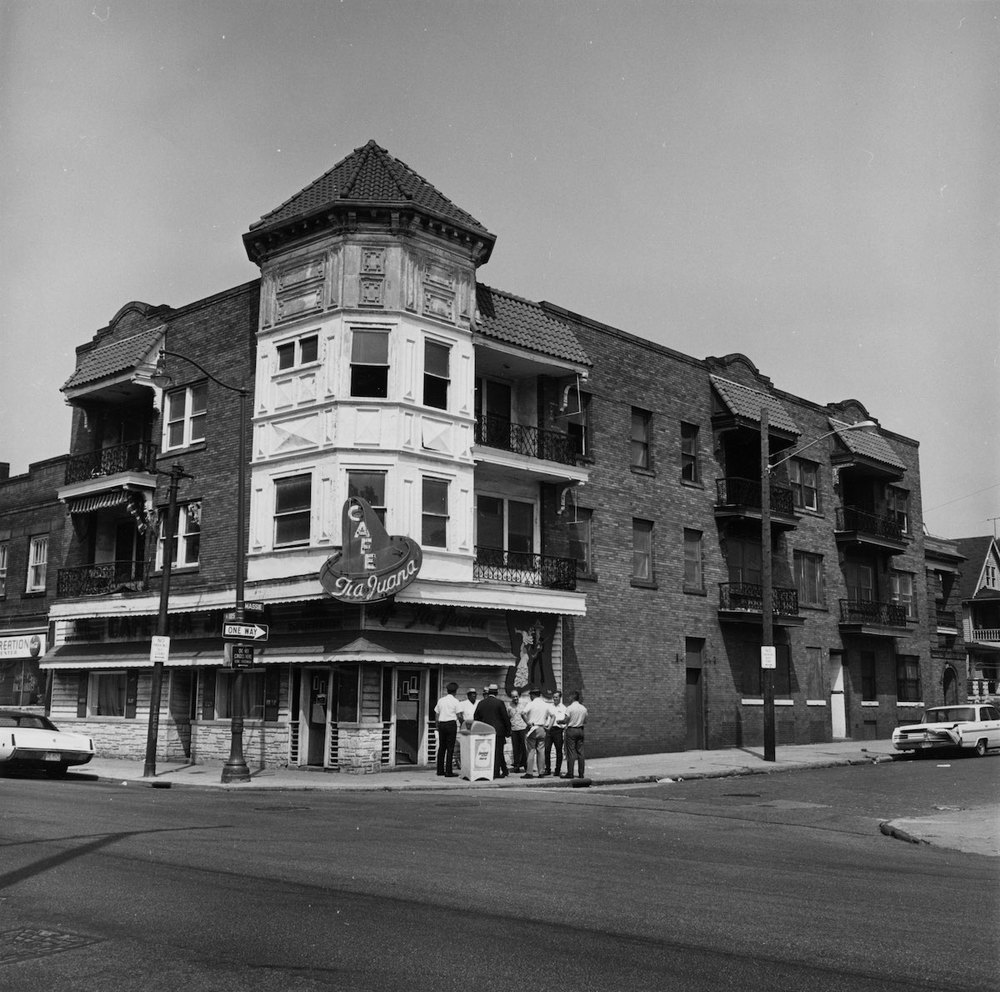
    <title type="html"><![CDATA[Cafe Tia Juana : Second Wave Jazz in Glenville]]></title>
    <summary type="html"><![CDATA[<p><strong><em>Cafe Tia Juana was meant to be a catalyst for change during the racially divided 1940s. The most "plush" jazz club in Cleveland became one of the most infamous, with a reputation that eventually brought the café to its demise. </em></strong></p><img src="https://clevelandhistorical.org/files/fullsize/0cf03608bde602831950bef6fa0a19db.jpg" alt="Cafe Tia Juana at the corner of Massie Avenue and East 105th Street" /><br/><p>It’s a typical cold and drizzly evening in Cleveland, 1948. A young woman can be seen walking along the cracked asphalt. The buzzing light of the flickering neon sign ahead beckons her as the wafting sounds of snare drum riffs, husky baritone vocals, and a blaring trumpet become louder. The sultry-sounding music coming from behind the fogging windows increases her anticipation. The rat-a-tat riffs and spontaneous blats of the saxophone call her name as her heartbeat quickens with excitement. At last, she enters into its musical oasis.</p><p>This musical escape was called Cafe Tia Juana, a true oasis for Cleveland’s jazz fanatics during a time of tumultuous racial tensions in the late 1940s to 1960s. Located in the Glenville neighborhood, Cafe Tia Juana was one of Cleveland’s most popular jazz clubs and was nationally recognized for bringing the hottest names of jazz through its doors. It eventually developed a dually famous and infamous reputation, encapsulating contradiction. It was said that the club provided “a rich formula of beauty and glamour and top-flight musical talent,” yet was simultaneously “a source of disorder and aggression to the community.” Perhaps this complex identity mirrors the time, place and culture in which it was birthed. Cafe Tia Juana opened during jazz’s second wave, not the earlier Jazz Age, featuring the free form of bebop. Cafe Tia Juana developed a dual reputation for lawlessness and sensuality while also providing an interracial haven where people from mixed backgrounds could gather. The club–like jazz itself–broke through the social expectations of its time.</p><p>Cafe Tia Juana was intentionally integrated when racial segregation was common. The club was opened in 1947 by Catherine and Arthur “Little Brother” Drake, along with Little Brother’s previous business partner, Willie Hoge. The inspiration for the venture came after Catherine Drake was barred from entering a club in Cleveland because she was African American. She was with Hoge at the time, who was solely permitted, as he was a white customer. In response, the two Drakes and Hoge decided to open their own venue that would not discriminate against anyone who wanted to enter, creating an inclusive congregation of musical talents and admirers alike. Catherine Drake became the first African American woman to own and manage a jazz club in Cleveland.</p><p>The club’s appearance made it stand out amongst numerous other venues. It was designed by Charles L. Sallee Jr., the first African American graduate of the Cleveland Institute of Art. Sallee designed the club with unapologetic lavishness in a colorfully playful “Mexican style” with a surprising element of posh sophistication, using velvet carpets and excessive draperies. The interior architecture was also unique, with a four-leaf clover-shaped bar and booth design based around an elevated revolving stage in the center. Despite the club’s Spanish name (a variation of the Mexican city, Tijuana), Sallee’s design is rooted in Southeast Asian inspiration versus the “South of the Border” theme which advertisements claimed. Sallee served in the military during World War II and was stationed in the Philippines for some time where he drew his inspiration for the design of Cafe Tia Juana. The country’s sunny skies, colorful architecture, and vibrant culture inspired the colorful Pacific Island atmosphere of Cafe Tia Juana.</p><p>At its finest, Cafe Tia Juana was nationally recognized as a hot jazz club and was every bit the musical oasis that the Drakes had sought to create. It was luxuriously extravagant through its interior decorative style and by its nationally acclaimed jazz superstars. Impressively, in Cafe Tia Juana’s first two years of operation, it hosted the nation’s most famous jazz icons including Dizzy Gillespie, the King Cole Trio, Billie Holiday, Sarah Vaughan, and Ella Fitzgerald, with The King Cole Trio being advertised as an upcoming performance in the club’s introductory article in 1947. The <em>Cleveland Call and Post</em> described the club in those early years as the “fabulous, most beautiful cafe spot in the Midwest” and as a “plush and fabulous cafe spot where top-flight entertainment is the mode.”</p><p>Despite the club’s promising start, Cafe Tia Juana struggled to maintain its positive reputation. As early as 1949, Cafe Tia Juana started to experience financial hardship as customers began to dwindle, due to changing music trends. In efforts to maintain excitement and to mitigate revenue troubles, Cafe Tia Juana became liberal in its entertainment offerings, first hosting talent shows and local bands, then clambakes, fashion shows and eventually exotic dancers. This expansion of entertainment also coincided with the club’s change of management and chronic financial and legal troubles. Catherine Drake became the sole owner of the club and managed Tia Juana with her two sons after Hoge and Little Brother were sent to prison for numerous racket schemes. In 1961, the U.S. Treasury Department “seized for nonpayment of delinquent Internal Revenue taxes due from Cafe Tia Juana.” The club was eventually managed by Mansfield Turner who started to bring in national jazz attractions once more, starting with Valerie Carr, in efforts to boost its image. Despite Turner’s efforts for revitalization, Cafe Tia Juana became exclusively associated with its poor management, gambling escapades, illegal activity and violence through a series of stabbings and a shooting. </p><p>In 1969, Cafe Tia Juana was closed permanently and the original building complex that ran along the corner of Massie Avenue and 105th Street was bought by Cleveland Christ Church Citadel of Hope Ministries and, soon after, was demolished. Although Cafe Tia Juana is long gone, its memory remains as an important symbol of Cleveland’s music history. It was both impacted and influenced by jazz and race during its short life and was a catalyst for change, it challenged cultural norms and expectations, representing an iconic time from Cleveland’s past. Tia Juana opened as a reaction to the discriminatory character of Cleveland and its racially divided public spaces. The space stood for equality and change in the face of adversity, successfully creating a lasting legacy.</p><p><em><strong><a href="https://clevelandhistorical.org/items/show/882">For more (including 11 images) view the original article</a></strong></em></p>]]></summary>
    <published>2019-11-20T20:08:13+00:00</published>
    <updated>2026-04-17T19:17:39+00:00</updated>
    <link rel="alternate" type="text/html" href="https://clevelandhistorical.org/items/show/882"/>
    <id>https://clevelandhistorical.org/items/show/882</id>
    <author>
      <name>Petra Brown</name>
    </author>
  </entry>
  <entry>
    <title type="html"><![CDATA[Jazz Temple: When Jazz Came to University Circle in the 1960s]]></title>
    <summary type="html"><![CDATA[<p><strong><em>Physical changes in neighborhoods are typical in most major cities, and with the passage of time they appear even more dramatic. Unlike fictional towns and buildings we’ve read about in childhood or seen in movies, change in community identity is inevitable.  Yet some images from the past populate our memories and we recall them with remarkable clarity.</em></strong></p><img src="https://clevelandhistorical.org/files/fullsize/4be345c46cab75278d8b8288ce1d1ba8.jpg" alt="Winston Willis, Dizzy Gillespie in rear of Jazz Temple Building" /><br/><p>The Mayfield Triangle: The former street address 11339 Mayfield Road is now 11400 Euclid Avenue. And although official street numbering changes over the years for one reason or another (zoning requirements, city planning, urban renewal, or real estate development), certain historical facts about some properties often become lost amid the changes. Today, observing motorists and pedestrians teeming around the bustling Euclid Avenue and Mayfield Road intersection, it’s fair to say that few if any of them know the history of the Triangle area before it was transformed into the mini-metropolis now known as Uptown Cleveland. For a brief time in the early 1960s, the triangular lot, then known as the Mayfield Triangle, upon which now rests the Museum of Contemporary Art building, was the site of a popular coffee house jazz club called the Jazz Temple. </p><p>When the 1960s dawned in the United States, it was heralded as a new decade of youth and change by a dynamic young president, John F. Kennedy, who assumed office trumpeting his “new frontier”. In previous years, the calm complacency of the post World War-II era had lent a relative tranquility, but it was gradually disappearing as post-war babies were becoming young adults. With a cultural landscape that included sleek cars, the Twist, the Pill, and a persistent atmosphere of cigarette smoke, the nation was on the verge of a decade of counterculture and social revolution. A great deal of this culture fermented on college campuses where students were beginning to find their voices and express their own individual political views and values. </p><p>At a time when the U.S. was approaching some of its most explosive times, including the rise of a free speech movement, music was rapidly becoming the main vehicle of self-expression for young people. Jazz and one of its subgenres, free jazz/improvisational jazz, were very attractive, especially to college students. So when a shrewd and savvy young African American entrepreneur named Winston Willis brought his coffee house jazz club to University Circle, within arm’s reach of the Western Reserve University (now CWRU) campus, and at affordable prices, it appeared to be a dream come true for all concerned. Imagined, engineered and created by young Willis, who was also a big fan of the musical genre, the Jazz Temple arrived on the scene at the tail end of the Beatnik era and smack in the heyday of ’60s-type coffee houses. Willis chose the club’s name to symbolize a devout gathering place dedicated to the icons of the jazz world where legendary artists could be collectively enjoyed and appreciated. </p><p>Having operated several successful small businesses, he sensed that something was lacking in this upscale college community.  So, after making a careful assessment of the area and determining what was needed and what would be likely to work, he decided that high-quality jazz performances at a student-friendly and affordable price was the answer.  Then, quickly putting his idea into action, he secured a lease on a vacated building, a former Packard automobile showroom, and immediately began remodeling, devoting careful attention to acoustics. Shortly thereafter, in 1962, the club opened to immediate success.  </p><p>The liquor-less establishment that seated approximately 450 people was near the ethnic enclave known as Murray Hill (Little Italy), a place that was notably hostile toward African Americans. As noted by former Cleveland mayor Carl B. Stokes, "... Cleveland was in the hands of ethnics, the immigrants from Middle and East European countries." Historian Dr. Todd M. Michney has observed that "... Little Italy's residents historically marked their territory and sought to ward off racial residential transition through the use of violence..." With surrounding institutional neighbors in the city’s so-called "cultural oasis," the Jazz Temple was a noteworthy, if incongruous jewel in the Mayfield Triangle. </p><p>From all over Cleveland and surrounding areas, dedicated jazz enthusiasts assembled to enjoy and appreciate the musical genre. Soon, the terms “preaching at The Temple” and “worshipping at The Temple” became popular colloquialisms and catchphrases. Legendary jazz greats, many of whom were considered musical geniuses, frequently headlined at the club. Miles Davis was cool but Kind of Blue, John Coltrane took Giant Steps to play My Favorite Things, and Dizzy Gillespie was blowin’ and Boppin’ and Groovin’. Many other notable artists also performed magnificent solo riffs, instrumentations and stunning improvisations that became sealed in memories forever.  Though sometimes described erroneously in the local press as "the ultimate 'beatnik' club", the Temple also featured popular female jazz vocalists like Dinah Washington and Gloria Lynne, as well as great stand-up comics like Dick Gregory, Redd Foxx, and Richard Pryor.</p><p>During the early 1960s, the Western Reserve student body was predominantly white, and these students and others from surrounding universities accounted for a large percentage of the club’s patronage. But as is typical of jazz establishments, there was a noticeable amount of race mixing and many interracial couples in attendance each night. Individuals who managed to navigate the social inequities of the time and gather in a communal appreciation of jazz.</p><p>As the club’s notoriety grew, it came to be considered by many world-famous jazz musicians as the “Jazz Mecca." But the interracial dating and race-mixing at the club triggered widespread resentment in racially polarized Cleveland.  Particularly in the Murray Hill (Little Italy) community, where visible racial tensions mounted. With attempted intimidation by local law enforcement, some nights saw as many Cleveland police officers in attendance in the club as regular customers. These visits were routinely followed by unscheduled and unannounced inspections and bogus citations. The warnings were dire and persistent, and thereafter, months of ominous threats of violence and anonymous phone calls during and after business hours foretold of the coming end. Several famous acts appearing at the club refused to be intimidated initially, insisting on performing. But finally, after several thwarted bombing attempts, the frequency and intensity of the threats were followed by a tremendous after-hours explosion in 1964 that completely demolished the Jazz Temple and its brief reign ended soon after. As reported in the local press:  “Police were unable to find reasons for the bombing of the interracial house of jazz but they found remnants of a bomb." And the message was clear.</p><p><em><strong><a href="https://clevelandhistorical.org/items/show/811">For more (including 10 images) view the original article</a></strong></em></p>]]></summary>
    <published>2017-09-23T21:49:29+00:00</published>
    <updated>2026-04-17T19:17:41+00:00</updated>
    <link rel="alternate" type="text/html" href="https://clevelandhistorical.org/items/show/811"/>
    <id>https://clevelandhistorical.org/items/show/811</id>
    <author>
      <name>Aundra Willis-Carrasco</name>
    </author>
  </entry>
  <entry>
    <title type="html"><![CDATA[Scatter&#039;s Barbecue: The Heart of Herman Stephens&#039; Glenville Business Empire ]]></title>
    <summary type="html"><![CDATA[<img src="https://clevelandhistorical.org/files/fullsize/958ac2e397895c4bebbb80fba667987a.jpg" alt="Scatter&#039;s Barbecue, 1954" /><br/><p>Before Hot Sauce Williams and Beckham's B&M Bar-B-Que ruled the east side, Scatter's Barbecue was Glenville's home for ribs, shoulder sandwiches, and fries soaked in Scatter's notable barbecue sauce. Herman "Scatter" Stephens, born in Birmingham, Alabama on June 1, 1920, moved to Cleveland in 1934 with his family. He graduated from Central High School in 1938 and attended West Virginia State College. After his college years, his family assisted in opening Scatter's Barbecue in 1952. It was not unusual to find his relatives, such as his mother, Emma Ricks, and aunt Nancy Stephens, in the restaurant assisting Scatter during the early years of the restaurant.</p><p>Located at 931 East 105th Street in the heart of Glenville's lively strip, Scatter's Barbecue was known for its shoulder sandwiches, where the meat was so tender it would "fall off the bone." The restaurant's walls were covered with framed portraits of prominent African Americans of the day, many of whom Scatter befriended, such as Sugar Ray Robinson and Count Basie. While Scatter's clientele included notable celebrities, many regulars were from the Glenville area. It was common for students from Empire Junior High School, located down the street, to stop by after school for a sauce-soaked paper bag of fries. </p><p>Scatter became an entrepreneur, owning not only a restaurant, but several businesses under the umbrella of Stephens Enterprises Inc. Herman "Scatter" Stephens owned Stephens Cigarette Service Inc., a cigarette and bowling machine servicing company, at 933 East 105th adjacent to Scatter's Barbecue, and the Silver Dollar Lounge. The lounge hosted his annual grandiose birthday parties, for which he issued an open invitation to "the world." By 1967, Stephens Enterprises expanded to include Stephens Real Estate, Stephens Vending Co., and the Lucky Bar. Scatter was a notable high-roller in Glenville, where he was known for having the latest Cadillacs, as well as a world traveler. In the summer of 1967, Scatter accompanied the Count Basie Orchestra to Europe for their tour. Since Scatter knew Count Basie, he was able to assist Cafe Tia Juana in booking jazz shows, featuring acts like saxophonists Eddie Lockjaw Davis and Sonny Stitt.</p><p>On September 10, 1967 at 2:30 A.M., tragedy struck when Scatter was shot in his Stephens Cigarette Service/Vending Co. store by a white assailant with possible mob ties. After being shot twice, Scatter stumbled out of the store and tried to escape to his barbecue restaurant, where the gunman followed him and shot him three more times. </p><p>Scatter's funeral took place September 21 at East Mount Zion Baptist Church. Some witnesses recalled the funeral being among the largest in the neighborhood in decades, with 3,000 mourners attending and traffic backed up for blocks. The funeral was just as impressive as his life; Scatter was buried in an $8,000 copper casket and the procession included 63 Cadillac Eldorados. Some of the attendees were rumored to be Sugar Ray Robinson and Joe Louis, who were able to slip out without being photographed. </p><p>Scatter's family ran the restaurant years after his passing, eventually closing in 1983. Though the only remnant of Scatter's Barbecue is the intact building, Scatter's legacy is still cherished in the Glenville community to this day.</p><p><em><strong><a href="https://clevelandhistorical.org/items/show/654">For more (including 4 images&#32;&amp;&#32;2 audio files) view the original article</a></strong></em></p>]]></summary>
    <published>2014-04-23T15:47:37+00:00</published>
    <updated>2026-04-17T19:17:40+00:00</updated>
    <link rel="alternate" type="text/html" href="https://clevelandhistorical.org/items/show/654"/>
    <id>https://clevelandhistorical.org/items/show/654</id>
    <author>
      <name>Julie A. Gabb</name>
    </author>
  </entry>
  <entry>
    <title type="html"><![CDATA[Majestic Hotel: &quot;America&#039;s Finest Colored Hostelry&quot;]]></title>
    <summary type="html"><![CDATA[<img src="https://clevelandhistorical.org/files/fullsize/66e6a7bad6f35262c81350cfa7c096b4.jpg" alt="Majestic Hotel Postcard" /><br/><p>Opened in 1902 as a five-story, 250-room residential hotel known as the Majestic Apartments, the Majestic Hotel emerged after the Great Migration as Cleveland's primary African American hotel, a role it played until integration eased the need for hotels catering primarily to a black clientele. From the mid-1920s to mid-1940s it was owned by Josef Weiss, who was Jewish of Hungarian descent, and managed by an African American man named Ted Witbeck. The imposing brick structure on the corner of East 55th Street and Central Avenue in the heart of the city's Cedar-Central neighborhood provided African Americans with a quality place to stay on a visit or to call home. Although the Majestic was listed as apartments in the city directory from 1907 to 1929, its primary function became that of a hotel, and it was the largest Cleveland hostelry listed perennially in the <em>Negro Motorist Green Book</em>, a guide for Black motorists during the Jim Crow era. Not only did the Majestic provide a place for Blacks to stay, it gave them a place to eat, relax, and enjoy musical entertainment free from discrimination.</p><p>As early as 1931 the Majestic Hotel had a jazz club originally named the Furnace Room. There, one would find the owners and operators of other local clubs along with musicians who had finished their night's work at other establishments. Patrons enjoyed entertainment from various crooners, dancers and even an accordion player while enjoying the house specialty of barbecue and spare ribs. In 1934 "Mammy" Louise Brooks served New Orleans Creole fare in the Majestic Grill, which also operated inside the Majestic Hotel until it changed hands in 1936 and became Sadie's.</p><p>In 1934 the Furnace Room changed its name to the Heat Wave. Once the Heat Wave closed three years later, the spot within the hotel it vacated did not stay empty for long. By the end of September 1938 a new hot spot emerged at the location. Elmer Waxman's Ubangi Club enjoyed a very lively first week of existence according to the <em>Cleveland Plain Dealer</em>. After only a short run, the Ubangi Club joined the ranks of the Furnace Room and the Heat Wave in closing its doors for good. However, the next club to emerge from the location within the Majestic would enjoy more fame than any of its predecessors. The new club emerged near the end of World War II after Weiss sold the hotel to Black investors led by former Sohio gasoline station franchisee Alonzo G. Wright. </p><p>While the Majestic may have been a Black hotel located in a largely African American section of Cleveland, the audiences drawn to the hotel's Rose Room Cocktail Lounge in the 1950s were anything but segregated. Indeed, the Majestic and the Log Cabin across the street, were fixtures in the "Black and Tan" scene in Cleveland's version of Harlem. The largest attractions for jazz lovers, according to jazz historian Joe Mosbrook, were "Blue Monday" parties, which featured pianist Duke Jenkins and his band, along with many other jazzmen. These jam sessions made the Rose Room a preeminent venue through the 1950s. </p><p>Although Wright was committed to running a thoroughly modern and fashionable hotel and poured hundreds of thousands of dollars into updates in the mid-1940s and again in the late 1950s, like countless Black-owned hotels across the nation, the Majestic lost its reason for being as Jim Crow practices receded. When it reported on May 27, 1967, on the impending demolition of the Majestic to build the Goodwill Industries Rehabilitation Center, the <em>Call and Post</em>, Cleveland's leading Black newspaper, took a bittersweet tone. Observing that the new center would be "a tremendous community development in a slum area," it also concluded, "With the Majestic goes the sounds of music, the voices of the great, and a bright era of Negro community life."</p><p><em><strong><a href="https://clevelandhistorical.org/items/show/636">For more (including 5 images&#32;&amp;&#32;3 audio files) view the original article</a></strong></em></p>]]></summary>
    <published>2013-12-04T21:46:24+00:00</published>
    <updated>2026-04-17T19:17:40+00:00</updated>
    <link rel="alternate" type="text/html" href="https://clevelandhistorical.org/items/show/636"/>
    <id>https://clevelandhistorical.org/items/show/636</id>
    <author>
      <name>Shawn Morris</name>
    </author>
  </entry>
  <entry>
    <title type="html"><![CDATA[Chatterbox Musical Bar and Grill: Chin Ballard&#039;s Jazz and Blues Mecca]]></title>
    <summary type="html"><![CDATA[<img src="https://clevelandhistorical.org/files/fullsize/ab6d1a132b44bec61ba7b4120c1acb76.jpg" alt="Chatterbox in 1949" /><br/><p>From 1949 to 1959, the Chatterbox Musical Bar and Grill, located at 5123 Woodland Avenue, was a place to be and be seen. Owned by John (Chin) Ballard, the colorful spot featured soft lighting, swank decorations, and a glowing atmosphere. Ballard and his assistant, famed Cleveland Browns star player and future National Football League Hall of Famer Marion Motley, instituted a policy at the Chatterbox of sparing no expense in order to provide their patrons with the very best experience possible.</p><p>The Chatterbox had become known citywide for its upscale atmosphere almost immediately after opening, and in 1951 Chin Ballard wanted it to be known for something else. Because the Chatterbox regularly drew large crowds to watch baseball games, Ballard decided to install the largest television set in any Cleveland café at his club. By Opening Day of that year, customers of the Chatterbox were able to watch games on an enormous 21-inch television set. The policy of providing the very best was not only instituted on what could be seen, but heard as well.</p><p>The jazz and rhythm and blues musical acts that graced the Chatterbox's stage were also of the highest quality. Bob Harvell and his trio played the club in the early 1950s, earning praise in the local papers, which compared their musical meanderings to those of the renowned King Cole Trio. Billie Holiday's performances at the Chatterbox were nothing short of sensational, and she took the place by storm with her inimitable voice. In October 1958, the record-breaking Idlewild Revue (featuring a cast comprised of all African Americans) began a two-week stand at the Chatterbox. Described by critics as one of the most fabulous revues of the past decade, the Idlewild Revue starred Della Reese, T-Bone Walker, Sonny Carter, Willie Lewis, the exotic "Black Velvet," the Four Tops, the Fiesta Dolls, Crip Heard, and the Bragettes. The revue would be the last large show at the club, as unforeseen circumstances would force the Chatterbox Musical Bar to close forever a few short months later.</p><p>Early Sunday morning, on February 8, 1959, the Woodland Avenue neighborhood surrounding the Chatterbox sprang from slumber when the four-story Ritzwood Hotel (located at 5117 Woodland Avenue, a few doors down from the Chatterbox) caught fire around two in the morning. Quickly the fire escalated to a five-alarm call, and began to engulf neighboring structures. Twenty-six pieces of firefighting equipment and 155 firefighters responded. The windswept fire spread quickly from the Ritzwood along Woodland Avenue, engulfing Owen's Billiard Parlor, the Fuller Products Company, Bob's Restaurant, the Sputnik Lounge Bar, and the Chatterbox Café. The destruction was too much to recover from, forcing the Chatterbox Musical Bar, as well as the other establishments that were damaged in the blaze, to close for good. Athough thousands of commuters pass daily through the intersection of East 55th and Woodland, most do not realize what rich history lies just to the northwest at what is now only a grassy lot. Sadly, jazz and rhythm-and-blues music will never be performed at this location again, and the only time it may be occasionally heard is from the radio of a passing motorist. </p><p><em><strong><a href="https://clevelandhistorical.org/items/show/635">For more (including 4 images&#32;&amp;&#32;1 audio file) view the original article</a></strong></em></p>]]></summary>
    <published>2013-12-04T21:40:23+00:00</published>
    <updated>2026-04-17T19:17:40+00:00</updated>
    <link rel="alternate" type="text/html" href="https://clevelandhistorical.org/items/show/635"/>
    <id>https://clevelandhistorical.org/items/show/635</id>
    <author>
      <name>Shawn Morris</name>
    </author>
  </entry>
  <entry>
    <title type="html"><![CDATA[Nighttown: A Dublin-Inspired Jazz Mecca]]></title>
    <summary type="html"><![CDATA[<img src="https://clevelandhistorical.org/files/fullsize/7af9f268dc7b93fa072593ac3448d30c.jpg" alt="Nighttown, 1977" /><br/><p>When John Barr opened Nighttown on February 5, 1965, it was a one-room bar. Constructed in 1920, the building had previously housed the Cedar Hill Diner, a deli, Sam’s Beauty Parlor and Stock's Candies. The Silhouette Lounge, which was run by mob-operated Cadillac Amusements, replaced Stock's Candies in 1960. After the feds shut down the Silhouette Lounge, Barr leased the storefront and named the tavern after the Dublin red-light district in James Joyce’s <em>Ulysses</em>. The space was quite small and had an upright piano upon which a few local musicians would occasionally play. A restaurant area was added in 1966.
As Nighttown became more popular, Barr expanded the restaurant and bar into three other storefronts surrounding the original space, yielding a 400-seat establishment comprising six dining rooms and three bars: the entire first floor of the three-story building. Barr sold Nighttown to Ireland-born Brendan Ring in 2001. As the building expanded (including a large covered patio named Stephen’s Green after Dublin, Ireland’s, best known city park), so did the list of guest performers. Barr had been a fan of stride piano, a type of jazz that was popular when the bar opened, but he only had space for one or two local players. When Brendan Ring became Nighttown’s general manager in 1993, he brought in Jim Wadsworth to book bigger national acts.
Nighttown enjoyed a reputation as one of the world’s premier venues for jazz music, according to <em>DownBeat</em> magazine. A short list of Nighttown’s performing alumni includes Freddy Cole, Jane Monheit, John Pizzarelli, Brian Auger, Ann Hampton Callaway, Tommy Tune, Ray Brown, Basia, Cyrille Aimee, Esperanza Spaulding, John Legend, Dick Cavett and Dick Gregory. In addition to formally booked acts, numerous musicians—from Wynton Marsalis to Stevie Wonder—dropped in for impromptu performances. Nighttown also became the home of the Press Club of Cleveland’s Journalism Hall of Fame in 2007.</p><p>Like many restaurants, Nighttown suffered from the upheaval of the coronavirus pandemic in 2020. Ring sold the restaurant to another operator who only managed to keep it open for several months. In 2025, restaurateur Brandon Chrostowski leased the former Nighttown space to relocate Edwin's, his French restaurant on Shaker Square that prepares formerly incarcerated people for success in the culinary and hospitality industries. </p><p><em><strong><a href="https://clevelandhistorical.org/items/show/550">For more (including 9 images&#32;&amp;&#32;3 audio files) view the original article</a></strong></em></p>]]></summary>
    <published>2012-09-06T16:14:22+00:00</published>
    <updated>2026-04-17T19:17:39+00:00</updated>
    <link rel="alternate" type="text/html" href="https://clevelandhistorical.org/items/show/550"/>
    <id>https://clevelandhistorical.org/items/show/550</id>
    <author>
      <name>Robin Meiksins</name>
    </author>
  </entry>
  <entry>
    <title type="html"><![CDATA[Django Reinhardt at the Music Hall]]></title>
    <summary type="html"><![CDATA[<img src="https://clevelandhistorical.org/files/fullsize/28dc2cac98b564c4add6f55a6e7a2de7.jpg" alt="Picking at a Guitar" /><br/><p>On November 4, 1946 Django Reinhardt made his American debut at the Music Hall in Cleveland. Reinhardt, a Belgian jazz guitarist, had been invited to open for Duke Ellington on a small tour of the Midwest. Reinhardt, a headliner in Europe, arrived in Cleveland without a guitar. He assumed that music companies would compete for the honor of having him play their instruments. Reinhardt quickly learned otherwise and was forced to buy a guitar.</p><p>Local promoters further complicated Reinhardt's US debut and failed to capitalize on the moment, purchasing only a small ad in the local papers – an ad that failed to mention Reinhardt's involvement, simply stating, "Elroy Willis presents Duke Ellington and his Orchestra at the Music Hall." Despite the oversight, the Cleveland Plain Dealer reported that 1,800 people attended the concert.</p><p>After a 45 minute delay while the musicians awaited the arrival of a baggage car carrying Ellington Orchestra's instruments, the crowd finally heard Django Reinhardt's first U.S. performance. The act was such a hit that Reinhardt and Ellington would go on to play in other major cities in the Midwest before concluding their tour in New York City at Carnegie Hall. </p><p><em><strong><a href="https://clevelandhistorical.org/items/show/525">For more (including 3 images&#32;&amp;&#32;1 audio file) view the original article</a></strong></em></p>]]></summary>
    <published>2012-07-24T12:05:12+00:00</published>
    <updated>2026-04-17T19:17:39+00:00</updated>
    <link rel="alternate" type="text/html" href="https://clevelandhistorical.org/items/show/525"/>
    <id>https://clevelandhistorical.org/items/show/525</id>
    <author>
      <name>Robin Meiksins</name>
    </author>
  </entry>
  <entry>
    <title type="html"><![CDATA[Leo&#039;s Casino: Cleveland&#039;s Motown Outpost]]></title>
    <summary type="html"><![CDATA[<img src="https://clevelandhistorical.org/files/fullsize/a70964832d3eacfe9272536cc9d27a18.jpg" alt="Gladys Knight &amp; The Pips" /><br/><p>In 1963, business partners Leo Frank and Jules Berger opened Leo's Casino in the lounge of the old Quad Hall Hotel at 7500 Euclid Avenue. The club could host 700 people and regularly booked the top jazz and R&B acts of its era. The Supremes, Marvin Gaye, John Coltrane, Ray Charles and The Temptations all performed at Leo's Casino, as did comedians Richard Pryor and Flip Wilson. Otis Redding played his final concert there on December 9, 1967, dying in a plane crash in Wisconsin the following afternoon.</p><p>Co-owner Leo Frank opened his first club - Leo's - in 1952 at East 49th Street and Central Avenue. Leo's attracted the nation's leading jazz and R&B acts, but burned down in 1962, leading to the opening of Leo's Casino the following year. The new club, which quickly established itself as a key stop for touring Motown artists, was one of the most racially integrated nightlife spots in Cleveland. In July 1966 The Supremes played to a packed house of blacks and whites at Leo's not long after the Hough Uprising broke out mere blocks away from the club. </p><p>Eventually, bigger venues offering bigger paydays began to lure the most popular performers away from Leo's Casino. Continued population decline and disinvestment in Cleveland's east side after the Hough Uprising further hurt the club's fortunes. Leo's Casino closed in 1972 and was later torn down.  In 1999, the Rock and Roll Hall of Fame named it a historic landmark, placing a plaque on the site where Leo's Casino once stood.</p><p><em><strong><a href="https://clevelandhistorical.org/items/show/5">For more (including 10 images&#32;&amp;&#32;5 audio files) view the original article</a></strong></em></p>]]></summary>
    <published>2010-09-09T21:06:55+00:00</published>
    <updated>2026-04-17T19:17:36+00:00</updated>
    <link rel="alternate" type="text/html" href="https://clevelandhistorical.org/items/show/5"/>
    <id>https://clevelandhistorical.org/items/show/5</id>
    <author>
      <name>CSU Center for Public History and Digital Humanities</name>
    </author>
  </entry>
</feed>