<?xml version="1.0" encoding="UTF-8"?>
<feed xmlns="http://www.w3.org/2005/Atom">
  <title type="text">Cleveland Historical</title>
  <updated>2026-08-21T21:04:52+00:00</updated>
  <generator uri="http://framework.zend.com" version="1.12.20">Zend_Feed_Writer</generator>
  <link rel="alternate" type="text/html" href="https://clevelandhistorical.org/"/>
  <link rel="self" type="application/atom+xml" href="https://clevelandhistorical.org/items/browse?output=rss2"/>
  <id>https://clevelandhistorical.org/</id>
  <author>
    <name>Cleveland Historical</name>
    <uri>https://clevelandhistorical.org</uri>
  </author>
  <link rel="hub" href="http://pubsubhubbub.appspot.com/"/>
  <entry>
    <title type="html"><![CDATA[Rockefeller Park Greenhouse: Municipal Nursery and Botanical Garden]]></title>
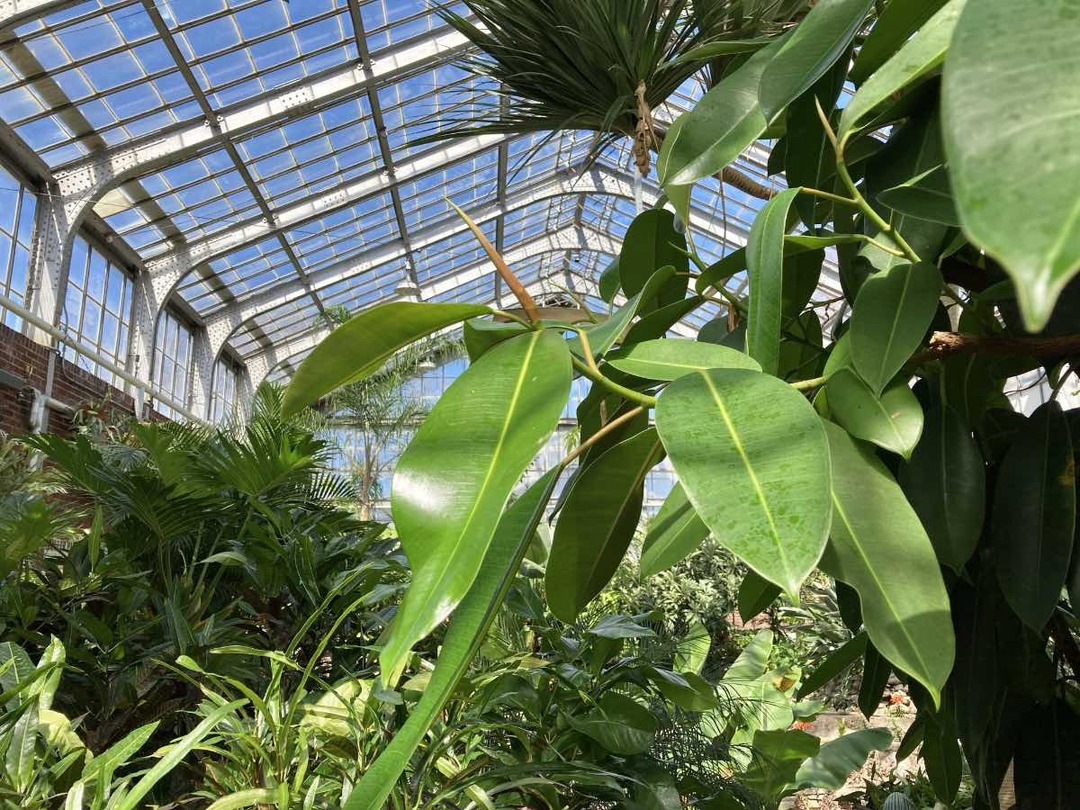
    <summary type="html"><![CDATA[<p><strong><em>Tucked away on a hilltop above the Cultural Gardens is an unassuming facility that for more than a century has played a mostly unseen role in supplying the Forest City’s parks, boulevards, and public properties with flowers, shrubs, and trees, while also cultivating a distinctive collection of tropical foliage and fruit-bearing trees.</em></strong></p><img src="https://clevelandhistorical.org/files/fullsize/ff65e75684b088775c7c081ec99ba269.jpg" alt="Tropical Showhouse" /><br/><p>The Rockefeller Park Greenhouse has its origin in greenhouses given to the city by the estate of William J. Gordon, whose country seat became Gordon Park in 1894. Five years after John D. Rockefeller deeded land to connect Gordon Park with Wade Park in 1897, the municipal government planned a new “city greenhouses” complex, which opened in 1905. Sometimes erroneously referred to as the Gordon Park Greenhouse in its early years, the complex was actually in Rockefeller Park. </p><p>The primary purpose of the city greenhouses was to supply trees and shrubs for Cleveland’s parks, boulevards, and public properties. The greenhouses also donated flowers to hospital wards. However, the idea of a botanical showcase for the city also took root. In 1913, the city completed a large new greenhouse to display palms, ferns, and orchids to the public, including the donated exotic plant collection of William E. Telling. This greenhouse also provided a place to keep the goldfish from the Public Square pond during the winter. </p><p>Despite its pre–World War I origins, the Rockefeller Park Greenhouse as we know it is largely a product of the New Deal. Between 1937 and 1939, the Works Progress Administration (WPA) rebuilt the city greenhouses with a substantial new Palm House (now called the Tropical Showhouse) surrounded by six other greenhouses that raised the facility’s area under glass sixfold to 35,000 square feet. A center walk divided the Palm House into two lush sunken gardens lined with tufa rock salvaged from the Great Lakes Exposition. One of these gardens featured a waterfall and the other a statue. Looming overhead were six 30-foot-tall royal palms taken from the Florida exhibit at the Great Lakes Exposition, as well as other tropical trees and plants. </p><p>After World War II, City Greenhouse, as it was then known, unveiled periodic improvements. In 1946, the greenhouse’s new cacti exhibit opened, its specimens backed by a painted desert scene in the fashion of a diorama. In addition to continuing to serve as a prominent destination for garden clubs and other groups, City Greenhouse also furnished tropical plants for special events, notably a New Orleans French Quarter–themed display for the 1956 Cleveland Home and Flower Show in Public Auditorium. </p><p>In 1962, the Leonard C. Hanna Fund gave $300,000 to improve and expand City Greenhouse. The gift funded a new entrance building and a Japanese Garden, completed in 1964, at which time the facility began to be known as Rockefeller Park Greenhouse. Unfortunately, in the following decade the facility began to suffer a dwindling city budget that accompanied Cleveland’s steepening population decline. By 1980, the city briefly contemplated closing the greenhouse before deciding against it. Then, in 1991, the Friends of Greenhouse, a nonprofit, formed to raise funds to place the facility on a firmer footing and use it to host special events. Later additions included the Betty Ott Talking Garden with its statue of Helen Keller and the Willott Iris Garden, in which hundreds of varieties of iris bloom each spring and summer.</p><p>Today the Rockefeller Park Greenhouse remains, as it has for more than a century, a place of welcome respite from the winter cold and arguably one of the city’s best free attractions in Cleveland.</p><p><em><strong><a href="https://clevelandhistorical.org/items/show/1076">For more (including 14 images) view the original article</a></strong></em></p>]]></summary>
    <published>2026-01-02T17:52:59+00:00</published>
    <updated>2026-04-17T19:17:43+00:00</updated>
    <link rel="alternate" type="text/html" href="https://clevelandhistorical.org/items/show/1076"/>
    <id>https://clevelandhistorical.org/items/show/1076</id>
    <author>
      <name>J. Mark Souther</name>
    </author>
  </entry>
  <entry>
    <title type="html"><![CDATA[Zverina Log House: A Bit of Historic Czechia on Cleveland&#039;s Southeast Side]]></title>
    <summary type="html"><![CDATA[<p><strong><em>Having spent much of his childhood in a rural village in Bohemia, Czech immigrant Anton Zverina Jr. wanted to provide his American children with a glimpse of what life was like in such a village. So, in 1908, in the middle of the apple orchard in the backyard of his house on Miles Avenue, in what is today Cleveland's Union-Miles neighborhood, he built for them a traditional Czech log house to play in.</em></strong></p><img src="https://clevelandhistorical.org/files/fullsize/8d51cf25dee19c7141a341b8d0cff3c1.jpg" alt="Zverina Log House" /><br/><p>It's a long journey from the village of Čechtice, in the South Moravian region of the Czech Republic, to Cleveland, Ohio.  However, like thousands of other Czechs who left their homes  in Bohemia for America in the second half of the nineteenth century, eleven-year-old Anton Zverina Jr. made that journey with his parents and two siblings in 1874. The family settled in a neighborhood on the southeast side of Cleveland, near what is today the intersection of Broadway Avenue and East 55th Street.  The neighborhood soon filled with so many Czech immigrants that it became known locally as "Little Bohemia."</p><p>Anton's father  started several businesses in Little Bohemia, including a grocery store.  Soon, young Anton was working for him in that grocery store—but perhaps sometimes, in idle moments, he would dream of what his more rural life  in Čechtice had been like.  His father's grocery store was first located on Dille Street, near Broadway and Forest (East 37th), and then later for several years on Willson (East 55th) near that street's intersection with Broadway and Hamlet Avenues. In 1889, the Zverina family left a more lasting mark on the neighborhood when the grocery store moved into a new three-story red brick commercial building on Broadway Avenue, just north of East 55th Street.  The building, still standing today and known as the Zverina Building, was designed for Anton Zverina Sr. by fellow Czech immigrant Andrew Mitermiler, a prominent Cleveland architect who, among other historic buildings in Cleveland, designed Ceska Sin Sokol Hall  on Clark Avenue  on the city's west side..</p><p>Andrew Mitermiler had a daughter named Rose and, in 1895, six years after the Zverina Building was built, Anton Jr. married Rose.  After marrying, the two moved into an apartment on an upper floor of the building that Rose's father had designed for Anton Jr.'s father.  Here, they started their lives together.  By 1904, they were sharing the apartment with their first four children, who ranged in age from the oldest (Rose), who was six years old, to the youngest (Frances), who was a newborn.</p><p>Like his father, Anton Jr. became a successful businessman in Little Bohemia.  He expanded his father's grocery and real estate businesses, and started several new businesses of his own, including one on Blanche Avenue, near Weckerling (East 53rd) Street, just north of the CC&S railroad tracks.  There, he built several commercial buildings, the chief amongst them a factory in which he manufactured a "coffee enhancement" made from the chicory herb.  </p><p>By 1905, Anton Zverina Jr. had accumulated enough wealth to do what many other Czech immigrants in Cleveland had done once they were financially able to do so.  Anton looked to move his family out of the crowded urban environment of Little Bohemia and into a more rural setting, perhaps somewhere that reminded him of his childhood village.  He found the ideal setting in  Newburgh Township, some four miles southeast of  Little Bohemia. There, he purchased the former  M. S.  Robertson farm which consisted of about five-acres of land that fronted on the south side of Miles Avenue, near what is  today  that street's intersection with MLK Boulevard.  The farm land included a large orchard filled with apple, pear and other fruit trees.</p><p>In 1906, the year after Anton Jr. had purchased the farmland, he, Rose and their children moved into a large new house built for them on the property.  A year or so after they had settled into their new home, Anton undertook to build, in the middle of  the farm's fruit orchard,  a little piece of Bohemia for his children.  By 1908, he had constructed a large single-story log house complete with a fireplace for cooking meat on one end of its interior and a large play area for his children complete with a large U-shaped table with benches on the other end.  In 1909, one year after the log house was completed, the area of Newburgh Township in which Zverina family  now lived and which in 1907 had been incorporated as the Village of Corlett, now was annexed into the City of Cleveland. These municipal events, however, did not seem to deter the Zverina family from enjoying their little bit of Czechia.</p><p>According to daughter Frances Zverina, who grew up to become a Cleveland public school teacher as well as a horticulturalist, Anton and Rose Zverina's children—who  included youngest son Robert, born in 1911—played in the log house to their heart's content.  In addition to being a constant source of entertainment for them, the log house also served as a place for gatherings of the extended  Zverina family, for friends and their families, and for almost anyone else  in the neighborhood who needed a pleasant place to celebrate any important event. According to Frances, the log house even served in 1914 as the site of a clambake at which future Cleveland mayor Harry L. Davis was nominated to become Cleveland's next mayor. Even after Anton Jr.'s death in 1934 , the Zverina family continued to use the log house for special events and occasions, and this continued for almost three more decades until the death of Anton's wife Rose in 1962.</p><p>In 1963, Frances Zverina and her brother Justin, who had inherited the property, parceled off and donated to the Cleveland School Board the log house and about a quarter acre of land upon which it stood, to be used in the School District's gardening program, which had been started in the early twentieth century.  Frances Zverina, in addition to her job as a school teacher in the district, was also a lover of herbs, something passed on to her from her father. In the late 1960s, she successfully persuaded the Cleveland School Board to design and build a special herb garden near the log house that would enable children at nearby Miles Public School to grow, tend to, and learn all about the value of herbs to humans.  </p><p>The new herb garden and log house were a successful addition to Cleveland school's horticulture programs from the time the restoration and garden work was completed in 1970, until the program was terminated during the Cleveland School Board's 1978 financial crisis.  While the formal school program ended, the herb garden and log house were, starting in 1981, voluntarily tended to by Reverend Ralph Fotia, pastor of the nearby Shaffer United Methodist Church, and his staff, for another decade.</p><p>In 1984, while Pastor Fotia was tending to the log house and its gardens, the City of Cleveland, acknowledging the importance of the log house and its herb garden to Cleveland's history, made the log house a local landmark, but in the process erased its Czech identity, designating it simply as the "Miles Garden Log Cabin and Herb Garden."  Moreover, even though it was now a local landmark, this did not seem to help improve the condition of the log house and the surrounding gardens, which severely deteriorated over the years that followed.  In the early twenty-first century, several plans were advanced to repair and restore the building, as well as the herb garden. Only one—a cleanup of the grounds by students from Washington Park community school in 2018, was successfully completed. More recently, a community development organization in the newly designated Union-Miles neighborhood, undertook a review of the condition of the Zverina Log House, which it renamed "The Union-Miles Log House," but to date, no repairs have been done to the log house, nor does it appear that any additional restoration work to the grounds of the log house has been done.</p><p>While time may be running out for the  more than a century-old Zverina Log House, it is hoped that a way can be found by the Cleveland Metropolitan School Board, which still owns the property, with help from Union-Miles neighborhood organizations, to restore the log house and its  grounds not only as a remembrance to Cleveland's historic school garden program, but also to Czech immigrants like Anton Zverina Jr. who built this little piece of Czechia in Cleveland, and who, on a broader scale, played an important role in  the development of Cleveland's southeast side in the nineteenth and twentieth centuries.</p><p><em><strong><a href="https://clevelandhistorical.org/items/show/1057">For more (including 15 images) view the original article</a></strong></em></p>]]></summary>
    <published>2025-05-11T12:33:51+00:00</published>
    <updated>2026-04-17T19:17:43+00:00</updated>
    <link rel="alternate" type="text/html" href="https://clevelandhistorical.org/items/show/1057"/>
    <id>https://clevelandhistorical.org/items/show/1057</id>
    <author>
      <name>Jim Dubelko</name>
    </author>
  </entry>
  <entry>
    <title type="html"><![CDATA[Vietnamese Cultural Garden]]></title>
    <summary type="html"><![CDATA[<img src="https://clevelandhistorical.org/files/fullsize/e2ec76727c199ed7d0aa762aed25a6af.jpg" alt="First Entrance to the Vietnamese Garden " /><br/><p>The Vietnamese Cultural Garden in Cleveland features a 12-foot-tall marble statue of a woman standing atop a square pedestal. The statue wears traditional Vietnamese garments, including the nón dang conical hat and the áo dài dress, which hold significant historical and cultural meaning and are still worn in the community today. The statue of the woman remains composed despite the weather or season, with her hair and dress gently swaying as if moved by the wind. </p><p>The Garden, located at the northern end of Martin Luther King Jr. Drive in Rockefeller Park, was sponsored by the Friendship Foundation and dedicated in 2020. The Garden was designed by Char Crowley, who also participated in the renovation of the Irish Cultural Garden in 2009. The most direct footpath to the Vietnamese Cultural Garden's entrance is along the Harrison Dillard Bikeway. </p><p>As the Vietnam War came to a close, many refugees sought new homes abroad. By November 1975, over 500 refugees had made their way to the Greater Cleveland area in search of freedom. The Vietnamese Cultural Garden stands as a testament to their bravery and the vibrant culture they brought with them. After the fall of Saigon, various religious and social groups formed to prepare aid and shelter for the newcomers seeking sanctuary. </p><p>A formal group was established in December 1975 to assist refugee community organization. Until 1995, the primary organization in the area was the Cong-Dong Viet-Nam Tai Vietnamese Community in Greater Cleveland. Since then, additional organizations have emerged to sponsor friends and families seeking opportunities away from Vietnam. Through local and international programs, these organizations help those adjust by encouraging socio-economic independence, providing housing opportunities, and promoting autonomy within the community. </p><p>American veterans were among those interested in volunteering or creating affiliated organizations. After serving with the Special Forces during the Vietnam War, U.S. Army Captain, historian, and attorney Joseph Meissner dedicated his time to the resettlement effort in Cleveland. Along with his many lifetime accomplishments and endeavors, Meissner helped establish the Friendship Foundation, serving as its vice president. </p><p>The Friendship Foundation is an American-Vietnamese non-profit organization founded in 1993 by Vietnamese-American immigrant Luong Thi Gia Hoa Ryan. Discouraged by the inability to visit home to her native country due to the aftermath of the war, Ryan and other community members joined efforts to establish the Foundation, fostering peace, respect, and harmony. The Foundation's website offers a descriptive history of the project and how the history of the Vietnam War influenced the culture of the community they aim to serve and other humanitarian activities they continue to sponsor. </p><p>After multiple delays, the Vietnamese Cultural Garden finally installed the 12-foot-tall marble statue on November 15, 2023, three years after the Garden's dedication. The sculpture has repeatedly been recognized as the Vietnamese Mother, exhibiting features in line with the Foundation's objectives. The Cleveland Vietnamese Cultural Garden serves as a symbol of courage and resilience for all community members, whether they are veterans, immigrants, or just passing by.</p><p><em><strong><a href="https://clevelandhistorical.org/items/show/1024">For more (including 5 images) view the original article</a></strong></em></p>]]></summary>
    <published>2024-05-01T23:22:22+00:00</published>
    <updated>2026-04-17T19:17:43+00:00</updated>
    <link rel="alternate" type="text/html" href="https://clevelandhistorical.org/items/show/1024"/>
    <id>https://clevelandhistorical.org/items/show/1024</id>
    <author>
      <name>Makialani Kanewa-Mariano</name>
    </author>
  </entry>
  <entry>
    <title type="html"><![CDATA[Mall Victory Garden : A Wartime Demonstration]]></title>
    <summary type="html"><![CDATA[<img src="https://clevelandhistorical.org/files/fullsize/6a8f58930a18ed03e5c48f7f115ca906.jpg" alt="Overhead View of Mall Victory Garden" /><br/><p>While the Second World War was raging across the globe, a different war was being fought on the homefront against food shortages. But victory gardens were more about supporting the U.S. war effort than fighting hunger. <a href="https://clevelandhistorical.org/items/show/312">The Mall</a>, a park-like civic space in downtown Cleveland, was selected by the city to host a community victory garden as a wartime demonstration project to inspire and educate students and people unfamiliar with growing vegetables. With land donated by the city, the victory garden grew as a successful community project that even lasted for some time after the end of the war.
Victory gardens were a nationwide federal initiative promoted by the U.S. Department of Agriculture with the purpose of feeding people amid wartime food rationing and farm labor shortages during World War II. Victory gardens were intended to grow a wide array of vegetables that would feed families while most processed food was shipped overseas to feed the military fighting the war. Victory gardens were thus seen as a patriotic duty towards the war effort. </p><p>While many rural Americans already grew their own food, this was less true of people in cities, towns, and suburbs. Most gardens were in suburban residential areas or in small towns, but cities also had gardens in parks, on school grounds and vacant lots, and on rooftops in the most urban areas. It has been estimated that victory gardens produced about 40% of all produce consumed by Americans during the war. However, after the D-Day landings, as an Allied victory looked increasingly attainable, victory gardens slowly declined in popularity.
Cleveland's demonstration victory garden was located on Mall B (the southern portion of the Mall), between Rockwell and St. Clair Avenues. Mayor Frank Lausche and city officals approved the Mall site because it was the a highly visible, central space with natural ground for growing vegetables.The groundbreaking for the Mall Victory Garden did not come until February 1943, during the height of the victory garden craze across the nation. Breaking ground was difficult due to contractors' fear of damaging their plows and equipment on rocks while plowing the ground for the plots. Planting of seeds for the various vegetables started in May, the start of the growing season. </p><p>After planting, Bee Taylor was assigned by the Cuyahoga County Victory Garden Committee to be the full-time attendant of the gardens for day-to-day duties. A resident of South Euclid, Taylor was a member of the Harvey Rice Garden Club. The Garden Center (later renamed the Cleveland Botanical Garden) paid her salary. By June, the garden began holding demonstrations to educate people on how to tend to certain vegetables. With twenty-four different kinds of vegetables under cultivation, the garden was a popular attraction for people who came and see the garden grow as well as watch demonstrations. Most of the produce raised there was either sent to local institutions or canned for display purposes. In the 1943 season alone, Bee Taylor counted 50,000 people visiting the garden "to ask questions, compare the growth of their own vegetables with those on the Mall, and hear experienced growers" in 24 lecture demonstrations. The garden was so popular that it expanded to include more plots for crops. By April 1944, the garden was open again with the new expansion. The garden surely played a role in inspiring the planting of some of the 115,000 victory gardens in the Cleveland area. </p><p>However, as the war started to shift in favor of Allied victory after D-Day, attendance started to decline slightly. Despite the decline, the Mall Victory Garden remained popular for students and those who wanted to learn gardening. There were even talks and demonstrations held by editors of victory garden columns and other publications. By the end of the 1944 growing season, the gardens closed and prepared for the 1945 season. When victory came in 1945, victory gardens decreased significantly after the surrender of the Axis forces and the government program ended a year later. Despite the end of the victory garden program, the city of Cleveland wanted to keep the community gardens around years after the end of the war. However, popularity was never the same as during the war. The Mall Victory Garden finally closed in late 1947. The former Mall Victory Garden site was later repurposed in 1964 for a "war memorial fountain" that is now known as the <a href="https://clevelandhistorical.org/items/show/1050">Fountain of Eternal Life</a>.</p><p><em><strong><a href="https://clevelandhistorical.org/items/show/988">For more (including 8 images) view the original article</a></strong></em></p>]]></summary>
    <published>2022-11-30T01:07:24+00:00</published>
    <updated>2026-04-17T19:17:42+00:00</updated>
    <link rel="alternate" type="text/html" href="https://clevelandhistorical.org/items/show/988"/>
    <id>https://clevelandhistorical.org/items/show/988</id>
    <author>
      <name>Tyler Jarosz</name>
    </author>
  </entry>
  <entry>
    <title type="html"><![CDATA[Ethiopian Cultural Garden]]></title>
    <summary type="html"><![CDATA[<img src="https://clevelandhistorical.org/files/fullsize/1a469ea4bc6380431c16e28e7eb02846.jpg" alt="Front of the Ethiopian Cultural Garden Mural" /><br/><p>The Ethiopian community in Cleveland is small but through the Menelik Hall Foundation it was able to establish a cultural garden. Ethiopia is the first country from Africa to be represented in Cleveland’s Cultural Gardens. Despite this achievement, many Clevelanders are unfamiliar with the Menelik Hall Foundation and the cultural garden. They are more likely to know the Empress Taytu.</p><p>The Empress Taytu is an Ethiopian restaurant that Carl and Senait Robinson founded in the St. Clair-Superior neighborhood in the mid-1990s. Carl Robinson is a doctor in Cleveland. Senait Robinson is a native Ethiopian nurse who moved to Cleveland after part of the Ethiopian army deposed Haile Selassie and set up a provisional military government in 1974.There were famines and political unrest, she sought refuge with friends in Cleveland. The Robinsons began by sponsoring Ethiopian students in Cleveland in the 1980s. The Robinsons and the students would often cook meals to thank those in the community that helped sponsor them. The community then in turn encouraged them to open a restaurant so more people could enjoy their food. While the Robinsons were originally opposed, Senait’s brother Mike agreed it was a good idea. Mike managed the restaurant, and it became a family business with their sons and daughters helping along the way.</p><p>Before opening the restaurant, the Robinsons had founded the Menelik Hall Foundation in 1987 to help Ethiopians in Ohio and abroad by providing support to students and refugees, sending health and medical supplies abroad, and promoting education and cultural understanding. The foundation also established a Sister City relationship between Bahir Dar, Ethiopia, and Cleveland in 2004. It hosts a variety of events throughout the year but the project that currently holds most of its attention is the creation of the Ethiopian cultural garden. </p><p>Menelik Hall completed the first of three phases in the Ethiopian Cultural Garden and hosted its dedication ceremony on August 24, 2019. It became the thirty-seventh cultural garden. The first phase included a twelve-foot-high wall with a five-panel ceramic mural on the front and a painting on the back. The five panel mosaic travels through different periods over Ethiopia’s 5,000-year history. The first panel begins with Lucy, one of the earliest human ancestors. The second panel represents the diversity of Ethiopia’s ethnicities. The third panel represents early civilization, the fourth represents the period of emperors, and the fifth and final panel represents the modern era of globalization. </p><p>On the back of the five panels is a reproduction of a painting by Yetmgeta, “When the Sun Gets the Moon.” Yetmgeta’s idea behind the painting is to bring attention to human impact on the environment. The plaque below the painting reads, “Despite modern technology, the Earth is being devastated.”</p><p>The garden’s second and third phases will involve the installation of two massive stone pieces. The first will be a silhouette of the Axum Stele, planned to be the centerpiece of the garden. The second will be a replica of a doorway from the Churches of Lalibela. Both the Axum Stele and the Churches of Lalibela are UNESCO World Heritage sites today. </p><p>Stelae are similar to obelisks but with rounded rather than pointed tops. Stelae were burial monuments built between the 3rd and 4th century C.E. by the Akumites. They were carved out of solid stone with ornate details to replicate the Aksumite buildings they were created in the image of. The sides of the stelae have carved windows and at the very bottom there are two false doors with carved handles and locks. While Aksumite buildings were only a few stories at most, the Axum Stele depicts thirteen floors and is the largest standing stelae in Ethiopia today. </p><p>The churches of Lalibela were constructed in the 12th century and attributed to the King Lalibela who wanted to create a “New Jerusalem” in Ethiopia due to Islamic control of the Holy Land. He hoped they would serve as an alternative pilgrimage site while the fighting continued between Christians and Muslims. There are eleven churches, each is carved out of a single block of stone. Each church is different from the next but many share design aspects. The replica doorway chosen for the Ethiopian cultural garden is one of these aspects.</p><p>Some Clevelanders’ only connection to Ethiopia is through Ethiopian restaurants like the Empress Taytu. The addition of the Ethiopian Cultural Garden not only reflects the widening scope of the Gardens’ original concept but the growing acknowledgement of diversity in Cleveland. The garden is one new place for Clevelanders to make connections to Ethiopia and the area’s local Ethiopian community members. </p><p><em><strong><a href="https://clevelandhistorical.org/items/show/952">For more (including 5 images) view the original article</a></strong></em></p>]]></summary>
    <published>2021-10-06T12:58:33+00:00</published>
    <updated>2026-04-17T19:17:42+00:00</updated>
    <link rel="alternate" type="text/html" href="https://clevelandhistorical.org/items/show/952"/>
    <id>https://clevelandhistorical.org/items/show/952</id>
    <author>
      <name>Jasmine Prezenkowski</name>
    </author>
  </entry>
  <entry>
    <title type="html"><![CDATA[Syrian Cultural Garden]]></title>
    <summary type="html"><![CDATA[<img src="https://clevelandhistorical.org/files/fullsize/7fcb10ded72d23525c712b8fbd22d705.jpg" alt="Main Entrance to Syrian Garden" /><br/><p>The dedication of the Syrian Cultural Garden on May 29, 2011, marked the first Arab American presence in the Cultural Gardens. This garden had been more than eighty years in the making from the original award for the land for a Syrian garden in 1929 to its dedication. Despite being an early recipient of a garden plot, it is unknown why the garden was never built. However, there was a growing Syrian population in Cleveland around the time that the gardens were being created.</p><p>The first wave of Syrian immigrants that would make up the Syrian community in Cleveland arrived in the 1890s and peaked by the 1910s. Many Syrian American immigrants came from agricultural villages and towns that surrounded Beirut and Damascus. The majority came from the Bekaa Valley in Lebanon, also known in antiquity as Coele-Syria. Most came from the towns of Zahle and Aiteneet, while others came from Aramoon and Kuba in northern Lebanon. Many of the early immigrants during the late nineteenth century into the early twentieth century were Christians.</p><p>The first Syrian immigrant believed to have arrived in Cleveland was named Salim Farres. He was a peddler who eventually purchased a storefront on Woodland Avenue that sold threads, needles, and other assorted items to small dealers and other Syrian peddlers in northern Ohio. Syrian immigrants often began in unskilled labor as peddlers, factory workers, and in construction. Over time, they established their own small businesses, including retail shops, grocery stores, produce stands, restaurants, and contracting firms. Most of the early settlers lived just south of downtown in the Haymarket district, notably on Carnegie, Orange, Webster, and Woodland Avenues. They also established significant populations on Bolivar Road, areas between East 9th and East 22nd Streets, and on the near west side in old Ohio City and across the Central Viaduct in Tremont. </p><p>The Caraboolads and Ottos were two pioneering Syrian families to immigrate to Cleveland. Salim Caraboolad moved to Cleveland in 1892 and married Najeebie Otto in 1893. In 1898, he organized and became the first president of the St. George Society, a fraternal organization that helped new immigrants settle in Cleveland. With help from the St. George Society, Mr. Caraboolad eventually founded the first Syrian American church in Cleveland in 1905, St. Elias Church. In the early twentieth century, many of the Syrian immigrants in Cleveland were Catholics of the Melkite Rite, an eastern rite of Catholicism. Originally known as the “Church of the Syrian Catholics,” the parish at St. Elias first located on Webster Avenue. As the congregation grew, the parish moved to Scranton Road after purchasing the South Presbyterian Church in 1937. It moved again to Memphis Avenue in Brooklyn in 1965 where the church still exists today. St. Elias Church was the first Melkite parish within a 500-mile radius of Cleveland, the first outside of New York, and the third in the United States. </p><p>The first World War sparked another wave of immigration to Cleveland, but the Quota Acts of 1921 and 1924 restricted immigration of many nationalities into the country. Many Syrian Americans in Cleveland moved outwards to the suburbs and surrounding neighborhoods during this time as well. By the 1930s, shortly after the garden plot was awarded, there were more than one thousand Syrian immigrants living in Cleveland proper. During this time, the Syrian community in Cleveland held fundraisers and made attempts to establish their garden plot. By 1934, more than fifteen organizations joined together to form the Syrian Cultural Garden Association. These fundraising events included a benefit gala at the Statler Hotel and the annual dance for Syrians held by the Syrian American Club. Efforts persisted into the 1940s, but despite these early fundraising attempts, the garden remained undeveloped.</p><p>However, in 2004, the Arab American Community Center for Economic and Social Services (AACCESS) rediscovered the plot. They cleaned up the site and worked to garner support from the Syrian American community in Cleveland to begin construction. Located between MLK Jr. and East Boulevards, the garden sits between the American and Hebrew gardens. Designed by graduate students Raghda Helal and Nagham Nano from Damascus University, the garden features many Syrian-influenced design elements. </p><p>Entering the garden from East Boulevard, you will pass through Syrian-style arches. These arches were designed to replicate the Arch of Triumph in Palmyra, Syria. Now destroyed, the original arches in Palmyra were built in the late second century into the early third century. Once through the arches, it descends into a Roman-style amphitheater, designed to mimic the ancient amphitheater of Bosra. In the middle of the amphitheater sits an Arabic-style fountain, constructed with traditional Syrian stone colors. The fountain is surrounded by a sixteen-point star design that is a common design in Arabic architecture. Surrounding the amphitheater are six black granite columns or pedestals that detail Syrian history from antiquity to the present. These include achievements like the first alphabet, a history of Syrian immigration in the United States, and the poem “A Message to Young Americans of Syrian Origin” by Khalil Gibran, written in 1919. </p><p>The most recent addition to the garden is the bust of Nizar Qabbani. Nizar Qabbani (1923-1998) was a Syrian poet during the mid-to-late twentieth century who tackled themes of romance and politics throughout his work. Formally dedicated to the garden on September 12, 2015, the bust was created by local Syrian American artist Leila Khoury. In addition to the many architectural features, the garden is landscaped with Damascene roses and cedars of Lebanon. These design elements contribute to a beautifully unique scene that captures many elements of Syrian cultural heritage.</p><p><em><strong><a href="https://clevelandhistorical.org/items/show/951">For more (including 6 images) view the original article</a></strong></em></p>]]></summary>
    <published>2021-08-11T03:36:08+00:00</published>
    <updated>2026-04-17T19:17:42+00:00</updated>
    <link rel="alternate" type="text/html" href="https://clevelandhistorical.org/items/show/951"/>
    <id>https://clevelandhistorical.org/items/show/951</id>
    <author>
      <name>Cheyenne Florence</name>
    </author>
  </entry>
  <entry>
    <title type="html"><![CDATA[Albanian Cultural Garden]]></title>
    <summary type="html"><![CDATA[<img src="https://clevelandhistorical.org/files/fullsize/c31f39fdb70c2555825f44224aeb34ca.jpg" alt="Albanian Cultural Garden Fountain" /><br/><p>The Albanian Cultural Garden at the Cleveland Cultural Gardens in Rockefeller Park is the first garden to be located on Martin Luther King Jr. Boulevard’s east side. Previously, all gardens to the east of the boulevard faced East Boulevard. The Albanian Cultural Garden was planted to celebrate the Albanian community that has been flourishing in Cleveland since the 1890s. </p><p>Many early Albanian immigrants who left for the United States in the 1890s first left Italy along with Italian immigrants. Many Albanians had previously fled the Ottoman invasion of their homeland in the Middle Ages, settling in southern Italy. Their descendants were called Arbëreshë, meaning Albanians of Italy. In addition to the Arbëreshë immigrants, other Albanians came from southern Albania’s Korçë to Cleveland seeking job opportunities. Many immigrants from the late 1800s to early 1900s lacked formal education and were predominantly men who hoped to make some money and then return home. However, many decided to stay and bring their families to the United States. By 1914, a little under 2,000 Albanian immigrants resided in Ohio. Early Albanian immigrants usually settled on the Near West Side of Cleveland especially on Detroit Avenue from West 54th to West 58th Streets, as well as in Linndale. </p><p>The population of Albanians rose before World War II and by 1940, there were about 1,000 Albanian immigrants in Cleveland. After the war, Cleveland received many more Albanians who had been displaced to refugee camps in Austria, Italy, and Germany, as well as those from Kosovo, Yugoslavia. Early Albanian immigrants who arrived before the end of World War II helped those who were able to make their way to Cleveland before immigration stopped. In 1946, Enver Hoxha came to power and no Albanians could leave. </p><p>Immigration resumed after the fall of communism in their homeland in 1992. Many left the city of Fier in Albania and other parts of southeastern Europe for the U.S. In addition, foreign exchange programs from Kosovo to the United States increased immigration. In 1999, President Bill Clinton decided to select Cleveland as one of five cities that would house resettled refugees from the war in Kosovo. Albanian immigrants have been coming to Cleveland for more than a century, and Albanians are one of Cleveland’s most prominent immigrant groups. There are about 20,000 Albanians in Greater Cleveland, many of whom live in western suburbs such as Lakewood, Fairview Park, and Rocky River. </p><p>The Albanian Cultural Garden was created with Albanian history and traditions in mind. The Albanian American Association of Cleveland was founded in 1998 and one of its cofounders was Cleveland city councilwoman Dona Brady. This association helped raise funds for a future Albanian cultural garden. In 2007, the opportunity for an Albanian cultural garden presented itself when the city of Cleveland set aside ten additional garden spaces within the Cleveland Cultural Gardens. Brady was instrumental to the creation of the Albanian cultural gardens because she sponsored legislation that would ensure that one of the ten spaces was for an Albanian cultural garden. In addition, Brady also worked side by side with Albanians in Cleveland, as well as with Cleveland’s sister city of Fier in Albania. Once the garden was officially approved, the landscape architect for the garden was chosen and James McKnight and Associates got to work on the garden.</p><p>During the first stage of the garden’s development, a seven-foot-tall bronze statue of Mother Teresa was installed in the Albanian Cultural Garden. Mother Teresa is important to many Albanians because she was a famous Catholic nun of Albanian decent who helped countless people in her life. The Asian-Indian community decided to help raise money for the Albanian Cultural Garden’s Mother Teresa statue because of her well-known work in Calcutta. With funding from the Sisters of Charity Health System, Albanian sculptor Kreshnik Xhiku created the bronze Mother Teresa statue, the centerpiece of the first phase of the garden. The statue sits atop a six-foot-tall pedestal bearing the inscription “Mother Teresa Agnes Gonxhe Bojaxhiu 1910-1997.” Next to the statue are benches for prayer and reflection. </p><p>With the completion of its first phase, the Albanian Cultural Garden officially became the twenty-ninth garden to be added to the Cleveland Cultural Gardens since 1918. On September 22, 2012, the dedication ceremony for phase one commemorated the 100th anniversary of Albanian independence. News of the garden made its way to Albania, and the Albanian President Bujar Nishani, as well as the Albanian Ambassador to the U.S., Gilbert Galanxhi, attended the dedication ceremony. Also in attendance were three musicians who were adopted from orphanages run by Mother Teresa. </p><p>The Mother Teresa statue continues to draw people to the Albanian Cultural Garden. Due to Mother Teresa’s work with the poor and the miracles she performed that healed two individuals of tumors on two separate occasions, Pope Francis believed she was worthy to be canonized and become a saint. The Albanian Cultural Garden held a canonization ceremony on September 4, 2016, the day that she was recognized as a saint. People who attended were asked to bring flowers to lay at the feet of the statue and to stay and learn about the process to become a saint. She was canonized the day before the 19th anniversary of her death.</p><p>During phase two of the garden project, an upper level with a fountain was added. This particular fountain, originally built in the 1920s was in Willard Park until it was removed to make way for the installation of the Free Stamp in 1991. The location of the fountain remained a mystery for some years until Councilwoman Brady discovered the fountain dismantled in Harvard Yard’s parking lot. The City of Cleveland originally planned to discard the fountain, but Brady saved it and donated it to the Albanian Cultural Garden. A lighted walkway to the fountain was also added to the garden. Many hope the beautiful fountain will entice more people to visit the garden for weddings, parties, and picnics. On November 24, 2013, the fountain was dedicated. This ceremony also captured the attention of Albanian officials just as the first dedication had. The mayor of Fier, Baftjar Zeqaj, and an Albanian Prime Minister representative attended the second dedication ceremony. Each completed phase of the garden gave Albanians the opportunity to come together.</p><p>The Albanian Cultural Garden celebrates Albanian culture and connects Albanian immigrants and their descendants with a piece of their homeland. Through the garden’s design, the events held at the garden, and the people who visit the garden, a piece of Albania has truly been added to the Cleveland Cultural Gardens.</p><p><em><strong><a href="https://clevelandhistorical.org/items/show/950">For more (including 6 images) view the original article</a></strong></em></p>]]></summary>
    <published>2021-08-10T15:43:13+00:00</published>
    <updated>2026-04-17T19:17:42+00:00</updated>
    <link rel="alternate" type="text/html" href="https://clevelandhistorical.org/items/show/950"/>
    <id>https://clevelandhistorical.org/items/show/950</id>
    <author>
      <name>Sarah White</name>
    </author>
  </entry>
  <entry>
    <title type="html"><![CDATA[Kentucky Street Reservoir: Today, Cleveland&#039;s Fairview Park and Kentucky Gardens]]></title>
    <summary type="html"><![CDATA[<img src="https://clevelandhistorical.org/files/fullsize/316d7b2f2105c42ac9f8734b0cfc76ac.jpg" alt="The Kentucky Street Reservoir" /><br/><p>The next time you find yourself driving down historic Franklin Boulevard between Franklin Circle and West 50th Street, take time to notice what is different about the stretch of the Boulevard between West 32nd and West 38th Streets.  It is entirely devoid of any grand houses--nineteenth century or otherwise.  Relevant to this story, on the south side of that stretch just west of the Fairview Gardens Apartments, you'll see a large community garden that extends all the way to West 38th Street. You might imagine that at one time grand mansions graced this section of Franklin Boulevard, too.  If you did, however, you'd be wrong, because this is instead where the now legendary Kentucky Street Reservoir once stood.</p><p>The Kentucky Street Reservoir was part of the City of Cleveland's first water works system.  In March 1850, Cleveland Mayor William Case, in his inaugural address, noted Cleveland's extraordinary population growth in the preceding decade--from 6,000 in 1840 to 17,000 in 1850, an increase of 180.6%--and challenged City Council to address, among other things, the issue of providing a sufficient supply of "pure water" for this growing population.  At the time, all of Cleveland's drinking water came from springs and wells.  Water for other purposes, such as cleaning, was hauled in barrels up Superior Hill from the Cuyahoga River.  Council took up the challenge and appointed a committee to study the matter.  Over the course of the next two years, the committee examined the City's water needs, talked with experts both in the United States and Europe, and observed the operations of the water works systems in a number of large cities, including Cincinnati, then the nation's sixth largest with a population of more than 115,000 residents.  </p><p>In a report delivered to the Mayor and Council in November 1852, the committee detailed its recommendations for the construction of a water works system that would provide, at least for the next decade, water for all of the city's needs, including sufficient pure drinking water for its burgeoning population, water for cleaning, water for "sprinkling" streets, and water for fighting fires. The committee also recommended that the Council hire Theodore Scowden, the engineer who had designed Cincinnati's water works system, to design Cleveland's new system. It appears Council quickly followed that recommendation, because, within a week, Scowden was, according to local news accounts, already at work as the Engineer for the City's Water Works Board. One year later in October 1853, after the State Legislature had in March authorized the project and the Cleveland electorate had in April approved its financing, Scowden submitted a report to  City Council with his recommendations for the various component parts of the new Cleveland water works system including a reservoir.  </p><p>While Council's committee in 1852 had recommended  that the reservoir for the new water works system be a masonry tower with an iron tank capable of holding one millions gallons of water, and that it be constructed on land near the intersection of Frontier (East 21st) Street and Euclid Avenue, Scowden instead recommended an earthen reservoir with a capacity of six million gallons, and that it be built not in Cleveland but across the Cuyahoga River in Ohio City.  The site he recommended was a six-acre parcel of land  located (north and south) between Franklin (Boulevard) and Woodbine (Avenue) Streets , and (east and west) between Duane (West 32nd) and Kentucky (West 38th) Streets.  Scowden's reservoir recommendation appears to have been based on advice the City had received from local engineer George W. Smith, who was familiar with Cleveland's unique topography.   According to newspaper accounts, Smith informed City officials that the higher elevation of the Ohio City site--it was 31 feet higher above the surface of Lake Erie than sites considered on the east side of the River--made it not only a safer engineering choice, but also a more cost effective one.  While some had reservations over building the reservoir for the new water works system in another city, Council--perhaps anticipating that Ohio City would soon be annexed by Cleveland--approved Scowden's recommendations in a 6-2 vote on October 12, 1853.</p><p>The Cleveland water works system designed by Theodore Scowden was constructed during the period 1854-1856.  Its main components were an aqueduct located out in Lake Erie, 300 feet from shore and 400 feet west of the western terminus of the Old River Bed; an engine house on Old River Street (Division Avenue) near Kentucky Street, which featured two massive engines for pumping; the Kentucky Street Reservoir; and some 70,150 feet (13 plus miles) of pipeline on the east and west sides of the City, which, effective June 5, 1854, included the territory of the now annexed Ohio City.  The total cost of the project was $500,000.  During the construction of the water works system and in anticipation of the Ohio State Fair to be held in Cleveland in September 1856, the City also constructed a large stone fountain, 40 feet in diameter, at the center of Public Square.  The fountain was fed water through a series of pipes that led from the Reservoir, down the hill to the Flats, then under the Cuyahoga River, and up Superior Avenue to the Square. The water works system was completed just before the Fair opened and the Public Square fountain, with its pure drinking water and its bursts of water some 30 to 50 feet into the air, became a big hit with visitors to the Fair.</p><p>The Kentucky Street Reservoir quickly became one of the most recognizable landmarks on the west side of Cleveland. It covered approximately four acres of the six-acre site upon which it was constructed and was built on a sloped 21-foot high, trapezoid-shaped embankment of sand and earth that at its base was 332 feet wide and 466 feet long.  Atop this embankment was a 25-foot-high retention basin which was 100 feet wide at its base and 15 feet wide at the top. The exterior of both the retention basin and the embankment was covered with sod.  At the top of the Reservoir--46 feet above the grade of nearby Franklin Street--was an eight-foot-wide gravel walk that encircled the basin and that was reached by ascending a flight of 70 steps on the Reservoir's north face.  On the inside of the gravel walk-- known as the Promenade Walk--there was a wooden fence which enclosed the basin. A fountain in the basin jetted water into the air.  The Reservoir's Promenade Walk, which at the time had the highest elevation of any man-made structure in the City, treated visitors to what people said was the best view of Cleveland and its surroundings. The Reservoir grounds themselves were beautifully landscaped with walks, shade trees and shrubbery.</p><p>The Kentucky Reservoir served as an important part of the Cleveland water works system for thirty years. It was abandoned as a reservoir in 1886 after completion of the new much larger Fairmount (80 million gallon) and the High Service (Kinsman - 20 million gallon) reservoirs on the City's east side.  For a decade, the fate of the Kentucky Street Reservoir, unused and, according to neighbors, an eyesore and nuisance in the Franklin Avenue neighborhood, was uncertain. Some officials wanted to dismantle it and sell the property to a residential developer, but City lawyers warned that this could cause the land to revert to the heirs of its previous owner, Benjamin F. Tyler, from whom it had been appropriated for public purposes in 1854. Others wanted to preserve it as a storage facility for the Water Works Department.  </p><p>Finally, in 1897, the City decided to convert the old Reservoir into a city park after receiving a petition from the Western Improvement Association (WIA), an organization of west and south side residents formed in 1894 to advocate for public improvements to their neighborhoods. (WIA member Horace Hannum who led the drive was  the owner of the Sarah Bousfield House which was located diagonally across Franklin from the Reservoir property.) Over the course of the next year, the Reservoir was razed, and dirt, sand and other materials from it were used to create a terraced park in its place.  The new city park, which opened in April 1898, was dubbed "Fairview," because from its terraced hills visitors could get a "fair view" of Lake Erie.  While the name stuck, its "fair views" were lost to park visitors after 1912 when the City flattened the hills and trucked away much of the dirt, sand and other materials for use in the construction of Edgewater Boulevard.  In 1917, when World War I was creating much anti-German sentiment in the city, German Hospital located next door to the park was renamed Fairview Park Hospital, the name it is still known by, even though in 1955 it moved to its present day location on Lorain Avenue in the Kamms Corner neighborhood of Cleveland.</p><p>In the 1930s,  Fairview Park was extensively redeveloped during the administration of Mayor Harold Burton.  A playground and wading pool for children--many undoubtedly students attending nearby Kentucky Elementary School--were added in 1938.  Walking paths and a baseball diamond were also added to the park during this period.  A section of the park was also set aside during this period as a vegetable garden which was tilled for decades by school children under a Cleveland public schools agricultural program.  In the 1980s, this school garden became a community garden for residents of the Ohio City neighborhood.  Today, the former site of the once famous Kentucky Street Reservoir is home to both the community garden known as Kentucky Gardens,  located on the northern part of the old Reservoir property, while what is left of the original Fairview Park now occupies only the southern part of the historic site.</p><p><em><strong><a href="https://clevelandhistorical.org/items/show/945">For more (including 15 images) view the original article</a></strong></em></p>]]></summary>
    <published>2021-05-21T22:44:12+00:00</published>
    <updated>2026-04-17T19:17:42+00:00</updated>
    <link rel="alternate" type="text/html" href="https://clevelandhistorical.org/items/show/945"/>
    <id>https://clevelandhistorical.org/items/show/945</id>
    <author>
      <name>Jim Dubelko</name>
    </author>
  </entry>
  <entry>
    <title type="html"><![CDATA[Croatian Cultural Garden]]></title>
    <summary type="html"><![CDATA[<img src="https://clevelandhistorical.org/files/fullsize/b2d9d390ccc9b889509488694d902ccf.jpg" alt="Walkway to Baptismal Font" /><br/><p>The Croatian Cultural Garden is situated between the Hebrew and the Hungarian Gardens at the Cleveland Cultural Garden to pay homage to Cleveland’s Croatian community. Discussions concerning creating a new garden to showcase Croatian heritage began in early 2010 with a meeting between the Croatian Heritage Museum library staff and a special committee who initiated its construction. Our Croatia Inc. was the sponsoring organization for this garden. Construction on the Croatian Cultural Gardens started in April 2011 after some land from the British Cultural Garden was permitted to be used for the Croatian garden. </p><p>There was certainly a desire and need to reflect Croatia’s history in the Cleveland Cultural Gardens. The first wave of Croatian immigration to Cleveland occurred between the 1880s and World War I. It is estimated that there were around ten thousand Croatians in Cleveland by World War I. Croatians started coming to Cleveland from neighboring states because of construction and industry jobs being readily available in the area. Many Croatians left their homeland for Cleveland during this first wave due to financial constraints at home, as well as Austro-Hungarian rule. Prior to 1900, Croatian immigrants were predominately single men who moved to Cleveland. Many decided to settle along St. Clair Avenue from around East 24th Street to East 79th Street, as well as south to Superior and Payne Avenue. Moreover, many Croatians along with some Slovenians decided to settle in and around Nottingham, Euclid, Newburgh, Collinwood, and Maple Heights. Many were unskilled workers who worked for local companies: Van Dorn Iron Works, Patterson Sargent Paint Co, W.S. Tyler Plant, and Otis Steel. Many early Croatian immigrants were able to make a home and community for themselves in Cleveland.  </p><p>Even more Croatian immigrants were inspired to move to Cleveland. There were a couple more waves of immigration with one large wave of immigration to the United States following World War II when many Croatians were fleeing a war-torn homeland and hoped for a better life in America. Another smaller wave of immigration to the United States in the mid-1960s to early 1970s occurred due to economic and political issues at home. According to the 1940 Census, there were an estimated 12,540 Croatians in Cleveland, and between 1967 and 1971, 8,000 Croatians immigrated to Cleveland. The Croatian population continued to grow in Cleveland and by 1985 the Croatian population grew to about 25,000. Due to the large population increase of Croatians, the cohesiveness of the Cleveland Croatians disintegrated into the broader Cleveland community. Despite this apparent fragmentation, Croatian immigrants and Croatian descendants still were and are connected through their churches and community organizations. There are currently 70,000 Croatian immigrants in Ohio, which demonstrates why a Croatian Cultural Garden was necessary and dedicated in 2012.</p><p>The design of this garden reflects Croatian history and culture. The lower plaza signifies Croatian folklore because it is formed like a licitar, a heart-shaped cake dating to the Middle Ages that is made from honey dough and wax. The licitar, a symbol of Croatia’s capital Zagreb, is made for special occasions. Many use licitars as ornaments on their Christmas trees and many will also give a licitar to someone on Valentine’s Day. The lower level also contains a 350-pound statue titled “Immigrant Mother.” Cleveland sculptor, Joseph Turkaly, was an immigrant from Croatia and wanted to create a statue that embodied the immigrant experience when he was an art teacher at Gilmour Academy, so he created this sculpture in 1985. The immigrant mother statue in the Croatian Cultural Gardens is not the only immigrant mother statue he has commissioned; there are immigrant statues he sculpted in Toronto, Canada; Buenos Aires, Argentina; Zagreb, Croatia; and in front of his Cleveland Heights home. There is text on the statue that is in Croatia’s original language Glagoltic and it states, “Dedicated to all the immigrant mothers who brought their families to America seeking freedom and a new life. Erected by the Croatian community of Greater Cleveland.” Furthermore, this statue contains a Croatian shield (Grb) and has a Croatian interlace pattern (Pletar) that represents the holy Trinity. </p><p>Moreover, there is an upper level to the garden that is conducive to gatherings due to its standard plaza shape. This level holds a baptismal font that illustrates when Croatia converted to Christianity and it replicates Prince Višeslav’s baptismal font. The American Croatian Women’s Club donated the six-sided font with the carved cross symbolizing the coming resurrection of Jesus. The font bears an inscription: “This font receives the weak to enlighten them. Here they are purged of their sins which they received from their first parents, to become Christians, salutary [sic] confessing the Eternal Trinity. This work was skillfully made by priest John at the time of Prince Višeslav, out of piety but to honor Saint John the Baptist, to mediate for him and his protégé.” This font was consecrated by Catholic priest Mirko Hladni of St. Paul’s Church on August 10, 2014, with Cleveland Mayor Frank Jackson in front of a crowd who came to see the garden. To connect this garden with Croatia even further, six benches were installed that were forged from Croatian Brac stone. The waterfall that flows from the upper to the lower level is meant to reflect of Croatia’s numerous waterfalls, such as Krka Falls and Plitvice Lake. </p><p>The Croatian Cultural Garden is a perfect representation of Croatia’s distinct history and reflects the strength that many Croatian immigrants had when immigrating to America. Their unique heritage is celebrated in these gardens because Croatians have been in Cleveland for over a hundred years. Croatia may be thousands of miles away from the Croatian Cultural Gardens, but anyone who visits this site today will feel a connection to Croatia that is undeniable. </p><p><em><strong><a href="https://clevelandhistorical.org/items/show/942">For more (including 11 images) view the original article</a></strong></em></p>]]></summary>
    <published>2021-04-19T15:34:34+00:00</published>
    <updated>2026-04-17T19:17:42+00:00</updated>
    <link rel="alternate" type="text/html" href="https://clevelandhistorical.org/items/show/942"/>
    <id>https://clevelandhistorical.org/items/show/942</id>
    <author>
      <name>Sarah White</name>
    </author>
  </entry>
  <entry>
    <title type="html"><![CDATA[Materials Park: The Inventive Headquarters of the American Society for Metals]]></title>
    <summary type="html"><![CDATA[<img src="https://clevelandhistorical.org/files/fullsize/0495f8370e24dd460dbe38ac3af7513a.jpg" alt="The Geodesic Dome As It Appears Today" /><br/><p>Just 20 miles east of Cleveland, in Novelty, Ohio, a massive architectural marvel sits, enveloping an office building. An immense open-lattice geodesic dome covers the headquarters of ASM International. ASM, which stands for the American Society of Metals (originally known as the Steel Treaters’ Club), was founded in 1913 in Detroit, Michigan. The Society would subsequently grow into one of the largest scientific societies in the world, with over 50,000 members internationally. Known as ASM International today, the headquarters are situated on a campus called Materials Park that sits on land originally belonging to one of the founding members of the American Society of Metals, William Hunt Eisenman.</p><p>The dome and grounds are the culmination of the work of four men: the aforementioned Eisenman, John Terence Kelly, Thomas C. Howard, and R. Buckminster Fuller. Eisenman was not only a founding member of ASM but served as its National Secretary and first Managing Director; Fuller, a futurist and creator of the geodesic dome; Kelly, a modernist architect; and Howard, an engineer. Each was skilled in their respective crafts.</p><p>R. Buckminster Fuller was born in Milton, Massachusetts, in 1895. He began his studies at Harvard University in 1913 but was ultimately expelled for excessive socializing and missing his midterm exams. He then moved to Canada to work at a mill, where he showed an aptitude for working with machinery. During the course of his lifetime, he went on to hold 28 patents, author 28 books, and receive 47 honorary degrees. </p><p>The geodesic dome became Fuller's focus in 1947. The geodesic dome, which Fuller patented in 1954, uses tension to hold its shape; the structures need no support internally and are some of the strongest and lightest made of metal. ASM's dome, also called a space lattice, is 103 feet high and 274 feet in diameter. It weighs 80 tons and has 65,000 parts. Fuller's ASM dome anticipated the internationally famous geodesic sphere, Spaceship Earth at Disney's Epcot Center in Florida by more than two decades. This attraction not only built upon Fuller's innovation but even its name owes a debt to him. Indeed, Fuller argued in the 1960s, "We are all astronauts on a little spaceship called Earth," and he believed that by being better able to visualize the entire planet, humans might better address the global challenges of life on this “Spaceship Earth.”</p><p>Cleveland architect John Terence Kelly, born in 1922, grew up in Elyria, Ohio. He received a B.A. in Architecture from the Carnegie Institute of Technology and an M.A. in Landscape Architecture from Harvard University. Kelly was inspired by Fuller’s geodesic dome and used Fuller’s model in his design. He enlisted the help of Fuller to design the dome. Thomas C. Howard, born in 1931, had worked with Fuller and others at Synergetics, a firm founded in Raleigh, NC's Research Triangle Park in 1955. After his work on the ASM dome, Howard designed the Climatron at the Missouri Botanical Garden (1960) and Churchill Pavilion at the New York World's Fair (1964), now the Queens Zoo Aviary.</p><p>Completed in 1959, ASM’s headquarters design was regarded not only as modern but state of the art. ASM International is known for its innovation in science and engineering. This is extremely evident not only in ASM’s mission and achievements, but also in its physical office building. The design of the office building echoes the very nature of ASM International’s vision: “We are dedicated to informing, educating, and connecting the materials community to solve problems and stimulate innovation around the world.” The building showcases various types of metals in many aspects of its design. The three-level office building houses 90 staff members in its 50,000 square feet. The building uses an emphasis on metal in many aspects of its design. As noted by ASM, “Every door on the lobby level is stainless steel; the ‘floating’ main stairway is also of stainless steel, hung dramatically by the use of steel rods running the height of the three levels. Copper sheeting frames the elevator.”</p><p>The designers and builders of ASM’s headquarters were ahead of their time in terms of sustainability and green building practices. Many of the features the architects incorporated into the project would be recognized today within the “green” (environmentally sound) design field. The focus on environmental impact truly shaped the way ASM International designed and built its office building. While environmentally conscious and sustainable design may be at the forefront of today’s architectural achievements, this was not necessarily true at the time of the campus’s construction.</p><p>Incorporating sustainable building materials like those made from recycled resources, creating indoor environments by reducing air pollution and lowering emissions, and featuring landscaping options that reduce water usage by using plants that can survive with limited watering are all features that may be commonplace now. Environmental awareness in the 1950s and 1960s, while just barely starting to blossom in the minds of the public, was not what it is today. There wasn’t as much knowledge, and there certainly wasn’t as much data. </p><p>These facets of ecologically and environmentally conscious design can be seen in many features in ASM International’s office building and Materials Park. The office building is heated during the winter months using hot water carried through metal tubes near the windows and it is kept cool during the summer using aluminum screens. The building also features a roof covered in grass. </p><p>The building was registered as a historic landmark in the state of Ohio and was listed on the National Register of Historic Places in 2009. It went through a major renovation project, completed in 2011, but “because of the Historic Landmark designation, the building had to be returned as closely as possible to its original design.” Original features, “including 32 original Steelcase chairs, brass metal screens, a conference room table with stainless steel ASM medallion inlays, and door handles and hinges designed by Kelly,” as well as light fixtures also designed by Kelly, had to be refurbished. Updates in regard to sustainability were also considered, with lighting fixtures being retrofitted with LED lightbulbs.</p><p>The designers and architects behind the Materials Park, office building, and the land surrounding ASM International’s headquarters knew exactly how to embody the vision of the Society in their construction. The four men responsible for creating such a marvel established a legacy that has truly made its mark east of Cleveland. The use of green building practices was not typical of the time period, but that didn’t stop the creators from utilizing things like water-based heating, sunshields for cooling, and arranging for protection of the land around the building. </p><p>More than fifty years on, with a National Register of Historic Places accreditation in its possession, and a recent renovation of the office building, ASM International’s headquarters is set to continue its legacy far into the future. A hidden gem, only 20 miles east of Cleveland, the Materials Park of ASM International’s novel headquarters is a wonderful example of the geodesic dome and its connections to the greater world surrounding it. </p><p><em><strong><a href="https://clevelandhistorical.org/items/show/925">For more (including 9 images) view the original article</a></strong></em></p>]]></summary>
    <published>2020-12-13T14:56:04+00:00</published>
    <updated>2026-04-17T19:17:42+00:00</updated>
    <link rel="alternate" type="text/html" href="https://clevelandhistorical.org/items/show/925"/>
    <id>https://clevelandhistorical.org/items/show/925</id>
    <author>
      <name>Ally Jagoda</name>
    </author>
  </entry>
  <entry>
    <title type="html"><![CDATA[Cleveland Botanical Garden: Eleanor Squire&#039;s Gift]]></title>
    <summary type="html"><![CDATA[<img src="https://clevelandhistorical.org/files/fullsize/215400b1a3866d83ea99061d7553de01.jpg" alt="Wade Park Lagoon Boathouse" /><br/><p>The Cleveland Botanical Garden, the first civic garden center in the country and now part of an expanded and renamed entity known as Holden Forests & Gardens, has a growing presence in University Circle. </p><p>The Garden’s origins date to 1916 when Eleanor Squire donated a large collection of horticultural books to the Garden Club of Cleveland. In 1930 members of the club—led by Mrs. Thomas P. Howell, Mrs. William G. Mather, Mrs. Charles A. Otis, Mrs. John Sherwin, Mrs. Walter C. White, and Mrs. Windsor T. White—remodeled an empty boathouse on the shore of Wade Lagoon to house their literature collection. They christened their new home and organization The Garden Center of Greater Cleveland, with a mission to “promote such knowledge and love of gardening as will result in a more beautiful community.” Seven years later the Center was incorporated as a non-profit organization, offering individual memberships, expanding its affiliations with other garden clubs and allying itself with the Garden Program of the Cleveland Public Schools. A renovation in 1939 tripled the building's size. During World War II, the Garden Center maintained victory gardens and delivered flowers to veterans at local hospitals and infirmaries.</p><p>In 1966, a new Garden Center facility was completed at 11030 East Boulevard, a quarter mile to the north of the old boathouse. The new site had, from 1889 to 1907, housed the <a href="https://clevelandhistorical.org/items/show/387">Wade Park Zoo</a>, Cleveland’s original zoo. That facility’s Monkey House stood where the Center’s herb garden is today and the Bear Pit was located alongside East Boulevard in what is now the Japanese Garden. Wade Hall (1886) had been the Zoo’s Deer Barn, one of the oldest zoo buildings in North America. In 1975 it was moved to the current Cleveland Metroparks Zoo in Old Brooklyn. Remodeled as a Victorian-style ice cream parlor, the building now sits adjacent to Waterfowl Lake. </p><p>The 1966 move followed a half dozen years of disastrous springtime flooding. Water from heavy storms often surged down the hills from Cleveland Heights, inundating much of University Circle. The Garden Center's boathouse was badly damaged on several occasions, ultimately necessitating its demolition. A concurrent City initiative to install new sewers in the Heights and several massive “interceptors” at key locations near the Circle was launched concurrently to contain floodwaters. </p><p>The Garden Center changed its name to the Cleveland Botanical Garden in 1994. In 2003, the building was remodeled to dramatically expand its footprint. That effort resulted in expanded outdoor gardens, a parking garage underneath Wade Oval, a climate-controlled environment for the library’s rare-book collection and, most notably, the Eleanor Armstrong Smith Glasshouse—two giant “biodomes” featuring the flora of Madagascar's Spiny Desert and a simulated Costa Rican Cloud Forest. Within these massive terraria live more than 350 species of plants and 50 species of animals, including hundreds of butterflies.</p><p>In 2014, the Cleveland Botanical Garden joined forces with <a href="https://clevelandhistorical.org/items/show/846">Holden Arboretum</a> to become Holden Forests and Gardens, thus putting CBG on far firmer financial ground. Today, its patrons enjoy a unique all-season, indoor-outdoor experience: an extensive horticultural museum; special events such as Orchid Mania, Gourmets in the Garden and WinterShow; as well as ten acres of gardens, including the Herb Garden (1969), Rose Garden (1971), Reading Garden (1973), Japanese Garden (1975), Woodland Garden (1989) and Children’s Garden (1999). Cleveland Botanical Garden also supports community outreach, environmental research and urban-farming programs, and an applied research initiative focused on turning abandoned properties into green infrastructure.</p><p><em><strong><a href="https://clevelandhistorical.org/items/show/764">For more (including 12 images&#32;&amp;&#32;2 audio files) view the original article</a></strong></em></p>]]></summary>
    <published>2016-04-12T20:03:49+00:00</published>
    <updated>2026-04-17T19:17:41+00:00</updated>
    <link rel="alternate" type="text/html" href="https://clevelandhistorical.org/items/show/764"/>
    <id>https://clevelandhistorical.org/items/show/764</id>
    <author>
      <name>Rachel L. Littler&amp;#32;&amp;amp;&amp;#32;Chris Roy</name>
    </author>
  </entry>
  <entry>
    <title type="html"><![CDATA[Miles Standish School Garden: Horticulture Education in Glenville]]></title>
    <summary type="html"><![CDATA[<img src="https://clevelandhistorical.org/files/fullsize/3a74cbfbefcecc5f2e5e9e306e9558cb.jpg" alt="Student Gardener Harvesting Eggplants" /><br/><p>Cleveland Public Schools began its horticulture education program for students, the first such program in the United States, in 1904, around the same time as the height of success of the Glenville Race Track, located between East 88th and East 101st streets. When Glenville Mayor Fredrick Goff closed the track in 1908, only the abandoned lot remained until the Miles Standish Elementary School was constructed in 1921. Other parcels of land also provided space for the construction of nearby Empire Junior High School. In 1960 a three-acre tract was allotted for Miles Standish Elementary School's horticulture program, under the direction of Dr. Edward T. Johnson. The garden was one of seven sponsored by the board of education. The Miles Standish school garden served pupils in the 4th-10th grades. The crops grown included corn, tomatoes, peppers, beets, cabbage, corn, and eggplants. Flowers were also raised in another part of the garden. The garden also had a high tunnel hoop house and its own water supply with a built-in irrigation system.</p><p>In order to participate in the school garden, students paid an annual fee of $1.25 (or $10 in modern value) for a plot. If the plot was successful, it could yield $25-$30 ($200-$240) in fruits and vegetables. Produce from the garden was also donated to the Eliza Bryant Jennings senior living home. In addition to working twice a week in the garden, where such duties include sowing, caring for, and harvesting fruits and vegetables from their plot, students also attended horticulture classes. Students learned how to prevent insects from eating their crops, as well as basics related to crop cultivation. Miles Standish Elementary School also held an annual Open House, with various themes each year. Some of the themes included "Garden City U.S.A.," "The Enchanted Forest," and "MSG Round-Up," the latter featuring a stagecoach and gardeners sporting cowboy costumes. The Open House also ran a competitive exhibition in which students could receive ribbons for their standout vegetables.</p><p>By 1979, many of Cleveland Public Schools' gardens were in decline due to financial strain and budget cuts. This led to the demise of the Miles Standish garden for a few years, until around the mid 1980s, when several community members brought the garden back as a community garden not so much for students, but for older Glenville citizens. As of now, the Miles Standish Community Garden still stands (next to what is now called Michael R. White Elementary School), cultivating not only crops, but a connection between the community's older generations and younger generations.</p><p><em><strong><a href="https://clevelandhistorical.org/items/show/665">For more (including 7 images&#32;&amp;&#32;2 audio files) view the original article</a></strong></em></p>]]></summary>
    <published>2014-08-13T14:07:15+00:00</published>
    <updated>2026-04-17T19:17:40+00:00</updated>
    <link rel="alternate" type="text/html" href="https://clevelandhistorical.org/items/show/665"/>
    <id>https://clevelandhistorical.org/items/show/665</id>
    <author>
      <name>Julie A. Gabb</name>
    </author>
  </entry>
  <entry>
    <title type="html"><![CDATA[Gwinn Estate: A Garden Retreat for Cleveland’s “First Couple”]]></title>
    <summary type="html"><![CDATA[<img src="https://clevelandhistorical.org/files/fullsize/6154e9471642e02349a6e636ac0e3328.jpg" alt="Gwinn as Seen from Lake Erie" /><br/><p>Sheltered in the quiet of Bratenahl Village, the Gwinn Mansion sits on the shoreline overlooking Lake Erie. It was home for William Gwinn Mather, the "first citizen" of Cleveland and one of the many wealthy industrialists who inhabited Bratenahl at the turn of the twentieth century. One million dollars went into the construction of his mansion in 1908. The Italianate villa, whose portico was inspired by the south facade of the White House, is considered to be one of the finest of architect Charles A. Platt's works. The gardens at Gwinn, whose cost equaled that of the mansion, became as famed as the house they surrounded.</p><p>William G. Mather lived alone at his estate until he married his widowed neighbor, Elizabeth Ring Ireland, in 1929. Mr. Mather had made millions from Cleveland-Cliffs Iron Company, the business he inherited from his father and expanded. But these millions did not just build his estate. Along with being a prominent industrialist in Cleveland, Mather was also known as a philanthropist. He was the president of the Cleveland Museum of Art for many years and donated many pieces to its collection.</p><p>Mrs. Mather was devoted to civic involvement in Cleveland, a commitment that seemed to grow after her marriage to one of the city's most prominent leaders. Her love for gardening led her to start the Garden Center of Greater Cleveland (now Cleveland Botanical Garden) and underwrite a master plan to redesign University Circle, the city's cultural commons. Through both of these endeavors she was able to help beautify the city of Cleveland. Besides serving as President of the Garden Center and hosting fundraising events at Gwinn, Mrs. Mather devoted time to the Red Cross. She even gave her talents to city government when she became the first female foreman of the grand jury in Cuyahoga County.</p><p>Mr. Mather died in 1951, and Mrs. Mather followed him just six years later in 1957. She left Cleveland-Cliffs stock to the University Circle Development Foundation in her will. She also instructed her son to make Gwinn into a community center. For a few years after her death, Gwinn continued to be used by civic groups for fundraisers and meetings for free. Today the estate is privately owned and not open to the public. In this and other ways, Gwinn embodied much of the character of both Mr. and Mrs. William G. Mather: millionaires, civic leaders, and socialites. It was the home and sanctuary for a couple who devoted themselves to their city.</p><p><em><strong><a href="https://clevelandhistorical.org/items/show/363">For more (including 9 images) view the original article</a></strong></em></p>]]></summary>
    <published>2011-12-13T20:05:33+00:00</published>
    <updated>2026-04-17T19:17:38+00:00</updated>
    <link rel="alternate" type="text/html" href="https://clevelandhistorical.org/items/show/363"/>
    <id>https://clevelandhistorical.org/items/show/363</id>
    <author>
      <name>Kelsey Smith</name>
    </author>
  </entry>
  <entry>
    <title type="html"><![CDATA[Donald Gray Gardens: Great Lakes Exposition]]></title>
    <summary type="html"><![CDATA[<img src="https://clevelandhistorical.org/files/fullsize/215bcf92919ba548bb90cfeb1c650e21.jpg" alt="Sunken Garden in Donald Gray Gardens" /><br/><p>The Donald Gray Gardens were situated on 3.5 acres of lakefront just to the north of Cleveland Municipal Stadium. The gardens and the Horticulture Building (1000 feet to the west of the gardens) were built in 1936 as part of the Great Lakes Exposition. One visiting the Expo had to pay twenty-five cents to reach the gardens, entering through the building. Ironically, the gardens sat on what was once the city dump, also a haven for the homeless during the Great Depression. Winsor French of the <em>Cleveland Press</em> remarked on this saying, "Incredible, to pass a dump one day and the next to find it a garden, complete with rolling lawns and flowering shrubs, but that's the way they do things."</p><p>Hundreds of workers from the New Deal's WPA (Works Progress Administration) were in charge of planting and landscaping the gardens. The man who designed the gardens was a prominent Cleveland architect by the name of A. Donald Gray who also had a private landscaping business and served as gardening editor for the Cleveland Press. Gray accomplished the task of constructing the gardens in only sixty-eight days. He created a rich and diverse setting in his landscape with waterfalls, ferns, mosses, vines, annuals, perennials, and rhododendron, to name just a few. Different gardens existed within the space, too, such as the various nationality gardens in the "Gardens of the Nations" and period gardens representing the eras of the frontier, Civil War, World War I, and the garden of the future. Expo visitors could relax in the gardens and enjoy views of Lake Erie on one of the many benches that lined a gravel walkway. </p><p>The Horticulture Building, meanwhile, was 60 feet wide and stretched 190 feet in length, with outdoor terraces at the top two levels holding umbrella tables and floral boxes It was built with the intention of being one of the permanent gifts left behind after the two year Expo ended, along with the gardens and the East 9th Street underpass. The building was designed in a modern, oval-tiered shape. Its fifty-foot tall entrance was embellished with Roman-style murals depicting harvesting and gardening scenes intricately painted by local artists. The building was under the sponsorship of the Garden Center of Greater Cleveland with contributions from other groups such as the Mentor Headlands Garden Club and Our Garden Club of Rocky River. Chairman of the project was Mrs. Elizabeth Mather, who planted the first tree outside the gardens. There were rotating flower shows in the building each month, along with space for garden club meetings and exhibition areas. </p><p>Unfortunately, the Horticultural Building burned down in 1941, only five years after it had opened. The gardens, however, lasted longer than any other part of the Expo. Indeed, they remained in their original location north of Municipal Stadium until being dug up and destroyed during the construction of the new Cleveland Browns Football Stadium in the late 1990s.</p><p><em><strong><a href="https://clevelandhistorical.org/items/show/291">For more (including 9 images&#32;&amp;&#32;2 audio files) view the original article</a></strong></em></p>]]></summary>
    <published>2011-07-24T09:05:50+00:00</published>
    <updated>2026-04-17T19:17:38+00:00</updated>
    <link rel="alternate" type="text/html" href="https://clevelandhistorical.org/items/show/291"/>
    <id>https://clevelandhistorical.org/items/show/291</id>
    <author>
      <name>Judy MacKeigan</name>
    </author>
  </entry>
  <entry>
    <title type="html"><![CDATA[Ben Franklin Elementary Gardening Program: &quot;Children Grow in Gardens&quot;]]></title>
    <summary type="html"><![CDATA[<p><strong><em>The Cleveland public school garden program was the most successful—and most emulated—garden program in the United States. Horticultural educators came from all over the country, and sometimes from other countries, to learn how to adapt the program into their cities. </em></strong></p><img src="https://clevelandhistorical.org/files/fullsize/cmp-benfrankelem-veggiesjuly33_2c1dbe6d5a.jpg" alt="Vegetable Garden" /><br/><p>In 1904, the Cleveland Public Schools began a small school gardening program as a way to beautify vacant lots. The idea quickly spread throughout the city, expanding to become a multimillion dollar education program that served 20,000 students at its peak. Generations of schoolchildren, beginning in kindergarten and continuing through the 12th grade, participated by growing food, beautifying vacant lots, and learning about the science of gardening. School gardens could be as small as a plot of land on a vacant lot or as large as a small farm with acres of land. </p><p>The larger gardens were called tract gardens and were the gems of the program, being considered as visual proof of the program's success. Garden science and horticulture became a part of the schools’ curriculum, generally with the science teacher becoming the garden teacher as well. In the second half of the 20th century, Cleveland set up a vocational horticulture program for older students, which prepared them for work and college in the fields of horticulture and earth science. If the students met the necessary prerequisites the possible programs they could enroll in were Environmental Management, Agriculture Mechanics, Ornamental Horticulture, or Small Animal Care.    </p><p>Because most teachers had a limited background in horticulture, the classes were often coordinated with a radio program that was set up by the Board of Education. The materials used in the broadcast—items like guidebooks, seeds, and tools—were sent to the teacher before the broadcast. The classes often took place at the same time as the broadcast so the students could follow along. These were likely the first radio-driven horticultural lessons in the nation.</p><p>Of all of the Cleveland school gardens, the one at Benjamin Franklin Elementary School is notable today for being the oldest and largest surviving community garden in Greater Cleveland. Located in the Old Brooklyn neighborhood, the 5.5-acre Benjamin Elementary School garden was once the second in size after the 7-acre Harvey Rice School Garden in the old Slovak-Hungarian neighborhood of Woodhill and Buckeye Roads.</p><p>In 1922 the Board of Education bought eleven acres of land from the owner of Boyert Farm, which was one of a number of large greenhouse operators in the vicinity of Brooklyn in the early 20th century. The land was then divided in half, one half for the school and the other for the garden. At first the garden was used as a nursery to grow plants to help beautify the area. After the school was completed in 1923 the students and others in the area were encouraged to rent individual plots. Plots were rented to children from grades 3 through 12, but there were plots for kindergarten through 2nd grade classes as well. The rental fee for plots not only covered the cost for the land, but also paid for the seeds, plants, fertilizer, and tools. The plots were typically 6 feet by 10 feet for third graders, and could get up to 10 feet by 30 feet for high school students.  </p><p>Karl J. Koop, the first superintendent of Benjamin Franklin, contributed much to the development and expansion of the tract garden program, not only in Cleveland, but in other cities looking to copy the program as well. Many of the techniques and programs that he implemented, such as the design and layout of a tract garden as well as the recycling of vegetation and composting, continued to be used through the 1970s.     </p><p>The Cleveland garden program, whose mantra was “Children Grow in Gardens,” came to an end in the fall of 1977. Unfortunately the small rental fee the children paid to rent the plots was never enough to cover the costs of the program. The main reason for ending the program was a growing budget deficit in the schools, and with less money one of the first programs to be cut was the school garden program. </p><p>The Benjamin Franklin Garden still exists today. However, it is a community garden rather than a school garden, and its size has been reduced somewhat to 5 acres from the original 5.5 acres. Despite its reduced size, it remains one of the largest, if not the largest, community gardens in the state. The current garden was established through an agreement between the Old Brooklyn CDC (Community Development Corporation) and the Cleveland Board of Education. There are currently over 200 plots and an average of 180 gardeners per year. The garden is run with help from staff from the Ohio State University Extension program who assist the gardeners with their plots. The OSU Extension and the City of Cleveland’s Summer Sprout program also provide seeds and plants for gardeners. In a survey of the area, the three things that Old Brooklyners love about their neighborhood are the Zoo, the monthly paper, and the Ben Franklin Garden. If the community were to have their way, the land will continue to be a gardening space for decades to come.</p><p><em><strong><a href="https://clevelandhistorical.org/items/show/142">For more (including 7 images) view the original article</a></strong></em></p>]]></summary>
    <published>2011-02-06T11:14:24+00:00</published>
    <updated>2026-04-17T19:17:37+00:00</updated>
    <link rel="alternate" type="text/html" href="https://clevelandhistorical.org/items/show/142"/>
    <id>https://clevelandhistorical.org/items/show/142</id>
    <author>
      <name>Matthew Steenbergh</name>
    </author>
  </entry>
  <entry>
    <title type="html"><![CDATA[Ukrainian Cultural Garden]]></title>
    <summary type="html"><![CDATA[<img src="https://clevelandhistorical.org/files/fullsize/cmp-ukrainian-40dedication_b9115f6399.jpg" alt="Garden Dedication, 1940" /><br/><p>Located along Martin Luther King Jr. Boulevard, and opposite the Greek Garden, the Ukrainian Garden was inaugurated in 1940. The garden is composed of a series of brick and stone courts connected by paved walks. The South Court of this formal place is accessed by a stone and iron gateway with two bronze plaques and portrait reliefs sculpted by Frank L. Jirouch. The portraits represent Bohdan Khmelnytsky, leader of a revolt against the Poles in 1614 (1593-1657), and Mykhailo Serhiyovych Hrushevsky, an historian, teacher and author (1866-1934). There is also a statue of poet Larysa Petrivna Kosach-Kvitka (Lesya Ukrainka) in the garden, as well as three bronze busts that celebrate significant nationalist leaders in Ukraine history: poet and writer Ivan Franko (1856-1916); Grand Prince of Kyiv Volodymyr the Great (c. 956-1015); and Taras Hryhorovych Shevchenko, a poet, teacher and artist (1814-1861).</p><p>The three major busts were the work of Kyiv-born Alexander Archipenko who immigrated to the United States in the 1920s. Archipenko was a part of the cubist movement. His work departed from classical sculptural design, using negative space in creative ways. The busts disappeared from the garden In the 1970s, making many believe that they had been destroyed or stolen. It wasn't until the 1990s that the missing busts were found in a Cleveland municipal garage where they had been placed for safekeeping. Since then, fiberglass copies of the busts have been made for the Garden whereas the originals have found a new home in the Ukrainian Museum & Archives in Cleveland's Tremont neighborhood. </p><p>The first Ukrainians arrived in the Cleveland area in the mid-1880s and settled in the Tremont area. Early numbers are difficult to determine because they were counted as being part of the ethnic groups that at one time or another occupied what is now Ukraine. A hundred years later, in 1986, the Ukrainian community of Greater Cleveland was centered in Parma and numbered over 35,000. A strong Ukrainian presence remains in the Parma area in 2012. Cultural education is still a focal point of community life with 'Saturday Schools' (Ridna Shkola) teaching language, history, geography and culture. This schooling is accredited by the Parma Board of Education. </p><p>Large Ukrainian collections exist in the local and university libraries through the contributions of Ukrainian professors. The Ukrainian Museum & Archive, Inc., located on Kenilworth Avenue in Tremont, was organized in 1952. It has attracted scholars from all over the world. Other organizations have been dedicated to preserving Ukrainian culture through summer camps, dance ensembles, choirs, percussion bands, mandolin ensembles, private orchestras, soccer teams, and skiing clubs.</p><p><em><strong><a href="https://clevelandhistorical.org/items/show/139">For more (including 6 images) view the original article</a></strong></em></p>]]></summary>
    <published>2011-01-06T11:49:58+00:00</published>
    <updated>2026-04-17T19:17:37+00:00</updated>
    <link rel="alternate" type="text/html" href="https://clevelandhistorical.org/items/show/139"/>
    <id>https://clevelandhistorical.org/items/show/139</id>
    <author>
      <name>Mark Tebeau</name>
    </author>
  </entry>
  <entry>
    <title type="html"><![CDATA[Slovenian Cultural Garden]]></title>
    <summary type="html"><![CDATA[<img src="https://clevelandhistorical.org/files/fullsize/cmp-jugo-1938aerial_6a33683e55.jpg" alt="Yugoslav Cultural Garden, 1938" /><br/><p>Originally named the Yugoslav Cultural Garden, the Slovenian Garden is located near the intersection of St. Clair Avenue and East Boulevard, adjacent to the Polish Garden. </p><p>Over 100,000 people paraded in support of the Yugoslav Garden's dedication on a rainy morning in May 1938. Dignitaries included Mayor Harold Burton, Governor Martin Davey, Senator Robert Bulkley, Judge Frank J. Lausche (later a United States Senator), United States Representatives Martin L. Sweeney, Robert Crosser and Anthony Fleger, Chief Ohio Supreme Court Justice Carl V. Weygandt, WPA Director Colonel Joseph H. Alexander, and Dr. Konstantin Fotic, the Yugoslavian Envoy in Washington. The garden reflected the culture of Cleveland's Croatians, Serbians, and Slovenians and their sometimes conflicted past. As Yugoslavia dissolved in the 1980s and 1990s, so too did the ideal of a unified Yugoslavian Cultural Garden. In 1991, the garden was rechristened the Slovenian Cultural Garden, and separate Serbian and Croatian Garden Delegations emerged.</p><p>In "The Paths Are Peace", Clare Lederer describes the Yugoslav Cultural Garden's design: "A circular fountain and pool are the central features of a paved court. Two stately linden trees, the typical Slovenian "lipa", whose sweet-scented, delicate blossoms are used in the brewing of a delightful tea, tower at either side of the garden entrance. The Jugoslav Garden slopes in three levels between the upper and lower boulevards. To the left of the entrance is a reposeful, formal, sunken garden to the right, a semi-circular section. A semi-circular stairway leads to the halfway lower level, and a wide stairway from the mid-level to the lower level, where there extends a spacious, stage-like paved court. Encircling this setting is a beautiful, natural amphitheatre formed of massive shade trees and the cooling stream of Doan Brook." </p><p>Over the years, statuary in the Garden has included Bishop Frederick Barago, a missionary to the Ottawa and Ojibway Native American tribes (1797-1868); Ivan Cankar, a poet and political activist (1876-1918); Simon Gregorcic, a priest and poet (1844-1906); General Rudolph Maister, a poet and political activist (1874-1934); Prince-Bishop Petar II Petrovic-Njegos, poet and ruler of Montenegro (1813-1851); and Ivan Zorman, a poet and composer (1885-1957). </p><p>Slovenians began settling in Cleveland in the 1880s. The first to arrive settled in the Newburgh area. By the late 1880s and early 1890s a much larger community began to form along St. Clair Avenue. At its peak in the 1920s and 30s, the community ran from E. 30th to E. 79th Streets between the lake and Superior Avenue. The Slovenians kept moving east until the 1980s, eventually establishing a sizable presence in  Lake County. Few Slovenians settled on the west side of Cleveland. The two small communities that developed in the West Park and Denison neighborhoods later moved to Maple Heights and Garfield Heights.</p><p>U.S. Census data for 1910 lists 14,332 Slovenians already living in Cleveland. By 1970, the number had risen to include 46,000 foreign-born or mixed-parentage Slovenians living in Greater Cleveland area. In the 1990s, the community in the Cleveland area numbered well over 50,000.</p><p>After the establishment of an independent Slovenia in 1991, its government opened an Honorary Consulate and appointed a local Slovenian, Dr. Karl B. Bonutti, honorary consul. While the use of the Slovenian language has all but disappeared in large parts of the community, many Slovenians still support organizations and attend performances that reflect their ethnic heritage and traditions.</p><p><em><strong><a href="https://clevelandhistorical.org/items/show/138">For more (including 6 images&#32;&amp;&#32;1 audio file) view the original article</a></strong></em></p>]]></summary>
    <published>2011-01-06T11:49:31+00:00</published>
    <updated>2026-04-17T19:17:37+00:00</updated>
    <link rel="alternate" type="text/html" href="https://clevelandhistorical.org/items/show/138"/>
    <id>https://clevelandhistorical.org/items/show/138</id>
    <author>
      <name>Mark Tebeau</name>
    </author>
  </entry>
  <entry>
    <title type="html"><![CDATA[Serbian Cultural Garden]]></title>
    <summary type="html"><![CDATA[<img src="https://clevelandhistorical.org/files/fullsize/cmp-serb-njegosh36_8c504d9633.jpg" alt="Njegos Unveiling, 1936" /><br/><p>Dedicated on October 5, 2008, the Serbian Cultural Garden features a central plaza with a marble cube and circular concrete seating. The plaza also contatins the garden's message: "Only Unity Saves The Serbs." A pebble mosaic surrounds the cube. It is a reproduction of mosaics found at the Hilandar Monastery (Greece) and at the Patriarchate of Pec and Zica Monasteries (Serbia). A trail meanders southwards from the plaza. After a pleasant stroll parallel to Martin Luther King Jr. Boulevard, the path ends at another plaza. This part of the garden is dedicated to inventor, engineer and genius Nikola Tesla (1856-1943). </p><p>The garden also holds a number of busts featuring other famous people. One of them is King Peter I, founding father of Yugoslavia (1844-1921). Another is poet Petar II Petrovic-Njegos, an Orthodox Prince-Bishop and ruler of Montenegro (1813-1851). </p><p>Originally, the republics of Serbia and Croatia were joined with Slovenia in the 1932 Yugoslav Garden. After the 1991 breakup of Yugoslavia, the Yugoslav Garden was re-dedicated to Slovenia. The bust of Njegos, which had been in the original garden, was consequently moved to the newly dedicated Serbian Garden.</p><p>Cleveland's first Serb is considered to be Lazar Krivokapic from Montenegro who settled here in 1893. Most Serbs did not immigrate to Cleveland until after the turn of the century though. The ones who came were part of the enormous migration from the Austro-Hungarian Empire. The largest group of Serbs came from Lika (a mountainous region in what is now Croatia), while others came from Banija (currently Banovina in central Croatia), Kordun (north of Lika in what is now central Croatia), Backa (currently divided between Serbia and Hungary) and Banat (whose area currently lies in western Romania, northeastern Serbia and southeastern Hungary). There were also a significant number of Serbs from Dalmatia (a region on the eastern coast of the Adriatic Sea which today lies mostly in Croatia but has smaller areas in Bosnia and Herzegovina and Montenegro) and Montenegro (before it became part of Yugoslavia).</p><p>Most Serbian immigrants to Cleveland lived in an area from East 20th Street to the E. 40s north of Superior Avenue. Hamilton and St. Clair Avenues were particularly dense Serbian neighborhoods. At the time of World War I it is estimated that 1,000 Serbs lived in Cleveland. Another 700 Serbs came to Cleveland between 1949 and 1952, with many settling in the East 55th–Broadway area. Today, a reduced settlement remains in that area. Most Serbs, however, have long since moved to the southwestern suburbs of Cleveland.  Between the 1960s and the mid-1980s, a large number of Serbs emigrated from the former Yugoslavia. Although the Serbs make up a fairly small part of the area's population, the Serbian language is still widely spoken, and cultural organizations and lodges remain active.</p><p><em><strong><a href="https://clevelandhistorical.org/items/show/137">For more (including 4 images) view the original article</a></strong></em></p>]]></summary>
    <published>2011-01-06T11:46:52+00:00</published>
    <updated>2026-04-17T19:17:37+00:00</updated>
    <link rel="alternate" type="text/html" href="https://clevelandhistorical.org/items/show/137"/>
    <id>https://clevelandhistorical.org/items/show/137</id>
    <author>
      <name>Mark Tebeau</name>
    </author>
  </entry>
  <entry>
    <title type="html"><![CDATA[Rusin Cultural Garden]]></title>
    <summary type="html"><![CDATA[<img src="https://clevelandhistorical.org/files/fullsize/cmp-rusin-duchnovich_b4d0b89871.jpg" alt="Duchnovich Bust" /><br/><p>The plot of land that makes up the Rusin Cultural Garden is located along East Boulevard. It was dedicated in June, 1939.</p><p>Most Rusyns (also commonly spelled Rusins) immigrated to Cleveland in the period from 1880 to World War I. The Rusyns are an Eastern Slavic ethnic group who speak a dialect known as Rusyn or Lemko. Rusyns descend from Ruthenians but, unlike some of the groups related to them, did not adopt the term Ukrainian in the early twentieth century to describe their ethnicity. Cleveland's Rusyns trace their heritage to the Carpathian Mountains, which is the second longest (932 mi) mountain range in Europe. This chain of mountains stretches in an arc from the Czech Republic (3%) in the northwest across Slovakia (17%), through Hungary (4%) and Poland (10%) to the Ukraine (11%). It then runs south to Romania (53%) before arcing back east to the Iron Gates (gorge) on the Danube River between Romania and Serbia (2%). </p><p>One of the earliest (1890) Rusyn settlements in Cleveland was located within a Hungarian community along Orange and Woodland Avenues. As these groups grew they both moved eastward along the Union and Buckeye Avenues. A second Rusyn settlement also developed in Tremont and by 1906 Rusyns were settling as far west as Lakewood. By the 1930s, more than 30,000 Rusyns lived in the city. After World War II, however,  Rusyns, like many others, moved to the suburbs in large numbers. In 1983, approximately 25,000 Rusyns still lived in the Greater Cleveland area, but most of the original Rusyn neighborhoods had long been abandoned. In 2009, the Carpatho-Rusyn Heritage Museum opened at the St. John the Baptist Cathedral in Parma to educate the public about the history and culture of Rusyns.</p><p>Pastor of Holy Ghost Greek Catholic Church, Reverent Jseph Hanulya, was also the head of the Rusin Cultural Garden Association. In May, 1952, Hanulya unveiled a bust of Alexander Duchnovich. A Greek Catholic priest, Alexander Duchnovich (1803-1865) wrote prose and poetry in the Rusyn language, and also wrote the Rusyn National Anthem. The bust has since been stolen and no longer stands in the garden. </p><p>The Cultural Gardens have often incorporated symbolism or design elements that subverted the message of unity and reflected ethnic tensions in Europe and Cleveland. Clever choices of sculptures and honorees by ethnic communities also brought the conflicts so evident in Europe and its history to the chain of gardens. An example of this sort of conflict can be found in the Rusin Garden's choice to honor Alexander Duchnovich; a champion of Rusyn language and identity who defended the Rusyn language from Hungarian rule in the nineteenth century. Both the Slovak and Czech gardens celebrated similar themes. It was no mistake that the Czech, Slovak, and Rusin gardens arrayed themselves across a boundary street from the contiguous German and Hungarian gardens. Location can sometimes suggest just how powerfully old cultural conflicts were felt.</p><p><em><strong><a href="https://clevelandhistorical.org/items/show/136">For more (including 4 images) view the original article</a></strong></em></p>]]></summary>
    <published>2011-01-06T11:46:20+00:00</published>
    <updated>2026-04-17T19:17:37+00:00</updated>
    <link rel="alternate" type="text/html" href="https://clevelandhistorical.org/items/show/136"/>
    <id>https://clevelandhistorical.org/items/show/136</id>
    <author>
      <name>Mark Tebeau</name>
    </author>
  </entry>
  <entry>
    <title type="html"><![CDATA[Romanian Cultural Garden]]></title>
    <summary type="html"><![CDATA[<img src="https://clevelandhistorical.org/files/fullsize/billjones-romanian-historicalmarker_d44ca7f82b.jpg" alt="Carpatina Society Historical Marker" /><br/><p>Not in the original chain of gardens, the Romanian Cultural Garden was inaugurated in 1967. This wide expanse of green space, surrounded by evergreens and maples, is home to a life-size bronze statue of twentieth century musician and composer George Enescu. </p><p>Romanians coming to Cleveland in the late 1800s and before World War I were from the Austro-Hungarian provinces of Transylvania and Bucovina. By the beginning of World War I there were about 12,000 ethnic Romanians living in Cleveland. The largest settlements were on the west side between W. 45th and W. 65th Streets immediately north and south of Detroit Avenue (where they gradually replaced the Irish and German settlements), and in the eastern part of Lakewood. A sizable group also settled in the E. 65th St. and St. Clair Avenue area and in the Buckeye Rd. section of Collinwood. </p><p>After World War I, when Transylvania and Bucovina became part of Romania, nearly half of the immigrant population returned to their native land. The distinct Romanian neighborhoods vanished along with them, except for the one on the west side which managed to maintain an ethnic and cultural Romanian character. The emigration back to Romania meant that by the 1920s, only about 6,000 Romanians remained in Cleveland.  In 1940, this number had dropped to around 4,000. Beginning c. 1948, however, Romanian emigration was again replaced by immigration as about 2,000 Romanians arrived in Cleveland. Around this time, the compact west side community started to break up and move farther west to the suburbs. Only a few old-time Romanians remained in the original neighborhood in the 1980s.</p><p>Although the Greater Cleveland Romanian community has lost its physical cohesiveness, the influx of post-WWII immigrants and the strong position of the Orthodox church has helped maintain a variety of traditional programs. It has also helped build a Transylvanian-style church with a museum, library and other facilities. </p><p><em><strong><a href="https://clevelandhistorical.org/items/show/135">For more (including 4 images&#32;&amp;&#32;2 audio files) view the original article</a></strong></em></p>]]></summary>
    <published>2011-01-06T11:45:45+00:00</published>
    <updated>2026-04-17T19:17:37+00:00</updated>
    <link rel="alternate" type="text/html" href="https://clevelandhistorical.org/items/show/135"/>
    <id>https://clevelandhistorical.org/items/show/135</id>
    <author>
      <name>Mark Tebeau</name>
    </author>
  </entry>
  <entry>
    <title type="html"><![CDATA[Polish Cultural Garden]]></title>
    <summary type="html"><![CDATA[<img src="https://clevelandhistorical.org/files/fullsize/cmp-polish-47unveiling_1b58bb213e.jpg" alt="Unveiling, 1947" /><br/><p>Located near the southwest corner of St. Clair and East Boulevard, the Polish Cultural Garden was dedicated in 1934 with the planting of an elm tree from Poland. Originally designed as a sunken, hexagonal court, the Polish Garden was designed with organic material from Poland.</p><p>Poles were one of Cleveland's largest nationality groups in the 20th century. Some arrived even earlier. In 1870, the first notable U.S. Census counted 77 Poles living in the city. The earliest Polish immigrants settled within the Czech community around Croton Street. Eventually, however, the Poles created their own settlement adjacent to Tod (E.65th) St. and what became Fleet Avenue. The area soon became known as Warszawa, after the capital city of Poland. Today, the area is known simply as Slavic Village today. Immigrants continued to move to Cleveland in the 1880s, increasing the Polish population considerably. Two more settlements grew up in the late 1880s and 1890s. The Poznan neighborhood was established around E. 79th St. and Superior Ave. and Kantowo arose in the Tremont area.</p><p>Cleveland's Polish community continued to grow with the city's need for workers. The largest influx occurred between 1900-14. The U.S. Census for 1920 records 35,024 Poles with several smaller neighborhoods having been settled by WWI: Josephatowo near E. 33rd St. and St. Clair Ave., Barbarowo at Denison Avenue, and along Madison Ave with other groups including Slovaks. All immigration after WWI was inconsequential and the Cleveland Polish community peaked in 1930 with a population of 36,668 foreign-born Poles.</p><p>The movement to the suburbs began as early as 1910. By 1970, only 6,234 Poles still resided within the city limits. The U.S. Census for 1990 estimated that only 1,635 Poles remained in the city, with Slavic Village being the community's main center.</p><p>At the center of the Polish Cultural Garden stands an octagonal fountain decorated with allegorical figures that represent music, literature, science and astronomy. It has an ornamental border of jumping fish and small carved turtles along its base. The fountain was dedicated to the daughter of 16th century poet Jan Kochanowski. The little girl's death at 2  ½ years of age prompted Kochanowski to write a series of 19 elegies. Fittingly, the fountain was built largely by the help of small donations from schoolchildren. It was dedicated in 1953.</p><p>Surrounding the central fountain are seven busts showing Polish notables. All the busts were dedicated between 1947 and 1966. Among the notables are 19th century composer and pianist Frederic Chopin (1810-1849), 16th century astronomer Nicholas Copernicus (1473-1543), and 20th century physicist and chemist Maria Sklodowska Curie (1867-1934). </p><p><em><strong><a href="https://clevelandhistorical.org/items/show/134">For more (including 6 images&#32;&amp;&#32;2 audio files) view the original article</a></strong></em></p>]]></summary>
    <published>2011-01-06T11:45:29+00:00</published>
    <updated>2026-04-17T19:17:37+00:00</updated>
    <link rel="alternate" type="text/html" href="https://clevelandhistorical.org/items/show/134"/>
    <id>https://clevelandhistorical.org/items/show/134</id>
    <author>
      <name>Mark Tebeau</name>
    </author>
  </entry>
  <entry>
    <title type="html"><![CDATA[Lithuanian Cultural Garden]]></title>
    <summary type="html"><![CDATA[<img src="https://clevelandhistorical.org/files/fullsize/cmp-lith-basanavicius1933_06cc8e2332.jpg" alt="Garden Dedication, 1936" /><br/><p>Dedicated in October 1936, the Lithuanian Cultural Garden extends from East Boulevard down three levels to Martin Luther King Boulevard. Designed by Professor Dubinecras in Lithuania, the garden was adjusted by the City Plan Commission of Cleveland to fit the local topography. The Lithuanian Cultural Garden's choice of sculptures reflects the importance of national identity in the construction of many of the cultural gardens. Designed in the shape of a lyre, the Lithuanian delegations explicitly organized the landscape into three levels, to represent three moments in Lithuanian history and its struggle for national identity. </p><p>The central feature of the garden's upper level is the Fountain of Biruta. Biruta was a priestess in the Temple of Perkunas, the God of Thunder and/or Oak. Two nooks frame the upper-level's fountain and terrace, each nook possessing a bust of a figure that is closely associated with Lithuanian national identity. On one side of the garden is a bronze bust of Vincas Kudirka, a poet, physician and composer of the Lithuanian National Anthem (1858-1899). This bust was dedicated in 1938. On the opposite side of the garden stands a bust of Maciulis Maironis, a priest whose poetry advanced the cause of Lithuanian independence (1862-1932). This bust was dedicated in 1961. </p><p>The middle level of the garden is a terrace defined by a three pillared sculptured wall that towers above the garden's lower level. The wall was modeled after the three pillars of Gediminas, which is a commemorative memorial in Vilnius symbolizing the unification of Lithuania. </p><p>The lowest level runs along MLK Boulevard. It tells the story of Lithuania's rebirth after World War I through the dominating bust of Dr. Jonas Basanavicius (1851-1927), a scholar, historian, and first president of the Lithuanian Republic in 1918. Dedicated in 1936, the bust was a gift of the Lithuanian government. According to Clara Lederer, both the Basanavicius and Kudirka busts were copies of originals created by prominent Lithuanian sculptor Jonas Zikaras, whose work championed Lithuanian national identity.</p><p>The first Lithuanians were recorded in Cleveland in 1871. They formed settlements around St. Clair and Oregon Ave (now Rockwell), ranging east to about E. 71st St. between Oregon and Cedar Avenues. By 1930 approximately 10-12,000 Lithuanians lived in Cleveland. The growing community continued to expand east to the Collinwood area. Around 4,000 Lithuanian refugees immigrated to Cleveland after World War II. By 1973, a new community center called Lithuanian Village was built and dedicated along E. 185th Street. Community activity quickly shifted to that area. </p><p>The Lithuanian community presently numbers about 16,000. The re-establishment of Lithuanian Independence in the early 1990s had a monumental impact on the community. There has been a modest level of new immigration since then, and some members of the Cleveland community have established business ties with the Republic of Lithuania. </p><p><em><strong><a href="https://clevelandhistorical.org/items/show/133">For more (including 6 images&#32;&amp;&#32;2 audio files) view the original article</a></strong></em></p>]]></summary>
    <published>2011-01-06T11:45:01+00:00</published>
    <updated>2026-04-17T19:17:37+00:00</updated>
    <link rel="alternate" type="text/html" href="https://clevelandhistorical.org/items/show/133"/>
    <id>https://clevelandhistorical.org/items/show/133</id>
    <author>
      <name>Mark Tebeau</name>
    </author>
  </entry>
  <entry>
    <title type="html"><![CDATA[Latvian Cultural Garden]]></title>
    <summary type="html"><![CDATA[<img src="https://clevelandhistorical.org/files/fullsize/latvian-view_506cea1e03.jpg" alt="Latvian Cultural Garden" /><br/><p>The Latvian Cultural Garden was dedicated on October 8, 2006. The garden was designed by landscape architect Albert Park and assisted by local architect Kalvis Kampe. An unusually colored flagstone walk leads visitors past a number of sculpturs. The garden's focal point, however, is Maras Akmens. A granite sculpture designed by Latvian artists Girts and Gaits Burvis, the Maras Akmens is shaped as an open silhouette that depicts a symbol of Latvian folk art and represents the strength and spirit of the Latvian culture. The garden also has three other beautifully crafted sculptures by Girts and Gaits (father and son).</p><p>Pioneering Latvian families in the Cleveland area are considered to have been the Raufmanis (sometimes given as Kaulomonis) family who arrived in 1887 and the Krastins (sometimes Krostius) family who arrived in 1902. Because they were often counted by country rather than by ethnic origin in the U.S. Census, it is difficult to determine exactly how many Latvians lived in the area at different points in time. What is certain is that Cleveland's Latvian population remained fairly small, numbering only about 1,000 in 1930. The group did not occupy any distinct neighborhoods except for an area near W. 25th St. and Memphis in the Buckeye Rd. area. An estimated 2,500 Latvians had settled on the west side and in the suburbs by the end of the 1960s. Reflecting the difficulties faced in determining the Latvian presence in Cleveland, estimates of the Latvian population in the 1970s for Cuyahoga County range from 1,500 to 3,000.</p><p>In 1963, 1968 and 1973 the community hosted the Latvian Song Festival. The first such Latvian song festival was held in the city of Riga in 1873 while the city and country were still part of the Russian empire. It is considered to have been "the first organized countrywide manifestation of nationalism." This gave later festivals strong overtones of patriotism and nationalism. Cleveland's festival of 1963 reportedly brought 10,000 Latvians to the city. The centennial (1973) song festival attracted an estimated 15,000. With Latvia gaining its independence in August of 1991, many Cleveland Latvians began revisiting their homeland. Visitors arrived from Latvia as well. Among these was the President of Latvia, who visited Cleveland in November of 1994 for the re-opening of the Honorary Latvian Consulate. </p><p><em><strong><a href="https://clevelandhistorical.org/items/show/132">For more (including 4 images&#32;&amp;&#32;2 audio files) view the original article</a></strong></em></p>]]></summary>
    <published>2011-01-06T11:44:27+00:00</published>
    <updated>2026-04-17T19:17:37+00:00</updated>
    <link rel="alternate" type="text/html" href="https://clevelandhistorical.org/items/show/132"/>
    <id>https://clevelandhistorical.org/items/show/132</id>
    <author>
      <name>Mark Tebeau</name>
    </author>
  </entry>
  <entry>
    <title type="html"><![CDATA[Hebrew Cultural Garden]]></title>
    <summary type="html"><![CDATA[<img src="https://clevelandhistorical.org/files/fullsize/cmp-hebrew-1943_a92599ec2b.jpg" alt="Hebrew Garden, 1943" /><br/><p>The Hebrew Garden was designed by T. Ashburton Tripp. It was the first garden to be built after the Shakespeare Garden and signaled the formal beginning of the Cultural Gardens. Dedicated in 1926, it is a monument to the Zionist movement, as well as the vision of Leo Weidenthal. Originally naming it "Poet's Corner", Weidenthal was instrumental in the founding of the Cultural Gardens chain. The Jewish Federation of Cleveland sponsors the Hebrew Cultural Garden through its Hebrew Cultural Garden committee.</p><p>The pink Georgia Eweh marble fountain is the centerpiece of the Hebrew Cultural Garden. The bowl sits on seven pillars referred to in the Hebrew holy texts. In the King James translation of Proverbs chapter 9, verse 1 that text states the following: "Wisdom hath built herself a house; She hath hewn her out of seven pillars". A popular explanation or commentary on the text suggests that the first sentence refers to that God created the world, with the second sentence referring to the seven days of creation.</p><p>Directly south of the fountain is the Musicians' Garden, which is in the shape of a lyre or small harp, framed by a sidewalk. The September 10th, 1937 article Wisdom's House Dwells in Hebrew Cultural Garden states that "the triangular pillar at the south end bore a plaque on its north face honoring Jacques Halevy, author of the opera 'The Jewess', Giacomo Meyerbeer, composer of the opera 'L'Africana', and Karl Goldmark, author of 'Queen of Sheba'."</p><p>The central architectural feature of the Garden is a hexagonal Star of David, which gives shape to the landscape. In an October 11, 1942 story in The Plain-Dealer, Mary Hirshfeld described the garden in the following way: "From the pool stone paths radiate and form the Shield of David. At four of the six points which form the double triangle of the Star of David are memorials to the Hebrew philosophers; Moses Maimonides, Baruch Spinoza, Moses Mendelssohn, and Ahad Ha'am".</p><p>A round bronze plaque is attached to an elevated boulder in the northern section of the garden. The plaque bears Emma Lazarus' poem for the Statue of Liberty: "Give me your tired, your poor, your huddled masses yearning to breathe free..." Underwritten by Federation of Jewish Women's Organizations and dedicated on June 14, 1949, the plaque is located adjacent to a boulder with Lazarus likeness on it.</p><p>The first Jews to make their home in Cleveland were from Unsleben, Bavaria. In 1840 there were 20 families alongside 20 single males living in the city. Jews settled in Cleveland during two "eras": The German Era (1837-1900) and The East European Era (1870-1942). By 1880 there were 3,500 Jews living in Cleveland. This number increased dramatically over the next generation.By 1925, about 85,000 Jews lived in the city. Initially, Jewish settlements were established near the Central Market east of the Cuyahoga River. As the community grew, they moved farther and farther east, first to Glenville and the Mt. Pleasant/Kinsman districts. Following World War II the Jewish community moved into Cleveland Heights and other eastern suburbs. At the turn of the twentieth century only a small number of Jews remained on the west side. In 1910 they formed a congregation which later became known as the West Side Jewish Center.</p><p>On the east side, the area between Coventry Rd. and South Green Rd in Cleveland Heights became the heart of the Jewish community. In the late 1950s and early 1960s the focal point was Taylor Rd., which witnessed the greatest concentration of Jewish institutions in Cleveland's history. Later decades have seen many Jews moving even further east, most recently to Beachwood and Pepper Pike.</p><p><em><strong><a href="https://clevelandhistorical.org/items/show/131">For more (including 5 images&#32;&amp;&#32;3 audio files) view the original article</a></strong></em></p>]]></summary>
    <published>2011-01-06T11:43:40+00:00</published>
    <updated>2026-04-17T19:17:37+00:00</updated>
    <link rel="alternate" type="text/html" href="https://clevelandhistorical.org/items/show/131"/>
    <id>https://clevelandhistorical.org/items/show/131</id>
    <author>
      <name>Mark Tebeau</name>
    </author>
  </entry>
</feed>