<?xml version="1.0" encoding="UTF-8"?>
<feed xmlns="http://www.w3.org/2005/Atom">
  <title type="text">Cleveland Historical</title>
  <updated>2026-04-17T14:57:06+00:00</updated>
  <generator uri="http://framework.zend.com" version="1.12.20">Zend_Feed_Writer</generator>
  <link rel="alternate" type="text/html" href="https://clevelandhistorical.org/"/>
  <link rel="self" type="application/atom+xml" href="https://clevelandhistorical.org/items/browse?output=rss2"/>
  <id>https://clevelandhistorical.org/</id>
  <author>
    <name>Cleveland Historical</name>
    <uri>https://clevelandhistorical.org</uri>
  </author>
  <link rel="hub" href="http://pubsubhubbub.appspot.com/"/>
  <entry>
    <title type="html"><![CDATA[Cook-Bousfield Mansion]]></title>
    <summary type="html"><![CDATA[<p><strong><em>The Cook-Bousfield mansion sits at the corner of Franklin Boulevard and West 32nd, formerly known as Duane Street. Famously dubbed the west side’s “Millionaires' Row,” Franklin was home to elite businessmen and influential politicians. The Cook-Bousfield mansion sits only a few hundred yards from Franklin Circle, the newly rehabbed Rhodes mansion, and  the Spitzer-Dempsey mansion.</em></strong></p><img src="https://clevelandhistorical.org/files/fullsize/ef8928a8f725dde1f21dea44a47d7479.jpg" alt=" Cook-Bousfield Mansion" /><br/><p><span style="font-weight:400;">The Cook-Bousfield mansion at 3105 Franklin Boulevard was originally built in 1853 for businessman Hiram Cook. It was constructed in the popular Italianate style. Not much is known about Hiram Cook, other than that he was a wealthy lumber dealer in the area. Cook sold the residence early on, and notable Cleveland residents John and Sarah Bousfield (née Featherstone) moved into the home in 1863. John Bousfield owned Cleveland Wooden Ware Manufacturing Company with his business partner J. B. Hervey. The business eventually collapsed and led to the Bousfield's temporarily leaving the company of Franklin’s finest. It is likely that the Bousfields were responsible for the substantial style change to the mansion around 1869. No longer strictly Italianate, the mansion boasted a mansard roof that covered the original belvedere. The mansard roof remains today, essentially blending the Italianate style with Second-Empire influence. </span>
<span style="font-weight:400;">When Bousfield’s woodenware business went under in 1875, he lost everything, including his home. The bank did not actually foreclose on the home until around 1880, but the Bousfields were already plotting their return to Franklin. Because of his social status, John Bousfield was involved with his neighbor’s businesses and had good relationships with Cleveland’s west side elite. Along with prominent names like Coffinberry and Rhodes, he was involved in founding People’s Gas Light Company, of which he later became President. He was also Vice President of the People’s Savings & Loan Association, which later foreclosed his 3105 Franklin home. Luckily, these positions earned him enough money to build a new mansion on the corner of Franklin and West 38th Street, just northeast of his old one. Known as </span><a href="https://clevelandhistorical.org/items/show/938"><span style="font-weight:400;">Stone Gables</span></a><span style="font-weight:400;">, this new home would be even more grandiose, with seventeen rooms just for the Bousfields. The couple rented out the remaining half of the house, supplementing their income. Stone Gables still stands as a private residence and inn, and it has been painstakingly restored. </span>
<span style="font-weight:400;">The mansion at 3105 Franklin passed through various forfeiture banks until it was purchased by land speculator Cyrus Bosworth, an heir to Leonard Case. It’s unclear if Bosworth purchased the home to live in or intended to resell it, but in 1885 the property was sold to John Pankhurst, a wealthy proprietor of the </span><span style="font-weight:400;">Globe Iron Works</span><span style="font-weight:400;"> and Globe Ship Building. Pankhurst’s business partners included Henry Coffinberry and Robert Wallace, who also owned homes on Franklin. After Pankhurst died in 1898, his widow sold the home to John M. Leich, president of Star Brewing Company, for $20,000. It was the last time the home was used as a private residence. In 1913 the property changed hands again. However, this time the Young Women’s Christian Association (YWCA) bought it and the neighboring mansion to the east. In 1928, the year before the onset of the Great Depression, YWCA demolished the mansion to the east and constructed a new dormitory complex of two three-story buildings for single working women to rent rooms. The dormitory buildings were designed by the firm of </span><span style="font-weight:400;">Howell & Thomas</span><span style="font-weight:400;">. Howell & Thomas was a small firm that designed many homes in the east side suburbs, including eleven demonstration homes for the Van Sweringen brothers. The firm also designed various YWCA buildings throughout Ohio and Texas. </span>
<span style="font-weight:400;">As the residential wealth that built the homes declined, religious institutions such as the YWCA moved in. Even before the Great Depression, much like the wealthy residents of Euclid Avenue, fortunes diminished and large city homes became less desirable. Franklin Boulevard went from a neighborhood of Cleveland’s elite to mainly working-class immigrants who rented out rooms in converted rooming houses. Many formerly elegant homes were overcrowded and unsightly as a result of housing shortages and the economic downturn of the 1930s. This is best exemplified by the decades-old story of a CWA census worker finding more than 80 people living in the old </span><a href="https://clevelandhistorical.org/items/show/847"><span style="font-weight:400;">Belden Seymour</span></a><span style="font-weight:400;"> home. However, unlike Euclid Avenue, the great homes have mostly persevered throughout this period and have survived despite commercial encroachment in the area.</span>
<span style="font-weight:400;">The YWCA remained at 3105 Franklin until 1957, when the properties were sold to The Sisters of the Humility of Mary, who operated Our Lady of Lourdes Academy just east of the site at 3307 Franklin, which is now an empty lot. The Sisters of the Humility of Mary, a Roman Catholic congregation, were looking to house sisters teaching at Lourdes Academy in the old YWCA dormitories. </span>
<span style="font-weight:400;">Both the YWCA buildings and the Cook-Bousfield mansion were sold again in 1976, after the Academy had merged. The new owners renovated the properties into an elderly care facility for seniors with mental illnesses. It was at this time that an above-ground tunnel connecting the mansion and the dormitories was added, presumably for ease of access for the workers and patients. The tunnel covered the original front entryway of the Cook-Bousfield mansion, and it is likely that the original ornate wooden doors were removed. According to a <em>Plain Dealer</em> article from 1920, the “double doors of black walnut, with ornate carvings of lion’s heads” came from the studio of John Herkomer, who had a shop at Erie (East 9th) and Eagle Street. Not constructed during the period of historical significance, the tunnel has been demolished. When crews were demolishing the tunnel in 2020, they revealed one of the original side porches of the mansion, which may have been turned into a pantry during its institutional days.</span>
<span style="font-weight:400;">Beginning in 2021, the Cook-Bousfield mansion and YWCA dormitory complex were rehabilitated for upscale apartments. There are approximately 38 apartment units throughout the buildings, with an adjoining courtyard. The YWCA complex was gutted and little of the original interior remains. However, due to the project’s tax credit status, the floor plan of the interior is mostly true to the original layout. Many of the historic elements of the Cook-Bousfield mansion, such as the ceilings, flooring, and woodwork, were covered up over time due to its institutional uses. These historic features are rediscovered in the modern setting. The Cook-Bousfield mansion’s conversion into apartments is, simply put, another chapter in its storied life.</span></p><p><em><strong><a href="https://clevelandhistorical.org/items/show/955">For more (including 15 images) view the original article</a></strong></em></p>]]></summary>
    <published>2022-01-14T18:50:11+00:00</published>
    <updated>2026-03-04T21:32:05+00:00</updated>
    <link rel="alternate" type="text/html" href="https://clevelandhistorical.org/items/show/955"/>
    <id>https://clevelandhistorical.org/items/show/955</id>
    <author>
      <name>Nate J. Lull</name>
    </author>
  </entry>
  <entry>
    <title type="html"><![CDATA[West Side Y.M.C.A. : A Cleveland Neighborhood Center for Over a Century]]></title>
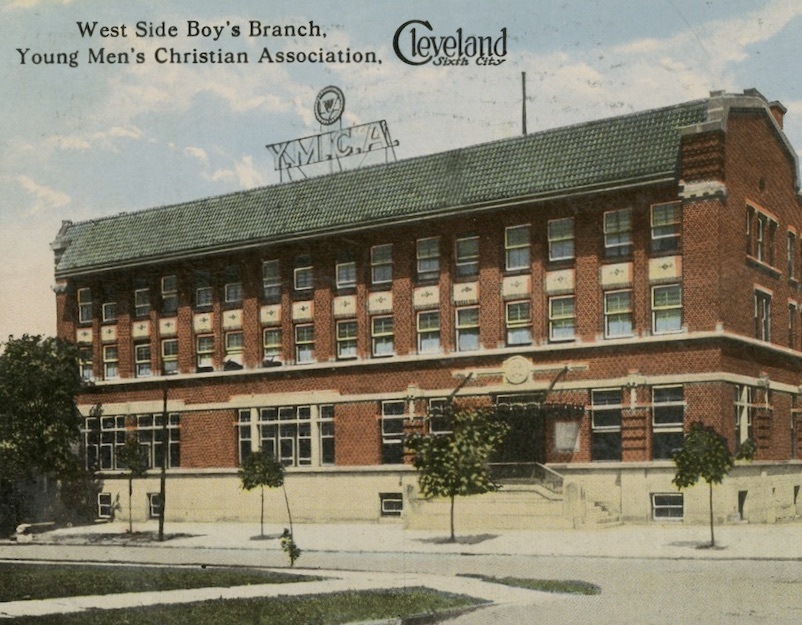
    <summary type="html"><![CDATA[<p><strong><em>In 1895, the Board of Directors of Cleveland's Young Men's Christian Association decided the time was right to build the organization's first branch facility on the city's West Side.  It was a decision that not only produced several important "firsts" for the organization but, in the longer view, created a new community center on Franklin Boulevard that would serve the surrounding neighborhood for more than a century.</em></strong></p><img src="https://clevelandhistorical.org/files/fullsize/e95030159fc082e7def69a9aaaf5408e.jpg" alt="The West Side YMCA" /><br/><p>The origins of the building at 3200 Franklin Boulevard, which today is home to a condominium development known as "Franklin Lofts,"  may be said to go back to May 7, 1898, and the sudden death of W. A. Ingham, a prominent Cleveland bookseller and publisher.  Ingham's business had sustained a severe and unexpected loss in 1889 from which neither it nor he fully recovered, and, when he died, Ingham left his widow in a precarious financial condition.  According to her late husband's will, she had two options.  She could continue to live in their grand Italianate style house on the northwest corner of Franklin Avenue and Duane (West 32nd) Street, or she could sell the house and receive a lump sum of money from the estate.  The widow in question was Mary B. Ingham (also known as Mary Bigelow Ingham), a Cleveland pioneer feminist, a charter member of the national Women's Christian Temperance Union, a co-founder of the Cleveland Institute of Art, and an author of numerous articles and books about the lives of nineteenth century women.  She decided to stay in the house for the next two years while her husband's estate was being probated, taking in roomers to help pay the bills.  As the estate proceedings drew to a close, she elected to have the house sold and, in the Fall of 1900, she moved out, taking up residence on the campus of Oberlin College.  There, she continued to write and publish and, undoubtedly, continued to influence yet another generation of American women.</p><p>W.A. Ingham's death in 1898, and the decision of Mary B. Ingham to move out of their house in 1900, paved the way for the Young Men's Christian Association (YMCA) to establish a branch facility on the west side of Cleveland.  Since 1895, the Cleveland YMCA had been looking for an opportunity to do so.  In 1897, it had mounted a campaign to establish a location, but, according to the March 18, 1900, edition of the Plain Dealer, it had failed for lack of support.  When, in 1900, it came to the attention of a young men's club at the Franklin Avenue Methodist-Episcopal Church, located on the southwest corner of Franklin Avenue and Duane Street that the Ingham House, just across the street, was for sale, they mounted their own campaign to have it become the new west side YMCA.  Prominent west side business men joined the effort. Robert Wallace, the recently retired  president of  the Cleveland Shipbuilding Company, and as well  a long-time resident of Franklin Boulevard,  purchased the Ingham house and donated it to the YMCA.  Others contributed the money necessary to construct a gymnasium addition onto the rear of the house.  On November 5, 1901, the new West Side YMCA, which was initially called the West Side Boys Club, opened.  Not only was it Cleveland's first YMCA branch located on the city's west side, but it was also, according to contemporary newspaper accounts, the first YMCA in the United States whose membership was restricted to boys between the ages of 12 and 18.</p><p>The person who was tapped to head the new West Side YMCA was Mathew D. Crackel, Secretary of the Junior Department of the Central YMCA since 1897.  Crackel, who had been living in downtown Cleveland, immediately moved to Franklin Boulevard, the street on which, except for a two-year stay in Jerusalem in the 1930s where he established a YMCA for Jewish and Palestinian boys, he would live for the rest of his life.  Crackel  was known for his moral compass, his motivational speeches and his extended hiking and camping trips. The most memorable of the latter were his annual "gypsy trips," which began in 1902.  Each year, Crackel led a group of YMCA boys on long hikes that often covered hundreds of miles, and involved camping outdoors for weeks, before returning to Cleveland.  Crackel also headed the first Boy Scout troop in Cleveland, which was formed at the West Side YMCA in 1910.  He served as Secretary of the West Side YMCA until his retirement in 1933.  </p><p>It was during Mathew Crackel's tenure as head of the West Side YMCA that the building which currently sits on the northwest corner of Franklin Boulevard and West 32nd Street was erected.  In 1909, the Cleveland YMCA had decided to expand its membership by constructing new and larger facilities for its Central YMCA on Prospect Avenue as well as for its East End and West Side branches.  The new West Side YMCA facility was to be built at the same general location as the existing facility.  The lot on Franklin immediately to the west of the Ingham House was purchased and the house on it razed.  The Ingham house was razed as well and the gymnasium, which had been attached to the rear of it, was moved to the rear of the lot to the west.  The new building was erected on and straddled both of the lots.  It was designed by architect Albert Skeel, an English immigrant who trained in Cleveland at the offices of the well-known architect Frank Barnum.  Four stories in height, including its basement which held the lobby and served as the building's "ground" floor, it had 120 feet of frontage on Franklin Boulevard and an equal amount on West 32nd Street.  It was equipped with a gymnasium (giving this branch two gymnasiums), a swimming pool, an indoor running track, a handball court, game rooms, reading rooms, club rooms, a dormitory with capacity for 100 occupants, and a large kitchen and dining room.  (Later, an addition with more handball courts was constructed onto the west side of the new building.) Construction was begun and completed in 1911 at a cost of $110,000.   The new West Side YMCA was dedicated by Cleveland Mayor Newton D. Baker on March 21, 1912. </p><p>In the years, and decades that followed, the West Side YMCA became more than just a place for young men to go and follow the tenets of what was then referred to as "muscular Christianity."  In addition to the athletics, the clubs, the reading rooms and the other programs designed for young men, the building also served as a place for neighborhood residents to gather and participate in community events.  There were open houses and receptions, meetings of a variety of local organizations, art and other exhibitions, political gatherings, concerts, workshops, fund-raising events, lectures, and even a circus, which were attended by residents of what was then called the Near West Side, but what eventually became known as the Ohio City neighborhood.  As Cleveland's west side changed demographically in the post World War II era, the West Side YMCA changed with it, converting dormitories that had been built for young men moving to Cleveland into transitional housing for Cleveland's  homeless, and hosting the Hispanic Culture Center in recognition of the growing Hispanic presence in the neighborhood.  It also became a favorite place for older neighborhood men, especially retirees, to go and play handball.  Change of a different type came to the West Side YMCA in 1953, when it was hit by the tornado that destroyed many buildings on the west side of Cleveland.  The original wooden gymnasium building on the property was totally destroyed and the main building suffered substantial damage.  The old complex roof built with Spanish tile on its sloped front was rebuilt as a flat roof, giving the building thereafter a very different look.  By the 1980s, the West Side YMCA, like many other inner city YMCAs, was facing yet another challenge, this time to stay financially afloat. Efforts by members of the community  helped to keep it open for another two decades, but, on September 1, 2004, the West Side YMCA closed its doors for good.  The building was later sold to a developer who, in 2010, converted it into the Franklin Lofts.</p><p><em><strong><a href="https://clevelandhistorical.org/items/show/933">For more (including 15 images) view the original article</a></strong></em></p>]]></summary>
    <published>2020-12-22T03:40:17+00:00</published>
    <updated>2026-03-04T21:32:04+00:00</updated>
    <link rel="alternate" type="text/html" href="https://clevelandhistorical.org/items/show/933"/>
    <id>https://clevelandhistorical.org/items/show/933</id>
    <author>
      <name>Jim Dubelko</name>
    </author>
  </entry>
</feed>