<?xml version="1.0" encoding="UTF-8"?>
<feed xmlns="http://www.w3.org/2005/Atom">
  <title type="text">Cleveland Historical</title>
  <updated>2026-05-10T00:21:54+00:00</updated>
  <generator uri="http://framework.zend.com" version="1.12.20">Zend_Feed_Writer</generator>
  <link rel="alternate" type="text/html" href="https://clevelandhistorical.org/"/>
  <link rel="self" type="application/atom+xml" href="https://clevelandhistorical.org/items/browse?output=rss2"/>
  <id>https://clevelandhistorical.org/</id>
  <author>
    <name>Cleveland Historical</name>
    <uri>https://clevelandhistorical.org</uri>
  </author>
  <link rel="hub" href="http://pubsubhubbub.appspot.com/"/>
  <entry>
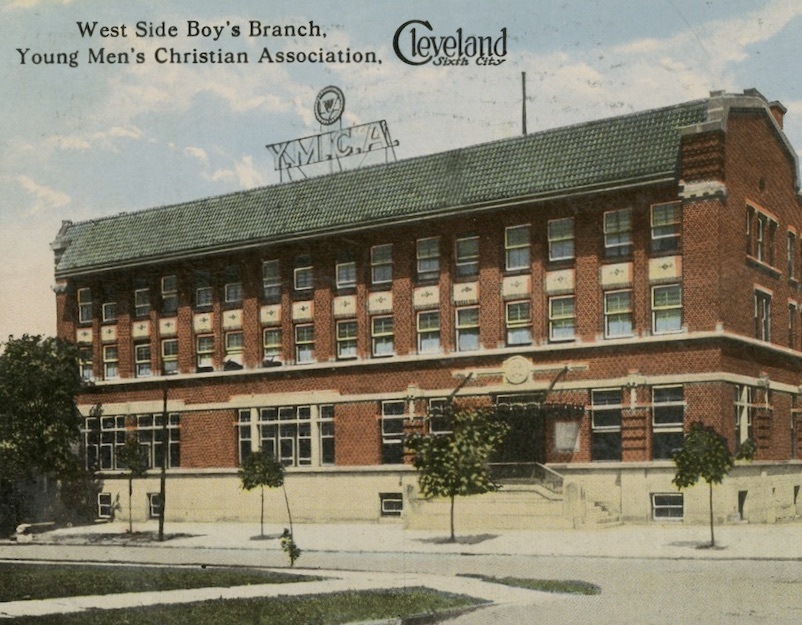
    <title type="html"><![CDATA[West Side Y.M.C.A. : A Cleveland Neighborhood Center for Over a Century]]></title>
    <summary type="html"><![CDATA[<p><strong><em>In 1895, the Board of Directors of Cleveland's Young Men's Christian Association decided the time was right to build the organization's first branch facility on the city's West Side.  It was a decision that not only produced several important "firsts" for the organization but, in the longer view, created a new community center on Franklin Boulevard that would serve the surrounding neighborhood for more than a century.</em></strong></p><img src="https://clevelandhistorical.org/files/fullsize/e95030159fc082e7def69a9aaaf5408e.jpg" alt="The West Side YMCA" /><br/><p>The origins of the building at 3200 Franklin Boulevard, which today is home to a condominium development known as "Franklin Lofts,"  may be said to go back to May 7, 1898, and the sudden death of W. A. Ingham, a prominent Cleveland bookseller and publisher.  Ingham's business had sustained a severe and unexpected loss in 1889 from which neither it nor he fully recovered, and, when he died, Ingham left his widow in a precarious financial condition.  According to her late husband's will, she had two options.  She could continue to live in their grand Italianate style house on the northwest corner of Franklin Avenue and Duane (West 32nd) Street, or she could sell the house and receive a lump sum of money from the estate.  The widow in question was Mary B. Ingham (also known as Mary Bigelow Ingham), a Cleveland pioneer feminist, a charter member of the national Women's Christian Temperance Union, a co-founder of the Cleveland Institute of Art, and an author of numerous articles and books about the lives of nineteenth century women.  She decided to stay in the house for the next two years while her husband's estate was being probated, taking in roomers to help pay the bills.  As the estate proceedings drew to a close, she elected to have the house sold and, in the Fall of 1900, she moved out, taking up residence on the campus of Oberlin College.  There, she continued to write and publish and, undoubtedly, continued to influence yet another generation of American women.</p><p>W.A. Ingham's death in 1898, and the decision of Mary B. Ingham to move out of their house in 1900, paved the way for the Young Men's Christian Association (YMCA) to establish a branch facility on the west side of Cleveland.  Since 1895, the Cleveland YMCA had been looking for an opportunity to do so.  In 1897, it had mounted a campaign to establish a location, but, according to the March 18, 1900, edition of the Plain Dealer, it had failed for lack of support.  When, in 1900, it came to the attention of a young men's club at the Franklin Avenue Methodist-Episcopal Church, located on the southwest corner of Franklin Avenue and Duane Street that the Ingham House, just across the street, was for sale, they mounted their own campaign to have it become the new west side YMCA.  Prominent west side business men joined the effort. Robert Wallace, the recently retired  president of  the Cleveland Shipbuilding Company, and as well  a long-time resident of Franklin Boulevard,  purchased the Ingham house and donated it to the YMCA.  Others contributed the money necessary to construct a gymnasium addition onto the rear of the house.  On November 5, 1901, the new West Side YMCA, which was initially called the West Side Boys Club, opened.  Not only was it Cleveland's first YMCA branch located on the city's west side, but it was also, according to contemporary newspaper accounts, the first YMCA in the United States whose membership was restricted to boys between the ages of 12 and 18.</p><p>The person who was tapped to head the new West Side YMCA was Mathew D. Crackel, Secretary of the Junior Department of the Central YMCA since 1897.  Crackel, who had been living in downtown Cleveland, immediately moved to Franklin Boulevard, the street on which, except for a two-year stay in Jerusalem in the 1930s where he established a YMCA for Jewish and Palestinian boys, he would live for the rest of his life.  Crackel  was known for his moral compass, his motivational speeches and his extended hiking and camping trips. The most memorable of the latter were his annual "gypsy trips," which began in 1902.  Each year, Crackel led a group of YMCA boys on long hikes that often covered hundreds of miles, and involved camping outdoors for weeks, before returning to Cleveland.  Crackel also headed the first Boy Scout troop in Cleveland, which was formed at the West Side YMCA in 1910.  He served as Secretary of the West Side YMCA until his retirement in 1933.  </p><p>It was during Mathew Crackel's tenure as head of the West Side YMCA that the building which currently sits on the northwest corner of Franklin Boulevard and West 32nd Street was erected.  In 1909, the Cleveland YMCA had decided to expand its membership by constructing new and larger facilities for its Central YMCA on Prospect Avenue as well as for its East End and West Side branches.  The new West Side YMCA facility was to be built at the same general location as the existing facility.  The lot on Franklin immediately to the west of the Ingham House was purchased and the house on it razed.  The Ingham house was razed as well and the gymnasium, which had been attached to the rear of it, was moved to the rear of the lot to the west.  The new building was erected on and straddled both of the lots.  It was designed by architect Albert Skeel, an English immigrant who trained in Cleveland at the offices of the well-known architect Frank Barnum.  Four stories in height, including its basement which held the lobby and served as the building's "ground" floor, it had 120 feet of frontage on Franklin Boulevard and an equal amount on West 32nd Street.  It was equipped with a gymnasium (giving this branch two gymnasiums), a swimming pool, an indoor running track, a handball court, game rooms, reading rooms, club rooms, a dormitory with capacity for 100 occupants, and a large kitchen and dining room.  (Later, an addition with more handball courts was constructed onto the west side of the new building.) Construction was begun and completed in 1911 at a cost of $110,000.   The new West Side YMCA was dedicated by Cleveland Mayor Newton D. Baker on March 21, 1912. </p><p>In the years, and decades that followed, the West Side YMCA became more than just a place for young men to go and follow the tenets of what was then referred to as "muscular Christianity."  In addition to the athletics, the clubs, the reading rooms and the other programs designed for young men, the building also served as a place for neighborhood residents to gather and participate in community events.  There were open houses and receptions, meetings of a variety of local organizations, art and other exhibitions, political gatherings, concerts, workshops, fund-raising events, lectures, and even a circus, which were attended by residents of what was then called the Near West Side, but what eventually became known as the Ohio City neighborhood.  As Cleveland's west side changed demographically in the post World War II era, the West Side YMCA changed with it, converting dormitories that had been built for young men moving to Cleveland into transitional housing for Cleveland's  homeless, and hosting the Hispanic Culture Center in recognition of the growing Hispanic presence in the neighborhood.  It also became a favorite place for older neighborhood men, especially retirees, to go and play handball.  Change of a different type came to the West Side YMCA in 1953, when it was hit by the tornado that destroyed many buildings on the west side of Cleveland.  The original wooden gymnasium building on the property was totally destroyed and the main building suffered substantial damage.  The old complex roof built with Spanish tile on its sloped front was rebuilt as a flat roof, giving the building thereafter a very different look.  By the 1980s, the West Side YMCA, like many other inner city YMCAs, was facing yet another challenge, this time to stay financially afloat. Efforts by members of the community  helped to keep it open for another two decades, but, on September 1, 2004, the West Side YMCA closed its doors for good.  The building was later sold to a developer who, in 2010, converted it into the Franklin Lofts.</p><p><em><strong><a href="https://clevelandhistorical.org/items/show/933">For more (including 15 images) view the original article</a></strong></em></p>]]></summary>
    <published>2020-12-22T03:40:17+00:00</published>
    <updated>2026-04-17T19:17:42+00:00</updated>
    <link rel="alternate" type="text/html" href="https://clevelandhistorical.org/items/show/933"/>
    <id>https://clevelandhistorical.org/items/show/933</id>
    <author>
      <name>Jim Dubelko</name>
    </author>
  </entry>
  <entry>
    <title type="html"><![CDATA[Rainey Institute: Building on Anna Edwards&#039; Dream]]></title>
    <summary type="html"><![CDATA[<p><strong><em><span style="font-weight:400;">If Anna M. Edwards, the first Director (then called "Superintendent") of the Eleanor B. Rainey Memorial Institute could attend an El Sistema concert today, she would probably at first be surprised that the Institute was involved in such a thing. But once she came to understand what music, and other visual and performing arts, programs at Rainey were doing for the children of Cleveland's Hough neighborhood, she would, while perhaps personally noting the irony of it all, be very pleased.</span></em></strong></p><img src="https://clevelandhistorical.org/files/fullsize/360e45df2b1005232b7d844e311585b0.jpg" alt="Willson Avenue Industrial Institute" /><br/><p>Anna M. Edwards dreamed of a career in music. Born in the Dayton, Ohio, area in 1849, she was the daughter of a Presbyterian minister who had moved his family to Cleveland near the end of the Civil War. Here, she attended local schools and then studied music at the Oberlin Conservatory of Music. By 1870, she was teaching music at the Lake Erie Seminary (today, Lake Erie College). However, when she was just 25 years old, her music career came to an end as a result of her involvement in the Women's Crusade (1873-1874), a national protest movement by women against America's saloon keepers. Edwards, according to her friend Edith Stivers, was persuaded by Frances Willard, legendary temperance reformer and women's suffragist, to give up her music career and go to work for the Woman's Christian Temperance Union (WCTU), a national organization led entirely by women that grew out of the Crusade and which was formally organized here in Cleveland in 1874.  </p><p>Edwards became the WCTU's Superintendent of Scientific Temperance Instruction for Ohio. This position required her to travel around the state, and later around the country, giving temperance lectures wherever she went. After a decade or so of this exhausting work, she began spending more of her time working at the non-partisan WCTU mission on St. Clair Street (St. Clair Avenue) near Willson Avenue (East 55th Street). The mission was located in a neighborhood that was brimming with saloons and home to many Eastern European immigrants, especially Slovenians. One day, according to accounts by several of her contemporaries, Edwards saw several young boys making a delivery of beer to a local saloon. They were drinking the "dregs" of the beer they were delivering and appeared to be intoxicated. Witnessing this was an epiphany for her. She decided then and there to devote the rest of her life to keeping boys like these away from saloons.</p><p>In 1888, Edwards took over the chairmanship of a WCTU reading room located on Willson Avenue, re-energized the neighborhood "Band of Hope" (a temperance pledge youth group), and opened the Flag Coffee House (so-called because of the flags she placed in its windows). The coffee house openly and actively competed with nearby saloons by offering boys a full dinner and a cup of coffee for just ten cents. Her work with the boys of this neighborhood eventually caught the attention of Eleanor B. Rainey, the widow of a wealthy Cleveland industrialist, who offered to provide Edwards with a larger and better facility for her work.  Rainey purchased a lot on the northeast corner of Willson and Dibble Avenues and built on it a three-story, 9,000-square-foot building, designed in the Tudor style by architects Badgley and Nicklas to resemble a large house. Officially called the Willson Avenue Industrial Institute, it opened in 1904. It had offices, and reading and game rooms, on the first floor; classrooms and a gymnasium on the second floor; and a custodian's apartment on the third floor. (Walfred and Anna Danielson, immigrants from Sweden and Canada respectively, and their son Harold, lived in that apartment and worked for the Institute for much of the period 1904-1940.)  </p><p>Just one year after the Institute opened, it was faced with a crisis that threatened its continued existence. Eleanor Rainey, its benefactor, suddenly died. The crisis was resolved when her heirs stepped in and agreed to continue their mother's support of the Institute's work, and the non-partisan WCTU (later known as the Women's Philanthropic Union) agreed to rename the Institute the "Eleanor B. Rainey Memorial Institute."  For the next half-century, the operations of Rainey as a settlement house were funded by Eleanor Rainey's heirs, particularly by her daughter Grace Rainey Rogers, who became sole owner of the building on East 55th Street and Dibble Avenues in 1931 and the sole surviving child of Eleanor Rainey in 1938. During this period, Rainey Institute functioned as a traditional settlement house, offering instruction in industrial trades for boys, home economics instruction (and also stenography and bookkeeping) for girls, and youth recreational activities. One of the young Slovenian boys who benefitted from these programs was Frank Lausche. He grew up to become Cleveland mayor (1942-1944), Ohio governor (1949-1957), and one of Ohio's United States Senators (1957-1969).</p><p>Anna Edwards served as superintendent of Rainey Institute until her death in 1923. She was succeeded by her younger sister, Flora, who served until her death in 1949. Upon her death, Flora Edwards was succeeded by Jessie Peloubet, whose mother was a close friend and associate of the Edwards sisters. Already 67 years old when she became superintendent, Peloubet faced many challenges during the decade of the 1950s. In 1957, the Goodrich settlement house moved from E. 31st Street to a location on E. 55th Street just up the street from Rainey Institute. The new Goodrich-Gannett neighborhood center, and several local organizations that provided funding to Cleveland settlement houses, put pressure on Rainey to either close, merge with Goodrich-Gannett, or move elsewhere. </p><p>Additionally, the decade of the 1950s saw the Hough neighborhood in which Rainey was located undergo racial transition, changing from primarily white and middle or working class in 1950 to primarily African American and working or lower class by 1960. Finally, the estate of Grace Rainey Rogers, Rainey's benefactor, who died in 1943, remained in administration well into the 1950s, forcing Peloubet to deal with estate executors and trustees in New York for the Institute's operational expenses. In 1955, pursuant to the terms of Rogers' will, the Rainey Institute land and building were finally conveyed from the estate to a newly formed non-profit corporation and a board of trustees was appointed that was charged with the financial management of an endowment left by Rogers for the continuing operating expenses of Rainey. </p><p>The record is silent as to how well Peloubet addressed these challenges, but by the end of 1959 she was no longer Rainey's superintendent, and, for a six-month period, Rainey was administered by League Park Center, Inc., a social services agency that was located, like Rainey, in the Hough neighborhood. According to an article which appeared later in the Cleveland Press on May 19, 1964, Rainey almost closed during this period. Shirley Lautenschlager, a social worker with a degree from Western Reserve University's School of Applied Social Sciences, was hired by the board of trustees in June 1960 to become the new director, of Rainey--the title of "superintendent" apparently having been discarded. Lautenschlager, who noted that, when she arrived, Rainey was functioning as little more than a recreation center, instituted a number of new social programs at Rainey that were intended to serve Hough's current population, including after school care for seven to twelve year olds; activities for teenagers including game rooms, clubs, and dances; and gardening, cake decorating and sewing classes. Several years later, in 1964, following the taking of a survey in the Hough neighborhood, Rainey also began offering piano lessons to the children of Hough. These and other music classes proved so popular with the neighborhood's parents and children that two years later Rainey Institute decided to concentrate its efforts solely in the field of music, becoming an affiliate of Cleveland Music Settlement in 1966. The institute also appointed a new Director that year who had a background in both music and social work.</p><p>For Rainey Institute, Zandra Richardson, the new Director hired in 1966, was like the second coming of founder Anna Edwards. Like Edwards, Richardson came to Cleveland from the Dayton area, and like Edwards, Richardson's first love was music. Both Edwards and Richardson became involved in social services because of their desire to help children in need and both ultimately worked for more than four decades helping children in what is today Cleveland's Hough neighborhood. Zandra Richardson, who served as Director from 1966 until 2008, left a deep imprint on the history and evolution of Rainey Institute as an arts center for underprivileged children. During her tenure, many new music and other arts programs were introduced at Rainey. One of the earliest new programs was a summer camp program promoted by Cleveland Music Settlement and Karamu House in 1967, the first summer following the 1966 Hough Riots. At summer camp, African American children were introduced to art, drama, African drumming, vocal music and dance. Several years later, Rainey expanded the summer camp program to include drama, art and music, and dance. Kids attending also received instruction in reading, math, and creative writing, and participated in recreational activities.</p><p>As time passed, Rainey's focus as a music and arts center gradually changed as theater and dance became more popular than music instruction. As a result, in 1997 Rainey severed its affiliate status with Cleveland Music Settlement. During first half of Richardson's directorship, she and Rainey's Board of Trustees, anchored by long-time trustee Theodore Horvath who worked tirelessly to preserve Rainey Institute's endowment, also initiated a long-term plan to build a new and larger facility so that more children in Hough and other nearby neighborhoods could be introduced to the visual and performing arts. In 2011, just three years after Richardson retired as Director, and with the guidance of new Director, Lee Lazar, many Cleveland businesses and charitable organizations, and Cleveland Councilwoman Fannie Lewis, Rainey Institute opened its new 27,500-square-foot Arts Center, just down the street from the old Rainey Institute building. In the same year as the new Arts Center opened, Isabel Trautwein, a violinist with the Cleveland Orchestra, established an El Sistema string orchestra program at Rainey. El Sistema, one of the most notable programs at Rainey today, promotes peaceful social change through music.</p><p>Under the directorship of Richardson and her successors, there have been many success stories at Rainey, of students who went on to have fulfilling careers in many different fields of endeavor ranging from music to government service to teaching to the business world. One of those former Rainey students is Stephanie D. Howse, an African American woman who had a successful career as an environmental engineer, before turning to public service and becoming State Representative from Ohio's 11th District. Today, Rainey Institute is a thriving art center, each year serving more than 2,500 children like Howse who hail from the Hough and other nearby neighborhoods of the City of Cleveland. </p><p>And the old Rainey Institute Building? It has not been forgotten by the City of Cleveland, which made it a Cleveland Landmark in 2018. From an early twentieth-century settlement house founded by a woman who gave up a career in music to help immigrant children threatened by saloons to a twenty-first century arts center, which uses music and other visual and performing arts to cultivate self-expression and promote social emotional growth in a new demographic of disadvantaged children in the neighborhood, Rainey Institute has come full circle, a statement with which Anna M. Edwards would certainly agree, even if she did find it ironic.</p><p><em><strong><a href="https://clevelandhistorical.org/items/show/869">For more (including 17 images) view the original article</a></strong></em></p>]]></summary>
    <published>2019-05-02T21:58:59+00:00</published>
    <updated>2026-04-17T19:17:38+00:00</updated>
    <link rel="alternate" type="text/html" href="https://clevelandhistorical.org/items/show/869"/>
    <id>https://clevelandhistorical.org/items/show/869</id>
    <author>
      <name>Jim Dubelko</name>
    </author>
  </entry>
  <entry>
    <title type="html"><![CDATA[Friendly Inn]]></title>
    <summary type="html"><![CDATA[<img src="https://clevelandhistorical.org/files/fullsize/e4a12c3ff937d2d08923daa54bf8d5d7.jpg" alt="Woodland Avenue Location, 1934" /><br/><p>The Friendly Inn Social Settlement was founded in 1874 to provide a liquor-free gathering place for the residents of poor neighborhoods. Originally called the "Temperance Coffee House and Lunchroom," it eventually evolved into one of the city's first settlement houses.  The charitable work of members of the Woman's Christian Temperance Union (WCTU) resulted in the establishment of multiple locations of the Friendly Inn within Cleveland at 634 St. Clair Street, 34 River (W. 11th) Street, and 71 Central Place.  These affluent women reportedly left their coachmen and drivers, setting out on their own to mingle with the poor, pass out food, and read passages from the Bible. Groups like the WCTU would eventually become the spokespersons for the Prohibition era.  </p><p>An article from the Cleveland Press states that the Friendly Inn was originally a place of boredom, but was transformed into a facility that was comfortable, well lit, and sanitary.  The settlement houses encouraged those who spent time there to read and learn other skills.   </p><p>Through donations from John D. Rockefeller and Stephen V. Harkness, one of the founders of Standard Oil Company, the Friendly Inn was able to consolidate its locations in 1888 into a three-story building called the Central Friendly Inn, located at 522 Central Avenue at the corner of Broadway.  However, in 1894 the organization was facing a financial crisis.  Administrators of the social settlement engineered a plan to raise the necessary funds to provide its services to the poor — the creation of the Woman's Edition of the Plain Dealer.  Through negotiations with the managing editor, 200 women contributed to the process of writing and distributing the first edition of the fundraising newspaper on January 24, 1895. </p><p>In contrast to many other settlement houses in Cleveland and the United States, the Friendly Inn refrained from practices of segregation and kept its doors open to African Americans.  The Friendly Inn was the first settlement house in Cleveland to operate with an interracial staff and by 1942 the organization was celebrating "Negro Health Week."  Between 1950 to 1970 the demographics of the neighborhood in which the Friendly Inn operated switched from a primarily European immigrant to a predominantly African American population.  In response to this change, the Friendly Inn created programs that specifically addressed issues faced by African Americans.  The Inn provided employment training, housing assistance and hosted G.E.D classes to combat the increased rates of high school dropouts.  </p><p>Currently, the Friendly Inn has included programs that focus on the role of the family  by providing family camping trips and promoting the benefits of living a healthy lifestyle.  In recent decades the Friendly Inn began to consolidate its branches, and in 2003 the organization moved into a 41,000-square-foot building located on 2386 Unwin Road.</p><p><em><strong><a href="https://clevelandhistorical.org/items/show/399">For more (including 8 images) view the original article</a></strong></em></p>]]></summary>
    <published>2012-01-20T20:27:30+00:00</published>
    <updated>2026-04-17T19:17:38+00:00</updated>
    <link rel="alternate" type="text/html" href="https://clevelandhistorical.org/items/show/399"/>
    <id>https://clevelandhistorical.org/items/show/399</id>
    <author>
      <name>Sule Holder</name>
    </author>
  </entry>
</feed>
