<?xml version="1.0" encoding="UTF-8"?>
<feed xmlns="http://www.w3.org/2005/Atom">
  <title type="text">Cleveland Historical</title>
  <updated>2026-05-02T04:23:52+00:00</updated>
  <generator uri="http://framework.zend.com" version="1.12.20">Zend_Feed_Writer</generator>
  <link rel="alternate" type="text/html" href="https://clevelandhistorical.org/"/>
  <link rel="self" type="application/atom+xml" href="https://clevelandhistorical.org/items/browse?output=rss2"/>
  <id>https://clevelandhistorical.org/</id>
  <author>
    <name>Cleveland Historical</name>
    <uri>https://clevelandhistorical.org</uri>
  </author>
  <link rel="hub" href="http://pubsubhubbub.appspot.com/"/>
  <entry>
    <title type="html"><![CDATA[Shaker Historical Society and Museum: Challenging Suburban Resistance and Shaping Community Identity in the Quest for Home]]></title>
    <summary type="html"><![CDATA[<img src="https://clevelandhistorical.org/files/fullsize/50726ca80912a440e06313046e9fd8e7.jpg" alt="Shaker Historical Society, 16740 South Park Boulevard (Scrapbook Excerpt)" /><br/><p>The Shaker Historical Society and Museum has a rich history marked by its successful establishment and resilience in overcoming challenges to secure a permanent location. The Museum presents historical artifacts and educational programs that extend beyond the <a href="https://clevelandhistorical.org/items/show/674">North Union Shaker</a> community, engaging Shaker Heights residents in public history. The legacy of the Van Sweringen brothers, who influenced the design of city streets and community values, is deeply embedded in the area’s physical layout and reflected in the Museum's role within the community.</p><p>Building on this foundation of historical interest, the story of the North Union Shaker community itself is central to understanding the origins of Shaker Heights. Founded by Ralph Russell in 1822, the Shaker community occupied the lands now known as Shaker Heights and Cleveland Heights. Although the community disbanded in 1889, its utopian ideals left a lasting legacy that helped shape the vision of the master-planned suburb. Interest in the Shakers within the community began to grow in the mid-1920s, when the Shaker Heights School District started incorporating local history into its educational programs. Teachers Edythe Turner and Pearl Lee Stark played a pivotal role in this effort, collecting Shaker artifacts and embedding them into the third-grade curriculum, ensuring that future generations would engage with this important chapter of the area’s past.</p><p>The Shaker community attracted interest from several institutions in the Cleveland area, with Wallace H. Cathcart, former director of the Western Reserve Historical Society (WRHS), initiating the Shaker collection in 1911. Today, the WRHS holds approximately 900 Shaker photographs from 1860 to 1920, which were vital in shaping a coherent public understanding of the North Union Shaker community’s legacy. Caroline B. Piercy, a Shaker Heights resident, extensively studied the Cathcart collection and published <em>The Valley of God’s Pleasure: A Saga of the North Union Shaker Community</em> in 1951. Her research led to connections with other local residents, including Rev. John M. Schott, Cary Alburn, Benjamin Jenks, and Councilman John A. Hecker, who took a major step in preserving this history by founding the Shaker Historical Society and Museum (SHS). Elizabeth B. Nord, the Museum's volunteer curator for twenty years until her death in 1972, was also instrumental in this effort. The Society began gathering Shaker artifacts and donations, hosting its first garden party on June 11, 1948, in the Shaker Room of the WRHS.</p><p>Over the next twenty-two years, the Shaker Historical Society relocated seven times before settling into a storefront at 3488 Lee Road in 1968. However, this location proved unsustainable due to high costs, prompting the board to seek a more permanent home for the Society and Museum. In 1966, a special board meeting was held in the basement of Boulevard School to discuss the donation of the Myers mansion. Designed by architect Daniel Reamer in 1910 for Louis Myers of the Van Sweringen Company, the mansion was being negotiated by his son, Frank Myers, as a potential permanent home for the SHS. The Myers mansion was historically significant, situated on the original site of the Shaker settlers’ farm and near Horseshoe Lake, created by the settlers’ dam. Despite this, local residents and neighbors at the time strongly opposed the Museum’s move into the area. Their concerns about relocating the Museum to a residential neighborhood reflected the nineteenth-century ideals behind the Van Sweringen brothers’ vision of an ideal “utopia.” In response, Mayor Paul K. Jones decided to allow neighborhood residents to voice their opinions based on issues of zoning policies.</p><p>The Van Sweringen brothers sought to control property values in Shaker Heights through deed restrictions, a common practice in American suburban development. By promoting homeownership, they aimed to stabilize property values and prevent “undesirable” neighbors, enforcing both aesthetic standards and racial covenants. In 1925, they introduced Restriction No. 5, which encouraged residents to return old property deeds for approval before selling. Zoning regulations were also implemented, designating certain areas for single-family homes while allowing commercial use in other zones. The northern areas of South Park Boulevard and Lee Road were reserved for single-family residences, while the neighborhoods south of South Woodland Road and Van Aken Boulevard were subject to a mix of zoning types. Together, Restriction No. 5 and the expanded zoning regulations reinforced the Van Sweringen brothers' vision of a white, upper-to-middle-class "utopia."</p><p>Although Shaker was well on its way to becoming a community that embraced social diversity, the Van Sweringen vision of exclusivity and zoning control was echoed decades later when the Shaker Historical Society's proposal to relocate to the South Park Boulevard neighborhood faced resistance. Much like the earlier concerns over "social invasion" and zoning laws, opponents feared the impact of the Society's move on the residential character of the area. <span>To bypass these objections, trustee Frank Myers donated the property to the state with vice president William R. Van Aken handling the legal complexities of the transfer, enabling the Society to contract with the State Department of Public Works and avoid city zoning regulations.</span></p><p>This effort to overcome zoning resistance marked a pivotal moment in the Shaker Historical Society's development and expansion. Drawing on this achievement, the Society began to shift its focus toward broader public engagement. The president of the SHS at the time, William Van Aken, discussed opening the Museum to all residents of northeastern Ohio, and the public was first invited into the space during a tour conducted around the Shaker Lakes in 1970. Building on this momentum, the Women's Committee of the SHS was established in June 1971 to increase interest, funding, and volunteer support for the museum. In 1972, Elizabeth Nord made a significant contribution by donating her personal library to the SHS and receiving the Golden Deeds Award from the Exchange Club of the Heights. Tragically, she passed away from a heart attack just four months later. The 1980s marked a period of expansion for the Society, which showcased four major exhibits and elected its first female president in 1988, further solidifying its commitment to inclusive public history.</p><p>The success of these early efforts laid the groundwork for the Shaker Historical Society’s continued growth and evolution. As the Society expanded its reach and strengthened its community ties, it also began to reflect the values and identity of Shaker Heights itself. The suburb, deeply intertwined with the concept of "home," influenced the Society’s transition into a single-family residence, further aligning its mission with the broader emphasis on home and place that defines the area. By broadening its focus from solely representing the Shakers to engaging more deeply with the diverse local community, the Shaker Historical Society and Museum is forging a new identity for public history in Shaker Heights—one that reflects the suburb's contemporary values while enriching its historical narrative.</p><p>Today, the Shaker Historical Society and Museum, along with the Elizabeth B. Nord Memorial Library and Archives, operates in its permanent location at 16740 South Park Boulevard. Despite past resistance, the museum now stands as a hub for public history, education, and community development, honoring the legacy of the North Union Shakers on the very land they once inhabited.</p><p><em><strong><a href="https://clevelandhistorical.org/items/show/1040">For more (including 14 images) view the original article</a></strong></em></p>]]></summary>
    <published>2024-11-26T01:14:49+00:00</published>
    <updated>2026-04-17T19:17:43+00:00</updated>
    <link rel="alternate" type="text/html" href="https://clevelandhistorical.org/items/show/1040"/>
    <id>https://clevelandhistorical.org/items/show/1040</id>
    <author>
      <name>Makialani Kanewa-Mariano</name>
    </author>
  </entry>
  <entry>
    <title type="html"><![CDATA[Ancient Mounds in Cleveland : Earthworks of the Whittlesey Culture]]></title>
    <summary type="html"><![CDATA[<img src="https://clevelandhistorical.org/files/fullsize/fd85fcb395a03abdff7424aa12acbd88.jpg" alt="Detail of 1870 Map of Cleveland Mounds" /><br/><p>If you have ever wondered why there’s a Mound Elementary School and a Mound Avenue in the Slavic Village neighborhood, it’s because Cleveland was once home to a series of mounds and the Native American cultures that built them. When most people think of the mound builders, Cleveland probably is not the first place that comes to mind. However, geologist Charles Whittlesey discovered a series of mounds in and around the city. One of the peoples who occupied the ancient future site of Cleveland is named the Whittlesey culture after the man who discovered and documented their artifacts.</p><p>Charles Whittlesey was born in 1808 in Southington, Connecticut, and moved to Tallmadge, Ohio, in 1813. He was also a West Point graduate in 1831. After returning to Ohio, Whittlesey also contributed to many publications on several different topics. Whittlesey served as the editor for the <em>Cleveland Herald</em> in 1836 and 1837 and continued thereafter to publish material on the early history of Cleveland, the Cuyahoga Valley, and other parts of Ohio. Those topics are just a few he wrote about in his more than 200 books and articles published during his career. Whittlesey accomplished many firsts in the history of Native American and Ohio geology. He conducted the first geological survey in Ohio during the late 1830s before becoming the official assistant geologist for Ohio in 1837. He also conducted geological surveys for over 20 years in states such as Wisconsin, Michigan, and Mississippi where he focused on Native American earthworks. During his Ohio survey, Whittlesey discovered numerous earthworks and found large iron and coal deposits that would help develop the state. </p><p>Charles Whittlesey is not only known for his discovery of new Native American earthworks; he is also known for his Civil War service. During the war, he helped plan and construct fortifications for the U.S. Army in Ohio and Kentucky. He was selected for the task because of his extensive knowledge of geological features and ancient fortifications. In addition to building fortifications, he also was appointed to serve as an escort for President-elect Abraham Lincoln, who would go on to be the sixteenth President of the United States in 1861.</p><p>Whittlesey was a large asset to the war effort as he built fortifications, served the future president, and fought in the war. He fought in both the Battle of Fort Donelson and the Battle of Shiloh in 1862. In addition to fighting in the war, he was also the assistant quartermaster general for Ohio troops while he engineered fortifications for Cincinnati, Ohio. Whittlesey eventually resigned from the army after the Battle of Shiloh in 1862. After he retired, he became a historian and moved back to Ohio in 1867. That same year, he was instrumental in founding the Western Reserve Historical Society, in which he served as president until 1885. But Whittlesey’s most notable legacy arguably his contributions to understanding the Native American culture which was named after him. </p><p>For over 14,000 years, prehistoric groups lived in Ohio, congregating around large bodies of water and other waterways. Many Native American cultures and practices have been a part of Ohio’s history. In Ohio, between 800 BCE and 1200 CE, the Woodland culture period flourished and was defined by several features: groups settling down into larger communities, large-scale agriculture, and mound building. Mounds were often used for burial practices but could also be used for gathering places or ceremonial rituals. However, none of the mounds discovered in Cleveland appeared to be designed for burial practices.</p><p>Archaeologists refer to the Late Woodland culture in northeast Ohio as the Whittlesey culture or Whittlesey tradition to acknowledge Charles Whittlesey, who documented many historical sites and mounds. The Whittlesey culture lived along the banks of rivers and brooks from Lake Erie to the Black River in Conneaut between about 1200 and 1640. Whittlesey discovered various mounds in what is now the Cleveland area. Thanks to his extensive documentation in books such as <em>Ancient Earth Forts of the Cuyahoga Valley</em>, <em>Descriptions of Ancient Works in Ohio</em>, <em>Early History of Cleveland Ohio</em>, and <em>Ancient Mining on the Shores of Lake Superior</em>, we have considerable insights into the Whittlesey culture's customs, art, and mounds. </p><p>Native American mounds that Whittlesey describes in the Cleveland area include Fort 1 Newburg, an earthwork he discovered in Cleveland near Harvard Grove Cemetery, and mounds near Public Square, Euclid and East 9th, Woodland Cemetery, Sawtell Avenue mound (now East 51st Street off Woodland Avenue), and on East 53rd Street.</p><p>The Sawtell Avenue mound measured 5 feet high, 40 feet long, and 25 feet wide. Whittlesey conducted a small-scale dig on this mound in 1870 along with partner Judge C.C. Baldwin where they both discovered copper artwork, clay tube pipes, and ornamental beads. The Slavic Village area mound was located along Mound Avenue near East 53rd Street. The mound inspired the name of both the street and Mound Public School, the precursor of today’s Mound Elementary School. The mound site was developed as a brick yard in the 1890s before being redeveloped as the school. </p><p>Unfortunately, not many of these mounds were preserved in the Cleveland area except for places such as the Lyman Site, located in the Lake Metroparks system, where Whittlesey documented and surveyed the area documenting earthworks of around 8 feet high. However, few saw these Native American discoveries as significant during the 19th century, which is why no efforts were made to preserve, protect, or interpret the mounds or their culture until much later. Any local interest in the Whittlesey culture and its mounds was overshadowed by the growing city and development of real estate. By the time Whittlesey was documenting earthworks in the 1830s, most of the Cleveland mounds were gone. An exception was the one on Sawtell Avenue, for it stood on land then owned by A. Freese, who told Whittlesey the mound was "one of the ornaments on his grounds," and he "did not wish to have it demolished." Even the much larger and more elaborate mounds located in Chillicothe, Ohio, were not studied until the early 1920s, when Mound City Group National Monument was established in 1923. From there, ancient Ohio mounds began to gain popularity, as the Chillicothe mounds attracted more federal investment in preservation and interpretation when the National Park Service redesignated the site as the Hopewell Culture National Historic Park in 1992.</p><p>Charles Whittlesey’s legacy lives on in many ways today in the Cleveland area and across Ohio areas. He provided one of the first geological surveys of the state in which he documented many ancient mounds, served in the Civil War, and helped create the Western Reserve Historical Society. Even though most of the Cleveland area mounds were flattened for urban development, they still live on in Ohio’s history, including in place names like Mound Avenue. Next time you find yourself in Cleveland, stop and look, you might see remembrance of the once great ancient mounds.</p><p><em><strong><a href="https://clevelandhistorical.org/items/show/997">For more (including 7 images) view the original article</a></strong></em></p>]]></summary>
    <published>2022-12-07T16:06:12+00:00</published>
    <updated>2026-04-17T19:17:43+00:00</updated>
    <link rel="alternate" type="text/html" href="https://clevelandhistorical.org/items/show/997"/>
    <id>https://clevelandhistorical.org/items/show/997</id>
    <author>
      <name>Tara Bostater</name>
    </author>
  </entry>
  <entry>
    <title type="html"><![CDATA[James A. Garfield National Historic Site]]></title>
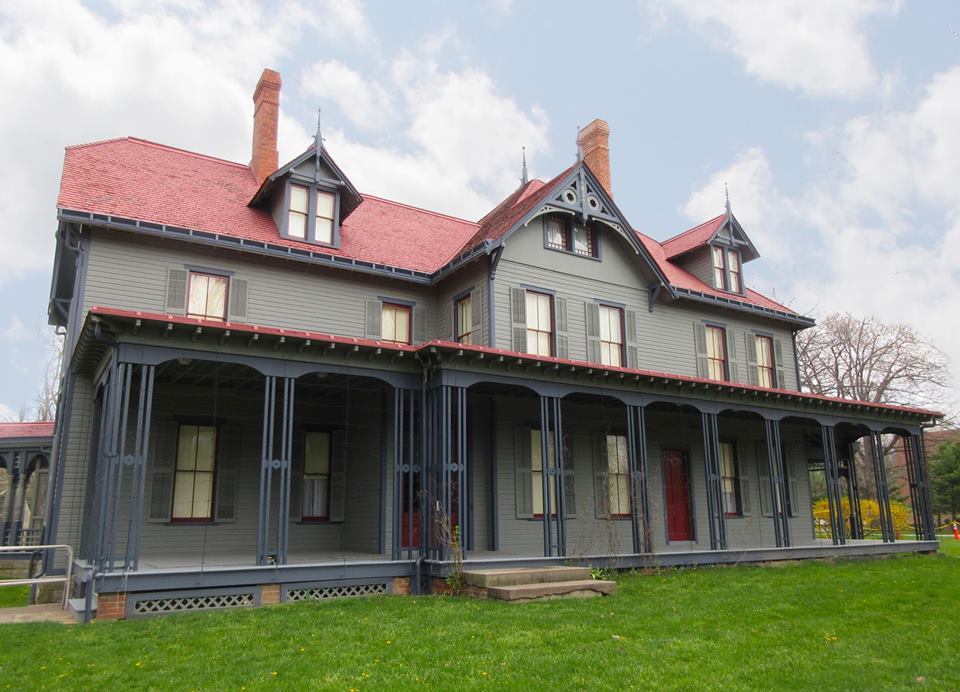
    <summary type="html"><![CDATA[<p><strong><em>"Do you think my name will have a place in human history?" — James A. Garfield, 1881</em></strong></p><img src="https://clevelandhistorical.org/files/fullsize/09f5423699901ef71093237d4ee90f12.jpg" alt="James A. Garfield National Historic Site" /><br/><p>In 1876, James A. Garfield was looking for a new home in his congressional district for himself and his family. He reflected in his diary, “Spent most of the day in examining some farms which are for sale. Made the Widow Dickey an offer of $115 per acre for her farm… and think it will result in a purchase. I must get a place where I can put my boys to work and teach them farming. I think this farm will always be worth the price I offer, and probably more by and by.” Mrs. Dickey sold her property to Garfield in 1876; a purchase Garfield never imagined would impact his family for decades. </p><p>In 1880, Garfield expanded the nine-room farm house to a twenty-room home. At this point in his career, he had been selected as the Republican candidate for the 1880 presidential election. As people learned of Garfield’s nomination, they started to come and visit. Initially, Garfield had been told by his political friends that it was not the responsibility of candidates to run their own campaign. Rather it was the political party’s job to run the campaign for him. Garfield ultimately decided to address the people coming to his home, and gave speeches on his front porch. As a result, Garfield is considered the first presidential candidate to run a front-porch campaign. </p><p>Garfield was inaugurated as president on March 4, 1881, and served until his death on September 19, 1881. Garfield was shot by an assassin Charles Guiteau on July 2, 1881, and lived for another eighty days. During that time, a subscription fund was created to help support his wife and the children. On October 15, 1881, when the fund closed, Lucretia Garfield was given a total sum of $360,000. She placed a majority of this money into savings bonds, leaving her with more than enough money to live on and to support her family. Garfield was eventually laid to rest at the <a href="https://clevelandhistorical.org/items/show/400">Garfield Memorial</a>, located in <a href="https://clevelandhistorical.org/items/show/76">Lake View Cemetery</a> in Cleveland. </p><p>The former First Lady moved the family back to the Mentor home. She had become very concerned about Garfield’s legacy, and feared that people would not remember him. A new addition to the house would encompass a grand memorial library to store all of Garfield’s books, as well as his personal papers. Besides the memorial library, the addition would provide kitchen space, servants' bedroom space, and a full third story. Changes were made to both the interior and the exterior of the house, and additional buildings were also added to the property to create a "country" estate aesthetic. As the Garfield children settled down with their own homes and families, their mother became worried about what was to become of her home. Her son Harry later reflected, “As mother remarked to us at one time, she would not have us make a white elephant of a home that had yielded so much to us…”</p><p>Lucretia Garfield died in 1918. What to do with the home became a great debate among the Garfield children. Although the siblings wanted to keep peace among themselves, they managed to find flaws in each other’s suggestions. When their Uncle Joe, who had been living in the home, died in 1934, the children were forced to deal with the situation head-on. The children ultimately decided that the best thing for the home and its contents, was to donate them as a museum for the enjoyment and education of future generations.</p><p><a href="https://clevelandhistorical.org/items/show/32">The Western Reserve Historical Society</a> (WRHS) accepted the donation of the home, in 1936. The home opened to the public in August of the same year. In 1938 the WRHS decided to form a new chapter of their group. The primary responsibility of the chapter would be for the “preservation of historical documents pertaining to the county and article of historic interest with the idea of housing them in one central place, the President Garfield Memorial Home…” as well as the, “…stimulation of greater interest in the national shrine.” By 1955 the Lake County chapter of WRHS was incorporated and its name changed to the Lake County Historical Society (LCHS). The main interpretation done at the home for the next several decades consisted of house tours and pamphlet interpretation for visitors, with a museum on the third floor of the home. LCHS also used the Garfield home as a headquarters building and as a space to interpret general county history. The organization hosted larger events such as Civil War battle reenactments, patriotic remembrances for President Day, and even large holiday celebrations with Victorian decor.</p><p>Congress authorized the establishment of James A. Garfield National Historic Site (JAGNHS) as a unit of the National Park Service on December 28, 1980. The act permitted the site to enter into an agreement with the WRHS to maintain, operate, and interpret the historic property. The National Park Service completed ten years worth of historical research and documentation of the site. In 1984 LCHS moved to a new location. This meant that the Garfield home and artifacts were intact and in the home, but still in the care of WRHS. In the 1990s, Congress allocated $12.5 million for the restoration of the home and property. This provided funding not only for the restoration on the interior and exterior of the home, but also for the adaptive reuse of many of the historic structures on the property. </p><p>The restoration of the Garfield home was completed in 1998, and the site re-opened to the public. The site continued to be co-managed by the NPS and WRHS for the next ten years. It was not until 2008, due to heavy financial constraints, that WRHS decided to relinquish their operation rights to the NPS. After this occurred the site finally became a true National Park. The NPS has designated the period of significance for the Garfield home to start with James A. Garfield’s campaign in 1880, continuing past his death and through most of his family’s life in the home, up to 1904. This allows the Park to tell not only Garfield’s story and his significance to history, but also that of his wife and children, and what they did to honor his legacy.</p><p><em><strong><a href="https://clevelandhistorical.org/items/show/856">For more (including 15 images) view the original article</a></strong></em></p>]]></summary>
    <published>2018-11-21T19:48:39+00:00</published>
    <updated>2026-04-17T19:17:42+00:00</updated>
    <link rel="alternate" type="text/html" href="https://clevelandhistorical.org/items/show/856"/>
    <id>https://clevelandhistorical.org/items/show/856</id>
    <author>
      <name>Rebekah Knaggs </name>
    </author>
  </entry>
  <entry>
    <title type="html"><![CDATA[Hale Farm and Village]]></title>
    <summary type="html"><![CDATA[<img src="https://clevelandhistorical.org/files/fullsize/9ae7439718714ed9a9954021f888f207.jpg" alt="Goldsmith House" /><br/><p>Walking through the Hale Farm and Village, visitors can hear the clanging of a blacksmith's hammer, feel the heat of a glassblower's kiln, and smell freshly cut timber from a woodworker's shop. The Hale Farm and Village is a living outdoor history museum that educates visitors about daily life in the nineteenth-century Western Reserve. The farm and village contain a collection of restored structures, including a church, log schoolhouse, law office, and several craft shops. In 1957, the Western Reserve Historical Society received the Hale Farm as a donation from Clara Belle Ritchie, the great-granddaughter of the farm's first owner Jonathan Hale. In the 1950s, the farm consisted of an 1825 brick home and surrounding outbuildings. Rather than risk the loss of her family's home and history, Ritchie offered the property to the WRHS on the condition that the society preserve the farm as a museum dedicated to local history.</p><p>Together, the Hale farm house and village testify to the nineteenth-century Western Reserve experience. At the farm house, visitors learn about the personal struggles and triumphs of Jonathan Hale and his family. The surrounding village presents additional aspects of life in the 1800s, including different forms of civic and religious participation. The church, for example, illustrates the importance of religion in the daily lives of Cuyahoga Valley settlers, while the land office teaches visitors about the area's immigration and financial history. Unlike the historic villages of Old Salem and Williamsburg, the Hale Farm and Village is a conglomeration of buildings moved to the site to represent significant elements in public and private nineteenth-century life.</p><p>In the later twentieth century, historians and history museum educators became increasingly concerned with representing the lives of ordinary people, rather than exclusively the rich, powerful, or famous. Museums like the Hale Farm and Village exemplify this more recent approach to history, which justified the preservation of a home and property that represented neither a grand form of architecture, nor the site of a famous man. The Hale Farm and Village, instead, emphasizes the interpretation and recreation of daily life, including family and community. </p><p><em><strong><a href="https://clevelandhistorical.org/items/show/344">For more (including 7 images) view the original article</a></strong></em></p>]]></summary>
    <published>2011-11-03T18:32:06+00:00</published>
    <updated>2026-04-17T19:17:38+00:00</updated>
    <link rel="alternate" type="text/html" href="https://clevelandhistorical.org/items/show/344"/>
    <id>https://clevelandhistorical.org/items/show/344</id>
    <author>
      <name>Carolyn Zulandt</name>
    </author>
  </entry>
  <entry>
    <title type="html"><![CDATA[Jonathan Hale Farm]]></title>
    <summary type="html"><![CDATA[<img src="https://clevelandhistorical.org/files/fullsize/939f7d4ea161807a57ef748bf4a2267a.jpg" alt="Farm and Village" /><br/><p>In the southwestern Cuyahoga Valley sits a tall red brick house on over 140 acres of the Hale Farm and Village. Now a tourist destination and educational trip for school groups, the Hale Farm provides a window into 19th century valley farm life. Jonathan Hale arrived in the Western Reserve from Connecticut in 1810 to begin a new life of hard work and dedication to his farm. In 1824, Jonathan and his sons began laying each brick of the famous home, an architectural landmark in the Cuyahoga Valley. </p><p>Jonathan's son Andrew Hale, who inherited the farm after his father's death, increased the Hale Farm's size and productivity. Based on market demands, Andrew developed specialized farming practices, which included commercial orchards and dairy products. </p><p>The third generation to own and operate the Hale Farm, Andrew's son Charles Oviatt (C.O.) Hale (1884-1938), was a farmer in name only. Part of the newer generation of "gentlemen farmers," C.O. Hale transformed the farm into an inn and recreational retreat for friends and visitors. Hiring local families to work on his land, C.O. Hale oversaw the labor and production of fruits and vegetables, hay, and maple syrup. </p><p>In the 1930s, the great-granddaughter of Jonathan Hale and C.O. Hale's niece, Clara Belle Ritchie, inherited the farm. A business woman with a strong interest in the investment-value of the farm, Clara Belle supervised the farm's restoration and donation to the Western Reserve Historical Society. Visitors to the farm today experience a living history museum that features reenactments, crafts, and historical interpreters to educate about Western Reserve farm life in the 1800s. </p><p><em><strong><a href="https://clevelandhistorical.org/items/show/338">For more (including 5 images&#32;&amp;&#32;4 audio files) view the original article</a></strong></em></p>]]></summary>
    <published>2011-09-29T13:42:55+00:00</published>
    <updated>2026-04-17T19:17:38+00:00</updated>
    <link rel="alternate" type="text/html" href="https://clevelandhistorical.org/items/show/338"/>
    <id>https://clevelandhistorical.org/items/show/338</id>
    <author>
      <name>Carolyn Zulandt</name>
    </author>
  </entry>
</feed>
