<?xml version="1.0" encoding="UTF-8"?>
<feed xmlns="http://www.w3.org/2005/Atom">
  <title type="text">Cleveland Historical</title>
  <updated>2026-05-02T03:02:57+00:00</updated>
  <generator uri="http://framework.zend.com" version="1.12.20">Zend_Feed_Writer</generator>
  <link rel="alternate" type="text/html" href="https://clevelandhistorical.org/"/>
  <link rel="self" type="application/atom+xml" href="https://clevelandhistorical.org/items/browse?output=rss2"/>
  <id>https://clevelandhistorical.org/</id>
  <author>
    <name>Cleveland Historical</name>
    <uri>https://clevelandhistorical.org</uri>
  </author>
  <link rel="hub" href="http://pubsubhubbub.appspot.com/"/>
  <entry>
    <title type="html"><![CDATA[Hart &amp; Co. Building: How One Building Helped Save a Struggling District]]></title>
    <summary type="html"><![CDATA[<p><strong><em>By 1980, 40 percent of the structures in the Warehouse District were gone. John Cimperman, head of the Cleveland Landmarks Commission,  summed up the situation best when he stated, “We need luck, money, and cooperation, but saving and restoring this area is [a] must.” The Hart & Co. Building was a starting point for the restoration of the Warehouse District in a broader trend of adaptive reuse.</em></strong></p><img src="https://clevelandhistorical.org/files/fullsize/36069c526aa18707bd0098b219f3c1fe.jpg" alt="Hart &amp; Co. Building in 1897" /><br/><p>The Hart & Co. Building is located at 1235 West 6th Street in the Warehouse District and currently contains the Hat Factory Lofts and Richardson Design. The Hart & Co. Building was commissioned in 1888 by Elbert Irving Baldwin, one of the city’s oldest dry goods merchants, who came to Cleveland in 1857. The building’s first tenant was E. L. and F. W. Hart & Co., which leased the building until 1900. Hart & Co. was one of the most prominent millineries in a millinery market that ranked third in the nation (behind New York and Chicago) by 1895. Hart & Co. made hats for women and imported hats and materials from Europe. Hart & Co. sold straw, felt goods, feathers, flowers, ostrich plumes, ribbons, silk, velvets, ornaments, and other goods for making hats; many of these items the company sold made their way to the “far west and extreme south.” Furthermore, in 1897 it was reported that thousands of milliners (most of whom were women) came to Cleveland each year from Ohio, Indiana, Kentucky, Michigan, and Pennsylvania to see the latest spring hat designs. </p><p>On April 15, 1899, catastrophe struck Hart & Co. At noon, a fire erupted in the building occupied by Comey & Johnson behind the Hart & Co. Building. The fire threatened the entire block bounded by West St. Clair Ave and West Lakeside Avenues and West 3rd and West 6th Streets. Eventually, the fire spread to the Hart & Co. Building; by 1:00 p.m. the building was “doomed.” The heaviest loss was suffered by Hart & Co. whose building was a wreck, with damage estimated at approximately $75,000. In 1899, the building was rebuilt and redesigned by F. S. Barnum and Co. and Hart & Co. moved and rented out the Brush Building. It is unclear whether the entire building was destroyed or if only parts of it were destroyed. What is certain is the building suffered significant damage from the fire.</p><p>In 1900, the building was sold to Adams & Ford, a wholesale dealer in rubber goods that primarily made boots and shoes. In 1941, White Tool & Supply Co. bought the building and used it as a warehouse until 1983. White Tool & Supply Co. seemed especially prosperous in the 1950s. In July 1951, it was reported that the company sold more than $3,000,000 of tools, equipment and machinery each year. Business likely declined from the 1960s to 1980s as many of the businesses in Cleveland (and elsewhere) saw a decline due to deindustrialization and urban decline. Additionally, other factors that led to the decline of the machine tools industry included the failure to modernize/innovate, the failure to sell internationally, bigger companies buying smaller companies in the industry, and the dismantling of the iron and steel industry, which was linked with the machine tool industry. Hence, many buildings in cities became vacant/abandoned and left to deteriorate. The solution many cities implemented due to the crisis of deteriorating structures was demolition. From the 1940s to 1970s, approximately one-third of the buildings in the Warehouse District were cleared and replaced with surface parking. By 1980, 40 percent of the structures in the Warehouse District were gone. </p><p>In 1971, in response to demolition in Cleveland, the Cleveland Landmarks Commission was formed. The Landmarks Commission’s mission was to find architecturally and historically significant buildings in Cleveland and label them as landmarks to prevent their demolition. In April 1977, John D. Cimperman, head of the Landmarks Commission and Cleveland City Council member, revealed a plan for the Warehouse District that focused on reusing buildings through renovations and creating urban housing. Cimperman was aware of the historic value of the Warehouse District: it contained early commercial skyscrapers and much of the early wealth acquired in Cleveland was earned in the district. Cimperman summed up the situation best when he stated, “We need luck money, and cooperation, but saving and restoring this area is [a] must.” In 1982, the Warehouse District gained further protection from destruction. That year, Cleveland City Council established the Warehouse Historic District and the National Park Service approved listing the Warehouse District in the National Register of Historic Places. However, in 1983, White Tool & Supply Co. left the Hart & Co. Building, leaving its fate in question. </p><p>Luckily, on January 8, 1984, the Cleveland City Planning Commission approved an Urban Development Action Grant proposal for the building and in March, the U.S. Department of Housing and Urban Development approved the application. This meant funds of $800,000 and a $2 million mortgage were approved to help restore and repurpose the building. The renovation was undertaken by the Old Cleveland Properties division of the Dalad Group and turned into an apartment building with thirty-three loft-style suites. The first floor was used as a commercial space where a restaurant and tavern were expected to be installed. Additionally, the developers tried to keep elements of the industrial history of the building but also made it look like a cozy residential space. In June 1985, the Hat Factory Lofts opened. Thus, the Hart & Co. Building began its life as the first legal housing unit in the Warehouse District. </p><p>The transformation of the Hart & Co. Building into the Hat Factory Lofts was the first step in the spread of adaptive reuse in the Warehouse District. The Hat Factory Lofts was one of twenty-one buildings the Dalad Group planned to develop in the Warehouse District. Additionally, there were plans to establish pedestrian walkways and courtyards in the district to make it pedestrian friendly and to transform it into a mixed-use neighborhood. In 1987, Old Cleveland Properties undertook a $3 million renovation of the Hoyt Block, a four-story Victorian building. This led to the creation of eighty thousand square feet of retail space at ground-level and upper-floor offices. In 1988, Old Cleveland Properties made fifty-six apartments out of upper-story space in the Hoyt Block. In 1990, only three buildings in the Warehouse District had apartments: the Bradley Building, Hat Factory Lofts, and the <a href="https://clevelandhistorical.org/items/show/1062">Hart Building</a>. Hence, the adaptive reuse of the Hart & Co. Building paved the way to revitalize the Warehouse District and served as part of the national trend to use adaptive reuse to save struggling cities like Baltimore, Minneapolis, and Pittsburgh. In the end, the Hat Factory Lofts tips its hat to the building’s first inhabitant, Hart & Co., through its name and architectural features, continuing to provide a sense of Cleveland’s past as the city continues to live on.</p><p><em><strong><a href="https://clevelandhistorical.org/items/show/1064">For more (including 8 images) view the original article</a></strong></em></p>]]></summary>
    <published>2025-11-13T19:36:21+00:00</published>
    <updated>2026-04-17T19:17:43+00:00</updated>
    <link rel="alternate" type="text/html" href="https://clevelandhistorical.org/items/show/1064"/>
    <id>https://clevelandhistorical.org/items/show/1064</id>
    <author>
      <name>Casey Smith</name>
    </author>
  </entry>
  <entry>
    <title type="html"><![CDATA[Hart Building: A Cast-iron Landmark of the Furniture Trade]]></title>
    <summary type="html"><![CDATA[<p><strong><em>At the center of one of two remaining clusters of nineteenth-century commercial buildings on West 9th Street, a slender gray facade stands out in a row of brick-faced buildings. The five-story Hart Building is only nine feet wide, making it Cleveland’s narrowest downtown building. Named for William Hart, a Connecticut-born cabinetmaker turned furniture manufacturer-merchant, it exemplifies Cleveland’s golden age of cast-iron facades and Hart’s gradual rise from a poor teenage orphan to one of the city’s prominent business and civic leaders.</em></strong></p><img src="https://clevelandhistorical.org/files/fullsize/839cd3f2260d0ebef88c4fdd293c40ca.jpg" alt="Hart Building" /><br/><p>William Hart (1811–1892) was born in Norwich, Connecticut, and migrated to the former Western Reserve with his parents and seven siblings in 1821 or 1822. Hart’s first experience in Cleveland was sleeping in the family’s covered wagon a couple of blocks west of Public Square, where they stopped on their way to the place they settled in Lorain County. About two years later, Hart’s parents both died within days of each other, orphaning eight children. In 1825, the same year that the Ohio & Erie Canal construction began, 14-year-old William moved to Cleveland to work as a cabinetmaking apprentice to Asabel Abel. After his apprenticeship ended, he opened his own small workshop and store at 49 Water Street near present-day Lakeside Avenue in 1834. That same year, he married and took up residence a block east of the shop on Bank Street. </p><p>The young cabinetmaker worked hard to provide for his younger siblings as well as for nieces and nephews that he and his wife adopted. Hart’s fortunes rose alongside Cleveland’s in the years after the canal launched the city’s upward arc of development, and in 1843 he moved just south to a larger building at 59 Water Street. By mid-century, William Hart & Co. was one of the six furniture wholesale houses that lined Water Street. However, soon thereafter, he suffered some setbacks. First, he nearly severed his arm in a circular saw accident in 1850, leading sympathetic voters to elect him City Treasurer, then a light job that enabled him to remain focused on his furniture business. Two years later, a fire destroyed his building and entire stock. </p><p>Undeterred, in 1853 Hart reopened briefly on Bank Street while he completed a larger four-story building at 103-105 Water Street (today 1370 West 9th Street). In 1868, two years after partnering with his son-in-law Hezekiah P. Malone to become Hart & Malone, he expanded to encompass the nine-foot-wide space between his building and the newly built Crittenden Block to its south. This became 107 Water Street (now 1374 West 9th Street). To match its cast-iron facade, he covered the old building with ornamental tinwork. This was at the height of the popularity of cast-iron facades, which also covered similar buildings erected in other cities in the 1850s-80s, perhaps most notably in New York’s SoHo and Tribeca districts. Hart also added a mansard roof on the fifth floor that further unified the two buildings. Today the facades appear more distinct because the older building’s tin facade was later removed to expose the brick.</p><p>In 1874, Hart & Malone was on the leading edge of an eastward shift of retailing when it moved from Water Street to 2 & 4 Euclid Avenue at the southeast corner of Public Square, lending higher visibility in what was on the cusp of becoming the heart of downtown. Hart & Malone probably struggled amid the economic downturn after the Panic of 1873. In 1875, Hart, who had already retired a few years before, left the business in the hands of an assignee and moved to Bradford, Pennsylvania, where he invested in the oil business, only to lose much of what remained of his onetime fortune. Meanwhile, his furniture store moved a block south to 15 & 17 Prospect Street just east of Ontario Street, where it continued to unload its remaining stock until it closed in 1877. </p><p>After the departure of the furniture business, the Hart Building saw a succession of business uses. Among the longest-running was the Cleveland office of Chicago-based Fairbanks, Morse & Co., a manufacturer of scales, engines, pumps, and windmills, which occupied the building in the 1880s to 1910s. After business declined on and around West 9th Street following World War II, the Hart Building became a part of efforts in the 1970s and '80s to revamp Cleveland’s so-called Warehouse District, including the ill-fated Lawrence A. Halprin plan for Settlers Landing. Jacobs Investments bought the Hart Building in 1984 and renovated its upper floors as apartments. As the district revitalized, the ground-floor space at 1370 West 9th became an antique store in 1988 and then housed two art galleries in succession in the 1990s to 2010s. Since 1995 the Hart Building’s five residential units have been condominiums. Its 1868 addition remains as a rare remnant of a time when the Warehouse District had many tall, narrow commercial blocks.</p><p><em><strong><a href="https://clevelandhistorical.org/items/show/1062">For more (including 13 images) view the original article</a></strong></em></p>]]></summary>
    <published>2025-10-05T21:56:34+00:00</published>
    <updated>2026-04-17T19:17:43+00:00</updated>
    <link rel="alternate" type="text/html" href="https://clevelandhistorical.org/items/show/1062"/>
    <id>https://clevelandhistorical.org/items/show/1062</id>
    <author>
      <name>J. Mark Souther</name>
    </author>
  </entry>
  <entry>
    <title type="html"><![CDATA[Frank Drew and His Dime Museum: Cleveland&#039;s Short-lived Sideshow]]></title>
    <summary type="html"><![CDATA[<p><strong><em>In 1881, Frank Drew – a protégé of famed showman P. T. Barnum – struck out on his own. Over the next few years, Drew brought Barnum’s signature sideshow style to several cities, including Cleveland.</em></strong></p><img src="https://clevelandhistorical.org/files/fullsize/26753a9580316230f41f181f4008b296.jpg" alt="Dime Museum in Commercial Building" /><br/><p>More than 130 years after his death, Phineas Taylor (P. T.) Barnum remains a household word. Despite being a philanthropist, newspaper publisher, writer, legislator, and abolitionist, he is best remembered as a co-founder of the “Greatest Show on Earth,” a circus he didn’t launch until he was in his 60s. But long before that, at age 32, he birthed Barnum’s American Museum, a wildly popular mashup of live beasts, clowns, acrobats, jugglers, magicians, and musical acts. Less savory, but every bit as popular, were the museum’s human oddities—albinos, giants, little people, the physically malformed—as well as any number of hoax exhibits: a creature with the body of a monkey and the tail of a fish, a 10-foot human corpse, George Washington’s 161-year-old nursemaid. Located on Broadway in lower Manhattan, the museum’s outside was garnished with giant images of animals and other exhibits. From the roof, attendees could go aloft in a hot air balloon. To Barnum it was all about hot air. He was, after all, the godfather of hucksterism—the self-described “Prince of Humbugs.”</p><p>From its inception, Barnum’s creation was known as a “dime museum,” a live entertainment cousin of circuses, minstrel shows, music halls, burlesque and, eventually, vaudeville. In fact, many of vaudeville’s most famous names (Harry Houdini, the Griffin Sisters, Maggie Cline) began their careers in dime museums. Still, it was freaks and fakes that most likely attracted the masses. In his own way, Barnum also sought to educate the unwashed, to offer what he called a “moral education” proffered through lectures, concerts, and the importation of exotic (translation: “savage and inferior”) humans. This mission—concurrently enlightening, amusing, and horrifying audiences—was more or less unique to dime museums. </p><p>Barnum’s first connection to Cleveland came in November 1851, when he brought the uber-famous Swedish soprano Jenny Lind to Cleveland. More than one thousand people paid $4 (about $150 in today’s money) to see and hear her at Kelley’s Hall on Superior Street at the corner of Bank Street (now West 6th). By 1871, however, Barnum had a protégé—an adept and highly ambitious showman named Frank Drew. And it is because of Frank Drew that Cleveland got its first dime museum. </p><p>Frank M. Drew was born in New York City on June 30, 1852, and, like Barnum, seemed born for show business. An actor and circus performer, Drew was a cousin of theater legend John Drew Jr. and the eventual uncle of acting greats John, Ethel, and Lionel Barrymore. Drew’s father (also named Frank) was an actor who often performed at Cleveland’s Park Theater. </p><p>After splitting with Barnum in 1881, Drew opened his first dime museum in Providence, Rhode Island. By 1884, he had moved to Cleveland and opened Drew’s Dime Museum at 189 Superior Street, just east of Bank Street and around the corner from the Academy of Music. By the late 1880s, he would also launch dime museums in Columbus, Ohio, and Indianapolis. </p><p>Housed in the Commercial Building, a multi-use structure, Drew’s Cleveland museum was largely featureless on the outside. The interior, however, was ever so Barnumesque. A “thin dime” admitted enquiring Clevelanders who, upon reaching the building’s third floor, might come face to face with Felix Wehrle (“The Elastic Skin Man”), Eugene Ward (“The Footless Song-and-Dance Man”), Jo-Jo (“The Dog-Faced Man”), R. J. James (“The Ohio Fat Boy”), or even “The Fairy Dwarf Sisters.” Inert creatures—e.g., a two-headed cow—drew abundant stares. Drew also offered what was, at the time, mainstream entertainment: black-face (minstrel) acts, trained animals (generally old, toothless, and tired), and a variety of laugh generators. The Four Mortons, a popular family act, performed at the museum early in their careers, as did comedy legends Sam Bernard and Weber & Fields. </p><p>But true to dime museums’ dual mission, Drew also hosted plays, concerts, lectures, and other forms of what Walt Disney would later dub "edutainment." For example, Drew hawked displays of animals and exotic humans as “cultural explorations,” as well as living proof of westerners’ supposed superiority over “lowly beasts and primitive cultures.” Such attractions in this era of scientific racism included the February 1884 appearances of “Cetewayo’s Zulu Princess and Suite” and nine Australian Boomerang Throwers: “ferocious, treacherous, uncivilized cannibals and savages." </p><p>Fortunately, other forms of enrichment were less dubious: In August 1884, four of the seven survivors of the tragic 28-man Greely Expedition to Ellesmere Island in the Canadian Arctic shared maps, curiosities, and stories. In January 1887, visitors were treated to a demonstration of clog dancing, followed by a concert featuring the Beethoven Quartet. And October 1889 brought to Drew’s a demonstration of shadowgraphs (silhouettes made by casting shadows from a bright light source) along with a visit from quarrelsome puppets Punch & Judy. </p><p>In late 1889, Drew closed his museum and became manager of the Star Theater on Euclid Avenue (opened two years earlier as The Columbia and now the site of PNC Center). In 1903, Drew also assumed management of the Cleveland’s Colonial Theater at Erie and Superior Streets. He eventually retired to Gerard, Pennsylvania, and later to St. Petersburg, Florida, dying in 1949 at the astonishing, stupendous, amazing, incredible age of 95 or 96.</p><p><em><strong><a href="https://clevelandhistorical.org/items/show/1045">For more (including 7 images) view the original article</a></strong></em></p>]]></summary>
    <published>2024-11-27T18:49:31+00:00</published>
    <updated>2026-04-17T19:17:43+00:00</updated>
    <link rel="alternate" type="text/html" href="https://clevelandhistorical.org/items/show/1045"/>
    <id>https://clevelandhistorical.org/items/show/1045</id>
    <author>
      <name>Chris Roy</name>
    </author>
  </entry>
  <entry>
    <title type="html"><![CDATA[Western Reserve Building: Weathering the Shifting Winds of Downtown Property Markets]]></title>
    <summary type="html"><![CDATA[<p><strong><em>Samuel L. Mather perched his offices in the Western Reserve Building above the river harbor where he plied his iron-mining and shipping business. At the time, he probably never imagined how the brick and stone edifice would fare as downtown and the city's economy evolved, but his onetime headquarters defied the odds, managing to retain its original function as an office building long after most other first-generation skyscrapers were demolished or converted to other uses.</em></strong></p><img src="https://clevelandhistorical.org/files/fullsize/b24eb52bdd6ec25243308a1cd22ba2a4.jpg" alt="Romanesque Arch Entrance" /><br/><p>Samuel L. Mather, the grandson of one of the founding fathers of the Connecticut Land Company whose investment had led to the establishment of Cleveland, co-founded the iron-ore mining and shipping firm of Pickands, Mather & Co. in 1883, which helped him amass a new fortune on top of his already formidable wealth. Pickands Mather had kept offices for only a short time in the <a href="https://clevelandhistorical.org/items/show/1029">Perry-Payne Building</a> on Superior Avenue when Mather commissioned the Chicago architectural firm of Burnham & Root (already known locally for its <a href="https://clevelandhistorical.org/items/show/305">Society for Savings Building</a>) to design a headquarters office building on land that he and John Hay had purchased on the northwest corner of Superior and Water Street (now W. 9th).</p><p>The aptly named Western Reserve Building occupied a triangular parcel on the crest of a steep hill descending into the flats along the river. The land had once been home to the Carter Tavern, a hewn-log inn that early Western Reserve of Connecticut settler Lorenzo Carter had built in 1803. Following Carter's death in 1814, Phineas Shepard operated the inn for an unknown span of time, and it was the site of the meeting in 1816 that organized Trinity Parish, later <a href="https://clevelandhistorical.org/items/show/81">Trinity Episcopal Cathedral</a>. After it closed, deeds show that Carter's children Alonzo and Laura sold the land to the Oviatt family in two transactions in 1825 and 1830. By 1828, the Oviatts had replaced the old two-story inn with a three-story brick building that stood until Orson M. Oviatt razed it for a new four-story commercial block called the Franklin Buildings in 1835. The Franklin Buildings housed various dry-goods houses and professional offices, including the men's clothing store of George A. Davis, who owned the block from 1851 until his death ten years later. </p><p>The Franklin Buildings later housed Western Union Telegraph Company, which added "innumerable adornments of fencing and wires which surmount[ed] the electric ridden structure," according to an account in the <em>Plain Dealer</em> in 1886. Three years later, Hay and Mather, the executors of Amasa Stone's estate, purchased the property in the estate's name and set out to redevelop it. (Hay's and Mather's wives Clara and Flora were Stone's daughters.) Following on the heels of the Perry-Payne Building, the announcement of a new building to replace the Western Union block was a welcome news to those who feared Euclid Avenue's inroads. As the <em>Plain Dealer</em> pointed out in 1889, "Enough is now promised in the way of new buildings to save the street from becoming what it had at one time threatened to do—a street for banks and the wholesale trade plentifully mixed up with saloons."</p><p>Mather’s new eight-story pressed-brick and sandstone Western Reserve Building, which opened in 1892, is considered a transitional skyscraper. Like Burnham & Root’s Monadnock Building in Chicago and Cudell & Richardson's Perry-Payne Building, it had traditional load-bearing masonry exterior walls but also incorporated some interior steel framing, a recent innovation. On the ground floor, the Western Reserve Building featured pink sandstone piers capped by Romanesque capitals and a large Romanesque arch framing its Water Street entrance. Its upper floors had either rectangular, segment arch, or full arch windows, some of them in oriel bays. Samuel Mather had an elaborate cherry-paneled office inside. </p><p>In addition to Pickands Mather, the Western Reserve Building housed American Steel & Wire, Cleveland-Cliffs Iron, Island Creek Coal, and other shipping, mining, and manufacturing concerns. The building’s uses reflected business leaders’ desire to locate offices in the Wholesale District (later renamed the Warehouse District) close to Cleveland’s harbor. The riverside location was also attractive to the U.S. Weather Bureau. On May 1, 1892, Cleveland’s weather observatory and signal station opened there, 135 feet above the street, giving it a commanding view of the lake and river. From this lofty perch, signalman and weather observer W. B. Stockman hoisted flags to alert ship captains and downtown pedestrians to impending changes in the weather. The station had previously operated on top of the six-story Wilshire Block on Superior Avenue a block and a half west of Public Square. Now it was another beneficiary of Mather’s eagerness to be closer to the harbor. </p><p>In 1903, the Western Reserve Building was expanded northward along Water Street with an interior lightwell that may have drawn inspiration from Burnham & Root’s Rookery Building in Chicago or perhaps from a similar feature inside the Perry-Payne Building. The expansion increased the original building's size by about 40 percent. The building flourished into the 1920s, but like other buildings west of Public Square, it faced increasing competition from newer ones that rose to the east along Euclid Avenue. In 1924, Mather sold his interest in the Western Reserve Building to the Union Lennox Company, a firm named for the mammoth Union Trust Building that had recently replaced the Lennox Building on the northeast corner of Euclid and East 9th. Soon after, Pickands Mather moved its headquarters into the Union Trust Building. With the loss of its identity as a hub of the city's iron-ore business and the rise of newer, larger skyscrapers, the Western Reserve Building's future was in question.</p><p>The Western Reserve Building changed hands twice during World War II and, under Louis E. Goldman, it underwent a modernization in 1947 that covered its Romanesque arch entrance with a blocky granite façade. Despite this effort to renew its appeal, over the next three decades, the building stood sentinel over a part of downtown that was gradually decaying and receding in civic importance. Toward the end of that time, Goldman was no longer able to attract tenants, so the building sat mostly vacant. The exception to the rule was the opening in 1970 of the Cleveland Urban Learning Community, an experiment by St. Ignatius High School that took advantage of cheap rent to place its headquarters in the Western Reserve Building.</p><p>The Cuyahoga River’s east bank had been a natural place for Samuel Mather to envision an office building housing his iron mining and shipping business in the early 1890s. Although seemingly less natural, Herbert W. Strawbridge, chairman of the Higbee Company department store, felt a similar pull toward the western edge of the derelict Warehouse District nine decades later. Several years earlier, Strawbridge had visited San Francisco’s Ghirardelli Square, a shopping, dining, and entertainment complex filling the shell of its namesake chocolate manufacturer’s former factory. As Higbee’s downtown store sales slipped, Strawbridge recalled Ghirardelli Square. Then he hatched a daring plan to buy a swath of property overlooking the river and create a similar venue. Settlers’ Landing, as it would be named, would evoke Cleveland’s start along its river and, like Ghirardelli Square, reuse existing buildings as much as possible. More importantly, Strawbridge reasoned, Settlers’ Landing could draw large numbers of tourists and suburbanites back to a sagging downtown—and hopefully to Higbee’s.</p><p>Among the properties that the newly formed Higbee Development Corporation bought through agent John H. Bustamante was the Western Reserve Building, which Goldman was doubtless thrilled to unload in 1973. Strawbridge then hired Lawrence Halprin, the man behind Ghirardelli Square, to plan Settlers’ Landing. Higbee Development sank $4.5 million into a full renovation of the Western Reserve Building in 1974-76. The results drew a mixed response locally. Some decried the sandblasting that pitted the delicate sandstone facade. Others looked askance at the similarly insensitive treatment of the building’s interior. To avoid removing any leasable space, Higbee Development enclosed the historic lightwell to add an interior fire escape, heating and cooling ducts, and new restrooms on each floor. Halprin’s designer Angela Tzvetin created a modern lobby with “domed brick vaults” and spiderweb-like iron designs between their pillars, leading one architectural critic to dub the “corny” concept “early wine cellar.” The same critic went so far as to suggest that the Western Reserve Building was “second-rate Burnham and Root” that would have been better off bulldozed.</p><p>When the Western Reserve Building reopened in 1976, it seemed that the building had a new relevance as the Flats transitioned from maritime to leisure uses, but renewal was slow and difficult. Higbee’s operated a sandwich shop off the lobby while it searched (ultimately in vain) for a full-service restaurant to assume the space. At the time of the opening, only 1,220 of 53,840 square feet of office space was leased. Then Higbee’s plans for Settlers’ Landing collapsed after a major fire consumed some of the buildings the company had hoped to renovate. Despite efforts to promote the building, including hosting an exhibit and slideshow as part of the 1977 sesquicentennial of the opening of the Ohio Canal, the Western Reserve Building underperformed expectations. Coupled with Higbee’s expenses from opening new stores at Euclid Square and Randall Park malls, its renovation of Pickands Mather’s onetime headquarters building contributed to record quarterly losses that year. By 1981, the building was reportedly at 97 percent occupancy, but Higbee’s needed an infusion of cash, so it sold the building to another syndicate headed by developer John Ferchill.</p><p>Though Settlers’ Landing had flopped, the Flats and Warehouse District boomed in the 1980s. Nightspots, restaurants, and loft apartment conversions reinvigorated an area that earlier downtown planners had largely forsaken in their fixation on <a href="https://clevelandhistorical.org/items/show/909">Erieview</a>. It was too late for Higbee’s, which sold out to Youngstown developer Edward J. DeBartolo and the Little Rock-based Dillard’s chain in 1987 (though the Higbee’s name survived another five years). As for the Western Reserve Building, it flourished anew. Among the firms based there was Those Characters from Cleveland (now CloudCo Entertainment), a subsidiary of Cleveland-based American Greetings that formed in 1981 to develop and license characters developed by the card company such as Holly Hobbie and Strawberry Shortcake. That year saw Cleveland artist Elena Kucharik’s creation of the Care Bears, making the Western Reserve Building the birthplace of one of the 1980s’ popular culture icons. </p><p>Ferchill and his partners undertook yet another renovation in 1990 and built an eight-story addition to the north that doubled the size of the 1892/1903 building. The sandstone- and microcotta-faced addition featured a new arched entry, while the syndicate uncovered and restored the long-hidden one on the original building. After initial success, the enlarged building gradually languished again. By 2016, it was two-thirds vacant and in foreclosure, leading Ferchill to sell it the following year to WRB Partners (comprised of developer Fred Geis, real estate firm Cushman & Wakefield, and others). During the COVID-19 pandemic, the Western Reserve Building clung to its original function as an office building in a new era marked by the loss of downtown office-based work and a spate of office to residential conversions. In addition to attracting a global co-working company, WRB Partners added to its amenity-driven approach to combatting the loss of traditional dedicated office work by doing what Higbee’s had tried and failed to do fifty years earlier: entice a restaurant operator. In 2023, the popular Cleveland Heights-based Luna Bakery opened its third cafe on the building’s ground floor.</p><p><em><strong><a href="https://clevelandhistorical.org/items/show/1030">For more (including 19 images) view the original article</a></strong></em></p>]]></summary>
    <published>2024-09-10T21:00:07+00:00</published>
    <updated>2026-04-17T19:17:43+00:00</updated>
    <link rel="alternate" type="text/html" href="https://clevelandhistorical.org/items/show/1030"/>
    <id>https://clevelandhistorical.org/items/show/1030</id>
    <author>
      <name>J. Mark Souther</name>
    </author>
  </entry>
  <entry>
    <title type="html"><![CDATA[Perry-Payne Building: Standing at a Place of Historic Memory]]></title>
    <summary type="html"><![CDATA[<p><strong><em>In the Spring of 1887, workmen tore down a number of three-story commercial buildings that had long stood on the north side of Superior Street between the National Bank Building on the northeast corner of Superior and Water (West 9th) Street and the Scovill Building (formerly the Franklin House), located midway up the block. The site was cleared to make room for the construction of the eight-story Perry-Payne Building. A little less than a year later, while the new Perry-Payne Building was going up, an article appeared in the <em>Plain Dealer</em> on April 15, 1888 recalling those earlier buildings and noting that "while the old must give way to the new," a number of Cleveland's most prominent pioneer merchants, including William Bingham and George Worthington, had started their businesses in the old buildings and that therefore "the place is of historic memory."</em></strong></p><img src="https://clevelandhistorical.org/files/fullsize/cdb5ba97d0c460c22c2c6b53c94355bd.jpg" alt="Perry-Payne Building, 740 W. Superior Avenue" /><br/><p><span style="font-weight:400;">The historic land upon which the Perry-Payne Building at 740 W. Superior Avenue stands, and much of the land that surrounds it in Cleveland's Warehouse District, was first commercially developed by the Nathan Perry family. Nathan Perry Sr. (1760-1813) was an innkeeper in western New York's Genesee County when, in 1796, he was hired by Moses Cleaveland to provide food supplies to the surveying party that founded Cleveland. Almost a decade later, he, his wife Sophia, and their children moved here. In 1806, Perry purchased six acres of land northwest of the Public Square. On that land, which had frontage on Superior, St. Clair and Water (West 9th) Streets, Perry opened a trading post in a cabin that stood less than fifty feet from where the Perry-Payne Building stands today. </p><p>Nathan Perry, Sr. was one of Cleveland's first merchants. Less than a decade after arriving in Cleveland, however, he died unexpectedly. Four of his six acres, including the land upon which the Perry-Payne Building stands, passed to his son Nathan Perry Jr. (1786-1865), who transformed his father's trading post into a dry goods store and, in 1819, replaced the cabin with a two-story brick commercial building, one of Cleveland's first. Nathan Jr. operated his dry goods business in that building until 1826, when he sold the business but retained ownership of the building and the land upon which it stood. </p><p>In addition to running his dry goods business, Nathan Perry Jr., as early as 1814, had been making shrewd purchases of land in Cleveland, and, by 1830, he had become one of the city's wealthiest landowners. In that latter year, he moved his family from the simple frame house they had lived in on Water Street, just north of his dry goods store, into an early-era mansion on Euclid Avenue. It stood where Berkman Hall stands today on Cleveland State University's campus, just east of East 22nd Street.</p><p>In 1835, Perry decided to lease some of his land near the corner of Superior and Water to two hardware merchants, William Cleveland and Elisha Sterling. The terms of their two leases—drawn up by a young Cleveland lawyer named Henry B. Payne—required them to construct two three-story brick commercial buildings on the land they leased. Each of the two brick buildings they built had two storefronts. The buildings with their four storefronts became known as the "Central Buildings" because the corner of Superior and Water was then the center of Cleveland's commercial business district. It was in these buildings that William Bingham, George Worthington, and other prominent early Cleveland merchants, who were mentioned in the <em>Plain Dealer</em> article of April 15, 1888, got their business start.</p><p>As important as the Central Buildings were to the enlargement of Nathan Perry Jr.'s real estate portfolio, lawyer Henry B. Payne, who drafted the leases that required they be built, would soon become even more important. In 1833, Henry B. Payne was a law student in Hamilton, New York, when he was impelled to travel to Cleveland to help nurse his best friend, Stephen A. Douglas, who was suffering from a severe illness. Douglas, who later became the Illinois Senator whom Abraham Lincoln famously debated in 1858, left Cleveland after recovering. Henry Payne chose to stay. Payne completed his law studies here and, in 1836, when Cleveland officially became a city, Henry Payne became its first solicitor. In August 1836, Payne, who had in 1835, as noted above, served as Nathan Perry's lawyer, married Perry's only daughter, Mary, who thereafter became known to all in Cleveland as Mary Perry Payne. </p><p>Henry Payne practiced law in Cleveland for more than a decade before he decided to leave the practice. In 1849 he joined forces with Alfred Kelley and Richard Hilliard to build Cleveland's first railroad, the Cleveland, Columbus and Cincinnati ("CCC"). In the process, he became that railroad's first president. In 1855, Payne turned his attention to government service and was appointed to the City Waterworks Commission. It built Cleveland's first waterworks system. Then, in 1862, he took on the work of chairing a city sinking fund board which reportedly stabilized Cleveland's finances for years. Henry Payne also became active in local and state politics. He served in a number of Democrat party positions, before being elected in 1874 to the United States House of Representatives. A decade later, in 1885, he was elected Ohio's first United States Senator from Cleveland. </p><p>It was during the second year of Henry Payne's term as a United States Senator that local newspapers reported that Senator Payne was planning to build a new commercial building on Superior Avenue that would be named the Perry-Payne Building.  Different reporters and different historians writing in different eras have speculated differently as to the reason why Henry Payne named the Perry-Payne Building as he did. They all, however, may have been looking to the wrong person for an answer to their question. </p><p>When plans were made to build the Perry-Payne Building, the land upon which it was to be built was owned by Mary Perry Payne. The decade of the 1880s was one in which American women were beginning to acquire greater property rights, including the right to own, develop and dispose of real property in their own name. Henry B. Payne was uniformly said to be a progressive person of kind disposition who had a very loving marriage with Mary Perry Payne. Given all of the foregoing, there is no reason not to believe that Mary Perry Payne, probably with her husband's full support, was the person who chose the name of the building that was to be built upon her land. So perhaps the question that we should ask today, even if it was not asked by newsmen in 1887, or by historians thereafter, is: Why did Mary Perry Payne choose to so name her building? While we do not know the answer to that question with any degree of certainty, it might be as simple as that was where she first met Henry Payne.</p><p>In proceeding with their plans to build the Perry-Payne Building, Henry and Mary Perry Payne selected Cudell & Richardson, one of Cleveland's most prominent late nineteenth-century architectural firms, to design it. Cudell & Richardson, in additional to this historic building, also notably designed the following buildings still standing in Cleveland: St. Stephen Roman Catholic Church on West 54th Street; Franklin Circle Christian Church at 1688 Fulton Road; Belden Seymour Block at 2513-2525 Detroit Avenue; Franklin Castle at 4318 Franklin Boulevard; the George Worthington Company Building at 802-832 W. St. Clair Avenue; the Root and McBride Building at 1220 West 6th Street; and the Bradley Building at 1212-1224 West 6th Street. Additionally, Cleveland's Cudell Commons Park and the city's Cudell neighborhood are both named after Frank Cudell, one of the two named partners in that architectural firm.</p><p>The building Cudell & Richardson designed for Henry and Mary Perry Payne was described in a June 19, 1887 <em>Cleveland Leader</em> article. It was to be constructed "of brown stone and granite, in the Rennaissance style of architecture. The side and rear walls will be of brick. . . . The floor joists will be of iron and the floors fire clay tile. . . . [T]he stairs will be made of iron and cement or marble. Iron balconies will be provided on the fifth and seventh floors." The article stated that the building would be "eight stories high in the middle and seven on either side, with a basement. It will have a frontage of 138 feet, a depth of 100 feet, and will be 120 feet high." The article noted that the first floor of the building would be designed for the offices of banks, and the upper floors would have a total of 46 offices with an average size of 18 x 26 feet. </p><p>Other articles noted that the interior of the building would feature an eight-story interior court illuminated by a sky light. (The design of this light court, as well as the building's front facade, were reminiscent of Chicago's Rookery Building designed by Burhnam and Roots.) Other interior features of the Perry-Payne Building were its modern elevators and mail chutes that carried mail from all of the building's upper floors down to a first floor mail room. Designed with interior iron support columns, the Perry-Payne Building is notable architecturally as a transitional building between earlier buildings with masonry support walls and later buildings, including the Society for Savings Building erected just one year later, having interior steel support beams which enabled them to be built to great heights and led to them becoming known as "skyscrapers."</p><p>Construction of the Perry-Payne building commenced in the summer of 1887 after all of the old commercial buildings on the site had been razed. While construction was expected to be completed in 1888, financing difficulties encountered by Henry and Mary Perry Payne appear to have delayed completion of construction until the summer of 1889. The first tenants of the Perry-Payne Building included Bingham Hardware and National City Bank, who opened their offices in the new building on July 1, 1889.  When the Perry-Payne Building opened, it was the tallest and most grand commercial building in Cleveland, and it attracted many of the largest iron ore, coal, and shipping companies in Cleveland as tenants. It also attracted a number of Cleveland law firms, including a new firm named Squire, Sanders and Dempsey (today, Squire, Patton and Boggs), which has since become one of the city's largest and most historic law firms. </p><p>In the first two decades of its existence, even as larger and grander commercial building went up in downtown Cleveland, the Perry-Payne Building continued to attract more than its fair share of Cleveland's coal, iron, and shipping-related businesses, as well as a number of law firms and insurance companies. However, almost all of its core tenants departed after 1913 when Marcus Hanna's son Dan completed his construction of the enormous 15-story Leader Building on the corner of Superior Avenue and East 6th Street. Thereafter, for decades, the Perry-Payne Building survived with much less than full occupancy.</p><p>During its early years, ownership of the Perry-Payne Building remained with the Perry-Payne family and their descendants through the Perry-Payne Company formed in 1899, several years after the deaths of Henry and Mary Perry Payne. However, in 1945, that company sold the Perry-Payne Building to another corporation that was unrelated to the family. The building had many new owners in the years that followed and these new owners struggled to find and hold onto tenants. Then, in 1965, the State of Ohio leased the entire building for a number of its agencies with offices in Cleveland. This, however, only temporarily solved the building's occupancy problems for, in the summer of 1979, the State agencies departed when the new <span>Frank J. Lausche State Office Building, directly across the street, opened</span>.</p><p>In the 1980s and early 1990s, the owners of the Perry-Payne Building struggled anew with occupancy problems. In 1994, however, a new partnership purchased the building, hired an architectural firm known for its restoration work, and proceeded to restore the front facade of the Perry-Payne Building; renovate the remainder of it; and convert it into an apartment building with 91 apartments and 8,000 square feet of retail space. As of the writing of this story in 2024, the Perry-Payne Apartments remain a prestigious address in downtown Cleveland's Warehouse District.</p><p>If Mary Perry Payne were alive today and learned that her Perry-Payne Building had been converted into an apartment building, she might say that it really didn't matter, so long as Clevelanders today believe, as she and her husband and Clevelanders of her generation more than a century ago believed, that the Perry-Payne Building stands at a place of historic memory.</p><p> </p>
</p><p><em><strong><a href="https://clevelandhistorical.org/items/show/1029">For more (including 19 images) view the original article</a></strong></em></p>]]></summary>
    <published>2024-08-06T01:52:23+00:00</published>
    <updated>2026-04-17T19:17:43+00:00</updated>
    <link rel="alternate" type="text/html" href="https://clevelandhistorical.org/items/show/1029"/>
    <id>https://clevelandhistorical.org/items/show/1029</id>
    <author>
      <name>Jim Dubelko</name>
    </author>
  </entry>
  <entry>
    <title type="html"><![CDATA[The Grand Arcade: W. C. Scofield&#039;s Enduring Building]]></title>
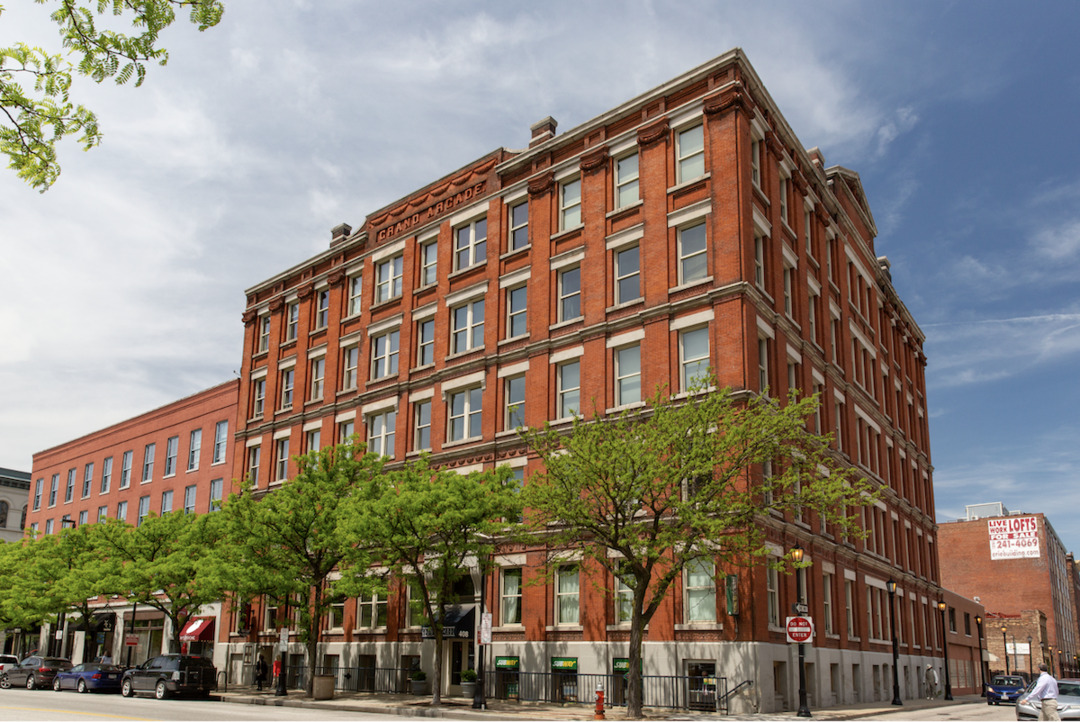
    <summary type="html"><![CDATA[<p><strong><em>When its construction was completed in 1883, the six-story Grand Arcade on the northwest corner of St. Clair and West 4th was the tallest commercial building and most prestigious business address in Cleveland.  Iron works, oil refineries and other industrial businesses rushed to lease offices in it.  However, when the even taller and more prestigious Perry-Payne Building opened on Superior Avenue  six years later, these businesses just as quickly left the Grand Arcade.  This wouldn't be the last occupancy challenge this historic building would face .</em></strong></p><img src="https://clevelandhistorical.org/files/fullsize/d392fd4e40264971599e4ebad93b154c.jpg" alt="The Grand Arcade" /><br/><p>William Charles Scofield, the person for whom the Grand Arcade Building at 408 West St. Clair Avenue was built, was one of Cleveland's most prominent industrialists in the second half of the nineteenth century.  He and John Alexander, reputedly the first person to refine oil in Cleveland, co-founded the Great Western Oil  Works which, in the 1860s, was one of the chief competitors of John D. Rockefeller's Standard Oil  Company.  When, in 1872,  Standard Oil Company engaged in anti-competitive acts and forced virtually all of Cleveland's oil refiners, including John Alexander and William Scofield, to sell their refineries to it at discounted prices, Alexander retired from the refinery business and returned to England. Scofield, however, did not.  He not only survived the so-called "Cleveland Massacre," but thrived after it.</p><p>In 1872,  the same year that he was forced out of the oil refining industry by Rockefeller's Standard Oil Company, W. C., as Scofield was known, entered the iron manufacturing industry, purchasing the historic Otis Iron Works on Whiskey Island.  He renamed it Lake Erie Iron Company, expanded its operations to include a new facility for the manufacture of nuts and bolts on land located between East 63rd Street and Addison Avenue close to the tracks of the Lake Shore and Michigan Southern Railroad, and made it a very successful business.  In 1874, two years after the Cleveland Massacre, Scofield formed a new partnership, built a new oil refinery on Willson Avenue (East 55th Street), north of Broadway and near the tracks of the Atlantic and Great Western Railroad, and re-entered the oil refining business, operating once again as Great Western Oil. </p><p>In 1882, W. C. Scofield decided to construct the Grand Arcade.  Yet, it wasn't his first presence on St. Clair or even the first building he had erected on that street.  After immigrating from England and arriving in Cleveland in about 1844, he and his wife Ann had settled on St.  Clair Street, where their first two children were born. In 1850, they had moved  east to Hamilton Street as the neighborhood northwest of Public Square (today known as the Warehouse District) began its mid nineteenth century transformation into a commercial district. Despite moving his residence, Scofield retained a presence on St. Clair, starting up several small manufacturing businesses there in the 1850s and early 1860s.</p><p>In 1864, the same year in which he formed his partnership with John Alexander, William Scofield had  expanded his business presence on St. Clair by purchasing the former homestead of pioneer Cleveland grocer and wholesale liquor merchant Nelson Monroe, which was located nearly directly across the street from where the Grand Arcade would be built almost two decades later.  The offices of the Great Western Oil  Company were located on this property from 1864 to 1868. In 1878, Scofield had further solidified his presence on St Clair by building the four-story brick and stone Scofield Block on the property.  A number of industrial tenants, including Scofield's Lake Erie Iron Company, soon moved their offices into that building.</p><p>So why did W. C. Scofield decide in 1882 to build the Grand Arcade across the street from the Scofield Block built just four years earlier?   It is not clear from recorded sources why he did so, but it may have been to expand his influence in the industry in which he was most personally and financially invested—coal and iron.  Whatever the reason, in February 1882, Scofield purchased the lot on the northwest corner of St. Clair and Academy (West 4th) and hired Cleveland architect Levi T. Scofield to design an office building for that lot which had 100 feet of frontage on St. Clair and 97 feet of frontage on Academy. Levi Scofield, who does not appear to have been a relative of W. C. Scofield—at least not a close relative—is best known to Clevelanders today as the architect of both the Soldiers and Sailors Monument on Public Square and the Schofield Building on the southwest corner of East 9th Street and Euclid Avenue. </p><p>Like some of the  other buildings Levi Scofield designed, the Grand Arcade was designed to be grand and notable.  Years after it was built, it was referred to by at least one newspaper as Cleveland 's first "modern" office building.  Designed in the Neoclassical Revival style with elements of Neo-Grec, it is a brick and stone building that stands six stories tall (five floors above ground with a raised basement).  Its exterior walls fronting St. Clair Avenue and West 4th Street are decorated with  pilasters, capitals, belt courses, entablatures, ornamental swags and other details formed from cut sandstone and unglazed terra cotta. The construction cost of the building was $100,000 ($3 million+ in 2024 dollars).</p><p>One of the most notable features of the Grand Arcade's original design was its approximately 100 by 20 foot,  five-story-tall interior court which had an ornate triangular prism-shaped glass skylight above it.  All of the building's interior offices had direct access to this court from iron balconies and descending stairs.  Regrettably, that interior court no longer exists.  Although no record has been found that documents when it was removed, it likely occurred during one of the several renovations of the building that took place between 1902 and 1962.</p><p>Another mystery associated with the Grand Arcade is: Why did W. C. Scofield decide to call this building an "arcade?"  That term traditionally refers to a building with a covered passageway lined with retail shops on both sides.  An article in the Cleveland Leader, on December 7, 1912, noted that "the building actually is not an arcade and received its name from  the court and its many balconies opening from the inner office suites."  However, there is no indication that the newspaper had obtained that explanation from W. C. Scofield who was still living at the time the article was published, and there may have been a reason, other than the explanation offered by the Leader, why Scofield used the term.  There were, in fact, retail shops located on the first floor of the building  in the decades of the 1880s and 1890s and some of these could have had interior storefronts and entrance ways on the court.</p><p>When the Grand Arcade opened in 1883, it notably drew as its first tenants a large number of companies from the coal and iron industries, some of which had previously been tenants in the Hilliard Building on Water (West 9th) Street which had been known since 1875 as the Coal and Iron Exchange Building.  According to information gleaned from the 1884-1885 Cleveland Directory,  the Grand Arcade in its first full year leased office suites to 14  iron manufacturing  companies and five coal companies.  However, when the Perry-Payne building opened in 1889, all of the iron manufacturing tenants, except Scofield's Lake Erie Iron Company, and all but two of the coal tenants left the Grand Arcade. </p><p>It appears, again from a survey of tenant listings in Cleveland directories, that W. C. Scofield attempted to address the departure of coal and iron companies from his building by seeking, in the 1890s, to attract  oil and railroad companies.  For a time he was successful in that effort, helped by the fact that so many railroads and streetcar companies had located their offices in buildings on St. Clair between Seneca (West 3rd) and Water (West 9th) that that stretch of St. Clair was known as Railroaders' Row.  But just as the opening of the Perry-Payne Building in 1889 had impacted the Grand Arcade's efforts to attract and keep coal and iron companies as tenants, the opening of additional new downtown office buildings in the 1890s, including the Society for Savings Building and the Arcade in 1890, the Western Reserve Building in 1892, the Garfield Building in 1893 and the New England Building in 1896, similarly impacted the Grand Arcades's efforts to attract tenants from other industries.  By 1899, only one oil company and just three railroad companies remained as tenants in the Grand Arcade.  In that same year, W. C. Scofield, who was already in his late seventies—although he would live to be 95 years old—turned over ownership and control of the building to his sons Charles and Frank.  They, likely with their father's blessing, took a new approach to dealing with the building's growing occupancy problem.</p><p>In 1902, the Grand Arcade was remodeled and transformed from an office building into what was then called a "power block," i.e., a building occupied by a single tenant.  It was a good decision for the Scofield family which would continue to own the Grand Arcade and lease it to a series of single tenants until they sold the property in 1955.  From 1902 until 1912, the building was leased to North Electric Company,  a telephone manufacturing company.  Then, from 1913 until 1926, it was leased to Clawson and Wilson, a wholesale drug company headquartered in Buffalo, New York. Finally, from 1926 until 1961, the building was occupied by the Standard Drug Company, a Cleveland  retail and wholesale company, which used it as a warehouse and  purchased the building from the Scofield family in 1955.  Standard Drug sold the Grand Arcade in 1961  to a realty company.  The following year, the building was purchased by the non-profit City Mission which remodeled  and converted it into a homeless shelter.  </p><p>After occupying the building for almost three decades, the City Mission sold the Grand Arcade  in 1991 to a for-profit limited partnership which restored and renovated the building, converting it to a new  residential use, first as market-rate apartments and later as condominiums. In the second phase of the project, three other historic Warehouse District buildings were added to the Grand Arcade condominium development—the Waring Building, built in 1855 and located on St. Clair adjacent to the Grand Arcade;  the Klein-Marks Building, built in 1881 and located on West 6th Street just north of the Waring Building; and the Blair Building, built circa 1868 and located just north of the Klein-Marks Building.</p><p>From Cleveland's tallest office building and most prestigious address; to a "power block" for single commercial tenants; to a wholesale drug warehouse; to a shelter for Cleveland's homeless; to market-rate apartments; and finally to residential condominiums, the Grand Arcade has endured more use changes than most  of Cleveland's other historic buildings. Through it all, the Grand Arcade, much like the nineteenth century industrialist who built it, has not only survived, but has thrived.</p><p><em><strong><a href="https://clevelandhistorical.org/items/show/1023">For more (including 17 images) view the original article</a></strong></em></p>]]></summary>
    <published>2024-04-16T16:33:30+00:00</published>
    <updated>2026-04-17T19:17:43+00:00</updated>
    <link rel="alternate" type="text/html" href="https://clevelandhistorical.org/items/show/1023"/>
    <id>https://clevelandhistorical.org/items/show/1023</id>
    <author>
      <name>Jim Dubelko</name>
    </author>
  </entry>
  <entry>
    <title type="html"><![CDATA[Bertsch Building: Built for Wohl&#039;s Hungarian Restaurant<br />
]]></title>
    <summary type="html"><![CDATA[<p><strong><em>The Hungarian dishes that Rosa Wohl cooked at the Wohl Boarding House on Seneca (West 3rd) Street in the 1880s were so popular with their guests that she and her husband Ludwig were encouraged to open a restaurant of their own. By 1888, they had opened one at the boarding house. It was said to be Cleveland's first Hungarian restaurant.  In 1903, the Wohls moved that restaurant, which by then had become one of the city's most popular, across the street into a new three-story building that still stands today at 1280 West 3rd Street.</p></strong></p><img src="https://clevelandhistorical.org/files/fullsize/3f92931a2c9528b48c33f9b420015ec7.jpg" alt="Bertsch Building" /><br/><p>It is difficult to learn much detail about the early lives in Europe of Ludwig and Rosa Wohl, the founders of Wohl's Hungarian Restaurant. According to Ludwig's petition for U.S. citizenship, he was born on April 8, 1837, in Bator, Hungary. By the late 1860s, when he would have been about 30 years old, he had already married Rosa Friedman, was living in Kassa, Hungary (today, Kosice, Slovakia), and was father to his and Rosa's four young sons, Ferdinand (Fred), Sandor (Alexander), Maximilian (Mike) and Julius. According to his obituary, Ludwig and his family then moved to Vienna, where he became a successful livestock trader and distiller until the Panic of 1873 financially ruined him. In 1878, all of the Wohl family, except for Sandor who remained in Europe to pursue an acting career in German theater, moved to the United States.</p><p>Upon arriving in America, the Wohl family traveled to Cleveland where Rosa Wohl appears to have had relatives.  Ludwig, now in his forties, became a dry goods peddler for a few years, and the family lived for a time on Water (West 9th) Street before they moved to Seneca (West 3rd) Street where Ludwig leased a two family house and then converted it into a boarding house. Rosa cooked such delicious Hungarian meals for their guests, including goulash, fresh baked bread and Hungarian pastries, that the Wohls were soon encouraged to open a restaurant in the boarding house, which they did in 1888. According to local newspapers, it was Cleveland's first Hungarian restaurant. Eventually, the Wohls closed the boarding house and devoted all of the house to the operations of the restaurant, which included living quarters for both the Wohl family and the restaurant staff. By 1900, according to the federal census, there were eight Hungarian immigrants living with the Wohl family—one listed as a cook, two as waitresses, and the other five as "kitchen help."</p><p>Even though the two-family house in which the original Wohl's Hungarian Restaurant was located had no signage that indicated it was a restaurant and was in such a dilapidated condition that it was referred to as "the Shanty," Clevelanders loved the restaurant and patronized it in large numbers. A March 8, 1903, article in the Cleveland Plain Dealer referred to it as the most popular "foreign"restaurant in Cleveland. It was also an important meeting place for Cleveland's Hungarian community. In late March 1894, it had served as the place where leaders of that community gathered to plan a memorial to Hungarian national hero Lajos Kossuth, who had died earlier that month.</p><p>In 1902, the Wohl family began making plans to move their restaurant into a new building across Seneca Street from their old restaurant building, and next door to the Cleveland Press building. Designed by Progressive architect Morris Gleichman in a style which local historian Drew Rolik called "Dutch Baroque Domestic (Revival)," the building, which still stands today at 1280 West 3rd Street, is three stories tall with an exterior of vitrified brick. It features two massive arches at its front door which originally led into the restaurant's main dining room. The first two floors of the building were devoted to dining and private meeting rooms, and a kitchen. The third floor, and perhaps outbuildings on the property, housed the residences of the Wohl family as well as the restaurant staff, which, according to the 1910 census, now numbered 19 individuals—all Hungarian immigrants—two employed as bartenders and the other 17 as waitresses. The new restaurant opened on June 6, 1903. The opening was attended by many prominent Clevelanders including Mayor Tom L. Johnson.</p><p>At about the time that the new restaurant building was opening, Alexander Sandor Wohl, the son of Ludwig and Rosa, who by this time had become a well-known actor and director of theater in Berlin, Germany, and who had made trips to and from the United States in the late 1880s and 1890s, returned to the United States and became active in the theater life of Cleveland. He also became involved in the family restaurant business, perhaps as the result of the death of his brother Mike in 1902 and the aging of his father Ludwig, who was now well into his 60s.  According to Alexander's obituary, he used his theater connections in Cleveland to arrange for members of the Cleveland Opera House orchestra to appear and play pieces by Mozart, Beethoven, and Strauss at Wohl's Hungarian restaurant, making it, according to Cleveland newspapers, the first restaurant in Cleveland to play music while patrons dined.</p><p>In the first two decades of the twentieth century, Wohl's Hungarian Restaurant remained one of Cleveland's most popular restaurants. When President Howard Taft visited Cleveland in 1912 during his presidential reelection campaign, he made a point of visiting the restaurant. After the death of Ludwig Wohl in 1910, management of the restaurant was left to his sons, Alexander and Julius. In 1920, the restaurant was dealt a blow from which it never really recovered by the start of Prohibition. Another blow to the restaurant was delivered in 1927 when Rosa Wohl, Ludwig's widow, whose Hungarian cooking had made the restaurant one of Cleveland's best, died.  </p><p>The final blow to Wohl's Hungarian Restaurant was the Great Depression, which began in 1929. By the time that the 1930 federal census was taken, only Alexander and Julius Wohl were still living in the building at 1280 West 3rd. Three years later, the brothers executed a deed conveying whatever interest in the property that they may have had  to the heirs of Frank W. Hubby from whom the Wohl family had leased the new restaurant building since 1903. Two years after this, in May 1935, despondent over their businesses losses, Alexander and Julius Wohl committed suicide in a back room of the restaurant. They both were cremated and their ashes interred with the bodies of their parents and siblings at Mayfield Cemetery in Cleveland Heights.</p><p>Following the deaths of Alexander and Julius Wohl, the Wohl family's longtime employee Ernest Mueller attempted to keep the restaurant going, but was ultimately unsuccessful. In 1936, the Hubby family heirs sold the building at 1280 West 3rd street to a union official representing the interests of the Cleveland Building and Trades Council. For approximately the next 50 years, the building was home to several different Cleveland labor organizations and was known for a time as the Cleveland Building and Trades Hall and later as the Painters' Union Building. In 1985, the building was sold to a corporation owned by a law firm headed by Richard Bertsch, after whom the building is now named. The Bertsch law firm, and its successor law firms, owned the building through various corporate entities until 2020, when it was sold to a local real estate developer. Recently, that developer has floated plans to demolish both the Bertsch Building and the next door Marion Building and build a hotel and apartment building on the site. Only time will tell whether the Bertsch Building, home to Cleveland's first Hungarian Restaurant, will be torn down, thereby removing from downtown Cleveland the last vestige of that historic trend setting restaurant owned and operated by the Ludwig and Rosa Wohl family.</p><p><em><strong><a href="https://clevelandhistorical.org/items/show/1019">For more (including 15 images) view the original article</a></strong></em></p>]]></summary>
    <published>2024-03-25T19:51:17+00:00</published>
    <updated>2026-04-17T19:17:43+00:00</updated>
    <link rel="alternate" type="text/html" href="https://clevelandhistorical.org/items/show/1019"/>
    <id>https://clevelandhistorical.org/items/show/1019</id>
    <author>
      <name>Jim Dubelko</name>
    </author>
  </entry>
  <entry>
    <title type="html"><![CDATA[Hilliard Building: The Oldest Commercial Building in Downtown Cleveland]]></title>
    <summary type="html"><![CDATA[<p><strong><em>Richard Hilliard achieved much as a businessman and civic leader in the thirty years (1826-1856) that he lived in Cleveland.  Most of his achievements have long since faded from the public's memory.  However, the three story brick building that he erected in 1850 still stands today on West 9th Street as a reminder to Clevelanders of who he was.</p></strong></p><img src="https://clevelandhistorical.org/files/fullsize/f6a53caee7076de0abc61048028a060b.jpg" alt="Hilliard Building" /><br/><p>In Cleveland's Warehouse District, northwest of Public Square, the historic Hilliard Building stands on the corner of West 9th Street and Frankfort Avenue. A visitor to the area can't help but notice how isolated it is from other buildings. In fact, it is entirely surrounded by parking lots. There is a parking lot to the west of it, directly across West 9th Street. There is another to the south of it between Frankfort and the Brotherhood of Railroad Trainmen Building on Superior Avenue. And finally there is a very large parking lot that extends north from the Hilliard Building all the way to St. Clair Avenue and also to the east behind the building all the way to West 6th Street. </p><p>Such parking lots, when covering large areas of a city's downtown, have become known as "parking craters," a term popularized by blogger Angie Schmitt who wrote that they render urban landscapes "inhospitable and unattractive." How and why the Hilliard Building came to occupy such an isolated location on West 9th Street, in the middle of a "parking crater," is an important part of the history of this building. </p><p>The Hilliard Building is named after Richard Hilliard, who was born in Chatham, New York in 1800. When he was a teenager, Hilliard began working in dry goods stores in western New York. One of those stores opened a branch in Cleveland in 1824, locating its new store at the southwest corner of Water (West 9th) and Superior, across Superior from where the Western Reserve Building stands today. Two years later, Hilliard who had by then become a partner in that business, moved to Cleveland. He soon bought out his partner and then formed a new partnership with William Hayes, a dry goods merchant in New York City. At about the same time that they formed their partnership, Hilliard married Sarah Katherine Hayes, a sister of his new partner, not an unusual way to cement a business relationship in the nineteenth century. </p><p>The dry goods business of Hilliard and Hayes, according to Hilliard's biographers, soon became very successful, and Richard Hilliard developed into an important figure in Cleveland's early history. In 1830, he was elected President of the Board of Trustees of Cleveland Village, and in 1836, when Cleveland became a city, he was elected one of its first aldermen. In the decade of the 1830s, he was one of the developers of Cleveland Centre in the Flats, a bold, but ill-fated, effort to make Cleveland the center of international trade in the Midwest. In the 1840s, Hilliard and Henry B. Payne, became more successfully involved in the incorporation of the Cleveland, Columbus and Cincinnati Railroad, Cleveland's first railroad, both of them becoming directors of that railroad. (Payne, an attorney, later built the Perry-Payne Building on Superior Avenue in downtown Cleveland.) In the early 1850s, Hilliard served as the first president of the Cleveland Water Works Commission, which led to the creation of Cleveland's first public water works system in 1856. </p><p>In 1850, Hilliard built the three story brick commercial building which is the subject of this story, moving his dry goods business into the building in the same year. According to an article appearing in the Plain Dealer on June 27, 1851, the building had 48 and 1/2 feet of frontage on Water Street and 100 feet on Centre (today, Frankfort) Street. The interior of the building was arranged as follows. There was a dry goods room measuring 25 by 100 feet on the Centre Street side of the building, and rooms on the two upper floors of the building that were also used in the dry goods business. The balance of the front of the building consisted of a room approximately 21 by 80 feet which served as a grocery store. The rear 20 feet of that part of the building was "furnished and used as a Counting-room." </p><p>Hilliard and Hayes, which then became Hilliard, Hayes and Co., was, according to newspaper sources, the largest dry goods wholesale business in the Midwest in the 1850s. It provided dry goods to retail stores in Ohio, Michigan, Indiana, Illinois and Wisconsin, and had sales that annually exceeded $500,000, equivalent to almost $20 million in 2024 dollars. However, shortly after returning from a business trip to New York, Richard Hilliard died on December 21, 1856 from typhoid fever. He was only 56 years old. His death had a profound effect upon his wholesale business operated out of the Hilliard Building, then known as the Hilliard Block. Several new partnerships were formed with combinations of Hilliard's son Richard Jr. and several of his father's former partners, but none lasted. On March 22, 1858, an advertisement appeared in the Plain Dealer, offering the "stock . . . business and good will" of the company for sale. By 1860, a new wholesale dry goods firm, S. Raymonds & Co., was operating its business out of the Hilliard Block. </p><p>S. Raymond and Co. occupied the Hilliard Block as a tenant for more than a decade under leases from the Hilliard family who still owned the building. Then, in 1875, the building took on new tenants when it was remodeled as an office building for merchants in Cleveland's coal and oil trade. Among those new tenants in the building now known as the Coal and Iron Exchange Building was Rhodes and Hanna, a business started by prominent early west side industrialist Daniel Rhodes, but, following his retirement in 1867, operated by a partnership that included his son Robert Russell Rhodes and son-in-law Marcus Hanna. (Known to history as "Cleveland's kingmaker," Hanna later directed the successful 1896 and 1900 presidential campaigns of William McKinley.) From 1875 to 1887, a number of Cleveland's most prominent coal and iron merchants had their offices in the building. </p><p>In the mid to late 1880s, as new and grander commercial buildings were erected in the Warehouse District like the Grand Arcade (1883) and the Perry-Payne Building (1889), coal and iron merchants left the Hilliard Block for these more prestigious addresses. For a time, the Hilliard building then served as home to the offices of several stocks, grains, provisions and oil brokers. In the early 1900s, several related wholesale fire equipment and marine supply companies operated out of the building. In 1914, Laura Hilliard, the youngest daughter of Richard Hilliard, who had owned the Hilliard Building since the 1880s, sold it to Koblitz Brothers Realty Company, who, under several different corporate names, owned and leased it to various tenants until 1950. </p><p>During the 1920s, when Koblitz Brothers owned the Hilliard Building, the Warehouse District, according to local historian and archivist Drew Rolik, reached its pinnacle of commercial development and then began a slow decline as some of its aging buildings were, beginning in the mid 1920s, demolished to make room for parking lots. At first these new lots were few and far between, but the pace of parking lot creation increased following the end of World War II and the building of the interstate highway system which facilitated a massive movement of urban dwellers to the suburbs in the post war era. </p><p>In the 1950s, government officials like County Engineer Albert Porter advocated for more parking lots in downtown Cleveland to encourage suburban residents to come downtown to work and shop. His sentiments were echoed by business leaders like Alfred Benesch who, in a letter published in the Plain Dealer on April 21, 1957, wrote that the Warehouse District (then known as the Wholesale District or as part of the Garment District) was an ideal location for such parking lots as it was filled with "buildings a hundred or more years old . . . which are not any asset to Cleveland . . [and] might be well condemned and razed in order to provide parking facilities . . " </p><p>With encouragement like this from government and private sector leaders, the pace of building demolition and parking lot creation in the Warehouse District increased in the 1960s and 1970s. However, in the latter decade the tide began to turn as preservationists made their voices heard. In 1977, aided by a report from architect William A. Gould, the Cleveland Landmarks Commission adopted a comprehensive preservation plan for the Warehouse District. Five years later, in 1982, with the Commission's urging, the City of Cleveland created the Warehouse Historic District, which was later accepted and added to the National Register of Historic Places. By 1988, the Landmarks Commission felt comfortable in proclaiming victory for the preservation of the District. </p><p>According to Stephanie Ryberg-Webster in her book <em>Preserving the Vanishing City</em>, by the time victory was declared, more than a third of the buildings that were standing in Cleveland's Warehouse District in its peak year of 1921 had been demolished.  The result was the creation of a number of "parking craters" in the District, including the earlier mentioned one within which the Hilliard Building still stands today.  That crater began to form in the 1930s when a number of buildings on Frankfort Avenue between West 9th and West 6th were torn down, as well as a part of the Payne Brothers Building on the southeast corner of West 9th and St. Clair. In circa 1950, the old W. Bingham building across Frankfort from the Hilliard Building was torn down for a parking lot, and, as that decade progressed, more buildings were torn down on Frankfort, as well as a number on the west side of West 9th across the street from the Hilliard Building.  </p><p>The decade of the 1960s and 1970s saw additional buildings demolished on the west side of the West 9th Street, many of them as the result of fires of unknown origin.  And then, perhaps most notably for the Hilliard Building, one by one the buildings that lined the east side of West 9th immediately north of the Hilliard Building and south of St. Clair Avenue were demolished for parking lots.  The remaining part of the Payne Brothers Building was the first to go in 1966; the Vincent Block next door to it then was torn down in the 1970s; and finally the Board of Trades Building, the last building standing on that side of the street between St. Clair and the Hilliard Building, in the 1980s. By the time the dust settled and the Cleveland Landmarks Commission declared victory in stemming the tide of demolition, the Hilliard Building was left in the middle of the parking crater that it still occupies today, almost 40 years after victory was declared.</p><p>The Hilliard Building avoided the fate of the other nineteenth century buildings that once surrounded it, most likely for two reasons. First, in 1950, the building was purchased by two brothers, Sidney E. and Albert E. Saltzman, who, during the peak years of demolition in the Warehouse District, operated a successful wholesale business called Drug Sundries Co. out of the building. And second, in 1983, after the tide had turned toward preservation rather than demolition in the district, attorneys Stanley Yulish and Mark Twohig purchased the building from the Saltzmans; renovated and restored it; and moved their law firm into the building. </p><p>Since 2000, the Hilliard Building has been owned by several different limited liability companies, and in 2020 it was further renovated and remodeled in order to convert the second and third floors of the building into apartments. Now, in 2024, almost 175 years old, the Hilliard Building is not just downtown Cleveland's oldest commercial building.  It is also a remarkable survivor of the second half of the twentieth century in this city when, for a time, parking in the Warehouse District was king.</p><p><em><strong><a href="https://clevelandhistorical.org/items/show/1018">For more (including 14 images) view the original article</a></strong></em></p>]]></summary>
    <published>2024-03-05T20:17:12+00:00</published>
    <updated>2026-04-17T19:17:43+00:00</updated>
    <link rel="alternate" type="text/html" href="https://clevelandhistorical.org/items/show/1018"/>
    <id>https://clevelandhistorical.org/items/show/1018</id>
    <author>
      <name>Jim Dubelko</name>
    </author>
  </entry>
  <entry>
    <title type="html"><![CDATA[Cleveland Harbor Lighthouse: Lighthouse Park]]></title>
    <summary type="html"><![CDATA[<img src="https://clevelandhistorical.org/files/fullsize/ffe3e819b1806afc0b03449af272f462.jpg" alt="Lighthouse in 1885" /><br/><p>If the Cleveland Harbor Lighthouse continued shining to this day, its beam would illuminate much of the Flats, keep most residents of the Archer Apartments and Pinnacle Condominiums unhappily awake, and seriously endanger drivers crossing the Cleveland Memorial Shoreway bridge. That’s all moot, of course, since the lighthouse ended its service in the 1890s. All that remains are sections of a sandstone wall and steps at the southwest corner of West 9th Street and Main Avenue. It’s a cute little spit of land, appropriately named Lighthouse Park. </p><p>By the mid 1820s Cleveland was hopping. The city had just dug a new entrance to the Cuyahoga River—eliminating a complicated stretch of waterway that took the river as far west as Weddell Street (now West 54th Street). Increased lake/river traffic around downtown, combined with Cleveland’s rapid commercial growth, convinced city fathers of the need to create a formal “Lighthouse Service” and to fund the creation of a “light station.” They chose a site on a bluff at the north end of Water (now West 9th) Street which, at the time, more or less abutted the Lake Erie shoreline (much of the land north of the Shoreway bridge is fill). Noted architect Levi Johnson was hired to design and build the tower and adjoining lighthouse-keeper’s house, which were completed around 1830. About the same time, an east-west artery, appropriately called Lighthouse Street, was cut through just north of the lighthouse. That road was later renamed Main Street, thus explaining why we often refer to the structure above it as the Main Avenue Bridge. </p><p>In the 1830s the immediately surrounding neighborhood was still quite bucolic with small residences, grassy plots, and a few grand homes, including Levi Johnson’s Mansard-style home just south of the Lighthouse. Cleveland’s commercial center was a few short blocks to the south and east, lining Superior Street between the Cuyahoga River and Public Square. Within fifteen years of the lighthouse’s completion, three grand hotels—the American House (1837), the Franklin House (1845), and the Weddell House (1847)—would offer testament to the area’s increasing vigor. In 1852, Johnson, who also was a shipbuilder and real-estate entrepreneur, built his own hotel, the Johnson House, on Superior between Water and Bank (West 6th) streets. </p><p>Today, lighthouses exhibit a special charm that most large structures lack. The Cleveland Harbor lighthouse was no exception, although its mission was inarguably utilitarian. Built at a cost of $8,000, the hexagonal stone building stood 55 feet high and 150 feet above the level of the lake. Via 11 lamps and 14-inch reflectors, it produced a fixed white light that could be seen for 19 miles. </p><p>In 1872 the tower was rebuilt and the keeper’s house remodeled. The lighthouse lasted until 1894 when, following a fire, it was decommissioned. Shortly thereafter, a new 63-foot-high lighthouse was constructed on a breakwall just west of the harbor entrance and the original lighthouse was torn down. Parts of the tower were used to increase the size of the adjoining dwelling to 43 rooms—capable of housing four keepers and their families. That structure remained until around 1937 when the Main Avenue Bridge was built. </p><p>Today, the wall and steps are the focal point of Lighthouse Park, which also features built-in seating, bench swings, electrical hookups for device charging, and an interesting light-bar feature. There also are several colorful historic markers that, like the Cleveland Harbor Lighthouse in years past, provide an illuminating view of Cleveland.</p><p><em><strong><a href="https://clevelandhistorical.org/items/show/1005">For more (including 9 images) view the original article</a></strong></em></p>]]></summary>
    <published>2023-08-01T02:06:25+00:00</published>
    <updated>2026-04-17T19:17:43+00:00</updated>
    <link rel="alternate" type="text/html" href="https://clevelandhistorical.org/items/show/1005"/>
    <id>https://clevelandhistorical.org/items/show/1005</id>
    <author>
      <name>Chris Roy</name>
    </author>
  </entry>
  <entry>
    <title type="html"><![CDATA[Soldiers&#039; Aid Society: Rebecca Rouse and the Local Care Campaign for Union Troops]]></title>
    <summary type="html"><![CDATA[<img src="https://clevelandhistorical.org/files/fullsize/df526cb968fafe42e88b2daf11e3e71a.jpg" alt="Soldiers&#039; Aid Society on Bank Street" /><br/><p>The Soldiers' Aid Society of Northern Ohio grew out of Cleveland's Ladies' Aid Society's efforts to assist soldiers serving in the Civil War. The parent organization of the Soldiers' Aid Society was the U.S. Sanitary Commission, which was established by the federal government in June 1861 to provide aid and medical care for Union soldiers throughout the North.  Before this occurred, however, the Ladies' Aid Society (1861-1865) was organized by Rebecca Rouse, only five days after President Lincoln's first call for troops to fight in the Civil War in April 1861. This small group of Cleveland women from various churches met on April 20 and organized a "blanket raid" by collecting blankets and quilts for soldiers being mustered at Camp Taylor in Cleveland. The officers of the organization were Rebecca Rouse, who served as the president, Mrs. John Shelley and Mrs. William Melhinch, who served as vice-presidents, Mary Clark Brayton, secretary, and Ellen F. Terry, treasurer. The Ladies Aid Society merged with several other of Cleveland's charitable groups in October 1861 to form the Soldiers' Aid Society of Northern Ohio.</p><p>The Cleveland Branch of the Soldiers' Aid Society was located at 95 Bank (West 6th) Street and served as a model for the creation of smaller aid societies in other towns and villages. It was the first permanently organized branch of the U.S. commission and the first to enter the field. The organization, financed mainly by private donations, cared for the sick and wounded, provided ambulance and hospital service, asked for clothing and medical supplies, and sent food to soldiers in the field throughout the Civil War. Rebecca herself frequently visited military hospitals at the front. She also helped organize a "sanitary fair" in 1864 to raise funds to help soldiers.  The Northern Ohio Sanitary Fair was widely advertised and held in a temporary building in Public Square. Single admission to the fair was $.25 and over $100,000 was raised.  For a few years after the end of the Civil War, the organization helped returning soldiers find employment and file benefits claims. The Soldiers' Aid Society of Northern Ohio finally closed in 1868.</p><p><em><strong><a href="https://clevelandhistorical.org/items/show/264">For more (including 7 images&#32;&amp;&#32;2 audio files) view the original article</a></strong></em></p>]]></summary>
    <published>2011-07-18T13:01:49+00:00</published>
    <updated>2026-04-17T19:17:38+00:00</updated>
    <link rel="alternate" type="text/html" href="https://clevelandhistorical.org/items/show/264"/>
    <id>https://clevelandhistorical.org/items/show/264</id>
    <author>
      <name>Suzanne Gross</name>
    </author>
  </entry>
  <entry>
    <title type="html"><![CDATA[Weddell House and Rockefeller Building: A President&#039;s Shrine and an Industrialist&#039;s Investment]]></title>
    <summary type="html"><![CDATA[<img src="https://clevelandhistorical.org/files/fullsize/823875ad8a7ceb18b176d8d1104277e2.jpg" alt="Ironwork Detail" /><br/><p>On February 15, 1861, the streets surrounding the Weddell House, as well as the windows, porches and even rooftops that looked upon the hotel, were dense with faces eager to see the newly elected president, Abraham Lincoln. Once inside his overnight lodgings on the corner of Superior Avenue and Bank (now W. 6th) Street, Lincoln walked onto the second floor balcony to greet the crowd of Clevelanders: "To all of you, then, who have done me the honor to participate in this cordial welcome, I return most sincerely, my thanks, not for myself, but for Liberty, the Constitution and Union." In 1931, the room in which Lincoln stayed during his visit was turned into a shrine to the late president. The public was welcome to visit, and fifteen presidents were among the many who visited the room. Other notable people who stepped through the Weddell House doors include the General Philip H. Sheridan, General George A. Custer, Swedish opera singer Jenny Lind, and many others.</p><p>The famous Weddell House opened in 1847. Its 200 rooms were used for offices, stores, parlors, dining, a tavern, and overnight lodgings. Important and historical events took place in the five-story, brick and sandstone structure. In August 1851, the Weddell House exhibited the first sewing machine, an invention that would soon help expedite Cleveland's industrialization. Another example of the hotel's historic significance occurred on November 13, 1869. An organization for teachers that promoted educational and professional improvements — the North Eastern Ohio Teachers Association (NEOTA) — was formed and still operates today. By 1853 the popularity of the Weddell House was so great that a four-story addition was built on Bank Street to accommodate for the high demand for rooms. </p><p>In 1903, <a href="https://clevelandhistorical.org/items/show/328">John D. Rockefeller</a> became owner of the Superior Avenue portion of the Weddell House. After two years of construction, the original section of the historic hotel had been replaced by the Rockefeller Building, a design by Knox & Elliott, a local firm whose partners got their start working for Daniel Burnham in Chicago. The design emulated the celebrated Chicago School skyscrapers of Louis H. Sullivan. In 1910, four more sections were added in the same "Sullivanesque" architectural style. Offices in the new seventeen-story building were dedicated to iron, coal, and lake shipping. John D. Rockefeller Jr. bought the million-dollar Rockefeller Building from his father for one dollar. It was later passed into the hands of Josiah Kirby in 1920 who renamed the building after himself. The Kirby Building did not keep its new name for long. Rockefeller repurchased the property simply to change it back to its original name.</p><p>In recent years, the vacant Rockefeller Building has suffered from repeated vandalism and break-ins. The forlorn skyscraper is in desperate need of investors who see its historic value and adaptive reuse potential.</p><p><em><strong><a href="https://clevelandhistorical.org/items/show/247">For more (including 12 images) view the original article</a></strong></em></p>]]></summary>
    <published>2011-07-12T21:27:32+00:00</published>
    <updated>2026-05-01T01:54:36+00:00</updated>
    <link rel="alternate" type="text/html" href="https://clevelandhistorical.org/items/show/247"/>
    <id>https://clevelandhistorical.org/items/show/247</id>
    <author>
      <name>Heidi Fearing&amp;#32;&amp;amp;&amp;#32;J. Mark Souther</name>
    </author>
  </entry>
  <entry>
    <title type="html"><![CDATA[Regional Transit Authority]]></title>
    <summary type="html"><![CDATA[<img src="https://clevelandhistorical.org/files/fullsize/lg_busses-streetcars-euclid-1948_52986edeca.jpg" alt="Buses and Streetcars, 1948" /><br/><p>Cleveland, like many American cities, experienced its heyday of streetcar transit lines in the early decades of the twentieth century. Many Clevelanders still fondly recall their trips downtown aboard the creaking, groaning streetcars that plied the city's major thoroughfares. While streetcars formed the backbone of public transit in the first half of the century, in the second half, buses and rapid trains became common. The Greater Cleveland Regional Transit Authority formed in 1975 through the merger of the Cleveland Transit System and the Shaker Heights Rapid Transit and also assumed control over several suburban bus systems. RTA spearheaded the federally funded Euclid Corridor Transportation Project, the culmination of decades of attempts to introduce a high-speed transit line on Euclid Avenue.</p><p><em><strong><a href="https://clevelandhistorical.org/items/show/12">For more (including 8 images) view the original article</a></strong></em></p>]]></summary>
    <published>2010-09-14T08:42:46+00:00</published>
    <updated>2026-04-17T19:17:36+00:00</updated>
    <link rel="alternate" type="text/html" href="https://clevelandhistorical.org/items/show/12"/>
    <id>https://clevelandhistorical.org/items/show/12</id>
    <author>
      <name>CSU Center for Public History and Digital Humanities</name>
    </author>
  </entry>
</feed>