<?xml version="1.0" encoding="UTF-8"?>
<feed xmlns="http://www.w3.org/2005/Atom">
  <title type="text">Cleveland Historical</title>
  <updated>2026-05-10T00:03:32+00:00</updated>
  <generator uri="http://framework.zend.com" version="1.12.20">Zend_Feed_Writer</generator>
  <link rel="alternate" type="text/html" href="https://clevelandhistorical.org/"/>
  <link rel="self" type="application/atom+xml" href="https://clevelandhistorical.org/items/browse?output=rss2"/>
  <id>https://clevelandhistorical.org/</id>
  <author>
    <name>Cleveland Historical</name>
    <uri>https://clevelandhistorical.org</uri>
  </author>
  <link rel="hub" href="http://pubsubhubbub.appspot.com/"/>
  <entry>
    <title type="html"><![CDATA[Wallace Manor: Robert Wallace&#039;s Great Stone House]]></title>
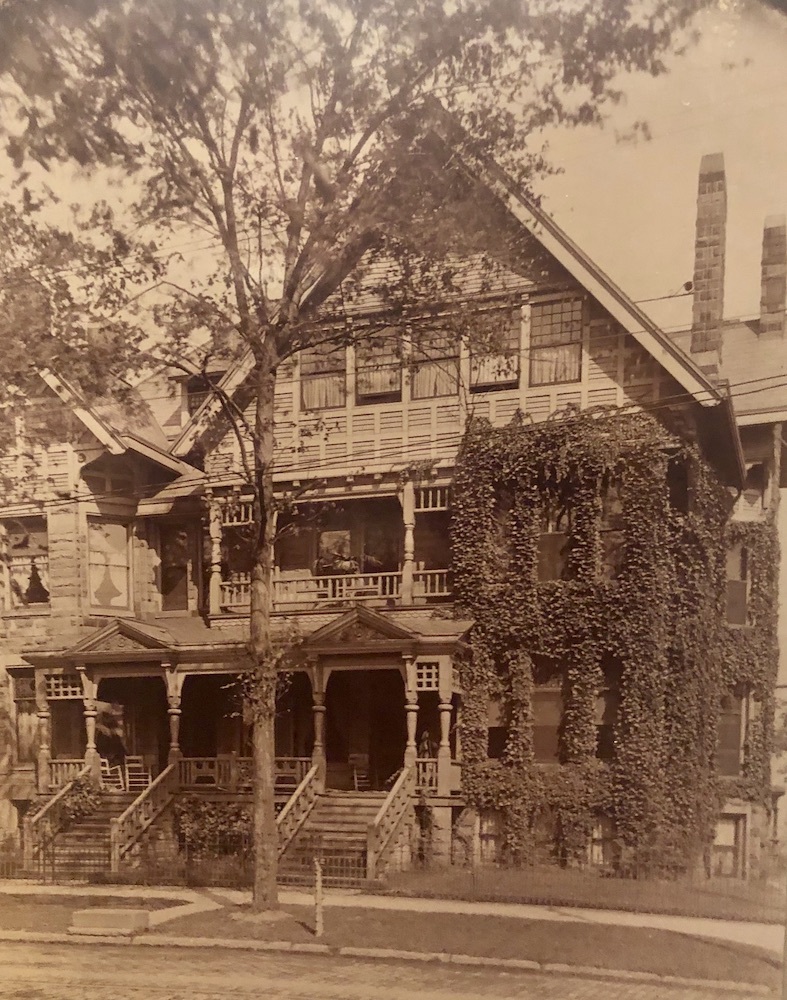
    <summary type="html"><![CDATA[<img src="https://clevelandhistorical.org/files/fullsize/7e617f347a46818e63e56bd6eafb0bde.jpg" alt="Wallace Manor" /><br/><p>If you spend a little bit of time studying the history of the houses that line both sides of Franklin Boulevard from the Circle to West 50th Street, you soon learn that they do not stand alone and apart from one another. They are related to one another – many of them intimately. Over time, these houses have shared owners and occupants; fraternal societies and charitable organizations; architects and architectural styles. They have often also shared ties to early Cleveland enterprises and industries. This is certainly the case with Wallace Manor, which has stood on the northeast corner of Franklin Boulevard and West 48th Street since 1883. </p><p>Wallace Manor was built for Robert Wallace, one of three individuals whom Cleveland journalists and historians have credited with the transformation and modernization of the Great Lakes commercial shipbuilding industry in the late nineteenth century. The other two? They also were residents of Franklin Boulevard. Wallace's long-time partner <a href="https://clevelandhistorical.org/items/show/940">Henry Coffinberry</a> lived in a Gothic Revival style house at 3910 Franklin Boulevard, which, like Wallace Manor, is still standing today. And Wallace's other early partner, John Pankhurst, lived in a beautiful Italianate-style house at 3117 Franklin Boulevard. John Pankhurst's house, like those of Robert Wallace and Henry Coffinberry, is still standing. On your next drive down Franklin Boulevard, you might want to take note of the houses at 3117, 3910, and 4724 Franklin Boulevard. They share a connection to each other and to Cleveland's once great shipbuilding industry. </p><p>Robert Wallace was born in 1834 in County Cavan, Northern Ireland. According to Elroy McKendree Avery, an early twentieth-century Cleveland historian, Wallace immigrated to the United States and arrived in Cleveland in 1854. In the eulogy he delivered at a memorial service for Wallace on May 28, 1911, Rev. Henry Tenney, a Congregationalist minister who had been Wallace's pastor, observed that, when Wallace came to Cleveland, he settled on the City's west side because that was where his uncle, Robert Sanderson lived and worked. (Sanderson was a machinist and later principal owner of Globe Iron Works, an historic iron foundry on the West Bank of the Flats.) A listing in the 1856 Cleveland directory is the first record of Wallace's presence here. It states that he was then living on Clinton Avenue and working as a machinist. His name, however, does not appear again in any Cleveland directory until 1865 when he is this time listed as an engineer. </p><p>It may be, as suggested in Rev. Tenney's eulogy, that Wallace spent some, if not all, of those intervening years as a sailor traveling the Great Lakes aboard commercial ships. By the time that the 1866 directory was published the following year, Wallace appears to have set down firm business roots in Cleveland as he and his partner John Pankhurst are listed as the owners of a small machine shop in <a href="https://clevelandhistorical.org/items/show/767">Cleveland Centre</a> at the corner of Center and Columbus Streets. A year after that, in 1867, according to historian Richard J. Wright in his book "Freshwater Whales: a History of the American Ship Building Company and its Predecessors," Wallace developed a portable steam engine for unloading cargo from commercial ships which dramatically improved the unloading process. It also proved extremely profitable for Wallace's machine shop. </p><p>Within two years of his development of the portable steam engine for unloading , Wallace, Pankhurst, and their new partner Henry Coffinberry had accumulated sufficient capital to acquire a controlling interest in Globe Iron Works, from which Robert Sanderson had recently retired. The company had for years been producing steam engines and other iron products for Great Lakes commercial ships. Now, under Robert Wallace's leadership, Globe Iron Works expanded its business. In 1876, it purchased an interest in a nearby dry dock and, under the name Globe Ship Building Company, began building ships. Up until this time, the process of building Great Lakes commercial ships had required the involvement and coordination of several different industries which manufactured different vessel parts at different locations. Robert Wallace, according to historian Wright, changed this industrial process in 1881 when Globe Ship Building built a commercial ship, from start to finish, entirely at its shipyard. Just one year later, in 1882, the company built and launched the Onoko, the first large iron commercial ship to sail the Great Lakes. This ship has been recognized by marine historians as the prototype for all the commercial freighters that sail the Great Lakes today. </p><p>By the time the Onoko was launched in 1882, Globe Iron Works and Globe Ship Building Company had become successful and profitable enterprises. It was at about this time that Robert Wallace and his second wife Fanny – his first wife Lydia had died in 1878 – decided to move from their modest house at 129 (today, 3405) Clinton Avenue onto Franklin Avenue (Boulevard), the West Side's version of nineteenth-century Euclid Avenue's <a href="https://clevelandhistorical.org/items/show/10">Millionaires' Row</a>. In early 1883, Wallace purchased a vacant lot on the northeast corner of Liberty (West 48th) Street and Franklin Avenue that was owned by and located next door to the house of Alanson and Harriet Hopkinson. Alanson, also known as A. G., was the retired first principal of Cleveland's <a href="https://clevelandhistorical.org/items/show/772">West High School</a>. He was well known to Wallace as both were members of the First Congregational Church, and both had served as trustees of the church. In the early 1880s both were also actively involved in the planning and building of a new church for their parish on the southeast corner of Taylor (West 45th) Street and Franklin Avenue. The new stone church for the First Congregational Church – West Side, designed by Coburn and Barnum and dedicated by Rev. Tenney on December 20, 1885, was located just a few blocks east of the Hopkinson property upon which Wallace built his new stone house in 1883. While both the First Congregational Church and A. G. Hopkinson's house are no longer standing, they present yet another example of the intimate historical relationships that the houses and other buildings on Franklin Boulevard, in this instance one still standing and the others not, often had with one another. </p><p>Wallace Manor is, according to local architectural historian Craig Bobby, built in the Queen Anne style. While the identity of the architect who, or architectural firm which, designed the house is unknown, it may have been the firm of Coburn and Barnum, which designed the <a href="https://clevelandhistorical.org/items/show/917">Spitzer-Dempsey House</a> at 2830 Franklin and the <a href="https://clevelandhistorical.org/items/show/938">Sarah Bousfield House</a> at 3804-06 Franklin. In the early 1880s, <a href="https://clevelandhistorical.org/items/show/755">Forrest Coburn</a> was living at 86 Root (1901 West 47th) Street, less than one-half mile from the future site of Wallace Manor. He was also, like Robert Wallace, a member of the First Congregational Church. As a principal of the architectural firm that designed the new First Congregational church, he likely would have interacted with Wallace who, as a trustee, was also deeply involved in planning and building that church. However, according to Bobby, in the absence of documentation that the house was designed by this firm, there is nothing in the design of the house itself which either proves or disproves that it was the work of Coburn and Barnum.  </p><p>Designed as a single family home, Wallace Manor is two and one-half stories tall and has an exterior facade built of sandstone. The expanse of sandstone on the front facade is broken up by at least one belt course of smoothed stones located just below the second floor windows, and the front facade, as well as the expanses of the other exterior walls of the house, are further broken up by stone lintels and hoods around the house's windows. The house has asymmetrical massing with the west side of the front facade extending out beyond the rest of the facade. The roof of the house is hipped and features a number of dormers and three tall stone chimneys. The front of the house has two notable arched windows on the first floor. Also notable is the house's one-story columned porch which extends along the entire length of the eastern part of the front facade.  Located at the rear of the property is another stone building that once likely served as a carriage house. Over its front door on West 48th Street are the initials "RW" carved in stone. The structure, which is depicted on the 1896 Sanborn map, was likely built at the same time as the main house. </p><p>The Robert Wallace family, including for a time his oldest son James, a future president of the American Ship Building Company, lived in Wallace Manor until 1895. In that year they moved, like other wealthy Franklin Boulevard families of that time period, to the Cleveland suburb of Lakewood, where they built a house on Detroit Avenue, west of Nicholson Avenue. That house, which is no longer standing, was located on what today is the campus of St. Edward Catholic High School. After the Wallace family departed from Wallace Manor, the house was home to several middle to upper economic class families, including a general manager of the Cleveland Railway, the president of Citizens Savings and Trust Company, and a physician, before it was sold and converted into a rooming house in about 1920. In 1923, the property was acquired by Hungarian immigrants Julius and Elizabeth Rak, who lived in the house and continued to operate it as a rooming house until their deaths in 1943. By 1930, the carriage house on the property had been converted into a dwelling with a street address of 1453 West 48th Street and was occupied by two families. By 1940, there were seven families (including the Rak family) with a total of 21 people living in Wallace Manor and five families with a total of 9 people living in the carriage house. </p><p>In the second half of the twentieth century, Wallace Manor, like many of the other once grand houses on Franklin Boulevard, was suffering from insufficient maintenance and repair. Photos reveal that, by the 1980s, it was in a deteriorated condition. Most notable was that its once grand front porch had at some time between 1961 and 1986 been razed and replaced with a simple entranceway porch. Like any number of the grand houses on Franklin Boulevard that needed a savior in the late twentieth century, Wallace Manor found one when it was purchased in 1997 by Scott Staley and David Castro. Staley, who is the sole owner of the house today (2021), spent the next 17 years slowly restoring and renovating Wallace Manor. Living in the owner's suite at Wallace Manor, he has also, for the last five years, operated a bed and breakfast in the house which has rooms for guest stays. The carriage house at the rear of the property has also been renovated and today functions as a two-family dwelling. In 2019, descendants of Robert Wallace paid a visit to Wallace Manor, touring the house, snapping pictures, and imagining their ancestors walking from room to room. They too, like their ancestors who once lived there, now share a special relationship with not only those ancestors, but also with Wallace Manor and with historic Franklin Boulevard.</p><p><em><strong><a href="https://clevelandhistorical.org/items/show/943">For more (including 18 images) view the original article</a></strong></em></p>]]></summary>
    <published>2021-04-26T19:29:34+00:00</published>
    <updated>2026-04-17T19:17:42+00:00</updated>
    <link rel="alternate" type="text/html" href="https://clevelandhistorical.org/items/show/943"/>
    <id>https://clevelandhistorical.org/items/show/943</id>
    <author>
      <name>Jim Dubelko</name>
    </author>
  </entry>
  <entry>
    <title type="html"><![CDATA[Sarah Bousfield House: Also known as &quot;Stone Gables&quot;]]></title>
    <summary type="html"><![CDATA[<p><strong><em>Wealth generated from John Bousfield's wooden ware business enabled the Bousfield family to move into their first house on Franklin Avenue in 1863.  After the business failed and they lost that house, the resilient Bousfields found a way to return to the west side's "Euclid Avenue" in 1883,  building the mammoth stone house that today still stands at Franklin Boulevard and West 38th Street.</em></strong></p><img src="https://clevelandhistorical.org/files/fullsize/7e94cfc54af23bff938538bc0ad44092.jpg" alt="The Sarah Bousfield House" /><br/><p>The large stone house on the northwest corner of Franklin Boulevard and West 38th Street was built in 1883-1884 for John and Sarah Bousfield. It was designed by the prominent nineteenth century architectural firm of Coburn and Barnum, the same firm that designed the Spitzer-Dempsey House at 2830 Franklin Boulevard.  The house, which today has the address of 3804-3806 Franklin, was designed to be  a two-family home with the Bousfields occupying the larger east side, which was advertised as having 17 rooms, and a renter occupying the west side which was said to have 13 rooms.  The house is two and one half stories tall and has more than 12,000 square feet of living space.  It also has a full basement with ground level access from the back yard.  The house was designed in the Queen Anne style, with characteristic asymmetrical massing, half-timbered gables, and what local architectural historian Craig Bobby referred to as "robust" spindlework.  Bobby also opined that the design of the house is closer to the English example of this style of house and less "Americanized" than other Queen Anne style houses built in Cleveland in the late nineteenth century.  </p><p>John Bousfield and Sarah Featherstone, the house's original owners, were English immigrants who came to America  in the early 1840s.  They met in Kirtland, Ohio, and married there in 1845.  After having little success in trying his hand at farming, John purchased a small wooden ware business and began manufacturing  wooden pails, first in Kirtland and then in nearby Fairport (today, Fairport Harbor).  Looking for a better location for his business, he moved his family to Cleveland in 1855.  His early years working and residing in the city  were filled with a mixture of small successes and  several business reverses, the latter often caused by fires that appear to have been altogether too common in the nineteenth century wooden ware manufacturing industry.  However, by the early 1860s, he and his business partner J. B. Hervey had established a large and successful business, known as Cleveland Wooden Ware Manufacturing Company, in Cleveland Centre, near the intersection of Leonard and Voltaire Streets.   After Hervey retired from the business in 1866, Bousfield and his new partner John Poole had even greater success initially, growing the business into what several contemporary sources stated was the largest wooden ware business in the country.  By this time, the company was manufacturing not only wooden pails, but also many other wooden products used in that era, including churns, half-tubs, washboards, clothes pins, dressed lumber, shingles, mouldings, and matches.</p><p>Befitting John Bousfield's business success, the Bousfield family in 1863 moved from a house on Pearl (West 25th) Street into their first house on Franklin Avenue (Boulevard), a grand mansion built in the Italianate style and located on the southeast corner of Franklin and Duane (West 32nd) Street.  To their east lived William Castle, former mayor of Cleveland, and to the west their house was just a stone's throw away from the Kentucky Street Reservoir and its legendary promenade walk.  (Diagonally across Franklin on the corner of State Street they may have noticed the little girl who tended to her flower garden and often played with Mayor Castle's daughter.  She would grow up to become Ella Grant Wilson, one of Cleveland's pioneer feminists.)  Living on Franklin Avenue, the Bousfields interacted socially with many of the west side's wealthiest families, including those of Daniel Rhodes, John Sargent, Nelson Sanford, Belden Seymour, Thomas Axworthy,  Judge James Coffinberry and his son Henry, and George Warmington, just to name  a few.  One such interaction, which was described in an article that appeared in the Cleveland Plain Dealer on January 8, 1870, was the party the Bousfields threw for their 25th wedding anniversary, where their "spacious mansion . . .on Franklin Street . . . was thronged with guests."  Interactions like these were not only "social," but often also presented opportunities for neighbors on the west side's "Euclid Avenue" to form new or cement old business relationships with each other.   John Bousfield was involved in several such business relationships with his neighbors.  In 1866, he and neighbors Daniel Rhodes, Nelson Sanford, John Sargent, James Coffinberry, and others, had founded the People's Gas Light Company, which Bousfield later headed as president.  Three years later, in 1869, he participated in the formation of the People's Saving and Loan Association, serving for the next six years as one of the bank's two vice presidents under president Daniel Rhodes.  Despite all of his neighborhood social and business successes, however, the economic depression in the United States that followed the Panic of 1873 may have been too much to overcome. John Bousfield's  wooden ware business in Cleveland Centre collapsed in 1875 and he was left bankrupt, losing not only his business assets  to creditors but, in 1880, his grand house on Franklin Avenue too.</p><p>After his business failed in 1875 and he lost his house on Franklin Boulevard, John Bousfield started a new wooden ware manufacturing business at a different location on the west side with help from his adult children, including his daughter Charlotte who lived with him and Sarah, but it was plagued by fire, lawsuits and other problems.  By 1881 it had closed and its business operations had been transferred to his adult sons' wooden ware manufacturing facility in Bay City, Michigan.  Between 1880 and 1883, the Bousfields rented a house on nearby Clinton Avenue--literally within sight of their former mansion--while they strove to satisfy creditors and plan their return to Franklin Avenue.  While there, they purchased another house on the northwest corner of Franklin and Kentucky (West 38th) Street in 1881.  They rented that house out until 1883, when they either razed it or moved it to make room for the large stone mansion designed by Coburn and Barnum that was subsequently built on the corner.  In the same year that the stone house was completed, the Bousfields began renting out rooms in a second house on the property that fronted Kentucky Street.  (This house may have been all or part of the house that formerly sat on the corner of Franklin and Kentucky; it may have been new construction; or it may have been a house that was moved from another location.) With two houses on their lot, the Bousfields were not only able to generate rental income from the west side of the stone mansion, but also from the second house too.  While there exists little evidence of the financial status of John and Sarah Bousfield during this period, the rental income from these properties may well have been critical to their survival in what were the later years of their lives.  John Bousfield died at the house in 1888; his wife Sarah died there six years later in 1894.</p><p>Following their deaths, Horace Hannum who lived up the street and who married Charlotte Bousfield  just months after her mother's death, took over the management of the Sarah Bousfield House as well as the other house on the property.  Hannum maintained the west side of the Sarah Bousfield House as a single-family unit, moving into it with Charlotte in 1898 and living there until his death in 1908.  The larger east side of the house, however, was by 1900 operating as a rooming house.  Shortly after Horace's death, Charlotte and the other heirs of Sarah Bousfield sold the property in 1910 to Juno Robeson, a social worker who had moved to Cleveland ten years earlier from Paducah, Kentucky.  Robeson converted the entire stone mansion into a rooming house for businesswomen.  It may have been during her ownership (1910-1923) that physical alterations were made to the house to provide access from one side of the house to the other.  Robeson's Business Inn for Women does not appear to have survived for more than a couple of years.  Thereafter the stone mansion, as well as the other house on the property, like many other large houses on Franklin Boulevard in the twentieth century, became rooming houses, first managed during Robeson's ownership, and then later directly owned, by Frank and Clara Bennett.  By 1925, the stone mansion was being advertised for lease as a rooming house with 38 rooms.  Both houses on the property remained rooming houses for much of the rest of the twentieth century.  In 1945, the lot upon which the two houses sat was split and the houses were thereafter under different ownership.  While it is unclear exactly when, at some point in time after 1966 the other house was razed.  The resulting vacant lot afterwards became property of the city of Cleveland which, in 1983, sold it to the  Franklin Boulevard Nursing Home, located across West 38th Street from the Sarah Bousfield House.</p><p>And thus the stone mansion continued to sit on the corner of Franklin Boulevard and West 38th Street, continued to be used as a rooming house, and continued to deteriorate until 1994,  when  James Hauer and Richard Turnbull purchased it at a sheriff's sale. The two men had since 1988 owned and lived in a house up the street at 3901 Franklin Boulevard.  Turnbull, an art historian, wanted to restore and renovate the house, redividing it into its original two-family configuration, with four apartment suites on the east side of the house and a five-room bed-and-breakfast on the west side.  After hiring Cleveland architect John Rakauskas,  obtaining city approval for their plan, and providing financial incentive for their roomers to vacate the house, Hauer and Turnbull began restoring and renovating it in 1999.  (That same year, they also purchased the vacant lot owned by the nursing home in order to provide parking for tenants and guests.)  Turnbull conducted extensive research in the restoration effort.  He located a 1905 photo of the house to guide his restoration of its exterior.  Decades of paint were hand-scraped off the house to get down to the original colors.  The front porch was restored with its original columns carefully replicated.  In the interior of the house, walls that had been put up to create the rooming house were removed, and the original rooms, to the greatest extent possible, were restored, even down to moldings and picture rails.  (During the renovation, Turnbull was able to debunk a legend told to him by a former roomer that in the 1950s money from a bank robbery had been hidden somewhere in the house under a floorboard.  Roomers believing the legend had cut through many of the house's floorboards, sometimes even switching rooms to cut through more.  If the money had ever been in the house, it was long gone before Trumbull did his extensive renovation.)  The total cost of the renovations and restoration was $650,000. The majority of the work was completed in 2001, when Stone Gables, a bed-and-breakfast that was advertised as a safe place for gay visitors to stay in Cleveland, opened.  Remaining work on the house continued for two more years before the renovation and restoration was complete.  Hauer and Turnbull operated the bed-and-breakfast and rented out the apartments in the house until 2017, when they sold the house.  As of 2021, its new owners continue to operate the Sarah Bousfield House--still also known as Stone Gables--as Hauer and Trumbull had.</p><p><em><strong><a href="https://clevelandhistorical.org/items/show/938">For more (including 18 images) view the original article</a></strong></em></p>]]></summary>
    <published>2021-02-06T15:26:30+00:00</published>
    <updated>2026-04-17T19:17:42+00:00</updated>
    <link rel="alternate" type="text/html" href="https://clevelandhistorical.org/items/show/938"/>
    <id>https://clevelandhistorical.org/items/show/938</id>
    <author>
      <name>Jim Dubelko</name>
    </author>
  </entry>
  <entry>
    <title type="html"><![CDATA[Allen-Sullivan House: A Forgotten and now Vanished Euclid Avenue Mansion]]></title>
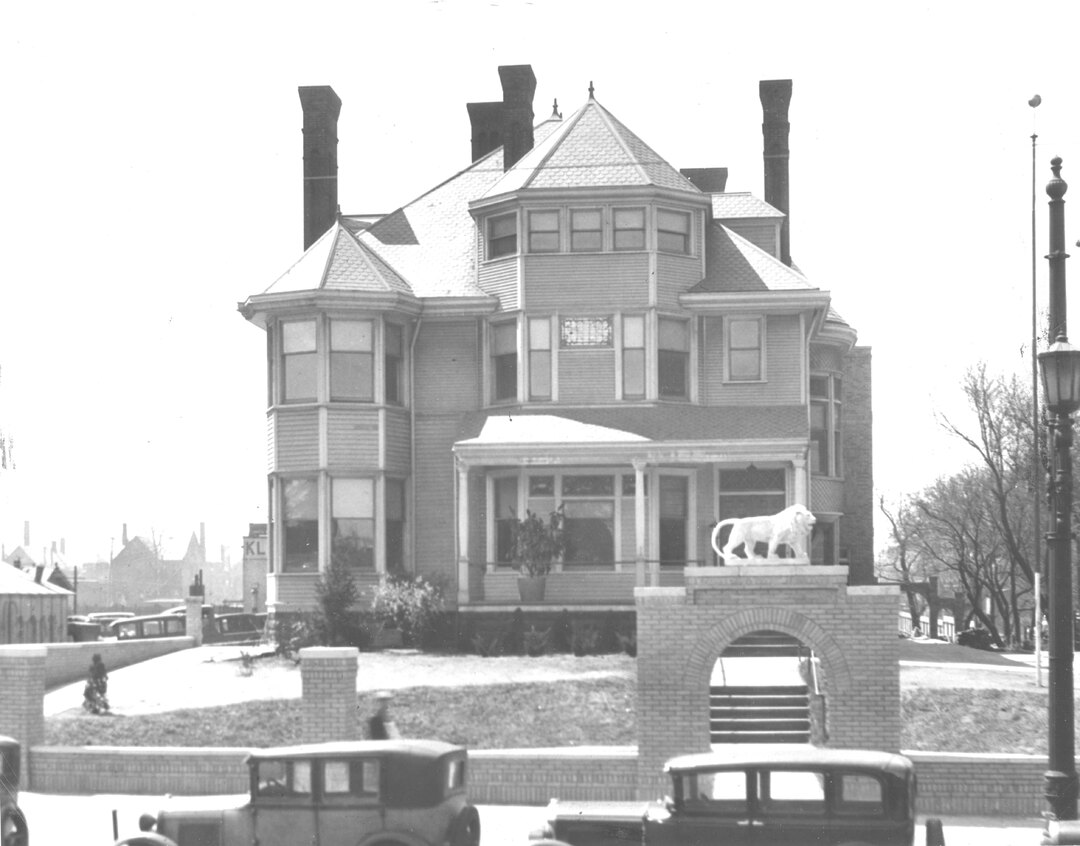
    <summary type="html"><![CDATA[<p><strong><em>It was one of the last grand houses from the nineteenth century left standing on Euclid Avenue, once described as the most beautiful residential street in the world.  And yet, inexplicably, the house was never designated an historic landmark; it was not put to any productive use in the last two decades of its existence; and little effort was made by anyone to save it from the wrecking ball.</em></strong></p><img src="https://clevelandhistorical.org/files/fullsize/34f19b8ae7f5a112075e74bbca5c62aa.jpg" alt="The Allen-Sullivan House" /><br/><p>In the late nineteenth century, Cleveland's Euclid Avenue was considered by travel writers to be one of the most beautiful residential streets in the world, compared favorably to the grandest avenues in Europe.  At the height of its grandeur, nearly 300 majestic homes graced its north and south sides from East 9th Street to East 90th Street.  Only a handful--six or seven depending on your count--of those nearly 300 houses are still standing today.  The Allen-Sullivan House was one of them.  And now it is gone!.</p><p>Richard N. Allen (1827-1890) was a railroad engineer who invented the paper car wheel, which dampened wheel noise and vibrations, revolutionizing railroad passenger travel in the nineteenth century.  The Massachusetts native, who had lived in Cleveland for a short period in the 1860s, returned to the city in 1881 after opening a factory near the Pullman Company's factory complex in Chicago.  He did not move back because Cleveland was close to that factory.  It was not.  However, he may very well have decided to return because Euclid Avenue was here.  It was then home to most of the richest men in America, and, as a result of his business successes, Allen, the former railroad engineer, was now a very rich man.  </p><p>Allen and his wife Susan purchased a house on Euclid Avenue that had been owned by Ephraim J. Estep, a prominent Cleveland attorney.  The house, likely built in the 1850s by one of the founders of the Joseph & Feiss Company, was located on the south side of the Avenue, just a few houses from Giddings Avenue (East 71st Street).  While Euclid Avenue from Giddings to East Madison (East 79th Street) was not as grand and desirable a neighborhood as the more famous section between East 22nd and East 40th Streets, which in the early twentieth century became known as "Millionaires' Row," it was still a very grand and desirable place to locate indeed.  Among the Allens' new neighbors were Morris A. Bradley (7217), heir to a shipping fortune and the father of future Cleveland Indians owner Alva Bradley; William J. Rainey (7418), said to be the largest coal and coke operator in the United States; Hiram Haydn (7119), pastor of the Old Stone Church and future President of Western Reserve University; Dr. Hiram Little (7615), a physician who became one of Cleveland's largest real estate developers; Edward Lewis (7706), a co-founder of Otis Steel Company and later a principal of Lake Erie Iron Company; and J. H. Thorp (7801), vice-president of Forest City Varnish Company.  </p><p>In 1881, when the Allens arrived on the Avenue, there were nineteen grand houses on Euclid between East 71st and East 79th Streets.  Less than two decades later that number had increased to thirty-six as several large lots were subdivided and sold to make more land available on the Avenue for Cleveland elites.  Many of those new houses going up in those ensuing decades were of Queen Anne design, the most popular architectural style of the period.  Queen Anne design is characterized, according to "A Field Guide to American Houses," by a "steeply pitched roof of irregular shape, usually with a dominant front-facing gable; patterned shingles, cutaway bay windows, and other devices used to avoid a smooth-walled appearance; and an asymmetrical facade with partial or full-width porch which is usually one story high and extended along one or both side walls."  </p><p>Perhaps simply to keep up with the Joneses, Richard and Susan Allen tore down the old Estep House in 1887 and built in its place a new three-story Queen Anne house.  According to local architectural historian Craig Bobby, this house, with approximately 9,000 square feet of living area, might have been viewed as "subdued" compared to other Queen Anne Houses that were built on Euclid Avenue in this period, but its massing was nevertheless "robust."  The house's boldest architectural feature was "an atypically wide, off-center bay . . . that [rose]  up onto the roof, nearly becoming a turret."  The house also featured a true turret on the east end of its front facade, which was deemphasized by a front porch which embraced the off-center bay, and bay windows on its east and west sides.</p><p>Richard Allen did not live very long after his mansion was completed.  He died suddenly in 1890 at the age of 63.  His widow Susan lived in the house until 1898, when she decided to move back to their native Massachusetts.  The house was then sold to Jeremiah J. Sullivan, a prominent Cleveland banker.  Sullivan, an Irish immigrant who moved to Cleveland in the early 1890s, was the founder of Central National Bank, which was one of  Cleveland's largest banks in the twentieth century.  In 1968, it erected the Central National Bank Building on the southwest corner of East Ninth and Superior.  The 23-story building--today known as  the AmTrust Financial Building--was at the time the fifth tallest building in downtown Cleveland. </p><p>When the Sullivan family moved onto Euclid Avenue in 1898, the Avenue was at its peak of wealth and elegance. Joining the Sullivan family as new residents of the East 71st-East 79th section of the grand Avenue in this decade were other prominent Clevelanders, including Dan Hanna (7404), the son of iron magnate and presidential kingmaker Marcus Hanna, and the future owner and publisher of the Cleveland Leader and the Cleveland News; David Z. Norton (7301), a Cleveland banker and principal of Oglebay Norton & Co., a large iron ore mining and shipping company; and Worchester Warner (7720) and Ambrose Swaney (7808), founders of machine and tool industrial giant, Warner and Swasey, and also life-long friends who built their Euclid Avenue houses next door to each other, just west of East 79th Street. These families were all witnesses not only to the zenith of the Avenue, but also to the beginning of its decline as a grand residential street.  By the time the Sullivan family moved out of their house in 1923 shortly after Jeremiah's death, Cleveland's elite were already fleeing the Avenue, as a result, according to Euclid Avenue historian Jan Cigliano, of encroaching commercial businesses,  the running of streetcars up and down Euclid Avenue, and a growing nearby African-American ghetto.  By 1930, only two elite families still resided on the section of Euclid Avenue between East 71st and East 79th--octogenarian Ambrose Swasey, who lived in his house until his death in 1937, and the son of David Z. Norton, who left the family's Avenue mansion for Cleveland Heights in 1939.</p><p>As Euclid Avenue declined as a residential street in the twentieth century, many of its grand houses were torn down, but others were put to different uses, sometimes commercial, sometimes multi-family, and sometimes institutional.  The Allen-Sullivan House was one of those put to other uses.  After the departure of the Sullivan family, it first served, from 1923 to 1931, as an upscale furniture store known as The Josephine Shop.  Then, in 1934, during the Great Depression, the house was purchased by the The Grand Lodge of Ohio, Order Sons of Italy (SOI) in America, an Italian-American fraternal organization.  The SOI made it their Ohio Grand Lodge, adding an auditorium onto the rear of the house.  On June 2, 1935, the organization held a dedication ceremony on the site, attended by many local, state and foreign dignitaries, including the Italian ambassador.  It was the first time that an ambassador from Italy had visited the State of Ohio.  </p><p>The SOI occupied the Allen-Sullivan House until 1946 when it sold it to the American Society of Heating and Ventilating Engineers (today known as ASHRAE--the American Society of Heating, Refrigerating and Air-Conditioning Engineers).  ASHRAE opened a national research laboratory on the site, operating it there from 1946 until 1961, when the laboratory closed.  The property was then sold in 1964 to Mary Fisco, spouse of Benjamin Fisco, an Italian immigrant who restored the house to its condition existing during the period when it was owned by the Sons of Italy. Fisco operated a party center there known for years as the Coliseum (or Colosseum) Party Center.  The party center closed in the late 1990s, several years after the death of Benjamin Fisco.   </p><p>Since the year 2000, according to City of Cleveland officials and others, the house had been vacant except for an onsite caretaker.  In that same period, a new owner purchased and assembled five sublots on and off Euclid Avenue near East 71st Street, including that upon which the Allen-Sullivan House stood.  According to officials at MidTown Cleveland, Inc., the owner of those properties had listed them for sale with an asking price of $3 million.  Given this owner's desire to sell, and the City of Cleveland's desire to continue redevelopment of its Midtown Corridor along Euclid Avenue, the future of the Allen-Sullivan House was precarious and it likely could not have avoided demolition without an effort on the part of the City and/or the future developer to save it. </p><p>While this was going on and the house still was standing, ASHRAE waged a campaign to have an Ohio historical marker placed in front of the Allen-Sullivan House to commemorate the national research laboratory that its organization operated there from 1946 to 1961.  When you consider all the history that was made at this, the last-standing Queen Anne-style house on the once grand residential Euclid Avenue, an historical marker alone should not have been enough.  The grand house itself should have been saved.</p><p>On June 21, 2021, time ran out for the Allen-Sullivan House.  No savior was found.  The house was torn down to make room for a city-approved apartment complex.  And so ends the story of one of the last grand houses standing for over a century on Euclid Avenue.</p><p><em><strong><a href="https://clevelandhistorical.org/items/show/864">For more (including 15 images) view the original article</a></strong></em></p>]]></summary>
    <published>2019-02-04T19:50:55+00:00</published>
    <updated>2026-04-17T19:17:42+00:00</updated>
    <link rel="alternate" type="text/html" href="https://clevelandhistorical.org/items/show/864"/>
    <id>https://clevelandhistorical.org/items/show/864</id>
    <author>
      <name>Jim Dubelko</name>
    </author>
  </entry>
</feed>