<?xml version="1.0" encoding="UTF-8"?>
<feed xmlns="http://www.w3.org/2005/Atom">
  <title type="text">Cleveland Historical</title>
  <updated>2026-04-17T16:02:35+00:00</updated>
  <generator uri="http://framework.zend.com" version="1.12.20">Zend_Feed_Writer</generator>
  <link rel="alternate" type="text/html" href="https://clevelandhistorical.org/"/>
  <link rel="self" type="application/atom+xml" href="https://clevelandhistorical.org/items/browse?output=rss2"/>
  <id>https://clevelandhistorical.org/</id>
  <author>
    <name>Cleveland Historical</name>
    <uri>https://clevelandhistorical.org</uri>
  </author>
  <link rel="hub" href="http://pubsubhubbub.appspot.com/"/>
  <entry>
    <title type="html"><![CDATA[The Sapirstein Family: A Greeting Card Company Grows in Glenville]]></title>
    <summary type="html"><![CDATA[<p><strong><em>In 1930, a year after the start of the Great Depression, 21-year old Irving Sapirstein, oldest son of postcard jobber Jacob Sapirstein, came to the conclusion that the Sapirstein family could make more money manufacturing and selling their own greeting cards rather than only selling those manufactured by others. To help make his point,  he  wrote some greeting card verses and then had printing plates made for them.  When he  approached his father and began telling him his idea, his father grabbed the metal plates from his  hands and smashed them on the ground, declaring, "We're jobbers, not manufacturers."  </p></strong></p><img src="https://clevelandhistorical.org/files/fullsize/422644a32d53a85c64ee25a8b6f68028.jpg" alt="The Jacob and Jennie Sapirstein Family" /><br/><p>The website of the American Greetings Corporation contains scant information — more corporate legend than historical fact — regarding the founding of the company by Jacob Sapirstein, a Polish Jew who immigrated to the United States in 1906. A review of news articles, deeds, directory listings, census sheets, and other records available online, provides a fuller view into the early years of the business that, in Cleveland's Glenville neighborhood, began to grow into the world's second largest manufacturer of greeting cards.</p><p>Jacob Sapirstein was born in 1884, in the village of Wasosz in northeastern Poland. His parents were Rabbi Isaac Sapirstein and Marion (Mollie) Berenson. He grew up in nearby Grajewo, which, like Wasosz, was located in a region of Poland that had been seized by Russian Empress Catherine the Great during one of the partitions of Poland in the late 18th century. When he was 21 years old, Jacob decided to leave the village and his family, and immigrate to the United States. Sources differ as to exactly why he decided to leave Poland when he did, but they all agree that it was related to the harsh conditions to which Jews were subjected while living under Russian rule. </p><p>With financial assistance from the Hebrew Immigrant Aid Society, Jacob booked passage on a ship bound for America. He landed in Boston in late December 1906 and then continued on to Chicago where he had been offered a job as an apprentice tailor. However, he found that the job was not at all to his liking, and, within days after starting, he made the life-changing decision to quit the job and head for Cleveland where another job, and another future, awaited him. </p><p>Jacob's new job in Cleveland was working in the card shop at the Hollenden Hotel. For many years, this legenday hotel stood on the southeast corner of Superior Avenue and East 6th Street where the Fifth Third Center stands today. The card shop in the hotel was then operated by Moses Fenberg, variously described as a relative or friend of the Sapirstein family. He not only gave Jacob a job, but also a place to stay—in Fenberg's house on the West Side. As it turned out, Sapirstein wasn't very happy with the card shop job either, and complained to Fenberg that he wasn't making enough money. Fenberg responded with what Jacob Sapirstein later said was the best advice he ever received — "If you want to make more money, become a postcard jobber." And so that was exactly what he did.</p><p>In the early twentieth century, postcard jobbing — wholesaling cards of manufacturers to retail stores — was a tough job with long hours. In his early years of jobbing, young Sapirstein used streetcars to travel to the commercial areas of the east and west sides of Cleveland, carrying with him boxes containing an assortment of postcards. At each stop near drug stores, candy shops, and other retail businesses that he thought might buy his cards, he got off and peddled them. Then, after he had visited all the stores in one area, he caught another streetcar that took him to the next commercial area of the city. And so his work days went, traveling the streets of Cleveland, peddling from the time stores opened in the morning, until they closed in the evening. And when he returned home in the evening, he spent more hours doing the work necessary to fill the card orders he had procured that day.</p><p>In time, just as Moses Fenberg had told him, Sapirstein was making more money than he had at the card shop — in fact so much more that, by 1908, he could afford to marry Jennie Kanter, a young woman from his home village in Poland. After they married, they moved out of Fenberg's house and into a Woodland Avenue apartment in the East Side's Cedar-Central neighborhood. At the time, it was a working-class neighborhood and home to many Jewish immigrants. Jacob and Jennie's first son, Isaac (later known as Irving), was born there in 1909. Their second son, Moses (later called Morris) was born there two years later. Both sons, as well as third son Harry (born in 1917), would come to play important roles in the early growth of the company that eventually became the American Greetings Corporation.</p><p>In 1914, World War I began. Soon after the start of hostilities, the United States imposed an embargo on the import of German goods, including the then-popular German-made postcards and greeting cards. This embargo, as well as the increased demand for cards that occurred during the war years, benefitted not only America's domestic card manufacturing industry but also jobbers like Jacob Sapirstein who sold those cards to retail businesses. Soon, Jacob could afford to purchase a horse and wagon with which he could more easily travel the streets of Cleveland peddling his cards, especially the new folded greeting cards which had become popular during the war. In time, as his jobbing business grew, Sapirstein exchanged that horse and wagon for a new Ford automobile. </p><p>With the growth of his business, Jacob and his wife and children were also able by 1918 to move out of the Cedar-Central neighborhood and into the more upscale Glenville neighborhood, one in which they would live for the next two decades and during which time Jacob's jobbing business would see substantial growth before transforming into a card manufacturing business. The first house the Sapirsteins bought in Glenville was a two-family house at 856-858 East 95th Street, near St. Clair Avenue. However, after living in this house for only a year, they sold it and purchased the house right next door — also a two-family — at 852-854 East 95th. Why the family would sell the first and buy the second is somewhat of a mystery, but it may have been related to the so-called first business expansion of the company described below.</p><p>As earlier noted, Jacob Sapirstein's jobbing business now included the new and popular folded greeting cards, as well as the more traditional postcards. As a result of this enlargement of his inventory and other growth in his jobbing business, Sapirstein at some point found it necessary to move all of his inventory out of the house and into the family garage. Different articles published by different newspapers in different years assign different addresses and dates to this first so-called expansion of the business, but the article that was published in the <em>Cleveland Jewish News</em> on May 24, 1985, which was based on an interview with Jacob's son Irving, is the most detailed and convincing. It also featured a photograph of Irving standing in front of what is clearly the garage at 852-854 East 95th Street. The caption below that photograph reads: "The company's first expansion — in 1917 — to Jacob Sapirstein's garage on East 95th Street." (The expansion at that address actually most likely occurred not in 1917, but instead in 1919 when the Sapirsteins purchased the second house on E. 95th Street.)</p><p>It was not only the expansion of the business into the family garage that was a marker of the growth of Sapirstein's jobbing business in the early years of the family's residency in Glenville. During the Influenza Pandemic of 1918-1920, Jacob Sapirstein contracted the virus and became so ill that he couldn't work. According to several articles, his sons Irving and Morris — though then not yet even teenagers — had to perform many of their father's jobbing duties, including jumping on streetcars in order to deliver cards to customers and keeping the books of the business at home. This inevitably led, in the decade of the 1920s, to both Irving and Morris becoming jobbers like their father. This, in turn, likely resulted in a large increase in the customer base of the business. Notable of the sons' early efforts, in 1928, Irving and Morris successfully procured a large order of postcards and greeting cards for Euclid Beach Park. This sale produced $48,000 in revenues for the family jobbing business — the equivalent of almost one million dollars in today's money.</p><p>By the time the Great Depression arrived in 1929, both Irving and Morris were jobbing full time with their father in the family business that was now known, according to Cleveland directories, as "The Sapirstein Greeting Card Company." It was at about this time, according to Jacob's son Irving, that he had the conversation with his father about going into the greeting card manufacturing business that led to his father shattering Irving's printing plates. However, while, according to Irving, Jacob (who later became known at American Greetings as "J.S.") was a hard sell, he "finally came around." While the exact year that the Sapirstein family began manufacturing their own greeting cards is difficult to determine, it may well have been in 1932 when, for the first time since 1919, the family business address was listed not at 852 East 95th Street but instead at 9313 Yale Avenue, then the site of a brick commercial building located less than a quarter mile from the Sapirstein home. </p><p>In 1934, the Sapirsteins incorporated their new manufacturing business under the name of the Sapirstein Greeting Card Company, and, in 1935, Jacob's third son Harry joined the company as a full-time employee. Meanwhile, his oldest son, Irving, who exhibited an artistic bent, became involved in the creation of the company's first greeting cards. His most notable early verse, which became the company's slogan, was: "From someone who wants to remember someone too nice to forget." </p><p>In 1938, the Sapirsteins changed the name of their company to the American Greeting Publishing Company, after expanding outside the Cleveland area by opening a manufacturing facility and branch office in Detroit, Michigan in 1936. (The company name would later be simplified to the American Greetings Corporation.) Several years after this, in 1941, the Sapirsteins moved their company out of Glenville and into a large commercial building complex on West 78th Street on Cleveland's West Side. And, several years after the business left Glenville, Jacob and Jennie Sapirstein left too, selling their house in the neighborhood and moving to University Heights. </p><p>Since the 1940s, American Greetings has grown and expanded numerous times, and now has manufacturing facilities and offices in many locations across the United States and around the world. Its headquarters today are located in Westlake. It is unlikely that many current employees of American Greetings are even aware of the company's humble beginnings in the Glenville neighborhood. Nevertheless, this is exactly where, over the course of more than two decades, that the Sapirstein family grew Jacob Sapirstein's postcard jobbing business into the second-largest manufacturer of greeting cards in the world.</p><p><em><strong><a href="https://clevelandhistorical.org/items/show/1035">For more (including 19 images) view the original article</a></strong></em></p>]]></summary>
    <published>2024-10-31T18:21:09+00:00</published>
    <updated>2026-03-04T21:32:05+00:00</updated>
    <link rel="alternate" type="text/html" href="https://clevelandhistorical.org/items/show/1035"/>
    <id>https://clevelandhistorical.org/items/show/1035</id>
    <author>
      <name>Jim Dubelko</name>
    </author>
  </entry>
  <entry>
    <title type="html"><![CDATA[Bertsch Building: Built for Wohl&#039;s Hungarian Restaurant<br />
]]></title>
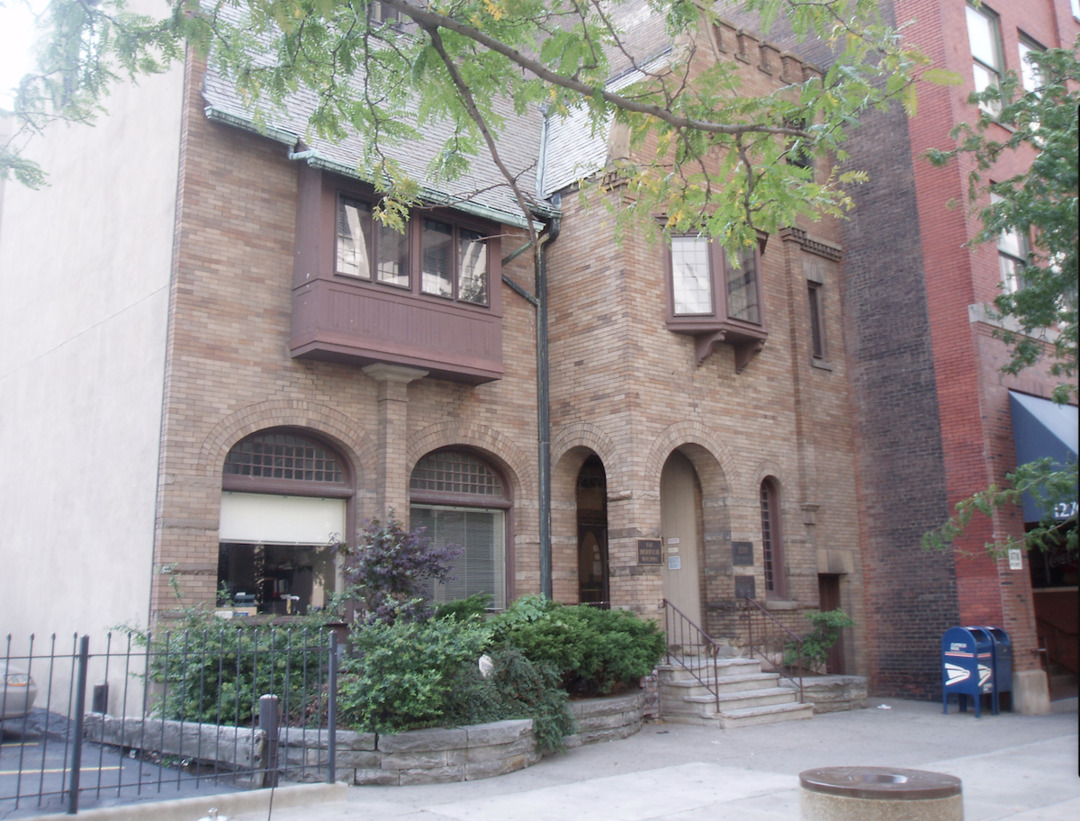
    <summary type="html"><![CDATA[<p><strong><em>The Hungarian dishes that Rosa Wohl cooked at the Wohl Boarding House on Seneca (West 3rd) Street in the 1880s were so popular with their guests that she and her husband Ludwig were encouraged to open a restaurant of their own. By 1888, they had opened one at the boarding house. It was said to be Cleveland's first Hungarian restaurant.  In 1903, the Wohls moved that restaurant, which by then had become one of the city's most popular, across the street into a new three-story building that still stands today at 1280 West 3rd Street.</p></strong></p><img src="https://clevelandhistorical.org/files/fullsize/3f92931a2c9528b48c33f9b420015ec7.jpg" alt="Bertsch Building" /><br/><p>It is difficult to learn much detail about the early lives in Europe of Ludwig and Rosa Wohl, the founders of Wohl's Hungarian Restaurant. According to Ludwig's petition for U.S. citizenship, he was born on April 8, 1837, in Bator, Hungary. By the late 1860s, when he would have been about 30 years old, he had already married Rosa Friedman, was living in Kassa, Hungary (today, Kosice, Slovakia), and was father to his and Rosa's four young sons, Ferdinand (Fred), Sandor (Alexander), Maximilian (Mike) and Julius. According to his obituary, Ludwig and his family then moved to Vienna, where he became a successful livestock trader and distiller until the Panic of 1873 financially ruined him. In 1878, all of the Wohl family, except for Sandor who remained in Europe to pursue an acting career in German theater, moved to the United States.</p><p>Upon arriving in America, the Wohl family traveled to Cleveland where Rosa Wohl appears to have had relatives.  Ludwig, now in his forties, became a dry goods peddler for a few years, and the family lived for a time on Water (West 9th) Street before they moved to Seneca (West 3rd) Street where Ludwig leased a two family house and then converted it into a boarding house. Rosa cooked such delicious Hungarian meals for their guests, including goulash, fresh baked bread and Hungarian pastries, that the Wohls were soon encouraged to open a restaurant in the boarding house, which they did in 1888. According to local newspapers, it was Cleveland's first Hungarian restaurant. Eventually, the Wohls closed the boarding house and devoted all of the house to the operations of the restaurant, which included living quarters for both the Wohl family and the restaurant staff. By 1900, according to the federal census, there were eight Hungarian immigrants living with the Wohl family—one listed as a cook, two as waitresses, and the other five as "kitchen help."</p><p>Even though the two-family house in which the original Wohl's Hungarian Restaurant was located had no signage that indicated it was a restaurant and was in such a dilapidated condition that it was referred to as "the Shanty," Clevelanders loved the restaurant and patronized it in large numbers. A March 8, 1903, article in the Cleveland Plain Dealer referred to it as the most popular "foreign"restaurant in Cleveland. It was also an important meeting place for Cleveland's Hungarian community. In late March 1894, it had served as the place where leaders of that community gathered to plan a memorial to Hungarian national hero Lajos Kossuth, who had died earlier that month.</p><p>In 1902, the Wohl family began making plans to move their restaurant into a new building across Seneca Street from their old restaurant building, and next door to the Cleveland Press building. Designed by Progressive architect Morris Gleichman in a style which local historian Drew Rolik called "Dutch Baroque Domestic (Revival)," the building, which still stands today at 1280 West 3rd Street, is three stories tall with an exterior of vitrified brick. It features two massive arches at its front door which originally led into the restaurant's main dining room. The first two floors of the building were devoted to dining and private meeting rooms, and a kitchen. The third floor, and perhaps outbuildings on the property, housed the residences of the Wohl family as well as the restaurant staff, which, according to the 1910 census, now numbered 19 individuals—all Hungarian immigrants—two employed as bartenders and the other 17 as waitresses. The new restaurant opened on June 6, 1903. The opening was attended by many prominent Clevelanders including Mayor Tom L. Johnson.</p><p>At about the time that the new restaurant building was opening, Alexander Sandor Wohl, the son of Ludwig and Rosa, who by this time had become a well-known actor and director of theater in Berlin, Germany, and who had made trips to and from the United States in the late 1880s and 1890s, returned to the United States and became active in the theater life of Cleveland. He also became involved in the family restaurant business, perhaps as the result of the death of his brother Mike in 1902 and the aging of his father Ludwig, who was now well into his 60s.  According to Alexander's obituary, he used his theater connections in Cleveland to arrange for members of the Cleveland Opera House orchestra to appear and play pieces by Mozart, Beethoven, and Strauss at Wohl's Hungarian restaurant, making it, according to Cleveland newspapers, the first restaurant in Cleveland to play music while patrons dined.</p><p>In the first two decades of the twentieth century, Wohl's Hungarian Restaurant remained one of Cleveland's most popular restaurants. When President Howard Taft visited Cleveland in 1912 during his presidential reelection campaign, he made a point of visiting the restaurant. After the death of Ludwig Wohl in 1910, management of the restaurant was left to his sons, Alexander and Julius. In 1920, the restaurant was dealt a blow from which it never really recovered by the start of Prohibition. Another blow to the restaurant was delivered in 1927 when Rosa Wohl, Ludwig's widow, whose Hungarian cooking had made the restaurant one of Cleveland's best, died.  </p><p>The final blow to Wohl's Hungarian Restaurant was the Great Depression, which began in 1929. By the time that the 1930 federal census was taken, only Alexander and Julius Wohl were still living in the building at 1280 West 3rd. Three years later, the brothers executed a deed conveying whatever interest in the property that they may have had  to the heirs of Frank W. Hubby from whom the Wohl family had leased the new restaurant building since 1903. Two years after this, in May 1935, despondent over their businesses losses, Alexander and Julius Wohl committed suicide in a back room of the restaurant. They both were cremated and their ashes interred with the bodies of their parents and siblings at Mayfield Cemetery in Cleveland Heights.</p><p>Following the deaths of Alexander and Julius Wohl, the Wohl family's longtime employee Ernest Mueller attempted to keep the restaurant going, but was ultimately unsuccessful. In 1936, the Hubby family heirs sold the building at 1280 West 3rd street to a union official representing the interests of the Cleveland Building and Trades Council. For approximately the next 50 years, the building was home to several different Cleveland labor organizations and was known for a time as the Cleveland Building and Trades Hall and later as the Painters' Union Building. In 1985, the building was sold to a corporation owned by a law firm headed by Richard Bertsch, after whom the building is now named. The Bertsch law firm, and its successor law firms, owned the building through various corporate entities until 2020, when it was sold to a local real estate developer. Recently, that developer has floated plans to demolish both the Bertsch Building and the next door Marion Building and build a hotel and apartment building on the site. Only time will tell whether the Bertsch Building, home to Cleveland's first Hungarian Restaurant, will be torn down, thereby removing from downtown Cleveland the last vestige of that historic trend setting restaurant owned and operated by the Ludwig and Rosa Wohl family.</p><p><em><strong><a href="https://clevelandhistorical.org/items/show/1019">For more (including 15 images) view the original article</a></strong></em></p>]]></summary>
    <published>2024-03-25T19:51:17+00:00</published>
    <updated>2026-03-04T21:32:05+00:00</updated>
    <link rel="alternate" type="text/html" href="https://clevelandhistorical.org/items/show/1019"/>
    <id>https://clevelandhistorical.org/items/show/1019</id>
    <author>
      <name>Jim Dubelko</name>
    </author>
  </entry>
  <entry>
    <title type="html"><![CDATA[Rosenblum&#039;s: &quot;One Account Outfits the Family&quot;]]></title>
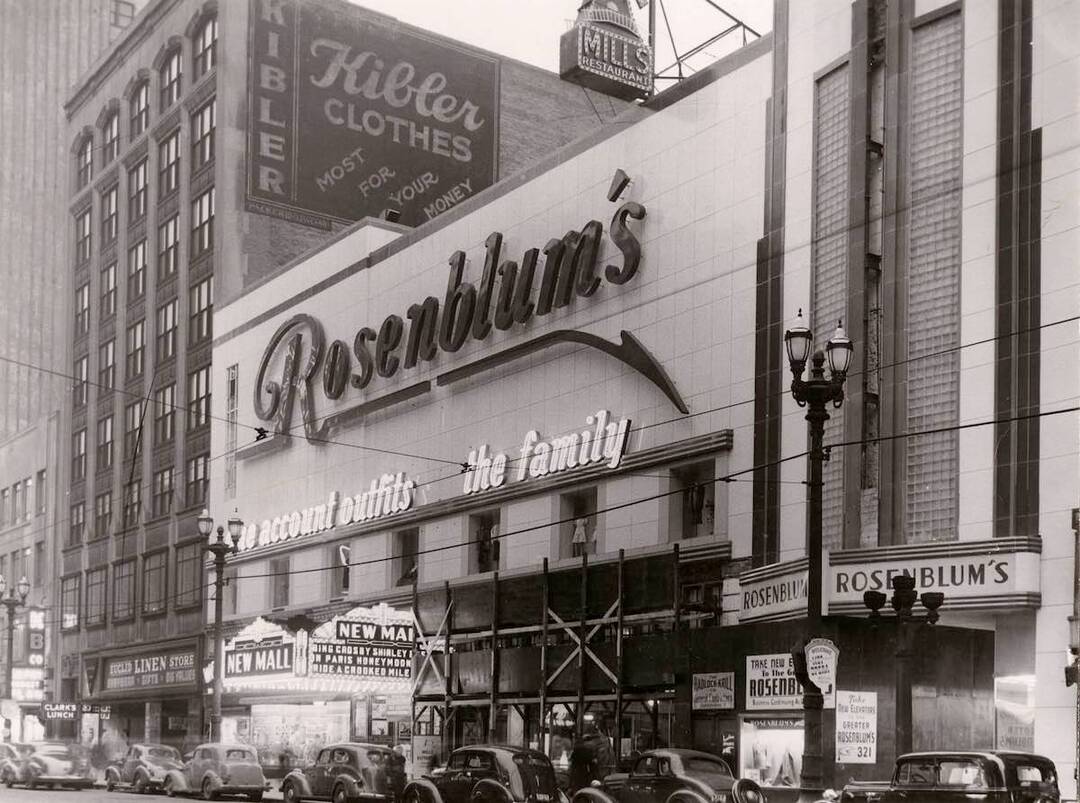
    <summary type="html"><![CDATA[<p><strong><em>When most people think about Cleveland’s downtown department stores, they think about Higbee’s or the May Company. There were, however, many other significant stores that contributed to the iconic image of downtown Cleveland, especially the many stores along Euclid Avenue. Among those stores was Rosenblum’s, a popular clothing store that was a shopping staple in Cleveland for close to a century. </em></strong></p><img src="https://clevelandhistorical.org/files/fullsize/8d222439b3d92080b893c291a533d464.jpg" alt="Rosenblum&#039;s" /><br/><p>Max Rosenblum was born in Austria-Hungary on December 5, 1877, and at the age of six he and his family immigrated to the United States, arriving in Cleveland not long after. Rosenblum attended grammar school in Cleveland, but left school after the sixth grade. As a child, at 3:30 every morning he would grab as many Plain Dealers as he could, bringing them down to Union Station and selling them before serving regular customers and then going to school. After leaving school, Max Rosenblum continued to sell papers and shined shoes at Superior Avenue and West 3rd Street (then known as Seneca Street). At 17, Rosenblum was given a job at a clothing concern where he worked in every department and went on to work at other businesses as well. In 1910, at the age of 32, he decided to go into business for himself, and open up his own clothing store on Public Square with the motto “New ideas, new methods, new policies.”
Rosenblum’s first store was located at 2014 Ontario Street on the second floor of a building that predated the Terminal Tower and the Higbee building where JACK Casino now operates. Rosenblum poured all that he had into opening the store. In order to put up the sign for his new business, he even had to borrow a month of rent from an uncle. Rosenblum was an early adopter of ready-to-wear clothing, much like what is seen in today's clothing stores. Rosenblum’s sold clothes for men, women, and children, and in addition to the ready-to-wear clothing, Rosenblum’s also made tailored suits to order for both men and women. Rosenblum also believed in easy credit. Newspaper ads for Rosenblum’s carried the motto as advertised was “It’s easy to pay the Rosenblum way.” In 1910 just one dollar per week paid over a period of forty weeks would buy any article of clothing at the store. Rosenblum’s also offered Eagle or Merchants stamps with all sales. These stamps, which were redeemable for cash or merchandise, were introduced by the May Company in 1903.
With Rosenblum’s business thriving, in 1920 Max Rosenblum moved the store just down the street to 321 Euclid Avenue. The new Rosenblum’s was located on the second floor of the building, later above Mills Restaurant, with private elevator service to bring customers up to the store. Once a customer stepped off the elevator, they were greeted by a large, eleven thousand square-foot store filled with clothes for men, women, boys, and girls of all ages and sizes. By 1922 the Rosenblum’s department store employed over one hundred employees and had a reputation as one of Cleveland’s oldest and most reliable business institutions. Rosenblum’s was open from 8:00 to 5:30 most days and on Saturdays closed at 6:00. Advertisements, however, stressed that shopping in the morning had greater benefits than other times of the day. Salespeople were fuller of vigor and, with fewer customers in the store, they were able to provide better one-on-one service. Fewer customers in the store also meant there were no crowds to contend with, making shopping less stressful and more comfortable.
Rosenblum’s department store prided itself on many things: high-quality products, wide array of styles in all sizes, stellar customer service, low prices, and easy pay-as-you-go credit that allowed customers to pay the price of an item over a period of forty weeks. Payments could be made weekly, semi-monthly, or monthly without paying interest or carrying charges. While customers might not get the product right away, this style of charge account allowed for greater flexibility for the shopper to make purchases. While this form of payment, which is similar to layaway, has fallen out of favor for most retailers today, one hundred years ago it was a popular and convenient way to purchase products.
What sort of products could you expect to find at Rosenblum’s? Much like any clothing retailer, Rosenblum’s, had a wide array of varying products for all ages and in all sizes. In the 1920s Rosenblum’s primarily sold women’s dresses, suits and fur coats, and for men they sold suits, dress shirts, slacks, and overcoats. Rosenblum’s also offered free tailoring service on all clothing, and for both men’s and women’s clothing Rosenblum's offered tailor made clothing as well. Rosenblum’s also had an extensive children’s section, and every year, much like now, they would advertise for back-to-school shopping. Everything they sold came in a variety of styles and fabrics. Women’s fur coats were a popular product at Rosenblum’s and were made from materials such as raccoon, muskrat, marmot, mink and more, while dresses were made from various types of silk and twill.
Rosenblum’s downtown store was a success, but after World War II shopping gradually began moving from downtown to the suburbs. Although it was relatively late in embracing suburban expansion, Rosenblum’s eventually opened stores in Cleveland's growing southern suburbs. Rosenblum’s second store opened in December of 1967 in the Parmatown Mall in Parma, and a third location was opened in October of 1980 in the Southgate Shopping Center in Maple Heights. These new branches sold kitchen wares and household appliances in addition to clothing. Sadly, at the end of May 1981, less than 8 months after their most recent suburban expansion, the downtown Rosenblum’s closed its doors for the last time. Rosenblum’s Parmatown store continued successful operations into the latter half of the 1990s. Rosenblum’s final remaining location at Southgate closed in 2006.</p><p><em><strong><a href="https://clevelandhistorical.org/items/show/1000">For more (including 6 images) view the original article</a></strong></em></p>]]></summary>
    <published>2023-04-07T21:12:27+00:00</published>
    <updated>2026-03-04T21:32:05+00:00</updated>
    <link rel="alternate" type="text/html" href="https://clevelandhistorical.org/items/show/1000"/>
    <id>https://clevelandhistorical.org/items/show/1000</id>
    <author>
      <name>Matthew Steenbergh</name>
    </author>
  </entry>
  <entry>
    <title type="html"><![CDATA[Euclid Avenue Temple: Anshe Chesed Congregation of Cleveland]]></title>
    <summary type="html"><![CDATA[<img src="https://clevelandhistorical.org/files/fullsize/0d5acdc682a504bb608104775fa459a2.jpg" alt="Euclid Avenue Temple" /><br/><p>In 1841, a rift opened within a German Orthodox congregation of a Bavarian Unsleben party that met in a rented room on Prospect Street. Known as the Israelite Congregation, it was formed just two years earlier as Cleveland’s first Jewish congregation. The group split over religious differences, with the departing members forming Anshe Chesed, meaning “the People of Loving-kindness.” The factions reunited in 1845 under the name Israelitic Anshe Chesed Society of Cleveland and soon built a synagogue on Eagle Street. This building was relatively small at 35 by 50 by 28 feet. After some disagreements over religious rituals in 1850, some members left to follow Rabbi Isidor Kalisch and establish Tifereth Israel. The Anshe Chesed then hired Rabbi Bernard L. Fould from Bavaria who headed the congregation from 1850 to 1875. </p><p>From 1861 to 1865, Rabbi Fould and chazan Gustava M. Cohen instituted many reforms, introduced an organ, tore down the women’s gallery, and installed pews. They also turned the reader of scripture from the Ark’s direction toward the audience. There were significantly more changes, later helped by Rabbi Michaelis Machol during his leadership from 1876 to 1906, converting Anshe Chesed from traditional to reformed Judaism. After the changes that Rabbi Michaelis Machol made during his leading congregation, they adopted English sermons, more moderate prayer books and services that switched between the Hebrew and English language. Some of these changes would later be reversed by Rabbi Barnett Brickner in the 1920s. Meanwhile, in 1887 the congregation relocated to a bigger building on Scovill Avenue and Henry Street (now East 25th). The 125-foot temple had alternating layers of white and red sandstone with octagonal turrets and three arching entrances. Designed by Lehman and Schmitt, the building could comfortably seat 1,200 people. </p><p>Rabbi Louis Wolsey from Little Rock, Arkansas, succeeded Rabbi Machol in 1907. The Anshe Chesed Congregation then announced their move to a location previously owned by Cassie Chadwick, who was known for defrauding banks out of millions by saying that she was an heir of Andrew Carnegie. Located on Euclid Avenue and East 82nd Street, Chadwick’s mansion was in the process of demolition in January of 1910, three years after she died in prison. On the vacant land, the Anshe Chesed planned to erect a synagogue designed by Lehman and Schmitt, the same architects who designed their previous home, and set aside $200,000 for construction. Rabbi Wolsey was said to favor an oriental style of architecture with tall columns and porticos for the new building. They cut some of the costs by choosing red brick instead of Indiana limestone, allowing them to spend the saved $50,000 on different amenities that included a new organ and pews. </p><p>In 1912, the congregation dedicated its new Euclid Avenue Temple. To commemorate the opening, they lit the eternal fire before the marble Ark representing God’s eternal presence. Within the Ark, there is a scroll of the Jewish law made of satin and gold. A sermon preached by Rabbi Wolsey gave thanks to God, who they believed allowed the building to be erected by His will and for His worship . The temple could seat 1,500 attendants and had one of Cleveland's largest organs at the time with 4,000 pipes. The temple had eight stained glass windows made by Tiffany and Company that each depicted moments of Jewish history as told in the Torah. The woodwork and pews had a silver-gray finish while the carpets and seating upholstery were a deep red. The Ark was made of French marble with two candelabras standing on each side made of bronze. Behind the choir lofts, a glass mosaic was imprinted with a verse from the book of Psalms, completing the synagogue. With all these extra expenses, the cost rose to $250,000. </p><p>Beginning in 1925, the Euclid Avenue Temple entered a new three-decade era in which it would become inseparable from the imprint of a new Rabbi. Born in New York City to Russian Jewish immigrants, Rabbi Barnett Brickner was a staunch Zionist and brought a new vision to Anshe Chesed. Rabbi Brickner moved away from many of the classical Reform practices of Anshe Chesed's prior years and reinstated many older Jewish traditions in services. So thoroughly did he shape Anshe Chesed that the synagogue became commonly known as "Brickner's Temple." </p><p>In 1956, Anshe Chesed, numbering 2,300 families, sold the building to a local African American congregation, Liberty Hill Baptist Church, which became the second Black church on Euclid Avenue, Anshe Chesed moved to Fairmount Boulevard in the eastern suburb of Beachwood. There they were known as the Anshe Chesed <a href="https://clevelandhistorical.org/items/show/404">Fairmount Temple</a>. At this new location, the congregation pushed for more civil and political rights for all Americans, even helping Soviet Jews relocate to America to flee persecution. The congregation also welcomed lesbian, gay, bisexual, and transgender Jews and their families, and they tasked Chevrei Tikva Chavurah in 2005 with undertaking outreach to the LGBT community. As a result of these actions, the Anshe Chesed Fairmount Temple received the Equality Award from the Human Rights Campaign Cleveland. </p><p>Anshe Chesed had a long history tied to the roots of Cleveland, but like most Jewish organizations, the congregation left the city of Cleveland as its members moved farther eastward into the suburbs. It cannot be understated that this congregation (which more recently merged with <a href="https://clevelandhistorical.org/items/show/40">Temple Tifereth-Israel</a> to form Mishkan Or) had a lasting impact on Jewish culture in Cleveland, including leaving a wonderful architectural legacy that continues to serve members of Liberty Hill Baptist Church.</p><p><em><strong><a href="https://clevelandhistorical.org/items/show/924">For more (including 9 images) view the original article</a></strong></em></p>]]></summary>
    <published>2020-12-13T02:24:17+00:00</published>
    <updated>2026-03-04T21:32:04+00:00</updated>
    <link rel="alternate" type="text/html" href="https://clevelandhistorical.org/items/show/924"/>
    <id>https://clevelandhistorical.org/items/show/924</id>
    <author>
      <name>Steven Nguyen</name>
    </author>
  </entry>
  <entry>
    <title type="html"><![CDATA[Martha House: The Home for Jewish Girls]]></title>
    <summary type="html"><![CDATA[<img src="https://clevelandhistorical.org/files/fullsize/1b6a936198fb12f770e275e1846029a8.jpg" alt="Martha Wolfenstein" /><br/><p>Established as a home for girls who came to Cleveland seeking employment more than a century ago, Martha House was considered to be a great blessing for many young Jewish single and self-supporting girls and young women from the ages of fourteen to twenty-two. In many cases, without relatives or friends, Martha House became an ideal residence, with all the comforts of home life at a moderate cost, and with the least possible restrictions to the girls’ personal freedoms. Named as a tribute to the memory of Martha Wolfenstein (1869-1906), gifted Jewish author and eldest daughter of Bertha (Brieger) and Dr. Samuel Wolfenstein, superintendent of the Cleveland Jewish Orphan Asylum, Martha House was first located at 2234 East 46th Street, between Cedar and Central Avenues, and was supported by the Cleveland Council of Jewish Women and its officers and trustees. A Board of Directors was created by the Council to administer the affairs of the organization, with vacancies being filled by appointment by the President of the Council.</p><p>The opening of Martha House in 1907 offered a most welcome solution to one of the gravest problems faced by Dr. Wolfenstein and his associates – the immediate future of discharged orphan asylum inmates who faced the world at an all-too-early age and for whom shelter and protection were tenuous. A new branch of work for the Council, Martha House was the direct outgrowth of those who recognized the needs of the city’s rapidly expanding Jewish population. While there was nothing in the constitution or governing by-laws to prevent the acceptance of others, it was understood that Martha House would benefit Jewish girls. However, the rules were framed with sufficient latitude to permit temporary housing for others in an emergency.</p><p>As reported in <em>The Jewish Review and Observer</em> (May 24, 1907), it was anticipated that the home would be fully-equipped and ready for occupancy by June 1, 1907, marking an important philanthropic event in the city. Initial monetary contributions were used for repairs and furnishings to the home, formerly the property of Mr. Malcolm Vilas. Once in running order, it was expected that the institution would be financially self-sustaining. </p><p>The building and its grounds were situated in a residential section of the city, not too remote from the centers of the Jewish population it aimed to serve. Additionally, it was adaptable to larger needs and permanence foreseen in its future. Described as “large and airy,” the home could easily accommodate 18 girls. The downstairs consisted of an entrance hall, parlor, library, dining room, kitchen, pantry, and one bedroom. Upstairs, there were sixteen bedrooms with white iron beds and large clothes presses. One room contained a large fireplace.</p><p>Residents were kept under the mild but wise surveillance of a governing board, whose interests were as much material as they were in the young girls’ moral and physical welfare. No efforts were spared to secure work for those temporarily unemployed as well as those inadequately paid for whom instruction would improve and increase their earning capacity.</p><p>At its opening, five applications for admission to Martha House had been granted. Mrs. Henry Woolf was to be the acting matron. In September of the following year, the board hired Miss Minnie Goldberg as matron. By this time, there were fifteen residents, whose occupations varied from stenographers, clerks, and factory hands to milliners’ and dressmakers’ helpers. By May 28, 1909, just two years since its June 1907 opening, Martha House was still under the capable guidance of Miss Goldberg. The fourteen residents enjoyed the surroundings and best influences the home provided.</p><p>Nine years later in 1918, a new home for Martha House was acquired, because the original East 46th Street site was found to be inadequate for the number of young women who applied for admission. Located at 2032 East 90th Street, the new Martha House was purchased by the Cleveland Council of Jewish Women with funds subscribed by the Jewish community. </p><p>Located on the west side of East 90th Street just south of Euclid Avenue and diagonally across from the Colonial Club building, the four-suite brick apartment house was remodeled to accommodate between forty and fifty girls. A formal dedication ceremony for the new Martha House took place on January 11, 1919, at the Hotel Statler, attended by various prominent dignitaries including Mayor Harry L. Davis. This new Martha House, which existed from 1919 to 1926, had a recreation room, dining room, laundry, pantry and kitchen on the basement floor. On the main floor were seven bedrooms, a living room, reading room, three baths and a resident worker’s apartment. There were fourteen bedrooms on the second floor.</p><p>As head of the household, Mrs. Emma Frensdorf took a personal interest in the activities offered, and aimed to make the house inviting for the few leisure hours the girls had. Not mere boarders, they shared in the house’s upkeep and décor, adding their artistic touches to the draperies and other furnishings. A spirit of pride and a hospitable atmosphere pervaded the young women’s new quarters. Rooms were attractive and well kept. Meals were well prepared. Every effort was made to look after the girls’ health. Medical services including those by house physician Dr. J. Selman and Mount Sinai Hospital were available at a nominal fee. </p><p>During the week, residents ate breakfast, straightened their rooms and went to their places of employment. In the evening after dinner, they were free to spend the time as they pleased. From time to time there was a program of activities which included: House Council; personality club; sewing; dramatics; piano lessons; dancing; lectures and concerts to which the community was invited. There were also classes in dressmaking, sewing and millinery. Dances were arranged periodically. Several ambitious girls attended night elementary and high schools. On Sundays, the girls typically performed personal duties and pastimes. In addition to secular holidays, Friday evenings and all the Jewish holidays were observed with appropriate ceremonies. Seats for temple services were provided for those who wished to attend.</p><p>From its opening nineteen years earlier in 1907, there had been a need for Martha House, a need which was championed by the Cleveland Council of Jewish Women and the community but that eventually changed. In a letter dated December 14, 1925, Mr. Charles Nemser, Executive Director of the Council Educational Alliance of Cleveland, requested the cooperation of the (National) Jewish Welfare Board in investigating the feasibility of turning over the facilities of Martha House to the ‘’Young women of the community, under a typical recreational-educational program of the YWHA type.”’</p><p>Emily Solis-Cohen, field secretary of the Jewish Welfare Board for Women’s Work, was assigned to this investigation. Her investigation, which occupied ten days, was devoted to interviews with executives and officers of organizations; study of activities and records of various organizations; results of related questionnaires and finally, studies previously made by other agencies, all of which were carefully reviewed. The facts ascertained with reference to the Jewish population (particularly the number of girls and young women); the activities of Jewish organizations; and other pertinent information were offered as the basis for the recommendations contained in the report.</p><p><em>The Report of Availability of Martha House – Cleveland, Ohio as a Jewish Center for Women and Girls – April, 1926</em> highlighted budget and demographic data. The Federation of Jewish Charities, of which Martha House was a member, paid nothing regularly towards its support except in the years 1916-1919 when it gave a monthly subsidy of $50 (excluding June and July), and during these same years an additional $1,000. The Council of Jewish Women contributed $700. In 1925, receipts were $8,838.42 and expenditures were $10,315.14, with a resulting deficit of $1,476. It was expected that $1,000 would have been required for the next four months, while plans were being made for the future.</p><p>The resident capacity of forty-two girls was utilized for several years but by 1923 the number of residents had dwindled to thirty. A study made by the Bureau of Social Research showed that of this number, twelve girls were foreign-born and had been in Cleveland less than five years. There were twenty-five wage earners (of whom twelve earned less than $20 weekly), while ten girls had relatives residing in Cleveland. After this study, certain changes were made in the admission policy. Finally, it was decided that since so many girls had relatives, the home was no longer functioning as a home for the homeless and that it would be better to try placing those seven girls with families.</p><p>By the time of its closing on March 1, 1926, there was little demand for the facilities the home provided. At its meeting in June 1926, the Jewish Recreation Conference of the Federation of Jewish Charities voted to recommend to the Council of Jewish Women that Martha House be sold and utilized for recreational purposes.</p><p><em><strong><a href="https://clevelandhistorical.org/items/show/875">For more (including 6 images) view the original article</a></strong></em></p>]]></summary>
    <published>2019-10-12T16:48:29+00:00</published>
    <updated>2026-03-04T21:32:00+00:00</updated>
    <link rel="alternate" type="text/html" href="https://clevelandhistorical.org/items/show/875"/>
    <id>https://clevelandhistorical.org/items/show/875</id>
    <author>
      <name>Gail Greenberg</name>
    </author>
  </entry>
  <entry>
    <title type="html"><![CDATA[Kol Israel Memorial]]></title>
    <summary type="html"><![CDATA[<img src="https://clevelandhistorical.org/files/fullsize/553b678e91787a823956dcee9457d96a.jpg" alt="Dedication Ceremony" /><br/><p>At the young age of fourteen in the predominantly Jewish town of Pryztyk, near Radom, Morry Malcmacher witnessed first-hand a violent pogrom fueled by his Polish neighbors. Three years later when the Germans invaded in 1939, Malcmacher found himself fighting for survival in a series of slave labor, concentration, and death camps. Upon liberation in 1945, he spent four years in a displaced persons camp in Feldafing, Germany before immigrating to the United States, ultimately settling down in University Heights. The roughly 96,000 Jewish survivors of the Holocaust that came to the US had to adjust to a new country, a new culture, and learn to live again while coming to terms with the murder of immediate family members, distant relatives, and friends. In 1959 Malcmacher and a small group of forward-thinking survivors in Cleveland laid the groundwork for a new organization that could help survivor émigrés make that transition. </p><p>Inspired by Voice of Israel, the clandestine radio station of the underground paramilitary force (<em>Haganah</em>) in Mandatory Palestine, the group opted for the phonetically identical, if orthographically different, name (in Hebrew) <em>Kol Israel</em>, or “All of Israel.” The Foundation elected its first officers in February 1960 and was chartered by the State of Ohio the following year. In 1963 the Sisterhood of Kol Israel, a division, was created to raise funds for the Foundation’s many initiatives. A third division, called Second Generation (2G), was formed in 1978 by the children of survivors with a commitment to continuing the legacy of their elders. All three divisions merged in 2013 as membership numbers dwindled. Three years later witnessed the birth of 3G (mainly the grandchildren of survivors) which has refocused Kol Israel on Holocaust education as well as efforts to curb all forms of hate and bigotry. Noteworthy is its <em>Share Our Stories</em> program which brings the children or grandchildren of survivors into local junior- and high-school classrooms who show and discuss recorded survivor accounts of their loved ones. And Kol Israel’s 2019 acquisition of Shaarey Tikvah’s <em>Face to Face</em> Holocaust education initiative reaffirms the organization’s commitment to “Never Forget.” </p><p>If not so clearly articulated in the formalistic language of its first charter, from the very beginning the Kol Israel Foundation has had three distinct, but related goals. For those who found themselves in Cleveland with no support network, Kol Israel privately offered financial assistance, smoothed access to vocational and housing services, and provided much needed emotional and psychological support via social gatherings and organized events. Secondly, the foundation was committed to supporting the State of Israel. From planting forests there through the Jewish National Fund, to donating ambulances to Magen David Adom (national emergency services), to buying State bonds, and giving monies to the Israeli Defense Forces, Kol Israel has been steadfast in its advocacy. The third aim from the outset has been Holocaust memorialization, in the form of holding annual <em>Yom Hashoah</em> events (Holocaust Remembrance Day), participating in the Warsaw Ghetto Uprising Memorial Services, and most notably building one of the first Holocaust monuments of its kind in the United States. In 2009 the Jewish Federation bestowed its highest honor, the Charles Eisenman Award, on the Foundation for its exceptional civic engagement. </p><p>The brainchild of Kol Israel’s first treasurer, Morry Malcmacher, the <em>matzavah</em> (grave marker) to the memory of six million murdered Jews was originally planned for Mount Olive Cemetery, but because of space constraints, was built in Zion Memorial Cemetery in Bedford Heights. It was unveiled at a public ceremony in 1961 attended by some 600 people, including Cleveland Mayor Anthony Celebrezze, who, during a speech averred “the lesson we must learn from it [the Holocaust]…is that it must not happen again.” Israeli writer Zvi Kolitz, perhaps best known for his <em>Yosl Rakover Talks to God</em>, gave the keynote address. </p><p>Designed and installed by Kotecki Family Memorials of Cleveland, the hulking monument of French Creek granite consists of a Star of David-capped obelisk which stands 17 ft. tall sandwiched between two 14 ft. panels. Haunting engravings on those panels depict a mother with two children and a man clutching a Torah scroll, all preparing to be engulfed by flames. Inscriptions in Hebrew and English front and rear call attention to the Nazi genocide and offer solace. At the foot of the memorial lies a crypt which holds the remains of Jewish martyrs secured from Poland. </p><p>On that sunny spring day in 1961 Kol Israel President William Miller announced that the memorial service was to become an annual event, and the Foundation has more than made good on that promise. The non-profit’s Memorial Committee, along with its co-sponsor the Jewish Federation of Cleveland, continues to hold the memorial service at the site between the Jewish holidays of Rosh Hashana and Yom Kippur. The family and friends of victims attend this solemn event which features a candle-lighting ceremony and the <em>Kaddish</em>, or Mourner’s Prayer. Each spring, the co-sponsors also hold a Holocaust Remembrance Day Event, wherein local dignitaries, religious leaders, survivors, liberators, and the public gather to commemorate the <em>Shoah</em> (Destruction). A granite knee wall, which has surrounded the monument since 1996, lists the names of some 1,300 victims and survivors who have since died, a jarring reminder of not only the duty to bear witness, but also just how much the legacy of the Holocaust has impacted Cleveland and the community. The Ohio History Connection of Columbus recognized that impact in 2017 by installing an Ohio Historical Marker. </p><p>Several hundred Holocaust survivors still live in the Cleveland area and the Kol Israel Foundation continues to support this vulnerable, yet dwindling population. Even when the last survivor has passed on, their mission to keep memory alive and combat intolerance via educational initiatives means the Foundation is well-positioned to carry on that most important of Jewish values, <em>tikuun olaam</em> (mending the world) in the 21st century.</p><p><em><strong><a href="https://clevelandhistorical.org/items/show/871">For more (including 12 images) view the original article</a></strong></em></p>]]></summary>
    <published>2019-08-15T16:58:19+00:00</published>
    <updated>2026-03-04T21:32:00+00:00</updated>
    <link rel="alternate" type="text/html" href="https://clevelandhistorical.org/items/show/871"/>
    <id>https://clevelandhistorical.org/items/show/871</id>
    <author>
      <name>Mark B. Cole</name>
    </author>
  </entry>
  <entry>
    <title type="html"><![CDATA[Temple Beth-El: A Jewish Sanctuary in Shaker Heights]]></title>
    <summary type="html"><![CDATA[<p><strong><em>On September 15, 1957,  the congregation of Temple Beth-El gathered to dedicate the first built synagogue in Shaker Heights.  Despite the city's substantial Jewish population, the physical development of civic associations in the suburb had only recently begun to be realized.  Under the spiritual leadership of Rabbi David L. Genuth, Temple Beth-El would become a refuge for modern Orthodox Jewish religion, culture and education within Shaker Heights.</em></strong></p><img src="https://clevelandhistorical.org/files/fullsize/bade6c3adf0ba4913b3256428679a226.jpg" alt="Temple Beth-El, 1957" /><br/><p>On July 29, 1951, more than 500 guests of Temple Beth-El convened at the Hotel Hollenden ballroom in downtown Cleveland to witness the dedication of the congregation’s Sefer Torah. Speakers at the ceremony included Rabbi David L. Genuth of Temple Beth-El, Ohio Governor Frank Lausche, and Mayor John W. Barkley of Shaker Heights. Rabbi Genuth, spiritual leader and founding member of the congregation, addressed the crowd with his vision for Temple Beth-El. “Our doors shall be open to all seeking a refuge and a haven from the troubles of the world, regardless of race, color or creed. Our temple shall be a sanctuary to the poor and the rich, the weak and the strong.”  Governor Lausche followed, observing the long and enduring history of Jewish persecution.  Mayor Barkley then welcomed Temple Beth-El to Shaker Heights, remarking “It is a people that make a city great. Your organization will make a valuable addition to our fair city.”  While Rabbi Genuth founded Beth-El to cultivate traditions of Jewish Orthodoxy within Shaker Heights, it was fitting for the public ceremony to be held in the neighboring City of Cleveland.  Efforts to institutionalize Jewish life in Shaker Heights had only recently begun to be realized.  The physical development of Jewish civic associations in the suburb was noticeably overdue, as was the newfound municipal support for their creation.    </p><p>Although not reflected in physical structures, Shaker Heights had long been home to an active Jewish community. As early as the 1920s, Cleveland’s many Jewish newspapers announced the births, deaths, bar mitzvahs, confirmations, business ventures, real estate purchases, and general comings-and-goings of the Shaker Heights community.  Increasingly throughout the 1930s, Jewish clubs and organizations regularly met in Shaker Heights homes for a variety of events that included garden parties, tea socials, sewing circles, and discussion groups. While hosting events in homes was common during the era, official meetings and charity events of Jewish clubs such as Kinsman-Shaker B'nai B'rith, Shaker Heights Masada, and Hadassah branches were typically held outside the suburb’s boundaries.  </p><p>As evidenced by these activities, a 1937 population study estimated that fifteen percent of the Shaker Heights population was Jewish. This accounted for over 3,600 individuals in 837 families. Fifty-seven percent of these Jewish families were members of congregations.  Despite the presence of a substantial Jewish population, there were no dedicated houses of worship in Shaker Heights. This lack of grounded religious organizations was partly due to the community’s ties to synagogues in both Cleveland and, increasingly, Cleveland Heights. Although shrinking in size and influence, large Jewish communities centered in Glenville and along Kinsman in the Mount Pleasant neighborhood remained the hubs of religious and cultural life through the 1930s.     </p><p>The dearth of Jewish institutions within Shaker Heights, however, can also be attributed to exclusionary real estate policies implemented by The Van Sweringen Company during the 1920s.  Restrictive covenants in deeds issued following 1925 deterred property sales to Jews, African Americans and Catholics, and strict building standards discouraged types of religious architecture. While the deed restrictions did not explicitly deny home-ownership on the basis of religion or race, the covenants required the re-sale of a home be approved by the majority of neighboring property owners.  Masked under the guise of community standards, the process discouraged both real estate agents and homeowners from entering into negotiations with non-white and Jewish prospective buyers.  Despite a Supreme Court decision declaring restrictive covenants unenforceable in 1948,  the practices were commonly employed and actively hindered access to housing in many Shaker Heights neighborhoods well into the 1950s.   </p><p>Because many properties in the southeast region of Shaker Heights were developed outside the Van Sweringens’ control, restrictive covenants were less likely to impede Jewish home ownership in the Moreland and Lomond neighborhoods.  A substantial Jewish community emerged near the intersection of Kinsman and Lee Roads during the 1940s, providing increased urgency for the development of religious institutions.  </p><p>Three new Jewish congregations in Shaker Heights were chartered during this period of Jewish settlement. Established in 1947, the Temple of Shaker Heights was led by Rabbi Albert L. Raab of the N’Vai Zedek Congregation in Mount Pleasant. The congregation initiated fundraising for a $250,000 religious complex to be located in the Kinsman-Lee neighborhood, but the project was never realized.  Temple Emanu El was founded that same year, holding both services and religious school at Moreland School. The Reform Jewish congregation moved their services to Plymouth Church of Shaker Heights within the year. Congregants continued to hold religious services and classes in Shaker Heights until 1954, when land was acquired to construct a synagogue in University Heights.  The Suburban Temple, a splinter of Emanu El, was established in 1948. The congregation held services in the Lomond School Auditorium until securing land in Beachwood to construct a temple in 1954. At midcentury, the Emanu El and Suburban Temple congregations were in the process of raising funds to construct synagogues.  While the city of Shaker Heights remained devoid of any permanent Jewish religious edifices, efforts were underway to ground religious life in the Kinsman-Lee neighborhood.   </p><p>In the fall of 1950, four families gathered at the home of Rabbi David L. Genuth on Hildana Road for the purpose of establishing the “First Hebrew Sanctuary in Shaker Heights.”   Aspiring to fill the “long apparent need” for Orthodox services in the suburb, the small group founded Beth-El.  Aided by the Shaker Heights School Board, Orthodox services were quickly scheduled to be held at the Moreland School Auditorium on Saturday mornings.  Within four weeks, the congregation was granted a charter by the State of Ohio. </p><p>  Reputed for his philanthropic, civic and cultural endeavors, Rabbi Genuth quickly grew the Beth-El congregation.  The Rabbi had long been an active and influential member of Cleveland’s Orthodox Jewish community.  Between 1933 and 1950, he acted as spiritual leader of the Kinsman Jewish Center in Mount Pleasant.  Modern Orthodox services were implemented under his guidance in 1937, and the congregation grew to over 400 families by 1940.  The Rabbi had also been instrumental in the development of the Cleveland Zionist Society, and helped found both the Jewish Community Council and the Shaker-Kinsman B’nai B’rith.  Like many congregants of the Kinsman Jewish Center, Rabbi Genuth relocated from Mount Pleasant to a home in Shaker Heights’ Kinsman-Lee district by the early 1940s.  With the announcement of the new congregation in Shaker Heights, both loyalties to the Rabbi and a desire to worship within the emerging Kinsman-Lee community aided in its rapid growth.   </p><p>In February, 1951, Beth-El celebrated its new charter at the Heights Jewish Center in Cleveland Heights.  That August, the sacred Sefer Torah was presented to the congregation and blessed at the Hollenden Hotel celebration.  Efforts were well underway to create a permanent space where Jewish religious life could be observed within the boundaries of Shaker Heights.   A frame dwelling, rumored to be the oldest standing farmhouse in Shaker Heights, was acquired by the Beth-El congregation in July of 1951 at 15808 Kinsman Road.   The grounds of the new property were consecrated, and the temple dedicated in August.  Before a capacity crowd, a procession led the congregation’s Torah scrolls into the building.   While the modest structure was only envisioned as a temporary home, Temple Beth-El was now equipped to provide for the educational, cultural and religious needs of the community.    </p><p>Due to limited facilities at the farmhouse, High Holy Day Services were held in the Moreland School Auditorium in 1951. Beth-El histories recount these ceremonies as the first time in the history of Cleveland that “a modern Orthodox congregation held services where men and women sat side by side and worshipped together.”  The years that followed witnessed a flurry of organizational and fundraising activities.  A Sisterhood was organized, a Sunday School established, cemetery lands purchased in Mt. Zion Memorial Park, existing grounds renovated to meet city codes, and plans prepared for the construction of a new synagogue. Doors remained open to the surrounding community daily throughout these years, with Rabbi David Genuth offering counsel to all that entered the Temple in Shaker Heights.   </p><p>On August 22, 1954, Rabbi Genuth stood before his congregation to perform groundbreaking rituals and initiate construction of Beth-El’s new synagogue. Below an open tent fronting the farmhouse, Mayor Barkley delivered the principal address to commemorate the establishment of the city’s first permanent Jewish temple.  The Mayor was presented with a bound Hebrew and English copy of the Song of Solomon, which had been printed in the recently formed state of Israel.  The turning of the soil symbolized the institutionalization of Jewish religious life in the community of Shaker Heights.  </p><p>The successes of Temple Beth-El can in part be attributed to its close ties with the municipal government.  While the City had already shown a willingness to work with the Jewish community in providing access to its schools for use in religious services during the late 1940s, a personal relationship between Rabbi Genuth and Mayor Barkley helped color the interaction between these two institutions. Upon news of John Barkley’s election in 1950, Rabbi Genuth had penned a letter of congratulations to the Mayor-elect. The written correspondence evolved into a friendship.  From the outset, the congregation found city officials to be supportive of their ambition to build a Jewish sanctuary in Shaker Heights.  Permissions were secured by both the Mayor of Shaker Heights and the Superintendent of Shaker Heights Schools to use the Moreland School Auditorium for forum meetings and religious services.    Upon Barkley’s subsequent acceptance of invitations to participate in Beth-El’s public ceremonies, relationships were forged between the Mayor and numerous congregation members.    </p><p>Through Mayor Barkley’s participation in public ceremonies, a precedent was set for the involvement of future administrations in Beth-El’s religious affairs. Personal ties would also be built by Rabbi Genuth with Mayors Wilson G. Stapleton and Paul K. Jones. The various Mayors participated in nearly all public events during these early years, including annual officer installations, construction-related ceremonies, ribbon-cuttings, and dedications.  This eventually extended to their attendance at significant religious observations, and a tradition emerged that the Mayor of Shaker Heights visited services on High Holy Days. The friendship and goodwill between municipal leaders and the congregation proved beneficial through the many difficult years of inspections, planning and construction of Temple Beth-El’s new structure.   </p><p>On September 15, 1957, Governor Frank Lausche and Mayor Wilson G. Stapleton of Shaker Heights convened to celebrate the dedication of Temple Beth-El’s House of Worship. The American colonial-type structure, situated at the rear of the historic farmhouse, was officially opened as the first built Synagogue in Shaker Heights. Designed to reflect the architectural motif of Shaker Square, the building merged traditions of the Jewish community and a historically exclusionary suburb. The dedication of a synagogue did not mark an end to the suburb’s troubled history of discriminatory real estate practices. The symbolic support offered by the City of Shaker Heights to Temple Beth-El throughout the 1950s, however, indicated the beginnings of an institutional shift towards inclusivity that would later become a cornerstone of the city’s identity.  Fittingly, the banquet that followed the official opening of Beth-El was held in Naiman Hall of the new synagogue.  </p><p> Under the leadership of David Genuth, Temple Beth-El continued to expand. The synagogue become a refuge for modern Orthodox Jewish religion, culture and education within Shaker Heights.  The congregation grew to 450 members by its tenth anniversary, 80 percent of whom lived in the immediate vicinity of the neighborhood. Even as the Kinsman-Lee Jewish community dispersed to the outer-ring suburbs of Cleveland during the 1960s and 1970s, Temple Beth-El maintained many of its members and a full schedule of religious services. The historic synagogue regularly reached full capacity on High Holy Days.  After nearly twenty-four years of service as the spiritual leader of Temple Beth-El, Rabbi Genuth passed away on February 23, 1974.  The Shaker Heights congregation continued on its path of fostering the traditions of modern Orthodox Judaism for the next twenty-five years.  Attrition, continued decline in the surrounding neighborhood’s Orthodox Jewish population, and the burdens of an aging structure impelled the sale of the synagogue to the City of Shaker Heights in 1998. Under the spiritual leadership of Rabbi Moshe Adler, the Beth-El congregation merged with 35 members of Beth Am to form Beth-El — The Heights Synagogue in January, 2000. The congregation is currently located in Cleveland Heights.</p><p><em><strong><a href="https://clevelandhistorical.org/items/show/838">For more (including 10 images) view the original article</a></strong></em></p>]]></summary>
    <published>2018-06-24T01:00:40+00:00</published>
    <updated>2026-03-04T21:32:04+00:00</updated>
    <link rel="alternate" type="text/html" href="https://clevelandhistorical.org/items/show/838"/>
    <id>https://clevelandhistorical.org/items/show/838</id>
    <author>
      <name>Richard Raponi</name>
    </author>
  </entry>
  <entry>
    <title type="html"><![CDATA[Moreland Elementary School: Historic Focal Point of the Moreland Neighborhood]]></title>
    <summary type="html"><![CDATA[<p><strong><em>Built in the Roaring Twenties to provide an elementary school education for the children of the families that were moving into the fast-growing, southwesternmost neighborhood of Shaker Heights, Moreland Elementary School not only lent its name to that neighborhood, but also became the neighborhood's iconic  landmark and its enduring symbol of heritage, transition, and renaissance.  </em></strong></p><img src="https://clevelandhistorical.org/files/fullsize/c0f8664caa0c0ed039e3e2bec1bdea26.jpg" alt="Moreland Elementary School (1926-1987)" /><br/><p>The Van Sweringen brothers knew that a premier suburb required a premier public school system.  So, it was not surprising that, in 1913, just one year after the incorporation of Shaker Heights, its Board of Education began implementing the Vans' vision, undertaking an ambitious building program that proposed to place a new elementary school in every neighborhood of the village. When neighboring East View Village was annexed in 1920, the school building program was extended to that new territory, which soon became home to Shaker Heights' southernmost residential neighborhoods.</p><p>Prior to the annexation, children in East View Village had attended elementary school in a small, four-classroom building located on the west side of Lee Road between South Moreland (Van Aken) Boulevard and Kinsman Road (now Chagrin Boulevard). That school building continued to be used by the Shaker Heights Board of Education for several years as an elementary school for children living in Shaker's southwesternmost neighborhood--later known as the Moreland neighborhood. By 1924, however, the Board recognized that the building had become inadequate to accommodate all of the school-age children living in this fast-growing area of Shaker Heights. Accordingly, in that year, the Board decided to build a new, larger elementary school just to the west of East View School, on a parcel of land sold to it by the Van Sweringens.</p><p>Charles Winning Bates, an architect from Wheeling, West Virginia, who had designed other school buildings in Shaker Heights, was awarded a contract by the Board of Education to design this new school.  Bates designed it in the neo-Georgian style, matching all other Shaker school buildings of its era. Three stories tall, brick, and with a grand entrance facing South Moreland (Van Aken) Boulevard, the new building was to have 28 classrooms — seven times as many as old East View School, as well as a teacher's restroom, a principal's office, a medical room, and an auditorium-gymnasium. After the Shaker Heights electorate approved a bond issue in November 1924 which had earmarked $425,000 for the new school building, construction commenced in 1925. By 1926, the building was completed, and on March 15 of that year the first children moved out of East View School and marched a few hundred feet into the new building, which was initially called Lee-Moreland School.</p><p>From the late 1920s until the late 1950s, Lee-Moreland School, which was by 1940 simply called Moreland School, served a largely Jewish population living in the Moreland neighborhood. In addition to providing a quality public education to the neighborhood's children, the school building also served as a meeting place for many Jewish organizations, as a place where sacred Jewish days were celebrated or commemorated, and even as a religious school for Temple Emanu El and the Cleveland Hebrew School. Beginning around 1960, as many Moreland neighborhood Jewish families moved to suburbs north and east of Shaker Heights, they were replaced largely by African American families, many of whom were moving out of Cleveland and its overcrowded school system, and into Shaker Heights with its nationally recognized, excellent school system.  </p><p>Racial transition in Shaker Heights presented challenges to many institutions in many places throughout the city, but perhaps none greater or more important to the city's future than those faced by Moreland Elementary School. Fortunately, the school was headed in this era by a principal who was more than up to the task. Orville Jenkins, who grew up in southern Ohio, attended college at Bowling Green University, taught as a teacher for a number of years, and then became principal of an elementary school in the Toledo, Ohio, area. In 1956, the Shaker Heights Board of Education hired him as the principal of Moreland Elementary School. Jenkins, who purchased a home on Scottsdale Boulevard in the Moreland neighborhood, was soon recognized as an excellent principal, and, as well, a fiery advocate for integrated schools. When the Moreland neighborhood began undergoing racial transition in the 1960s, Jenkins was among the leaders of the neighborhood who engaged in concerted efforts to stop blockbusting, to keep the neighborhood stable, and to preserve the high standard of community life there. He helped found the Moreland Community Association (MCA) in 1962 and he permitted the new organization to hold its meetings and functions at Moreland Elementary school. He instituted an individualized instruction program at the school, designed to help children to learn at a pace most appropriate for them. And, he became a friend to all children in the school.  Jenkins was said to have known the first name of every child in the school. He served as school principal, as well as a trustee of the MCA and other community organizations, including the Shaker Historical Society, until his untimely death at age 46 in October 1969.</p><p>Despite the efforts of Principal Jenkins, and many others in Shaker Heights, to keep Moreland an integrated neighborhood, by 1969 its population had become overwhelmingly African American, and, according to a November 18, 1969 Plain Dealer article, the number of African American children attending Moreland Elementary School had reached ninety-five percent. The Moreland Community Association, with a goal of seeing Moreland Elementary School re-integrate, petitioned the Shaker School Board of Education to initiate a program to bring in white children from other neighborhoods of Shaker Heights to achieve that.  Ultimately, Shaker Heights BOE, after a series of public meetings, instituted a voluntary busing program (the "Shaker Plan") in the city, which, with modifications in the mid-1970s, resulted in a somewhat improved racial balance at Moreland in that decade.</p><p>At about the same time that the voluntary busing program was instituted in Shaker Heights, the city began suffering a decline in the number of school-age children in its public school system and the Board of Education began experiencing financial difficulties in maintaining all of the existing school buildings. To remedy this problem, the Board of Education ultimately adopted a school reorganization plan that led to the closing of Moreland Elementary school in 1987, despite vigorous protests from the Moreland neighborhood. While Shaker Heights initially considered selling the old school building for private redevelopment, it was eventually persuaded to preserve it because of its importance to the Moreland neighborhood's history and identity. In 1993, after a renovation process was completed, the former Moreland Elementary School became the new main branch of the Shaker Heights Public Library.  </p><p>More than two decades have now passed since Moreland Elementary School was transformed into the new Shaker Heights Public Library.  While the historic building now serves a different purpose in the community, the purpose it serves is still an educational one. And, perhaps more importantly, at least to the Moreland neighborhood, the building continues to be a focal point for the neighborhood, a beloved landmark, and an enduring symbol of the neighborhood's heritage, transition, and renaissance.</p><p><em><strong><a href="https://clevelandhistorical.org/items/show/835">For more (including 12 images) view the original article</a></strong></em></p>]]></summary>
    <published>2018-05-09T15:06:42+00:00</published>
    <updated>2026-03-04T21:32:04+00:00</updated>
    <link rel="alternate" type="text/html" href="https://clevelandhistorical.org/items/show/835"/>
    <id>https://clevelandhistorical.org/items/show/835</id>
    <author>
      <name>Jim Dubelko</name>
    </author>
  </entry>
  <entry>
    <title type="html"><![CDATA[B&#039;nai Jeshurun Congregation: The Temple on the Heights]]></title>
    <summary type="html"><![CDATA[<img src="https://clevelandhistorical.org/files/fullsize/12283ff747d75d931758363aa2b4dafb.jpg" alt="Temple on the Heights today" /><br/><p>By the 1920s, Cleveland's growing Jewish community approached 10% of the city's population. As with Jewish enclaves in other major American cities of the era, the Jewish-American community of Cleveland began spreading into the suburbs. B'nai Jeshurun, became the first to make the move when in 1919 the congregation decided to relocate out of the city proper and into the nearby suburb of Cleveland Heights. The new building on Mayfield Road held over 3,000 worshipers and included a gymnasium, a banquet hall, and an entertainment hall, as well as a library. The congregation also retained its old building on East 55th Street for other social events before the existing structure became Shiloh Baptist Church.</p><p>Cleveland's Jewish population went back decades. Fleeing religious persecution in Europe and seeking greater job opportunities, Hungarian Jewish immigrants to the United States flocked to large cities. The western side of Cleveland attracted to pre-existing Jewish settlements and manufacturing jobs. The old German synagogues of earlier settlers simply would not do, necessitating buildings for  distinctly Hungarian congregations. In 1866, Hungarian Jewish immigrants began meeting in their own homes, and then in Gallagher’s Hall on Erie and Superior to pray, partially because they simply could not afford the fees the German synagogues required. In 1906, the Hungarian Jewish community of B'nai Jeshurun constructed their first permanent synagogue on East 55th Street and called it home for two decades.</p><p>B’nai Jeshurun’s congregation moved into the new temple in March of 1926, and Rabbi Abraham Nowak consecrated the structure in August of the same year: by now, over a thousand Jews called B’nai Jeshurun home. It was also at this time that B’nai Jeshurun gained its famous moniker— the Temple on the Heights, or more simply, Heights Temple. In comparison, the second Jewish congregation to move to the suburbs came nearly 20 years later when Anshe Chesed Fairmount Temple, Cleveland's oldest Jewish congregation, moved to Beachwood in 1947.</p><p>The congregation elected its first Cleveland-born Head Rabbi in 1934, Rudolph Rosenthal.  At the time of Rosenthal’s election, the Temple on the Heights served more than 1,000 families, had more than 600 youths in its education program, and was home to one of the largest Conservative congregations in the entire United States and would continue to grow over the next three decades. By the late 1960s, further suburbanization of the Jewish-American community moved congregants farther east. It was obvious the still-vibrant synagogue would need to move once again.</p><p>In 1978, only a few years after the 110th anniversary of B’nai Jeshurun’s founding, some 400 members of the congregation participated in a ceremonial groundbreaking of the temple’s new location on Fairmount Boulevard, in Pepper Pike, further east than Cleveland Heights and truly suburban. In late 1979 Rabbi Herbert Schwartz consecrated the new temple on the first night of Hanukkah.</p><p>On October 30, 2016, B’nai Jeshurun, Cleveland's third-oldest continuously operated Jewish congregation, capped off its 150th anniversary with a gala. The success of the Temple on the Heights in smoothing its congregants' transition to suburban life and the congregation's continued vitality over the past century and a half cements B'nai Jeshurun as a mainstay of the Cleveland metropolitan area. </p><p><em><strong><a href="https://clevelandhistorical.org/items/show/821">For more (including 5 images) view the original article</a></strong></em></p>]]></summary>
    <published>2017-11-27T19:12:37+00:00</published>
    <updated>2026-03-04T21:32:03+00:00</updated>
    <link rel="alternate" type="text/html" href="https://clevelandhistorical.org/items/show/821"/>
    <id>https://clevelandhistorical.org/items/show/821</id>
    <author>
      <name>Anthony J. Kleem</name>
    </author>
  </entry>
  <entry>
    <title type="html"><![CDATA[Fir Street Cemetery: Cleveland&#039;s Second Oldest Jewish Cemetery]]></title>
    <summary type="html"><![CDATA[<p><strong><em>"Give me your tired, your poor, your huddled masses yearning to breathe free, the wretched refuse of your teeming shore."  Emma Lazarus' immortal words from her poem "The New Colossus," etched on the Statue of Liberty, had special meaning to one immigrant family buried in this historic Jewish cemetery in Cleveland.</em></strong></p><img src="https://clevelandhistorical.org/files/fullsize/2fe917423c69448b6ae8f17f711353e8.jpg" alt="Aerial View from the South" /><br/><p>When James and Fannie Horwitz experienced the unspeakable heartbreak of losing a child--their 2-year-old son Aaron in January 1865, they undoubtedly found some consolation in burying him in the new Jewish cemetery out in the countryside, west of the Cuyahoga River in Brooklyn Township, on a charming little lane called Peach Street (later to be renamed Fir Street).  The cemetery had just been opened that year by the Hungarian Aid Society (HAS), an organization formed in Cleveland in 1863 by Morris Black, Herman Sampliner and others, for the purpose of providing aid, including burials, to Hungarian Jewish immigrants.  Aaron Horwitz was the organization's first burial at the new cemetery.</p><p>Aaron's father James (or Jacob as he was known in Europe) was a Vienna-trained medical doctor, and his mother Fannie a sister of Michael Heilprin, a brilliant Hebrew scholar.  Both men were Polish Jews who lived in Galicia, an area of historic Poland that had been "annexed" by Austria in first partition of that country in the late 18th century.  In 1848, both men had become ardent supporters of Lajos Kossuth and the Hungarian Revolution.  And when the Hapsburgs defeated the insurgents and Kossuth fled Hungary, both men also did the same.  Horwitz, immigrated to Cleveland, via Sandusky, practicing medicine before turning to business enterprises.  Heilprin went instead to New York, where he became a celebrated Hebrew scholar, a friend of Horace Greeley, and mentor to the young poet Emma Lazarus.  Several sources attribute the inspiration for Lazarus' 1883 poem "The New Colossus" to a meeting she earlier had with Michael Heilprin.  Heilprin was both inspiration to Emma Lazarus and the uncle of an unfortunate young boy who was the first person to be buried at the new Jewish cemetery in Brooklyn Township.</p><p>The cemetery where Aaron Horwitz is buried we know today as Fir Street (or Fir Avenue) Cemetery.  The second oldest Jewish cemetery in Cleveland, it is actually three small, separate historic cemeteries which are located on a rectangular-shaped piece of land bounded on the north by Fir Avenue; the east by West 59th Street; the south by Bayne Court; and the west by West 61st Street.  The center cemetery, where Aaron and other members of the Horwitz family are buried, was owned by the HAS until 1963 when the land was deeded to the Jewish Community Federation (JCF) of Cleveland.  While the first burial took place there in 1865, permission to operate a cemetery on the grounds was not officially granted by the City of Cleveland until 1880,  several years after the section of Brooklyn Township in which it was located was annexed to the City.</p><p>The western cemetery was established by Anshe Emeth, the largest and oldest conservative Jewish congregation in Cleveland.  It was founded by Polish Jewish immigrants in 1859.  The Congregation made its first purchase of land on Fir Street in 1877, the same year that it was granted permission by the City to establish a cemetery on its  grounds there.   Anshe Emeth, in the twentieth century, merged with Beth Tefilo congregation to form Park Synagogue Anshe Emeth Beth Tefilo Congregation.</p><p>The eastern cemetery may also have been founded by Polish Jews, although there is some mystery surrounding the identity of the two Jewish organizations which owned the land in the nineteenth century.  Chebra Kadisha, which acquired the land in 1866, was identified in the conveyance deed simply as a "religious organization."  Thirteen years later, in 1879, through its trustees, it deeded the land to the B'nai Abraham Cemetery Association, an organization for which no records appear to exist.  Chebra Kadisha may have been an early congregation which later merged with other congregations to form  what became, in the twentieth century, the Heights Jewish Center (HJC).  Or, it may have simply been a "burial society."  </p><p>Among the locally famous residents of Fir Street Cemetery are:  Herman Sampliner (1835-1899), founder of the B’nai Jeshurun Congregation; Harry “Czar” Bernstein (1856-1920), owner of Perry Bank and the Perry Theatre, and city councilman allied with Mark Hanna; Moses A. Adelstein (1813-1903), organizer of Cleveland’s first Russian synagogue and first free Jewish cemetery, Lansing Cemetery; Isaac Goldman (1858-1919), Cleveland’s first Jewish building contractor; Fanny Jacobs (1835-1928), founder of Park Synagogue’s sisterhood; Rabbi Gershon Ravinson (1848-1907), a 10th-generation rabbi who became a leading scholar of Talmud; Reverend Elias Rothschild (1858-1914), a kosher butcher with a reputation for offering meals and beds to the down-and-out. Rothschild is believed to have saved the Hebrew Free Loan Society when it ran into financial difficulty.</p><p>This final resting place of so many locally famous Clevelanders, as well as families with heart-wrenching stories like the Horwitz's, Fir Street became an inactive cemetery in 1971, after the last burials there took place.  In the decades that followed, the condition of its grounds steadily deteriorated, in part due to acts of vandalism and in part because the Cleveland Jewish community had moved east, leaving the cemetery geographically distant from its founding congregations.  The condition of Fir Street Cemetery troubled Cleveland Housing Court Judge Raymond J. Pianka, who been interested in the history of the cemetery, and the strange inscriptions on its gravestones, ever since he was a young boy attending Waverly Elementary School, just a block away from the cemetery.  In 2007, he and a stalwart group of neighborhood residents collaborated with Park Synagogue and successfully formed a coalition of funding, organizations and volunteers that, over the next two-year period, renovated and restored the cemetery, cleaning its grounds, fixing broken grave stones, planting trees and hundreds of tulip bulbs, and repairing the entrance gate and signage.  Since the completion of these repairs and renovations in 2009, the cemetery has been maintained by Park Synagogue Anshe Emeth Beth Tefilo Congregation with financial assistance from the JCF.  Fir Street Cemetery is now, once again, a source of pride not only for Cleveland's Jewish community, but also for the Detroit Shoreway neighborhood.</p><p><em><strong><a href="https://clevelandhistorical.org/items/show/800">For more (including 9 images) view the original article</a></strong></em></p>]]></summary>
    <published>2017-05-31T09:25:09+00:00</published>
    <updated>2026-03-04T21:32:03+00:00</updated>
    <link rel="alternate" type="text/html" href="https://clevelandhistorical.org/items/show/800"/>
    <id>https://clevelandhistorical.org/items/show/800</id>
    <author>
      <name>Jim Dubelko</name>
    </author>
  </entry>
  <entry>
    <title type="html"><![CDATA[Oheb Zedek-Taylor Road Synagogue: A Model of Resilience in Jewish Cleveland]]></title>
    <summary type="html"><![CDATA[<img src="https://clevelandhistorical.org/files/fullsize/d031afb9bfbae4b8beb8b8809916cc9b.jpg" alt="Taylor Road Synagogue, 2015" /><br/><p>Oheb Zedek is one of the most venerable Orthodox Jewish congregations in the greater Cleveland area. It was founded in 1904 by a group of former members of the congregation B’nai Jeshurun. The disgruntled ex-congregants vehemently disagreed with B’nai Jeshurun’s ongoing transition from Orthodox to Conservative Judaism. Accordingly, they sought to establish a more firmly Orthodox synagogue of their own. The next year, the group built and moved into a synagogue on East 38th Street and Scovill Avenue in Cleveland’s predominantly Jewish Woodland neighborhood. From there, Oheb Zedek followed the general migratory pattern of Cleveland’s Jewish population, slowly but steadily moving further eastward. By 1922, the congregation had fully relocated to the Glenville neighborhood, northeast of Woodland; by 1955, the group had moved again, this time to the inner-ring suburb of Cleveland Heights.</p><p>In Cleveland Heights, Oheb Zedek established itself in the building it occupies to this day: the Taylor Road Synagogue. In the 1950s and early 1960s, Taylor Road was in the process of becoming a hub of Jewish life and worship, reminiscent of similar streets in the Woodland and Glenville neighborhoods back when they had been among the primary Jewish enclaves in the Cleveland area. Notable institutions like the Jewish Education Center of Cleveland and the Hebrew Academy were also located on Taylor Road, and in 1961, the Jewish Community Center was built just down the street. In addition, a panoply of Jewish shops, restaurants, and other establishments spread up and down the street. Oheb Zedek was far from alone. By 1955, when its building had been completed and dedicated, the newly renamed Taylor Road Synagogue had absorbed several other Orthodox congregations: Agudath Achim, Agudath B’nai Israel Anshe Sfard, Chibas Jerusalem, Knesseth Israel, and Shaaray Torah. Together, these congregations would maintain a thriving Jewish community … for a while.</p><p>After about a decade, the Taylor Road Synagogue was under pressure to relocate once again. Faced with familiar motivators — an influx of African Americans into the area and the gradual departure of the Jewish population — it would have been relatively unsurprising to see Oheb Zedek and the other Taylor Road congregations move eastward once more. Many other Cleveland Heights congregations had already moved, or would do so within the next several decades: for instance, B’nai Jeshurun, Oheb Zedek’s forebear and occupant of the grand Temple on the Heights, voted to leave for Pepper Pike in 1969, although it did not officially relocate there until 1980. Surprisingly, however, Oheb Zedek and its brethren, along with a number of other Cleveland Heights Jewish congregations, refused to leave. With the help of the Heights Area Project, a nonprofit organization run by the Jewish Community Federation, Cleveland Heights’ Jewish residents rallied together, embracing integration and investing in institutions in a way that previous Cleveland Jewish communities had not. In this way, Cleveland Heights’s Jews managed to preserve their Heights presence, and prevent the departure of some (although far from all) local synagogues. Taylor Road in particular retained a significant portion of its Orthodox population, ensuring the survival of the Taylor Road Synagogue.</p><p>The aforementioned happy ending comes with a strange recent twist. In 2012, Oheb Zedek reportedly merged with the Cedar-Sinai Synagogue in Lyndhurst. What did not become apparent until later that year was that the proposed merger had engendered heated opposition. In November of 2012, furious members of Oheb Zedek on Taylor Road filed a lawsuit aimed at stopping the merger. This lawsuit was aimed not just at Cedar-Sinai, but at three leading members of Taylor Road Synagogue as well! The members who filed the suit mainly argued that the merger had been somehow illegitimate, and therefore invalid. After over a year of legal wrangling, involving both the Common Pleas Court of Cuyahoga County and a prominent Jewish religious court based in New York, the plaintiffs and the defendants reached an out-of-court settlement. While most of the details were not disclosed, it was made clear that the two synagogues would not be making a full merger. Once again, Oheb Zedek managed to pull through and survive. </p><p><em><strong><a href="https://clevelandhistorical.org/items/show/709">For more (including 6 images) view the original article</a></strong></em></p>]]></summary>
    <published>2015-05-16T11:50:01+00:00</published>
    <updated>2026-03-04T21:32:02+00:00</updated>
    <link rel="alternate" type="text/html" href="https://clevelandhistorical.org/items/show/709"/>
    <id>https://clevelandhistorical.org/items/show/709</id>
    <author>
      <name>Carter Hastings</name>
    </author>
  </entry>
  <entry>
    <title type="html"><![CDATA[Brith Emeth Temple/Ratner School]]></title>
    <summary type="html"><![CDATA[<img src="https://clevelandhistorical.org/files/fullsize/055190be2d074795553c31f77a091024.jpg" alt="Detail of Circular Portico" /><br/><p>In 2013 the Lillian and Betty Ratner Montessori School celebrated the semicentennial of its founding in 1963. Melding its Jewish roots with the educational philosophy of Maria Montessori, the Ratner School is both a story of innovative education and of suburbanization. Ratner developed at Park Synagogue in Cleveland Heights, where it was housed for most of its first two decades before moving to Lyndhurst and, later, Pepper Pike.  </p><p>For a generation, Cleveland Heights represented upward mobility for Cleveland Jews, just as the Glenville neighborhood had for the previous generation. The Temple on the Heights (B'nai Jeshurun), which opened on Mayfield Road in 1926, signaled that decades of eastward movement of the city's Jewish population might continue into the suburbs, but in the meantime East 105th Street in Glenville was still on the build as a hub of Jewish life. Another congregation, Anshe Emeth, had recently moved from the Central neighborhood to a new facility on East 105th. Known as the Cleveland Jewish Center, the synagogue housed a religious school and recreational facilities that included the Council Educational Alliance, a forerunner of the Jewish Community Center of Cleveland.</p><p>Meanwhile, a group of Vassar-educated women founded the Park School in 1918 to provide a setting for "learning by living." Originally holding classes in the Heights Masonic Temple at Mayfield and Lee roads, the Park School grew to serve preschool through high school. The school leased a tract between Euclid Heights Boulevard and Mayfield Road in 1929 from John D. Rockefeller Jr., who tore up the lease three years later. The school's president, Harold T. Clark, predicted that the Park School would complement Rockefeller's nearby Forest Hill residential allotment.  </p><p>By the early 1940s, it was already apparent that the Jewish community was forsaking Glenville for Cleveland Heights.  Anshe Emeth Beth Tefilo purchased the Park School grounds with the idea of building a new synagogue there. In the meantime Lillian Ratner, whose husband Leonard B. Ratner headed Forest City Materials (which progressed from lumber sales to suburban real estate development after World War II), worked with Rabbi Armond E. Cohen and Anne Cohen to reorganize the Park Nursery School under congregational control in 1943. Instruction focused on "character training, handicrafts and Jewish customs." After World War II, Anshe Emeth Beth Tefilo commissioned renowned architect Eric Mendelsohn to design Park Synagogue. The congregation sold the Cleveland Jewish Center to Cory Methodist Church in 1946 and moved into Mendolsohn's new copper-domed synagogue four years later.</p><p>Twenty years after leading the transition of the Park School, Lillian Ratner acted upon her interest in the Montessori method and founded the Lillian Ratner Montessori School in 1963. The nursery school operated for the next nineteen years at Park Synagogue, during which time it attracted a diverse student body that was eventually primarily non-Jewish. In 1969 the school expanded to the third grade and was renamed the Lillian Ratner Montessori Day School. Over the next dozen years the school gradually expanded to serve through the eighth grade. The growth necessitated a move, and Ratner left Park Synagogue's grounds to occupy a repurposed school building in Lyndhurst in 1982. Finally, in 2006, it moved to its present location in Pepper Pike.</p><p>Ratner's current facility began as the Brith Emeth Temple. From its inception in 1959, the Brith Emeth Congregation had met in the First Unitarian Church in Shaker Heights. Under Rabbi Philip Horowitz's guidance, Brith Emeth grew to nearly 400 families in its first few years, making it the tenth largest Reform congregation in Ohio. Brith Emeth acquired land for its own temple in Pepper Pike in 1962. In doing so, it overcame the legacy of exclusion embodied in the Van Sweringen Company deed restrictions since 1926, when the railroad barons' Shaker Heights venture grew to include Shaker Country Estates, a vast, wooded expanse earmarked for large home sites. Later absorbed by Beachwood, Pepper Pike, Orange, Hunting Valley, and Gates Mills, the properties continued to carry their original Van Sweringen restrictive covenants. Brith Emeth's success in building on former Van Sweringen land contrasted with a fight that pitted another Jewish congregation against a hastily formed Pepper Pike Homeowners Association that purportedly opposed the temple on grounds of endangering the community's residential character.</p><p>Like Park Synagogue, Brith Emeth sought a highly regarded architect for its building. Edward Durell Stone, who had designed Busch Memorial Stadium in St. Louis, the U.S. Embassy in New Delhi, and the U.S. Pavilion at the 1958 Brussels world's fair, built a modernistic temple on the north side of Shaker Boulevard. Brith Emeth worshipped at the temple from 1967 until its membership shrank to the point that it merged with Park Synagogue in the 1980s, by which time the latter was reacting to the large-scale departure of Jewish residents from Cleveland Heights into more easterly suburbs. From 1986 to 2006, when it built its current facility across Brainard Circle, Park Synagogue East progressed from a branch of the main temple in Cleveland Heights to become the location of its main offices and many of its activities. The congregation sold the onetime Brith Emeth Temple to the Ratner School, which benefited from the fact that the original temple design provided for a 500-student religious school. Indeed, in 1970 the Samuel Y. Agnon School, an ecumenical Jewish day school, opened in the temple before moving several years later. Ratner's history, like that of Park Synagogue, reflects the eastward migration of Jewish Cleveland and a legacy of strong congregational support of Judaic education aimed toward a broad cross-section of society.</p><p><em><strong><a href="https://clevelandhistorical.org/items/show/672">For more (including 8 images) view the original article</a></strong></em></p>]]></summary>
    <published>2014-11-08T08:48:32+00:00</published>
    <updated>2026-04-05T12:25:45+00:00</updated>
    <link rel="alternate" type="text/html" href="https://clevelandhistorical.org/items/show/672"/>
    <id>https://clevelandhistorical.org/items/show/672</id>
    <author>
      <name>J. Mark Souther</name>
    </author>
  </entry>
  <entry>
    <title type="html"><![CDATA[Cory United Methodist Church: Formerly Cleveland Jewish Center]]></title>
    <summary type="html"><![CDATA[<img src="https://clevelandhistorical.org/files/fullsize/4fb8831eb8170f1bd8978a1ad4a29481.jpg" alt="Interior, Cory Methodist, 1958" /><br/><p>From about 1915 to 1935, Cleveland's Glenville neighborhood became a major area of settlement for second-generation Jewish immigrants. By 1936, more than 70 percent of the total neighborhood population was Jewish. New immigrants and relocated residents from the Woodland Avenue area created a distinctively Jewish enclave, with Jewish-owned groceries, delis, shops, and synagogues. One of the city's largest synagogues was built during the years Glenville was becoming the heart of Jewish Cleveland. Constructed in 1920, the Cleveland Jewish Center was home to Anshe Emeth Beth Tefilo Congregation. When completed as the first "Jewish Center" west of the Alleghenies, it contained a 2,400-seat auditorium, a gymnasium, an indoor pool, and a branch of the Cleveland Hebrew Schools.</p><p>Anshe Emeth originated as an Orthodox congregation in 1869 with a small group of Jews of Polish descent. They met in rented halls until 1880 when they purchased their first place of worship near the Central Market on East Third Street. Around this time there were many who wished to become a Reform congregation, causing a temporary split within the membership. The influx of African Americans from the South into previously Jewish neighborhoods coincided with the eastward movement of Jewish population away from downtown. In 1903, the congregation built a new synagogue on East 37th Street near Woodland Avenue. By this time Anshe Emeth was recognized as the leading Orthodox congregation in Cleveland. In 1916, Anshe Emeth merged with Congregation Beth Tefilo and, four years later, it built the Cleveland Jewish Center on East 105th Street. Following rancorous internal debate, Anshe Emeth Beth Tefilo became a Conservative congregation. In 1946, the congregation sold the Cleveland Jewish Center to Cory Methodist Church. Four years later, Anshe Emeth Beth Tefilo completed its move to a location acquired earlier in the decade on Mayfield Road in Cleveland Heights and took the name Park Synagogue. The Pepper Pike-based Brith Emeth congregation's merger with Park Synagogue in 1986 transformed Brith Emeth Temple into an eastern branch of Park, a response to the continuing eastward movement of congregation members.  </p><p>Cory Methodist Church's move into the old Cleveland Jewish Center reflected a similar eastward trend in the city's African American population, with Blacks often following in the footsteps of Jews. Indeed, Cory's purchase was but one of several examples of black congregations succeeding Jewish ones on Cleveland's east side. In 1875, a twelve-member prayer group purchased land on the corner of Central Avenue and East 37th Street, just several blocks from where Anshe Emeth would build twenty-eight years later. Named for Rev. John Bruce Cory, a Methodist missionary, in 1911, Cory Methodist purchased the Scovill Avenue Methodist property at Scovill Avenue and East 35th Street. A fire in February 1921 forced services to be held elsewhere until repairs could be completed.  </p><p>Between 1937 and 1943, over 600 new members joined Cory. Recognizing the need for a larger facility, Cory's congregation started a building fund in 1944. The members of Cory purchased the Cleveland Jewish Center for $135,000, making it the largest Black church in Cleveland and one of the largest in the United States. Since Methodist canon states that all debt must be paid before a church can be dedicated, the congregation officially moved in March 1947, with the dedication service and cornerstone-laying taking place March 9, 1958.  </p><p>Cory's rank as Cleveland's largest Black church made it a nationally important stop for civil rights luminaries in the 1960s. Martin Luther King, Jr., spoke at Cory in May 1963. Traffic came to a standstill for twenty blocks around the church prior to his arrival. During his address to an overflowing crowd, King stated that he had "never seen a more aroused response." Malcolm X also spoke at Cory on April 3, 1964, giving his famous speech "The Ballot or the Bullet." In his rousing speech, Malcolm X advised African Americans to exercise their right to vote, but cautioned that if the American government continued to prevent African Americans from attaining full equality, it might be necessary for them to take up arms.</p><p>The church, like its Jewish predecessor, also made ample use of its plant to minister to all its congregants' needs, including social opportunities. Cory Recreation Center offered church youth many opportunities for fun and learning. It sponsored little-league baseball and football teams, as well as dance and music classes, youth bands, and beauty pageants. It even provided an indoor swimming pool and gymnasium. Community outreach programs at the Cory Center include a Headstart program and daycare center, a senior program, and computer classes. The Eastside Hunger Organization opened its first Hunger Center at Cory in 1971, part of a long tradition of community outreach that continues to make Cory a beacon in the Glenville neighborhood.</p><p><em><strong><a href="https://clevelandhistorical.org/items/show/643">For more (including 4 images&#32;&amp;&#32;1 audio file) view the original article</a></strong></em></p>]]></summary>
    <published>2013-12-10T08:12:07+00:00</published>
    <updated>2026-03-04T21:32:02+00:00</updated>
    <link rel="alternate" type="text/html" href="https://clevelandhistorical.org/items/show/643"/>
    <id>https://clevelandhistorical.org/items/show/643</id>
    <author>
      <name>Donna Tressler</name>
    </author>
  </entry>
  <entry>
    <title type="html"><![CDATA[The Glenville Plan: &quot;Urban Renewal is Black Removal&quot;]]></title>
    <summary type="html"><![CDATA[<img src="https://clevelandhistorical.org/files/fullsize/8d076ed2aecfb455be65fe3018aff0f6.jpg" alt="Councilman Leo Jackson" /><br/><p>"Urban renewal is black removal." So said 24th Ward Councilman Leo Jackson, a fiery African American politician who advocated for the advancement of his ward. This short but poignant quote summarized his feelings about urban renewal projects in Cleveland, which Jackson believed "created a market for slum operators" and forced African Americans out of their homes. The councilman is known for his efforts in fighting against slum operators and for his attempts to abolish the Board of Zoning Appeals, which unfortunately never came to fruition. The solution, according to Jackson, was to enforce strict zoning standards within Glenville in order to fight urban blight because assisting the community from within was less harmful to the well-being of urban residents than removing Glenville's existing structures and starting from scratch. For these reasons and the unsuccessful attempts to implement urban renewal in the Hough and Central neighborhoods, Councilman Jackson did not support urban renewal, especially "The Glenville Plan."</p><p>In the mid-twentieth century, African Americans were moving into Glenville and the Jewish population of Glenville, the former majority in the area, was moving out. This shift a common trend in the United States during the era of the Second Great Migration, when African Americans moved into northern cities such as Detroit, Chicago, and Cleveland. As the African American population in Glenville soared, the neighborhood suffered from overcrowding and deteriorating buildings due to the greed and neglect of the landlords who divided single-family homes into multi-family dwellings and failed to maintain their rental properties. The population shift also led to businesses leaving the Glenville neighborhood as they followed the Jewish population into the suburbs. On a national level, as urban areas decayed, plans for urban renewal emerged. Proposed in 1964, the Glenville Plan was created to remedy the urban blight that was creeping its way into the neighborhood as the demographics of the area were changing. </p><p>Like the federally funded University-Euclid urban renewal project to its south and west, the Glenville Plan claimed to be able to transform the crowded, disordered, and unplanned neighborhood to a planned, well-ordered place that was both pleasant and livable. Although the Plan claimed to preserve most residential neighborhoods, it would have altered the residential makeup of the area by reconfiguring residential neighborhoods. In addition, new housing would also have included tall-tower apartments, rowhouses, and walk-up apartments by razing the structures along the southeast corner of Glenville and along Lakeview Road.</p><p>Along with housing, other features of Glenville's urban renewal included the creation of a new shopping center, improving existing traffic patterns, and a new school that would also be utilized as a neighborhood center. To accommodate the retail decline, the Plan designed a shopping center along East 105th Street. The design of the center included two new buildings and ample off-street parking. The Plan also aimed to improve east-west travel by widening the streets of Greenlawn and Parkgate into three lanes and creating through streets to better connect the city. Finally, the Plan would have removed Parkwood School on East 110th Street and constructed a larger school with athletic fields and walkways for community use to promote student safety and community involvement. Most importantly, Glenville residents were encouraged, within the Plan, to begin the urban renewal process in their own homes by performing maintenance on their properties.</p><p>However, the Glenville Plan became just another urban fairytale. Not only did Leo Jackson spearhead opposition, so did the black professional class who had moved up into the large homes of the East Boulevard and Wade Park sections, which they tended to see as separate from Glenville. Fearing that Glenville might become "another Hough" if subjected to urban renewal, they spoke out. Ultimately, however, the plan faltered because after 1966, Cleveland had fallen out of favor with the federal government for its abysmal record of urban renewal failures, and then the Glenville Shootout turned the neighborhood into a war zone in the summer of 1968, dashing any lingering hopes of action.  Like the plans for the Hough and Central neighborhoods where there were good intentions on paper, the Glenville Plan never became a reality.</p><p><em><strong><a href="https://clevelandhistorical.org/items/show/638">For more (including 11 images&#32;&amp;&#32;1 audio file) view the original article</a></strong></em></p>]]></summary>
    <published>2013-12-04T21:51:26+00:00</published>
    <updated>2026-03-04T21:32:01+00:00</updated>
    <link rel="alternate" type="text/html" href="https://clevelandhistorical.org/items/show/638"/>
    <id>https://clevelandhistorical.org/items/show/638</id>
    <author>
      <name>Marilyn Miller</name>
    </author>
  </entry>
  <entry>
    <title type="html"><![CDATA[Glenville&#039;s Racial Transition: Making &quot;The Gold Coast&quot;]]></title>
    <summary type="html"><![CDATA[<img src="https://clevelandhistorical.org/files/fullsize/a304b3312e1eaf8fbeb18f8973d745f1.jpg" alt="The Jewish Migration, 1961" /><br/><p>The Jewish Community Federation collaborated with the Cleveland Board of Education to organize the Glenville Summer Tutoring Program in the summer of 1970. This program was designed to assist Glenville High School students, as the Call and Post describes, to "bone up on needed courses for the coming year." The Glenville Summer Tutoring Program is just one of many programs the Jewish Community Federation implemented to assist the Glenville community. What is the connection between the Jewish organization and the African American community of Glenville? Glenville was once a neighborhood that housed a largely Jewish population only thirty years before. Its rapid change begged the question of how the suburban Jewish community might relate to Cleveland, which one keen observer had dubbed a "City without Jews."</p><p>What was a quiet country escape east of Cleveland was annexed by the city in 1905. Migration trends in Cleveland shortly following the annexation saw Jews moving out of Woodland and settling in the Glenville area. Glenville eventually came to house the largest Jewish population within the city. However, during the Second Great Migration, African Americans moved away from the Jim Crow South and into northern urban areas such as Cleveland. Unlike non-Jewish neighborhoods, Jewish families often were more willing to sell their houses to African American families that were usually subject to racial discrimination within the real estate market, producing a "revolving door" of demographic change in Glenville. After selling their homes, the Jewish community moved out into the suburban Heights area due to the population influx and advances in their own economic situations, leaving the Glenville community with almost an entirely African American population.</p><p>African Americans comprised only 2 percent of Glenville's population of 61,614 in 1940. By 1950, the African American population increased to 40 percent of the 63,980 people living in the neighborhood. This drastic change could be easily observed by Glenville residents. Within the neighborhood, Jewish businesses were leaving, the school demographics rapidly switched from being predominantly Jewish to predominantly African American, large one-family houses were being rented out as multi-family dwellings, and synagogues were being converted into churches. The synagogue that once housed the congregation of Anshe Emeth Beth Tefilo was purchased by Cory Methodist Church after the congregation moved to what became known as Park Synagogue on Mayfield Road in Cleveland Heights.</p><p>What makes the Glenville neighborhood unique is the connection between the African American and Jewish community. Not only was there a relative lack of friction during the transitional years of the revolving door in the mid-twentieth century, the Jewish community continued to contribute to the Glenville community, not only with the Glenville Tutoring Project, but through many other initiatives sponsored or co-sponsored by the Jewish Community Federation. For many upwardly mobile African Americans, the middle decades of the twentieth century were ones in which Glenville's spacious homes with sweeping lawns and vibrant businesses along East 105th offered a sense of arrival, a sentiment embodied in the newcomers' nickname for the neighborhood: The Gold Coast.</p><p><em><strong><a href="https://clevelandhistorical.org/items/show/637">For more (including 8 images&#32;&amp;&#32;3 audio files) view the original article</a></strong></em></p>]]></summary>
    <published>2013-12-04T21:48:31+00:00</published>
    <updated>2026-03-04T21:32:01+00:00</updated>
    <link rel="alternate" type="text/html" href="https://clevelandhistorical.org/items/show/637"/>
    <id>https://clevelandhistorical.org/items/show/637</id>
    <author>
      <name>Marilyn Miller</name>
    </author>
  </entry>
  <entry>
    <title type="html"><![CDATA[Park Synagogue, Cleveland Heights: Erich Mendelsohn&#039;s Masterpiece]]></title>
    <summary type="html"><![CDATA[<img src="https://clevelandhistorical.org/files/fullsize/5328f29f8f24ab954f76b83d29f39f38.jpg" alt="Park Synagogue, Cleveland Heights" /><br/><p>In 1917, Anshe Emeth—an Orthodox congregation founded by Polish Jews near Woodland and Broadway Avenues (and later located on East 37th Street)—merged with congregation Beth Tefilo and bought land on East 105th Street in Glenville. Spearheaded by Rabbi Samuel Benjamin, the resultant building (completed in 1922) become one of the first US synagogues to adopt the Jewish Center mode: comprehensive services which (in the case of the Glenville structure) comprised an auditorium, swimming pool, and basketball and handball courts; as well as worship, study, education, library and administrative spaces. The congregation also sponsored lectures, social functions and entertainment; provided space for clubs; housed a branch of the Cleveland Hebrew Schools; and offered Americanization classes. </p><p>Led by Rabbi Solomon Goldman, the congregation changed from Orthodox to Conservative about the time of its move to Glenville. Within 20 years, Anshe Emeth Beth Tefilo’s membership reached 920 families, making it the largest congregation affiliated with the United Synagogue of America. Armond Cohen became the congregation's rabbi in 1934. </p><p>By 1942, members were migrating en masse to the suburbs—primarily Cleveland Heights—so the congregation sought to establish an eastern branch on the property of the Park School, a huge piece of land situated between Euclid Heights Boulevard and Mayfield Road, just east of Ivydale Road. At the time, the property contained only a few frame structures. A great new complex was envisioned and, in November 1945, a building campaign was launched at a dinner in the Carter Hotel. </p><p>Rabbi Cohen was already familiar with the work of Erich Mendelsohn, an architect working in New York and then San Francisco. Together with his family, the architect had escaped Nazi Germany, moving to England and Palestine. Mendelsohn had had an illustrious career in Europe. Among his most admired creations were the De la Warr Pavilion in Bexhill, England; Expressionist-style department stores in several German cities; and the Einstein Tower in Potsdam, Germany.</p><p>Rabbi Cohen was instrumental in bringing Mendelsohn to Cleveland. During his first visit, Mendelsohn sketched his ideas on a blackboard and immediately won the synagogue building committee’s approval to move ahead. The new Park Synagogue would be one of the architect’s first American synagogue commissions, although he would go on to design several others. In all, four were constructed, all in the Midwest. During the course of synagogue planning, the architect also remodeled much of the interior of Rabbi Cohen’s own home on Euclid Heights Boulevard, to conform with International Style principles. Dedication activities for the as-yet-unfinished project were held in December, 1950. Building activity for the original structure was completed by 1953.</p><p>The complex’s centerpiece is its vast hemispheric temple dome: 125 feet high, 120 feet in diameter and weighing 680 tons. Reputed to be the third largest in the world at the time of construction, the dome required 180,000 feet of lumber and took eleven weeks to assemble. Its outer layer is pre-formed copper, designed to blend through natural oxidation with the surrounding landscape. </p><p>Beneath the dome, the main sanctuary is connected to a fan-shaped assembly hall with folding doors, so that the size can be almost doubled for attendance on High Holy Days. Lighting effects were designed at Nela Park. Mendelsohn also insisted that only clear glass should be used—absolutely no stained glass. </p><p>By the mid-1960s, more space was needed. Large donations culminated in the Kangesser wing, dedicated in March 1968, which added an art gallery, another assembly hall with a large auxiliary space for events such as weddings, and numerous smaller rooms. The new wing connects to the main building via an enclosed bridge over a ravine. Around the same time that the Kangesser construction took place, land in Pepper Pike was donated to the congregation for a future educational facility.</p><p>Shortly after Park’s dedication in 1950, one critic referred to the synagogue as “the outstanding example of modern Hebrew architecture in America . . . the forerunner of a modern, functional synagogue design.” A curator of the Jewish Museum in New York wrote: “I regard Park Synagogue as the most significant structure of its kind in our generation.” The Cleveland Heights facility is now referred to as Park Main, as the congregation built and maintains a second facility in Pepper Pike.</p><p><em><strong><a href="https://clevelandhistorical.org/items/show/491">For more (including 8 images&#32;&amp;&#32;3 audio files) view the original article</a></strong></em></p>]]></summary>
    <published>2012-05-31T17:18:34+00:00</published>
    <updated>2026-03-04T21:32:00+00:00</updated>
    <link rel="alternate" type="text/html" href="https://clevelandhistorical.org/items/show/491"/>
    <id>https://clevelandhistorical.org/items/show/491</id>
    <author>
      <name>Jim Lanese&amp;#32;&amp;amp;&amp;#32;Ken Goldberg</name>
    </author>
  </entry>
  <entry>
    <title type="html"><![CDATA[Heights Hardware]]></title>
    <summary type="html"><![CDATA[<img src="https://clevelandhistorical.org/files/fullsize/32676f62699cb720d90f86162b736135.jpg" alt="Heights Hardware, 1982" /><br/><p>Near the northern edge of Coventry Village, surrounded by vintage, hip clothing stores, stands one of Cleveland Heights' oldest businesses. Operated by Tom and Andy Gathy, a father-son team, Heights Hardware is in some ways timeless: Oak cabinets, rolling ladders, pressed-tin ceiling, and friendly personalized service have endured. From three blocks south, the store's giant sign–blue-and-white paint on old brick–is readily visible: "Heights Hardware Since 1911." The date might puzzle those who know that Coventry Village emerged in 1919-22. How do we account for the difference?</p><p>In 1911, Alfred, Arthur, and Sidney Weiskopf opened Weiskopf Bros. Hardware and Plumbing Company at 1140 East 105th Street in Cleveland's Glenville neighborhood. At the time, the surrounding streets were the nucleus of the city's Jewish community. A decade later the brothers, sensing the new trend of Jews moving into the Heights, opened a second location called Weiskopf Bros. Heights Hardware in 1922. They sold their Glenville store three years later to concentrate on serving contractors and homeowners in the midst of the 1920s suburban population boom. A succession of owners continued to operate the original hardware store on East 105th through the 1970s, but the building suffered repeated challenges. It was bombed in 1935, caught fire in 1958, and was robbed at gunpoint by seven juveniles in 1967.</p><p>Oscar Elton, son of Hungarian immigrants to Cleveland, bought out the Weiskopfs in 1949, beginning a family connection to the business that remains to this day. Elton sold the business to his distant cousin Carl Weiss in 1969, but continued to work in the store for some 40 more years (into his nineties). Meanwhile, Elton's second cousin, current owner Tom Gathy, fled Europe during the 1956 Hungarian Revolution. After six years he arrived in Cleveland and, with some help from Elton, became active in the construction trades. Having become a regular customer at Heights Hardware, Gathy decided to buy the store in 1979.</p><p>Over the next two decades Gathy modernized the store, adding new plate-glass windows and neon signage, and affiliating with the Ace independent hardware cooperative in the early 1980s. When new big-box stores opened in the reconfigured Severance Town Center in 1998, Gathy responded decisively. He expanded the store's merchandise by building an extension to replace an old rear carriage house and hiring his son Andy to build for the future. Today Heights Hardware remains a strong presence on Coventry Road by continuing to offer a large product selection, fast service, know-how,  and the personal touch.</p><p><em><strong><a href="https://clevelandhistorical.org/items/show/453">For more (including 12 images&#32;&amp;&#32;5 audio files) view the original article</a></strong></em></p>]]></summary>
    <published>2012-05-09T12:54:24+00:00</published>
    <updated>2026-03-04T21:32:00+00:00</updated>
    <link rel="alternate" type="text/html" href="https://clevelandhistorical.org/items/show/453"/>
    <id>https://clevelandhistorical.org/items/show/453</id>
    <author>
      <name>J. Mark Souther</name>
    </author>
  </entry>
  <entry>
    <title type="html"><![CDATA[Coventry Kosher Poultry]]></title>
    <summary type="html"><![CDATA[<img src="https://clevelandhistorical.org/files/fullsize/b38d8671c298797deb154b94c6224f85.jpg" alt="Rabbi Kazen" /><br/><p>As the well-dressed young adults sit on the patio of Panini's Bar and Grill, sipping their drinks and watching the game on TV, few probably realize that their trendy warm-weather hangout was once the site of a slaughterhouse.  From 1946 until 1992, the Coventry Poultry Market sat on the eastern edge of what today is Panini's patio, providing freshly-killed kosher chickens to the neighborhood's Jewish residents.  </p><p>Jews began moving to the Coventry area in the 1920s, leaving neighborhoods on the east side of Cleveland for apartments and small homes in the suburbs. Their presence led to the opening of a number of kosher delis, bakeries, and meat markets (including a few poultry slaughterhouses) on Coventry Road.  </p><p>Benny Simon opened the Coventry Poultry Market in 1946.  Since it was a kosher market, a "shochet" (ritual slaughterer) handled the killing duties, using a special, sharp knife to quickly sever the chicken's neck arteries, sparing it (supposedly) from undue pain. Kosher chicken is also carefully drained of all blood, since the Old Testament states that "blood is the life; and thou shalt not eat the life with the flesh." The shochet must also rigorously inspect each chicken for disease or impurities and say specific prayers at the beginning and end of each day.  </p><p>In the 1960s, the "counter culture" came to Coventry, and many Jews left the neighborhood for suburban areas further east.  One by one, the Jewish businesses on Coventry Road closed up shop.  Younger Jews seemed less concerned with the strict Kosher practices of their elders, and it was more modern and convenient to buy frozen, pre-packaged chicken at the nearby Pick-N-Pay supermarket. The Coventry Kosher Market, however, remained -- the last remnant of a largely bygone generation set amidst "jazzy window displays, 10-speed bicycles, and patrician antique stores," as a 1982 Plain Dealer article described it. Nonetheless, the market still served a diverse clientele, including elderly Jews who had not moved away, new Russian immigrants, and Muslims. A number of Asians who used chicken blood in their cooking also frequented the market, as did some Case Western Reserve University students who picked up chicken heads for research. Therefore, even as the community changed, there still seemed to be a use for the Coventry Poultry Market.</p><p>In 1992, however, the city of Cleveland Heights had the market torn down. The market simply did not fit in with Coventry's new image as a family-friendly, middle-class shopping and dining destination. Demolition of the market cleared the way for a municipal parking garage.</p><p><em><strong><a href="https://clevelandhistorical.org/items/show/440">For more (including 8 images&#32;&amp;&#32;4 audio files) view the original article</a></strong></em></p>]]></summary>
    <published>2012-04-25T12:35:16+00:00</published>
    <updated>2026-03-04T21:32:00+00:00</updated>
    <link rel="alternate" type="text/html" href="https://clevelandhistorical.org/items/show/440"/>
    <id>https://clevelandhistorical.org/items/show/440</id>
    <author>
      <name>Michael Rotman</name>
    </author>
  </entry>
  <entry>
    <title type="html"><![CDATA[Salmon Halle Mansion: Once Home to a Leading Department Store Magnate]]></title>
    <summary type="html"><![CDATA[<img src="https://clevelandhistorical.org/files/fullsize/610b7eb314f07f127c7d6764ac57a5e5.jpg" alt="The Salmon Halle Mansion" /><br/><p>Located at 2701 Park Drive, the Salmon Halle Mansion is one of the most elegantly designed houses in Shaker Heights.  Its design reflects the same elegance and sense of style which Salmon P. Halle, co-founder of the Halle Brothers department store, brought to his famed Cleveland area business.</p><p>Salmon P. Halle (1864-1949) was a second generation Jewish-American, whose father Moses immigrated to Cleveland from Bavaria in 1848--the year of revolutions in Europe.  Moses was a savvy businessman who in 1864, together with his brother Manuel, developed a successful wholesale notions business on Water Street (W. 9th St.) in Cleveland.  Moses passed his business acumen on to his sons Salmon and Samuel who founded the Halle Brothers department store on Superior Street in downtown Cleveland in 1891.  Salmon and Samuel built upon the business skills of their father, adding class and elegance to their retail business venture.  Halle Brothers soon came to be known as Cleveland's most elegant department store and retained that reputation for most of the twentieth century until the store closed in 1982.       </p><p>In 1927, Salmon Halle hired John William Cresswell Corbusier to design his new home on Park Drive (formerly known as Park Drive Way) in Shaker Heights.  Corbusier was a noted Cleveland architect who specialized in the design of churches. During the years 1913-1928, Corbusier designed eleven churches in northeast Ohio--all of which are still standing, including the Church of the Covenant in University Circle and the Church of the Savior in Cleveland Heights. </p><p>The mansion which Corbusier designed for Salmon Halle is one of the most notable in Shaker Heights.  Situated on almost four acres of land, the mansion is built in late French Renaissance/Neoclassical style. It has more than 15,000 square feet of livable area.  The mansion features glass entrance doors flanked by lanterns, gable dormers with volutes (spiral scroll-like ornaments), quoins (cornerstones) and voussoirs (wedge-shaped elements that form an arch) above windows.  There are quoins at the corner and iron railings.  The windows and doors have wide stone surrounds set within smoothly dressed stone walls.</p><p>Members of the Halle family resided in the Salmon Halle mansion in Shaker Heights from 1929, when the two year long construction of the home was completed, until 1965, when Salmon Halle's widow Carrie died and the home was sold out of her estate.</p><p>On August 23, 1976, the Salmon Halle mansion was designated a Shaker Heights landmark.</p><p><em><strong><a href="https://clevelandhistorical.org/items/show/424">For more (including 8 images) view the original article</a></strong></em></p>]]></summary>
    <published>2012-03-31T17:55:20+00:00</published>
    <updated>2026-03-04T21:32:00+00:00</updated>
    <link rel="alternate" type="text/html" href="https://clevelandhistorical.org/items/show/424"/>
    <id>https://clevelandhistorical.org/items/show/424</id>
    <author>
      <name>Jim Dubelko</name>
    </author>
  </entry>
  <entry>
    <title type="html"><![CDATA[Fairmount Temple: The Suburbanization of Anshe Chesed]]></title>
    <summary type="html"><![CDATA[<img src="https://clevelandhistorical.org/files/fullsize/b4585263ff49f07db671ffd8768d3199.jpg" alt="The Fairmount Temple, Beachwood, Ohio" /><br/><p>The Fairmount Temple in Beachwood was the last home of Anshe Chesed, a Reform congregation of more than 1,500 families, prior to its 2024 merger with <a href="https://clevelandhistorical.org/items/show/40">Temple Tifereth Israel</a> to form Mishkan Or. Fairmount Temple, bearing the name of the street on which it was located, followed the tradition of Cleveland's original Jewish congregation of German immigrants. Percival Goodman, a New York architect was assisted by Clevelander Sigmund Braverman to design the facility following World War II when congregation members were moving eastward from their downtown neighborhoods. In 1948, 32 acres of land was purchased along Fairmount Boulevard for a new synagogue location. Following a long zoning battle which ended in the Ohio Supreme Court, the City of Beachwood issued a building permit in 1954 to erect the Fairmount Temple. The expansive facility served the congregation's mission of "lifelong learning, worship, social action, and deeds of loving kindness."</p><p>Fairmount Temple was the last of four temples providing a home for the congregation since 1842. In 1837, Simon Thorman was the first German from Bavaria of Jewish faith to settle in Cleveland. Gathering fellow Jews, he formed a minyan and initiated the organization of a congregation of worshipers. By 1845, the cornerstone of Cleveland's first Jewish house of worship was laid. It was supported by Leonard Case, a non-Jewish Cleveland philanthropist. The Eagle Street Temple was built and dedicated in 1846 on the site now occupied by Progressive Field. The congregation experienced significant growth and splits during the next forty years before the reformed congregation moved to a new site on Scovill Avenue and Henry Street (near East 25th). Dedicated in 1887, the Scovill Avenue Temple served the congregation until further expansion fostered another move to the <a href="https://clevelandhistorical.org/items/show/924">Euclid Avenue Temple</a> at East 82nd Street in 1912. </p><p>The Anshe Chesed congregation continued to thrive at this location for more than forty years into the mid-20th century. The Euclid Avenue building is the home of eight Tiffany windows. When the congregation moved, however, the windows were deemed too old-fashioned for the newer Temple. Families moving to the eastern suburbs, combined with limited access and parking, prompted the congregation leaders to build a new facility in Cleveland's eastern suburbs. The Euclid Avenue Temple has been occupied by the Liberty Hill Baptist Church since 1956, when it became the first Black church on Euclid Avenue.</p><p><em><strong><a href="https://clevelandhistorical.org/items/show/404">For more (including 6 images&#32;&amp;&#32;2 audio files) view the original article</a></strong></em></p>]]></summary>
    <published>2012-01-29T13:35:42+00:00</published>
    <updated>2026-03-04T21:32:00+00:00</updated>
    <link rel="alternate" type="text/html" href="https://clevelandhistorical.org/items/show/404"/>
    <id>https://clevelandhistorical.org/items/show/404</id>
    <author>
      <name>Jim Lanese&amp;#32;&amp;amp;&amp;#32;Ken Valore</name>
    </author>
  </entry>
  <entry>
    <title type="html"><![CDATA[Tower Press]]></title>
    <summary type="html"><![CDATA[<img src="https://clevelandhistorical.org/files/fullsize/e64b47242a647160590cce7da9dbb557.jpg" alt="Tower Press Entrance" /><br/><p>Upon entering the Tower Press building from Superior Avenue, one can not help but notice "The H. Black Co." engraved in tile over its doors.  The Black family, enterprising Hungarian Jewish immigrants, decided to produce ready-to-wear clothing based on European patterns.  The business began in their own home, and by 1883 Herman Black founded the H. Black Company as a manufacturer of women's coats and suits.</p><p>Morris Black, Herman's son born in 1868, became a designer in his father's company in 1890 after graduating from Harvard University.  In 1903, Morris succeeded his father as president of the H. Black Co. He would go on to become responsible for turning Cleveland into a national leader in the garment industry, second only to New York in importance. In 1907, Morris moved the H. Black Co. from its original location in the Warehouse District to a state-of-the-art facility on Superior Avenue - what is now known as the Tower Press Building.</p><p>Morris Black believed that factories should be productive as well as pleasant workplaces for his employees.  Black and architect Robert Kohn built a factory that provided attractive surroundings, proper ventilation, and ample lighting for his workers. The building consists of a two-story central wing connected by two three-story wings forming a "U" shape.  In the rear of the building is a tower, square at the base and rising to become an octagon.  When the Tower Press building was constructed, the surrounding area was mostly frame houses or undeveloped land.  By the 1930s, however, the area became an emerging garment district, home to notable garment companies such as Bobbie Brooks, Inc., Joseph & Feiss Co., Cleveland Worsted Mill, Richman Brothers Co., and Printz-Biederman.</p><p>Morris Black served as president of the H. Black Co. until 1922, when the company merged with the Printz-Biederman Co.  Printz-Biederman was founded in 1893 by Moritz Printz, master tailor and head designer of the H. Black Co.  Black, however, continued to have an impact on the garment industry as head of the Cleveland Garment Manufacturer's Association, where he attempted to stabilize the garment industry by making agreements with labor unions, allowing for the impartial arbitration of workers' grievances during strikes.</p><p>On June 6, 1911, the International Ladies' Garment Workers' Union (ILGWU) staged a massive strike. Four thousand of Cleveland's garment workers took to the streets to protest unfair working conditions.  Workers demanded a 50-hour work week with Saturday afternoons and Sundays off, but employers rejected their demands. The often violent strike lasted four months but ultimately failed as manufacturers were still able to fill their orders using smaller, non-union shops. Though the ILGWU eventually gained recognition and conditions gradually improved, the decline of  Cleveland's garment industry, which began during the Great Depression and climaxed in the late 1960s and early 1970s, led to the loss of most of these jobs.</p><p>In 1928 the H. Black Building was renamed the Evangelical Building, becoming home to a publisher of religious materials. It housed a variety of tenants in the succeeding years, but by 1987 the building was vacant and remained so until 2002.  Since then, the building has been remodeled, providing 8,000 square feet of retail and office space on the ground level as well as apartments on the upper levels.  The 130-foot-tall tower has been turned into five floors of living space. It takes a climb of over 100 steps to reach its top.</p><p><em><strong><a href="https://clevelandhistorical.org/items/show/322">For more (including 10 images) view the original article</a></strong></em></p>]]></summary>
    <published>2011-08-11T14:37:29+00:00</published>
    <updated>2026-03-04T21:31:59+00:00</updated>
    <link rel="alternate" type="text/html" href="https://clevelandhistorical.org/items/show/322"/>
    <id>https://clevelandhistorical.org/items/show/322</id>
    <author>
      <name>Jason Fritsch</name>
    </author>
  </entry>
  <entry>
    <title type="html"><![CDATA[Hebrew Cultural Garden]]></title>
    <summary type="html"><![CDATA[<img src="https://clevelandhistorical.org/files/fullsize/cmp-hebrew-1943_a92599ec2b.jpg" alt="Hebrew Garden, 1943" /><br/><p>The Hebrew Garden was designed by T. Ashburton Tripp. It was the first garden to be built after the Shakespeare Garden and signaled the formal beginning of the Cultural Gardens. Dedicated in 1926, it is a monument to the Zionist movement, as well as the vision of Leo Weidenthal. Originally naming it "Poet's Corner", Weidenthal was instrumental in the founding of the Cultural Gardens chain. The Jewish Federation of Cleveland sponsors the Hebrew Cultural Garden through its Hebrew Cultural Garden committee.</p><p>The pink Georgia Eweh marble fountain is the centerpiece of the Hebrew Cultural Garden. The bowl sits on seven pillars referred to in the Hebrew holy texts. In the King James translation of Proverbs chapter 9, verse 1 that text states the following: "Wisdom hath built herself a house; She hath hewn her out of seven pillars". A popular explanation or commentary on the text suggests that the first sentence refers to that God created the world, with the second sentence referring to the seven days of creation.</p><p>Directly south of the fountain is the Musicians' Garden, which is in the shape of a lyre or small harp, framed by a sidewalk. The September 10th, 1937 article Wisdom's House Dwells in Hebrew Cultural Garden states that "the triangular pillar at the south end bore a plaque on its north face honoring Jacques Halevy, author of the opera 'The Jewess', Giacomo Meyerbeer, composer of the opera 'L'Africana', and Karl Goldmark, author of 'Queen of Sheba'."</p><p>The central architectural feature of the Garden is a hexagonal Star of David, which gives shape to the landscape. In an October 11, 1942 story in The Plain-Dealer, Mary Hirshfeld described the garden in the following way: "From the pool stone paths radiate and form the Shield of David. At four of the six points which form the double triangle of the Star of David are memorials to the Hebrew philosophers; Moses Maimonides, Baruch Spinoza, Moses Mendelssohn, and Ahad Ha'am".</p><p>A round bronze plaque is attached to an elevated boulder in the northern section of the garden. The plaque bears Emma Lazarus' poem for the Statue of Liberty: "Give me your tired, your poor, your huddled masses yearning to breathe free..." Underwritten by Federation of Jewish Women's Organizations and dedicated on June 14, 1949, the plaque is located adjacent to a boulder with Lazarus likeness on it.</p><p>The first Jews to make their home in Cleveland were from Unsleben, Bavaria. In 1840 there were 20 families alongside 20 single males living in the city. Jews settled in Cleveland during two "eras": The German Era (1837-1900) and The East European Era (1870-1942). By 1880 there were 3,500 Jews living in Cleveland. This number increased dramatically over the next generation.By 1925, about 85,000 Jews lived in the city. Initially, Jewish settlements were established near the Central Market east of the Cuyahoga River. As the community grew, they moved farther and farther east, first to Glenville and the Mt. Pleasant/Kinsman districts. Following World War II the Jewish community moved into Cleveland Heights and other eastern suburbs. At the turn of the twentieth century only a small number of Jews remained on the west side. In 1910 they formed a congregation which later became known as the West Side Jewish Center.</p><p>On the east side, the area between Coventry Rd. and South Green Rd in Cleveland Heights became the heart of the Jewish community. In the late 1950s and early 1960s the focal point was Taylor Rd., which witnessed the greatest concentration of Jewish institutions in Cleveland's history. Later decades have seen many Jews moving even further east, most recently to Beachwood and Pepper Pike.</p><p><em><strong><a href="https://clevelandhistorical.org/items/show/131">For more (including 5 images&#32;&amp;&#32;3 audio files) view the original article</a></strong></em></p>]]></summary>
    <published>2011-01-06T11:43:40+00:00</published>
    <updated>2026-03-04T21:31:58+00:00</updated>
    <link rel="alternate" type="text/html" href="https://clevelandhistorical.org/items/show/131"/>
    <id>https://clevelandhistorical.org/items/show/131</id>
    <author>
      <name>Mark Tebeau</name>
    </author>
  </entry>
  <entry>
    <title type="html"><![CDATA[Mount Sinai Hospital : Medical Care for All]]></title>
    <summary type="html"><![CDATA[<img src="https://clevelandhistorical.org/files/fullsize/mtsinai1_2a5948e427.jpg" alt="Cancer Surgery, 1946" /><br/><p>The history of Mount Sinai Hospital began in 1892, as the Young Ladies' Hebrew Association started collecting funds to "care for the needy and sick." In 1903 it was decided that those funds would be used to establish a hospital catering to the needs of Cleveland's east side Jewish population. Mount Sinai Hospital opened on East 32nd Street, later moving to a larger facility on East 105th Street in 1916. Despite its inception as a Jewish hospital, Mount Sinai quickly became the primary healthcare provider to Cleveland's urban poor population - regardless of race or religion. The hospital pioneered in many areas of research and education and is known for accomplishing the first ever separation of conjoined twins. </p><p>During the early 1900s, Jewish doctors in Cleveland faced immense difficulty finding employment in hospitals due to discrimination and antisemitism. Due to this, Mount Sinai became a prominent location where Jewish doctors could find jobs, establish medical practices, and perform research. These physicians established their view that healthcare was a basic human right, and should not be denied to anyone on the basis of race, religion, or economic status. This idea became embedded in the institution's core values for the entire time of the hospital's operation, and allowed for the poor and minority populations of Cleveland to seek medical care at Mount Sinai without fear of being turned away. </p><p>Throughout its time of operation, Mount Sinai Hospital distinguished itself as a pioneering institution of medical research and education. During the early 1900s, Dr. Myron Metzenbaum, an ear, nose, and throat specialist, became a leading national figure in the field of facial reconstruction through his work at the hospital, and taught his methods at clinics and research institutes across the country. Around 1910, Dr. Metzenbaum designed a pair of surgical dissecting scissors of which are still widely used and bear his name to this day. In the mid-20th century, Dr. Jack Geller brought further national and even international attention to Mount Sinai Hospital as on December 15, 1952, he performed the first ever successful separation of infant conjoined twins. These innovations among many others by various significant contributors allowed the hospital to be known across notional medical and Jewish organizations as a location of premier teaching and practice.</p><p>Despite Mount Sinai's renown and the great ability of its doctors through the century, it could not overcome the effects of changing financial circumstances. The high cost of providing care to uninsured patients, as well as the competitive healthcare economy in Cleveland, led to the hospital's closure in 1996. The hospital's legacy lives on in the Mount Sinai Healthcare Foundation, a non-profit funding agency dedicated to research, education, and continuing service to Cleveland's Jewish and urban poor communities.</p><p><em><strong><a href="https://clevelandhistorical.org/items/show/43">For more (including 8 images&#32;&amp;&#32;3 audio files) view the original article</a></strong></em></p>]]></summary>
    <published>2010-09-18T22:31:22+00:00</published>
    <updated>2026-03-04T21:31:57+00:00</updated>
    <link rel="alternate" type="text/html" href="https://clevelandhistorical.org/items/show/43"/>
    <id>https://clevelandhistorical.org/items/show/43</id>
    <author>
      <name>Andrew Zelina</name>
    </author>
  </entry>
  <entry>
    <title type="html"><![CDATA[Temple-Tifereth Israel: &quot;Silver&#039;s Temple&quot;]]></title>
    <summary type="html"><![CDATA[<img src="https://clevelandhistorical.org/files/fullsize/tti9_e062f9a30d.jpg" alt="The Temple in Winter" /><br/><p>The Tifereth Israel congregation was established in 1850, after several members left the Anshe Chesed congregation. It moved to its synagogue in University Circle in 1924, vacating its Wilson Avenue (East 55th Street) Temple dedicated in 1894. Designed by architect Charles R. Greco, the East 105th Street Temple provided sanctuary seating for 2,000, a reflection of the congregation's large size. In 1969, Tifereth Israel also opened a branch in the eastern suburb of Beachwood. This branch later became the congregation's primary home. In 2010 Case Western Reserve University partnered with the Temple to form the Milton and Tamar Maltz Performing Arts Center in the historic structure, which opened five years later.</p><p>The Tifereth-Israel congregation, whose name was derived from the Hebrew phrase meaning "glory to Israel," had a rich history within several national and international movements of the Jewish faith, shown most markedly in the congregation's early adoption of Reform Judaism and its embrace of Zionism in the early twentieth century. Temple-Tifereth Israel's notable rabbis include Moses J. Gries (rabbi from 1892-1917), a major proponent of Reform Judaism, and Rabbi Abba Hillel Silver (rabbi from 1917-1963) who became an international figure in the Zionist movement. Rabbi Silver's stature is memorialized in the decision to name the Maltz Performing Arts Center's repurposed sanctuary Silver Hall.</p><p>In 2024, following an eighteen-month period of discussion, members of Temple Tifereth-Israel and Anshe Chesed <a href="https://clevelandhistorical.org/items/show/404">Fairmount Temple</a> voted to merge and form Mishkan Or, whose name means "place of light." The historic merger reunified two large, thriving congregations 175 years after they split.</p><p><em><strong><a href="https://clevelandhistorical.org/items/show/40">For more (including 9 images&#32;&amp;&#32;4 audio files) view the original article</a></strong></em></p>]]></summary>
    <published>2010-09-18T16:31:24+00:00</published>
    <updated>2026-03-04T21:31:57+00:00</updated>
    <link rel="alternate" type="text/html" href="https://clevelandhistorical.org/items/show/40"/>
    <id>https://clevelandhistorical.org/items/show/40</id>
    <author>
      <name>CSU Center for Public History and Digital Humanities</name>
    </author>
  </entry>
</feed>