<?xml version="1.0" encoding="UTF-8"?>
<feed xmlns="http://www.w3.org/2005/Atom">
  <title type="text">Cleveland Historical</title>
  <updated>2026-08-21T20:48:30+00:00</updated>
  <generator uri="http://framework.zend.com" version="1.12.20">Zend_Feed_Writer</generator>
  <link rel="alternate" type="text/html" href="https://clevelandhistorical.org/"/>
  <link rel="self" type="application/atom+xml" href="https://clevelandhistorical.org/items/browse?output=rss2"/>
  <id>https://clevelandhistorical.org/</id>
  <author>
    <name>Cleveland Historical</name>
    <uri>https://clevelandhistorical.org</uri>
  </author>
  <link rel="hub" href="http://pubsubhubbub.appspot.com/"/>
  <entry>
    <title type="html"><![CDATA[James A. Garfield National Historic Site]]></title>
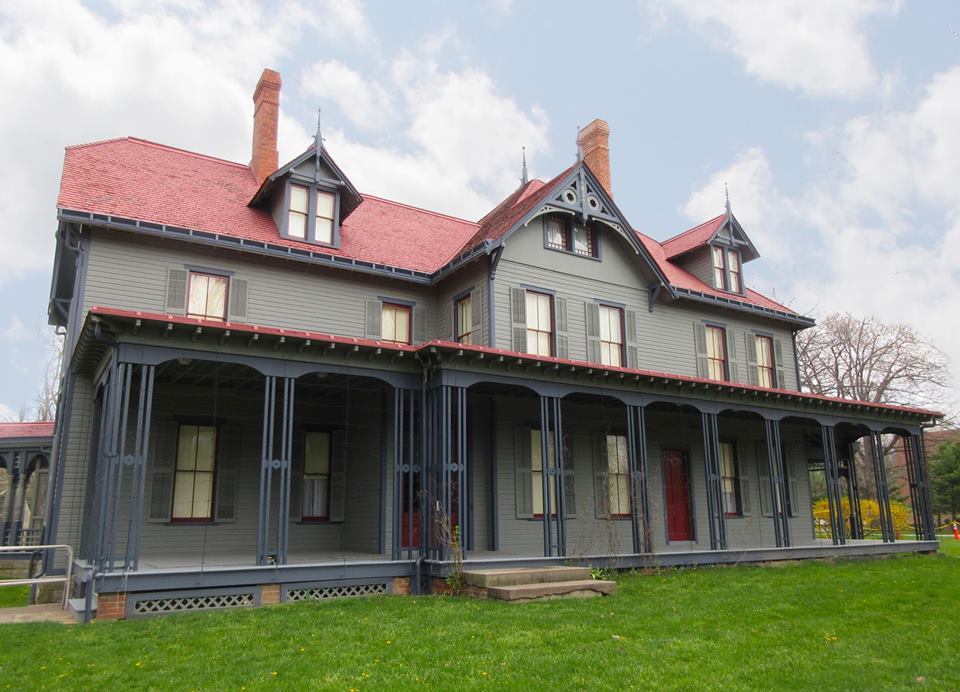
    <summary type="html"><![CDATA[<p><strong><em>"Do you think my name will have a place in human history?" — James A. Garfield, 1881</em></strong></p><img src="https://clevelandhistorical.org/files/fullsize/09f5423699901ef71093237d4ee90f12.jpg" alt="James A. Garfield National Historic Site" /><br/><p>In 1876, James A. Garfield was looking for a new home in his congressional district for himself and his family. He reflected in his diary, “Spent most of the day in examining some farms which are for sale. Made the Widow Dickey an offer of $115 per acre for her farm… and think it will result in a purchase. I must get a place where I can put my boys to work and teach them farming. I think this farm will always be worth the price I offer, and probably more by and by.” Mrs. Dickey sold her property to Garfield in 1876; a purchase Garfield never imagined would impact his family for decades. </p><p>In 1880, Garfield expanded the nine-room farm house to a twenty-room home. At this point in his career, he had been selected as the Republican candidate for the 1880 presidential election. As people learned of Garfield’s nomination, they started to come and visit. Initially, Garfield had been told by his political friends that it was not the responsibility of candidates to run their own campaign. Rather it was the political party’s job to run the campaign for him. Garfield ultimately decided to address the people coming to his home, and gave speeches on his front porch. As a result, Garfield is considered the first presidential candidate to run a front-porch campaign. </p><p>Garfield was inaugurated as president on March 4, 1881, and served until his death on September 19, 1881. Garfield was shot by an assassin Charles Guiteau on July 2, 1881, and lived for another eighty days. During that time, a subscription fund was created to help support his wife and the children. On October 15, 1881, when the fund closed, Lucretia Garfield was given a total sum of $360,000. She placed a majority of this money into savings bonds, leaving her with more than enough money to live on and to support her family. Garfield was eventually laid to rest at the <a href="https://clevelandhistorical.org/items/show/400">Garfield Memorial</a>, located in <a href="https://clevelandhistorical.org/items/show/76">Lake View Cemetery</a> in Cleveland. </p><p>The former First Lady moved the family back to the Mentor home. She had become very concerned about Garfield’s legacy, and feared that people would not remember him. A new addition to the house would encompass a grand memorial library to store all of Garfield’s books, as well as his personal papers. Besides the memorial library, the addition would provide kitchen space, servants' bedroom space, and a full third story. Changes were made to both the interior and the exterior of the house, and additional buildings were also added to the property to create a "country" estate aesthetic. As the Garfield children settled down with their own homes and families, their mother became worried about what was to become of her home. Her son Harry later reflected, “As mother remarked to us at one time, she would not have us make a white elephant of a home that had yielded so much to us…”</p><p>Lucretia Garfield died in 1918. What to do with the home became a great debate among the Garfield children. Although the siblings wanted to keep peace among themselves, they managed to find flaws in each other’s suggestions. When their Uncle Joe, who had been living in the home, died in 1934, the children were forced to deal with the situation head-on. The children ultimately decided that the best thing for the home and its contents, was to donate them as a museum for the enjoyment and education of future generations.</p><p><a href="https://clevelandhistorical.org/items/show/32">The Western Reserve Historical Society</a> (WRHS) accepted the donation of the home, in 1936. The home opened to the public in August of the same year. In 1938 the WRHS decided to form a new chapter of their group. The primary responsibility of the chapter would be for the “preservation of historical documents pertaining to the county and article of historic interest with the idea of housing them in one central place, the President Garfield Memorial Home…” as well as the, “…stimulation of greater interest in the national shrine.” By 1955 the Lake County chapter of WRHS was incorporated and its name changed to the Lake County Historical Society (LCHS). The main interpretation done at the home for the next several decades consisted of house tours and pamphlet interpretation for visitors, with a museum on the third floor of the home. LCHS also used the Garfield home as a headquarters building and as a space to interpret general county history. The organization hosted larger events such as Civil War battle reenactments, patriotic remembrances for President Day, and even large holiday celebrations with Victorian decor.</p><p>Congress authorized the establishment of James A. Garfield National Historic Site (JAGNHS) as a unit of the National Park Service on December 28, 1980. The act permitted the site to enter into an agreement with the WRHS to maintain, operate, and interpret the historic property. The National Park Service completed ten years worth of historical research and documentation of the site. In 1984 LCHS moved to a new location. This meant that the Garfield home and artifacts were intact and in the home, but still in the care of WRHS. In the 1990s, Congress allocated $12.5 million for the restoration of the home and property. This provided funding not only for the restoration on the interior and exterior of the home, but also for the adaptive reuse of many of the historic structures on the property. </p><p>The restoration of the Garfield home was completed in 1998, and the site re-opened to the public. The site continued to be co-managed by the NPS and WRHS for the next ten years. It was not until 2008, due to heavy financial constraints, that WRHS decided to relinquish their operation rights to the NPS. After this occurred the site finally became a true National Park. The NPS has designated the period of significance for the Garfield home to start with James A. Garfield’s campaign in 1880, continuing past his death and through most of his family’s life in the home, up to 1904. This allows the Park to tell not only Garfield’s story and his significance to history, but also that of his wife and children, and what they did to honor his legacy.</p><p><em><strong><a href="https://clevelandhistorical.org/items/show/856">For more (including 15 images) view the original article</a></strong></em></p>]]></summary>
    <published>2018-11-21T19:48:39+00:00</published>
    <updated>2026-04-17T19:17:42+00:00</updated>
    <link rel="alternate" type="text/html" href="https://clevelandhistorical.org/items/show/856"/>
    <id>https://clevelandhistorical.org/items/show/856</id>
    <author>
      <name>Rebekah Knaggs </name>
    </author>
  </entry>
  <entry>
    <title type="html"><![CDATA[Franklin Circle Christian Church: Where President James A. Garfield Once Preached]]></title>
    <summary type="html"><![CDATA[<img src="https://clevelandhistorical.org/files/fullsize/3b4100769484ca69b4430f418a6b6dec.jpg" alt="Franklin Circle Christian Church" /><br/><p>The origins of the founding of Franklin Circle Christian Church, located at 1688 Fulton Road, lie in America's Second Great Awakening, an early nineteenth century movement which was characterized by a resurgence in religious enthusiasm and a diversification in Christian religious groups.  Northeastern Ohio became a center of this new religious fervor and home to a number of new Christian religious groups, including the Mormons (Kirtland), the Shakers (Warrensville Township), and the Amish (Holmes County).  In this era, as Cleveland State University history professor David Goldberg taught his graduate history students, Ohio beckoned to religious enthusiasts much like a century or so later California would beckon to altruistic baby boomers. </p><p>The Disciples of Christ, which founded Franklin Circle Christian Church in 1842, was another new Christian group that grew out of the Second Great Awakening and found fertile ground for its new religion in northeastern Ohio.  The Disciples of Christ were adherents to the religious philosophy of Thomas and Alexander Campbell, father and son ministers, who urged Christians to put aside the doctrinal differences that divided different sects and return to the principles of the primitive Christian Church.   In 1848, the parish built its first permanent church on Franklin Circle.  It was large and cavernous and was known to its parishioners as "God's Barn."  Three decades later, the parish hired the noted Cleveland architectural firm of Cudell and Richardson to design a new church on Franklin Circle--on a parcel of land just south of "God's Barn."  The new church was built in the years 1874-1875 and has become one of the oldest and best known landmarks on the near west side of Cleveland. </p><p>Franklin Circle Christian Church and the Disciples of Christ have a long history of promoting education and engaging in social activism in northeastern Ohio.  In 1850, the Disciples of Christ founded the Western Reserve Eclectic Institute, which later became known as Hiram College.  Future United States President James A. Garfield was a student at the new college in the early 1850s and returned to it in 1858 to become President of the College.  In 1857, Garfield also served as pastor at Franklin Circle Christian Church.  The Church's members also included fervent supporters of the nineteenth century Temperance and Prohibition movements.  Long time parishioner Abraham Teachout, a lumber merchant who lived on Franklin Avenue, was the church's Sunday School Superintendent for 25 years in the late nineteenth century.  In 1884, he ran for Congress on the Prohibition ticket and remained a fervent Prohibitionist until his death in 1912.</p><p>Franklin Circle Christian Church today continues to engage in educational programs and social activism that serve a constituency very different from the Franklin Avenue neighborhood of the nineteenth century.  Today, the Franklin Avenue neighborhood is home to many working class and immigrant families.  The Church's outreach programs minister to the needs of this new community.</p><p><em><strong><a href="https://clevelandhistorical.org/items/show/537">For more (including 8 images) view the original article</a></strong></em></p>]]></summary>
    <published>2012-08-15T07:56:14+00:00</published>
    <updated>2026-04-17T19:17:39+00:00</updated>
    <link rel="alternate" type="text/html" href="https://clevelandhistorical.org/items/show/537"/>
    <id>https://clevelandhistorical.org/items/show/537</id>
    <author>
      <name>Jim Dubelko</name>
    </author>
  </entry>
  <entry>
    <title type="html"><![CDATA[James A. Garfield Memorial: Cleveland&#039;s Monument to a Fallen President]]></title>
    <summary type="html"><![CDATA[<img src="https://clevelandhistorical.org/files/fullsize/0815d1ec3ec92e5260f4402719794328.jpg" alt="Front Elevation, 2014" /><br/><p>James A. Garfield was born on November 19, 1831, in a log cabin in Orange Township. His father passed away when he was only 18 months old, leaving his mother to fend for herself and her family. Garfield started working at an early age to try to keep his family out of poverty. His first job--working on the Ohio Canal--was only the beginning. During his lifetime, the hardworking Garfield ably filled a number of positions and jobs. Among his many occupations, he served as a minister, lawyer, war hero and general in the volunteer Union Army, president of Hiram College, Republican state representative and senator, and finally the President of the United States of America. </p><p>Marking the pinnacle of Garfield's achievements in terms of position, his presidency lasted only 200 days. It is the second shortest presidency in U.S. history (only "beaten" by William Henry Harrison who died of pneumonia-related causes on his 32nd day in office). It spanned from March 4 to Sept. 19, 1881, when he died from a gunshot wound inflicted by his assassin Charles J. Guiteau.</p><p>A committee was formed for the memorial of Ohio's third President. J. H. Wade was its president, and many other notable citizens were involved as well, including Rutherford B. Hayes and John D. Rockefeller. They wanted to build a structure that would do justice to the nation's slain hero. An international competition was held for artists and architects to compete for the task and honor of designing the memorial. For that reason, a notice was sent throughout the U.S., England, Germany, Italy, and France. In the end, the job was awarded to George Keller of Hartford, Connecticut, as the committee favored his design. Construction of the 180-foot-tall memorial began in Cleveland's Lake View Cemetery on October 6, 1885, and the memorial, which sits astride the Cleveland–Cleveland Heights border, was dedicated on May 30, 1890.</p><p>The tomb of President Garfield is located inside the memorial. It is entered through the portico from a terrace. There are five bas-reliefs inside the memorial, with more than 108 life-size figures, showing Garfield in the role of schoolteacher, statesman, and president. Sculpture work inside of the tomb is by Casper Buberl. The statue of Garfield, prominently displaced in the center of the circular chapel, is the creation of Alexander Doyle. The marble used by Doyle was taken from the famous quarries near Carrara, Italy, which were first opened by Leonardo da Vinci.</p><p>An interesting detail was revealed in an interview with the architect George Keller. Keller told that the five bas-reliefs show some famous Americans. There are depictions of  Chief Justice Waite, General Sherman, ex-President Rutherford B. Hayes, Chester Arthur, John A. Logan, Carl Schurz, James G. Blaine, and many others. The sculptor Buberl had also included depictions of himself, the architect, the sculptor's assistant, and even the foreman of the plaster casters of Perth Amboy Terra Cotta works. Furthermore, on the interior in the mosaic frieze, the artist Mr. Lonsdale had introduced a portrait of the architect's infant daughter. These little details were obviously introduced unobtrusively.</p><p>The memorial has required repeated preservation work in the past several decades. In 1984, the memorial was closed for major restorations including repairing the walls, floors and roof in addition to restoring the stained-glass windows. The cemetery received a $500,000 federal grant to help pay for the restoration work, which was completed in time for a rededication ceremony on Memorial Day in 1985. More recently, a multimillion-dollar restoration project aimed to mitigate more than century of wear and tear, including repointing the mortar and performing the first cleaning of the sandstone exterior. The scaffolding came down in 2020, 130 years after the monument's completion, revealing an edifice that again looks much as it did a decade after President Garfield's death.</p><p><em><strong><a href="https://clevelandhistorical.org/items/show/400">For more (including 8 images&#32;&amp;&#32;3 audio files) view the original article</a></strong></em></p>]]></summary>
    <published>2012-01-24T10:44:44+00:00</published>
    <updated>2026-04-17T19:17:38+00:00</updated>
    <link rel="alternate" type="text/html" href="https://clevelandhistorical.org/items/show/400"/>
    <id>https://clevelandhistorical.org/items/show/400</id>
    <author>
      <name>Ashley Hardison</name>
    </author>
  </entry>
  <entry>
    <title type="html"><![CDATA[Lake View Cemetery: Cleveland&#039;s Garden Cemetery]]></title>
    <summary type="html"><![CDATA[<img src="https://clevelandhistorical.org/files/fullsize/c5cf6774e56288b828fff27f810103c4.jpg" alt="The Haserot Angel" /><br/><p>One afternoon in the summer of 1869 Liberty Holden was riding down Euclid Avenue when he noticed a beautiful forested green space with rolling hills. Holden suggested the spot to the Lake View Cemetery Association as the perfect place for the cemetery they were planning. The Association bought the 211-acre spot and transformed it into the first rural cemetery in Cleveland.</p><p>The rural cemetery (or garden cemetery) movement in the United States began on the East Coast during the early nineteenth century. Mount Auburn Cemetery in Cambridge, Massachusetts (established in 1831), Laurel Hill Cemetery in Philadelphia, Pennsylvania (1836), and Green-Wood Cemetery in Brooklyn, New York (1838) are considered the nation’s first three rural cemeteries, and they laid the pattern that many other American cities would follow in establishing their own rural cemeteries. </p><p>Before the rural cemetery movement, most urban burial places were located in churchyards. The move from burial places in the city to a rural setting happened for a multitude of reasons. The first reason was many burial grounds in the city occupied prime locations eyed for commercial development. The second issue that led to the foundation of rural cemeteries was that the capacities of these burial grounds were reaching their limits. Yellow fever in New York led to high mortality rates. Mass graves, bodies being kept in church cellars, and the generally poor condition brought up concerns about respect for the dead. The condition of the burial grounds was also threatening to compromise public health. In particular the gas fumes from dead bodies were noxious. The final reason for the establishment of rural cemeteries was a change in view of nature. Nature came to be seen as beneficial for human health. Those who planned the first rural cemeteries responded by taking the natural landscape into consideration in their designs. </p><p>The rural cemetery movement was also called the garden cemetery movement because rural cemeteries, with their emphasis on cultivated nature, doubled as parklands. Rural cemetery planners drew inspiration from English gardens. Mount Auburn was the brainchild of Dr. Jacob Bigelow, a medical doctor and botanist. With the support of the Massachusetts Horticultural Society, the cemetery included a botanical garden. The cemetery, along with providing a place for burials, was a green space for the city of Boston and a popular destination for locals and tourists alike. Rules were implemented and updated in order to manage the number of visitors in respect of those buried and their families. The rural cemetery movement therefore helped with the creation of separate city parks. </p><p>Lake View Cemetery mirrored these predecessors in its creation. Jeptha H. Wade, Joseph Perkins, and Henry Bolton Payne were the first group to discuss the creation of a rural cemetery in Cleveland. Through their efforts, the Lake View Cemetery Association was organized on July 28, 1869. The Association looked for picturesque locations for the cemetery and acquired 211 acres (now 285 acres) east of Cleveland between Euclid Avenue and Mayfield Road. The Association brought in Adolph Strauch, a well-known gardener, landscaper, and the superintendent of Spring Grove Cemetery in Cincinnati. Spring Grove was another well-known early rural cemetery designed by John Notman, who had previously designed Philadelphia’s Laurel Hill Cemetery. Lake View had hills and valleys with peaks high enough to look out over Lake Erie and still see the city. Parts of the land were densely forested. A few streams were located on the property that were planned for use in creating manmade lakes. Strauch laid out the walking paths and the lot boundaries before filling in where the trees and plants should be placed. His method involved accentuating the natural features of the landscape. </p><p>Not only did Lake View mirror Mount Auburn, Laurel Hill, and Green-Wood in its conception but also in its later regulation of visitors. These regulations reflected one of the intended aspirations for rural cemeteries besides merely housing the dead. The cemetery served as a place of moral education as well as a beautiful landscape with grand monuments, including memorials to President James A. Garfield, John D. Rockefeller, and Jeptha Wade. If the solemnity of its statuary failed to inspire, cemetery rules instructed visitors on how to act while on the grounds and guide toward solemn remembrance. An 1882 column titled “Lake View Cemetery: Not a Picnic Resort” brought complaints made by lot owners and family of the buried to the public's attention. Its author described the fanfare associated with visiting President Garfield’s memorial but emphasized the issue of strangers setting up picnics on grave monuments and the crowds trampling the grounds. There was a call for regulation on Sundays that led to implementation of ticketing for admittance to follow the same action taken at Green-Wood and Spring Grove cemeteries. </p><p>Once among the only substantial cultivated green spaces in reach of Clevelanders, Lake View Cemetery became less novel by the turn of the twentieth century, when newly opened city parks began to lure recreation-seekers away. Nevertheless, Lake View continued to attract visitors with its variety of plants, trees, and flowers. In the 1940s Dr. William Weir cultivated more than 170 varieties of daffodils and donated a large collection of bulbs to Lake View. The bulbs were planted in a three-acre portion of the cemetery with more being added each year. With more than one hundred thousand bulbs, Daffodil Hill has become a perennial attraction enticing visitors back to Lake View Cemetery yearly to see them in bloom.</p><p><em><strong><a href="https://clevelandhistorical.org/items/show/76">For more (including 9 images&#32;&amp;&#32;5 audio files) view the original article</a></strong></em></p>]]></summary>
    <published>2010-11-03T12:12:39+00:00</published>
    <updated>2026-04-17T19:17:37+00:00</updated>
    <link rel="alternate" type="text/html" href="https://clevelandhistorical.org/items/show/76"/>
    <id>https://clevelandhistorical.org/items/show/76</id>
    <author>
      <name>Jasmine Prezenkowski</name>
    </author>
  </entry>
</feed>
