<?xml version="1.0" encoding="UTF-8"?>
<feed xmlns="http://www.w3.org/2005/Atom">
  <title type="text">Cleveland Historical</title>
  <updated>2026-05-02T04:44:16+00:00</updated>
  <generator uri="http://framework.zend.com" version="1.12.20">Zend_Feed_Writer</generator>
  <link rel="alternate" type="text/html" href="https://clevelandhistorical.org/"/>
  <link rel="self" type="application/atom+xml" href="https://clevelandhistorical.org/items/browse?output=rss2"/>
  <id>https://clevelandhistorical.org/</id>
  <author>
    <name>Cleveland Historical</name>
    <uri>https://clevelandhistorical.org</uri>
  </author>
  <link rel="hub" href="http://pubsubhubbub.appspot.com/"/>
  <entry>
    <title type="html"><![CDATA[Charles W. Chesnutt: A Life Devoted to Battling America&#039;s &quot;Color Line&quot;]]></title>
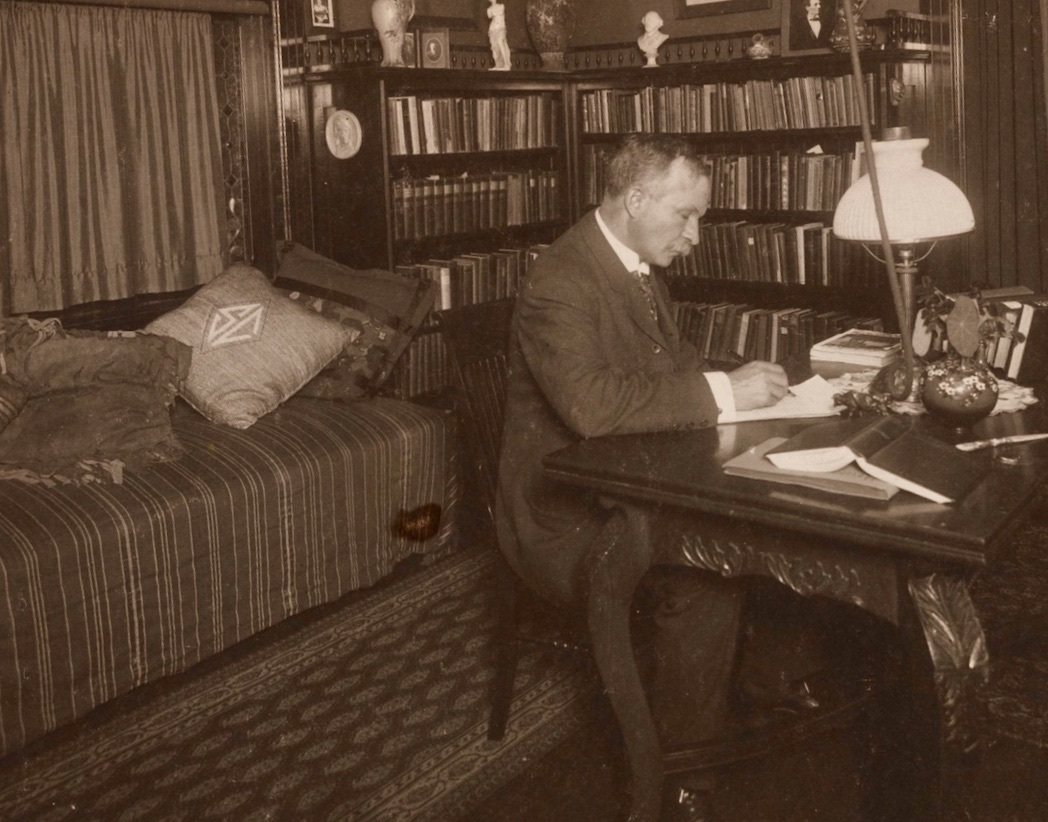
    <summary type="html"><![CDATA[<p><strong><em>"I should not want this fact [of my race] to be stated in the book, nor advertised unless the publisher advised it; first, because I do not know whether it would affect its reception favorably or unfavorably, or at all; secondly, because I would not have the book judged by any standard lower than that set for other writers. If some of these stories have stood the test of admission into <em>The Atlantic</em> and other publications where they have appeared, I am willing to submit them all to the public on their merits." – Letter of Charles W. Chesnutt to Houghton, Mifflin & Co., Summer of 1891.</em></strong></p><img src="https://clevelandhistorical.org/files/fullsize/0796553bef18cf7af45666eb9e56ba46.jpg" alt="Charles W. Chesnutt in his Library" /><br/><p>Charles W. Chesnutt was the first commercially successful American fiction writer of mixed race. While he experienced much early success with the short stories he penned in the last two decades of the nineteenth century, his efforts at the beginning of the twentieth century to become equally successful as a novelist failed because of the unwillingness of the American public to buy a sufficient number of his books. America was at that time just not yet ready for novels that exposed at length and in great detail the ugliness and ridiculousness of the "color line" that then existed in the U.S., a line which — though applied in different ways in the North and South — nonetheless in all places limited persons of color from fully exercising their rights and liberties, simply because of the color of their skin.
After the commercial failure in 1905 of his third novel, <i>The Colonel's Dream</i>, Chesnutt, at age 47, gave up on <em>his</em> dream — with that novel being the final one published during his lifetime. Had Chesnutt's contemporary, Mark Twain, been similarly discouraged in his literary career at a similar age, many of his novels that we have all come to know, love and cherish, would never have been written. Following Chesnutt's death 27 years later in 1932, his works were, for decades, largely forgotten. In the 1960's, they experienced a short-lived revival, but it wasn't until the early twenty-first century that critics and readers alike finally began to recognize the literary brilliance of his work and his unique insights into the problems of race in America in the post-Civil War/pre-Harlem Renaissance period.
Charles Waddell Chesnutt was born in Cleveland, Ohio, on June 20, 1858. His parents, Andrew Jackson Chesnutt and Anna Marie Sampson, both of whom were biracial and free, had fled their hometown of Fayetteville, North Carolina in 1856, because the rights and liberties of free blacks living in the South were being severely curtailed in that decade which led up to America's Civil War. While Andrew Chesnutt initially headed to Indiana to live with an uncle there, Anna Sampson, her mother Chloe and her stepfather Moses Harris headed to Cleveland where, since the early 1850s, biracial families from North Carolina and other Southern states had been settling in an area of the city near Hudson (East 30th) Street, north and south of what is today Central Avenue. There, these families — almost all of whom were headed by men who were carpenters, masons or other tradesmen — had formed a small but vibrant biracial community amid a white population composed mostly of German and Irish immigrants. Among the biracial families who had settled there earlier in the decade was the Cicero M. and Sarah Harris Richardson family. Cicero was a mason by trade who later became a "plasterer." Census and other public records suggest that Sarah was very likely a niece of Moses Harris.
Upon arriving in Cleveland, Moses Harris, who was a carpenter by trade, purchased (according to County tax records) a house on Hudson Street that was just a few houses from the home of Cicero and Sarah Richardson. The following year, Andrew Chesnutt left Indiana, moved to Cleveland, married Anna Marie Sampson, and became a member of the Harris household. A year later, Charles Waddell Chesnutt was born. Except for parts of the years 1859 and 1860, when his parents temporarily relocated to Oberlin, Ohio, Charles Chesnutt spent the first eight years of his life growing up in his grandparents' house on Hudson Street. He likely played with both black and white children who lived nearby and, though there are no extant school records to confirm it, he likely attended, at least for several years, nearby Hudson Street School (later, Sterling School), an integrated public elementary school which was founded in 1859 and which stood on the southwest corner of Sibley (today, Carnegie) Avenue and Hudson, less than a quarter-mile walk from his home.
In these early years of his life in Cleveland, Charles Chesnutt would have also been witness to significant events in the neighborhood like the construction in 1864 of the original Shiloh Baptist Church on Hudson, just down the street from his grandparents' house. Undoubtedly, he would have thought it cool that his relative and neighbor, Cicero Richardson, a founder of that church, played a significant role in the ceremonial laying of the cornerstone for the new church by "the order of colored masons" on August 1st of that year. Moreover, in addition to the impact upon him of this event and his likely attendance at Hudson Street school, young Chesnutt would have likely also been impacted, or shaped, by the nearby Richardson family, which occasionally would expand with visits by Sarah Richardson's mother and siblings who had moved to Cleveland in the late 1850s, where they lived on Ohio Street (today, Carnegie Avenue near East 14th Street). He perhaps would have been most affected by visits from Sarah's brilliant younger brothers, Robert and Cicero Harris, who, in the early 1860s, were young adults. These brothers, just a few years later, would play an even greater role in the shaping of Charles Chesnutt.
In 1866, shortly after the end of the Civil War, Andrew Chesnutt, who had served in the Union Army, was persuaded by his white father, Wadell Cade, to move his family back to Fayetteville where his son Charles attended Howard School, a segregated school for black children. Robert Harris, that same brilliant brother of Sarah Richardson, who, like the Chesnutts, had also moved back to Fayetteville after the war, served as the first principal of that school. Harris recognized Charles' talents as a student, and, when Charles graduated early from Howard School at the age of 14, Harris recommended him to his younger brother Cicero, a teacher at Peabody School in Charlotte, for an assistant teacher position. After teaching for three years in Charlotte under Cicero Harris' guidance, Charles was called back to Fayetteville in 1875 by Robert Harris to become a teacher at Howard school which had been converted into the State Normal School for training black teachers.
The next eight years were busy and significant ones for Charles Chesnutt. In 1877, he married fellow teacher, Susan Yu Perry, and by 1880 the two were parents of daughters Ethel and Helen. In that same year, principal Robert Harris, the man who had had enormous influence on the shaping of Charles Chesnutt, died suddenly. Chesnutt, at age 22, was picked to succeed him as principal of the State Normal School. The job paid well and was prestigious, but Chesnutt soon became dissatisfied with it. As a journal he kept from 1874 to 1882 noted, he had long fantasized of moving back to the North where he believed more opportunities, including the possibility of becoming a writer, awaited him.
So, in the spring of 1883, Charles Chesnutt resigned his position as principal of the school in Fayetteville and moved to New York. There he obtained a job as a reporter for Dow, Jones & Co., but, after six months, he decided that Cleveland, where he had been born and had spent his early years, would be a better fit. He moved to Cleveland in the fall of that year, obtaining employment as a clerk in the accounting department of the newly organized Nickel Plate Railroad. The following year, his wife and children (including his son Edwin, born while Chesnutt was away in New York) joined him in Cleveland where they all moved into a rented house on Wilcutt Avenue (today, East 63rd Street) in the Central (today, Fairfax) neighborhood.
From 1883 to 1888, the Chesnutts rented several different houses in the Fairfax and Central neighborhoods. Finally, in 1888, they were able to purchase their first house, one that was located on Brenton (East 73rd) Street, just south of Cedar Avenue, an upscale area of the Central neighborhood. In these early years that followied his return to Cleveland, Chesnutt was very busy with new employments, both as a stenographer (for which he had self-trained in North Carolina) and as an attorney — which he began practicing after "reading" the law and receiving the highest test score on the Ohio bar exam in 1887. Still, despite all this, he managed to find time in 1885 to turn his atttention to his dream job and in that year began writing for publication fictional stories about people of color learning how to exercise their rights and live their lives in the Reconstruction South.
In December 1885, Charles Chesnutt's first story (as an adult writer) was published. Titled "Uncle Peter's House," it was about a former slave who tried to build a nice house for his family but failed during his lifetime because of the predatory sharecropping system instituted in the South in the post-Civil War period. The story was purchased by the McClure newspaper syndicate and appeared in a number of newspapers in the country, including the Cleveland Herald. Over the next two years, Chesnutt wrote a number of other stories about the post-War South that appeared in various newspapers and magazines. In 1887, his recognition as a writer reached new heights when his story, "The Goophered Grapevine" appeared in the nationally-known <em>Atlantic Monthly</em>.
Thereafter, during the years 1887-1900, Chesnutt published forty-seven short stories in the <i>Atlantic </i>and other magazines and newspapers, some of these painting a graphic picture of life for newly freed slaves in the South and others showing how, even in the North, color mattered, albeit in different ways than in the South. In early 1899, two collections of his stories were published as books — one, <i>The Wife of his Youth</i>, consisting of stories about the "color line" in the North, and the other, <i>The Conjure Woman</i>, on stories of life for blacks in the post-war South. After these two books were published, William Dean Howell, an author himself and noted literary critic, praised Chesnutt, adding more glitter to his growing reputation as a great American writer.
After the successful debut of his first two books in 1899, Chesnutt sat down with his wife Susan and, after reviewing their family budget, they agreed that he could, for at least a two year period, close his attorney and stenographer offices and devote all of his time to his dream job of becoming a novelist. Over the course of the next two years, he wrote two novels that were published, <em>The House Behind the Cedars</em> (1900) and <em>The Marrow of Tradition</em> (1901). Each treated what was then a very sensitive subject — the first, intermarriage between a white man and a black woman, and the second — inspired by the Wilmington, North Carolina massacre of 1898 — white supremacy and violence against Southern blacks who sought to exercise their rights as citizens. Neither book sold well and both were panned by critics for being too moralistic and by angry white Southerners who claimed they were filled with lies. Chesnutt, after seeing the poor book sales and the negative reviews, decided it was time to step back and reopen his offices as an attorney and stenographer, which he did in the new Williamson Building in downtown Cleveland in early 1902.
As noted at the beginning of this story, Charles Chesnutt's novel writing all but came to an end several years later in 1905 with the publishing of <i>The Colonel's Dream</i>. For Chesnutt himself and certainly for his family, it may not have been the worst result because, in addition to allowing him to write what he wanted about the race problem in America, and how he wanted to write it, he also now became free to pursue other important matters of both a personal and professional nature, including becoming a member of and participating in the Rowfant Club's literary work in Cleveland in 1910 (after the Club had rejected his initial membership application on account of his race in 1904); supporting the founding in 1915 of the Playhouse Settlement House, which later was renamed Karamu House; corresponding at length with other black intellectuals; traveling with his family across the United States and around the world; and lecturing, whenever called upon to do so, on the problems of America's "color line," always delivering thoughtful opinions on how it might best be finally erased in this country. And Charles W. Chestnut continued in such activities for the rest of his life.
When he died peacefully in his house on November 15, 1932, at the age of 74, his death was front page news for the Plain Dealer. All in all, despite the existence of racism in America and its impact upon him as a biracial man, Charles W. Chesnutt led a very enviable and comfortable life. He owned a grand house in an upscale, integrated neighborhood; he was respected by his peers, both white and black, in Cleveland — something that he had often dreamed about as a young black man growing to adulthood in Fayetteville, North Carolina; and he witnessed all of his children going to college and obtaining the degrees that had been denied to him. (Three of his children attended and graduated from Ivy League schools.) Perhaps then, it would be fair and not inappropriate to say that who suffered most from the premature ending of Chesnutt's career as a novelist was not he but we, the American public, who have been deprived ever since of reading the best novels that he never wrote.</p><p><em><strong><a href="https://clevelandhistorical.org/items/show/1052">For more (including 19 images) view the original article</a></strong></em></p>]]></summary>
    <published>2025-03-02T22:24:58+00:00</published>
    <updated>2026-04-17T19:17:40+00:00</updated>
    <link rel="alternate" type="text/html" href="https://clevelandhistorical.org/items/show/1052"/>
    <id>https://clevelandhistorical.org/items/show/1052</id>
    <author>
      <name>Jim Dubelko</name>
    </author>
  </entry>
  <entry>
    <title type="html"><![CDATA[African American Museum of Cleveland: Icabod Flewellen&#039;s Dream ]]></title>
    <summary type="html"><![CDATA[<img src="https://clevelandhistorical.org/files/fullsize/d78d197a863c1fd79cd03fa1e5eb65d8.jpg" alt="The African American Museum" /><br/><p>Icabod Flewellen founded the first independent African American museum in the United States. In his home at 8716 Harkness Avenue, Flewellen chartered the Afro-American Historical and Cultural Society in 1953. His vision was the preservation and dissemination of information regarding the contributions of individuals of African descent. He hoped to educate young people about the positive contributions of African Americans to the cultures of the world, and to eliminate distorted portrayals and images of African Americans. </p><p>At age 13, Icabod Flewellen began collecting newspaper clippings about African American history. He drew inspiration from the writings of the Jamaican author J. A. Rogers, a self-trained historian, novelist, and journalist who spent most of his life debunking pseudo-scientific and racist depictions of people of African ancestry while popularizing the history of persons of black people around the world. Flewellen’s passion was also inspired by the lack of African American history in American classrooms. As he told the <em>Cleveland Plain Dealer</em>, “My daddy, who was a railroad brakeman, used to tell me of the great black inventors on the railroad. Every now and then we found a self-motivated teacher who would throw in a few things that weren’t in the textbooks, but still, we got very little Black history.” </p><p>Flewellen graduated from high school in the mid-1930s and began working for the Civilian Conservation Corps (CCC), a New Deal program created in 1933. At the age of 23, Flewellen went to West Virginia State University and enrolled in the National Youth Administration (NYA), another New Deal program, but ended up switching to the Civil Pilot Training Program. In 1942 Flewellen was drafted into the U.S. Army and served in North Africa in the quartermaster's service. </p><p>His first collection, located in his West Virginia home was, he said, “exceedingly rich with historical material.” While Flewellen served in the military, he asked his neighbor Mr. Pryor to store his collection in his garage. Unfortunately, most of the collection was lost when a firebomb thrown by white supremacists destroyed the garage. Flewellen was honorably discharged from the Army in 1945 and he moved to Cleveland. After his return from the military, Flewellen stated, “They were people who did not like what I was doing.” Undeterred, within a few years after moving to Cleveland, Flewellen had essentially transformed his home into a museum. It was so stuffed with portraits, letters, documents, books, busts and sheet music that he barely had room to sleep and eat. Seeking to institutionalize his activity, Flewellen helped organize and became president of the Afro-American Cultural and History Society, the first such organization in the U.S. With the help of the AACHS and his neighbors, Flewellen’s collection continued to grow. </p><p>In 1964, Flewellen’s and the AACHS’s accomplishments were recognized by the “Parade of Progress,” a national exhibition held at Cleveland’s Public Hall. A portion of Flewellen’s collection was on display as one of fifty displays set up by the National Service Center. Flewellen never tired of his role in bringing African American accomplishments to the public’s attention, including Garrett Morgan’s invention of the traffic light, Charles Drew’s work in perfecting blood plasma, and John Green’s role as the father of Labor Day. As Flewellen observed, “The Negro child doesn’t realize how great is his heritage. My goal is to let the Negro child know his ancestors were something besides just slaves.” Flewellen hoped his exhibition at the “Parade of Progress” would help create interest in the museum he wanted to build. </p><p>Flewellen opened his first museum outside of his home in a tiny classroom in the old school building behind St. Marian Catholic Church at 2212 Petrarca Avenue near Cedar Avenue and Fairhill Road in 1968. The next location was briefly located at the old Bell building at 1839 East 81st Street. Finally, in February 1983 it moved to the Cleveland Public Library’s decommissioned Treasure House building at 1765 Crawford Road in Hough.</p><p>By the 1970s, African Americans were being heard. Yet in spite of the fact that Black culture and history were increasing in popularity, the Afro-American Cultural and Historical Society faced extinction in a month’s time unless support and a benefactor could be found. The AACHS became a victim of the Black movement’s success. “It’s a really big thing these days,” said Flewellen. “There’s so many people jumping on the bandwagon with Black movements at universities, colleges, and other things who have much more funds and facilities than we do, we don’t find it easy to get support like that.” After seventeen years of struggling to keep his organization going, Flewellen's fortunes still appeared dim.</p><p>By 1985, a rift between founder and museum board over managerial and financial concerns forced Flewellen out. The group disbanded, which broke his heart. He saw his life’s work wasted. When his dream could not be a reality, he arranged for his entire collection to be donated to the East Cleveland Public Library upon his death, which came in 2001. Much of his life’s work lies in a wing of the library called The Flewellen Collection. </p><p>The African American Museum has provided cultural awareness, education about Black history, and community events, in addition to a collection of artifacts that represent a holistic view of the African Diaspora experience. Because of the vision and sacrifices made by Icabod Flewellen and countless others to document and display the accomplishment of African Americans and people of African descent, the National Museum of African American History and Culture was born. President Barack Obama spoke at the groundbreaking ceremony February 22, 2012, and on September 24, 2016, the museum opened – a long-imagined dream come true that would have made Flewellen proud.</p><p><em><strong><a href="https://clevelandhistorical.org/items/show/897">For more (including 10 images) view the original article</a></strong></em></p>]]></summary>
    <published>2019-12-06T19:11:43+00:00</published>
    <updated>2026-04-17T19:17:42+00:00</updated>
    <link rel="alternate" type="text/html" href="https://clevelandhistorical.org/items/show/897"/>
    <id>https://clevelandhistorical.org/items/show/897</id>
    <author>
      <name>Linda Mack</name>
    </author>
  </entry>
  <entry>
    <title type="html"><![CDATA[Rainey Institute: Building on Anna Edwards&#039; Dream]]></title>
    <summary type="html"><![CDATA[<p><strong><em><span style="font-weight:400;">If Anna M. Edwards, the first Director (then called "Superintendent") of the Eleanor B. Rainey Memorial Institute could attend an El Sistema concert today, she would probably at first be surprised that the Institute was involved in such a thing. But once she came to understand what music, and other visual and performing arts, programs at Rainey were doing for the children of Cleveland's Hough neighborhood, she would, while perhaps personally noting the irony of it all, be very pleased.</span></em></strong></p><img src="https://clevelandhistorical.org/files/fullsize/360e45df2b1005232b7d844e311585b0.jpg" alt="Willson Avenue Industrial Institute" /><br/><p>Anna M. Edwards dreamed of a career in music. Born in the Dayton, Ohio, area in 1849, she was the daughter of a Presbyterian minister who had moved his family to Cleveland near the end of the Civil War. Here, she attended local schools and then studied music at the Oberlin Conservatory of Music. By 1870, she was teaching music at the Lake Erie Seminary (today, Lake Erie College). However, when she was just 25 years old, her music career came to an end as a result of her involvement in the Women's Crusade (1873-1874), a national protest movement by women against America's saloon keepers. Edwards, according to her friend Edith Stivers, was persuaded by Frances Willard, legendary temperance reformer and women's suffragist, to give up her music career and go to work for the Woman's Christian Temperance Union (WCTU), a national organization led entirely by women that grew out of the Crusade and which was formally organized here in Cleveland in 1874.  </p><p>Edwards became the WCTU's Superintendent of Scientific Temperance Instruction for Ohio. This position required her to travel around the state, and later around the country, giving temperance lectures wherever she went. After a decade or so of this exhausting work, she began spending more of her time working at the non-partisan WCTU mission on St. Clair Street (St. Clair Avenue) near Willson Avenue (East 55th Street). The mission was located in a neighborhood that was brimming with saloons and home to many Eastern European immigrants, especially Slovenians. One day, according to accounts by several of her contemporaries, Edwards saw several young boys making a delivery of beer to a local saloon. They were drinking the "dregs" of the beer they were delivering and appeared to be intoxicated. Witnessing this was an epiphany for her. She decided then and there to devote the rest of her life to keeping boys like these away from saloons.</p><p>In 1888, Edwards took over the chairmanship of a WCTU reading room located on Willson Avenue, re-energized the neighborhood "Band of Hope" (a temperance pledge youth group), and opened the Flag Coffee House (so-called because of the flags she placed in its windows). The coffee house openly and actively competed with nearby saloons by offering boys a full dinner and a cup of coffee for just ten cents. Her work with the boys of this neighborhood eventually caught the attention of Eleanor B. Rainey, the widow of a wealthy Cleveland industrialist, who offered to provide Edwards with a larger and better facility for her work.  Rainey purchased a lot on the northeast corner of Willson and Dibble Avenues and built on it a three-story, 9,000-square-foot building, designed in the Tudor style by architects Badgley and Nicklas to resemble a large house. Officially called the Willson Avenue Industrial Institute, it opened in 1904. It had offices, and reading and game rooms, on the first floor; classrooms and a gymnasium on the second floor; and a custodian's apartment on the third floor. (Walfred and Anna Danielson, immigrants from Sweden and Canada respectively, and their son Harold, lived in that apartment and worked for the Institute for much of the period 1904-1940.)  </p><p>Just one year after the Institute opened, it was faced with a crisis that threatened its continued existence. Eleanor Rainey, its benefactor, suddenly died. The crisis was resolved when her heirs stepped in and agreed to continue their mother's support of the Institute's work, and the non-partisan WCTU (later known as the Women's Philanthropic Union) agreed to rename the Institute the "Eleanor B. Rainey Memorial Institute."  For the next half-century, the operations of Rainey as a settlement house were funded by Eleanor Rainey's heirs, particularly by her daughter Grace Rainey Rogers, who became sole owner of the building on East 55th Street and Dibble Avenues in 1931 and the sole surviving child of Eleanor Rainey in 1938. During this period, Rainey Institute functioned as a traditional settlement house, offering instruction in industrial trades for boys, home economics instruction (and also stenography and bookkeeping) for girls, and youth recreational activities. One of the young Slovenian boys who benefitted from these programs was Frank Lausche. He grew up to become Cleveland mayor (1942-1944), Ohio governor (1949-1957), and one of Ohio's United States Senators (1957-1969).</p><p>Anna Edwards served as superintendent of Rainey Institute until her death in 1923. She was succeeded by her younger sister, Flora, who served until her death in 1949. Upon her death, Flora Edwards was succeeded by Jessie Peloubet, whose mother was a close friend and associate of the Edwards sisters. Already 67 years old when she became superintendent, Peloubet faced many challenges during the decade of the 1950s. In 1957, the Goodrich settlement house moved from E. 31st Street to a location on E. 55th Street just up the street from Rainey Institute. The new Goodrich-Gannett neighborhood center, and several local organizations that provided funding to Cleveland settlement houses, put pressure on Rainey to either close, merge with Goodrich-Gannett, or move elsewhere. </p><p>Additionally, the decade of the 1950s saw the Hough neighborhood in which Rainey was located undergo racial transition, changing from primarily white and middle or working class in 1950 to primarily African American and working or lower class by 1960. Finally, the estate of Grace Rainey Rogers, Rainey's benefactor, who died in 1943, remained in administration well into the 1950s, forcing Peloubet to deal with estate executors and trustees in New York for the Institute's operational expenses. In 1955, pursuant to the terms of Rogers' will, the Rainey Institute land and building were finally conveyed from the estate to a newly formed non-profit corporation and a board of trustees was appointed that was charged with the financial management of an endowment left by Rogers for the continuing operating expenses of Rainey. </p><p>The record is silent as to how well Peloubet addressed these challenges, but by the end of 1959 she was no longer Rainey's superintendent, and, for a six-month period, Rainey was administered by League Park Center, Inc., a social services agency that was located, like Rainey, in the Hough neighborhood. According to an article which appeared later in the Cleveland Press on May 19, 1964, Rainey almost closed during this period. Shirley Lautenschlager, a social worker with a degree from Western Reserve University's School of Applied Social Sciences, was hired by the board of trustees in June 1960 to become the new director, of Rainey--the title of "superintendent" apparently having been discarded. Lautenschlager, who noted that, when she arrived, Rainey was functioning as little more than a recreation center, instituted a number of new social programs at Rainey that were intended to serve Hough's current population, including after school care for seven to twelve year olds; activities for teenagers including game rooms, clubs, and dances; and gardening, cake decorating and sewing classes. Several years later, in 1964, following the taking of a survey in the Hough neighborhood, Rainey also began offering piano lessons to the children of Hough. These and other music classes proved so popular with the neighborhood's parents and children that two years later Rainey Institute decided to concentrate its efforts solely in the field of music, becoming an affiliate of Cleveland Music Settlement in 1966. The institute also appointed a new Director that year who had a background in both music and social work.</p><p>For Rainey Institute, Zandra Richardson, the new Director hired in 1966, was like the second coming of founder Anna Edwards. Like Edwards, Richardson came to Cleveland from the Dayton area, and like Edwards, Richardson's first love was music. Both Edwards and Richardson became involved in social services because of their desire to help children in need and both ultimately worked for more than four decades helping children in what is today Cleveland's Hough neighborhood. Zandra Richardson, who served as Director from 1966 until 2008, left a deep imprint on the history and evolution of Rainey Institute as an arts center for underprivileged children. During her tenure, many new music and other arts programs were introduced at Rainey. One of the earliest new programs was a summer camp program promoted by Cleveland Music Settlement and Karamu House in 1967, the first summer following the 1966 Hough Riots. At summer camp, African American children were introduced to art, drama, African drumming, vocal music and dance. Several years later, Rainey expanded the summer camp program to include drama, art and music, and dance. Kids attending also received instruction in reading, math, and creative writing, and participated in recreational activities.</p><p>As time passed, Rainey's focus as a music and arts center gradually changed as theater and dance became more popular than music instruction. As a result, in 1997 Rainey severed its affiliate status with Cleveland Music Settlement. During first half of Richardson's directorship, she and Rainey's Board of Trustees, anchored by long-time trustee Theodore Horvath who worked tirelessly to preserve Rainey Institute's endowment, also initiated a long-term plan to build a new and larger facility so that more children in Hough and other nearby neighborhoods could be introduced to the visual and performing arts. In 2011, just three years after Richardson retired as Director, and with the guidance of new Director, Lee Lazar, many Cleveland businesses and charitable organizations, and Cleveland Councilwoman Fannie Lewis, Rainey Institute opened its new 27,500-square-foot Arts Center, just down the street from the old Rainey Institute building. In the same year as the new Arts Center opened, Isabel Trautwein, a violinist with the Cleveland Orchestra, established an El Sistema string orchestra program at Rainey. El Sistema, one of the most notable programs at Rainey today, promotes peaceful social change through music.</p><p>Under the directorship of Richardson and her successors, there have been many success stories at Rainey, of students who went on to have fulfilling careers in many different fields of endeavor ranging from music to government service to teaching to the business world. One of those former Rainey students is Stephanie D. Howse, an African American woman who had a successful career as an environmental engineer, before turning to public service and becoming State Representative from Ohio's 11th District. Today, Rainey Institute is a thriving art center, each year serving more than 2,500 children like Howse who hail from the Hough and other nearby neighborhoods of the City of Cleveland. </p><p>And the old Rainey Institute Building? It has not been forgotten by the City of Cleveland, which made it a Cleveland Landmark in 2018. From an early twentieth-century settlement house founded by a woman who gave up a career in music to help immigrant children threatened by saloons to a twenty-first century arts center, which uses music and other visual and performing arts to cultivate self-expression and promote social emotional growth in a new demographic of disadvantaged children in the neighborhood, Rainey Institute has come full circle, a statement with which Anna M. Edwards would certainly agree, even if she did find it ironic.</p><p><em><strong><a href="https://clevelandhistorical.org/items/show/869">For more (including 17 images) view the original article</a></strong></em></p>]]></summary>
    <published>2019-05-02T21:58:59+00:00</published>
    <updated>2026-04-17T19:17:38+00:00</updated>
    <link rel="alternate" type="text/html" href="https://clevelandhistorical.org/items/show/869"/>
    <id>https://clevelandhistorical.org/items/show/869</id>
    <author>
      <name>Jim Dubelko</name>
    </author>
  </entry>
  <entry>
    <title type="html"><![CDATA[Luther Moses House: A Cleveland Landmark that did not find  its Savior]]></title>
    <summary type="html"><![CDATA[<p><strong><em>The house was one of the oldest and most historic residences in Cleveland's  Hough neighborhood.  And that's saying a lot, because Dunham Tavern Museum, just a mile or so away, is located in the same neighborhood.</em></strong></p><img src="https://clevelandhistorical.org/files/fullsize/97ebaaee58bed93ec97998bb4bf90f73.jpg" alt="The Luther Moses House " /><br/><p>It was widely believed that the house which once stood at 5611 Lexington  Avenue was built in 1854 by pioneer Cleveland shipbuilder,  Luther Moses.  However, the house, which was originally designed in a vernacular style exhibiting  elements of Gothic, Greek Revival and Federal architecture, may have been nearly a decade older than that.  County tax and deed records suggest that Luther and his wife Arvilla, who in the 1840s had been living in Ohio City near his shipyard, moved in 1848 to East Cleveland Township, onto a 100-acre lot southeast of the intersection of Superior Street (Avenue) and Willson Avenue (East 55th Street).  The tax records further suggest that they took possession under a land contract and that, when they arrived, there was already a house on the property, one which was likely built in 1845 by early Cleveland merchant, real estate developer, and renowned house builder, Philo Scovill.  Finally, the tax records note that, in 1852, Luther was taxed for an "addition to house"--which was perhaps a one-story addition on the east side of the house observable for many decades--an improvement to the property that Luther may have delayed constructing until he acquired legal title, which occurred in 1851.  </p><p>So, was the house built in 1845 the same house that until recently sat at 5611 Lexington, or was the house at 5611 Lexington a newer house built on the property in 1854? That mystery may not be easily solved, but it is clear that Luther and Arvilla Moses lived in the house, which originally had a front entrance facing west toward Willson Avenue, until the early 1870s. Before that decade arrived,  Luther retired from the shipbuilding business and focused for a time on farming the 30 acres he had retained from his original 1851 land purchase. His farming days came to an end in the 1870s when East Cleveland Village--East Cleveland Township had become a village in 1866--was annexed to its fast-growing neighbor to the west, Cleveland. Anticipating (or perhaps even promoting) this annexation, Luther and Arvilla  Moses submitted a plat to East Cleveland village in 1871, proposing to create a  residential subdivision with 68 lots, most of them fronting new Moses Avenue. The subdivision was approved in 1872, the same year that East Cleveland was  annexed to Cleveland, and also, sadly for Luther, the same year that Arvilla Moses died. </p><p>As a result of the development of the new subdivision, the Luther Moses House acquired a street address of 1220 Moses Avenue (and likely also a new front entrance facing the new street). That street address became 1220 Lexington Avenue a few years later, when, in anticipation of the centennial of the Declaration of Independence, Moses Avenue was renamed Lexington Avenue.  In 1906 the house acquired its current address when Cleveland enacted legislation, among other things, renaming many of the city's north-south streets as numbered streets, and at the same time renumbering houses and other buildings on east-west streets with numbers indicative of their approximate location from a particular numbered street.</p><p>Within a month of his wife's death, Luther Moses moved from the house and put it up for sale.  It remained unsold for seven years--though it was rented out for several of those years--until it was purchased by Rosetta Scowden, the wife of renowned Cleveland engineer, Theodore Ransom Scowden. In 1852, Scowden, who had designed a water works system for the City of Cincinnati, came to Cleveland and designed this city's first system.  Because of the effects of Cleveland's early industrialization and population growth on the Cuyahoga River and Lake Erie, drinking water was becoming dangerously contaminated, leading to cholera and other disease epidemics. To combat this contamination and disease, Scowden designed a waterworks that included  an intake pipe that went well out into the Lake where the water was cleaner, an engine house near the shoreline that pumped the clean water uphill from the Lake, and a reservoir that held and distributed this water to Cleveland residents.</p><p>The Scowdens had become wealthy as a result of Theodore's engineering work here and elsewhere. They lived in a grand house on Euclid Avenue for years before retiring to their "cottage" in 1879, as Rosetta Scowden referred in her will to the Moses House. The Scowdens unfortunately did not live to enjoy many years of retirement in the house. Theodore died  in 1881, just two years after the house was purchased, and Rosetta the following spring in 1882. Upon her death, the house passed to their daughter Josephine, who had married Charles Gaylord, a Civil War veteran whose maternal grandfather was General Erastus Cleaveland, a hero in the War of 1812 and a cousin of Cleveland's legendary founder.</p><p>The Gaylords, who owned the house from 1882 until 1910, were the last family to occupy it as a single family residence for an extended period of time. When Josephine Gaylord died in 1910, her husband moved from the house and it was sold to Arnold and Pauline Roth who purchased it with the intention to convert it to a multifamily dwelling. The Roths made extensive changes to the exterior, as well as to the interior of the house, including replacing the front porch which extended along the entire south side of the house with a shortened two-story porch, adding a second floor to the addition on the east side of the house, and constructing an exterior two-story stairwell for tenant access on the north side of the house. In 1913, shortly after the reconstruction was completed, the Roths sold the house to local physician Dr. John H. Belt.</p><p>The Belt family owned and managed 5611 Lexington Avenue as absentee landlords for the next thirty years. As housing conditions in the Hough neighborhood declined, the condition of the Luther Moses House slowly did too.  The last owners of the house--Steve Matt Skrita, a Croatian immigrant, who owned the house from 1948 to 1963, and the African American Beatrice Landon family, who purchased it from Skrita in 1963--lived on site in one of the suites while renting out the others. However, after the death of Beatrice Landon in 1991, the Landon family struggled unsuccessfully to maintain it, and the condition of the house declined precipitously until the last owner, Herbert Landon, was compelled because of its condition to sell it to the County Land Bank in 2017.</p><p>Since at least 1987, when it was landmarked by the City of Cleveland, the Luther Moses House had been recognized in the community as one of the historic jewels of the Hough neighborhood. In recent years, that neighborhood has begun to rebound from its long decline, with new businesses opening up, new housing going up, and the renovation of historic League Park (just down the street from the Luther Moses House). During this period, continuing efforts were made by the City, the County, and even the Landon family, to save the house. It was the subject of well-researched articles, including one that appeared in the Cleveland Plain Dealer in 1995, and three that appeared in Christopher Busta-Peck's locally famous "Cleveland Area History" blog in 2009 and 2011.  In 2019, final efforts were made by the Cleveland Restoration Society to save the historic house. It was not an easy task, as efforts to save a similar historic house on the City's west side--the William Burton House on West 41st Street--have demonstrated.  While the William Burton House was eventually saved and restored, unfortunately, despite the efforts of many organizations, the Luther Moses House was not.  In September 2020, the 175-year old landmark was razed.</p><p><em><strong><a href="https://clevelandhistorical.org/items/show/849">For more (including 12 images) view the original article</a></strong></em></p>]]></summary>
    <published>2018-10-04T21:18:38+00:00</published>
    <updated>2026-04-17T19:17:42+00:00</updated>
    <link rel="alternate" type="text/html" href="https://clevelandhistorical.org/items/show/849"/>
    <id>https://clevelandhistorical.org/items/show/849</id>
    <author>
      <name>Jim Dubelko</name>
    </author>
  </entry>
  <entry>
    <title type="html"><![CDATA[Charles F. Schweinfurth Residence: The Unostentatious Home of the Man that Molded Beauty  ]]></title>
    <summary type="html"><![CDATA[<p><strong><em>"So you may know my life has been a happy and busy one, if at times, architecturally lonesome." – Charles F. Schweinfurth</em></strong></p><img src="https://clevelandhistorical.org/files/fullsize/3c1c1eb54472a74b8b786aba07c8bbc1.jpg" alt="Front of Schweinfurth Residence" /><br/><p>As you look around Cleveland – attuned to the city's built landscape – you may not know it, but you are looking at many structures designed by the renowned architect Charles Frederick Schweinfurth. He envisioned the most expensive private residence, Mather Mansion, built on the acclaimed Millionaires' Row and erected his masterpiece Trinity Episcopal Cathedral. Schweinfurth's "sound mentality and intellectual discipline of a high order, supplemented by a thorough mastery of technical knowledge" sounded through in the design of the Union Club, and the stone bridges that accent the Cultural Gardens. Not only did Schweinfurth design these beautiful architectural works of art, he lived and thrived in the urban landscape that he was charged with making so aesthetically pleasing. During his successful tenure as one of Cleveland's master architects, Schweinfurth also conceived his own private residence on East 75th Street, formerly known as Ingleside Avenue. </p><p>What became the Schweinfurth residence was originally proposed for one of his clients W.K. Vanderbilt. In his book <em>Cleveland Architecture 1876-1976</em>, Eric Johannesen notes that "Vanderbilt was chairman of the Lake Shore & Michigan Southern Railroad" and a member of the famed robber baron family. Nevertheless, these plans fell through for unknown reasons and Schweinfurth took control of the property and set forth to design a home that truly expressed his own stylistic flare. In 1894, Schweinfurth's Romanesque Revival unostentatious home was completed. Schweinfurth occupied the home from 1894 until his death in 1919. In 1915 he "enlarged the original house … to provide [for an] additional dining area and space for servants and guests, as well as [a]…small conservatory." Over time, the lots down E. 75th Street were procured and the wealth of Euclid Avenue flowed off of the main artery onto the side streets. But then the area took an unimagined turn. </p><p>White flight to the suburbs changed the character of the neighborhood. The mansions and other grand homes were either boarded up, torn down, or chopped up by slum landlords eager to make a quick buck at the expense of the new predominantly African American clientele. The Schweinfurth home, no longer a private residence, continued after 1930 as the William L. Wagner & Son Funeral Home. The City of Cleveland turned away from the Midtown Corridor, leaving the people and structures to splinter into vermin riddled streets. A resident of E. 75th recalled looking out his "'window at the neighbor's house and watch[ing] the ground under the garbage cans writhe with rats.'" The Hough Riots of 1966, which were in no small way a response to the lack of investment in the area, did not propel the City of Cleveland or private investors to revive the area that "when Cleveland was a boom town… was the neighborhood in which to live." Banks only perpetuated the problem. Local banks redlined the neighborhood because it was overwhelmingly "occupied by persons at the bottom of the economic heap." It was not until 1970—when R. Van Petten and his partner Dale H. Smith purchased the former Schweinfurth property after convincing an African American bank to sign a loan agreement—that a twinkling of resurgence gleamed on the horizon. </p><p>Van Petten and Smith labored away, restoring the residence to its original simple elegance, while the rest of the street continued to suffer from urban decay. The new owners hoped that their personal investment in the area would encourage others to follow, but the home for decades remained an "oasis-in-the-desert." In the 1970s, Van Petten and Smith started a preservation movement in the Midtown Corridor that never quite caught. Once investment and economic recovery acts were implemented in the Midtown Corridor, new construction became the answer. Today the winding roads of infrastructure and the expanding Cleveland Clinic campus has architecturally sterilized much of the neighborhood. The former Schweinfurth residence remains an "architecturally lonesome" part of the Ingleside Historic District.</p><p><em><strong><a href="https://clevelandhistorical.org/items/show/810">For more (including 8 images) view the original article</a></strong></em></p>]]></summary>
    <published>2017-08-23T18:02:06+00:00</published>
    <updated>2026-04-17T19:17:41+00:00</updated>
    <link rel="alternate" type="text/html" href="https://clevelandhistorical.org/items/show/810"/>
    <id>https://clevelandhistorical.org/items/show/810</id>
    <author>
      <name>Sarah Nemeth</name>
    </author>
  </entry>
  <entry>
    <title type="html"><![CDATA[Father Albert A. Koklowsky: Hough’s “Slum Priest” and His Parish]]></title>
    <summary type="html"><![CDATA[<img src="https://clevelandhistorical.org/files/fullsize/63a4925674699764c9f3fcf2a75e76cf.jpg" alt="Ladies and Gentleman" /><br/><p>In the wake of the Civil Rights movement, the Hough Riots broke out in Cleveland in 1966, bringing attention to the predominantly African American community’s need for change. Growing racial tension between blacks and whites crippled Hough, like similar racially transitioning neighborhoods in many cities in the 1960s. Father Albert A. Koklowsky, pastor of Our Lady of Fatima Parish, heard the plea for reform.</p><p>Father Koklowsky was born in Clifton, New Jersey, and attended St. Joseph’s Preparatory Seminary in Holy Trinity, Alabama, in 1929. He was ordained in the Order of Missionary Servants of the Most Holy Trinity in 1944. Father Koklowsky worked at parishes in North Carolina (1946), Mississippi (1953-1958), and Puerto Rico (1958) prior to being transferred to Our Lady of Fatima. </p><p>Our Lady of Fatima Church was founded in 1949 and was built where the former League Park movie theater stood across Lexington Avenue from League Park. The first pastor to serve the church was Rev. Raymond Smith. In 1958, the Missionary Servants of the Most Holy Trinity took charge of Our Lady of Fatima Parish. Father Koklowsky was transferred to Our Lady of Fatima Parish in 1963 to serve the members of the growing Spanish-speaking Puerto Rican population that St. Agnes Church was not able to serve. The two parishes later merged to form St. Agnes–Our Lady of Fatima. </p><p>Father Koklowsky’s goal for the Hough community was to help rehabilitate housing and assist African Americans with job training and placement. Sister Henrietta Gorris C.S.A. and several nuns from the Sisters of Charity assisted Father Koklowsky. They began their work in Hough by educating the residents with techniques on how to keep their houses and themselves clean. They later began to work on housing projects on Lexington Avenue.</p><p>The first renovation that Father Koklowsky worked on was an apartment complex  attached to Our Lady of Fatima’s rectory. Father Koklowsky turned the apartment complex into a convent and community center. This project would provide new housing for Sister Henrietta and three other nuns belonging to the Sisters of Charity of St. Augustine. He would later refurbish housing on Lexington Avenue for members of the community. These residents would pay rent to HOPE Inc.</p><p>Father Koklowsky started HOPE Inc. in 1965, a private non-profit developed for projects that the city of Cleveland was unable to assist. Father Koklowsky’s weekly column in the Catholic Universe Bulletin provided the goals and visions he had for Hough to be achieved through HOPE Inc.  This column was entitled “a voice from the slums” and would feature the story of a different person in the community each week. The readers of the column learned how they could help those who lived in Hough. </p><p>The column readers assisted Father Koklowsky and Our Lady of Fatima by donating and raising funds to restore houses or initiate public programs. The parish also utilized the publicity generated through the Plain Dealer to gain funds and create connections with contractors and lawyers, who donated their time to assist Father Koklowsky and Our Lady of Fatima with their project. </p><p>Father Koklowsky was transferred to Sacred Heart Chapel in Lorain, Ohio, on September 1, 1969. He left behind the foundations of housing rehabilitation through his private non-profit HOPE Inc., which was underfunded.  HOPE Inc. clung to life until the 1980s when it faded into obscurity, but was far from completing its task of revitalizing Hough.</p><p><em><strong><a href="https://clevelandhistorical.org/items/show/785">For more (including 6 images) view the original article</a></strong></em></p>]]></summary>
    <published>2017-02-21T21:12:16+00:00</published>
    <updated>2026-04-17T19:17:41+00:00</updated>
    <link rel="alternate" type="text/html" href="https://clevelandhistorical.org/items/show/785"/>
    <id>https://clevelandhistorical.org/items/show/785</id>
    <author>
      <name>Elizabeth Cielec</name>
    </author>
  </entry>
  <entry>
    <title type="html"><![CDATA[HOPE Inc.: The Rise and Fall of a Grassroots Housing Movement ]]></title>
    <summary type="html"><![CDATA[<img src="https://clevelandhistorical.org/files/fullsize/0eea3aee2f820465e420014624392286.jpg" alt="Belvidere Avenue, 1950" /><br/><p>The mid- to late 1960s were a very turbulent time of demonstrations and uprisings in scores of major American cities. One such riot erupted in July 1966 in Hough, a troubled inner-city neighborhood on Cleveland’s East Side. In the year before the riot, Hough seemed to be mostly forgotten and feelings of helplessness were on the rise. The University-Euclid Urban Renewal Project, announced at the start of the decade, was supposed to leverage spending on campus improvements by University Circle institutions to trigger federal funds for redevelopment and rehabilitation in adjacent Hough, but the program was poorly administered and, if anything, worsened the plight of the neighborhood. Although most observers tend to fixate on the loss of hope, several grassroots groups decided to take matters into their own hands. One such group was created in June 1965 from a plan by Rev. Walter E. Grevatt Jr. and Fr. Albert A. Koklowsky to fix up dilapidated houses in Hough and then sell them to poor families in need. This organization was called Housing Our People Economically, or HOPE Inc. Despite their good intentions, this isn’t a story with a happy ending.</p><p>HOPE Inc.’s first rehabilitation, an apartment house at 6516 Hough Avenue, went successfully. However, when attempting to restore two more buildings on nearby Belvidere Avenue, their funds began to run dry and they had effectively stalled by January 1966. HOPE Inc. appeared unable to do even on a small scale what the larger urban renewal campaign was failing to do on a grand scale. The growing tension and lack of aid would mount until they boiled over, leading to the Hough riots. Things finally began looking up as HOPE Inc. became the first organization in the nation to receive federal rent subsidies. However, the election of Carl B. Stokes as mayor in November 1967 could be seen as the biggest turning point. Stokes wanted to improve race relations and revive inner-city Cleveland, ambitions that he packaged in his Cleveland: NOW! program starting in May 1968.</p><p>HOPE Inc. was able to finish the restoration of the Belvidere apartments and keep on going to other projects. The organization was even able to expand beyond house restoration, teaching classes and donating food and clothing to those in need. Other similar organizations also benefitted from Stokes’ success in lifting the federal government’s freeze on funding to Cleveland community development, as well as from the aid of some businesses like the Forest City Materials Company, which placed a prefabricated home on HOPE-owned property. With money coming from both local and governmental levels, projects began to be finished. Neighborhood revitalization finally seemed to be getting off the ground.</p><p>Unfortunately this wasn’t to last. Even at its best, the amount of restoration was nowhere near enough. While organizations like HOPE Inc., Better Homes for Cleveland Foundation, and Hough Development Corporation were moving, they were still somewhat underfunded and, admirable as their efforts were, it would likely have taken well over a decade fix up all of Cleveland’s inner-city neighborhoods even if they had proper funding. There was a growing impatience and general loss of faith not only in Cleveland but also for other similar programs across the nation thanks to the federal government’s retreat from President Lyndon Johnson’s War on Poverty. The event that killed Cleveland’s progress was the Glenville Shootout, which started July 23, 1968, and continued for five days. After the disorder, it came to light that the group that instigated the violence, headed by Fred “Ahmed” Evans, had bought weapons using funds gained from the Cleveland: NOW! and everything fell apart. Although Stokes won reelection in 1969, his political capital was so depleted that he didn’t run in 1971. Funding quickly began drying up along with faith in these programs in general. Government aid stopped not long after as Johnson’s War on Poverty was gradually dismantled in the years after Richard Nixon took office in 1969.  </p><p>Unfortunately, this is where the story ends, with inner cities far from restored and many of the organizations devoted towards helping revitalize them either closing down or being radically changed. HOPE Inc. would continue to cling to life throughout the 1970s, only to fade into obscurity in the early 1980s. </p><p><em><strong><a href="https://clevelandhistorical.org/items/show/780">For more (including 6 images) view the original article</a></strong></em></p>]]></summary>
    <published>2017-01-01T16:05:21+00:00</published>
    <updated>2026-04-17T19:17:41+00:00</updated>
    <link rel="alternate" type="text/html" href="https://clevelandhistorical.org/items/show/780"/>
    <id>https://clevelandhistorical.org/items/show/780</id>
    <author>
      <name>James Mastandrea</name>
    </author>
  </entry>
  <entry>
    <title type="html"><![CDATA[The Afro Set: Black Nationalism and Cleveland&#039;s East Side in the Late 1960s]]></title>
    <summary type="html"><![CDATA[<img src="https://clevelandhistorical.org/files/fullsize/ea57c0c0ce31388d691c350622a09504.jpg" alt="Mayor Carl Stokes and Harllel Jones Watch a Drill Team" /><br/><p>The vacant lot at 8127 Superior Avenue N.E. sits quietly in the midst of an East Side neighborhood that has seen a great deal of upheaval and civic unrest. In the late sixties, the lot was the home of the Afro Set Black Nationalist Party for Self Defense storefront as well as the headquarters of the group of the same name. Founded by Harllel Jones (later Harllel X) in late 1968, the Afro Set was largely a response to the rise of Black Nationalist sentiment due to escalating racial and socio-economic tensions that were prevalent not only in Cleveland but across the country. Jones had grown up in the East Side neighborhood of Hough, and his experiences there helped shape the Afro Set’s Nationalist core.  </p><p>Cleveland’s East Side was a victim of the migration to the suburbs that most urban centers suffered in the post-World War II era, and more critically, of the economic policies of the 1950s and 1960s that caused the rapid dereliction of what had become a series of predominantly black neighborhoods, with Glenville and Hough (the neighborhood where the Afro Set was located) suffering some of the worst decay and lack of governmental aid. Administrations prior to the election of Mayor Carl Stokes were marred by a racially conservative tendency to ignore urban neighborhoods, often tying up (or underfunding) desperately needed resources as well as ignoring the overpopulation, poor sanitation, and high unemployment rates in such areas. While Mayor Stokes’ programs such as Cleveland: NOW! were intended to address these issues, tensions in neighborhoods like Hough produced increasing levels of hostility towards even their own residents, with riots breaking out in the late 1960s following racial confrontations. Black Nationalists like those of the Afro Set would argue that such instances were almost inevitable given the charged atmosphere of the era. </p><p>Black Nationalism began as a movement predominantly among urban African Americans who focused on the belief in self-regulated black agency within the larger nation. As with the Civil Rights movement of the same era, Black Nationalists were concerned with the rights and discrimination that dominated postwar America, but the Nationalists were generally convinced that a nonviolent approach to the tensions between black communities and the establishment was ineffectual at best. Therefore Nationalist groups such as the Afro Set, while promoting black community values and a return to African culture, were more militarily inclined and also included a focus not just on black agency but also on separation of black society from the national whole.</p><p>The Afro Set was a beneficiary of the Cleveland: NOW! program, which represented Mayor Carl Stokes’ attempt to help blighted communities through a series of grants that were used in hopes of promoting a more positive urban experience. Jones’ Afro Set was not only a storefront that sold African cultural items and gave urban black youths a place to work, it was also meant to be a community and cultural institution where area people could come and hear lectures on prominent blacks such as Marcus Garvey and Malcolm X, as well as receive lectures on black culture in general. However, the message of black cultural identity tended to get lost in the coverage that men such as Jones received in the press: Black Nationalists were generally seen as overtly violent and communistic militants who threatened the status quo, and interviews from Jones and his compatriots tended to verbally confront the press and authority figures such as the police with thinly veiled threats and rhetoric. That is not to say that all Nationalists were focused on violent revolution, and even Jones did eventually move his focus to helping men reintegrate into the society that he had vehemently opposed; but the legacy of violence, and the bias shown towards groups like the Afro Set means that today’s urban blacks have little to show from an era that caused so much upheaval and social change; there are far too many vacant lots that are fading back into the landscape with their stories fading from memory.        </p><p><em><strong><a href="https://clevelandhistorical.org/items/show/777">For more (including 7 images) view the original article</a></strong></em></p>]]></summary>
    <published>2016-12-11T21:06:44+00:00</published>
    <updated>2026-04-17T19:17:41+00:00</updated>
    <link rel="alternate" type="text/html" href="https://clevelandhistorical.org/items/show/777"/>
    <id>https://clevelandhistorical.org/items/show/777</id>
    <author>
      <name>Toni Berry</name>
    </author>
  </entry>
  <entry>
    <title type="html"><![CDATA[Calvary Presbyterian Church: The Successful Integration of an Inner-city Congregation]]></title>
    <summary type="html"><![CDATA[<img src="https://clevelandhistorical.org/files/fullsize/9c4243b73966b09110c9a66acb00a934.jpg" alt="On the Corner of East 79th and Euclid Avenue" /><br/><p>On April 6, 1953, Dr. John Bruere, pastor of Calvary Presbyterian Church, mentioned that a "certain colored woman has been attending our services frequently of late." The appearance of an African American woman in the church's congregation "raised in his mind the question of segregation." Further discussion concerning the vices of racial segregation ensued during the Session meeting of Calvary's Elders. After some discussion the Elders agreed Calvary would stand opposed to racial segregation.  </p><p>Dedicated in 1890 on the corner of East 79th and Euclid Avenue, Calvary first catered to Cleveland's white elite. Women in fur coats and men dressed glamorously with top hats and overcoats, strolled down Euclid Avenue on Sunday mornings. They entered the church eager to socialize with their neighborhood acquaintances and spread their fortunate circumstances, in the name of religion, to less fortunate members of society. From the church's inception, Calvary's congregation prided itself on being a neighborhood church. </p><p>Since the church's founding, the surrounding community had made up the majority of the membership. As the elite left Euclid Avenue after the 1900s during the "flight to the Heights" phenomenon, Calvary chose to remain at its original location. When World War I created need for an alternative labor force, Cleveland factories turned to southern African Americans. In the ensuing Great Migration, southern blacks flooded into the central city, setting up residence predominantly in the Central neighborhood. By the 1950s, displacement due to urban renewal in Central caused African Americans to spread eastward into the neighborhoods surrounding Calvary. </p><p>Even before the influx of African American population, the neighborhoods surrounding Calvary had succumbed to neglect and visibly exuded a slum-like character. As African Americans moved in, they arrived in neighborhoods already tainted with poverty and despair. In the 1950s, with landlords' inattention to their properties and a lack of city housing inspections, slum-like conditions worsened. In addition, now racial tension accented the impoverished neighborhoods. </p><p>After Dr. Bruere had drawn attention to the question of racial segregation, Calvary's congregation emerged from behind the church's stone walls and filtered into the community. The congregation engaged with community members to clean up the neighborhood's houses and streets, close down bars, and rid the community of pesky vermin. In addition to polishing the surface of the neighborhoods, Calvary penetrated deep into the community to heal the wounds of racially spurred neglect. The programs aimed to instill pride, construct a new community image, and propagate the power of spirituality and morality to combat the negativity rampant in the neighborhoods. As a result of the cleanup programs, many area residents joined the church. Calvary's award-winning youth programs also attracted community residents. The Saturday Program aimed to keep the youth off the streets, providing a safe haven for children that came from broken homes. The church's free youth programs provided meals and educated the youth on practical skills. Calvary even had recreational sport teams. In the youth programs' heyday of 1966, WKYC-TV reported that, despite the Hough Riots, "nearly five thousand children" participated in Calvary's Saturday Youth Program.   </p><p>The betterment of the neighborhoods surrounding Calvary, as well as the promotion of social justice, remained the church's mission. Upholding the charter members' credo, Calvary remained a neighborhood church. During the 1950s and 1960s the nation struggled with racial segregation and discriminatory rhetoric. Calvary succeeded in achieving a racially integrated congregation through community outreach programs. By 1967, many saw Calvary as a beacon of social justice and activism in the inner city. </p><p>Calvary today continues to promote the same mission of social justice the church followed in previous decades. Through hot meal and childcare programs and cultivation of a welcoming atmosphere, Calvary still engages the community. A gradual decline of church attendance, however, forced Calvary pastors following Dr. Bruere to focus on membership retention and scouting. The racial congregational balance, once highlighted as one of the church's defining features, has since dissipated. Today Calvary Presbyterian Church, under the new name New Life at Calvary, has been described as one of "the largest predominantly African-American churches in Ohio." Regardless of the church's demographics, New Life at Calvary remains at the corner of East 79th and Euclid Avenue and continues to fight for social justice. New Life at Calvary remains a relevant fixture on Cleveland's east side. </p><p><em><strong><a href="https://clevelandhistorical.org/items/show/775">For more (including 8 images) view the original article</a></strong></em></p>]]></summary>
    <published>2016-12-06T23:07:36+00:00</published>
    <updated>2026-04-17T19:17:41+00:00</updated>
    <link rel="alternate" type="text/html" href="https://clevelandhistorical.org/items/show/775"/>
    <id>https://clevelandhistorical.org/items/show/775</id>
    <author>
      <name>Sarah Nemeth</name>
    </author>
  </entry>
  <entry>
    <title type="html"><![CDATA[Church Square: Hough&#039;s Neighborhood Shopping Center]]></title>
    <summary type="html"><![CDATA[<img src="https://clevelandhistorical.org/files/fullsize/0eb37f9d511a3d331d9d792bc24b0412.jpg" alt="Before Church Square" /><br/><p>In 1991 a derailed construction project had left an abundance of weeds and hills of mounded dirt in the vacant 19.3-acre lot that stretched from East 79th to East 84th Street between Euclid and Chester Avenues. The project to build a shopping center for east side Clevelanders had been postponed after its 1986 reveal, leading to a string of buyouts, sellouts, and revisions. However, from the efforts and dedication of NOAH (Neighbors Organized for Action Housing), the importance of the project was finally realized by the Cleveland City Council. The Church Square shopping plaza symbolized a crowning achievement in the undertaking to rejuvenate highly visible Euclid Avenue face of the Hough neighborhood. </p><p>NOAH started in response to the devastation left by the Hough Riots of 1966. The leaders of Calvary Presbyterian Church, St. Agnes Church, Glenville Presbyterian Church, and the Hough Community Council joined forces in 1968 to construct and/or advise the construction of adequate housing for the local residents of Hough. Calvary under the leadership of Rev. Roger Shoup provided the seed money to get the grassroots redevelopment project in motion. Along with Calvary's seed money, the group also obtained federal funds to jumpstart the housing project. NOAH sought opportunities to purchase land or locate buildings that could be rehabilitated. Even in the organization's infancy, NOAH envisioned that in a three-year period up to one hundred family units would be constructed or rehabilitated up to code. NOAH stood out as an organization as it championed a holistic approach towards the redevelopment of Hough and adjacent neighborhoods. </p><p>NOAH not only provided adequate family and single dwelling units for the Hough community residents. NOAH sought to rehabilitate not only housing in the area, but also the individual. Those who moved into one of NOAH's housing developments were encouraged to attend church programs and take advantage of counseling services. Church Square plaza was envisioned to complete this holistic aim of the project. Developers, from a stipulated string attached to the city council loan allocated to bail out the project, were required to hire local Clevelanders for the construction of the plaza and for permanent jobs. Church Square gave local residents, many of whom lived in NOAH housing like Rainbow Place apartments on the northwest corner of Euclid Avenue and East 79th Street, a place to seek employment opportunities. </p><p>Church Square was an important piece of a larger effort to revitalize the Fairfax and Hough neighborhoods. By 1992 the once-vacant lot on the northeast corner of East 79th and Euclid heralded the promise of economic advancement for the neighborhood. Church Square represented an important step towards achieving the successful revitalization of the Hough community. Church Square sought to provide a local and easily accessible place for community residents to do their shopping. The shopping plaza also offered middle-class shoppers speeding down Chester or Euclid Avenues from their suburban residences to downtown a quick stop to meet their consumer needs. With the promise of an influx in outside revenue and jobs for local residences, many fragile futures hinged on the success of Church Square. Today the notable hustle and bustle around the plaza symbolizes a piece of a comprehensive and successful grassroots effort to revitalize one of Cleveland's downtrodden districts.  </p><p><em><strong><a href="https://clevelandhistorical.org/items/show/774">For more (including 6 images&#32;&amp;&#32;1 audio file) view the original article</a></strong></em></p>]]></summary>
    <published>2016-12-04T11:40:38+00:00</published>
    <updated>2026-04-17T19:17:41+00:00</updated>
    <link rel="alternate" type="text/html" href="https://clevelandhistorical.org/items/show/774"/>
    <id>https://clevelandhistorical.org/items/show/774</id>
    <author>
      <name>Sarah Nemeth</name>
    </author>
  </entry>
  <entry>
    <title type="html"><![CDATA[Street Clubs of the East Side: &quot;We Do Our Own Thing Ourselves&quot;]]></title>
    <summary type="html"><![CDATA[<img src="https://clevelandhistorical.org/files/fullsize/1b2ca92c217f7880b4ce38ff4730531f.jpg" alt="E. 85th Street Club Cleanup, 1952" /><br/><p>In August 1940, residents on East 85th Street on Cleveland's east side decided to organize their efforts for the betterment of the their block and Mrs. Beatrice Beasley, a citizen of the street, founded the E. 85th Street Club. In its beginning stages, the E. 85th Street Club held meetings at members' homes routinely every month, whereas after the Fairfax Recreation Center was completed in 1958, meetings were held weekly. The street club served members from East 85th between Cedar Avenue and Central Avenue in Fairfax. The club was dedicated to doing good within its own block by holding an annual spring cleaning program, which entailed older members as well as the youth raking leaves, painting houses, whitewashing trees and curbs, and remodeling abodes. The organization also held a "Back to School" dance for the children, which included refreshments, prizes, and music disc-jockeyed by Eddie O'Jay, who was known for discovering and managing the R&B music group "The Mascots," later known as the legendary "O'Jays." Other community outreach events included giving fruit baskets to the sick, donating money to various Fairfax events, and holding neighborhood picnics and banquets.</p><p>"We do our own thing ourselves," "Improve, don't move" - These are the mottos that spearheaded street clubs into action. When federal urban renewal programs fell short in their attempt to stabilize urban neighborhoods, street clubs tried to fill the void. While the E. 85th Street Club's work may have been the most publicized, other street clubs took very similar actions to make their neighborhood a better place to live. Christmas parties, home renovations for the poor and elderly, and voiced opinions regarding community renewal were not unusual. Street clubs, also known as neighborhood clubs or civic clubs, were prominent especially on Cleveland's east side neighborhoods, such as Fairfax, Glenville, and Hough. An annual meeting called "Street Club Organization Day" started in 1968 to bring together street club presidents to lead combined efforts to address problems plaguing the community. Workshops were led by the Street Club Presidents League, as well as representatives of various community non-profit organizations such as Citizens for Better Housing Inc. and University-Euclid Development Center. Through the meeting, combined club efforts yielded clean-up campaigns and an award banquet. Street clubs also participated in yearly beauty contests known as "The Beautiful Block Contest" and "The Bright and Beautiful Contest," conducted by the Cleveland newspaper The Call & Post. Contests were judged based on appearance and the total house participation. While this encouraged blocks to clean and renovate homes, other streets sometimes experienced difficulty contending, for they were plagued by absentee landlords and even rats. Since then, street clubs and neighborhood associations have expanded to the outer parts of Cleveland, including Shaker Heights as well as the west side of Cleveland.</p><p><em><strong><a href="https://clevelandhistorical.org/items/show/666">For more (including 5 images&#32;&amp;&#32;1 audio file) view the original article</a></strong></em></p>]]></summary>
    <published>2014-08-13T20:46:48+00:00</published>
    <updated>2026-04-17T19:17:40+00:00</updated>
    <link rel="alternate" type="text/html" href="https://clevelandhistorical.org/items/show/666"/>
    <id>https://clevelandhistorical.org/items/show/666</id>
    <author>
      <name>Julie A. Gabb</name>
    </author>
  </entry>
  <entry>
    <title type="html"><![CDATA[Pla-Mor Roller Rink: Cleveland&#039;s Black Skating Mecca]]></title>
    <summary type="html"><![CDATA[<img src="https://clevelandhistorical.org/files/fullsize/10a90a3bf8f149d9744afb1e81b8ddec.jpg" alt="Pla-Mor Label" /><br/><p>For a generation in the 1940s-60s, Pla-Mor Roller Rink provided a much-needed recreational venue for all ages on the eastern end of the Cedar-Central (Fairfax) neighborhood and for a time was the only Black-owned skating rink in Cleveland. More than a place to skate, it also attracted top-billed musical acts.</p><p>On land now owned by Case Western Reserve University, Pla-Mor's location on Cedar Avenue at East 107th Street was a converted bus garage named the Coliseum, which opened in 1940. Built by the same syndicate that operated the Arena on Euclid Avenue, this multipurpose venue was intended for conventions, concerts, boxing shows, basketball games, and rollerskating. In 1942, Elmer "Al" Collins took over the "dark cavern," painted its interior, and opened the well-lighted Pla-Mor Roller Rink. He hired a full-time skating instructor and an organist to provide music for skaters. Not only did Collins enable many youths to compete in the National Roller Rink Operators Association that he founded, he also intervened in the fight against juvenile delinquency in Cedar-Central. In 1948 he even persuaded a "roving gang" that harassed the neighborhood to reconstitute as the Royal Dutchmen, a supervised social and athletic club that pledged to model constructive play for younger adolescents.</p><p>Pla-Mor hosted an array of events. Following World War II, the Negro Business Alliance of Cleveland sponsored the "Exhibit of Progress" several years in a row at the facility, drawing as many as 70,000 people to view displays and demonstrations of successful black enterprises, and in the latter half of the 1950s the Call & Post newspaper held its annual Home and Food Show there. The Future Outlook League, a civil rights organization founded in the 1930s, along with Black social organizations such as Coronet, the Ghana Club, and Les Charmantes, held lavish cabaret parties at Pla-Mor in the 1950s. Along with exhibitions and parties, the Pla-Mor ballroom attracted big-name music acts in the 1950s-60s, including Wynonie Harris, Dinah Washington, Frankie Lymon, the Marvelettes, and even B. B. King. In the late 1950s, DJs like WJMO's Ken Hawkins also spun records for dance nights.</p><p>But the Pla-Mor was best known for skating, which ranged from children's lessons to teen nights to skating shows such as those by the Roller Vanities. Racial discrimination contributed to Pla-Mor's popularity in the Black community. Although forbidden by law, segregation was common in Cleveland at mid century. From time to time, Blacks reported difficulties at Skateland, another popular roller rink at Euclid Avenue and East 90th Street. These problems seem to have escalated in the 1950s, when the adjacent Hough neighborhood transformed from 4 to 74 percent African American in only a decade. As late as 1955, after an interracial group of youth from Boys Town, Nebraska, went to Pla-Mor after exclusion from an undisclosed East Side rink, a spokesman at Skateland denied knowledge of the incident but openly admitted that the rink tried to deny African American entry except to private parties held by church or school groups. Although Skateland more openly hosted black events by the late 1950s, the Pla-Mor remained essential in the Black community.</p><p>In 1965 the Pla-Mor underwent renovation, and took the new name University Party Center. Count Basie's orchestra belted out jazz tunes at the Go-Go Girls Big Cabaret Party in June of the following year. It turned out to be the last of the storied shows at the place many still called the Pla-Mor. Just over a month later, the Hough Uprising broke out on Cleveland's East Side. The University Party Center went up in flames and, according to the Call & Post, was reduced to "twisted lengths of burned steel." Amid the chaos, the Townes family, who lived across the street, attempted to flee the danger in their 1957 Ford. When they drove through a nearby National Guard roadblock, police fired into their windshield, striking 16-year-old Diana Townes, who lost an eye. Four months later, the family's home also burned to the ground. </p><p>Today the mention of the Pla-Mor evokes bittersweet remembrances--both happy recollections of good times spent skating or dancing and sorrow for the roller rink's tragic end. Fondness for the good times led a handful of investors to reopen the former Euclid Rollerdrome as the new Pla-Mor in 2009 at 22466 Shore Center Drive in suburban Euclid, promising to keep the memory of its namesake alive. </p><p><em><strong><a href="https://clevelandhistorical.org/items/show/621">For more (including 6 images&#32;&amp;&#32;2 audio files) view the original article</a></strong></em></p>]]></summary>
    <published>2013-10-26T16:20:12+00:00</published>
    <updated>2026-04-17T19:17:40+00:00</updated>
    <link rel="alternate" type="text/html" href="https://clevelandhistorical.org/items/show/621"/>
    <id>https://clevelandhistorical.org/items/show/621</id>
    <author>
      <name>J. Mark Souther&amp;#32;&amp;amp;&amp;#32;Timothy Klypchak</name>
    </author>
  </entry>
  <entry>
    <title type="html"><![CDATA[East High School]]></title>
    <summary type="html"><![CDATA[<img src="https://clevelandhistorical.org/files/fullsize/f2140a01cf0d071fde65169f251a1dc6.jpg" alt="The Original East High" /><br/><p>East High School was coined a "20th-century schoolhouse" when it opened its doors on November 26, 1900. The "original" East High was the talk of the town, as no other school in the city could compete with the grandeur of the $180,000 brick school building that opened at East 82nd Street and Decker Avenue. The present building, constructed just to the northwest of the original, was built in 1975 at a cost of $17 million. The Cleveland Metropolitan School District closed the school at the end of the 2009-10 school year as part of the District's Transformation Plan. </p><p>The original East High School initially offered only three courses of study — classical, English, and scientific. It was run much like a city, as students elected a senior classmate as "mayor" and nine "judges" from each class, a practice that gave East High some of its uniqueness.  The motto "Noblesse Oblige" was adopted by East High's first principal Benjamin U. Rannells in 1900, providing the guidance that each graduating class carried on as it pursued life's endeavors. East High School was also known for its sports and won various titles and championships, both locally and statewide. "The Home of the Blue Bombers," with its blue and gold school colors, grew to more than 1,200 students within five years of its opening. "Eastites," as its students were called, proclaimed and believed in "nothing but the best."</p><p>Despite the fact that the new East High School was built in 1975 amidst a declining urban neighborhood, it continued to be the pride of the community until declining enrollment and security problems led to its closure in 2010. The vacant building, which suffered widespread damage at the hands of vandals and scrap thieves, underwent a $1 million renovation, reopening in 2013 as the East Professional Center, an administrative and training complex for a number of CMSD departments.</p><p><em><strong><a href="https://clevelandhistorical.org/items/show/290">For more (including 6 images) view the original article</a></strong></em></p>]]></summary>
    <published>2011-07-23T23:00:45+00:00</published>
    <updated>2026-04-17T19:17:38+00:00</updated>
    <link rel="alternate" type="text/html" href="https://clevelandhistorical.org/items/show/290"/>
    <id>https://clevelandhistorical.org/items/show/290</id>
    <author>
      <name>CSU Center for Public History and Digital Humanities</name>
    </author>
  </entry>
  <entry>
    <title type="html"><![CDATA[Hough Bakery]]></title>
    <summary type="html"><![CDATA[<img src="https://clevelandhistorical.org/files/fullsize/ac170364d78693ff21543bea96d3d400.jpg" alt="Pile Bros., 1945" /><br/><p>Memories of a signature blue-and-white, string-tied cake box filled with a streusel coffee cake, hot cross buns, sticky pecan rolls, coconut chocolate bars or an Easter "daffodil" cake evoke pure food nostalgia for anyone from northeast Ohio who fondly remembers the legendary Hough Bakeries. In almost nine decades, from 1903 to 1992, founder Lionel A. Pile and later his sons, Arthur, Lawrence, Kenneth and Robert, built a family business that grew from a single shop, located at 8708 Hough Avenue, to the largest multiple-unit bakery in Ohio, and one of the ten largest nationwide. </p><p>Through the years, Hough expanded into the suburbs, establishing branch stores in the Greater Cleveland area and neighboring communities in Cuyahoga, Lake, Summit, and Portage counties. Operations and corporate headquarters were at the old Star Bakery plant at 1519 Lakeview Road, which the family acquired in 1941. Despite the company's enormous success and diversification, its rising production costs, lack of modernization, and stiff competition caused continuing financial difficulties. On August 8, 1992, the Lakeview facility and the remaining 32 retail stores closed without notice, and Hough Bakeries filed for Chapter Seven bankruptcy. The catering division was sold to the I-X Center in Brook Park, and the company name and its recipes were purchased by Kraft Foods.</p><p>But that was then and this is now, and the Hough name and baking tradition live on at Archie's Hough Bakery at 3365 Richmond Road in Beachwood. When Hough Bakeries closed, Archie Garner was head baker in the company's catering department. He knew that there would continue to be a market for all of the delectable confections, with or without Hough Bakeries. So, Archie opened his shop, which is dedicated to all things Hough, from the "secret" recipes and bakery equipment to the gallery of historic photos, authentic counters, and display cases. True to his predictions, cake-lovers drive from near and far for one of Archie's creations. Those tastes and smells associated with birthdays, weddings, and special occasions of times long past are being perpetuated for a new generation.</p><p><em><strong><a href="https://clevelandhistorical.org/items/show/274">For more (including 9 images&#32;&amp;&#32;3 audio files) view the original article</a></strong></em></p>]]></summary>
    <published>2011-07-21T22:41:08+00:00</published>
    <updated>2026-04-17T19:17:38+00:00</updated>
    <link rel="alternate" type="text/html" href="https://clevelandhistorical.org/items/show/274"/>
    <id>https://clevelandhistorical.org/items/show/274</id>
    <author>
      <name>Gail Greenberg&amp;#32;&amp;amp;&amp;#32;Diane Rolfe</name>
    </author>
  </entry>
  <entry>
    <title type="html"><![CDATA[Vineyards of Chateau Hough]]></title>
    <summary type="html"><![CDATA[<img src="https://clevelandhistorical.org/files/fullsize/helenliggett-chateuhough-nov2010jpg_b2e7449aa6.jpg" alt="Chateau Hough, Nov. 2010" /><br/><p>The Hough neighborhood on Cleveland’s east side faced tough times over several decades, especially after the Hough Riots in 1966. Many homes had boarded or broken windows, empty lots abounded, and debris cluttered the streets. The condition  of Hough left the neighborhood vulnerable to violence, crime, and foreclosures. With the future of Hough in question, one man hoped to make a difference.</p><p>After serving prison time in the late 1990s, Cleveland native Mansfield Frazier re-evaluated his life choices, and wanted to give back to his hometown. Frazier created a non-profit, Neighborhood Solutions, Inc., and used his own money to form Chateau Hough in 2010. Located at the corner of East 66th and Hough Avenue, Chateau Hough occupies three former empty lots, now housing grape vineyards. One contributor to Chateau Hough was ReImagining Cleveland, a grant program that has provided funding for over 50 environmental projects located on vacant lots across the city. The community program, initiated by the predecessor to Cleveland Neighborhood Progress, was dedicated to reusing vacant lots for the community’s benefit. The program worked with the city to award Chateau Hough $15,000.</p><p>In order to be a part of the urban pioneer movement, Frazier took up residence across the street from the nascent vineyards. Frazier believed that Chateau Hough would help re-establish the black middle class. Chateau Hough’s main objective is to prevent at-risk youth from entering the criminal system, in what is called “pre-entry,” by giving them something to do after school. Former inmates and war veterans also serve as volunteers, working and pruning over 200 vines.</p><p>Along with its role in trying to address the conditions that often lead to incarceration, Chateau Hough’s main selling point is the abundance of grapes produced to make wine. Working with volunteers from the community, the vacant lots were first cleared of debris. Then, the grapevines were planted, along with stakes and wires for their support. </p><p>The vineyards grow two distinct kinds of grapes, which can survive the cold winters in Cleveland. These grapes are called the Traminette and Frontenac. Chateau Hough’s website offers descriptions of these grapes, including what type of flavor both produce. These grapes have so far made seven varied, contemporary wines. The success of the wines is evident; Chateau Hough won second place in the Great Geauga County Fair in 2014, and made news in both the New York Times Sunday magazine and Oprah Winfrey’s O magazine. The vineyard also grows shiitake mushrooms and strawberries. Chateau Hough is able to grow all this produce year-round despite Cleveland’s harsh winters by using what is called a biocellar.</p><p>According to biologist Jean Loria, biocellars are repurposed basements of old, abandoned homes that are remodeled into greenhouses. Chateau Hough began using biocellars in 2014, allowing produce to be grown during the colder seasons. Frazier and Loria worked together by using this technological advancement. The idea was to bring the neighborhood back into a positive light and generate more revenue.</p><p>In 2018, Neighborhood Solutions Inc. obtained a permit to sell the wines made at Chateau Hough. Although Mansfield Frazier died on October 9, 2021, at the age of 78, Chateau Hough remains a community anchor, offering wine tastings and other events and continuing to seek ways to honor Frazier's vision of mentoring at-risk youth and people returning after incarceration. </p><p><em><strong><a href="https://clevelandhistorical.org/items/show/148">For more (including 5 images&#32;&amp;&#32;2 audio files) view the original article</a></strong></em></p>]]></summary>
    <published>2011-02-17T07:35:10+00:00</published>
    <updated>2026-04-17T19:17:37+00:00</updated>
    <link rel="alternate" type="text/html" href="https://clevelandhistorical.org/items/show/148"/>
    <id>https://clevelandhistorical.org/items/show/148</id>
    <author>
      <name>Michael Rotman&amp;#32;&amp;amp;&amp;#32;Katherine Gerchak</name>
    </author>
  </entry>
  <entry>
    <title type="html"><![CDATA[League Park: A &quot;Neighborhood&quot; Home for Cleveland Sports ]]></title>
    <summary type="html"><![CDATA[<img src="https://clevelandhistorical.org/files/fullsize/lg_boy-sneaking-a-peek_db121825b5.jpg" alt="Sneaking a Peek " /><br/><p>The construction of the massive, 70,000-seat Cleveland Municipal Stadium in the 1930s spelled the beginning of the end for a much older stadium— League Park. This ballpark was constructed in 1891 east of downtown in Cleveland's Hough neighborhood at Dunham Street (East 66th) between Linwood and Lexington Avenues. Lexington Avenue trolley-line operator Frank Robison shoehorned the ballpark into the residential neighborhood, conveniently generating revenues from fares and game tickets. Its tight quarters and restrictive right-field fence to fit the property gave rise to “pinball” baseball, leaving outfielders never knowing where the ball would ricochet. Close-by homes featured signs advertising local businesses for home-run promotions. Despite renovations in 1910 that replaced the original wood with concrete and steel, expanding capacity to over 20,000, League Park was deemed to be too small and antiquated for professional baseball after Municipal Stadium opened. </p><p>League Park began its run as the home of the Cleveland Spiders who became the Indians in what was the site of the 1920 World Series, in which the Indians beat the Brooklyn Dodgers for their first championship. From 1916 to 1927, as a perquisite of owning the team, Jim Dunn changed the name to Dunn Field, but thereafter the name reverted to League Park. Negro League baseball teams also thrived at League Park from the mid-1930s, culminating with the <a href="https://clevelandhistorical.org/items/show/867">Cleveland Buckeyes</a> winning the the Negro American League World Series in 1945. The Indians played their last game at League Park in 1946, but for ten years prior to that they had been playing weekend and holiday games at the bigger stadium on the lakefront. During its heyday, the Park hosted MLB’s best—manager Tris Speaker, hitter Ty Cobb, slugger Babe Ruth, Lou Gehrig, infamous shoeless Joe Jackson, shortstop Ray Chapman, and champion Bob Feller, among others. Joe DiMaggio finalized his 56-game hitting streak at the Park in 1941; the streak ended the next day at Muny Stadium. The Indians initially achieved success after departing League Park, but the team's fortunes soon declined. The last thirty years or so of the Indians' tenure at Municipal Stadium were marked by losing seasons and tens of thousands of empty seats until their move to Jacobs Field in the mid-1990s and re-emergence of winning ways.</p><p>Though usually remembered for baseball, League Park also hosted a wider variety of sporting events. In the second and third decades of the 20th century, boxing drew crowds in the mild weather months to see Clevelander <a href="https://clevelandhistorical.org/items/show/288">Johnny Kilbane</a> defend his titles at the Park. Local high school football first appeared at the Park in 1896 when Central High met University School in a championship contest. More games were hosted over the years, including several Thanksgiving Day games between Cathedral Latin and St. Ignatius. College football also came calling to the facility between 1920 and 1949. The Big Four League of Western Reserve, Case Tech, John Carroll, and Baldwin Wallace used League Park regularly, hosting visiting teams from Ohio State, Ohio U., and others. The 1945 NFL champion <a href="https://clevelandhistorical.org/items/show/781">Cleveland Rams</a>, the last of a series of Cleveland professional football teams predating the Browns, also called League Park home between 1916 and 1950. Much of the stadium was demolished in 1952, when the site became a public park. However, a few remnants, including the baseball diamond itself, still stand today. </p><p>In 2002 the last of the grandstand structure was demolished. Cleveland city councilwoman Fannie Lewis mobilized local interest in capturing and preserving memories of the glory days of the stadium, and in revitalizing the surrounding neighborhood. Osborn Engineering, the firm that managed the 1910 refurbishment, provided design work for a renewed League Park recreation area. The Baseball Heritage Museum has been located at League Park since 2014. The Museum is dedicated to preserving the artifacts and stories of baseball’s past with a special focus on diversity in the sport; the stories of challenge and triumph intrinsic in the stories of the Negro Leagues and other underserved demographics in the sport. “General programming, youth educational offerings, community outreach and other initiatives are driven by the rich repository of life lessons in these stories. The Museum is also a driver of Cleveland’s sense of place, by continuously working to become a center of neighborhood life and a destination location for baseball and history lovers from across the city and across the country.”</p><p><em><strong><a href="https://clevelandhistorical.org/items/show/16">For more (including 13 images, 3 audio files,&#32;&amp;&#32;1 video) view the original article</a></strong></em></p>]]></summary>
    <published>2010-09-14T20:50:40+00:00</published>
    <updated>2026-04-17T19:17:36+00:00</updated>
    <link rel="alternate" type="text/html" href="https://clevelandhistorical.org/items/show/16"/>
    <id>https://clevelandhistorical.org/items/show/16</id>
    <author>
      <name>Michael Rotman&amp;#32;&amp;amp;&amp;#32;Jim Lanese</name>
    </author>
  </entry>
  <entry>
    <title type="html"><![CDATA[The Hough Uprisings of 1966]]></title>
    <summary type="html"><![CDATA[<img src="https://clevelandhistorical.org/files/fullsize/ee7e77597e5e9b6dddbfd1d3a557dd5d.jpg" alt="National Guard Outside Seventy Niners’ Café" /><br/><p>On July 5, 1966, Mayor Ralph S. Locher unveiled an eight-point peace program meant to alleviate racial tensions in Cleveland. Prepared by Locher’s administration, businessmen, politicians, community activists, and religious leaders, the pact forged a symbolic peace between the city government and Cleveland’s African American community in response to an eruption of violence in the Hough and Glenville neighborhoods. For four nights beginning June 23rd, bands of youths roamed the East Side. Rocks, bottles and fire bombs were thrown from moving vehicles, a handful of pedestrians were assaulted, and vandals targeted businesses near Superior Avenue and East 79th Street. Upwards of 200 policemen patrolled the area. A helicopter loomed overhead, directing police battalions towards congregating youths. Showcasing recently acquired white helmets, riot sticks and tear gas guns, the uniformed squads evoked imagery reminiscent of civil rights unrest in the American South. While some community members considered it a “violent demonstration,” others attributed the outbreak to teenagers blindly striking against society. In reality, racial inequality and the economic disparities endemic in segregated neighborhoods lay at the root of the violence. As reported by Cleveland’s African American newspaper, the <em>Call and Post</em>, the local government was “dealing with dynamite, and ”…a crash program of reform” was necessary to avoid further racial violence.”</p><p>In large part, the unrest grew from distrust of Cleveland’s government, particularly the police force. Longstanding racial tensions with neighboring white communities set the stage; two white men fired a gun from their vehicle into a group of African American boys that had been throwing rocks at passing cars. A ten-year-old child was hit in the groin and admitted to the hospital. Rumors quickly spread that attending police officers refused to take descriptions of the young witness’s assailants. A crowd gathered and began pelting the police with rocks. The ensuing peace pact recommended a full investigation of the shooting, impartial handling by police of all persons involved in the disorder, full integration of the police force, the holding of a mass community meeting, the creation of a committee to investigate the needs of inner-city areas, an investigation into incendiary race hate literature recently circulated on the East Side by white supremacists, and the employment of specially trained police officers in the affected neighborhoods until tensions abated. The efforts proved ineffective in quelling the unrest. By month’s end, Cleveland joined a growing number of U.S. cities that became grounds for violent social uprisings during the 1960s.</p><p>During the week-long uprising, four African Americans died and an incalculable amount of property damage was incurred due to widespread fires and looting. This second revolt, also a response to the inequalities faced by the Black community living on Cleveland’s east side, became known as the Hough Riots. Similar incidents had become increasingly common – and feared – in northern cities. Civil disorder in the form of “race riots” had become a costly bargaining unit for marginalized communities abandoned by governing institutions. Each of these aging industrial centers had previously been remolded in the face of segregation and suburbanization.</p><p>Hough first developed as a product of suburbanization. The area took its name from Oliver and Eliza Hough, who settled there in 1799. Before the Civil War, the area was primarily farmland. Hough became an exclusive community following incorporation into the City of Cleveland in 1873, and housed some of the city’s most prominent residents and private schools. Spanning about two square miles, the Hough neighborhood was bordered by Euclid and Superior avenues and East 55th and 105th streets. As Cleveland industrialized and expanded outward through World War I, wealthy residents of Hough increasingly moved further east to newer suburbs. Many homes were split into apartments, and Hough became densely populated with white working and middle class residents by mid century.</p><p>Much of Cleveland’s African American community concentrated in the Cedar-Central neighborhood to the south of Hough during this time. Previously displaced by downtown housing clearance projects meant to guide business district growth in the early 20th century, the Black community was upended again in the 1940s as city officials pursued highway development and so-called urban renewal in Cedar-Central. Restrictive banking and real estate practices, in combination with segregated public housing placement, steered displaced African Americans towards the Hough and Glenville neighborhoods. With an influx of Black migrants from the South during the Second Great Migration, Hough transitioned from a white to a Black community by 1960. White residents left en masse, moving to Cleveland’s west side and newly developed suburbs. These neighborhoods forged their identities in contrast to emerging communities of color, and systemically excluded African Americans. Even as whites fled Hough, the neighborhood’s population peaked at over 83,000 in 1957 before dropping to about 72,000 in 1966. At the time of the uprisings, 90% of Cleveland’s Black community lived in Black neighborhoods on the city’s east side. Cleveland had become one of the nation’s most segregated cities. As Black residents crowded into Hough, the proximity to available jobs diminished with a concurrent exodus of industry to the suburbs, leaving African Americans in mostly low-paying, unskilled jobs. Inadequate schools and the resistance of local trade unions to integrate only exacerbated the impact of high Black unemployment.</p><p>The influx of new residents moving into Hough taxed available resources. Schools were overcrowded, garbage amassed on side streets and open lots, and the community lacked recreation spaces. Virtually no new homes had been built in Hough since World War II. To accommodate the growing population, aging residences were further broken into units. The city did little to enforce existing housing codes that governed occupancy and living standards. Vacant homes deteriorated, becoming hazards to the community and breeding grounds for vermin. Even as Hough’s physical condition declined, residents were regularly charged high rents due to the limited housing options available to the Black community in Cleveland and the refusal of suburbs to accept Black residents.</p><p>City officials publicly recognized the deteriorating state of Hough, but did little more than offer well-intentioned proposals and plans. The University - Euclid urban renewal project was one of two major redevelopment plans unveiled in 1960. The scope of this massive project included much of the Hough neighborhood. In a move away from the “slum clearance” approach to urban development, the plan emphasized housing rehabilitation and the development of recreation spaces. The project rolled out with fanfare, but soon faced delays and funding setbacks. </p><p>Despite resource inventories and grand promises, only a handful of scattered rehabilitation efforts in Hough came to fruition by 1966. While delays were often tied to federal and local oversight of the massive endeavor, completed work was typically over budget and behind schedule. The city administration appeared to be diverting its resources towards the Erieview renewal area in downtown rather than aiding struggling east side neighborhoods. Speculation also grew that the local authorities were allowing Hough to become blighted in order to lower the cost of acquiring land for a proposed Heights Freeway project. Marred by general disorganization and administrative mismanagement, the federal government eventually froze funding for Cleveland urban renewal projects. Vacant lots littered with dirt and rubbish quickly became the most common evidence of renewal efforts in Hough.</p><p>While city officials did little to stem the impact of suburbanization and segregation on Hough, the administration’s law enforcement branch physically embodied and actively reinforced discriminatory policies and practices that promoted social inequality. A longstanding tradition of hostile relations existed between Black residents and the police. Charges of police brutality and a dual system of law enforcement persisted throughout the 1950s and 1960s, but were dismissed by a predominantly white city administration. An independent report in 1965 found that only 175 of the force’s 2,100 employees were Black. Only two held rank above patrolman, and few were assigned duty to west side neighborhoods.</p><p>Cleveland’s segregated police department was racially unrepresentative of the community it served, and offered no recourse for civilian grievances to be heard. While many residents of Hough advocated for a stronger, integrated police presence in order to deter crime, complaints regularly surfaced concerning the department’s use of excessive force and practice of turning a blind eye toward racial violence against the Black community. Throughout the 1960s, instances of violence perpetrated by African Americans against white victims resulted in public outrage and swift arrests, often with little evidence. In cases of racially motivated attacks against persons of color, police often blamed the victims for inciting violence. In the years leading to the unrest in Hough, Locher’s administration refused to meet with community groups concerning mounting claims of physical and verbal abuse against Cleveland’s Black community. As racial tensions grew, Cleveland’s police department became a symbol of the city administration's alignment with white interests. Beginning on July 18, 1966, and lasting approximately one week, residents clashed with police as discontent over living conditions and systemic racial injustice surfaced in Hough.</p><p>Sparked by a minor racially charged dispute at a neighborhood bar at East 79th Street and Hough Avenue, the July uprising in Hough brought widespread looting, arson and destruction. While impacting the entire community, primary targets were white-owned stores, abandoned buildings, and residences owned by absentee landlords. As symbols of civic authority, police officers and firemen were met with violence; no white civilians were attacked. Conversely, an African American was fatally shot by a patrol of white vigilantes while driving to work. Three additional Black residents of Hough were also killed by unknown assailants during the week.</p><p>Outbreaks of violence diminished in severity beginning July 22nd. Local ministers, civic leaders and community activists met the following morning in an effort to establish peace and address the problems that incited the tragic events. Mayor Locher refused to attend, but was presented with the underlying causes of the uprising on July 25th in City Council by Hough area councilman M. Morris Jackson.</p><p><blockquote>(I)t was not without warning. The warnings were in the broken promises of urban renewal, Mr. Mayor. The warnings were seen in the continued existence of rat-infested buildings that should have been renewed long ago. The warnings, Mr. Mayor, were in the inadequate recreation facilities, insufficient city services, lack of employment, and the failure to integrate the police force. These were the seeds of discontent that exploded last Monday night…where do we go from here, Mr. Mayor?</blockquote>
</p><p>A special session of the Cuyahoga County Grand Jury convened that same day to explore the causes of the riot. Headed by former Cleveland Press editor Louis B. Seltzer, an all-white jury of non-Hough residents presided. Following a bus tour of Hough and interviews with residents, law enforcement, civic leaders and government officials, the fifteen-member committee released their conclusion in a report on August 2, 1966. They determined that the uprising was instigated by a small, organized group of extremist agitators with communist leanings. The police force was exonerated of all wrong-doing and abuses, and stricter sentences for crimes committed during riots were recommended. While acknowledging Hough residents faced social and economic inequalities in their daily life, the committee did not considered these to be causes of unrest. Instead, the jury asserted that radicals had exploited these conditions to provoke teenagers into rioting. The report not only dismissed the possibility that Hough residents had agency in their decision to participate in or support the uprising, but exonerated the city government from culpability in creating conditions that fostered civil disorder. Exemplifying their misreading of the situation, the committee concluded that the “Negro community may be moving too fast for the total community to bear”; Cleveland was not ready to accept African Americans as equal members of society.</p><p>The report, lauded by Mayor Locher, sparked outrage in Cleveland’s Black community. Its findings were quickly refuted by both federal and community sponsored investigations into the unrest. No evidence was found to corroborate the jury’s findings that Communist agitators were responsible for inciting or propelling violence. Instead, a citizen committee organized by the Urban League of Cleveland determined that the city’s disregard of social conditions in Hough “led to frustration and desperation that…finally burst forth in a destructive way.” The committee documented numerous examples of the police exacerbating unrest through use of derogatory slurs and excessive force. These different readings of the uprising in Hough were an ominous predictor of a long and difficult road ahead for efforts to rebuild the neighborhood.</p><p>Despite an influx of federal funds for rehabilitation, the economic and physical condition of Hough did not dramatically improve in the wake of the 1966 uprisings. Social unrest, accompanied by widespread looting and arson, would revisit the area during the summer of 1968 following a shootout between police and Black nationalists. The population of Hough rapidly declined as more suburbs slowly began to open up to Black residency. Even as overcrowding subsided, the inability of local government to address issues of segregation, racial discrimination, economic and social inequality, neighborhood deterioration, and poor police-community relations continued to impact Cleveland’s communities of color. Institutionalized policies and practices that reinforced the underlying causes of the 1966 Hough uprisings had been inscribed into the landscape, and would continue to guide the trajectory of Cleveland’s development over the proceeding decades.</p><p><em><strong><a href="https://clevelandhistorical.org/items/show/7">For more (including 18 images, 3 audio files,&#32;&amp;&#32;2 videos) view the original article</a></strong></em></p>]]></summary>
    <published>2010-09-12T21:16:44+00:00</published>
    <updated>2026-04-17T19:17:36+00:00</updated>
    <link rel="alternate" type="text/html" href="https://clevelandhistorical.org/items/show/7"/>
    <id>https://clevelandhistorical.org/items/show/7</id>
    <author>
      <name>Richard Raponi</name>
    </author>
  </entry>
  <entry>
    <title type="html"><![CDATA[Leo&#039;s Casino: Cleveland&#039;s Motown Outpost]]></title>
    <summary type="html"><![CDATA[<img src="https://clevelandhistorical.org/files/fullsize/a70964832d3eacfe9272536cc9d27a18.jpg" alt="Gladys Knight &amp; The Pips" /><br/><p>In 1963, business partners Leo Frank and Jules Berger opened Leo's Casino in the lounge of the old Quad Hall Hotel at 7500 Euclid Avenue. The club could host 700 people and regularly booked the top jazz and R&B acts of its era. The Supremes, Marvin Gaye, John Coltrane, Ray Charles and The Temptations all performed at Leo's Casino, as did comedians Richard Pryor and Flip Wilson. Otis Redding played his final concert there on December 9, 1967, dying in a plane crash in Wisconsin the following afternoon.</p><p>Co-owner Leo Frank opened his first club - Leo's - in 1952 at East 49th Street and Central Avenue. Leo's attracted the nation's leading jazz and R&B acts, but burned down in 1962, leading to the opening of Leo's Casino the following year. The new club, which quickly established itself as a key stop for touring Motown artists, was one of the most racially integrated nightlife spots in Cleveland. In July 1966 The Supremes played to a packed house of blacks and whites at Leo's not long after the Hough Uprising broke out mere blocks away from the club. </p><p>Eventually, bigger venues offering bigger paydays began to lure the most popular performers away from Leo's Casino. Continued population decline and disinvestment in Cleveland's east side after the Hough Uprising further hurt the club's fortunes. Leo's Casino closed in 1972 and was later torn down.  In 1999, the Rock and Roll Hall of Fame named it a historic landmark, placing a plaque on the site where Leo's Casino once stood.</p><p><em><strong><a href="https://clevelandhistorical.org/items/show/5">For more (including 10 images&#32;&amp;&#32;5 audio files) view the original article</a></strong></em></p>]]></summary>
    <published>2010-09-09T21:06:55+00:00</published>
    <updated>2026-04-17T19:17:36+00:00</updated>
    <link rel="alternate" type="text/html" href="https://clevelandhistorical.org/items/show/5"/>
    <id>https://clevelandhistorical.org/items/show/5</id>
    <author>
      <name>CSU Center for Public History and Digital Humanities</name>
    </author>
  </entry>
</feed>
