<?xml version="1.0" encoding="UTF-8"?>
<feed xmlns="http://www.w3.org/2005/Atom">
  <title type="text">Cleveland Historical</title>
  <updated>2026-05-02T02:55:45+00:00</updated>
  <generator uri="http://framework.zend.com" version="1.12.20">Zend_Feed_Writer</generator>
  <link rel="alternate" type="text/html" href="https://clevelandhistorical.org/"/>
  <link rel="self" type="application/atom+xml" href="https://clevelandhistorical.org/items/browse?output=rss2"/>
  <id>https://clevelandhistorical.org/</id>
  <author>
    <name>Cleveland Historical</name>
    <uri>https://clevelandhistorical.org</uri>
  </author>
  <link rel="hub" href="http://pubsubhubbub.appspot.com/"/>
  <entry>
    <title type="html"><![CDATA[U. S. Dearing: Cleveland&#039;s  “Mister Restaurant”]]></title>
    <summary type="html"><![CDATA[<p><strong><em>In 1956, the <i>Call & Post</i>, Cleveland’s weekly African American newspaper, praised a leading light in the city’s restaurant field: “There is a double-star attraction featured by U. S. Dearing ... which has attracted the happy attention of approximately 65,000 Clevelanders during the past six months. Dearing’s double-feature is not a song and dance team or a couple of nationally famed stage stars; it is his Golden Brown Fried Chicken and his Hickory Smoked Barbecue.” So good was Dearing’s food that his wife, said to be a “fine cook” in her own right, confided to the paper that she usually served the restaurant’s food at parties in their 783 East Boulevard home: “I find it just too difficult to match the cooking that comes out of my husband’s kitchens,” she exclaimed.</em></strong></p><img src="https://clevelandhistorical.org/files/fullsize/eaf4757cad966edd111dcd2665e4ac21.jpg" alt="U. S. Dearing Outside His Last Restaurant" /><br/><p>Born in 1903 in Washington, Virginia, in the foothills of the Blue Ridge Mountains, Ulysses S. (“Sweets”) Dearing was abandoned at birth and raised by his uncle in a tarpaper shack. At age 14 he joined the Great Migration, arriving in Pittsburgh with no money and no formal education. After a stint working in a Carnegie Steel mill and as a butler, Dearing opened his own restaurant in the Hill District before buying and operating a small hotel there in the early 1930s. Soon thereafter, Dearing tried to open a restaurant and hotel in the rural outskirts of the city but suffered a flood that, with the weight of the Great Depression, returned him to financial ruin. </p><p>As a result, Dearing left the Steel City for the Forest City in 1932. According to a story he told often, Dearing arrived in Cleveland with 97 or 98 cents in his pocket, which he said he threw on the sidewalk after getting off the bus at East 107th Street and Euclid Avenue because he decided someone else might need it more than he. Over the next two years, Dearing worked as a short-order cook before eventually landing a job as the manager of the popular, Green Book–listed <a href="https://greenbookcleveland.org/locations/cedar-gardens/">Cedar Gardens</a> restaurant at 9706 Cedar, a Harlem-inspired “black and tan” club where jazz music brought the races together. There he earned the nickname “Prince of Green Pastures” because Cedar Gardens was the pulsing heart of an emerging upscale Black nightlife district that assumed this name upon the death in 1935 of Black actor Richard B. Harrison, beloved for his starring role in the Broadway hit <i>Green Pastures</i>.</p><p>Over the next decade, Dearing managed other entrepreneurs’ ventures, all of them featured in the <i>Green Book for Negro Motorists</i>, while struggling to launch his own. He managed Jack Hecht’s Cedar Gardens (1933–37), Benny Mason’s <a href="https://clevelandhistorical.org/items/show/967">Cedar Country Club/Mason's Farm</a> in Solon (1938–42), and Mason’s <a href="https://greenbookcleveland.org/locations/blue-grass-club/">Blue Grass Club</a> (1943–45). During his tenure at Mason’s Farm, Dearing briefly owned two restaurants of his own. First, he operated Dearing’s Tasty Shop (1938–39), formerly the <i>Green Book</i>–listed <a href="https://greenbookcleveland.org/locations/the-chicken-coop/">Chicken Coop</a>. Then he bought the Park Avenue Restaurant at 5622 Woodland in 1941 but owned it for less than a year. Dearing then opened his next Dearing’s at 9708 Cedar (next to Cedar Gardens) in the former Palace Cafe in 1943, but within a few months he had moved a block to the former site of <a href="https://greenbookcleveland.org/locations/club-ron-day-voo/">Club Ron-Day-Voo</a> at 9804 Cedar, where he remained until 1945. </p><p>Following the end of World War II, Dearing finally hit his stride, entering what was to turn out to be a nearly four-decade run. In 1946, he opened his newest Dearing’s restaurant at 1035 East 105th Street. His move to 105th, the main commercial thoroughfare running through Glenville, placed Dearing’s among the vanguard of Black-owned businesses in a neighborhood that was soon to transform from one of the city’s prime Jewish communities into the so-called “Gold Coast,” which supplanted “Green Pastures” as the most coveted address for upwardly mobile African Americans. For several years he shared his block with other illustrious Black-owned establishments, including <a href="https://clevelandhistorical.org/items/show/882">Cafe Tia Juana</a>, <a href="https://greenbookcleveland.org/locations/gold-coast-tavern/">Gold Coast Tavern</a>, and <a href="https://greenbookcleveland.org/locations/mercury-bar/">Mercury Bar.</a></p><p>Within a few years, Dearing had expanded to four locations that included the dining rooms Alonzo Wright’s <i>Green Book</i>–listed <a href="https://greenbookcleveland.org/locations/carnegie-hotel/">Carnegie</a> and <a href="https://clevelandhistorical.org/items/show/636">Majestic</a> Hotels, as well as in Club Amvets, which resurrected a former Dearing’s location at 9804 Cedar. He advertised citywide delivery service by 1949, although this effectively meant only a few square miles of the East Side at a time when the vast majority of African Americans still lived in either Cedar-Central or Glenville. Thereafter, with his own restaurant’s “shack fried chicken” and barbecued ribs having become wildly popular, Dearing scaled back to concentrate solely on his Glenville dining room. </p><p>Open 24 hours a day, Dearing’s flagship restaurant was known not only for its unforgettable fried chicken but also for its sumptuous Sunday dinners. One Sunday menu in 1953, for instance, included thirteen entree options — Roast Prime Rib of Beef Au Jus, Roast Young Hen Turkey with Gravy and Cranberry Sauce, Roast Loin of Pork with Candied Yams, Broiled Boston Lamb Chops on Toast Points, Baked Sugar-cured Ham with Fresh Fruit Sauce, Stewed Fresh Country Chicken Dublin Style, Roast Long Island Duckling with Stewed Apples, Sauce Baby Chicken Livers in Butter on Toast, Broiled Prime Boston Strip Steak with Mushrooms, Lobster a la Newburgh in Casserole, Saute Veal Sweet Breads with Fresh Mushrooms, Broiled Fresh Caught Lake Erie White Fish Maitre D’Hotel, Broiled Fresh Caught Red Snapper with Lemon Butter, and Fried Jumbo Frog Leg with Tartar Sauce — all modestly priced between $1.25 and $2.25. </p><p>The Glenville-based Dearing’s enjoyed a long run, proving so successful that Dearing began to expand with the assistance of his son U. S. Dearing Jr. In 1956, he opened Dearing’s Carry-Out Store, whose slogan was, “Your apartment is your dining room.” Between 1960 and 1970, Dearing’s added five additional locations: Dearing’s Chic-A-Rib Room (1960), later named Dearing’s Living Room Lounge, Mark I Lounge, Second Choice Lounge, and finally the Candlelight Room, in the former Gem Snack Bar & Bar-B-Q at 10932 Superior Avenue; Dearing’s Carry-Out (1963) at 12019 Ashbury Avenue; Dearing’s Continental Lounge (1968) at 12804 St. Clair Avenue; Dearing’s Party Center (1969) at 17324 Harvard Avenue; and finally Dearing’s Catering (1970), later known as the Mark III Lounge and Carry-Out, at 11223 St. Clair.</p><p>Amidst his overall expansion, Dearing sold his original Glenville restaurant in 1962 to his employee Grace Sears, but just two years later he bought back the building to attempt a new concept, Mr. D’s Pancake House, which offered more than 80 different pancakes and, like his original restaurant, was open around the clock. Just a year later, he pivoted again, turning it into Mr. D’s Seafood, but then he abruptly closed down before the end of 1965. Perhaps these more specialized eateries fell short of expectations with pancakes mainly appealing in the morning hours and seafood costing more. </p><p>For the remainder of the decade, Dearing’s overall enterprise continued to prosper. However, no sooner had Dearing reached the zenith of being proprietor of his own local chain than he began to scale back. In 1971, he phased out the Continental, and he also shuttered his carry-out on East 105th following a devastating fire in 1972. Four years later, he closed the Mark III on St. Clair and, soon after on the advice of his doctor, in 1977 he also sold the Party Center to Edward Haggins and Dale Carter, with whom he shared his famous fried chicken recipe. Carter then carried on the Dearing’s tradition in Lee-Harvard, first as Dearing’s Lounge and then as Juva De’, which featured musical acts like the O’Jays.</p><p>Dearing, meanwhile, spent his remaining years concentrating on his Candlelight Room at Superior and East 110th, which operated until a few months before his death in 1984. Although only one of the Dearing’s buildings (the one in Lee-Harvard) stands today, Dearing’s legacy lives in the memory of many who remember his culinary prowess and warm hospitality. It is therefore little surprise that the <i>Cleveland Press</i> dubbed him “Mr. Restaurant,” rightly recognizing Dearing’s reputation as one of and possibly<i> the </i>foremost Black restaurateur of the twentieth century in Cleveland.</p><p><em><strong><a href="https://clevelandhistorical.org/items/show/1073">For more (including 13 images) view the original article</a></strong></em></p>]]></summary>
    <published>2025-11-24T12:44:21+00:00</published>
    <updated>2026-04-17T19:17:43+00:00</updated>
    <link rel="alternate" type="text/html" href="https://clevelandhistorical.org/items/show/1073"/>
    <id>https://clevelandhistorical.org/items/show/1073</id>
    <author>
      <name>J. Mark Souther</name>
    </author>
  </entry>
  <entry>
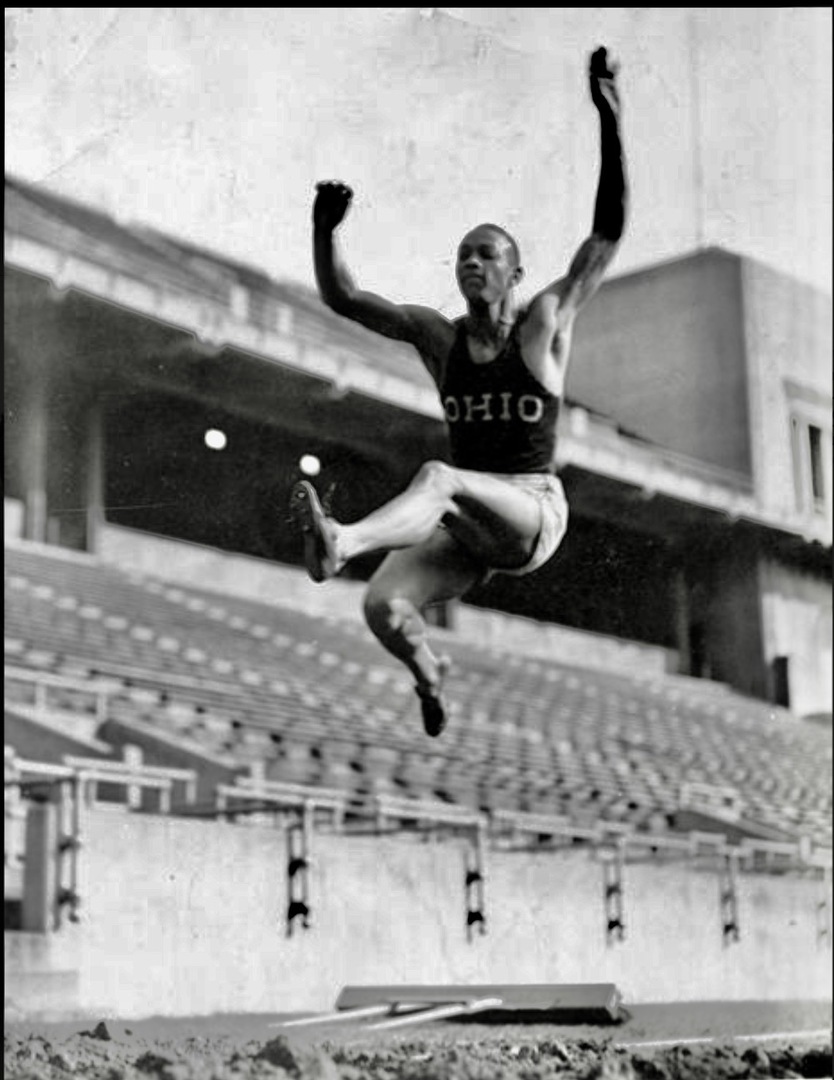
    <title type="html"><![CDATA[Jesse Owens: The Cleveland Years]]></title>
    <summary type="html"><![CDATA[<p><strong><em>In the 1936 Olympics held in Berlin, Germany, African American Jesse Owens won 4 gold medals for the United States, sending a clear message to Adolf Hitler about his Nazi regime and theories of white supremacy. Owens' early years in Cleveland contributed in no small way to his ability to cope with racism at home and abroad while at the same time performing at the highest levels in athletic competitions.</em></strong></p><img src="https://clevelandhistorical.org/files/fullsize/b06f252d1c7c1b369927bf03397a7f4e.jpg" alt="Setting an American Record in the Long Jump in 1935" /><br/><p>James Cleveland "Jesse" Owens, widely considered to be one of the greatest American athletes of the 20th century, was born in 1913 in Oakville, Alabama. His parents, Henry and Emma Owens, were sharecroppers who, like thousands of other African Americans living in the South in the post World War I era, decided to leave and migrate to one of the industrial cities of the North. By 1922, Henry and Emma and their eight children had moved to Cleveland and were renting a house on Hamilton Avenue near East 21st Street. The area was home to a small enclave of African Americans who lived within a larger ethnic neighborhood composed predominantly of immigrants from Poland, Lithuania, Russia, and Serbia. </p><p>Jesse, as he would later come to be called, was the family's youngest son. According to an interview he later gave in 1961, he made friends with the Polish boys in the neighborhood who were his age, saying that the color of his skin did not seem to matter to them. Like his father and older brothers who worked in the nearby steel mills, Jesse also worked in his new neighborhood, finding employment as a shoe shine boy at a nearby shoe repair shop on St. Clair Avenue.</p><p>In 1926, when he was 13 years old, his family moved to a house on East 90th Street, just south of Cedar Avenue. The move may have been prompted by his mother's discomfort in the Hamilton Avenue neighborhood. Years later, Owens remembered her keeping the window blinds closed all day and rarely venturing from the house unless accompanied by a member of her family. The family's new house was located in a part of the Cedar-Central neighborhood, east of East 55th Street, where many middle class and professional black families were settling in the 1920s. </p><p>The Owens family's relocation to East 90th Street would make all the difference to Jesse's future. He was enrolled in the sixth grade at nearby Bolton Elementary School and it was there that he acquired the name "Jesse" when his teacher asked him what his name was and he responded, with a Southern drawl, "J.C. . . Owens." Even more importantly, it was at Bolton where Owens was introduced to Charles Riley, a playground supervisor there. Riley was also the track coach at Fairmount Junior High on East 107th Street, the school where Owens would be attending the following year. Riley devoted himself to working with underprivileged youths and soon took Owens under his wing, training him every day before school started, often also bringing breakfast to the underweight boy. When Jesse started seventh grade at Fairmount the following year, Riley, seeing his potential, convinced him to try out for the track team.</p><p>It didn't take long before Cleveland began to take notice of track star Jesse Owens. Local papers reported in March 1928 that he took first place in the high jump at the annual Cleveland Athletic Club Indoor Meet held at Cleveland Public Hall. A year later, as an eighth grader competing at the same meet, he won three events--the high jump, the 40 yard low hurdles and the 40 yard dash--setting meet records in two of them. In March 1930, he returned to the Cleveland Athletic Club indoor meet at Public Hall for the final time as a junior high student, setting a new record in the high jump, besting the old record by more than two inches.</p><p>In the fall of 1930, Jesse Owens started high school at East Tech on East 55th Street. The joy of beginning high school may have been tempered, as it likely was for many other Cleveland students, by the deepening of the Great Depression which had struck America the year before. Just prior to its onset, Jesse's father was injured in a car accident and lost his job at the steel mill. Even after he recovered, he was not hired back. Jesse's older brothers also lost their jobs at the mill as the national economy slowed. To survive, Henry and Emma, along with the families of several of their adult children, moved in together into a two-family house at 2211 East 95th Street. Later, this extended family moved into a larger house at 2178 East 100th.</p><p>While his family struggled to just survive, Jesse thrived in high school, especially in sports. By this time, he was the only one of Henry and Emma Owens' eight children who had not dropped out of school to work and help support the family. Although he excelled in several sports in junior high, Owens was persuaded by East Tech's principal to now focus exclusively on his best sport, track and field. He also gave up the high jump--at the time arguably his best event--because East Tech already had a good jumper in future Olympic silver medalist Dave Albritton. Owens believed that he could best contribute to the success of his team at track meets by concentrating on the broad jump and several of the sprint events.</p><p>After a string of victories and record-setting performances at various track meets during his first two years at East Tech, Owens decided to try out for the 1932 Olympic team. At the tryouts held in June in Chicago, he found himself competing against older and more seasoned athletes and, despite performing well for a high schooler, he did not make that Olympic team. In his senior year, the high schooler bounced back, especially at the National Interscholastic Championships, where he won the long jump, as well as the 100 and 220 yard dashes, setting new national interscholastic records in all three events. The City of Cleveland honored Owens afterwards with a parade and a personal meeting with Mayor Ray T. Miller, who presented him with a laudatory city resolution.</p><p>As his high school years at East Tech came to a close, Jesse Owens publicly announced in August 1933 that he had decided to attend college at Ohio State University, where he planned to continue his amateur track and field career. It was a decision that angered leaders in the black community in Cleveland and elsewhere who referred to the university as "color-line Ohio State," because of its unfair treatment of black students at that time. According to Owens' principal biographer, however, Owens made his decision based solely upon which college he believed would best enable him to continue to contribute to his family's support. </p><p>Jesse Owens' support obligations had increased at the beginning of his senior year in high school when his girlfriend Ruth Solomon gave birth to their first child. From that point on, Owens added the obligation of supporting his child to what he felt was a continuing obligation to help support his parents. In the 1930s, colleges did not offer athletic scholarships in track and field. Therefore, for a track and field athlete like Owens, the only way to both attend college and meet family support obligations was to find a job that would enable him to do both. Ohio State offered him such a job, arranging for him to be hired as an elevator operator at the State House in Columbus while attending college. According to Owens, he made enough money at this job to not only pay his school tuition and personal living expenses, but to also send money home every week to both his mother and to Solomon, whom he married in Cleveland in 1935.</p><p>At Ohio State, Jesse Owens continued to win and set records in the long jump and sprint events. In May 1935, he achieved international fame and became a favorite for the 1936 Olympics to be held in Berlin, Germany, as a result of his performances at the Big Ten Championship Meet in Ann Arbor, Michigan. There, just days after being hospitalized for a back injury sustained in a fall down a flight of stairs on Ohio State's campus, he won the long jump, the 220 yard low hurdles, and the 100 yard dash, setting world records in all three events. One year later, at the Berlin Olympics, Owens won four gold medals--in the long jump, 100 and 200 meter dashes and as a member of the 400 meter relay team. He returned home to the United States to parades in New York City and in Cleveland. While some writers at the time contended that Hitler had snubbed Owens at the Olympics, historians have subsequently noted that the real snub he received was from President Franklin D. Roosevelt who, fearing to offend Southern Democrats, failed to even congratulate Owens, much less invite him to the White House.</p><p>Jesse Owens' Olympic victories signaled the beginning of the end of his days in Cleveland. After being honored with a parade in Cleveland for the second time, he looked for work in Cleveland but found very little that provided compensation commensurate with the level of success he had experienced at the Olympics. Since 1933, when not attending classes in Columbus, Owens had worked in Cleveland as a filling station attendant at <a href="https://greenbookcleveland.org/locations/wrights-service/" title="Wright’s Service @ Green Book Cleveland">Alonzo Wright's Sohio gas station</a> at East 93rd and Cedar. He now hoped that Cleveland would give him a better paying and more prestigious job, but the City instead offered him a position as a playground supervisor which paid an annual salary of only $1,600.00. He later referred to the combination of grand parades which honored him and the meager jobs which were offered him as "parades and poverty."</p><p>For several years following his Olympic experience, Owens explored businesses opportunities in Cleveland and elsewhere. One was the Jesse Owens Dry Cleaners store, which he and several business partners opened at the corner of East 100th and Cedar in 1938. Within a few years, however, the business failed, bankrupting Owens and causing a bank to foreclose on the house at 2187 East 87th Street which he had bought for his parents in 1936. According to a Call and Post news article, Owens was able to later buy a second house for them on Westchester Avenue in the Glenville neighborhood. However, just two weeks after moving into this house, Jesse's mother died. Two years later, his dad died, and, shortly after that, Jesse Owens departed Cleveland for good, accepting a management job in Detroit with the Ford Motor Company. Later, he moved to Chicago where he lived for most of the rest of his life. In 1980, Jesse Owens died at age 67. </p><p>In 1982, Cuyahoga County honored Jesse Owens by commissioning a statue of him which was placed in <a href="https://clevelandhistorical.org/items/show/518">Huntington Park</a>, just to the west of the Cuyahoga County Court House. More recently, in 2022, University Circle unveiled plans to honor Owens by constructing the Jesse Owens Olympic Oak Plaza at Wade Park. The plaza, located just north of the Rockefeller Lagoon, is (as of May 2023) partially constructed. Its centerpiece is an oak sapling which was cloned from the last of the surviving oak trees given to Owens by the German Olympic Committee in 1936 to commemorate his four Olympic gold medals. Were he alive today to witness these postmortem honors from the County and now University Circle, Inc., Jesse Owens might thank them but at the same time remind them that "parades" alone will not reduce "poverty" in underserved communities like the ones he lived in when he called Cleveland his home.</p><p><em><strong><a href="https://clevelandhistorical.org/items/show/1003">For more (including 18 images) view the original article</a></strong></em></p>]]></summary>
    <published>2023-05-24T22:13:34+00:00</published>
    <updated>2026-04-17T19:17:43+00:00</updated>
    <link rel="alternate" type="text/html" href="https://clevelandhistorical.org/items/show/1003"/>
    <id>https://clevelandhistorical.org/items/show/1003</id>
    <author>
      <name>Jim Dubelko</name>
    </author>
  </entry>
  <entry>
    <title type="html"><![CDATA[Euclid Avenue Temple: Anshe Chesed Congregation of Cleveland]]></title>
    <summary type="html"><![CDATA[<img src="https://clevelandhistorical.org/files/fullsize/0d5acdc682a504bb608104775fa459a2.jpg" alt="Euclid Avenue Temple" /><br/><p>In 1841, a rift opened within a German Orthodox congregation of a Bavarian Unsleben party that met in a rented room on Prospect Street. Known as the Israelite Congregation, it was formed just two years earlier as Cleveland’s first Jewish congregation. The group split over religious differences, with the departing members forming Anshe Chesed, meaning “the People of Loving-kindness.” The factions reunited in 1845 under the name Israelitic Anshe Chesed Society of Cleveland and soon built a synagogue on Eagle Street. This building was relatively small at 35 by 50 by 28 feet. After some disagreements over religious rituals in 1850, some members left to follow Rabbi Isidor Kalisch and establish Tifereth Israel. The Anshe Chesed then hired Rabbi Bernard L. Fould from Bavaria who headed the congregation from 1850 to 1875. </p><p>From 1861 to 1865, Rabbi Fould and chazan Gustava M. Cohen instituted many reforms, introduced an organ, tore down the women’s gallery, and installed pews. They also turned the reader of scripture from the Ark’s direction toward the audience. There were significantly more changes, later helped by Rabbi Michaelis Machol during his leadership from 1876 to 1906, converting Anshe Chesed from traditional to reformed Judaism. After the changes that Rabbi Michaelis Machol made during his leading congregation, they adopted English sermons, more moderate prayer books and services that switched between the Hebrew and English language. Some of these changes would later be reversed by Rabbi Barnett Brickner in the 1920s. Meanwhile, in 1887 the congregation relocated to a bigger building on Scovill Avenue and Henry Street (now East 25th). The 125-foot temple had alternating layers of white and red sandstone with octagonal turrets and three arching entrances. Designed by Lehman and Schmitt, the building could comfortably seat 1,200 people. </p><p>Rabbi Louis Wolsey from Little Rock, Arkansas, succeeded Rabbi Machol in 1907. The Anshe Chesed Congregation then announced their move to a location previously owned by Cassie Chadwick, who was known for defrauding banks out of millions by saying that she was an heir of Andrew Carnegie. Located on Euclid Avenue and East 82nd Street, Chadwick’s mansion was in the process of demolition in January of 1910, three years after she died in prison. On the vacant land, the Anshe Chesed planned to erect a synagogue designed by Lehman and Schmitt, the same architects who designed their previous home, and set aside $200,000 for construction. Rabbi Wolsey was said to favor an oriental style of architecture with tall columns and porticos for the new building. They cut some of the costs by choosing red brick instead of Indiana limestone, allowing them to spend the saved $50,000 on different amenities that included a new organ and pews. </p><p>In 1912, the congregation dedicated its new Euclid Avenue Temple. To commemorate the opening, they lit the eternal fire before the marble Ark representing God’s eternal presence. Within the Ark, there is a scroll of the Jewish law made of satin and gold. A sermon preached by Rabbi Wolsey gave thanks to God, who they believed allowed the building to be erected by His will and for His worship . The temple could seat 1,500 attendants and had one of Cleveland's largest organs at the time with 4,000 pipes. The temple had eight stained glass windows made by Tiffany and Company that each depicted moments of Jewish history as told in the Torah. The woodwork and pews had a silver-gray finish while the carpets and seating upholstery were a deep red. The Ark was made of French marble with two candelabras standing on each side made of bronze. Behind the choir lofts, a glass mosaic was imprinted with a verse from the book of Psalms, completing the synagogue. With all these extra expenses, the cost rose to $250,000. </p><p>Beginning in 1925, the Euclid Avenue Temple entered a new three-decade era in which it would become inseparable from the imprint of a new Rabbi. Born in New York City to Russian Jewish immigrants, Rabbi Barnett Brickner was a staunch Zionist and brought a new vision to Anshe Chesed. Rabbi Brickner moved away from many of the classical Reform practices of Anshe Chesed's prior years and reinstated many older Jewish traditions in services. So thoroughly did he shape Anshe Chesed that the synagogue became commonly known as "Brickner's Temple." </p><p>In 1956, Anshe Chesed, numbering 2,300 families, sold the building to a local African American congregation, Liberty Hill Baptist Church, which became the second Black church on Euclid Avenue, Anshe Chesed moved to Fairmount Boulevard in the eastern suburb of Beachwood. There they were known as the Anshe Chesed <a href="https://clevelandhistorical.org/items/show/404">Fairmount Temple</a>. At this new location, the congregation pushed for more civil and political rights for all Americans, even helping Soviet Jews relocate to America to flee persecution. The congregation also welcomed lesbian, gay, bisexual, and transgender Jews and their families, and they tasked Chevrei Tikva Chavurah in 2005 with undertaking outreach to the LGBT community. As a result of these actions, the Anshe Chesed Fairmount Temple received the Equality Award from the Human Rights Campaign Cleveland. </p><p>Anshe Chesed had a long history tied to the roots of Cleveland, but like most Jewish organizations, the congregation left the city of Cleveland as its members moved farther eastward into the suburbs. It cannot be understated that this congregation (which more recently merged with <a href="https://clevelandhistorical.org/items/show/40">Temple Tifereth-Israel</a> to form Mishkan Or) had a lasting impact on Jewish culture in Cleveland, including leaving a wonderful architectural legacy that continues to serve members of Liberty Hill Baptist Church.</p><p><em><strong><a href="https://clevelandhistorical.org/items/show/924">For more (including 9 images) view the original article</a></strong></em></p>]]></summary>
    <published>2020-12-13T02:24:17+00:00</published>
    <updated>2026-04-17T19:17:42+00:00</updated>
    <link rel="alternate" type="text/html" href="https://clevelandhistorical.org/items/show/924"/>
    <id>https://clevelandhistorical.org/items/show/924</id>
    <author>
      <name>Steven Nguyen</name>
    </author>
  </entry>
  <entry>
    <title type="html"><![CDATA[Drury Mansion: A Stove Baron&#039;s Short Tenure on Millionaires&#039; Row]]></title>
    <summary type="html"><![CDATA[<img src="https://clevelandhistorical.org/files/fullsize/719da37ef2812c0fac19d2745697e2c3.jpg" alt="8615 Euclid Avenue" /><br/><p>The son of Dewitt and Sarah Dimmick Drury, Francis Edson Drury was born on August 20, 1850, in Pittsfield, Michigan. After receiving a public-school education, he entered the hardware business where he invented the first internal gear lawnmower. Drury moved to Cleveland in 1870 and worked with the Taylor and Boggis Foundry Company to manufacture his mowers. In addition, and some years later, he partnered with H.P. (Henry Parsons) of Chicago to start the Cleveland Foundry Company, which built oil heating and cooking stoves.</p><p>Drury served as vice president, president, and general manager of the Taylor and Boggis Company, also known as T&B Foundry Company. On March 31, 1906, a fire destroyed not only the Taylor & Boggis Company but also the H.C. Tack Company, resulting in a $20,000 loss. The Tack Company suffered more damage because it was primarily a wood-frame building, unlike the mostly brick T&B building. Several months after the death of Robert H. Boggis, T&B's president, on June 10, 1911, from complications of pneumonia, the company purchased a large plot of land near East 55th Street and the old Erie tracks where it planned to build a new foundry and power plant. This land was previously owned by the Schofield-Schurmer-Teagle Company, which was (at the time) an oil plant. The buildings would be built of the most up-to-date machinery and in a modern style. </p><p>Because of the enormous success he had on his inventions, Drury built one of the last remaining homes on Euclid Avenue at East 87th Street. This mansion, composed of 34 rooms and 25,000 square feet, is located at 8615 Euclid Avenue. Drury, his wife Julia and their son lived at this location for twelve years. In 1924, however, Drury felt it was time to live in a more pastoral setting. As a result, in 1925 the Drurys decided to follow the route many of their neighbors took, relocating to an affluent eastern suburb. They bought the 155-acre Cedar Hill Farm in Gates Mills, Ohio, and built an almost exact duplicate of their home but nearly 1.5 times its size. They even transplanted the entirety of the Euclid Avenue home's gardens to the new estate. Today, the mansion, also known as the Tudor House, is on the campus of Gilmour Academy.</p><p>The new Drury home, situated near the corner of Cedar and S.O.M. Center Roads, has 41 rooms and 14 fireplaces (each made with marble from a different country), and each of its major rooms (i.e. master bathroom, kitchen, master bedroom) is finished with a different type of wood. When the Drurys lived there, the property also contained seventeen different buildings, including a creamery, vegetable-cleaning building, and toolshed. Almost five acres were greenhouses that grew not only vegetables but flowers as well. The surprising thing to note is that Drury and his wife lived on this property for only a year. Following a social snub as a result of getting the land before the Van Sweringens could do so to include in their Shaker Country Estates, the Drurys wrote off Cleveland, opting to spend the rest of their lives dividing their time between an apartment in New York City and estates on Georgian Bay in Ontario and in New Hampshire and Augusta, Georgia. Francis E. Drury passed away in Augusta on April 3, 1932, and his wife, Julia, died 11 years later on April 16, 1943.</p><p>After Drury and his wife left their original home on Euclid Avenue, it was closed off to the public until the Drury Club acquired it on June 11, 1939. The Cleveland Plain Dealer described the home as a fine example of 17th-century-style architecture. Up to this point in time, forty carefully chosen men and women spent most of their Saturday nights here enjoying dinner and a bit of dancing with their guests. The Drury Club later entered negotiations to sell the Drury mansion to the Florence Crittenton Home in 1946.</p><p>The Florence Crittenton Home officially inaugurated the Drury mansion as its new home in 1948. The mansion served as a maternity home of unmarried mothers and their children. Originally organized as a branch of the National Florence Crittenton Mission, the home was able to care for fifteen unwed mothers during pregnancy and for them and their infants for up to six months after delivery. The home had a part-time nursing staff and visiting physician to provide medical care as well as volunteers from Protestant and other women’s organizations to assist with activities and services. </p><p>The organization fought against social stigmas of the time. Many people viewed unwed mothers as ‘sinful’ or ‘undeserving’ because they believed these women's situations reflected a moral failure. Institutions such as the Crittenton Home guaranteed the mothers a sense of safety, mostly on the premise of spiritual reclamation. As public opinion in the latter decades of the twentieth century shifted, places such as the Crittenton Home became obsolete. These changing ideas, in conjunction with the loss of the organization's executive director, ultimately brought about the end of the Florence Crittenton Home in the mansion in 1971. Although the Florence Crittenton Organization continued to have a presence in Cleveland with a newfound focus on helping delinquent girls in a new treatment center, the branch at the Drury mansion had met its end. </p><p>The Florence Crittenton Home leased the building to AIM Jobs, and a Community Reintegration Center opened in the building in February 1973. The Center provided programs to treat parole and probation violators. It differentiated itself from traditional half-way houses in that it was designed to diagnose and treat the problems of parole violators. This provided a new opportunity as opposed to automatically sending them back to serve additional jail time. </p><p>The mansion continued to be used by the Reintegration Center until its sale in 1989 to the Cleveland Clinic. Renamed the Foundation House, the Clinic’s administration partly restored the mansion's first level to a condition similar to that in which the Drurys had left it in 1924. The work done by the Clinic was recognized in 1995 by the Cleveland Restoration Society. Overall, the mansion has been adaptively reused as a conference center and office space for the Clinic building where it hosts receptions, graduations for medical residents, and some Cleveland Clinic Foundation board meetings today.</p><p><em><strong><a href="https://clevelandhistorical.org/items/show/822">For more (including 7 images) view the original article</a></strong></em></p>]]></summary>
    <published>2017-11-28T12:31:50+00:00</published>
    <updated>2026-04-17T19:17:41+00:00</updated>
    <link rel="alternate" type="text/html" href="https://clevelandhistorical.org/items/show/822"/>
    <id>https://clevelandhistorical.org/items/show/822</id>
    <author>
      <name>Alexis Johnson&amp;#32;&amp;amp;&amp;#32;Rebekah Knaggs</name>
    </author>
  </entry>
  <entry>
    <title type="html"><![CDATA[Calvary Presbyterian Church: The Successful Integration of an Inner-city Congregation]]></title>
    <summary type="html"><![CDATA[<img src="https://clevelandhistorical.org/files/fullsize/9c4243b73966b09110c9a66acb00a934.jpg" alt="On the Corner of East 79th and Euclid Avenue" /><br/><p>On April 6, 1953, Dr. John Bruere, pastor of Calvary Presbyterian Church, mentioned that a "certain colored woman has been attending our services frequently of late." The appearance of an African American woman in the church's congregation "raised in his mind the question of segregation." Further discussion concerning the vices of racial segregation ensued during the Session meeting of Calvary's Elders. After some discussion the Elders agreed Calvary would stand opposed to racial segregation.  </p><p>Dedicated in 1890 on the corner of East 79th and Euclid Avenue, Calvary first catered to Cleveland's white elite. Women in fur coats and men dressed glamorously with top hats and overcoats, strolled down Euclid Avenue on Sunday mornings. They entered the church eager to socialize with their neighborhood acquaintances and spread their fortunate circumstances, in the name of religion, to less fortunate members of society. From the church's inception, Calvary's congregation prided itself on being a neighborhood church. </p><p>Since the church's founding, the surrounding community had made up the majority of the membership. As the elite left Euclid Avenue after the 1900s during the "flight to the Heights" phenomenon, Calvary chose to remain at its original location. When World War I created need for an alternative labor force, Cleveland factories turned to southern African Americans. In the ensuing Great Migration, southern blacks flooded into the central city, setting up residence predominantly in the Central neighborhood. By the 1950s, displacement due to urban renewal in Central caused African Americans to spread eastward into the neighborhoods surrounding Calvary. </p><p>Even before the influx of African American population, the neighborhoods surrounding Calvary had succumbed to neglect and visibly exuded a slum-like character. As African Americans moved in, they arrived in neighborhoods already tainted with poverty and despair. In the 1950s, with landlords' inattention to their properties and a lack of city housing inspections, slum-like conditions worsened. In addition, now racial tension accented the impoverished neighborhoods. </p><p>After Dr. Bruere had drawn attention to the question of racial segregation, Calvary's congregation emerged from behind the church's stone walls and filtered into the community. The congregation engaged with community members to clean up the neighborhood's houses and streets, close down bars, and rid the community of pesky vermin. In addition to polishing the surface of the neighborhoods, Calvary penetrated deep into the community to heal the wounds of racially spurred neglect. The programs aimed to instill pride, construct a new community image, and propagate the power of spirituality and morality to combat the negativity rampant in the neighborhoods. As a result of the cleanup programs, many area residents joined the church. Calvary's award-winning youth programs also attracted community residents. The Saturday Program aimed to keep the youth off the streets, providing a safe haven for children that came from broken homes. The church's free youth programs provided meals and educated the youth on practical skills. Calvary even had recreational sport teams. In the youth programs' heyday of 1966, WKYC-TV reported that, despite the Hough Riots, "nearly five thousand children" participated in Calvary's Saturday Youth Program.   </p><p>The betterment of the neighborhoods surrounding Calvary, as well as the promotion of social justice, remained the church's mission. Upholding the charter members' credo, Calvary remained a neighborhood church. During the 1950s and 1960s the nation struggled with racial segregation and discriminatory rhetoric. Calvary succeeded in achieving a racially integrated congregation through community outreach programs. By 1967, many saw Calvary as a beacon of social justice and activism in the inner city. </p><p>Calvary today continues to promote the same mission of social justice the church followed in previous decades. Through hot meal and childcare programs and cultivation of a welcoming atmosphere, Calvary still engages the community. A gradual decline of church attendance, however, forced Calvary pastors following Dr. Bruere to focus on membership retention and scouting. The racial congregational balance, once highlighted as one of the church's defining features, has since dissipated. Today Calvary Presbyterian Church, under the new name New Life at Calvary, has been described as one of "the largest predominantly African-American churches in Ohio." Regardless of the church's demographics, New Life at Calvary remains at the corner of East 79th and Euclid Avenue and continues to fight for social justice. New Life at Calvary remains a relevant fixture on Cleveland's east side. </p><p><em><strong><a href="https://clevelandhistorical.org/items/show/775">For more (including 8 images) view the original article</a></strong></em></p>]]></summary>
    <published>2016-12-06T23:07:36+00:00</published>
    <updated>2026-04-17T19:17:41+00:00</updated>
    <link rel="alternate" type="text/html" href="https://clevelandhistorical.org/items/show/775"/>
    <id>https://clevelandhistorical.org/items/show/775</id>
    <author>
      <name>Sarah Nemeth</name>
    </author>
  </entry>
  <entry>
    <title type="html"><![CDATA[Church Square: Hough&#039;s Neighborhood Shopping Center]]></title>
    <summary type="html"><![CDATA[<img src="https://clevelandhistorical.org/files/fullsize/0eb37f9d511a3d331d9d792bc24b0412.jpg" alt="Before Church Square" /><br/><p>In 1991 a derailed construction project had left an abundance of weeds and hills of mounded dirt in the vacant 19.3-acre lot that stretched from East 79th to East 84th Street between Euclid and Chester Avenues. The project to build a shopping center for east side Clevelanders had been postponed after its 1986 reveal, leading to a string of buyouts, sellouts, and revisions. However, from the efforts and dedication of NOAH (Neighbors Organized for Action Housing), the importance of the project was finally realized by the Cleveland City Council. The Church Square shopping plaza symbolized a crowning achievement in the undertaking to rejuvenate highly visible Euclid Avenue face of the Hough neighborhood. </p><p>NOAH started in response to the devastation left by the Hough Riots of 1966. The leaders of Calvary Presbyterian Church, St. Agnes Church, Glenville Presbyterian Church, and the Hough Community Council joined forces in 1968 to construct and/or advise the construction of adequate housing for the local residents of Hough. Calvary under the leadership of Rev. Roger Shoup provided the seed money to get the grassroots redevelopment project in motion. Along with Calvary's seed money, the group also obtained federal funds to jumpstart the housing project. NOAH sought opportunities to purchase land or locate buildings that could be rehabilitated. Even in the organization's infancy, NOAH envisioned that in a three-year period up to one hundred family units would be constructed or rehabilitated up to code. NOAH stood out as an organization as it championed a holistic approach towards the redevelopment of Hough and adjacent neighborhoods. </p><p>NOAH not only provided adequate family and single dwelling units for the Hough community residents. NOAH sought to rehabilitate not only housing in the area, but also the individual. Those who moved into one of NOAH's housing developments were encouraged to attend church programs and take advantage of counseling services. Church Square plaza was envisioned to complete this holistic aim of the project. Developers, from a stipulated string attached to the city council loan allocated to bail out the project, were required to hire local Clevelanders for the construction of the plaza and for permanent jobs. Church Square gave local residents, many of whom lived in NOAH housing like Rainbow Place apartments on the northwest corner of Euclid Avenue and East 79th Street, a place to seek employment opportunities. </p><p>Church Square was an important piece of a larger effort to revitalize the Fairfax and Hough neighborhoods. By 1992 the once-vacant lot on the northeast corner of East 79th and Euclid heralded the promise of economic advancement for the neighborhood. Church Square represented an important step towards achieving the successful revitalization of the Hough community. Church Square sought to provide a local and easily accessible place for community residents to do their shopping. The shopping plaza also offered middle-class shoppers speeding down Chester or Euclid Avenues from their suburban residences to downtown a quick stop to meet their consumer needs. With the promise of an influx in outside revenue and jobs for local residences, many fragile futures hinged on the success of Church Square. Today the notable hustle and bustle around the plaza symbolizes a piece of a comprehensive and successful grassroots effort to revitalize one of Cleveland's downtrodden districts.  </p><p><em><strong><a href="https://clevelandhistorical.org/items/show/774">For more (including 6 images&#32;&amp;&#32;1 audio file) view the original article</a></strong></em></p>]]></summary>
    <published>2016-12-04T11:40:38+00:00</published>
    <updated>2026-04-17T19:17:41+00:00</updated>
    <link rel="alternate" type="text/html" href="https://clevelandhistorical.org/items/show/774"/>
    <id>https://clevelandhistorical.org/items/show/774</id>
    <author>
      <name>Sarah Nemeth</name>
    </author>
  </entry>
  <entry>
    <title type="html"><![CDATA[Street Clubs of the East Side: &quot;We Do Our Own Thing Ourselves&quot;]]></title>
    <summary type="html"><![CDATA[<img src="https://clevelandhistorical.org/files/fullsize/1b2ca92c217f7880b4ce38ff4730531f.jpg" alt="E. 85th Street Club Cleanup, 1952" /><br/><p>In August 1940, residents on East 85th Street on Cleveland's east side decided to organize their efforts for the betterment of the their block and Mrs. Beatrice Beasley, a citizen of the street, founded the E. 85th Street Club. In its beginning stages, the E. 85th Street Club held meetings at members' homes routinely every month, whereas after the Fairfax Recreation Center was completed in 1958, meetings were held weekly. The street club served members from East 85th between Cedar Avenue and Central Avenue in Fairfax. The club was dedicated to doing good within its own block by holding an annual spring cleaning program, which entailed older members as well as the youth raking leaves, painting houses, whitewashing trees and curbs, and remodeling abodes. The organization also held a "Back to School" dance for the children, which included refreshments, prizes, and music disc-jockeyed by Eddie O'Jay, who was known for discovering and managing the R&B music group "The Mascots," later known as the legendary "O'Jays." Other community outreach events included giving fruit baskets to the sick, donating money to various Fairfax events, and holding neighborhood picnics and banquets.</p><p>"We do our own thing ourselves," "Improve, don't move" - These are the mottos that spearheaded street clubs into action. When federal urban renewal programs fell short in their attempt to stabilize urban neighborhoods, street clubs tried to fill the void. While the E. 85th Street Club's work may have been the most publicized, other street clubs took very similar actions to make their neighborhood a better place to live. Christmas parties, home renovations for the poor and elderly, and voiced opinions regarding community renewal were not unusual. Street clubs, also known as neighborhood clubs or civic clubs, were prominent especially on Cleveland's east side neighborhoods, such as Fairfax, Glenville, and Hough. An annual meeting called "Street Club Organization Day" started in 1968 to bring together street club presidents to lead combined efforts to address problems plaguing the community. Workshops were led by the Street Club Presidents League, as well as representatives of various community non-profit organizations such as Citizens for Better Housing Inc. and University-Euclid Development Center. Through the meeting, combined club efforts yielded clean-up campaigns and an award banquet. Street clubs also participated in yearly beauty contests known as "The Beautiful Block Contest" and "The Bright and Beautiful Contest," conducted by the Cleveland newspaper The Call & Post. Contests were judged based on appearance and the total house participation. While this encouraged blocks to clean and renovate homes, other streets sometimes experienced difficulty contending, for they were plagued by absentee landlords and even rats. Since then, street clubs and neighborhood associations have expanded to the outer parts of Cleveland, including Shaker Heights as well as the west side of Cleveland.</p><p><em><strong><a href="https://clevelandhistorical.org/items/show/666">For more (including 5 images&#32;&amp;&#32;1 audio file) view the original article</a></strong></em></p>]]></summary>
    <published>2014-08-13T20:46:48+00:00</published>
    <updated>2026-04-17T19:17:40+00:00</updated>
    <link rel="alternate" type="text/html" href="https://clevelandhistorical.org/items/show/666"/>
    <id>https://clevelandhistorical.org/items/show/666</id>
    <author>
      <name>Julie A. Gabb</name>
    </author>
  </entry>
  <entry>
    <title type="html"><![CDATA[Antioch Baptist Church]]></title>
    <summary type="html"><![CDATA[<img src="https://clevelandhistorical.org/files/fullsize/9d206814a73d3e80220fe214cfc2bf93.jpg" alt="Antioch Baptist Church" /><br/><p>"Antioch Church In Area Where Evictions Ordered: The Federal Court last Tuesday issued orders for the nearly 300 families living in the area bounded by E. 22nd St., Central and Cedar Ave. and E. 30th, to move by the 15th of October. While the judge said when to move, he didn't say where. The big problem therefore, facing the people, many of whom are on charity, is where they can move."   </p><p>So reported the Cleveland Call and Post on September 15, 1934. Originally located at East 24th Street and Central Avenue, Antioch Baptist Church found itself in the same predicament as 300 nearby households--in the precarious position of needing to relocate in one month's time in order to make way for the Cedar Homes Public Housing Project. After finalizing the purchase of the property at East 89th Street and Cedar Avenue, Antioch moved to the area that would later come to known as the Fairfax neighborhood. As African Americans migrated to northern cities in the 1920s and 1930s in search of industrial jobs, they flooded into Cleveland's Cedar-Central neighborhood, adding to the congregational numbers of neighborhood churches including Antioch. Under the guidance of Rev. Wade Hampton McKinney, Antioch Baptist Church assumed a leadership role in Cedar-Central, establishing a credit union in 1947 to aid returning African American veterans as well as local residents in securing loans.</p><p>The Antioch Credit Union became wildly successful and this success along with growing congregational numbers created financial stability for the church, allowing Antioch to add a youth center to the church property as well as partner with the Cleveland Clinic to build the Antioch Towers for elderly residents in 1974. As more housing options opened up to African Americans on the periphery of the city in the 1970s, many black residents moved to the suburbs with neighborhood churches following their congregations out from the central city. Antioch remained committed to the Fairfax area, however, and chose to stay in Fairfax, buying up available property in an attempt to prevent undesirable businesses from exploiting the area.</p><p>With the ever-present threat of urban decay and possibility of the Cleveland Clinic expanding into the Fairfax area looming large over the neighborhood, Antioch continued to support cleanup efforts within the community as well as to once again partner with the Cleveland Clinic to establish the Antioch Development Corporation. The corporation began its Agape Program in 1999 to provide HIV testing, prevention education, case management, treatment referrals, as well as spiritual counseling to the community and continues to produce a positive impact on the Fairfax neighborhood.</p><p>While Antioch's decision to stay at its East 89th Street location demonstrated its commitment to the Fairfax neighborhood, more telling perhaps, is the decision of many of its congregational members who relocated to the suburbs to continue to return for services, illustrating Antioch's importance not only to the Fairfax neighborhood but to the entire Greater Cleveland African American community.</p><p><em><strong><a href="https://clevelandhistorical.org/items/show/633">For more (including 4 images&#32;&amp;&#32;4 audio files) view the original article</a></strong></em></p>]]></summary>
    <published>2013-12-04T21:34:32+00:00</published>
    <updated>2026-04-17T19:17:40+00:00</updated>
    <link rel="alternate" type="text/html" href="https://clevelandhistorical.org/items/show/633"/>
    <id>https://clevelandhistorical.org/items/show/633</id>
    <author>
      <name>Joseph Wickens</name>
    </author>
  </entry>
  <entry>
    <title type="html"><![CDATA[Fairfax Neighborhood]]></title>
    <summary type="html"><![CDATA[<img src="https://clevelandhistorical.org/files/fullsize/053045c05bdd03389ec3816099482658.jpg" alt="Fairfax Recreation Center Dedication, 1959" /><br/><p>Fairfax neighborhood's namesake, Florence Bundy Fairfax, was a decorated civil servant with a remarkable story. Born in Cleveland on Christmas Eve in 1907, Florence Bundy spent her teenage years living on the <a href="https://clevelandhistorical.org/items/show/915">Kenyon V. Painter estate</a> in Cleveland Heights, where her parents worked as house servants. After graduating from Cleveland Heights High School in 1924, she earned her degree in Chemistry from Mather College for Women at Western Reserve University in 1929. In 1953, while on a vacation to the summer resort of Idlewild, she narrowly survived an automobile accident that killed her husband, Lawrence Fairfax, on a Michigan highway. But the Fairfax name would soon be immortalized through the continued selfless work of Mrs. Fairfax.</p><p>Her passion for youth recreation developed during her college years. While a student at Mather, she excelled as a swimmer, and due to her passion and proficiency for the sport she was hired by the Department of Recreation in Cleveland to teach swimming classes following her graduation. During her tenure in the Department of Recreation, Fairfax was appointed the first African American Supervisor of Summer Playgrounds and, later, Recreation Supervisor and Recreation Superintendent. Recognizing her impact on and dedication to the Department of Recreation, particularly in the Cedar-Central neighborhood, when the city decided to erect a recreation center on East 82nd Street in 1957, Fairfax was the person for whom the structure was named when it opened two years later.</p><p>Shortly after the new recreation center was completed in 1959 and named for Mrs. Fairfax, the area bounded by Euclid Avenue and Woodland Avenue north to south and East 105th Street and East 71st Street east to west came to be designated as the Fairfax neighborhood, replacing earlier names such as East End, East Central, and "Green Pastures." That same year a cleanup project was started in an attempt to further boost the neighborhood with bases of operation located at the recreation center itself and the Karamu House. For the next twenty years, similar community cleanup initiatives persisted, largely under the direction of the Fairfax Foundation, an organization established with the goal of continuing community revitalization, and in 1971 the Fairfax Security Patrol was established. A unique program funded by members of the community, the Fairfax Security Patrol employed eleven off-duty Cleveland police officers to patrol the neighborhood in an effort to curb criminal activity in the area.</p><p>Complementing these community-led initiatives, area churches like Antioch Baptist and St. James A.M.E. contributed to the preservation of the community by providing support systems and social venues for area residents along with buying up property in the neighborhood to prevent undesirable businesses from entering and exploiting the area. Adding to these efforts, in 1992 the Fairfax Renaissance Development Corporation was established, which still holds as its mission the improvement of the Fairfax neighborhood through comprehensive community development.</p><p>While the menace of urban decay has continually posed a serious threat to the Fairfax neighborhood and its residents, the efforts of area institutions, individuals like Florence Bundy Fairfax, and the community at large helped prevented this historically significant neighborhood from succumbing to the wrecking ball of urban renewal, a trend that claimed tremendous amounts of urban space across the United States during the twentieth century.</p><p><em><strong><a href="https://clevelandhistorical.org/items/show/632">For more (including 5 images) view the original article</a></strong></em></p>]]></summary>
    <published>2013-12-04T21:32:37+00:00</published>
    <updated>2026-04-17T19:17:40+00:00</updated>
    <link rel="alternate" type="text/html" href="https://clevelandhistorical.org/items/show/632"/>
    <id>https://clevelandhistorical.org/items/show/632</id>
    <author>
      <name>Joseph Wickens</name>
    </author>
  </entry>
  <entry>
    <title type="html"><![CDATA[Pla-Mor Roller Rink: Cleveland&#039;s Black Skating Mecca]]></title>
    <summary type="html"><![CDATA[<img src="https://clevelandhistorical.org/files/fullsize/10a90a3bf8f149d9744afb1e81b8ddec.jpg" alt="Pla-Mor Label" /><br/><p>For a generation in the 1940s-60s, Pla-Mor Roller Rink provided a much-needed recreational venue for all ages on the eastern end of the Cedar-Central (Fairfax) neighborhood and for a time was the only Black-owned skating rink in Cleveland. More than a place to skate, it also attracted top-billed musical acts.</p><p>On land now owned by Case Western Reserve University, Pla-Mor's location on Cedar Avenue at East 107th Street was a converted bus garage named the Coliseum, which opened in 1940. Built by the same syndicate that operated the Arena on Euclid Avenue, this multipurpose venue was intended for conventions, concerts, boxing shows, basketball games, and rollerskating. In 1942, Elmer "Al" Collins took over the "dark cavern," painted its interior, and opened the well-lighted Pla-Mor Roller Rink. He hired a full-time skating instructor and an organist to provide music for skaters. Not only did Collins enable many youths to compete in the National Roller Rink Operators Association that he founded, he also intervened in the fight against juvenile delinquency in Cedar-Central. In 1948 he even persuaded a "roving gang" that harassed the neighborhood to reconstitute as the Royal Dutchmen, a supervised social and athletic club that pledged to model constructive play for younger adolescents.</p><p>Pla-Mor hosted an array of events. Following World War II, the Negro Business Alliance of Cleveland sponsored the "Exhibit of Progress" several years in a row at the facility, drawing as many as 70,000 people to view displays and demonstrations of successful black enterprises, and in the latter half of the 1950s the Call & Post newspaper held its annual Home and Food Show there. The Future Outlook League, a civil rights organization founded in the 1930s, along with Black social organizations such as Coronet, the Ghana Club, and Les Charmantes, held lavish cabaret parties at Pla-Mor in the 1950s. Along with exhibitions and parties, the Pla-Mor ballroom attracted big-name music acts in the 1950s-60s, including Wynonie Harris, Dinah Washington, Frankie Lymon, the Marvelettes, and even B. B. King. In the late 1950s, DJs like WJMO's Ken Hawkins also spun records for dance nights.</p><p>But the Pla-Mor was best known for skating, which ranged from children's lessons to teen nights to skating shows such as those by the Roller Vanities. Racial discrimination contributed to Pla-Mor's popularity in the Black community. Although forbidden by law, segregation was common in Cleveland at mid century. From time to time, Blacks reported difficulties at Skateland, another popular roller rink at Euclid Avenue and East 90th Street. These problems seem to have escalated in the 1950s, when the adjacent Hough neighborhood transformed from 4 to 74 percent African American in only a decade. As late as 1955, after an interracial group of youth from Boys Town, Nebraska, went to Pla-Mor after exclusion from an undisclosed East Side rink, a spokesman at Skateland denied knowledge of the incident but openly admitted that the rink tried to deny African American entry except to private parties held by church or school groups. Although Skateland more openly hosted black events by the late 1950s, the Pla-Mor remained essential in the Black community.</p><p>In 1965 the Pla-Mor underwent renovation, and took the new name University Party Center. Count Basie's orchestra belted out jazz tunes at the Go-Go Girls Big Cabaret Party in June of the following year. It turned out to be the last of the storied shows at the place many still called the Pla-Mor. Just over a month later, the Hough Uprising broke out on Cleveland's East Side. The University Party Center went up in flames and, according to the Call & Post, was reduced to "twisted lengths of burned steel." Amid the chaos, the Townes family, who lived across the street, attempted to flee the danger in their 1957 Ford. When they drove through a nearby National Guard roadblock, police fired into their windshield, striking 16-year-old Diana Townes, who lost an eye. Four months later, the family's home also burned to the ground. </p><p>Today the mention of the Pla-Mor evokes bittersweet remembrances--both happy recollections of good times spent skating or dancing and sorrow for the roller rink's tragic end. Fondness for the good times led a handful of investors to reopen the former Euclid Rollerdrome as the new Pla-Mor in 2009 at 22466 Shore Center Drive in suburban Euclid, promising to keep the memory of its namesake alive. </p><p><em><strong><a href="https://clevelandhistorical.org/items/show/621">For more (including 6 images&#32;&amp;&#32;2 audio files) view the original article</a></strong></em></p>]]></summary>
    <published>2013-10-26T16:20:12+00:00</published>
    <updated>2026-04-17T19:17:40+00:00</updated>
    <link rel="alternate" type="text/html" href="https://clevelandhistorical.org/items/show/621"/>
    <id>https://clevelandhistorical.org/items/show/621</id>
    <author>
      <name>J. Mark Souther&amp;#32;&amp;amp;&amp;#32;Timothy Klypchak</name>
    </author>
  </entry>
  <entry>
    <title type="html"><![CDATA[Creating Cleveland Clinic]]></title>
    <summary type="html"><![CDATA[<img src="https://clevelandhistorical.org/files/fullsize/6845ee93b180d188aecf10dd2e9f2a22.jpg" alt="Clinic Staff" /><br/><p>The Cleveland Clinic was founded on February 5, 1921. Frank E. Bunts, George W. Crile, and William E. Lower volunteered to serve their country as field surgeons and physicians in the Medical Corps of the United States Army during World War I. The military hospital experience impressed these men with the efficiency of an organization that included every branch or specialty of medicine and surgery. By the time that they returned home, Bunts, Crile and Lower had recognized the benefits that could be obtained from cooperation by a group of specialists. Along with John Phillips, they came together to found the Cleveland Clinic. </p><p>Many private practices and physicians were against the concept of opening a group practice. They believed that such a wealth of resources available to a group might give them an unfair competitive advantage. Fortunately, the founders of the Clinic were professors in one or more of the Cleveland medical schools and all had served as presidents of the Academy of Medicine. A core ideal emerged to create an institution in which medicine and surgery could be practiced, studied and taught by a group of specialists.</p><p>The Cleveland Clinic officially opened for business on Monday, February 28, 1921. The beautiful new building featured four stories, of which the upper three were built around a large central well extending from the second floor up to a glass skylight. The main waiting room was located at the bottom of the well on the second floor; while the office, examination rooms and treatment rooms opened onto the elegant second floor waiting area. The x-ray department, clinical laboratories and a pharmacy were located on the first floor. The fourth floor contained the art and photography department, editorial offices, offices for administrative personnel, a library and an executive boardroom. </p><p>The hospital quickly grew in popularity and Clevelanders accepted it so enthusiastically that plans for expansion were made within the first few years after it opened. By 1928, the Cleveland Clinic was a rapidly expanding, state-of-the-art hospital full of promise with potential to become one of the leading medical institutions in the nation.</p><p><em><strong><a href="https://clevelandhistorical.org/items/show/603">For more (including 8 images) view the original article</a></strong></em></p>]]></summary>
    <published>2013-04-10T09:45:40+00:00</published>
    <updated>2026-04-17T19:17:40+00:00</updated>
    <link rel="alternate" type="text/html" href="https://clevelandhistorical.org/items/show/603"/>
    <id>https://clevelandhistorical.org/items/show/603</id>
    <author>
      <name>Brad Clifton&amp;#32;&amp;amp;&amp;#32;Jessica Carmosino</name>
    </author>
  </entry>
  <entry>
    <title type="html"><![CDATA[Cleveland Clinic]]></title>
    <summary type="html"><![CDATA[<img src="https://clevelandhistorical.org/files/fullsize/lg_clinic-art-deco-1920_54abe48524.jpg" alt="Clinic Building, ca. 1920s" /><br/><p>Four Cleveland physicians <a href="https://clevelandhistorical.org/items/show/603">founded</a> the Cleveland Clinic Foundation in February 1921, creating an institution dedicated not only to medical care, but also to research, innovation, and physician education. Three of the four founders had served together in a U.S. Army medical unit in France during World War I. The <a href="https://clevelandhistorical.org/items/show/573">Cleveland Clinic X-ray fire</a> of 1929 – a basement fire caused by combustible nitrocellulose film that left 123 dead – was a tragedy that temporarily set back the hospital's progress. After World War II, however, the Cleveland Clinic rose to become one of the nation's leading medical centers.</p><p>During the 1940s and 1950s, Clinic researchers pioneered dialysis and kidney treatment and were the first to identify carpal tunnel syndrome and isolate the neurotransmitter serotonin. The Cleveland Clinic also emerged as a national leader in cardiac procedures. Clinic physicians performed the first coronary angiography in 1958 and continued to make significant advances in heart surgery techniques in the proceeding decades. The Clinic's main campus, located along Euclid Avenue in Cleveland's Fairfax neighborhood, has undergone tremendous growth since the 1970s. As adjacent land has been purchased and numerous new facilities constructed in a process of expansion, it is no great surprise that the Cleveland Clinic has become one of the city's largest private employers.</p><p><em><strong><a href="https://clevelandhistorical.org/items/show/8">For more (including 8 images&#32;&amp;&#32;2 audio files) view the original article</a></strong></em></p>]]></summary>
    <published>2010-09-12T21:30:35+00:00</published>
    <updated>2026-04-17T19:17:36+00:00</updated>
    <link rel="alternate" type="text/html" href="https://clevelandhistorical.org/items/show/8"/>
    <id>https://clevelandhistorical.org/items/show/8</id>
    <author>
      <name>CSU Center for Public History and Digital Humanities</name>
    </author>
  </entry>
  <entry>
    <title type="html"><![CDATA[Cleveland Play House: From East Side Farmhouse to Playhouse Square Fixture]]></title>
    <summary type="html"><![CDATA[<img src="https://clevelandhistorical.org/files/fullsize/b70a8cf58c3341e6b706f8fcc508e316.jpg" alt="CPH and CSU Join in the Allen Theatre" /><br/><p>The story of the Cleveland Play House begins in 1915 with a series of meetings held at the home of essayist Charles Brooks. Charles and his wife Minerva Brooks met each week with eight of their friends to discuss theatre and the arts. Eventually, the well-to-do couple decided to form the Cleveland Play House, a professional theatre company that would offer performances of a more substantive nature than the vaudeville and burlesque acts popular at the time. With Brooks as president, the company held its first show in May 1916 in an old farmhouse on land owned by industrialist Francis Drury, who lived across the street in <a href="https://clevelandhistorical.org/items/show/822">his mansion</a> at 8615 Euclid Avenue. </p><p>As attendance grew, the farmhouse became inadequate. In 1917 the Play House spent nearly $9,000 to purchase and renovate a Lutheran Church at East 73rd Street and Cedar Avenue that could seat 160 people. Audiences soon became too big for this space, too, and in 1926 the company moved back to the Drury estate. This time, Drury donated his land to the Play House and in place of the old farmhouse were two new interconnected theaters: the 522-seat Drury Theatre and the 160-seat Brooks Theatre. In 1949 the Play House also added a third theater in a converted Christian Science church on Euclid Avenue and East 77th Street. The Play House's continued success led to the 1983 opening of a new complex on East 86th Street at Carnegie Avenue. The complex, which comprised a former Sears store and a new building designed by renowned architect Philip Johnson, included the 550-seat Bolton Theater. </p><p>In 2009, after selling its East 86th Street complex to the Cleveland Clinic, Cleveland Play House announced it planned to move downtown. The move came just one year after the Great Lakes Theater Festival left its Lakewood home to take up residence in the Hanna Theatre. Cleveland Play House partnered with Cleveland State University to create a state-of-the-art complex for shared use in the revamped historic Allen Theatre.</p><p><em><strong><a href="https://clevelandhistorical.org/items/show/6">For more (including 11 images&#32;&amp;&#32;6 audio files) view the original article</a></strong></em></p>]]></summary>
    <published>2010-09-12T20:56:42+00:00</published>
    <updated>2026-04-17T19:17:36+00:00</updated>
    <link rel="alternate" type="text/html" href="https://clevelandhistorical.org/items/show/6"/>
    <id>https://clevelandhistorical.org/items/show/6</id>
    <author>
      <name>CSU Center for Public History and Digital Humanities</name>
    </author>
  </entry>
</feed>