<?xml version="1.0" encoding="UTF-8"?>
<feed xmlns="http://www.w3.org/2005/Atom">
  <title type="text">Cleveland Historical</title>
  <updated>2026-08-21T21:30:02+00:00</updated>
  <generator uri="http://framework.zend.com" version="1.12.20">Zend_Feed_Writer</generator>
  <link rel="alternate" type="text/html" href="https://clevelandhistorical.org/"/>
  <link rel="self" type="application/atom+xml" href="https://clevelandhistorical.org/items/browse?output=rss2"/>
  <id>https://clevelandhistorical.org/</id>
  <author>
    <name>Cleveland Historical</name>
    <uri>https://clevelandhistorical.org</uri>
  </author>
  <link rel="hub" href="http://pubsubhubbub.appspot.com/"/>
  <entry>
    <title type="html"><![CDATA[Van Horn and Clarke Fields: Pre-Merger Football at Case Western Reserve University]]></title>
    <summary type="html"><![CDATA[<p><strong><em>Case School of Applied Sciences and Western Reserve University grew up as next-door neighbors and friends — until it was time to compete on the athletic field. Seventy-five years of competition ended as the Case Rough Riders and Western Reserve Red Cats  joined forces as the CWRU Spartans.</em></strong></p><img src="https://clevelandhistorical.org/files/fullsize/9cd012990a06ef39581119ed226c2c2b.jpg" alt="Football Players on Van Horn Field" /><br/><p>The blending of Case School of Applied Sciences and Western Reserve University (Adelbert College) began in 1882 as the schools relocated from downtown Cleveland and Hudson, respectively, to adjoining land plots in University Circle. Amasa Stone donated money to acquire land for Adelbert College, and other donors stepped up to contribute funds to acquire adjoining property for Case. The concept of cooperation and collaboration of the two schools appealed to the donors and trustees of both institutions. The northwest-southeast campus spaces were bounded by Euclid Avenue, a railroad line, Adelbert Road, and Doan Brook. Adelbert College faced Case School of Applied Sciences with a shared “front yard” delineated by a sidewalk and, at times, a fence. The faculties and school administrations began a friendly relationship to complement each school’s programs which also manifested the sharing of space and facilities over time as needed. Despite the boundary, students and faculty shared experiences on campus at both institutions. </p><p>So, the story begins with buildings as Case began developing the southwestern ’stripe’ of campus land with one building in 1886 while Adelbert built five buildings on the northeastern ‘stripe’. By 1900, the Case campus occupied six buildings and WRU had nineteen. A center sidewalk marked the schools’ property line. Both schools dedicated space on the south side of campus to athletic fields which mirrored each other. Athletics in colleges in the later 1800s were typified by “pickup” games among students and faculty (intramural games) or “club” games with neighborhood teams involving track and field sports, baseball and, the newcomer, football. Two of Adelbert’s opponents in 1890 were Cleveland high school teams. By 1900, football had grown in national popularity among high school and college sports to the top of the scholastic sporting list. Case and Western Reserve were growing as well. Interscholastic competition was becoming popular and both schools sought to enter the competition. It is noteworthy that collegiate athletics and competition were generally governed not by the schools’ administrations, but by organizations of students, faculty, and patrons (boosters) to support sports programs.</p><p>Frank R. Van Horn was hired to the Case faculty in 1897 as a professor of assaying (geology) but was also assigned extra-curricular duties with the Case Athletic Association, the campus sports organization. Dr. Van Horn took a keen interest in the growing interscholastic scene and its demands upon the community to support the teams with both spirit and financial resources. He began a campaign to raise funds via ticket sales by fencing the field and building grandstands to accommodate spectators at the events in 1903. His planning succeeded with Case ‘Rough Rider’ football thriving for 36 seasons playing 167 home games on Van Horn Field and occasionally hosting 34 Reserve home games as well through 1939. Case, like Reserve, played area teams; the two schools hosted games in Cleveland nearly every week to the pleasure of local fans. Van Horn Field was the campus home field during these four decades, but many of both schools’ games were played at local venues — <a href="https://clevelandhistorical.org/items/show/16" title="League Park">League Park</a>, Shaw High Stadium, and Cleveland<a href="https://clevelandhistorical.org/items/show/149" title="Cleveland Municipal Stadium"> Municipal Stadium</a> — to accommodate larger crowds.</p><p>At Reserve, the blend of alumni and students to organize and ‘administer’ intercollegiate sports began during the 1890s and remained in force until 1919 when an unscrupulous alumnus absconded with the athletic treasury. The school ‘enrolled’ the sports program administration into the physical education department. Reserve ‘Red Cat’ football adopted and maintained a seven- to nine-game schedule in each season between 1891 and 1903 with opponents from around Ohio, Pennsylvania, and New York. Reserve home games were played on Justice John H. Clarke Field on campus as well as other local venues. The development of Van Horn Field provided shared facilities for Reserve as well. Improvements and additions to Clarke Field at mid-century made it the primary home site for WRU with 70 games and Case with 43 games between 1952 and 1966. Each season ended with Case as the opponent on a campus field or at the local League Park.</p><p>Both Case and Reserve scheduled annual opponents that also included Ohio State, Penn State, Cornell, Syracuse, Michigan, Notre Dame, Navy, and once with Alabama along with smaller neighboring college and university teams from the multi-state region during the first four decades decades of the 20th century. The allure of college football grew throughout the first half of the century and both schools maintained healthy fan bases and local attendance on fall Saturdays. Attendance at Saturday football began to diminish in the early 1950s signaling declining interest among students and fans. </p><p>By the end of the 1953 season, Case President T. Keith Glennan assembled a committee to review the athletic program. In December, he announced that football would be dropped from the athletic program. Reactions were strong on both sides of the issue; the loss of tradition and a popular sport versus the increasingly competitive and costly circumstances of intercollegiate football. A “funeral” was held on campus complete with a coffin, deflated football, and one-ton gravestone. Meanwhile, Glennan instructed the Case committee to draft a proposal to assemble a league of schools using Ivy League guidelines for athletics: no athletic scholarships and an emphasis on academics as the primary focus for all students. </p><p>Football continued unabated in 1954. Two years later, both schools became members of the newly formed Presidents Athletic Conference (PAC), which fielded between four and eleven teams over the years. The newly renovated Clarke Field was home to both schools through 1966 while space on campus north of Euclid Avenue was developed for Ed Finnigan athletic fields. Case and Western Reserve cooperated in several ways for the 70+ years they shared space in and around University Circle. On July 1, 1966, the schools announced a federation agreement to become Case Western Reserve University under a single Board of Directors and President. Presidents Glennan of Case and John Millis of WRU had worked towards this merger for several years. The merging of institutional programs would ensue for about four years, but meanwhile the two football teams maintained separate annual schedules through the 1969 season ending with their annual rivalry, a 28–14 victory for WRU on November 15, 1969, played on Finnigan Field. The 1970 CWRU team continued as the Spartans with student athletes from the new federated university. Teams maintained home schedules on Finnigan Field through the 2004 season. In 2005, the new $126 million DiSanto Field opened to host home football and soccer games and house the Bill Sudeck Track. The state-of-the-art facility is nestled among seven dormitory buildings between East 115th and 117th Streets north of Euclid Avenue. </p><p>Meanwhile, Van Horn Field and Clarke Field remained next-door neighbors for 75 years serving intercollegiate and intramural athletics at both institutions in different phases of growth and development. Van Horn remains today, realigned with new facilities as a recreational field in the original location of Van Horn and Clarke Fields on the Case Western Reserve University campus.</p><p><em><strong><a href="https://clevelandhistorical.org/items/show/1034">For more (including 19 images) view the original article</a></strong></em></p>]]></summary>
    <published>2024-10-27T16:08:27+00:00</published>
    <updated>2026-04-17T19:17:43+00:00</updated>
    <link rel="alternate" type="text/html" href="https://clevelandhistorical.org/items/show/1034"/>
    <id>https://clevelandhistorical.org/items/show/1034</id>
    <author>
      <name>Jim Lanese</name>
    </author>
  </entry>
  <entry>
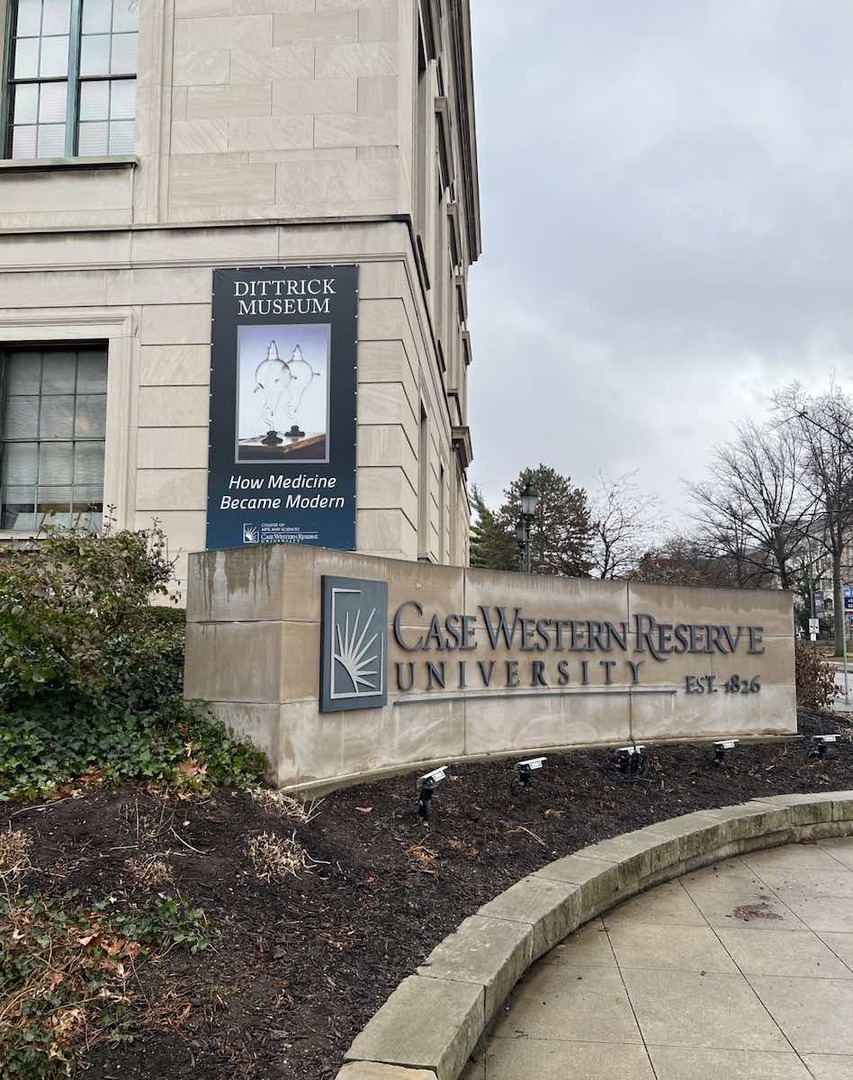
    <title type="html"><![CDATA[Dittrick Medical History Center: A Showcase for Two Centuries of Healthcare Advancements]]></title>
    <summary type="html"><![CDATA[<p><strong><em>In the late nineteenth century, the Cleveland Medical Library Association opened a fledgling museum "that represented a collection of heterogeneous articles stored in boxes, not arranged systematically, and not catalogued." By the twenty-first century, the Dittrick Medical History Center was recognized as one of the foremost medical museums. Its evolution unfolded alongside not only medical advances but also the city's broader growth as a healthcare hub.</em></strong></p><img src="https://clevelandhistorical.org/files/fullsize/ef7f6a8ea3687947e8d93b8f9918ab79.jpg" alt="Dittrick Medical History Center Today" /><br/><p>Medical history museums long existed in Europe prior to their origins in the United States, which occurred following the outbreak of the Civil War, and were initially used as educational centers for medical students. The Army Medical Museum was one of the United States’ first known medical history museums and was established to support the Union Army Medical Department’s library. Although the funding for the Army Medical Library decreased over the years, causing relocation and merging, other medical history museums in the U.S. somehow managed to survive and thrive, helping promote the continuance of medical education. For the surviving medical history museums, credit can surely be granted to institutional funding, but the real praise goes to the dedicated educators and collectors, the commitments made to their communities, and an ability to connect relevantly to an ever-changing audience. In its origins, the Dittrick Medical History Center, like the Army Medical Museum, struggled with financing and sustainability. The Dittrick’s history begins with a small library on Prospect Avenue for members and associates of the Cleveland Medical Library Association. Dudley P. Allen, one of the founders of the CMLA, was an avid collector, educator, and surgeon who collected medical books and instruments, which he would later donate to the museum. Upon his death, Allen’s will left a fund of roughly $200,000 to support the library’s maintenance. Allen’s generosity and commitment made him a most appropriate namesake for the medical library and museum on Western Reserve University’s campus, dedicated as the Allen Memorial Medical Library in 1926. Canadian physician Howard Dittrick came to Cleveland in the early twentieth century to work in healthcare and educate about medicine. Unsurprisingly, Dittrick connected with Allen and began researching and collecting medical instruments, tools, and practices from other parts of the world and previous time periods. Dittrick and Allen both aspired to turn the collection of “obsolete types of surgical instruments, microscopes, stethoscopes, diplomas, war material, and personal objects from prominent doctors” into a more robust museum, eventually for public audiences. Early nineteenth-century meeting minutes from the CMLA Executive Council reveal that the museum did not always exist on a large scale. Yet due to Dittrick’s advocacy, avid collecting, fundraising, and work cataloging the artifacts, a museum eventually gained traction within the CMLA community, which decided that the new space in the Allen Memorial Medical Library would have a specific section on the third floor established for a museum space. Although an achievement for Dittrick, it was not until 1934 that the museum, initially named the Museum of Historical and Cultural Medicine, earned enough respect and praise to become its own department. Dittrick continued to work avidly as the Director of the Museum of Historical and Cultural Medicine for about ten more years. In 1945, the CMLA decided to dedicate the Museum to Dittrick in honor of his fierce dedication and advocacy to make a museum of its kind flourish not only for the medical field but for the public. The Howard Dittrick Museum of Historical Medicine continued to grow and flourish over the years under new direction and guidance, all still with the spirit of Dittrick in mind. While museums like the Army Medical Museum were not able to sustain themselves, the Howard Dittrick Museum continued to receive donated artifacts, lend out collections, host guest lecturers, and keep its doors open for both research and public education. </p><p>Throughout the twentieth century and into the twenty-first, the Dittrick has mounted many permanent and temporary exhibits. Many of the exhibits have been timely. For the U.S. Bicentennial, the museum presented an exhibit that depicted health and medical care in the era of the American Revolution. Other, more permanent exhibits depict the history and improvement of medical technologies, including microscopes and stethoscopes. As the museum and its exhibits continued to adapt to changing times, such as online cataloging and technologically engaging activities, the Dittrick underwent another name change in 1998 to better reflect the mission and collections of artifacts, rare books, images, and other materials. Today, the Dittrick Medical History Center has one of the most prominent collections of contraceptives in the United States, as well as one of the largest collections of antique surgical instruments.</p><p><em><strong><a href="https://clevelandhistorical.org/items/show/985">For more (including 7 images) view the original article</a></strong></em></p>]]></summary>
    <published>2022-11-28T05:05:18+00:00</published>
    <updated>2026-04-17T19:17:42+00:00</updated>
    <link rel="alternate" type="text/html" href="https://clevelandhistorical.org/items/show/985"/>
    <id>https://clevelandhistorical.org/items/show/985</id>
    <author>
      <name>J. Wilson</name>
    </author>
  </entry>
  <entry>
    <title type="html"><![CDATA[Frances Payne Bolton]]></title>
    <summary type="html"><![CDATA[<img src="https://clevelandhistorical.org/files/fullsize/e829755af1b6acb4519dd4a5f1340d3f.jpg" alt="Swearing In of Bolton, 1940" /><br/><p>Congressman Frances Payne Bolton was born Frances Payne Bingham into a wealthy and prominent family of Cleveland in 1885. Two of her grandfathers, William Bingham and Henry B. Payne, introduced her to the world of politics at an early age.  William Bingham, well known for his hardware wholesale company Wm. Bingham & Co., served on the Cleveland City Council. Payne became Cleveland's first solicitor under its municipal charter and was later elected to city council before ultimately serving at a national level as a Democratic Senator.  Having the familial link to politics may have prepared her for a future political career but her marriage and the death of her husband, Chester C. Bolton, provided her the position for candidacy.  She began serving as a Republican House of Representatives member in 1940 to fill her late husband's position and continued serving until her 1968 defeat.</p><p>Frances Bolton's family's wealth allowed for the best schooling and many travel opportunities that served her in her future career. Her father was a wealthy banker-industrialist, but it was her uncle Oliver Hazard Payne, who worked alongside John D. Rockefeller in founding the Standard Oil Company, that earned a great deal of economic wealth and established trust funds for each of the Binghams. With this trust, Frances Payne Bolton would be known as one of the wealthiest women in the United States and use her funds to finance various philanthropic measures.</p><p>Bolton is most recognized for her involvement with the healthcare field, specifically nursing. Bolton began her involvement by volunteering with the Visiting Nurses Association in 1904 and learned about the healthcare system, nursing profession, and social welfare programs through the experience. Her wealth provided her opportunities to benefit society. She influenced the founding of the Army School of Nursing, which created Army-trained nurses, rather than volunteers, to be used in World War I. She is well remembered throughout Cleveland for providing the financial contributions that enabled Western Reserve University, now Case Western Reserve University, to open one of the first university schools of nursing in the country in 1923. In 1935 the school was renamed the Frances Payne Bolton School of Nursing. As Bolton became a congressman she authored the Bolton Act, which created the Cadet Nurse Corps in 1943. This program expanded the number of trained nurses for the war effort.</p><p>Bolton's political actions beyond healthcare have been influential but often overlooked. As she was elected into the House of Representatives, she joined only five other women in that legislative body.  Bolton was a "distinctly conservative" member of Congress but often progressive in her support for measures of equality, including supporting a bill to support equal pay for men and women in the workplace in 1954. Bolton's career helped set an example for future women of the possibility to embark on political careers and the success that can be achieved in those careers.</p><p>Bolton became involved with foreign affairs in Congress and achieved great success in her career. She reorganized the Foreign Affairs committees and created five permanent sub-committees for better functioning. She paid her own way on several travel missions and became an expert on Communism (writing Strategy and Tactics of World Communism) and the first woman to head an official mission abroad. In 1953 she was promoted to a delegate to the United Nations; she was the first woman to achieve this position.  Bolton's work on her mission to Africa remains one of her most overlooked contributions. This trip allowed for a better U.S. connection with the continent and its people, understanding their way of life, building better relationships and promoting the developing of democratic governments in the countries visited. Bolton continued her position in Foreign Affairs until she was defeated in the election of 1968.</p><p>After her defeat, Bolton retired from politics but her civic work and philanthropies continued.  Historic preservation was another of the causes Bolton supported with her time and finances throughout her life; Mount Vernon was of particular interest to Bolton and lay behind her creation of the Accokeek Foundation to preserve the shores across the Potomac River. Because of her age, she only continued her support for a few more years until passing away in 1977. The immense show of support through local newspapers and at her funeral was indicative of the influence Bolton had on the public. She was praised and remembered as a humanitarian, philanthropist, politician, and patriot.</p><p><em><strong><a href="https://clevelandhistorical.org/items/show/678">For more (including 9 images) view the original article</a></strong></em></p>]]></summary>
    <published>2014-12-04T22:01:48+00:00</published>
    <updated>2026-04-17T19:17:40+00:00</updated>
    <link rel="alternate" type="text/html" href="https://clevelandhistorical.org/items/show/678"/>
    <id>https://clevelandhistorical.org/items/show/678</id>
    <author>
      <name>Renée Hubbell</name>
    </author>
  </entry>
  <entry>
    <title type="html"><![CDATA[Warner and Swasey Observatory: Cleveland&#039;s &quot;Plumb Line to the Heavens&quot;]]></title>
    <summary type="html"><![CDATA[<img src="https://clevelandhistorical.org/files/fullsize/362fedbc7e018dc02fb3a0d47268db26.jpg" alt="Warner and Swasey Observatory" /><br/><p>On a high, grassy knoll overlooking East Cleveland stands the Warner & Swasey Observatory. Once a scientific landmark, today it is a bleak sentinel.  Although it operated for more than sixty years, offering what the Plain Dealer called "a plumb line to the heavens," light pollution from a growing Cleveland reduced its usefulness with each passing year so that by midcentury it was no longer a reliable resource for astronomical research. </p><p>The Warner and Swasey Company, maker of machine tools and precision instruments, got its start in 1880 when Connecticut machinists Worcester Reed Warner and Ambrose Swasey decided to go into business for themselves. Moving to Cleveland, eventually they built a large factory on Carnegie Avenue at East 55th Street to manufacture turret lathes and telescopes. Their products found military uses during both world wars, and they built a number of telescopes for leading observatories, including the University of California's Lick Observatory, which reigned as the world's largest refracting telescope for about a decade in the late 19th century, and the U.S. Naval Observatory. Warner and Swasey operated in Cleveland until being bought out in 1980 by the Bendix Corporation.</p><p>Warner and Swasey became trustees of Case Institute of Technology. Among their many gifts to the institution was the Warner and Swasey Observatory. Designed by the renowned Cleveland firm of Walker and Weeks and situated some 270 feet above the level of Lake Erie, the observatory, which opened in 1920, was equipped with a Warner and Swasey-built 9.5-inch refractor. Unlike today's telescopes, which use mirrors to reflect light from objects in space to form an image, older refracting telescopes utilized a lens to refract, or bend, light and render an image. </p><p>The initial telescope was used until 1941, when the company delivered a much more powerful, 24-inch telescope, the Burrell Schmidt, housed in a second dome. The observatory mounted groundbreaking studies in the early 1950s, including one to prove the theory that the Milky Way was a spiral galaxy and another that found that cooler stars (red giants) were mainly near the center of the Milky Way. But these discoveries marked the twilight of the observatory's short-lived heyday. When light pollution--a common problem for observatories located near cities--became insurmountable in the 1950s, Case acquired a new site for the Burrell Schmidt telescope near the "chimney" of Geauga County, some thirty miles east of its original location. There it operated from 1957 until 1979, when it was again moved to Kitt Peak National Observatory in Arizona. </p><p>Meanwhile, the Warner and Swasey Observatory was outfitted with a 36-inch telescope. Hailed as the nation's finest for public viewing, it operated for more than twenty years until the observatory closed permanently in 1980, the same year that Warner and Swasey sold out to Bendix. Just as its maker's success led to a corporate takeover that ultimately brought its liquidation, the observatory itself succumbed to a byproduct of the relentless expansion of the city that had attracted two young machinists westward a century before.</p><p>Today one can still find the original refracting telescope built for the observatory. Since 1982 it has operated in a small dome atop Case Western Reserve University's Albert W. Smith Building. </p><p><em><strong><a href="https://clevelandhistorical.org/items/show/551">For more (including 8 images&#32;&amp;&#32;1 audio file) view the original article</a></strong></em></p>]]></summary>
    <published>2012-09-14T21:22:21+00:00</published>
    <updated>2026-04-17T19:17:39+00:00</updated>
    <link rel="alternate" type="text/html" href="https://clevelandhistorical.org/items/show/551"/>
    <id>https://clevelandhistorical.org/items/show/551</id>
    <author>
      <name>J. Mark Souther</name>
    </author>
  </entry>
  <entry>
    <title type="html"><![CDATA[The Cleveland Institute of Music]]></title>
    <summary type="html"><![CDATA[<img src="https://clevelandhistorical.org/files/fullsize/cim1_0a835e861a.jpg" alt="CIM Director Victor Babin, 1966" /><br/><p>The Cleveland Institute of Music was founded in 1920 by a small group of backers who each contributed $1,000 to get the music conservatory off the ground. Initially the school focused on student performance. Classes were first taught in the Statler Hotel, then moved to various residences on Euclid Avenue until the institute built its own facility in University Circle in 1961.  </p><p>CIM's first artistic director was Ernest Bloch, a Swiss composer and teacher who came to Cleveland from New York City. Bloch began teaching Dalcroze Eurhythmics, a holistic method of music education focusing on the expression of both musical and physical rhythms that is still taught to students today. The institute offers a comprehensive liberal arts education in conjunction with Case Western Reserve University and also provides a preparatory program for younger students. Since its founding, CIM continues to have a close relationship with the Cleveland Orchestra. The number of enrolled students in CIM's inaugural year was five. A century later, more than 400 students enroll in a typical academic year.</p><p><em><strong><a href="https://clevelandhistorical.org/items/show/46">For more (including 8 images&#32;&amp;&#32;6 audio files) view the original article</a></strong></em></p>]]></summary>
    <published>2010-09-19T10:44:45+00:00</published>
    <updated>2026-04-17T19:17:36+00:00</updated>
    <link rel="alternate" type="text/html" href="https://clevelandhistorical.org/items/show/46"/>
    <id>https://clevelandhistorical.org/items/show/46</id>
    <author>
      <name>CSU Center for Public History and Digital Humanities</name>
    </author>
  </entry>
  <entry>
    <title type="html"><![CDATA[University Hospitals]]></title>
    <summary type="html"><![CDATA[<img src="https://clevelandhistorical.org/files/fullsize/universityhospitals2_47a0028091.jpg" alt="Hanna House, 1930" /><br/><p>University Hospitals of Cleveland is a world-class, not-for-profit medical institution with close ties to Case Western Reserve University. Its roots go back to 1866, with the formation of the Cleveland City Hospital Association, a charitable society designed to provide medical care to Cleveland's poor. The association's hospital quickly outgrew its original facilities and in 1876 moved into the Marine Hospital at East 9th Street and Lakeside Avenue. Eventually it became known as Lakeside Hospital and, in 1895, was affiliated with Western Reserve University's Medical Department.</p><p>In 1925, Lakeside Hospital formally merged with Maternity Hospital and Babies & Children's Hospital - two other Cleveland medical institutions that formed around the turn of the century with the aid of charitable contributions. This merger created University Hospitals of Cleveland and led to the development of new medical programs, services, and facilities throughout the greater Cleveland area. Much of the new construction occurred in University Circle, where University Hospital's main campus remains today.  </p><p><em><strong><a href="https://clevelandhistorical.org/items/show/45">For more (including 7 images&#32;&amp;&#32;3 audio files) view the original article</a></strong></em></p>]]></summary>
    <published>2010-09-19T10:23:48+00:00</published>
    <updated>2026-04-17T19:17:36+00:00</updated>
    <link rel="alternate" type="text/html" href="https://clevelandhistorical.org/items/show/45"/>
    <id>https://clevelandhistorical.org/items/show/45</id>
    <author>
      <name>CSU Center for Public History and Digital Humanities</name>
    </author>
  </entry>
  <entry>
    <title type="html"><![CDATA[Peter B. Lewis Building: Frank Gehry Designs a Home for the Case Weatherhead School]]></title>
    <summary type="html"><![CDATA[<img src="https://clevelandhistorical.org/files/fullsize/peterblewis2_643a0a2cfd.jpg" alt="Entrance " /><br/><p>Designed by world-famous architect Frank Gehry, the Peter B. Lewis Building's unique architectural features symbolize the Case Western Reserve University Weatherhead School of Management's innovative approach to management education. Opened in 2002, the wavy, stainless-steel sheathed landmark takes its name from Peter B. Lewis, Chairman of the Progressive Insurance Company, whose vision and support made the building possible. Lewis had previously commissioned Gehry to design an iconic downtown lakefront skyscraper as a new headquarters for Progressive and a home for himself in Lyndhurst. Neither was built, and cost overruns threatened to nix the new Weatherhead project until Lewis followed his original gift with an even larger one. The building continues in its original purpose of providing workspaces and classrooms to Weatherhead School of Management's students and faculty. In 2018, the demolition of the adjacent former home of the Cleveland Institute of Art opened a parklike expanse to the west that provides a better vista of the building, which was previously difficult to see except from the streets that line its southern and eastern flanks.</p><p><em><strong><a href="https://clevelandhistorical.org/items/show/39">For more (including 6 images&#32;&amp;&#32;3 audio files) view the original article</a></strong></em></p>]]></summary>
    <published>2010-09-18T15:46:25+00:00</published>
    <updated>2026-04-17T19:17:36+00:00</updated>
    <link rel="alternate" type="text/html" href="https://clevelandhistorical.org/items/show/39"/>
    <id>https://clevelandhistorical.org/items/show/39</id>
    <author>
      <name>CSU Center for Public History and Digital Humanities</name>
    </author>
  </entry>
  <entry>
    <title type="html"><![CDATA[Case Western Reserve University: The Evolution of a Renowned University]]></title>
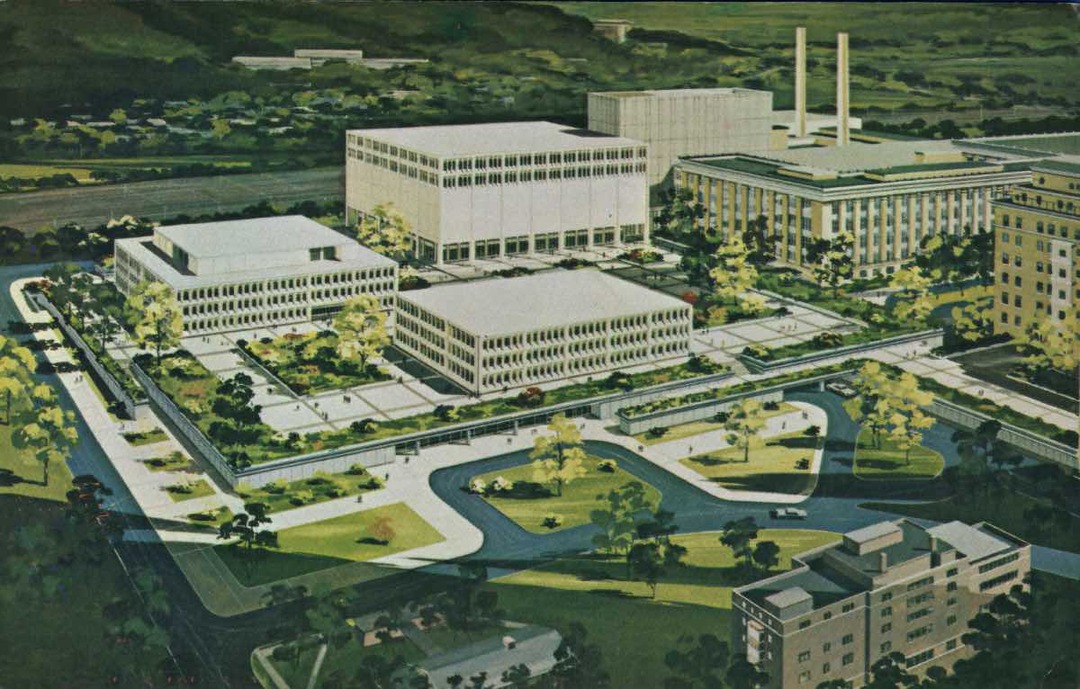
    <summary type="html"><![CDATA[<p><strong><em>Two colleges growing in parallel through the nineteenth century achieved a cooperative union in 1967 and emerged as a premier educational institution in Cleveland and beyond.</em></strong></p><img src="https://clevelandhistorical.org/files/fullsize/ba8a3ad4174ab34278f7d98d8eb8d28c.jpg" alt="Health Science Center" /><br/><p>Case Western Reserve University traces its roots to Western Reserve College, founded in Hudson, Ohio, in 1826.  Three faculty members began instruction in theology, ancient languages, and mathematics/natural philosophy and began to graduate students in 1830. Western Reserve grew up in Hudson through national economic hardships and many political and academic challenges. Abolitionism, the Civil War, and the education of women were among the issues that shaped the College in the mid to late 19th century. Presidents George Pierce, Henry Hitchcock, and Carroll Cutler guided the development and logistics of Western Reserve’s curriculum, facilities, and finances from 1834 to 1886. The Cleveland Medical College was founded in 1843 in downtown Cleveland as an autonomous department of Western Reserve College. Among the growth in faculty during this time, Edward Morley was appointed as a Professor of Chemistry in 1869 (remaining until 1906) as a leader in chemistry and physics instruction. Economic and population growth in northern Ohio encouraged the school’s leaders to consider the metropolitan area and its resources for a relocation of the College from Hudson to Cleveland. Industrialist Amasa Stone financed the college’s move to Cleveland’s University Circle in 1880. The College moved its programs to newly constructed buildings along Euclid Avenue adjacent to the Case School of Applied Science and within six years established Adelbert College (for men), the College for Women and embraced affiliation with Music and Art programs in the locale.   </p><p>The Case School of Applied Science was the brainchild of philanthropist Leonard Case, Jr. He financed the founding of the school in 1880 originally holding classes in the family home near Cleveland’s Public Square until construction of buildings along Glenwood Street (later becoming East Boulevard, then Martin Luther King Drive) in University Circle were completed. Western Reserve and Case became neighbors in 1882, and the schools began to share relationships through faculty research and program cooperation. CWRU historian, C. H. Cramer noted that in 1880, “the two schools agreed on ‘friendly cooperation’ —and for some time there was good will and good spirit between the institutions.”  A fire at Case Main building prompted Adelbert College to provide rooms and equipment for Case programs. One of the first appointments to the Case faculty was physicist Albert Michelson. The two schools’ relationship became the setting for the groundbreaking Michelson-Morley Experiment, an 1887 study which laid the groundwork for modern theories of physics involving the measurement of light. Four presidents: Cady Staley, Charles Howe, William Wickenden, and T. Keith Glennan guided Case School Applied Science into Case Institute of Technology by 1947. Increased cooperation and federation with Western Reserve University from 1886 to 1966 was evident despite faculty, student, and alumni resistance to any discussions of an institutional merger. </p><p>Meanwhile, WRU continued growing through the decades and into the 20th century with the addition of Schools of Law, Dentistry, Graduate Programs, Pharmacy, Applied Social Sciences, Nursing, Education, Architecture, Business/Management, and Library Science by 1941. Cleveland College of Western Reserve University (and affiliated with Case) was established on Public Square in the Chamber of Commerce Building to provide downtown access to programs during days and evenings. At Case, under President Wickenden, the curriculum was molded to include humanities as part of the engineering program. Also notable was the admission of women into undergraduate programs in the sciences at Case during 1943 to bolster the Army and Navy workforce during the war. Women continued to earn degrees through 1954 when admissions ceased until 1960 at which time women were welcomed to all science and engineering programs permanently. Upon the aftermath of World War II, Keith Glennan, a businessman, assumed the presidency of Case Institute of Technology. He guided an era of unprecedented growth and expansion of the school and its programs via newfound support from foundations and government contracts. Glennan twice used leaves of absence to join the Atomic Energy Commission and to head NASA during his tenure which expanded his university’s exposure and engagement. Glennan also endorsed the notion that engineers and technologists needed to broaden their knowledge of human and social behavior and, consequently, expanded the curricula to that end. He noted that one economical method to implement this educational approach was to federate with “the complementary institution that was within eyesight of the Case administration building.” Glennan was also influenced by the merger of Fenn College of Engineering with Cleveland State University which eliminated a private engineering school in Cleveland and by the insights of the Carnegie Foundation president John Gardner concerning the advantages of a merged university in Cleveland. He and WRU president John Millis began regular meetings to discuss the possibilities of a federation or merger and sought consultant studies and expert input concerning the prospect.</p><p>The name Case Western Reserve University was derived from the merger of Western Reserve University and Case Institute of Technology. The process culminated a year-long administrative consolidation after both institutions' trustees’ approved merger plans. The plan required equal partnership and status of Case and WRU, despite their respective size differences and renewed vocalized resistance by faculty and alumni. Robert Morse succeeded Glennan as president of Case on July 1, 1966, and one year later became president of Case Western Reserve University. Eight more presidents would lead the institution through 2017 which marked the 50th anniversary of the merger and a celebration of the benefits and growth of the University and its developmental impact upon the University Circle region of Cleveland. </p><p><em><strong><a href="https://clevelandhistorical.org/items/show/37">For more (including 12 images&#32;&amp;&#32;4 audio files) view the original article</a></strong></em></p>]]></summary>
    <published>2010-09-18T14:21:26+00:00</published>
    <updated>2026-04-17T19:17:36+00:00</updated>
    <link rel="alternate" type="text/html" href="https://clevelandhistorical.org/items/show/37"/>
    <id>https://clevelandhistorical.org/items/show/37</id>
    <author>
      <name>Jim Lanese</name>
    </author>
  </entry>
  <entry>
    <title type="html"><![CDATA[The Cleveland Agora: From College Dance Hall to Rock &amp; Roll Proving Ground]]></title>
    <summary type="html"><![CDATA[<p><strong><em>In 1967, an article in the Case student newspaper decried that Cleveland area college students had “no place to go” to socialize off-campus. One local music fan and entrepreneur stepped in and changed everything, putting Cleveland on the map as an international rock and roll destination.</em></strong></p><img src="https://clevelandhistorical.org/files/fullsize/adced2e64e0976ef952d9b6d55c12ef5.jpg" alt="Devo onstage at the Agora, ca. 1978" /><br/><p>After a stint distributing records for jukeboxes, Hank LoConti opened the original Agora club on February 27, 1966, at 2175 Cornell Road, in the former Ripa Hall, which had been home to an Italian hometown society for immigrants from Ripalimosani, Italy. With its location in Little Italy just across the railroad tracks from Case Institute of Technology and Western Reserve University, the original Agora was a simple venue intended primarily for students. The Agora grew steadily from the start, opening the nation's first in-house recording studio in 1968 and producing many live albums. As LoConti later reflected, from there the Agora “grew to the magnitudes no one had ever dreamed.” </p><p>As word spread and crowds began to swell, some residents in famously-protective Little Italy decided the Agora – with its raucous fans and loud music – didn’t fit with their vision for the neighborhood. A large group of locals formed one night to publicly voice their disdain for the college students’ unwelcome invasion. Moved by the group’s grievances but also pleased with the Agora’s rising success, LoConti arranged for a second lease at 1724 East 24th Street near Payne Avenue, opening a new club in July 1967, likely intending to reduce crowds on Cornell Road. For the next 18 months, LoConti operated two Agoras, nicknaming the original "Agora Alpha" and the new club "Agora Beta." Agora Beta would become the stuff of legend.</p><p>Throughout the 1970s, the Agora’s reputation grew as it began to host increasingly prominent acts and even expanded for a time into a chain with clubs in a dozen other cities. Deanna R. Adams’s book *Rock 'n' Roll and the Cleveland Connection* compares the Agora to other famous venues of the era, describing it as Cleveland’s counterpart to San Francisco’s Avalon Ballroom and New York’s Bottom Line. The Agora’s floor plan allowed fans to experience live performances up close, fostering an electric atmosphere that artists and audiences loved. Artists like Bruce Springsteen, Meat Loaf, Alice Cooper, Roxy Music, Southside Johnny, and more came back to Cleveland time and again to play the Agora.</p><p><a href="https://clevelandhistorical.org/items/show/978">WMMS</a>, Cleveland's leading rock radio station – and a national cultural force in its own right – also played a crucial role in the Agora's success. Disk jockeys like Kid Leo championed emerging rock acts and used their platforms to create buzz around upcoming shows at the Agora. WMMS’s Buzzard brand became synonymous with Cleveland’s rock identity, frequently broadcasting live performances from the Agora, and giving the club a regional and even national audience. Meanwhile, "Onstage at the Agora" became an internationally syndicated television show years before MTV brought rock music to the living room. At the Agora, attendees experienced a sense of community that went beyond entertainment, reinforcing Cleveland’s image as a “music town.”</p><p>As Cleveland underwent economic challenges and transformations in the 1980s, so too did the Agora. A fire broke out at the Agora in 1984 and forced the location to close. Due to a dispute with the property’s landlord, Cleveland State University, LoConti eventually opened the Agora in its present – omega? – form at East 55th and Euclid Avenue, formerly WHK Auditorium. Despite the apparent setback, the Agora, along with WMMS, continued to build its reputation as a proving ground for up and coming acts and bring a sense of cultural relevance to the city. Where once young Clevelanders had bemoaned having “no place to go,” the city now had rock and roll bragging rights.</p><p>The Agora’s legacy was ultimately recognized in the early 2000s, as Cleveland began to understand the importance of preserving its musical heritage. By this time, the Agora had solidified its reputation as a historical landmark, a status that attracted both financial support and media attention. The Agora was claimed to be “one of the hottest places to catch rock shows of every style and persuasion.” Seating an impressive 2,700 people in its theater and ballroom, the Agora was as welcoming as it was entertaining. The City of Cleveland acknowledged the Agora’s role in shaping Cleveland’s identity through renewal projects and official landmark status, recognizing it as more than just a concert hall but as a space where generations of Clevelanders have gathered to celebrate music and community. This support from the City of Cleveland, coupled with Cleveland’s broader efforts to promote its cultural assets, has allowed the Agora to continue evolving while honoring its roots.</p><p><em><strong><a href="https://clevelandhistorical.org/items/show/1">For more (including 6 images, 1 audio file,&#32;&amp;&#32;3 videos) view the original article</a></strong></em></p>]]></summary>
    <published>2010-05-26T16:03:12+00:00</published>
    <updated>2026-04-17T19:17:36+00:00</updated>
    <link rel="alternate" type="text/html" href="https://clevelandhistorical.org/items/show/1"/>
    <id>https://clevelandhistorical.org/items/show/1</id>
    <author>
      <name>Alex Wicker</name>
    </author>
  </entry>
</feed>