<?xml version="1.0" encoding="UTF-8"?>
<feed xmlns="http://www.w3.org/2005/Atom">
  <title type="text">Cleveland Historical</title>
  <updated>2026-08-21T21:28:36+00:00</updated>
  <generator uri="http://framework.zend.com" version="1.12.20">Zend_Feed_Writer</generator>
  <link rel="alternate" type="text/html" href="https://clevelandhistorical.org/"/>
  <link rel="self" type="application/atom+xml" href="https://clevelandhistorical.org/items/browse?output=rss2"/>
  <id>https://clevelandhistorical.org/</id>
  <author>
    <name>Cleveland Historical</name>
    <uri>https://clevelandhistorical.org</uri>
  </author>
  <link rel="hub" href="http://pubsubhubbub.appspot.com/"/>
  <entry>
    <title type="html"><![CDATA[St. Mary Cemetery: Cleveland&#039;s First West Side Catholic Cemetery]]></title>
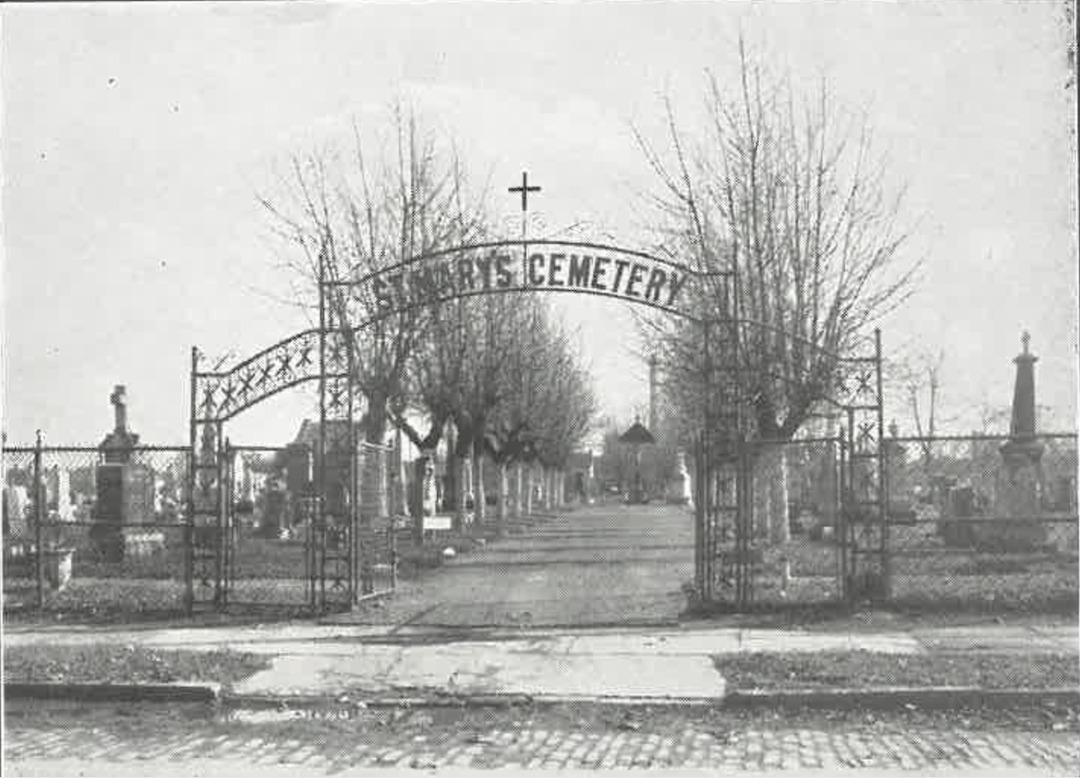
    <summary type="html"><![CDATA[<p><strong><em>St. Mary Cemetery lies in the middle of one of the most densely populated residential areas on Cleveland's west side. Its nine acres of land, dotted with shade trees and beautiful grave stones, is surrounded by a fence, and, at its West 41st Street entrance, a posted sign advises visitors of its visiting hours.  However, neither this entrance nor its other on West 38th is gated. This being the case, St. Mary's almost beckons to neighbors and any other passersby to  visit it at any time, day or night, enjoy its grassy grounds, walk its pretty paths, and, most importantly, respect its magnificent  monuments.</em></strong></p><img src="https://clevelandhistorical.org/files/fullsize/1cc9a1a467673d53392c76e36c48e8e6.jpg" alt="The once ornate West 41st Street entranceway to St. Mary Cemetery." /><br/><p>In 1853, just one year before Ohio City was annexed to the City of Cleveland, thus becoming Cleveland's west side, prolific nineteenth-century real estate developer Hiram Stone platted a new residential subdivision south of Ohio City in Brooklyn Township. He called it "H. Stone's Addition to Ohio City & Cleveland," a remarkably prescient title at the time. The new subdivision stretched west from Pearl (West 25th) Street all the way to Gauge (West 44th) Street, and from Clark Avenue north to <a href="https://clevelandhistorical.org/items/show/659">Walworth Run</a> at Ohio City's southern boundary. </p><p>The platted area contained almost 700 lots for residential houses, but left undeveloped in its midst were thirteen acres located just east of Burton (West 41st) Street and north of Clark Avenue. In 1861, as houses were going up in Stone's subdivision—many of them for German immigrants who were pouring into Cleveland in this period in large numbers—the southernmost six acres of the undeveloped thirteen in the middle of the subdivision were purchased by the Catholic Diocese of Cleveland for, according to the deed of purchase, "cemetery purposes for the benefit of German Catholics on the west side of the Cuyahoga River." </p><p>Many of the early records of St. Mary Cemetery appear to have been destroyed in a fire, making research of the early years of the cemetery difficult.  However, secondary sources tell us that St. Mary Cemetery was established on those six acres of land in 1862 by St. Mary of the Assumption parish, Cleveland's first west side German Catholic parish. The property for St. Mary Cemetery was purchased during the pastorship of Father F. X. Obermueller, a German immigrant, but it appears that it was under a subsequent pastor, Father Stephen Falk, a Swiss immigrant who served the parish from 1862 to 1880, that the cemetery grounds were developed and consecrated. In St. Mary Cemetery's early years, it was often referred to as Burton Street Cemetery, after the street upon which it fronted. That street, in turn, had been named after <a href="https://clevelandhistorical.org/items/show/660">William Burton</a>, an Ohio City pioneer whose summer cottage was built on the street in 1839 and still stands directly across from St. Mary Cemetery.  </p><p>Just a few years after St. Mary Cemetery opened, another German Catholic parish, <a href="https://clevelandhistorical.org/items/show/649">St. Stephen</a>, was established on Cleveland's west side. It began in 1869 as a mission of St. Mary of the Assumption for German Catholics living west of Gauge (West 44th) Street. A decade later, in 1881, another parish, <a href="https://clevelandhistorical.org/items/show/717">St. Michael Archangel</a>, was also founded as a mission of St. Mary's for German Catholics living on Cleveland's southwest side. In the years that followed, German Catholics who belonged to either St. Mary of the Assumption, St. Stephen or St. Michael's parishes were permitted to be buried at St. Mary Cemetery which, by this date, had now become part of Cleveland's west side following the 1867 annexation of an area of Brooklyn Township that included the lands upon which the cemetery was located.</p><p>It is interesting to note that no Cleveland newspaper mentioned St. Mary Cemetery during the first decade of its existence. The first to mention the cemetery, albeit obscurely, was the Plain Dealer on May 30, 1871, when it published an article which noted that, on Decoration Day, Father Falk of St. Mary's German church had, at the west side "Catholic cemetery," decorated the graves of "J. Mayer, J. Schneider, F. Werz, A. Klein, K. Mecil, B. Lais, F. Schwonger, S. Vochatger, C. A. Schmidt, and Jas. Macklin." All of these men presumably were German Catholics who had fought for the Union—and for which some had died—in America's Civil War. Cleveland city directories were even slower in acknowledging the existence of the new cemetery. St. Mary Cemetery was not listed in any Cleveland directory until 1874.</p><p>Thousands of German immigrants and descendants of German immigrants were buried at St. Mary Cemetery in the years that followed its establishment, many of them beneath beautiful gravestones inscribed in the German language. A number of these gravestones are memorials to notable German Catholics who, in the second half of the nineteenth century, operated successful retail businesses on Lorain Avenue near Fulton Road, an intersection that soon became known as <a href="https://clevelandhistorical.org/items/show/966">Lorain-Fulton Square</a>. A number of those gravestones honor members of the related Fridrich and Schmitt families who operated several different businesses in that west side commercial district, including <a href="https://clevelandhistorical.org/items/show/964">Fridrich Bicycle</a>, one of the oldest retail bicycle shops in the United States until it closed its doors in 2024. </p><p>Another example of a notable German immigrant businessman buried at St. Mary Cemetery is Friedlin "Freddie" Hirz (1843-1903), a tailor who for years had a shop on Lorain Avenue, just west of what is today West 45th Street. His shop was so well known that it was featured in the 1874 Atlas of Cuyahoga County. Another is Edward Disler, a German immigrant and jeweler who successfully operated a store on Lorain Avenue near West 25th Street for many years.</p><p>While St. Mary Cemetery was explicitly founded for German Catholic burials, Catholics of other ethnicities were later given permission to bury their dead there too. The first of these were Bohemian Catholics many of whom lived near the cemetery in a west side neighborhood that was known in the second half of the nineteenth century as the <a href="https://clevelandhistorical.org/items/show/646">Isle of Cuba</a>. The early-arriving immigrants likely first worshiped with German Catholics at either St. Mary of the Assumption or St. Stephen, but, by 1872, their numbers were sufficiently large that the Bishop permitted them to form a parish of their own, which they called <a href="https://clevelandhistorical.org/items/show/661">St. Procop</a>, after Bohemia's patron saint. Their first church was built on Burton Street, just south of St. Mary Cemetery in 1874. One of the earliest verifiable burials of a Bohemian Catholic at St. Mary Cemetery occurred in 1892, when 41-year- old Miloslav Holecek, a Cleveland grocer and immigrant from <span>Karlova Huť in Central Bohemia</span>, died and was buried there. His gravestone, as well as those for a number of other Bohemian immigrants buried at St. Mary's, is inscribed entirely in the Czech language.</p><p>In the early years of the twentieth century, Catholic immigrants of other ethnic groups from Central Europe who often tended to settle in urban areas where Germans and/or Bohemians had first settled, including Hungarians, Poles, and Slovaks, became members of the west side German and Bohemian Catholic parishes, and when they died, they were permitted to be buried at St. Mary Cemetery too. Their gravestones were often inscribed in their native languages.</p><p>In 1917, Father Casimer Reichlin, the first pastor of St. Stephen who had served for an incredible 47 years, died.  By this time, there appears to have already been a large circular section near the West 41st Street entrance to St. Mary Cemetery, in the center of which a large cross had been erected. It further appears that it was decided that this beloved pastor should be buried in that section, with a large sculpted monument erected over his grave. Four years later, Father Reichlin's long-time friend and fellow priest, Bishop Joseph Koudelka, who had been a pastor at both St. Procop and St. Michael, died and was buried next to Father Reichlin's grave in the circular section. A similarly sized sculpted monument was placed over his grave too. Soon this circular section of St. Mary Cemetery became known as the Priests Circle. In the years that followed, other notable local priests who had served west side Catholic parishes were accorded the same honor and buried in the Priests Circle, some below large monuments and others below simple flat grave markers. As of October 2025, there were eleven priests buried in the Priests Circle. Father Stephen Falk, whose efforts led to the development of the cemetery and its consecration in 1862, is not buried in the Circle, as he died in 1899 long before the Priests Circle was initiated. A simple flat grave marker in Father Falk's memory, which apparently replaced a more elaborate earlier monument, is located in another section of St. Mary Cemetery.</p><p>By the early 1920s, there were few available burial plots left at St. Mary Cemetery. The parish of St. Mary of the Assumption decided to remedy this by expanding the cemetery's lands, and in 1927 and 1928 it successfully purchased three additional acres of land for the cemetery that abutted the eastern end of the original cemetery grounds.  The additional acres had earlier been developed as residential lots in H. Stone's Additional Subdivision. Houses on the lots were either torn down or moved, and the cemetery grounds were successfully extended all the way to West 38th Street. Along with the additional land, St. Mary Cemetery was further enhanced at this time with a second entrance on West 38th Street and a new walking path that led from that entrance directly to a new circular section in the cemetery.</p><p>On November 15, 1931, the new addition to St. Mary Cemetery was consecrated at a ceremony attended by a representative of Bishop Joseph Schrembs.  Some five years later, on May 17, 1936, the Cuyahoga County Council of the Veterans of Foreign Wars placed a flagpole and a memorial plaque in the center of the new circular section, the plaque inscribed: "Dedicated To The Veterans Who Served . . . Lived . . . Died . . . for their Country."  </p><p>As previously noted, St. Mary Cemetery had long held the graves of a number of German Catholic soldiers who fought and died in the Civil War, and also likely holds graves of soldiers and veterans who had fought in the Spanish-American War and/or in World War I. No veterans from any of these war, however, are buried in this new circular section. The first soldier buried in what became known as the Soldiers Circle, was Charles L. Andrews, a U. S. Navy radio operator who was killed on Easter Sunday, April 5, 1942, during the Battle of Bataan in the Philippine Islands. The remains of sixteen other soldiers or veterans who served in World War II were also buried in the Circle between 1942 and 1948.</p><p>In 1945, as a result of dwindling attendance numbers, St. Mary of the Assumption parish was dissolved and, in 1948, the management, care and maintenance of St. Mary Cemetery was transferred to the Calvary Cemetery Association, an organization which was later renamed the Catholic Cemeteries Association of the Cleveland Diocese. By the early 1950s, the last of the available lots in the cemetery were purchased, and, by 1976, according to a January 21, 1976 Plain Dealer article, the number of annual burials at St. Mary Cemetery had dropped to just fifty.  Today, in 2025, the annual numbers appear to be considerably less. According to findagrave.com—a website at which volunteers create memorials for people whose remains have been buried in cemeteries all around the world—the remains of only nine deceased persons have been buried at St. Mary Cemetery since 2020.  </p><p>St. Mary Cemetery is no longer the active burial place for west side Catholics that it once was. Burials are now few and far between. The cemetery's elaborate gate that once stood at its West 41st Street entrance in 1929 is gone. The sacred monuments to Father Reichlin, Bishop Koudelka and Father Falk have been substantially damaged, likely by vandals. The cross in the middle of the Priests Circle, which stood there for years until recently, is now gone. Acts of vandalism, as noted in a number of Plain Dealer and Press articles over the years, and the effects of exposure of the cemetery's monuments to Cleveland's weather over long periods of time, have left many monuments damaged and unreadable while many others have simply vanished. Still, St. Mary Cemetery remains one of the most historic cemeteries on Cleveland's west side and one which should be visited, respected, and carefully managed and maintained, not only for the descendants whose ancestors are buried there, but also for all Clevelanders who see value in preserving an important piece of their city's history.</p><p><em><strong><a href="https://clevelandhistorical.org/items/show/1072">For more (including 15 images) view the original article</a></strong></em></p>]]></summary>
    <published>2025-11-23T16:18:32+00:00</published>
    <updated>2026-04-17T19:17:43+00:00</updated>
    <link rel="alternate" type="text/html" href="https://clevelandhistorical.org/items/show/1072"/>
    <id>https://clevelandhistorical.org/items/show/1072</id>
    <author>
      <name>Jim Dubelko</name>
    </author>
  </entry>
  <entry>
    <title type="html"><![CDATA[Vietnamese Cultural Garden]]></title>
    <summary type="html"><![CDATA[<img src="https://clevelandhistorical.org/files/fullsize/e2ec76727c199ed7d0aa762aed25a6af.jpg" alt="First Entrance to the Vietnamese Garden " /><br/><p>The Vietnamese Cultural Garden in Cleveland features a 12-foot-tall marble statue of a woman standing atop a square pedestal. The statue wears traditional Vietnamese garments, including the nón dang conical hat and the áo dài dress, which hold significant historical and cultural meaning and are still worn in the community today. The statue of the woman remains composed despite the weather or season, with her hair and dress gently swaying as if moved by the wind. </p><p>The Garden, located at the northern end of Martin Luther King Jr. Drive in Rockefeller Park, was sponsored by the Friendship Foundation and dedicated in 2020. The Garden was designed by Char Crowley, who also participated in the renovation of the Irish Cultural Garden in 2009. The most direct footpath to the Vietnamese Cultural Garden's entrance is along the Harrison Dillard Bikeway. </p><p>As the Vietnam War came to a close, many refugees sought new homes abroad. By November 1975, over 500 refugees had made their way to the Greater Cleveland area in search of freedom. The Vietnamese Cultural Garden stands as a testament to their bravery and the vibrant culture they brought with them. After the fall of Saigon, various religious and social groups formed to prepare aid and shelter for the newcomers seeking sanctuary. </p><p>A formal group was established in December 1975 to assist refugee community organization. Until 1995, the primary organization in the area was the Cong-Dong Viet-Nam Tai Vietnamese Community in Greater Cleveland. Since then, additional organizations have emerged to sponsor friends and families seeking opportunities away from Vietnam. Through local and international programs, these organizations help those adjust by encouraging socio-economic independence, providing housing opportunities, and promoting autonomy within the community. </p><p>American veterans were among those interested in volunteering or creating affiliated organizations. After serving with the Special Forces during the Vietnam War, U.S. Army Captain, historian, and attorney Joseph Meissner dedicated his time to the resettlement effort in Cleveland. Along with his many lifetime accomplishments and endeavors, Meissner helped establish the Friendship Foundation, serving as its vice president. </p><p>The Friendship Foundation is an American-Vietnamese non-profit organization founded in 1993 by Vietnamese-American immigrant Luong Thi Gia Hoa Ryan. Discouraged by the inability to visit home to her native country due to the aftermath of the war, Ryan and other community members joined efforts to establish the Foundation, fostering peace, respect, and harmony. The Foundation's website offers a descriptive history of the project and how the history of the Vietnam War influenced the culture of the community they aim to serve and other humanitarian activities they continue to sponsor. </p><p>After multiple delays, the Vietnamese Cultural Garden finally installed the 12-foot-tall marble statue on November 15, 2023, three years after the Garden's dedication. The sculpture has repeatedly been recognized as the Vietnamese Mother, exhibiting features in line with the Foundation's objectives. The Cleveland Vietnamese Cultural Garden serves as a symbol of courage and resilience for all community members, whether they are veterans, immigrants, or just passing by.</p><p><em><strong><a href="https://clevelandhistorical.org/items/show/1024">For more (including 5 images) view the original article</a></strong></em></p>]]></summary>
    <published>2024-05-01T23:22:22+00:00</published>
    <updated>2026-04-17T19:17:43+00:00</updated>
    <link rel="alternate" type="text/html" href="https://clevelandhistorical.org/items/show/1024"/>
    <id>https://clevelandhistorical.org/items/show/1024</id>
    <author>
      <name>Makialani Kanewa-Mariano</name>
    </author>
  </entry>
  <entry>
    <title type="html"><![CDATA[The First Brecksville VA Hospital]]></title>
    <summary type="html"><![CDATA[<img src="https://clevelandhistorical.org/files/fullsize/1a319271772cca9be244e26c4cc7a989.jpg" alt="Brecksville Veterans Hospital, 1940" /><br/><p>Veterans in the Cleveland, Akron, and Canton areas had fought for over a decade for a veterans' hospital in the local area. In 1938, President Franklin Roosevelt answered their call and authorized the building of a veterans' hospital in the Cleveland area. This became the Brecksville Veterans Administration (VA) Hospital, originally located in Broadview Heights Village. It carried the name Brecksville because Brecksville and Broadview Heights shared the same Brecksville post office. The Broadview Heights Recreation Center is now at the site of the former hospital. The remnants of the old VA Hospital can still be seen in satellite photographs of the area such as the tree-lined driveway. In the midst of the Great Depression, Roosevelt was interested in projects that would create jobs and provide valuable public services as part of the New Deal. The Brecksville VA Hospital did exactly that. </p><p>The Works Progress Administration (WPA) allocated $1,090,000 for the Brecksville VA Hospital. The state of the art hospital opened in November of 1940 to great fanfare and celebration. The hospital created 150 new jobs. Although economic conditions were not as bad as in the early 1930s, Clevelanders still appreciated new opportunities in 1940. </p><p>Tuberculosis patients primarily occupied the 278 beds at the hospital. A contagious respiratory infection, tuberculosis, often shortened to TB, was a common disease prior to World War II when it was often called consumption. Fever, chills, night sweats, and loss of appetite with attendant weight loss characterize TB. However, the most dramatic symptoms are chest pain and coughing and coughing up blood in particular. Tuberculosis was also terminal. The Brecksville VA Hospital provided long-term care for TB patients, as they needed to be quarantined to prevent further spread of the illness. Doctors and nurses could only make TB patients as comfortable as possible in the absence of a cure. </p><p>Beginning in the 1960s, antibiotics were successfully used were used to treat tuberculosis. Sanatoriums and hospitals that treated TB patients were no longer necessary and began to close. Brecksville VA Hospital was one of them. It closed its doors in 1965 and its remaining patients were transferred to <a href="https://clevelandhistorical.org/items/show/594">the new Brecksville Veterans Administration Hospital</a>. The original facility then became the Broadview Developmental Center, a psychiatric hospital until it also closed in 1993. The City of Broadview Heights demolished most of the buildings on the old VA campus.</p><p><em><strong><a href="https://clevelandhistorical.org/items/show/595">For more (including 8 images) view the original article</a></strong></em></p>]]></summary>
    <published>2013-02-27T01:11:53+00:00</published>
    <updated>2026-04-17T19:17:40+00:00</updated>
    <link rel="alternate" type="text/html" href="https://clevelandhistorical.org/items/show/595"/>
    <id>https://clevelandhistorical.org/items/show/595</id>
    <author>
      <name>Daniel Zamborsky</name>
    </author>
  </entry>
  <entry>
    <title type="html"><![CDATA[Brecksville VA Hospital]]></title>
    <summary type="html"><![CDATA[<img src="https://clevelandhistorical.org/files/fullsize/318d7c206379f07b3924e55deee19ff7.jpg" alt="Aerial, 1964" /><br/><p>The Brecksville Veterans Administration Hospital had a tumultuous history that raised the question of whether the hospital was actually unhealthy for the environment. Although initially embraced by the community, the hospital soon became a lightning rod for concerns that would last many years. </p><p>The Brecksville Veterans Administration Hospital was a massive 999-bed facility built as a replacement for an <a href="https://clevelandhistorical.org/items/show/595">earlier facility</a> of the same name built in 1938 in the village of Broadview Heights, which at the time carried a Brecksville address. When construction was completed on an 87-acre site in Brecksville in 1961, the hospital was one of the largest veterans' hospitals in the U.S. After World War II the growth rate of long-term care patients in the Veterans Administration was over 1,000 a month. In late 1945 the federal government earmarked a generous sum of one billion dollars for the construction of hospitals to serve the large number of veterans needing care. </p><p>When the Brecksville facility was built, its designers chose to embrace nature, going so far as to incorporate a natural lake on the premises for use by the patients. However, concerns mounted over pollution generated by the hospital. In 1970 the hospital faced accusations of polluting the air in Brecksville due to the large amounts of coal it burned around the clock in order to heat the dozens of buildings and miles of hospital corridors. In 1971 the hospital administration admitted the Brecksville VA Hospital was severely polluting the air, prompting a switchover to cleaner-burning oil and gas. </p><p>The problems the hospital presented to the local community were greater than just pollution in the air and water. The 1970s saw a shift in the attitudes of many local residents toward the hospital. Some of this ill will can be linked to attitudes toward returning Vietnam veterans. At that time there was a prevailing shift in the nation's collective consciousness towards veterans, for never had the U.S. been embroiled in a war that was so controversial or, with the exception of the Korean conflict, with an end result that did not produce victory. In addition, much of the Brecksville communal backlash was due to the problems the Brecksville hospital presented to the community. The local press reported that mental patients from the hospital were escaping and wandering the town, which frightened some residents. In the late 1970s the hospital was also rocked by several scandals, including the theft and sale of prescription drugs. These crimes had led to several dozen convictions by the early 1980s.</p><p><em><strong><a href="https://clevelandhistorical.org/items/show/594">For more (including 8 images) view the original article</a></strong></em></p>]]></summary>
    <published>2013-02-26T23:54:46+00:00</published>
    <updated>2026-04-17T19:17:40+00:00</updated>
    <link rel="alternate" type="text/html" href="https://clevelandhistorical.org/items/show/594"/>
    <id>https://clevelandhistorical.org/items/show/594</id>
    <author>
      <name>Daniel Zamborsky</name>
    </author>
  </entry>
  <entry>
    <title type="html"><![CDATA[Liberty Row: The American Legion&#039;s Liberty Oaks Program in Cleveland]]></title>
    <summary type="html"><![CDATA[<img src="https://clevelandhistorical.org/files/fullsize/174869a188143225dbd31a22d311f806.jpg" alt="Joseph H. Stier" /><br/><p>Trees have always been planted as symbolic gestures. Greater Cleveland – and Cleveland Heights particularly – is an excellent example. In fact, this was one of the very first regions to coordinate a living memorial to soldiers who gave their lives in the First World War.</p><p>Following the Armistice on November 11, 1918, American Legion posts, garden clubs, school children, communities and families around the country planted trees, usually as part of dignified ceremonies. That very month, the Board Chairman of the American Forests Association, Charles Lathrop Pack, called for "a new form of monument - a memorial that lives." Greater Clevelanders lost little time. They mobilized to such a forceful extent that by Memorial Day 1919, the planting of a long chain of "Liberty Oaks" was already underway.</p><p>Under the leadership of Cleveland City Councilman Jerry Zmunt, Cleveland Director of Parks and Public Property Floyd E. Waite, and City Forester Harry C. Hyatt, a path was selected. On July 15, 1918, Ordinance 47590 was passed, "relative to changing North Park Boulevard, running through Ambler Park, Rockefeller Park and Shaker Heights Park from Cedar to Center (Warrensville) Road to 'Liberty Row.'"</p><p>Planting and casting began shortly thereafter, and by May of 1919 a dedication ceremony was held. Concurrent with the event, a poem by W. R. Rose was printed in the <em>Cleveland Plain Dealer</em>. It concluded:
<blockquote>The little trees that line the way, Sad symbols of a nation's pride, Are etched against the wintry gray—Oh let them live for those who died!</blockquote>
</p><p>By 1924, some 800 Liberty Oaks had been planted. Almost 100 years later, a surprising number of North Park's Liberty Oaks and plaques are intact. You can also see quite a few along Shelburne Road in Shaker Heights, southeast of Shelburne's intersection with North Park near Horseshoe Lake. Unfortunately, the trees and plaques along Martin Luther King Jr. Drive have fared less well, often succumbing to theft and sudden encounters with out-of-control automobiles. Nevertheless, the spirit of the Oaks and the majesty they bring to the area is uncompromised. For many years, the American Legion Glenville Post 130 decorated the plaques. On patriotic holidays, flags are still placed by at least some of the remaining markers.</p><p><em><strong><a href="https://clevelandhistorical.org/items/show/473">For more (including 6 images) view the original article</a></strong></em></p>]]></summary>
    <published>2012-05-22T22:55:30+00:00</published>
    <updated>2026-04-17T19:17:39+00:00</updated>
    <link rel="alternate" type="text/html" href="https://clevelandhistorical.org/items/show/473"/>
    <id>https://clevelandhistorical.org/items/show/473</id>
    <author>
      <name>Chris Roy</name>
    </author>
  </entry>
  <entry>
    <title type="html"><![CDATA[Pioneers, Manxmen and Shakers at the Warrensville West Cemetery ]]></title>
    <summary type="html"><![CDATA[<img src="https://clevelandhistorical.org/files/fullsize/c335d571cce23002c94d6956b4ef0f60.jpg" alt="Pioneer Grave" /><br/><p>Located within a small business district at 3451 Lee Road, Warrensville West Cemetery offers a reminder of the individuals and communities that inhabited the area prior to the development of Shaker Heights. The headstones and markers adorning the small graveyard speak of an unfamiliar landscape, lost to time, that was the home of brave pioneer families and their descendants, immigrant settlers, and the North Union Shakers. Listed as a landmark on August 24, 1976, these symbolic grounds are among the oldest designated landmarks in Shaker Heights, and provide a fitting place of remembrance for Warrensville Township's earliest residents.</p><p>The history of the cemetery can be traced back to the first settlers, and namesakes, of Warrensville Township. Daniel and Margaret Prentiss Warren emigrated to the Western Reserve from Acworth, New Hampshire in 1808 with their infant son. Working as a brick-maker, Daniel earned rights to a $300 parcel of land for his work in the construction of the Court House in Jefferson, Ohio. Choosing a lot based on its vicinity to Moses Cleveland's settlement, the Warrens built a log cabin in 1809 and cleared land for crops in the heavily wooded forest. The Warrens then began to raise a family in the rugged environment, and were soon joined by relatives in what was eventually named Warrensville Township. </p><p>In 1811, the couple's two year old daughter, Lovisa, died. She was buried on a ridge at the edge of their property. When this land was purchased by Asa Stiles in 1812, the grounds were transferred to the township for use as a cemetery. The burial ground would continue to be used by the Warren family, as well as other early settlers of Warrensville Township. Similar to community burial grounds formed in other inhospitable areas of Cuyahoga County, the cemetery was small, rustic, and unadorned. With roads and trails that proved to be unsuitable for travel much of the year, no nearby church, and living conditions that tended to promote their frequent usage, the centralized burial grounds soon became a repository of the township's pioneer settlers and their descendants.</p><p>As Warrensville attracted new residents, the cemetery began to reflect the changing face of the surrounding community. In 1826, three families that had recently emigrated from the Isle of Man arrived in Cleveland. Within a year, more than 200 Manx residents had settled in the Newburgh and Warrensville area. As word spread that Warrensville was a desirable location for farming, the township quickly became the center of the region's Manx population. Often characterized as deeply religious, hard-working and clannish, many of the pioneers of Warrensville's Manx settlement purchased lots in the austere graveyard. A demographic shift within the cemetery resulted from the combined influence of this growing immigrant population, changes in popular taste of burial grounds, and improved routes of transportation into and out of the township. By the early 1900s, vver half the graveyard's population were Manxmen.</p><p>The community burial grounds became host to a new group of Warrensville settlers at the turn of the 20th century. A 40-foot lot was purchased by the City of Shaker Heights to re-inter bodies from the North Union Shaker cemetery. Located on land that was to be developed as a residential neighborhood, the Van Sweringen Company received permission from the Shaker Society in Union Village, Ohio, to relocate the bodies of the 138 members of the communal society to Warrensville West Cemetery.  The remains of eighty-nine Shakers were located, placed in coffins, and buried in a common grave. The site would not be marked until 1949, when the Shaker Historical Society placed a granite boulder from an old Shaker farm above the grave.</p><p>While the cemetery markers reflect the history of Warrensville's founders, Manxmen and Shakers, they also offers clues to the lives led by those interred. The many children and infants buried in the graveyard are a reminder of the harsh living conditions endured by Warrensville's earliest resident. Engravings on headstones identify the veterans of five wars. Of these veterans, four served in the American Revolution, two in the War of 1812, one in the Mexican-American War, fourteen in the Civil War, and one in World War II.  Familial relationships, birthplaces, and occupations are also memorialized.  Although most markers have been weathered to the point of ineligibility,  the grave of Mary Brogden -who died in 1843 - even offers visitors to the burial grounds advice:</p><p>"Friends as you pass me by, As you are now, So once was I.  As I am now, So all must be. Prepare for death, And follow me."</p><p><em><strong><a href="https://clevelandhistorical.org/items/show/423">For more (including 6 images) view the original article</a></strong></em></p>]]></summary>
    <published>2012-03-28T00:11:19+00:00</published>
    <updated>2026-04-17T19:17:39+00:00</updated>
    <link rel="alternate" type="text/html" href="https://clevelandhistorical.org/items/show/423"/>
    <id>https://clevelandhistorical.org/items/show/423</id>
    <author>
      <name>Richard Raponi</name>
    </author>
  </entry>
  <entry>
    <title type="html"><![CDATA[Warrensville West Cemetery: From Deserted Burial Ground to Shaker Heights Shrine]]></title>
    <summary type="html"><![CDATA[<img src="https://clevelandhistorical.org/files/fullsize/1562d9a715347e427ba630937c9f0aeb.jpg" alt="Cemetery Marker, ca. 1959" /><br/><p>In the late 1950s, the Shaker Historical Society undertook the daunting task of creating a memorial marker to tell the story of a small unmarked burial ground commonly referred to as the "Lee Road Cemetery" or the "Old Manx Cemetery." This graveyard, located at 3451 Lee Road, was the second oldest burial ground in Cuyahoga County, and the oldest designated landmark in Shaker Heights. Records for the cemetery, however, had long been lost, and only a few burials had taken place in the previous half-century. The Shaker Historical Society would need to interpret a story for the space through a study of grave inscriptions, newspaper articles, county histories, maps, and accounts provided by descendants of those buried. The narrative of the recovered history was framed to tell the tale of Shaker Heights's common heritage and be a celebration of the region's pioneer past.</p><p>The memorial marker was to inscribe new meaning into the public burial grounds. The Shaker Historical Society intended to transform the unmarked and deserted graveyard into a shrine, and a space where residents of Shaker Heights could pay tribute to the region's founders. Concise and inclusive, trustees of the historical society decided on what they hoped would be a perfect tribute:</p><p><blockquote>"First Burial 1811 / Final Resting Place Of / Pioneer Families / Manx Settlers / Veterans Of Five Wars / North Union Shakers"</blockquote>
</p><p>Dedicated on Memorial Day, 1959, the plaque captured the stories of patriotic veterans, brave pioneers, industrious immigrants and pious Shakers. Its placement among the weathered gravestones offered a point of departure for discovering and memorializing the colorful, unique history of both Warrensville Township and Shaker Heights.</p><p><em><strong><a href="https://clevelandhistorical.org/items/show/408">For more (including 6 images) view the original article</a></strong></em></p>]]></summary>
    <published>2012-02-08T13:38:58+00:00</published>
    <updated>2026-04-17T19:17:38+00:00</updated>
    <link rel="alternate" type="text/html" href="https://clevelandhistorical.org/items/show/408"/>
    <id>https://clevelandhistorical.org/items/show/408</id>
    <author>
      <name>Richard Raponi</name>
    </author>
  </entry>
  <entry>
    <title type="html"><![CDATA[Crile Military Hospital]]></title>
    <summary type="html"><![CDATA[<img src="https://clevelandhistorical.org/files/fullsize/59e2642baef37f1c85baa9032fa4d731.jpg" alt="Entertaining the Troops, 1944" /><br/><p>Rustling trees, wildlife, ponds, fountains, and students hustling between their cars and classrooms. The first impressions of Cuyahoga Community College's Western Campus would, most likely, not include hints of its significant military history. Yet, wounded soldiers, German prisoners of war, and an entire military "city" were once the occupants inhabiting the property at 11000 Pleasant Valley Road in Parma. The site's rich history began when Crile General Hospital was dedicated on Easter Sunday 1944.</p><p>Built as a "temporary" facility, Crile grew to be more than a hospital. Its barracks-type structures were in almost continuous use for thirty years and served a variety of purposes. The Crile complex provided medical care to veterans of two wars, held 250 German POWs during World War II, and housed a Nike anti-aircraft missile base during the Cold War. It became home to Tri-C's Western Campus in 1966. </p><p>Crile General Hospital was built by the U.S. Army and named in honor of George Washington Crile (1864-1943), an internationally renowned surgeon and founder of the Cleveland Clinic. Crile served in both the Spanish American War and World War I and was a pioneer in military medicine, leading research and treatment of shock, blood transfusion, and blood banking. </p><p>Crile General Hospital actually received its first patient weeks before the official opening. In early March 1944, Richard Currier, a severely wounded POW, arrived as the lone patient in a facility with nearly 2,000 beds, 7 miles of corridors, and a staff of 1,000. Other patients arrived a few weeks later. In December 1944 the first detachment of German POWs arrived from Camp Perry, Ohio and remained until the end of 1945. Repatriated to Germany at the end of the war, many returned to the United States and subsequently became citizens. </p><p>After the end of World War II, Crile General Hospital became Crile Veterans Hospital in June 1946. Crile General Hospital had treated and healed over 15,000 patients by this time. The capacity of Crile was reduced to 1,000 beds, but was reorganized for clinical study and teaching. Physical therapy, occupational therapy, and corrective therapy were additional aspects of the Veterans Hospital's program. </p><p>The Crile Hospital in Parma closed in 1964, relocating to a new facility in University Circle (now the Louis Stokes VA Medical Center). In the fall of 1966, however, life returned to its empty ward and hallways as Cuyahoga Community College's newly created Western Campus enrolled 3,000 students. In 1975, the barracks were torn down and a new campus rose on the site of the old hospital to meet the community's expanding educational needs. </p><p>The site's military legacy has not been forgotten, however. Dedicated to preserving Cuyahoga Community College Western Campus's rich history, the Crile Archives, housed at the Tri-C Western Campus, is home to artifacts, documents, photographs, and books chronicling combat medicine and veterans' experiences from World War I to the present.</p><p><em><strong><a href="https://clevelandhistorical.org/items/show/316">For more (including 10 images) view the original article</a></strong></em></p>]]></summary>
    <published>2011-08-05T09:17:56+00:00</published>
    <updated>2026-04-17T19:17:38+00:00</updated>
    <link rel="alternate" type="text/html" href="https://clevelandhistorical.org/items/show/316"/>
    <id>https://clevelandhistorical.org/items/show/316</id>
    <author>
      <name>Jennifer Pflaum</name>
    </author>
  </entry>
  <entry>
    <title type="html"><![CDATA[May Day Riot : Political Brawl on Public Square]]></title>
    <summary type="html"><![CDATA[<img src="https://clevelandhistorical.org/files/fullsize/maydayriots3new_ebab6ea15c.jpg" alt="Rioters and Police" /><br/><p>In 1919, the United States was experiencing its first "Red Scare." Following the Bolshevik Revolution in Russia in 1917, public sentiment against Socialists — who maintained a strong presence in Cleveland during this era — was high. Many viewed the Socialists and their sympathizers as a threat to American society.  </p><p>The 1919 Cleveland May Day Riot began when a World War I veteran took offense at the red flags being proudly waved by  Socialist demonstrators as they marched toward Public Square. A fight broke out, and soon enough a melee between Socialist and anti-Socialist citizens ensued. The violence was only quelled after the intervention of police and military units. At one point during the widespread rioting, a mob stormed and ransacked the Socialist Party headquarters on Prospect Avenue. The riots injured dozens and resulted in two deaths. The event highlighted the simmering tensions that existed in Cleveland after World War I.  </p><p>This tension would continue well into the 1930s when unionists, leftists, and unemployed workers joined together in a series of strikes and protests under the banner of the Unemployed Council. Although Communist and Socialist movements in the US have waned since World War II, Public Square continues to serve as a setting for protests of all types.</p><p><em><strong><a href="https://clevelandhistorical.org/items/show/28">For more (including 8 images&#32;&amp;&#32;4 audio files) view the original article</a></strong></em></p>]]></summary>
    <published>2010-09-16T15:48:07+00:00</published>
    <updated>2026-04-17T19:17:36+00:00</updated>
    <link rel="alternate" type="text/html" href="https://clevelandhistorical.org/items/show/28"/>
    <id>https://clevelandhistorical.org/items/show/28</id>
    <author>
      <name>Matthew Ferraton</name>
    </author>
  </entry>
</feed>
