<?xml version="1.0" encoding="UTF-8"?>
<feed xmlns="http://www.w3.org/2005/Atom">
  <title type="text">Cleveland Historical</title>
  <updated>2026-04-17T13:55:24+00:00</updated>
  <generator uri="http://framework.zend.com" version="1.12.20">Zend_Feed_Writer</generator>
  <link rel="alternate" type="text/html" href="https://clevelandhistorical.org/"/>
  <link rel="self" type="application/atom+xml" href="https://clevelandhistorical.org/items/browse?output=rss2"/>
  <id>https://clevelandhistorical.org/</id>
  <author>
    <name>Cleveland Historical</name>
    <uri>https://clevelandhistorical.org</uri>
  </author>
  <link rel="hub" href="http://pubsubhubbub.appspot.com/"/>
  <entry>
    <title type="html"><![CDATA[Max S. Hayes High School: Building a Cleveland Citizen]]></title>
    <summary type="html"><![CDATA[<p><strong><em>Max S. Hayes was an inspirational leader and voice of the labor movement in the city of Cleveland during the early 20th century. With manufacturing continuing to boom after World War II, Cleveland needed vocational training more than ever before to meet the need for new workers. When city leaders decided to build a new trade school, Hayes proved a fitting namesake for it.</em></strong></p><img src="https://clevelandhistorical.org/files/fullsize/585eacd9c6b5fd63e6033efe2df4ee56.jpg" alt="Students at Max S. Hayes High School" /><br/><p>After World War II and into the 1950s, young men had more ample time and opportunity to look to their futures in a peacetime economy still dominated by industrial work, and as a result the enrollment in vocational schools on the West Side of Cleveland rose rapidly. During the war, the West Side division enrollment had averaged around 67 students, but by 1948 it had soared to 2,800 before leveling off at a slightly lower number in the following years. </p><p>In 1952, talks began about opening a new trade school on Cleveland’s West Side. The school was proposed to be opened on West 49th and Detroit Avenue. The conditions of the other trade schools on the West side were growing overcrowded, and the old Cleveland Trade School on Eagle Avenue had nowhere to expand in its densely packed downtown block. The new school’s opening was seen as ideal because it would allow more space for the influx of new apprentices in need of space.</p><p>There was dispute over whom the new school would be named after. The choice came down to William Green and Max S. Hayes. Green was the former president of the American Federation of Labor and was a conservative figure compared to Max S. Hayes. Hayes was ultimately chosen as the namesake for the school because he was a more progressive figure who stood for workers as compared to Green, who leaned towards favoring greater union cooperation with labor management. </p><p>Max S. Hayes was a Cleveland politician and writer in the early 20th century. Hayes was a member of the American Socialist Party and an advocate for workers’ unions and workers' rights in the city of Cleveland. The newspaper developed in 1891, named <em>The Cleveland Citizen</em>, was Hayes's ultimate mark on the labor and socialist politics in not only Cleveland and Ohio but in the entirety of the United States. <em>The Cleveland Citizen</em> was the first labor-focused newspaper in the United States. The paper concentrated on getting out information relevant to the city's working class. Hayes was also nominated as a candidate for Vice President of the United States on two occasions — once in 1900 under the Socialist Party and then again in 1920 as the candidate for the Farmer-Labor Party — but without success. </p><p>Upon Max S. Hayes Vocational School's opening in 1955, it met with instant success. When the school opened, there were only young men in attendance who were split up into a three-group program. The largest group included 4,000 young men who attended both day and night classes and were already working in their field and now extending their education. The second group included 2,700 students who were apprentices. Another 325 of the students were high school young men who planned on working in the field after graduation and not attending college or university. Max S. Hayes Vocational School offered 22 programs, including bricklaying, automotive, barbering, plumbing, and the list goes on. </p><p>The school has run very much the same since its opening. The primary changes have been the pivot from being a general vocational school to a school only for high school age students, and the expansion of young women also being able to attend the school. However, Max S. Hayes High School no longer exists in its original incarnation. In 2015, it was relocated to a new building on West 65th Street just a few minutes south of the original location. With the funds available, the Cleveland Metropolitan School District decided to build a new Max S. Hayes High School in order to have an updated space with new facilities to better suit its current generation of students. The school still serves as a pull school that educates students from all over the city with the goal of training the next generation of workers in Cleveland and upholding Max S. Hayes's legacy.</p><p><em><strong><a href="https://clevelandhistorical.org/items/show/1046">For more (including 12 images) view the original article</a></strong></em></p>]]></summary>
    <published>2024-12-01T23:23:36+00:00</published>
    <updated>2026-03-04T21:32:05+00:00</updated>
    <link rel="alternate" type="text/html" href="https://clevelandhistorical.org/items/show/1046"/>
    <id>https://clevelandhistorical.org/items/show/1046</id>
    <author>
      <name>Mike Webber</name>
    </author>
  </entry>
  <entry>
    <title type="html"><![CDATA[Sidney Hillman Memorial Building: &quot;In Union There is Strength&quot;]]></title>
    <summary type="html"><![CDATA[<img src="https://clevelandhistorical.org/files/fullsize/abe9cefa03be09821627e5a6182ba9d7.jpg" alt="The historic exterior of the Hillman Building" /><br/><p>Standing at 2227 Payne Avenue just east of downtown Cleveland is a building whose exterior is unlike any other in the city. Its two-story façade is deeply concave and dominated by five vertical panels of block glass windows beneath high-relief, Art Deco-style letters, perhaps ten feet high, reading “In Union There Is Strength”. In 1949, when the building was completed and the labor movement in America was approaching its postwar zenith, probably most people would have recognized the words as a rallying cry to join and support labor unions. Today, after decades of decline suffered by organized labor, probably most passersby are merely puzzled by these words.</p><p>In fact, the union which built this impressive headquarters, designed by local architect Milo Holdstein, was the Amalgamated Clothing Workers of America, once a pillar of the local and national labor movements. It was named the Sidney Hillman Memorial Building in honor of the founder and long-time president of the union, who had died in 1946 at the age of 59. However, the “Amalgamated,” or ACWA, which organized workers in the men’s clothing industry, began declining in membership and resources soon after this building opened, and, in 1999, fifty years later, the union, a mere shadow of its former self, abandoned the building, which has been, since 2004, the Norma Herr Women’s Center, an emergency shelter for homeless women.</p><p>Sidney Hillman and his colleagues founded the Amalgamated in 1914, following a revolt of more socialist-minded locals against the conservative leadership of the United Garment Workers, and by the next year, 1915, the new union was active in Cleveland. Apparently the first years here were difficult ones for the union; it made some headway among the smaller “shops,” or production units, but a Cleveland delegate to the 1918 national convention pleaded that a Bohemian and an Italian organizer be sent to Cleveland to help with the organizing (he claimed that 75% of the workers here were Bohemian).</p><p>A 1919 “general,” or industry-wide, strike resulted in a 44-hour work week, increased wages, and union security in many of the Cleveland shops, and a seven-week strike in 1921 against the Douglas Tailoring Co., which had shops in Akron and Canton as well as Cleveland, resulted in the union’s greatest organizing victory during its early years here. A young shop steward from the Douglas Co., Beryl Peppercorn, the son of a Jewish tailor from Austria whose family immigrated to Cleveland around 1900, was to emerge as the head of the local union; Peppercorn was not only the Manager of the Cleveland Joint Board of the Amalgamated from 1922 to 1958, but he was also instrumental in forming the first CIO (Congress of Industrial Organizations) unions in Cleveland during the 1930s and in fighting Communist domination of these unions during the early 1940s.</p><p>Regardless of its successes in the smaller shops, the union’s welfare depended critically on its ability to organize the city’s three largest garment manufacturers, Kaynee, Joseph and Feiss, and Richman Brothers. Interestingly, all three were owned by Jewish entrepreneurs and developed national reputations for their progressive labor policies. <a href="https://clevelandhistorical.org/items/show/723">Kaynee</a>, which employed around 700 workers at its main plant on Aetna Avenue in the Slavic Village neighborhood, produced mainly boys’ clothing. Its factory contained, remarkably, a day care center, recreation room, dance hall, and movie theater, as well as medical and dental clinics, and an outdoor playground.</p><p>Likewise, the <a href="https://clevelandhistorical.org/items/show/653">Joseph and Feiss Co.</a>, which employed some 2,000 workers at its West 53rd Street plant, combined scientific management and progressive welfare policies, resulting in well-lit and well-ventilated work spaces, work chairs and tables redesigned to maximize comfort and minimize injury, plus company-sponsored dances, choruses, athletic clubs, and more; in addition, Joseph and Feiss introduced the five-day, forty-hour work week in 1917, before Henry Ford did so in Detroit. <a href="https://clevelandhistorical.org/items/show/708">Richman Bros.,</a> operating out of a 65,000 sq. ft. factory on East 55th Street, offered its thousands of employees two weeks (later three) of paid annual leave, paid maternity leave, interest-free loans in times of need, and many other benefits.</p><p>The union had made concerted efforts to organize both Joseph and Feiss and Richman Brothers since 1926, but it was not until 1934 that they could claim success at Joseph and Feiss. The firing of a worker for union activity resulted in a walkout, picketing by as many as a thousand employees, and finally, after intervention by Hillman, a vote inside the factory on whether the workers preferred the Amalgamated or the pre-existing company union – a vote won overwhelmingly by the ACWA. Later that year, the union called a strike at Kaynee, and after a two-month strike marred by violence and the company’s temporary closing of the factory, the company agreed in January 1935 to a contract providing union recognition, wage increases, and other benefits.</p><p>The one firm which the Amalgamated could never organize, despite thirty years of trying, was Richman Brothers. Management of this firm had always tried to achieve a work environment suitable for its big “family” of employees, and toward the end of the union’s efforts, in the early fifties, it complained that “the union plan has been one to crush our business. We think this is wrong…to put this kind of pressure on our family.” Beryl Peppercorn reported to the 1950 convention that Richman Brothers remained unorganized, but he was hopeful the new union label program would lead to falling sales for the firm and an eventual union victory. The union also shifted its organizing efforts to the company’s 64 retail outlets, which employed 800 workers, compared with 2,500 at the East 55th factory, and began picketing around half the stores in 1951.</p><p>This picketing prompted an amusing response from the Plain Dealer, whose editors wrote in June 1951 that “the ACWA organizers are by no means stupid. They realize that the Richman Brothers Co. would be a big, fat, juicy plum…The Richman Brothers Co. is not having labor troubles with its employees and never has had troubles with them. The union, its mouth watering for the juicy plum, is simply trying to gobble up a good thing.”</p><p>With the defeat of the union efforts at Richman Bros. in the early fifties, the Amalgamated began a process of slow decline not long after the Sidney Hillman Building was opened. New plant technology, changing markets, and much cheaper labor, first in the American South and then overseas, spelled the death knell of the local industry. In 1952 Aetna International bought a large share of Kaynee Co. stock and then sold it to Piedmont Shirt Co. of Greenville, S.C., which closed the Cleveland factory in 1958 (the building no longer stands). In 1969 Richman Brothers merged with F.W. Woolworth, which liquidated the Cleveland firm and closed the massive factory in 1992 (the factory still stands empty after many failed proposals for redevelopment). Finally, in 1995, Joseph and Feiss closed its doors after 150 years in Cleveland, and the main factory building was razed in 2003, though the office building was spared and redeveloped in 2017 as Menlo Park Academy, a charter school.</p><p>And as the industry declined locally, so did the union. It first merged with the Textile Workers Union in 1976 to form ACTWU, the Amalgamated Clothing and Textile Workers Union, which then merged with the International Ladies’ Garment Workers Union in 1995 to form UNITE, the United Needle Trades, Industrial, and Textile Employees, and then, in 2004 merged with the Hotel and Restaurant Employees (HERE) to form UNITE HERE. A dissident group broke from UNITE HERE in 2009 to form Workers United, a union which represented around 150 workers in Brooklyn, Ohio, producing expensive men’s suits under the Hugo Boss label until that facility, too, was closed in 2019.</p><p><em><strong><a href="https://clevelandhistorical.org/items/show/861">For more (including 10 images) view the original article</a></strong></em></p>]]></summary>
    <published>2018-12-03T02:04:44+00:00</published>
    <updated>2026-03-04T21:32:04+00:00</updated>
    <link rel="alternate" type="text/html" href="https://clevelandhistorical.org/items/show/861"/>
    <id>https://clevelandhistorical.org/items/show/861</id>
    <author>
      <name>David Nicolai</name>
    </author>
  </entry>
  <entry>
    <title type="html"><![CDATA[Standard Building: Warren S. Stone&#039;s Crowning Achievement]]></title>
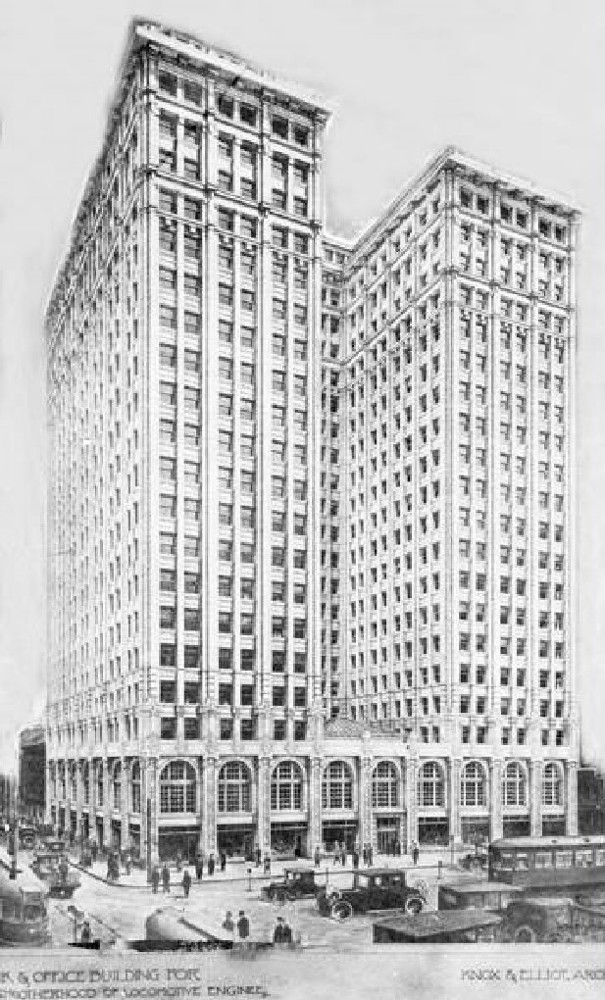
    <summary type="html"><![CDATA[<p><strong><em>The Brotherhood of Locomotive Engineers had never before had a leader quite like Warren Sanford Stone.  In 1910, with Stone at the helm as their Grand Chief, the Brotherhood built the 14-story Engineers Building on the southeast corner of Ontario Street and St. Clair Avenue in downtown Cleveland.  It was the first skyscraper in the country built by a union.  That might have been achievement enough for most men, but Stone was just getting started.</em></strong></p><img src="https://clevelandhistorical.org/files/fullsize/a6e8224f8218548bc297cde3527eca53.jpg" alt="Standard Building, ca. 1921" /><br/><p>On July 20, 1925, its formal opening was held.  The Brotherhood of Locomotive Engineers (BLE) Bank Building--known to us today as the Standard Building.  That beautiful 21-story pale cream terra cotta building located on the southwest corner of Ontario Street and St. Clair Avenue, in downtown Cleveland.  Built by the union whose name it originally bore and designed by the well-regarded architectural firm of Knox and Elliot, whose other works included the Rockefeller Building (1905), the Hippodrome Theater (1908), and the Engineers Building (1910) downtown, and the Breakers Hotel (1905) at Cedar Point.   At 282 feet, it was taller than any other in Cleveland to that date, except for the Union Trust Building (in 2022, the Centennial Building), at the corner of Euclid Avenue and East Ninth Street.  And even that building--also with 21 stories-- was only 7 feet taller.</p><p>The opening of such a building should have been a festive event for the BLE, which had been headquartered in Cleveland since 1870.  The union claimed the distinction of being the oldest in the country and, with 80,000 members, it was also one of the largest.  And, since 1903, it had been led by one of the most capitalist--yes, capitalist--union leaders ever, Warren Sanford Stone.   In 1910, under his leadership, the union had constructed the 14-story tall Engineers Building just across Ontario Street from where the BLE Bank Building would go up 15 years later.  It was the first skyscraper in the country built by an employee organization.  Ten years later, in 1920, the BLE, again, with Stone at its helm, founded the country's first labor bank.  Officially incorporated as the Brotherhood of Locomotive Engineers National Cooperative Bank, it was from the start known to all simply as the Engineers Bank.  And then, in the first five years following the founding of that bank, Stone, who also served as its president, opened 15 branch offices in cities all across the country, including New York, Philadelphia, Boston, Minneapolis and Portland, Oregon. By 1925, the BLE was invested in banks, real estate, businesses and other holdings with a total value in excess of $150 million, a huge figure in that era.  When asked why he had led his union into so many capital ventures, Stone responded, "When there is trouble the owners have been inaccessible to us.  They were to be found on Wall Street, no matter where the [rail]road in question was located.  So we decided to buy into 'Wall Street.'  Now we can sit at the same table with these men and talk things over."</p><p>And now Stone's growing labor bank was preparing to move into its new headquarters in the second tallest building in downtown Cleveland.  And so, by all accounts, July 20, 1925 should have been a festive day.  But the mood that day was  not, because Warren Sanford Stone, Grand Chief of the Brotherhood of Locomotive Engineers since 1903 and the driving force behind all of these capitalist projects, had one month earlier, after returning from a business trip to New York, died suddenly on June 12 from kidney disease.  His death had been mourned not just by union members, and not just in Cleveland, but, according to newspaper accounts, all across the country.  So tragic a loss it was that the opening of the union's new bank building, which had been scheduled to open in June, was delayed to July 20.  The crowd that turned out for the rescheduled event was still a large one as originally expected, but, as one reporter noted, many who attended first stood for a moment in the bank lobby of the building, gazing up reverently at the large portrait of Warren S. Stone, before moving on to see the rest of the building.</p><p>In the early years of the Engineers Bank Building's history, the bank itself occupied the two-story skylighted lobby and mezzanine in the center of the U-shaped building, as well as the basement.  The next 18 floors held a variety of government and private sector tenants.  The federal Treasury Department had offices on the sixth floor, and for several years Elliot Ness, who was investigator in charge of the Alcohol Tax Unit in Cleveland, had an office in the building before Mayor Harold Burton hired him to become the city's Safety Director in 1935.  Other prominent tenants in the building over the years included Dyke College, Sherwin Williams, and the U.S. Army Induction Center.  From the start, many lawyers also had offices in the building because of its proximity to the County Court House and City Hall, both located on Lakeside Avenue.  (The number of lawyers in the building later grew even more when, in 1976, the massive Justice Center complex opened just across the street on the northwest corner of St. Clair Avenue and Ontario Street.) The 20th floor of the building originally featured a glass-enclosed garden and promenade, as well as a "sky-top" restaurant, ballroom and health club.  Ness was known, even as Safety Director, to return to the health club from time to time to play a very competitive game of badminton.</p><p>It was in the 1930s that the building acquired the name by which it is known today.  When the Engineers Bank merged with several other small banks in 1930 to form the Standard Trust bank, the building was renamed the Standard Trust Building.  However, as so many other banks did during the Great Depression, the Standard Trust Bank soon failed, and the building then became known simply as the Standard Building.  It was so known until 1974 when it was renamed the Northern Ohio Bank Building after the bank that opened offices there.  However, that bank went out of business in 1975, and, on January 1, 1976, the building reverted to the name, Standard Building. It has been known as that ever since.</p><p>In 1989, the Standard Building became the headquarters of the Brotherhood of Locomotive Engineers and Trainmen (BLE-T), the successor organization to the BLE, the original owner of the building.  The union had been headquartered in the Engineers Building across Ontario Street since 1910, but had been forced to move from that building in 1989 when the building was razed in order to make room for the Key Center complex.  The BLE-T kept its headquarters in the Standard Building until 2014, when it moved to its new headquarters in Independence, Ohio, and sold the Standard Building to a subsidiary of Weston Inc., a local real estate development firm owned by the Asher family.  Weston soon announced that it planned to convert the Standard Building, which was designated a Cleveland Landmark in 1979, into a luxury apartment building to be known as "The Standard."  </p><p><em><strong><a href="https://clevelandhistorical.org/items/show/789">For more (including 15 images) view the original article</a></strong></em></p>]]></summary>
    <published>2017-04-27T16:23:11+00:00</published>
    <updated>2026-03-04T21:32:03+00:00</updated>
    <link rel="alternate" type="text/html" href="https://clevelandhistorical.org/items/show/789"/>
    <id>https://clevelandhistorical.org/items/show/789</id>
    <author>
      <name>Jim Dubelko</name>
    </author>
  </entry>
  <entry>
    <title type="html"><![CDATA[Cleveland Worsted Mills: From Spinning Yarn to Spawning Regulatory Reform]]></title>
    <summary type="html"><![CDATA[<img src="https://clevelandhistorical.org/files/fullsize/7859eb3c4298e747b687cb1f72cb398b.jpg" alt="Cleveland Worsted Mills" /><br/><p>Cleveland once ranked as one of the nation’s leaders in garment manufacturing, thanks in large part to the Cleveland Worsted Mills. An immense sight in its heyday, the plant suffered years of neglect and decline after its closure, until a fire destroyed much of the complex. Today the industrial giant is largely forgotten, but the impact it had on Cleveland and environmental laws has remained. </p><p>In 1878, Joseph Turner started the Turner Worsted Mill, renamed the Cleveland Worsted Mill in 1902. The Cleveland Plant, located at 5932 Broadway Avenue, handled every aspect of the worsted cloth process, from scouring and sorting wool to boiling the cloth. At the height of production in the 1920s, the mill ran more than 500 looms and consumed 25-35,000 pounds of wool daily.</p><p>As one of the leading employers of the area's large immigrant population, namely Poles and Czechs, the company expanded rapidly. In 1908 it completed a $200,000 addition, including a six-story brick steel factory building and a three-story office building. To ease employee concerns about safety, it constructed exterior stairways and elevator shafts in the new building and also added elevators in existing buildings. With the addition the facility became the second largest plant for worsted production in the country.</p><p>Despite its national recognition and financial success, the company had a difficult relationship with its employees. In 1934, the plant closed for almost three months due to striking over union discrimination. In 1937, complaints were made against the company for “terrorizing and intimidating employees” to keep them from joining the Textile Workers Organizing Committee and workers again went on strike for a few weeks. Striking broke out again in August 1955, brought on by a breakdown in talks between company officials and the Textile Workers Organization. Rather than continue talks, Cleveland Worsted Mills chose to liquidate its assets in January 1956. </p><p>Although the company was gone, disaster struck the plant again in 1993. In April, investigators found 100 barrels of potentially hazardous materials left improperly stored in the warehouse complex. The material was found to be flammable and reports state the building had no working sprinkler system. Investigators determined that the barrels would remain in the building until they knew what they contained and who was responsible for them as there was some dispute over who owned the property. While city officials were trying to determine who owned the property, an arson fire destroyed the complex on July 4. City fire officials were aware of the danger the barrels within the mill presented and had already devised a plan to fight the blaze they correctly figured was inevitable. </p><p>As a result of the fire, new laws were put in place with tougher punishments for environmental offenders. It became a crime for companies to walk away from a site without cleaning up contamination. Moreover, the courts could force them to pay for the cleanup, and any damage incurred was the company’s responsibility. Environmental nuisances were added to the state's nuisance abatement laws that allow the state to take over such properties. </p><p>The city spent $3 million to clean up the debris from the fire and fill in the land. A few years later, it became the Boys and Girls Club of Cleveland. The organization runs a recreational and educational site on more than five acres of the 12.5-acre complex.</p><p><em><strong><a href="https://clevelandhistorical.org/items/show/745">For more (including 9 images) view the original article</a></strong></em></p>]]></summary>
    <published>2015-11-05T15:06:36+00:00</published>
    <updated>2026-03-04T21:32:03+00:00</updated>
    <link rel="alternate" type="text/html" href="https://clevelandhistorical.org/items/show/745"/>
    <id>https://clevelandhistorical.org/items/show/745</id>
    <author>
      <name>Danielle Rose </name>
    </author>
  </entry>
  <entry>
    <title type="html"><![CDATA[Kaynee ]]></title>
    <summary type="html"><![CDATA[<img src="https://clevelandhistorical.org/files/fullsize/6a259be565b9f43a72b8ea0c8cbf213e.jpg" alt="Kaynee Building" /><br/><p>In 1888, Charles Eisenman and Jacob Kastriner pooled their resources to create a company that would provide boys with quality shirts and washtogs. The company was originally named the Kastriner and Eisenmann company but underwent a number of name changes before finally in 1914 settling on Kaynee, a phonetic spelling of the founders' surname initials. </p><p>From the very beginning Kaynee offered employees a number of benefits and services that are unheard of in most companies of today’s world. There was a staffed day care free for all employees and workers could visit the children on breaks. In addition to a large cafeteria and kitchen for employees, there was also a recreation room for various indoor games and activities, most notably exercise. A large area was used primarily as a dance floor but could also be transformed into a motion picture theater. The company used this area to host a number of dances and concerts for their employees in efforts to promote company loyalty. </p><p>The company also invested in improving the welfare and education of all employees. Medical and dental offices were located on the premises, providing inexpensive and convenient healthcare for employees and their family. Employees could choose to participate in continuation school, the expense taken care of by the Kaynee Company, in order to further their education in avenues related to the business and work they were performing. </p><p>In 1915, the company donated a play area to the neighborhood, equipped with tennis courts, a baseball diamond, and sand boxes for younger children. The company looked to improve conditions under which children in the district grew up. This generosity was not altruistic as much as it was a strategic business decision. A company representative stated, “All that Kaynee does is done in the cause of better business. Children who are brought up in the open grow into better men and women, and the better men and women are, the healthier they are- the better employees they will make.” </p><p>Kaynee was also able to find a way to promote itself while simultaneously supporting children’s education and astuteness. From 1940 to 1953, <em>Quiz Kids</em> was a popular weekly show in which a panel of children were asked a series of trivia questions and gave very detailed answers without the help of calculators or notes. Kaynee used the show to promote their line of boys clothing in commercials and started a new Quiz Kids line. Kaynee also sponsored a contest for boys to write in why they wanted to be a quiz kid and the winner would be featured on the show. </p><p>Despite the plethora of welfare programs available to employees, problems arose. Workers began pushing for unionization at the behest of the Amalgamated Clothing Workers of America. On November 8, 1934, workers began a strike for unionization. A majority of the employees refused to strike or join the union and was thus susceptible to attacks by strikers. Despite what union leaders claimed, a large number of employees did not walk out; the plant entrances were barred by the picket line and they were unable to begin work. On November 12, Kaynee announced the closing of its Cleveland plants and cancelled all orders placed for delivery. The decision came in the wake of brutal attacks on their employees when riding to and from work and even at their homes. The strike ended January 1935 when the two entities reached an agreement that provided collective bargaining, reinstatement of workers without discrimination, equalization of work, and a reconsideration of wage rates. </p><p>The company quickly resumed production and continued operations peacefully until the 1950s. Aetna International bought a large share of stock in 1952 and later sold it to Piedmont Shirt Co. of Greenville, South Carolina. Piedmont bought out the company in 1958 and soon closed both plants (the other being in Williamsburg, Kentucky), putting around 600 employees out of work. The company is still in operation today but is known as Rifle Kaynee and is based in New Jersey.</p><p><em><strong><a href="https://clevelandhistorical.org/items/show/723">For more (including 6 images) view the original article</a></strong></em></p>]]></summary>
    <published>2015-07-21T17:23:17+00:00</published>
    <updated>2026-03-04T21:32:02+00:00</updated>
    <link rel="alternate" type="text/html" href="https://clevelandhistorical.org/items/show/723"/>
    <id>https://clevelandhistorical.org/items/show/723</id>
    <author>
      <name>Danielle Rose</name>
    </author>
  </entry>
  <entry>
    <title type="html"><![CDATA[Richman Brothers Co.: A Paragon of Welfare Capitalism]]></title>
    <summary type="html"><![CDATA[<img src="https://clevelandhistorical.org/files/fullsize/a7bf8baef6477bde5fe7910a347c767b.jpg" alt="Richman Factory Drawing, ca. 1930s" /><br/><p>The Richman Brothers Company was originally founded by Jewish-Bavarian immigrant Henry Richman Sr. and his brother-in-law and business partner Joseph Lehman in Portsmouth, Ohio, in 1853. In an effort to become closer to a bustling city, both to expand their operations and customer base, the two men relocated with their families and business to Cleveland, Ohio, in 1879. Originally named the Lehman-Richman Company, the operation took on the moniker the Richman Brothers Company in 1904 after both Henry Richman Sr. and Joseph Lehman had retired and transferred ownership of the company to Henry Sr.’s three sons Nathan, Charles and Henry Jr. </p><p>After having a presence in the region for nearly forty years, the Richman Brothers Company commissioned their first Cleveland factory to be built at 1600 East 55th Street after previously retrofitting their operations into several other pre-existing structures throughout the city. Designed by The Christian Schwarzenberg and Gaede Company and constructed by Hunkin-Conkey Construction Co., the building was designated the “Best Built Factory in Cleveland in 1917” by the Cleveland Chamber of Commerce. Later additions were added onto the structure in 1924 and 1927, which completed the 650,000 square feet of interior space still present on the site. </p><p>The factory quickly became a landmark on the East 55th Street landscape as a result of its domineering size, both inside and out. With fifteen-foot-high ceilings, large-scale windows, and even the world’s largest cutting tables at the time, measuring sixty feet long, the structure provided Richman Brothers’ employees with working conditions previously unheard of in the garment industry. </p><p>Not only were Clevelanders familiar with the building, so, too, was the federal government. After entry into World War I, the federal government approached the brothers with a proposition to turn the site over to a military occupation to be used as a hospital for returning injured soldiers. After only one year of owning the building, in 1918 the Richman Brothers readily agreed to allow the government to utilize the structure as needed, making Cleveland the first city in the country to place such a building at the government’s disposal without expense. </p><p>Their commitment to the war effort was just one element of the Richman Brothers’ reputable business practices. As a family owned and operated company, the Richman Brothers ensured that each person under their employ felt as though they were part of a family. The first industrial organization to do so, the Richman Brothers Company offered two weeks paid vacation for all employees. Similarly, the company also instituted paid maternity leave, set a thirty-six hour work week, utilized no time clocks, and offered corporate stock options. To assist employees during times of personal distress, The Richman Brothers Foundation was created which provided no interest loans to employees as needed. The brothers were viewed as such progressives that the federal government based many workplace regulation laws off of Richman standards. </p><p>The Richman Brothers also tirelessly fought to keep the unions out of their company. Pressures mounted around the middle of the twentieth century, which resulted in the company releasing a statement saying, “The union plan . . . has been one to crush our business. We think this is wrong . . . to put this kind of pressure on our family.” Confident in their business practices, the Richman Brothers believed the union to be unnecessary and felt it would restrict the benefits they were able to offer their employees. </p><p>While the name of the company implies that all three brothers were equally in control of the company, it is Nathan Richman who is credited with maintaining the company’s standards and growing the business into one of the largest men’s clothing retailers in the country. At the time of his death in 1941, two thousand employees gathered at the open-casket services to bid farewell to the last surviving Richman brother. </p><p>After Nathan’s death the company remained under the ownership of one of his nephews, who continued to successfully grow and expand the business. In 1969, the Richman Brothers merged with F. W. Woolworth Company, who kept the Richman brand viable for another three decades. As the industry changed sharply in the late 1980s, the bloated conglomerate Woolworth began to shutter some of its subsidiaries. In 1990, the Richman Brothers Company was deemed financially unstable and was completely liquidated by 1992. Since that time, the structure on East 55th Street has remained vacant with many unsuccessful reuse projects proposed to redevelop the site. </p><p><em><strong><a href="https://clevelandhistorical.org/items/show/708">For more (including 8 images) view the original article</a></strong></em></p>]]></summary>
    <published>2015-05-16T10:56:17+00:00</published>
    <updated>2026-03-04T21:32:02+00:00</updated>
    <link rel="alternate" type="text/html" href="https://clevelandhistorical.org/items/show/708"/>
    <id>https://clevelandhistorical.org/items/show/708</id>
    <author>
      <name>Joe Dill</name>
    </author>
  </entry>
  <entry>
    <title type="html"><![CDATA[May Day Riot : Political Brawl on Public Square]]></title>
    <summary type="html"><![CDATA[<img src="https://clevelandhistorical.org/files/fullsize/maydayriots3new_ebab6ea15c.jpg" alt="Rioters and Police" /><br/><p>In 1919, the United States was experiencing its first "Red Scare." Following the Bolshevik Revolution in Russia in 1917, public sentiment against Socialists — who maintained a strong presence in Cleveland during this era — was high. Many viewed the Socialists and their sympathizers as a threat to American society.  </p><p>The 1919 Cleveland May Day Riot began when a World War I veteran took offense at the red flags being proudly waved by  Socialist demonstrators as they marched toward Public Square. A fight broke out, and soon enough a melee between Socialist and anti-Socialist citizens ensued. The violence was only quelled after the intervention of police and military units. At one point during the widespread rioting, a mob stormed and ransacked the Socialist Party headquarters on Prospect Avenue. The riots injured dozens and resulted in two deaths. The event highlighted the simmering tensions that existed in Cleveland after World War I.  </p><p>This tension would continue well into the 1930s when unionists, leftists, and unemployed workers joined together in a series of strikes and protests under the banner of the Unemployed Council. Although Communist and Socialist movements in the US have waned since World War II, Public Square continues to serve as a setting for protests of all types.</p><p><em><strong><a href="https://clevelandhistorical.org/items/show/28">For more (including 8 images&#32;&amp;&#32;4 audio files) view the original article</a></strong></em></p>]]></summary>
    <published>2010-09-16T15:48:07+00:00</published>
    <updated>2026-03-04T21:31:57+00:00</updated>
    <link rel="alternate" type="text/html" href="https://clevelandhistorical.org/items/show/28"/>
    <id>https://clevelandhistorical.org/items/show/28</id>
    <author>
      <name>Matthew Ferraton</name>
    </author>
  </entry>
</feed>