<?xml version="1.0" encoding="UTF-8"?>
<feed xmlns="http://www.w3.org/2005/Atom">
  <title type="text">Cleveland Historical</title>
  <updated>2026-05-02T05:26:54+00:00</updated>
  <generator uri="http://framework.zend.com" version="1.12.20">Zend_Feed_Writer</generator>
  <link rel="alternate" type="text/html" href="https://clevelandhistorical.org/"/>
  <link rel="self" type="application/atom+xml" href="https://clevelandhistorical.org/items/browse?output=rss2"/>
  <id>https://clevelandhistorical.org/</id>
  <author>
    <name>Cleveland Historical</name>
    <uri>https://clevelandhistorical.org</uri>
  </author>
  <link rel="hub" href="http://pubsubhubbub.appspot.com/"/>
  <entry>
    <title type="html"><![CDATA[Rockefeller Park Greenhouse: Municipal Nursery and Botanical Garden]]></title>
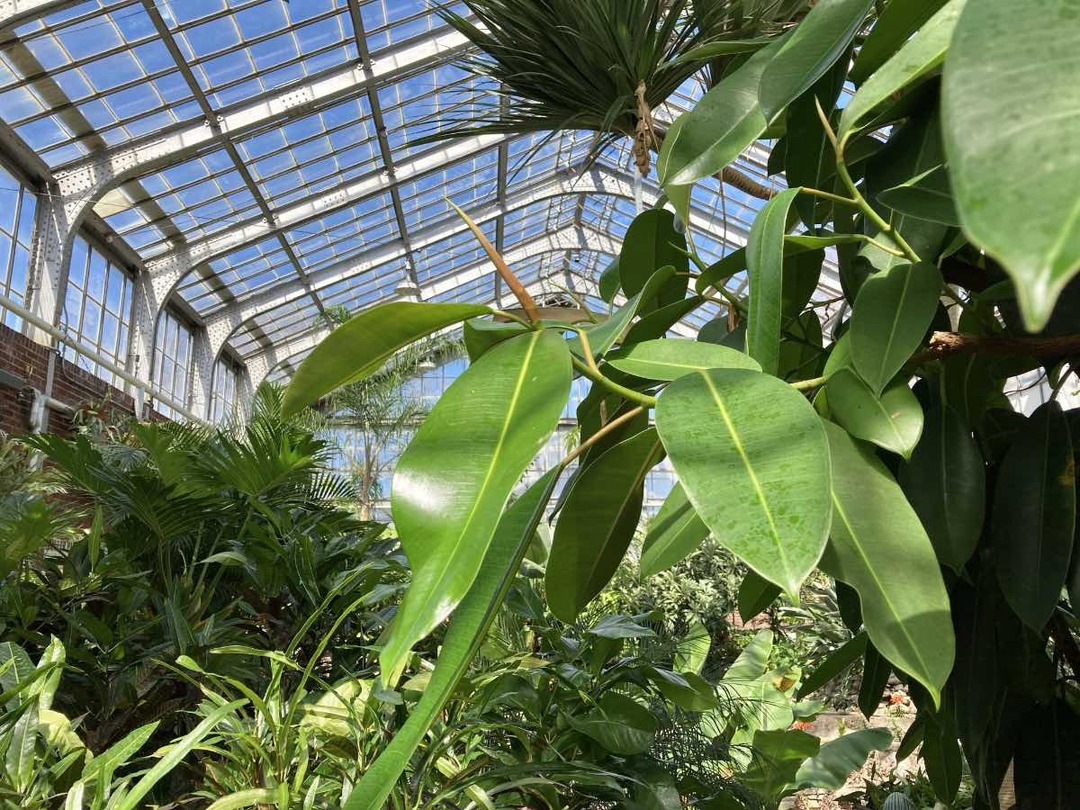
    <summary type="html"><![CDATA[<p><strong><em>Tucked away on a hilltop above the Cultural Gardens is an unassuming facility that for more than a century has played a mostly unseen role in supplying the Forest City’s parks, boulevards, and public properties with flowers, shrubs, and trees, while also cultivating a distinctive collection of tropical foliage and fruit-bearing trees.</em></strong></p><img src="https://clevelandhistorical.org/files/fullsize/ff65e75684b088775c7c081ec99ba269.jpg" alt="Tropical Showhouse" /><br/><p>The Rockefeller Park Greenhouse has its origin in greenhouses given to the city by the estate of William J. Gordon, whose country seat became Gordon Park in 1894. Five years after John D. Rockefeller deeded land to connect Gordon Park with Wade Park in 1897, the municipal government planned a new “city greenhouses” complex, which opened in 1905. Sometimes erroneously referred to as the Gordon Park Greenhouse in its early years, the complex was actually in Rockefeller Park. </p><p>The primary purpose of the city greenhouses was to supply trees and shrubs for Cleveland’s parks, boulevards, and public properties. The greenhouses also donated flowers to hospital wards. However, the idea of a botanical showcase for the city also took root. In 1913, the city completed a large new greenhouse to display palms, ferns, and orchids to the public, including the donated exotic plant collection of William E. Telling. This greenhouse also provided a place to keep the goldfish from the Public Square pond during the winter. </p><p>Despite its pre–World War I origins, the Rockefeller Park Greenhouse as we know it is largely a product of the New Deal. Between 1937 and 1939, the Works Progress Administration (WPA) rebuilt the city greenhouses with a substantial new Palm House (now called the Tropical Showhouse) surrounded by six other greenhouses that raised the facility’s area under glass sixfold to 35,000 square feet. A center walk divided the Palm House into two lush sunken gardens lined with tufa rock salvaged from the Great Lakes Exposition. One of these gardens featured a waterfall and the other a statue. Looming overhead were six 30-foot-tall royal palms taken from the Florida exhibit at the Great Lakes Exposition, as well as other tropical trees and plants. </p><p>After World War II, City Greenhouse, as it was then known, unveiled periodic improvements. In 1946, the greenhouse’s new cacti exhibit opened, its specimens backed by a painted desert scene in the fashion of a diorama. In addition to continuing to serve as a prominent destination for garden clubs and other groups, City Greenhouse also furnished tropical plants for special events, notably a New Orleans French Quarter–themed display for the 1956 Cleveland Home and Flower Show in Public Auditorium. </p><p>In 1962, the Leonard C. Hanna Fund gave $300,000 to improve and expand City Greenhouse. The gift funded a new entrance building and a Japanese Garden, completed in 1964, at which time the facility began to be known as Rockefeller Park Greenhouse. Unfortunately, in the following decade the facility began to suffer a dwindling city budget that accompanied Cleveland’s steepening population decline. By 1980, the city briefly contemplated closing the greenhouse before deciding against it. Then, in 1991, the Friends of Greenhouse, a nonprofit, formed to raise funds to place the facility on a firmer footing and use it to host special events. Later additions included the Betty Ott Talking Garden with its statue of Helen Keller and the Willott Iris Garden, in which hundreds of varieties of iris bloom each spring and summer.</p><p>Today the Rockefeller Park Greenhouse remains, as it has for more than a century, a place of welcome respite from the winter cold and arguably one of the city’s best free attractions in Cleveland.</p><p><em><strong><a href="https://clevelandhistorical.org/items/show/1076">For more (including 14 images) view the original article</a></strong></em></p>]]></summary>
    <published>2026-01-02T17:52:59+00:00</published>
    <updated>2026-04-17T19:17:43+00:00</updated>
    <link rel="alternate" type="text/html" href="https://clevelandhistorical.org/items/show/1076"/>
    <id>https://clevelandhistorical.org/items/show/1076</id>
    <author>
      <name>J. Mark Souther</name>
    </author>
  </entry>
  <entry>
    <title type="html"><![CDATA[Holden Arboretum: A Mining Magnate&#039;s Verdant Dream]]></title>
    <summary type="html"><![CDATA[<p><strong><em>Albert Fairchild Holden (1866-1913) found wealth and inspiration in the ground. His roles as founder of the Island Creek Coal Company and managing director of the United States Mining and Smelting Company made him millions. But his lifelong passion for botany created a heritage for which northeast Ohioans may be thankful.</em></strong></p><img src="https://clevelandhistorical.org/files/fullsize/c3ef5c3e409fb193f2f9a92c3198b1de.jpg" alt="Birdwatchers at Holden Arboretum" /><br/><p>Albert Holden was a child of privilege, the son of Liberty Emery Holden, a silver-mining magnate and early owner of the <em>Plain Dealer</em>. Growing up on the family estate in Bratenahl, Ohio, Albert built greenhouses and grew and cataloged plants and trees. As a young adult, he traveled to England where he visited the famed Kew Gardens. He attended Harvard University where he often explored the Arnold Arboretum. The seeds of Holden’s legacy clearly were planted early. </p><p>Family tragedies also played a role in forming what would eventually become the Holden Arboretum. Albert’s wife Katherine, barely 30, died in 1900 and one of his three daughters, Elizabeth, passed on at the age of 12 in 1908. In 1912, at age 46, Holden himself was diagnosed with cancer. Acknowledging his imminent demise, he set out to establish a living memorial to his wife and daughter. </p><p>His first vision—an institution of higher learning in the botanical sciences on his family’s Bratenahl property—was deemed unworkable due to land-size constraints and objections from the family. So shortly before his death, Holden agreed to place the newly named Elizabeth Davis Holden Memorial Arboretum on 50 acres at <a href="https://clevelandhistorical.org/items/show/76">Lake View Cemetery</a>. In the coming years, however, Albert’s sister, Roberta Holden Bole (who assumed custody of the couple’s two surviving daughters), grew uncomfortable with the idea of a “cemetery arboretum;” so although a site plan at Lake View had already been completed by the famed Olmsted Brothers, the Lake View agreement was terminated before any development was undertaken. </p><p>In 1929, the Bole family offered the project a 100-acre site in Kirtland, far from Cleveland’s pollution and an ideal “mini-climate” that could accommodate the planting of myriad specimens. C. Gordon Cooper, a consulting architect with A.D. Taylor and Company (which also designed John D. Rockefeller’s <a href="https://clevelandhistorical.org/items/show/83">Forest Hill</a>), was hired to oversee the project. </p><p>Two years later, Cooper recommended a change. In addition to an educational institution, he asked the family to consider a novel initiative to re-create the flora and ecosystems of different areas of the country and the world. These dual missions (academic and archival) would mesh well with the interests of the Cleveland Museum of Natural History, which was providing the undertaking with guidance and legal governance. The strategic foundation of the world’s first “ecological arboretum” thus was planted. </p><p>The size of the Kirtland site grew quickly, with large donations of additional land from the Bole family and financial assistance from Emery May Holden Norweb, Ben Bole, Jr., and Warren H. Corning, whose property was nearby. The institution’s “soft opening” came on October 17, 1937, with a tour by members and trustees of the Cleveland Museum of Natural History. The next year, Corning Lake was constructed and the lilac, rhododendron and azalea gardens were planted. World War II and a disastrous flood slowed the institution’s expansion; but when the war ended, vast new initiatives—buoyed by large gifts from Warren Corning and Emery May Holden Norweb—were undertaken. Trails and roads were constructed, gardens were added and expanded; and the Albert Fairchild Holden Shelter was built. </p><p>Despite growing pains, Holden Arboretum took firmer root and flourished after World War II. In 1951, disagreements between Holden staff and Cleveland Museum of Natural History boiled over, and the latter’s board of trustees proposed that Holden be “spun off” as an independent, not-for-profit institution. This new incarnation became a reality in 1952. By 1956 Holden Arboretum comprised nearly 1,000 acres. New gardens and plantings were implemented constantly and adjoining forested properties were acquired for preservation and protection. To this day, wild places like Bole Woods, Stebbins Gulch and Little Mountain—navigable but essentially unaltered—are vital untamed elements of the Arboretum. </p><p>The 1960s were no less fruitful. During this decade a large horticultural library was constructed. The Corning family also moved to a pair of converted farmhouses in the center of the Arboretum grounds and offered their Lantern Court mansion to the Arboretum for a modest yearly rental. Additional land and financial donations by the Firman and Holden families were made in the 1970s. In 1985 Katherine Holden Thayer—the last surviving child of Albert Fairchild Holden—died. This put the Arboretum on firmer financial footing, since additional funds could now be released by the Albert Fairchild Holden Trust. </p><p>Today, the Arboretum is supported by funds from the Albert Fairchild Holden Trust, as well as the contributions of members, donors and business partners. The largess of these groups and so many others have helped create an extraordinary outdoor living museum on 3,500 acres. Holden grounds feature more than 20 miles of trails that meander through cultivated gardens and native forests. The Murch Canopy Walk (an elevated walkway 65 feet above the forest floor) and the Kalberer Family Emergent Tower (a wooden tower that rises 120 feet above the forest floor) provide breathtaking views of the landscape. Moreover, the Cleveland Botanical Garden in University Circle is now part of an expanded and renamed entity known as Holden Forests & Gardens. Together, the Holden Arboretum and Cleveland Botanical Garden offer a unique fusion of urban greening and forestry initiatives, community outreach, environmental research, educational programs, and world-renowned visitor experiences.</p><p><em><strong><a href="https://clevelandhistorical.org/items/show/846">For more (including 8 images) view the original article</a></strong></em></p>]]></summary>
    <published>2018-07-25T10:21:35+00:00</published>
    <updated>2026-04-17T19:17:37+00:00</updated>
    <link rel="alternate" type="text/html" href="https://clevelandhistorical.org/items/show/846"/>
    <id>https://clevelandhistorical.org/items/show/846</id>
    <author>
      <name>Chris Roy</name>
    </author>
  </entry>
  <entry>
    <title type="html"><![CDATA[Cleveland&#039;s Greenhouse Industry: &quot;Gardens Under Glass&quot;]]></title>
    <summary type="html"><![CDATA[<p><strong><em><div>"An acre of lettuce under the artificial rain is a sight to remember. The sun plays rainbows on the mist and glints from the little pools and bright green leaves; the moisture stirs rich smells from the light earth; the rain itself, the patter of the drops on the leaves, the grateful odor of the plants and soil, all are in miniature, confined under a sky of glass—within is spring, beyond lies winter."</div>
<div>— John W. Love, "Manufacturing Cleveland’s Vegetables," <em>Cleveland Plain Dealer</em>, February 4, 1923</div></em></strong></p><img src="https://clevelandhistorical.org/files/fullsize/beca9c6f4cb2fd59903c6c5f4c01fff5.jpg" alt="A &quot;World Under Glass,&quot; 1970" /><br/><p>On the southern rim of the industrial Flats along the Cuyahoga River, Martin Luther Ruetenik, son of a German immigrant pastor, built his first greenhouse on Schaaf Road in the village of Brooklyn Heights in 1885.  Over time his greenhouses and truck farms earned him the nickname the “Celery King.” By 1900 a handful of other growers, including Fred Witthuhn, had joined him, placing a total of five acres “under glass.”  Despite increasing competition from southern and western states, the Brooklyn Heights greenhouse industry continued to expand, and Ruetenik pioneered scientific methods that made Cleveland’s hothouse industry a national model.  By the mid-1920s, some fifty businesses maintained eighty acres of greenhouses that grew primarily tomatoes, leaf lettuce, and cucumbers in rapid rotation.  A secondary focus of the industry was to supply Easter lilies and “the potted plant and window box trade.”  </p><p>Ruetenik and other growers banded together in 1926 to form the Cleveland Hothouse Vegetable Growers’ Cooperative Association.  This organization undertook scientific research and promoted greenhouse produce.  It also started the Greenhouse Vegetable Packing Company in Berea, which graded and packed tomatoes and other produce bound for market.  Martin Reutenik maintained a fleet of Ford Model T’s that trucked produce to markets from Indiana to Pennsylvania.  However, the majority of the vegetables grown in Cleveland-area greenhouses were sold locally from small roadside stands and in Central and West Side Markets.  </p><p>Greenhouse agriculture was no simple endeavor.  In fact, it was both laborious and expensive.  In summer, when Ohio’s outdoor farms were in the middle of their growing season, greenhouse farmers were hard at work sterilizing soil, cleaning boilers, and repiping their greenhouses as needed.  Sometimes they burned tobacco stems in large cans, releasing clouds of blue smoke to kill insects inside the greenhouses.  In fall, hothouse workmen transplanted seeds twice, ultimately placing them at regular intervals in long rows.  Mimicking the work of bees, they tapped tomato blossoms with electric vibrating rods every other day to force fruit to develop on the plants.  Using steel pipes to release steam, hothouse growers carefully regulated the temperature inside the greenhouses to create ideal conditions for crop development.  Every few years workers also had to sterilize the soil with steam “lest the slightest disease invade the indoor empire.”  </p><p>Cleveland’s greenhouse industry continued to expand through the mid-20th century, reaching 400 acres under glass and employing 1,000 hothouse farmers, many of them Puerto Rican migrants, by the early 1960s.  By that time greenhouses stretched for more than two miles along either side of Schaaf Road, and additional smaller concentrations could be found in Olmsted Falls, Rocky River, Columbia Station, Berea, Avon, Sheffield Lake, and Wooster.  In 1966, Governor James A. Rhodes visited the A. G. Heinrichs Greenhouse on Schaaf Road to promote Ohio’s greenhouse industry.  At a special luncheon there, he washed down nine large hothouse tomatoes and a cucumber and Bibb lettuce salad with a glass of tomato juice.  Even as Rhodes was extolling the hothouse growers’ successes, the “Greenhouse Capital of America,” which produced 80 million pounds of tomatoes each year, was already on the cusp of decline.  </p><p>Greenhouse agriculture was always a high-cost undertaking that depended on high yields per acre to generate a profit.  A single acre under glass not only required misting plants from overhead pipes with 750,000 gallons of water per year, it also produced a hefty heating bill.  As the cost of burning coal in boilers to heat greenhouses became prohibitive in the early 1960s, farmers turned to natural gas, but then the energy crisis of the early 1970s drove up the price of gas so much that many greenhouse owners could no longer afford to operate.  Pollution from nearby factories in the Flats produced smog that only compounded the problems associated with Cleveland’s notoriously dark, cloudy winters. Sometimes heavy rains caused chemicals in the air to seep into the greenhouses, burning plants.  Industrial expansion also placed a premium on spacious farmlands outside the city, and many struggling hothouse growers were eager to sell.  One such farmer, Edwin Orth, sold all but three acres of his 60-acre Brooklyn Heights farm in 1969, including 16 greenhouses, which became part of a new industrial park.  Growing competition from government-subsidized greenhouse companies in Canada further undercut Cleveland’s greenhouses.</p><p>By the 1980s, most of the large greenhouses in Brooklyn Heights were no more.  Smaller ones remained, but they turned away from growing vegetables in favor of flowers, trees, shrubs, and seasonal plants such as poinsettias. Today one can still see the Ruetenik mansion, which the “Celery King” built in the 1930s on Schaaf Road.  Nearby a small handful of remnant greenhouses operate to this day, offering a hint of Cleveland’s onetime national reputation as a center of “manufactured” vegetables.  </p><p>Could Northeast Ohio recapture its position as the “Greenhouse Capital of America?”  If the Cuyahoga Valley Greenhouse Growers Association, formed in 2009, has its way, it will do so using state-of-the-art sustainable greenhouse technologies.  The Green City Growers Cooperative, opened in 2013 in Cleveland’s Central neighborhood, produces hydroponic Butterhead, Cleveland Crisp, and Green leaf lettuce in a 3-1/4-acre greenhouse that overlooks the RTA rapid transit line.  As the nation’s largest urban food-production greenhouse, Green City Growers is not so much a sign that Cleveland is returning to its coal-fueled hothouse heyday as it is a suggestion that the Forest City might become a national leader in environmentally friendly urban agriculture.</p><p><em><strong><a href="https://clevelandhistorical.org/items/show/713">For more (including 11 images) view the original article</a></strong></em></p>]]></summary>
    <published>2015-06-22T18:51:40+00:00</published>
    <updated>2026-04-17T19:17:40+00:00</updated>
    <link rel="alternate" type="text/html" href="https://clevelandhistorical.org/items/show/713"/>
    <id>https://clevelandhistorical.org/items/show/713</id>
    <author>
      <name>J. Mark Souther</name>
    </author>
  </entry>
  <entry>
    <title type="html"><![CDATA[Solar Interpretation Center: A Model of Efficiency]]></title>
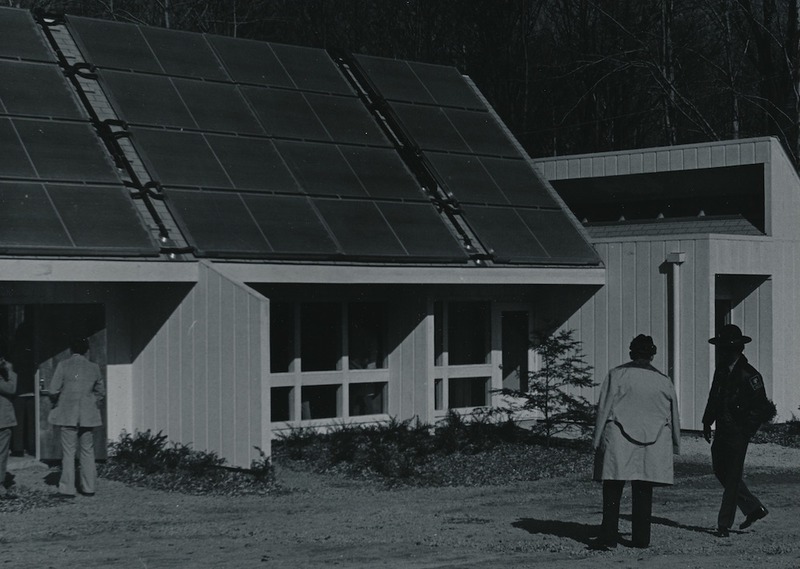
    <summary type="html"><![CDATA[<p><strong><em>As prices for gasoline, heating oil, electricity and natural gas skyrocketed during the 1970s,  Americans increasingly explored alternatives to fossil fuel energy resources.   In an effort to promote its mission of conservation, the Cleveland Metroparks opened a unique, state-of-the-art interpretation center that harnessed the power of the sun.</em></strong></p><img src="https://clevelandhistorical.org/files/fullsize/5ee47ef813bbef0ead7bf5f01e7f940c.jpg" alt="Solar Panels" /><br/><p>In 1976, the Cleveland Home and Flower Exposition drew a record crowd of nearly 100,000 persons during its opening weekend.    The annual convention displayed the latest in landscaping techniques, construction materials and methods, and home furnishings.  Eager consumers sauntered about the 250-plus exhibition booths and elaborate indoor gardens that temporarily adorned Cleveland's Public Hall.  Inside the building, a canopy of trees jut out from a transplanted pastoral landscape embellished with waterfalls, rustic patios, windmills, greenhouses, flowering shrubs, and cobblestone walls.  </p><p>Two full-scale model homes highlighted the show. A red cedar shake geodesic dome, called Fantasia, offered potential homeowners reduced building and heating costs by minimizing the structure’s surface area.  The year’s main attraction, however, was a house designed by Neil William Guda of Shaker Heights.  Equipped with “every possible energy-saving device,” the model home invited visitors to explore new ideas about energy efficiency.  Refereed to as the "solar home,"  Guda's exhibit was slated for relocation in the Cleveland Metroparks North Chagrin Reservation at the close of the show.   The underlying concept of the structure aligned with the Cleveland Metroparks long-standing mission to promote conservation, an idea that Clevelanders were increasingly willing to embrace.  </p><p>Public attitudes toward solar power, conservation, and environmentalism were changing.  A nationwide “energy crisis” was leaving its signature on every facet of American life as prices for gasoline, heating oil, electricity and natural gas skyrocketed during the 1970s.  Fossil fuel alternatives began to shed their counter culture stigma, and technologies for harvesting renewable, clean energy garnered public interest.  The exposition's model home envisioned possibilities for the future of home design, and the potential of the wind and sun as practical energy resources - even during the bleakest of Cleveland winters.  </p><p>Decades of postwar prosperity and voracious consumption had screeched to a halt just a few years prior to the 1976  Home and Flower Exposition.  Although oil production in the United States had been outpaced by rising consumer demand since the  late 1940s, prices were kept low in part by East Texas oil reserves. Coinciding with the decline of this oil surplus during the early 1970s, the Organization of Petroleum Exporting Countries (OPEC) imposed an oil embargo in 1973 on nations providing aid to Israel during the Yom Kippur/October War.   Foreign petroleum producers also drastically raised benchmark prices, and the cost of oil quadrupled.  Americans experienced fuel shortages for the first time since the days of World War II rations.  The country's problems were not limited to high gasoline prices, though.  America's infrastructure was built upon fossil fuel combustion, and the oil crisis lent a forceful hand in spiraling the United States into an economic recession.  Industrial workers feared layoffs, over 20,000 gas stations closed, consumer goods inflated to offset transportation expenses, and the high cost of petroleum-based fuels was paralleled by skyrocketing electricity and natural gas prices. </p><p>Local, state, and national government officials quickly called upon citizens to conserve their resources.  Speed limits were lowered, gas stations were asked to close on either evenings or Sundays, and governmental policies were drawn up to promote energy reform and reduce the nation's dependence on petroleum. The finite nature of fossil fuels and impact of over-consumption could no longer be ignored.   As a national debate emerged over the development of petroleum alternatives, the environmental movement flourished and found a voice in shaping energy policy. In Washington, funding was generously allotted to researching alternative power sources.  While the bulk of resources fell to advancing coal based fuels and nuclear fission plants, room was carved out in the budget for the promotion of wind and solar power technologies.</p><p>The promise of clean, renewable solar energy and wind power resonated with the public. The potential environmental toxicity of coal fuels and nuclear waste was not lost on Clevelanders already confronted with a burning river and dying lake.  The energy crisis seemingly worsened each year, and it was believed that the world's supply of oil and natural gas was running out.  The technology required to generate alternative energy, however, was new, untested and incredibly expensive. There was a lot of talk about the possibilities of  passive and active solar-powered homes by 1975, but few prototypes had been constructed.  A solar home erected on Ohio State fairgrounds in the fall of 1975 received mixed reviews; engineers were neither able to keep the house warm or water tank hot without utilizing supplemental power sources. Electricity and natural gas remained the cheapest energy options for heating and cooling homes.  </p><p>In Cleveland, builders turned to conservation techniques in order to stay afloat in the sinking economy. Residential designs became more compact, cathedral ceiling disappeared from new construction, and windows got smaller.  The model home built for the Home and Flower Exposition in 1976 presented a myriad of additional energy saving options to realtors, homeowners, landscapers and construction companies.  The house was meticulously designed to promote energy conservation. Among its many features were an electricity-generating windmill, a greenhouse acting as a solar collector, energy efficient air circulation, automated shutters, triple glazed windows, natural ventilation systems, and copious amounts of insulation lining the ceiling, floor and walls. The most intriguing characteristic of the house was a sawtooth roof pitched at 45 degrees, directing the surface of flat plate solar panels towards the sky.  The home was conservatively estimated to reduce fuel bills by fifty percent, and could run for three days in dark weather.</p><p>Valued at $100,000, not including land, the solar house was presented as a gift to the Cleveland Metroparks.  The conservation-minded institution expressed a willingness to spend $50,000 for the structure's relocation, but it was soon discovered that the allotted funds would not cover the cost of excavating a foundation, laying utilities, and transporting the home. An additional $30,000 in finances was quickly acquired by the Metropolitan Park Board through a grant provided by the Cleveland Foundation. At the close of the Cleveland Home and Flower Exposition, the house was dismantled and trucked to the North Chagrin Reservation.  The building was converted to accommodate the needs of the public and Cleveland Metroparks staff, and dedicated as the Solar Environmental Interpretive Center on October 29, 1976.  As a Cleveland Metroparks interpretative educational center, the old solar home displayed the possibilities of conservation and energy efficiency.  </p><p>On May 3, 1978,  the Solar Interpretive Center hosted a public program entitled, "All You Ever Wanted to Know About Solar Energy and More."  The day marked a new height for the 1970s alternative energy movement.  Despite recent efforts to defund solar research by the Department of Energy, a joint resolution passed by Congress asked that President Jimmy Carter designate the date as "Sun Day."   Polls showed that over 80% of Americans supported government development of solar energy, and it was purported that over thirty million people world-wide would participate in the festivities. Sunrise services, solar cookouts, speeches, concerts, and informational exhibits were planned throughout the country.  To commemorate the day, President Carter visited a solar power research center; in his speech, he pledged to install a solar heat project at the White House. By September, plans were in place to install solar panels on the roof of the West Wing to power the White House kitchen's hot water heater.  The new roof was unveiled to the public on June 20, 1979.  </p><p>America's enthusiasm for alternative energies soon passed. A significant reduction in demand for oil, in part due to the successes of the energy conservation movement, helped stabilize prices in the 1980s. Additionally, new-found reserves of natural gas and petroleum eased fears over the depletion of the world's supply of fossil fuels. As the energy crisis came to a close, government funding for solar energy research was gutted.  Many Americans eased back into complacent use of petroleum-based fuels, and the appeal of alternative energies waned. The solar water heating system at the White House was dismantled in 1986.</p><p>With the energy crisis abated, and the public's interest in solar power subsiding, North Chagrin Reservation's Solar Interpretive Center found new life as the Nature Education Building in 1984.  The prior year, the Cleveland Metroparks announced a capital improvement plan to make its grounds more usable and comfortable for visitors.  A new wildlife preserve and large interpretive nature center were to be constructed in the North Chagrin Reservation as part of the make-over. The Nature Education building was transformed to include touchable educational exhibits, classrooms, and laboratory space.  While many of the energy efficient features were removed, the old solar home - sitting adjacent to Sanctuary Marsh and North Chagrin Nature Center - continues to embody the Cleveland Metroparks' mission of promoting the conservation of natural resources.</p><p><em><strong><a href="https://clevelandhistorical.org/items/show/700">For more (including 11 images) view the original article</a></strong></em></p>]]></summary>
    <published>2015-04-08T09:41:52+00:00</published>
    <updated>2026-04-17T19:17:40+00:00</updated>
    <link rel="alternate" type="text/html" href="https://clevelandhistorical.org/items/show/700"/>
    <id>https://clevelandhistorical.org/items/show/700</id>
    <author>
      <name>Richard Raponi</name>
    </author>
  </entry>
</feed>