<?xml version="1.0" encoding="UTF-8"?>
<feed xmlns="http://www.w3.org/2005/Atom">
  <title type="text">Cleveland Historical</title>
  <updated>2026-05-02T04:45:30+00:00</updated>
  <generator uri="http://framework.zend.com" version="1.12.20">Zend_Feed_Writer</generator>
  <link rel="alternate" type="text/html" href="https://clevelandhistorical.org/"/>
  <link rel="self" type="application/atom+xml" href="https://clevelandhistorical.org/items/browse?output=rss2"/>
  <id>https://clevelandhistorical.org/</id>
  <author>
    <name>Cleveland Historical</name>
    <uri>https://clevelandhistorical.org</uri>
  </author>
  <link rel="hub" href="http://pubsubhubbub.appspot.com/"/>
  <entry>
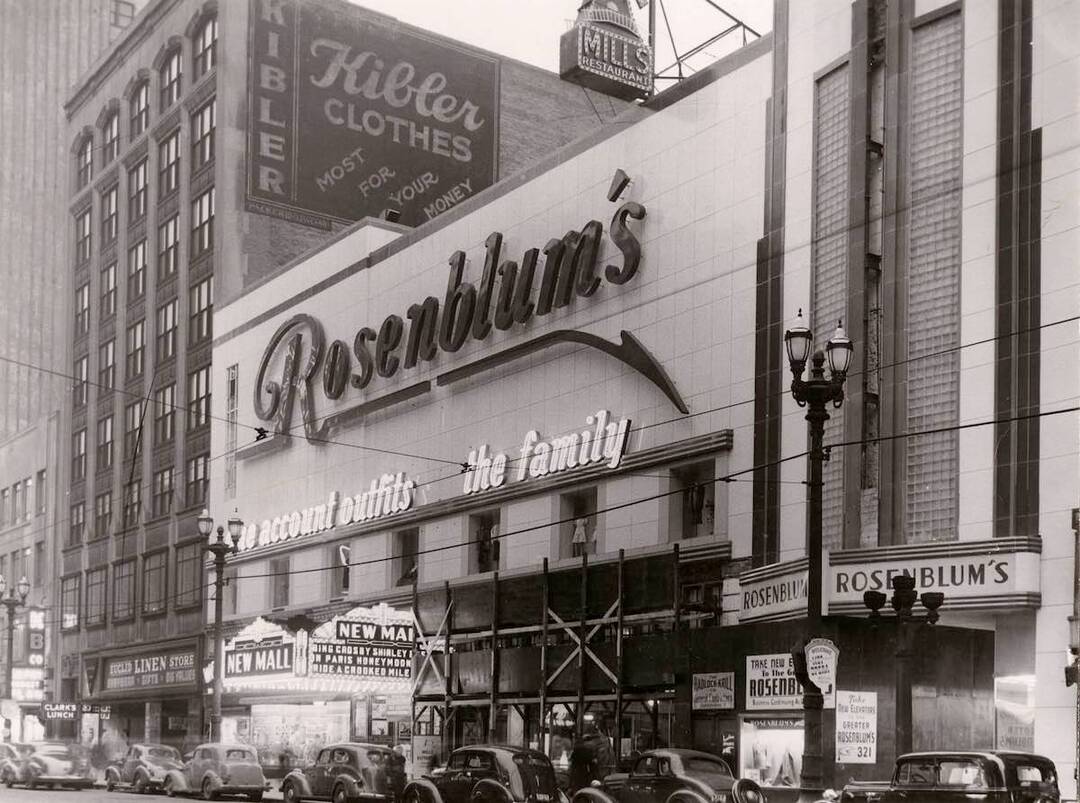
    <title type="html"><![CDATA[Rosenblum&#039;s: &quot;One Account Outfits the Family&quot;]]></title>
    <summary type="html"><![CDATA[<p><strong><em>When most people think about Cleveland’s downtown department stores, they think about Higbee’s or the May Company. There were, however, many other significant stores that contributed to the iconic image of downtown Cleveland, especially the many stores along Euclid Avenue. Among those stores was Rosenblum’s, a popular clothing store that was a shopping staple in Cleveland for close to a century. </em></strong></p><img src="https://clevelandhistorical.org/files/fullsize/8d222439b3d92080b893c291a533d464.jpg" alt="Rosenblum&#039;s" /><br/><p>Max Rosenblum was born in Austria-Hungary on December 5, 1877, and at the age of six he and his family immigrated to the United States, arriving in Cleveland not long after. Rosenblum attended grammar school in Cleveland, but left school after the sixth grade. As a child, at 3:30 every morning he would grab as many Plain Dealers as he could, bringing them down to Union Station and selling them before serving regular customers and then going to school. After leaving school, Max Rosenblum continued to sell papers and shined shoes at Superior Avenue and West 3rd Street (then known as Seneca Street). At 17, Rosenblum was given a job at a clothing concern where he worked in every department and went on to work at other businesses as well. In 1910, at the age of 32, he decided to go into business for himself, and open up his own clothing store on Public Square with the motto “New ideas, new methods, new policies.”
Rosenblum’s first store was located at 2014 Ontario Street on the second floor of a building that predated the Terminal Tower and the Higbee building where JACK Casino now operates. Rosenblum poured all that he had into opening the store. In order to put up the sign for his new business, he even had to borrow a month of rent from an uncle. Rosenblum was an early adopter of ready-to-wear clothing, much like what is seen in today's clothing stores. Rosenblum’s sold clothes for men, women, and children, and in addition to the ready-to-wear clothing, Rosenblum’s also made tailored suits to order for both men and women. Rosenblum also believed in easy credit. Newspaper ads for Rosenblum’s carried the motto as advertised was “It’s easy to pay the Rosenblum way.” In 1910 just one dollar per week paid over a period of forty weeks would buy any article of clothing at the store. Rosenblum’s also offered Eagle or Merchants stamps with all sales. These stamps, which were redeemable for cash or merchandise, were introduced by the May Company in 1903.
With Rosenblum’s business thriving, in 1920 Max Rosenblum moved the store just down the street to 321 Euclid Avenue. The new Rosenblum’s was located on the second floor of the building, later above Mills Restaurant, with private elevator service to bring customers up to the store. Once a customer stepped off the elevator, they were greeted by a large, eleven thousand square-foot store filled with clothes for men, women, boys, and girls of all ages and sizes. By 1922 the Rosenblum’s department store employed over one hundred employees and had a reputation as one of Cleveland’s oldest and most reliable business institutions. Rosenblum’s was open from 8:00 to 5:30 most days and on Saturdays closed at 6:00. Advertisements, however, stressed that shopping in the morning had greater benefits than other times of the day. Salespeople were fuller of vigor and, with fewer customers in the store, they were able to provide better one-on-one service. Fewer customers in the store also meant there were no crowds to contend with, making shopping less stressful and more comfortable.
Rosenblum’s department store prided itself on many things: high-quality products, wide array of styles in all sizes, stellar customer service, low prices, and easy pay-as-you-go credit that allowed customers to pay the price of an item over a period of forty weeks. Payments could be made weekly, semi-monthly, or monthly without paying interest or carrying charges. While customers might not get the product right away, this style of charge account allowed for greater flexibility for the shopper to make purchases. While this form of payment, which is similar to layaway, has fallen out of favor for most retailers today, one hundred years ago it was a popular and convenient way to purchase products.
What sort of products could you expect to find at Rosenblum’s? Much like any clothing retailer, Rosenblum’s, had a wide array of varying products for all ages and in all sizes. In the 1920s Rosenblum’s primarily sold women’s dresses, suits and fur coats, and for men they sold suits, dress shirts, slacks, and overcoats. Rosenblum’s also offered free tailoring service on all clothing, and for both men’s and women’s clothing Rosenblum's offered tailor made clothing as well. Rosenblum’s also had an extensive children’s section, and every year, much like now, they would advertise for back-to-school shopping. Everything they sold came in a variety of styles and fabrics. Women’s fur coats were a popular product at Rosenblum’s and were made from materials such as raccoon, muskrat, marmot, mink and more, while dresses were made from various types of silk and twill.
Rosenblum’s downtown store was a success, but after World War II shopping gradually began moving from downtown to the suburbs. Although it was relatively late in embracing suburban expansion, Rosenblum’s eventually opened stores in Cleveland's growing southern suburbs. Rosenblum’s second store opened in December of 1967 in the Parmatown Mall in Parma, and a third location was opened in October of 1980 in the Southgate Shopping Center in Maple Heights. These new branches sold kitchen wares and household appliances in addition to clothing. Sadly, at the end of May 1981, less than 8 months after their most recent suburban expansion, the downtown Rosenblum’s closed its doors for the last time. Rosenblum’s Parmatown store continued successful operations into the latter half of the 1990s. Rosenblum’s final remaining location at Southgate closed in 2006.</p><p><em><strong><a href="https://clevelandhistorical.org/items/show/1000">For more (including 6 images) view the original article</a></strong></em></p>]]></summary>
    <published>2023-04-07T21:12:27+00:00</published>
    <updated>2026-04-17T19:17:43+00:00</updated>
    <link rel="alternate" type="text/html" href="https://clevelandhistorical.org/items/show/1000"/>
    <id>https://clevelandhistorical.org/items/show/1000</id>
    <author>
      <name>Matthew Steenbergh</name>
    </author>
  </entry>
  <entry>
    <title type="html"><![CDATA[Halle Building: Alfred Pope&#039;s Terra-Cotta Showcase for Downtown Shopping]]></title>
    <summary type="html"><![CDATA[<p><strong><em>In 1907 a New York industrialist acquired a rooming house on the south side of Euclid Avenue with rear frontage on Huron Road. At the time, downtown scarcely reached east of East Ninth Street, and this section of Millionaires' Row remained largely residential. Undeterred, the man imagined a tall building that might entice downtown development eastward. Appropriately enough, he selected an architect who was no stranger to big plans.</em></strong></p><img src="https://clevelandhistorical.org/files/fullsize/0d988b9998d31b9ae3413f9581728ae0.jpg" alt="The Halle Building, Euclid Avenue Facade" /><br/><p>Alfred Atmore Pope had left his Millionaires' Row mansion in Cleveland in 1901 and moved to New York, but he remained keenly interested in the Forest City. After all, his parents had moved there from Maine on the eve of the Civil War, and it was there that he had struck out on his own as a young man, leaving his father's wool business to invest in the burgeoning iron industry. In only a decade he had risen to the helm of Cleveland Malleable Castings Company. Now he wanted to build a monument to his success. Even the Panic of 1907 did not deter Pope, who doubled down on his commitment, which he now also billed as a show of faith in Cleveland's future during an uncertain time.</p><p>Pope's "monument" would take the form of a skyscraper that he undertook on speculation. He turned to Henry Bacon to design this tribute to himself. The New York architect had prepared initial drawings for the Lincoln Memorial about a decade earlier, but the project's implementation still awaited congressional approval. Unlike in Washington, in Cleveland, backed by a "millionaire rolling mill master" on a mission, Bacon knew he wouldn't have to wait long to see the fruits of his labor.</p><p>Pope's monument began with a 42-foot-deep hole in the ground because he believed Euclid Avenue would eventually have a subway, and he wanted to have an underground entrance when that day came. To hold back the "quicksand" that reflected the site's nearness to Lake Erie, Pope's construction crews had to build a cofferdam and then pour thick reinforced concrete walls to keep the basement and subbasement dry. Above, they quickly assembled the building's steel superstructure and clad it with elaborately ornamented, white-glazed terra-cotta tile and enamel brick that would enable periodically washing off Cleveland's industrial soot.</p><p>Originally intending his monument to have two floors of retail space with eight floors of office space above, Pope instead found a single tenant to lease the entire $1 million Pope Building, a lessee that had a grand vision of its own that even a financial depression couldn't subdue. Who would make such a bold move during an economic depression and in a space so far east of Cleveland's business core? Samuel and <a href="https://clevelandhistorical.org/items/show/424">Salmon Halle</a>. The Halle Bros. Co. had started when its namesakes bought out a small furrier on Superior Avenue just west of Public Square in 1891. The Halles joined the shift of retailers eastward across Public Square to a Euclid Avenue storefront near the Arcade the next year, but with a growing mail-order and home-delivery business in addition to expanding into a full department store, they soon outgrew this space too. </p><p>With the lease of the 140,000-square-foot Pope Building in 1908, the Halles now had three times the space of their former location. Their move also influenced two other large stores to move eastward to upper Euclid Avenue. Within a year of Halle Bros.'s announcement, the Higbee Co. and Sterling & Welch Co. announced their own new stores on the sites of former Millionaires' Row homes across from the Pope Building. The Halle store's continued expansion led to the purchase of the building and plans to expand onto the adjacent lot following Pope's death in 1913. The Halles commissioned Bacon again, and he designed a mirror-image addition that was completed the following year. Close observers will note the vertical seam that marks where the newer building rose alongside the original one.</p><p>Halle's continued to grow in the 1920s, adding an identically styled terra-cotta clad Huron-Prospect Building (designed by Walker & Weeks) to the south of the main store that housed the Men's Store for the next three decades. Near the end of the '20s it also opened branches in Erie and New Castle, Pennsylvania, and Canton, Ohio. After weathering the Depression and War years, Halle's continued to grow, investing in its first suburban branch (at Shaker Square) and undertaking a modernization program that included the addition of escalators. </p><p>Downtown's fortunes began to turn in the second half of the 1950s, forcing Halle's to continue its aggressive planning to maintain its enormous downtown store's profitability. Walter M. Halle, Samuel Halle's son and by then the store's president, grew concerned about the impact of the CTS rapid transit line, which opened in 1954-55 and served downtown with a single station beneath the Terminal Tower (which incidentally benefitted Higbee's after its move to Public Square in 1930). Halle Bros. added its own free bus service from the Terminal on Public Square in 1956 and converted its Huron-Prospect annex into a parking garage in 1957, all while actively lobbying for a downtown subway to carry suburban shoppers closer to its store.  This hope — an echo of Mr. Pope's vision of a subway six decades earlier — collapsed once and for all after county commissioners twice rejected the plan in the late '50s. </p><p>Nevertheless, through ongoing effort, Halle's continued to hold its own into the late 1960s. In fact, for many Clevelanders born after midcentury, the 1950s and 1960s shaped their relationship with Halle's. The store introduced <a href="https://clevelandhistorical.org/items/show/828">Mr. Jingeling</a>, said to be Santa's keeper of the keys, as a popular Christmastime character who joined other child-friendly features such as the toy department, playground, and miniature golf course. Still, by the latter half of the 1960s, the convenience of suburban malls and inconvenience or even trepidation about trekking downtown led Halle's to press for new downtown apartments to create a captive market. </p><p>Although the Chesterfield Apartments opened in 1967 and Park Centre (Reserve Square) in 1969, the future of Halle's seemed shaky. Sterling Lindner, the successor to Sterling & Welch, closed in 1968 and the Allen, Ohio, State, and Palace Theaters fell dark the next year. In the decade after Chicago-based Marshall Field's scooped up Halle's in 1970, it made changes that irked some longtime tradition-minded customers—dropping the signature Halle Bros. logo in Old English font with a script font Halle's matching that of the Chicago store; ending the Mr. Jingeling tradition; and introducing cheaper lines of merchandise. </p><p>Ultimately, Field's dumped Halle's in 1981, and the store closed permanently the following year. Just as suddenly as Samuel and Salmon Halle had justified Alfred Pope's big gamble at a time when downtown had not yet "arrived," the building emptied. In the decades that followed, the Halle Building became what Pope had originally envisioned—an office building with a few small retailers (a food court and sundry services for office workers). It lived on as a department store only in public memory and, for a decade in the 1990s-2000s, as the fictional Winfred-Louder on ABC's <em>The Drew Carey Show</em>. Today it is an apartment building.</p><p><em><strong><a href="https://clevelandhistorical.org/items/show/960">For more (including 17 images) view the original article</a></strong></em></p>]]></summary>
    <published>2022-07-07T01:24:38+00:00</published>
    <updated>2026-04-17T19:17:42+00:00</updated>
    <link rel="alternate" type="text/html" href="https://clevelandhistorical.org/items/show/960"/>
    <id>https://clevelandhistorical.org/items/show/960</id>
    <author>
      <name>J. Mark Souther</name>
    </author>
  </entry>
  <entry>
    <title type="html"><![CDATA[Higbee&#039;s Silver Grille: Always a Special Event]]></title>
    <summary type="html"><![CDATA[<img src="https://clevelandhistorical.org/files/fullsize/0da38d1355a3a7911d341c5dc89cf4bb.jpg" alt="Taking Tea" /><br/><p>In 1989 the Silver Grille restaurant at the Higbee Company’s downtown department store closed its doors. The 10th-floor space later became a special-event center managed by the nearby Ritz-Carlton hotel. This was a noteworthy transition because, in a very real sense, dining at the Silver Grille had always been a special event.</p><p>One contributor to the eatery’s special-event status was its décor: an immersive Art Deco experience. Short for Arts Décoratifs, Art Deco was the height of fashion when Higbee’s opened in 1931. And a meal at the Silver Grille was a celebration of everything Art Deco stood for: luxury, glamour, hope and the power of progress. Entering the restaurant, guests were met by a red marble fountain stocked with goldfish. Ornate grillwork complemented the green-colored walls, bronze light fixtures and floor-to-ceiling columns bathed in purple light. Uber-modern aluminum tables with black marble tops dotted the room. Even the name of the restaurant’s manager sounded innovative: Mrs. Kenneth McKay (yes, Kenneth was her first name) previously taught restaurant management at Columbia University. The space was conceived by Rorimer-Brooks Studios in collaboration with Philip Lindsley Small, who designed Shaker Square and nearby Moreland Courts. Small also architected numerous structures for John Carroll and Case Western Reserve Universities, as well as opulent homes in Cleveland Heights and Shaker Heights.</p><p>“Patrons of a certain age” may recall that the food also was an event. Many might wax nostalgic about the creamed chicken and chicken pie: famous, according to architectural historian Richard E. Karberg, for its sheer “WASPishness.” More could cite the innovative Puerto Rican salad with mangoes, avocados and dates. But invariably topping the nostalgia list was the Grille’s welsh rarebit: melted cheese over toast, garnished with almonds. At one time or another, every child has insisted that this 18th-century British delight is actually called “Welsh Rabbit.” And believe it or not, they’d be right: The Columbia Guide to Standard American English states that “rarebit” is a variant of “rabbit” — believed to be an insult to the Welsh, whom the English claimed ate the cheese dish “instead of the rabbit meat they lacked.”</p><p>And speaking of children, every Silver Grille hamburger, hot dog or french fry arrived ceremoniously in its own little stove, truck, teepee or space capsule—originally tin and later cardboard. At Christmastime, youngsters might order a Christmas tree adorned with tiny sandwiches, followed by ice cream shaped like a snowman or molded into a wreath with lighted candles. </p><p>The Silver Grille also was part of a larger experience—an all-day, all-Higbee event that frequently included live music and fashion shows in the restaurant. Female patrons, often with children in tow, would arrive early via the Shaker, Van Aken or Windermere (now the Green, Blue, and Red) rapid transit lines. The Silver Grille served breakfast as well as lunch, so folks could dine-and-shop-and-dine-and-shop. So in addition to feasting, a full day might include getting a manicure (6th floor), trying on dresses (2nd floor), picking up pet supplies and even pets (4th floor), purchasing live plants and books (5th floor), sitting for a photo shoot (7th floor), perusing furniture (7th floor), and tempting kids with Higbee’s massive toy collection (4th floor). The latter, of course, is where Mrs. Parker bought the Red Ryder BB gun that would surely shoot Ralphie’s eye out. </p><p>Despite an ownership change in the late 1930s, Higbee’s and the Silver Grille survived the Depression. Both thrived well into the 1960s. After all, this was the heyday of the “soup-to-nuts urban department store”—Higbee’s shared the lower Euclid Avenue area with Bailey’s, Halle’s, May Company, Sterling-Lindner-Davis and Taylor’s department stores. </p><p>By mid-century, Art Deco was falling out of favor so management softened the Silver Grille’s look by installing banquettes (booths), painting over the grillwork and installing a gazebo over the fountain. By 1962 the restaurant’s color scheme was pink, green and red (ouch). Some Art Deco elements were restored in 1982. </p><p>Beginning in the late 1960s, however, downtown slowly ceased to be Cleveland’s preeminent shopping destination. Suburban shopping malls—replete with Bailey’s, Halle’s, Higbee’s and May Company stores—sprang up from Eastgate to Southgate to Westgate. More and more Cleveland residents relocated to the burbs, and a car ride to the mall largely usurped a train or bus trip to downtown. Nonetheless, the Silver Grille remained in business until late 1989 when the Higbee’s Public Square store downsized. Today, Higbee’s is folded invisibly into Dillard’s (albeit without a downtown store) and the Silver Grille is merely a memory adorned with melted cheese and eye-piercing BB guns.</p><p><em><strong><a href="https://clevelandhistorical.org/items/show/946">For more (including 8 images) view the original article</a></strong></em></p>]]></summary>
    <published>2021-05-27T14:32:16+00:00</published>
    <updated>2026-04-17T19:17:42+00:00</updated>
    <link rel="alternate" type="text/html" href="https://clevelandhistorical.org/items/show/946"/>
    <id>https://clevelandhistorical.org/items/show/946</id>
    <author>
      <name>Chris Roy</name>
    </author>
  </entry>
  <entry>
    <title type="html"><![CDATA[Parmatown: A Civic Center for Postwar Parma]]></title>
    <summary type="html"><![CDATA[<img src="https://clevelandhistorical.org/files/fullsize/2404ab218c9497624e85072d7a578fef.jpg" alt="Santa Claus Castle at Parmatown Shopping Center" /><br/><p>Parmatown was part of a national trend that emerged in the 1950s sparked by the father of shopping malls, Victor Gruen. Originally, like many malls of that time, Parmatown once looked more like it looks today as the new Shoppes at Parma before it became enclosed in 1965. In fact, there is actually a statue that has managed to remain outside of the Shoppes of Parma to this very day that dates to Parmatown's opening, which is the statue of a seal. While there are still remnants of the old Parmatown such as the seal statue, a lot has changed throughout the years, specifically its iconicism as a place where everyone used to want to be and the pinnacle of a town's consumerism. </p><p>Parmatown featured a wide array of stores to shop from throughout its years, including department stores such as May Co. and Higbee's, many shops for dress clothes or casual clothes depending on the time period, restaurants, one of which, Antonio's Pizza, can be seen to this very day, and entertainment ranging from Aladdin's Arcade to a movie theatre. This enclosed community allowed people of all ages and primarily those of younger age to experience a sense of wonder and excitement that they couldn't have found anywhere else, a home away from home. For many of us, shopping malls are places with a wealth of childhood memories, and one of the first places that one gets to experience independence away from one's parents. The welcoming warmth of the shopping mall helped to shape the image of what it meant to be American during a time when consumer culture portrayed somewhat of an idealized romance regarding shopping malls and the indulgences they offered.</p><p>Closely mirroring the broader history of malls, Parmatown was, like most malls, an experience, one that was a cornerstone of Parma culture for generations. Longtime Parma resident Jane Kovach recalls, "It used to be a big deal to go to the mall. One wouldn't just wear jeans and shirt; people wanted to show respect to each other by dressing decently–no jeans and a t-shirt." Despite the informality many younger people may associate with suburban malls, Kovach's memory is a reminder that in their early days, malls shared a lot with downtown shopping, where people also tended to dress up in their finer clothes.</p><p>Officially opening in 1956, Parmatown was not originally like the mall that stood for generations. Instead it was an open-air shopping plaza like the kind we have today in Parmatown's old location of what is now the Shoppes at Parma. It was not until 1965 that the mall was enclosed, taking the form that most people would associate with a mall. Parmatown would have many attractions throughout its years as a mall, both inside and out, including the annual Rib N Rock, an arcade, Easter events with live animals, and more. Parmatown's influence extended far and wide, not least through its promotion in advertisements throughout Cleveland newspapers. </p><p>During Parmatown's time before becoming the Shoppes at Parma, it underwent three expansions: first in 1965 as an enclosed mall, second in 1966 adding a Higbee's with a second floor and a fully enclosed west wing, and third in 1979 to add a new south wing, a food court, and a second floor for J.C.Penney. All of the expansions highlight the growing popularity of the mall phenomenon. Despite its success as an enclosed mall for almost fifty years, however, on January 4, 2012, the first sign of Parmatown's downfall appeared with the closing of Macy's. Shocking everyone, Macy's would lay off its 127 employees that spring. Due to underperformance of the store, Macy's decided it was best to focus on the higher performing stores rather than keep underperforming ones like that of Parmatown barely afloat. The lost jobs were those which were not unionized, but more importantly they were all jobs that once thrived for decades, highlighting the warning signs of a changing economy. At this point, Parmatown representatives announced plans to keep the mall open and try out new stores, which indicates that amid the economic hardship, mall representatives were likely told to keep quiet regarding the mall's failing state in order to see just how much longer the mall could keep generating revenue before its closing would be declared.</p><p>Finally, it was announced in 2013 that Parmatown mall would be closing and the owner would be given a 30-year tax break in order to help finance a renovation where the mall would be taken back to a state closely resembling its original form until it was enclosed in 1965. The agreement was that Phillips Edison & Co. would use one-hundred percent of new property taxes generated at the mall on infrastructure improvements and demolitions. By 2015, the Shoppes at Parma were almost fully built, and as of 2019 the center appeared to be thriving from an outsider's perspective, with businesses all around where the entrance to Parmatown once was, now providing an open-air concept just like Parmatown before it was enclosed mall in 1965. It appears as if the mall got its third chance at life.</p><p>Although Parmatown surely experienced a surge of new competition when SouthPark Mall opened in Strongsville in 1996, Parmatownâ€™s demise primarily stems from the rise of the internet, with people being able to access billions of products that may fit a particular need better than what a store can fulfill at any given moment, all at a cheaper price. The impact of massive companies like Amazon or Walmart taking over the retailing industry was ultimately too much for Parmatown. Historian Vicki Howard, author of <em>From Main Street to Mall</em>, argues that "traditional department stores no longer had a powerful trade voice as they had earlier in the twentieth century, when presidents sent messages to their annual conventions or appointed merchants to head important wartime agencies or consult on national policy." Eventually, certain companies started to reign supreme in the fight for market share, and have since made it harder for traditional department stores to remain in business. A perfect example of this phenomenon occurring at Parmatown, along with many other malls, was when when Walmart took over the old the Dillard's in 2004 and remains in the same building until this very day. </p><p>Parmatown was a victim of a changing economy, one in which online competition outshines brick-and-mortar retailers of all sizes, and only the strongest survive. Pairing the changing economy with little innovation in terms of trends, Parmatown was eventually forced to close and move to an open-air model reminiscent of it had been prior to 1965. While the Shoppes at Parma is not technically considered a mall, it still has mall-like inflections with tens of stores along a massive strip. The mall-like inflections, however, are limited. They foster little sense of community, as the plaza model no longer forces people to shop in one massive building, instead granting them the ability to move only between their car and a particular store. Despite the tradeoffs, hopefully the plaza model will sustain the revival of the Shoppes for many years to come.</p><p><em><strong><a href="https://clevelandhistorical.org/items/show/892">For more (including 10 images) view the original article</a></strong></em></p>]]></summary>
    <published>2019-12-02T07:30:20+00:00</published>
    <updated>2026-04-17T19:17:42+00:00</updated>
    <link rel="alternate" type="text/html" href="https://clevelandhistorical.org/items/show/892"/>
    <id>https://clevelandhistorical.org/items/show/892</id>
    <author>
      <name>Ian E. Phillips</name>
    </author>
  </entry>
  <entry>
    <title type="html"><![CDATA[Max Ellis House: Home of Television’s Original Mr. Jingeling]]></title>
    <summary type="html"><![CDATA[<p><strong><em>When Max Ellis died in his home at 3427 Ashby Road, in Shaker Heights' Moreland neighborhood, on June 25, 1964, he was remembered in a front page article in the Cleveland Plain Dealer as one of northeast Ohio's greatest local actors.  Today, he is perhaps better remembered as the actor who first played  Mr. Jingeling on televsion.</em></strong></p><img src="https://clevelandhistorical.org/files/fullsize/502ef1fbe8f337b13ef2af69f5b49ec4.jpg" alt="Television&#039;s original Mr. Jingeling" /><br/><p>Derrell Max Ellis (later known simply as Max Ellis) was born on March 10, 1914, in Wellington, Kansas.  The youngest of four children, Max grew up in Iowa and studied theater at the University of Iowa, performing in plays in the 1930s written by fellow Iowa student Thomas Williams, later more famously known as Tennessee Williams.  After graduating in 1939, and serving a short stint as assistant director of the Erie Playhouse in Erie, Pennsylvania, Ellis came to Cleveland in 1942 and became an actor at the Cleveland Play House.  Founded in 1915, the Cleveland Play House is America's oldest professional regional theater.  Ellis landed his first role the following year in the theater's production of "Arsenic and Old Lace."  Described by one reporter as "portly, rotund and mustached," he soon became one of the most sought after and popular local actors at the Play House, performing in more than 200 roles over the course of the next two decades.</p><p>In 1956, Ellis was asked to take on a new role on a Cleveland local television show.  An advertising agency had come up with a new idea for promoting Christmas shopping at the Halle Brothers department store downtown.  It had created  a story about a fictional elf, Mr. Jingeling, who had manufactured new keys for Santa Claus's toy treasure house after Santa had misplaced them.  Jingeling was rewarded for his ingenuity by being named Santa's chief elf and keeper of the keys.  The character of Mr. Jingeling had initially been performed by Tom Moviel, a Cleveland police officer, but once the decision to produce the television show was made, it was decided that a professional actor was needed for the role.  The show began airing twice every afternoon every year between Thanksgiving and Christmas.  Cleveland children soon learned that one of the best ways to get Santa's ear for that special holiday toy was to visit Mr. Jingeling on Halle's seventh floor.</p><p>In the year following the introduction of the television show, Max Ellis and his wife Myra, also an actor, moved from their apartment on East 86th Street, just down the street from where the Play House had then been located.  They chose  a home in the Moreland neighborhood of Shaker Heights.  The house at 3427 Ashby Road was a modest Cape Cod-style house which had been built in 1942, during the decade in which many new houses were built on Ashby and surrounding streets in the northern part of the Moreland neighborhood.   This neighborhood, located in the southwest section of the suburb and often called the Gateway to Shaker Heights, is notable--and distinguishable from much of the northern and eastern neighborhoods of Shaker--for its grid streets and moderately priced houses.  In the mid-twentieth century, many people of moderate means moved into the neighborhood  in order to have access to Shaker's exceptional educational system, the Shaker Rapid Transit, and nearby Chagrin-Lee-Avalon Shopping Center.</p><p>It is not known which, if any, of these traditional attractions drew the Ellises to Moreland.  It may have simply been that they learned that the house had become available when its prior owners, John and Frances Ryan, also members of the Cleveland area acting community, suffered tragic deaths within 15 days of each other in September 1956.  The Ellises purchased the house from the Ryans' estate in January of the following year.  Max Ellis only lived  at 3427 Ashby for seven years, but from an article appearing in the Cleveland Press in March 1964, it was obvious that the house was a source of pride for him.  He described its interior in detail to the reporter who interviewed him and boasted of the addition to the rear of the house that he and his wife had added.  Sadly, Max Ellis, just 50 years old, died suddenly in June 1964, just several months after this interview.</p><p>The Mr. Jingeling role that Max Ellis had performed for almost a decade was taken over by Earl Keyes, who had been the director of the Christmas season television show.  Keyes, today perhaps the better known Mr. Jingeling, continued to play the role of the jolly elf for the next thirty years.  Myra Ellis, Max's widow, continued to live in their home on Ashby Road in Shaker's Moreland neighborhood until 1969, when, after remarrying, she moved from the area.  Today, the well-maintained house at 3427 Ashby Road still looks much like it did more than a half century ago when it was the home of the original Mr. Jingeling.</p><p><em><strong><a href="https://clevelandhistorical.org/items/show/828">For more (including 8 images&#32;&amp;&#32;1 audio file) view the original article</a></strong></em></p>]]></summary>
    <published>2017-12-08T15:46:29+00:00</published>
    <updated>2026-04-17T19:17:41+00:00</updated>
    <link rel="alternate" type="text/html" href="https://clevelandhistorical.org/items/show/828"/>
    <id>https://clevelandhistorical.org/items/show/828</id>
    <author>
      <name>Jim Dubelko</name>
    </author>
  </entry>
  <entry>
    <title type="html"><![CDATA[Bailey&#039;s: &quot;The Store For All the People&quot;]]></title>
    <summary type="html"><![CDATA[<img src="https://clevelandhistorical.org/files/fullsize/b5a7cdb6acfcbd7c3ddb668f9334f7c3.jpg" alt="Bailey&#039;s Decorated for Lake Erie Centennial Exposition" /><br/><p>The sweet smell of retail success was in the air in the early 1870s due to the example set by William Taylor and Thomas Kilpatrick.  Their success prompted Lewis A. Bailey, Colonel Louis Black, and Charles K. Sunshine to combine their financial resources and open a store of their own.  In 1881 these men opened the L.A. Bailey Dry Goods Company, which was located at the corner of Ontario Street and Prospect Avenue.  L.A. Bailey’s Dry Goods proved to be very successful and grew throughout the years. By 1895 the building had five floors and many departments including the Grocery Department.</p><p>Bailey’s Dry Goods went through a major change after Lewis Bailey’s death in 1899.  Colonel Louis Black and Charles Sunshine bought the company and combined it with the Cleveland Dry Goods Co.  The Bailey Co. was now a real department store.  The department store became even more successful than the dry goods store was.  As business continued to grow so did the store.  The store expanded and new buildings were added.  By 1910, Bailey’s included a ten-story building.  Bailey’s opened their first branch store in 1929 at 10007 Euclid Avenue.  The success of this branch led to branches being opened in Lakewood (1930), at East 228th Street and Lake Shore Boulevard (1951), and in the Eastgate Shopping Center in Mayfield Heights (1959).</p><p>Bailey’s success was due to many things.  First, Cleveland was a city that provided an ideal setting for store growth.  Many people were moving into Cleveland at the time of the Bailey Co.’s opening.  The Bailey Co. turned into a department store at a time when Cleveland was the seventh city in population and the ninth city in manufacturing.  It made an important decision to market itself as a store friendly to working-class Clevelanders with low prices, installment plans, and frequent sales promotions. It even branded itself "The Store For All the People." Another, later, factor in Bailey’s success was its branch stores.  Suburban stores were good because they were located where the people were living.  This was convenient because it did not force the people to commute downtown.  </p><p>In 1958 Century Food Market Company (CFM) bought Bailey’s and hoped to turn it into one of Cleveland’s largest department store chains.  In 1961 Taylor’s Department Store (which was the store that influenced the original Bailey’s) became the first downtown department store to close.  Bailey’s followed in Taylor’s footsteps and a few months later the downtown Bailey’s store closed.  Demolition began and in 1964 a parking garage called the Parkade opened where Bailey’s once stood.</p><p>This was not the end of Bailey’s…yet.  The people of Cleveland were outraged and still wanted to shop downtown.  The public forced Bailey’s to reconsider, so Bailey’s decided to open a store back up downtown.  On November 1, 1962 Bailey’s opened the first two floors of its new eleven-story store which was located at 514 Prospect Avenue and formerly belonged to the Bing Furniture Co.</p><p>Bailey’s began to struggle financially so they decided to merge with Miracle Mart in 1963.  Miracle Mart was very optimistic and projected high profits.  In 1968 three former Bailey’s stores, the Lake Shore Boulevard store in Euclid, the Eastgate Shopping Center store in Mayfield Heights, and the downtown store on Prospect Avenue, opened as Bailey’s Wonder Marts.  Cleveland department stores began to close in the 1960s due to growing competition, profit losses, changing ownership, and increasing debt.  A new generation of customers had emerged in the 1960s who wanted excitement and flair, not a traditional store like Bailey’s.  These shoppers were sophisticated and wanted upscale department stores and specialty shops that were especially located in the suburbs. They were willing to pay for these stores. The Bailey’s Wonder Marts did not impress these new customers and was faced with growing competition to discount stores like K-Mart that appealed to these customers. Bailey’s ended up declaring bankruptcy in 1968.  All of the Bailey’s stores closed and the Bailey’s era was over.</p><p><em><strong><a href="https://clevelandhistorical.org/items/show/706">For more (including 8 images) view the original article</a></strong></em></p>]]></summary>
    <published>2015-05-15T12:09:21+00:00</published>
    <updated>2026-04-17T19:17:40+00:00</updated>
    <link rel="alternate" type="text/html" href="https://clevelandhistorical.org/items/show/706"/>
    <id>https://clevelandhistorical.org/items/show/706</id>
    <author>
      <name>Rachel Verba</name>
    </author>
  </entry>
  <entry>
    <title type="html"><![CDATA[Taylor Building: From Department Store to Office Building to Apartments]]></title>
    <summary type="html"><![CDATA[<img src="https://clevelandhistorical.org/files/fullsize/a636888b1f7d236168b8eb1eed98f1b3.jpg" alt="Taylor&#039;s Dept. Store" /><br/><p>The history of the Taylor Building highlights the rise and fall of Cleveland's downtown department stores as well as the recent revitalization of Euclid Avenue. It was part of the wave of department store closings that signaled the beginning of downtown's economic woes. </p><p>The Taylor Department Store began with the partnership of William Taylor and Thomas Kilpatrick, both Scottish immigrants. Together they opened the first dry-goods store — a one-room shop — on Euclid Avenue in 1870. Taylor, a devout Presbyterian, drew curtains to hide the store's display windows on Sundays and refrained from placing Sunday ads in the daily newspapers. In 1885, William Taylor's son, John, joined the company. When Kilpatrick left Cleveland the following year, the company was renamed William Taylor Son & Co. Sadly, both father and son succumbed to tuberculosis five years apart, in 1887 and 1892. After John's passing, his wife Sophie became president of the company and ran the store until her death in 1936. </p><p>Sophia Strong Taylor oversaw the continued expansion of the company. In 1907, she moved the family store to a new five-story building at 630 Euclid Ave, known as the Taylor Building. Six years later, four more stories were added to Taylor's. In the 1930s, the company acquired the adjacent Taylor Arcade and thoroughly modernized the store. After Sophie Taylor died, the May Co., Cleveland's largest department store (located at Public Square and Ontario Street) acquired a substantial interest in Taylor's, which continued to maintain both its name and autonomous operation. </p><p>The postwar years saw Taylor's chase the same suburban dreams as other retailers. In 1958, the store opened a branch at the Southgate Shopping Center in Maple Heights. The changing retailing economy spurred by suburbanization eventually led the May Co. to close Taylor's downtown location in 1961 and rename the Southgate branch. The closure of the original Taylor's concerned nearby retailers, who worried about slipping sales. Then, in 1964, Albert A. Levin, a local developer, stepped in and purchased the defunct store, which he remodeled into an office building called the 666 Euclid Building, which housed a Gray Drug store and Lerner clothing shop at street level. The address change, from 630 to 666, was likely intended to sound catchy, but in time it came to be seen as a liability. In the meantime, however, the future seemed bright. Levin, whose efforts to build downtown's first new apartment tower further out Euclid had been stymied by the city's strict adherence to the Erieview downtown renewal plan, said of his latest investment, "It is terribly important that someone take the lead in revitalizing Euclid Avenue. The action should be taken by private investors in contrast to the socialization shown in urban renewal projects such as Erieview." </p><p>The 666 Euclid Building held its own as an office building but gradually became more difficult to lease. In the early 1980s the building changed hands, getting a remodeling and a new name: Atrium Office Plaza. But by 1986, the owners reclassified the property's address as 668 after the previous address's "devilish stigma" were, they argued, dissuading would-be lessees. In 1995 and again in 1998 the Atrium Office Plaza was sold. Each time the new investors hoped to turn the corner, only to be frustrated as more and more tenants departed. By 2007 the onetime Taylor Building stood empty. </p><p>The decided turning point — the first since Levin's early 1960s purchase — finally came in 2008, when another investor took possession and K&D, a rising presence in downtown residential conversions, took advantage of historic preservation tax credits to remake the former department store-turned-office plaza into upscale apartments. Called the Residences at 668, the latest repurposing of the Taylor Building coincided with other efforts to revitalize Cleveland's economy and reinvent downtown. Since the catalytic $197 million Euclid Corridor Transportation Project, completed that same year, investors have spent more than a billion dollars on other downtown projects. More than most downtown buildings, the Taylor Building has epitomized the three eras in Cleveland's downtown, transforming from a department store to an office building to luxury apartments.</p><p><em><strong><a href="https://clevelandhistorical.org/items/show/242">For more (including 10 images) view the original article</a></strong></em></p>]]></summary>
    <published>2011-07-01T15:43:18+00:00</published>
    <updated>2026-04-17T19:17:37+00:00</updated>
    <link rel="alternate" type="text/html" href="https://clevelandhistorical.org/items/show/242"/>
    <id>https://clevelandhistorical.org/items/show/242</id>
    <author>
      <name>Sarah Kasper</name>
    </author>
  </entry>
  <entry>
    <title type="html"><![CDATA[The May Company: Ohio&#039;s Largest Store]]></title>
    <summary type="html"><![CDATA[<img src="https://clevelandhistorical.org/files/fullsize/5311ab18b650cdbfded0d81e2f761acc.jpg" alt="May Company, 1924" /><br/><p>The new May Company department store opened on Public Square in 1915. Containing over 800,000 square feet of floor space, it was said to be the third largest store in the nation.  Built by world-famous architect and city planner Daniel Burnham (who also designed Cleveland's Group Plan and Mall, as well as the White City at Chicago's 1893 World's Fair), it reflects the architectural values of the City Beautiful movement popularized by Burnham. Its gleaming white terra-cotta facade, clean lines, and symmetrical detailing gives the building a dignified and elegant look. Unlike many of the classically-influenced City Beautiful type buildings, however, its durable steel and concrete frame allowed for the generous inclusion of wide "Chicago style" (tripartite) windows facing Public Square.  But what really excited the public about the new May Company were the luxurious shopping areas that could be found behind its front doors. </p><p>Shoppers could expect to find everything they needed at the May Company. Clothing, housewares, furniture: it was all there, spread across dozens of departments. In addition, the building contained the city's largest soda fountain, an auditorium for cooking and fashion demonstrations, a hair salon (including a "children's barber shop"), a "children's playground" staffed by a storytelling governess where mothers could drop off their children while shopping, and 23 passenger elevators. More than 2,500 employees worked at the store, including a trained nurse at the baby department who advised "mothers as to the proper dressing and care for infants," as well as "nine young women, conversant with ten languages" who made up the "foreign department," where non-English-speaking patrons could find help.  </p><p>The May Company, founded in Denver in 1888, first opened in Cleveland in 1899 after purchasing the E.R. Hull & Dutton Company's store on Ontario Street near Public Square. Burnham's 1915 building underwent expansion in 1931 that saw the addition of two floors, increasing the sales area to more than one million square feet.  In the 1950s, the May Company began an expansion into the suburbs, following the population's movement away from the city. By 1979,  it had nine branches throughout Northern Ohio. Shifting population and spending patterns eventually forced the May Company and other Cleveland department stores to curtail their downtown businesses, leading to their closures in the 1980s and 1990s. The May Company's downtown store ultimately closed in January 1993, and its remaining stores were rebranded Kaufmann's, at the time a May-owned department store with Pittsburgh roots.</p><p>The bulk of the building lay vacant for many years after the store closed. Many of the interior architecture was lost when the building was gutted in anticipation of being turned into a parking garage to support the nearby casino in the former Higbee's department store building. The street level facing Euclid Avenue became home to the Cuyahoga Community College School of Hospitality Management and two restaurants. The remainder more recently underwent renovation to become apartments in 2020.</p><p><em><strong><a href="https://clevelandhistorical.org/items/show/241">For more (including 12 images) view the original article</a></strong></em></p>]]></summary>
    <published>2011-07-01T15:27:25+00:00</published>
    <updated>2026-04-17T19:17:37+00:00</updated>
    <link rel="alternate" type="text/html" href="https://clevelandhistorical.org/items/show/241"/>
    <id>https://clevelandhistorical.org/items/show/241</id>
    <author>
      <name>J. Mark Souther</name>
    </author>
  </entry>
  <entry>
    <title type="html"><![CDATA[Severance Center: Ohio&#039;s First Enclosed Shopping Mall]]></title>
    <summary type="html"><![CDATA[<img src="https://clevelandhistorical.org/files/fullsize/9447e1b4c9aa03823953166260c6f71a.jpg" alt="Aerial View, 1963" /><br/><p>Seven years after Victor Gruen's visionary Southdale appeared outside Minneapolis, consigning many an American downtown to a generation of retail decline, Severance Center opened in Cleveland Heights in 1963 as the first fully enclosed regional mall in Ohio. The shopping center's namesake, Cleveland industrialist and philanthropist John L. Severance (who also was responsible for Severance Hall in University Circle), once lived at Longwood, the 125-acre estate that became the mall site. Two other Severance family estates were located near Longwood, both situated across Mayfield Road. Ben Brae, the estate of Julia Severance Millikin, was located near the northeast corner of Mayfield and Taylor Roads, and Glen Allen, the estate of Elisabeth Severance Allen Prentiss, sat to the east of Ben Brae.  </p><p>After John Severance died in 1936, his nephew Severance Millikin inherited Longwood and lived on the estate until 1959. By the early 1950s, Millikin was making plans to redevelop Longwood, and he hired Cleveland's Austin Company to plan a future use for the property, leading to the recommendation for a regional shopping center. Austin Company ended up acquiring the land and brought in a Seattle-based development firm as a partner on the project.  While the decision to build a large mall on the previously undeveloped land caused some controversy, the city eventually gave its assent to the plan. The mansion at Longwood was torn down in 1961 and a groundbreaking ceremony for the mall was held during the winter of 1962.</p><p>Severance Center opened for business in October 1963.  The mall's original anchors were Cleveland-based department stores Halle's and Higbee's. Other tenants at the new mall included Fisher Foods, Woolworth's, Richman Brothers, Peck and Peck, and a branch of Society National Bank. At first, the mall was extremely successful. As newer malls opened across Greater Cleveland, however, Severance faced stiff competition. Halle's closed in 1982, prompting a renewed push to upgrade the mall into a full-fledged "town center."  New anchor stores were brought in, a new food court opened, and, most significantly, in 1986 the Cleveland Heights City Hall relocated to the northwest corner of the Severance property. By the 1990s, however, the mall was simply unable to compete in its existing form, and much of the original mall was torn down. The current outdoor shopping center, anchored by "big box" stores, reflects the response to continually changing patterns in retailing.</p><p><em><strong><a href="https://clevelandhistorical.org/items/show/197">For more (including 7 images&#32;&amp;&#32;4 audio files) view the original article</a></strong></em></p>]]></summary>
    <published>2011-04-21T14:14:50+00:00</published>
    <updated>2026-04-17T19:17:37+00:00</updated>
    <link rel="alternate" type="text/html" href="https://clevelandhistorical.org/items/show/197"/>
    <id>https://clevelandhistorical.org/items/show/197</id>
    <author>
      <name>Michael Rotman</name>
    </author>
  </entry>
  <entry>
    <title type="html"><![CDATA[Downtown Department Stores: Cleveland’s Fifth Avenue ]]></title>
    <summary type="html"><![CDATA[<img src="https://clevelandhistorical.org/files/fullsize/6fc45be15e0da3d22ad453d4587f44aa.jpg" alt="Santa Above Higbee&#039;s Entrance" /><br/><p>Clevelanders of a certain age remember Euclid Avenue as a home for Cleveland’s department stores, but these stores were not always on Euclid Avenue. In the 1830s, most dry goods merchants conducted business east of the Flats on River Road in their warehouses, which functioned as storage spaces, showrooms, and offices. In the 1840s, the warehouse district expanded pushing retailers out to Superior along Ontario, Water (W. 9th), Seneca (W. 3rd), and Bank (W. 6th). Along Superior and its side streets, merchants constructed a commercial block specifically for retailers. Retailers were looking for inexpensive quarters to rent either in new office building’s ground floors or basements.</p><p>By the 1860s and 1870s, industrial enterprises displaced businesses that operated warehouses, pushing the wholesale district into areas that were currently retailer occupied. Rising rents and a lack of room to expand induced many retailers to seek new locations, leading to the emergence of new retail outlets on Euclid Avenue by the late 1870s. When the streetcar lines were built around Public Square in the 1880s, Euclid Avenue stores became even more popular. Massive, multi-level stores (consisting of various "departments") began to appear on lower Euclid Avenue around the turn of the twentieth century.</p><p>At the peak of Cleveland department stores’ popularity, Euclid Avenue was ranked among the largest retail districts in the United States and was compared to New York's stylish Fifth Avenue. Many popular downtown department stores lined Euclid Avenue and the south side of Public Square in the early to mid-1900s: Higbee’s, May Company, William Taylor Son & Company (later Taylor’s Department Store), Sterling-Lindner-Davis, and Halle’s. Heralded for their fanciful window displays and holiday traditions like Halle's "<a href="https://clevelandhistorical.org/items/show/828">Mr. Jingeling</a>" and Sterling-Lindner-Davis's magnificent 50-foot-high Christmas tree, the stores drew thousands of shoppers downtown. The development of Playhouse Square in the 1920s added to the crowds and excitement along that stretch of Euclid Avenue. A trip on the streetcar down to Cleveland’s department stores was for many Clevelanders an occasion that called for dressing up.</p><p>After World War II, however, the growth of suburbs and shopping malls started to draw business away from downtown and Euclid Avenue. Clevelanders who moved to the suburbs could now patronize stores near their homes without the need to travel downtown and customer loyalty to stores became a thing of the past. By the 1960s, the downtown department stores started closing, first Taylor’s in 1961 and then Sterling-Lindner-Davis in 1968. Downtown department stores tried to hold on by opening their own suburban branches, but by the turn of the twenty-first century most of these local companies had been bought out by national chains, with their flagship downtown locations converted to other uses. The last of the giants, Higbee's, was purchased in 1992 by Arkansas-based Dillard's and closed its Tower City store in 2002.</p><p>Although many downtown department stores are gone, they are certainly not forgotten. One notable department store, Higbee's, gained national recognition when it appeared in a scene of the classic holiday film <em>A Christmas Story</em>. Many building also still bear architectural fixtures that act as a nod to their department store pasts. If you look closely, you can still glimpse reminders of Cleveland's grand department stores in the soaring terra-cotta facade of the Halle Building, the clock on top of the May Company, or the bronze deco Higbee's plaques that adorn its old home on Public Square. Better yet, ask almost any Clevelander past a certain age about shopping on Euclid Avenue, and listen closely while they fondly recall childhood trips downtown.</p><p><em><strong><a href="https://clevelandhistorical.org/items/show/23">For more (including 9 images, 4 audio files,&#32;&amp;&#32;2 videos) view the original article</a></strong></em></p>]]></summary>
    <published>2010-09-16T09:43:36+00:00</published>
    <updated>2026-04-17T19:17:36+00:00</updated>
    <link rel="alternate" type="text/html" href="https://clevelandhistorical.org/items/show/23"/>
    <id>https://clevelandhistorical.org/items/show/23</id>
    <author>
      <name>CSU Center for Public History and Digital Humanities</name>
    </author>
  </entry>
</feed>
