<?xml version="1.0" encoding="UTF-8"?>
<feed xmlns="http://www.w3.org/2005/Atom">
  <title type="text">Cleveland Historical</title>
  <updated>2026-05-10T00:03:31+00:00</updated>
  <generator uri="http://framework.zend.com" version="1.12.20">Zend_Feed_Writer</generator>
  <link rel="alternate" type="text/html" href="https://clevelandhistorical.org/"/>
  <link rel="self" type="application/atom+xml" href="https://clevelandhistorical.org/items/browse?output=rss2"/>
  <id>https://clevelandhistorical.org/</id>
  <author>
    <name>Cleveland Historical</name>
    <uri>https://clevelandhistorical.org</uri>
  </author>
  <link rel="hub" href="http://pubsubhubbub.appspot.com/"/>
  <entry>
    <title type="html"><![CDATA[Baldwin Bird Research Laboratory: Samuel Prentiss Baldwin, the &quot;Birdman&quot; of Cleveland]]></title>
    <summary type="html"><![CDATA[<img src="https://clevelandhistorical.org/files/fullsize/3add629dd12eee2880dfcd05acf9fad8.jpg" alt="The Baldwin Bird Research Laboratory" /><br/><p>Why have more people not heard of Samuel Prentiss Baldwin, the “Birdman” of Cleveland? Baldwin was born in 1868 and, as a young man, initially pursued a legal career. About midway through his life, however, he opted for a switch to ornithology. This by no means sprang out of nowhere; for much of his life, Baldwin had cultivated this interest during his spare time, inspired by the wonderful opportunities for studying birds in their natural woodland habitat on the eastern edges of Cleveland. It was around 1906, however, that he started down the path of ornithology on a professional level and truly devoted himself to this rather niche discipline. From here it was just a short step to establishing what would become his main haunt, the Baldwin Bird Research Laboratory on his Gates Mills property in 1914, taking advantage of its prime bird habitat.</p><p>In 1899, Samuel Prentiss Baldwin and his wife Lillian Hanna Baldwin, newlyweds, acquired a 450-acre forested farm called Hillcrest in the village of Gates Mills. It was at Hillcrest, as well as in the winter resort colony of Thomasville, Georgia, that the lawyer-turned-ornithologist began conducting his pioneering studies on wild birds. His achievements through his lab were considerable. Baldwin pioneered new methods for the study of bird migratory habits and physiology that became noted by the greater international ornithological community. Foremost among these achievements was his innovation of tracking bird migration through marked bird-banding. </p><p>Baldwin trapped and tagged birds before their migration, usually in their juvenile phase for the sake of their own well-being and for most efficient study, and tracking departures and re-arrivals and their timing so as to be able to understand breeding patterns. This enabled a new discovery: that the birds primarily studied, House Wrens, did not mate for life as previously hypothesized. Baldwin’s discovery was recognized by the Biological Survey of 1920. In addition to his pioneering research on bird migration and breeding patterns, Baldwin also made discoveries related to the regulation of their body temperature and further solidified that birds were, beyond a doubt, warm-blooded, just as their dinosaur ancestors were believed to have been. He used special lab tools to measure these temperatures not only from early adolescence in the bird life cycle, but from the embryo itself. To top that off, he published a book on that same topic, titled "Physiology of the Temperature of Birds."  </p><p>By the 1920s, his Baldwin Bird Research Laboratory on the Gates Mills property was a focal point in the rapidly developing field of ornithology. The vast majority of articles about Baldwin and his work are found in publications from the late 1920s through the 1930s, when he made his most substantial impacts in the field. His bird-banding innovation was sufficiently well-known for him to earn an honorary degree in Sciences from Dartmouth College in New Hampshire. He also was one of five American delegates to the Canadian National Museum exhibition in 1926. Finally, he was instrumental in collaborative work with Western Reserve University in the study of and experimentation on bird embryos. In his time, Baldwin was a figure of no small importance in the world of ornithology – and even science in general – and deserves more modern-day recognition. </p><p>Following Baldwin’s death in 1938, his wife Lilian deeded the S. Prentiss Baldwin Bird Sanctuary in his memory to the village of Gates Mills. Later, in the 1960s, an ordinance designated all of Gates Mills a bird sanctuary, and although a Cardinal appears on the village's "Bird Sanctuary" signs that mark the village limits, Samuel Prentiss Baldwin might wish it were a Wren.</p><p><em><strong><a href="https://clevelandhistorical.org/items/show/930">For more (including 10 images) view the original article</a></strong></em></p>]]></summary>
    <published>2020-12-13T22:42:32+00:00</published>
    <updated>2026-04-17T19:17:42+00:00</updated>
    <link rel="alternate" type="text/html" href="https://clevelandhistorical.org/items/show/930"/>
    <id>https://clevelandhistorical.org/items/show/930</id>
    <author>
      <name>Michael Finocharo</name>
    </author>
  </entry>
  <entry>
    <title type="html"><![CDATA[Painter Estate: A Globetrotting Banker&#039;s Menagerie]]></title>
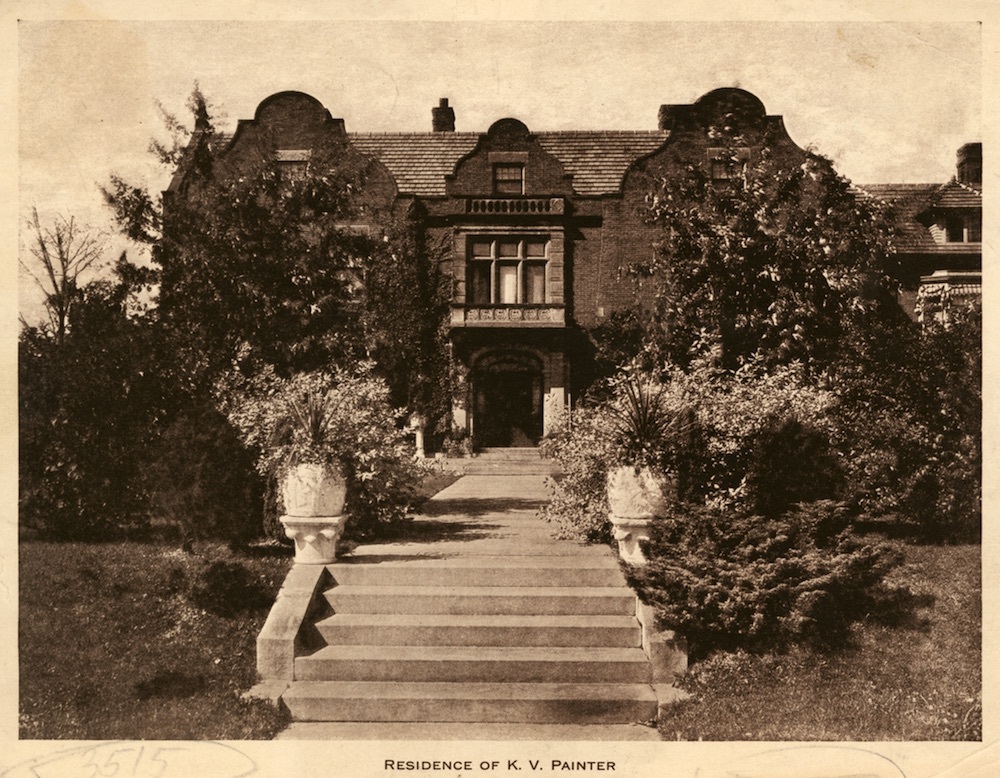
    <summary type="html"><![CDATA[<p><strong><em>The ornithology collections of the Cleveland Zoo and the Cleveland Museum of Natural History trace their origins partly to the backyard zoo and aviary that banker and investor Kenyon V. Painter cobbled together on his Cleveland Heights estate from his far-flung travels around the world.</em></strong></p><img src="https://clevelandhistorical.org/files/fullsize/c7cbbf59c14e2c23996cae29b6353712.jpg" alt="The Residence of Kenyon V. Painter" /><br/><p>Kenyon V. Painter (1867 - 1940) grew up on the 25th block of Euclid Avenue. His father, John Vickers Painter, a wealthy banker, railroad man and associate of John D. Rockefeller, purchased 8.5 acres in Cleveland Heights and hired Frank Skeel to design a summer home for his family. After the elder Painter’s untimely death in 1903, his wife and son Kenyon continued construction. The 65-room Jacobean-style house, completed in 1905, was situated on a property covering more than 50 acres. After serving as a summer refuge for more than a decade, the estate became the family's permanent home in 1915. Mr. Painter followed his father into a successful banking career with Cleveland’s Union Trust Company. </p><p>Painter was a product of the Gilded Age. His wealth and stature afforded him many luxuries and hobbies, including expensive automobiles, big game hunting in Africa, and flirtations as an inventor (Painter sought a patent for a novel golf ball design in 1903). As an automobile enthusiast, Kenyon received one of Cleveland’s earliest speeding tickets for traveling along Rockefeller Parkway in 1901 at twice the 10 mph limit. In 1903, he “ran over” a young boy at a downtown intersection, breaking the boy’s collarbone and shoulder. Painter’s chauffeur took the boy to Lakeside hospital. The police arrested Kenyon, who posted bond, claiming the boy ran out in front of his car. It is plausible that Painter's social status helped his case. Among his well-connected friends was former President of the United States Theodore Roosevelt, with whom he shared safari resources during his frequent hunting trips to the African continent.</p><p>Despite his seemingly freewheeling nature, Kenyon Painter also sought to establish familial roots. He married Mary Chisholm in 1889. They had one daughter who died in 1894.  Mary died in 1901, and soon after, Painter married Maud Wyeth. They would have four children but again suffer the loss of a daughter in 1921 – somewhat ironically, in an automobile accident. </p><p>Painter's globetrotting safaris often mixed leisure with business. Kenyon and Maud honeymooned for three months on a safari in German East Africa, one of 31 extended hunting trips between 1907 and the 1930s. During these trips, Painter established investments near Arusha, Tanganyika, where he developed an 11,000-acre coffee estate, and built Arusha’s first post office, church, hospital, hotel, and coffee research facility with an $11 million investment. </p><p>Kenyon Painter's passion for wild animal trophies and specimens manifested itself on his Cleveland Heights estate grounds. In 1928, Tudor details were added to the mansion in addition to a garage, a stable, zoo and aviary, playhouse, and a small house for Painter's secretary. His trophy room surpassed any other and his two aviary facilities were filled with specimens personally secured when visiting foreign countries. The New York Zoological Society documented his bird collection in its September 1913 bulletin. The writer lauded “Painter’s aviaries as excellent examples of what can be done in private enterprise… Everything possible was done for the comfort of the birds…” He went on to document the birds in the collection, noting it “is cared for by a very intelligent Italian woman, and the uniformly perfect condition of her charges attests her skill in handling them.” In time, Painter would donate birds to the Cleveland Natural History Museum and to Cleveland Brookside Zoo to support the ornithology collections.</p><p>Like many fortunate sons, Painter may have taken for granted the privilege that his father's fortune afforded him. In 1935, he was involved in a notable financial fiasco. As the director and major stockholder of the Union Trust Bank, Painter borrowed nearly $3 million and was unable to pay it back, causing the bank to fail. He was sued and sentenced to prison in Columbus but fell ill and was hospitalized. Ohio Governor Davey pardoned the conviction and Painter returned to the estate where he lived quietly until his death in 1940. </p><p>Painter's life was marked by adventure and intrigue, loss and disgrace, excessive wealth and financial disaster. Philanthropy is perhaps his most lasting legacy. Painter's donations to the Natural History Museum and Cleveland Zoo helped both organizations start their ornithology collections with contributions following his early safaris. The Natural History Museum documents letters of thanks for the donation of a Turaco and parrot in 1930 and cites catalogs of his earlier donations. The zoo indicated Painter's donations included a Japanese robin, two black-headed parrots, two Indian geese, an Australian parakeet, two cranes, four Singapore doves, a silver pheasant, a South African golden oriole, and a South African black-breasted dove. Upon the sale of his estate in 1942, Painter's widow, Maud, donated his remaining aviary of 500 birds to the Cleveland Zoo. </p><p>Likewise, the sprawling Painter Estate found a new life. Shortly after Kenyon Painter's death, the Ursuline Academy (a school for girls at East 55th Street and Scovill Avenue in Cleveland since 1893) was in need of more space. On February 21, 1942, Maud Painter agreed to sell her Cleveland Heights mansion and property to the Ursuline Sisters for use as an educational facility. The sisters modified the house for classrooms and a library and used auxiliary buildings for related school facilities, including a gymnasium in the main trophy room where Kenyon had once kept his prized specimens. In 1943, they renovated the Aviary building. By 1964, the sisters built a new school building on the property with classroom space for 540 students, a new gymnasium, dining room, chapel, and administrative offices. The Aviary and Trophy Rooms were converted to house the Fine Arts Department. As the school progressed through the 20th century, additional facilities were added on the grounds and the mansion was used to house the nuns and for administrative offices and functions. </p><p>In 1979, the Painter Estate was declared a Cleveland Heights Landmark. It also has been featured on the Heights Community Congress’s “Heights Heritage Tour.” Despite its historic significance, the future of the Painter Estate is unclear. By the turn of the 21st century, studies were commissioned to explore options to renovate and utilize the mansion for schooling functions once again. Cost estimates to maintain or convert the mansion space were prohibitive for the nuns. They sold the property and building to Beaumont School in July 2009 and some administrative functions remained in Painter’s house. By 2017-18, Beaumont School administrators and directors removed staff from the building for safety and maintenance concerns and subsequently adopted a plan to demolish the mansion and use the land for athletic facilities. The City of Cleveland Heights has resisted action on the plan, and the ‘mothballed’ building stands today.</p><p><em><strong><a href="https://clevelandhistorical.org/items/show/915">For more (including 10 images) view the original article</a></strong></em></p>]]></summary>
    <published>2020-08-25T14:50:21+00:00</published>
    <updated>2026-04-17T19:17:42+00:00</updated>
    <link rel="alternate" type="text/html" href="https://clevelandhistorical.org/items/show/915"/>
    <id>https://clevelandhistorical.org/items/show/915</id>
    <author>
      <name>Jim Lanese</name>
    </author>
  </entry>
  <entry>
    <title type="html"><![CDATA[The Great Depression and the Zoo: Infrastructure and Insecurity]]></title>
    <summary type="html"><![CDATA[<p><strong><em>Cleveland's Brookside Zoo faced a crisis at the onset of the Great Depression.  With Clevelanders going hungry, the city government was faced with the decision of whether to spend its limited resources caring for and feeding zoo animals.</em></strong></p><img src="https://clevelandhistorical.org/files/fullsize/179c4df538a371bbc6b80e9fcfbd6236.jpg" alt="WPA Rebuilds Brookside Park, ca. 1938" /><br/><p>The Great Depression was a trying time in the City of Cleveland. As early as 1931, nearly one third of the city's work force was unemployed, and things would only get worse. With an already growing economic divide between suburban communities and inner city residents, the depression hit those living in Cleveland the hardest; the tax base that financed local government all but dried up, leading to a financial crisis. Public funding for institutions such as parks and libraries were heavily cut, requiring that they operate on a shoestring budget. Brookside Zoo found itself in a predicament. While maintenance of park grounds could be delayed, animals in the zoo needed food and care. The economically conservative city government was unable to provide relief within its budget; as people were waiting in food lines, the decision to provide care for animals at the zoo raised a few eyebrows. The animal population dwindled, and existing structures and exhibits deteriorated.</p><p>Despite these setbacks, the depression era marked a period of incredible expansion and growth for both the Cleveland Metropolitan Park System and the City of Cleveland's Zoo. The Brookside Zoo offered free recreation, and droves of cash-strapped city residents visited its remains.  Aiding in its revitalization, federal work relief programs provided the labor needed to completely overhaul Brookside Park and Zoo. The latter would emerge the economic crisis with both a new skeleton of an infrastructure and a foundation of public support, paving the way for a period of expansion in the 1940s.</p><p>A comment by Captain Curley Wilson in 1934 concerning the shape of the public zoo summed up the depression-era state of affairs: "Sixth city-and 25th zoo -- but what are you going to do when you haven't got any money?"  Beginning his work as superintendent of the zoo in 1931,  plans for development of the grounds had already been stilted by a lack of available city funding.  All the while, attendance and usage of the free park increased due to both the newly found free time of the unemployed as well as the cautious spending habits of those with work.</p><p>Coming into his new job, Captain Wilson was initially charged with building the zoo to be on par with established zoological gardens in the United States. Efforts to remodel a bird preserve were undertaken, but plans for new structures were soon bypassed to meet the more immediate need of feeding animals. The new superintendent was instantly confronted with the staff's inability to afford adequate security at the zoo; a seal was killed at the hands of a bottle wielding vandal, birds were shot after-hours, and four locals executed a not-so-daring break-in to retrieve a pet monkey placed in the zoo's care by local police.  </p><p>Providing a bit of salt for an open wound, the shrinking zoo needed to deny donations of new animals due to the cost of their upkeep. Even when zoo advocate Laura Mae Corrigan offered a donation in 1933 of 28 animals acquired on safari in Africa, the city was initially forced to refuse the gift. While it was known that the exotic animals would be an incredible boon to the zoological garden's validity as an institution, there was no available money to cover the cost of caring for the animals. Eventually, the widow of steel magnate James W. Corrigan padded her donation with a $5000 check to provide four years worth of food for the zoo's new inhabitants. The gift from Africa would act as the highlight of Brookside's collection during the Depression era.   </p><p>Beyond Corrigan's generous gift, the zoo's infrastructure expanded greatly during the Depression era.  A hefty list of construction projects was undertaken at the zoo and Brookside Park, utilizing work relief programs.  Under the umbrella of the WPA, the zoo was provided two new exhibits - a Sea Lion pool and Monkey Island; runs for prairie dogs, guinea pigs and woodchucks were also constructed, and the bear pits were reconditioned.  The grounds were rehabilitated with new roads, a lake, animal shelters, picnic grounds, and parking lots.  All in all, Brookside Park and Zoo received much in the way of attention and resources from work relief programs.  </p><p>A decade of depleted funding during the Great Depression also had its adverse effects.  A 1940 inspection of the grounds found that nearly every building at the zoo leaked, and needed roofing and spouting.  Most structures required painting and new plumbing, fencing throughout the zoo needed repaired or replaced, and the heating plant was due for a complete overhaul. The deteriorating remnants of Cleveland's early zoo structures littered the grounds which were redeveloped by work relief laborers.  As the zoo emerged from the Great Depression, this contrast in the physical landscape aptly reflected the state of the institution; pushed forward by a resurgence in popularity and the evident possibilities for further expansion, the zoo's growth was restrained by its ties with Cleveland's Department of Recreation as just one of many public spaces in the city's vast park system.  </p><p><em><strong><a href="https://clevelandhistorical.org/items/show/615">For more (including 12 images) view the original article</a></strong></em></p>]]></summary>
    <published>2013-06-19T10:14:47+00:00</published>
    <updated>2026-04-17T19:17:40+00:00</updated>
    <link rel="alternate" type="text/html" href="https://clevelandhistorical.org/items/show/615"/>
    <id>https://clevelandhistorical.org/items/show/615</id>
    <author>
      <name>Richard Raponi</name>
    </author>
  </entry>
  <entry>
    <title type="html"><![CDATA[Cleveland Lakefront Nature Preserve: From Sunken Barges to Nature Preserve]]></title>
    <summary type="html"><![CDATA[<p><strong><em>During the mid- twentieth century, the City of Cleveland used its eastern Lake Erie shoreline as a landfill, polluting the lake with everything from dredging refuse to residential garbage and even decommissioned ships and old cars. This practice, common in many waterfront cities during that time, endangered the Great Lakes. Following thirty years of extensive remediation efforts and natural recovery, what was once a city dump is now the foundation of a protected area that has seen a remarkable resurgence of wildlife.</em></strong></p><img src="https://clevelandhistorical.org/files/fullsize/770ca4fad1b81552a1881b5f993b7e49.jpg" alt="Aerial View of Nature Preserve, Looking East" /><br/><p>Cleveland's Memorial Shoreway (I-90) bisects Gordon Park near the mouth of Doan Brook. To the north of the Cleveland Metroparks Lakefront Reservation field office on Lakeshore Boulevard lies Dike 14, now known as the Cleveland Lakefront Nature Preserve. The space is officially designated as "a confined disposal facility," or CDF, for dredge spoils. Dredging involves removing sediments that build up on the bottom of a riverbed to maintain a navigable channel. Prior to the Clean Water Act of 1972 the dredge spoils from the Cuyahoga River were put in the open lake or along the shoreline to create new land. Between 1979 and 1999, the US Army Corps of Engineers, under contract with the Cuyahoga County Port Authority and the City of Cleveland, filled the space with dredging material from the Cuyahoga River. Dike 14 stands 39 feet high, has a 5,400-foot perimeter, and occupies 88 acres. It is one of a series of confined disposal facilities in Lake Erie along Cleveland's shoreline, but it is no ordinary CDF. Since 1999, Dike 14 has been naturally reforesting.</p><p>During the first half of the twentieth century, the city used much of the area just east of Gordon Park as a garbage dump. As many as 1,000 trucks brought their tattered loads of rubbish to the dump each day for incineration. At the same time, industrial wastes were routinely secreted into the Cuyahoga River, adding to its demise and ultimate 'death'. The accumulation of years of pollutants branded the river the most polluted river in the United States. The river required cleanup, including removal of sediment from its bed.</p><p>The eastward extension of the Memorial Shoreway in the 1950s divided Gordon Park.  The park fell into neglect and adjacent land became used as a landfill by the city. In 1962, two sixty-year-old freighters, the James S. Hill and the William Edenborn of the U.S. Steel fleet, were sunk offshore to protect against beach erosion. In 1965 the city announced plans to utilize the site for a landfill to expand the park. Two years later the city began to dump junked cars and other refuse at the site. By March 1969, the Cleveland Press reported that more than 8,000 cars along with other rubble had been dumped at the landfill. However, the city was criticized for its poor handling of the site allowing pollutants to escape into the lake.  On May 18, 1971, the Cleveland Press reported that the planned fishing pier would likely "remain a crooked finger of barren land in the lake."  </p><p>Meanwhile, several organizations and agencies were seeking efficient, effective, and environmentally safe solutions to urban industrial challenges. In 1975, a proposal by the U.S. Army Corps of Engineers drafted a plan to utilize the landfill space adjacent to Gordon Park as "Diked disposal facility site number 14." The report detailed a plan to construct a retaining wall around the space that contains the freighters, junk, and fill (about eight acres) and enlarge the walled space in the lake to include another 80 acres to deposit river dredged material in a safe manner that would not threaten the lake with its pollutants. The proposal was approved with little opposition, except from the neighboring Bratenahl City Council. In 1979, work began on a breakwall, a retaining culvert for Doan Brook, and rubble mound walls for the dike. The final fill occurred in 1999, twenty years after filling began. Dike 14 presently holds about 5.66 million cubic yards of consolidated dredge material.</p><p>All of the vegetation and wildlife now present has occurred naturally, including more than 280 species of birds and several varieties of butterflies. Revitalization of the area occurred after the last fill deposit without human intervention (planting, seeding, or stocking). However, some grooming activity has enhanced the site for birding walks. Dike 14 is held under public trust by the State of Ohio, and is currently under lease to Cleveland-Cuyahoga County Port Authority. The Cleveland Lakefront Nature Preserve formally opened to the public on a daily basis in February 2012.</p><p><em><strong><a href="https://clevelandhistorical.org/items/show/433">For more (including 9 images) view the original article</a></strong></em></p>]]></summary>
    <published>2012-04-24T16:06:18+00:00</published>
    <updated>2026-04-17T19:17:39+00:00</updated>
    <link rel="alternate" type="text/html" href="https://clevelandhistorical.org/items/show/433"/>
    <id>https://clevelandhistorical.org/items/show/433</id>
    <author>
      <name>Jim Lanese</name>
    </author>
  </entry>
  <entry>
    <title type="html"><![CDATA[Cleveland Museum of Natural History: From Humble Shack to Venerable Institution]]></title>
    <summary type="html"><![CDATA[<img src="https://clevelandhistorical.org/files/fullsize/cmnh1_ae14055c96.jpg" alt="Happy the Haplocanthosaurus, ca. 1977" /><br/><p>The Ark was a small, two-room frame house located on the northeast side of Public Square. It housed taxidermy ranging from birds to reptiles and mammals, which led to its being called the Ark in reference to the biblical story of saving the world's fauna from the great flood. The Arkites, as the group of 26 young men who frequented the Ark came to be known, were led by William Case, mayor of Cleveland from 1850 to 1851, and his brother Leonard Case Jr. Their father Leonard Case Sr. had started the Ark in the 1830s as a place to relax. After buying the property, he let his two sons take charge of the building and began to fade from popular society because of health issues. William Case worked in his father's companies but spent much of his time at the Ark. The Ark is important because there were no museums in Cleveland during this time. The Arkites collected, researched, and discussed findings with each other. As time passed, other societies were interested in representing Cleveland history and the Arkites were the most knowledgeable within the city. They began to present papers and work with others to curate and show their research. William Case's taxidermy bird collection is still on display in the Cleveland Museum of Natural History (CMNH) today.</p><p>CMNH considers the Ark as a part of its founding because of the work that was done by the Arkites. The Ark moved into adjacent Case Hall in 1876 after its building was demolished to build a new post office. Many other societies also used Case Hall, including the Kirtland Society, whose leader Jared Kirtland was also an Arkite. Case Hall lasted until 1916, when it too gave way to the new Cleveland Public Library.</p><p>When the Natural History Museum was established in 1920, it was located in the Lennox Building at Euclid Avenue and East 9th Street. The museum first moved down Euclid Avenue onto Millionaires Row in the Leonard Hanna Mansion. The mansion held many exhibits but most notably many of them were from the original Arkites, including William Case's birds as well as many exhibits donated by the Kirtland Society  in 1920. As the museum began to gather more and more collections, such as Jeptha Wade II's precious stone collection and discoveries of new animals and plants from the a safari that the museum had sponsored in Kenya in 1930, eventually it either had to expand or find a larger building.</p><p>The choice was made for the museum when the Hanna mansion was in the path of a planned highway. In 1958 the museum moved to Wade Park, where it is still located today. Since that time, the museum has enjoyed many achievements. In 1971 the CMNH sponsored a team of zoologists to breed bald eagles, which were threatened with extinction and had only a handful of working nests. They were the first team ever to artificially inseminate a bald eagle and repopulated the area and others with the national bird.</p><p>The CMNH's accomplishments built upon a firm foundation. The Arkites, with the Case family at its center, set the stage for this venerable institution in both spirit and collections. Thus, as this nationally significant museum looks toward its official centennial, it must also cast a glance back-more than 80 years before its official inception-to the humble shack that started it all. </p><p><em><strong><a href="https://clevelandhistorical.org/items/show/41">For more (including 9 images&#32;&amp;&#32;5 audio files) view the original article</a></strong></em></p>]]></summary>
    <published>2010-09-18T20:58:32+00:00</published>
    <updated>2026-04-17T19:17:36+00:00</updated>
    <link rel="alternate" type="text/html" href="https://clevelandhistorical.org/items/show/41"/>
    <id>https://clevelandhistorical.org/items/show/41</id>
    <author>
      <name>Emily Splain</name>
    </author>
  </entry>
</feed>
