<?xml version="1.0" encoding="UTF-8"?>
<feed xmlns="http://www.w3.org/2005/Atom">
  <title type="text">Cleveland Historical</title>
  <updated>2026-05-09T23:13:14+00:00</updated>
  <generator uri="http://framework.zend.com" version="1.12.20">Zend_Feed_Writer</generator>
  <link rel="alternate" type="text/html" href="https://clevelandhistorical.org/"/>
  <link rel="self" type="application/atom+xml" href="https://clevelandhistorical.org/items/browse?output=rss2"/>
  <id>https://clevelandhistorical.org/</id>
  <author>
    <name>Cleveland Historical</name>
    <uri>https://clevelandhistorical.org</uri>
  </author>
  <link rel="hub" href="http://pubsubhubbub.appspot.com/"/>
  <entry>
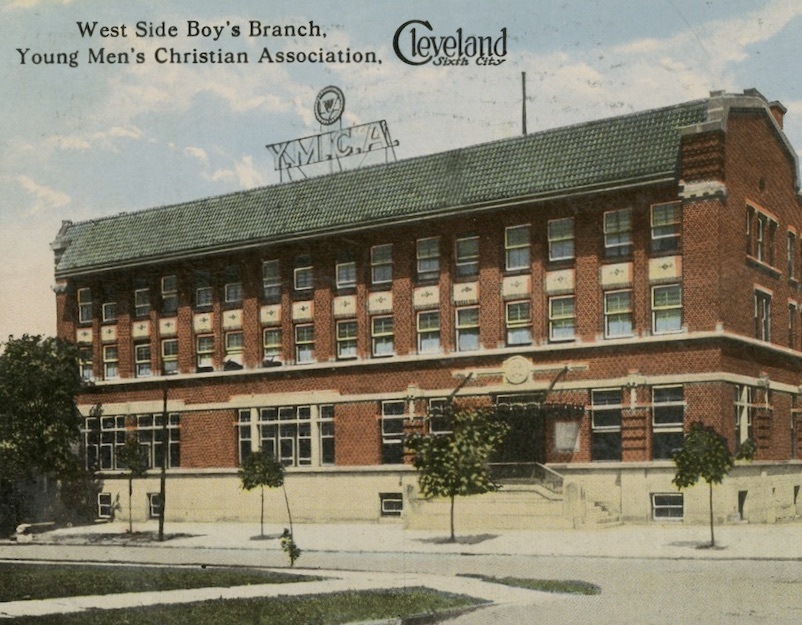
    <title type="html"><![CDATA[West Side Y.M.C.A. : A Cleveland Neighborhood Center for Over a Century]]></title>
    <summary type="html"><![CDATA[<p><strong><em>In 1895, the Board of Directors of Cleveland's Young Men's Christian Association decided the time was right to build the organization's first branch facility on the city's West Side.  It was a decision that not only produced several important "firsts" for the organization but, in the longer view, created a new community center on Franklin Boulevard that would serve the surrounding neighborhood for more than a century.</em></strong></p><img src="https://clevelandhistorical.org/files/fullsize/e95030159fc082e7def69a9aaaf5408e.jpg" alt="The West Side YMCA" /><br/><p>The origins of the building at 3200 Franklin Boulevard, which today is home to a condominium development known as "Franklin Lofts,"  may be said to go back to May 7, 1898, and the sudden death of W. A. Ingham, a prominent Cleveland bookseller and publisher.  Ingham's business had sustained a severe and unexpected loss in 1889 from which neither it nor he fully recovered, and, when he died, Ingham left his widow in a precarious financial condition.  According to her late husband's will, she had two options.  She could continue to live in their grand Italianate style house on the northwest corner of Franklin Avenue and Duane (West 32nd) Street, or she could sell the house and receive a lump sum of money from the estate.  The widow in question was Mary B. Ingham (also known as Mary Bigelow Ingham), a Cleveland pioneer feminist, a charter member of the national Women's Christian Temperance Union, a co-founder of the Cleveland Institute of Art, and an author of numerous articles and books about the lives of nineteenth century women.  She decided to stay in the house for the next two years while her husband's estate was being probated, taking in roomers to help pay the bills.  As the estate proceedings drew to a close, she elected to have the house sold and, in the Fall of 1900, she moved out, taking up residence on the campus of Oberlin College.  There, she continued to write and publish and, undoubtedly, continued to influence yet another generation of American women.</p><p>W.A. Ingham's death in 1898, and the decision of Mary B. Ingham to move out of their house in 1900, paved the way for the Young Men's Christian Association (YMCA) to establish a branch facility on the west side of Cleveland.  Since 1895, the Cleveland YMCA had been looking for an opportunity to do so.  In 1897, it had mounted a campaign to establish a location, but, according to the March 18, 1900, edition of the Plain Dealer, it had failed for lack of support.  When, in 1900, it came to the attention of a young men's club at the Franklin Avenue Methodist-Episcopal Church, located on the southwest corner of Franklin Avenue and Duane Street that the Ingham House, just across the street, was for sale, they mounted their own campaign to have it become the new west side YMCA.  Prominent west side business men joined the effort. Robert Wallace, the recently retired  president of  the Cleveland Shipbuilding Company, and as well  a long-time resident of Franklin Boulevard,  purchased the Ingham house and donated it to the YMCA.  Others contributed the money necessary to construct a gymnasium addition onto the rear of the house.  On November 5, 1901, the new West Side YMCA, which was initially called the West Side Boys Club, opened.  Not only was it Cleveland's first YMCA branch located on the city's west side, but it was also, according to contemporary newspaper accounts, the first YMCA in the United States whose membership was restricted to boys between the ages of 12 and 18.</p><p>The person who was tapped to head the new West Side YMCA was Mathew D. Crackel, Secretary of the Junior Department of the Central YMCA since 1897.  Crackel, who had been living in downtown Cleveland, immediately moved to Franklin Boulevard, the street on which, except for a two-year stay in Jerusalem in the 1930s where he established a YMCA for Jewish and Palestinian boys, he would live for the rest of his life.  Crackel  was known for his moral compass, his motivational speeches and his extended hiking and camping trips. The most memorable of the latter were his annual "gypsy trips," which began in 1902.  Each year, Crackel led a group of YMCA boys on long hikes that often covered hundreds of miles, and involved camping outdoors for weeks, before returning to Cleveland.  Crackel also headed the first Boy Scout troop in Cleveland, which was formed at the West Side YMCA in 1910.  He served as Secretary of the West Side YMCA until his retirement in 1933.  </p><p>It was during Mathew Crackel's tenure as head of the West Side YMCA that the building which currently sits on the northwest corner of Franklin Boulevard and West 32nd Street was erected.  In 1909, the Cleveland YMCA had decided to expand its membership by constructing new and larger facilities for its Central YMCA on Prospect Avenue as well as for its East End and West Side branches.  The new West Side YMCA facility was to be built at the same general location as the existing facility.  The lot on Franklin immediately to the west of the Ingham House was purchased and the house on it razed.  The Ingham house was razed as well and the gymnasium, which had been attached to the rear of it, was moved to the rear of the lot to the west.  The new building was erected on and straddled both of the lots.  It was designed by architect Albert Skeel, an English immigrant who trained in Cleveland at the offices of the well-known architect Frank Barnum.  Four stories in height, including its basement which held the lobby and served as the building's "ground" floor, it had 120 feet of frontage on Franklin Boulevard and an equal amount on West 32nd Street.  It was equipped with a gymnasium (giving this branch two gymnasiums), a swimming pool, an indoor running track, a handball court, game rooms, reading rooms, club rooms, a dormitory with capacity for 100 occupants, and a large kitchen and dining room.  (Later, an addition with more handball courts was constructed onto the west side of the new building.) Construction was begun and completed in 1911 at a cost of $110,000.   The new West Side YMCA was dedicated by Cleveland Mayor Newton D. Baker on March 21, 1912. </p><p>In the years, and decades that followed, the West Side YMCA became more than just a place for young men to go and follow the tenets of what was then referred to as "muscular Christianity."  In addition to the athletics, the clubs, the reading rooms and the other programs designed for young men, the building also served as a place for neighborhood residents to gather and participate in community events.  There were open houses and receptions, meetings of a variety of local organizations, art and other exhibitions, political gatherings, concerts, workshops, fund-raising events, lectures, and even a circus, which were attended by residents of what was then called the Near West Side, but what eventually became known as the Ohio City neighborhood.  As Cleveland's west side changed demographically in the post World War II era, the West Side YMCA changed with it, converting dormitories that had been built for young men moving to Cleveland into transitional housing for Cleveland's  homeless, and hosting the Hispanic Culture Center in recognition of the growing Hispanic presence in the neighborhood.  It also became a favorite place for older neighborhood men, especially retirees, to go and play handball.  Change of a different type came to the West Side YMCA in 1953, when it was hit by the tornado that destroyed many buildings on the west side of Cleveland.  The original wooden gymnasium building on the property was totally destroyed and the main building suffered substantial damage.  The old complex roof built with Spanish tile on its sloped front was rebuilt as a flat roof, giving the building thereafter a very different look.  By the 1980s, the West Side YMCA, like many other inner city YMCAs, was facing yet another challenge, this time to stay financially afloat. Efforts by members of the community  helped to keep it open for another two decades, but, on September 1, 2004, the West Side YMCA closed its doors for good.  The building was later sold to a developer who, in 2010, converted it into the Franklin Lofts.</p><p><em><strong><a href="https://clevelandhistorical.org/items/show/933">For more (including 15 images) view the original article</a></strong></em></p>]]></summary>
    <published>2020-12-22T03:40:17+00:00</published>
    <updated>2026-04-17T19:17:42+00:00</updated>
    <link rel="alternate" type="text/html" href="https://clevelandhistorical.org/items/show/933"/>
    <id>https://clevelandhistorical.org/items/show/933</id>
    <author>
      <name>Jim Dubelko</name>
    </author>
  </entry>
  <entry>
    <title type="html"><![CDATA[River Road Camp: The YMCA in the Cleveland Metroparks]]></title>
    <summary type="html"><![CDATA[<p><strong><em>Cleveland Metroparks North Chagrin Reservation was once home to a rustic resort for Cleveland's youth.  A massive camp built during the 1930s hosted countless children and adults for nearly half a century.</em></strong></p><img src="https://clevelandhistorical.org/files/fullsize/5a59d3b9bd9004793176a849e75e0d9c.jpg" alt="The YMCA Mission" /><br/><p>The lazy days of summer took an industrious turn for attendees of the Young Men’s Christian Association River Road Camp at the Cleveland Metropolitan Park District's North Chagrin Reservation in 1943.  The camp’s forty-four temporary residents had joined in the war effort by enlisting with the United States Crop Corps service. The boys awoke at six o' clock each morning from Monday to Saturday, washed up, made their beds, and straightened the sleeping quarters for inspection.  Upon devouring a large breakfast, they were piled into school buses and shipped off to local farms and orchards. The recruits spent their summer weeding, cultivating plants and harvesting crops. In return for an eight hour day of of sweat and manual labor, the youngsters received forty cents an hour and a chance to enjoy life at the YMCA’s newest camp in the Cleveland Metropolitan Parks. This wasn’t merely a chance for the boys to rough it in the wilderness under the cover of battered tents. The River Road Camp was a tiny, rustic village situated in the forested outskirts of Cleveland.  The rural resort was comprised of thirty-five buildings, including a recreation center, craft shop, nature museum, dining hall, and sleeping cabins.  The impressive complex housed both the mission of the YMCA and its campers — young and old alike — for nearly forty years.  </p><p>Camping had been a cornerstone of the YMCA’s programming since the undertaking of its first American summer overnight expedition in 1885.  Similar to any longstanding institution created for children, the design and purpose of YMCA camps changed over time in response to the values and concerns of adult society. At their core, though, these camps were built upon promoting the tenants of Christian faith,  instilling confidence and self reliance in campers, and fostering positive social development in children.  As early as 1921, the YMCA secured sites within the Cleveland Metropolitan Park District for use as daytime and overnight retreats.  Small camps and structures were erected or borrowed by local chapters of the service organization in Rocky River, Brecksville, and Euclid Creek Reservations.  Boys generally brought their own food and supplies, and camping was free or offered at a nominal charge to cover the cost of ice and kerosene. </p><p>The funding, labor, and impetus to build what would become the YMCA’s River Road Camp materialized with the birth of federal relief agencies during the Great Depression. The land in North Chagrin Reservation had been operated as a camp since the 1920s by the Cleveland Heights Kiwanis Club and the Cleveland Heights Board of Education.  In 1934, the Euclid Post of the American Legion took over existing camp equipment as an experiment in community service. Forty-nine additional American Legion posts agreed to support the funding and operation of the camp within a year. Even in the depths of an economic recession, their venture in the woods took root and grew.  The camp brought together the varied Americanization, youth activity, child welfare, relief, community service, and juvenile delinquency programs of the American Legion.   The American Legion supplied $12,000 in materials, and worked in consort with the Park Board to obtain state and Works Progress Administration support for the construction of the $100,000 camp.  The immense project was meant to provide other social and civic organizations a model in offering the public both recreational and educational facilities.</p><p>By incorporating National Park Service design standards, the cabins and campground of the American Legion Boys and Girls Camp embraced contemporary trends in camp planning.  Partly a response to the theories of child psychologists of the day, professionally designed landscapes were commonly employed that envisioned encampments as planned communities.  Attractive permanent structures and picturesque landscapes gained favor over tented or makeshift sites that typified campgrounds of service organizations prior to the 1930s.  Dedicated in August of 1939, the ornate American Legion camp was envisioned as vacation grounds for the city’s youth.  Children were to be whisked away from the stresses of daily life for a brief stint of leisure, recreation and education; the lucky campers even received a reprieve from daily chores  – including the scourge of kitchen duty.</p><p>Amnesty from the drudgery of daily errands soon came to an end for campers in North Chagrin Reservation.   The American Legion camp was leased to the YMCA in 1942 for use in expanding the latter organization’s service-oriented facilities.  The camp was repurposed as a front line defense against the rise of wartime juvenile delinquency.  Constructive activities and daily tasks bestowed upon camp attendees aimed to not only occupy their time during the summer months, but aid in building character.  Without doubt, the boys participating in the United States Crop Corps remained busy while earning their keep at the YMCA camp. </p><p>The YMCA continued operation of its River Road Camp following the conclusion of World War II.  As an extension of the service organization’s longstanding mission to nurture the spiritual, physical and intellectual development of young men, the summer camp housed a variety of programs that promoted fitness, nature study, and the fashioning of slightly disfigured handicrafts. The success of the camp, and of the national YMCA organization, lay in its openness and affordability to middle class families.  Dependent on attracting paying customers, YMCA branches proved flexible in adapting programming to the needs of their surrounding communities. The River Road Camp became coed in 1957, mirroring a trend in Cuyahoga County of sharing facilities with the Young Women’s Christian Association to meet public demand and lower operating costs.  </p><p>Also critical to the YMCA’s continued success was a transformation of American thought concerning the importance of fitness during the 1950s.  With the advent of the Cold War, the national media quickly pointed out how terribly unfit American children were in comparison to their European counterparts.  Popular rhetoric increasingly equated fitness with morality, and emphasized the importance of health, religion and sports – a position that paralleled the YMCA’s mission.  This emphasis on fitness was further bolstered during the early 1960s as scientific research identified the importance of exercise in preventing disease.  The subsequent health craze invaded mainstream society, as evidenced by the existence of a rather pricey fitness industry at the decade’s end. </p><p>The River Road Camp was revamped in 1966 as an answer to the public’s growing interest in health and fitness. During two ten-day intervals, squads of boys majoring in a sport of their choosing were submitted to intensive training under the direction of branch YMCA instructors.  A half-mile obstacle course highlighted the new fitness camp.  Battalions of youth raced through its 27 activity stations, balancing on beams over tiny pits, dragging themselves across horizontal ladders, climbing and swinging from ropes, and scaling a 40 foot high wall.  Soon after, adults were let in on the fun.  An annual Physical Fitness Camp for Women was established in 1969 that catered to middle class housewives seeking exercise, healthy meals, and massages. </p><p>The fitness and sports-themed camping experience proved popular, and continued to be a mainstay at the River Road Camp until its closing in 1979.  While varied YMCA branches continued to use cabins and grounds in the Cleveland Metroparks for their extensive programming, the lease between the Park Board and the YMCA for the operation of the North Chagrin campgrounds expired in 1980.   As part of the Cleveland Metroparks’ million dollar redevelopment of the North Chagrin Reservation during the early 1980s, the aged buildings of the American Legion summer camp were demolished to make way for a picnic shelter and area for winter sporting activities. </p><p><em><strong><a href="https://clevelandhistorical.org/items/show/699">For more (including 15 images&#32;&amp;&#32;3 audio files) view the original article</a></strong></em></p>]]></summary>
    <published>2015-04-08T09:41:28+00:00</published>
    <updated>2026-04-17T19:17:40+00:00</updated>
    <link rel="alternate" type="text/html" href="https://clevelandhistorical.org/items/show/699"/>
    <id>https://clevelandhistorical.org/items/show/699</id>
    <author>
      <name>Richard Raponi</name>
    </author>
  </entry>
  <entry>
    <title type="html"><![CDATA[Fenn Tower: &quot;The Campus in the Clouds&quot;]]></title>
    <summary type="html"><![CDATA[<img src="https://clevelandhistorical.org/files/fullsize/297fec656bd9767cd0df86a03e24c740.jpg" alt="Fenn Tower ca. 1955-60" /><br/><p>The origins of Cleveland State University date to 1870, when the Cleveland Young Men's Christian Association began offering free evening classes in French and German. After a decade of sporadic course offerings, the YMCA's evening educational program became firmly established in 1881. In 1906, the YMCA combined its newly created day school with the evening program under the name Association Institute. Fifteen years later, it was renamed the Cleveland YMCA School of Technology.</p><p>The need to achieve accreditation led the YMCA to reorganize its educational program in 1930. At that time, the school was renamed Fenn College, in honor of Sereno Peck Fenn, who had served as president of the Cleveland YMCA for 25 years and as a board director between 1868 and 1920. College lore holds that another motivation for the name change was students’ desire for a more prestigious-sounding diploma.</p><p>With several private colleges in Cleveland, including Case Institute of Technology and Western Reserve University, Fenn College focused on serving students for whom college otherwise would be financially unattainable. It offered a low-cost, high-quality education and became the second college in Ohio, after the University of Cincinnati, to adopt a cooperative education program. This model of alternating classroom study with paid employment was required for all day students and optional for evening students. Fenn also operated Nash Junior College, the first such program in the state, for a few years in the 1930s.</p><p>In 1937, Fenn College purchased the 22-story National Town and Country Club building at Euclid Avenue and East 24th Street. The tower had been conceived during the height of Cleveland’s Roaring Twenties prosperity. Composed of many of the city’s leading businessmen and professionals, the club broke ground only days after the 1929 stock market crash. Designed by George B. Post—the architect of the New York Stock Exchange and the Cleveland Trust Company—the building reflected the Art Deco style with strong Mayan motifs. </p><p>Its lower floors contained resort-like amenities, including six bowling alleys, an English pub, formal dining rooms (one of them paneled with Macacauba wood from East Africa), a Turkish bath, a natatorium, a gymnasium, and handball and squash courts. Upper floors served as guest rooms for members and their guests from out of town. The tower’s crown featured a terrazzo-tiled solarium that even provided “ultraviolet ray equipment” to counter Cleveland’s dreary winters.</p><p>The club held only one event in the building before the Great Depression forced its dissolution, leaving the tower vacant until Fenn College acquired it. Renamed Fenn Tower in 1939, the former club provided much-needed classroom and office space and gave the college a prestigious Euclid Avenue address. Variously nicknamed the "Skyscraper Schoolhouse" and the "Campus in the Clouds,” the reconfigured Fenn Tower contained classrooms, a library, a gymnasium, a pool, student lounges, and other amenities—all within its vertical confines.</p><p>Throughout its history, Fenn College never operated at a deficit. By 1963, however, increasing operating costs, competition from the new Cuyahoga Community College, and rumors of a possible state takeover placed the institution under severe financial strain. That year, the college released <i>A Plan for Unified Higher Education in Cleveland–Northeastern Ohio</i>, calling upon the state to charter a public university in Cleveland, using Fenn College as its nucleus.</p><p>In his 1962 campaign for governor, James A. Rhodes proposed that every Ohioan should live within 30 miles of a state university. At the time, the nearest such institution to Cleveland was Kent State. On December 18, 1964, Governor Rhodes signed legislation creating Ohio's seventh state university, Cleveland State University, and announced the appointment of a board of trustees with James Nance as its first chairman.</p><p>For the next forty years, as CSU expanded westward along Euclid Avenue, Fenn Tower continued to serve a variety of functions, including classrooms, offices, and a class-registration and health center. In 2006, this once self-contained skyscraper “campus” for commuters became a residence hall, marking CSU’s first step toward developing a substantial residential student population.</p><p><em><strong><a href="https://clevelandhistorical.org/items/show/54">For more (including 17 images, 2 audio files,&#32;&amp;&#32;2 videos) view the original article</a></strong></em></p>]]></summary>
    <published>2010-09-22T10:45:14+00:00</published>
    <updated>2026-04-17T19:17:37+00:00</updated>
    <link rel="alternate" type="text/html" href="https://clevelandhistorical.org/items/show/54"/>
    <id>https://clevelandhistorical.org/items/show/54</id>
    <author>
      <name>J. Mark Souther</name>
    </author>
  </entry>
</feed>
