<?xml version="1.0" encoding="UTF-8"?>
<feed xmlns="http://www.w3.org/2005/Atom">
  <title type="text">Cleveland Historical</title>
  <updated>2026-05-10T00:16:47+00:00</updated>
  <generator uri="http://framework.zend.com" version="1.12.20">Zend_Feed_Writer</generator>
  <link rel="alternate" type="text/html" href="https://clevelandhistorical.org/"/>
  <link rel="self" type="application/atom+xml" href="https://clevelandhistorical.org/items/browse?output=rss2"/>
  <id>https://clevelandhistorical.org/</id>
  <author>
    <name>Cleveland Historical</name>
    <uri>https://clevelandhistorical.org</uri>
  </author>
  <link rel="hub" href="http://pubsubhubbub.appspot.com/"/>
  <entry>
    <title type="html"><![CDATA[I-X Center: From Factory to Exposition Center]]></title>
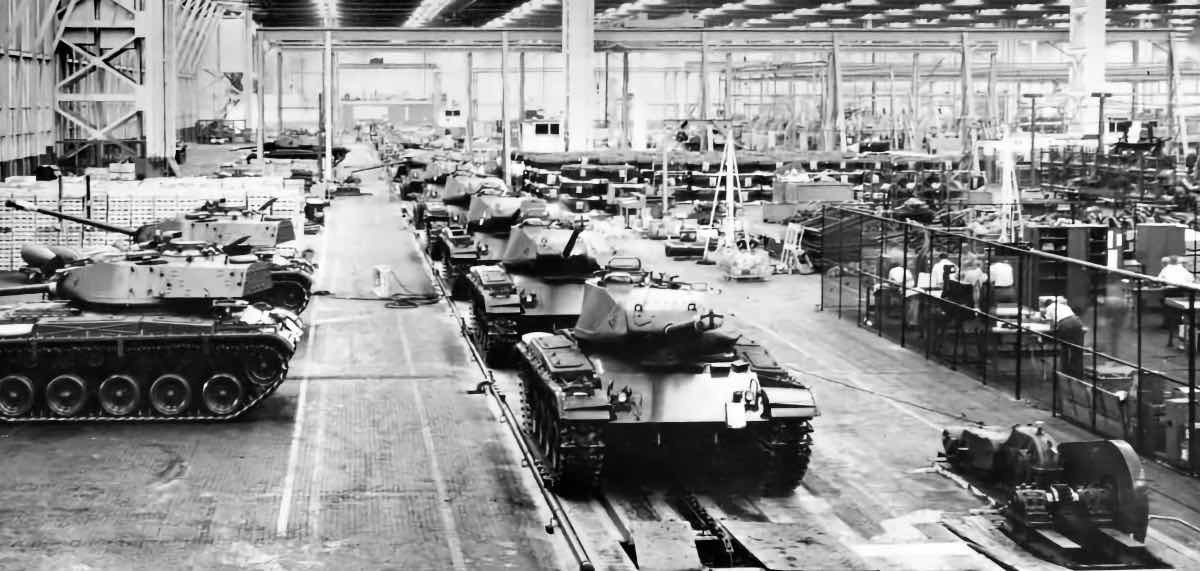
    <summary type="html"><![CDATA[<p><strong><em>The International Exposition Center, originally built as the Cleveland Bomber Plant, has seen an impressive variety of uses over its years of operation. From bomber planes and tanks to the various trade shows and events, the I-X Center has been used for countless different productions and conventions.</em></strong></p><img src="https://clevelandhistorical.org/files/fullsize/d918f614ed2aac926ea0fd41c3c6304a.jpg" alt="M41 Walker Bulldog Tanks" /><br/><p>The International Exposition Center, originally known as the Cleveland Bomber Plant, was built in 1942 with the purpose of constructing major sections of B-29 bombers for the United States during the Second World War. It was constructed and owned by the U.S. Department of Defense and was operated by Fisher Body, a subsidiary of General Motors. Following the conclusion of World War II, the Cleveland Bomber Plant was used briefly as an exhibition hall and sales center, a foreshadowing of what was to come many years later.</p><p>The workspace at the Cleveland Bomber Plant during World War II was diverse. African American men and women worked alongside white workers for attractive wages for the time. The demand for workers in the factory was so great that employees required approval from the Department of Defense to change jobs. Aside from the fabrication of B-29 bomber nose and tail sections, Fisher Body also received a contract to build and test top-secret experimental XP-75 fighter planes. The operations were so secretive that those working at the plant did not even know the specifications of the planes themselves.</p><p>After the end of World War II, the Cleveland Bomber Plant was leased to National Terminals and used as a soybean storage facility. The plant was used in this way until the beginning of the Korean War. U.S. involvement in the Korean War saw the Cleveland Bomber Plant become the Cadillac Tank Plant (or Cleveland Tank Plant). During the time of the Cadillac Tank Plant, the plant had expanded to include a photo department, a labor relations office, a full-time lawyer's office, and even a hospital with nurses and a staff doctor. This expansion, coupled with the thousands of workers at the facility, made the plant feel more like a small town in its own right than just a place of work.</p><p>The Cadillac Tank Plant produced tanks, artillery pieces, and other military vehicles with varying degrees of success. Following two years of production, the U.S. Army rejected all tanks made at the plant because of a faulty gun mechanism. In 1953, the Walker Bulldog, a light tank, was successfully put into service in Korea.</p><p>Between 1964 and 1966, Chrysler held the manufacturing contract at the plant while General Motors held the engineering contract. The relationship between these two companies was reputed to be poor. The plant was divided between these two companies, and a wall was built to protect trade secrets from one another, showcasing the lack of cooperation between the two. Chrysler would eventually lose the manufacturing bid to the Allison division of General Motors, leading to a smoother production process once again. Production continued until 1972. With United States involvement in the Vietnam War coming to an end, the U.S. government decided not to continue with the program upon the completion of the last General Motors contract.</p><p>After the Department of Defense closed the Cleveland Tank Plant, it made the site available for purchase. General Motors and the cities of Brook Park and Cleveland all showed some interest in purchasing the tank plant, but ultimately, none of them bought it.</p><p>In 1977 the plant was purchased by The Park Corporation of Charleston, West Virginia, with the intention of transforming the it into an international trade mart. Years after its purchase, in 1985 the facility reopened as the International Exposition and Trade Center, or I-X Center, and was reputedly the largest single-building exposition facility in the world. The I-X Center hosted a large variety of events such as conferences, car, motorcycle, boat, and home and garden shows, trade shows, and later the I-X indoor amusement park.</p><p>The I-X Center had created strong competition for the Cleveland Convention Center. After it opened, the I-X Center drew away both the auto and boat shows that were previously held at the downtown convention center.  Local unions tried to create new contracts that were aimed at helping the Cleveland Convention Center to keep or attract new trade shows, as the available work at the Cleveland center continued to decline. There was also a "gentlemen's agreement" between Ray Park, owner of the I-X Center, and the City of Cleveland that the I-X Center would not solicit shows that were traditionally run at the Cleveland Convention Center. Despite this agreement, however, the I-X Center offered the space and time desired by shows such as the Auto Show, and the I-X Center was picked over the Cleveland Center.</p><p>The Cleveland Convention Center went under renovations and attempted to showcase and market these renovations to remain competitive with the I-X Center and other cities. These renovations proved not to be enough as the Cleveland Convention Center would continue to operate at a loss after its most profitable shows went to the I-X Center.</p><p>The addition of 185,000 square feet of exhibit space in 2008 puts the I-X Center at a total of 2.2 million square feet, and it remains one of the largest trade show and exhibition centers in the world as of 2026. The I-X Center was closed during the COVID pandemic and was purchased and reopened by the Industrial Realty Group in 2021. Events continued until March 2026, with the Industrial Realty Group seemingly uninterested in continuing to use the I-X Center for event space.</p><p>The I-X Center remains a historic piece of Cleveland's industrial and commercial legacy. From the manufacturing of important military hardware to one of the largest exposition centers in the world, its many different uses mirror the shifting phases of Cleveland's economy.</p><p><em><strong><a href="https://clevelandhistorical.org/items/show/1081">For more (including 8 images) view the original article</a></strong></em></p>]]></summary>
    <published>2026-03-06T15:40:14+00:00</published>
    <updated>2026-05-01T00:22:38+00:00</updated>
    <link rel="alternate" type="text/html" href="https://clevelandhistorical.org/items/show/1081"/>
    <id>https://clevelandhistorical.org/items/show/1081</id>
    <author>
      <name>Jaret Glueck</name>
    </author>
  </entry>
  <entry>
    <title type="html"><![CDATA[Mall Victory Garden : A Wartime Demonstration]]></title>
    <summary type="html"><![CDATA[<img src="https://clevelandhistorical.org/files/fullsize/6a8f58930a18ed03e5c48f7f115ca906.jpg" alt="Overhead View of Mall Victory Garden" /><br/><p>While the Second World War was raging across the globe, a different war was being fought on the homefront against food shortages. But victory gardens were more about supporting the U.S. war effort than fighting hunger. <a href="https://clevelandhistorical.org/items/show/312">The Mall</a>, a park-like civic space in downtown Cleveland, was selected by the city to host a community victory garden as a wartime demonstration project to inspire and educate students and people unfamiliar with growing vegetables. With land donated by the city, the victory garden grew as a successful community project that even lasted for some time after the end of the war.
Victory gardens were a nationwide federal initiative promoted by the U.S. Department of Agriculture with the purpose of feeding people amid wartime food rationing and farm labor shortages during World War II. Victory gardens were intended to grow a wide array of vegetables that would feed families while most processed food was shipped overseas to feed the military fighting the war. Victory gardens were thus seen as a patriotic duty towards the war effort. </p><p>While many rural Americans already grew their own food, this was less true of people in cities, towns, and suburbs. Most gardens were in suburban residential areas or in small towns, but cities also had gardens in parks, on school grounds and vacant lots, and on rooftops in the most urban areas. It has been estimated that victory gardens produced about 40% of all produce consumed by Americans during the war. However, after the D-Day landings, as an Allied victory looked increasingly attainable, victory gardens slowly declined in popularity.
Cleveland's demonstration victory garden was located on Mall B (the southern portion of the Mall), between Rockwell and St. Clair Avenues. Mayor Frank Lausche and city officals approved the Mall site because it was the a highly visible, central space with natural ground for growing vegetables.The groundbreaking for the Mall Victory Garden did not come until February 1943, during the height of the victory garden craze across the nation. Breaking ground was difficult due to contractors' fear of damaging their plows and equipment on rocks while plowing the ground for the plots. Planting of seeds for the various vegetables started in May, the start of the growing season. </p><p>After planting, Bee Taylor was assigned by the Cuyahoga County Victory Garden Committee to be the full-time attendant of the gardens for day-to-day duties. A resident of South Euclid, Taylor was a member of the Harvey Rice Garden Club. The Garden Center (later renamed the Cleveland Botanical Garden) paid her salary. By June, the garden began holding demonstrations to educate people on how to tend to certain vegetables. With twenty-four different kinds of vegetables under cultivation, the garden was a popular attraction for people who came and see the garden grow as well as watch demonstrations. Most of the produce raised there was either sent to local institutions or canned for display purposes. In the 1943 season alone, Bee Taylor counted 50,000 people visiting the garden "to ask questions, compare the growth of their own vegetables with those on the Mall, and hear experienced growers" in 24 lecture demonstrations. The garden was so popular that it expanded to include more plots for crops. By April 1944, the garden was open again with the new expansion. The garden surely played a role in inspiring the planting of some of the 115,000 victory gardens in the Cleveland area. </p><p>However, as the war started to shift in favor of Allied victory after D-Day, attendance started to decline slightly. Despite the decline, the Mall Victory Garden remained popular for students and those who wanted to learn gardening. There were even talks and demonstrations held by editors of victory garden columns and other publications. By the end of the 1944 growing season, the gardens closed and prepared for the 1945 season. When victory came in 1945, victory gardens decreased significantly after the surrender of the Axis forces and the government program ended a year later. Despite the end of the victory garden program, the city of Cleveland wanted to keep the community gardens around years after the end of the war. However, popularity was never the same as during the war. The Mall Victory Garden finally closed in late 1947. The former Mall Victory Garden site was later repurposed in 1964 for a "war memorial fountain" that is now known as the <a href="https://clevelandhistorical.org/items/show/1050">Fountain of Eternal Life</a>.</p><p><em><strong><a href="https://clevelandhistorical.org/items/show/988">For more (including 8 images) view the original article</a></strong></em></p>]]></summary>
    <published>2022-11-30T01:07:24+00:00</published>
    <updated>2026-04-17T19:17:42+00:00</updated>
    <link rel="alternate" type="text/html" href="https://clevelandhistorical.org/items/show/988"/>
    <id>https://clevelandhistorical.org/items/show/988</id>
    <author>
      <name>Tyler Jarosz</name>
    </author>
  </entry>
  <entry>
    <title type="html"><![CDATA[Sherwin-Williams]]></title>
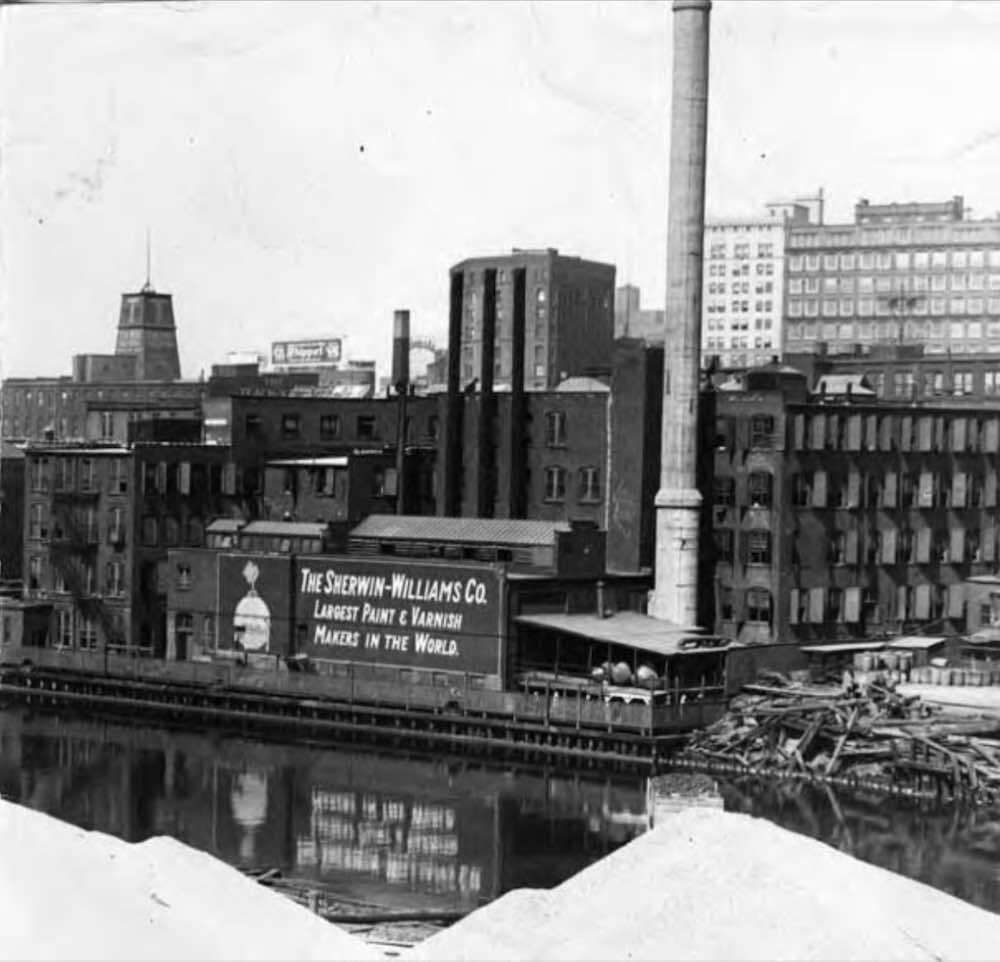
    <summary type="html"><![CDATA[<p><strong><em>For Cleveland, Sherwin-Williams is more than just a paint company. It is a fixture in the lives of many Clevelanders and one of the economic backbones of the city.</em></strong></p><img src="https://clevelandhistorical.org/files/fullsize/a7a8aee8c9ec21aca187cc6572e0c510.jpg" alt="Sherwin-Williams Co. Factory in the Flats" /><br/><p>From humble beginnings in 1866, Sherwin-Williams has become increasingly a staple of Cleveland’s economy. Henry Sherwin came to Cleveland looking for work at the request of his uncle, eventually finding his way into the paint industry with his position in Truman Dunham & Co. Following the end of his tenure there, Sherwin took a leap of faith, starting his own paint company with every penny he had saved from his previous jobs. This venture would pay off as the Sherwin-Williams company thrives today, over one hundred and fifty years later. Partnering with Edward Porter Williams the Sherwin-Williams company was born, establishing its first plant along the Cuyahoga River. In its early years the company made many industry-changing moves, including ready mixed paint, created in 1880 and now an industry standard. </p><p>Sherwin-Williams gradually established itself as an industry giant as it began to buy more property outside the city of Cleveland. Chicago and Detroit were two of the cities that saw expansion from Sherwin-Williams. Sherwin even went as far as purchasing Berger Sons & Co., the UK’s biggest paint company, in 1905 to cement itself internationally. These global acquisitions make sense for the time as 1905 saw the birth of a slogan everyone in Cleveland should be familiar with, “Cover the Earth.” Spanning much of the company’s history, the slogan and logo show the Earth being covered with paint from a Sherwin-Williams can. Not only is this logo iconic but it exemplifies what the company was attempting to do during its early years: become a global giant in the paint industry. In the early twentieth century, Sherwin began purchasing smaller companies to strengthen its corporate stature. Companies like Martin-Senour and Acme Quality Paints were acquired around 1920 as they caught the eyes of Sherwin-Williams executives as smart investments. </p><p>In the 1940s Sherwin-Williams was forced to make more innovations, this time with fewer materials at its disposal. As a result of the wartime shortage of oil, the company had to create a new type of paint, Kem-Tone, which was the world’s first water-based interior paint. Paintbrush materials were also in short supply at this time, meaning Sherwin-Williams would have to innovate new applicator products as well. The first roller brushes were made during this time, a now industry standard as well. During the war, Sherwin-Williams started heavily marketing a “do it yourself” notion, creating a whole new market for the company. By the end of World War II Sherwin-Williams had seen its sales double, despite the uncertainty of world events. </p><p>The growth of Sherwin-Williams finally stagnated in the 1970s, as the company began to see exorbitant amounts of debt piling up. Hostile company takeover rumors were swirling around before a new CEO was appointed, Jack Breen. Breen would be credited with bringing the company back from the brink of collapse, but legal battles stemming from this era still haunt the company. Lead paint was banned in 1978 but many homes across the country still have walls covered in it, causing serious health problems, especially for children in urban neighborhoods. Following a long legal battle in which Sherwin had to pay out $305 million for its use of lead paint, its main competitor, Pittsburgh-based PPG, announced it was ceasing all use of lead in its paint. This move may have swayed some customers away from Sherwin-Williams. Another stain on the reputation of the company appeared in 1981, when it purchased struggling Cleveland-based Gray Drug Stores for $55 million, a move meant to stabilize their financial portfolio. Following the acquisition of additional local chains, including 26 Cunningham Drug Stores, Sherwin sold their drug store division to Rite Aid for $165 million in 1987. More recently Sherwin has made many acquisitions of former rivals and industry fixtures, including Minneapolis-based paint and coatings company Valspar, Purdy (a top company for paint applicators), and Minwax (a popular finish company), allowing it to control much of the paint market. </p><p>In February of 2020 the company announced that it would build its brand-new headquarters in the center of downtown Cleveland. Cities like Atlanta and Dallas were rumored to be considered for the company’s headquarters but ultimately Sherwin stayed true to their Cleveland roots. Along with its new headquarters, Sherwin-Williams announced that it would build an R&D facility in Brecksville, continuing to invest in the region it has called home for nearly two centuries. Employing nearly 4,500 workers, Sherwin-Williams stands as the largest industrial employer in the city of Cleveland.</p><p><em><strong><a href="https://clevelandhistorical.org/items/show/928">For more (including 8 images) view the original article</a></strong></em></p>]]></summary>
    <published>2020-12-13T22:05:18+00:00</published>
    <updated>2026-04-17T19:17:42+00:00</updated>
    <link rel="alternate" type="text/html" href="https://clevelandhistorical.org/items/show/928"/>
    <id>https://clevelandhistorical.org/items/show/928</id>
    <author>
      <name>Gabriel Wieland-Fiorello</name>
    </author>
  </entry>
  <entry>
    <title type="html"><![CDATA[SIFCO Industries, Inc. : The Steel Improvement and Forge Company]]></title>
    <summary type="html"><![CDATA[<img src="https://clevelandhistorical.org/files/fullsize/0a307a7be070ea28ca2ad6e4a05bf44e.jpg" alt="Exterior circa 1928. " /><br/><p>Cleveland is a city that was built upon the backs of industries and although it has come to be identified with burning rivers and unavailing sports franchises, the industrial culture of the region is what drove, and continues to drive, a significant amount of the economic prosperity of the city. A strong player in Cleveland’s industrial market in existence for over a century is SIFCO Industries, Inc. located off of St. Clair Avenue on Cleveland’s east side. </p><p>SIFCO was originally founded in 1913 by a small group of men in Cleveland who set out with one goal, to improve the strength of metals. Accordingly, their operation was initially known as the Steel Improvement Company and they began to build their business by testing and enhancing the properties of steel through the use of thermal cycles. Directly next door to the Steel Improvement Company at the time was the Forest City Machine Company who manufactured hardware using many of the types of metals the Steel Improvement Company was attempting to enhance. Deeming a merger as an opportunity for growth for both businesses, the neighbors merged in 1916 to form the Steel Improvement and Forge Company. </p><p>One reason that SIFCO has been able to remain a viable entity in an industry that has seen drastic changes since the company’s conception in 1913 can be attributed to the fact that, much like the city of Cleveland itself, SIFCO possesses an affinity for adaptability. During the early years of the business when the world was entrenched in World War II, it was SIFCO who played a pivotal role in contributing to the Allies' success. The Allied Powers had tested launching torpedoes from aircrafts only to find that the propellers needed to direct the torpedoes once in the water could not withstand the force of being launched from a plane. SIFCO engineers were able to develop a forged steel alloy propeller strong enough to make the airstrikes possible. The company shifted gears and produced every propeller for aircraft-launched torpedoes used by the United States throughout the duration of the war. For this and many other wartime contributions, SIFCO was awarded the ‘E’ Pennant for Defense Manufacturing Excellence, the highest such honor bestowed on manufacturing entities, by President Roosevelt in 1942.  </p><p>Following its collections of notable wartime successes, SIFCO shifted its focus once again and reconnected with the roots of the company, improving steel. The art of forging metals has been in existence for millennia, and while the methods employed in forging metals are universally standard, the materials used are where the possibility for advancements exist. Only a few short years after the conclusion of World War II, SIFCO became the first company to forge titanium in 1949, harkening back to its pioneering of the forging of the alloy monel before the onset of the war.</p><p>One way in which SIFCO’s war involvement did change the trajectory of the company, though, is the industry in which SIFCO began to specialize in. Recognizing the growing importance of the airspace industry, both for commercial and military purposes, SIFCO established itself as a premier supplier of forged components for airspace and engine construction and retains that same identity today. </p><p>Aside from the many milestones the company had achieved in its work with metals, SIFCO also added another feather in its cap when it joined the New York Stock Exchange in 1969. The acronym SIFCO was never actually used by the company until its debut on Wall Street when the company, then referred to solely as the Steel Improvement and Forge Company as it had been since 1916, was given the symbol SIFCO to be identified by investors. In an effort to connect itself with this new moniker, the Steel Improvement and Forge Company rebranded around the name SIFCO and has used the abbreviated name in all its operations since.</p><p>In addition to its home for over century in Cleveland, SIFCO’s innovations and dedication to the craft and quality of forged metals has allowed the company to expand its operations beyond its plant on East 64th Street. With nearly one hundred and fifty employees working in its corporate offices and production shop in Cleveland, SIFCO conjointly has plants in Alliance, Ohio, and Orange County, California. In 2015, SIFCO also expanded its operations overseas with the purchase of C*Blade S.P.A. Forging & Manufacturing in Italy.</p><p>Today, SIFCO remains a robust company in the city of Cleveland, the United States, and abroad. Nearly every plane in flight today has at least one component produced by SIFCO. The business has remained in Cleveland at a time when many other companies relocated to the suburbs because of the talented workforce in the area, connections to transit, and its ties to its heritage. As a centennial celebration of SIFCO’s history, the company produced an online blog and Ebook highlighting some of SIFCO’s many accomplishments and distinguished employees. Though not immune to economic downturns, it is SIFCO’s dedication to craftsmanship and ability to work with exotic metals to produce highly specialized, durable products that has kept it a viable, growing company for over a century.  </p><p><em><strong><a href="https://clevelandhistorical.org/items/show/726">For more (including 7 images&#32;&amp;&#32;3 audio files) view the original article</a></strong></em></p>]]></summary>
    <published>2015-07-27T14:27:12+00:00</published>
    <updated>2026-04-17T19:17:41+00:00</updated>
    <link rel="alternate" type="text/html" href="https://clevelandhistorical.org/items/show/726"/>
    <id>https://clevelandhistorical.org/items/show/726</id>
    <author>
      <name>Joe Dill</name>
    </author>
  </entry>
  <entry>
    <title type="html"><![CDATA[Warner and Swasey Building: A Decades-Long Search for Repurpose]]></title>
    <summary type="html"><![CDATA[<img src="https://clevelandhistorical.org/files/fullsize/d88f4f911a19abbebdacd82968fc2cf5.jpg" alt="Warner and Swasey Building" /><br/><p>According to one website, it was for years one of Cleveland's most popular places for urban exploring. In a building where world wars were once won, young people crept through dark hallways, clambered up rusted metal stairways, and walked carefully through debris-filled rooms.  </p><p>Well, perhaps it is a bit of a stretch to say that wars were won in this building. But it is a fact that, in the long-vacant Warner & Swasey building at 5701 Carnegie Avenue, critical armament parts were once manufactured that helped the United States and its allies win two world wars during the twentieth century.  </p><p>The five-story building made of reddish-brown stone was constructed over a six-year period from 1904 to 1910.  It replaced the original Warner & Swasey building that had been erected on the site in the early 1880s. That was just shortly after Worcester Warner and Ambrose Swasey, two young New England machinists, had come to Cleveland to build a machine shop — to Cleveland, because they thought Chicago was just too far west.  </p><p>Warner & Swasey built telescopes and machine lathes in the new, as well as the old, building on Carnegie Avenue. And in wartime, when the company built those armament parts that helped America win two world wars, thousands of Clevelanders worked there. They built parts for tommy guns in World War I. And in World War II, when 7,000 Clevelanders worked for Warner & Swasey, they built parts for planes, ships, and tanks.</p><p>From World War I, through World War II, and into the 1950s and the 1960s, the building on Carnegie Avenue was one of Cleveland's most important workplaces. People talked about Warner & Swasey in the same breath and in the same way that they talked about the city's other big employers, like Republic Steel, TRW, and Ford Motor. But then the building on Carnegie Avenue began its downward slide, much like the city of Cleveland did in the same period. In the end it was a victim of high technology, and when it closed its doors for good in 1985, only a few hundred employees were still left to be sent elsewhere.</p><p>Decades passed after Warner & Swasey left Cleveland. Its iconic early twentieth-century industrial building was owned for much of that period of time by the City of Cleveland, which looked to put the building to a new use. In 1988, Cuyahoga County had considered the building as a possible site for its Department of Human Services and Child Support Enforcement Agency. That fell through. In 1992, Cleveland officials talked about making it the Charles V. Carr Municipal Center. That never happened either.  </p><p>In 2010, yet another proposal was put on the table. Fred and Greg Geis, sons of German immigrants who came to Cleveland in the 1960s, proposed to convert the Warner & Swasey building into a high-tech office, lab and manufacturing facility. However, after several years of planning, the Geis Brothers ultimately decided that the Warner & Swasey Building would not suit their purpose, and they developed their Tech Park instead on a large piece of land located between Euclid and Carnegie Avenues, several blocks east of the Warner & Swasey Building.</p><p>And so the historic building stood vacant and deteriorating on Carnegie Avenue for several more years. And then, in 2018, a new redevelopment proposal was put forward by Pennrose, a housing developer from Philadelphia. Its proposal was to convert the Warner & Swasey Building into an apartment building with some affordable housing units, some units for seniors, and some market-rate units. The proposal included a possible roof deck which, according to the developer, would offer tenants amazing views of downtown Cleveland. </p><p>In 2025, Pennrose completed its acquisition of the Warner & Swasey Building and, in early 2026,  it began its redevelopment and restoration of the historic building. It is likely  hoped by all who know the historic nature of the Warner & Swasey Building that soon it will be filled with residents who will not only enjoy the benefits of living in an historic building, but will, as well, enjoy the benefits of living in Cleveland's fast-developing Midtown neighborhood.</p><p><em><strong><a href="https://clevelandhistorical.org/items/show/623">For more (including 10 images) view the original article</a></strong></em></p>]]></summary>
    <published>2013-11-01T08:47:21+00:00</published>
    <updated>2026-04-29T19:12:22+00:00</updated>
    <link rel="alternate" type="text/html" href="https://clevelandhistorical.org/items/show/623"/>
    <id>https://clevelandhistorical.org/items/show/623</id>
    <author>
      <name>Jim Dubelko</name>
    </author>
  </entry>
  <entry>
    <title type="html"><![CDATA[Monsignor Francis Dubosh: Balancing Slovak Identity with American Patriotism]]></title>
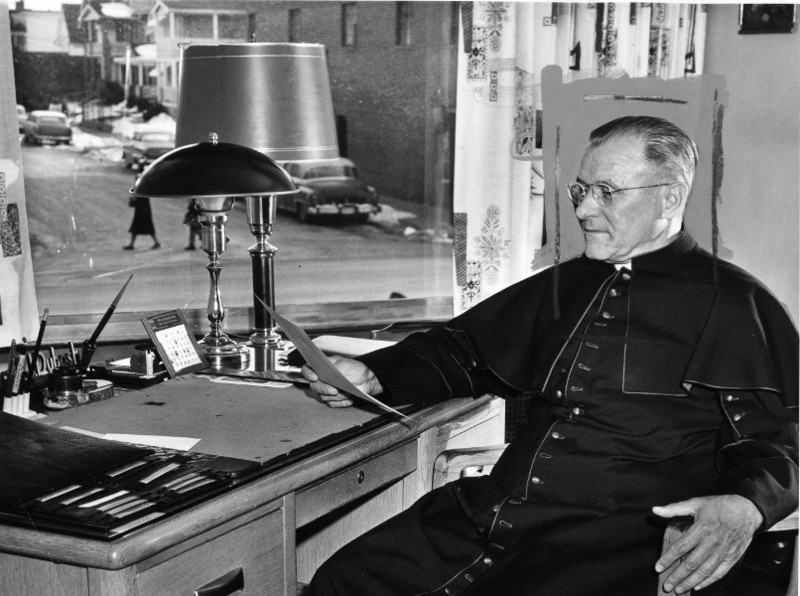
    <summary type="html"><![CDATA[<p><strong><em>Monsignor Francis J. Dubosh did not suffer a fool gladly.  When he wasn't satisfied with the speed exhibited by the editor of one national Slovak newspaper in publishing articles about Slovak American patriotism during World War II, he didn't mince his words.  "Please don't muff this," he wrote the editor, "as you did with the naming of the three Liberty Ships."   </em></strong></p><img src="https://clevelandhistorical.org/files/fullsize/096e5d11e275ec99ed900caf6ebce980.jpg" alt="Overseeing Birdtown" /><br/><p>World War II was a challenging time for many of America's Eastern European ethnic communities whose homelands were allied during the war with Hitler's Nazi Germany.  Because of the close ties which many in these ethnic communities maintained with family and friends in the old homelands, their civic organizations often engaged in concerted action to demonstrate to the United States government that, despite overseas ties, their members were still loyal and patriotic Americans.  One of America's foremost leaders during World War II who led such a concerted organizational effort for the national Slovak-American community was Monsignor Francis J. Dubosh, long-time pastor of Saints Cyril and Methodius Catholic Church in Lakewood, Ohio and the son of Slovak immigrants.</p><p>Francis J. Dubosh was born in the Tremont neighborhood of Cleveland on September 27, 1890.  He was a graduate of St. Ignatius high school, Loyola College (now John Carroll University), and St. Mary's Seminary.  In 1916, he was ordained as a Cleveland diocesan priest, and two decades later, in 1935, he was appointed a domestic prelate with the title of Monsignor.  During the years leading up to World War II, Monsignor Dubosh was engaged in an active and fruitful career as pastor at Saints Cyril and Methodius.  In addition to his cleric duties there, however, Dubosh, became an activist in a number of Slovak civic and religious organizations, and in the years leading up to World War II he attained leadership positions in several of these organizations, including the First Catholic Slovak Union, which had been founded in Cleveland in 1890, and the Slovak Catholic Federation, founded in Wilkes-Barre, Pennsylvania in 1911.  </p><p>In 1943, as America entered into its second year of World War II, Monsignor Dubosh was elected President of the Slovak League of America, one of the most important Slovak national civic organizations.  The Slovak League-- founded in Cleveland in 1907,  had been instrumental in forging the Cleveland Agreement of 1915 and the Pittsburgh Agreement of 1918, which led to the creation of Czechoslovakia in 1918.  As the new president of the Slovak League, Monsignor Dubosh traveled around the country during World War II promoting Slovak patriotism in America, but at the same time lobbying for an independent democratic Slovak state in post-war Europe.   </p><p>Through Monsignor Dubosh's organizational efforts as President of the Slovak League, tens of millions of dollars were raised in war bonds purchases by Slovak-Americans.  The "Slovak Record," a national newspaper published by the League, was strategically circulated to targeted government officials, creating a compelling record of the many acts of sacrifice and patriotism both at home and in the military overseas that Slovak-Americans performed during the war.  And, although Slovakia did not emerge from World War II as an independent democratic state as he had worked and prayed for,  his speeches, trips, and correspondence as president of the Slovak League of America during the war kept the vision alive.  </p><p>After World War II ended and his tenure as President of the Slovak League came to an end,  Monsignor Dubosh continued to give public speeches--some of them controversial, all of them passionate, and campaign for an independent democratic Slovak state in Europe.  His vision finally materialized on January 1, 1993 when the Slovak Republic was created--an event that took place two and one-half decades after Monsignor Dubosh's death in Cleveland on Christmas day 1967.</p><p><em><strong><a href="https://clevelandhistorical.org/items/show/583">For more (including 11 images) view the original article</a></strong></em></p>]]></summary>
    <published>2013-02-13T00:24:22+00:00</published>
    <updated>2026-04-17T19:17:39+00:00</updated>
    <link rel="alternate" type="text/html" href="https://clevelandhistorical.org/items/show/583"/>
    <id>https://clevelandhistorical.org/items/show/583</id>
    <author>
      <name>Jim Dubelko</name>
    </author>
  </entry>
  <entry>
    <title type="html"><![CDATA[Lustron Homes: &quot;A New Idea of Home&quot;]]></title>
    <summary type="html"><![CDATA[<img src="https://clevelandhistorical.org/files/fullsize/14b67d6be67b9eaf22d8e3b100b77bd0.jpg" alt="Detail from Lustron Advertisement" /><br/><p>The home at 1022 Keystone in Cleveland Heights is a rather modest dwelling, with little now to distinguish it from its neighbors. But underneath the siding and some other modern improvements is a Lustron home, one of about 3,000 prefabricated enameled-steel houses that were built nationwide between 1948 and 1950. The remaining homes are generally cherished by their owners, and many consider it an honor to be part of the exclusive club of Lustron homeowners. </p><p>Any discussion of early postwar suburban housing is likely to turn quickly to the Levitt brothers, whose development company built tens of thousands of modest homes with near assembly-line precision. Less known but similarly important was the Lustron Corporation. A division of Chicago Vitreous Enamel Corporation, Lustron formed following World War II to provide relatively cheap, efficient, and, most important, quickly constructed housing to returning veterans, many of whom had promptly married the sweethearts they'd left behind and started families. The housing industry had been at a virtual standstill during the war, and now, in addition to a growing need for housing, the country found itself with an excess of steel when war production ceased. With Reconstruction Finance Corporation backing, the Lustron Corporation (the name derived from 'luster on steel') was created to solve both those problems.  </p><p>There were four different models, all quite modest in size (713 to 1209 sq. ft. depending on the model chosen). In the more deluxe models, a specially developed radiant heating system was available with warm air flowing across the ceiling panels which then radiated heat into the room. All models came with an option to purchase a built-in combination Dish Washer - Clothes Washer produced by the Thor Corporation exclusively for Lustron homes (although these proved to be unreliable with need for frequent repairs). </p><p>Production problems and a scandal related to the government loans that had helped finance the company brought the Lustron company to bankruptcy by 1950, just two years after the first houses were built.  Approximately 2,000 Lustron homes remain in 36 states, with a user-supported website to register and track the remaining houses. The remaining homes harken to a time when thousands of Americans looked to the suburbs as the embodiment of the American dream.</p><p><em><strong><a href="https://clevelandhistorical.org/items/show/481">For more (including 10 images) view the original article</a></strong></em></p>]]></summary>
    <published>2012-05-28T12:58:29+00:00</published>
    <updated>2026-04-17T19:17:39+00:00</updated>
    <link rel="alternate" type="text/html" href="https://clevelandhistorical.org/items/show/481"/>
    <id>https://clevelandhistorical.org/items/show/481</id>
    <author>
      <name>Lissa Waite</name>
    </author>
  </entry>
  <entry>
    <title type="html"><![CDATA[Crile Military Hospital]]></title>
    <summary type="html"><![CDATA[<img src="https://clevelandhistorical.org/files/fullsize/59e2642baef37f1c85baa9032fa4d731.jpg" alt="Entertaining the Troops, 1944" /><br/><p>Rustling trees, wildlife, ponds, fountains, and students hustling between their cars and classrooms. The first impressions of Cuyahoga Community College's Western Campus would, most likely, not include hints of its significant military history. Yet, wounded soldiers, German prisoners of war, and an entire military "city" were once the occupants inhabiting the property at 11000 Pleasant Valley Road in Parma. The site's rich history began when Crile General Hospital was dedicated on Easter Sunday 1944.</p><p>Built as a "temporary" facility, Crile grew to be more than a hospital. Its barracks-type structures were in almost continuous use for thirty years and served a variety of purposes. The Crile complex provided medical care to veterans of two wars, held 250 German POWs during World War II, and housed a Nike anti-aircraft missile base during the Cold War. It became home to Tri-C's Western Campus in 1966. </p><p>Crile General Hospital was built by the U.S. Army and named in honor of George Washington Crile (1864-1943), an internationally renowned surgeon and founder of the Cleveland Clinic. Crile served in both the Spanish American War and World War I and was a pioneer in military medicine, leading research and treatment of shock, blood transfusion, and blood banking. </p><p>Crile General Hospital actually received its first patient weeks before the official opening. In early March 1944, Richard Currier, a severely wounded POW, arrived as the lone patient in a facility with nearly 2,000 beds, 7 miles of corridors, and a staff of 1,000. Other patients arrived a few weeks later. In December 1944 the first detachment of German POWs arrived from Camp Perry, Ohio and remained until the end of 1945. Repatriated to Germany at the end of the war, many returned to the United States and subsequently became citizens. </p><p>After the end of World War II, Crile General Hospital became Crile Veterans Hospital in June 1946. Crile General Hospital had treated and healed over 15,000 patients by this time. The capacity of Crile was reduced to 1,000 beds, but was reorganized for clinical study and teaching. Physical therapy, occupational therapy, and corrective therapy were additional aspects of the Veterans Hospital's program. </p><p>The Crile Hospital in Parma closed in 1964, relocating to a new facility in University Circle (now the Louis Stokes VA Medical Center). In the fall of 1966, however, life returned to its empty ward and hallways as Cuyahoga Community College's newly created Western Campus enrolled 3,000 students. In 1975, the barracks were torn down and a new campus rose on the site of the old hospital to meet the community's expanding educational needs. </p><p>The site's military legacy has not been forgotten, however. Dedicated to preserving Cuyahoga Community College Western Campus's rich history, the Crile Archives, housed at the Tri-C Western Campus, is home to artifacts, documents, photographs, and books chronicling combat medicine and veterans' experiences from World War I to the present.</p><p><em><strong><a href="https://clevelandhistorical.org/items/show/316">For more (including 10 images) view the original article</a></strong></em></p>]]></summary>
    <published>2011-08-05T09:17:56+00:00</published>
    <updated>2026-04-17T19:17:38+00:00</updated>
    <link rel="alternate" type="text/html" href="https://clevelandhistorical.org/items/show/316"/>
    <id>https://clevelandhistorical.org/items/show/316</id>
    <author>
      <name>Jennifer Pflaum</name>
    </author>
  </entry>
  <entry>
    <title type="html"><![CDATA[Akron Airdock]]></title>
    <summary type="html"><![CDATA[<img src="https://clevelandhistorical.org/files/fullsize/12084ea72fde7cb58277160e420a3718.jpg" alt="Akron Airdock at Night" /><br/><p>When was the last time you saw a blimp in the sky? For those who live in Akron, a blimp sighting is as predictable as seeing the sun rise in the east. It has been that way since the construction of the Akron Airdock in 1929. Designed by the Wilbur Watson Engineering Co. of Cleveland and built by the Goodyear Zeppelin Corporation for the construction and housing of lighter-than-air ships (as blimps are sometimes called), the Airdock was once the world's largest structure without interior supports.</p><p>The Airdock is gigantic. Stretching 1,175 feet in length and 325 feet in width, the structure covers 364,000 square feet of ground. That means that almost seven football fields can fit inside it. The outer skin of the structure has been described as "half a silkworm's cocoon, cut in half the long way." The top of this "cocoon" reaches 211 feet high. Each end of the Airdock has a pair of huge doors that weigh 609-tons apiece. Each door rests on forty wheels and railroad tracks that allow them to open and close. The Airdock cost $2.2 million to build. </p><p>The first two dirigibles launched from the Airdock were the <em>Akron</em> (ARS-4) in 1931 and its sister the <em>Macon</em> (ARS-5) in 1934. Goodyear built these for use by the Navy, but the two airships had short lives. The <em>Akron</em> fell from the sky on April 4, 1933, in a violent electrical storm off the coast of New Jersey, killing 73 passengers. The <em>Macon</em> also crashed in 1935, ending up in the Pacific Ocean.</p><p>The blimps Goodyear produced at the Airdock were mainly intended for military use. The development of passenger blimps, once thought to be a viable form of transportation, was abandoned when it became clear that planes were the future of commercial air transport. Military blimps continued to be developed in Akron, however, serving as both reconnaissance planes and as experimental "flying aircraft carriers" that launched smaller airships. The last blimp built in the Airdock was the Navy's ZPG-3W, completed in 1960. </p><p>After 1960, the Airdock served for a time as the location of Goodyear's photographic division. It has also held rallies for the United Way and Presidential Candidate Bill Clinton, the latter drawing a crowd of 30,000 to the Airdock in 1992. Goodyear sold their Aerospace plant and the Airdock to the Loral Corporation in 1987, who ended up selling the property to Lockheed Martin in 1996. Lockheed Martin owns the Airdock today and conducts well-concealed aircraft research inside the building. </p><p>Goodyear still maintains a blimp hangar, home to one of the famous Goodyear blimps seen at sporting events, at Wingfoot Lake in nearby Suffield. Wingfoot Lake was the original site of Goodyear's Aeronautics Department. In 1917, the company began building blimps and training military pilots at the site. Shortly thereafter, the Navy took over the facility and operated it as the United States Airship Training Station from 1917 until 1921. Goodyear moved its aeronautics program to the Airdock in 1929 and, after using the Wingfoot Lake site for a variety of purposes, sold most of the land to the State of Ohio in 2009 to create Wingfoot Lake State Park.</p><p><em><strong><a href="https://clevelandhistorical.org/items/show/281">For more (including 9 images) view the original article</a></strong></em></p>]]></summary>
    <published>2011-07-22T17:43:34+00:00</published>
    <updated>2026-04-17T19:17:38+00:00</updated>
    <link rel="alternate" type="text/html" href="https://clevelandhistorical.org/items/show/281"/>
    <id>https://clevelandhistorical.org/items/show/281</id>
    <author>
      <name>George Wetzel</name>
    </author>
  </entry>
  <entry>
    <title type="html"><![CDATA[Jack &amp; Heintz Co.]]></title>
    <summary type="html"><![CDATA[<img src="https://clevelandhistorical.org/files/fullsize/jahco-billjackgivesturkeydec24-42low_89c851fbd8.jpg" alt="Christmas Turkeys, 1942" /><br/><p>Bill Jack and Ralph Heintz formed Jack & Heintz in 1940 in Palo Alto, California. They soon moved their company to the Cleveland area, building a small plant at 17600 Broadway Avenue in Maple Heights.  The company made airplane parts, and it soon received a military contract to produce airplane starters. After their initial work orders were fulfilled on time and at a lower cost than other contractors, Jack and Heintz soon received more military contracts, including a significant one for the production of autopilot devices. </p><p>By 1944, Jack and Heintz employed over 8700 workers (including several thousand women) at their expanded Maple Heights location and several other new plants around the area.  This number is staggering when one considers that at its inception in 1940 the company only employed about 50 people. </p><p>While its name may have been Jack & Heintz, it was Bill Jack who became the charismatic public face of the company.  Before founding Jack & Heintz , Jack had been a  machinist, then became a leader in the machinist's union, and eventually opened his own plant, making him a wealthy man.  </p><p>Jack believed that a company should take good care of its employees -- or "associates," as he preferred to call them. Everyone -- even Jack himself -- was called by their first name, and the titles "sir" and "mister" were strictly forbidden. More significantly, workers at JAH-CO (as the company was popularly known) received free health care, paid sick leave, free meals, access to a sauna and massages, frequent cash bonuses, and two weeks of paid vacation at no-cost company resorts.  Smoking on the job was permitted, as was the hanging up of pin-up girls. Workers even received complimentary donuts, coffee (in a personal mug embossed with their name!), and vitamins. The company had a music collection totaling nearly 5000 records, which it played from during working hours.  In return, associates agreed to work 12-hour shifts, 7 days a week with only one day off a month. Despite these long hours, worker morale was high and absenteeism remained well below the national average. In terms of the speed and efficiency at which the company fulfilled its military contracts, the working conditions at the plant were deemed to be wildly successful. Eventually, the company's unique treatment of its employees received national publicity, and Jack savored the spotlight. Workers seemed to support Jack, as well -- literally singing his praises in the "JAH-CO Victory Song" </p><p>JAH-CO -- On to VIC-TO-RY!</p><p>Working ev'ry hour for our LI-BER-TY!</p><p>JAH-CO -- That means you and me!</p><p>Ev'ry one must fight for VIC-TO-RY!</p><p>"Bill" and "Ralph," You've stood by us,</p><p>We're all in back of YOU</p><p>Anything you care to ask,</p><p>We're waiting here to do.</p><p>When the war ended, however, the lucrative military contracts that allowed JAH-CO to take such good care of its workers came to an end as well. In 1946, the company merged with Precision Products. Both Jack and Heintz sold all their stock after the acquisition, making millions but giving up their voting control in the new company. While Precision Products vowed to make no changes to JAH-CO's unique personnel practices, little by little the new owners of Jack & Heintz scaled back Jack's way of doing things. </p><p><em><strong><a href="https://clevelandhistorical.org/items/show/153">For more (including 8 images&#32;&amp;&#32;1 video) view the original article</a></strong></em></p>]]></summary>
    <published>2011-03-03T12:18:25+00:00</published>
    <updated>2026-04-17T19:17:37+00:00</updated>
    <link rel="alternate" type="text/html" href="https://clevelandhistorical.org/items/show/153"/>
    <id>https://clevelandhistorical.org/items/show/153</id>
    <author>
      <name>Michael Rotman</name>
    </author>
  </entry>
</feed>