<?xml version="1.0" encoding="UTF-8"?>
<feed xmlns="http://www.w3.org/2005/Atom">
  <title type="text">Cleveland Historical</title>
  <updated>2026-05-10T00:16:49+00:00</updated>
  <generator uri="http://framework.zend.com" version="1.12.20">Zend_Feed_Writer</generator>
  <link rel="alternate" type="text/html" href="https://clevelandhistorical.org/"/>
  <link rel="self" type="application/atom+xml" href="https://clevelandhistorical.org/items/browse?output=rss2"/>
  <id>https://clevelandhistorical.org/</id>
  <author>
    <name>Cleveland Historical</name>
    <uri>https://clevelandhistorical.org</uri>
  </author>
  <link rel="hub" href="http://pubsubhubbub.appspot.com/"/>
  <entry>
    <title type="html"><![CDATA[Saint Josaphat of Parma: From Mission to Parish to Cathedral]]></title>
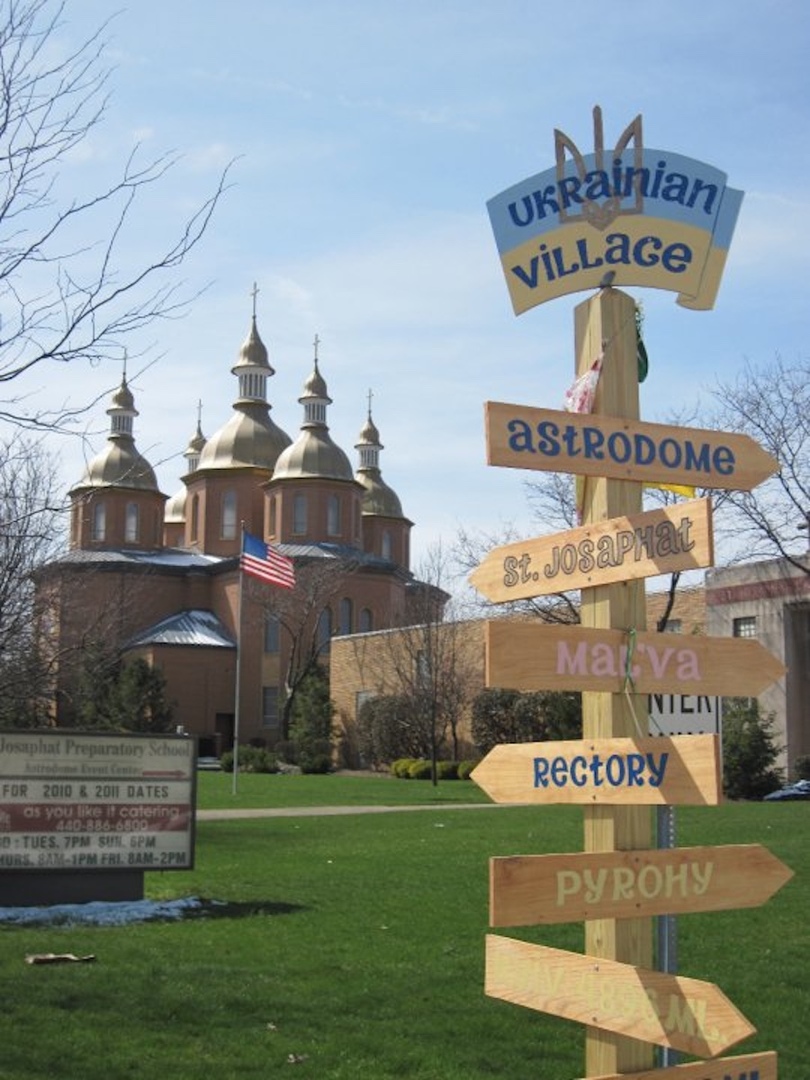
    <summary type="html"><![CDATA[<p><strong><em>Like the Ukrainian population itself in Parma, Saint Josaphat Ukrainian Catholic Church had an inauspicious start—a simple brick and stone schoolhouse built in 1949 on ten acres of land on State Road.  However, less than forty years later, as the Ukrainian population in Parma was growing into the largest in the State of Ohio, Saint Josaphat became a Cathedral church and  the seat of  a new Ukrainian Catholic eparchy whose territory includes Ohio, part of Pennsylvania and most of the South.</em></strong></p><img src="https://clevelandhistorical.org/files/fullsize/dd208222bed267ab663c6c38be39d65e.jpg" alt="Saint Josaphat Cathedral in the Shadow of Parma Ukrainian Village Signage" /><br/><p>The first generation of Catholic Ukrainians to come to Cleveland in the late nineteenth and early twentieth centuries were Ruthenians, who had immigrated from a mountainous area within Galicia known as Ruthenia. Their lands were then located within the Austro-Hungarian Empire. Today, they are part of Ukraine and Poland. Religiously, these Ruthenians were Byzantine or Greek Catholics, or sometimes called Uniates. They were spiritual descendants of Eastern Orthodox Ruthenians and other Eastern European groups who, through the Union of Brest in 1596, had sworn allegiance to the Roman Catholic pope, while retaining a right to practice most of their historic Eastern Orthodox customs, rituals, and liturgy.</p><p>Settling in the Tremont neighborhood, the immigrant Ruthenians, in 1910, built a church of their own that still stands today on West 7th Street, near College Avenue. It was first called Saints Peter and Paul Ruthenian Catholic Church, but was renamed <a href="https://clevelandhistorical.org/items/show/738">Saints Peter and Paul Ukrainian Catholic Church</a> at the conclusion of World War I when the first modern Ukrainian state was established.</p><p>For most of the first half of the twentieth century, the children of the parishioners at Saints Peter and Paul Church attended school either in the basement of their church in Tremont or at other places in Cleveland. In 1947, Pastor Dmytro Gresko and his parishioners decided that they would build an elementary school for the parish children on land located in the suburb of Parma. Their decision was likely influenced by the number of parishioners who, since the end of World War II, had been moving out of Tremont and into that fast growing suburb.</p><p>The land selected for the new elementary school was a 10-acre parcel that lay on the west side of State Road between Kenmore Avenue and Liggett Drive. It was located just two blocks north of Saint Francis de Sales Catholic Church, and almost directly across the street from the Saint Stanislaus Novitiate, later renamed the Jesuit Retreat House. In the 1920s, the Order of the Polish Sisters of Saint Joseph had planned to construct a convent and school on this land. However, the Sisters later decided to instead construct those buildings—the latter of which was later known for many years as Marymount High School—on Granger Road in Garfield Heights. The Sisters then sold the land in Parma in 1929. </p><p>The land's new owners agreed, in October 1947, to sell it to Saints Peter and Paul Ukrainian Catholic Church for $17,500. In April 1949, construction began on the new two-story, brick and stone Saints Peter and Paul school building. Completed that fall, it had eight classrooms for students on its north end and a large assembly hall on its south end that could hold 500 persons and also serve as a chapel. On November 6, 1949, a dedication ceremony was held at the new school, led by Ukrainian Catholic Archbishop Constantine Bohachevsky of the Philadelphia Archeparchy, with assistance from Cleveland Bishop Edward F. Hoban and other Catholic church officials. At the ceremony, it was noted that this was the first Ukrainian Catholic grade school built in the Cleveland area. </p><p>Two years after dedicating the new school, Archbishop Bohachevsky returned to Parma on May 12, 1951 to bless the chapel in the school building which was named Saint Josaphat Chapel, after Josaphat Kuntsavych, a Ukrainian priest who had been murdered in 1623 because of his efforts, consistent with the tenets of the Union of Brest, to bring together Eastern Orthodox Christians and Roman Catholics living in Galicia, which in that period was part of the Polish-Lithuanian Commonwealth. </p><p>Classes began at Saints Peter and Paul grade school on November 15, 1949, with a total of 135 students attending only grades one through three in that first year. Because many of those students still lived in Tremont, the parish also purchased a bus to transport children to and from the school in Parma. One of those bus drivers was Father Myroslav Lubachivsky, then an assistant pastor at Saints Peter and Paul. Some thirty-five years later, in 1985, he would be appointed a Cardinal of the Ukrainian Catholic Church by Pope John Paul II. </p><p>During the period 1950-1960, the number of people of Ukrainian, and other Eastern and South European ethnicities, moving into Parma more than tripled, as that city became one of the fastest growing suburbs in America. In order to address the increases in the Ukrainian Catholic population, Saints Peter and Paul added several new buildings to the Parma campus, including another classroom building, a rectory and a convent, and expanded the grades taught at the school to include from kindergarten to eighth grade. </p><p>In August 1959, recognizing the significant increase in the Ukrainian Catholics living in Parma, Archbishop Bohachevsky announced the creation of a new Ukrainian Catholic parish in Parma, to be sited on the grounds of Saints Peter and Paul grade school. The new parish was named—and the grade school renamed—like the chapel, Saint Josaphat. Father Andrew Ulicky, an assistant pastor at Saints Peter and Paul, was appointed the first pastor of this new Ukrainian Catholic parish. </p><p>Shortly after his appointment as pastor, Father Ulicky initiated plans to build a high school on the State Road campus. Construction of the building began in 1961, largely funded through the efforts of parishioners who not only gave money to the project, but also volunteered to do much of the skilled construction work. The new circular-shaped high school building was designed by architect and engineer Michael Stefanyk, who volunteered his services to the parish. </p><p>The building featured a wooden domed roof with a 141-foot diameter. However, because of mounting costs and limitations on the amount of time that could be spent on construction by parish volunteers, construction of the building lagged for years, taking many more years to complete than the two years initially anticipated. In the interim, while it sat unfinished, the building became a favorite haunt of Parma teenagers, who visited it often at night, conducting what might be called an early form of urban (or suburban) exploration. </p><p>The proposed high school building was finally completed in 1969 and blessed by Metropolitan Archbishop Ambrose Senshyn on April 20 of that year. By that time, however, the plan to use the building as a high school had been abandoned, largely due to the establishment of Saint Andrew Ukrainian Catholic parish on the south end of Parma in 1965. The creation of the new parish prompted the departure of about 500 families from Saint Josaphat. </p><p>When the circular, domed building was blessed, it was given the name Saint Josaphat Astrodome Hall—commonly known as the "Astrodome" in reference to Houston's recently completed domed stadium. Rather than serving students as their new high school, the building was repurposed as an assembly hall for the use of the Saint Josaphat parish. Since its completion, it has been the venue for many parish events, as well as serving as a venue for the events of other organizations, such as ethnic festivals, and for individual events, including weddings. </p><p>After the completion of the Astrodome, Father Ulicky and the parish's second pastor, Father Yaroslav Sirko, who succeeded Father Ulicky in 1971, turned their attention to building a church on the State Road campus. The need to do so became pressing when, on April 11, 1973, a horrific fire at Saint Josaphat grade school destroyed the chapel within the school building. As a temporary measure, masses were thereafter held in the Astrodome. Father Sirko, who was the pastor at the time of the 1973 fire, wanted to immediately construct a new church, but was unable to do so due to the state of parish finances at the time. </p><p>As a result, the challenge to build the new church fell to the parish's third pastor, Father Michael Fedorowich, who came to Saint Josaphat in 1979. By 1981, the parish finances had sufficiently improved to enable Father Fedorowich to begin construction. By the summer of 1983, when construction was almost completed, word was received by the parish that the new Saint Josaphat church was to become a Ukrainian Catholic cathedral and seat of a new eparchy—the equivalent of a Roman Catholic diocese—for the Ukrainian Catholic Church in the United States. As a result of this development, additional construction was required in order to render the building's interior suitable as a cathedral. The following year, Father Robert Moskal was appointed the first bishop of the new Ukrainian Catholic Eparchy of Parma, Ohio.</p><p>When the 1990 federal census was taken—the first one following the completion of Saint Josaphat Cathedral and creation of the new Parma Ukrainian Catholic Eparchy, the results of the community questionnaires for Parma showed that the city's Ukrainian population, which in 1950, had been one of the smallest for residents of East European ancestry, had now become one of the largest, behind only the Polish and Slovak populations. In subsequent years, the Parma Ukrainian community continued to grow until it became, according to an article appearing in the Cleveland Plain Dealer on March 24, 2022, the largest in the State of Ohio. </p><p>Along the way of their journey as one of the most important Ukrainian institutions in Parma, Saint Josaphat and its parishioners have experienced their share of joys and sorrows at their now historic State Road campus. In 2008, Saint Josaphat Ukrainian Catholic grade school,which had served children of the parish for nearly 60 years, closed its doors for good. However, in what must have been somewhat consoling to the parish, several years later the school building became home to a new K-8 public community school called the Global Village Academy, which offers language and cultural programs to students in every grade. </p><p>On an even more positive note, in 2008 the Parma City Council passed a resolution recognizing the many contributions that Ukrainians at Saint Josaphat and other institutions in the City had made, and honoring the Ukrainian community with the establishment of <a href="https://clevelandhistorical.org/items/show/863">Ukrainian Village</a>, a section of State Road beginning at Tuxedo Avenue on its north end and extending south all the way to Grantwood Drive, with signs alerting drivers of the existence of the Village. </p><p>Today, visitors to Parma, who drive to the suburb on State Road will, as they cross Brookpark Road, immediately take notice of the colorful signage which announces that they are entering Ukrainian Village. Within moments thereafter, they will see the five majestic onion domes of the beautiful Saint Josaphat Cathedral. The signs and the domes inform visitors not only of the historical importance of Saint Josaphat to Parma's Ukrainian community, but also of its importance to the City of Parma itself.</p><p><em><strong><a href="https://clevelandhistorical.org/items/show/1078">For more (including 16 images) view the original article</a></strong></em></p>]]></summary>
    <published>2026-01-08T16:48:20+00:00</published>
    <updated>2026-04-17T19:17:43+00:00</updated>
    <link rel="alternate" type="text/html" href="https://clevelandhistorical.org/items/show/1078"/>
    <id>https://clevelandhistorical.org/items/show/1078</id>
    <author>
      <name>Jim Dubelko</name>
    </author>
  </entry>
  <entry>
    <title type="html"><![CDATA[Saint Sava Serbian Orthodox Cathedral: A Community and a Church Divided and Reunited]]></title>
    <summary type="html"><![CDATA[<img src="https://clevelandhistorical.org/files/fullsize/2c884eed1f3e9cd2dff0cf3e3d929ae2.jpg" alt="Mosaic of St. Sava" /><br/><p>The newly constructed St. Sava Cathedral was the centerpiece of the Serbian and Eastern Orthodox community. It boasted a spacious area for worship, welcoming crowds on Sundays and festive holidays, and featured a large hall for gatherings like weddings, festivals, and communal dinners. Its establishment filled a void that the Serbian community felt with their previous church on East 36th Street. Yet, the political upheavals in Yugoslavia soon impacted this harmonious community, leading to the existence of two identically named churches in close proximity. How did this happen? Read on.</p><p>Cleveland’s Serbian history traces back to 1893 when Lazar Krivokapic, the first Serb-Montenegrin, arrived. Unlike many other early Serbian immigrants who worked in low-wage, industrial jobs, Krivokapic was a highly educated diplomat stationed in Constantinople, then part of the Ottoman Empire. The Serbian population in Cleveland steadily increased, reaching over 1,000 by 1914. Most of these immigrants lived in extended family units called <em>Zadruge</em>, housing up to sixty members each. The transition to American family structures was often jarring, especially for those from rural Serbia who had little exposure to industrial work environments. Their residential choices were influenced by work, leading to settlements in areas close to their workplaces.</p><p>World War I brought devastation to Serbia, claiming approximately 3.1 million lives. Answering the call to defend their homeland, between 400 and 500 Cleveland-based Serbs joined the war effort. The local paper, <em>The Plain Dealer</em>, highlighted the potential for an exodus that could disrupt the city’s industrial and commercial activities. It was important to ensure that southern Slavs, who primarily worked in the industrial sector, were not coerced into striking during the war. Today, the St. Sava Cathedral in Parma displays a plaque honoring those who fought and died in World War I.</p><p>As Eastern Orthodox Christians, Serbians’ lives are intertwined with the Church calendar. The absence of a designated church building until 1919, however, left early Serbian settlers without a spiritual home. Instead, they held worship services and celebrations in rental halls and cultural societies. The community eventually purchased a German Lutheran church on East 36th Street in 1919, which became the first St. Sava in Cleveland.</p><p>After World War II, another wave of immigration from Yugoslavia to Cleveland ensued. New immigrants, largely comprised of war prisoners, Chetniks loyal to the Serbian monarchy and Church, and those seeking economic opportunities, settled south in Parma and Seven Hills. They chose not to return to Yugoslavia, which had transformed into a communist state. However, the increased influx of new Serbian immigrants strained the resources of the small church on East 36th Street, leading to the purchase of land for a new church in Parma.</p><p>In 1963, amid financial problems, disputes arose within the church community. A division was formed when the Holy Synod of Belgrade, under Patriarch German’s leadership, removed Bishop Dionisije as the sole leader of the American-Canadian diocese and created three new dioceses. Some parishioners believed this move indicated communist infiltration of the Serbian Orthodox Church. Two factions emerged, one siding with Father Branko Skaljac and Belgrade, and the other with Bishop Dionisije and Father Branko Kusonjic. Both factions laid claim to the newly constructed St. Sava and its properties.</p><p>After twelve years of protracted legal battles, the pro-Belgrade faction was granted St. Sava and half the lot in 1975, while the faction loyal to Bishop Dionisije received the other half and the picnic grounds in Broadview Heights. In 1980, the Bishop Dionisije faction, now recognized as the Free Serbian Orthodox Church, completed another St. Sava in Broadview Heights. It was not until Patriarch Pavle’s intervention in 1992 that the dispute was finally resolved. Today, members from both churches interact during events, religious services, picnics, and soccer tournaments, reflecting a harmony long awaited.</p><p><em><strong><a href="https://clevelandhistorical.org/items/show/921">For more (including 9 images) view the original article</a></strong></em></p>]]></summary>
    <published>2020-12-12T19:56:33+00:00</published>
    <updated>2026-04-17T19:17:42+00:00</updated>
    <link rel="alternate" type="text/html" href="https://clevelandhistorical.org/items/show/921"/>
    <id>https://clevelandhistorical.org/items/show/921</id>
    <author>
      <name>Stefan Nikolic</name>
    </author>
  </entry>
  <entry>
    <title type="html"><![CDATA[Nike Site CL-59: One of Eight Cold War–Era Missile Bases in the Cleveland Area]]></title>
    <summary type="html"><![CDATA[<img src="https://clevelandhistorical.org/files/fullsize/c8baac09f73f03ff1eec12597183bdff.jpg" alt="Nike Missiles Prepped for Transport" /><br/><p>By the year 1956, the United States and the Soviet Union had been engaged with one another in the Cold War for almost a decade. Although there was no direct confrontation between the two world superpowers, the development of weapons and defense systems was heating up heading into the 1950s. Cleveland and its surrounding suburbs played a part in the Cold War narrative due to the fact that eight Nike missile installations were active in and around the city itself during the late 1950s and early 1960s. Among these installations was one in the West Side suburb of Parma Heights. Designated as Nike Site CL-59 by the U.S. Army, it was tasked with protecting that particular part of Northeast Ohio from the perceived Soviet threat. </p><p>The Army officially activated Nike Site CL-59 in 1956, and by July of that year, the base was capable of launching the cutting-edge Nike Ajax missile at incoming Soviet bombers. However, as technology advanced during the Cold War, soon there was a bigger and deadlier weapon which would replace the Nike Ajax missile. This new missile was named the Nike Hercules and was considered more capable of taking out a greater number of Soviet aircraft and could also be equipped with a nuclear warhead. Nike Site CL-59 was retrofitted to accept this new technology following its tenure being armed with the Nike Ajax missile.</p><p>As far as the base itself, the installation could be split into two major sections. One section was referred to as the ‘Control Area’ while the other was the ‘Launch Area.’ The control area was primarily where military personnel worked and spent much of their time and included amenities such as a mess hall and a barracks where soldiers lived. The other portion, referred to as the launch area, has a fairly self-explanatory purpose. The missiles themselves were located here, as well as an underground storage apparatus for them and their launchers which actually propelled the missiles skyward. The storage of fuel and waste products was also located in this section in the form of underground tanks.</p><p>Nike Site CL-59 occupied 187.2 acres in an area located near primarily residential-zoned property as well as <a href="https://clevelandhistorical.org/items/show/316">Crile Hospital</a> to the east. During the base’s heyday, an interesting intersection of military and civilian life occurred there in the form of dances and even beauty pageants which were held in or in close proximity to the base itself and involved servicemembers stationed there. Additionally, there was even an organized basketball team made up of some servicemembers from the ‘B Battery’ section of the base who played other local teams.</p><p>Nike Site CL-59’s tenure in the Parma – Parma Heights area was fairly short, though, due to the fact that it was only formally active from 1956-1961. The years following CL-59’s deactivation were filled with discussion and debate as far as what the land should become when the military was finished with it. Most bases in the Cleveland area were re-designated into areas having to do with education or recreation, and as fate would have it, land occupied and in close proximity to CL-59 became both of these things.</p><p>Following the base’s peak, the area the site once stood on was divvied up amongst various local entities, and the creation of recreational areas such as public parks occurred. Nike Park, located on Pleasant Valley Road, as well as Nathan Hale Park were two such locations born out of what used to be a military base which at one point had the potential to launch nuclear missiles. Another notable structure located in close proximity to Nike Site CL-59 is Cuyahoga Community College’s Western Campus. The institution, which was first completed in 1965, is actually on land which was primarily Crile Hospital. However, the fact that Tri-C West is the closest modern structure to what used to be the base’s launch area is most certainly a fact most students studying there are not aware of and makes for an interesting bit of area trivia.</p><p>Another aspect of the former location of Site CL-59 involves the removal of two underground storage tanks which at one point housed potentially dangerous fluids such as fuel and acid. This action occurred in the year 2000, a full thirty-nine years after the base was formally deactivated in 1961. It is important to note that at this point, all of the recreational and educational facilities which were planned for the former missile site’s location had been present for a number of years themselves. The U.S. Army Corps of Engineers was involved in the removal of the tanks, and the local citizenry was also made to be a part of the entire event, with public forums and the like being held.</p><p>All in all, although Nike Site CL-59 itself can most certainly be considered a relic of the Cold War, what became of the area is something quite different than what the land was originally meant for. Although the base itself disappeared decades ago, the strategic defense it once provided for part of the local area has not been forgotten by those who consider themselves Cold War historians. Also, it is worth pointing out the juxtaposition between the area when it was occupied by tools of warfare versus what it consists of now. Today, what used to be CL-59 is made up of facilities which are used to educate students and serve as recreational areas for local citizens, a far cry from the destructive objects which once occupied the land.</p><p><em><strong><a href="https://clevelandhistorical.org/items/show/896">For more (including 8 images) view the original article</a></strong></em></p>]]></summary>
    <published>2019-12-05T21:40:38+00:00</published>
    <updated>2026-04-17T19:17:42+00:00</updated>
    <link rel="alternate" type="text/html" href="https://clevelandhistorical.org/items/show/896"/>
    <id>https://clevelandhistorical.org/items/show/896</id>
    <author>
      <name>Andrew Shaniuk</name>
    </author>
  </entry>
  <entry>
    <title type="html"><![CDATA[Ukrainian Village: Suburban Heir of a Tremont Legacy]]></title>
    <summary type="html"><![CDATA[<img src="https://clevelandhistorical.org/files/fullsize/1e3d7fa8fe82aa3e7087cadc08140c50.jpg" alt="Ukrainian Village Sign" /><br/><p>When you leave Cleveland for the suburbs, perhaps the last thing you expect to find is a slice of another country nestled along the streets. In 2009, the suburban municipality of Parma to the southwest of Cleveland officially recognized its long-standing settlement of Ukrainians, giving them a "village" of their own. Ukrainian Village, located along a two-mile stretch of State Road, had been the vision of Ukrainian Americans since the 1940s. The rise of suburbs began to push them out of their original enclave in Cleveland’s Tremont neighborhood, setting the stage for the emergence of the vibrant community that is present today.  </p><p>In the late nineteenth century, immigrants of all walks of life arrived in Cleveland because of many different factors. Ukrainians were escaping political and economic hardships by coming to the United States, looking for work in any shape they could find. Ordinarily, they took up various jobs in Cleveland’s thriving industrial plants and mills. These jobs helped them to save money to send back to their relatives in the “old country.” They ended up establishing cultural and religious centers that have changed over time yet still stand as strong symbols of Ukrainian pride.   </p><p>Ukrainian settlement in Cleveland began in Tremont. The community began to put down roots in order to keep their memories and customs from home alive. The first of these Ukrainian institutions was the Saints Peter and Paul Ukrainian Church, built in 1910 on West 7th Street. Shortly after, St. Vladimir Church was also established in Tremont. The first few years of worship took place at Craftman’s Hall on West 14th Street.  In 1933 the congregation's original church building was dedicated. It still stands on West 11th Street but it is now the Spanish Assembly of God Church. In 1967, the St. Vladimir Ukrainian Orthodox Cathedral in Parma was opened for worship. Its shift from Tremont to Parma reflected the trend of people moving to the suburbs after an influx of immigration, pushed by the Holodomor (famine) of the 1930s, German occupation of the Ukraine during World War II, and displacement under Stalinist rule in the Cold War era. </p><p>Churches like St. Vladimir’s were the anchor of the Ukrainian community. Not only did they provide a sense of community in a new and strange country, they also kept the cultural of the old country alive. One of the many new organizations was the Ridna Shkola, a school teaching heritage, language, and customs to the youth of the community. Today, classes are held at St. Josaphat Cathedral on State Road.  </p><p>Churches are not the only anchors of Ukrainian culture in the Ukrainian Village today. Many shops, such as Lviv International Foods and State Meats, offer a taste of the ethnic fare unique to many people. These places, among others, serve as the backbone of the Ukrainian community. In 2007, the board of trustees from St. Vladimir’s Church asked the city of Parma to hang decorative banners and to dub State Road Ukrainian Village. First, however, much work had to be done, including landscaping, restoring storefronts, and placing banners and murals to signify the village’s presence. The vision came to life only a year and five months after work began. Ukrainian Village was officially dedicated on September 19, 2009, and was celebrated with a festival, religious services, and a parade.  </p><p>The lasting legacy of the Ukrainian immigrants can be viewed not only through Ukrainian Village, but also in Tremont where some of the original settlements still stand. These institutions, regardless of their locations, stand for the progress of a people and the achievements they have made.  </p><p><em><strong><a href="https://clevelandhistorical.org/items/show/863">For more (including 12 images) view the original article</a></strong></em></p>]]></summary>
    <published>2019-01-23T01:06:06+00:00</published>
    <updated>2026-04-17T19:17:42+00:00</updated>
    <link rel="alternate" type="text/html" href="https://clevelandhistorical.org/items/show/863"/>
    <id>https://clevelandhistorical.org/items/show/863</id>
    <author>
      <name>Olivia Garl</name>
    </author>
  </entry>
  <entry>
    <title type="html"><![CDATA[Holodomor Ukrainian Famine Memorial]]></title>
    <summary type="html"><![CDATA[<img src="https://clevelandhistorical.org/files/fullsize/6f264539621601e8a16867494bde5ced.jpg" alt="Holodomor Monument In Parma, Ohio" /><br/><p>The word genocide conjures disturbing images of the Holocaust. Yet, another massive but often overlooked extermination of human life also occurred on the European continent. This little known genocide, orchestrated by Josef Stalin's Soviet regime, is called the Ukrainian Holodomor Famine. The name Holodomor literally translates into "death by forced starvation," and the death toll from this manmade famine was high--approximately 3,000 to 10,000 deaths, and 7 million victims. The official number however, is unknown today due to cover-ups orchestrated by the Soviet Union. The Holodomor Famine occurred between the years 1932 and 1933, and recently has been recognized as genocide by several nations including the United States, Canada and Mexico. </p><p>With the dissolution of the Soviet Union and the reemergence of Ukraine as an autonomous nation, the Ukrainian people have sought to remember the victims of this tragedy by building monuments dedicated to it all over the world. One such monument can be found in Parma, Ohio, on the grounds of a church named Saint Vladimir Ukrainian Orthodox Cathedral. Parma, Ohio may seem like an unlikely destination for a monument dedicated to those who lost their lives in the Holodomor Famine in 1932 and 1933. Yet upon further inspection, it seems to make more sense. The most important reason is tied into immigration. The City of Parma saw a large wave of Ukrainian immigrants during the years between the World Wars, and again after the collapse of the Soviet Union. Furthermore, there are a large number of Ukrainian immigrants the Parma, Ohio that might have been directly affected by the Holodomor Famine. Many knew or were related to someone who was a victim of this tragedy. The monument was created in October 1993 in order to mark the 60th anniversary of the famine.</p><p>Monuments commemorating the Holodomor Famine have popped up all over the country and the world. The most notable is in Kiev, Ukraine, but there are also monuments in Edmonton, Canada, and Washington, D.C.</p><p><em><strong><a href="https://clevelandhistorical.org/items/show/600">For more (including 4 images) view the original article</a></strong></em></p>]]></summary>
    <published>2013-03-27T03:15:07+00:00</published>
    <updated>2026-04-17T19:17:40+00:00</updated>
    <link rel="alternate" type="text/html" href="https://clevelandhistorical.org/items/show/600"/>
    <id>https://clevelandhistorical.org/items/show/600</id>
    <author>
      <name>Nicholas Anthony&amp;#32;&amp;amp;&amp;#32;John Horan</name>
    </author>
  </entry>
  <entry>
    <title type="html"><![CDATA[Parmadale: An Experimental Suburban Community for Orphaned Children]]></title>
    <summary type="html"><![CDATA[<img src="https://clevelandhistorical.org/files/fullsize/286995bb62e61b03711f169e5cdad4b7.jpg" alt="The Parmadale Band " /><br/><p>Parmadale Children's Village of St. Vincent de Paul opened its doors in 1925 on State Road in Parma, Ohio. With funding and organizational support from the Catholic Charities Corporation, Parmadale opened with the mission of caring for orphaned boys aged six to sixteen. Parmadale was among the first orphanages to move away from institutional care, implementing a cottage residential plan meant to foster a sense of family. </p><p>The campus was designed by architect George S. Rider and built by John Gill & Sons, a construction company notable for their work on the Terminal Tower and Allen Theatre.  Initially, the campus consisted of only twelve cottages, but as nearby orphanages consolidated or closed, Parmadale expanded to meet demand. In addition to the cottages, the grounds consisted of a school, gymnasium, pool, dining hall, administrative building, and convent, making it almost unnecessary for the children to leave the grounds unless they were going on a special outing. </p><p>The first occupants at Parmadale arrived from the St. Vincent's de Paul and St. Louisville orphanages, which were both closing their doors as Parmadale was being built. St. Vincent's de Paul Orphanage had been established in 1853 by the Sisters of Charity of St. Augustine. The sisters continued their work at Parmadale before its shift to a residential treatment facility, serving as teachers and housemothers.</p><p>As local conditions changed, Parmadale's mission evolved and its campus grew. In 1947, Bishop Hoban blessed the opening of additional cottages as Parmadale saw the arrival of the first girls from the closing St. Joseph's Orphanage. Parmadale also took on the care of children from Home of the Holy Family when that institution closed in 1952. </p><p>When Parmadale merged with St. Anthony's Home for Boys and Young Men in 1975, the organization was rechristened Parmadale Family Services. With the orphan population in decline by the 1980s, Parmadale began to focus on serving special needs children. To facilitate these changes, new buildings were constructed, including two Intensive Treatment Facilities (built in 1989 and 1994) and the Multi-Purpose Center.  In 2009, Parmadale changed yet again, bringing an end to the cottage residential plan and opening the Parmadale Institute, a residential treatment facility intended to treat up to eighty adolescents with behavioral health needs, such as chemical dependency, trauma, severe depression, and other psychological disorders.</p><p><em><strong><a href="https://clevelandhistorical.org/items/show/567">For more (including 6 images) view the original article</a></strong></em></p>]]></summary>
    <published>2012-12-15T16:21:24+00:00</published>
    <updated>2026-04-17T19:17:39+00:00</updated>
    <link rel="alternate" type="text/html" href="https://clevelandhistorical.org/items/show/567"/>
    <id>https://clevelandhistorical.org/items/show/567</id>
    <author>
      <name>Brenna Reilly</name>
    </author>
  </entry>
  <entry>
    <title type="html"><![CDATA[Crile Military Hospital]]></title>
    <summary type="html"><![CDATA[<img src="https://clevelandhistorical.org/files/fullsize/59e2642baef37f1c85baa9032fa4d731.jpg" alt="Entertaining the Troops, 1944" /><br/><p>Rustling trees, wildlife, ponds, fountains, and students hustling between their cars and classrooms. The first impressions of Cuyahoga Community College's Western Campus would, most likely, not include hints of its significant military history. Yet, wounded soldiers, German prisoners of war, and an entire military "city" were once the occupants inhabiting the property at 11000 Pleasant Valley Road in Parma. The site's rich history began when Crile General Hospital was dedicated on Easter Sunday 1944.</p><p>Built as a "temporary" facility, Crile grew to be more than a hospital. Its barracks-type structures were in almost continuous use for thirty years and served a variety of purposes. The Crile complex provided medical care to veterans of two wars, held 250 German POWs during World War II, and housed a Nike anti-aircraft missile base during the Cold War. It became home to Tri-C's Western Campus in 1966. </p><p>Crile General Hospital was built by the U.S. Army and named in honor of George Washington Crile (1864-1943), an internationally renowned surgeon and founder of the Cleveland Clinic. Crile served in both the Spanish American War and World War I and was a pioneer in military medicine, leading research and treatment of shock, blood transfusion, and blood banking. </p><p>Crile General Hospital actually received its first patient weeks before the official opening. In early March 1944, Richard Currier, a severely wounded POW, arrived as the lone patient in a facility with nearly 2,000 beds, 7 miles of corridors, and a staff of 1,000. Other patients arrived a few weeks later. In December 1944 the first detachment of German POWs arrived from Camp Perry, Ohio and remained until the end of 1945. Repatriated to Germany at the end of the war, many returned to the United States and subsequently became citizens. </p><p>After the end of World War II, Crile General Hospital became Crile Veterans Hospital in June 1946. Crile General Hospital had treated and healed over 15,000 patients by this time. The capacity of Crile was reduced to 1,000 beds, but was reorganized for clinical study and teaching. Physical therapy, occupational therapy, and corrective therapy were additional aspects of the Veterans Hospital's program. </p><p>The Crile Hospital in Parma closed in 1964, relocating to a new facility in University Circle (now the Louis Stokes VA Medical Center). In the fall of 1966, however, life returned to its empty ward and hallways as Cuyahoga Community College's newly created Western Campus enrolled 3,000 students. In 1975, the barracks were torn down and a new campus rose on the site of the old hospital to meet the community's expanding educational needs. </p><p>The site's military legacy has not been forgotten, however. Dedicated to preserving Cuyahoga Community College Western Campus's rich history, the Crile Archives, housed at the Tri-C Western Campus, is home to artifacts, documents, photographs, and books chronicling combat medicine and veterans' experiences from World War I to the present.</p><p><em><strong><a href="https://clevelandhistorical.org/items/show/316">For more (including 10 images) view the original article</a></strong></em></p>]]></summary>
    <published>2011-08-05T09:17:56+00:00</published>
    <updated>2026-04-17T19:17:38+00:00</updated>
    <link rel="alternate" type="text/html" href="https://clevelandhistorical.org/items/show/316"/>
    <id>https://clevelandhistorical.org/items/show/316</id>
    <author>
      <name>Jennifer Pflaum</name>
    </author>
  </entry>
</feed>
