<?xml version="1.0" encoding="UTF-8"?>
<feed xmlns="http://www.w3.org/2005/Atom">
  <title type="text">Cleveland Historical</title>
  <updated>2026-05-02T03:58:33+00:00</updated>
  <generator uri="http://framework.zend.com" version="1.12.20">Zend_Feed_Writer</generator>
  <link rel="alternate" type="text/html" href="https://clevelandhistorical.org/"/>
  <link rel="self" type="application/atom+xml" href="https://clevelandhistorical.org/items/browse?output=rss2"/>
  <id>https://clevelandhistorical.org/</id>
  <author>
    <name>Cleveland Historical</name>
    <uri>https://clevelandhistorical.org</uri>
  </author>
  <link rel="hub" href="http://pubsubhubbub.appspot.com/"/>
  <entry>
    <title type="html"><![CDATA[A Public Service Message from David Blaushild Chevrolet: &quot;Let’s Stop Killing Lake Erie!&quot;]]></title>
    <summary type="html"><![CDATA[<p><strong><em>In July of 1964, motorists were greeted by the newest billboard from Shaker Heights auto dealer David L. Blaushild.  Bold letters declared: “Let’s Stop Killing Lake Erie, have your council vote Anti-Pollution!"  Learn how one car salesman  helped initiate an environmental movement in Cleveland that pushed lawmakers to publicly recognize and respond to the lax enforcement of antipollution laws.  </em></strong></p><img src="https://clevelandhistorical.org/files/fullsize/b52b771ceac298f1e9f52ffb08a7719e.jpg" alt="Future Home Of Blaushild Chevrolet / Peugeot" /><br/><p>In July of 1964, motorists traveling along the Inner Belt Freeway south of Memorial Shoreway were greeted by the newest billboard from Shaker Heights auto dealer David L. Blaushild. Bold letters spanning a giant 80- by 20-foot sign declared: “Let’s Stop Killing Lake Erie, have your council vote Anti-Pollution! write…David Blaushild 16003 Chagrin.” The environmentally conscious car salesman acquired free use of 15 billboards in the Cleveland area, and was using them to draw attention to the issue of lake pollution. A series of advertisements in Cleveland’s newspapers complemented the imposing signage, and called on the citizenry to join the crusade. Blaushild asked Clevelanders to express their support for the cause by filling out and mailing in a coupon to his dealership, which would be forwarded to public officials. An overflow of public response prompted the salesman to expand his efforts. He began sending both petitions and an antipollution resolution to those that replied to his ads. The respondents could then circulate the petitions within their communities throughout the greater Cleveland area, and submit with the proposed statement of position to local governing bodies for adoption. By some accounts, over half a million signatures were gathered between June and August. Twenty-six towns along Lake Erie passed Blaushild’s resolution calling on the Ohio Governor to take steps towards preventing industrial and sanitary pollution from reaching public waters. </p><p>David Blaushild’s Moreland-based Chevrolet dealership served as headquarters for the petition drive. Both his surname and automobile promotions had long been known in the Cleveland and Shaker Heights area. Just one year prior, he had caused a minor stir with another billboard located near Fairhill (Stokes Boulevard) and Petrarca Roads. As described by Cleveland Plain Dealer, “Tired businessmen driving home…have been met by the sight of two scantily clad young women cavorting on the catwalk of a billboard.” Police intervened after receiving complaints, which Blaushild chalked up to the doings of rival auto dealers. Beyond enlisting bikini-models to sell cars, he was also known for imaginative radio and print advertisements. In 1963, Blaushild employed the Cleveland Orchestra to record a minute-long jingle promoting a “classically, classical deal at David Blaushild Chevrolet.” </p><p>Beyond his sometimes-questionable promotional tactics, Blaushild’s name carried weight in the auto sales industry. Lester Blaushild, David’s father, opened a franchise of the Star-Durant car line around 1921 at 12100 Kinsman Road. Keeping up with the rapidly changing automobile industry, Lester switched to the Hudson-Essex line before finally settling with a Chrysler dealership in 1931. The Latvian immigrant brought members of his family to Cleveland during this time, including his brother Bennie. Bennie started working for Lester in 1924, and soon after opened B.W Blaushild Motors, Inc. at 15215 Kinsman Road. The Dodge-Plymouth dealership relocated within Mount Pleasant at 14307 Kinsman Road in 1932, and eventually opened a showroom at the Kinsman-Lee intersection in Shaker Heights at 16333 Kinsman Road by 1948. All the while, Lester’s dealership grew by bounds. Regularly touted as the largest Chrysler dealership in the region, at one time it was the third largest in the country. In 1949, Lester opened a new Chrysler-Plymouth showroom at 16005 Kinsman Road. </p><p>David Blaushild worked for his father’s auto dealership beginning in 1938. With the advent of World War II, David enlisted in the U.S Army Air Forces. Joining in 1942, he served as a photo intelligence officer in Europe for nearly the duration of the war. Upon his discharge, Lester offered David the choice to work in the mechanic shop or frontroom. David chose the latter, at which point his father removed himself from the business’ daily operations. Following the relocation of both the Dodge-Plymouth and Chrysler-Plymouth auto dealerships to Shaker Heights at midcentury, the Blaushild name became a fixture in the emerging Kinsman-Lee auto row. A year after Lester’s death in 1958, David transitioned the business into a Chevrolet dealership. The Chevrolet dealership expanded to include a showroom across the street at 16222 Chagrin Boulevard in 1963.</p><p>A trip to Shaker Lakes in the summer of 1963 drastically altered the trajectory of David Blaushild’s life for the next decade. Hoping to share fond childhood memories of visiting the recreation grounds with his young daughter, David Blaushild arrived to find the body of water emitting a rancid odor and littered with garbage. Similar to most cities situated along Lake Erie, both Shaker Heights’ and Cleveland’s sewage infrastructure was outdated and ineffective. With excessive rain, the sewer systems regularly failed and raw waste flowed into the surrounding rivers and lakes. He quickly discovered that Lake Erie was in just as bad of shape. In addition to being a final destination for much of the region’s sewage overflow, the lake was used as a dumping ground for untreated chemical waste by local industries. </p><p>Blaushild immediately began working to raise public awareness about the sad state of the region’s water supply. He was not alone in advocating for the modernization of sewage systems or holding industries accountable for breaking antipollution laws. Increasingly since the early 1960s, scientists and environmental activists voiced their concerns over the alarming levels of pollution in Lake Erie. Blaushild, however, effectively used his skills as an advertiser, salesperson and showman to bring this crisis to light and build a base of support that could influence policymakers. In addition to his billboard and print campaign, Blaushild booked television appearances, radio interviews and a speaking tour to spread his message. Local newspapers similarly began to call on lawmakers to take action on water pollution issues. </p><p> As support for Blaushild’s cause grew, governing bodies of communities along Lake Erie were quick to adopt his resolution. Cleveland Mayor Ralph Locher initially rejected the non-binding proposal, however, citing the potential negative economic impact on local industry if antipollution laws were strictly enforced. Following public outcry, the resolution passed in the fall of 1964. The following year, Ohio’s Governor requested a federal government conference be held concerning Lake Erie pollution. Blaushild used the opportunity to present state officials over 200,000 signed petitions and letters that had been collected over the course of his campaign. </p><p>The Woods and Water Club of Cleveland named Blaushild their Man of the Year in 1964, noting that he had “single-handedly…done more than any other person to fight pollution of our lake and waterways.” The highly visible media campaign, however, only marked the beginnings of a nearly decade-long battle waged by Blaushild to raise public awareness about the region’s water pollution crisis. In 1965, Blaushild sued the City of Cleveland for failing to enforce water pollution laws. He asserted that the local government turned a blind eye to local industries that dumped untreated chemical waste into the Cuyahoga River. </p><p> The case was drawn out over seven years, eventually making it to the Supreme Court. In the end, Blaushild lost. It was determined that the City was not the appropriate regulatory authority for enforcement of the antipollution laws. Despite its outcome, the lawsuit had served its purpose. The harmful and illegal dumping practices employed by a number of Cleveland industries were brought out into the open. Coinciding with the national media coverage of the 1969 Cuyahoga River fire, the work of environmental activists such as Blaushild attracted attention to the dire state of Lake Erie and set the stage for future regulatory protections of the region’s water supply. </p><p>Blaushild stepped away from his public role in the fight against water pollution during the early 1970s. Since the eye-opening visit to Shaker Lake in 1963, the crusade to save Lake Erie had taken over much of his life. Reflecting a tenacity and flare for salesmanship that is often disparagingly associated with used car dealers, Blaushild instigated lawmakers to publicly recognize and respond to the lax enforcement of antipollution laws. His campaign mobilized residents living near Lake Erie into action by offering a platform from which they could express their concerns.</p><p><em><strong><a href="https://clevelandhistorical.org/items/show/845">For more (including 16 images) view the original article</a></strong></em></p>]]></summary>
    <published>2018-07-20T06:04:10+00:00</published>
    <updated>2026-04-17T19:17:39+00:00</updated>
    <link rel="alternate" type="text/html" href="https://clevelandhistorical.org/items/show/845"/>
    <id>https://clevelandhistorical.org/items/show/845</id>
    <author>
      <name>Richard Raponi</name>
    </author>
  </entry>
  <entry>
    <title type="html"><![CDATA[Moreland Community Association: Block Building]]></title>
    <summary type="html"><![CDATA[<p><strong><em>Since the early 1960s, Moreland's community associations have helped guide the implementation and development of nearly every urban renewal and redevelopment project initiated by the City of Shaker Heights in their neighborhood.  Learn how and why a group of community activists reshaped their community in pursuit of integration.</em></strong></p><img src="https://clevelandhistorical.org/files/fullsize/350b90c85cc647c1af9de486de361e17.jpg" alt="Moreland on the Move Community Association" /><br/><p>Visitors to the Moreland neighborhood in Shaker Heights are greeted with picturesque sights of an idealized inner ring suburban community. Attractive tree lawns line its residential streets, which lead past rows of well-maintained Cleveland Doubles, American Foursquares and Bungalows. City parks and designated recreation grounds are scattered throughout the neighborhood, with vacant lots appearing to receive the same high level of maintenance as their green space counterparts. Commercial and retail buildings stand along the main throughways, with many of the stores consolidated within a highly uniform suburban shopping strip. A stately civic building, now home to the public library, acts as the symbolic center of the neighborhood. The area seems to effortlessly combine the feel of city life with hallmark traits of suburbia. A tradition of intensive municipal planning and management, however, underlies the history of these commercial, residential and public spaces. The civic engagement of Moreland residents proved key to the success of these efforts.  </p><p>Since the early 1960s, Moreland’s community associations helped formulate, shape and implement nearly every urban renewal and redevelopment project initiated by the City of Shaker Heights in the neighborhood. The Moreland Community Association (MCA), established in the spring of 1962, was the first of these groups. The organization acted as the front line for identifying and publicly addressing perceived threats to community stability, and functioned as an intermediary between local residents and governing organizations. From the minutia of announcing everyday community activities to the tackling of contentious social, religious, economic and political matters, MCA had a hand in nearly every aspect of life in Moreland. Their resume of achievements included helping to guide the development of the Shaker Heights Service Center, Chelton Park, the Sutton Townhouse Development Project and Shaker Towne Center. The association also galvanized public support for urban renewal projects, advocated for street improvements, aided in implementing and educating residents about housing code enforcement, offered funds for housing upkeep to low income residents, precipitated a minor barricade controversy, purchased and rehabilitated vacant homes, published newsletters, sponsored public debates and held street fairs. By consolidating and amplifying the voices of neighborhood activists, MCA offered a platform for select residents to have a say in defining the future of their community.  </p><p>The establishment of MCA grew from concerns over the impact of integration in the southwestern region of Shaker Heights. A small group of Moreland residents began meeting in the fall of 1961 to discuss what they perceived to be the potential complications and benefits of African American settlement in the neighborhood. Racial tensions had mounted following the emergence of a small African American community in the neighboring community of Ludlow beginning in the mid-1950s. Panic selling ensued, and the garage of an African American resident was bombed in 1956. To further complicate the matter, realtors and banks steered potential white purchasers away from homes in the neighborhood. The Ludlow Community Association, composed of both African American and white residents, was formed in 1957 to quell fears over integration and counteract the institutional forces that discouraged white families from buying houses in the area. </p><p>While modeled after the Ludlow Community Association, the community meetings in Moreland were initially only opened to white residents of the neighborhood. The Moreland community was home to a large population of middle- and working-class southern and eastern Europeans and their descendants. The gatherings were meant as a forum for these residents to express concerns over integration, with the goal of dispelling fears and deterring any physical violence against African American community members. The first racially inclusive community meeting of the MCA was held in February, 1962. Nearly 400 residents attended. A statement of purpose was adopted: “It shall be the common goal of the Association to encourage, to develop and to maintain the quality, stability, high standards and community interests of the area, to promote the general welfare of the entire Moreland Community and to achieve these goals through a democratic community open to all races and religions.”  Following the drafting and ratification of a constitution during the next few months, the MCA was officially established. A second public meeting held in April also attracted 400 persons. The organization’s message to the surrounding community was simple: Panic was the only thing they had to fear. </p><p>Despite efforts to stave off panic selling and block-busting, the neighborhood witnessed an unprecedented rise of homes being placed on the resale market by 1962. MCA received a $9,330 grant from the Cleveland Foundation the following year as seed money to fund its operations. To counteract the dissuasion of white families from purchasing homes in the neighborhood by banks and realtors, the community association immediately formed a real estate committee. A listing service was developed to bring together home buyers and sellers, and marked the organization’s first endeavor to proactively attract white residents to rent and buy homes in Moreland. Early efforts to stabilize the community also focused on pressuring the City of Shaker Heights to enforce housing code violations. The City was urged to acquire and demolish homes deemed unsuitable for rehabilitation, thereby increasing the visual desirability of the community while decreasing its population.  </p><p>Moreland’s community activists quickly forged an alliance with the City of Shaker Heights through their work with School and Recreation Boards, the Mayor and City Council. As noted in a 1966 newsletter, MCA enlisted municipal help to “maintain a good neighborhood —clean, attractive, convenient, served by good schools, good municipal services, good recreational facilities, and good business establishment.”  The underlying objective of the association’s efforts was to create a stable, attractive and integrated neighborhood. While not presuming “to define by numerical ratio the idea of ‘racial balance,’” MCA advocated for a “neighborhood in which people of many racial, religious, and ethnic groups can live in fellowship and mutual trust.” </p><p>The African American community in Moreland continued to grow throughout the 1960s, facilitated by the increased number of homes placed on the resale market. While the integrated community association eased neighborhood tensions during a time of rapid racial transition, its successes in attracting new white home owners to the area were limited.   By the mid-1960s, MCA shifted its emphasis to advocating for large-scale urban renewal projects. A task force, composed in part by Moreland residents and representatives of the City, recommended the development of a master plan for the community in 1966. These efforts culminated in the Styche-Hisaka Plan, an ambitious locally funded urban renewal project that focused on the redevelopment of Shaker Heights’ southern neighborhoods. Plans for Moreland included the revitalization of its commercial district, street improvements and the removal of older, high-density housing stock. A civic center, townhouses, park spaces and service center were proposed to replace many residential homes. While the civic center was never realized due to objections by the Moreland community, homes would be demolished to make room for the Shaker Heights Service Center and a park-townhouse development.  </p><p>Lateral efforts to renew housing in Moreland were initiated by MCA beginning in 1967. The Shaker Foundation was established by the association to purchase and rehabilitate rundown houses. Properties were then rented or placed on the real estate market for sale. Loans with below-market interest rates were offered by the foundation to entice potential buyers. The community group was also represented in the Shaker Heights Housing Office, which hired one member of the Moreland, Ludlow, Lomond and Sussex community associations to act as housing coordinators. As an arm of the municipal government, the Housing Office’s committee worked to attract white homeowners into the southern region of Shaker Heights and combat practices by realtors and banks that discouraged neighborhood integration. Cooperative work between MCA and the City extended to pursuing private-sector investment for a $2 million revitalization of the Chagrin-Lee-Avalon shopping center in 1969.  </p><p>By focusing efforts on these City-sponsored urban renewal efforts, the work of MCA became intertwined with municipal government operations.  The association continued operating as a community group into the 1990s, but efforts to promote both integration and urban renewal projects were increasingly pursued by members through their involvement with City boards and committees. These official mechanisms for promoting the stabilization of Moreland emerged during MCA’s first decade of existence, and were largely a response to work undertaken by the organization. Projects implemented and advocated by the community organization during the 1960s and early 1970s guided the development of the neighborhood over the subsequent three decades, and helped redefine both the physical landscape and character of the Moreland community.</p><p><em><strong><a href="https://clevelandhistorical.org/items/show/844">For more (including 11 images) view the original article</a></strong></em></p>]]></summary>
    <published>2018-07-20T05:26:48+00:00</published>
    <updated>2026-04-17T19:17:37+00:00</updated>
    <link rel="alternate" type="text/html" href="https://clevelandhistorical.org/items/show/844"/>
    <id>https://clevelandhistorical.org/items/show/844</id>
    <author>
      <name>Richard Raponi</name>
    </author>
  </entry>
  <entry>
    <title type="html"><![CDATA[Heinen&#039;s Fine Foods: A Supermarket Chain&#039;s Shaker Roots]]></title>
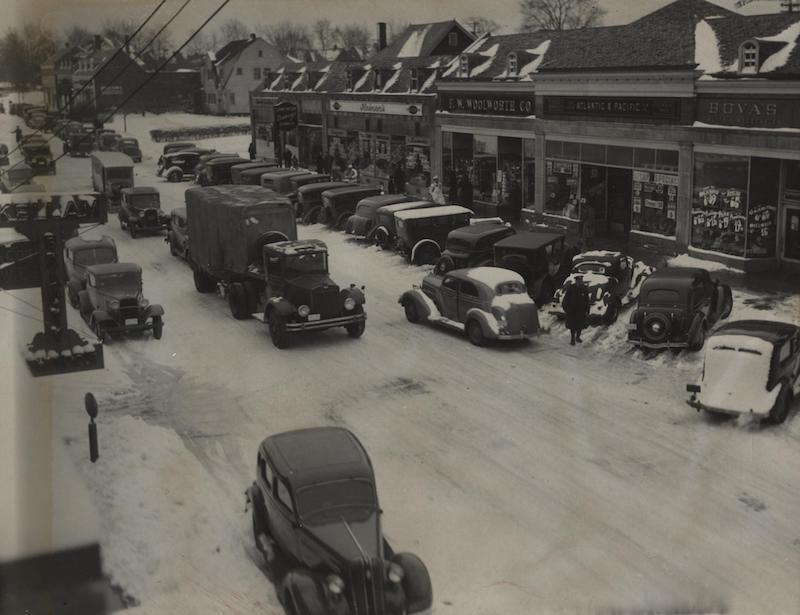
    <summary type="html"><![CDATA[<p><strong><em>Heinen's Fine Foods grew from within the bustling Kinsman-Lee commercial district to become both a revered neighborhood institution and a thriving supermarket chain with stores located throughout the Greater Cleveland area.   With origins as a small storefront butcher shop in the Kinlee Building, the story of Heinen's Fine Foods is intertwined with the history of a flourishing commercial district at the intersection of Kinsman and Lee Roads.</p></strong></p><img src="https://clevelandhistorical.org/files/fullsize/77d27e861f4418e7cc9fe9d22f5b42cd.jpg" alt="Kinsman Road, 1936" /><br/><p>The northeast quadrant of the Chagrin Boulevard and Lee Road intersection sat empty in the winter of 1990. The only remaining structures along Chagrin Boulevard between Lee and Avalon Roads were Shaker Hardware and Heinen’s Grocery Store at the eastern end of the lot. The two businesses had been selected to anchor a ten-million-dollar redevelopment project of Shaker Towne Center initiated by the City of Shaker Heights. Both had ties to the Kinsman-Lee community dating back to the intersection’s early development as a retail hub for the growing populations of Lomond and Moreland neighborhoods. While Shaker Hardware would stay at its present location, Heinen’s, Inc., was to move just west of its 23,000 square foot building into a 43,000 square foot supermarket. An aisle of parking for the new site sat directly north of the grocery’s place of origin at 16621 Kinsman Road (now Chagrin Boulevard). Once a small storefront butcher shop, the business grew within the bustling Kinsman-Lee commercial district to become both a revered neighborhood institution and a successful grocery chain with supermarkets throughout the Greater Cleveland area.  </p><p>As recounted by business founder Joseph H. Heinen in the 1950s, the beginnings of Heinen’s Grocery Store can be traced back to 1929 at the northeast corner of the Kinsman-Lee intersection in Shaker Heights. The German immigrant had worked at butcher shops in Cleveland since his youth, including seven years at Dedreux Market Co. stores. Following a heated disagreement with a boss, Heinen quit his job and opened a small meat market on Kinsman Road. Heinen’s timing and choice of locations proved key to his success. </p><p>Sustained by rapid population growth in the southwest region of Shaker Heights, both land speculators and business owners prospered in the Kinsman-Lee district. The site was previously designated for commercial development by the Van Sweringen Co., and businesses operated out of homes east of Lee Road along the north side of Kinsman Road during the early 1920s. A lot with 212 feet fronting Kinsman Road and 203 feet on Lee Road had sold in 1922 for $29,000. The purchaser sold the land soon after to a group of investors for $40,000, which in turn sold it in 1924 to the H. A. Stahl Company for $70,000. The property was once again passed on for around $90,000 to the Union Trust Company, which immediately leased the corner for ninety-nine years to the Kinlee Company. A purchase option was offered at $110,000, effective from 1929 to 1939. The Kinlee Company demolished the existing homes and erected a commercial building at a cost of $75,000. Twelve storefronts comprised the new building. Upon opening in March, 1926, all spaces had been subleased. With similar speculation occurring on the northwest corner of Kinsman-Lee, the <em>Cleveland Plain Dealer</em> noted that the “two corners of Lee and Kinsman roads afford two of the best illustrations of the money to be made in Greater Cleveland land investment.”   </p><p>Cleveland newspapers reported the quick leasing of all business spaces in the commercial district through the time Heinen set up shop in 1929. The Great Atlantic & Pacific Tea Co., Cleveland’s largest merchandising chain, announced that their Kinsman-Lee branch was the busiest of nearly 500 regional stores that year. Listed as 16621 Kinsman Road in the 1930 Cleveland City Directory, plat maps place Joseph Heinen’s butcher shop at the eastern corner of The Kinlee Building. Dedreux Markets Co. also moved into this structure in 1929. Heinen would later reflect on these early years operating the store: “It amazed me. I didn’t expect to do as well. I think the section had a lot to do with it. It was a very fertile spot.” </p><p>By 1931, stores extended along the east side of Lee Road between South Moreland (now Van Aken Boulevard) and Kinsman Roads. Six hundred feet east along the north side of Kinsman Road also housed commercial structures. Development quickly moved to the southern side of Kinsman Road, attracting many of the businesses housed in the Kinlee Building’s small storefronts. Six storefronts and 12 offices opened in a new structure at the intersection of Kenyon, Lee and Kinsman Roads in 1933. A building permit for 16708 to 16710 was filed in July 1933. A block structure connecting the two buildings opened its doors in November 1935. At that time, all spaces had been leased. Both the Dedreux Market Co. grocery and Great Atlantic & Pacific Tea Co. relocated to the new block building, which also housed a Woolworth Co.  </p><p>Joseph Heinen was among the new tenants on the south side of Kinsman Road. His small butcher shop, having earned a reputation for cleanliness and high-quality products, was thriving amidst an economic recession. Looking to expand, the entrepreneur relocated to a double storefront at 16708 and 16710 Kinsman Road. The new store, however, would offer more than just meat. Responding to demands of customers for additional products, food options such as canned goods, seasonal vegetables, and peanut butter were offered. This mixture of salable items was unique within the Kinsman-Lee shopping district, and marked the beginnings of Heinen’s Grocery Store. The deed for the property was transferred to Joseph Heinen in 1936. </p><p>The grocery continued to grow at the double storefront in the Kinsman-Lee neighborhood through midcentury. During this time, Joseph Heinen began early efforts to expand as a chain in Cleveland’s affluent suburbs. New stores in Cleveland Heights and Shaker Square opened in 1939 and 1950, respectively. The Kinsman store would once again move in 1953, relocating to 17021 Kinsman Road. Nearly occupying the entirety of a city block, the modernized space offered both a large parking lot and interior designed for customer convenience and comfort. These new features guided the future character of Heinen’s chain of stores. Walls were painted in soft colors, with special attention paid to the accessibility, presentation and lighting of the store’s goods. Check-out conveyors were equipped with ‘magic eyes’ to speed up the cash register process, and a policy of parcel pickup service was implemented where attendants loaded groceries into customers’ vehicles.  </p><p>A period of rapid expansion followed. Eleven supermarkets and a distribution warehouse would be opened throughout the Greater Cleveland area between 1953 and 1990. In 1987, the City of Shaker Heights announced its plans to completely overhaul the Kinsman-Lee commercial district. As one of the few areas zoned for commercial purposes, economic growth in the district was critical to providing tax revenues in a predominately residential city. While not in disrepair, the area faced increased competition from malls in Cleveland’s eastern suburbs. </p><p> Prior to redevelopment, the Kinsman-Lee district had three supermarkets, three gas stations, four delicatessens and numerous specialty shops. Characterized by its many specialty shops, the recently branded Shaker Town Center lacked a strong anchor store, unified management, convenient parking and a cohesive identity. Despite strong opposition from business owners, the public showed support for the City-sponsored project by voting down an alternate redevelopment plans that would have placed revitalization efforts in the hands of multiple private developers.  </p><p>Early plans for Shaker Towne Center centered on building a 40,000 square foot upscale supermarket, which would be complemented by a drug store, a bank and a variety of retail shops. All office spaces would be removed. The City acquired the land and then sold it to Chase Properties for development. Heinen’s, Inc. was selected to be the anchoring supermarket. The company agreed to sell their current building to the City, and lease the proposed shopping center at the heart of the development. During the winter of 1991, Heinen’s relocated to its new home at the intersection of Chagrin Boulevard and Lee Road. Once a tiny butcher shop, the family owned supermarket had grown from within the Kinsman-Lee commercial district to become both an integral component of the neighborhood’s commercial identity as well as a thriving regional supermarket chain.</p><p><em><strong><a href="https://clevelandhistorical.org/items/show/842">For more (including 12 images) view the original article</a></strong></em></p>]]></summary>
    <published>2018-07-19T15:49:20+00:00</published>
    <updated>2026-04-17T19:17:36+00:00</updated>
    <link rel="alternate" type="text/html" href="https://clevelandhistorical.org/items/show/842"/>
    <id>https://clevelandhistorical.org/items/show/842</id>
    <author>
      <name>Richard Raponi</name>
    </author>
  </entry>
  <entry>
    <title type="html"><![CDATA[Shaker Heights Public Library: A Legacy of the Van Sweringens&#039; Shaker &quot;Group Plan&quot;]]></title>
    <summary type="html"><![CDATA[<p><strong><em>Public library services in Shaker Heights grew from within the walls of the village's school system. By mid-century, the library had emerged as a valued civic institution.  Culminating in the opening of a stately structure on Lee Road in 1951, learn how these early years shaped the identity of Shaker Heights Public Library.</em></strong></p><img src="https://clevelandhistorical.org/files/fullsize/c852ba06bfec7b746c5b7aa61ea6bdee.jpg" alt="Shaker Heights High School Library, ca 1929" /><br/><p>In 1913, a Van Sweringen “Group Plan” was beginning to take form in the young village of Shaker Heights. Construction of a stately school on Southington Road was nearing completion.  Borrowing from the neighboring City of Cleveland’s ambitious efforts to centralize civic buildings, a large oval tract had been donated to the village by the Van Sweringens as a potential site for an elementary school, town hall, high school and small library. While Boulevard School would be the only structure realized at this site, the short-lived plan displays early efforts to anchor civic life around school buildings in Shaker Heights’ emerging residential community.   </p><p> The Van Sweringen brothers invested heavily to bring this vision to fruition. A 1923 promotional publication for the Village of Shaker Heights claimed the investment of over two million dollars in property and equipment to the development of the village’s five educational institutions, and noted their intentions of building a school to serve each square mile of the suburb.  By 1931, ten public schools had been constructed.  Civic life centered around these educational institutions, which regularly housed the social, recreational, cultural and religious activities of the community. Despite the inclusion of a library in early plans for the Village of Shaker Heights, a public building devoted to this use was never erected during the suburb’s developmental years. Library services, however, grew from within the walls of Shaker Heights schools to become a valued public amenity. Prompted by community demand, an independent school district library was established in 1937 and the institution found a home in the Lee-Kinsman Building at the intersection of Kinsman (Chagrin Boulevard) and Lee Roads. By mid century, the library had emerged as a civic institution in its own right. These early years shaped both the future development and identity of Shaker Heights Public Library. The library’s significance as a civic institution and anchor of the Moreland neighborhood was reaffirmed in 1993 by a return to the place of its founding, the site of the former Moreland School.   </p><p> Public library services in Shaker Heights grew from the dedicated study rooms and book collections of the village’s school libraries. The only Shaker Heights library recognized by the Library Club of Cleveland and Vicinity in its 1924 handbook was operated out of Shaker Heights High School. The school, which would later be renamed Woodbury Elementary School, established its library in 1919. A graduate of Western Reserve University Library School was appointed as librarian the following year.  The library was available for use by teachers and students during the day.  Its materials supplied Shaker Heights’ classrooms and school libraries. Transition from a school-based system into a public institution was prompted by the creation of the Cuyahoga County Public Library during the early 1920s. </p><p> Spearheaded by librarian Linda Eastman of the Cleveland Public Library, efforts to make the nationally renowned institution available to county residents were met with popular support. The Ohio State Legislature authorized the creation and funding of county libraries in 1921, and a regional vote approved the establishment of a Cuyahoga County district the following year. With the law to be enacted in April of 1924, Cleveland Public Library’s County Department was formed to begin making preparations for the extension of library services to all persons living within the county.  Operated as a department of Cleveland Public Library, the County Library was an independent institution with its own personnel, book collection and funding. Early efforts focused on utilizing schools in outlying areas as distribution centers for library materials. The existing public libraries in Cleveland were also made available to county residents beginning in March, 1924. </p><p> Shortly after the creation of the County Department, negotiations began with Shaker Heights Superintendent of Schools to transform Shaker Heights High School Library into a branch of the new library system.  The village’s Board of Education approved the plans in June, 1924, and services were made available to the public beginning in October of that year. A basement room at the high school was converted into a workspace for staff, and new shelving was added to the library.  The existing book collection was supplemented by the County Library, and the position of school librarian taken over by a county employee. </p><p> The new librarian continued lending materials for classroom collections at Boulevard, East View, Malvern, Onaway and Sussex elementary schools, and immediately implemented in-house programming for Shaker Heights elementary school classes.  To accommodate its new adult patrons, the library extended weekday hours till five in the afternoon and opened on Saturday mornings. Access to the library was briefly offered on Tuesday evenings, but little demand was found for the service.  </p><p> During its first two years of operations at Shaker Heights High School, the County Library documented a steady rise in the circulation of materials. A 1926 report by the County Department noted that “the grown people of the community have discovered that the library is there and are demanding more service than our very new organization can give.” It was also quickly determined that the site of Shaker Heights High School was “far from ideal as a library center.”  A new branch of the County Library was planned for Moreland School, which was under construction at the time.   Shaker Heights Board of Education approved plans for a large room and workspace to be dedicated for use as a public library within the building.  </p><p> The public library in Moreland School opened on November 2, 1926. Final plans for the site included a room for adults, a room for students, and a work space for staff. The new facility housed a mixed collection of books culled from both County Library resources and the Shaker Heights High School collection. Moreland School’s library immediately supplanted the High School as the center for elementary school book distribution and classroom visits, but the High School branch remained staffed by its county-funded librarian and housed administrative duties for patron registration. Demand for library services from both students and adults continued to grow, and the Board of Education approved the purchase of a book truck to facilitate transportation of incoming and outgoing requested materials.   </p><p> Over the next decade, library services in Shaker Heights expanded as part of the Cuyahoga County Library system. Both Shaker Heights High School and Moreland School branches remained opened to the public, and furnished books to Shaker Heights’ Junior High and seven elementary school libraries. In response to community demand for increased services, including weekend and evening hours, the Shaker Heights Board of Education approved the creation of an independent school district library in 1937. A seven-member Library Board of Trustees was appointed by the Board of Education to govern the institution, which served the same geographic area as the school system. The Library Board was responsible for developing, implementing and overseeing all polices related to the library, including its services, budget and staff.  The Cuyahoga County Library remained affiliated with the successor institution, allowing patrons to borrow from its circulating system. The independent library, however, operated separately from the Cuyahoga County branches and received a share of the intangible property tax revenue that financed the region’s libraries.   </p><p> Arrangements were made to secure a site for the library at the intersection of Lee and Kinsman Roads soon after its institutional founding.  The owner of the Lee-Kinsman Building would erect a 49- by 70-foot, one-story addition to his commercial structure, and the newly installed Library Board agreed to lease the building for five years. Additionally, the board hired Ellen Ewing as Head Librarian to oversee the process of organizing and purchasing books for the Shaker Heights community. Opened to the public in 1938, the leased storefront was only planned as temporary headquarters. In 1941, the Board of Education agreed to sell property on Moreland School grounds to the Library Board for the construction of a new library. East View School, which had served as the neighborhood’s elementary school prior to the opening of Moreland Elementary School, had been converted into warehouse space; It would be demolished to make room for the new structure. Bond issues were approved by Shaker Heights voters in 1945 and 1948 for library construction, but construction was delayed due to World War II.</p><p> Concerns over the legitimacy of the independent school district library also delayed construction plans.  Beginning in 1946, the County Budget Commission reduced the income of several regional independent libraries. Interpreted as an attempt by the Cuyahoga County Library to absorb Shaker Heights’ library, the actions of the commission presented “an intolerable situation…that…will hamper the operation of the library in the coming year, jeopardize the proposed library building and deny the citizens of Shaker Heights the library services for which they have clearly expressed their desire.” The situation grew dire with the passage of a state law that barred the establishment of independent libraries in 1947. Because no prior law existed permitting Shaker Heights from withdrawing from the county system, the future of the library was in question.   </p><p> In 1948, the Board of Education announced it would initiate a test case to determine the legal status of independent library systems. The sale of $150,000 in notes was ordered towards financing construction of the new Shaker Heights Library, which the Clerk-Treasurer refused to issue. The case went before the Cuyahoga County Court of Appeal, and was decided in the Board of Education’s favor. The Court of Appeals compelled the Clerk-Treasurer to sell Shaker Heights’ bonds, confirming the legality of independent libraries established prior to the 1947 state law. Bids were accepted by the Shaker Heights Library Board in 1949 for the construction of a new edifice at 3450 Lee Road, the current site of the Stephanie Tubbs Jones Community Building. The library’s construction was long overdue.  More than 30,000 books were packed into the existing small, storefront location.  </p><p> The new library opened to the public in 1951. Just as the head librarian curated materials for Shaker patrons, the state-of-the-art facility was fashioned to reflect the character of the community. The interior of the civic building exuded a comfortable, home-like setting. Elaborate woodwork, easy chairs, multicolored drapes, end tables, reading lamps and an open fireplace offered visitors the ambiance of a residential study. Upon entering a room devoted to the history of the Shaker religious community, peg board floors and an off-white paint job presented patrons with a historically accurate replication of the religious sect's penchant for the austere. Low tables marked areas devoted for use by children, while space for quiet study acted as a memorial to the recently deceased Ellen Ewing. </p><p> Over the next four decades, the independent library continued to expand and diversify its services. Building renovations were made, the Bertam Wood branch opened and a number of outreach programs were instituted. Computer terminals replaced card catalogs, while patron access to library materials grew exponentially with the introduction of the Online Computer Library Catalog database and CLEVNET.  The introduction of videocassettes, books-on-tape and audio compact discs to the library catalog precipitated a surge in circulation beginning in the late 1980s.   </p><p> Sources of revenue to finance library services also changed. Beginning in 1974, county funds were supplemented through the passage of local library tax levies. Shaker Heights residents regularly displayed support for their independent library through the passage of operational levies since that time.  Per capita circulation of Shaker Heights Public Library materials consistently remained the highest in the county during the 1980s and 1990s. </p><p> As the once-spacious building at 3450 Lee Road grew crowded with materials and patrons, plans were developed to expand and modernize the main library.  After exhaustive studies, the recently vacated Moreland School site next door was chosen as the library’s new home. Previously relegated to rooms at the eastern entrance of the structure between 1926 and 1938, the library would return to Moreland School as the primary occupant. The school house would once again be an anchor for civic life in the region. The new library was dedicated and opened to the public in 1993.</p><p><em><strong><a href="https://clevelandhistorical.org/items/show/841">For more (including 15 images) view the original article</a></strong></em></p>]]></summary>
    <published>2018-07-14T15:44:22+00:00</published>
    <updated>2026-04-17T19:17:39+00:00</updated>
    <link rel="alternate" type="text/html" href="https://clevelandhistorical.org/items/show/841"/>
    <id>https://clevelandhistorical.org/items/show/841</id>
    <author>
      <name>Richard Raponi</name>
    </author>
  </entry>
  <entry>
    <title type="html"><![CDATA[Chelton Park: Creating Spaces to Play in the Moreland Neighborhood]]></title>
    <summary type="html"><![CDATA[<p><strong><em>The creation of public spaces in the Moreland neighborhood has been both a point of collaboration and contention between local residents and the City of Shaker Heights since the 1960s.  The efforts of Moreland Community Association in advocating for the development of Chelton Park set a precedent of community involvement in park building activities which lives on to this day.  </em></strong></p><img src="https://clevelandhistorical.org/files/fullsize/56974d173011659fe551eccd78c689df.jpg" alt="Faces of Moreland, 2016" /><br/><p>Convening in Chelton Park during the first week of August, 2016, bands of volunteers joined artists Gary Williams and Robin Robinson to take part in the final stage of a community art endeavor that aspired to beautify the public space. A bleak retaining wall was to be transformed into a colorful representation of the surrounding Moreland community.  With chalk and paintbrushes in hand, participants spent their summer days outlining and painting interlocking shapes along an eastern barrier that divided recreation grounds from the Shaker Heights School Bus Garage. The final mural depicted images of Moreland neighborhood residents surrounded by jigsaw puzzle pieces. Overseen and guided by the non-profit art organization Sankofa Fine Art Plus, the Chelton Park Mural Project had evolved from community input as part of the City of Shaker Heights’ Moreland Rising program.  Culminating in the Faces of Moreland mural, the dividing wall now serves as an apt tribute to the Moreland community’s long tradition of advocacy for the development of public spaces within the neighborhood.  The advancement of park building projects, as reflected through the development of Chelton Park, had been both a point of collaboration and contention between Moreland residents and the City of Shaker Heights since the 1960s.  </p><p>The need for public parks in Moreland had long been apparent by the time of Chelton Park’s opening in 1964.  The area’s only designated recreation facilities and playground were located at Moreland School.  This was typical of Shaker Heights neighborhoods.  Local schools acted as the nucleus of community life and identity, and provided grounds for civic and recreational activities. Moreland’s residential layout, however, presented unique conditions that demanded a different approach to public space.  Small property lots and the prevalence of multifamily homes precipitated a need for accessible community recreation facilities.  Additionally, play space at the school had dwindled over time following the construction of a library, warehouses, bus garages and parking lots. What remained of the land was often unavailable due to school activities, and its asphalt surface precluded use for activities such as baseball and football. While neighborhood children used vacant lots and city streets for play, the practice was discouraged by police.  </p><p>The first realized efforts to promote park building were initiated by the Moreland Community Association (MCA).  Formed in the spring of 1962, the community group was modeled after and inspired by the Ludlow Community Association. Its primary goals were to deter block busting and promote stability within the neighborhood.  Moreland had witnessed an unprecedented rise in the number of homes being placed on the market, in part a reaction to racial integration in the southwest region of Shaker Heights. Beyond efforts to manage the neighborhood’s racial composition, MCA advocated for improvements to municipal services and the creation of community recreation grounds.  </p><p>Upon its founding, MCA quickly began work with the Shaker Heights Recreation Board to identify locations for the development of local playgrounds. These sites were conceived as designated play spaces for the neighborhood’s estimated 1,300 children, as well as a means of promoting urban renewal through the creation of an aesthetically attractive landscape.  United in purpose to create stable, attractive and livable communities, MCA and the City did not always align in their perception of where parks should be located and how they were to be used. </p><p>  Early park building efforts focused on two sites.  Four adjoining lots owned by the City near Milverton and Sutton Roads were recommended as a tot-lot facility.  Grounds behind a commercial building on Lee Road between Hampstead and Nicholas Roads were chosen for potential use as a play field.  The City of Shaker Heights Finance Committee swiftly rejected plans for the proposed Milverton-Sutton playground.  The land’s potential value for future development, inaccessibility to the total community, and proximity to parks in other neighborhoods were cited as reasons for not moving forward with the project. In a letter penned to City of Shaker Heights Mayor Paul K. Jones for the Moreland Community Association in March, 1963, Mrs. Netta Berman expressed, “We are appalled at the possibility of the development of this site for other than recreation purposes.”  </p><p>Within a month of sending the letter, Nette Berman presented Shaker Heights City Council a petition containing 889 signatures to demonstrate support of MCA’s plans for neighborhood playgrounds. Despite continued objections to the Milverton-Sutton site, the City Council approved the purchase of a 240 by 200 parcel of land between Hampstead and Nicholas Roads in February, 1964.  A house on the property was to be demolished to create an entrance from Chelton Road, and three lots developed as a community playground.  </p><p>In October, 1964, the playground off Chelton Road was dedicated.  Mayor Paul K. Jones spoke at the ceremony, recognizing the collaborative efforts of the Moreland Community Association and Shaker Heights' Recreation Board. Recreation facilities, including a baseball backstop and field, were added during the Spring of 1966. For the park’s youngest visitors, a fenced-in tot-lot was situated at the south end of the play field.  Shrouded from the dangers of stray baseballs, the area offered benches, a Swedish Gym, a climb-around, a slide, a steam engine and five spring-loaded saddle mates of differing animal types.</p><p>  The Moreland Community Association continued working with local government officials to guide the maintenance and development of neighborhood recreation spaces over the next two decades. In 1968, the organization offered its support for a City-sponsored bond issue that included funds to develop open spaces within the southwest section of Shaker Heights.  The issue’s passage helped finance the construction of Sutton Place, a controversial six-acre combination park and town house development.  The community organization also advocated for city property at Hildana Road and Chagrin Boulevard to be transformed into a play space and ice-skating pond.  </p><p>A new community organization took the lead advancing recreational facilities for the Moreland community during the 1990s.  Founded in 1991 as Moreland on the Move, the community group merged with the Moreland Community Association in 1994 to establish Moreland on the Move Community Association.  These institutions oversaw the renovation and expansion of Chelton Park as part of a larger effort by the City of Shaker Heights to overhaul its playgrounds and recreational amenities during the first half of the decade.  </p><p>  In the fall of 1992, the City hired a landscape architect to redesign the playground in Moreland.  Plans included the purchase of two adjoining properties on Chelton Road to open the grounds for better visibility and security.  The new park was to be made over as a play space for elementary school children.  An application for a Community Development Block Grant was submitted by the City to finance the project, but the proposal was denied. Shaker Heights City Council agreed to move forward and fund the plans, which had received widespread support from Moreland residents and its community organizations. Two homes were acquired and demolished, and existing playground equipment was reinstalled closer to Chelton Road.  In the spring of 1995, the revamped park opened to the public.  </p><p>Municipal government efforts to develop and improve green spaces within the Moreland neighborhood once again surged following 2010.  The City of Shaker Heights had begun receiving disbursements of over $2.75 million in federal grants the prior year for Neighborhood Stabilization Programs through the Cuyahoga County Department of Development. This funding aimed to counteract the devastating impact of the national foreclosure crisis in hard-hit communities such as Moreland.  Foreclosed and abandoned properties quickly accrued in the city land bank.  While some homes were rehabbed and placed on the market, dilapidated structures that undermined neighborhood stability were demolished.  The ensuing vacant lots were maintained by the city while being marketed to buyers wishing to build quality new homes within the neighborhood. Empty lots were also developed into parks and playgrounds for the community.   </p><p>In Moreland, $181,000 in National Stabilization Program funding was utilized to enhance the neighborhood’s playground and park facilities. Working in collaboration with Moreland on the Move Community Association to identify the needs of neighborhood residents, the City developed two new playgrounds in vacant properties.  The Menlo Tot-Lot was designed for children two to five years old, and the Ashby Play Lot was created as a neighborhood play space.  Funds were also allocated to the Chelton Park Expansion Project.  The City purchased and demolished a home adjacent to the park, landscaped the grounds, and added new fencing, amenities and playground equipment.  Throughout the park building process, community members actively engaged in its planning.  A petition signed by over 100 members of the Moreland community in 2015 helped advance the Chelton Park Mural Project, which used public art to physically inscribe the neighborhood’s identity into the popular recreation grounds.</p><p>  In 2018, the Moreland neighborhood boasts five recreation spaces available to its residents.   Continuing a long tradition of collaboration between community members and the local government in park building projects, the City of Shaker Heights made a concerted effort to engage local residents in the development and implementation of plans initiated through Neighborhood Stabilization Programs. This partnership, dating back to the creation of Chelton Park in the 1960s, has guided the creation of meaningful, attractive and usable spaces in the Moreland community.</p><p><em><strong><a href="https://clevelandhistorical.org/items/show/840">For more (including 15 images) view the original article</a></strong></em></p>]]></summary>
    <published>2018-07-09T11:40:39+00:00</published>
    <updated>2026-04-17T19:17:39+00:00</updated>
    <link rel="alternate" type="text/html" href="https://clevelandhistorical.org/items/show/840"/>
    <id>https://clevelandhistorical.org/items/show/840</id>
    <author>
      <name>Richard Raponi</name>
    </author>
  </entry>
  <entry>
    <title type="html"><![CDATA[Moreland Doubles and Bungalows: Residential Development in Shaker&#039;s Former East View Village]]></title>
    <summary type="html"><![CDATA[<p><strong><em>Visible along the tree-lined streets of Shaker Heights’ South Moreland neighborhood, large porches embellish the first and second stories of double family homes. These stately dwellings offer passersby clues to the area's unique story of development as East View Village during the first two decades of the 20<sup>th</sup> century.</em></strong></p><img src="https://clevelandhistorical.org/files/fullsize/87020c70384b5f1a3dff7b325e95a25b.jpg" alt="Two Family Homes on Hildana Road" /><br/><p>One might be inclined to think that the homes of South Moreland existed prior to the area’s annexation by Shaker Heights in 1919. Similar to almost half of the housing in the suburb, however, the Moreland neighborhood emerged amid a flurry of construction during the 1920s. While many of the buildings no longer stand, more than 550 homes were erected in Moreland during this era of unprecedented growth for the Village of Shaker Heights. The distinctiveness and historical significance of the neighborhood speaks to the timing and circumstances of residential development in Shaker Heights' lower region, previously a part of East View Village. The differing paths of growth for these two communities converged following the exclusive suburb's annexation of the rural village, contributing to the present-day boundaries - and character - of the City of Shaker Heights.</p><p>Histories of Shaker Heights typically center upon the successes of the Van Sweringen brothers in growing what would become one of America’s premier suburbs. Central to this story is the Van Sweringens’ adherence to strict guidelines for the appearance of homes and landscapes, made possible by their company's singular control over the large tract of land initially laid out as the suburb. Through the implementation of deed restrictions, highly-regulated building standards and zoning ordinances, the Village of Shaker Heights became known for its harmonious architectural consistency, beautified public grounds, and highly landscaped streetscapes. However, the Moreland neighborhood, along with other small pockets of land along the edges of the city, offer a different and equally important side to the story of development in Shaker Heights.</p><p>The region currently encompassing much of the Moreland, Lomond, Sussex, and Fernway neighborhoods was once a part of East View Village. Established in 1906 from lands of the declining farming community of Warrensville Township, East View Village originally included the area between East 140<sup>th</sup> Street and Warrensville Center Road. Harvard Road and the lands held by the Shaker Land Company acted as the southern and northern boundaries, respectively. With Cleveland growing inexorably to the west, the decision to carve out a village within Warrensville Township was likely rooted in concerns of being annexed by the emerging city. Since the turn of the century, portions of Brooklyn Township, Newburgh Heights, Glenville, and South Brooklyn had been annexed to Cleveland by way of both community choice and court order. While annexation provided governmental services and municipal facilities to surrounding regions, opponents often cited the pitfalls of decreased governing independence and the perceived corrupting influences of the city. </p><p>During its brief existence between 1906 and 1919, East View Village was both a farming community and an emerging middle- and working-class neighborhood for eastern and southern Europeans living along Kinsman Road. The semi-rural region, probably best known to Clevelanders as a speed trap along their route to Randall Park Race Track, was in the path of suburban development. Land in East Cleveland, Cleveland Heights, the Village of Shaker Heights, and East View Village was being acquired and improved by residential developers by 1913. Among these speculative interests in East View Village were the Van Sweringen brothers, who had already acquired properties in what would become Shaker Heights' Fernway neighborhood. At the time, nearly all grounds within a nine-mile radius of Cleveland’s city center had been divided into lots, and the reach of allotment dealers extended from the eastern edge of Bratenahl down to Bedford. A 1915 appraisal of the region reflected East View Village lands as having grown in value more than any other district, with an increase of more than two and a half times their worth in under five years.</p><p>The increase in land value, however, did not mean the small village was without its problems. Initially tied to the City of Cleveland for select municipal services, a policy was instituted by Cleveland's Board of Education in 1913 that discontinued the practice of providing education to regional children by annexing suburban school districts. The following year, Cleveland’s fire department announced it would no longer respond to East View Village fire alarms following the refusal of residents to pay a bill. Agreements for fire protection and access to certain schools would eventually be made with the Village of Shaker Heights, but the small community remained tied to outside municipalities for providing basic services to its populace. The increase in land values also meant that East View Village would be subject to larger tax levies by the City of Cleveland.</p><p>Not everyone preferred village life. Residents along East 140<sup>th</sup> Street petitioned for annexation by Cleveland in order to receive cheaper water services in 1914. Still, growth was on the horizon. Van Sweringen interests needed to build a large population base to financially support their planned rapid transit system. Agents for the real estate entrepreneurs pursued all available East View Village farmlands near the Shaker Heights enclave. The Shaker Overlook Company, along with a host of other allotment dealers, was also busy acquiring, subdividing, and improving lands in East View Village and the eastern border of Mount Pleasant. Formed by Emory H. Komlos and Clifford E. Sherry, the Shaker Overlook Company, the Rapid Transit Land Company, and the Parkhill Land and Allotment Company developed over 1,350 building lots in the areas to the west and south of Shaker Heights beginning in 1915.</p><p>While the Vans marketed Shaker Heights as a high-class suburb, the allotments in East View Village were designed to attract people of more limited means. Propelled by the promise of a rapid transit system that would drastically reduce travel time to Cleveland, East View Village property dealers attempted to entice buyers with large lots, churches and schools open to Catholics and Protestants alike, and a year of free potatoes delivered to their doorstep. Additionally, advertising for these lands mirrored the marketed attributes of Shaker Heights: plentiful sunshine, pure air, stable property values, and neighbors of the “right sort.”</p><p>In 1917, a majority of the lands held by the Shaker Overlook Company was annexed to Cleveland. This included substantial properties on the southwest outskirts of what was to become the Shaker Heights border. The land company, along with a small host of other developers, maintained small lots of lands in what is now the Moreland neighborhood. By 1918, they were beginning to sell new doubles and single-family homes along the border of Shaker Heights, as well as on Milverton, Birch (Colwyn), and East View (Sutton) Roads. </p><p>With large portions of East View Village already annexed to Cleveland by 1919, the remaining residents of the small village voted in favor of becoming part of Shaker Heights. This acquisition of land created the current southern boundaries of Shaker Heights, and brought in areas that now compose the neighborhoods of Moreland, Sussex, Lomond, and Fernway. As evidenced by a 1922 map of properties being sold by the Van Sweringen Company, the brothers had purchased and subdivided nearly all annexed lands. Beyond a handful of randomly located lots in Lomond and Sussex, the only substantial areas not held by the Van Sweringens were the entire South Moreland neighborhood between East 156<sup>th</sup> Street and Lee Road and the southernmost portion of North Moreland.</p><p>Having evaded development by the Van Sweringens, these lands were not subject to the deed restrictions or architectural standards placed upon other lands within Shaker Heights. Following the opening of the Shaker Heights Rapid Transit in 1920, demand for housing in the exclusive suburb grew. During the 1920s, nearly 550 building permit cards were filed for the Moreland area. Comparatively, 67 permits were requested during the 1930s and 234 cards filed in the 1940s. The South Moreland neighborhood quickly filled in with American Foursquares, Bungalows, Cleveland Doubles, and smaller single-family houses. This new housing reflected the popular types and styles of homes being built in Cleveland's inner-ring suburbs such as Mount Pleasant and Newburgh Heights. As advertised, the land companies were building homes within the exclusive suburb for middle- and working-class consumers.</p><p>The Van Sweringens similarly began exploring the development of more affordable housing and apartments for their newly annexed lands. These efforts, however, were guided by more traditional architectural leanings. A myriad of rules for home and apartment construction were published, and an architectural review board designated to monitor new construction on their lands. The new standards countered the popular building trends that characterize development in the South Moreland neighborhood. All homes were required to be two stories in height, thereby barring Bungalow style structures. Apartments, two-family houses, duplex houses and terraces were allowed, but contained to designated streets. The multifamily homes built on approved grounds, however, were required to have the outward appearance of being single-family structures. </p><p>With these restrictions firmly in place by the mid-1920s, the Moreland neighborhood would stand architecturally distinct among its Shaker Heights counterparts. The community's vernacular doubles and single-family homes reflect early 20<sup>th</sup>-century building trends in both Cleveland and the United States. The homes are also a reminder of the varied paths that converged with the suburb's annexation of East View Village, and how these regional influences shaped both the development and character of what is now the City of Shaker Heights.</p><p><em><strong><a href="https://clevelandhistorical.org/items/show/837">For more (including 15 images) view the original article</a></strong></em></p>]]></summary>
    <published>2018-06-20T02:10:46+00:00</published>
    <updated>2026-04-17T19:17:41+00:00</updated>
    <link rel="alternate" type="text/html" href="https://clevelandhistorical.org/items/show/837"/>
    <id>https://clevelandhistorical.org/items/show/837</id>
    <author>
      <name>Richard Raponi</name>
    </author>
  </entry>
  <entry>
    <title type="html"><![CDATA[Moreland Elementary School: Historic Focal Point of the Moreland Neighborhood]]></title>
    <summary type="html"><![CDATA[<p><strong><em>Built in the Roaring Twenties to provide an elementary school education for the children of the families that were moving into the fast-growing, southwesternmost neighborhood of Shaker Heights, Moreland Elementary School not only lent its name to that neighborhood, but also became the neighborhood's iconic  landmark and its enduring symbol of heritage, transition, and renaissance.  </em></strong></p><img src="https://clevelandhistorical.org/files/fullsize/c0f8664caa0c0ed039e3e2bec1bdea26.jpg" alt="Moreland Elementary School (1926-1987)" /><br/><p>The Van Sweringen brothers knew that a premier suburb required a premier public school system.  So, it was not surprising that, in 1913, just one year after the incorporation of Shaker Heights, its Board of Education began implementing the Vans' vision, undertaking an ambitious building program that proposed to place a new elementary school in every neighborhood of the village. When neighboring East View Village was annexed in 1920, the school building program was extended to that new territory, which soon became home to Shaker Heights' southernmost residential neighborhoods.</p><p>Prior to the annexation, children in East View Village had attended elementary school in a small, four-classroom building located on the west side of Lee Road between South Moreland (Van Aken) Boulevard and Kinsman Road (now Chagrin Boulevard). That school building continued to be used by the Shaker Heights Board of Education for several years as an elementary school for children living in Shaker's southwesternmost neighborhood--later known as the Moreland neighborhood. By 1924, however, the Board recognized that the building had become inadequate to accommodate all of the school-age children living in this fast-growing area of Shaker Heights. Accordingly, in that year, the Board decided to build a new, larger elementary school just to the west of East View School, on a parcel of land sold to it by the Van Sweringens.</p><p>Charles Winning Bates, an architect from Wheeling, West Virginia, who had designed other school buildings in Shaker Heights, was awarded a contract by the Board of Education to design this new school.  Bates designed it in the neo-Georgian style, matching all other Shaker school buildings of its era. Three stories tall, brick, and with a grand entrance facing South Moreland (Van Aken) Boulevard, the new building was to have 28 classrooms — seven times as many as old East View School, as well as a teacher's restroom, a principal's office, a medical room, and an auditorium-gymnasium. After the Shaker Heights electorate approved a bond issue in November 1924 which had earmarked $425,000 for the new school building, construction commenced in 1925. By 1926, the building was completed, and on March 15 of that year the first children moved out of East View School and marched a few hundred feet into the new building, which was initially called Lee-Moreland School.</p><p>From the late 1920s until the late 1950s, Lee-Moreland School, which was by 1940 simply called Moreland School, served a largely Jewish population living in the Moreland neighborhood. In addition to providing a quality public education to the neighborhood's children, the school building also served as a meeting place for many Jewish organizations, as a place where sacred Jewish days were celebrated or commemorated, and even as a religious school for Temple Emanu El and the Cleveland Hebrew School. Beginning around 1960, as many Moreland neighborhood Jewish families moved to suburbs north and east of Shaker Heights, they were replaced largely by African American families, many of whom were moving out of Cleveland and its overcrowded school system, and into Shaker Heights with its nationally recognized, excellent school system.  </p><p>Racial transition in Shaker Heights presented challenges to many institutions in many places throughout the city, but perhaps none greater or more important to the city's future than those faced by Moreland Elementary School. Fortunately, the school was headed in this era by a principal who was more than up to the task. Orville Jenkins, who grew up in southern Ohio, attended college at Bowling Green University, taught as a teacher for a number of years, and then became principal of an elementary school in the Toledo, Ohio, area. In 1956, the Shaker Heights Board of Education hired him as the principal of Moreland Elementary School. Jenkins, who purchased a home on Scottsdale Boulevard in the Moreland neighborhood, was soon recognized as an excellent principal, and, as well, a fiery advocate for integrated schools. When the Moreland neighborhood began undergoing racial transition in the 1960s, Jenkins was among the leaders of the neighborhood who engaged in concerted efforts to stop blockbusting, to keep the neighborhood stable, and to preserve the high standard of community life there. He helped found the Moreland Community Association (MCA) in 1962 and he permitted the new organization to hold its meetings and functions at Moreland Elementary school. He instituted an individualized instruction program at the school, designed to help children to learn at a pace most appropriate for them. And, he became a friend to all children in the school.  Jenkins was said to have known the first name of every child in the school. He served as school principal, as well as a trustee of the MCA and other community organizations, including the Shaker Historical Society, until his untimely death at age 46 in October 1969.</p><p>Despite the efforts of Principal Jenkins, and many others in Shaker Heights, to keep Moreland an integrated neighborhood, by 1969 its population had become overwhelmingly African American, and, according to a November 18, 1969 Plain Dealer article, the number of African American children attending Moreland Elementary School had reached ninety-five percent. The Moreland Community Association, with a goal of seeing Moreland Elementary School re-integrate, petitioned the Shaker School Board of Education to initiate a program to bring in white children from other neighborhoods of Shaker Heights to achieve that.  Ultimately, Shaker Heights BOE, after a series of public meetings, instituted a voluntary busing program (the "Shaker Plan") in the city, which, with modifications in the mid-1970s, resulted in a somewhat improved racial balance at Moreland in that decade.</p><p>At about the same time that the voluntary busing program was instituted in Shaker Heights, the city began suffering a decline in the number of school-age children in its public school system and the Board of Education began experiencing financial difficulties in maintaining all of the existing school buildings. To remedy this problem, the Board of Education ultimately adopted a school reorganization plan that led to the closing of Moreland Elementary school in 1987, despite vigorous protests from the Moreland neighborhood. While Shaker Heights initially considered selling the old school building for private redevelopment, it was eventually persuaded to preserve it because of its importance to the Moreland neighborhood's history and identity. In 1993, after a renovation process was completed, the former Moreland Elementary School became the new main branch of the Shaker Heights Public Library.  </p><p>More than two decades have now passed since Moreland Elementary School was transformed into the new Shaker Heights Public Library.  While the historic building now serves a different purpose in the community, the purpose it serves is still an educational one. And, perhaps more importantly, at least to the Moreland neighborhood, the building continues to be a focal point for the neighborhood, a beloved landmark, and an enduring symbol of the neighborhood's heritage, transition, and renaissance.</p><p><em><strong><a href="https://clevelandhistorical.org/items/show/835">For more (including 12 images) view the original article</a></strong></em></p>]]></summary>
    <published>2018-05-09T15:06:42+00:00</published>
    <updated>2026-04-17T19:17:41+00:00</updated>
    <link rel="alternate" type="text/html" href="https://clevelandhistorical.org/items/show/835"/>
    <id>https://clevelandhistorical.org/items/show/835</id>
    <author>
      <name>Jim Dubelko</name>
    </author>
  </entry>
  <entry>
    <title type="html"><![CDATA[Shaker Heights Service Center: A Public Improvement That Improved the Gateway to the City ]]></title>
    <summary type="html"><![CDATA[<p><strong><em>In March 1963, Cosmopolitan Magazine ran a story about the "Good Life" in Shaker Heights, Ohio, the wealthiest city per capita in the United States.  While nationally-recognized wealthy suburb was the public image of the city in the 1960s, a very different story about the city was unfolding in one of its southwestern neighborhoods.  The siting and construction of the Service Center in the Moreland neighborhood, as much as any other public project undertaken by the city in that decade, was an integral part of that very different story.</em></strong></p><img src="https://clevelandhistorical.org/files/fullsize/ee7c1c8efcdf45996b168fb65bf801ab.jpg" alt="Welcome to the Neighborhood!" /><br/><p>As you drive east on Kinsman Road today through Cleveland's Mount Pleasant neighborhood and approach East 154th Street, you come upon and notice it--almost before you notice anything else.  You see it before you see that Kinsman Road has now become Chagrin Boulevard.  And it greets your eyes even before they are greeted by the nearby Shaker Heights welcome sign.  It's that long expanse of yellow brick wall--interrupted only once by a driveway-- that stretches for more than two city blocks along the south side of Chagrin.  It is the Shaker Heights Service Center and it tells you that you have left Cleveland and have now entered one of the area's premier suburbs.  How the Service Center came to be sited there, in Shaker’s Moreland neighborhood, is a fascinating story about city planning and resident activism.</p><p>Before the Service Center was built, Shaker Heights had for decades kept all of its service department trucks, other vehicles, and equipment on a five-acre parcel of land on East 173rd Street in Cleveland, just south of Harvard Avenue.  In the early 1960s, nearby Cleveland residents and businesses began complaining to their ward councilman about odors coming from the yard as a result of Shaker using it also as a transfer station for city garbage.  In large part as a result of these complaints, the city, which had since the previous decade been looking for a better location for its service yard, intensified its search and in January 1962 proposed to relocate it to a vacant parcel of land on the southeast corner of the intersection of Chagrin Boulevard and Warrensville Center Road, adjacent to Highland Park Cemetery.  Opposition from Shaker residents living in the Mercer and Sussex neighborhoods, as well as nearby businesses, however, prompted the city to reject the site.  Five years would pass before Shaker Heights would again attempt to relocate the service yard to within its city limits.  In the interim period, it and Cleveland remained at impasse.  Cleveland could not shut down Shaker's lawful activities on land that Shaker owned, but Cleveland could prohibit Shaker from expanding its activities there and from constructing modern buildings to house its service department vehicles and equipment. </p><p>It was Shaker Heights' decision in 1966 to hire two nationally known architects, Leonard Styche from Milwaukee and Don Hisaka, whose offices were in Cleveland but who was a resident of Shaker Heights, to create a city master plan that eventually provided the opportunity to site the Service Center in Moreland.   The Styche-Hisaka Plan recommended a substantial redevelopment of the southwestern and southeastern sections of Shaker Heights, stating that it was necessary in order to improve the city's tax base for the future and to stem the tide of white flight from the aging middle class housing of these sections that was occuring during racial transition there.  Official meetings on the plan had not even been scheduled in January 1967, when news leaked that a key feature of phase one of the plan was a proposal to construct a large civic center (a building that was expected to house the Shaker Historical Society, the Shaker Players, the Shaker Symphony and other cultural groups) at the intersection of Hildana and Hampstead Roads, in the southern part of the Moreland neighborhood.   In order to calm residents' fears, the city scheduled an informal meeting, under the auspices of the League of Women Voters of Shaker Heights, on February 22 at Woodbury Junior High School to share the details of the master plan.</p><p>Hundreds of residents, mostly from the Moreland neighborhood, showed up for the meeting.  There, Shaker Heights officials confirmed that a civic center was indeed proposed for the Moreland neighborhood and that it would likely displace 75 families whose houses would be demolished to make room for it. The officials added, however, that, prior to this occurring, the city planned to provide new housing in Moreland which would be available to displaced residents.  Anxious residents responded by expressing their concerns over losing their homes and questioning whether they would even be able to afford the planned new housing.  While representatives of Operation Equality, an organization created to expand housing opportunities in the Cleveland area for African Americans, and the Urban League of Cleveland, both of whom had been in contact with the city administration, stated that they saw no evidence that the plan was intended to remove African Americans from Moreland, at least one Moreland resident who had attended the meeting disagreed, calling it "a thinly disguised containment program for the Moreland negro population."  </p><p>Following the February 22 meeting, the Moreland Community Association (MCA), an organization formed in 1962 and largely funded by the Cleveland Foundation to help stabilize Moreland during its racial transition, and a number of local block clubs, scheduled almost weekly meetings with residents to discuss the Styche-Hisaka master plan as it pertained to their neighborhood.  When Council held its first official public hearing on the plan on May 1, 1967, more than 300 residents showed up.  According to news accounts, it was the largest audience in the history of Shaker Heights council meetings.  Netta Berman, MCA president, who attended the meeting, conveyed the residents' feelings, including their strong opposition to the proposed civic center, and suggested that, in phase one of the plan, the city do something about the south side of Chagrin Boulevard between the Cleveland city line and Lee Road, the condition of which she intimated was adversely impacting the neighborhood.</p><p>Within days following the May 1, 1967 hearing, Shaker Heights Mayor Paul K. Jones announced that the proposed civic center would not be built in the Moreland neighborhood.  Several months later, Jones appointed a 15-member master plan advisory committee, which included two MCA representatives--Patricia James (whose husband Clarence would be appointed Cleveland law director in 1968 by Mayor Carl Stokes) and William B. Hammer (who also served as operations coordinator for the Metropolitan Housing Authority),  charging the committee with the task of coming up with alternatives to the master plan's proposed redevelopment of the Moreland neighborhood.  Meeting for the next several months, the committee presented its recommendations to Shaker Heights City Council in January 1968.  Among them was a proposal to fund the construction of a service center along the south side of Chagrin Boulevard near the Cleveland city line, the area that MCA president Berman had stated needed immediate redevelopment.  City Council accepted that committee recommendation and thereafter voted to submit a bond issue to the electorate providing funding for land acquisition and construction.  While the bond issue was endorsed by the Moreland Community Association, it was not without its opponents.  On July 22, 1968, Robert LaChance, who lived at 3742 Menlo Road, submitted a petition to Council signed by 71 residents of Menlo and Pennington Roads, opposing the issue. (At the same meeting, MCA vice-president James Peoples spoke in support of the issue.)   Shaker housing officers Alan Gressel and Suzanne Spetrino also actively campaigned against the issue, and were, allegedly as a result of their opposition, fired by Mayor Jones.  On November 5, 1968, the Shaker Heights electorate passed the issue by a vote of 8257 to 5275.</p><p>Over the course of the next two and one-half years, the city purchased 32 homes on Menlo, Pennington and Ludgate Roads, as well as a number of commercial properties on Chagrin Boulevard, that were located on the site of the new Service Center, moving some of the homes and demolishing the rest, before then proceeding to construct the Center.  Pursuant to a relocation policy that it had entered into with the Moreland Community Association in January 1968, the city offered housing assistance to all residents who had been displaced.  County deed records and local directories show that, of the 27 families whose relocation information could be found, only 12 moved to a new address in Shaker Heights, with the remaining 15 moving out of the city.  The new Shaker Heights Service Center became operational in April 1971 and was officially dedicated on May 1 of that year.  </p><p>The Shaker Heights Service Center has now for 47 years fulfilled the city's need to have a service yard located within its city limits.  It is a notable gateway to Shaker Heights and improved the appearance of the south side of Chagrin Boulevard near the Cleveland city line.  It also blocked commercial retail traffic on Chagrin from Menlo and Pennington Roads.  But the story of the Shaker Heights Service Center is not just one about the needs of the city that were filled or the benefits that may have been derived by the Moreland neighborhood. It is also, and maybe more importantly, a story about neighborhood activism and how residents, working together and making sure that their voices are heard by city hall, can have a positive impact on the future development, and redevelopment, of their neighborhood.</p><p><em><strong><a href="https://clevelandhistorical.org/items/show/832">For more (including 11 images) view the original article</a></strong></em></p>]]></summary>
    <published>2018-03-31T17:37:12+00:00</published>
    <updated>2026-04-17T19:17:41+00:00</updated>
    <link rel="alternate" type="text/html" href="https://clevelandhistorical.org/items/show/832"/>
    <id>https://clevelandhistorical.org/items/show/832</id>
    <author>
      <name>Jim Dubelko</name>
    </author>
  </entry>
  <entry>
    <title type="html"><![CDATA[Dr. Spock&#039;s Last Babies: The Rosenberg Twins Grew Up in Shaker&#039;s Moreland Neighborhood]]></title>
    <summary type="html"><![CDATA[<p><strong><em>The Moreland neighborhood of Shaker Heights, like many neighborhoods, is rich in history, tradition, and legend.  One of its most persistent legends involves the late Dr. Benjamin Spock, the world-famous twentieth century pediatrician, author and social activist, and a twins study he is said to have conducted decades ago in the neighborhood.  There is historical basis for the legend but, as is often the case with legends, some of the details have been distorted by the passage of time.</em></strong></p><img src="https://clevelandhistorical.org/files/fullsize/36e63ded1ec4cff953220c0eb6935b28.jpg" alt="Dr. Spock at nursery school" /><br/><p>Benjamin McClane Spock (1903-1998) was born to an upper-class Connecticut family.  He attended private schools and Ivy League colleges, along the way capturing a gold medal in rowing for his Yale team in the 1924 Olympics.  He graduated first in his class at medical school, and after a series of internships and residencies in both pediatrics and psychiatry, he settled into a pediatrics practice in New York City.  In his practice, he discarded the lecturing style that traditional pediatricians at the time used with new mothers, instead listening to what mothers had to say and then applying Freudian psychoanalytic concepts to help them to raise their babies and children in what he believed would be a healthier way.  At the urging of a publishing company, he organized his progressive child rearing advice into a book entitled "The Common Sense Book of Baby and Child Care," which was published in 1946.  Consistent with his desire to empower new mothers, he began the book with the now famous words:  "Trust yourself.  You know more than you think you do."  Almost overnight the book became a huge success, selling millions of copies.  Soon it was known as the "bible" for raising children in post-World War II America.</p><p>In 1955, after teaching stints at the Mayo Clinic and University of Pittsburgh, Dr. Spock moved to Cleveland, where he became an assistant professor at the Western Reserve University medical school, heading a newly established child development program there.   In addition to teaching medical students and being a popular figure on the lecture circuit, he sought funding to conduct a study on some of the era's more controversial questions regarding child-rearing.  In 1958, he received a grant to do so from the W. T. Grant Foundation.  The study was conducted by a group of twelve pediatricians, psychologists and psychiatrists at the medical school who followed and counselled twenty-four young families in the Cleveland area. The families were selected by obstetricians on the staff of the MacDonald House (now known as University Hospitals MacDonald Women's Hospital).  For his part in the study, Dr. Spock became pediatrician to two families with ties to Shaker Heights.  The first was the Diener family--James and Nathalie and their children Kenneth (b. 1959) and Linda (b. 1960).  The Dieners lived in South Euclid at the time the study began, but in 1963 they moved  into the Boulevard neighborhood of Shaker Heights, purchasing a house on Weymouth Avenue that had been previously owned by Mrs. Diener's parents.  Later, the family moved to Larchmere Boulevard buying the house of legendary Cleveland Orchestra conductor George Szell.</p><p>The other family that Dr. Spock studied was the Rosenberg family--Marvin and Janet, and their twin girls, Miriam and Ruth (b. 1960).  Janet was at the time a social worker at the Jewish Family Services Association.  When she and her husband became participants in the study in 1959, she was pregnant and they were living on South Woodland Road in Shaker's Onaway neighborhood.  After their daughters were born the following year, they moved into the Moreland neighborhood, a largely Jewish area that was then beginning to undergo racial transition.  The Rosenbergs first rented at 3286 Milverton Road, but several years later purchased a house up the street at 3452 Milverton where they lived for nearly the next three decades. And thus the legend of a twins study by Dr. Spock in the Moreland neighborhood was born.</p><p>Growing up in Moreland, the Rosenberg twins attended Moreland Elementary School, then Woodbury Junior High, and finally Shaker Heights High School from which they graduated in 1978.  Their first friends in the neighborhood were African Americans, a fact likely not lost on Dr. Benjamin Spock, who was a staunch advocate for integrated neighborhoods and schools.  On May 14, 1964, a year before Miriam and Ruth Rosenberg were scheduled to begin kindergarten at Moreland Elementary School, Dr. Spock, at the invitation of the Moreland Community Association, an association formed to stabilize the neighborhood during racial transition, came to the school and gave a talk, urging parents to teach their young children not to grow up to be bigots.  </p><p>When Miriam and Ruth Rosenberg were very little, they had weekly visits with Dr. Spock, with the visits becoming less frequent as they grew older.  Dr. Spock typically saw the twins at his office on the campus of Western Reserve University, but he also interacted with them over the years at their home and at their schools.  When the Rosenberg twins were seven years old, Dr. Spock retired from Western Reserve University, moving back to the east coast and becoming more active in the peace movement and in other social justice causes.  According to his biographer Thomas Maier, the child rearing study begun in 1959 floundered after Spock left Cleveland, and no comprehensive study results were ever published.  </p><p>Though he departed the area and his child rearing study suffered as a result, Dr. Spock continued to keep in touch with the Rosenberg family, making annual visits, when possible, to Cleveland to check up on them.  During these years, according to one of the twins, Dr. Spock became like a grandfather to them, a sentiment that was echoed by Ken Diener, a child from the other Shaker Heights family that Spock studied.  Spock's last visit with the Rosenberg twins, whom he referred to as "his last babies," was in 1996 when they were 36 years old.  He told them that it would be his last visit, as he was becoming too frail for travel.  Dr. Benjamin Spock died two years later in 1998, less than two months before his 95th birthday.  For the Moreland neighborhood of Shaker Heights, Dr. Spock will always be remembered as more than just a famous pediatrician, author and social activist.  He was the personal pediatrician to one of their families and a guiding light in the neighborhood's struggle in the 1960s to maintain stability while undergoing racial transition. </p><p><em><strong><a href="https://clevelandhistorical.org/items/show/830">For more (including 11 images) view the original article</a></strong></em></p>]]></summary>
    <published>2018-01-14T17:08:13+00:00</published>
    <updated>2026-04-17T19:17:41+00:00</updated>
    <link rel="alternate" type="text/html" href="https://clevelandhistorical.org/items/show/830"/>
    <id>https://clevelandhistorical.org/items/show/830</id>
    <author>
      <name>Jim Dubelko</name>
    </author>
  </entry>
  <entry>
    <title type="html"><![CDATA[Max Ellis House: Home of Television’s Original Mr. Jingeling]]></title>
    <summary type="html"><![CDATA[<p><strong><em>When Max Ellis died in his home at 3427 Ashby Road, in Shaker Heights' Moreland neighborhood, on June 25, 1964, he was remembered in a front page article in the Cleveland Plain Dealer as one of northeast Ohio's greatest local actors.  Today, he is perhaps better remembered as the actor who first played  Mr. Jingeling on televsion.</em></strong></p><img src="https://clevelandhistorical.org/files/fullsize/502ef1fbe8f337b13ef2af69f5b49ec4.jpg" alt="Television&#039;s original Mr. Jingeling" /><br/><p>Derrell Max Ellis (later known simply as Max Ellis) was born on March 10, 1914, in Wellington, Kansas.  The youngest of four children, Max grew up in Iowa and studied theater at the University of Iowa, performing in plays in the 1930s written by fellow Iowa student Thomas Williams, later more famously known as Tennessee Williams.  After graduating in 1939, and serving a short stint as assistant director of the Erie Playhouse in Erie, Pennsylvania, Ellis came to Cleveland in 1942 and became an actor at the Cleveland Play House.  Founded in 1915, the Cleveland Play House is America's oldest professional regional theater.  Ellis landed his first role the following year in the theater's production of "Arsenic and Old Lace."  Described by one reporter as "portly, rotund and mustached," he soon became one of the most sought after and popular local actors at the Play House, performing in more than 200 roles over the course of the next two decades.</p><p>In 1956, Ellis was asked to take on a new role on a Cleveland local television show.  An advertising agency had come up with a new idea for promoting Christmas shopping at the Halle Brothers department store downtown.  It had created  a story about a fictional elf, Mr. Jingeling, who had manufactured new keys for Santa Claus's toy treasure house after Santa had misplaced them.  Jingeling was rewarded for his ingenuity by being named Santa's chief elf and keeper of the keys.  The character of Mr. Jingeling had initially been performed by Tom Moviel, a Cleveland police officer, but once the decision to produce the television show was made, it was decided that a professional actor was needed for the role.  The show began airing twice every afternoon every year between Thanksgiving and Christmas.  Cleveland children soon learned that one of the best ways to get Santa's ear for that special holiday toy was to visit Mr. Jingeling on Halle's seventh floor.</p><p>In the year following the introduction of the television show, Max Ellis and his wife Myra, also an actor, moved from their apartment on East 86th Street, just down the street from where the Play House had then been located.  They chose  a home in the Moreland neighborhood of Shaker Heights.  The house at 3427 Ashby Road was a modest Cape Cod-style house which had been built in 1942, during the decade in which many new houses were built on Ashby and surrounding streets in the northern part of the Moreland neighborhood.   This neighborhood, located in the southwest section of the suburb and often called the Gateway to Shaker Heights, is notable--and distinguishable from much of the northern and eastern neighborhoods of Shaker--for its grid streets and moderately priced houses.  In the mid-twentieth century, many people of moderate means moved into the neighborhood  in order to have access to Shaker's exceptional educational system, the Shaker Rapid Transit, and nearby Chagrin-Lee-Avalon Shopping Center.</p><p>It is not known which, if any, of these traditional attractions drew the Ellises to Moreland.  It may have simply been that they learned that the house had become available when its prior owners, John and Frances Ryan, also members of the Cleveland area acting community, suffered tragic deaths within 15 days of each other in September 1956.  The Ellises purchased the house from the Ryans' estate in January of the following year.  Max Ellis only lived  at 3427 Ashby for seven years, but from an article appearing in the Cleveland Press in March 1964, it was obvious that the house was a source of pride for him.  He described its interior in detail to the reporter who interviewed him and boasted of the addition to the rear of the house that he and his wife had added.  Sadly, Max Ellis, just 50 years old, died suddenly in June 1964, just several months after this interview.</p><p>The Mr. Jingeling role that Max Ellis had performed for almost a decade was taken over by Earl Keyes, who had been the director of the Christmas season television show.  Keyes, today perhaps the better known Mr. Jingeling, continued to play the role of the jolly elf for the next thirty years.  Myra Ellis, Max's widow, continued to live in their home on Ashby Road in Shaker's Moreland neighborhood until 1969, when, after remarrying, she moved from the area.  Today, the well-maintained house at 3427 Ashby Road still looks much like it did more than a half century ago when it was the home of the original Mr. Jingeling.</p><p><em><strong><a href="https://clevelandhistorical.org/items/show/828">For more (including 8 images&#32;&amp;&#32;1 audio file) view the original article</a></strong></em></p>]]></summary>
    <published>2017-12-08T15:46:29+00:00</published>
    <updated>2026-04-17T19:17:41+00:00</updated>
    <link rel="alternate" type="text/html" href="https://clevelandhistorical.org/items/show/828"/>
    <id>https://clevelandhistorical.org/items/show/828</id>
    <author>
      <name>Jim Dubelko</name>
    </author>
  </entry>
  <entry>
    <title type="html"><![CDATA[Lee-Scottsdale Building]]></title>
    <summary type="html"><![CDATA[<img src="https://clevelandhistorical.org/files/fullsize/24369525a932b9cbe4a858a4e4ffa3cc.jpg" alt="The Lee-Scottsdale Building" /><br/><p>The Lee-Scottsdale Building, located at 3756 Lee Road in Shaker Heights' Moreland neighborhood, is one of the oldest commercial buildings in that neighborhood of the city.  Over the years, visitors to this four-story Romanesque and Renaissance motiffed building located near Shaker Heights' southern boundary line with Cleveland may have noticed and wondered about the meaning of the non-English words that are prominently carved into the stone entrance way to the building: "Uradoven Prvej Katolickej Slovenskej Zenskej Jednoty."  The words, written in the Slovak language, translate in English to "Office of the First Catholic Slovak Ladies Association," and they identify the organization which erected the building in 1930.</p><p>The First Catholic Slovak Ladies Association (FCSLA) is one of the oldest still existent ethnic fraternal benefit societies in the United States.  It was founded in 1892 by Anna Hurban at St. Ladislas Church, a Slovak Catholic Church located on Holton Avenue in the Buckeye Road neighborhood of Cleveland.  Hurban was a Slovak immigrant who had settled in the Slovak ethnic enclave of this southeast side Cleveland neighborhood in the late nineteenth century.  The FCSLA was organized to provide insurance benefits to Slovak women who sought financial security from the many environmental risks that faced Slovak immigrants working in and living near the industrial factories that at this time dotted the landscape in Cleveland's Lower Buckeye Road area.</p><p>The FCSLA for several decades conducted its business out of the homes of the women who served in the organization's various executive positions.  However, in the 1920s, the organization's leadership decided that it was important to the organization's efficiency to establish a central office. In 1929, land was purchased on the southwest corner of Scottsdale and Lee Roads and the architectural firm of Fox, Duthie and Foose was hired to design a headquarters building for the FSCLA.  Construction of the building began in 1929 and was completed in 1930.</p><p>The building, which included first floor retail shops, an auditorium, and residential units on the upper floors, served as the headquarters of the FCSLA from 1930 until 1968.  In that latter year, the organization moved into its new headquarters on Chagrin Boulevard. Since the late1960s, the Lee-Scottsdale building has served a variety of other retail, office and residential uses in Shaker Heights.  Interestingly, in the 1970s, the Cleveland Modern Dance Association (now DANCECleveland), which is another long-standing organization managed by and devoted primarily to serving the interests of Cleveland area women, operated its dance studio out of this building at 3756 Lee Road.</p><p>The Lee-Scottsdale Building was designated an historic landmark by the Shaker Heights Landmark Commission in 1988.</p><p><em><strong><a href="https://clevelandhistorical.org/items/show/398">For more (including 8 images) view the original article</a></strong></em></p>]]></summary>
    <published>2012-01-20T11:04:12+00:00</published>
    <updated>2026-04-17T19:17:38+00:00</updated>
    <link rel="alternate" type="text/html" href="https://clevelandhistorical.org/items/show/398"/>
    <id>https://clevelandhistorical.org/items/show/398</id>
    <author>
      <name>Jim Dubelko</name>
    </author>
  </entry>
</feed>