<?xml version="1.0" encoding="UTF-8"?>
<feed xmlns="http://www.w3.org/2005/Atom">
  <title type="text">Cleveland Historical</title>
  <updated>2026-04-17T13:43:31+00:00</updated>
  <generator uri="http://framework.zend.com" version="1.12.20">Zend_Feed_Writer</generator>
  <link rel="alternate" type="text/html" href="https://clevelandhistorical.org/"/>
  <link rel="self" type="application/atom+xml" href="https://clevelandhistorical.org/items/browse?output=rss2"/>
  <id>https://clevelandhistorical.org/</id>
  <author>
    <name>Cleveland Historical</name>
    <uri>https://clevelandhistorical.org</uri>
  </author>
  <link rel="hub" href="http://pubsubhubbub.appspot.com/"/>
  <entry>
    <title type="html"><![CDATA[Saint Patrick on Bridge Avenue: A Memorial to Cleveland&#039;s Irish Immigrants]]></title>
    <summary type="html"><![CDATA[<p><strong><em>In 1903, when William A. Manning wrote his "History of St. Patrick's Parish," the first generation of Irish Catholics who founded St. Patrick parish in 1853 was already slowly beginning to disappear. Manning urged his readers to remember them, not just for the grand church and other buildings they had erected on the parish campus, but just as importantly for the strong and caring community they had created on Cleveland's Near West Side.</em></strong></p><img src="https://clevelandhistorical.org/files/fullsize/e28f264aefdd05e6861aff8d02f74ab6.jpg" alt="St. Patrick Church" /><br/><p>Up until 1852, there was only one Catholic church in Cleveland. It was Our Lady of the Lake—better known as St. Mary of the Flats—located at <a href="https://clevelandhistorical.org/items/show/767">Cleveland Centre</a>. That changed when the Cathedral of St. John the Evangelist on Erie (East Ninth) Street was dedicated and opened for services that year, providing Catholics living east of the Cuyahoga River with a neighborhood church. And that, in turn, gave rise to requests by Irish and German Catholics living in Ohio City—which would soon become Cleveland's West Side—for parishes and churches of their own. Bishop Amadeus Rappe, Cleveland's first Catholic bishop, responded to the German Catholics by granting them permission to form a new parish called St. Mary of the Assumption and giving them temporary possession of St. Mary of the Flats church, pending construction of a church of their own on the southwest corner of Carroll and Jersey (West 30th) Streets, which was completed and dedicated in 1865.   </p><p>The Bishop also gave permission to the Irish Catholics living in Ohio City to form a parish of their own, which they named St. Patrick after their patron saint. In 1853, Rappe appointed Father James Conlan, his vicar general and an immigrant from Ireland, to be the first pastor of the new parish and authorized the parish to build a church on a lot on the south side of Merchant (later, Whitman) Street, between Woodbine and Kentucky (West 38th). It took four years to build and dedicate that church—a small brick Gothic-style building—though services were held in it, according to several sources, as early as Christmas of 1853.  </p><p>The new St. Patrick parish also soon made arrangements for the parochial education of its children. Initially, school-aged boys were taught in a temporary classroom within the nave of the church on Whitman and girls in another diocese-owned building on Franklin Circle where the Franklin Circle Christian Church stands today. More permanent arrangements were made in 1863 when a two-story brick building that held classrooms for boys on the second floor and girls on the first was erected on the lot on Whitman immediately to the west of the church. Two years later, a second two-story brick school building was built on Whitman on the lot immediately to the east of the church. When opened, this second building became the school for girls of the parish, and the building to the west now became exclusively the boys' school.  </p><p>The church and two school buildings on Whitman constituted the entirety of the St. Patrick parish campus on June 15, 1870, when 23-year-old Western Union telegraph operator William A. Manning married Mary Devine, a West Sider and second generation Irish-American, in that church. Manning's parents were Irish, but they had moved to Scotland where he was born in 1847. The family then immigrated to the United States in 1849, living first on the East Coast, before continuing west and eventually settling on Cleveland's East Side. They resided in rental properties until 1867 when Manning's parents purchased a house on Oregon Street (today, Rockwell Avenue) between Dodge (East 17th) and North Perry (East 21st) Streets. After he married, William Manning moved from his family's house on the East Side to the West Side and, in the process, became a member of St. Patrick's parish.    </p><p>The year 1870 was an important one for St. Patrick parish too. As a result of a large population increase on Cleveland's West Side in the decades of the 1850s and 1860s—much of it consisting of Irish Catholics—the parish church on Whitman had become too small to serve the parish. The Cleveland Diocese had addressed this population increase by consenting to the formation of two new West Side Irish Catholic parishes, St. Augustine parish on the South Side in 1860 and St. Malachi on the West Side in 1865. However, despite the formation of these new parishes, membership in St. Patrick parish continued to grow and the parish, still led by its first pastor Father Conlan, and with diocese approval, decided to build a new and larger church. Several lots or parts of lots were purchased on Bridge Street (Avenue), immediately south of the church on Whitman, and, by late summer of 1870, construction was begun on the new church—the one which still stands today on Bridge Avenue.</p><p>The original design of the new St. Patrick's church on Bridge Avenue was created by Samuel Lane of the Cleveland architectural firm of Koehler and Lane. However, in the early years of the project, architect Alfred Green superintended the building of the church. As a result of the Panic of 1872 and ongoing parish financing challenges, it took some 60 years to complete the construction of the church, although enough was finished by 1877 to allow services to be held in the church and enough additional work was completed by 1882 to permit it to be dedicated. Over the course of the years that followed, other architects weighed in and, at times, modified Lane's original design.  </p><p>That design, according to a <em>Plain Dealer</em> article on August 21, 1871, was for a Gothic-style church built with an exterior facade composed of two types of stone—in this case, sandstone and limestone—arranged in a manner known, according to architectural historian Tim Barrett, as polychromatic structuring. The building was to be 132 feet long and 67 feet wide, "exclusive of buttresses and sacristy," which were to be constructed "on the outside of the church." The walls of the church were to be 43 feet high "from table to wall plate, ninety-three from floor to ridge, and 230 feet from street line to top of spire." The interior of the church was "to have a highly enriched grained ceiling, and a main and two side aisles." The plan also called for an "elaborate stained and figured glass window at the back of the altar . . . which [was] to be one of the principal features in the sanctuary." The new church was expected to have a seating capacity for at least twelve hundred persons, which was more than double the seating capacity of the church on Whitman. </p><p>During the foregoing early period of the church's construction, the parish also added other buildings to the parish campus, including a residence on Whitman in 1873 for the Marianist Brothers who taught at St. Patrick's boys school and, in 1878, a parsonage or rectory, west of the new church on Bridge, for the parish priests. In 1890, St. Patrick parish turned its attention to its school buildings which had become overcrowded as the population of the parish continued to grow in this period. In that year, the old church and the two school buildings on Whitman were razed and, in their place, a large three-story school building was erected in 1891 which featured a parish hall on its third floor with seating capacity for 1,200 persons. At the time, as reported in the November 24, 1891 edition of the <em>Catholic Observer</em>, it was reputed to be the largest school building in the United States. According to a 1898 Diocese report, there were more than 900 students attending the school in that year. </p><p>With residences for the parish priests and Marianist brothers acquired, and the new school building on Whitman completed, parish attention turned once again to the uncompleted "new" church on Bridge. In the latter half of the 1890s, a number of improvements were made to the church in preparation for the 1903 celebration of the golden jubilee of the parish. In 1896, during the pastorship of Father James O'Leary, the interior of the church was frescoed; new windows, doors, altars, statues, and carpeting were added; and other various interior improvements made. Three years later, a new organ was installed in the interior of the church and chimes with eleven bells in the church tower. In 1903, during the tenure of new pastor Francis Moran, the tower of the church was finally completed, not with a steeple as contemplated by architect Samuel Lane in his original design, but instead with a pinnacled crown designed by Akron architect William P. Ginther. </p><p>In that golden jubilee year of 1903, William Manning, who had moved in 1897 from the Near West Side to the new streetcar suburb of Lakewood and in 1900 had become a founding member of St. Rose of Lima parish, returned to St. Patrick's to write a history of the first fifty years of the parish. Over the course of the nearly three decades in which he had been a member of St. Patrick's parish, he had been one of its most active members, had held a seat on the parish council for two decades, and, according to pastor Moran, had "charge of financial accounts and prepared the annual report." Manning had been acquainted with every pastor of the parish up to that date, and, as he noted in his history of the parish, was able to call upon a number of the older parishioners to fill in the gaps where his personal knowledge was not sufficient. If, as likely was the case, he had taken the streetcar back to St. Patrick while his history was a work in progress and stood on Bridge Avenue in front of the church to admire the pinnacled crown recently added to its tower, he would have seen nearly the same exterior as anyone who stands before it today—except the pinnacles he would have seen atop the crown are now gone. They were removed years ago when they began to crumble and fall, creating a safety hazard for pedestrians below.   </p><p>When he wrote his parish history, William Manning was very aware, as the lede to this story reveals, that many changes had come to the parish and its campus since its founding in 1853. And there were more to come, a good number of which Manning likely witnessed, as he lived for another 34 years, before dying in 1937 at the age of 90. In 1913, the parish built a 55-foot addition to the rear of the church designed by architect Edwin J. Schneider and within which a sacristy was added and the sanctuary and nave of the church enlarged. In 1931, the old wooden altars in the church were replaced with marble ones, a new pulpit was installed and the interior freshly repainted, leading to the consecration of the church on St. Patrick's Day of that year, an event 83-year-old William Manning would have almost certainly attended, health permitting.    </p><p>Another change to St. Patrick—the beginnings of which William Manning may have witnessed—was the thinning of the Irish population of the parish, which, according to <em>Plain Dealer</em> newspaper articles, may have begun as early as the 1930s. Irish Americans like Manning had been moving west to suburbs like West Cleveland (1871-1894), Lakewood, and others since the 1870s, leading to the creation of new Irish parishes, such as St. Colman on Gordon (West 65th) Street (1880) and St. Rose of Lima near the Cleveland-Lakewood border (1897). However, it is likely that it was the increased movement to the suburbs in the mid-20th century stimulated by the development of the interstate highway system and the post–World War II influx of Appalachian and Puerto Rican migrants to Cleveland's Near West Side that dramatically changed the ethnic composition of the parish. Moreover, in 1945, St. Mary of the Assumption church—located less than a quarter of a mile from St. Patrick's—became a chapel on the St. Ignatius High School campus when its parish apparently dissolved.  While some of its parishioners likely transferred to St. Stephen or St. Michael parish, both also historic German Catholic parishes in Cleveland, a number may have preferred to join St. Patrick parish, because its church was much closer, thereby also contributing to the thinning of the Irish membership there. (The ending of St. Mary parish also had another effect on St. Patrick's parish. Jesuit priests who previously had ministered to St. Mary's parish were reassigned. Included was Father Francis Callan who became pastor of St. Patrick's, and, for the next 35 years, Jesuit priests led the historic Irish parish.)  </p><p>By 1971, when St. Patrick parish celebrated the 100th anniversary of the laying of the cornerstone of the church on Bridge Avenue, it was noted in a March 16, 1971 <em>Plain Dealer</em> article that there were only a few "patches" of Irish left in the parish and that the parish was now one of many different ethnicities, with fifteen percent of it speaking Spanish as a first language. In the 1980s, as Jesuit priests departed and diocesan priests returned to St. Patrick parish, the new pastor, Mark DiNardo, along with co-pastor Edward Camille, became the first diocesan priests in the history of the parish to not have Irish surnames. In 1985, Father DiNardo, sole pastor of St. Patrick parish after the reassignment of Father Camille in 1983, initiated a series of outreach programs, designed to help the inner-city homeless and poor. While Father DiNardo retired in 2017 after serving the parish as its pastor for 37 years, the programs, which include a Hunger Center, Charity of the Month, and Project Afford, have continued.  </p><p>If William A. Manning were alive today to take a tour of the current St. Patrick parish campus, he would note with approval that many of the buildings that existed on the campus when he last visited are still standing, and he would likely be very sorry to hear that the grand school building on Whitman is not. It was razed by the parish in 1978, leading <em>Plain Dealer</em> columnist George Condon, an Irish-American, to advocate for the preservation of St. Patrick church as a "memorial to Irish immigrants." Manning might be most interested, however, to learn about the parish outreach programs and whether the parish had, over the years, reduced poverty, illness, and homelessness, and fostered a greater sense of community, in the Ohio City neighborhood, a feat that he believed the Irish immigrants who founded St. Patrick parish in 1853 had in their day achieved.</p><p><em><strong><a href="https://clevelandhistorical.org/items/show/1007">For more (including 19 images) view the original article</a></strong></em></p>]]></summary>
    <published>2023-11-14T23:07:42+00:00</published>
    <updated>2026-03-04T21:32:05+00:00</updated>
    <link rel="alternate" type="text/html" href="https://clevelandhistorical.org/items/show/1007"/>
    <id>https://clevelandhistorical.org/items/show/1007</id>
    <author>
      <name>Jim Dubelko</name>
    </author>
  </entry>
  <entry>
    <title type="html"><![CDATA[Irishtown Bend: Excavating an Irish Immigrant&#039;s Life]]></title>
    <summary type="html"><![CDATA[<p><strong><em>When he wasn't on the police beat, John Quinn lived in a frame house on a street that hugged the arc of the Cuyahoga River. Although many frowned upon his neighborhood, this Irish immigrant became a rather well off and influential man who defied stereotypes about the residents of Irishtown Bend.</em></strong></p><img src="https://clevelandhistorical.org/files/fullsize/b8a55264f45d43552992b690b87fc3fa.jpg" alt="Photo Looking South from Irishtown Bend" /><br/><p>John Quinn lived in Irishtown Bend, an Irish settlement on the west bank of the flats, from 1870 to 1912 and became one of the enclave’s best-known denizens. In the late 1980s, archaeologists from the Cleveland Museum of Natural History excavated his homesite, unearthing many artifacts that helped shed light on his life in Irishtown Bend. Quinn held several jobs before finally working as a police officer until he retired. As a police officer, he was well known both at Irishtown Bend, where he started out, and on Whiskey Island, where he worked the longest. Not only was he a hard worker but he also had a large family to take care of.</p><p>His story, like that of all immigrants, starts before he even set foot in the United States. John Arthur Quinn was born on June 4, 1846, in the village of Ardfinnan, Ireland, and in 1860 Quinn, his parents, and his younger siblings immigrated to the United States. Many people left Ireland during this time because of the Great Famine of 1845 to 1849. Once immigrants arrived in the United States, they had to find jobs, which became increasingly difficult due to discrimination against Irish immigrants. The Quinn family’s history resurfaces in 1860, around this time they immigrated to the United States. At this time, John started working as a mechanic for the Cuyahoga Steam Furnace Company. </p><p>In 1871, Quinn worked as a bricklayer and had a house in Irishtown Bend. This was an Irish community first established in the 1820s. One of the reasons why so many Irish immigrants settled in this area was because of the construction of the Ohio Canal, which opened in 1832. Many Irish immigrants had the opportunity to work as both as ditch diggers for the canal and on the ore docks. Between these jobs, there was a lot of draw for Irish immigrants to settle in Irishtown Bend. </p><p>Irishtown Bend was a place marred by several stigmas attached to it. One of these stigmas was due to the area’s poor and hazardous living conditions. Prior to the 1860s, Irishtown Bend was a shantytown filled with one-room shacks, most of which were poorly built. The whole family would oftentimes live in these one-room shacks. They were a huge fire hazard and in 1877 the <em>Cleveland Plain Dealer</em> had a story about a fire that started with a stove being knocked over, spread quickly, and burned down five shanties. The Bend was unsanitary because there were many factories located by the river. At this time, there were no regulations in place for proper waste management, making it all too easy for factories to dump waste and sewage into the river. These conditions caused the whole area to be known as the “open sewer of the city.”</p><p>Another stigma attached to Irishtown Bend was that it was notable for being very crude and unsavory. There were often fights and usually these fights ended up in the newspaper because of arrests or involvement with the police. For example, in 1889 a <em>Plain Dealer</em> article titled “The Irishtown Battlers” relayed how the two suspects were charged for resisting the constable and were arrested. The notoriety of Irishtown Bend did not help Irish immigrants in the area to get decent jobs because these incidences continually reinforced its reputation. </p><p>In 1870, John Quinn married a woman named Ellen, also an Irish immigrant, and in 1870 they had their first child, a boy named John. After a few years, the Quinn family moved to the north side of West River Road in Irishtown Bend. By that time, Irishtown Bend was no longer filled with one-room shacks. While there was still a stigma attached to the area as a “shantytown,” the buildings that occupied the area were of decent quality. </p><p>On May 16, 1871, John Quinn became a police officer and served for 32 years as a patrolman. Over the years many, newspaper articles featured him. His first couple of months as a police officer were spent in the Ninth Precinct. From early on it was clear that John Quinn had a “special talent for finding thieves and arresting them.” After his first year as a police officer, his record was so good when it came to dealing with difficult people that he was transferred to Whiskey Island, where he remained for the rest of his career. </p><p>Both Irishtown Bend and Whiskey Island were very difficult to patrol, but Quinn was up to the task. In dealing with difficult people the interviewer from the <em>Plain Dealer</em> asked him in 1903 how difficult his work was and if he had ever gotten hurt. He remarked that it was not too difficult after people realized that he meant business. As far as being hurt, he said that he had been bitten on his hands several times. He went on to say that he had no other marks and that in all the years that he had been patrolling he had never had to draw his weapon on a man. He became very well known in this area and in Irishtown Bend for being a fair but stern policeman. </p><p>On May 30, 1903, Quinn resigned from the police force. However, he remained active in the community, including serving on a committee that oversaw the creation of a park in Irishtown Bend in 1905. In 1912 the Quinn residence was demolished, and John Quinn and his family moved from Irishtown Bend. Some years after this, a May 20, 1918, obituary for Quinn revealed that he died after being ill. The obituary’s title, “Whiskey Island’s Iron ‘Mayor’ Dies,” suggests how well respected he was to be given the respectable nickname of ‘mayor’.</p><p>After John Quinn's death, Irishtown Bend continued to be demolished and all of the residents moved away. During CMNH’s 1980s archaeological dig in the area, The Quinn house at 435 West River Road was one of the properties that had been uncovered. While many artifacts were uncovered, some of the most interesting were high price ceramics and glass objects, all of which show that the Quinn residence became financially quite well off. As a policeman, Quinn most likely stayed in the area because of this connection to his community. Not only was he connected to the community, the discrimination that Irish immigrants faced meant that they often had to live in ethnic communities to avoid some of the harsher aspects of the biases that they faced. Among the other most interesting items found were ceramic insulators, demonstrating that Quinn at some point had electricity, which was very rare. This suggests that he was a diligent worker and that he most likely saved whatever money he could so that when he was older, he had a fair amount of wealth established. It also shows that he rose above the discrimination against Irish immigrants by proving that most of the stigmas applied towards Irish people were not applicable to him. Quinn’s story, illuminated through archaeological work, adds dimension to the Irish-American experience in Cleveland’s Irishtown Bend.</p><p><em><strong><a href="https://clevelandhistorical.org/items/show/927">For more (including 9 images) view the original article</a></strong></em></p>]]></summary>
    <published>2020-12-13T20:42:42+00:00</published>
    <updated>2026-03-04T21:32:04+00:00</updated>
    <link rel="alternate" type="text/html" href="https://clevelandhistorical.org/items/show/927"/>
    <id>https://clevelandhistorical.org/items/show/927</id>
    <author>
      <name>Zoe Sizemore</name>
    </author>
  </entry>
  <entry>
    <title type="html"><![CDATA[Spitzer-Dempsey House: A Fitting Residence for a 19th-Century Banker]]></title>
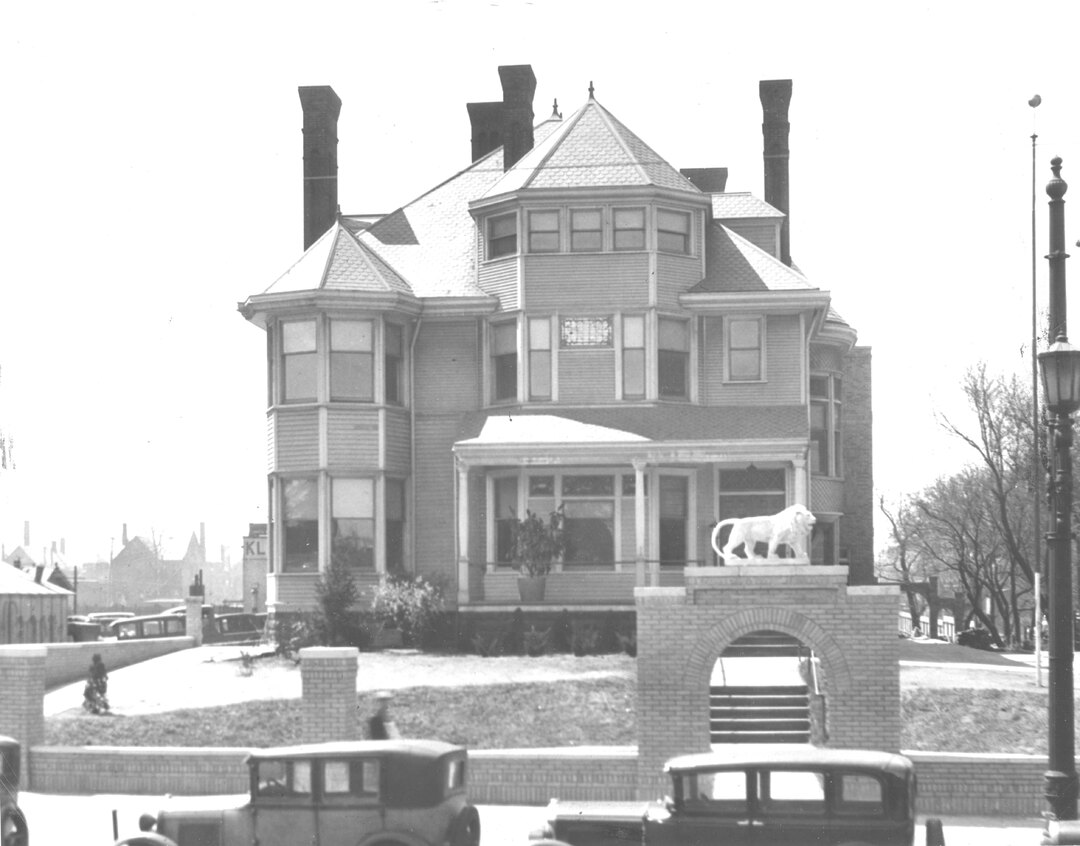
    <summary type="html"><![CDATA[<p><strong><em>There is a myth circulating in Cleveland that the  house at 2830 Franklin Boulevard was built in 1872 for Frederick W. Pelton, Cleveland's 22nd mayor.  Like many myths, it is not true.  The house was neither built in 1872, nor was it built for Mayor Pelton.  When it was built, who it was built for, and what prominent family first resided in it is the subject of this story.</em></strong></p><img src="https://clevelandhistorical.org/files/fullsize/80a03411fbd7cbb9745e280f4b056ae2.jpg" alt="The Spitzer-Dempsey House" /><br/><p>In the mid-afternoon hours of July 28, 1880, Col. John Dempsey, a banker from Shelby, Ohio, a small town in Richland County located  about 80 miles southwest of Cleveland, appeared at a sheriff's sale being held on the south steps of the Cuyahoga County Courthouse, in downtown Cleveland.  There, he made a successful bid to purchase an elegant house that  was designed by a reputable Cleveland architectural firm and located on the west side's grand Franklin Avenue.  The house had been built in 1879 for Ceilan Milo Spitzer, who, like Dempsey, was a banker.  However, before Spitzer could even move into his new house in early 1880, creditors of his German-American Bank, which had recently failed, forced its sale.</p><p>How and why John Dempsey came to Cleveland on July 28, 1880, to purchase the house that today has the address of  2830 Franklin Boulevard is lost to history.  However, the long path which eventually brought him to Cleveland is more easily discernible. Dempsey was born on May 27, 1829, in Mountrath, Queens County, Ireland to James and Catherine Key Dempsey.  In 1848, during the Great Famine in Ireland, his family immigrated to the United States, settling first in Sandusky, Ohio, where five members of the family, including his father and four of his siblings, died during a cholera outbreak.  By 1860, he had married Martha Davis and had moved to Richland County, where he was a merchant and Martha was raising their first child, one-year old son James.  Dempsey's business career was interrupted by the Civil War which broke out that year.  He joined a militia and gained military fame as one of the "Squirrel  Hunters" who defended Cincinnati from a threatened invasion by Southern troops in 1862.  Later, he served in the 48th Ohio Infantry and 163rd Ohio Voluntary Infantry, rising to the rank of Lieutenant-Colonel.  After the war's conclusion, Col. Dempsey returned to Richland County where in a short time he amassed a fortune in the  wholesale grocer and banking businesses and was reputed to be the wealthiest man in the county.  By 1871, he was semi-retired and breeding race horses on his farm called "Mohican" in nearby Plymouth Township.  Retirement--even semi-retirement--may not have suited John Dempsey and that may well have been why he  decided in 1880 to move to Cleveland, then the second largest city in Ohio, to find new opportunities and to grow his commercial empire.  In addition to purchasing the mansion on Franklin Avenue in July of that year, the following spring he erected a new commercial building on Bank (West 6th) Street and also became active in Cleveland's banking circles. In 1886, Dempsey became president of the newly chartered Euclid Avenue National Bank.</p><p>The house which John Dempsey purchased on Franklin Boulevard in 1880 had been designed by the architectural firm of Coburn and Barnum.  Two and one-half stories tall and with nearly 4,000 square feet of living space, its design mirrored almost exactly that of another house on Case Avenue (East 40th Street), south of Cedar Avenue, that Frank Barnum had designed just three years earlier.  The late 1870s was a period of transition for residential architecture in the United States, with interest in the Italianate style waning and enthusiasm for the new Queen Anne style not yet fully developed.  Barnum's design for the house at 2830 Franklin may therefore be called "eclectic," according to Cleveland architectural historian Craig Bobby, its elements drawing inspiration from several different architectural styles.  Its general massing, with its tower tucked into the "L" of the house, is borrowed from the  Italian Villa style, as is the shallow bay on the first floor, right side of the house.  The bracketing of the eves of the tower also suggests the Italianate style, but the tower's flat-topped cap reflects a Second Empire influence, and the house's gabled roof is not typical of Italianate houses.  The house's design also borrows from the Gothic Revival style, particularly the quatrefoils on the projection from the left side of the roof and the barge boards along the eves of the gabled roof on the right side of the house.  The current porch is not part of the original design.</p><p>Moving into the grand house on Franklin Avenue with John Dempsey and his wife Martha in 1880 were their daughters Mary Katherine (19), Nellie (12) and Florence (3).  Their son James, then a 21 year old college student, was living in Gambier, Ohio, where he was attending classes at Kenyon College.  During school breaks at Kenyon, and later during breaks at Columbia University where he attended law school, James resided with his parents in their house on Franklin Avenue.  According to biographers,  the first legal employment he found in Cleveland was in 1883 with the downtown law firm of Estep, Dickey and Squire.  Two of the named partners, Moses Dickey and Andrew Squire were, like John Dempsey,  Franklin Avenue residents.   Andrew Squire lived in a house--since razed--that sat on the lot of what today is the Lutheran Family Services building at 4100 Franklin Boulevard, and Moses Dickey lived just a stone's throw away up the street at what is today 4211 Franklin Boulevard.  It is no stretch of  imagination to believe that law student James H. Dempsey was first introduced by his father to neighbors Moses Dickey and Andrew Squire, and that John Dempsey's business reputation and his residency on Franklin Avenue were important factors in the law firm's decision to hire James.  In 1884, James H. Dempsey became a licensed attorney in Ohio, and, just six years later, he and Andrew Squire, along with Judge William B. Sanders, formed a new firm they called Squire, Sanders and Dempsey, which in the twentieth century became one of Cleveland's most prestigious law firms, specializing in corporate and municipal bond law.  Today, the firm is known as Squire Patton Boggs, and it has become an international law firm that employs thousands of lawyers and has offices in twenty different countries around the world.</p><p>In 1892, just two years after  his son co-founded Squire, Sanders and Dempsey, Col. John Dempsey again retired from business, this time for good.  In retirement, he spent winters living in the house on Franklin Avenue in Cleveland and summers at his beloved Mohican Farm down in Richland County, where he died in August 1904.  During this period, the Spitzer-Dempsey House became the year round residence of John Dempsey's oldest daughter, Mary Katherine, and her husband Ernest Cook, a prominent Cleveland lawyer and a close friend of James H. Dempsey.  After Mary Katherine's untimely death in 1898, Ernest and the couple's four children remained in the house on Franklin Avenue, which later was bequeathed to them out of the estate of John Dempsey.  Even after his children grew up and moved out, Ernest continued to live in the house until his death in 1929.  </p><p>By the time Ernest Cook died in 1929, Franklin Avenue, which had been renamed Franklin Boulevard in 1921, was well into its transformation from a grand avenue lined with the beautiful single family houses of Cleveland's west side elite to a much less grand avenue with many of its beautiful houses razed and others converted into retail establishments, apartments or crowded rooming houses.  After Cook's death, the Spitzer-Dempsey House too transformed. The 1930 federal census identified four families living at 2830 Franklin Boulevard in that year.  Ten years later, according to the 1940 census, nine families were now living in the house.  By 1945, according to an ad in the Plain Dealer, the house had 11 furnished suites.  Following its conversion into a multi-family dwelling, the the house slowly deteriorated over the years, especially during the second half of the twentieth century, reflecting the general decline in the condition of Cleveland's housing stock and the rapid decline of the city's population during this period.  By the 1980s, the Spitzer-Dempsey house was, like many other older houses on the near west side of Cleveland, vacant and in disrepair.  In 1981, it acquired local notoriety when the body of a murdered west side teenage girl was discovered in one of its upstairs rooms.  In the mid-1990s, the house experienced renewal, as many houses in Ohio City did, when it was rehabilitated by two lawyers who converted it into their law office.  One of the lawyers later also made it her residence.  Today, the Spitzer-Dempsey House is once again one of the grand and desirable residences on Franklin Boulevard in Ohio City.</p><p><em><strong><a href="https://clevelandhistorical.org/items/show/917">For more (including 15 images) view the original article</a></strong></em></p>]]></summary>
    <published>2020-11-05T15:32:38+00:00</published>
    <updated>2026-03-04T21:32:04+00:00</updated>
    <link rel="alternate" type="text/html" href="https://clevelandhistorical.org/items/show/917"/>
    <id>https://clevelandhistorical.org/items/show/917</id>
    <author>
      <name>Jim Dubelko</name>
    </author>
  </entry>
  <entry>
    <title type="html"><![CDATA[Allen-Sullivan House: A Forgotten and now Vanished Euclid Avenue Mansion]]></title>
    <summary type="html"><![CDATA[<p><strong><em>It was one of the last grand houses from the nineteenth century left standing on Euclid Avenue, once described as the most beautiful residential street in the world.  And yet, inexplicably, the house was never designated an historic landmark; it was not put to any productive use in the last two decades of its existence; and little effort was made by anyone to save it from the wrecking ball.</em></strong></p><img src="https://clevelandhistorical.org/files/fullsize/34f19b8ae7f5a112075e74bbca5c62aa.jpg" alt="The Allen-Sullivan House" /><br/><p>In the late nineteenth century, Cleveland's Euclid Avenue was considered by travel writers to be one of the most beautiful residential streets in the world, compared favorably to the grandest avenues in Europe.  At the height of its grandeur, nearly 300 majestic homes graced its north and south sides from East 9th Street to East 90th Street.  Only a handful--six or seven depending on your count--of those nearly 300 houses are still standing today.  The Allen-Sullivan House was one of them.  And now it is gone!.</p><p>Richard N. Allen (1827-1890) was a railroad engineer who invented the paper car wheel, which dampened wheel noise and vibrations, revolutionizing railroad passenger travel in the nineteenth century.  The Massachusetts native, who had lived in Cleveland for a short period in the 1860s, returned to the city in 1881 after opening a factory near the Pullman Company's factory complex in Chicago.  He did not move back because Cleveland was close to that factory.  It was not.  However, he may very well have decided to return because Euclid Avenue was here.  It was then home to most of the richest men in America, and, as a result of his business successes, Allen, the former railroad engineer, was now a very rich man.  </p><p>Allen and his wife Susan purchased a house on Euclid Avenue that had been owned by Ephraim J. Estep, a prominent Cleveland attorney.  The house, likely built in the 1850s by one of the founders of the Joseph & Feiss Company, was located on the south side of the Avenue, just a few houses from Giddings Avenue (East 71st Street).  While Euclid Avenue from Giddings to East Madison (East 79th Street) was not as grand and desirable a neighborhood as the more famous section between East 22nd and East 40th Streets, which in the early twentieth century became known as "Millionaires' Row," it was still a very grand and desirable place to locate indeed.  Among the Allens' new neighbors were Morris A. Bradley (7217), heir to a shipping fortune and the father of future Cleveland Indians owner Alva Bradley; William J. Rainey (7418), said to be the largest coal and coke operator in the United States; Hiram Haydn (7119), pastor of the Old Stone Church and future President of Western Reserve University; Dr. Hiram Little (7615), a physician who became one of Cleveland's largest real estate developers; Edward Lewis (7706), a co-founder of Otis Steel Company and later a principal of Lake Erie Iron Company; and J. H. Thorp (7801), vice-president of Forest City Varnish Company.  </p><p>In 1881, when the Allens arrived on the Avenue, there were nineteen grand houses on Euclid between East 71st and East 79th Streets.  Less than two decades later that number had increased to thirty-six as several large lots were subdivided and sold to make more land available on the Avenue for Cleveland elites.  Many of those new houses going up in those ensuing decades were of Queen Anne design, the most popular architectural style of the period.  Queen Anne design is characterized, according to "A Field Guide to American Houses," by a "steeply pitched roof of irregular shape, usually with a dominant front-facing gable; patterned shingles, cutaway bay windows, and other devices used to avoid a smooth-walled appearance; and an asymmetrical facade with partial or full-width porch which is usually one story high and extended along one or both side walls."  </p><p>Perhaps simply to keep up with the Joneses, Richard and Susan Allen tore down the old Estep House in 1887 and built in its place a new three-story Queen Anne house.  According to local architectural historian Craig Bobby, this house, with approximately 9,000 square feet of living area, might have been viewed as "subdued" compared to other Queen Anne Houses that were built on Euclid Avenue in this period, but its massing was nevertheless "robust."  The house's boldest architectural feature was "an atypically wide, off-center bay . . . that [rose]  up onto the roof, nearly becoming a turret."  The house also featured a true turret on the east end of its front facade, which was deemphasized by a front porch which embraced the off-center bay, and bay windows on its east and west sides.</p><p>Richard Allen did not live very long after his mansion was completed.  He died suddenly in 1890 at the age of 63.  His widow Susan lived in the house until 1898, when she decided to move back to their native Massachusetts.  The house was then sold to Jeremiah J. Sullivan, a prominent Cleveland banker.  Sullivan, an Irish immigrant who moved to Cleveland in the early 1890s, was the founder of Central National Bank, which was one of  Cleveland's largest banks in the twentieth century.  In 1968, it erected the Central National Bank Building on the southwest corner of East Ninth and Superior.  The 23-story building--today known as  the AmTrust Financial Building--was at the time the fifth tallest building in downtown Cleveland. </p><p>When the Sullivan family moved onto Euclid Avenue in 1898, the Avenue was at its peak of wealth and elegance. Joining the Sullivan family as new residents of the East 71st-East 79th section of the grand Avenue in this decade were other prominent Clevelanders, including Dan Hanna (7404), the son of iron magnate and presidential kingmaker Marcus Hanna, and the future owner and publisher of the Cleveland Leader and the Cleveland News; David Z. Norton (7301), a Cleveland banker and principal of Oglebay Norton & Co., a large iron ore mining and shipping company; and Worchester Warner (7720) and Ambrose Swaney (7808), founders of machine and tool industrial giant, Warner and Swasey, and also life-long friends who built their Euclid Avenue houses next door to each other, just west of East 79th Street. These families were all witnesses not only to the zenith of the Avenue, but also to the beginning of its decline as a grand residential street.  By the time the Sullivan family moved out of their house in 1923 shortly after Jeremiah's death, Cleveland's elite were already fleeing the Avenue, as a result, according to Euclid Avenue historian Jan Cigliano, of encroaching commercial businesses,  the running of streetcars up and down Euclid Avenue, and a growing nearby African-American ghetto.  By 1930, only two elite families still resided on the section of Euclid Avenue between East 71st and East 79th--octogenarian Ambrose Swasey, who lived in his house until his death in 1937, and the son of David Z. Norton, who left the family's Avenue mansion for Cleveland Heights in 1939.</p><p>As Euclid Avenue declined as a residential street in the twentieth century, many of its grand houses were torn down, but others were put to different uses, sometimes commercial, sometimes multi-family, and sometimes institutional.  The Allen-Sullivan House was one of those put to other uses.  After the departure of the Sullivan family, it first served, from 1923 to 1931, as an upscale furniture store known as The Josephine Shop.  Then, in 1934, during the Great Depression, the house was purchased by the The Grand Lodge of Ohio, Order Sons of Italy (SOI) in America, an Italian-American fraternal organization.  The SOI made it their Ohio Grand Lodge, adding an auditorium onto the rear of the house.  On June 2, 1935, the organization held a dedication ceremony on the site, attended by many local, state and foreign dignitaries, including the Italian ambassador.  It was the first time that an ambassador from Italy had visited the State of Ohio.  </p><p>The SOI occupied the Allen-Sullivan House until 1946 when it sold it to the American Society of Heating and Ventilating Engineers (today known as ASHRAE--the American Society of Heating, Refrigerating and Air-Conditioning Engineers).  ASHRAE opened a national research laboratory on the site, operating it there from 1946 until 1961, when the laboratory closed.  The property was then sold in 1964 to Mary Fisco, spouse of Benjamin Fisco, an Italian immigrant who restored the house to its condition existing during the period when it was owned by the Sons of Italy. Fisco operated a party center there known for years as the Coliseum (or Colosseum) Party Center.  The party center closed in the late 1990s, several years after the death of Benjamin Fisco.   </p><p>Since the year 2000, according to City of Cleveland officials and others, the house had been vacant except for an onsite caretaker.  In that same period, a new owner purchased and assembled five sublots on and off Euclid Avenue near East 71st Street, including that upon which the Allen-Sullivan House stood.  According to officials at MidTown Cleveland, Inc., the owner of those properties had listed them for sale with an asking price of $3 million.  Given this owner's desire to sell, and the City of Cleveland's desire to continue redevelopment of its Midtown Corridor along Euclid Avenue, the future of the Allen-Sullivan House was precarious and it likely could not have avoided demolition without an effort on the part of the City and/or the future developer to save it. </p><p>While this was going on and the house still was standing, ASHRAE waged a campaign to have an Ohio historical marker placed in front of the Allen-Sullivan House to commemorate the national research laboratory that its organization operated there from 1946 to 1961.  When you consider all the history that was made at this, the last-standing Queen Anne-style house on the once grand residential Euclid Avenue, an historical marker alone should not have been enough.  The grand house itself should have been saved.</p><p>On June 21, 2021, time ran out for the Allen-Sullivan House.  No savior was found.  The house was torn down to make room for a city-approved apartment complex.  And so ends the story of one of the last grand houses standing for over a century on Euclid Avenue.</p><p><em><strong><a href="https://clevelandhistorical.org/items/show/864">For more (including 15 images) view the original article</a></strong></em></p>]]></summary>
    <published>2019-02-04T19:50:55+00:00</published>
    <updated>2026-03-04T21:32:04+00:00</updated>
    <link rel="alternate" type="text/html" href="https://clevelandhistorical.org/items/show/864"/>
    <id>https://clevelandhistorical.org/items/show/864</id>
    <author>
      <name>Jim Dubelko</name>
    </author>
  </entry>
  <entry>
    <title type="html"><![CDATA[Standard Brewing Company: What Ever Happened to Erin Brew Beer?]]></title>
    <summary type="html"><![CDATA[<p><strong><em>When the Standard Brewing Company sponsored the TV and radio broadcasts of Cleveland Indians games in 1948 (the year the Tribe last won the World Series), the company's Erin Brew beer, for decades a favorite in the city's Irish-American community, suddenly became one of the most popular beers in all of Cleveland. </em></strong></p><img src="https://clevelandhistorical.org/files/fullsize/246ee1e9dabac3347720325b2b5e7508.jpg" alt="Delivering Neighborhood Beer" /><br/><p>Train Avenue on the west side of Cleveland is undoubtedly so named because it follows the tracks of the Big Four Railroad in a northeasterly direction from the old Stockyards near Clark Avenue and West 61st Street almost all the way to the Cuyahoga River.  If you travel to Train Avenue's western end today, you'll see on the south side of the street—just before you get to the West 61st Street intersection—several old red brick buildings.  Near the top of one are two granite stones, one carved with the word "Bottle" and the other with "Works."  On the building next to that, you'll see another granite stone, this one carved with the year "1913." Whether you're a beer lover or not, give yourself a pat on the back, for you have just arrived at the place where the Standard Brewing Company once manufactured Erin Brew beer—one of the most popular beers in the history of Cleveland.</p><p>The Standard Brewing Company had its origins in the founding of the Kress-Weiss Brewing Company in 1902.  In that year, Stephen S. Creadon, a west side saloonkeeper and second generation Irish-American, entered into an agreement with German immigrant brewer Andrew Kress  and several investors to produce a weiss (light wheat) beer out of an old butcher shop located on the corner of Sackett and Louis (West 32nd) Streets, in today's Clark-Fulton neighborhood.  Unfortunately, the venture faltered, and Creadon and Kress soon parted ways.  In 1904, Creadon, who retained the lease to the brewery building, brought in new investors and Jaroslav Pavlik, a Czech immigrant brewer, and incorporated anew under the name of the Standard Brewing Company. Pavlik brewed lager beer—darker and heavier than weiss beer—and sales quickly took off. The following year, the growing firm recapitalized and moved to a larger facility, an old flour mill located on the north side of Train Avenue near the West 61st street intersection.</p><p>Just one year after moving to its new location, the young company faced a serious challenge to its continued existence.  In November 1906,  J. P. Kraus, a banker with First National Bank which had financed the new venture and controlled most of the company's stock, proposed that its directors approve a sale of their business to Cleveland and Sandusky Brewing Company.  The latter was a large regional brewery which had been gobbling up local independent breweries in the Cleveland and Sandusky areas since 1897.  Standard Brewing's directors—led by Creadon, whose experiences as a saloon keeper had perhaps persuaded him to stay away from conglomerates—voted to stay independent and rejected the proposed sale.  However, Creadon now had to find new financing for his company and find it quickly.  His search ended with John T. Feighan, a Forest City Savings and Trust Company banker, who, like Creadon, was a member of the west side Irish community.  Feighan's bank, which since 1903 had been located in a new building on the southwest corner of Pearl (West 25th) Street and Detroit Avenue, was right across the street from Creadon's other business—his neighborhood saloon.  Soon Feighan became not only a lender and director of Standard Brewing, but also an officer of the company, serving first as its treasurer and then later as its president after Creadon's death in 1921.</p><p>Creadon's savvy in the saloon business, Feighan's business acumen, and Pavlik's brewing skills:  They were a winning combination.  By 1913, new brewery buildings had gone up on both the north and south sides of Train Avenue and the company was now marketing Pavlik's lager under the name of Erin Brew, making it a favorite among Cleveland's west side Irish-American community.  According to the company's 1914 corporate report, between the years 1906 and 1913 it almost doubled production, increasing annual output from 40,000 barrels to 75,000 in that period.  As it approached the end of that decade, Standard Brewing Company had become one of Cleveland's largest and most successful independent breweries.  Then, in 1919, the State of Ohio banned the sale and manufacture of liquor within the state, and one year after that the Eighteenth Amendment to the U.S. Constitution was passed, ushering in the era of national Prohibition.  Standard Brewing Company, like several other Cleveland breweries that survived Prohibition, converted its manufacturing facilities to the production of ginger ale and other soft drinks.  When Prohibition ended in 1933, those breweries were able to quickly shift production back to beer.  By May of that year, Standard Brewing Company was once again producing Erin Brew beer for a very thirsty consumer public.</p><p>In the 1940s, just after the end of World War II, Standard Brewing Company, under the leadership of John T. Feighan and George Creadon, son of founder Stephen Creadon, entered into a series of annual agreements to sponsor radio and TV broadcasts of Cleveland Indians baseball games.  When the Indians won the World Series in 1948, Erin Brew beer went from being the favorite beer of Cleveland's Irish community to being one of the most loved beers in all of Cleveland.  Responding to this increased demand, in 1950 the company built an extensive new bottling and canning facility just west of its earlier twentieth-century buildings on Train Avenue.  Sadly, this would be the peak of Standard Brewing Company's successful operations in Cleveland.</p><p>The decade of the 1950s marked the beginning of the end for Cleveland's brewing industry, as a changing consumer public and improved transportation facilities promoted the success of large national breweries at the expense of smaller local breweries.  Standard Brewing Company was one of the last of Cleveland's independent breweries to succumb, selling its brewery facilities to the F & M Schaefer Brewing Company of New York in 1961.  Three years after that, Schaefer sold the facilities to C. Schmidt & Sons Inc., a large Philadelphia brewery.  By the mid-1960s, Erin Brew was replaced by Standard Premium and soon the once most popular beer in Cleveland was just a memory.</p><p><em><strong><a href="https://clevelandhistorical.org/items/show/809">For more (including 14 images) view the original article</a></strong></em></p>]]></summary>
    <published>2017-07-08T16:21:19+00:00</published>
    <updated>2026-03-04T21:32:03+00:00</updated>
    <link rel="alternate" type="text/html" href="https://clevelandhistorical.org/items/show/809"/>
    <id>https://clevelandhistorical.org/items/show/809</id>
    <author>
      <name>Jim Dubelko</name>
    </author>
  </entry>
  <entry>
    <title type="html"><![CDATA[Masterson-Bivins Park: Twice Dedicated, Twice Forgotten, and Now Remembered]]></title>
    <summary type="html"><![CDATA[<p><strong><em>It is one of Cleveland's smallest parks.  Not much more than a patch  of grass and a lamp post on the northwest corner of West 25th Street and Detroit Avenue.  But it is an important public space-- dedicated twice, over the course of the last ninety years, as a memorial to two different legendary Clevelanders--Ward Eight political boss Bernard "Brick" Masterson and famed boxer James Louis "Jimmy" Bivins.</em></strong></p><img src="https://clevelandhistorical.org/files/fullsize/33a01ceebda7a1f7819cba73d7f650f2.jpg" alt="A Very Small Park" /><br/><p>It  was, in the first place, road and bridge improvements that created the park — almost as an afterthought.  For much of the first two decades of the twentieth century, the city of Cleveland had planned and then constructed Bulkley Boulevard (today, the west Shoreway) and then the Detroit-Superior Bridge, thereby providing more direct access for Clevelanders living on the east side to travel to Edgewater Park on the west side.  To address anticipated congestion from traffic coming off the new bridge near West 25th Street, the city purchased, and in 1917 razed, several buildings on Detroit  and Vermont Avenues, immediately west of West 25th, using part of the  cleared land  to create a fan-shaped entrance way onto Bulkley Boulevard.  The land that was left over after the fan-shaped entrance way had been created?  Well, little thought was apparently given to it until west side Councilman Michael H. Gallagher came along and decided that the remnant land should be a park serving as a memorial to Bernard "Brick" Masterson.</p><p>In 1917, Gallagher, a Republican, had been elected Ward Eight Councilman — the ward that then encompassed much of the near west side — defeating three-term incumbent Democrat,  William J. Horrigan.   Gallagher owed much of his electoral success to Brick Masterson, the Republican ward leader.   Masterson, who also was owner of a popular saloon at 1313 West 25th Street, was known on the west side as  "Mayor of the Angle."  This was perhaps due to his success in turning out the Republican vote in 1909, which contributed significantly to the stunning defeat  of Cleveland's most famous mayor, Tom L. Johnson.  Nine years after Johnson's defeat, and just four months after he engineered Michael Gallagher's  victory  over incumbent Councilman Horrigan, the 44-year old Masterson died tragically from a fall he suffered on St. Patrick's Day.  </p><p>While other politicians likely forgot the colorful ward leader soon after his very public funeral, Councilman Gallagher did not.  In 1921,  several years after the entrance way to Boulkley Boulevard at West 25th and Detroit had been created, he successfully sponsored legislation to make that small leftover piece of land a park named "Masterson Square."  And while some may have poked fun at the little park, as the Plain Dealer did in an article published in 1926, for decades Masterson Square served as a gathering place for community events in the historically Irish Old Angle neighborhood.  As late as 1944, it  was the site of a gala fundraising event for the new memorial chapel at nearby St. Malachi Catholic Church.  And then, apparently, as time passed, and the ethnic composition of the neighborhood changed, the park lost its public identity as a memorial to Brick Masterson.  </p><p>In the year 2000, eight decades after the park had been first named as the result of one Cleveland councilman's efforts, another Cleveland councilman came along — Ward 14's Nelson Cintron, who decided that it would be a great idea to honor boxing great Jimmy Bivins by naming the park, which was by this time apparently only known to city officials as the "Detroit-West 25th Street park,"  after him.  </p><p>James Louis "Jimmy" Bivins, an African American whose family moved from Georgia to Cleveland in 1921 during the Great Migration, was one of the city's best boxers ever, fighting both as a light heavyweight and as a heavyweight.  His professional career lasted from 1940 to 1955, during which time he amassed a record of 86-25-1.  During the years of World War II, he won the "duration" championship — awarded when Joe Lewis and others were away in the service — in both the light heavyweight and heavyweight classes.  Bivins retired from boxing in 1955, but afterwards he became  a trainer at the Old Angle Gym, which for many years was located in the Campbell Block, a building catty-corner across the street from Masterson Square.  There, Bivins not only trained young men--many of whom came from impoverished areas of the near west side, but he also became a partner in the operation of the gym, contributing his money as well as his time to keeping the gym going, at a time when many Cleveland boxing gym owners were hanging up their gloves for good.  After the Campbell Block was torn down in 1975, Bivins moved the gym first to the West Side Community House at West 30th Street and Bridge Avenue, and then in 1978 to St. Malachi School, where he taught boxing to kids there until 1996 when old age and personal tragedy ended his career as a trainer.</p><p>On October 4, 2000, Cleveland City Council passed Councilman Cintron's sponsored legislation to name the little park at the corner of West 25th and Detroit Avenue  "Jimmy Bivins Park."  But no plaque or other signage was ever put up to identify the park.  And so it remained for fifteen years until 2015, when a redevelopment proposal came before the City that included the land upon which the park was located.  During the redevelopment review process, the City not only learned that the proposal included land that was a city park, but also that the park had been named on two different occasions in honor of two different legendary Clevelanders.  City officials are now considering  the possibility of upgrading the park, and, hopefully, once and for all, resolving its name.</p><p>2021 Update:  Apparently, the City has resolved the issue of the twice-named little park by reaffirming that it is Jimmy Bivins Park in honor of the late, great Cleveland boxer. Signage honoring Bivins has gone up in the park area on the northwest corner of Detroit Avenue and West 25th Street.</p><p><em><strong><a href="https://clevelandhistorical.org/items/show/752">For more (including 12 images) view the original article</a></strong></em></p>]]></summary>
    <published>2015-12-16T07:42:43+00:00</published>
    <updated>2026-03-04T21:32:03+00:00</updated>
    <link rel="alternate" type="text/html" href="https://clevelandhistorical.org/items/show/752"/>
    <id>https://clevelandhistorical.org/items/show/752</id>
    <author>
      <name>Jim Dubelko</name>
    </author>
  </entry>
  <entry>
    <title type="html"><![CDATA[Boxing in the Old Angle Neighborhood: From Johnny Kilbane to Jimmy Bivins]]></title>
    <summary type="html"><![CDATA[<p><strong><em>Cleveland has a rich history of amateur and professional boxing.  Much of it derives from the establishment of a number of athletic clubs and gymnasiums that were started on the near west side in the the late nineteenth and early to mid-twentieth centuries.  St. Malachi's La Salle Literary and Athletic Club in 1894.  Jimmy Dunn's gymnasium at 2618 Detroit in 1910.  Danny Dunn's gymnasium at 2861 Detroit in 1927.  And, the Old Angle Gym in the Campbell Block on  West Superior Avenue in 1943.  These gyms--which over the years trained hundreds, if not thousands, of amateur and professional boxers, including featherweight champion Johnny Kilbane, top heavyweight contender Johnny Risko, and "duration" champion Jimmy Bivins, were all located at or near the intersection of West 25th Street and Detroit Avenue, making the area--just south of the Old Angle neighborhood, an historic epicenter of boxing in Cleveland.</em></strong></p><img src="https://clevelandhistorical.org/files/fullsize/27a4ec60c18084f2f426ee321ca18f50.jpg" alt="The Epicenter of Boxing in Cleveland" /><br/><p>Boxing in the Old Angle, an historic Irish neighborhood located on Cleveland's near west side, has deep roots,  reaching back at least as far as the year 1894 when Brother Salpicious of the Christian Brothers of the La Salle Order founded the La Salle Literary and Athletic Club at St. Malachi school for boys on the corner of Pearl Street (West 25th) and Division Avenue.  The Club encouraged boys attending St. Malachi to engage in a number of sports, including boxing.  It achieved national attention in 1912 when it sponsored the St. Patrick's Day parade in Cleveland, featuring new featherweight boxing champion Johnny Kilbane, who had learned to box at the La Salle Club in the first decade of the twentieth century.</p><p>As young school boys who trained at the La Salle Club grew older, other, more professional places were needed to provide continued training in the sport of boxing.  Johnny Kilbane, and others like Tommy Kilbane (no relation), Tommy (later "Black Jack") McGinty, and "Young Brick" Masterson, at first often had to travel out of the  Old Angle neighborhood to places like Volk's Gymnasium downtown on Prospect Avenue to train.  But in 1910, that changed when Jimmy Dunn, legendary trainer of Johnny Kilbane and other early twentieth century fighters, opened his first professional gym in the Angle neighborhood at 2618 Detroit Avenue--just a block west of the intersection of West 25th Street and Detroit.  According to an article which appeared that year in the Plain Dealer, Dunn's new establishment was "fitted up as completely as any gym in the city."  Johnny Kilbane was training out of Dunn's Gym at 2618 Detroit when he won his featherweight boxing crown in 1912.</p><p>Other gyms sprouted up in the neighborhood, and elsewhere, as the sport of boxing--thanks in large part to Johnny Kilbane's fame, became more popular in Cleveland in the 1920s and was viewed as a way to climb out of poverty, despite official discouragement of the sport from City Hall.  Jimmy Dunn's Gym at 2618 Detroit saw a succession of new owners, including Tommy "Black Jack" McGinty, the Frisco Club and others, including former boxer Bryan Downey who, around 1930 closed the gym at this location and opened a new one downtown on Superior.  Danny Dunn (a cousin of Jimmy Dunn), who for a short time managed the gym his cousin had founded, opened his own gym just up the street at 2816 Detroit in 1926. It became a neighborhood fixture for over a decade, training many boxers, until it closed around 1941.  Its most well-known boxer was Johnny Risko, a Slovak immigrant and heavyweight boxer, who trained at the gym in the decades of the 1920s and 1930s when he was one of the top contenders in the United States for the heavyweight crown.</p><p>Shortly after Danny Dunn's gym closed, as well as Bryan Downey's downtown in the same year, a movement appears to have begun in 1943 to bring a boxing gymnasium back to the Old Angle.  Prominent among the people involved in the movement was John A. Keough, a third generation Irish-American born in the Angle neighborhood, whose son John M. "Jackie" Keough, a welterweight, was one of the top boxers in Cleveland in the 1940s.  In or about 1943, Keough and a partner opened a gym in two rooms and an allotted basement area of the Campbell Block, an historic building erected in 1891 by Alexander Campbell, the grandfather of another famed fighter--Admiral Isaac Campbell Kidd, who went down fighting on the USS Arizona at Pearl Harbor on December 7,  1941.  </p><p>Located near St. Malachi Church and just a block north of the intersection of West 25th and Detroit Avenue, the gym was named the "Old Angle" gym, according to one source, by former boxing champion Johnny Kilbane.  For much of the next three decades, the Old Angle Gym was THE place to train on the west side of Cleveland. It operated out of the Campbell Block from 1943 until 1949.   In 1950, Keough opened a new Old Angle Gym  in the Rhodes Building at 1699 West 25th Street. This Old Angle Gym—sometimes also called the Old Angle Athletic Center— remained at that location until 1959, when Keough moved it back to the Campbell Block.  </p><p>One of the boxers attracted to the Old Angle Gym was James Louis "Jimmy" Bivins, an African American, whose family moved to Cleveland from Georgia in 1921 when he was just two years old.  Bivins fought as both a light heavyweight and heavyweight, winning the "duration" title in both weight classes during World War II.  After retiring from boxing in 1955, Bivins returned to the Old Angle gym to become a trainer, introducing a whole new generation of  kids living in the neighborhood to the "sweet science," including bantamweight Gary Horvath, who won multiple Golden Gloves championships in the decade of the 1960s.  Later, after Keough and his partners retired from management of the gym, Bivins and Horvath took over, operating the Old Angle Gym out of the Campbell Block until that building was torn down in 1975.  Afterwards, the two operated a boxing gym for several years in the West Side Community Center at West 30th Street and Bridge Avenue, and then Bivins opened up a boxing gym at St. Malachi Church--where it all started, for neighborhood youths in 1979, running it until the mid 1990s. </p><p>In the year 2000, in recognition of the contributions which Jimmy Bivins made to the community both as a legendary boxer and as a trainer of young boxers on the near west side,  the City of Cleveland, figuratively speaking, returned to the historic intersection of West 25th Street and Detroit Avenue, passing legislation to name the little park on the northwest corner of  that intersection "Jimmy Bivins Park."  Unknown to city officials at the time, the same park had eighty years earlier been dedicated as a memorial to Bernard "Brick" Masterson, a popular near west side ward leader, who was also associated with the sport of boxing--as a member of the historic La Salle club and as the father of a promising young boxer who, in the early days, trained with Johnny Kilbane in Jimmy Dunn's gym on  Detroit Avenue.  No matter the inadvertent slight to "Brick."  Had he been alive to witness the renaming of his park,  he probably would have been honored to share it with a man like Bivins.  It would be  entirely in keeping with history and tradition at this epicenter of boxing in Cleveland.</p><p><em><strong><a href="https://clevelandhistorical.org/items/show/750">For more (including 13 images) view the original article</a></strong></em></p>]]></summary>
    <published>2015-11-30T05:22:25+00:00</published>
    <updated>2026-03-04T21:32:03+00:00</updated>
    <link rel="alternate" type="text/html" href="https://clevelandhistorical.org/items/show/750"/>
    <id>https://clevelandhistorical.org/items/show/750</id>
    <author>
      <name>Jim Dubelko</name>
    </author>
  </entry>
  <entry>
    <title type="html"><![CDATA[Campbell Block: Gone, but still remembered in the Old Angle]]></title>
    <summary type="html"><![CDATA[<p><strong><em>On September 19, 1975, the late George Condon, legendary Plain Dealer columnist and author of many books about Cleveland's history, wrote that the Campbell Block--condemned and slated for imminent demolition, was unworthy of historical recognition and should not be saved.  "If there is anything historic about the Campbell Block it would have to be the historic drinking and arguing that took place in Green's Cafe at the street level, or in the furious thumping and rope-skipping that occurred in the Old Angle Gymnasium, on the High Level Bridge side of the building,"  he wrote.  With all due respect to George Condon, the Campbell Block had a richer history than his column suggested.</em></strong></p><img src="https://clevelandhistorical.org/files/fullsize/5782d97ac9360feaf3f917923f0d1f59.jpg" alt="The Campbell Block" /><br/><p>The Campbell Block was for many years one of the most recognizable buildings in the Old Angle neighborhood on Cleveland's near west side.   It was actually at one time two separate buildings located just east of Pearl (West 25th) Street, between Vermont and Viaduct Avenues.  Both were built by Alexander Campbell and both came about as a result of the construction of the Superior Viaduct, Cleveland's first high level bridge, which opened to traffic in 1878. In the course of planning construction of the west side approach to the Viaduct, the City had purchased an eighty foot wide swath of land (part of the Alonzo Carter Allotment) located just east of the intersection of Pearl Street and Vermont Avenue. This purchase split a number of parcels of land and, among other things, created a triangular piece of land with frontage on Pearl Street, Vermont Avenue and the new Viaduct Avenue. During the period 1877-1882, Campbell, a Scottish immigrant who had settled in Cleveland in 1867 and had become a prominent paving contractor in the city, purchased all of the land interests which comprised the triangular area with the intent of constructing a commercial building and hotel on the land.</p><p>Campbell's first building, identified on early maps as "Campbell's Block" and located on the eastern part of the triangular piece of land, was a three-story wood and brick building which fronted on Viaduct Avenue.  It was completed in 1880. The upper two floors were devoted to apartment suites, while the first floor was divided into seven store fronts for retail merchants, among whom over the years were butchers, confectioners, cigar-makers, barbers, saloon keepers and others.  One of those store fronts was home to the offices of the Cleveland Graphic, a weekly Democrat newspaper. And, in 1886, according to the Plain Dealer, this was where Charles Salen, co-owner of the Graphic and County Democrat party leader, organized Cleveland's first amateur baseball league, which played its games on the southeast side at Beyerle's Park (later called Forest City Park) for several years, before moving to Brookside Park on the west side.</p><p>The second Campbell Block building—which many Clevelanders still remember—was built in 1892, just to the west of the first building.  It was a red brick five-story building that was originally planned as a hotel, but became instead an apartment building with retail store fronts on the first floor. This building had frontage on both Viaduct Avenue and Pearl Street. In 1897, the building received acclaim for its innovative fire escape system—called the "Burden" fire escape, which enabled fire fighters to extract people from a burning building using a wire basket hauled along rails attached to projections from the roof and exterior sides. This new fire escape had been promoted and installed on the building by Isaac Kidd, Alexander Campbell's son-in-law and the father of the future-famed World War II war hero, Admiral Isaac Campbell Kidd. Like the first building, this building also had a variety of retail tenants on the first floor.  In the post World War II era, the most famous of these in the neighborhood were J & L Seafoods, Green's Cafe, and the Old Angle Gym.</p><p>By the time World War II arrived, Alexander Campbell's heirs now owned and managed the two Campbell Block buildings. In 1948, the first building--said by one County official to be in "very poor shape," was torn down and in the same year the second was conveyed out of the family.  Gradually, as the surviving building aged and deteriorated, it emptied of its apartment residents and became--from a revenue perspective, primarily a site for billboard signs.  It's three locally famous first floor tenants—J & L Seafoods, Green's Cafe, and the Old Angle Gym, however, continued to operate their businesses there until the very the end.  That end came in late December 1975 when a wrecking ball knocked down the building, demolishing  the Block that the Superior Viaduct and Alexander Campbell had created almost 100 years earlier.</p><p><em><strong><a href="https://clevelandhistorical.org/items/show/749">For more (including 11 images) view the original article</a></strong></em></p>]]></summary>
    <published>2015-11-28T15:00:51+00:00</published>
    <updated>2026-03-04T21:32:03+00:00</updated>
    <link rel="alternate" type="text/html" href="https://clevelandhistorical.org/items/show/749"/>
    <id>https://clevelandhistorical.org/items/show/749</id>
    <author>
      <name>Jim Dubelko</name>
    </author>
  </entry>
  <entry>
    <title type="html"><![CDATA[Bluestone Quarries: Euclid Township&#039;s &quot;Bluestone Rush&quot; Boomtown]]></title>
    <summary type="html"><![CDATA[<img src="https://clevelandhistorical.org/files/fullsize/cbe7476989dd05c70343ae2a4adbab2e.jpg" alt="Bluestone Quarry" /><br/><p>Denison Park, which anchors the northeastern edge of Cleveland Heights just west of Euclid Creek, straddled one of the old Euclid bluestone quarries that dotted the landscape to the east of Cleveland. Nearby, a town called Bluestone appeared in Euclid Township in present-day South Euclid to serve several quarries, including that of Irish-born Duncan McFarland on Euclid Creek. Peopled by mostly by Irish and Italian immigrants, the town was a wide-open boomtown with a general store and saloon, not unlike western mining towns. Railway spurs opened to carry the heavy loads of stone to market. Euclid bluestone was used widely in the Cleveland area and in Detroit, Milwaukee, and Buffalo as flagstone for sidewalks, exterior steps, windowsills, and a host of other applications. </p><p>The boomtown atmosphere of the village of Bluestone settled down as the quarrying business slowed in the 1900s and 1910s, and by the 1920s the Cleveland Metropolitan Park Board transformed the largest of the quarries into a portion of the Euclid Creek Reservation. Bluestone quarrying never regained its former importance but did continue in limited form under the aegis of the WPA in the 1930s. The old Euclid City Hall, now the Cleveland-Style Polka Hall of Fame, is among the few reminders of that effort.</p><p>The northeastern section of Cleveland Heights, almost rural as late as the 1920s, began to fill with subdivisions, a process that accelerated as the last farmlands gave way to the bulldozers in the years after World War II, aided by the WPA-constructed Monticello Boulevard in the late 1930s. Impressive growth helped raise Cleveland Heights's population to around 60,000 by the early 1950s. In response to the need for convenient recreational facilities to relieve having to travel up to three miles to use the nearest city parks, in 1955, Denison Park opened on the site of one of the bluestone quarries that had been used for years thereafter as a city dump. Named for Cleveland Heights councilman Robert F. Denison, it added a swimming pool in 1968 to relieve overcrowded Cumberland Pool. In recent years, with populations trending downward, the pool closed.</p><p>The suburban development that followed the "bluestone rush" reflected its legacy. In the Noble-Monticello area of Cleveland Heights, Bluestone and Quarry roads were so named for their proximity to Nine Mile Creek on the western fringe of the Euclid Creek quarrying area. Today many slabs of bluestone remain intact on Cleveland Heights sidewalks, although many are nearing the end of their useful life due to damage from vehicles, freeze-and-thaw cycles, and erosion. The Bluestone condominium development on Mayfield Road also keeps the name alive.</p><p><em><strong><a href="https://clevelandhistorical.org/items/show/552">For more (including 6 images&#32;&amp;&#32;6 audio files) view the original article</a></strong></em></p>]]></summary>
    <published>2012-09-15T14:17:18+00:00</published>
    <updated>2026-03-04T21:32:01+00:00</updated>
    <link rel="alternate" type="text/html" href="https://clevelandhistorical.org/items/show/552"/>
    <id>https://clevelandhistorical.org/items/show/552</id>
    <author>
      <name>J. Mark Souther</name>
    </author>
  </entry>
  <entry>
    <title type="html"><![CDATA[Dredging the Bend]]></title>
    <summary type="html"><![CDATA[<img src="https://clevelandhistorical.org/files/fullsize/aa79dc34a084a5624e3c290d8d956cba.jpg" alt="Irishtown Bend" /><br/><p>Irish immigrants flocked to Cleveland after the potato famine in 1848. Along the Cuyahoga River in Ohio City grew a concentrated Irish neighborhood known as Irishtown Bend. It was so named because of the Irish shantytown located along one of the curves of the Cuyahoga River.  This neighborhood centered on Riverbed Street, but ranged from West 25th Street eastward to the Cuyahoga River, and between Detroit Avenue southward to Columbus Street.  </p><p>Irishtown Bend was located in the heart of Cleveland's industrial infrastructure.  A significant number of Irish worked in the shipping industry that thrived along the Cuyahoga River as part of the extensive Great Lakes trading network.  For Irishtown Bend, the shipping industry came in the form of ore docks used to load and unload the massive freighters that traversed the Great Lakes.</p><p>Although essential to Cleveland's industrial well-being, trade, and Irish population, the Cuyahoga River proved to be its own worst enemy.  Cuyahoga literally means crooked river, and it earned a sinister reputation because of how treacherous it was to navigate, particularly in a 500-foot freighter. In 1901, Cleveland discussed straightening the Cuyahoga River to alleviate the problems of navigating it.  The first detailed study did not begin until 1912, and work did not occur until the mid-1930s, continuing intermittently into the 1950s.</p><p>When discussion of altering the Cuyahoga River began at the turn of the 20th century, the fate of the river and those who depended on it became untenable.  Proposed plans involved cutting land to make river bends wider, or completely re-rerouting the river.  The possibility of eminent domain threatened the homes and livelihoods of those living and working along the river.</p><p>The approval of an improvement plan in 1929 called for the widening of the river at Irishtown Bend, which required the demolition of the shanty homes erected on its hillside.  Dredging of the river did not occur at Irishtown Bend until 1938, but even after this initial alteration, the Plain Dealer reported that Irishtown Bend was still a nuisance.  By the mid-1950s, what was left of Irishtown Bend's residential area was either dilapidated or abandoned, and the area was razed in 1958 to prepare for a second attempt to alter the river.</p><p>River improvement was not the only reason for razing the Irishtown Bend slums, however, as a $10 million public housing project had also been approved in an attempt to revitalize the neighborhood.  The highlight of the housing project was a pair of 16-story buildings called Riverview Towers, which still prominently stand.  Unfortunately, the housing project did not fulfill the proposal's intent to revitalize the neighborhood.  While the entire housing project was intended to attract residents of diverse stages in life, young and middle-aged suitors mistook the project as one exclusively for elderly residents. </p><p>Local magnate Jeffrey P. Jacobs planned further development of Irishtown Bend in 1989 but a geographical survey revealed the remainder of undeveloped land at Irishtown Bend was too unstable for any further development. In 2019, federal funds enabled the stabilization of the river bank and the transformation of the Bend into a riverside park to proceed.</p><p><em><strong><a href="https://clevelandhistorical.org/items/show/549">For more (including 8 images) view the original article</a></strong></em></p>]]></summary>
    <published>2012-09-06T11:05:30+00:00</published>
    <updated>2026-03-04T21:32:01+00:00</updated>
    <link rel="alternate" type="text/html" href="https://clevelandhistorical.org/items/show/549"/>
    <id>https://clevelandhistorical.org/items/show/549</id>
    <author>
      <name>Matthew Sisson</name>
    </author>
  </entry>
  <entry>
    <title type="html"><![CDATA[The House That Brass Built: The Farnan Family Builds One of Detroit Shoreway&#039;s Treasures]]></title>
    <summary type="html"><![CDATA[<img src="https://clevelandhistorical.org/files/fullsize/3f6c070bd717c2c46e9668d86a978117.jpg" alt="The House that Brass Built" /><br/><p>The yellow pastel colored, Italianate style house on the corner of W. 73rd Street and Herman Avenue, which in recent years has been restored to its nineteenth century grandeur, was built by a member of the family that pioneered Cleveland's brass industry.
Cleveland's first brass foundry was built in 1852 on Center Street (located in the East Bank of the Flats) by Irish immigrant Walter Farnan. The business quickly flourished as brass was a important metal alloy used in many products manufactured in the nineteenth century. It was especially critical in the construction of municipal water works systems, and thus Farnan Brass Works became an early supplier in the 1850s to the Cleveland waterworks system.
In 1860, Walter Farnan's oldest son James, now active in the family business, purchased 12 acres of farmland on Detroit Avenue in what was then northern Brooklyn Township. Today it is part of the Detroit Shoreway neighborhood of the west side of Cleveland. According to county tax records, James Farnan, who became owner of Farnan Brass Works upon the death of his father in 1866, built the house which is the subject of this story in 1870. Unfortunately, James did not live long enough to enjoy his grand house. He died from cancer in 1875 at age 44. Mary Farnan, his widow, not only completed the task of raising the couple's four surviving children but, in addition, took over the reins of Farnan Brass Works, running the company for 36 years until her own death in 1911. She was so successful as a business woman that, in 1894, she was able to hire noted local architect W. D. Benes to design an extensive remodeling of her home.
The house that brass built was originally located on what is now the northeast corner of W. 70th Street and Detroit Avenue. Several years after Mary Farnan's death, the house was purchased by Thomas "Coal Oil" Masterson, an Irish immigrant, political activist and local entrepreneur, who, in 1917, moved the house to <a href="https://clevelandhistorical.org/items/show/288">Kilbane Town</a>. Masterson and his family lived in the house on the corner of W. 73rd and Herman for nearly 50 years. It was sold by the family in 1968 shortly after the death of Thomas Masterson's widow, Ida.
In the late 1970s and early 1980s, efforts began to be undertaken by concerned citizens to revitalize Cleveland's historic Detroit Shoreway neighborhood, including rehabilitating and restoring many of the historic houses in the neighborhood. Tim and Mimi Elliott, two suburbanites, moved into the neighborhood and began restoring a number of those historic houses.  One of them was the Farnan's Italianate mansion that Coal Oil Masterson had moved to the corner of W. 73rd and Herman. The restoration of that house by the Elliotts took years of patience, hard work and quality craftsmanship.  Today, as a result of their labors, the house that brass built is once again a neighborhood jewel.</p><p><em><strong><a href="https://clevelandhistorical.org/items/show/524">For more (including 8 images) view the original article</a></strong></em></p>]]></summary>
    <published>2012-07-17T09:55:55+00:00</published>
    <updated>2026-03-04T21:32:00+00:00</updated>
    <link rel="alternate" type="text/html" href="https://clevelandhistorical.org/items/show/524"/>
    <id>https://clevelandhistorical.org/items/show/524</id>
    <author>
      <name>Jim Dubelko</name>
    </author>
  </entry>
  <entry>
    <title type="html"><![CDATA[Danny Greene: &quot;The Irishman&quot;]]></title>
    <summary type="html"><![CDATA[<img src="https://clevelandhistorical.org/files/fullsize/9f2396ca026eac5ebf8596a7949c9611.jpg" alt="Daniel &quot;Danny&quot; Greene" /><br/><p>Daniel "Danny" John Patrick Greene  (November 9, 1929 – October 6, 1977) son of John and Irene Greene, suffered from a difficult childhood.  His mother passed away due to medical complications shortly after the boy's birth. His father, devastated by his loss, began to drink away his sorrows, placing his son in the care of Parmadale Children's Home until Danny found a permanent  home with his paternal grandfather.</p><p>In his youth, Daniel dabbled in delinquency, dropped out of high school, and earned himself a reputation as an alley-fighter.  As an adult, he seemed to mellow out.  In 1956, he married a local waitress and the following year took employment as a stevedore on the banks of Lake Erie. Here he was quickly elected president of the Local 1317 International Longshoremen's Association.</p><p>Sometime during this period Greene began to travel a path of illegal activity. On  November 13, 1964, Greene was indicted by the federal grand jury on charges of embezzlement and falsifying records.  Accused of stealing $11,542.38 in union funds, Daniel Greene stood trial in spring 1966 alongside the union's vice president Leon J. Ponikvar.  It only took the twelve jurors five and a half hours to deliberate Greene's fate.  With proof that he had deposited 19 grain boat checks into his personal account at the Rockefeller branch of Central National Bank, Greene was found guilty.  The ruling however, was overturned in August 1968 because "the Government's cross-examination of Greene about his high living on his union expense account was prejudicial."</p><p>In the years following his indictment, Daniel Greene, forbidden to participate in union activity, formed the Cleveland Trade Solid Waste Guild.  Chartered by the state in June 1969, the guild was intended to unify the commercial rubbish business in the city of Cleveland.  Membership was solely voluntary, but many collectors reported that they joined for fear of being put out of business.  In a membership meeting held on June 25th of the same year Danny is quoted as saying "If others don't join we will follow their trucks and take away their 'stops', offer to pick up for less and take away their business at the cheapest price- and knock them out of the box."  In July 1971, Greene once again found himself in a legal hotspot, as police noted a connection between organized crime and the violence amongst private rubbish haulers.</p><p>Greene's connections with organized crime went beyond the world of waste. In the early 1970s there was a reported 35 homicides linked to explosives, many of which could be linked to Greene or one of his associates.   Over the next few years multiple attempts were made on Danny Greene's life  until he met his end in a car blast outside of his dentist's office on October 6, 1977.</p><p><em><strong><a href="https://clevelandhistorical.org/items/show/401">For more (including 8 images) view the original article</a></strong></em></p>]]></summary>
    <published>2012-01-24T11:13:46+00:00</published>
    <updated>2026-03-04T21:31:59+00:00</updated>
    <link rel="alternate" type="text/html" href="https://clevelandhistorical.org/items/show/401"/>
    <id>https://clevelandhistorical.org/items/show/401</id>
    <author>
      <name>Morgan Choffin</name>
    </author>
  </entry>
  <entry>
    <title type="html"><![CDATA[&quot;Black Jack&quot; McGinty: From the Old Angle to the Desert Inn]]></title>
    <summary type="html"><![CDATA[<p><strong><em>Like world champ Johnny Kilbane, Thomas McGinty saw boxing as a way out of the poverty that was endemic among Irish immigrants in early twentieth century Cleveland. </em></strong></p><img src="https://clevelandhistorical.org/files/fullsize/39e79d8a565384103b99215439b4b6d4.jpg" alt="Thomas J. McGinty (1892-1970)" /><br/><p>He wasn't called "Black Jack" when, in 1912, he married Helen Mulgrew from West 67th Street and the two newly weds moved into a house at 1377 West 69th Street. In 1912, he was Tommy McGinty, and he was one of Cleveland's best featherweight boxers.</p><p>Like world featherweight boxing champion <a href="https://clevelandhistorical.org/items/show/288">Johnny Kilbane</a>, Tommy McGinty was a second generation Irish-American who grew up in Cleveland's Old Angle and saw boxing as a way out of the poverty that was endemic to the Angle in early twentieth century Cleveland. By 1909, Tommy McGinty, just like Johnny Kilbane, was boxing under the management of the legendary Jimmy Dunn. Also like Kilbane, McGinty moved uptown in the years just before World War I to what is now the Detroit Shoreway neighborhood. However, while Kilbane went on to win the featherweight boxing title in 1912, McGinty's career was cut short in 1911 by an injury he suffered in a fight. Turning lemons into lemonade, McGinty withdrew from the ring and became one of Cleveland's earliest and most successful fight promoters.</p><p>In addition to promoting boxing matches in Cleveland, however, Tommy McGinty also promoted gambling, operating a cheat spot at 2077 West 25th Street that was famously raided by Cleveland Safety Director Elliot Ness on July 21, 1936. It was his promotion of gambling that gave Tommy McGinty the moniker "Black Jack" McGinty.</p><p>While McGinty's cheat spot on West 25th street catered to a lower economic class, McGinty also provided gambling opportunities to the rich and famous. In 1930, he built the <a href="https://clevelandhistorical.org/items/show/331">Mounds Club</a> on Chardon Road, just across the Lake County line. The Mounds Club was famous in Cleveland for two decades as a swanky night club that featured lively entertainment, alcohol and gambling. Like McGinty's cheat spot on West 25th Street, the Mounds Club too was often the target of raids by local law enforcement officials.</p><p>In 1950, after the State of Ohio had closed down the Mounds Club, Tommy McGinty, now better known as Thomas J. McGinty, took his gambling operations national and, along with several organized crime figures from Cleveland, founded the Desert Inn in Las Vegas. McGinty's ownership of the Desert Inn, as well as his association with alleged organized crime figures Moe Dalitz and Morris Kleinman, soon drew the attention of federal authorities. In 1951, McGinty was subpoenaed to testify before Senator Estes Kefauver's committee on organized crime in America.</p><p>McGinty avoided federal prosecution and shortly thereafter retired to West Palm Beach, Florida, where he died in 1970--a long way away from the home that he and Helen Mulgrew shared on West 69th Street in 1912.</p><p><em><strong><a href="https://clevelandhistorical.org/items/show/326">For more (including 6 images) view the original article</a></strong></em></p>]]></summary>
    <published>2011-08-17T04:39:29+00:00</published>
    <updated>2026-03-04T21:31:59+00:00</updated>
    <link rel="alternate" type="text/html" href="https://clevelandhistorical.org/items/show/326"/>
    <id>https://clevelandhistorical.org/items/show/326</id>
    <author>
      <name>Jim Dubelko</name>
    </author>
  </entry>
  <entry>
    <title type="html"><![CDATA[Kilbane Town: A Story About One of Cleveland&#039;s Most Famous Boxing Champions]]></title>
    <summary type="html"><![CDATA[<p><strong><em>It hadn't been called "Kilbane Town" in 100 years.  In 2012, Cleveland City Council resurrected the name to honor an extraordinary Clevelander.</em></strong></p><img src="https://clevelandhistorical.org/files/fullsize/bef8b2fa76b7c3f4e940516d91225130.jpg" alt="Johnny Kilbane and Daughter, 1913" /><br/><p>The Cleveland Leader dubbed the west side neighborhood near Herman Avenue and West 74th Street "Kilbane Town," in honor of world featherweight boxing champion Johnny Kilbane. In March 1912, Kilbane Town was the end point of one of the longest and largest St. Patrick's Day parades in city history.</p><p>Just one month earlier, the diminutive second-generation Irish American from the west side of Cleveland, had faced Abe Attell, a scrappy Jewish-American boxer, for the world featherweight boxing title in a match held in Los Angeles. Attell had dominated the featherweight class since 1901, holding the World Featherweight Champion title between 1901 and 1905, and again from 1906 until 1912. He had even defeated Kilbane less than two years earlier, on October 24, 1910, in a title match held in Kansas City. This time the result would be different. Kilbane defeated Attell in their grueling 20 round rematch to become world champion.</p><p>Kilbane returned to Cleveland on the perfect day for an Irish-American boxer--St. Patrick's Day.  At 4 PM on March 17, 1912, his train pulled into Union Station located on Lakeside Avenue between West 6th and West 9th Streets.  There, Johnny emerged from the train waving a green flag symbolizing his Irish roots.  Throngs of Clevelanders were there to greet him, literally covering the hillsides and embankments near the Station.  Cleveland newspapers "conservatively" estimated that the crowd in downtown Cleveland that day numbered 200,000.</p><p>A parade sponsored by the La Salle Club of St. Malachi Church formed at the Station and carried Johnny and his family by automobile to the steps of Cleveland City Hall (then located at East 4th and Superior Avenue).  Mayor Newton Baker, who broke his rule against attending parades on Sunday, was there to greet Johnny.  The parade then wound its way through the streets of downtown Cleveland, before crossing the Cuyahoga River onto Cleveland's west side.  There, the parade proceeded all the way down Detroit Avenue to West 74th Street--to Kilbane Town, finally and reluctantly disbanding there at 7:00 PM, approximately three hours after the parade began. </p><p>Johnny Kilbane was born and raised in Cleveland's Old Angle, before moving uptown to West Herman Avenue in 1910.  He was an affable man who captured the public's love and affection as much by his fighting prowess as by his reputed clean living style and devotion to his blind father, young wife and daughter. Johnny did much to bring respectability to a sport that was, at the time, generally considered to be disreputable.</p><p>After his boxing days were over, Johnny Kilbane remained in the public eye by operating a west side gym for kids and later by embarking on a career in politics which included a term as State Senator.  He ended his public career as Clerk of Courts for Cleveland Municipal Court, a position he held until his death in 1957.</p><p>In 2012, one hundred years after Johnny Kilbane won the World Featherweight Boxing title, Cleveland City Council passed legislation renaming Herman Avenue between West 74th and West 76th Streets "Kilbane Town" in honor of that historic sports event.</p><p><em><strong><a href="https://clevelandhistorical.org/items/show/288">For more (including 9 images) view the original article</a></strong></em></p>]]></summary>
    <published>2011-07-23T16:18:09+00:00</published>
    <updated>2026-03-04T21:31:59+00:00</updated>
    <link rel="alternate" type="text/html" href="https://clevelandhistorical.org/items/show/288"/>
    <id>https://clevelandhistorical.org/items/show/288</id>
    <author>
      <name>Jim Dubelko</name>
    </author>
  </entry>
  <entry>
    <title type="html"><![CDATA[West Cleveland Town Hall]]></title>
    <summary type="html"><![CDATA[<img src="https://clevelandhistorical.org/files/fullsize/3f773eacffc4c8e04b9ef2164895610a.jpg" alt="6802 Herman Avenue, 1948" /><br/><p>Carved out of the Brooklyn Township territory, West Cleveland was incorporated as a village in 1871. The new suburb consisted of 1,500 acres of land and was bounded on the north by Lake Erie, on the east by the Cleveland corporation line near Gordon Avenue (West 65th Street), on the west by Highland Avenue (West 117th Street), and on the south by Lorain Street. The village was developed by landowners as a residential subdivision. It was hoped that the suburban setting would appeal to the housing wants and needs of Clevelanders living in an industrial area of the near west side known as the "Triangle". The plan was successful, and the area was predominately settled by working class immigrants.</p><p>A two-story, wood-framed structure at West 83rd Street and Detroit Avenue was built as the town hall for the Village of West Cleveland.  The building housed the local jail and governmental offices, but also regularly acted as a site for voting and community meetings. With the expansion of the Village of West Cleveland to around 6,000 people in the 1890s, the local government proved inadequate in providing necessary services such as police protection and the grading of roads.  In 1893, residents of West Cleveland voted to annex their suburb to the City of Cleveland. The following year, appointed commissioners from West Cleveland and Cleveland negotiated and agreed on provision for the terms of West Cleveland's annexation.  As part of this agreement, the site of the town hall was to become a police station.  Auctions were held for the purchase of the historic building. Initial plans to relocate the structure and have it act as a school were never realized.  Instead, the building ended up in the hands of Irish immigrant and land developer James Faerron in 1894. The new owner moved the town hall to a lot of land off of McCart Street (West 69th Street) and used it as a residence. In 1912, the City of Cleveland purchased portions of Faerron's land to extend Herman Avenue. The building was once again moved, this time to its current location at 6802 Herman Avenue. </p><p><em><strong><a href="https://clevelandhistorical.org/items/show/214">For more (including 8 images) view the original article</a></strong></em></p>]]></summary>
    <published>2011-06-01T17:37:05+00:00</published>
    <updated>2026-03-04T21:31:58+00:00</updated>
    <link rel="alternate" type="text/html" href="https://clevelandhistorical.org/items/show/214"/>
    <id>https://clevelandhistorical.org/items/show/214</id>
    <author>
      <name>Jim Dubelko&amp;#32;&amp;amp;&amp;#32;Richard Raponi</name>
    </author>
  </entry>
  <entry>
    <title type="html"><![CDATA[Stone Mad Pub]]></title>
    <summary type="html"><![CDATA[<img src="https://clevelandhistorical.org/files/fullsize/434cfcf1a0fc989fbc3c6b1255ae0bc7.jpg" alt="Stone Mad Pub, Exterior" /><br/><p>Opened in 2008, Stone Mad Pub is the latest in a long tradition of saloons and bars located at 1306 West 65th Street. The history of the building speaks to the importance of these establishments within a community, and reflects the changes that the Detroit Shoreway neighborhood has experienced over the last century. </p><p>The building was constructed as a tavern and store house by Cleveland's <a href="https://clevelandhistorical.org/items/show/156">Leisy Brewing Company</a> in 1912. The construction of the bar coincided with a period of great success for the brewery. As Cleveland's largest brewery at the turn of the century, Leisy owned multiple taverns throughout the city. This was a common practice for breweries of the era. Saloon keepers generally paid rent at the first of the month and were billed weekly for beer and whiskey. Breweries established the prices, which were generally the same throughout all of their saloons. </p><p>The choice to build on West 65th was likely due to the rapidly growing working-class immigrant population in the neighborhood. The neighborhood surrounding the tavern was densely populated with Irish, Italian, and Romanian immigrants. At a time when boardinghouses were common -- and living quarters were cramped -- the saloon offered a space to socialize and relax. The saloon keepers, who could generally speak English, were important members of the ethnic community. They regularly acted as intermediaries between the immigrant population and government officials. Some establishments even acted as banks for their patrons. </p><p>While production for Leisy Brewing Company peaked in 1918, the Prohibition enacted between 1920-1933 quickly resulted in the brewery's downfall. The bar on 1306 West 65th Street, however, continued operation as a popular speakeasy of the time. What is now known as the Detroit Shoreway neighborhood was notorious for Romanian, Irish, and Italian bootleggers during the Prohibition. Oral histories from the neighborhood suggested that the speakeasy at 1306 was raided by the police one night, and that barrels of whiskey were cracked open and poured onto West 65th Street. Despite such displays, Prohibition had little effect on the alcohol consumption of Cleveland residents. It is estimated that whereas Cleveland had about 1,200 bars in 1919, by 1923 these had all been replaced by over 3,000 speakeasies. Even more common was the sale of liquor in neighborhoods by those with an entrepreneurial spirit, and the brewing and distilling of homemade beverages for personal use. </p><p>Following Prohibition, the bar on 1306 West 65th Street continued to reflect its place within an ethnic community. The establishment was operated through the 1950s by an Italian social club known as the Societa Operia Italiana di Mutuo Soccorso del West Side. Italian social clubs, which were generally made up of people from the same family or hometown, peaked in popularity during the 1930s and 1940s. With the effects of post World War II suburbanization and assimilation, these societies slowly lost their importance as social and recreational outlets. By the 1960s the establishment was known as the I & R Bar, or the Italian and Romanian Bar. Due to the continued decline in the presence of these ethnic communities in the surrounding neighborhood, the establishment became the R & A Lounge by the 1980s. </p><p>With the disappearance of commerce and industry from the area, the neighborhood began to show signs of physical deterioration. Through the efforts of community organizers and citizen action groups, the commercial district on West 65th Street and Detroit Avenue has been revitalized over the last three decades. Efforts to develop the area as a center for the arts are also well on their way. These changes in the neighborhood were both instigated by and helped foster a resurgence in the creation of locally operated businesses. As with much of the redevelopment that has occurred in Detroit Shoreway, Stone Mad Pub acknowledged and preserved the history of the area while creating an establishment that would also serve the needs of a rapidly changing neighborhood. The front bar was designed as a traditional Irish pub, while the dining room took on an Italian motif.</p><p><em><strong><a href="https://clevelandhistorical.org/items/show/213">For more (including 5 images) view the original article</a></strong></em></p>]]></summary>
    <published>2011-06-01T17:36:46+00:00</published>
    <updated>2026-03-04T21:31:58+00:00</updated>
    <link rel="alternate" type="text/html" href="https://clevelandhistorical.org/items/show/213"/>
    <id>https://clevelandhistorical.org/items/show/213</id>
    <author>
      <name>Richard Raponi</name>
    </author>
  </entry>
  <entry>
    <title type="html"><![CDATA[Saint Colman Catholic Church]]></title>
    <summary type="html"><![CDATA[<img src="https://clevelandhistorical.org/files/fullsize/saintcolman-clevelandstateuniveristy-clevelandmemory_brookins028-w65thandlorainintersection-nd_4a6232f0c9.jpg" alt="View From Intersection at W. 65th and Lorain Avenue" /><br/><p>St. Colman Catholic Church, located on West 65th Street near Lorain Avenue, was founded in 1880 as a response to the rapidly growing Irish immigrant population on Cleveland's West Side. Father Eugene M. O'Callaghan, former pastor of the predominately Irish St. Patrick's Catholic Church, held the first mass in a rented home off of Gordon Street (W 65th Street).  Later that year, the first church was constructed on Gordon Street and the home was converted into St. Colman School. With over 1,000 worshipers in 1883, the church was expanding in both its size and the role it played within the surrounding community. A new school was built on Gordon Street in 1885, and a convent was constructed for the Sisters of St. Joseph to begin their residency the following year.  By 1904, a larger three-level schoolhouse opened that included a 1,000 seat auditorium in the basement.</p><p>Taking four years to construct, St. Colman Catholic Church opened its doors in 1918. The classically styled structure could accommodate 2,800 people. St. Colman continued to expand, with a convent added in 1921, and both a second school and rectory constructed in 1930. The Church continued to act as the centerpiece of the neighborhood's Irish community until the middle of the century.</p><p>The West Side Irish community remained stable until the end of World War II. Soon after, however, the community dissolved as a result of the general exodus of Cleveland residents away from the urban core. In this changing environment, St. Colman Church evolved to meet the needs of an increasingly diverse and less prosperous community. With the 1904 school being closed and demolished in 1974, St. Colman opened one of the West Side's first preschools in its 1930 school building. Additionally, the church expanded its role ministering and providing social services to the outlying neighborhood through the development of a recovery program, literacy projects, an outreach ministry, and HUD-supported housing for senior citizens. </p><p>In an effort to downsize the Cleveland Catholic Diocese, Bishop Richard Lennon announced that St. Colman would merge with St. Stephen in March 2009. This order led to local grassroots efforts by the community to get Lennon to reconsider his decision. Rev. Bob Begin visited Lennon on two occasions to make the case for St. Colman. A flurry of appeal letters were sent to Lennon, arguing that the parish's social services had a tremendous impact on the urban poor, and that the church was financially stable. The works done by both Begin and St. Colman’s parishioners convinced Lennon to keep the church open.</p><p>However, not every church was spared closure. St. Emeric Church closed on June 30, 2010, leaving hundreds without a parish. Enter St. Colman; Rev. Begin collaborated with St. Emeric’s parishioner Eva Szabo, to hold monthly masses at St. Colman. Begin started learning Magyar, a Hungarian language, in order to prepare for St. Emeric’s churchgoers. He told the Plain Dealer, “I’ll learn to speak Hungarian enough to do the prayers.” The masses continued while Szabo and others continued to fight for their parish.</p><p>When Rev. Begin turned 75, he had to retire under church law. St. Colman’s parishioners disagreed, wishing Begin could stay longer. In their efforts, they submitted over 3,000 signatures and letters to Lennon to change his mind about Begin’s retirement. Lennon listened and offered to allow Begin to work for one more year, which Begin accepted. Begin officially retired in 2014, but continued to help and assist the church and those in need.</p><p><em><strong><a href="https://clevelandhistorical.org/items/show/185">For more (including 6 images&#32;&amp;&#32;2 audio files) view the original article</a></strong></em></p>]]></summary>
    <published>2011-03-17T04:42:38+00:00</published>
    <updated>2026-03-04T21:31:58+00:00</updated>
    <link rel="alternate" type="text/html" href="https://clevelandhistorical.org/items/show/185"/>
    <id>https://clevelandhistorical.org/items/show/185</id>
    <author>
      <name>Richard Raponi&amp;#32;&amp;amp;&amp;#32;Katherine Gerchak</name>
    </author>
  </entry>
  <entry>
    <title type="html"><![CDATA[Cleveland Public Theatre]]></title>
    <summary type="html"><![CDATA[<img src="https://clevelandhistorical.org/files/fullsize/dscdo_detroitshoreway_clevelandpublictheatre_signstorefront_nd_8ed8e72065.jpg" alt="A Renovated Cleveland Public Theatre" /><br/><p>Cleveland Public Theatre was founded in 1982 by Cleveland native James Levin.  From its early years, CPT was instrumental in promoting, creating, and providing a home for experimental theater in the Cleveland area.  Initially sparking interest in local theater through productions such as Shakespeare at the Zoo and the New Plays Festival, the focus of CPT gravitated toward the latter by the late 1980's.  Over the next decade, the theater would make a name for itself both within and outside of Cleveland as a stage for original works by contemporary artists.</p><p>Ingrained into the mission of the theater is the belief that art can not only change individual lives, but that the theater can be a means to revitalize the surrounding neighborhood.  Beyond providing a space and forum for local artists to perform and display their work, CPT developed urban outreach programs that provide educational services to at-risk youth and homeless adults.  In addition, the success of Cleveland Public Theatre helped set the stage for the transformation of the surrounding neighborhood into an emerging arts district.  Working in collaboration with other community organizations, Cleveland Public Theater has played a key role in promoting the commercial and economic development of what is now the Gordon Square Arts District. </p><p><em><strong><a href="https://clevelandhistorical.org/items/show/181">For more (including 5 images) view the original article</a></strong></em></p>]]></summary>
    <published>2011-03-13T20:01:56+00:00</published>
    <updated>2026-03-04T21:31:58+00:00</updated>
    <link rel="alternate" type="text/html" href="https://clevelandhistorical.org/items/show/181"/>
    <id>https://clevelandhistorical.org/items/show/181</id>
    <author>
      <name>Richard Raponi</name>
    </author>
  </entry>
  <entry>
    <title type="html"><![CDATA[Irish Cultural Garden]]></title>
    <summary type="html"><![CDATA[<img src="https://clevelandhistorical.org/files/fullsize/cmp-irish-33dedication_34f707e0df.jpg" alt="Dedication, 1933" /><br/><p>The first Irish immigrants arrived in Cleveland in the early 1820s, with approximately 500 Irishmen and women residing in the city by 1826. Within two decades, the number had doubled, reaching 1,024 by the late 1840s. The passing of another twenty years saw an even greater increase as the Irish population in Cleveland grew ten-fold. In 1870, the U.S. Census counted almost 10,000 Irish living in the city, making up ten percent of the total population. </p><p>Most of the Irish lived around the east and west banks of the "Angle," a bend in the Cuyahoga River. Another significant community resided along Detroit Ave. Over time, however, the Irish began leaving their unique enclaves and started settling among other groups. Furthermore, the number of new immigrants began to dwindle. By 1930 there were 8,113 Irish immigrants living in the Cleveland metropolitan area. But, although the number of new immigrants was decreasing, the number of Clevelanders with Irish heritage continued to grow. By 1970, with no distinct Irish neighborhoods remaining, estimates of Irish descendants living in Cleveland varied wildly, ranging anywhere from 37,000 to 100,000. </p><p>The Irish Cultural Garden was originally dedicated on May 28, 1933. A refurbished Garden with a renovated and enlarged northern section was re-dedicated on October 3, 2009. Numerous groups have sponsored the Garden over time, including The Irish Garden Club (the original sponsor), The Ladies Ancient Order of Hibernians, and Murphy Irish Arts Center. These three groups currently share responsibility for upkeep and other activities. </p><p>The principal feature of the Irish Cultural Garden is a sandstone walk with a Celtic cross design. In 1960 the Irish Cultural Garden League dedicated a granite pillar and a bronze bust of Victor Herbert, renowned Irish-American composer and musicians' organizer. Originally placed at the northern edge of the Garden, it was moved in 2009 to its current site at the east side of the north central part of the Garden. Black granite pillars with the portraits of Irish literary figures were part of the Garden's re-dedication in 2009. Among the people honored are Samuel Beckett, dramatist, poet and writer (1906-1989), and author, playwright and poet James Joyce (1882-1941). </p><p>Writing in "Their Paths are Peace," Clare Lederer describes the natural beauty of this "greenest of the park gardens." She reports that "Irish juniper, yew and white lilac, hawthorn, lavender and wisteria have been planted, and shamrocks, cowslips, and Shannon roses form the borders. There are beds of Killarney roses and of the "Last Rose of Summer" species. Along a cinder path descending to the Irish Garden are planted Irish blackthorn, used in the making of a shillelagh, or cudgel." </p><p>The Irish Cultural Gardens was designed by Donald Gray. </p><p><em><strong><a href="https://clevelandhistorical.org/items/show/116">For more (including 5 images) view the original article</a></strong></em></p>]]></summary>
    <published>2010-12-31T13:39:17+00:00</published>
    <updated>2026-03-04T21:31:58+00:00</updated>
    <link rel="alternate" type="text/html" href="https://clevelandhistorical.org/items/show/116"/>
    <id>https://clevelandhistorical.org/items/show/116</id>
    <author>
      <name>Mark Tebeau</name>
    </author>
  </entry>
  <entry>
    <title type="html"><![CDATA[Saint Augustine Church]]></title>
    <summary type="html"><![CDATA[<img src="https://clevelandhistorical.org/files/fullsize/cphdh-staugustine_580d9d1444.jpg" alt="St. Augustine" /><br/><p>St. Augustine Parish was formed in 1860 as part of Ohio City's St. Patrick's Parish—one of the oldest Catholic parishes in the city. Other Tremont churches formed from St. Patrick's include Annunciation Greek Orthodox Church (1871) and St. John Cantius (1899).</p><p>The need for a new parish in Tremont arose as people of Irish descent began moving into the neighborhood. In 1896 the Cleveland Catholic Diocese purchased the old Pilgrim Congregational Church (whose congregation had recently moved into a new building at the corner of West 14th Street (Jennings Avenue) and Starkweather Avenue. The “new” St. Augustine had been built in the 1860s in Victorian Gothic style, replacing the original frame church which stood at Tremont Street and Jefferson Avenue.</p><p>St. Augustine is an interesting blend of Romanesque and Gothic styles. Its Romanesque features include a corbel table–that is, a line of stone blocks–below the roofline; large gables; and rectangular columns or pilasters. The pointed arches above several of the entrances are more Gothic in design.</p><p>To meet the needs of the neighborhood's changing demographics, St. Augustine began offering Spanish-language services in the 1970s. The congregation focuses particularly tightly on aiding the homeless and people with disabilities.</p><p><em><strong><a href="https://clevelandhistorical.org/items/show/103">For more (including 4 images) view the original article</a></strong></em></p>]]></summary>
    <published>2010-11-27T16:12:56+00:00</published>
    <updated>2026-03-04T21:31:58+00:00</updated>
    <link rel="alternate" type="text/html" href="https://clevelandhistorical.org/items/show/103"/>
    <id>https://clevelandhistorical.org/items/show/103</id>
    <author>
      <name>Michael Rotman</name>
    </author>
  </entry>
  <entry>
    <title type="html"><![CDATA[The McCart Street Gang: AKA The Gang from Cheyenne]]></title>
    <summary type="html"><![CDATA[<img src="https://clevelandhistorical.org/files/fullsize/1896-mugshot-of-michael-foxy-gorman_c3022dcb6c.jpg" alt="Michael  Gorman, aka Red Fox or Foxy" /><br/><p>Many Cleveland moviegoers have seen Martin Scorsese's 2002 film "Gangs of New York," a story about the vicious street gangs that populated New York's notorious Five Points District around the time of the U.S. Civil War.  Few Clevelanders, however, know that from about 1888 to the early years of the twentieth century, Cleveland was home to a street gang that was just as notorious and vicious as any nineteenth century New York street gang. </p><p>Everyone who lived in Cleveland during the late nineteenth century knew of the McCart Street Gang.  As a young physician practicing medicine on the West Side of Cleveland in the 1890s, even Dr. George Crile ( later one of the founders of the Cleveland Clinic) knew that he had to look out for the Gang when he went out to minister to sick patients late at night.</p><p>The gang was named after McCart Street, which is known today as West 69th Street.   This long and narrow west side street was developed by Irish immigrant John McCart and soon came to be the home of a large number of Irish-American families. The McCart Street Gang itself was composed exclusively of first and second generation Irish-American boys and young men.  The most famous members of the McCart Street Gang-Patrick Gorman, Michael "Foxy" Gorman, and Michael "Gillie" Gallagher, all lived on McCart Street at one time or another during the 1890s.</p><p>The reign of terror imposed by the McCart Street Gang (which, for reasons lost to history, was also referred to as "The Gang from Cheyenne" or sometimes  simply as "Da Gang"),  fell mostly upon an area just west of the intersection of West 65th Street and Detroit Avenue. In the 1890s, this was the northeastern quadrant of the Village of West Cleveland, which existed as a separate suburb of Cleveland from 1871-1894.  During its final years as a suburb, West Cleveland was not able to marshal sufficient safety forces to respond effectively to the crime wave launched in its community by the McCart Street Gang.</p><p>During the McCart Street Gang's heyday, west siders would read in their local papers of the many sensational and daring crimes committed by the Gang-- often on main streets in broad daylight. Things began changing in 1894 however, as West Cleveland was annexed to the City of Cleveland. First, a new police station was built in the former village and staffed with a group of dedicated police officers. One of the first Cleveland police officers to take on the Gang was Officer Thomas Commerford, who suffered serious injury when he traveled to McCart Street in August 1894 to arrest one of Foxy Gorman's younger brothers.  </p><p>By the close of the decade, a coalition of law enforcement officials, local businesses and the residents of McCart Street ended the gang's reign of terror. Local businesses organized in 1895 and demanded better law enforcement from the City. In the same year, residents of McCart Street, who felt that the name of their street had been disgraced by the gang's crime spree, successfully petitioned Cleveland City Council to change the name of their street to Hillside Avenue. In the end, heightened Cleveland police efforts, aggressive prosecutions, and tough judges during the final years of the 1890s placed key members of the gang behind bars, effectively ending the gang's power and influence in the neighborhood for good.</p><p><em><strong><a href="https://clevelandhistorical.org/items/show/72">For more (including 9 images) view the original article</a></strong></em></p>]]></summary>
    <published>2010-09-23T11:59:31+00:00</published>
    <updated>2026-03-04T21:31:58+00:00</updated>
    <link rel="alternate" type="text/html" href="https://clevelandhistorical.org/items/show/72"/>
    <id>https://clevelandhistorical.org/items/show/72</id>
    <author>
      <name>Jim Dubelko</name>
    </author>
  </entry>
  <entry>
    <title type="html"><![CDATA[Whiskey Island: (It&#039;s Actually a Peninsula)]]></title>
    <summary type="html"><![CDATA[<img src="https://clevelandhistorical.org/files/fullsize/whiskeyisland-me-park_f8a491812d.jpg" alt="Wendy Park" /><br/><p>Back when Native Americans made camp along Lake Erie, Whiskey Island was a spit of high land rising out of the marshes surrounding the original mouth of the Cuyahoga River. Lorenzo Carter,  Cleveland's first permanent white settler, chose this location as the site of his family farm.  </p><p>Activity on Whiskey Island really picked up with the rechanneling of the Cuyahoga River in 1827. Undertaken due to the increased river traffic caused by the opening of the Ohio & Erie Canal, the  straighter, man-made mouth entered Lake Erie at Whiskey Island's eastern end. The new configuration partially dried out the marshes surrounding Whiskey Island, making it somewhat more amenable to development.</p><p>Land developers soon purchased Whiskey Island from Carter's descendants and laid out a street grid on the land. Most Clevelanders still considered the area too marshy and unhealthy to consider settling there. Irish immigrants, however, who did much of the labor on both the canal and the rechanneling project, soon took up residence on Whiskey Island. The area quickly developed into a rough and tumble immigrant neighborhood, filled with saloons and slum housing. It was around this time that Whiskey Island received its name, thanks to the presence of a distillery. </p><p>Docks and manufacturing plants arrived on Whiskey Island around the same time as the Irish. By the 1850s, railroads—quickly making the canal obsolete—also began running their way across the land. By the late nineteenth century, many of the Irish inhabitants had risen in wealth and status and moved to more attractive neighborhoods. As the Irish moved away and Cleveland's industrial might grew, Whiskey Island became nearly exclusively an industrial area.  </p><p>The Cleveland and Pittsburgh ore docks on Whiskey Island, which linked up with the Pennsylvania Railroad tracks running across it, featured a number of Hulett ore unloaders, named for their Cleveland-based inventor George Hulett. These 100-foot-tall behemoths had buckets that could scoop out 17 tons of ore from a lake freighter's hull in a single go. The hundreds of millions of tons of iron ore, coal, and limestone unloaded on Whiskey Island fed Cleveland's bustling industries for decades.</p><p>Today, the Huletts have been dismantled, replaced by self-unloading ships. The railroad tracks, ore docks, and a salt mine remain on Whiskey Island, but Cleveland's postwar deindustrialization has lessened their activity. Out of this unhappy development, though, has come something positive, as Clevelanders have reinvented Whiskey Island once again, turning its eastern end into an area for lakefront recreation. Wendy Park and the Whiskey Island Marina  are yet another chapter in the story of the ever-changing Whiskey Island. </p><p><em><strong><a href="https://clevelandhistorical.org/items/show/68">For more (including 7 images&#32;&amp;&#32;1 video) view the original article</a></strong></em></p>]]></summary>
    <published>2010-09-22T14:46:49+00:00</published>
    <updated>2026-03-04T21:31:58+00:00</updated>
    <link rel="alternate" type="text/html" href="https://clevelandhistorical.org/items/show/68"/>
    <id>https://clevelandhistorical.org/items/show/68</id>
    <author>
      <name>Michael Rotman</name>
    </author>
  </entry>
</feed>