<?xml version="1.0" encoding="UTF-8"?>
<feed xmlns="http://www.w3.org/2005/Atom">
  <title type="text">Cleveland Historical</title>
  <updated>2026-04-17T14:57:07+00:00</updated>
  <generator uri="http://framework.zend.com" version="1.12.20">Zend_Feed_Writer</generator>
  <link rel="alternate" type="text/html" href="https://clevelandhistorical.org/"/>
  <link rel="self" type="application/atom+xml" href="https://clevelandhistorical.org/items/browse?output=rss2"/>
  <id>https://clevelandhistorical.org/</id>
  <author>
    <name>Cleveland Historical</name>
    <uri>https://clevelandhistorical.org</uri>
  </author>
  <link rel="hub" href="http://pubsubhubbub.appspot.com/"/>
  <entry>
    <title type="html"><![CDATA[Bertsch Building: Built for Wohl&#039;s Hungarian Restaurant<br />
]]></title>
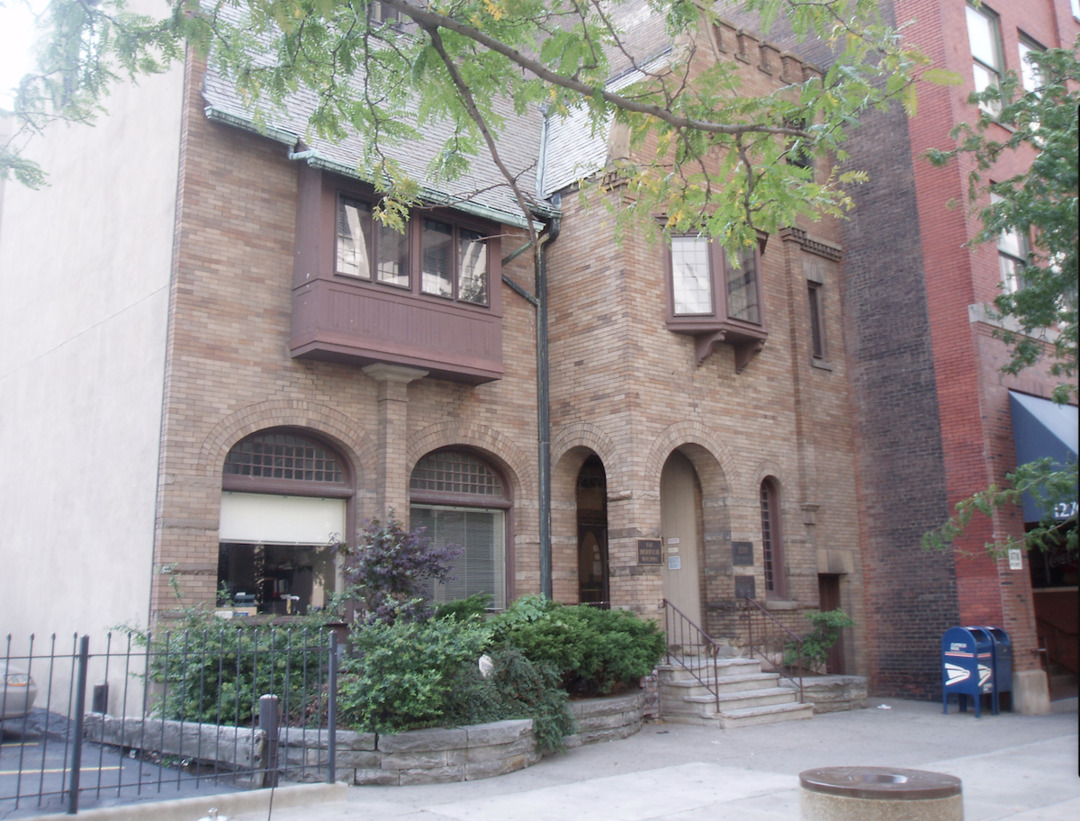
    <summary type="html"><![CDATA[<p><strong><em>The Hungarian dishes that Rosa Wohl cooked at the Wohl Boarding House on Seneca (West 3rd) Street in the 1880s were so popular with their guests that she and her husband Ludwig were encouraged to open a restaurant of their own. By 1888, they had opened one at the boarding house. It was said to be Cleveland's first Hungarian restaurant.  In 1903, the Wohls moved that restaurant, which by then had become one of the city's most popular, across the street into a new three-story building that still stands today at 1280 West 3rd Street.</p></strong></p><img src="https://clevelandhistorical.org/files/fullsize/3f92931a2c9528b48c33f9b420015ec7.jpg" alt="Bertsch Building" /><br/><p>It is difficult to learn much detail about the early lives in Europe of Ludwig and Rosa Wohl, the founders of Wohl's Hungarian Restaurant. According to Ludwig's petition for U.S. citizenship, he was born on April 8, 1837, in Bator, Hungary. By the late 1860s, when he would have been about 30 years old, he had already married Rosa Friedman, was living in Kassa, Hungary (today, Kosice, Slovakia), and was father to his and Rosa's four young sons, Ferdinand (Fred), Sandor (Alexander), Maximilian (Mike) and Julius. According to his obituary, Ludwig and his family then moved to Vienna, where he became a successful livestock trader and distiller until the Panic of 1873 financially ruined him. In 1878, all of the Wohl family, except for Sandor who remained in Europe to pursue an acting career in German theater, moved to the United States.</p><p>Upon arriving in America, the Wohl family traveled to Cleveland where Rosa Wohl appears to have had relatives.  Ludwig, now in his forties, became a dry goods peddler for a few years, and the family lived for a time on Water (West 9th) Street before they moved to Seneca (West 3rd) Street where Ludwig leased a two family house and then converted it into a boarding house. Rosa cooked such delicious Hungarian meals for their guests, including goulash, fresh baked bread and Hungarian pastries, that the Wohls were soon encouraged to open a restaurant in the boarding house, which they did in 1888. According to local newspapers, it was Cleveland's first Hungarian restaurant. Eventually, the Wohls closed the boarding house and devoted all of the house to the operations of the restaurant, which included living quarters for both the Wohl family and the restaurant staff. By 1900, according to the federal census, there were eight Hungarian immigrants living with the Wohl family—one listed as a cook, two as waitresses, and the other five as "kitchen help."</p><p>Even though the two-family house in which the original Wohl's Hungarian Restaurant was located had no signage that indicated it was a restaurant and was in such a dilapidated condition that it was referred to as "the Shanty," Clevelanders loved the restaurant and patronized it in large numbers. A March 8, 1903, article in the Cleveland Plain Dealer referred to it as the most popular "foreign"restaurant in Cleveland. It was also an important meeting place for Cleveland's Hungarian community. In late March 1894, it had served as the place where leaders of that community gathered to plan a memorial to Hungarian national hero Lajos Kossuth, who had died earlier that month.</p><p>In 1902, the Wohl family began making plans to move their restaurant into a new building across Seneca Street from their old restaurant building, and next door to the Cleveland Press building. Designed by Progressive architect Morris Gleichman in a style which local historian Drew Rolik called "Dutch Baroque Domestic (Revival)," the building, which still stands today at 1280 West 3rd Street, is three stories tall with an exterior of vitrified brick. It features two massive arches at its front door which originally led into the restaurant's main dining room. The first two floors of the building were devoted to dining and private meeting rooms, and a kitchen. The third floor, and perhaps outbuildings on the property, housed the residences of the Wohl family as well as the restaurant staff, which, according to the 1910 census, now numbered 19 individuals—all Hungarian immigrants—two employed as bartenders and the other 17 as waitresses. The new restaurant opened on June 6, 1903. The opening was attended by many prominent Clevelanders including Mayor Tom L. Johnson.</p><p>At about the time that the new restaurant building was opening, Alexander Sandor Wohl, the son of Ludwig and Rosa, who by this time had become a well-known actor and director of theater in Berlin, Germany, and who had made trips to and from the United States in the late 1880s and 1890s, returned to the United States and became active in the theater life of Cleveland. He also became involved in the family restaurant business, perhaps as the result of the death of his brother Mike in 1902 and the aging of his father Ludwig, who was now well into his 60s.  According to Alexander's obituary, he used his theater connections in Cleveland to arrange for members of the Cleveland Opera House orchestra to appear and play pieces by Mozart, Beethoven, and Strauss at Wohl's Hungarian restaurant, making it, according to Cleveland newspapers, the first restaurant in Cleveland to play music while patrons dined.</p><p>In the first two decades of the twentieth century, Wohl's Hungarian Restaurant remained one of Cleveland's most popular restaurants. When President Howard Taft visited Cleveland in 1912 during his presidential reelection campaign, he made a point of visiting the restaurant. After the death of Ludwig Wohl in 1910, management of the restaurant was left to his sons, Alexander and Julius. In 1920, the restaurant was dealt a blow from which it never really recovered by the start of Prohibition. Another blow to the restaurant was delivered in 1927 when Rosa Wohl, Ludwig's widow, whose Hungarian cooking had made the restaurant one of Cleveland's best, died.  </p><p>The final blow to Wohl's Hungarian Restaurant was the Great Depression, which began in 1929. By the time that the 1930 federal census was taken, only Alexander and Julius Wohl were still living in the building at 1280 West 3rd. Three years later, the brothers executed a deed conveying whatever interest in the property that they may have had  to the heirs of Frank W. Hubby from whom the Wohl family had leased the new restaurant building since 1903. Two years after this, in May 1935, despondent over their businesses losses, Alexander and Julius Wohl committed suicide in a back room of the restaurant. They both were cremated and their ashes interred with the bodies of their parents and siblings at Mayfield Cemetery in Cleveland Heights.</p><p>Following the deaths of Alexander and Julius Wohl, the Wohl family's longtime employee Ernest Mueller attempted to keep the restaurant going, but was ultimately unsuccessful. In 1936, the Hubby family heirs sold the building at 1280 West 3rd street to a union official representing the interests of the Cleveland Building and Trades Council. For approximately the next 50 years, the building was home to several different Cleveland labor organizations and was known for a time as the Cleveland Building and Trades Hall and later as the Painters' Union Building. In 1985, the building was sold to a corporation owned by a law firm headed by Richard Bertsch, after whom the building is now named. The Bertsch law firm, and its successor law firms, owned the building through various corporate entities until 2020, when it was sold to a local real estate developer. Recently, that developer has floated plans to demolish both the Bertsch Building and the next door Marion Building and build a hotel and apartment building on the site. Only time will tell whether the Bertsch Building, home to Cleveland's first Hungarian Restaurant, will be torn down, thereby removing from downtown Cleveland the last vestige of that historic trend setting restaurant owned and operated by the Ludwig and Rosa Wohl family.</p><p><em><strong><a href="https://clevelandhistorical.org/items/show/1019">For more (including 15 images) view the original article</a></strong></em></p>]]></summary>
    <published>2024-03-25T19:51:17+00:00</published>
    <updated>2026-03-04T21:32:05+00:00</updated>
    <link rel="alternate" type="text/html" href="https://clevelandhistorical.org/items/show/1019"/>
    <id>https://clevelandhistorical.org/items/show/1019</id>
    <author>
      <name>Jim Dubelko</name>
    </author>
  </entry>
  <entry>
    <title type="html"><![CDATA[Cleveland Trust Tower: Marcel Breuer&#039;s Only Skyscraper]]></title>
    <summary type="html"><![CDATA[<img src="https://clevelandhistorical.org/files/fullsize/e8976666b8329c5668f39b5d0ae0874e.jpg" alt="Architect Rendering " /><br/><p>The 9, originally called Cleveland Trust Tower and then Ameritrust Tower, is the only skyscraper designed by one of the most eminent Modernist architects of the 20th century, Marcel Breuer. But like a number of projects Breuer designed in his career, this Brutalist tower did not win universal praise and was nearly destroyed in the early 2000s. </p><p>Marcel Breuer was a Bauhaus-trained architect and furniture designer. A native of Hungary and a protege of the eminent Modernist architect Walter Gropius, Breuer earned a reputation for designing furniture and tubular steel chairs such as the Model B3 or Wassily Chair in the 1920s. In 1938 he joined Gropius on the faculty at Harvard's Graduate School of Design. For the next three years, Breuer and Gropius collaborated on several residential designs, including Aluminum City Terrace, an International Style defense housing project near Pittsburgh in 1941. The 240-unit "ultra-utilitarian" compound of prefabricated multifamily and semi-detached dwellings immediately drew "intense antagonism from surrounding economically well-off private residential property owners" who decried the project's design. It would not be the last time Breuer's designs produced strong feelings.</p><p>In the 1950s, Breuer continued in domestic architecture but also moved into institutional building design, notably in his UNESCO headquarters and I.B.M. Research Center in France. He went on to design the Whitney Museum of American Art in New York in 1966, which earned him accolades, but when he produced a design for the proposed FDR Memorial that same year in Washington, D.C., the U.S. Commission of Fine Arts rejected his creation as a "disrespectful" "pop art sculpture." Breuer found a better reception with his design of the Department of HUD headquarters in the Southwest Washington, D.C. urban renewal project, and he enjoyed commissions for a number of laboratories, university and museum buildings, including the Education Wing at the Cleveland Museum of Art, completed in 1971.</p><p>The latter commission, received in 1967, led Cleveland Trust Company to turn to Breuer to steer the expansion of its downtown offices at Euclid and East 9th Street, where <a href="https://clevelandhistorical.org/items/show/761">George B. Post's early-1900s rotunda</a> was too small for the bank's needs. Breuer was no stranger to Modernist additions to historic buildings. He had recently designed a proposed pair of skyscrapers to rise above Manhattan's Grand Central Terminal, but the project foundered because it underestimated the groundswell of commitment to historic preservation among New Yorkers who were still reeling from the loss of the grand Penn Station. </p><p>In Cleveland, Breuer planned twin 29-story towers that together would frame the old rotunda with frontage on Euclid and East 9th. Elements of the building's design evoked Breuer's HUD headquarters. The first tower, clad in black granite with cast concrete window frames, was completed on the East 9th side in 1971. Bank president George Karch was quick to assert that it reflected Cleveland Trust's dissent from the prevailing "gloomy predictions" about downtown's future. However, by that time, the second tower's expected construction was not expected to start before 1975. Not only was the second tower ultimately not built, its twin and the rotunda were abandoned in 1996 after Ameritrust (as Cleveland Trust had renamed itself in 1971) merged in 1991 with Society for Savings, which had recently invested in expanding its footprint on Public Square, leading to the construction of the Society Center. Society and KeyCorp, which acquired it three years later, had no need for the old Cleveland Trust complex.</p><p>The tower sat empty for nearly a decade before Cuyahoga County purchased it in 2005. County commissioners tried to convince the public to support demolishing it for a new county administration center because it was purportedly beyond saving. The threat of demolition hung over the tower for several years, stimulating considerable efforts to highlight the building's many merits, including its build quality, the renown of its architect, the fact that this was Breuer's only skyscraper. </p><p>After the county commissioners' failure to assemble the needing financing for a new county complex and their becoming embroiled in scandal, the Geis Companies, a Northeast Ohio real estate development firm, stepped in and offered to purchase the skyscraper and rotunda and undertake their adaptive reuse. Completed in 2015, the rotunda opened as a distinctive Heinen's supermarket, while the tower became the 156-room Metropolitan Hotel and 105 apartments, and the adjacent Swetland Building contained part of Heinen's on the first floor and more apartments on upper floors. The project did much to reenliven a forlorn corner of downtown and ensured that Cleveland did not destroy what was possibly the boldest expression of one of the 20th century's greatest Modernist designers.</p><p><em><strong><a href="https://clevelandhistorical.org/items/show/962">For more (including 12 images&#32;&amp;&#32;2 audio files) view the original article</a></strong></em></p>]]></summary>
    <published>2022-07-08T13:57:48+00:00</published>
    <updated>2026-03-04T21:32:05+00:00</updated>
    <link rel="alternate" type="text/html" href="https://clevelandhistorical.org/items/show/962"/>
    <id>https://clevelandhistorical.org/items/show/962</id>
    <author>
      <name>J. Mark Souther</name>
    </author>
  </entry>
  <entry>
    <title type="html"><![CDATA[Thomas Axworthy House: Where a Popular West Side Gym Once Stood]]></title>
    <summary type="html"><![CDATA[<p><strong><em>Clement and Katherine Folkman, immigrants from Eastern Europe, probably didn't know much, if any, of the history of the house at 4206 Franklin when they purchased it in 1923. So they, and their son Clement Jr. proceeded to make their own history there.</em></strong></p><img src="https://clevelandhistorical.org/files/fullsize/8487376c904adf13daff3b7ec1272cda.jpg" alt="4206 Franklin Boulevard" /><br/><p>The house at 4206 Franklin Boulevard is one of only a few Second Empire  style houses on Franklin Boulevard.  It has approximately 3,000 square feet of living area and is notable for its hexagonal mansard roof, decorative window hoods and wrap-around single-story covered front porch.  The house was built in 1866 and,  while the name of the contractor who actually built it is unknown, it may have been Ferdinand Dreier (Dryer), a German immigrant and house carpenter by trade.  Dreier built a number of houses on or near Franklin Boulevard in the late 1860s, including a somewhat similar Second Empire style house almost directly across the street at 4211 Franklin.   </p><p>According to National Register of Historic Places (NRHP) records of the Franklin Boulevard Historic District, the house at 4206 Franklin is named for Thomas Axworthy, a nineteenth century coal merchant, who purchased it in 1873.  Its original owner was Atherton Curtis, a liquor dealer, whose family only lived in the house for a year or so before moving to Huron County, Ohio.  The family then rented the house  out to tenants for several years before selling it to Axworthy, who lived in the house with his wife Rebecca and their three daughters for more than a decade.</p><p>Thomas Axworthy was an interesting figure who left his mark on Cleveland city government, although not in the way you might think.  An English immigrant, Axworthy became involved in Cleveland politics in the 1870s, serving in that decade as a city fire commissioner as well as president of the "West Side Democracy," a political club for Democrats living west of the Cuyahoga River.  In 1883, while his star was still rising, Axworthy was considered to be a likely candidate for city mayor, but he ran instead for city treasurer and was elected in a close race.  He  was re-elected to the office in 1885 and again in 1887.  By the time he was re-elected the second time, he had already sold the house at 4206 Franklin, moving, like many other Franklin Boulevard residents during this period, to the city's far west end.  There, he built a grand house on Lake Avenue, not far from where political kingmaker Marcus Hanna, also a Franklin Boulevard resident, would build his Lake Avenue mansion just a few years later.</p><p>In October 1888, Thomas Axworthy's political star crashed and burned when the Cleveland Leader broke the news that he had fled the city after embezzling some $440,000 from the city treasury.  (To appreciate the size of his embezzlement, that sum would be almost $13 million in 2022 dollars.)  The papers, not only in Cleveland, but across the country, were abuzz for months with stories of Axworthy's whereabouts, the efforts made by Cleveland to recover the funds he had stolen, and the inevitable litigation that followed.  The person who headed the effort to locate Axworthy was attorney Andrew Squire, who just two years later would co-found Squire, Sanders and Dempsey, for many years one of Cleveland's largest and  most prestigious law firms.  Squire also happened to be a former neighbor of Axworthy, having lived just three houses down the street  from Axworthy during the years that the latter  resided on Franklin.  Squire doggedly searched for Axworthy, located him in London, and traveled  all the way there to confront  the disgraced treasurer who was living in England's capital under an assumed name.  Squire successfully negotiated a settlement with Axworthy which required him to surrender all of the cash and bonds still in his possession, and  agree to sell properties that he still owned back in the States--which included Colorado and Tennessee as well as Ohio--to cover much of the rest of what he had stolen.  In the end, after bondsmen made up the difference, the City of Cleveland was fully reimbursed for its loss.</p><p>After the Axworthy family moved from the house at 4206 Franklin, it was next owned and occupied by the family of a district passenger agent for the Erie Railroad and after that by a treasurer of a trucking company.  In 1919, the house was purchased by a Hungarian immigrant  whose family lived in it for four years before selling it to Clement and Katherine Folkman in 1923.  Clement, a German immigrant who worked in Cleveland as an auto body builder, and his wife Katherine, a Hungarian immigrant, were among a large number of  German and Hungarian immigrants who settled on and around Franklin Boulevard in the second and third decades of the twentieth century.  A number of them, like the Folkmans, purchased grand houses on Franklin that had once been occupied by the West Side's  wealthiest families, and then converted them into multi-family dwellings or rooming houses.  The Folkmans created three suites in the house at 4206 Franklin, living in one themselves and renting out the other two.</p><p>Clement and Katherine Folkman's son Clement, Jr., who was sixteen years old when his parents bought the house at 4206 Franklin, initially entered the workplace as an auto body builder like his father.   In 1936, however, when he was 29 years old, he decided to become a different type of body builder.  "Clem," as he was referred to by his family, was an adherent of  the "physical culture" theories of Bernarr McFadden, an American entrepreneur who, in the late nineteenth and early twentieth centuries, advocated physical fitness through weight lifting regimens. McFadden later published  a series of popular magazines which may have caught young Clem's eyes.  With his father's help, Clem built a gymnasium in the two-story carriage house that stood in the rear yard of their property.  An avid weightlifter himself, Clem soon was training young men in the neighborhood at his Folkman's Athletic Club, which he later renamed Folkman's Physical Culture Studio. By October 17, 1938, when an  article about his gym appeared in the Plain Dealer, he was training 50 young men, ages 20 to 30, who came to the gym three times a week, some with Olympic medal aspirations.</p><p>For decades, Folkman's Physical Culture Studio was a popular gym and  rare commercial enterprise on historically residential Franklin Boulevard.  The Folkman family at some point in time built another two-story building on the property, the first story of which served as a garage, and connected the new building to the old carriage house, which itself was extensively remodeled to accommodate Clem's growing business.  The gym was located on the second floor of the remodeled carriage house, and a locker room, sauna, and massage room on the first.  A large round clock was also installed on a pole in the front yard that for years reminded passers by on Franklin that it was "Time To Exercise."  The gym was still thriving in 1967 when legendary Plain Dealer reporter Bill Hickey paid a visit to Folkman's gym.  By this time, Clem's son Ronald, a Cleveland firefighter, was also working part-time at the gym as a masseuse.  Bill Hickey referred to the two of them in an article that appeared in the Plain Dealer on March 30, 1967, as "the Squires of Franklin Boulevard."   When Hickey reminded Clem that he had been exercising at the gym for years, Clem, according to the article, took one look at Hickey's body and responded, "Please don't tell anybody that. It will ruin me."</p><p>In 1986, the Folkman Physical Culture Studio had been operating at 4206 Franklin Boulevard for 50 years.  Cleveland Plain Dealer reporter James Neff visited the property in August of that notable anniversary year to interview Clem Folkman.  When he arrived, he found an elderly man who was gravely ill and reliving past glories, and a gymnasium that was literally falling apart and papered with city building code violation notices.   Clem Folkman died just three months after this interview.  After the death of Clem Folkman, one of his grandsons attempted to revive the business, but was unsuccessful.  In 1991, the   house at 4206 Franklin Boulevard was sold to a new owner, and one year after that the buildings on the rear of the property, which had housed Folkman's Physical Culture Studio  for more than a half century, were unceremoniously torn down.</p><p>Today, no evidence remains of the Folkman Physical Culture Studio where Clem Folkman trained so many Clevelanders for so many years in the theories, methodologies and regimens of Bernarr McFadden.  The Thomas Axworthy House, however, now nicely renovated as a three-family dwelling, and celebrating its 156th birthday in 2022, still stands at 4206 Franklin Boulevard.</p><p><em><strong><a href="https://clevelandhistorical.org/items/show/956">For more (including 16 images) view the original article</a></strong></em></p>]]></summary>
    <published>2022-01-18T01:10:47+00:00</published>
    <updated>2026-03-04T21:32:05+00:00</updated>
    <link rel="alternate" type="text/html" href="https://clevelandhistorical.org/items/show/956"/>
    <id>https://clevelandhistorical.org/items/show/956</id>
    <author>
      <name>Jim Dubelko</name>
    </author>
  </entry>
  <entry>
    <title type="html"><![CDATA[Henry Coffinberry House: The House of a Cleveland Shipbuilding Magnate]]></title>
    <summary type="html"><![CDATA[<img src="https://clevelandhistorical.org/files/fullsize/8f583943a7d15a1572fe55dc8a5bf36b.jpg" alt="Henry Coffinberry House" /><br/><p>The house at 3910 Franklin Boulevard, which today is largely hidden from view by its owner's lush and exotic landscaping, is known as the Henry Coffinberry House.  It was built for Henry Darling Coffinberry, one of Cleveland's shipbuilding industry giants of the late nineteenth century.  Along with partners Robert Wallace and John F. Pankhurst, he was instrumental in modernizing the Great Lakes shipbuilding industry and building both the first iron and the first steel large commercial freighters to sail on the Great Lakes.  His efforts made Cleveland, for a time,  the largest shipbuilding center in the United States.   Think of Henry Coffinberry the next time you see an ore carrier streaming across Lake Erie.</p><p>Henry Darling Coffinberry was born in Maumee, Ohio, on October 12, 1841.  In 1855, when he was 14 years old, his father James, a lawyer who later became a Common Pleas Court judge, moved the family to Cleveland, purchasing a house on Franklin Boulevard that was located on the present day site of the former West Side Masonic Temple building.  According to biographers, Henry attended classes at and graduated from West High School, although records from the school do not show him graduating.  In 1862, with the Civil War raging, Henry joined the United States Navy, reaching the rank of "Acting Master" and serving until shortly after the War's end in 1865.  Returning to Cleveland, he tried his hand at several jobs before buying an interest in a small machine shop owned by fellow west siders Robert Wallace, John Pankhurst and a third individual, Arthur Sawtell, who soon departed from the business.  In 1869, the three surviving partners purchased a controlling interest in Globe Iron Works, an iron foundry started in 1853 by a partnership that included Samuel Lord, the brother of Ohio City pioneer real estate developer and mayor Richard Lord. The original foundry was  located in the West Bank of the Flats  at the northwest corner of Elm Street and Spruce Avenue--no more than a mile or so away from where Henry lived on Franklin Boulevard.  After the foundry was destroyed in a fire in January 1872, Henry and his partners built a new foundry--still standing today--on the southwest corner of that intersection.</p><p>Henry Coffinberry was living at his parents house in 1869 when he and his partners acquired their interest in Globe Iron Works.  He continued to reside with his parents until 1875, the year he married Harriet Morgan, the daughter of Civil War General George W. Morgan.  In August 1874, just eight months before his wedding, Coffinberry purchased a house up the street on the north side of Franklin Avenue, several lots west of Kentucky (West 38th) Street. According to local architectural historian Craig Bobby, Coffinberry either razed or moved that house and, in 1875, built in its place the house that today stands at 3910 Franklin Boulevard. Designed in the Gothic Revival style with cross gables, the two-story house has a prominent central gable that has an extension at what had been the original center of the front facade, which incorporates a vestibule and a large, decorative gable above. Two second-floor windows have Gothic detailing and its gables have decorated vergeboards. There is a one story entry porch at its front door.  The house also has an addition that was constructed onto its east side in 1895. The addition has a front door which for many years also had an entry porch.  Local historian Bobby observed that the house was built in the later years of the Gothic Revival period here in the United States. As a result, it has some features that were influenced by the then more prevalent Italianate style, such as, for example, the elaborate hoods over some of its windows.</p><p>According to Cleveland directories, Henry and Harriet Coffinberry did not move into their new house until more than a year after their marriage--sometime in late 1876 or early 1877.  (This may have been because they lived with Henry parents during the first year of their marriage, possibly to help care for the latter who had suffered severe injuries in a collision between their carriage and a train near the Union Depot Station while returning home from their son's wedding.)  Henry and Harriet, along with their daughters Nadine and Maria, resided in the house at 3910 Franklin until 1891, when the family moved from the house.  The fifteen or so years during which Henry Coffinberry lived there corresponded with the most productive years of his business career.  In 1876, Globe Iron Works started a new business called Globe Ship Building Company and began producing wooden ships. Henry Coffinberry was tapped by the partners to serve as president of the new business. Five years later in 1881, under his direction, the company built the Onoko, which, when launched in February 1882, became the first large commercial ship built of iron to sail the Great Lakes.  By 1883, Globe had built a large shipyard on W. Old River Street (Division Avenue) near its intersection with St. Paul (West 49th) Street, not far from the west end of the Ship Canal. In 1886, the company built and launched at its shipyard the Spokane, the first steel freighter to sail the Great Lakes. Globe Iron's iron and steel ships were prototypes for all the modern freighters that sail the Great Lakes today. </p><p>Just a month after the launch of the Spokane in 1886, a dispute within the partnership led to Coffinberry and Wallace's departure from Globe Iron Works and, several months later, their formation of a new company – Cleveland Shipbuilding Co. – which was financially backed by a number of prominent east and west side industrialists, including J. H. Wade, Jr., William Chisolm, M. A. Bradley, Robert Russell Rhodes, and George Warmington. As he had at Globe Ship Building, Coffinberry headed the new company as its president.  Cleveland Shipbuilding successfully competed with Globe Ship Building, with both businesses contributing to make Cleveland the leading shipbuilding center in the United States by 1890. Coffinberry retired from the shipbuilding business in 1894.  Five years later in 1899, Cleveland Shipbuilding, Globe Iron Works, Ship Owners' Dry Dock Company, and several out-of-town businesses consolidated to form the American Shipbuilding Company, one of Cleveland's great industrial enterprises of the late nineteenth and early twentieth century, according to environmental historian David Stradling and his brother Richard Stradling in their book "Where the River Burned."  </p><p>After moving out of the house at 3910 Franklin Boulevard in 1891, the Coffinberry family continued to own it and leased it to renters.  As noted above, they constructed an addition onto the house in 1895 and converted it into a two-family residence, which, after 1905, had the addresses of 3910 and 3912 Franklin Boulevard. The house remained in the Coffinberry family until 1918 when it was sold by Henry Coffinberry's widow and daughters.  The Coffinberry House thereafter passed through the hands of several short-term owners before it was acquired by Ernest and Mary Toth in 1926.  Ernest, a carpenter by trade, and his wife Mary, were Hungarian immigrants, as were many residents of Franklin Boulevard during this period.  The Toths initially leased it to renters, but from the mid 1930s until the mid 1950s they lived in the east side of the house, renting out only the west side.  Photographs of the house taken while it was occupied by the Toth family show that it was well-maintained during this period.  The Toths moved to the suburbs in the mid-1950s, and thereafter leased both sides of the Coffinberry House to renters.  Mary Toth sold the house in 1963 shortly after the death of her husband.  In the several decades that followed, the condition of the house declined until 1982 when it was acquired by Mark Pokrandt who restored and renovated the house.  As of 2021, the Henry Coffinberry House is still owned by Pokrandt.</p><p><em><strong><a href="https://clevelandhistorical.org/items/show/940">For more (including 15 images) view the original article</a></strong></em></p>]]></summary>
    <published>2021-03-09T21:16:40+00:00</published>
    <updated>2026-03-04T21:32:04+00:00</updated>
    <link rel="alternate" type="text/html" href="https://clevelandhistorical.org/items/show/940"/>
    <id>https://clevelandhistorical.org/items/show/940</id>
    <author>
      <name>Jim Dubelko</name>
    </author>
  </entry>
  <entry>
    <title type="html"><![CDATA[B&#039;nai Jeshurun Congregation: The Temple on the Heights]]></title>
    <summary type="html"><![CDATA[<img src="https://clevelandhistorical.org/files/fullsize/12283ff747d75d931758363aa2b4dafb.jpg" alt="Temple on the Heights today" /><br/><p>By the 1920s, Cleveland's growing Jewish community approached 10% of the city's population. As with Jewish enclaves in other major American cities of the era, the Jewish-American community of Cleveland began spreading into the suburbs. B'nai Jeshurun, became the first to make the move when in 1919 the congregation decided to relocate out of the city proper and into the nearby suburb of Cleveland Heights. The new building on Mayfield Road held over 3,000 worshipers and included a gymnasium, a banquet hall, and an entertainment hall, as well as a library. The congregation also retained its old building on East 55th Street for other social events before the existing structure became Shiloh Baptist Church.</p><p>Cleveland's Jewish population went back decades. Fleeing religious persecution in Europe and seeking greater job opportunities, Hungarian Jewish immigrants to the United States flocked to large cities. The western side of Cleveland attracted to pre-existing Jewish settlements and manufacturing jobs. The old German synagogues of earlier settlers simply would not do, necessitating buildings for  distinctly Hungarian congregations. In 1866, Hungarian Jewish immigrants began meeting in their own homes, and then in Gallagher’s Hall on Erie and Superior to pray, partially because they simply could not afford the fees the German synagogues required. In 1906, the Hungarian Jewish community of B'nai Jeshurun constructed their first permanent synagogue on East 55th Street and called it home for two decades.</p><p>B’nai Jeshurun’s congregation moved into the new temple in March of 1926, and Rabbi Abraham Nowak consecrated the structure in August of the same year: by now, over a thousand Jews called B’nai Jeshurun home. It was also at this time that B’nai Jeshurun gained its famous moniker— the Temple on the Heights, or more simply, Heights Temple. In comparison, the second Jewish congregation to move to the suburbs came nearly 20 years later when Anshe Chesed Fairmount Temple, Cleveland's oldest Jewish congregation, moved to Beachwood in 1947.</p><p>The congregation elected its first Cleveland-born Head Rabbi in 1934, Rudolph Rosenthal.  At the time of Rosenthal’s election, the Temple on the Heights served more than 1,000 families, had more than 600 youths in its education program, and was home to one of the largest Conservative congregations in the entire United States and would continue to grow over the next three decades. By the late 1960s, further suburbanization of the Jewish-American community moved congregants farther east. It was obvious the still-vibrant synagogue would need to move once again.</p><p>In 1978, only a few years after the 110th anniversary of B’nai Jeshurun’s founding, some 400 members of the congregation participated in a ceremonial groundbreaking of the temple’s new location on Fairmount Boulevard, in Pepper Pike, further east than Cleveland Heights and truly suburban. In late 1979 Rabbi Herbert Schwartz consecrated the new temple on the first night of Hanukkah.</p><p>On October 30, 2016, B’nai Jeshurun, Cleveland's third-oldest continuously operated Jewish congregation, capped off its 150th anniversary with a gala. The success of the Temple on the Heights in smoothing its congregants' transition to suburban life and the congregation's continued vitality over the past century and a half cements B'nai Jeshurun as a mainstay of the Cleveland metropolitan area. </p><p><em><strong><a href="https://clevelandhistorical.org/items/show/821">For more (including 5 images) view the original article</a></strong></em></p>]]></summary>
    <published>2017-11-27T19:12:37+00:00</published>
    <updated>2026-03-04T21:32:03+00:00</updated>
    <link rel="alternate" type="text/html" href="https://clevelandhistorical.org/items/show/821"/>
    <id>https://clevelandhistorical.org/items/show/821</id>
    <author>
      <name>Anthony J. Kleem</name>
    </author>
  </entry>
  <entry>
    <title type="html"><![CDATA[Fir Street Cemetery: Cleveland&#039;s Second Oldest Jewish Cemetery]]></title>
    <summary type="html"><![CDATA[<p><strong><em>"Give me your tired, your poor, your huddled masses yearning to breathe free, the wretched refuse of your teeming shore."  Emma Lazarus' immortal words from her poem "The New Colossus," etched on the Statue of Liberty, had special meaning to one immigrant family buried in this historic Jewish cemetery in Cleveland.</em></strong></p><img src="https://clevelandhistorical.org/files/fullsize/2fe917423c69448b6ae8f17f711353e8.jpg" alt="Aerial View from the South" /><br/><p>When James and Fannie Horwitz experienced the unspeakable heartbreak of losing a child--their 2-year-old son Aaron in January 1865, they undoubtedly found some consolation in burying him in the new Jewish cemetery out in the countryside, west of the Cuyahoga River in Brooklyn Township, on a charming little lane called Peach Street (later to be renamed Fir Street).  The cemetery had just been opened that year by the Hungarian Aid Society (HAS), an organization formed in Cleveland in 1863 by Morris Black, Herman Sampliner and others, for the purpose of providing aid, including burials, to Hungarian Jewish immigrants.  Aaron Horwitz was the organization's first burial at the new cemetery.</p><p>Aaron's father James (or Jacob as he was known in Europe) was a Vienna-trained medical doctor, and his mother Fannie a sister of Michael Heilprin, a brilliant Hebrew scholar.  Both men were Polish Jews who lived in Galicia, an area of historic Poland that had been "annexed" by Austria in first partition of that country in the late 18th century.  In 1848, both men had become ardent supporters of Lajos Kossuth and the Hungarian Revolution.  And when the Hapsburgs defeated the insurgents and Kossuth fled Hungary, both men also did the same.  Horwitz, immigrated to Cleveland, via Sandusky, practicing medicine before turning to business enterprises.  Heilprin went instead to New York, where he became a celebrated Hebrew scholar, a friend of Horace Greeley, and mentor to the young poet Emma Lazarus.  Several sources attribute the inspiration for Lazarus' 1883 poem "The New Colossus" to a meeting she earlier had with Michael Heilprin.  Heilprin was both inspiration to Emma Lazarus and the uncle of an unfortunate young boy who was the first person to be buried at the new Jewish cemetery in Brooklyn Township.</p><p>The cemetery where Aaron Horwitz is buried we know today as Fir Street (or Fir Avenue) Cemetery.  The second oldest Jewish cemetery in Cleveland, it is actually three small, separate historic cemeteries which are located on a rectangular-shaped piece of land bounded on the north by Fir Avenue; the east by West 59th Street; the south by Bayne Court; and the west by West 61st Street.  The center cemetery, where Aaron and other members of the Horwitz family are buried, was owned by the HAS until 1963 when the land was deeded to the Jewish Community Federation (JCF) of Cleveland.  While the first burial took place there in 1865, permission to operate a cemetery on the grounds was not officially granted by the City of Cleveland until 1880,  several years after the section of Brooklyn Township in which it was located was annexed to the City.</p><p>The western cemetery was established by Anshe Emeth, the largest and oldest conservative Jewish congregation in Cleveland.  It was founded by Polish Jewish immigrants in 1859.  The Congregation made its first purchase of land on Fir Street in 1877, the same year that it was granted permission by the City to establish a cemetery on its  grounds there.   Anshe Emeth, in the twentieth century, merged with Beth Tefilo congregation to form Park Synagogue Anshe Emeth Beth Tefilo Congregation.</p><p>The eastern cemetery may also have been founded by Polish Jews, although there is some mystery surrounding the identity of the two Jewish organizations which owned the land in the nineteenth century.  Chebra Kadisha, which acquired the land in 1866, was identified in the conveyance deed simply as a "religious organization."  Thirteen years later, in 1879, through its trustees, it deeded the land to the B'nai Abraham Cemetery Association, an organization for which no records appear to exist.  Chebra Kadisha may have been an early congregation which later merged with other congregations to form  what became, in the twentieth century, the Heights Jewish Center (HJC).  Or, it may have simply been a "burial society."  </p><p>Among the locally famous residents of Fir Street Cemetery are:  Herman Sampliner (1835-1899), founder of the B’nai Jeshurun Congregation; Harry “Czar” Bernstein (1856-1920), owner of Perry Bank and the Perry Theatre, and city councilman allied with Mark Hanna; Moses A. Adelstein (1813-1903), organizer of Cleveland’s first Russian synagogue and first free Jewish cemetery, Lansing Cemetery; Isaac Goldman (1858-1919), Cleveland’s first Jewish building contractor; Fanny Jacobs (1835-1928), founder of Park Synagogue’s sisterhood; Rabbi Gershon Ravinson (1848-1907), a 10th-generation rabbi who became a leading scholar of Talmud; Reverend Elias Rothschild (1858-1914), a kosher butcher with a reputation for offering meals and beds to the down-and-out. Rothschild is believed to have saved the Hebrew Free Loan Society when it ran into financial difficulty.</p><p>This final resting place of so many locally famous Clevelanders, as well as families with heart-wrenching stories like the Horwitz's, Fir Street became an inactive cemetery in 1971, after the last burials there took place.  In the decades that followed, the condition of its grounds steadily deteriorated, in part due to acts of vandalism and in part because the Cleveland Jewish community had moved east, leaving the cemetery geographically distant from its founding congregations.  The condition of Fir Street Cemetery troubled Cleveland Housing Court Judge Raymond J. Pianka, who been interested in the history of the cemetery, and the strange inscriptions on its gravestones, ever since he was a young boy attending Waverly Elementary School, just a block away from the cemetery.  In 2007, he and a stalwart group of neighborhood residents collaborated with Park Synagogue and successfully formed a coalition of funding, organizations and volunteers that, over the next two-year period, renovated and restored the cemetery, cleaning its grounds, fixing broken grave stones, planting trees and hundreds of tulip bulbs, and repairing the entrance gate and signage.  Since the completion of these repairs and renovations in 2009, the cemetery has been maintained by Park Synagogue Anshe Emeth Beth Tefilo Congregation with financial assistance from the JCF.  Fir Street Cemetery is now, once again, a source of pride not only for Cleveland's Jewish community, but also for the Detroit Shoreway neighborhood.</p><p><em><strong><a href="https://clevelandhistorical.org/items/show/800">For more (including 9 images) view the original article</a></strong></em></p>]]></summary>
    <published>2017-05-31T09:25:09+00:00</published>
    <updated>2026-03-04T21:32:03+00:00</updated>
    <link rel="alternate" type="text/html" href="https://clevelandhistorical.org/items/show/800"/>
    <id>https://clevelandhistorical.org/items/show/800</id>
    <author>
      <name>Jim Dubelko</name>
    </author>
  </entry>
  <entry>
    <title type="html"><![CDATA[The Battle at Saint Ladislas: Hungarians and Slovaks fight for control of their Church]]></title>
    <summary type="html"><![CDATA[<img src="https://clevelandhistorical.org/files/fullsize/34d6ef9688a04bd4b4ec57eb2d2d70d8.jpg" alt="St. Ladislas Church" /><br/><p>On Sunday, August 2, 1891, the congregation of Hungarian (Magyar) and Slovak parishioners gathered in St. Ladislas Roman Catholic Church on the southeast side of Cleveland for mass. Father John Martvon, the church's Slovak pastor, began the mass in Latin, but when the time arrived for him to give his sermon, he began to speak in Slovak. This touched off a riot at the church. The Hungarian parishioners began cursing the priest, which drew an angry response from the Slovak parishioners. Then, someone yelled, "Kill the Slav priest!" Soon, Slovaks and Hungarians were battling one another in the church, while one of the Slovaks, Jacob Gruss, stood by the altar in front of Father Martvon, brandishing a pistol to keep the threatening Hungarians from harming the priest. Eventually, Cleveland police officers from the nearby Fifth Precinct arrived on the scene and dispersed the crowd before anyone was seriously injured.</p><p>The riot at St. Ladislas on August 2, 1891, was the opening salvo in a battle for control of the church which had been built just two years earlier in 1889. The church had been built to serve Roman Catholic immigrants from Hungary—primarily Magyars and Slovaks, who had been moving to the southeast side of Cleveland—near the iron works and other factories, since the early 1880s. While these two ethnic groups were from the same country and shared the same religious faith, they had animosity towards one another as the result of a Hungarian nationalist policy known as "Magyarization," which sought to suppress the language, culture and identity of Slovak and other non-Magyar ethnics living in Hungary. </p><p>Throughout the month of August 1891, Slovaks and Magyars continued to wage their battle. The Cleveland police officers who staffed the Fifth precinct station remained on high alert throughout the month, especially after another riot broke out in front of Father Martvon's residence on South Woodland Avenue (Buckeye Road) on August 15. While Magyar parish leaders deplored the violence, they hired two prominent Cleveland attorneys--Martin A. Foran, a former county prosecutor and former congressman, and Joseph C. Bloch, a Jewish lawyer born in Hungary, in an attempt to convince the Cleveland Catholic diocese to award the church to the Hungarians and to instruct the Slovaks to build another church somewhere else. </p><p>In the twelve day period between August 6 and August 18, at least four meetings were held in which the warring ethnic groups yelled at each other, pleaded with each other, and tried to convince each other to agree to a deal which would give one or the other exclusive control of the church. In the end, the advantage was with the Slovaks. While the Hungarians had hired two of Cleveland's best attorneys to argue their case, the Slovaks, who had not hired legal counsel, instead relied upon their parish priest Father Martvon and Our Lady of Lourdes pastor Stephen Furdek, both Slovak immigrants, to argue their case to the diocese. It was a winning strategy. The Hungarians saw that the Diocese was not going to award them St. Ladislas so they settled with the Slovaks. They relinquished their claim to the church and built a new church, <a href="https://clevelandhistorical.org/items/show/203">St. Elizabeth of Hungary</a>, two blocks away. The Slovaks paid the departing Magyars $1000 and St. Ladislas officially became Cleveland's first Slovak Roman Catholic Church.</p><p><em><strong><a href="https://clevelandhistorical.org/items/show/596">For more (including 11 images) view the original article</a></strong></em></p>]]></summary>
    <published>2013-02-28T23:54:55+00:00</published>
    <updated>2026-03-04T21:32:01+00:00</updated>
    <link rel="alternate" type="text/html" href="https://clevelandhistorical.org/items/show/596"/>
    <id>https://clevelandhistorical.org/items/show/596</id>
    <author>
      <name>Jim Dubelko</name>
    </author>
  </entry>
  <entry>
    <title type="html"><![CDATA[Heights Hardware]]></title>
    <summary type="html"><![CDATA[<img src="https://clevelandhistorical.org/files/fullsize/32676f62699cb720d90f86162b736135.jpg" alt="Heights Hardware, 1982" /><br/><p>Near the northern edge of Coventry Village, surrounded by vintage, hip clothing stores, stands one of Cleveland Heights' oldest businesses. Operated by Tom and Andy Gathy, a father-son team, Heights Hardware is in some ways timeless: Oak cabinets, rolling ladders, pressed-tin ceiling, and friendly personalized service have endured. From three blocks south, the store's giant sign–blue-and-white paint on old brick–is readily visible: "Heights Hardware Since 1911." The date might puzzle those who know that Coventry Village emerged in 1919-22. How do we account for the difference?</p><p>In 1911, Alfred, Arthur, and Sidney Weiskopf opened Weiskopf Bros. Hardware and Plumbing Company at 1140 East 105th Street in Cleveland's Glenville neighborhood. At the time, the surrounding streets were the nucleus of the city's Jewish community. A decade later the brothers, sensing the new trend of Jews moving into the Heights, opened a second location called Weiskopf Bros. Heights Hardware in 1922. They sold their Glenville store three years later to concentrate on serving contractors and homeowners in the midst of the 1920s suburban population boom. A succession of owners continued to operate the original hardware store on East 105th through the 1970s, but the building suffered repeated challenges. It was bombed in 1935, caught fire in 1958, and was robbed at gunpoint by seven juveniles in 1967.</p><p>Oscar Elton, son of Hungarian immigrants to Cleveland, bought out the Weiskopfs in 1949, beginning a family connection to the business that remains to this day. Elton sold the business to his distant cousin Carl Weiss in 1969, but continued to work in the store for some 40 more years (into his nineties). Meanwhile, Elton's second cousin, current owner Tom Gathy, fled Europe during the 1956 Hungarian Revolution. After six years he arrived in Cleveland and, with some help from Elton, became active in the construction trades. Having become a regular customer at Heights Hardware, Gathy decided to buy the store in 1979.</p><p>Over the next two decades Gathy modernized the store, adding new plate-glass windows and neon signage, and affiliating with the Ace independent hardware cooperative in the early 1980s. When new big-box stores opened in the reconfigured Severance Town Center in 1998, Gathy responded decisively. He expanded the store's merchandise by building an extension to replace an old rear carriage house and hiring his son Andy to build for the future. Today Heights Hardware remains a strong presence on Coventry Road by continuing to offer a large product selection, fast service, know-how,  and the personal touch.</p><p><em><strong><a href="https://clevelandhistorical.org/items/show/453">For more (including 12 images&#32;&amp;&#32;5 audio files) view the original article</a></strong></em></p>]]></summary>
    <published>2012-05-09T12:54:24+00:00</published>
    <updated>2026-03-04T21:32:00+00:00</updated>
    <link rel="alternate" type="text/html" href="https://clevelandhistorical.org/items/show/453"/>
    <id>https://clevelandhistorical.org/items/show/453</id>
    <author>
      <name>J. Mark Souther</name>
    </author>
  </entry>
  <entry>
    <title type="html"><![CDATA[East End Neighborhood House: A Social Settlement Born on a Hungarian Woman&#039;s Front Porch]]></title>
    <summary type="html"><![CDATA[<img src="https://clevelandhistorical.org/files/fullsize/a74621dd903e473d462e320a7656204b.jpg" alt="East End Neighborhood House" /><br/><p>In 1907, Hedwig Kosbab, a Hungarian immigrant's daughter and social worker, began teaching English to children on the porch of her mother’s home. As Kosbab’s programs expanded, she moved them first to a storeroom at East 89th Street and Woodland Avenue. In 1910 Kosbab’s venture incorporated at East End Neighborhood House and over the next year held high-profile fundraisers that included a charity bridge party at the Colonial Club and a benefit performance of <em>The Three Lights</em> by May Robson at the Colonial Theater. In 1911 the organization moved into a former saloon at 9410 Holton Avenue to serve a growing immigrant population in the predominantly Hungarian, Slovak, and Italian Buckeye, Woodland, and Woodhill areas and also maintained a summer playground and training garden at Woodland and East 93rd Street. East End Neighborhood House was guided by influential board members such as Samuel Mather, Rollin White (founder of White Consolidated Industries, co-founder of American Ball Bearing Company, and founder of Baker Motor Vehicle Company), and O. P. Van Sweringen.</p><p>East End Neighborhood House moved to 2749 Woodhill Road in 1916. The house had previously served as the residence of J. T. and Catherine Wamelink. J. T. Wamelink was a Dutch immigrant, musician, composer, and music store proprietor who also invested in real estate on Cleveland’s east side in the latter half of the nineteenth century. On one of his parcels Wamelink created a triangular subdivision bounded by Woodland Avenue, Woodland Hills Avenue (later Woodhill Road), and Steinway Avenue, a new street whose name reflected his musical interest. The Wamelinks retained eight acres to the east, across Woodland Hills Avenue, as their homestead. There they built a large, two-and-a-half story, hipped-roof frame house in 1894. After Mr. Wamelink died in 1900, Catherine subdivided much of the homestead in 1907. These lots remained unbuilt, and in 1912 the Weybridge Land Company, a “straw corporation” for M. J. and O. P. Van Sweringen’s real estate interest, bought the entirety of the Wamelink property before transferring it to the Van Sweringen Company. Both entities stipulated in the transfer deeds a life interest for Mrs. Wamelink that enabled her to remain in her home, which she did until her death in 1915. The Van Sweringen Company continued to own the property until East End Neighborhood House acquired it in 1933. </p><p>In the years after Hedwig Kosbab died in 1922, East End Neighborhood House initiated other clubs, summer programs, and craft classes in addition to the ongoing English classes she had started. The organization directed more of its energies toward serving African Americans following the Buckeye neighborhood’s racial transition that began in the 1940s. A $100,000 addition designed by architect Philip L. Small was completed in 1950. The addition contained a large room with a stage, lounges with a kitchen, sewing rooms, woodworking and ceramic rooms, craft rooms, and a photographic dark room. East End Neighborhood House served more than 4,000 people at that time and had a daycare for children and older individuals, programs for children, transportation, a gardening center, music and art programs, and vocational training for high school dropouts. Two classes for adults entitled "Understanding Your Child" and "Home Nursing" were created in 1959. A new "Taking Off Pounds Sensibly" program began in 1961 that had group therapy discussions every week. East End Neighborhood House also collaborated with other organizations and groups to put on events such as Circus Day and the Soap Box Derby. </p><p>Today, East End Neighborhood House remains in its 2749 Woodhill Road location and is thriving. It still offers daycare and after-school programs for children and services to the elderly. The organization now offers home visits for children at risk and hosts Alcoholics Anonymous meetings.</p><p><em><strong><a href="https://clevelandhistorical.org/items/show/372">For more (including 11 images) view the original article</a></strong></em></p>]]></summary>
    <published>2011-12-21T00:14:04+00:00</published>
    <updated>2026-03-04T21:31:59+00:00</updated>
    <link rel="alternate" type="text/html" href="https://clevelandhistorical.org/items/show/372"/>
    <id>https://clevelandhistorical.org/items/show/372</id>
    <author>
      <name>Jessica Poiner</name>
    </author>
  </entry>
  <entry>
    <title type="html"><![CDATA[Tower Press]]></title>
    <summary type="html"><![CDATA[<img src="https://clevelandhistorical.org/files/fullsize/e64b47242a647160590cce7da9dbb557.jpg" alt="Tower Press Entrance" /><br/><p>Upon entering the Tower Press building from Superior Avenue, one can not help but notice "The H. Black Co." engraved in tile over its doors.  The Black family, enterprising Hungarian Jewish immigrants, decided to produce ready-to-wear clothing based on European patterns.  The business began in their own home, and by 1883 Herman Black founded the H. Black Company as a manufacturer of women's coats and suits.</p><p>Morris Black, Herman's son born in 1868, became a designer in his father's company in 1890 after graduating from Harvard University.  In 1903, Morris succeeded his father as president of the H. Black Co. He would go on to become responsible for turning Cleveland into a national leader in the garment industry, second only to New York in importance. In 1907, Morris moved the H. Black Co. from its original location in the Warehouse District to a state-of-the-art facility on Superior Avenue - what is now known as the Tower Press Building.</p><p>Morris Black believed that factories should be productive as well as pleasant workplaces for his employees.  Black and architect Robert Kohn built a factory that provided attractive surroundings, proper ventilation, and ample lighting for his workers. The building consists of a two-story central wing connected by two three-story wings forming a "U" shape.  In the rear of the building is a tower, square at the base and rising to become an octagon.  When the Tower Press building was constructed, the surrounding area was mostly frame houses or undeveloped land.  By the 1930s, however, the area became an emerging garment district, home to notable garment companies such as Bobbie Brooks, Inc., Joseph & Feiss Co., Cleveland Worsted Mill, Richman Brothers Co., and Printz-Biederman.</p><p>Morris Black served as president of the H. Black Co. until 1922, when the company merged with the Printz-Biederman Co.  Printz-Biederman was founded in 1893 by Moritz Printz, master tailor and head designer of the H. Black Co.  Black, however, continued to have an impact on the garment industry as head of the Cleveland Garment Manufacturer's Association, where he attempted to stabilize the garment industry by making agreements with labor unions, allowing for the impartial arbitration of workers' grievances during strikes.</p><p>On June 6, 1911, the International Ladies' Garment Workers' Union (ILGWU) staged a massive strike. Four thousand of Cleveland's garment workers took to the streets to protest unfair working conditions.  Workers demanded a 50-hour work week with Saturday afternoons and Sundays off, but employers rejected their demands. The often violent strike lasted four months but ultimately failed as manufacturers were still able to fill their orders using smaller, non-union shops. Though the ILGWU eventually gained recognition and conditions gradually improved, the decline of  Cleveland's garment industry, which began during the Great Depression and climaxed in the late 1960s and early 1970s, led to the loss of most of these jobs.</p><p>In 1928 the H. Black Building was renamed the Evangelical Building, becoming home to a publisher of religious materials. It housed a variety of tenants in the succeeding years, but by 1987 the building was vacant and remained so until 2002.  Since then, the building has been remodeled, providing 8,000 square feet of retail and office space on the ground level as well as apartments on the upper levels.  The 130-foot-tall tower has been turned into five floors of living space. It takes a climb of over 100 steps to reach its top.</p><p><em><strong><a href="https://clevelandhistorical.org/items/show/322">For more (including 10 images) view the original article</a></strong></em></p>]]></summary>
    <published>2011-08-11T14:37:29+00:00</published>
    <updated>2026-03-04T21:31:59+00:00</updated>
    <link rel="alternate" type="text/html" href="https://clevelandhistorical.org/items/show/322"/>
    <id>https://clevelandhistorical.org/items/show/322</id>
    <author>
      <name>Jason Fritsch</name>
    </author>
  </entry>
  <entry>
    <title type="html"><![CDATA[Kundtz Castle: A Hungarian Lumberman&#039;s Lakewood Estate]]></title>
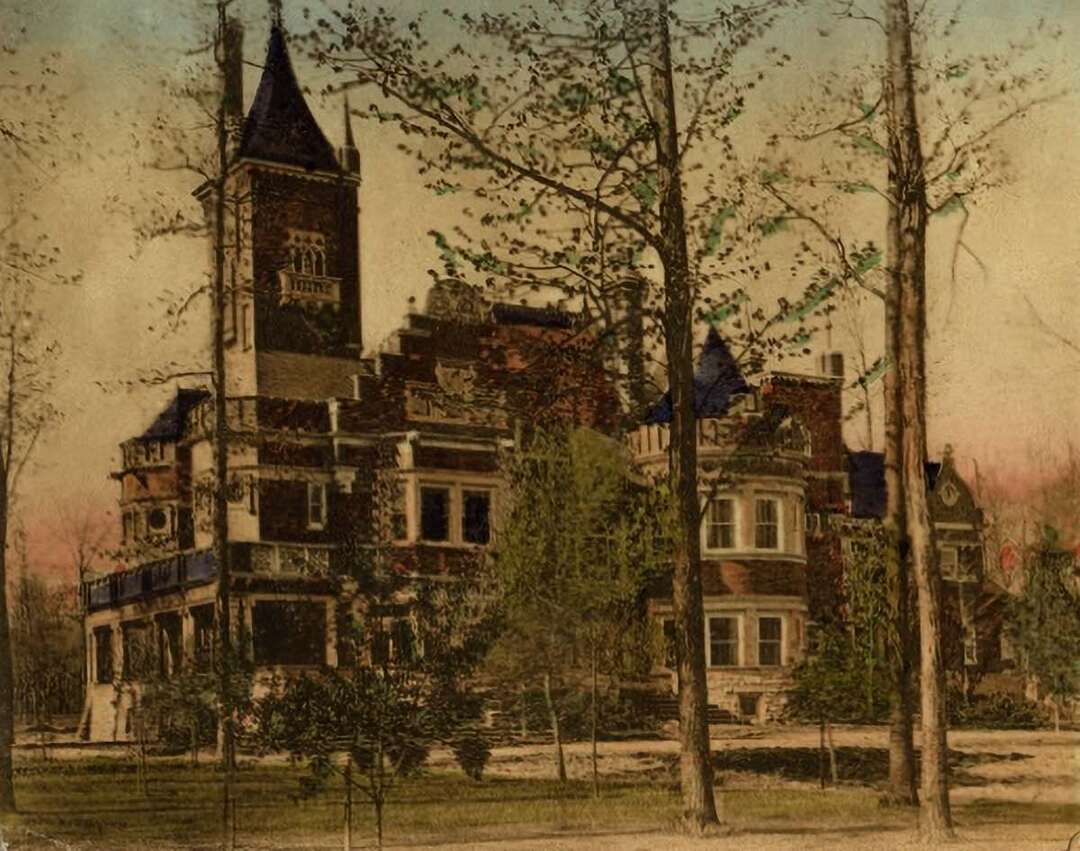
    <summary type="html"><![CDATA[<p><strong><em>Built by Theodor Kundtz between 1899 and 1903, the mansion known as Kundtz Castle featured a five-story tower, a bowling alley, and a music room with 12 stained glass windows. Kundtz did most of the woodwork himself. In 1925, the <em>Cleveland Press</em> called Kundtz's work "genius."</em></strong></p><img src="https://clevelandhistorical.org/files/fullsize/ffeb4dffbda2ee671248840cdd3ec54b.jpg" alt="Postcard View of Kundtz Residence" /><br/><p>Theodor Kundtz immigrated to Cleveland from Hungary in 1873, at the age of twenty one. Trained as a carpenter, he found a job making cabinets for Whitworth Co.  Kundtz was ambitious and wanted to make a name for himself, so in 1878 he left Whitworth and founded his own company, Theodor Kundtz Co. The main product was sewing machine cabinets, but the company sold many other wood items as well, including bodies for cars and vans. Kundtz accrued dozens of patents to protect his many ventures. Later on, he also founded a bicycle wheel company. Combined, the two businesses turned the poor immigrant into one of Cleveland's largest employers. </p><p>As his wealth grew, Kundtz invested his considerable wealth and woodworking skills in the construction of a grand estate situated on five acres of land stretching along the Lake Erie shoreline on the north side of Lake Avenue in Lakewood, Ohio. Each of the many rooms were adorned with Kundtz' own handcarved detail work.</p><p>Kundtz was active in Cleveland's Hungarian community. At the height of his success, nearly all of his 2,500 workers (92 percent, reportedly) were Hungarian. Kundtz also founded the Hungarian Savings and Loan Company and funded the Hungarian Hall on Clark Avenue. In 1902, his service to the Hungarian people was recognized and honored when Emperor Franz Joseph of Austria-Hungary had the immigrant-turned-businessman/philanthropist knighted.</p><p>Kundtz sold his "castle" to Robert R. Morrow in 1945. In 1960, the Eggleston Development Co. purchased the property for $110,000 with plans for redevelopment. On December 18, 1961, the public saw Kundtz Castle for the last time. After a brief period during which the public was invited to view the interior of the castle, the company tore down the mansion to build 16 custom homes and a new street – Kirtland Lane. Before Kundtz Castle was demolished, the Eggleston Company salvaged some of the woodwork and sold it at auction. Most pieces went to private collectors, allowing the memory of Kundtz Castle to survive, if only in pieces.</p><p><em><strong><a href="https://clevelandhistorical.org/items/show/224">For more (including 7 images) view the original article</a></strong></em></p>]]></summary>
    <published>2011-06-07T16:57:46+00:00</published>
    <updated>2026-03-04T21:31:58+00:00</updated>
    <link rel="alternate" type="text/html" href="https://clevelandhistorical.org/items/show/224"/>
    <id>https://clevelandhistorical.org/items/show/224</id>
    <author>
      <name>Robin Meiksins</name>
    </author>
  </entry>
  <entry>
    <title type="html"><![CDATA[Saint Elizabeth of Hungary: The Nation&#039;s First Hungarian Catholic Parish]]></title>
    <summary type="html"><![CDATA[<img src="https://clevelandhistorical.org/files/fullsize/50c79479ae91331a0943350491bd10b0.jpg" alt="St. Elizabeth of Hungary Roman Catholic Church" /><br/><p>St. Elizabeth of Hungary Roman Catholic Church sits on the corner of Buckeye Road and East 90th Street in Cleveland's Lower Buckeye neighborhood. In the late nineteenth century, the neighborhood became home to thousands of Hungarian immigrants who were drawn to the area by nearby factories and mills, especially the Cleveland Malleable Iron Company and the Eberhard Manufacturing Company, which were known to these immigrants as, respectively, the "old" factory and the "new" factory. </p><p>Hungarian immigrants initially worshiped alongside Slovak immigrants at St. Ladislas Church, located on the corner of Holton Avenue and East 92nd Street. However, when <a href="https://clevelandhistorical.org/items/show/596">a dispute broke out between Hungarian and Slovak parishioners</a> as to which mass should be said in which ethnic group's native language, the Hungarians were induced to leave St. Ladislas and form a parish of their own. That new parish became St. Elizabeth of Hungary parish, the first Roman Catholic Hungarian parish in the United States. </p><p>The first parish church was built in large part as a result of the efforts of Father Karolyn Boehm. Arriving in America in 1892, Fr. Boehm temporarily held masses for the parish in a nearby hall and led the efforts of the parish in constructing a small wood-framed church on the corner of Buckeye Road (then called South Woodland Avenue) and East 90th Street (then called Bismark Street). </p><p>On June 4, 1893, the cornerstone of the first St. Elizabeth's Roman Catholic Church was laid. This first church provided seating for up to 800 Hungarian immigrants at a single mass. Within a decade, however, it was too small to accommodate the thousands of Roman Catholic Hungarian immigrants arriving in Lower Buckeye. As early as 1907, Father Szepessy, the second pastor of St. Elizabeth began to petition the Bishop of Cleveland for permission to raise money to build a new church that would hold up to 1300 parishioners. Permission was finally granted by the bishop and, in 1918, construction of the new church was begun.</p><p>The new church, designed by French-born architect Emile Uhlrich, was completed in 1922. The church is a large rectangular building with a gable roof and exterior masonry walls composed of large smooth grey blocks of stone. A prominent feature of the Church are its twin bell towers which flank the front of the building, each topped with a brass dome and an internally illuminated cross. The two exterior side walls of the Church are each graced with six large stained glass windows with semicircular arches. The Church has a front entrance way consisting of ten wide and deep stone steps that lead up to three large metal front double doors with semicircular arches above them. Each doorway is flanked by stone columns, and above the doors, arches and columns is a decorative triangular pediment. The facade of the building also features a large ornate circular window with carved stone decoration directly above the front doors.</p><p>De-industrialization and suburbanization induced the Hungarian population to begin leaving the Buckeye neighborhood in the 1960s. Today, few Hungarian-Americans live in the Buckeye neighborhood. A small group of Hungarian-Americans--most of whom live in Cleveland's suburbs, however, continue to worship at St. Elizabeth of Hungary. The church now serves as a symbol and reminder of the once thriving and bustling Hungarian-American population that resided in Cleveland's Buckeye neighborhood for nearly 100 years.</p><p><em><strong><a href="https://clevelandhistorical.org/items/show/203">For more (including 13 images&#32;&amp;&#32;3 audio files) view the original article</a></strong></em></p>]]></summary>
    <published>2011-04-26T21:31:54+00:00</published>
    <updated>2026-03-04T21:31:58+00:00</updated>
    <link rel="alternate" type="text/html" href="https://clevelandhistorical.org/items/show/203"/>
    <id>https://clevelandhistorical.org/items/show/203</id>
    <author>
      <name>Jim Lanese&amp;#32;&amp;amp;&amp;#32;Jim Dubelko</name>
    </author>
  </entry>
  <entry>
    <title type="html"><![CDATA[Hungarian Cultural Garden]]></title>
    <summary type="html"><![CDATA[<img src="https://clevelandhistorical.org/files/fullsize/cmp-hung-1938_3207d4ea2b.jpg" alt="Garden Dedication" /><br/><p>The Hungarian Cultural Garden began with the dedication of a bas-relief to composer Franz Liszt (1811-1886) on the site in 1934; it was completed and formally dedicated in 1938. The Garden is constructed on two levels along the upper boulevard, and overlooks lower East Boulevard. Designed by a well-known architect of Budapest, Hungary, its design is distinguished by a compact, opulent, and formal landscape style. The original design and intentions have been well maintained, with hedges cut to a larger size. This lends the spaces a contemplative feel of discovery. </p><p>The Hungarian population's first significant immigration to Cleveland began in the 1870s. The Buckeye Rd. neighborhood, on the easternmost edge of the city at that time, was the first Hungarian settlement area. A separate settlement arose in the 1880s between Madison St. (now E. 79th) and E. 65th St. along the south-side of Woodland Ave. The largest wave of Hungarian immigration occurred between 1870 and 1924. In 1900 the U.S. Census recorded 9,558 Hungarians (or 8% of the city's foreign born population) in Cleveland. By 1920 this number was 43,134 (18%). During these years Hungarians would come to Cleveland and then encourage relatives and friends to emigrate as well. Called "chain migration," this eventually created a community on the west side of Cleveland where several hundred immigrants from the same village settled. </p><p>After 1920 the original Buckeye Rd. neighborhood expanded to Woodland Ave. and ran between E. 72nd St. and E. 125th St. It is estimated that the years 1947-53 brought 6,000 Hungarian immigrants to Cleveland with 6-9,000 more arriving in 1956 after the Hungarian Revolution. By the 1960s with the trend to the suburbs, the Buckeye Rd. neighborhood began to decline. The 1990 U.S. Census recorded 61,681 Cleveland area residents asserting Hungarian descent.</p><p>From East Boulevard, visitors enter the Hungarian Cultural Garden through a patterned wrought-iron gateway gifted by the Verhovay Insurance Association. Crafted by Handcraft Metal, whose crafts people trained at the renowned Rose Iron Works, the gate is like the traditional type of archway leading to country estates in the Szekely region of Hungary. The Szekely Kapus is decorated with two small, delightful peasant figures in bronze; it also bears the year 1938, signaling the Gardens' formal dedication. Though "rehabilitated" in recent years, the gate remains a remarkable tribute to the delicate artistry of early twentieth century ironworkers in Cleveland. </p><p>Clara Lederer, writing in "Their Paths are Peace", describes the principal plot on the upper level as "a rectangular reflecting pool and fountain... set in a pattern of low walls and geometric walks of brick, stone, and marble, and rich plantings of the growths best known in Hungary--hawthorn, yew, cotoneasters, and azaleas. Two linden trees, formal flower beds, and brick, stone, and marble walls and walks are the features of the lower garden. Two wing sections, formal arrangements of lawn, brick paths, and sculptured stone benches, adjoin the larger upper garden. In the section to the left of the entrance is a bas-relief of Franz Liszt."</p><p>The Garden contains three busts and an additional bas relief commemorating Bela Bartok, a composer and collector of folk music (1881-1945); Endre Ady, a poet, writer and journalist (1877-1919); Imre Madach, a writer, poet, lawyer and politician (1823-1864); and Joseph Remenyi, a writer who taught at Case Western Reserve University (1892-1956). </p><p><em><strong><a href="https://clevelandhistorical.org/items/show/109">For more (including 6 images&#32;&amp;&#32;4 audio files) view the original article</a></strong></em></p>]]></summary>
    <published>2010-12-29T13:31:07+00:00</published>
    <updated>2026-03-04T21:31:58+00:00</updated>
    <link rel="alternate" type="text/html" href="https://clevelandhistorical.org/items/show/109"/>
    <id>https://clevelandhistorical.org/items/show/109</id>
    <author>
      <name>Mark Tebeau</name>
    </author>
  </entry>
  <entry>
    <title type="html"><![CDATA[Rose Iron Works: The Nation&#039;s Oldest Decorative Metalwork Company]]></title>
    <summary type="html"><![CDATA[<img src="https://clevelandhistorical.org/files/fullsize/lg_rose-paul-feher-art-deco-screen-cma-3521996_f248b68887.jpg" alt="Art Deco Screen (1930)" /><br/><p>The Rose Iron Works, opened in 1904 on Cleveland's east side. The oldest continually-operating decorative metalwork company in the United States, it was founded by Martin Rose, a Hungarian immigrant who worked in Budapest and Vienna before moving to Cleveland. </p><p>Rose provided craft metalwork that adorned many of Cleveland's notable dwellings and buildings during the height of the city's growth. The works included fanciful dividing screens at Halle's as well as the decorative iron gates that guarded many of the Millionaires' Row estates on Euclid Avenue. Informed by European ornamental Beaux-Arts architecture, Rose worked in the tradition of other craft ironworkers such as Samuel Yellin.</p><p>Even as the market for ornamental ironwork began to decline as a result of changing styles and the Depression, Rose Iron Works thrived. During the 1930s, the Rose Iron Works produced some of the most notable Art Deco ironwork in the nation, including styling recognized internationally for their uniquely American characteristics.  </p><p>The company turned to the production of industrial products during World War II (an activity that now dominates its business) but it never forsook the craft and metalworking traditions of nineteenth-century Europe. </p><p><em><strong><a href="https://clevelandhistorical.org/items/show/13">For more (including 9 images, 3 audio files,&#32;&amp;&#32;3 videos) view the original article</a></strong></em></p>]]></summary>
    <published>2010-09-14T15:17:51+00:00</published>
    <updated>2026-04-04T22:10:23+00:00</updated>
    <link rel="alternate" type="text/html" href="https://clevelandhistorical.org/items/show/13"/>
    <id>https://clevelandhistorical.org/items/show/13</id>
    <author>
      <name>Emma Yanoshik-Wing, James Calder,&amp;#32;&amp;amp;&amp;#32;Mark Tebeau</name>
    </author>
  </entry>
</feed>