<?xml version="1.0" encoding="UTF-8"?>
<feed xmlns="http://www.w3.org/2005/Atom">
  <title type="text">Cleveland Historical</title>
  <updated>2026-05-02T02:04:08+00:00</updated>
  <generator uri="http://framework.zend.com" version="1.12.20">Zend_Feed_Writer</generator>
  <link rel="alternate" type="text/html" href="https://clevelandhistorical.org/"/>
  <link rel="self" type="application/atom+xml" href="https://clevelandhistorical.org/items/browse?output=rss2"/>
  <id>https://clevelandhistorical.org/</id>
  <author>
    <name>Cleveland Historical</name>
    <uri>https://clevelandhistorical.org</uri>
  </author>
  <link rel="hub" href="http://pubsubhubbub.appspot.com/"/>
  <entry>
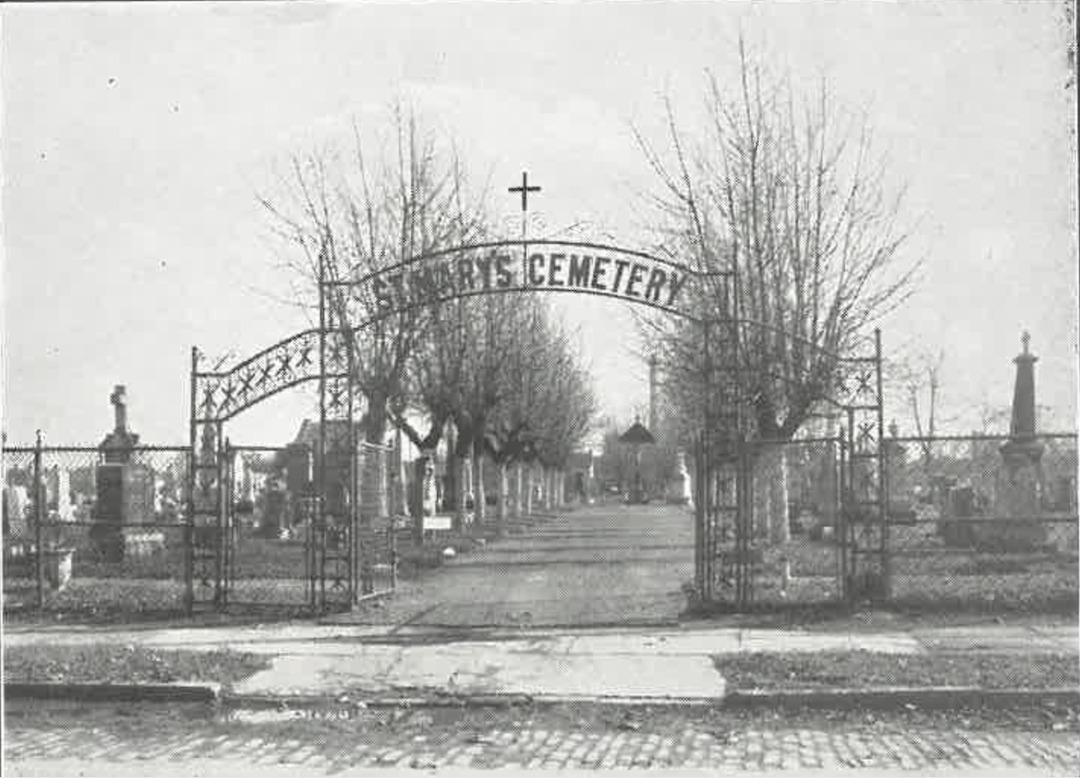
    <title type="html"><![CDATA[St. Mary Cemetery: Cleveland&#039;s First West Side Catholic Cemetery]]></title>
    <summary type="html"><![CDATA[<p><strong><em>St. Mary Cemetery lies in the middle of one of the most densely populated residential areas on Cleveland's west side. Its nine acres of land, dotted with shade trees and beautiful grave stones, is surrounded by a fence, and, at its West 41st Street entrance, a posted sign advises visitors of its visiting hours.  However, neither this entrance nor its other on West 38th is gated. This being the case, St. Mary's almost beckons to neighbors and any other passersby to  visit it at any time, day or night, enjoy its grassy grounds, walk its pretty paths, and, most importantly, respect its magnificent  monuments.</em></strong></p><img src="https://clevelandhistorical.org/files/fullsize/1cc9a1a467673d53392c76e36c48e8e6.jpg" alt="The once ornate West 41st Street entranceway to St. Mary Cemetery." /><br/><p>In 1853, just one year before Ohio City was annexed to the City of Cleveland, thus becoming Cleveland's west side, prolific nineteenth-century real estate developer Hiram Stone platted a new residential subdivision south of Ohio City in Brooklyn Township. He called it "H. Stone's Addition to Ohio City & Cleveland," a remarkably prescient title at the time. The new subdivision stretched west from Pearl (West 25th) Street all the way to Gauge (West 44th) Street, and from Clark Avenue north to <a href="https://clevelandhistorical.org/items/show/659">Walworth Run</a> at Ohio City's southern boundary. </p><p>The platted area contained almost 700 lots for residential houses, but left undeveloped in its midst were thirteen acres located just east of Burton (West 41st) Street and north of Clark Avenue. In 1861, as houses were going up in Stone's subdivision—many of them for German immigrants who were pouring into Cleveland in this period in large numbers—the southernmost six acres of the undeveloped thirteen in the middle of the subdivision were purchased by the Catholic Diocese of Cleveland for, according to the deed of purchase, "cemetery purposes for the benefit of German Catholics on the west side of the Cuyahoga River." </p><p>Many of the early records of St. Mary Cemetery appear to have been destroyed in a fire, making research of the early years of the cemetery difficult.  However, secondary sources tell us that St. Mary Cemetery was established on those six acres of land in 1862 by St. Mary of the Assumption parish, Cleveland's first west side German Catholic parish. The property for St. Mary Cemetery was purchased during the pastorship of Father F. X. Obermueller, a German immigrant, but it appears that it was under a subsequent pastor, Father Stephen Falk, a Swiss immigrant who served the parish from 1862 to 1880, that the cemetery grounds were developed and consecrated. In St. Mary Cemetery's early years, it was often referred to as Burton Street Cemetery, after the street upon which it fronted. That street, in turn, had been named after <a href="https://clevelandhistorical.org/items/show/660">William Burton</a>, an Ohio City pioneer whose summer cottage was built on the street in 1839 and still stands directly across from St. Mary Cemetery.  </p><p>Just a few years after St. Mary Cemetery opened, another German Catholic parish, <a href="https://clevelandhistorical.org/items/show/649">St. Stephen</a>, was established on Cleveland's west side. It began in 1869 as a mission of St. Mary of the Assumption for German Catholics living west of Gauge (West 44th) Street. A decade later, in 1881, another parish, <a href="https://clevelandhistorical.org/items/show/717">St. Michael Archangel</a>, was also founded as a mission of St. Mary's for German Catholics living on Cleveland's southwest side. In the years that followed, German Catholics who belonged to either St. Mary of the Assumption, St. Stephen or St. Michael's parishes were permitted to be buried at St. Mary Cemetery which, by this date, had now become part of Cleveland's west side following the 1867 annexation of an area of Brooklyn Township that included the lands upon which the cemetery was located.</p><p>It is interesting to note that no Cleveland newspaper mentioned St. Mary Cemetery during the first decade of its existence. The first to mention the cemetery, albeit obscurely, was the Plain Dealer on May 30, 1871, when it published an article which noted that, on Decoration Day, Father Falk of St. Mary's German church had, at the west side "Catholic cemetery," decorated the graves of "J. Mayer, J. Schneider, F. Werz, A. Klein, K. Mecil, B. Lais, F. Schwonger, S. Vochatger, C. A. Schmidt, and Jas. Macklin." All of these men presumably were German Catholics who had fought for the Union—and for which some had died—in America's Civil War. Cleveland city directories were even slower in acknowledging the existence of the new cemetery. St. Mary Cemetery was not listed in any Cleveland directory until 1874.</p><p>Thousands of German immigrants and descendants of German immigrants were buried at St. Mary Cemetery in the years that followed its establishment, many of them beneath beautiful gravestones inscribed in the German language. A number of these gravestones are memorials to notable German Catholics who, in the second half of the nineteenth century, operated successful retail businesses on Lorain Avenue near Fulton Road, an intersection that soon became known as <a href="https://clevelandhistorical.org/items/show/966">Lorain-Fulton Square</a>. A number of those gravestones honor members of the related Fridrich and Schmitt families who operated several different businesses in that west side commercial district, including <a href="https://clevelandhistorical.org/items/show/964">Fridrich Bicycle</a>, one of the oldest retail bicycle shops in the United States until it closed its doors in 2024. </p><p>Another example of a notable German immigrant businessman buried at St. Mary Cemetery is Friedlin "Freddie" Hirz (1843-1903), a tailor who for years had a shop on Lorain Avenue, just west of what is today West 45th Street. His shop was so well known that it was featured in the 1874 Atlas of Cuyahoga County. Another is Edward Disler, a German immigrant and jeweler who successfully operated a store on Lorain Avenue near West 25th Street for many years.</p><p>While St. Mary Cemetery was explicitly founded for German Catholic burials, Catholics of other ethnicities were later given permission to bury their dead there too. The first of these were Bohemian Catholics many of whom lived near the cemetery in a west side neighborhood that was known in the second half of the nineteenth century as the <a href="https://clevelandhistorical.org/items/show/646">Isle of Cuba</a>. The early-arriving immigrants likely first worshiped with German Catholics at either St. Mary of the Assumption or St. Stephen, but, by 1872, their numbers were sufficiently large that the Bishop permitted them to form a parish of their own, which they called <a href="https://clevelandhistorical.org/items/show/661">St. Procop</a>, after Bohemia's patron saint. Their first church was built on Burton Street, just south of St. Mary Cemetery in 1874. One of the earliest verifiable burials of a Bohemian Catholic at St. Mary Cemetery occurred in 1892, when 41-year- old Miloslav Holecek, a Cleveland grocer and immigrant from <span>Karlova Huť in Central Bohemia</span>, died and was buried there. His gravestone, as well as those for a number of other Bohemian immigrants buried at St. Mary's, is inscribed entirely in the Czech language.</p><p>In the early years of the twentieth century, Catholic immigrants of other ethnic groups from Central Europe who often tended to settle in urban areas where Germans and/or Bohemians had first settled, including Hungarians, Poles, and Slovaks, became members of the west side German and Bohemian Catholic parishes, and when they died, they were permitted to be buried at St. Mary Cemetery too. Their gravestones were often inscribed in their native languages.</p><p>In 1917, Father Casimer Reichlin, the first pastor of St. Stephen who had served for an incredible 47 years, died.  By this time, there appears to have already been a large circular section near the West 41st Street entrance to St. Mary Cemetery, in the center of which a large cross had been erected. It further appears that it was decided that this beloved pastor should be buried in that section, with a large sculpted monument erected over his grave. Four years later, Father Reichlin's long-time friend and fellow priest, Bishop Joseph Koudelka, who had been a pastor at both St. Procop and St. Michael, died and was buried next to Father Reichlin's grave in the circular section. A similarly sized sculpted monument was placed over his grave too. Soon this circular section of St. Mary Cemetery became known as the Priests Circle. In the years that followed, other notable local priests who had served west side Catholic parishes were accorded the same honor and buried in the Priests Circle, some below large monuments and others below simple flat grave markers. As of October 2025, there were eleven priests buried in the Priests Circle. Father Stephen Falk, whose efforts led to the development of the cemetery and its consecration in 1862, is not buried in the Circle, as he died in 1899 long before the Priests Circle was initiated. A simple flat grave marker in Father Falk's memory, which apparently replaced a more elaborate earlier monument, is located in another section of St. Mary Cemetery.</p><p>By the early 1920s, there were few available burial plots left at St. Mary Cemetery. The parish of St. Mary of the Assumption decided to remedy this by expanding the cemetery's lands, and in 1927 and 1928 it successfully purchased three additional acres of land for the cemetery that abutted the eastern end of the original cemetery grounds.  The additional acres had earlier been developed as residential lots in H. Stone's Additional Subdivision. Houses on the lots were either torn down or moved, and the cemetery grounds were successfully extended all the way to West 38th Street. Along with the additional land, St. Mary Cemetery was further enhanced at this time with a second entrance on West 38th Street and a new walking path that led from that entrance directly to a new circular section in the cemetery.</p><p>On November 15, 1931, the new addition to St. Mary Cemetery was consecrated at a ceremony attended by a representative of Bishop Joseph Schrembs.  Some five years later, on May 17, 1936, the Cuyahoga County Council of the Veterans of Foreign Wars placed a flagpole and a memorial plaque in the center of the new circular section, the plaque inscribed: "Dedicated To The Veterans Who Served . . . Lived . . . Died . . . for their Country."  </p><p>As previously noted, St. Mary Cemetery had long held the graves of a number of German Catholic soldiers who fought and died in the Civil War, and also likely holds graves of soldiers and veterans who had fought in the Spanish-American War and/or in World War I. No veterans from any of these war, however, are buried in this new circular section. The first soldier buried in what became known as the Soldiers Circle, was Charles L. Andrews, a U. S. Navy radio operator who was killed on Easter Sunday, April 5, 1942, during the Battle of Bataan in the Philippine Islands. The remains of sixteen other soldiers or veterans who served in World War II were also buried in the Circle between 1942 and 1948.</p><p>In 1945, as a result of dwindling attendance numbers, St. Mary of the Assumption parish was dissolved and, in 1948, the management, care and maintenance of St. Mary Cemetery was transferred to the Calvary Cemetery Association, an organization which was later renamed the Catholic Cemeteries Association of the Cleveland Diocese. By the early 1950s, the last of the available lots in the cemetery were purchased, and, by 1976, according to a January 21, 1976 Plain Dealer article, the number of annual burials at St. Mary Cemetery had dropped to just fifty.  Today, in 2025, the annual numbers appear to be considerably less. According to findagrave.com—a website at which volunteers create memorials for people whose remains have been buried in cemeteries all around the world—the remains of only nine deceased persons have been buried at St. Mary Cemetery since 2020.  </p><p>St. Mary Cemetery is no longer the active burial place for west side Catholics that it once was. Burials are now few and far between. The cemetery's elaborate gate that once stood at its West 41st Street entrance in 1929 is gone. The sacred monuments to Father Reichlin, Bishop Koudelka and Father Falk have been substantially damaged, likely by vandals. The cross in the middle of the Priests Circle, which stood there for years until recently, is now gone. Acts of vandalism, as noted in a number of Plain Dealer and Press articles over the years, and the effects of exposure of the cemetery's monuments to Cleveland's weather over long periods of time, have left many monuments damaged and unreadable while many others have simply vanished. Still, St. Mary Cemetery remains one of the most historic cemeteries on Cleveland's west side and one which should be visited, respected, and carefully managed and maintained, not only for the descendants whose ancestors are buried there, but also for all Clevelanders who see value in preserving an important piece of their city's history.</p><p><em><strong><a href="https://clevelandhistorical.org/items/show/1072">For more (including 15 images) view the original article</a></strong></em></p>]]></summary>
    <published>2025-11-23T16:18:32+00:00</published>
    <updated>2026-04-17T19:17:43+00:00</updated>
    <link rel="alternate" type="text/html" href="https://clevelandhistorical.org/items/show/1072"/>
    <id>https://clevelandhistorical.org/items/show/1072</id>
    <author>
      <name>Jim Dubelko</name>
    </author>
  </entry>
  <entry>
    <title type="html"><![CDATA[Cinecraft Productions: The Historic Film Company Produced by a Love Story]]></title>
    <summary type="html"><![CDATA[<img src="https://clevelandhistorical.org/files/fullsize/9356c399633956464b62b5acc6d1022b.jpg" alt="Ray and Betty Culley working together (circa 1940)" /><br/><p>When, as Americans, we look back at the decade of the 1930s, we often see only the Great Depression. It was a calamitous time for the country and it may be difficult for us to imagine that anything good actually occurred during it. People, we may think, didn't thrive during this decade. At best, they just survived.  But for the two people who are at the center of this story, the decade of the 1930s was the one in which events conspired to bring them together in Cleveland; to allow them to fall in love; and to finally inspire them, just as they started their life together, to take a huge risk and start their own industrial motion picture company. Today, more than 80 years later, that company—Cinecraft Productions, Inc.—is still in business and, according to the Hagley Museum and Library in Wilmington, Delaware, is now the oldest surviving industrial film company in the United States.</p><p>First, a few words about industrial films, otherwise known as sponsored or non-theatrical films. These were films produced for the benefit of, and paid for by, private sector companies, nonprofit organizations, educational institutions, the federal government, or state or local governments. In the first half of the twentieth century, the making of such films by motion picture companies  developed into a large industry in the United States. Thousands of such films were produced in this period, many more than the number of entertainment films produced in Hollywood during the same period. </p><p>Some industrial films were produced to promote the products of large industrial and utility companies like General Electric, Standard Oil of Ohio (Sohio), Ohio Bell and Westinghouse; others to train industrial workers at steel mills, auto factories and other production sites; others to train members of the United States military on how to perform their duties; and still others to alert the public to a health risk or other public emergency. In the years before televisions became available in the United States to the general public, many of these films were shown in movie theaters as a prelude to the main attraction.  </p><p>The story of the two people who founded Cinecraft Productions  is itself worthy of a film. One of the two was Elizabeth "Betty" Buehner. She was born in Bavaria, Germany, in 1914. Her father Albin was a soldier who fought in the Great War, as World War I was called at that time. After the war ended, he came home to his wife Franziska and five-year old daughter, and together they experienced the financial and psychological trauma that many German families experienced in the aftermath of that war.  Hoping for a better life, Betty's parents decided to immigrate to the United States. Her father traveled first, arriving in Cleveland in 1922, where, according to family lore, his brother found him work as a laborer on theTerminal Tower project. In 1923, the now nine-year old Betty and her mother joined him here. While the Buehner family may have been very optimistic in the first years after their arrival, things didn't turn out for them the way they hoped.  </p><p>The family struggled to make ends meet and then, in 1928, Betty's mother died suddenly. Her father found himself unable to care for a teenage daughter and sent her off to live with and work as a nanny, first for a family in Shaker Heights and then later for one in Lakewood. Betty survived it all and, in the process, learned to speak English so well that, according to her son, years later no one could detect even a hint of a German accent when she spoke.  She attended Lakewood High where she was active in a number of school organizations, graduating in 1934. Before long, the resourceful and hard-working young woman  found employment and was living on her own. And then, just a few years out of high school, she landed the job which would change her life. Through a connection she had made as a nanny in Shaker Heights, she was hired to work as a  film editor (then called a "cutter") for Tri-State Motion Picture Company, a pioneer industrial film production company whose offices were then located in the Rockefeller Building in downtown Cleveland. Betty Buehner was working there in 1938 when she met Ray Culley.</p><p>Raymond "Ray" Culley came from a very different world.  He was born in Norwalk, Ohio, in 1904, the oldest son of working-class parents whose families had lived in Norwalk for several generations.  Ray dropped out of school in his teens and  went to work as a watchmaker's apprentice.  In the 1920s, he worked in  jewelry stores in Norwalk, Columbus, and West Virginia. In this early work, he demonstrated creativity and a willingness to take risks to succeed. While working in West Virginia, he taught himself how to fly a plane so that he could perform aerial stunts that would not only impress potential customers but also demonstrate the durability of his product.   </p><p>In 1930, after the economy collapsed and the country lurched into the Great Depression, Ray found himself thinking that perhaps the only people who could now afford to buy his jewelry were Hollywood actors.  So, the 26-year-old bought a car and drove across the country to southern California. Once there, he didn't sell jewelry for very long, as he soon found more profitable work at some of Hollywood's early motion picture studios. He first worked as an actor, landing bit roles in Westerns which featured big-name actors like Gene Autry, Hoot Gibson and Hopalong Cassidy. But later, in the way that things sometimes go in Hollywood, he found himself on the other end of the camera, first as a production assistant and then an assistant director. He was working in that latter capacity in 1937 when Tri-State contacted Republic Pictures, where Ray was then working, looking for a director. Tri-State's director, Jack T. Flanagan, had died in October 1936 following a film-shooting accident and the company needed someone to direct an industrial film that the company had contracted to produce for General Electric. Republic dispatched Ray to Cleveland where he directed that film, titled "From Now On." Tri-State must have been impressed by the young director, because, before Ray could return to Hollywood, he was hired as Tri-State's new director. And it was there that Ray Culley met Betty Buehner.</p><p>Their sons don't know—and it's unlikely that anyone now still living knows—the complete story of how, when and why the two Tri-State employees fell in love. What we do know is this. Shortly after Ray's arrival at Tri-State, Betty left the company and moved to New York where she hoped to learn more about the film editing business. As part of his duties with Tri-State, Ray was required to make regular trips to New York to have new industrial films edited. Ray and Betty likely met  in New York during these trips, because, in the spring of 1939, Ray made a special trip to New York  and, on that trip, the two married. They then  returned to Cleveland where, after a very short period, they founded the company they called Cinecraft Productions.  </p><p>In 1999, some sixty years later, Ray's younger brother Paul stated in an interview that Ray and Betty started Cinecraft  Productions because Ray had had a "falling out" with Tri-State. It is not known whether this "falling out" preceded his marriage to Betty, but the two certainly were ready with a plan when they returned to Cleveland. Ray's father lent the newlyweds $1500—the equivalent of approximately $30,000 today—to purchase a camera and tripod. Betty persuaded Ray that he should shoot movies with 16mm film, instead of the traditional 35mm, as she believed it was the future for industrial films. And the two quickly went into business together, at first operating Cinecraft Productions out of their west side apartment, but later out of an office and studio in the Card Building, which then stood on St. Clair Avenue East, near Ontario Street, where the Cleveland Marriott Hotel at Key Tower stands today. </p><p>In the same year that Ray and Betty Culley started their business, they successfully produced their first film. Titled "You Bet Your Life," it was made  for the Cleveland Railway Company and designed to alert riders about the rules of safety while traveling on the company's streetcars. In time, other businesses came their way, some via advertising companies  impressed with the couple. Ray's artful script work, skillful directing and affable personality, coupled with Betty's knowledge of film editing, frugality and business management skills, made the two an early era power couple in Cleveland industrial filmmaking. It enabled them to survive the early years, as difficult as they may have been, and to then begin growing their business from the ground up.</p><p>In the 1940s, Betty Culley was presented with a new challenge as she gave birth to the couple's twin boys in 1944 and then to a third son several years later. She continued to work for Cinecraft Productions, the 1950 federal census listing  her as an "executive" with the company.  Her sons, looking back to when they were children, remember the nanny who came to their house in Rocky River to watch them, allowing  their mom to jump into her car to drive to the company's offices and attend to . . .  well, to whatever needed her attention. In 1947 that drive became a little shorter after the company purchased the historic building at 2515 Franklin Boulevard on the west side of Cleveland and moved all of its operations there. The Culleys remodeled the building—which was designed and built to house Cleveland Public Library's first branch library—creating a large studio and offices for the company's  art work, film editing, and other departments.</p><p>The Culleys operated Cinecraft Productions from this west side location for decades, creating hundreds of quality industrial films for entities like the City of Cleveland, the Cleveland Transit System, Cleveland Electric Illuminating Company, Republic Steel, Westinghouse, Sohio, General Electric, and many other business and government organizations. Along the way, the company became  one of the early pioneers in the film industry to use three cameras with teleprompters operating in synch with each other to shoot the same movie scene from three different angles. The industrial films that Cinecraft Productions produced often featured  local talent from the Cleveland Play House, but the company was also able to land some big names from Hollywood and other parts of the country. The list of actors and other notables who traveled to Cleveland to be in industrial films directed by Ray Culley included Basil Rathbone, Merv Griffin, Joe E. Brown, Don Ameche, Danny Kaye, Joel Grey, Tim Conway, Ernie Anderson (Ghoulardi), and future United States presidents Richard Nixon and Ronald Reagan.</p><p>In 1970, Ray and Betty Culley retired, selling Cinecraft Productions to Ray's younger brother Paul. In 1986, Paul, after 16 years of ownership in which he guided the company in its transition from 16mm films to video films, retired too. Cinecraft Productions was then purchased by a company employee, Neil McCormick, and his wife Maria Keckan.  McCormick and Keckan shepherded in another major change in the company's history by transitioning it from video to  digital media production, and positioning the company to become a local leader in the production of e-learning courses.</p><p>The love story of Ray and Betty Culley, which produced Cinecraft Productions, Inc., came to an end in 1983 when Ray died. Betty went on to live for almost three more decades before dying at the age of 102 in 2016. Today, as noted earlier, Cinecraft Productions is believed to be the longest surviving industrial film company in the United States. This suggests that not only does love conquer all, but sometimes it also survives all too.</p><p><em><strong><a href="https://clevelandhistorical.org/items/show/999">For more (including 23 images&#32;&amp;&#32;4 videos) view the original article</a></strong></em></p>]]></summary>
    <published>2023-02-11T16:38:26+00:00</published>
    <updated>2026-04-17T19:17:42+00:00</updated>
    <link rel="alternate" type="text/html" href="https://clevelandhistorical.org/items/show/999"/>
    <id>https://clevelandhistorical.org/items/show/999</id>
    <author>
      <name>Jim Dubelko</name>
    </author>
  </entry>
  <entry>
    <title type="html"><![CDATA[Lorain-Fulton Square: Once the &quot;Hub of the West Side&quot;]]></title>
    <summary type="html"><![CDATA[<img src="https://clevelandhistorical.org/files/fullsize/2e69c04a06dba37e0b0aba310b4f2ca6.jpg" alt="&quot;Next Stop . . .  Lorain-Fulton Square!&quot;" /><br/><p>Fulton Road is one of seven streets that were originally designed to radiate from Franklin Circle in accordance with the 1836 subdivision plat created by Ohio City pioneer real estate developers Josiah Barber and Richard Lord.  Starting at the Circle, it runs for one-half mile in a southwesterly direction, intersecting several grid streets at sharp angles, before terminating--at least until 1905--at Lorain Avenue  (then, Lorain Street).  It is unknown whether Barber or Lord envisioned it, but the original terminus of Fulton Road was destined to become one of the most commercially important corners on the west side of Cleveland in the late nineteenth and early twentieth centuries.</p><p>Eighteen years after Barber and Lord recorded their 1836 subdivision plat, Ohio City was annexed to Cleveland, becoming that city's west side.  At about the same time, German immigrants began arriving in Cleveland in large numbers and moving  onto streets in the Barber and Lord  and other  residential subdivisions located on lands north and south of Lorain, and west of West 25th Street (then, Pearl Street).  As the immigrant population swelled in these subdivisions, a neighborhood emerged and Lorain  Street  transformed into its commercial corridor.  Retail merchants of German origin built and occupied store fronts along the street's north and south sides, and, before long, both sides of Lorain Street were lined  with retail stores all the way to Cleveland's western corporation line which, in the post Civil War period, was just west of West 59th Street (then, Purdy Street).  </p><p>A number of these early west side retail stores were built at or near corners of the intersection of Lorain with Fulton and nearby Willett Street, a north-south grid street which began on the south side of Lorain just across the street from Fulton Road's terminus. (In 1905, Willett Street would be renamed Fulton Road, creating the much longer version of the latter road that Clevelanders know today.)  These two intersections (hereinafter, simply referred to as the Lorain-Fulton intersection) were from the start likely viewed by merchants as favorable places to conduct retail business.  As noted above, the Lorain-Fulton intersection was just a half mile down Fulton from Franklin Circle, where the west side's elite were already beginning to build the mansions that would one day make Franklin Boulevard (then, "Franklin Street") the "West Side's Euclid Avenue."  Moreover, the intersection was also just one-half mile down Lorain from the West Side Market, which had become, since it relocated to the northwest corner of Lorain and Pearl in 1859, a popular place where west siders gathered and shopped for their meat and produce.  </p><p>The early retail merchants who located their businesses at or near the Lorain-Fulton intersection included grocers,  butchers, shoe makers, saloon keepers, tobacconists, bakers, confectioners, milliners and tailors, to name just a few.  A survey of period directories suggests that business failures among these merchants  were frequent and it wasn't unusual for a merchant to sell one type of product one year and then an entirely different one the next.  Two of the early merchants who located at or near the intersection, however, are noteworthy for establishing retail businesses that thrived for decades.  One was Henry Leopold, a German immigrant from Hanover, who, in 1859, opened up a store near the southeast corner of the  intersection where he initially manufactured and sold furniture and caskets.  Eventually, his company would leave the casket business and devote its full attention to making and selling furniture.  Leopold's store was a neighborhood fixture until the 1940s when it relocated to Cleveland's West Park neighborhood and, after that, to the suburb of Brecksville where it is still in business today.   The other notable early merchant at this intersection was George Tinnerman, a German immigrant from Bavaria, who opened a hardware and stove store on the northeast corner in 1868.  Tinnerman later developed a steel range stove which  became so popular that, after operating his retail business at the Lorain-Fulton intersection for almost four decades, he  finally closed it  in 1915 to focus exclusively on manufacturing steel range stoves at a factory he built on Fulton Road just south of the Lorain-Fulton intersection.</p><p>In 1879, the businesses of Henry Leopold, George Tinnerman and the other merchants engaged in the retail sale of products or services at or near the Lorain-Fulton intersection were boosted when the West Side Street Railway (WSSR), then controlled by Marcus Hanna, bested Tom Johnson's Brooklyn Street Railway and secured a license from Cleveland City Council to build and operate a new branch of the WSSR streetcar system on tracks which soon ran south on Fulton from Franklin Circle to Lorain and then west on Lorain Chestnut Ridge (today, West 73rd) Street. Later, that new branch was additionally connected to the WSSR main line by a separate track which ran from the Lorain-Fulton intersection to Pearl Street.  As more and more streetcar riders hopped on, got off or waited for a transfer at the Lorain-Fulton intersection, the businesses of nearby merchants grew as evidenced by the construction  of many larger and more grand commercial buildings at or near the intersection in the decades that followed.</p><p>In the early twentieth century, another change came to the Lorain-Fulton intersection that reflected its continued vitality and key location on Cleveland's west side.   Between 1903 and 1905, the Cleveland Public Library, armed with a promise of funding from Andrew Carnegie, conducted a search for a site for its new West Side branch library.  A number of sites at or near prominent West Side intersections were considered, including one at the intersection of Lorain and West 25th near the West Side Market and another at the junction of Lorain and Clark Avenues.  The Board, however, ultimately chose a site  on Fulton Road less than a tenth of a mile north of the Lorain-Fulton intersection.  The new Carnegie West branch library opened in 1910.  It was then, and still is today, the largest of Cleveland Public Library's branch libraries.  </p><p>In the same year that the new library opened, the City of Cleveland, spurred by the example of New York City, began naming a number of its more notable diagonal intersections "squares." (For example, the diagonal intersection of Huron Road and Euclid Avenue in downtown Cleveland was named "Euclid Square" in1910. It was later renamed "Playhouse Square" in 1921 when theaters began to locate there.)  While it is not known whether the City of Cleveland ever officially named it a square, the Lorain-Fulton intersection became popularly known on the West Side as "Lorain-Fulton Square" in this decade, likely as the result of a number of actions taken by merchants with stores located at or near the intersection.  In 1914, a number of these merchants, including George Tinnerman and Henry Leopold's son August, formed the Lorain-Fulton Square Business Association to further their mutual business interests and promote the area as a great place for west siders, including those on west side street cars, to shop for all of their family and other needs.  In 1915, the merchants sponsored a contest to create a slogan for their business area.  The winning slogan was "The Hub of the West Side." The merchants later used that slogan repeatedly in "Opportunity Ads" that promoted their stores and advertised their "bargain" sales.</p><p>The 1920s opened with another sign  of the continuing commercial vibrancy of  the Lorain-Fulton intersection. On December 25,1921, John and Bertha Urbansky opened their beautiful new Lorain-Fulton Theater at 3321-3409 Lorain Avenue, adjacent to Leopold's four-story furniture store on the intersection's southeast corner.  The theater seated 1,400 patrons; had a dance hall on the second floor; and had  storefronts for retail businesses.   In the years that followed, the intersection remained an active and busy commercial area, but as streetcars declined and automobile traffic increased, as upper- and middle-class residents (and the businesses that catered to them) moved to the suburbs, and as the city's deindustrialization began in the post World War II era, Lorain-Fulton Square began to lose many of its shoppers. By the 1950s, historic commercial buildings at or near the intersection were already beginning to show signs of  deterioration and neglected maintenance.   A number of them were torn down and replaced by parking lots, gas stations or fast-food restaurants which better served the needs of the more mobile--and more transient--population now frequenting  Lorain-Fulton Square.</p><p>At least since 1993, when the Cleveland Landmarks Commission cataloged historic buildings on Lorain Avenue between West 32nd and West 58th Streets during the process that created the Lorain Avenue Commercial Historic District, the City has been aware of the extent of the deterioration and loss of historic buildings at or near Lorain-Fulton Square.  Before Landmarks Commission intern Don Petit walked up and down Lorain Avenue in that year, snapping photos of the historic buildings, many historic buildings were already lost--burned down, torn down or perhaps blown down in the 1953 Tornado.  The photos he took were part of a City effort to save  the remaining historic buildings. Many of the buildings that were still standing at or near the intersection of Lorain and Fulton when Petit walked the area in 1993, no longer are.  Lorain Fulton Square has become a very different place than it was one hundred or even thirty years ago.  </p><p>While other prominent West Side intersections such as Detroit Avenue -West 25th Street and Lorain Avenue -West 25th Street have for decades  garnered  attention from redevelopers resulting in the preservation of a number of historic buildings in those areas being saved, Lorain-Fulton Square has not.  In 2022,  however, there is reason for hope as Lorain Avenue west of West 25th Street is beginning to get redevelopment attention.  While little of that attention has yet come to  Lorain-Fulton Square itself, it seems inevitable that it soon will.  It would be fitting to honor the rich commercial history of this historic intersection with redevelopment that recalls and reflects some of the height, massing and location of significant historic buildings.  This would seem to be good for business branding. It would also instill some pride in new business owners operating there, as well as new residents choosing to live there, as they came to learn that Lorain-Fulton Square was at one time, and for good reason, known as the "Hub of the West Side." </p><p><em><strong><a href="https://clevelandhistorical.org/items/show/966">For more (including 21 images) view the original article</a></strong></em></p>]]></summary>
    <published>2022-09-30T14:36:48+00:00</published>
    <updated>2026-04-17T19:17:42+00:00</updated>
    <link rel="alternate" type="text/html" href="https://clevelandhistorical.org/items/show/966"/>
    <id>https://clevelandhistorical.org/items/show/966</id>
    <author>
      <name>Jim Dubelko</name>
    </author>
  </entry>
  <entry>
    <title type="html"><![CDATA[Fridrich Bicycle: Once Cleveland&#039;s Oldest Bike Shop]]></title>
    <summary type="html"><![CDATA[<p><strong><em>Until it closed in 2024, Fridrich Bicycle was Cleveland's oldest retail bicycle shop and  one of the oldest in the United States.  The Fridrich family had been selling bicycles in Cleveland for well over 100 years.  The family's roots in the Lorain Avenue Commercial Historic District, however, extended even deeper than that.</em></strong></p><img src="https://clevelandhistorical.org/files/fullsize/04db346c2bc5a56681c7300fc5141dbf.jpg" alt="Fridrich Bicycle Store - 1993" /><br/><p>As in many other American families, the Fridrich family story begins with an immigrant.  In 1847, 36 year-old Joseph Friedrich, the unmarried son of a restaurant owner in Pirkensee, Bavaria, emigrated from his homeland. At the time, revolution and war in central Europe were pushing large numbers of ethnic Germans out of their principalities which became parts of a unified German state in 1871. Many immigrated to the United States, and to Cleveland, then a young, but growing, industrial city in the Midwest.  Friedrich--who would later change his surname to "Fridrich"--may have traveled directly to Cleveland from Europe, but there is no record of his presence until May 1853 when County records reveal that he married Margarete Schaefer, also a German immigrant.  </p><p>Margarete Schaefer Friedrich was the mother of three young boys--John, Anton and August Schmidt--all under the age of eight.  When he married her, Joseph Friedrich became a father to all of them. Over the course of the next ten years, he worked as a laborer--for at least some of that time employed by the Cleveland and Erie Railroad.  Margarete gave birth to three more boys, Joseph W., George, and William Friedrich.  In 1863, the year their youngest son William was born, the Friedrich family was residing in a house near the intersection of Old River and Mulberry Streets on the West Bank of the Flats.  The surrounding neighborhood was fast developing into an Irish-American enclave which became known as the Triangle, later shortened to "the Angle," and today nostalgically referred to by the Cleveland Irish community as "the Old Angle."</p><p>In 1864, the Friedrichs moved from the Angle about a mile south to a growing and predominantly German-American neighborhood that was centered around Lorain Street (Avenue) and located primarily west of Pearl (West 25th) Street.   Joseph purchased a new house on Branch (later renamed China, then Elvira and finally West 37th), a street south of Lorain and just west of Willet (Fulton) Road.  It was one of several streets in a new residential subdivision platted in 1860 by real estate developers John H. Sargent and Thomas Dixon.   Sargent & Dixon's subdivision was just one of a number built north and south of Lorain Street in the 1850s and 1860s that together grew into a neighborhood that was centered around a commercial corridor on Lorain Street. </p><p>Growing up in this neighborhood, the Schmidt and Friedrich boys would have had ample opportunity to explore Lorain Street, located less than a quarter mile from their doorstep.  When the family first arrived, most buildings on Lorain were one or two stories and made of wood.  Later, by the 1880s, many of the earlier era buildings had been razed and replaced by taller, more ornate buildings often built of brick.  When the boys made their first trips up to the corner of Mechanic (West 38th) Street and Lorain, possibly the first building that would catch their eyes was the livery and stable of Andrew Steinmetz which was built circa 1871. It was located almost directly across Lorain from Mechanic Street, and it clearly stood out from other nearby buildings because of its unusual mansard roof and because of the constant stream of horses, wagons and carriages going into or out of the building.  </p><p>Over the years as they grew up in their house on Branch which was renamed China Street in 1873, the Schmidt and Friedrich boys likely made many trips up to the corner and then up or down Lorain Street.  By 1880, this corridor was lined with commercial buildings that stretched westward from near Columbus Road almost all the way to Gordon Avenue (West 65th Street)  near Cleveland's border with the suburb of West Cleveland.  Some of those trips likely took them to the Pearl Street Market on the northwest corner of Lorain and Pearl (West 25th) Street,  just a half mile east of Mechanic Street.  When the Friedrich family moved into the neighborhood in 1864, there was an open-air market on that corner that was known as the West Side Market.  Four years later, the City of Cleveland built a one-story wooden market house on the site which it named after nearby Pearl Street.  (Forty-four years later in 1912, the market house that we know today as the West Side Market would open across the street, and the Pearl Street Market would shortly afterwards be razed.)  </p><p>Walking or riding to the Market, the Schmidt and Friedrich boys would have passed a number of thriving shops in the second half of the nineteenth century that became well-known to them, like Julius Grothe's cabinet shop at 265 (today, 3704) Lorain, John Kraus's boots and shoe shop at 257 (3622) Lorain, the Koblenzer family's butcher shop at 246 (3613) Lorain, and Heidenger's Bakery at 234 (3601) Lorain, just to name a few.  As they crossed Fulton Road, they would also have noted the rest of the nearly two dozen saloons that dotted the corners of Lorain from Mechanic Street to the Market, some sharing space with early grocery stores, others located in boarding houses.  The boys would take in all the sights, sounds and smells of the commercial businesses of Lorain Street, including the pungent aromas from the Dahlheimer cigar and tobacco factory and retail shop at 199 (3228) Lorain. In 1875, it was purchased by new owner Charles Sauer who, some two decades later, would build a new and larger factory and retail shop on the premises, one still standing today and recently renovated and restored. As the boys neared the Pearl Street Market, they might have noticed the millinery shop of Matilda and Julia Chubb at 96 (2615) Lorain, diagonally across the street.  The two sisters operated their retail business on the southwest corner of McLean (West 26th) Street and Lorain for nearly 20 years in the second half of the nineteenth century before retiring and moving to Lakewood.  As the boys passed the store, they may have turned their heads to better admire a fashionably dressed young woman leaving the Chubb sisters' store with a new hat atop her head.</p><p>The Schmidt and Friedrich boys were undoubtedly influenced by interactions with the Lorain Street commercial corridor like those imagined above.  While the two oldest Schmidt boys worked in traditional trades (one becoming a stone cutter and the other a bookkeeper), the younger four, after they became old enough, by nineteenth-century standards, to work for a living, all started new retail businesses on Lorain Street. This development within the second generation of the Fridrich family living in America would lead not only to the 1909 establishment of Fridrich Bicycle, but also to Fridrich Moving and Storage Co., another Fridrich family business that was founded by youngest brother William in 1915 and which has, like the bicycle shop, now operated in the Cleveland area for more than a century.</p><p>Fridrich Bicycle grew out of an early business partnership between August Schmidt, the youngest of the Schmitt brothers, and Joseph W. Friedrich, the oldest of the Friedriches.  In 1884, 34 year-old Schmidt, who by this time was spelling his last name "Schmitt," and 26 year-old Friedrich (whose immigrant father, a short time before his death in 1888, would change the spelling of their family's last name to "Fridrich") started a retail coal business under the name of "Schmitt and Friedrich." Originally operating out of the family house at 19 China (2000 West 37th) Street, the two moved their business in 1885 into a storefront at 840 (3817) Lorain Street.  Why they decided to start a retail coal business is unknown, but it may have been prompted by contacts their father developed while working for the Cleveland and Erie Railroad.   Meanwhile, the two youngest Friedrich boys, William and George, had also pooled their resources together and, in 1891, started a retail flour and feed business up the street from their older brothers' retail coal store at 924 (4209) Lorain.)</p><p>After operating their retail coal store together for 15 years, August Schmitt and Joseph W. Fridrich closed it in 1900, with each starting new retail coal businesses in their individual names.  While it is unknown why they ended their partnership, it may have been related to their different family statuses.  Joseph W. Fridrich had married in 1881 and, by 1900, had two sons--one of whom, Joseph Aloysius Fridrich, was 17 years old and already working in the family coal business.  August Schmitt, on the other hand, though eight years older than his brother, had not married until 1891 and had children who in 1900 were just  3 and 7 years old.  Schmitt operated his new business out of a store at 750 (3207) Lorain, while Fridrich took over the storefront of their former partnership business at 840 Lorain.  </p><p>While August Schmitt's new business was apparently successful--he operated it until his retirement in 1915, Joseph W. Fridrich's appeared to have been less so, as he faced the challenge of bringing two sons into the business.  In 1902, he opened a flour and feed store at 842 (3821) Lorain, right next door to his retail coal store, but that business closed by 1904.   He then formed a new partnership in the retail coal business with August Schmitt and his younger brother William Fridrich, but both August and William appear to have withdrawn from this association by 1907.  Joseph might have attempted other changes to his business model had not a new business opportunity suddenly come his way in 1908.  After his flour and feed store at 842 Lorain had closed in 1904, that storefront had been rented to a Walter J. Meyers, who opened a retail bicycle store there that same year.  Sometime in late 1908 or early 1909, however, Meyers closed his shop.  It is likely that Joseph's younger son, Alphonse, who, probably more so than his father, was aware of the bicycle "craze" going on in the United States in the early twentieth century, successfully lobbied his father to take over Meyer's bicycle shop.  It was the beginning of Fridrich Bicycle and the end of Joseph Fridrich's retail coal shop, which closed the same year. </p><p>While Alphonse Fridrich was the first manager of Fridrich Bicycle, the business was later largely operated by Joseph W. Fridrich and his older son Joseph Aloysius.  The Fridrich family continued to lease space for their shop at 3821 Lorain until 1915 when they purchased the building. In 1919, they added a retail auto parts business to their store and changed the name of the business to Fridrich Bicycle and Auto Supply Co.  In 1925, as the result of the successful growth of these two businesses, the Fridrich family purchased a building across Lorain Avenue which had originally been  Andrew Steinmetz's livery and stable.  It must have given Joseph W. Fridrich some pause the day he vacated the storefront at 3821 Lorain and  moved the business across the street into the historic building which had likely captured his imagination as a child.  </p><p>Seven years later, in 1932, Joseph W. Fridrich died and a new era in the family began when his son Joseph Aloysius took over operation of the store.  He was helped by his son Joseph J.  who had dropped out of high school  to work in the family business.  Continuing to thrive on Lorain Avenue, even in the wake of the Great Depression, Fridrich Bicycle and Auto Supply expanded again in 1942, purchasing  the three-story Schenck Building at 3806-3808 Lorain.  The business's address for its combined retail operations in the two  buildings would soon be changed to simply 3800 Lorain.  In 1947, when he was just 64 years old, Joseph Aloysius Fridrich died  and this ushered in yet another new era for the family business.  </p><p>Joseph J. Fridrich, known in the family as "J.J.," took over the operations of the store.  He is remembered by members of the Fridrich family today for the "Cadillac" bicycles which he and staff built in the store's basement, and which he passionately promoted as the store's owner and manager.  J.J. Fridrich also built a new building on Lorain Avenue to the west and adjacent to the Schenck Building, which soon became known in the family as "Schwinn Hall," because its first floor was used  to display the company's inventory of Schwinn bicycles.  In the 1960s, he made the decision to close the retail auto parts business and to concentrate exclusively on selling bicycles of all types.  In 1966, the name of the company was accordingly changed to Fridrich Bicycle, Inc.</p><p>J. J. Fridrich owned and operated Fridrich Bicycle until his death in 1992.  According to an article appearing in the Plain Dealer on April 14, 1992, when the store closed for a day in his memory, it was the first time it had closed on a day other than Christmas in the memory of anyone then working at the store.  After J. J. Fridrich's death, the store was owned and the business operated by J.J's son, Charles "Chuck" Fridrich.  Day-to-day operations later were handled by Jane Alley, the store's general manager, and a staff of nine employees.  Cleveland's oldest retail bicycle store remained an important business in the Lorain Avenue Commercial Historic District, as well as a custodian of two of that District's most historic buildings, until it closed in 2024.</p><p><em><strong><a href="https://clevelandhistorical.org/items/show/964">For more (including 14 images) view the original article</a></strong></em></p>]]></summary>
    <published>2022-08-22T03:31:47+00:00</published>
    <updated>2026-04-17T19:17:42+00:00</updated>
    <link rel="alternate" type="text/html" href="https://clevelandhistorical.org/items/show/964"/>
    <id>https://clevelandhistorical.org/items/show/964</id>
    <author>
      <name>Jim Dubelko</name>
    </author>
  </entry>
  <entry>
    <title type="html"><![CDATA[Thomas Axworthy House: Where a Popular West Side Gym Once Stood]]></title>
    <summary type="html"><![CDATA[<p><strong><em>Clement and Katherine Folkman, immigrants from Eastern Europe, probably didn't know much, if any, of the history of the house at 4206 Franklin when they purchased it in 1923. So they, and their son Clement Jr. proceeded to make their own history there.</em></strong></p><img src="https://clevelandhistorical.org/files/fullsize/8487376c904adf13daff3b7ec1272cda.jpg" alt="4206 Franklin Boulevard" /><br/><p>The house at 4206 Franklin Boulevard is one of only a few Second Empire  style houses on Franklin Boulevard.  It has approximately 3,000 square feet of living area and is notable for its hexagonal mansard roof, decorative window hoods and wrap-around single-story covered front porch.  The house was built in 1866 and,  while the name of the contractor who actually built it is unknown, it may have been Ferdinand Dreier (Dryer), a German immigrant and house carpenter by trade.  Dreier built a number of houses on or near Franklin Boulevard in the late 1860s, including a somewhat similar Second Empire style house almost directly across the street at 4211 Franklin.   </p><p>According to National Register of Historic Places (NRHP) records of the Franklin Boulevard Historic District, the house at 4206 Franklin is named for Thomas Axworthy, a nineteenth century coal merchant, who purchased it in 1873.  Its original owner was Atherton Curtis, a liquor dealer, whose family only lived in the house for a year or so before moving to Huron County, Ohio.  The family then rented the house  out to tenants for several years before selling it to Axworthy, who lived in the house with his wife Rebecca and their three daughters for more than a decade.</p><p>Thomas Axworthy was an interesting figure who left his mark on Cleveland city government, although not in the way you might think.  An English immigrant, Axworthy became involved in Cleveland politics in the 1870s, serving in that decade as a city fire commissioner as well as president of the "West Side Democracy," a political club for Democrats living west of the Cuyahoga River.  In 1883, while his star was still rising, Axworthy was considered to be a likely candidate for city mayor, but he ran instead for city treasurer and was elected in a close race.  He  was re-elected to the office in 1885 and again in 1887.  By the time he was re-elected the second time, he had already sold the house at 4206 Franklin, moving, like many other Franklin Boulevard residents during this period, to the city's far west end.  There, he built a grand house on Lake Avenue, not far from where political kingmaker Marcus Hanna, also a Franklin Boulevard resident, would build his Lake Avenue mansion just a few years later.</p><p>In October 1888, Thomas Axworthy's political star crashed and burned when the Cleveland Leader broke the news that he had fled the city after embezzling some $440,000 from the city treasury.  (To appreciate the size of his embezzlement, that sum would be almost $13 million in 2022 dollars.)  The papers, not only in Cleveland, but across the country, were abuzz for months with stories of Axworthy's whereabouts, the efforts made by Cleveland to recover the funds he had stolen, and the inevitable litigation that followed.  The person who headed the effort to locate Axworthy was attorney Andrew Squire, who just two years later would co-found Squire, Sanders and Dempsey, for many years one of Cleveland's largest and  most prestigious law firms.  Squire also happened to be a former neighbor of Axworthy, having lived just three houses down the street  from Axworthy during the years that the latter  resided on Franklin.  Squire doggedly searched for Axworthy, located him in London, and traveled  all the way there to confront  the disgraced treasurer who was living in England's capital under an assumed name.  Squire successfully negotiated a settlement with Axworthy which required him to surrender all of the cash and bonds still in his possession, and  agree to sell properties that he still owned back in the States--which included Colorado and Tennessee as well as Ohio--to cover much of the rest of what he had stolen.  In the end, after bondsmen made up the difference, the City of Cleveland was fully reimbursed for its loss.</p><p>After the Axworthy family moved from the house at 4206 Franklin, it was next owned and occupied by the family of a district passenger agent for the Erie Railroad and after that by a treasurer of a trucking company.  In 1919, the house was purchased by a Hungarian immigrant  whose family lived in it for four years before selling it to Clement and Katherine Folkman in 1923.  Clement, a German immigrant who worked in Cleveland as an auto body builder, and his wife Katherine, a Hungarian immigrant, were among a large number of  German and Hungarian immigrants who settled on and around Franklin Boulevard in the second and third decades of the twentieth century.  A number of them, like the Folkmans, purchased grand houses on Franklin that had once been occupied by the West Side's  wealthiest families, and then converted them into multi-family dwellings or rooming houses.  The Folkmans created three suites in the house at 4206 Franklin, living in one themselves and renting out the other two.</p><p>Clement and Katherine Folkman's son Clement, Jr., who was sixteen years old when his parents bought the house at 4206 Franklin, initially entered the workplace as an auto body builder like his father.   In 1936, however, when he was 29 years old, he decided to become a different type of body builder.  "Clem," as he was referred to by his family, was an adherent of  the "physical culture" theories of Bernarr McFadden, an American entrepreneur who, in the late nineteenth and early twentieth centuries, advocated physical fitness through weight lifting regimens. McFadden later published  a series of popular magazines which may have caught young Clem's eyes.  With his father's help, Clem built a gymnasium in the two-story carriage house that stood in the rear yard of their property.  An avid weightlifter himself, Clem soon was training young men in the neighborhood at his Folkman's Athletic Club, which he later renamed Folkman's Physical Culture Studio. By October 17, 1938, when an  article about his gym appeared in the Plain Dealer, he was training 50 young men, ages 20 to 30, who came to the gym three times a week, some with Olympic medal aspirations.</p><p>For decades, Folkman's Physical Culture Studio was a popular gym and  rare commercial enterprise on historically residential Franklin Boulevard.  The Folkman family at some point in time built another two-story building on the property, the first story of which served as a garage, and connected the new building to the old carriage house, which itself was extensively remodeled to accommodate Clem's growing business.  The gym was located on the second floor of the remodeled carriage house, and a locker room, sauna, and massage room on the first.  A large round clock was also installed on a pole in the front yard that for years reminded passers by on Franklin that it was "Time To Exercise."  The gym was still thriving in 1967 when legendary Plain Dealer reporter Bill Hickey paid a visit to Folkman's gym.  By this time, Clem's son Ronald, a Cleveland firefighter, was also working part-time at the gym as a masseuse.  Bill Hickey referred to the two of them in an article that appeared in the Plain Dealer on March 30, 1967, as "the Squires of Franklin Boulevard."   When Hickey reminded Clem that he had been exercising at the gym for years, Clem, according to the article, took one look at Hickey's body and responded, "Please don't tell anybody that. It will ruin me."</p><p>In 1986, the Folkman Physical Culture Studio had been operating at 4206 Franklin Boulevard for 50 years.  Cleveland Plain Dealer reporter James Neff visited the property in August of that notable anniversary year to interview Clem Folkman.  When he arrived, he found an elderly man who was gravely ill and reliving past glories, and a gymnasium that was literally falling apart and papered with city building code violation notices.   Clem Folkman died just three months after this interview.  After the death of Clem Folkman, one of his grandsons attempted to revive the business, but was unsuccessful.  In 1991, the   house at 4206 Franklin Boulevard was sold to a new owner, and one year after that the buildings on the rear of the property, which had housed Folkman's Physical Culture Studio  for more than a half century, were unceremoniously torn down.</p><p>Today, no evidence remains of the Folkman Physical Culture Studio where Clem Folkman trained so many Clevelanders for so many years in the theories, methodologies and regimens of Bernarr McFadden.  The Thomas Axworthy House, however, now nicely renovated as a three-family dwelling, and celebrating its 156th birthday in 2022, still stands at 4206 Franklin Boulevard.</p><p><em><strong><a href="https://clevelandhistorical.org/items/show/956">For more (including 16 images) view the original article</a></strong></em></p>]]></summary>
    <published>2022-01-18T01:10:47+00:00</published>
    <updated>2026-04-17T19:17:42+00:00</updated>
    <link rel="alternate" type="text/html" href="https://clevelandhistorical.org/items/show/956"/>
    <id>https://clevelandhistorical.org/items/show/956</id>
    <author>
      <name>Jim Dubelko</name>
    </author>
  </entry>
  <entry>
    <title type="html"><![CDATA[Kiefer&#039;s Tavern: From Prussia with Love]]></title>
    <summary type="html"><![CDATA[<img src="https://clevelandhistorical.org/files/fullsize/8e61741ce6c1e55d4ad108a393fae5a3.jpg" alt="Sign of Better Times" /><br/><p>Some classic restaurants bank on culinary excellence. Others feature great ambiance or perhaps famous clientele: celebrities, gangsters, politicians and so forth. However, the claim to fame for Kiefer’s – the venerable German eatery – might be the strangest: the longest-closed hostelry that still has a sign out in front. </p><p>This is not to say that Kiefer’s didn’t have great food and good karma. Quite the contrary; Kiefer recipes for signature dishes like wiener schnitzel are still floating around the Internet. But since the restaurant closed in 1991, virtually everything around West 25th Street and Detroit Avenue has changed. Art galleries. New residences. Revamped buildings. A huge park planned for nearby Irishtown Bend. In fact, the only vestiges of an earlier time are the St. Malachi complex and the lonely Kiefer’s sign at 2519 Detroit Ave. The giant Seymour building in which Kiefer’s was located dates to the early 20th Century, and it too is getting a major facelift – a conversion to affordable housing. </p><p>The story of Kiefer’s begins in Paradise – the name of the restaurant that previously occupied the space. Kiefer’s, on the other hand, began as a beer and bratwurst stand launched by William and Anna Kiefer at the Great Lakes Exposition of 1936. When the event closed in late 1936, the Kiefers bought out Paradise and renamed it Swartzwald (“Black Forest” in German). It was a good time for German and central European cuisine and the establishment thrived. Expansions swallowed an adjoining carpet store, furniture store and barber shop and by the 1940s the eatery’s seating capacity topped 400. William baked and prepped. Anna handled the cooking and bookkeeping. Otto Thurn and his oompah band entertained patrons and conducted singalongs. Heavy wood paneling, Teutonic murals and copious beer immersed patrons in the Black Forest. President Jimmy Carter once held a nationally televised meeting there.</p><p>The restaurant's early years coincided with the rise of the Bund. Seeking to promote favorable views of Nazi Germany, the Bund was populated primarily by American citizens of German descent. In 1939 and 1940 the Schwartzwald was a hotbed of Bund activity. Soon, however, Schwarzwald (like most German terms) became an undesirable moniker, so the couple renamed their establishment “Kiefer’s.” </p><p>In 1960 the Kiefers sold out to a syndicate headed by Jack and Joseph Klingbeil but the menu changed little: everything from paprikash to pig’s knuckles. A second consortium headed by County Treasurer Francis E. Gaul bought Kiefer's in 1976, seasoning it with a slight Irish flavor. The rediscovery and renovation of Ohio City was just beginning at this time. That was fine for Kiefer’s but it also was a harbinger of increased competition. Nonetheless, when Gaul shuttered the restaurant in 1991, he blamed a recession and the 18-month renovation of the Main Avenue Bridge.</p><p>Signs of change are everywhere along lower Detroit Avenue. That’s a great thing for the most part. But when the Seymour Building overhaul is complete, the one remaining “sign of other times” will probably disappear. </p><p><em><strong><a href="https://clevelandhistorical.org/items/show/913">For more (including 8 images) view the original article</a></strong></em></p>]]></summary>
    <published>2020-07-01T14:55:22+00:00</published>
    <updated>2026-04-17T19:17:42+00:00</updated>
    <link rel="alternate" type="text/html" href="https://clevelandhistorical.org/items/show/913"/>
    <id>https://clevelandhistorical.org/items/show/913</id>
    <author>
      <name>Chris Roy</name>
    </author>
  </entry>
  <entry>
    <title type="html"><![CDATA[Donauschwaben German-American Cultural Center]]></title>
    <summary type="html"><![CDATA[<img src="https://clevelandhistorical.org/files/fullsize/50b4a4f713ade34ff781cfb18a338e6a.jpg" alt="The German-American Cultural Center" /><br/><p>German-speaking immigrants have been settling in Cleveland for more than two centuries and remain one of the largest and most influential ethnic groups. Unbeknownst to many though, the end of World War II brought a wave of ethnic Germans from Eastern Europe to the city in the 1950s. These people are known as Danube Swabians, an homage to their early 18th-century Swabian ancestors who left Germany by invitation to colonize parts of the Danube River Valley in the Austro-Hungarian Empire in what is today mostly Hungary, Romania, Croatia, and Serbia. Having kept their language and culture alive through the centuries, Germany’s defeat in World War II, followed by Soviet occupation of that region, meant oppression, incarceration, and death for many of the nearly two million ethnic Germans caught behind the Iron Curtain. This subjugation led to the forced migration of several hundred thousand Danube Swabians who came to the United States in the largest numbers from 1950 to 1952, many settling in Cleveland, where they found work, raised families, and forged new, unbreakable ties to their new homeland. </p><p>Like so many immigrants, the Cleveland Danube Swabians unsurprisingly sought to preserve key aspects of their cultural identity, namely through associational life. That first began by mixing with the Banater Club, an existing German-speaking organization which had a small building (Banater Hall) on W. 140th Street near Lorain Avenue. There the Danube Swabians joined recreational groups, such as <em>Gesangvereine</em> (choirs) and folk dance troops, and introduced their own youth and sports initiatives as well as educational opportunities. In 1958 the Society of Danube Swabians was formerly recognized and elected its first president, Anton K. Rumpf. A year later a women’s group was formed with leadership from President Katharina Ritzmann. By 1960 the Society had formalized its bylaws and structure, elected a Board, and endeavored to grow the organization. This was done so successfully that it was soon clear they had outgrown the Banater Club. For the festive annual events like <em>Tag der Donauschwaben</em> (Day of the Danube Swabians), <em>Trachtenfest</em> (Folk Costume Festival), and <em>Weihnachtsfeier</em> (Christmas Celebration), they had to rent spaces to accommodate the large crowds. German language course offerings, known first as Weekend School, soon had to be held in classrooms in local churches. By 1970 the Weekend School was renamed the German Language School and offered classes for varying age levels as well as kindergarten in rooms at St. Stephen’s Catholic Church. That same year the Board approved the use of $97,000 in member donations to purchase Ritter Farm, a 17-acre parcel off Columbia Rd. in Olmsted Township, in the hope it would eventually accommodate the needs of the Cleveland Danube Swabian community. </p><p>Soon after closing the deal the land was cleared and leveled by member volunteers. In short order soccer fields, tennis courts, a pond, as well as a bar, picnic and restroom facilities were installed, but no large central building yet for its many indoor programs. The new property was renamed “Lenau Park,” after Nikolaus Lenau, a famed 19th-century German poet (from what is today Romania) who had settled in Ohio for a short time in the 1830s. Economically speaking, the 1970s were a terrible time to commence such a project as the United States soon entered its worst economic downturn since the Great Depression. Undaunted, the group proceeded with planning and fundraising for its main clubhouse under the tireless efforts of then President Josef (Sepp) Holzer. Construction eventually began in 1980 and culminated in the <em>Donauschwaben Deutsch-Amerikanishes Kulturzentrum</em> (Danube Swabian German-American Cultural Center), a 46,000 plus sq. ft. multi-level building that is today replete with sundry class, meeting, and dance rooms, a two-lane bowling alley, an indoor soccer field with locker and shower facilities, as well as a central ballroom. Named in honor of Josef Holzer (<em>Holzer Halle</em>), the ballroom has kitchen, bar, and restroom facilities to accommodate nearly 600 people. Dedication ceremonies were held on the 17th and 18th of May, 1986, the first day in English, the second in German. The keynote address on that first day was given by Cleveland State University President Walter B. Waetjen, himself of German descent. </p><p>A motto of sorts sits high above the stage in <em>Holzer Halle</em>. The Josef Linster quote reads “<em>Nur der ist seiner Ahnen wert, der ihre Sitten treu verehrt</em>.” This translates roughly to “Only those who honor the traditions of their ancestors are worthy to be their descendant.” Whether consciously or not, the newer generations of leadership have imbibed this sage message. Just as the founders had intended, the Cultural Center continues to be a conduit for German language and culture. Today, the German Language School offer eight levels of language instruction for children and six levels for adults as well as national and international proficiency exam testing. The strong tradition of associational life is alive and well too. For those interested in sports, the Concordia Soccer Club, the Blau-Weiss Tennis Group, the Edelweiss Ski Club, or the <em>Kegelverein</em> (bowling club) fit the bill. Dance groups for all ages, a choir group (<em>Banater Chor</em>), and the <em>Blaskapelle</em> (Brass Band) uphold musical traditions. The event calendar is packed all year round, from Lenten fish fries to the massive Oktoberfest celebration. And one certainly need not be of German heritage to join in the fun. Shaped by their history, from being guest immigrants in a foreign land in the 18th century to <em>Vertriebene</em> (expellees) in the 20th century, they value inclusivity and welcome their neighbors, thus personifying an American ideal that we still struggle with today.</p><p><em><strong><a href="https://clevelandhistorical.org/items/show/872">For more (including 9 images) view the original article</a></strong></em></p>]]></summary>
    <published>2019-08-23T20:45:13+00:00</published>
    <updated>2026-04-17T19:17:39+00:00</updated>
    <link rel="alternate" type="text/html" href="https://clevelandhistorical.org/items/show/872"/>
    <id>https://clevelandhistorical.org/items/show/872</id>
    <author>
      <name>Mark B. Cole</name>
    </author>
  </entry>
  <entry>
    <title type="html"><![CDATA[Standard Brewing Company: What Ever Happened to Erin Brew Beer?]]></title>
    <summary type="html"><![CDATA[<p><strong><em>When the Standard Brewing Company sponsored the TV and radio broadcasts of Cleveland Indians games in 1948 (the year the Tribe last won the World Series), the company's Erin Brew beer, for decades a favorite in the city's Irish-American community, suddenly became one of the most popular beers in all of Cleveland. </em></strong></p><img src="https://clevelandhistorical.org/files/fullsize/246ee1e9dabac3347720325b2b5e7508.jpg" alt="Delivering Neighborhood Beer" /><br/><p>Train Avenue on the west side of Cleveland is undoubtedly so named because it follows the tracks of the Big Four Railroad in a northeasterly direction from the old Stockyards near Clark Avenue and West 61st Street almost all the way to the Cuyahoga River.  If you travel to Train Avenue's western end today, you'll see on the south side of the street—just before you get to the West 61st Street intersection—several old red brick buildings.  Near the top of one are two granite stones, one carved with the word "Bottle" and the other with "Works."  On the building next to that, you'll see another granite stone, this one carved with the year "1913." Whether you're a beer lover or not, give yourself a pat on the back, for you have just arrived at the place where the Standard Brewing Company once manufactured Erin Brew beer—one of the most popular beers in the history of Cleveland.</p><p>The Standard Brewing Company had its origins in the founding of the Kress-Weiss Brewing Company in 1902.  In that year, Stephen S. Creadon, a west side saloonkeeper and second generation Irish-American, entered into an agreement with German immigrant brewer Andrew Kress  and several investors to produce a weiss (light wheat) beer out of an old butcher shop located on the corner of Sackett and Louis (West 32nd) Streets, in today's Clark-Fulton neighborhood.  Unfortunately, the venture faltered, and Creadon and Kress soon parted ways.  In 1904, Creadon, who retained the lease to the brewery building, brought in new investors and Jaroslav Pavlik, a Czech immigrant brewer, and incorporated anew under the name of the Standard Brewing Company. Pavlik brewed lager beer—darker and heavier than weiss beer—and sales quickly took off. The following year, the growing firm recapitalized and moved to a larger facility, an old flour mill located on the north side of Train Avenue near the West 61st street intersection.</p><p>Just one year after moving to its new location, the young company faced a serious challenge to its continued existence.  In November 1906,  J. P. Kraus, a banker with First National Bank which had financed the new venture and controlled most of the company's stock, proposed that its directors approve a sale of their business to Cleveland and Sandusky Brewing Company.  The latter was a large regional brewery which had been gobbling up local independent breweries in the Cleveland and Sandusky areas since 1897.  Standard Brewing's directors—led by Creadon, whose experiences as a saloon keeper had perhaps persuaded him to stay away from conglomerates—voted to stay independent and rejected the proposed sale.  However, Creadon now had to find new financing for his company and find it quickly.  His search ended with John T. Feighan, a Forest City Savings and Trust Company banker, who, like Creadon, was a member of the west side Irish community.  Feighan's bank, which since 1903 had been located in a new building on the southwest corner of Pearl (West 25th) Street and Detroit Avenue, was right across the street from Creadon's other business—his neighborhood saloon.  Soon Feighan became not only a lender and director of Standard Brewing, but also an officer of the company, serving first as its treasurer and then later as its president after Creadon's death in 1921.</p><p>Creadon's savvy in the saloon business, Feighan's business acumen, and Pavlik's brewing skills:  They were a winning combination.  By 1913, new brewery buildings had gone up on both the north and south sides of Train Avenue and the company was now marketing Pavlik's lager under the name of Erin Brew, making it a favorite among Cleveland's west side Irish-American community.  According to the company's 1914 corporate report, between the years 1906 and 1913 it almost doubled production, increasing annual output from 40,000 barrels to 75,000 in that period.  As it approached the end of that decade, Standard Brewing Company had become one of Cleveland's largest and most successful independent breweries.  Then, in 1919, the State of Ohio banned the sale and manufacture of liquor within the state, and one year after that the Eighteenth Amendment to the U.S. Constitution was passed, ushering in the era of national Prohibition.  Standard Brewing Company, like several other Cleveland breweries that survived Prohibition, converted its manufacturing facilities to the production of ginger ale and other soft drinks.  When Prohibition ended in 1933, those breweries were able to quickly shift production back to beer.  By May of that year, Standard Brewing Company was once again producing Erin Brew beer for a very thirsty consumer public.</p><p>In the 1940s, just after the end of World War II, Standard Brewing Company, under the leadership of John T. Feighan and George Creadon, son of founder Stephen Creadon, entered into a series of annual agreements to sponsor radio and TV broadcasts of Cleveland Indians baseball games.  When the Indians won the World Series in 1948, Erin Brew beer went from being the favorite beer of Cleveland's Irish community to being one of the most loved beers in all of Cleveland.  Responding to this increased demand, in 1950 the company built an extensive new bottling and canning facility just west of its earlier twentieth-century buildings on Train Avenue.  Sadly, this would be the peak of Standard Brewing Company's successful operations in Cleveland.</p><p>The decade of the 1950s marked the beginning of the end for Cleveland's brewing industry, as a changing consumer public and improved transportation facilities promoted the success of large national breweries at the expense of smaller local breweries.  Standard Brewing Company was one of the last of Cleveland's independent breweries to succumb, selling its brewery facilities to the F & M Schaefer Brewing Company of New York in 1961.  Three years after that, Schaefer sold the facilities to C. Schmidt & Sons Inc., a large Philadelphia brewery.  By the mid-1960s, Erin Brew was replaced by Standard Premium and soon the once most popular beer in Cleveland was just a memory.</p><p><em><strong><a href="https://clevelandhistorical.org/items/show/809">For more (including 14 images) view the original article</a></strong></em></p>]]></summary>
    <published>2017-07-08T16:21:19+00:00</published>
    <updated>2026-04-17T19:17:41+00:00</updated>
    <link rel="alternate" type="text/html" href="https://clevelandhistorical.org/items/show/809"/>
    <id>https://clevelandhistorical.org/items/show/809</id>
    <author>
      <name>Jim Dubelko</name>
    </author>
  </entry>
  <entry>
    <title type="html"><![CDATA[Stephen Buhrer House: Built for a Cleveland Mayor and  Close Friend of John D. Rockefeller]]></title>
    <summary type="html"><![CDATA[<img src="https://clevelandhistorical.org/files/fullsize/097b7bd4c7a46e21570faa9d767335d4.jpg" alt="Stephen Buhrer House" /><br/><p>The Second Empire style house at 327 Franklin Avenue (today, 4606 Franklin Boulevard), designed by the notable architectural firm of Griese & Weile, was undoubtedly a place of refuge for Cleveland Mayor Stephen Buhrer, as the city struggled to sort itself out politically in the wake of the horrendous United States Civil War.  When Buhrer, a Democrat, was elected mayor on April 1, 1867 after three consecutive Republican administrations dating back to the beginning of that war, the Plain Dealer, then a partisian Democrat paper, couldn't resist.  In its next day edition, it not only celebrated the victory, but also mocked the local Republicans who had branded the Democrats as "traitors" and "disloyal."  A week later, on April 9, the Cleveland Leader, the partisan Republican paper, concluded that Buhrer had only been elected because of  "a fusion of the German beer-drinking vote and Democrats."  And the Leader was just getting started.  It spilled much ink during Buhrer's two terms (1867-1871), criticizing the mayor, who owned a distillery business,  often referring to him as  a "dictator" and claiming that his  police force was notoriously soft on liquor violations,  while hard on citizens when they publicly assembled to celebrate post-Civil War Republican achievements like the Civil Rights amendments to the Constitution.</p><p>Stephen Buhrer led a life that was a Horatio Alger rags-to-riches tale.  He was born in Zoar, Ohio in 1825.  When his father died in 1829, Buhrer was bound over to the Society of Separatists who operated a communal farm there.  He began working on the farm at a young age and learned the cooper trade.  He left the community when he turned 18 years old, eventually settling in Cleveland in 1844.  He initially worked as a cooper here,  but soon left the trade and founded Eagle Distillery, a wholesale and retail liquor business which made him wealthy.  It had offices and a warehouse  on Merwin Street in the fast-growing Cleveland Centre.  Working in a firm next door as a bookkeeper was young John D. Rockefeller,  who once asked Buhrer for a job.   The two later became life-long friends.</p><p>Buhrer married Eva Schneider, a German immigrant, in 1848, and the couple moved to a house in Ohio City.  In 1855, the year following that city's annexation to Cleveland, he entered local politics, winning the Ward 11 trustee (council) election at just 29 years of age.  Buhrer would go on to serve three terms as a ward councilman before being elected mayor in 1867.  As councilman, one of his universally acknowledged Civil War era achievements  was successfully satisfying the federal quota requirements for his ward,  thereby easing his constituents' fears of becoming subjected to what many then viewed as an oppressive federal draft.  Later, as Cleveland mayor, he was credited with building the city's first workhouse and for laying the groundwork for the construction of the first viaduct over the Cuyahoga River, subsequently completed in 1878.</p><p>In 1869, the same year in which he began his second term as mayor, Buhrer, and his wife and their three children, moved into the grand house on Franklin Avenue.  Buhrer lived in the house for almost 40 years, until his death in 1907 at the age of 82.  His second wife, Marguerite Paterson--Buhrer's first wife, Eva, had died in 1889-- continued to live there until her own death in 1914. It would be the last time that the large house with approximately 5,000 square feet of living space was used as a single family dwelling. </p><p>Upon the death of Stephen Buhrer's widow, the house at 4606 Franklin Avenue passed by will to her brother, Abraham Paterson. By the time Paterson inherited the property, Franklin Avenue was no longer the west side's answer to millionaires' row that it had been in the nineteenth century.  Like many other owners of large houses on Franklin Avenue, Paterson converted the Buhrer house into a multi-family dwelling.  According to the 1920 federal census, there were three families and a total of 13 persons, including Paterson and his wife, living there.  By 1930, Paterson had sold the house and, according to the census of that year, the new owner had increased the number of tenant families living there to eight, with 21 people sharing living space in the house.</p><p>Over the years that followed, which included the decade of the Great Depression, followed by several decades of general decline on Cleveland's near west side, the condition of the once grand Buhrer house also declined.  At some point in time between the 1930s and 1950s, the house lost its front porticos and its ornate window shutters.  By 1960, as a tax photo of the house taken in 1961 reveals,  it was a house which hardly resembled the structure designed by Carl Griese and Albert Weile.  By the end of the 1970s, the house appeared to be almost in shambles, with photos showing a board nailed across its front door.  But then in 1980, it was rescued by Charles and Alice Butts, who renovated the house along with a number of others in Ohio City during this period.  As a result of the Butts' efforts, the Buhrer house once again began to at least resemble its original design, although the porticos were not restored. Under the Butts family ownership, the Buhrer house has now for more than three decades served the Ohio City neighborhood as a multi-family dwelling with five suites.  In 2018, the house celebrated its 150th birthday on historic Franklin Boulevard.</p><p><em><strong><a href="https://clevelandhistorical.org/items/show/805">For more (including 15 images) view the original article</a></strong></em></p>]]></summary>
    <published>2017-06-25T07:33:11+00:00</published>
    <updated>2026-04-17T19:17:41+00:00</updated>
    <link rel="alternate" type="text/html" href="https://clevelandhistorical.org/items/show/805"/>
    <id>https://clevelandhistorical.org/items/show/805</id>
    <author>
      <name>Jim Dubelko</name>
    </author>
  </entry>
  <entry>
    <title type="html"><![CDATA[Trinity Evangelical Lutheran Church: From Historic German Church to Inner-City Ministry]]></title>
    <summary type="html"><![CDATA[<p><strong><em>Although it was not officially designated as a city landmark until 1973, Trinity Evangelical Lutheran Church, with its grand steeple rising 175 feet into the air just south of the intersection of West 30th Street and Lorain Avenue, has been a neighborhood landmark on Cleveland's west side ever since it went up in 1873.  But this church is clearly more than just a landmark.</em></strong></p><img src="https://clevelandhistorical.org/files/fullsize/bfd73751dd56b51e56d7b2f4c0c75bb0.jpg" alt="Trinity Evangelical Lutheran Church" /><br/><p>In 1864, the German immigrant parishioners at Trinity Evangelical Lutheran Church (known today as Trinity Ohio City Church) were facing the unhappy prospect of replacing their founding pastor, Rev. John Lindemann (also sometimes referred to historically as William Lindemann).  He had organized this second Lutheran parish in Cleveland in 1853 as a mission of Zion Evangelical Lutheran Church.  He was pastor in 1858 when the parish became officially independent of Zion, took the name Trinity, and built its first real church.  (The parish had previously conducted services in a house that doubled as church and school.)   A teacher by profession, who had become an ordained minister to fill his religious community's need, Lindemann had just accepted a position as president of a teacher's college in Chicago.  He would not be an easy man to replace.  So imagine the joy, and the relief, Trinity's parishioners experienced when they learned that Rev. Friedrich Wyneken was available for the position.  What they felt was perhaps not unlike what Ohio State football fans experienced in 2011 when they learned that Urban Meyer was available to replace departing  coach Jim Tressel.</p><p>The new pastor, Friedrich Konrad Dietrich Wyneken (1810-1876), was a German immigrant and Lutheran minister, who had arrived in the United States in 1838 and undertaken pioneer missionary work in the Midwest, eventually helping to organize in 1847 the German Evangelical Lutheran Synod of Missouri, Ohio and Other States (known today as The Lutheran Church - Missouri Synod).  From 1850 to 1864, Wyneken served as President of the Synod.  But the office of president had exhausted his health, and because he believed it might improve in Cleveland, where his nephew, Rev. Heinrich Schwan, was already serving as the pastor of Zion Evangelical, Wyneken decided to accept the invitation.  Being Trinity's pastor turned out to be more challenging than he expected.  As a result of political instability during this period in central Europe, there was a surge in German immigration to Cleveland in the late 1860s, requiring that Wyneken preside over new building projects for both the parish church and school.  In 1870, a new school was built--a red brick building that still stands today on West 29th Street behind the church, and two years later  constructioin was begun on the current church.  Designed by the  local architectural firm of Gries and Weile, the Victorian Gothic red brick church with its grand steeple had floor dimensions of 57 feet by 181 feet, providing the parish with nearly five times the interior space of the old church.  It had seating for 900 in the assembly room, and another 600 in the galleries above, and could easily accommodate the parish membership which had increased to more than 1,000 by 1870.  Upon completion of construction, the new church was dedicated on Sunday, July 27, 1873. </p><p>If you could snap your fingers and transport yourself back to that dedication ceremony in 1873, you would immediately be struck not only by the beauty of the new church, but also by the fact that everyone there was speaking German, and that all the services were held in German.  For Trinity, the German language has and will always be a part of its cultural heritage, but, just as importantly, language has been for this church, as for other churches in Cleveland, a barometer of change in the parish and change in the neighborhood.  From 1853 until 1919, Trinity was a German church and only German was spoken at services.  This began to change during the period 1919-1949, as English first became an additionally permitted language at services, and then, shortly after the end of World War II, the only permitted language as it replaced German  as the liturgical language for all services.   As elsewhere in Cleveland during this period, the parish and the neighborhood were changing as middle-class German-American residents were moving to the suburbs in large numbers, and were being replaced by new residents who were neither German nor middle class.  In 1956, Trinity had to confront this sea change head on when its parish was called upon to decide whether to leave the inner city and merge with Holy Cross Church, a Lutheran parish located on Cleveland's far west side, or stay.  Trinity's parish chose to stay.</p><p>And in reality, Trinity did a lot more than just stay.  During the 1958-1973 pastorship of Rev. Arthur Ziegler, who authored a history of the church in 1969, the parish undertook new community ministries that began providing food and needed services, such as legal and medical assistance, to the neighborhood poor.  These ministries continued, and were expanded, under succeeding pastors.  In 1976, a food cooperative was started.  In 1978, in recognition of the growing Hispanic community in the neighborhood, the church began conducting services in Spanish.  In the same year, Trinity became a voice for social justice in Cleveland when it began participating in annual "Marches for the Poor" each Palm Sunday.  In 1980, Trinity opened a Food Pantry in Trinity Hall, and in 1982 it began offering preschool services in its former elementary school building.  In 1992, a nursing program was started and, in 1994, the church began opening its historic doors to the public every Wednesday for free organ concerts performed on its world-famous Beckerath organ.  In 1995, the church established a program offering free community meals to the public twice each week.  And in the year 2000, Pastor Jeff Johnson founded a organization, which exists to this day, that he called "Building Hope in the City," designed to raise funds and provide a wide range of needed services to the most needy in the Ohio City neighborhood.</p><p>In 2018, Trinity Ohio City's historic church will celebrate its 145th anniversary as a landmark in the Ohio City neighborhood.  During the celebration, there will likely be services held in English and  Spanish, but they will also likely be held in the African language of Kirundi, because in recent years the church has begun to minister to a west side refugee community from Burundi.  Because of the choice that this historic church's parish made in 1956 to stay in the inner city and minister to all residents, whether German or not, whether middle class or not, and regardless of what language they spoke, the church remains today as relevant to its community--maybe even more so,  than it was in 1873 when it was first dedicated as a house of worship for German Lutheran immigrants.</p><p><em><strong><a href="https://clevelandhistorical.org/items/show/804">For more (including 12 images) view the original article</a></strong></em></p>]]></summary>
    <published>2017-06-25T07:29:11+00:00</published>
    <updated>2026-04-17T19:17:41+00:00</updated>
    <link rel="alternate" type="text/html" href="https://clevelandhistorical.org/items/show/804"/>
    <id>https://clevelandhistorical.org/items/show/804</id>
    <author>
      <name>Jim Dubelko</name>
    </author>
  </entry>
  <entry>
    <title type="html"><![CDATA[Cleveland East Side Turners : The Complicated History of a Simple Social Club]]></title>
    <summary type="html"><![CDATA[<img src="https://clevelandhistorical.org/files/fullsize/7ccdc88a4c4b0d561662117cadb6f9fb.jpg" alt="Cleveland East Side Turners Building" /><br/><p>The small, two and half story, red brick building lying in the shadow of the long-abandoned Richmond Bros. complex on East 55th Street is not exactly welcoming.  The building sits on a weed-filled lawn behind a small parking lot, surrounded by a barbed-wire-topped chain link fence.  The windows are covered and the small sign above the doorway can barely be made out from the street.  Security cameras are prominently placed and focused on the entrance of the building.  An unassuming passerby may well wonder what sort of nefarious deeds are occurring there that warrant such secrecy and security.  Well, none, actually—other than some rather aggressive digging, setting and spiking.  It happens to be the hall of the Cleveland East Side Turners, Northeast Ohio’s most popular volleyball club.</p><p>Like its building, the history behind the East Side Turners would surprise many unknowing passersby.  Turners is an Americanization of Turnverein, a gymnastics movement started in 1811 by Friedrich Ludwig Jahn in the Germanic lands of Central Europe. Jahn was a nationalist who wanted a united Germany, but, above all, he believed proper exercise would propel the Germanic people to preeminence in the region. Seen by some as an eccentric outcast with xenophobic, anti-Semitic, and militaristic tendencies bent on improving the Germanic race, it is not hard to understand why some historians have drawn parallels between Jahn and a later German with a similar worldview and mindset—Adolph Hitler. Jahn was exiled during Clemons von Metternich’s anti-liberalism crusade in 1819, becoming a mere figurehead as his Turnverein evolved into a more inclusive group. After the Germanic Revolutions of 1848 the organization was disbanded and its leaders arrested, which led many members to seek new lives with greater freedom and economic opportunity in the United States.</p><p>The Cleveland Turnverein was the fourth formed in the U.S. behind Cincinnati, Boston, and Philadelphia. Established in 1850, the members initially met at Welch & Frank’s—a local, German-run shop, while practicing their gymnastic exercises in Bellevue Garden on Central Avenue near what would later become the Gateway complex. Membership grew as Germans continued to flock to the Cleveland area in the mid-19th century, until the Civil War intervened. The Turnverein members tended to be staunch abolitionists and the entire Cleveland Turnverein joined the Union Army en masse in 1861. Their initial three-month enlistment created the 150-man, Company K of the 7th Ohio Volunteers—the first all-German unit from Cleveland. Most members immediately reenlisted in the same regiment after this first stint, and the unit fought bravely at Fredericksburg, Chancellorsville and Chattanooga. One Turnverein member from the original Company K, Dr. Charles Hartmann, instead joined the illustrious 107th Ohio Infantry as the regimental surgeon.  At Chancellorsville on May 2, 1863, he entered the fray in an attempt to rally the troops and prevent the regiment from being routed. However, he was gunned down by advancing Confederate troops, and became the only surgeon killed in battle during the war.  </p><p>As German-American soldiers made their way home after the war and attempted to reunite the Turnverein, difficulties arose and the social club splintered. In 1867, a west side group began meeting at the Free German School auditorium on Mechanic Street (now West 38th). Another faction stationed on the near east side of downtown started calling themselves the Germania Turnverein in 1876, initially meeting at a hall on Woodland Avenue before building Germania Hall on Erie Street (East 9th) a dozen years later. Yet another group, calling themselves the Turnverein Vonvaerts, formed in 1890, and in 1893 they built the red-brick hall on the corner of Willson Avenue (East 55th) and Harlem Street. The Germania Turnverein merged with the Vonvaerts in 1908 and the combined clubs have since remained at that location in the shadow of the Richmond Bros. building. </p><p>The athletic emphasis of the Cleveland Turnverein was reestablished after World War I and they regularly held large, public gymnastic displays. Men and women would engage in elaborate demonstrations that showcased their agility and strength at public venues in front of enormous crowds—a kind of forerunner to today’s Cirque du Soleil. One prominent member, Dr. Karl Zapp, was an early and loud advocate for instituting physical education classes in school curricula. It is through his early efforts that American children have enjoyed the benefits, or torments, of gym classes since the 1920s. The Turnverein was also instrumental in popularizing bowling throughout the United States as a form of recreational exercise.  </p><p>Aside from brave Civil War medics, various lithe gymnasts and physical education proponents, many illustrious Clevelanders have been members of the Cleveland Turnverein. Ernst Mueller was one of Cleveland’s most successful brewers, founding the very popular Cleveland Home Brewing Co, and serving as President of the enormous Cleveland-Sandusky Brewing Corp.  The architect Theodore Schmitt was responsible for many public structures throughout Cleveland, including the Cuyahoga County Courthouse, the Joseph & Feiss Building, and the Euclid Avenue Temple, among many others. His father Jacob was Chief of Police for the city, and when he died in 1893, his obituary in the Cleveland Plain Dealer claimed that he was “better known than any other one man in the city.” Although the Turnverein concentrated on athletics, and gymnastics in particular, it also served as a German social club for the city’s large and influential German population, and many of its members were prominent citizens.</p><p>The World Wars brought certain prejudices, and German-Americans during this time sought to distance themselves from purely Germanic associations and better assimilate into American life. To this end, the Turnverein began referring to itself simply as the more acceptably American sounding--American Turners. By 1941, the Turnverein Vonvaerts had become the Cleveland East Side Turners.  </p><p>As the enthusiasm waned for public displays of gymnastics, the East Side Turners eventually transformed into an organization running popular volleyball leagues and tournaments. The outlying structures of the property on East 55th Street, which once included a separate meeting hall and a large kitchen facility, eventually were lost until only the gymnasium remained. Although this lone building in a corner of the resurgent St. Clair-Superior neighborhood may look foreboding, volleyball enthusiasts of every nationality are warmly welcomed here. Like the convoluted history of its ancestral gymnastics club, the nondescript brick building that is home to today’s Cleveland East Side Turners is far more interesting, and less frightening, than it seems at first glance.</p><p><em><strong><a href="https://clevelandhistorical.org/items/show/744">For more (including 12 images) view the original article</a></strong></em></p>]]></summary>
    <published>2015-11-04T15:03:18+00:00</published>
    <updated>2026-04-17T19:17:41+00:00</updated>
    <link rel="alternate" type="text/html" href="https://clevelandhistorical.org/items/show/744"/>
    <id>https://clevelandhistorical.org/items/show/744</id>
    <author>
      <name>Michael Barkacs</name>
    </author>
  </entry>
  <entry>
    <title type="html"><![CDATA[Calvary Pentecostal Church]]></title>
    <summary type="html"><![CDATA[<img src="https://clevelandhistorical.org/files/fullsize/7fdc2bb758da558714576f2f379ca897.jpg" alt="Iglesia Pentecostal El Calvario Church, ca. 1910" /><br/><p>Like so many Tremont structures, Calvary Pentecostal Church has led many lives. In fact, the roots on its site at the corner of West 14th Street and Starkweather Avenue run about as deep as any church in the neighborhood. In 1865, when the area was still known as University Heights, German immigrants built Emmanuel Evangelical United Bretheren Church. At the time, grand mansions dotted West 14th Street (then Jennings Avenue). Across from the church, what we now know as Lincoln Park was a private fenced-in property. Less than a mile away, a Civil War training camp and hospital were still in operation. No bridges connected the neighborhood with Ohio City or downtown. </p><p>Services at the wooden structure were held until 1908, when the present yellow-brick facility was erected. Gothic in nature, the new church’s architectural highlights include large pointed windows with hood moldings and corbel stops (decorative supports) on the front and sides. The entry porches and short steeple are more English in origin. </p><p>Services at Emmanuel Evangelical were held almost exclusively in German until World War I. (Interestingly, Cleveland’s Germans did not suffer extensively from anti-German hysteria during and after World War I.) By the mid-1930s, Emmanuel Evangelical had more than 300 regular members. Because of a declining German population in the area, the church was sold in 1968 to the Cleveland Baptist Temple. This congregation remained there until 1994 when Calvary Pentecostal Church – known by its predominantly Puerto Rican members as Iglesia Pentecostal El Calvario ("Iglesia" is Spanish for "Church") – purchased the property. That congregation had been located at 4502 Bridge Avenue in Ohio City (now the Metro Alliance Church) since 1978. </p><p>Today, Iglesia Pentecostal El Calvario is one of several neighborhood churches that serve the area’s Hispanic population. It is one of seven Churches Assembly Of God In Cleveland. The church also is one of four anchors on a corner with exceptional spiritual beauty. Across Starkweather Avenue and West 14th Street reside two other heavenly gems: Pilgrim Congregational Church and St. George Antiochian Orthodox Christian Church. And across West 14th to the east, Lincoln Park – sans fences, adorned by a 100-year-old gazebo, and festooned with old sycamore trees – provides its own type of divine radiance. </p><p><em><strong><a href="https://clevelandhistorical.org/items/show/734">For more (including 3 images) view the original article</a></strong></em></p>]]></summary>
    <published>2015-09-15T20:26:00+00:00</published>
    <updated>2026-04-17T19:17:41+00:00</updated>
    <link rel="alternate" type="text/html" href="https://clevelandhistorical.org/items/show/734"/>
    <id>https://clevelandhistorical.org/items/show/734</id>
    <author>
      <name>Chris Roy</name>
    </author>
  </entry>
  <entry>
    <title type="html"><![CDATA[Forest City Brewing Company]]></title>
    <summary type="html"><![CDATA[<img src="https://clevelandhistorical.org/files/fullsize/5ae91fb35283d72b87a18f0abe811739.jpg" alt="Forest City Brewing Company" /><br/><p>One could easily mistake the recent proliferation of microbreweries and brew pubs springing up on what often seem to be every other block in Cleveland as a modern and unique phenomenon.  All of this has occurred here before, however, and with even more vigor and success than today’s upstarts are enjoying.  With the influx of beer-loving immigrants from Germany, Bohemia and Ireland after the Napoleonic Wars ended in 1815, Cleveland was a big, and expanding, beer-drinking town.  Just as IPAs fuel the burgeoning beer market today, at the end of the 19th century it was the new German lager that was all the rage, and most of the two dozen breweries then producing upwards of half a billion barrels of beer, switched from ale to lager brewing.  Ironically, the shift today is back in the other direction, from the now disdained lager, back to ale.  In an attempt to take advantage of the huge profits being raked in by beer barons of the day such as Isaac Leisy and George Gund, in the spring of 1904 a grocer and tailor pooled their resources and built a state of the art brewery on Union Avenue and East 69th Street, and the Forest City Brewing Company was born.</p><p>Michael Albl was brought to America by his father in 1850, leaving behind his handicapped mother in Stenovic, a province of Pilsen in what was then Bohemia.  Arriving in Cleveland, like many Czech immigrants of the time, Albl quickly found work as a cooper in Rockefeller’s refinery.  In the winter of 1873 he opened a grocery at 4950 Broadway that would grow to become one of the largest in the area.  By this time Albl was trusted and admired by his community and was often called on to serve as executor of estates and to offer business advice to his neighbors.  He dabbled in real estate and the insurance business, and was elected to a string of political offices after garnering the support of the community. He was appointed judge on April 1, 1887, and waterworks trustee in 1890.  In 1904 Albl teamed with fellow Czech Joseph Troyen to build a state of the art brewery just a short walk from Albl’s successful grocery and Troyen’s clothing shop.  They recruited Vaclev Humel from the Pilsner Brewing Company on Cleveland’s west side to supply the beer brewing expertise they lacked.</p><p>The enormous building at 6920 Union Avenue was designed by Mueller & Mildner, a team of architects from Detroit who specialized in breweries throughout the Midwest and Canada at the turn of the 20th century. This was a hulking industrial building built more for function rather than form, but was described as, “the most distinctive and unusual industrial architecture to be found on this continent” by the journal Historic Preservation in 1975.  The brewery was among the first to switch to steel fermenting tanks, vats and kegs, and coupled with the steel supports of the brewery itself, made it far less prone to fire than previous breweries.  It opened with a brewing capacity of 50,000 barrels/year to serve a mostly local market, and is estimated to have cost $220,000 to construct. </p><p>Although the brewery was successful from the start and was featured in many of Cleveland’s saloons in the early 20th century, several difficulties had to be confronted by Albl and his team.  A worker named Emil Kohlt was severely burned on July 16, 1909, when scalding wort was accidentally spilled on him.  Just two years later Jerry Mrazek was the subject of the most grisly event that occurred at the brewery when his body was found boiled at the bottom of a huge brewing vat.  Newspaper accounts vary, with one claiming he fell into the boiling liquid after fainting due to illness, while another maintains that it was suicide.  Despite these accidents, the brewery was constantly expanding during these early years, and in 1913 a $25,000, three-story bottling line was planned.  With construction nearing completion the night of December 17th of that year, and despite the brewmaster, Marian Hansky, living in a house directly across the street, two men armed with sledgehammers did extensive damage to the new addition and parts of the existing brewery.  The men, who were never apprehended, were suspected of belonging to the Prohibition movement, which would be the biggest and most constant threat to Forest City Brewing. </p><p>Prohibition began in Ohio in 1919, a year before it became law across the United States.  Forest City was one of the very few breweries in Cleveland that attempted to remain open during this period.  Michael Albl’s son Frank attempted to keep Forest City afloat by producing Zem-Zem grape juice and XLNT De-Alcoholized beer, but was rumored to have continued  supplying local speakeasies with the fully-alcoholized, illegal variety.  After numerous lay-offs, Prohibition won and the brewery finally closed its doors in 1930, leaving only Pilsener Brewing Company operating in Cleveland by the end of Prohibition.</p><p>With the repeal of Prohibition in 1933, Forest City immediately went back into production.  Hansky was still the brewmaster, brewing the famous Samson Ale—named after the brewery near Albl’s hometown in Bohemia that produced the original Budweiser.  Forest City, better suited than most Cleveland brewers to resume production, accounted for 25% of the beer sold in the first year after Repeal, but soon struggled financially once the new beer conglomerates got up to speed.  The brewery was purchased by the Carling Brewing Co. in 1944 for $477,000, but they would consolidate their production facilities four years later and the brewery on Union was closed and the equipment sold.  The building was not well-suited for other businesses, and after a short period as Distributors Furniture Warehouse in the 1970s, the building was demolished in February 2012.  Of all the many breweries that once proudly called Cleveland home, the Forest City Brewing Company's building on Union Avenue is the only one that has ever been named to the National Register of Historic Places.  </p><p><em><strong><a href="https://clevelandhistorical.org/items/show/721">For more (including 13 images) view the original article</a></strong></em></p>]]></summary>
    <published>2015-07-14T15:48:04+00:00</published>
    <updated>2026-04-17T19:17:41+00:00</updated>
    <link rel="alternate" type="text/html" href="https://clevelandhistorical.org/items/show/721"/>
    <id>https://clevelandhistorical.org/items/show/721</id>
    <author>
      <name>Michael Barkacs</name>
    </author>
  </entry>
  <entry>
    <title type="html"><![CDATA[Diemer Mansion: Cleveland&#039;s Hidden Home]]></title>
    <summary type="html"><![CDATA[<img src="https://clevelandhistorical.org/files/fullsize/ff7de401c26ffc56b0a4b76a83896ce4.jpg" alt="The Diemer Mansion (Pre-1924)" /><br/><p>In a city with a history as rich as Cleveland, one would have no problem finding a building, landscape, or district recognized either nationally or locally for its historical significance. Places like the Terminal Tower, Rockefeller Park, or the West Side Market might quickly come to the minds of locals listing significant places in the area, or they may be found on the lists of tourists traveling to Cleveland. When driving down St. Clair Avenue on the city’s near-east side, these same individuals would undoubtedly notice the <a title="Slovenian National Home" href="https://clevelandhistorical.org/items/show/289">Slovenian National Home</a>, the largest such cultural center of its kind in the United States. However, locals and tourists alike may be unaware that lurking behind this iconic cultural center is a mansion that has stood on the property for over a century.
Built around 1870, the Diemer Mansion was constructed for Peter Diemer, a German immigrant who relocated to Cleveland with his parents in 1840. Peter Diemer’s personal wealth was amassed thanks to his entrepreneurial spirit and business savvy. He began Cleveland’s first artificial ice company capitalizing on a growing national industry that would eventually lead to the downfall of the global Ice Trade of the nineteenth century. As owner of the company, Diemer's success allowed him to become one of the first individuals to purchase and develop land east of East 55th Street where his family would live for almost fifty years.
Though not as grand as the sprawling homesteads that would have been found along Euclid Avenue on Millionaire’s Row in Cleveland around the same time, the Diemer Mansion had a dominating presence along the St. Clair corridor. Situated on a sprawling estate, the two story home boasted many unique features which included an access road running along side it, known as Diemer Street, that provided direct access to Lake Erie for the family, now renamed East 64th Street.
The exterior of the home is derivative of the Colonial style with Italianate influences. Constructed of red brick, the front facade is perfectly symmetrical around the main entryway with two windows flanking the front door on either side. Four ionic columns support a one story portico and each window on the first and second story are accented with terra cotta keystones. Along the roof line is an ornamental wooden cornice supported by modillions which wrap around the entire structure. The triangular pediment in the center of the facade above the second story windows is surpassed in height on the home only by the cupola in the center of the roof.
Immediately inside the front door is the grand foyer with a staircase opened to the second floor. On either side of the staircase stands the parlor and dining room with two matching carved marble fireplaces. Arguably the most unique feature of the interior, though, is the second floor ballroom. To accentuate its grandeur, the ceiling of the ballroom was raised into the attic to match the room heights of the spaces located downstairs.
Aside from its significance to the house, the ballroom is also a meaningful space in regards to the Diemer family’s history with the home. In 1918, the ballroom was host to the family’s last social event held there for the marriage of Alma Diemer. Shortly thereafter in the same year, the Diemer family sold the home to the Slovenian National Home Organization. After purchasing the site, the group converted the upstairs bedrooms into classrooms where English classes were offered to immigrants from Slovenia who settled in Cleveland. The organization also excavated the basement to be converted into a private bar for members of the organization.
Today, the mansion remains surprisingly unaltered for a structure of its age, both inside and out. The Slovenian National Home did little to the home aside from the reconfiguration of the basement and the shortening of the first floor windows on the front facade. The home was also originally built with wooden shutters which the Slovenian National Home removed but have kept stored in the attic. In 1924, rather than demolish the mansion to make way for a much-needed expansion of the center, the Slovenian National Home had a new structure erected around the house, simultaneously preserving and hiding it away from the streetscape.
Traces of the Diemer family near the site are most readily observed by the renaming of an alley behind the Slovenian National Home now recognized as Diemer Court. In 1974, the city of Cleveland designated the mansion a historic landmark with the Slovenian National Home being identified as such a decade late in 1984.</p><p><em><strong><a href="https://clevelandhistorical.org/items/show/719">For more (including 7 images) view the original article</a></strong></em></p>]]></summary>
    <published>2015-07-09T15:44:15+00:00</published>
    <updated>2026-04-17T19:17:41+00:00</updated>
    <link rel="alternate" type="text/html" href="https://clevelandhistorical.org/items/show/719"/>
    <id>https://clevelandhistorical.org/items/show/719</id>
    <author>
      <name>Joe Dill</name>
    </author>
  </entry>
  <entry>
    <title type="html"><![CDATA[The Sachsenheim: Transylvanian Saxon Immigrants Find a Home on Cleveland&#039;s West Side]]></title>
    <summary type="html"><![CDATA[<img src="https://clevelandhistorical.org/files/fullsize/c1d27aa40af2d9a6aca9f62b1c6c5d3b.jpg" alt="The Sachsenheim" /><br/><p>According to legend, Prince Vlad III, the fifteenth century Wallachian prince who inspired Bram Stoker to create Dracula, once cruelly impaled a thousand Saxons on stakes in his bloody quest to conquer neighboring Transylvania.  While Vlad the Impaler  was an actual historical figure and while there is some historical evidence that the Saxons of Transylvania may have crossed paths with him in his incursions in the late 1400s into their lands, the legend itself is likely an exaggerated account of a battle gory by today's standards, but not so much so by those of the fifteenth century. Yet the legend does suggest something about the west side Transylvanian Saxon immigrants to the United States who, in 1907, purchased a large house at 7001 Denison Avenue in the Cleveland Stockyards neighborhood and converted it into a place they called the Sachsenheim.  The word translates literally to "Saxons' Home."  As you read a little bit more about the Saxons from Transylvania, you will understand why having a home was so important to them. </p><p>The Saxons were ethnic Germans who, at the invitation of King Geza II of Hungary, began immigrating in the twelfth century into Transylvania--at the time a vast, but thinly populated area east of Hungary, near lands further to the east that later became the Romanian principalities of Moldavia and Wallachia.  The Saxons called Transylvania "Siebenburgen"--seven towns, after the original seven fortified settlements they built there.  Over time they built more towns and villages.  As centuries passed, Transylvania--not Germany, became their home.  They survived Vlad the Impaler's assault upon their home in the fifteenth century, but the mid-nineteenth century brought a new threat to their home when nationalism took root in eastern Europe.  The ruling Hungarians implemented a policy called Magyarization, which aimed at destroying the language and culture of all non-Hungarians.  And, the Romanians, by now forming a majority of the population, contended that Transylvania should become part of a Romanian state.</p><p>Saxons began leaving Transylvania in large numbers in the late nineteenth and early twentieth centuries.  Many came here to Cleveland, where, by 1895, colonies existed on both the east and west sides of the city. Like other immigrant groups did in America's pre-welfare society, they formed local fraternal benefits organizations called Erster Siebenburgen Sachsen Kranken Untersteutszung Verein ("First Transylvanian Saxons Sick Benefit Society") to protect members of their community from catastrophic illness and industrial workplace injury and death. These local organizations later led to the creation of a national organization, known today as the Alliance of Transylvania Saxons (ATS) with local branches here in Cleveland and elsewhere in the United States.  It was west side Cleveland's Branch 1 that in 1907 bought and converted the dwelling at 7001 Denison Avenue into the Sachsenheim so that its members would have a place to gather and engage in cultural activities.  </p><p>The Eintracht Singing Society, organized in 1897, practiced and performed at the Sachsenheim.  In 1904, Branch 1 and the Eintracht united, according to an ATS publication, "beginning a period of intensive civic and cultural work in Cleveland."  In 1902, Branch 4 was organized for women.  Both branches over the years have actively maintained the Sachsenheim as well as planned the scheduling of cultural activities there.  In 1905, a second singing society was organized, "Hermania," which in 1922 united with the earlier formed singing society to form Eintracht-Hermania, the predecessor of today's surviving mixed chorus, Eintracht-Saxonia Sachsenchor.  Over the years, other cultural groups were organized at the Sachsenheim, including a cultural dance group called the Cleveland Saxon Dance Group.  These cultural groups perform today not only here in the United States, but also internationally in Europe.</p><p>The Sachsenheim itself changed over the years.  Renovations and expansions were made to the building--one in 1910 and and a second in 1925, which added a ballroom, two bowling alleys, a music room, dining room, a restaurant, and other amenities to the facility.  The Sachsenheim also opened itself during this era to the Stockyards Neighborhood, allowing local residents and organizations to use the hall for weddings, showers and other events.  The restaurant today hosts a weekly Taco Tuesday and is a popular gathering place for young people in the neighborhood.</p><p>Over the years since its founding, the Sachensheim has been maintained primarily through revenues raised by the events of the cultural activities groups. The women of the Auxiliary Committee of Branch 4 have for years provided catering services for events at the hall.  Money is also raised by the Sachsenheim's bi-annual homemade sausage sale that, according to the ATS, is "well known around town."  As a result of the efforts of these two local branches of the Alliance of Transylvania Saxons and others, as well as that of the singing society Eintracht-Saxonia Sachsenchor, and with help from time to time from other organizations and the residents of the Stockyards neighborhood, the Sachsenheim at 7001 Denison Avenue, while very far away from Transylvania, continues to this day to be the Transylvanian Saxons' home in Cleveland. </p><p><em><strong><a href="https://clevelandhistorical.org/items/show/671">For more (including 12 images) view the original article</a></strong></em></p>]]></summary>
    <published>2014-11-06T16:31:04+00:00</published>
    <updated>2026-04-17T19:17:40+00:00</updated>
    <link rel="alternate" type="text/html" href="https://clevelandhistorical.org/items/show/671"/>
    <id>https://clevelandhistorical.org/items/show/671</id>
    <author>
      <name>Jim Dubelko</name>
    </author>
  </entry>
  <entry>
    <title type="html"><![CDATA[Henry Hoffman House: The Home of One of Cleveland&#039;s Early German Brewers]]></title>
    <summary type="html"><![CDATA[<img src="https://clevelandhistorical.org/files/fullsize/de6246f3f673ea5eef2cb95cc89a116f.jpg" alt="Henry Hoffman Brewery" /><br/><p>On the northwest corner of Walton Avenue and Fulton Road there is a little red brick house that is one of the oldest houses in the Clark-Fulton neighborhood.  It is also all that is left of Henry Hoffman's dream to build a great  brewery in Cleveland.</p><p>In 1845, eighteen-year-old Hoffman immigrated from Hesse-Cassell, Prussia (now central Germany) to the United States.  He initially settled in Independence, Ohio, where he married, started a family, and worked as a farmer on land he owned.  Sometime just as the Civil War was winding down, and for reasons lost to history--although perhaps it was because of the death of his first wife, Hoffman moved to Cleveland. He remarried in 1865 and, in 1868 at age 41 and with his dream in mind, he purchased a large lot of land that stretched along the west side of Rhodes Avenue (Fulton Road) from Walton Avenue nearly all the way to Erin Avenue.  By 1870, he had built and was operating a small brewery on the land in a couple of commercial buildings he had constructed.  He had also built, and he and his family were living in, that little red brick house.  Today we would say that he was now living the dream.</p><p>According to Cleveland directory records, Hoffman's Brewery was one of more than a dozen operating here in 1870.  Many, if not most, of these breweries were, like Hoffman's, owned by German immigrants and were built to serve neighborhood "needs."  Within a few years, however, Hoffman had enlarged the brewery and, in 1878, he added a new brick saloon.  This was, according to one industry publication that called him one of Cleveland's prominent brewers, so that his customers might "get a glass of lager without interruption to the men at work in the brewery."  Hoffman must have felt that he was well on his way to becoming as large and as successful a brewer as fellow German immigrant Carl Gehring, whose fast-growing brewery was located just a mile away on West 25th Street, a block south of where the West Side Market stands today.  </p><p>And why shouldn't Hoffman have felt that way?  He had enlarged the capacity of his brewery so that it could produce 8,000 barrels (248,000 gallons) of German lager beer per year.  He was carefully grooming his son William to help him further grow the business.  He was a leader in several important Cleveland fraternal organizations.  And, in 1874, he had been elected Councilman for Ward 12.  This was the west side ward which encompassed almost all of what today are the Clark-Fulton and Stockyards neighborhoods of Cleveland</p><p>As it turned out, Henry Hoffman did not become the next Carl Gehring.  Just two years later, in 1880, the local newspapers began reporting that Ward 12 Councilman Hoffman was very ill.  And, on November 23, 1880, he died.  The cause of death was said to be stomach cancer.  Hoffman, who had just been re-elected to Council the previous year, was only 53 years old.</p><p>A grand funeral was held in Cleveland for Henry Hoffman.  Resolutions of condolence were passed by City Council.  Flags flew at half-mast in Public Square (then called Monumental Park).  A moving eulogy was delivered (in German) by Rev. Klein at the service held at the Zion Church on Jennings Avenue (West 14th Street) in what is today the Tremont neighborhood.  And, with his fellow councilmen serving as pall-bearers, Hoffman was buried at Riverside Cemetery with all the pomp and ceremony that his position as member of City Council and leader in the business community then warranted.</p><p>After Hoffman's death, his son William and a partner attempted to run the brewery, but within two years they were hopelessly in debt and were being sued by a number of creditors.  The little red brick house and the brewery, ice house and all, were sold to one of those creditors, Miller Spangler, a millionaire maltster.  Spangler used part of the brewery building for storage of his malt and rented the rest of the building to others.  He also rented out Hoffman's little red brick house.  A few years later, the brewery and nearby ice-house mysteriously burned to the ground.  What was left of those buildings was later razed. Then, new houses were built on the land where the brewery once stood.  Eventually, there was no trace of Henry Hoffman's dream left standing except for the little red brick house on the corner of Walton and Fulton.</p><p>In the decades that followed the fire, the house was initially used as a store.  Then it was converted into a two-family dwelling.  Later, an addition was built on the south side of the building, and various small retail businesses operated out that part of the house, while the rest of the house was used as a residence.  Finally, the house's last resident sold the property in 1990 and, since then, it has been used exclusively as the retail business office of a local locksmith.  </p><p><em><strong><a href="https://clevelandhistorical.org/items/show/664">For more (including 9 images) view the original article</a></strong></em></p>]]></summary>
    <published>2014-07-31T12:42:27+00:00</published>
    <updated>2026-04-17T19:17:40+00:00</updated>
    <link rel="alternate" type="text/html" href="https://clevelandhistorical.org/items/show/664"/>
    <id>https://clevelandhistorical.org/items/show/664</id>
    <author>
      <name>Jim Dubelko</name>
    </author>
  </entry>
  <entry>
    <title type="html"><![CDATA[Saint Stephen Roman Catholic Church]]></title>
    <summary type="html"><![CDATA[<img src="https://clevelandhistorical.org/files/fullsize/5eb0b60371a2cdd29ed74449eceff369.jpg" alt="St. Stephen Tower" /><br/><p>St. Stephen Roman Catholic Church, located on West 54th Street near Lorain Avenue, is considered by many to be one of the most beautiful interiors in Cleveland. Included on the National Register of Historic Places in 1977, its spacious inside is adorned with intricately carved alters and statuary, stained glass windows, and ecclesiastical artwork.</p><p>The highly ornate interior of St. Stephen Roman Catholic Church is a reflection of the German parish that funded and built the church. In 1860, residents of German descent constituted one third of Cleveland's population. They remained the largest ethnic group settling in the city until the mid 1890s. While many of Cleveland's German inhabitants arrived from within the United States, other Germans immigrated from their homeland for reasons including religious persecution, political unrest, and economic depression. Many were professionals and skilled craftsmen, and Cleveland's German population quickly became one of the most influential and prosperous ethnic groups.</p><p>The parish was founded in 1869 in response to the growing German population on Cleveland's West Side. St. Stephen's was the daughter church of St. Mary's of the Assumption of Mary Church on West 30th Street, and was organized to serve the German-speaking residents west of West 44th Street. A two-story building was constructed in 1869 that housed both a school and church. The parish continued to grow, and the cornerstone for a new St. Stephen church was laid in 1873.   Initially delayed due to the Panic of 1873 and the economic depression that followed, finances to resume construction on the church were in part gathered by the mortgaging of personal properties by parishioners. The present church was completed and consecrated in 1881.   </p><p>By the turn of the century, St. Stephen's was home to the largest number of German Catholics in Cleveland.   To meet the educational needs of the growing parish and surrounding German community, a new brick school house was opened in 1897 and construction of a high school was completed in 1916. Enrollment in schools continued to increase through the mid century, and a ten-room addition to the original school was completed in 1952. </p><p>St. Stephen's, like many other urban Catholic churches in Cleveland, found itself facing a shrinking congregation and declining enrollment in its schools throughout the second half of the 20th century. Due to a combination of the pressures for Germans to assimilate following the World Wars and the general exodus of more prosperous residents from the area, much of the German and Catholic population disappeared from the surrounding neighborhood.   The high school was consolidated with Lourdes Academy in 1970 to form Lourdes-St.Stephen's High School for girls, which merged with St. Peter's High School the following year to become Erieview Catholic High School for girls. The elementary school was consolidated with St. Michael's and St. Boniface to form Metro Catholic Parish School in 1988.   While maintaining a variety of organizations and societies associated with German heritage, St. Stephen's expanded its ministry to be inclusive of new Catholic settlers in the Detroit Shoreway neighborhood; in 1970, the church became the headquarters for a Hispanic ministry. Masses are still held in German the first Sunday of every month.</p><p><em><strong><a href="https://clevelandhistorical.org/items/show/649">For more (including 7 images&#32;&amp;&#32;2 audio files) view the original article</a></strong></em></p>]]></summary>
    <published>2014-03-18T16:24:32+00:00</published>
    <updated>2026-04-17T19:17:40+00:00</updated>
    <link rel="alternate" type="text/html" href="https://clevelandhistorical.org/items/show/649"/>
    <id>https://clevelandhistorical.org/items/show/649</id>
    <author>
      <name>Richard Raponi</name>
    </author>
  </entry>
  <entry>
    <title type="html"><![CDATA[Tiedemann House : a.k.a. Franklin Castle]]></title>
    <summary type="html"><![CDATA[<img src="https://clevelandhistorical.org/files/fullsize/ad90318786748484f6e7d3214bd72072.jpg" alt="Tiedemann House (Franklin Castle)" /><br/><p>The High Victorian Eclectic style stone house located on the north side of Franklin Boulevard across from West 44th Street is still known to many Clevelanders as "Franklin Castle."  The home has been a witness to much of the history of Cleveland's west side in the 125 years of its existence.  </p><p>Tiedemann House was built in the period 1881-1883 by Hannes Tiedemann, a German immigrant who became prosperous first as a wholesale grocer and then later as a banker.  The house was designed by the famed Cleveland architectural firm of Cudell and Richardson.  When Tiedemann built the house in the late nineteenth century, Franklin Boulevard was one of the most upscale residential avenues in Cleveland, perhaps second only to famed Euclid Avenue's Millionaires' Row.  </p><p>Hannes Tiedemann built his grand house on Franklin Boulevard, not only to provide a more upscale residence for his family, but also to provide a temporary place for friends, family and others emigrating from Germany to stay when they first arrived in Cleveland.  The house replaced an earlier house on the property which was razed during the construction of the new house.  Hannes, his wife Louise and their two surviving children, August and Dora, moved into the new house in 1883.  There, the two children grew to adulthood.  Both children later married and provided Hannes and Louise with a total of six grandchildren--all boys.  </p><p>Hannes Tiedemann sold Franklin Castle in 1896--just one year after his wife Louise died.  In the century that followed, the house saw many new owners and several new uses.  For forty-seven of those years--from 1921 to 1968, the house was known as Eintracht Hall.  During these years, it was the home of the German-American League for Culture, an ethnic cultural organization that, in its early years, was involved in political causes, and, in later years, functioned as a  German singing club.</p><p>Around the time that the German club sold the house in 1968, rumors began to circulate around the west side of Cleveland that the house was haunted by the nineteenth century ghosts of Mrs. Tiedemann and her daughter Emma, who died before the house was even built.  In the mid-1970s, one owner of the house capitalized on these rumors and offered tours of  "haunted" Franklin Castle to the public.</p><p>In 1985, Michael DeVinko purchased the Tiedemann House and spent a large sum of money restoring it.  DeVinko, whose stage name was Mickey Deans and who was the last husband of legendary singer and actress Judy Garland, lived in the house for over a decade.  Shortly after he sold the house in 1999, the house was torched by an arsonist, causing substantial damage to it. A new owner spent a large sum of money in repairs, but, as a result of the two economic recessions in the first decade of the twenty-first century, was unable to complete restoration of the house.  In 2011, the house was purchased by a European couple, who have made substantial progress in restoring it.</p><p><em><strong><a href="https://clevelandhistorical.org/items/show/531">For more (including 10 images) view the original article</a></strong></em></p>]]></summary>
    <published>2012-07-31T18:07:04+00:00</published>
    <updated>2026-04-17T19:17:39+00:00</updated>
    <link rel="alternate" type="text/html" href="https://clevelandhistorical.org/items/show/531"/>
    <id>https://clevelandhistorical.org/items/show/531</id>
    <author>
      <name>Jim Dubelko</name>
    </author>
  </entry>
  <entry>
    <title type="html"><![CDATA[E. A. Schellentrager House: Glenville’s Evergreen Manor]]></title>
    <summary type="html"><![CDATA[<img src="https://clevelandhistorical.org/files/fullsize/3face41d2719d85168d4a02b61f6185d.jpg" alt="Evergreen" /><br/><p>Situated at 690 Lakeview Road in Cleveland's historic Glenville neighborhood, the E. A. Schellentrager House, known to the Schellentrager family as "Evergreen," was built in 1893.  It was designed by one of Cleveland's most prolific late nineteenth-century architects, Fenimore C. Bate.  Bate was very possibly Cleveland's most successful architect of houses designed in the Queen Anne style.  Bate is also notable as the architect who designed Grays Armory on Bolivar Avenue in downtown Cleveland.</p><p>Ernst August Schellentrager, for whom Evergreen was built, was an immigrant from the Thuringia region of Germany who came to Cleveland in 1864 as a 14 year old. By 1867, he was employed as an assistant pharmacist in a downtown drug store.  Just six years later he opened his own drug store on St. Clair Avenue--at what today would be 3361 St. Clair.  He operated his drug store from that downtown Cleveland location for 46 years.</p><p>In addition to operating his drug store and being father to nine children, E. A. Schellentrager was a Cleveland community activist. He served on the Cleveland School Board for 14 years from 1878 until 1892. He was compelled to resign his position that year when he and his family moved to Glenville, then a suburb of Cleveland.  While on the Cleveland School Board, Schellentrager headed the German instruction committee. He also served as Board President in 1886.  </p><p>Schellentrager was an early leader in the efforts to promote the professionalization of the pharmacist practice in Ohio.  He was an active member of the Ohio and Cleveland Pharmacists' Associations, and was one of the founders of the Cleveland School of Pharmacy.  He served as President of the Cleveland Pharmacy School for 22 years--from its inception in 1882 to 1904. In 1908, the Cleveland School became one of Western Reserve University's colleges.  </p><p>E.A. Schellentrager lived at Evergreen for 11 years.  In 1904, the same year that he stepped down as President of the Cleveland School of Pharmacy, Schelletrager sold the two-acre estate to a real estate developer. The family moved to a house on East 115th Street, where E. A. lived until his death in 1926.  </p><p><em><strong><a href="https://clevelandhistorical.org/items/show/486">For more (including 8 images) view the original article</a></strong></em></p>]]></summary>
    <published>2012-05-30T08:49:27+00:00</published>
    <updated>2026-04-17T19:17:39+00:00</updated>
    <link rel="alternate" type="text/html" href="https://clevelandhistorical.org/items/show/486"/>
    <id>https://clevelandhistorical.org/items/show/486</id>
    <author>
      <name>Jim Dubelko</name>
    </author>
  </entry>
  <entry>
    <title type="html"><![CDATA[The Brewing Industry in Cleveland]]></title>
    <summary type="html"><![CDATA[<img src="https://clevelandhistorical.org/files/fullsize/8fc8987c0fbad5c169684ef23c4b0d02.jpg" alt="P.O.C. Beer, 1933" /><br/><p>The Great Lakes Brewing Company opened in Ohio City in 1988, kick-starting an industry in Cleveland that a few years earlier had appeared to be finished. In 1984, the city's only remaining brewery, C. Schmidt & Sons, closed its doors, becoming the final victim of the brewing industry's trend toward consolidation.  The emergence of national beer brands with gigantic production facilities and even bigger advertising budgets hurt Cleveland's breweries -- even those that had retooled and expanded  following World War II to become regional producers.  The city had nine breweries in 1939, five in 1960, and then none in 1984 with the closing of Schmidt's.  </p><p>Beer had probably been brewed in Cleveland from its earliest days, but the brewing industry really took off in the 1840s with the arrival of large numbers of German and Bohemian immigrants. Their lager beer (different from "ale," which had English origins) proved to be popular with Clevelanders of all ethnicities, and in 1852 German immigrant Carl Gehring opened the Gehring Brewery at what is today Gehring Avenue and West 25th Street in Ohio City.   Other immigrants followed suit, and by 1900 there were 23 breweries in the city.  These were generally small, family-run businesses that produced beer for consumption within the city.  Already by 1899, however, when ten of Cleveland's breweries merged to form the regional Cleveland & Sandusky Brewing Company, it was becoming clear that only the biggest breweries would survive in the city's increasingly competitive brewing industry. </p><p>The start of National Prohibition in 1920 led some Cleveland breweries to permanently close, while others switched to producing juice, soda, or dairy products.  Several reopened immediately following Prohibition's repeal in 1933, and by 1939 Cleveland had 9 breweries which employed 1,265 persons and produced over $10 million worth of beverages.  New forms of mechanization and expanded sales territories led to increased production at the breweries that made it through Prohibition.  Despite further expansions, mergers, and regional sales strategies, though, none of Cleveland's breweries could compete with the national brands that emerged after World War II.  </p><p>The success of the Great Lakes Brewing Company, however, has brought brewing back to Cleveland.  Several microbreweries now operate in the city, with the most recent opening in a space next to the West Side Market.  How fitting that Ohio City, home to several breweries during the industry's heyday at the turn of the 20th-century, should emerge as Cleveland's new brewing center over 100 years later!</p><p><em><strong><a href="https://clevelandhistorical.org/items/show/311">For more (including 7 images, 2 audio files,&#32;&amp;&#32;1 video) view the original article</a></strong></em></p>]]></summary>
    <published>2011-07-30T14:57:54+00:00</published>
    <updated>2026-04-17T19:17:38+00:00</updated>
    <link rel="alternate" type="text/html" href="https://clevelandhistorical.org/items/show/311"/>
    <id>https://clevelandhistorical.org/items/show/311</id>
    <author>
      <name>Mark Pecot</name>
    </author>
  </entry>
  <entry>
    <title type="html"><![CDATA[German Cultural Garden]]></title>
    <summary type="html"><![CDATA[<img src="https://clevelandhistorical.org/files/fullsize/cmp-german-nov6-1936_001b4c774c.jpg" alt="Goethe &amp; Schiller, Nov. 1936" /><br/><p>In the 19th and 20th centuries Germans formed one of Cleveland's largest nationality groups. They began arriving here in substantial numbers during the 1830s, after the canals were built. The first German settlements were built along Lorain Street in Brooklyn and along Superior and Garden (Central Ave.) Streets on the east side. Succeeding generations have lived among the rest of the city's population. </p><p>Between 1840 and 1846 Cleveland's population grew from 6,000 to 10,000. One third of this growth was due to immigrants arriving from Germany. By 1848-49, the German-born population reached 2,590 (60 less than the total of all other foreign-born residents). German immigrants remained the largest ethnic group arriving in the city until the mid-1890s. By 1900, more than 40,000 Germans resided in Cleveland. Immigration continued into the twentieth century, but on a smaller scale. German culture and customs in Cleveland have been preserved both in Gemuetlichkeit (public festivity) and German clubs.</p><p>Clara Lederer writes that "The Cultural Gardens fountain, stone walks and double lateral sections of linden alleys center about an impressive bronze two-figure statue of Johann Wolfgang Goethe (1749-1832) and Friedrich von Schiller (1759-1805), Germany's greatest two poet-philosophers. The statue is a replica of the famous Weimar statue, modeled in 1856 by Ernest Reitschal, the Dresden sculptor. Here tower the two mighty figures, joined in friendship as they were in life, and grandly dominate the spacious and imposing German Garden. The garden is entered at the upper Boulevard level through a triple-arched ornamental iron gate. The German Cultural Garden was dedicated on June 2, 1929, as part of a week-long celebration commemorating the Lessing-Mendelssohn Bi-centennial. The Lessing bust was unveiled at this time, and the Goethe-Schiller statue, which formerly had stood in Wade Park, was rededicated in its new place of honor in the German Garden." </p><p>The garden also commemorates other German heroes with plaques, busts, a gate and fountain. Among the many figures honored are naturalist and explorer Alexander von Humboldt (1769-1859), composers Johann Sebastian Bach (1685-1750) and Ludwig Van Beethoven (1770-1827), and artist and theorist Albrecht Durer (1471-1528). </p><p><em><strong><a href="https://clevelandhistorical.org/items/show/130">For more (including 6 images&#32;&amp;&#32;3 audio files) view the original article</a></strong></em></p>]]></summary>
    <published>2011-01-06T11:42:57+00:00</published>
    <updated>2026-04-17T19:17:37+00:00</updated>
    <link rel="alternate" type="text/html" href="https://clevelandhistorical.org/items/show/130"/>
    <id>https://clevelandhistorical.org/items/show/130</id>
    <author>
      <name>Mark Tebeau</name>
    </author>
  </entry>
  <entry>
    <title type="html"><![CDATA[Zion United Church of Christ: A Tremont Church with German Roots]]></title>
    <summary type="html"><![CDATA[<img src="https://clevelandhistorical.org/files/fullsize/57b63f43aef83e0d006fabd6070e00aa.jpg" alt="Zion UCC Church " /><br/><p>German families began moving into Tremont during the 1860s—one of the first ethnic groups (along with the Irish) to settle in Tremont. Some Germans relocated from older communities on the city's near west side (particularly Ohio City). Others came directly from overseas—driven out by political oppression, religious persecution, economic depression and crop failures. Germans remained the largest group arriving in Cleveland on an annual basis until the mid-1890s. One German congregation—Zion Evangelical Lutheran Church—is credited with introducing the Christmas tree to Cleveland.</p><p>Zion United Church of Christ (UCC) traces its history to 1867, when 40 German families living in Tremont (then known as Lincoln Heights) received permission from the pastor of Ohio City's West Side Church to form a new neighborhood congregation. That same year, The United German Evangelical Protestant Church (in 1927, it dropped "German" from its name and added "Zion") dedicated a new structure at College Avenue and Tremont Street. In 1872, a new facility—a frame building seating 600 people—was erected at Branch and Jennings Avenues. Oil lamps adorned the sidewalls and a small hand pump organ was installed in the balcony. In 1885, the church’s current home was completed on the same site. Services were held exclusively in German until 1916 when one weekly English service was added.</p><p>The new church included seating for more than 1,500 worshippers. Pointed arches over window and door openings are Gothic inspired, as are the open belfry and an octagonal spire atop the squared-off bell tower. The church’s 175-foot steeple is visible for miles—a holy beacon for a neighborhood steeped in ethnic and religious history.</p><p>Zion UCC is not the only church in Tremont founded by German immigrants. Emmanuel Evangelical United Brethren Church built a wooden facility in 1865 and replaced it with a Gothic-themed facility in 1908. That building (2536 West 14th Street) is now Iglesia Pentecostal El Calvario Church. Germans also built Immanuel Evangelical Lutheran Church (2928 Scranton Road) in 1880 and St. Michael the Archangel (3114 Scranton Road) in 1881.</p><p>Zion UCC celebrated its 90th anniversary on May 15, 1957, with almost 600 people attending a special service and a capacity crowd of 400 participating in the anniversary dinner. This may well have been Zion’s apotheosis as a house of worship. The 1970s saw an increase in neighborhood crime and vandalism. Residents fled to the suburbs. Church attendance dwindled. The parsonage was torn down and a parking lot was created. In December, 2000, a windstorm severely damaged the steeple and blew tiles off the roof. Insurance funds covered only repairs to the roof and temporarily patches for the steeple. </p><p>By the 2010s, the congregation numbered only a few dozen people. The high cost of maintaining its large, historic building led the congregation to consider selling it for redevelopment. After a plan for turning the sanctuary into a rock-climbing gym fell through, Zion sold its building to a developer for conversion into the San Sofia Apartments, which opened in 2020. Although it sold the historic pews for scrap and shipped the church bells to Vietnam for reuse in a new church there, the Zion redevelopment conserved some of the property's historic character as possible in the absence of historic preservation tax credits. Unlike most conversions, which tend to follow the move or dissolution of a struggling congregation, Zion continues to hold services in its adjacent former school building, which it leases from the new owners. </p><p><em><strong><a href="https://clevelandhistorical.org/items/show/97">For more (including 6 images) view the original article</a></strong></em></p>]]></summary>
    <published>2010-11-23T10:34:29+00:00</published>
    <updated>2026-04-17T19:17:37+00:00</updated>
    <link rel="alternate" type="text/html" href="https://clevelandhistorical.org/items/show/97"/>
    <id>https://clevelandhistorical.org/items/show/97</id>
    <author>
      <name>Michael Rotman&amp;#32;&amp;amp;&amp;#32;Chris Roy</name>
    </author>
  </entry>
</feed>
