<?xml version="1.0" encoding="UTF-8"?>
<feed xmlns="http://www.w3.org/2005/Atom">
  <title type="text">Cleveland Historical</title>
  <updated>2026-05-09T23:56:50+00:00</updated>
  <generator uri="http://framework.zend.com" version="1.12.20">Zend_Feed_Writer</generator>
  <link rel="alternate" type="text/html" href="https://clevelandhistorical.org/"/>
  <link rel="self" type="application/atom+xml" href="https://clevelandhistorical.org/items/browse?output=rss2"/>
  <id>https://clevelandhistorical.org/</id>
  <author>
    <name>Cleveland Historical</name>
    <uri>https://clevelandhistorical.org</uri>
  </author>
  <link rel="hub" href="http://pubsubhubbub.appspot.com/"/>
  <entry>
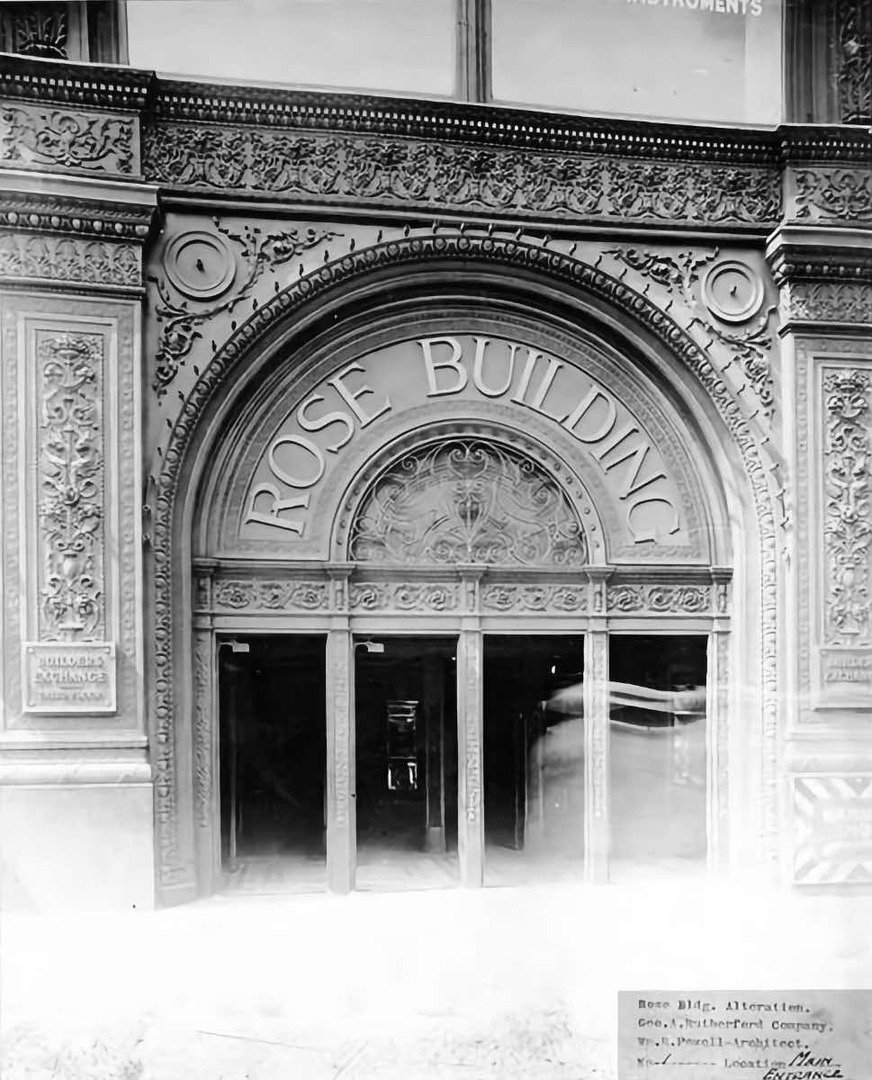
    <title type="html"><![CDATA[Rose Building: &quot;The New Center&quot;]]></title>
    <summary type="html"><![CDATA[<p><strong><em>In 1898-1900, Benjamin Rose financed the construction of the largest office building ever built in Ohio up to that time. At a time when conventional wisdom dictated a Euclid Avenue address, Rose did the unthinkable, selecting a spot at the corner of Prospect Avenue and Erie Street. Naysayers were convinced Rose's daring venture was doomed to fail, but they were wrong.</em></strong></p><img src="https://clevelandhistorical.org/files/fullsize/1e18dd70994fd06dc46874a9b5534ab0.jpg" alt="Main Entrance" /><br/><p>The ten-story Rose Building took its name from its developer, an English immigrant and pioneer in the meatpacking industry. In 1854 Benjamin Rose and Chauncey Prentiss established Rose & Prentiss, later renamed Cleveland Provision Company, which embraced refrigeration and other innovations early and was the city’s largest packinghouse for more than a century. With the fortune he amassed selling cuts of meat, in 1898 Rose commissioned architect George Horatio Smith to design what would become Ohio’s largest office building.</p><p>When the Rose Building was constructed, Erie Street (now East 9th), was on the eastern fringe of downtown, but Rose cleverly dubbed the intersection “The New Center” and used this slogan to entice businesses that might otherwise have considered the location too distant. Indeed, the Rose Building stood out. Its first five stories were sixteen feet high, while floors six to ten were eleven feet high. The choice to make the ceiling height of the lower floors so much higher than usual was reportedly Rose’s wish. </p><p>Upon its opening in 1900, the building’s primary tenants on the lower floors included Lederer Furniture, Scott Dry Goods, and offices of the White Sewing Machine and Cleveland Gas & Electrical Fixture companies. The upper floors contained doctors’ and dentists’ offices, an artist’s studio, a correspondence school, and the offices of fifteen oil companies. In its early years the Rose Building also hosted many exhibitions, including the works of Cleveland artists, a Slavic craft fair, and even a mock Congressional session. </p><p>In 1908 Rose was poised to stake out the next speculative “new center” of downtown. He bought out the St. John’s African Methodist Episcopal Church on East 9th across from Erie Street Cemetery with plans to build a twelve-story office building, but before he could carry out the plan, he died during a trip to England. Instead of burnishing his reputation in life as a visionary developer, in death Rose seeded the legacy for which he is known today. In 1909, the Rose Building gained a new tenant. Tucked away in small, sparely furnished office on the tenth floor was the Benjamin Rose Institute. Funded by Rose’s $3 million bequest, it used the office to review applications for small pensions to enable elderly men and women to afford to remain in their own homes.</p><p>In 1984, the Institute sold the Rose Building to Medical Mutual of Ohio, which had located its headquarters there in 1947. Medical Mutual owned the building until 2000, when it sold it to California-based BentleyForbes and leased its space. When the owner fell into foreclosure, Medical Mutual bought the building back in 2017, but its future in downtown was anything but certain. After much deliberation, Medical Mutual vacated the Rose Building in 2023 and merged its operations in its Brooklyn, Ohio, offices in the former American Greetings headquarters. While pessimists might quip that Benjamin Rose's doubters were ultimately proven right, the Rose Building's now much more central location makes it a likely candidate for a new lease on life.</p><p><em><strong><a href="https://clevelandhistorical.org/items/show/1012">For more (including 12 images) view the original article</a></strong></em></p>]]></summary>
    <published>2024-01-11T16:07:38+00:00</published>
    <updated>2026-04-17T19:17:43+00:00</updated>
    <link rel="alternate" type="text/html" href="https://clevelandhistorical.org/items/show/1012"/>
    <id>https://clevelandhistorical.org/items/show/1012</id>
    <author>
      <name>J. Mark Souther</name>
    </author>
  </entry>
  <entry>
    <title type="html"><![CDATA[Colonial Hotel]]></title>
    <summary type="html"><![CDATA[<img src="https://clevelandhistorical.org/files/fullsize/45aede22394e0d51e961ccfb60c9bd60.jpg" alt="Colonial Hotel Cleveland" /><br/><p>The Colonial Hotel, now called the Residence Inn, is located on Prospect Avenue next to Cleveland’s historic East 4th Street. The hotel was built in 1898 in combination with the Colonial Arcade by designer George H. Smith, who was also the architect of “The Arcade,” Cleveland’s more famous shopping street under glass which was built in 1890. The Colonial Hotel opened on October 21, 1898, with an informal ceremony, which was attributed to the fact that it opened a day earlier than scheduled. The Colonial Arcade, however, was not fully complete until 1911, when John F. Rust hired architect Franz Warner. Warner was able to design an adjacent arcade that would link the William and Rodgers buildings on Euclid Avenue (one block to the north) with the Colonial Hotel, thus creating the Euclid Arcade. Today the interconnected Colonial and Euclid Arcades are known together as the <a href="https://clevelandhistorical.org/items/show/236">5th Street Arcades</a>.</p><p>Within a year after opening, the hotel was already being improved with the addition of a 100-room wing on the Prospect Avenue side and parallel to the Colonial Arcade. Another expansion occurred in 1901, adding nearly one hundred rooms and expanding the hotel’s restaurant. The hotel during this period occupied a considerable amount of property on the Euclid side of the street, but the side facing Prospect Avenue was shallow in comparison. With this enlargement, the Colonial Hotel would be one of the largest hotels in the city. This renovation was started so the Colonial could keep up with the accommodations and luxuries that other hotels in the city were offering. In fact, it was speculated that the Colonial only decided to attempt this expansion to keep pace with the Hollenden Hotel, which, at this period, was one of the most luxurious hotels in the city. </p><p>In the 1930s, however, during the Great Depression, Cleveland’s unemployment rate rose to encompass nearly a third of its population, which impacted the hotel industry drastically. The Colonial dealt with this problem rather well, and in fact, some of their only concerns were simply competing with other hotels in Cleveland and attempting to attract more patrons with fresh new ideas and amenities.</p><p>Though the Colonial had survived the worst economic period in the nation’s history, the hotel eventually began to decline in later years as Cleveland took a turn for the worse. This occurred in the 1970s and the 1980s, a time when Cleveland lost close to twenty-five percent of its entire population. By 1975, Cleveland stood in the nation’s highest quintile among cities in terms of poverty, unemployment, poor housing, violent crime, and municipal debt. The Colonial Hotel also felt this pressure, first by changing ownership to the Milner Hotel Company, which was based in Detroit, Michigan. This transfer was all the Colonial could do to keep alive during this tough economic time. After this exchange, things seemingly got worse for the Colonial. The Colonial kept getting devastatingly bad luck, which reflected in the <em>Plain Dealer</em>, most notable being two deaths that occurred within five years of each other. The first death being Dan Duffy, a popular lawyer in Cleveland and a beloved patron to the Colonial Hotel. The second death was a John B. Caduff, whom tragically died in a fire, caused by Caduff carelessly smoking. Finally, however, to finish off these hard economic times, the Colonial Hotel closed in 1978. </p><p>This was not the end of the Colonial Hotel, however. Twenty years after the hotel's closing, an idea to re-open the hotel came into the minds of businessmen as part of broader attempts to preserve and revitalize Cleveland’s historic downtown area. This project finally got underway in 1998, when investors partnered with Marriott, a thriving hotel company, and wanted to open a Residence Inn in the former Colonial Hotel. The project would not only put a new hotel in the heart of downtown, it would also revitalize the Cleveland arcades. This eventually led to a $30 million project to renovate the space into extended stay lodging with 144 rooms of a Marriott Residence Inn and nearly 60,000 square feet of shopping. This hotel eventually opened in 2000 and would thrive amid a reemerging entertainment district.</p><p><em><strong><a href="https://clevelandhistorical.org/items/show/819">For more (including 8 images) view the original article</a></strong></em></p>]]></summary>
    <published>2017-11-26T15:38:17+00:00</published>
    <updated>2026-04-17T19:17:41+00:00</updated>
    <link rel="alternate" type="text/html" href="https://clevelandhistorical.org/items/show/819"/>
    <id>https://clevelandhistorical.org/items/show/819</id>
    <author>
      <name>Keanu Hallowell</name>
    </author>
  </entry>
  <entry>
    <title type="html"><![CDATA[The Arcade: Cleveland&#039;s Crystal Palace]]></title>
    <summary type="html"><![CDATA[<img src="https://clevelandhistorical.org/files/fullsize/173b67dbf4e76fb9c6cf781271dd78f1.jpg" alt="Arcade, Facing Superior" /><br/><p>In the summer of 1886, former councilman and real estate broker James M. Curtiss met with acting Cleveland Parks superintendent and Case School of Applied Sciences professor John Eisenmann to express enthusiasm about a novel form of enclosed street called an arcade. After having visited an arcade in Toronto, Canada, Curtiss described to Eisenmann his dream for a grand structure in Cleveland’s downtown. Awed by the grand arcades in Europe, Curtiss spent years traveling around the United States to see other arcades and making plans for his own in Cleveland. Now, more than a decade later, he hoped to persuade Eisenmann to design a building that would “eclipse them all.” This request would produce the Arcade, sometimes called the Superior Arcade and now colloquially known as “The Old Arcade.”</p><p>Curtiss approached industrialists across northern Ohio seeking financial backing. Charles Brush, Myron T. Herrick, Louis Henry Severance, and John D. Rockefeller expressed interest in financing the project early on. They were joined shortly thereafter by Standard Oil investor Stephen Harkness and H. J. Herrick. Myron Herrick was essential in securing the land for the structure. </p><p>While Curtiss and other stockholders worked to secure funding through the sale of interests of ownership in the newly formed Arcade Company, John Eisenmann was joined by George Horatio Smith and the two went to work designing the Arcade. They designed two office towers connected by a several hundred-foot light court, surrounded by five stories of shops and offices and topped with a glass and steel roof. Eisenmann, an architectural engineer, is generally credited with the design of the Arcade’s esplanade while Smith, the architectural designer, is credited the work on the towers.</p><p>In December 1886, Eisenmann and company began the search for a location for the arcade and settled on a tract of land between Euclid and Superior, hoping to provide a commercial passageway between two of the city’s largest thoroughfares. This parcel of land seemed ideal, until he discovered that there was an unfortunate feature. Where Euclid Avenue now sits marks the shoreline of a prehistoric lake named Lake Warren. Retreating ice sheets lowered water levels, resulting in a difference in elevation between Euclid and Superior that forced Eisenmann and Smith were forced to adjust their designs. To combat this problem, they designed two main ground floors with a grand staircase connecting the two floors. </p><p>Between the issue of topography and the nature of Eisenmann and Smith’s designs, finding a contractor to build the structure proved difficult. They claimed that the designs the architects brought them were impossible to construct, particularly Eisenmann’s designs for the glass roof. The roof trusses Eisenmann designed were novel for the time and employed a technique that many contractors simply believed would not work. In Eisenmann’s designs the Arcade’s roof trusses were hinged at the base and the apex and lacked cross bracing. This technique allowed the skylight’s support to follow the shape of the skylight without interfering with light. After a series of refusals and rejections, the Arcade Company contacted the Detroit Bridge Company. Known for their experience building bridge trusses, they accepted the job.</p><p>After construction began in May 1888, the project faced continuing delays that included striking contractors and unions and continuously rising costs. Initially, the project was expected to cost $500,000. As the Arcade reached completion, journalists speculated that the project must have cost more than a million dollars. Following various delays and unforeseen expenses, the Arcade opened to the public on May 30, 1890, with a final cost of $875,000.</p><p>The Arcade and its design demonstrated the changing times with new engineering and architecture techniques. At the time it opened the Arcade was nothing short of a modern marvel. With two nine-story office towers connected by a five-story esplanade, the building was the largest and tallest of its kind attempted in the U.S. The entrance towers on both ends included heavy loadbearing masonry walls. The upper floors of both towers used steel skeletons like one first employed in a Chicago skyscraper a few years earlier. Eisenmann’s design of the glass roof proved particularly innovative, and some visitors remarked that there is “better light inside the building than there is outside in the street, as the light pours through the immense glass covering and is reflected to all parts of the structure.” Beyond its architectural importance, the Arcade also boasted a beautifully decorated interior. Virtually every surface on the interior is decorated with intricate metalwork, marble walls, brass elevator doors, gargoyles, and Roman mosaic floors. </p><p>Many Cleveland businesses and professionals raced to occupy the new building, filling the Arcade with top-of-the-line restaurants, retailers, and other services. One of the original retailers was Baxter and Beattie (later H.W. Beattie and Sons). One of Cleveland’s most prominent diamond merchants, H.W. Beattie operated his jewelry store in the Arcade from 1890 to 1977, when it moved to the Statler. The store was well-known for the eye-catching gemstone displays created by Beattie’s youngest son Milton. These displays involved using gemstones to form mosaic-like images, including portraits of presidents, animals, flags, and other themes. His displays literally stopped patrons in their tracks, so much so that there is still a groove worn into the floor outside where the shop was located. Milton Beattie continued creating these displays, rotating them weekly, until his death in 1998. </p><p>By the turn of the century, the Arcade was said to have only one rival, the Galleria Vittorio Emanuele in Milan. The Arcade served as an urban amenity to the citizens in Cleveland. It provided a passage between two of the city’s largest thoroughfares, leisure space for the public, and even Sunday band concerts. The Arcade also served as an important shopping district. The construction of the Arcade, and its successors, the <a href="https://clevelandhistorical.org/items/show/236">Colonial and Euclid and Arcades</a>, responded to the expansion of industry between the Cuyahoga River and Public Square that caused many retailers to move toward Euclid Avenue in the late nineteenth century. The addition of new streetcar lines in Public Square in the late 1880s also turned this area into prime real estate, encouraging more retailers to make the move eastward.</p><p>Nicknamed “Cleveland’s Crystal Palace,” the Arcade served as an ideal location to host large-scale events and did so many times throughout its history. Famously, the Arcade became the site for the National Convention of Republican Clubs in June 1895, which included visits from Marcus Hanna and Ohio governor and future president William McKinley. It also hosted a range of functions from the biennial Symphony Ball in 1960 to the annual meeting of the National Trust for Historic Preservation in 1973. </p><p>In 1939, the original Richardsonian Romanesque entry for the Euclid Avenue façade was replaced with a more modern storefront. Designed by Walker & Weeks, these changes incorporated more modernist style, removing the arched front and incorporating Art Deco elements. Constructed by the Sam W. Emerson Co., the renovations included the Euclid façade redesign, reinforcing the loadbearing walls with steel beams, and the addition of two large medallions with the profiles of Harkness and Brush. However, the Superior entrance has retained its original arched design. </p><p>In 1975, the Old Arcade became the first building in Cleveland to be listed on the National Register of Historic Places. Shortly after in 1978, the Arcade was purchased by Harvey Oppmann and two San Francisco investors. Oppmann made some renovations to the structure, including a small food court on the lower level. However, the Arcade's designation as a historic landmark did not guarantee its survival. As downtown employment began to decrease and retailers moved into suburbs to accommodate growing clientele there, the Arcade saw an increase in vacancies. Some retailers in the 1980s also cited rising rent prices for their move. In 2001, following the threat of demolition, the Arcade underwent extensive renovations and redevelopment and has become home to a Hyatt Regency Hotel.</p><p><em><strong><a href="https://clevelandhistorical.org/items/show/24">For more (including 10 images, 2 audio files,&#32;&amp;&#32;1 video) view the original article</a></strong></em></p>]]></summary>
    <published>2010-09-16T10:53:37+00:00</published>
    <updated>2026-04-17T19:17:36+00:00</updated>
    <link rel="alternate" type="text/html" href="https://clevelandhistorical.org/items/show/24"/>
    <id>https://clevelandhistorical.org/items/show/24</id>
    <author>
      <name>Cheyenne Florence</name>
    </author>
  </entry>
</feed>