<?xml version="1.0" encoding="UTF-8"?>
<feed xmlns="http://www.w3.org/2005/Atom">
  <title type="text">Cleveland Historical</title>
  <updated>2026-08-21T20:45:53+00:00</updated>
  <generator uri="http://framework.zend.com" version="1.12.20">Zend_Feed_Writer</generator>
  <link rel="alternate" type="text/html" href="https://clevelandhistorical.org/"/>
  <link rel="self" type="application/atom+xml" href="https://clevelandhistorical.org/items/browse?output=rss2"/>
  <id>https://clevelandhistorical.org/</id>
  <author>
    <name>Cleveland Historical</name>
    <uri>https://clevelandhistorical.org</uri>
  </author>
  <link rel="hub" href="http://pubsubhubbub.appspot.com/"/>
  <entry>
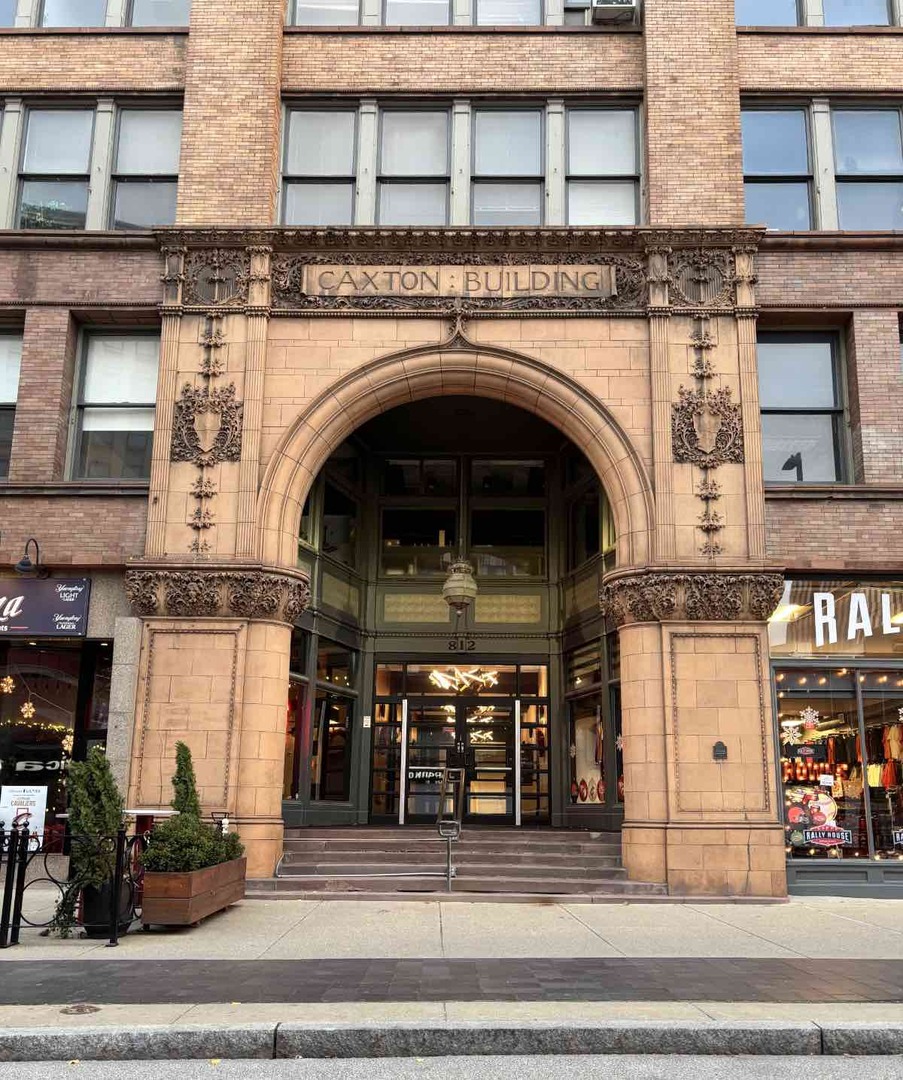
    <title type="html"><![CDATA[Caxton Building: Cleveland’s Historic Printing and Publishing Hub]]></title>
    <summary type="html"><![CDATA[<p><strong><em>The Caxton Building, located in downtown Cleveland, is a historic landmark that embodies the city's industrial past. Constructed in 1898-1900, the eight-story structure was designed by the architect F. S. Barnum as one of the nation’s earliest fireproof office buildings, tailored for printing and publishing businesses. Today, the Caxton Building stands as a testament to Cleveland’s rich history, housing a variety of modern offices while maintaining its vintage character through preserved architectural details.</em></strong></p><img src="https://clevelandhistorical.org/files/fullsize/1494a8988e3d83f1bc0ace442fef0381.jpg" alt="Caxton Building Entrance" /><br/><p><span>The Caxton Building is named after William Caxton, a 15th-century British printer who was the first person to introduce the printing press to England. Caxton was known for printing the earliest English-language version of the Bible, along with other classical works. The Caxton Building’s namesake reflected the original motivation for its construction. Stockholders of the Caxton Building Co., Worcester R. Warner, Ambrose Swasey, Samuel T. Wellman, Rollin C. White, Luther Allen, and Wilson M. Day were behind the building's planning and construction. (Warner and Swasey were already widely known as the principals of a major Cleveland machine-tool and telescope manufacturing company bearing their name; Allen was a founder of Cleveland's White Motor Corp.) Their leadership and vision helped the Caxton Building develop as an aggregated space for printing and publishing businesses by providing the necessary infrastructure to attract such firms. The creation of nodes or hubs of aligned businesses, including so-called "power block" buildings like the Caxton, was a common practice during the rise of American downtowns.</p><p>Designed by architect Frank Seymour Barnum, the Caxton Building is an outstanding example of Chicago School architecture, which was popular in the late 19th and early 20th centuries. Completed in 1900, the building stands eight stories tall and is noted for its steel-frame construction, one of the earliest uses of this Chicago-born technology in Cleveland. This architectural style allowed for larger windows, a lighter appearance, and more flexibility in interior space, and the building’s reinforced concrete floors were especially suited to support the heavy equipment used by printing, publishing, and graphic design firms.</p><p>The arrival of enterprise publishers establishing their quarters in the Caxton Building soon fulfilled its developers’ hopes for it to become the recognized center for printing and publishing in Cleveland. The movement of the Chautauqua Assembly’s headquarters and publication office from Buffalo, New York, to the Caxton Building was a major milestone in the building's history and it brought a unique book publishing and magazine business in the city. Among the famous products developed at the Caxton Building were the <em>Chautauquan </em>(magazine), <em>Engineers’ Magazine</em>, <em>Iron Trade Review</em>, and the <em>Jesuit Relations</em> book series. Other notable printing businesses located there were the Cleveland Printing and Publishing Company and Arthur H. Clark Company, which specialized in historical and geographical publications. Perhaps the most famous Caxton Building business was the World Publishing Company, a major publisher of Bibles, dictionaries, and children's books, which was begun in 1902 by Alfred H. Cahen.</p><p>The Caxton Building was listed in the National Register of Historic Places in 1973 and a Cleveland Landmark three years later, solidifying its reputation as a historic building. As many publishing and printing firms closed or moved away, however, the building became largely vacant by the early 1990s. When the Gateway sports and entertainment complex arrived soon afterward, it spurred new business interest in the surrounding blocks. A well-timed renovation in 1994 gave the Caxton Building many much-needed modern updates while preserving its historic architectural features and well-lit interiors. In the years since, the building’s adaptability has enabled it to attract and new tenants, including architectural firms, law offices, digital media firms, design studios, and civic organizations. The Caxton Building is an excellent but rare example of how a building constructed for a specialized purpose adapted to changing needs while remaining a commercial and civic hub.</p></p><p><em><strong><a href="https://clevelandhistorical.org/items/show/1041">For more (including 5 images) view the original article</a></strong></em></p>]]></summary>
    <published>2024-11-26T07:51:18+00:00</published>
    <updated>2026-04-17T19:17:43+00:00</updated>
    <link rel="alternate" type="text/html" href="https://clevelandhistorical.org/items/show/1041"/>
    <id>https://clevelandhistorical.org/items/show/1041</id>
    <author>
      <name>Ansh Doshi</name>
    </author>
  </entry>
  <entry>
    <title type="html"><![CDATA[Saint Maron Church: A Spiritual Center of Lebanese Cleveland]]></title>
    <summary type="html"><![CDATA[<img src="https://clevelandhistorical.org/files/fullsize/0e4d365a8333724593847ea2840a1f4c.jpg" alt="St. Maron in Its Modern Context" /><br/><p>In view of Progressive Field stands a historic landmark of Cleveland’s Lebanese community. Wedged between Aladdin’s Bakery and Market on its east flank and a double-decker parking garage topped by the statues of eight saints to its west, the twin-spired red-brick edifice of St. Maron Church offers a hint of a long-lost neighborhood that was once home to thousands of immigrants from the eastern Mediterranean before central-city redevelopment and suburbanization simultaneously pushed and pulled them away. </p><p>St. Maron Church, with close to 1,000 parishioners, is a Lebanese parish that follows the Maronite Rite, a liturgy recited in Syriac, a dialect of the Aramaic language believed to have been spoken by Jesus Christ at the Last Supper. The Maronite Rite is one branch of the Antiochene or Antiochian Rite that arose from St. Peter’s establishment of the Church of Antioch. Cleveland’s St. Maron is part of the Maronite Christian denomination, named for St. Maron, a 4th-century Syrian Christian priest who later became a hermit monk. His disciples went on to settle in the cedar-forested highlands of Mount Lebanon. The Maronites have been in communion with Rome since the 12th century but retained autonomous governance under the Patriarch of Antioch in Lebanon.</p><p>Lebanese and Syrian immigration to Cleveland dates as far back as the 1870s but was more pronounced in the 1890s and 1900s. Although they settled in various parts of the central city, most concentrated in the Haymarket District around what is now Progressive Field. Among the immigrants were more than 100 Maronite families, who formed the St. John Maron Society in 1914 to raise money to establish their own parish. In 1915, they succeeded in forming St. Maron Church in an 1870 two-story brick apartment building they purchased at 2214 East 21st Street just north of Cedar Avenue. The parish converted the building into its church with an upstairs rectory. Fr. Peter Chalala of Baalbek, Lebanon, served as St. Maron’s first pastor for its first six years. The congregation had four subsequent pastors over the thirty-two years after 1921. The longest-serving pastor, Fr. Joseph Komaid, a missionary originally from Sahel Alma, Lebanon, served the church for twenty-five years (1927-1952). </p><p>Under Fr. Komaid’s leadership, St. Maron acquired the former St. Anthony Church at 1245 Carnegie Avenue in 1939. St. Anthony, an Italian parish, had formed in 1886 and met in a small wood-frame building on Ohio Street (Central Avenue) until it was able to build a large Romanesque-style church on Carnegie in 1904. As the Haymarket neighborhood it served experienced an outmigration of parishioners, St. Anthony merged with St. Bridget’s, an Irish parish on East 22nd Street off Scovill Avenue, in 1938. St. Anthony sold its Carnegie Avenue church property to St. Maron the following year. St. Maron held its dedicatory mass, followed by a banquet at Hotel Carter, on April 7, 1940. </p><p>Over the years, a flourishing St. Maron expanded even as it faced some challenges. The congregation built a rectory in 1951 and renovated the church four years later, adding new stained-glass windows. In 1971, it had to repair substantial damage inflicted by a bomb that detonated inside a car parked in the East 13th Street alley between the church and Middle East Bakery (later Aladdin’s), which had been the target of three bombing attempts since it opened the previous year. In the early 1980s the church undertook the second major renovation and built a new administration building along its rear on Bronson Court. In the 1990s, St. Maron continued to attract an increasing number of parishioners, which necessitated additions to the church in 1997 and again two years later. The opening of Jacobs Field (now Progressive Field) west of St. Maron made parking more difficult for parishioners, leading the church to demolish its social hall in 1998 for a two-story garage that could ease access for churchgoers while raising money through event parking. </p><p>Continued congregational growth led the “landlocked” church to pursue building a larger church in Independence on land once occupied by Marcus A. Hanna II’s Rhea-Mar country estate and, later, the Sisters of the Good Shepherd’s Marycrest convent. When the suburb’s government tried to block St. Maron’s plan in 2007, citing drainage concerns, the parish sued and won the right to build. Thereafter, the church initiated a long-term building fund and has since used the Independence property, christened Maronite Village, for its administrative office, chapel, and community events such as its annual Middle Eastern Food Festival even as it continues its tradition of Sunday mass along downtown’s southern edge.</p><p><em><strong><a href="https://clevelandhistorical.org/items/show/1032">For more (including 5 images) view the original article</a></strong></em></p>]]></summary>
    <published>2024-10-13T01:34:41+00:00</published>
    <updated>2026-04-17T19:17:43+00:00</updated>
    <link rel="alternate" type="text/html" href="https://clevelandhistorical.org/items/show/1032"/>
    <id>https://clevelandhistorical.org/items/show/1032</id>
    <author>
      <name>J. Mark Souther</name>
    </author>
  </entry>
  <entry>
    <title type="html"><![CDATA[Greek Town: Onetime Heart of Cleveland&#039;s Eastern Mediterranean Communities]]></title>
    <summary type="html"><![CDATA[<img src="https://clevelandhistorical.org/files/fullsize/b075cf420e41bd644a4bd93b2effeaf3.jpg" alt="Acropolis Coffee House" /><br/><p>Cleveland’s Greek population, only 6 in 1890 and 42 ten years later, soared to near its peak of 5,000 before immigration restrictions in 1924 imposed low quotas for further newcomers from Greece and other eastern Mediterranean nations. A smaller but still sizable community of immigrants had also come from what are now Lebanon and Syria. So many Greeks settled in the Haymarket district around the Central Market that the enclave that some Clevelanders referred to this area as "Greek Town." Some Greeks worked as fruit and vegetable peddlers, others as day laborers or steelworkers. Over time, a number became storekeepers, bakers, and proprietors of coffee houses and wholesale import grocery houses selling everything from olives to dried devil fish. Bolivar Road emerged as the social center for Greeks, its numerous coffee houses serving as places where Greek men sipped coffee or tea, shared hookahs, gossiped, played cards, dominoes, or barbouth, and caught up on news from their homeland. Yet even as Greek Town lost more and more Greek residents to Tremont and neighborhoods along East 79th Street in the years after World War I, its businesses remained a magnet drawing them back both to buy goods and socialize.</p><p>By the early 1940s, <em>Plain Dealer</em> columnist S. J. Kelly lamented that he “found Bolivar Road sadly depleted of its Greek. It is, in fact, a modern business thoroughfare and most of its classic residents are scattered over the city.” In the postwar years, as so many Clevelanders departed for the suburbs, remnants of ethnic communities beckoned as “old and colorful” anomalies in a downtown increasingly dominated by office towers and parking garages. As Bolivar Road transitioned from a complete neighborhood to the central business district for Greek, Lebanese, Syrian, and Palestinian populations that were now spread across the metropolitan area, it also gained greater popularity beyond these communities. A succession of "Grecian-American" restaurant-clubs at 714 Bolivar — The Athenian, Grecian Nites, and Never On Sunday — enticed patrons with belly dancers and bouzouki music. Middle East Restaurant, opening in 1962, introduced many Clevelanders to Middle Eastern cuisine. The restaurant’s proprietor, Edward Khouri, a native of Aramoun, a village near Beirut, built a loyal clientele with inexpensive, authentic dishes prepared and served by Josephine Abraham, also Lebanese. As Abraham later recalled, pita and hummus were so exotic to many customers when she started at the restaurant that she had to instruct them on how to use pita to eat hummus; “It was like feeding babies,” she quipped. </p><p>In 1973, the Greek and Middle Eastern businesses on Bolivar Road, along with the L&K Hotel, a single-room-occupancy hotel for “down-on-their-luck men,” fell to the wrecking ball to make way for a parking lot, which was later replaced with a garage for Progressive Field and Rocket Mortgage FieldHouse. <em>Plain Dealer</em> columnist George Condon echoed S. J. Kelly’s lament of three decades before, complaining that “downtown is diminished again.” While the Middle East Restaurant and Shiekh Grocery were able to find space in and next to the Carter Manor (formerly the Hotel Carter), other businesses dispersed. Today there is no sign of the Greek, Lebanese, and Syrian enclave on Bolivar. Greek culture revolves more around churches such as Tremont’s <a href="https://clevelandhistorical.org/items/show/95">Annunciation Greek Orthodox Church</a>. However, on nearby Carnegie Avenue, <a href="https://clevelandhistorical.org/items/show/1032">St. Maron Church</a> and Aladdin’s Bakery and Market still offer visible reminders of where Cleveland’s Middle Eastern communities got their start.</p><p><em><strong><a href="https://clevelandhistorical.org/items/show/1031">For more (including 6 images) view the original article</a></strong></em></p>]]></summary>
    <published>2024-10-13T00:40:24+00:00</published>
    <updated>2026-04-17T19:17:43+00:00</updated>
    <link rel="alternate" type="text/html" href="https://clevelandhistorical.org/items/show/1031"/>
    <id>https://clevelandhistorical.org/items/show/1031</id>
    <author>
      <name>J. Mark Souther</name>
    </author>
  </entry>
  <entry>
    <title type="html"><![CDATA[Gund Arena: A Catalyst for the &quot;Comeback City&quot;]]></title>
    <summary type="html"><![CDATA[<img src="https://clevelandhistorical.org/files/fullsize/ee9b43abcfc97ecf7cdcc8a650c5c730.jpg" alt="&quot;Artist rendering of Gund Arena&quot;" /><br/><p>In the 1970s, Cleveland's outlook was grim. The city was losing large swaths of its population, defaulting on its loans, planning on converting Playhouse Square to a parking lot, and becoming known as "Bomb City USA" due to mob violence. The Cuyahoga River was dying, and manufacturing in the city was on the decline. The city's National Basketball Association franchise, the Cleveland Cavaliers, was established in 1970, at the beginning of this tumultuous decade. The first home of the Cavs was the historic <a href="https://clevelandhistorical.org/items/show/85">Cleveland Arena</a> on Euclid Avenue near E. 36th Street. The Arena was beloved by some for hosting Alan Freed's Moondog Coronation Ball in 1952, but was well past its prime and hardly suitable for a modern NBA team. After only four years, the Cavaliers, like many downtown Cleveland businesses, moved out of the city and into the suburbs. </p><p>Richfield, Ohio would be the new hometown of the Cavaliers and the <a href="https://clevelandhistorical.org/items/show/886">Richfield Coliseum</a> their arena. Although the Coliseum featured state-of-the-art architecture at the time of its opening, Richfield never developed the way that Cavaliers' owner Nick Mileti had hoped. Mileti imagined Richfield developing rapidly with new roads, businesses, and sports facilities to create "a megalopolis stretching from Cleveland to Akron." Due to the creation of the 50-square-mile Cuyahoga Valley National Recreation Area in 1974, this never materialized and Richfield remained an isolated and rural town, far from most of the team's fans and overwhelmed by out-of-town car traffic. The Richfield experiment had failed. </p><p>When Gordon Gund became the principal owner of the Cavaliers in 1983, the organization began searching for a new home in Cleveland, with hopes of sparking a downtown revitalization. To make an impact, Cleveland needed something more significant than just a sports arena with four walls and a roof. To accomplish this, the city used the concept of an urban entertainment district, or UED, in the creation of Gund Arena. In 1990, the Gateway Economic Development Corporation was formed to build a stadium for the Cavaliers and to create a financially productive district for Cleveland. </p><p>The Gateway project was unveiled amidst years of sports-related controversy. A plan for a domed sports complex had already failed to generate sufficient public and political support. In 1984, voters had rejected a $150 million bond issue to fund the domed stadium by a vote of nearly two to one. For the Gateway plan to succeed, the city and the team would need to generate support for the public funding portion of the project. In 1990, following endorsements from business and civic leaders, voters approved a "sin tax" on liquor and cigarettes by a narrow margin of 52 percent to 48 percent. With public funding secured, the path was cleared for the Gateway Project to begin and for the Cavaliers to build their new home downtown.
Gund Arena opened on October 17, 1994. After a decade of planning and work, the result was a state-of-the-art sports facility that was "well integrated into the existing fabric of downtown." At the grand opening of the venue, visitors got their first look at the curved roof, glass walls, and large arcades throughout the stadium. The interior of the complex was visible from the outside and featured, "lobbies, a restaurant and sports bar, box offices, stairways and escalators." The architects – from Ellerbe Becket and <a href="https://clevelandhistorical.org/items/show/639">Robert P. Madison International</a> – succeeded in making the stadium seem open and living in accordance with the rest of downtown Cleveland. </p><p>Team and public expectations for stadiums and arenas never remain unchanged. By the 2010s, Gund Arena, by then known as Quicken Loans Arena following its purchase by Dan Gilbert, was no longer state-of-the-art in comparison to some cities' newer venues. The impetus for renovation drew strength from the increasing importance of the venue. Quicken Loans Arena (or "the Q" as it was then known) hosted the 2016 Republican Convention and was also one of six finalists to host the 2016 Democratic National Convention. That same year, the Cavaliers won the NBA championship. In 2018-2019, the arena underwent a massive $185 million renovation in which the team and taxpayers shared the cost, with the Cavs contributing around 68% of the total after cost overruns. The changes included an increase in square footage, a new glass entryway to emphasize a connection to downtown Cleveland, new wireless access points, luxury suites, membership spaces, and an additional 731 television monitors. With renovations complete, and the arena newly-rechristened as Rocket Mortgage FieldHouse, the Cavaliers signed a lease to occupy the space until 2034. When that lease expires, the arena will have been home to the Cavaliers for 40 years following their move in 1994. </p><p>In 2022, Rocket Mortgage FieldHouse (or "the Rock," as it has come to be known) hosted the National Basketball Association's All-Star Weekend event. Thanks to continuous improvement and innovation, the complex was able to host these events in both 1997 and 2022, for the 50th and 75th anniversaries of the NBA. Despite controversy regarding the initial funding for the project as well as for ongoing maintenance, Rocket Mortgage FieldHouse has proven to be an unwavering symbol of Cleveland.</p><p><em><strong><a href="https://clevelandhistorical.org/items/show/981">For more (including 8 images) view the original article</a></strong></em></p>]]></summary>
    <published>2022-11-23T21:43:00+00:00</published>
    <updated>2026-04-17T19:17:42+00:00</updated>
    <link rel="alternate" type="text/html" href="https://clevelandhistorical.org/items/show/981"/>
    <id>https://clevelandhistorical.org/items/show/981</id>
    <author>
      <name>Stirling Musselman</name>
    </author>
  </entry>
  <entry>
    <title type="html"><![CDATA[Progressive Field: The Cleveland Indians Find a Home of Their Own]]></title>
    <summary type="html"><![CDATA[<img src="https://clevelandhistorical.org/files/fullsize/4fdee760b77a05e58d40ef50ae115a40.jpg" alt="Progressive Field, 2008" /><br/><p>Art Modell. The very mention of his name in Cleveland still stirs up vitriol. In 1963 he angered many by firing legendary Cleveland Browns coach Paul Brown, only two years after Art assumed principal ownership of the team. Most was forgiven in 1964 when the Browns won the NFL championship; but for decades after, Art was regularly criticized for meddling in on-field affairs. More bridges were burned in 1986 when the Ohio Supreme Court declared that Modell had enriched himself unfairly through the buying, operating and selling of Stadium Corporation, a company he founded to manage Municipal Stadium. Acrimony reached the stratosphere in 1995 when Art announced that he was moving the Browns to Baltimore. </p><p>The loss of the Browns — a blow from which many Cleveland sports fans have not fully recovered (even though the team name, colors, and traditions were salvaged when the NFL awarded Cleveland an expansion team in 1999) — is inseparable from the history of Jacobs Field, as the new stadium was known before Progressive Insurance acquired naming rights. That history is filled with perennial disappointments on the playing field for the Browns and Cleveland's professional baseball team, the Indians. </p><p>From the beginning of the 20th century, Cleveland Indians home games were played at League Park (also known as Dunn Field) at Lexington Avenue and East 66th Street. Beginning in 1932, some Indians games were staged in the newly built Cleveland Municipal Stadium on the city's lakefront. After 1947, the Indians used Municipal Stadium exclusively. Built as a multipurpose facility, Municipal Stadium began hosting football in 1946 — the year the Cleveland Browns came into being as part of the All-America Conference (the team joined the National Football League in 1950). By the early 1970s, the forty-year-old stadium was aging and needed major repairs, which the financially strapped City of Cleveland could not afford. In 1973, Art Modell agreed to lease the stadium and take responsibility for its upkeep. Over the years his Stadium Corporation made much more money from the stadium than it paid the city in rent, in part because Modell refused to share with the Indians any of the revenues from the 108 loges he added in the mid-1970s.</p><p>By the early 1980s, plans surfaced for a domed stadium that might house both the Indians and the NBA Cavaliers. At the same time, Cleveland State University was planning a convocation center for its basketball team, concerts, and university events. At Governor Richard Celeste's urging, the university agreed to study the feasibility of building a larger domed stadium that would serve CSU’s needs as well as those of Cleveland’s pro baseball and basketball teams. Researchers subsequently concluded that such a combination facility would lose money unless the Indians dramatically improved their dismal attendance. Advocates claimed a domed stadium would stimulate downtown revitalization and boost civic pride. Skeptics noted that the Silverdome in Pontiac, Michigan, and the Louisiana Superdome in New Orleans had fallen short of expectations and required constant public subsidies to break even. Many believed that the Indians didn't deserve a new home and that any money spent on the franchise should be used to field a team worthy of attracting larger crowds. Unsurprisingly, voters refused to foot the bill—rejecting a property tax issue to fund the dome in May 1984.</p><p>The Indians had threatened to leave Cleveland before, in 1958 and 1964, prompting emergency campaigns to "save the Indians." And when owner F.J. “Steve” O'Neill died in 1983, the Cleveland Indians’ tenancy was once again under threat. Salvation came in the form of sibling developers Richard and David Jacobs, who acquired the team in 1986. The newly formed Greater Cleveland Domed Stadium Corporation began assembling land around the former site of the old Central Market, just south of Prospect Avenue at East 9th Street and Carnegie Avenue. But even though the Jacobs family pumped new life into the Indians franchise, Art Modell continued to demand a new 20-year lease on Municipal Stadium in return for his agreement to make much-needed improvements. Among the most serious problems were structural concerns, antiquated restrooms, a paucity of concession stands and poor field drainage. The situation was chaotic: Art was adamant. CSU was going forward with its convocation center. And now the Domed Stadium group was proposing two stadia: an open-air baseball field and an adjacent arena to lure the Cavaliers back from suburban Richfield.</p><p>In May 1990, voters approved a 15-year "sin tax" on sales of alcoholic beverages and cigarettes to help fund what was now being called the Gateway Sports and Entertainment Complex. Combined with Jacobs money, the new Jacobs Field was built in what has sometimes been called the "retro-modern ballpark" style first used a few years before for Baltimore's Oriole Park at Camden Yards. Like Oriole Park, Jacobs Field aimed not only to revive a city's fan base, it also sought to stimulate downtown development and build upon Cleveland's "comeback" under George Voinovich, Cleveland's counterpart to "messiah mayor" William Donald Schafer of Baltimore.</p><p>On April 4, 1994, President Bill Clinton threw the ceremonial first pitch at the new Jacobs Field. Roughly 18 months later, the Indians appeared in their first World Series since being swept by the New York Giants in 1954 (the Tribe lost the ’95 Series to Atlanta in six games). Jacobs Field enjoyed a record 455 consecutive sold-out home games between 1995 and 2001. That same period marked the demise and rebirth of the Cleveland Browns. Art Modell, who had steadfastly refused to participate in the effort to build the Gateway complex, incurred millions of dollars in revenue losses when the Indians departed for Jacobs Field. Already burdened with excessive debt, Art turned his back on the crumbling Municipal Stadium and reestablished the Browns as the Baltimore Ravens in 1996. </p><p><em><strong><a href="https://clevelandhistorical.org/items/show/703">For more (including 9 images&#32;&amp;&#32;4 audio files) view the original article</a></strong></em></p>]]></summary>
    <published>2015-04-28T09:16:25+00:00</published>
    <updated>2026-04-17T19:17:40+00:00</updated>
    <link rel="alternate" type="text/html" href="https://clevelandhistorical.org/items/show/703"/>
    <id>https://clevelandhistorical.org/items/show/703</id>
    <author>
      <name>CSU Center for Public History and Digital Humanities</name>
    </author>
  </entry>
  <entry>
    <title type="html"><![CDATA[Central Market]]></title>
    <summary type="html"><![CDATA[<img src="https://clevelandhistorical.org/files/fullsize/528433047c5eae661cdef76937837fc1.jpg" alt="Central Market, Looking South, 1940" /><br/><p>Cleveland's Central Market was a raucous place. Inside, dozens of languages careened around the cavernous facility like so many bouncing balls as haggling vendors and prospective customers shouted and gesticulated. Outside, horses, buggies, streetcars and (later) automobiles whinnied, rattled, screeched, roared, and honked. </p><p>For more than 100 years, beginning in 1856, the publicly owned Central Market near Ontario Street and Carnegie Avenue served a huge, mostly immigrant population living near or around the area. These people likely paid scant heed to the dim lighting, grimy walls, and constant noise because the market's 200+ stalls offered an unsurpassed assortment of meats, produce, and dairy products for generally reasonable prices. </p><p>Despite the constant busyness, Central Market was only one of several competing entities. From 1891 to 1936, the privately owned Sheriff Street Market at Bolivar Street and Huron Road just one block north competed with Central Market. Beginning in 1912, the magnificent West Market, situated a mile away at Lorain Avenue and West 25th Street, added to the fray. </p><p>By the middle of the 20th century, Sheriff Street Market had closed, the West Side Market was thriving, and Central Market was struggling. Central Market’s principal problem was a faltering infrastructure which raised costs for vendors. Newspaper articles lamented the poor lighting and grimy walls. Clutter abounded and safety concerns mounted. Inadequate parking (no lot and limited, on-street, meter-paid parking) was another headache. Bus service began to replace streetcars but the new bus lines didn’t stop as close to the market. Nonetheless, Central Market soldiered on. Local historian William Ganson Rose remarked that although the market was “antiquated and lacking in health and sanitary facilities, it continued to monopolize one of the busiest intersections in the city.”</p><p>Then came a fire. In December 1949, Central Market went up in flames, the result of a gas leak. This marked the end of the market’s residence at Ontario and Carnegie. However, within six months a new six-story Central Market opened (on March 24, 1950) at East 4th Street between Bolivar and Huron, near where the Rocket Arena now stands. Unfortunately, the same maintenance and custodial issues dogged the new facility and Cleveland city officials failed to provide the funds to overcome them. Produce stall owner Tony LoSchiavo observed, “We put a new ceiling in a few years ago, but there's some problems with that too. Some panels are out, and when it rains we have to put plastic tarp down. That looks like hell.” </p><p>From the 1950s, mass migration to the suburbs cut into the Central Market’s business. A few decades later came high inflation. By the 1980s, LoSchiavo's electricity bill approached $10,000 a month and steam heat bills were up as well. Most every vendor struggled to remain profitable. One poultry stall operator lamented, “This is Cleveland's forgotten market, and this is a quiet battle because probably few Clevelanders care how it ends—whether the market stays open or closes.” </p><p>At the same time, the West Side Market was growing in popularity. Unlike Central Market, the West Side Market remained proximate to residential neighborhoods and offered plenty of parking. It also was structurally sound and aesthetically pleasing, and it enjoyed steady funding from the city. According to one interviewee, the West Side Market “is the closest thing to Europe in Cleveland.” </p><p>By the 1990s it was time to pull the proverbial plug. Cleveland commissioners agreed to remove the New Central Market and build a massive sports complex on the land that had been occupied by both markets. In the markets’ place, Clevelanders now enjoy watching two of the country’s best baseball and basketball teams. And inside each complex, patrons somewhat grudgingly pay more than $15 for food and a drink. If the original and New Central Markets could have charged those prices, perhaps they’d still be around. </p><p><em><strong><a href="https://clevelandhistorical.org/items/show/676">For more (including 10 images) view the original article</a></strong></em></p>]]></summary>
    <published>2014-12-04T21:54:54+00:00</published>
    <updated>2026-08-16T19:18:48+00:00</updated>
    <link rel="alternate" type="text/html" href="https://clevelandhistorical.org/items/show/676"/>
    <id>https://clevelandhistorical.org/items/show/676</id>
    <author>
      <name>Rashida Mustafa&amp;#32;&amp;amp;&amp;#32;Chris Roy</name>
    </author>
  </entry>
  <entry>
    <title type="html"><![CDATA[Erie Street Cemetery: The City&#039;s Oldest Existing Cemetery]]></title>
    <summary type="html"><![CDATA[<img src="https://clevelandhistorical.org/files/fullsize/339dc6a8f2ea9c0d279933f59d550ef5.jpg" alt="Erie Street Cemetery Entrance" /><br/><p>On East 9th Street, enclosed by a 19th century iron fence and Gothic gateway, is the Erie Street Cemetery — the final resting place of some of Cleveland's most notable pioneers and combatants. Located right next door to Progressive Field, even the popular baseball stadium is easily forgotten once you find yourself surrounded by the many weathered gravestones. Although not all are marked, there are almost 8,000 burials in the cemetery, the oldest dating back to 1827. Scattered among the graves are monuments that have been constructed to honor some of the cemetery's more famous occupants. Some of these include Joseph L. Weatherly, founder and first president of the Board of Trade of Cleveland; Lorenzo Carter, community leader and the first permanent settler of Cleveland; and Chief Joc-O-Sot, chief of the Mesquakie tribe who fought in the Black Hawk War. </p><p>There are 168 veterans buried in the Erie Street Cemetery who participated in the Revolutionary War through the Spanish-American War. Ninety-eight of these men owe their veteran status to their participation in the Civil War. For example, General James Barnett was an officer in the Civil War and was on the commission for the construction of the Soldiers and Sailors' Monument. He has both a family grave site and a monument. Also buried among fellow Civil War veterans is Jabez W. Fitch, best known for having charge of Camp Taylor, he later served in the 19th Ohio Volunteer Infantry.  </p><p>Despite the many Cleveland pioneers and soldiers buried at Erie Street Cemetery, efforts were made to reclaim the land for other purposes in the early 20th century. Bodies were even removed to other cemeteries in the in order to make room for new streets. In 1915, the Pioneers' Memorial Association was formed and fought to keep the cemetery and all who remained there undisturbed.  Since then efforts have been made to beautify the cemetery by groups like the Works Progress Administration and the Cleveland Grays. Today some markers are worn or broken to the point of being indecipherable, but the graves of numerous dignitaries and veterans can still be found.  </p><p><em><strong><a href="https://clevelandhistorical.org/items/show/319">For more (including 10 images) view the original article</a></strong></em></p>]]></summary>
    <published>2011-08-08T15:47:59+00:00</published>
    <updated>2026-04-17T19:17:38+00:00</updated>
    <link rel="alternate" type="text/html" href="https://clevelandhistorical.org/items/show/319"/>
    <id>https://clevelandhistorical.org/items/show/319</id>
    <author>
      <name>Heidi Fearing</name>
    </author>
  </entry>
  <entry>
    <title type="html"><![CDATA[Grays Armory]]></title>
    <summary type="html"><![CDATA[<img src="https://clevelandhistorical.org/files/fullsize/f8cf81238aac64efff2aefdb74d5ff86.jpg" alt="Richardsonian Romanesque Arch" /><br/><p>On May 30, 1893, patriotic melodies of the Grand Army Band of Canton could be heard coming from the corner of Bolivar Street and Prospect Avenue as an exciting celebration was taking place — the laying of the new Grays Armory cornerstone. Grays Armory was to be the new location of weaponry and drilling procedures for the Cleveland Grays, a local volunteer militia group who had served Cleveland and the country since 1837 and would continue to do so until World War I. The Grays did find their home here, but Grays Armory was also host to many other civic and social events including military balls, a performance by the Metropolitan Opera Company in 1902, the first performance of the Cleveland Orchestra in 1917, a speech by William Howard Taft in 1916, and multiple appearances by William McKinley. </p><p>The history of the Cleveland Grays makes their headquarters all the more interesting. Sixty-five men formed themselves into a City Guard Unit on February 22, 1837, and the color of their uniforms later inspired their name. The Cleveland Grays' primary purpose was to protect the city from disturbances and riots, but they were involved in many other Cleveland events as well. According to an article in the <i>Cleveland Plain Dealer</i> on May 26, 1893, "Probably no public event of importance has occurred since [the time they were organized] but the Grays were participants. . . . every monument and public improvement in Cleveland they have assisted in dedicating . . ." </p><p>The public also depended on the Grays for peace and order. For example, in 1852 the gun squad put an end to a two day riot at Cleveland's Medical College. These nine Grays were then organized into the Cleveland Light Artillery. The local artillery militia and the rest of the Grays would soon be summoning their bravery in conflicts outside of Cleveland.</p><p>At the beginning of the Civil War, the local militia stood fast to their motto Semper Paratus, meaning "always prepared." On April 14, 1861, the Cleveland Grays left Cleveland as the first company to respond to the call for Union soldiers. They served as Company E, 1st Ohio Volunteer Infantry, in the 84th OVI, and as Company A, 150th OVI in 1863. While serving in these regiments, the Cleveland Grays took part in the First Battle of Bull Run on July 21, 1861, the defense of Washington D.C. during the Confederate's Valley Campaigns of 1864, and other skirmishes. Following the Civil War, the Grays went on to serve their country in the Spanish-American War, the Mexican Expedition in 1916, and World War I. Although amendments to the Militia Act of 1903 prevented the Grays from serving in other conflicts as a local militia group, they continued their organization up until the 1990s as a "Businessmen's Camp."</p><p>Part of Grays Armory now serves as a museum. Probably the most salient item on display is the first cannon captured by the Union in the Civil War. The cannon's first Cleveland home was in Public Square, where it would fire after each Union victory. A few of the features the armory was designed with are a 140' shooting range in the basement, an equipment room with lockers and a place for arms, a drill room, a billiard room, and a banquet hall. The large sandstone building is filled with relics of the Cleveland Grays' deeds and services.</p><p><em><strong><a href="https://clevelandhistorical.org/items/show/298">For more (including 7 images) view the original article</a></strong></em></p>]]></summary>
    <published>2011-07-25T18:54:41+00:00</published>
    <updated>2026-06-02T14:42:37+00:00</updated>
    <link rel="alternate" type="text/html" href="https://clevelandhistorical.org/items/show/298"/>
    <id>https://clevelandhistorical.org/items/show/298</id>
    <author>
      <name>Heidi Fearing</name>
    </author>
  </entry>
  <entry>
    <title type="html"><![CDATA[Hippodrome: Once Downtown&#039;s Premier Cinema House]]></title>
    <summary type="html"><![CDATA[<img src="https://clevelandhistorical.org/files/fullsize/59a06b7879adf43b962c637753394bb7.jpg" alt="Marquee Months Before Demolition" /><br/><p>Eighteen months of planning and preparation preceded the opening of the massive Hippodrome Theater on December 31, 1907, with seating for 3,548 and the world's second largest stage. Architect John Eliot of Knox and Eliot designed the building to span the lot at 720 Euclid Avenue through to Prospect Avenue to the south. Ensconced in an eleven-story office building with theatre marquees and entrances on both streets, “The Hipp” was originally designed to host operas, plays, and vaudeville shows and prospered for two decades with a variety of live theater events. It hosted performances by the most famous performers of the early twentieth century, including Enrico Caruso, W. C. Fields, Will Rogers, Lillian Russel, John Phillip Sousa, and Al Jolson. </p><p>Modeled after the Hippodrome in New York, Cleveland’s version reflected developer Max Faetkenheuer’s dream of a theater that could house any size of production and staging. The central area in front of the stage held a pool which splashed the orchestra when horses paraded past. One backstage area was created that could dress up to 1,500 actors or be used for scenery staging. Faetkenheuer staged Aida with the Triumphant March to include elephants, horses, troops, and dancers. They continued circling onto and off the stage, “refreshed” by stage hands to look different for each circuit. The illusion supported the image of the largest theater to house so many animals and characters. Management evolved in 1912 when the B.F. Keith family of motion picture theaters leased the Hipp and managed it for the next decade of live theater operations.</p><p>The advent of projected film began to take popular hold during the 1920s, and the Hipp was primed to welcome and accommodate the new technology in 1922. Remodeling proceeded in 1931 with expanded seating for over 4,000 and an air-conditioning system utilizing water from Lake Erie. The Hipp became the nation's largest theater devoted exclusively to showing films and prospered for the next four decades, enjoying large movie crowds as Cleveland’s premier downtown movie house. The theater continued to show movies until the late 1970s, when declining attendance no longer supported the business. </p><p>The eleven-story office building to which the theater was attached became home to several tenants, including the longstanding street-level Green’s Jewelers, a haberdashery, and a shoe store. During its 73-year lifespan, the Hipp also was home to the Downtown Health Club and Danny Vegh’s Billiards and Table Tennis Center in the basement level between 1965 and 1980. The late 1960s brought increased challenges to maintain the building as tenants and visitors diminished. The Hippodrome closed all but its street-level operations by 1978. In 1979, a giant complex was proposed for the site to meet a perceived need for office space downtown. However, no tenants signed up and financing was not achieved. Similar to the campaign to rescue the theaters of Playhouse Square, the Cleveland Landmarks Commission was approached to initiate action to preserve the Hippodrome as an historic site, but the building’s condition was judged insufficient to warrant repair or restoration. In the summer of 1980, the Hippodrome fell to the wrecking ball to make way for a parking lot. In 2023, a 23-story tower called City Club Apartments replaced the surface lot.</p><p><em><strong><a href="https://clevelandhistorical.org/items/show/25">For more (including 11 images&#32;&amp;&#32;2 audio files) view the original article</a></strong></em></p>]]></summary>
    <published>2010-09-16T11:38:39+00:00</published>
    <updated>2026-04-17T19:17:36+00:00</updated>
    <link rel="alternate" type="text/html" href="https://clevelandhistorical.org/items/show/25"/>
    <id>https://clevelandhistorical.org/items/show/25</id>
    <author>
      <name>Heidi Fearing</name>
    </author>
  </entry>
</feed>
