<?xml version="1.0" encoding="UTF-8"?>
<feed xmlns="http://www.w3.org/2005/Atom">
  <title type="text">Cleveland Historical</title>
  <updated>2026-05-10T00:03:30+00:00</updated>
  <generator uri="http://framework.zend.com" version="1.12.20">Zend_Feed_Writer</generator>
  <link rel="alternate" type="text/html" href="https://clevelandhistorical.org/"/>
  <link rel="self" type="application/atom+xml" href="https://clevelandhistorical.org/items/browse?output=rss2"/>
  <id>https://clevelandhistorical.org/</id>
  <author>
    <name>Cleveland Historical</name>
    <uri>https://clevelandhistorical.org</uri>
  </author>
  <link rel="hub" href="http://pubsubhubbub.appspot.com/"/>
  <entry>
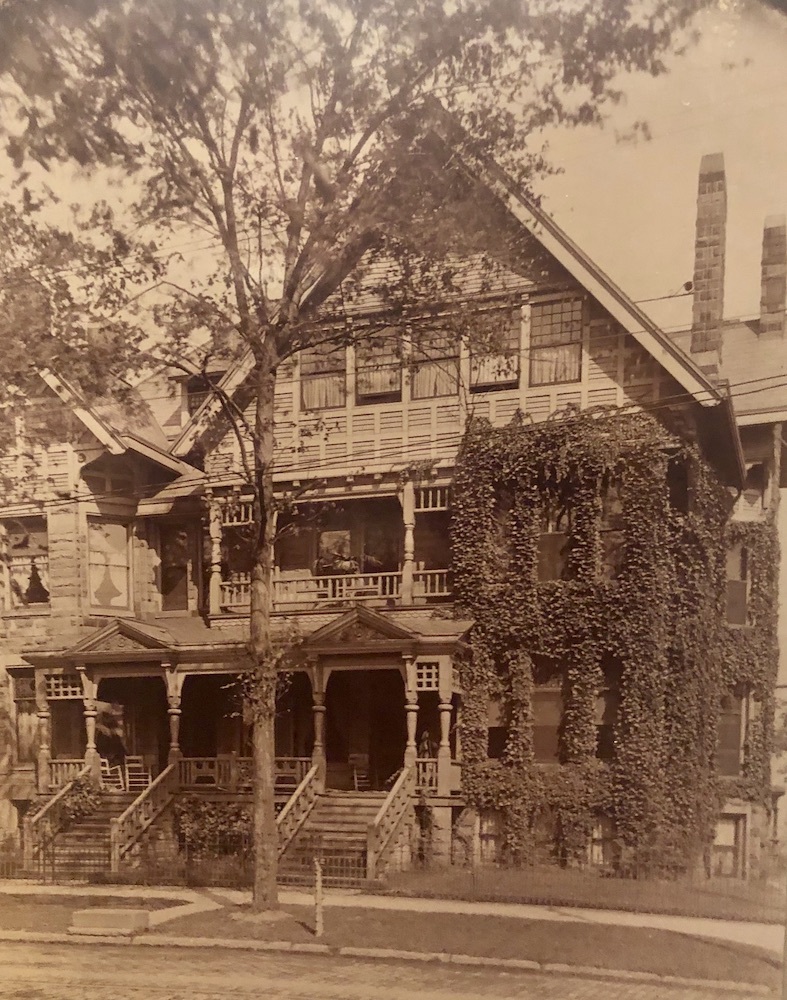
    <title type="html"><![CDATA[Wallace Manor: Robert Wallace&#039;s Great Stone House]]></title>
    <summary type="html"><![CDATA[<img src="https://clevelandhistorical.org/files/fullsize/7e617f347a46818e63e56bd6eafb0bde.jpg" alt="Wallace Manor" /><br/><p>If you spend a little bit of time studying the history of the houses that line both sides of Franklin Boulevard from the Circle to West 50th Street, you soon learn that they do not stand alone and apart from one another. They are related to one another – many of them intimately. Over time, these houses have shared owners and occupants; fraternal societies and charitable organizations; architects and architectural styles. They have often also shared ties to early Cleveland enterprises and industries. This is certainly the case with Wallace Manor, which has stood on the northeast corner of Franklin Boulevard and West 48th Street since 1883. </p><p>Wallace Manor was built for Robert Wallace, one of three individuals whom Cleveland journalists and historians have credited with the transformation and modernization of the Great Lakes commercial shipbuilding industry in the late nineteenth century. The other two? They also were residents of Franklin Boulevard. Wallace's long-time partner <a href="https://clevelandhistorical.org/items/show/940">Henry Coffinberry</a> lived in a Gothic Revival style house at 3910 Franklin Boulevard, which, like Wallace Manor, is still standing today. And Wallace's other early partner, John Pankhurst, lived in a beautiful Italianate-style house at 3117 Franklin Boulevard. John Pankhurst's house, like those of Robert Wallace and Henry Coffinberry, is still standing. On your next drive down Franklin Boulevard, you might want to take note of the houses at 3117, 3910, and 4724 Franklin Boulevard. They share a connection to each other and to Cleveland's once great shipbuilding industry. </p><p>Robert Wallace was born in 1834 in County Cavan, Northern Ireland. According to Elroy McKendree Avery, an early twentieth-century Cleveland historian, Wallace immigrated to the United States and arrived in Cleveland in 1854. In the eulogy he delivered at a memorial service for Wallace on May 28, 1911, Rev. Henry Tenney, a Congregationalist minister who had been Wallace's pastor, observed that, when Wallace came to Cleveland, he settled on the City's west side because that was where his uncle, Robert Sanderson lived and worked. (Sanderson was a machinist and later principal owner of Globe Iron Works, an historic iron foundry on the West Bank of the Flats.) A listing in the 1856 Cleveland directory is the first record of Wallace's presence here. It states that he was then living on Clinton Avenue and working as a machinist. His name, however, does not appear again in any Cleveland directory until 1865 when he is this time listed as an engineer. </p><p>It may be, as suggested in Rev. Tenney's eulogy, that Wallace spent some, if not all, of those intervening years as a sailor traveling the Great Lakes aboard commercial ships. By the time that the 1866 directory was published the following year, Wallace appears to have set down firm business roots in Cleveland as he and his partner John Pankhurst are listed as the owners of a small machine shop in <a href="https://clevelandhistorical.org/items/show/767">Cleveland Centre</a> at the corner of Center and Columbus Streets. A year after that, in 1867, according to historian Richard J. Wright in his book "Freshwater Whales: a History of the American Ship Building Company and its Predecessors," Wallace developed a portable steam engine for unloading cargo from commercial ships which dramatically improved the unloading process. It also proved extremely profitable for Wallace's machine shop. </p><p>Within two years of his development of the portable steam engine for unloading , Wallace, Pankhurst, and their new partner Henry Coffinberry had accumulated sufficient capital to acquire a controlling interest in Globe Iron Works, from which Robert Sanderson had recently retired. The company had for years been producing steam engines and other iron products for Great Lakes commercial ships. Now, under Robert Wallace's leadership, Globe Iron Works expanded its business. In 1876, it purchased an interest in a nearby dry dock and, under the name Globe Ship Building Company, began building ships. Up until this time, the process of building Great Lakes commercial ships had required the involvement and coordination of several different industries which manufactured different vessel parts at different locations. Robert Wallace, according to historian Wright, changed this industrial process in 1881 when Globe Ship Building built a commercial ship, from start to finish, entirely at its shipyard. Just one year later, in 1882, the company built and launched the Onoko, the first large iron commercial ship to sail the Great Lakes. This ship has been recognized by marine historians as the prototype for all the commercial freighters that sail the Great Lakes today. </p><p>By the time the Onoko was launched in 1882, Globe Iron Works and Globe Ship Building Company had become successful and profitable enterprises. It was at about this time that Robert Wallace and his second wife Fanny – his first wife Lydia had died in 1878 – decided to move from their modest house at 129 (today, 3405) Clinton Avenue onto Franklin Avenue (Boulevard), the West Side's version of nineteenth-century Euclid Avenue's <a href="https://clevelandhistorical.org/items/show/10">Millionaires' Row</a>. In early 1883, Wallace purchased a vacant lot on the northeast corner of Liberty (West 48th) Street and Franklin Avenue that was owned by and located next door to the house of Alanson and Harriet Hopkinson. Alanson, also known as A. G., was the retired first principal of Cleveland's <a href="https://clevelandhistorical.org/items/show/772">West High School</a>. He was well known to Wallace as both were members of the First Congregational Church, and both had served as trustees of the church. In the early 1880s both were also actively involved in the planning and building of a new church for their parish on the southeast corner of Taylor (West 45th) Street and Franklin Avenue. The new stone church for the First Congregational Church – West Side, designed by Coburn and Barnum and dedicated by Rev. Tenney on December 20, 1885, was located just a few blocks east of the Hopkinson property upon which Wallace built his new stone house in 1883. While both the First Congregational Church and A. G. Hopkinson's house are no longer standing, they present yet another example of the intimate historical relationships that the houses and other buildings on Franklin Boulevard, in this instance one still standing and the others not, often had with one another. </p><p>Wallace Manor is, according to local architectural historian Craig Bobby, built in the Queen Anne style. While the identity of the architect who, or architectural firm which, designed the house is unknown, it may have been the firm of Coburn and Barnum, which designed the <a href="https://clevelandhistorical.org/items/show/917">Spitzer-Dempsey House</a> at 2830 Franklin and the <a href="https://clevelandhistorical.org/items/show/938">Sarah Bousfield House</a> at 3804-06 Franklin. In the early 1880s, <a href="https://clevelandhistorical.org/items/show/755">Forrest Coburn</a> was living at 86 Root (1901 West 47th) Street, less than one-half mile from the future site of Wallace Manor. He was also, like Robert Wallace, a member of the First Congregational Church. As a principal of the architectural firm that designed the new First Congregational church, he likely would have interacted with Wallace who, as a trustee, was also deeply involved in planning and building that church. However, according to Bobby, in the absence of documentation that the house was designed by this firm, there is nothing in the design of the house itself which either proves or disproves that it was the work of Coburn and Barnum.  </p><p>Designed as a single family home, Wallace Manor is two and one-half stories tall and has an exterior facade built of sandstone. The expanse of sandstone on the front facade is broken up by at least one belt course of smoothed stones located just below the second floor windows, and the front facade, as well as the expanses of the other exterior walls of the house, are further broken up by stone lintels and hoods around the house's windows. The house has asymmetrical massing with the west side of the front facade extending out beyond the rest of the facade. The roof of the house is hipped and features a number of dormers and three tall stone chimneys. The front of the house has two notable arched windows on the first floor. Also notable is the house's one-story columned porch which extends along the entire length of the eastern part of the front facade.  Located at the rear of the property is another stone building that once likely served as a carriage house. Over its front door on West 48th Street are the initials "RW" carved in stone. The structure, which is depicted on the 1896 Sanborn map, was likely built at the same time as the main house. </p><p>The Robert Wallace family, including for a time his oldest son James, a future president of the American Ship Building Company, lived in Wallace Manor until 1895. In that year they moved, like other wealthy Franklin Boulevard families of that time period, to the Cleveland suburb of Lakewood, where they built a house on Detroit Avenue, west of Nicholson Avenue. That house, which is no longer standing, was located on what today is the campus of St. Edward Catholic High School. After the Wallace family departed from Wallace Manor, the house was home to several middle to upper economic class families, including a general manager of the Cleveland Railway, the president of Citizens Savings and Trust Company, and a physician, before it was sold and converted into a rooming house in about 1920. In 1923, the property was acquired by Hungarian immigrants Julius and Elizabeth Rak, who lived in the house and continued to operate it as a rooming house until their deaths in 1943. By 1930, the carriage house on the property had been converted into a dwelling with a street address of 1453 West 48th Street and was occupied by two families. By 1940, there were seven families (including the Rak family) with a total of 21 people living in Wallace Manor and five families with a total of 9 people living in the carriage house. </p><p>In the second half of the twentieth century, Wallace Manor, like many of the other once grand houses on Franklin Boulevard, was suffering from insufficient maintenance and repair. Photos reveal that, by the 1980s, it was in a deteriorated condition. Most notable was that its once grand front porch had at some time between 1961 and 1986 been razed and replaced with a simple entranceway porch. Like any number of the grand houses on Franklin Boulevard that needed a savior in the late twentieth century, Wallace Manor found one when it was purchased in 1997 by Scott Staley and David Castro. Staley, who is the sole owner of the house today (2021), spent the next 17 years slowly restoring and renovating Wallace Manor. Living in the owner's suite at Wallace Manor, he has also, for the last five years, operated a bed and breakfast in the house which has rooms for guest stays. The carriage house at the rear of the property has also been renovated and today functions as a two-family dwelling. In 2019, descendants of Robert Wallace paid a visit to Wallace Manor, touring the house, snapping pictures, and imagining their ancestors walking from room to room. They too, like their ancestors who once lived there, now share a special relationship with not only those ancestors, but also with Wallace Manor and with historic Franklin Boulevard.</p><p><em><strong><a href="https://clevelandhistorical.org/items/show/943">For more (including 18 images) view the original article</a></strong></em></p>]]></summary>
    <published>2021-04-26T19:29:34+00:00</published>
    <updated>2026-04-17T19:17:42+00:00</updated>
    <link rel="alternate" type="text/html" href="https://clevelandhistorical.org/items/show/943"/>
    <id>https://clevelandhistorical.org/items/show/943</id>
    <author>
      <name>Jim Dubelko</name>
    </author>
  </entry>
  <entry>
    <title type="html"><![CDATA[Sarah Bousfield House: Also known as &quot;Stone Gables&quot;]]></title>
    <summary type="html"><![CDATA[<p><strong><em>Wealth generated from John Bousfield's wooden ware business enabled the Bousfield family to move into their first house on Franklin Avenue in 1863.  After the business failed and they lost that house, the resilient Bousfields found a way to return to the west side's "Euclid Avenue" in 1883,  building the mammoth stone house that today still stands at Franklin Boulevard and West 38th Street.</em></strong></p><img src="https://clevelandhistorical.org/files/fullsize/7e94cfc54af23bff938538bc0ad44092.jpg" alt="The Sarah Bousfield House" /><br/><p>The large stone house on the northwest corner of Franklin Boulevard and West 38th Street was built in 1883-1884 for John and Sarah Bousfield. It was designed by the prominent nineteenth century architectural firm of Coburn and Barnum, the same firm that designed the Spitzer-Dempsey House at 2830 Franklin Boulevard.  The house, which today has the address of 3804-3806 Franklin, was designed to be  a two-family home with the Bousfields occupying the larger east side, which was advertised as having 17 rooms, and a renter occupying the west side which was said to have 13 rooms.  The house is two and one half stories tall and has more than 12,000 square feet of living space.  It also has a full basement with ground level access from the back yard.  The house was designed in the Queen Anne style, with characteristic asymmetrical massing, half-timbered gables, and what local architectural historian Craig Bobby referred to as "robust" spindlework.  Bobby also opined that the design of the house is closer to the English example of this style of house and less "Americanized" than other Queen Anne style houses built in Cleveland in the late nineteenth century.  </p><p>John Bousfield and Sarah Featherstone, the house's original owners, were English immigrants who came to America  in the early 1840s.  They met in Kirtland, Ohio, and married there in 1845.  After having little success in trying his hand at farming, John purchased a small wooden ware business and began manufacturing  wooden pails, first in Kirtland and then in nearby Fairport (today, Fairport Harbor).  Looking for a better location for his business, he moved his family to Cleveland in 1855.  His early years working and residing in the city  were filled with a mixture of small successes and  several business reverses, the latter often caused by fires that appear to have been altogether too common in the nineteenth century wooden ware manufacturing industry.  However, by the early 1860s, he and his business partner J. B. Hervey had established a large and successful business, known as Cleveland Wooden Ware Manufacturing Company, in Cleveland Centre, near the intersection of Leonard and Voltaire Streets.   After Hervey retired from the business in 1866, Bousfield and his new partner John Poole had even greater success initially, growing the business into what several contemporary sources stated was the largest wooden ware business in the country.  By this time, the company was manufacturing not only wooden pails, but also many other wooden products used in that era, including churns, half-tubs, washboards, clothes pins, dressed lumber, shingles, mouldings, and matches.</p><p>Befitting John Bousfield's business success, the Bousfield family in 1863 moved from a house on Pearl (West 25th) Street into their first house on Franklin Avenue (Boulevard), a grand mansion built in the Italianate style and located on the southeast corner of Franklin and Duane (West 32nd) Street.  To their east lived William Castle, former mayor of Cleveland, and to the west their house was just a stone's throw away from the Kentucky Street Reservoir and its legendary promenade walk.  (Diagonally across Franklin on the corner of State Street they may have noticed the little girl who tended to her flower garden and often played with Mayor Castle's daughter.  She would grow up to become Ella Grant Wilson, one of Cleveland's pioneer feminists.)  Living on Franklin Avenue, the Bousfields interacted socially with many of the west side's wealthiest families, including those of Daniel Rhodes, John Sargent, Nelson Sanford, Belden Seymour, Thomas Axworthy,  Judge James Coffinberry and his son Henry, and George Warmington, just to name  a few.  One such interaction, which was described in an article that appeared in the Cleveland Plain Dealer on January 8, 1870, was the party the Bousfields threw for their 25th wedding anniversary, where their "spacious mansion . . .on Franklin Street . . . was thronged with guests."  Interactions like these were not only "social," but often also presented opportunities for neighbors on the west side's "Euclid Avenue" to form new or cement old business relationships with each other.   John Bousfield was involved in several such business relationships with his neighbors.  In 1866, he and neighbors Daniel Rhodes, Nelson Sanford, John Sargent, James Coffinberry, and others, had founded the People's Gas Light Company, which Bousfield later headed as president.  Three years later, in 1869, he participated in the formation of the People's Saving and Loan Association, serving for the next six years as one of the bank's two vice presidents under president Daniel Rhodes.  Despite all of his neighborhood social and business successes, however, the economic depression in the United States that followed the Panic of 1873 may have been too much to overcome. John Bousfield's  wooden ware business in Cleveland Centre collapsed in 1875 and he was left bankrupt, losing not only his business assets  to creditors but, in 1880, his grand house on Franklin Avenue too.</p><p>After his business failed in 1875 and he lost his house on Franklin Boulevard, John Bousfield started a new wooden ware manufacturing business at a different location on the west side with help from his adult children, including his daughter Charlotte who lived with him and Sarah, but it was plagued by fire, lawsuits and other problems.  By 1881 it had closed and its business operations had been transferred to his adult sons' wooden ware manufacturing facility in Bay City, Michigan.  Between 1880 and 1883, the Bousfields rented a house on nearby Clinton Avenue--literally within sight of their former mansion--while they strove to satisfy creditors and plan their return to Franklin Avenue.  While there, they purchased another house on the northwest corner of Franklin and Kentucky (West 38th) Street in 1881.  They rented that house out until 1883, when they either razed it or moved it to make room for the large stone mansion designed by Coburn and Barnum that was subsequently built on the corner.  In the same year that the stone house was completed, the Bousfields began renting out rooms in a second house on the property that fronted Kentucky Street.  (This house may have been all or part of the house that formerly sat on the corner of Franklin and Kentucky; it may have been new construction; or it may have been a house that was moved from another location.) With two houses on their lot, the Bousfields were not only able to generate rental income from the west side of the stone mansion, but also from the second house too.  While there exists little evidence of the financial status of John and Sarah Bousfield during this period, the rental income from these properties may well have been critical to their survival in what were the later years of their lives.  John Bousfield died at the house in 1888; his wife Sarah died there six years later in 1894.</p><p>Following their deaths, Horace Hannum who lived up the street and who married Charlotte Bousfield  just months after her mother's death, took over the management of the Sarah Bousfield House as well as the other house on the property.  Hannum maintained the west side of the Sarah Bousfield House as a single-family unit, moving into it with Charlotte in 1898 and living there until his death in 1908.  The larger east side of the house, however, was by 1900 operating as a rooming house.  Shortly after Horace's death, Charlotte and the other heirs of Sarah Bousfield sold the property in 1910 to Juno Robeson, a social worker who had moved to Cleveland ten years earlier from Paducah, Kentucky.  Robeson converted the entire stone mansion into a rooming house for businesswomen.  It may have been during her ownership (1910-1923) that physical alterations were made to the house to provide access from one side of the house to the other.  Robeson's Business Inn for Women does not appear to have survived for more than a couple of years.  Thereafter the stone mansion, as well as the other house on the property, like many other large houses on Franklin Boulevard in the twentieth century, became rooming houses, first managed during Robeson's ownership, and then later directly owned, by Frank and Clara Bennett.  By 1925, the stone mansion was being advertised for lease as a rooming house with 38 rooms.  Both houses on the property remained rooming houses for much of the rest of the twentieth century.  In 1945, the lot upon which the two houses sat was split and the houses were thereafter under different ownership.  While it is unclear exactly when, at some point in time after 1966 the other house was razed.  The resulting vacant lot afterwards became property of the city of Cleveland which, in 1983, sold it to the  Franklin Boulevard Nursing Home, located across West 38th Street from the Sarah Bousfield House.</p><p>And thus the stone mansion continued to sit on the corner of Franklin Boulevard and West 38th Street, continued to be used as a rooming house, and continued to deteriorate until 1994,  when  James Hauer and Richard Turnbull purchased it at a sheriff's sale. The two men had since 1988 owned and lived in a house up the street at 3901 Franklin Boulevard.  Turnbull, an art historian, wanted to restore and renovate the house, redividing it into its original two-family configuration, with four apartment suites on the east side of the house and a five-room bed-and-breakfast on the west side.  After hiring Cleveland architect John Rakauskas,  obtaining city approval for their plan, and providing financial incentive for their roomers to vacate the house, Hauer and Turnbull began restoring and renovating it in 1999.  (That same year, they also purchased the vacant lot owned by the nursing home in order to provide parking for tenants and guests.)  Turnbull conducted extensive research in the restoration effort.  He located a 1905 photo of the house to guide his restoration of its exterior.  Decades of paint were hand-scraped off the house to get down to the original colors.  The front porch was restored with its original columns carefully replicated.  In the interior of the house, walls that had been put up to create the rooming house were removed, and the original rooms, to the greatest extent possible, were restored, even down to moldings and picture rails.  (During the renovation, Turnbull was able to debunk a legend told to him by a former roomer that in the 1950s money from a bank robbery had been hidden somewhere in the house under a floorboard.  Roomers believing the legend had cut through many of the house's floorboards, sometimes even switching rooms to cut through more.  If the money had ever been in the house, it was long gone before Trumbull did his extensive renovation.)  The total cost of the renovations and restoration was $650,000. The majority of the work was completed in 2001, when Stone Gables, a bed-and-breakfast that was advertised as a safe place for gay visitors to stay in Cleveland, opened.  Remaining work on the house continued for two more years before the renovation and restoration was complete.  Hauer and Turnbull operated the bed-and-breakfast and rented out the apartments in the house until 2017, when they sold the house.  As of 2021, its new owners continue to operate the Sarah Bousfield House--still also known as Stone Gables--as Hauer and Trumbull had.</p><p><em><strong><a href="https://clevelandhistorical.org/items/show/938">For more (including 18 images) view the original article</a></strong></em></p>]]></summary>
    <published>2021-02-06T15:26:30+00:00</published>
    <updated>2026-04-17T19:17:42+00:00</updated>
    <link rel="alternate" type="text/html" href="https://clevelandhistorical.org/items/show/938"/>
    <id>https://clevelandhistorical.org/items/show/938</id>
    <author>
      <name>Jim Dubelko</name>
    </author>
  </entry>
  <entry>
    <title type="html"><![CDATA[Spitzer-Dempsey House: A Fitting Residence for a 19th-Century Banker]]></title>
    <summary type="html"><![CDATA[<p><strong><em>There is a myth circulating in Cleveland that the  house at 2830 Franklin Boulevard was built in 1872 for Frederick W. Pelton, Cleveland's 22nd mayor.  Like many myths, it is not true.  The house was neither built in 1872, nor was it built for Mayor Pelton.  When it was built, who it was built for, and what prominent family first resided in it is the subject of this story.</em></strong></p><img src="https://clevelandhistorical.org/files/fullsize/80a03411fbd7cbb9745e280f4b056ae2.jpg" alt="The Spitzer-Dempsey House" /><br/><p>In the mid-afternoon hours of July 28, 1880, Col. John Dempsey, a banker from Shelby, Ohio, a small town in Richland County located  about 80 miles southwest of Cleveland, appeared at a sheriff's sale being held on the south steps of the Cuyahoga County Courthouse, in downtown Cleveland.  There, he made a successful bid to purchase an elegant house that  was designed by a reputable Cleveland architectural firm and located on the west side's grand Franklin Avenue.  The house had been built in 1879 for Ceilan Milo Spitzer, who, like Dempsey, was a banker.  However, before Spitzer could even move into his new house in early 1880, creditors of his German-American Bank, which had recently failed, forced its sale.</p><p>How and why John Dempsey came to Cleveland on July 28, 1880, to purchase the house that today has the address of  2830 Franklin Boulevard is lost to history.  However, the long path which eventually brought him to Cleveland is more easily discernible. Dempsey was born on May 27, 1829, in Mountrath, Queens County, Ireland to James and Catherine Key Dempsey.  In 1848, during the Great Famine in Ireland, his family immigrated to the United States, settling first in Sandusky, Ohio, where five members of the family, including his father and four of his siblings, died during a cholera outbreak.  By 1860, he had married Martha Davis and had moved to Richland County, where he was a merchant and Martha was raising their first child, one-year old son James.  Dempsey's business career was interrupted by the Civil War which broke out that year.  He joined a militia and gained military fame as one of the "Squirrel  Hunters" who defended Cincinnati from a threatened invasion by Southern troops in 1862.  Later, he served in the 48th Ohio Infantry and 163rd Ohio Voluntary Infantry, rising to the rank of Lieutenant-Colonel.  After the war's conclusion, Col. Dempsey returned to Richland County where in a short time he amassed a fortune in the  wholesale grocer and banking businesses and was reputed to be the wealthiest man in the county.  By 1871, he was semi-retired and breeding race horses on his farm called "Mohican" in nearby Plymouth Township.  Retirement--even semi-retirement--may not have suited John Dempsey and that may well have been why he  decided in 1880 to move to Cleveland, then the second largest city in Ohio, to find new opportunities and to grow his commercial empire.  In addition to purchasing the mansion on Franklin Avenue in July of that year, the following spring he erected a new commercial building on Bank (West 6th) Street and also became active in Cleveland's banking circles. In 1886, Dempsey became president of the newly chartered Euclid Avenue National Bank.</p><p>The house which John Dempsey purchased on Franklin Boulevard in 1880 had been designed by the architectural firm of Coburn and Barnum.  Two and one-half stories tall and with nearly 4,000 square feet of living space, its design mirrored almost exactly that of another house on Case Avenue (East 40th Street), south of Cedar Avenue, that Frank Barnum had designed just three years earlier.  The late 1870s was a period of transition for residential architecture in the United States, with interest in the Italianate style waning and enthusiasm for the new Queen Anne style not yet fully developed.  Barnum's design for the house at 2830 Franklin may therefore be called "eclectic," according to Cleveland architectural historian Craig Bobby, its elements drawing inspiration from several different architectural styles.  Its general massing, with its tower tucked into the "L" of the house, is borrowed from the  Italian Villa style, as is the shallow bay on the first floor, right side of the house.  The bracketing of the eves of the tower also suggests the Italianate style, but the tower's flat-topped cap reflects a Second Empire influence, and the house's gabled roof is not typical of Italianate houses.  The house's design also borrows from the Gothic Revival style, particularly the quatrefoils on the projection from the left side of the roof and the barge boards along the eves of the gabled roof on the right side of the house.  The current porch is not part of the original design.</p><p>Moving into the grand house on Franklin Avenue with John Dempsey and his wife Martha in 1880 were their daughters Mary Katherine (19), Nellie (12) and Florence (3).  Their son James, then a 21 year old college student, was living in Gambier, Ohio, where he was attending classes at Kenyon College.  During school breaks at Kenyon, and later during breaks at Columbia University where he attended law school, James resided with his parents in their house on Franklin Avenue.  According to biographers,  the first legal employment he found in Cleveland was in 1883 with the downtown law firm of Estep, Dickey and Squire.  Two of the named partners, Moses Dickey and Andrew Squire were, like John Dempsey,  Franklin Avenue residents.   Andrew Squire lived in a house--since razed--that sat on the lot of what today is the Lutheran Family Services building at 4100 Franklin Boulevard, and Moses Dickey lived just a stone's throw away up the street at what is today 4211 Franklin Boulevard.  It is no stretch of  imagination to believe that law student James H. Dempsey was first introduced by his father to neighbors Moses Dickey and Andrew Squire, and that John Dempsey's business reputation and his residency on Franklin Avenue were important factors in the law firm's decision to hire James.  In 1884, James H. Dempsey became a licensed attorney in Ohio, and, just six years later, he and Andrew Squire, along with Judge William B. Sanders, formed a new firm they called Squire, Sanders and Dempsey, which in the twentieth century became one of Cleveland's most prestigious law firms, specializing in corporate and municipal bond law.  Today, the firm is known as Squire Patton Boggs, and it has become an international law firm that employs thousands of lawyers and has offices in twenty different countries around the world.</p><p>In 1892, just two years after  his son co-founded Squire, Sanders and Dempsey, Col. John Dempsey again retired from business, this time for good.  In retirement, he spent winters living in the house on Franklin Avenue in Cleveland and summers at his beloved Mohican Farm down in Richland County, where he died in August 1904.  During this period, the Spitzer-Dempsey House became the year round residence of John Dempsey's oldest daughter, Mary Katherine, and her husband Ernest Cook, a prominent Cleveland lawyer and a close friend of James H. Dempsey.  After Mary Katherine's untimely death in 1898, Ernest and the couple's four children remained in the house on Franklin Avenue, which later was bequeathed to them out of the estate of John Dempsey.  Even after his children grew up and moved out, Ernest continued to live in the house until his death in 1929.  </p><p>By the time Ernest Cook died in 1929, Franklin Avenue, which had been renamed Franklin Boulevard in 1921, was well into its transformation from a grand avenue lined with the beautiful single family houses of Cleveland's west side elite to a much less grand avenue with many of its beautiful houses razed and others converted into retail establishments, apartments or crowded rooming houses.  After Cook's death, the Spitzer-Dempsey House too transformed. The 1930 federal census identified four families living at 2830 Franklin Boulevard in that year.  Ten years later, according to the 1940 census, nine families were now living in the house.  By 1945, according to an ad in the Plain Dealer, the house had 11 furnished suites.  Following its conversion into a multi-family dwelling, the the house slowly deteriorated over the years, especially during the second half of the twentieth century, reflecting the general decline in the condition of Cleveland's housing stock and the rapid decline of the city's population during this period.  By the 1980s, the Spitzer-Dempsey house was, like many other older houses on the near west side of Cleveland, vacant and in disrepair.  In 1981, it acquired local notoriety when the body of a murdered west side teenage girl was discovered in one of its upstairs rooms.  In the mid-1990s, the house experienced renewal, as many houses in Ohio City did, when it was rehabilitated by two lawyers who converted it into their law office.  One of the lawyers later also made it her residence.  Today, the Spitzer-Dempsey House is once again one of the grand and desirable residences on Franklin Boulevard in Ohio City.</p><p><em><strong><a href="https://clevelandhistorical.org/items/show/917">For more (including 15 images) view the original article</a></strong></em></p>]]></summary>
    <published>2020-11-05T15:32:38+00:00</published>
    <updated>2026-04-17T19:17:42+00:00</updated>
    <link rel="alternate" type="text/html" href="https://clevelandhistorical.org/items/show/917"/>
    <id>https://clevelandhistorical.org/items/show/917</id>
    <author>
      <name>Jim Dubelko</name>
    </author>
  </entry>
  <entry>
    <title type="html"><![CDATA[North Presbyterian Church : &quot;A Mighty Fortress&quot;]]></title>
    <summary type="html"><![CDATA[<img src="https://clevelandhistorical.org/files/fullsize/eda6b2a8823147b085d4ca6eb94fdec5.jpg" alt="North Presbyterian Church" /><br/><p>When the North Presbyterian Church was dedicated on October 23, 1887, the congregation held its first two services with 800 people in the pews. According to a contemporary account, “The interior is very cheerful, being finished with light drab and terracotta tints. The circular dome is filled with handsome windows of stained glass which flood the whole amphitheatrical interior with mellow light… Before the altar numerous flowering plants lifted up their fragrant blossoms seemingly in joy and thanksgiving… The choir, which is led by a cornet, two violins and an organ then rendered an anthem…‘Christ is Our Corner Stone.’” The next day, the <em>Cleveland Plain Dealer</em> observed, “When you enter the sanctuary at North Church, you feel transported to an otherworldly, protected place…The building is an architectural expression of ‘A Mighty Fortress Is Our God.’”</p><p>The church started as a Sunday School Mission of the First Presbyterian (Old Stone) Church in 1859. From that Sunday school, North Church Congregation was established on St. Clair Avenue in 1870. The congregation moved from location to location before ultimately finding a home at East 40th Street and Superior Avenue in 1887, serving this primarily industrial neighborhood under the leadership of Dr. William H. Goodrich (then assistant minister at Old Stone) and then elders Ruben F. Smith and George H. Ely. Fifty former members of the Old Stone church became charter members of the new North Presbyterian Church, with Rev. Anson Smyth D.D. as their first pastor. The church was additionally responsible for starting other Presbyterian churches as Sunday schools, including the Madison Avenue Presbyterian Church in 1890 and the Glenville Presbyterian Church in 1893.</p><p>The North Presbyterian Church was designed in 1886-87 by the architectural firm of Forrest A. Coburn and Frank Seymour Barnum. Although not traditionally considered architects of sacred spaces, Coburn and Barnum were responsible for designing only a few of the churches in Cleveland in the late 19th century. The firm designed North Presbyterian in the Gothic style and styled the interior according to what was known as the Akron Plan.</p><p>The Akron Plan was a popular type of religious building construction so named for its origin in the First Methodist Episcopal Church built in Akron, Ohio, in the 1860s. The main feature of the Akron Plan is a large open “rotunda” surrounded by smaller classrooms on one, or even two levels. All of the rooms opened into the rotunda by means of folding, sliding or rolling doors/shutters. In the case of North Presbyterian, the Akron Plan served the purpose of the building well. The architectural plan of the church lends itself to an environment whose main concerns were church, education, and community. The Akron Plan reflects a Uniform Lesson System within the church. This system dictated that all children learn weekly lessons in addition to attending church service. This system caught on in the latter portion of the 19th century. An Akron Plan Sunday school is a direct result of the Uniform Lesson System, by combining the space needed for worship and prayer, but also providing the compartmentalized space for individualized teaching for children of all age groups.</p><p>After North Presbyterian opened, Sereno P. Fenn served as the superintendent of the Sunday school from 1879 to 1906. During this time the church reached a peak membership of more than 1,200, making it one of the largest churches in Cleveland at the time. When Rev. Robert J. McAlpine accepted a call from Boulevard Presbyterian Church in 1909, however, many North Presbyterian parishioners followed, only leaving around 300 members. Despite the setback, the church managed to thrive again and serve its local community. </p><p>Under Dr. Harvey E. Holt’s pastorate (1918-1930), the church initiated many community programs. The church also became a center for offering emergency food, clothing, childcare and other services, all administered by other community volunteer organizations. Throughout the twentieth century, the church also served many of the increasing numbers of minorities arriving in Cleveland. This included Slovaks, Croatians, Serbians, and Romanians. Many of these individuals were employed in the mills and factories of Cleveland, and the church served as a space to otherwise occupy individuals in the bustle of cosmopolitan life. The church continued these programs under Rev. Arthur R. Kinsler Jr.’s pastorate (1930-1968).</p><p>The congregation celebrated its 100th anniversary in 1970, and in the coming years it continued to serve the primarily industrial neighborhood. The church was listed on the National Register of Historic Places in 1974. In recent years, the North Presbyterian congregation got too small to afford the continued upkeep of its building and moved down the street to a building on East 45th Street, where it shares a space with Lutheran Metropolitan Ministry. North Presbyterian is still a vibrant congregation with a diverse socioeconomic and spiritual background, and continues to serve the Midtown community. The new sanctuary, although much more modern in construction, still relies greatly on the same multi-functionality aspects of the Akron Plan to fit the varying needs and missions of the congregation.</p><p>Created in 1870, the North Presbyterian congregation founded a space that they would have never thought would hold such a rich history. The building itself stands as a living memory, not only of a widespread architectural movement, but also of a vibrant congregation. The Akron Plan of the building worked perfectly in conjunction with the mission of the congregation to provide educational and personal resources not only for their congregation, but also for their greater community. Although the congregation continues to strive towards serving the local Midtown community, the churches need for an Akron Plan Sunday school has become unnecessary. Churches, like North Presbyterian, have changed their Sunday school approach to be more one on one with students, and separate from entire sessions. This eliminates a need for school-wide spaces, and has churches abandoning their, what they now might deem, awkwardly shaped and imperfectly soundproofed rooms for more traditional style classrooms. Today the North Presbyterian Church building stands as one of the few remaining spaces with an Akron Plan interior, and provides an example of this religious practice in Cleveland history.</p><p><em><strong><a href="https://clevelandhistorical.org/items/show/877">For more (including 8 images) view the original article</a></strong></em></p>]]></summary>
    <published>2019-10-20T15:44:45+00:00</published>
    <updated>2026-04-17T19:17:39+00:00</updated>
    <link rel="alternate" type="text/html" href="https://clevelandhistorical.org/items/show/877"/>
    <id>https://clevelandhistorical.org/items/show/877</id>
    <author>
      <name>Rebekah Knaggs </name>
    </author>
  </entry>
  <entry>
    <title type="html"><![CDATA[Olney Art Gallery: The City&#039;s First Art Museum]]></title>
    <summary type="html"><![CDATA[<img src="https://clevelandhistorical.org/files/fullsize/4a7882afbb16bfc15c61bc8ca870d2fe.jpg" alt="Olney Art Gallery Interior" /><br/><p>For decades, visitors to Tremont have wondered about the three magnificent, but poorly maintained mansions they encounter when exiting Interstate 90 at Abbey Avenue and West 14th Street. What are (or were) these structures? Why have buildings in such a high-profile location been so neglected? What plans (if any) exist for their regeneration? </p><p>The answer to these questions reaches back to the late 19th century. At that time, Tremont (then known as Lincoln Heights) was home to scores of wealthy industrialists, and Jennings Avenue (renamed West 14th Street in 1906) was their street of choice—a sort of south-side Millionaire's Row, not unlike Euclid or Franklin Avenues. </p><p>Just north of Fairfield Avenue, two of Jennings Avenue’s most majestic homes belonged to Samuel Sessions and brothers Thomas and Isaac Lamson, founders of the Lamson & Sessions Company. In 1912, The Pan-Hellenic Union purchased and razed these houses, and subsequently erected Annunciation Greek Orthodox Church which stands to this day. However, most of the block to the south (across Fairfield Avenue) also was owned by Sessions and the Lamson brothers; and two of the structures in this area are among those noted at the beginning of this article: the Olney Residence (2255 West 14th Street) and the Olney Gallery (2241 West 14th Street). </p><p>Meant from the start to be an exhibition space, the Olney Gallery was built in 1892 for Charles Fayette Olney, an art collector and academic who came to Cleveland from New York City in the 1880s. This handsome Renaissance Revival building (with “Olney Art Gallery” etched in stone above the front portico) was created to display Olney’s extensive collection of oil and watercolor paintings, ivories, porcelains, statuary and bronzes. The building was designed by the firm of Forrest A. Coburn and Frank Seymour Barnum, which also created more than twenty houses along Euclid Avenue’s Millionaires’ Row, as well as several buildings for Case Institute of Technology and Western Reserve University. Physically adjoining the Gallery to the south is the giant mansion (built around 1870) that Olney and his wife Abigail Bradley Lamson, the widow of Lamson & Sessions founder Thomas Lamson, occupied after they married in 1887 (Abigail had previously lived in the house with Thomas Lamson). Around that time, the home was extensively remodeled—shifting in style from its original Italianate to the more popular Colonial Revival. The house’s belvedere and wraparound porch were added at that time.  </p><p>The Olneys became major benefactors of Pilgrim Church, which opened its doors at Starkweather Avenue and West 14th Street in 1894.</p><p>When the Olney Art Gallery opened in 1893, it became the city’s first publicly accessible art space, pre-dating the Cleveland Museum of Art by more than two decades. More than 200 objects from the Olney’s private collection populated the gallery. Other prominent Clevelanders, such as Windsor White and Charles Brush, also donated works. Charles and Abigail Olney died in 1903 and 1904, respectively. The Olney Gallery closed in 1907, and most of its inventory was donated to Oberlin College, where it became the foundation of the Dudley Allen Memorial Art Museum.</p><p>The two structures were used briefly by the Polish National Church before being sold in 1920 to the Ukrainian National Home Company for $45,000. Ukrainians had been coming to America since the 1870s, and by the 1880s many had settled in the Tremont area. So great was the surge that the need for worship and meeting space became acute (the city’s first Ukrainian Catholic parish, organized in Tremont in 1902, was headquartered in a former trolley garage). These critical needs weren’t met until a new house of worship—Saints Peter & Paul Church at 2280 West 7th Street—was built in 1910 and the Olney Residence and Gallery was acquired a decade later to provide a social and meeting space.</p><p>A short walk from Saints Peter & Paul, the Olney structures (renamed the “Ukrainian National Home”) filled a variety of needs: organizing educational, social and recreational events; hosting union meetings; and serving as a temporary refuge for the Ukrainian political émigrés and displaced persons who came to Cleveland following World War II. By the 1960s, however, much of the Ukrainian community had moved to Parma and other western suburbs and the Ukrainian National Home closed in 1967. Still, the area continues to maintain a strong Ukrainian presence, primarily in the form of Saints Peter & Paul Church and the widely renowned Ukrainian Museum-Archives at 1202 Kenilworth Avenue. Reflecting the changing nature of Tremont’s community, the two Olney buildings later became a Puerto Rican social hall. </p><p>Since 1990, nearby Grace Hospital has owned the buildings and, aided by a large historic preservation grant in 2015, renovated the two structures, along with a third, somewhat smaller home, the Higbee House, to the immediate south. (It does not appear that this home was occupied by Edwin Converse Higbee, the founder of Higbee’s Department Store, but the building may have housed a relative.) Grace Hospital has turned the former Olney residence into a health/spa facility and is using the former gallery for special events. Plans for the former Higbee house have not been finalized. </p><p><em><strong><a href="https://clevelandhistorical.org/items/show/757">For more (including 15 images) view the original article</a></strong></em></p>]]></summary>
    <published>2016-02-09T22:28:18+00:00</published>
    <updated>2026-04-17T19:17:41+00:00</updated>
    <link rel="alternate" type="text/html" href="https://clevelandhistorical.org/items/show/757"/>
    <id>https://clevelandhistorical.org/items/show/757</id>
    <author>
      <name>Chris Roy&amp;#32;&amp;amp;&amp;#32;Michael Rotman</name>
    </author>
  </entry>
</feed>
