<?xml version="1.0" encoding="UTF-8"?>
<feed xmlns="http://www.w3.org/2005/Atom">
  <title type="text">Cleveland Historical</title>
  <updated>2026-05-10T00:16:47+00:00</updated>
  <generator uri="http://framework.zend.com" version="1.12.20">Zend_Feed_Writer</generator>
  <link rel="alternate" type="text/html" href="https://clevelandhistorical.org/"/>
  <link rel="self" type="application/atom+xml" href="https://clevelandhistorical.org/items/browse?output=rss2"/>
  <id>https://clevelandhistorical.org/</id>
  <author>
    <name>Cleveland Historical</name>
    <uri>https://clevelandhistorical.org</uri>
  </author>
  <link rel="hub" href="http://pubsubhubbub.appspot.com/"/>
  <entry>
    <title type="html"><![CDATA[Blossom Music Center: A Summer Home for the Cleveland Orchestra]]></title>
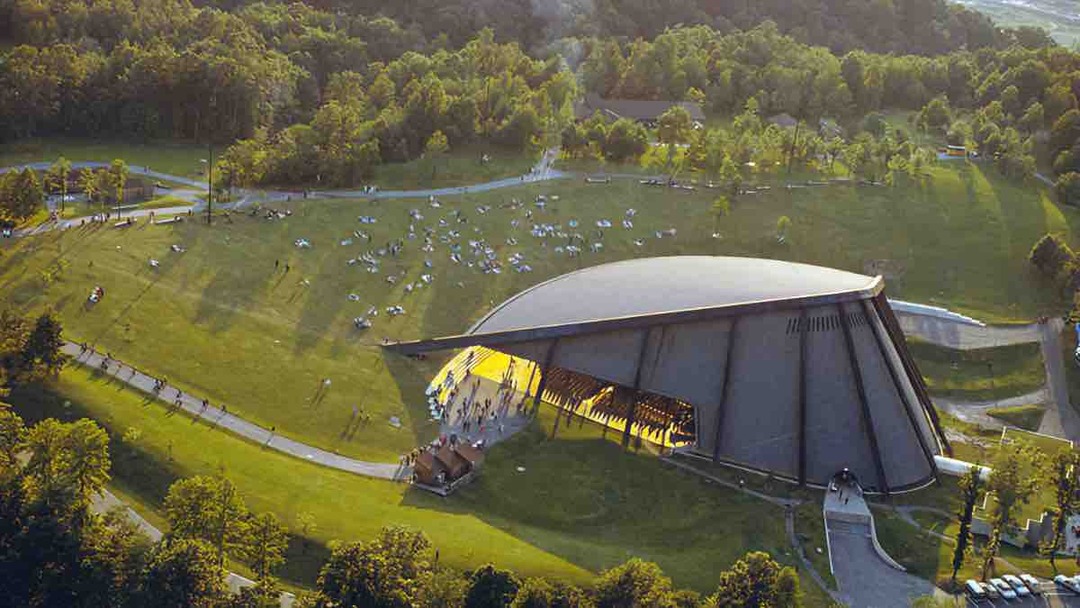
    <summary type="html"><![CDATA[<p><strong><em>Music fills the air in the Cuyahoga Valley National Park as Blossom’s summer concerts draw many into the heart of the forest. Meticulous research and conscientious attention to location and architectural design within a natural environment allowed for the creation of a summer home for the Cleveland Orchestra and a venue for many different types of music.</em></strong></p><img src="https://clevelandhistorical.org/files/fullsize/e67c3aa3ffcca26787c72b8b101f636d.jpg" alt="Aerial Photo of Blossom" /><br/><p>Blossom Music Center is located approximately 33 miles south of downtown Cleveland and 10 miles north of Akron on a plot of land surrounded by wildlife and trees, one of the only venues in Cleveland where one can listen to music under the stars. The amphitheater obtained its name from Dudley Blossom, who served as the Musical Arts Association president from 1936 to 1938. Before this summer home, the Orchestra performed at local venues such as the Public Auditorium and less frequently at Cleveland Municipal Stadium before baseball games. Since Blossom’s first opening season in 1968, the amphitheater has served as a place for people to gather and enjoy concerts for over 50 years.
George Szell, the conductor of the Cleveland Orchestra from 1946 to 1970, desired a permanent summer home for the orchestra and helped identify the Cuyahoga Valley as a viable option. The need for a summer venue for the Orchestra was due to its successful reputation; the summer festival was the only way to keep the skilled musicians in Cleveland. Despite everything—winter concerts, the pops, and country club dates—the Cleveland Orchestra's season could only be expanded with the Blossom amphitheater. Including the summer concert dates at Blossom would ensure the musicians could have full-time occupations.
Considering parcels of land fit for a location for Blossom was challenging. Szell consulted William A. Gould Associates on the search for sites. More than 80 properties were studied for development and eleven were even offered as gifts, but none met Gould's standards. Topographical needs helped narrow down the site options. The orchestra settled on a 500-acre plot of land between West Steels Corners Road and Akron-Peninsula Road. The rugged contours of its ground made it unsuitable for industry, but the natural bowl made it perfect for the orchestra. The land's natural slope helped influence the clam-like design of the Blossom Music Center amphitheater. 
Successful funding made the amphitheater eligible for a Ford Foundation grant, which required local organizations to raise $4 million within five years. $4,360,000 of the Half Century Fund's goal was used to construct the center. Through Szell's push to create Blossom Music Center and keep the musicians in Cleveland, their union was happy with the full-time opportunities.
The amphitheater was of modern design by a local architect Peter van Dijk, the son of Dutch immigrants. He worked on many projects throughout the Cleveland-Akron area, such as the restoration of Huntington Bank in downtown Cleveland. Van Dijk left his mark through the 1981 conversion of the old Akron post office into the Akron Art Museum and the construction of E.J. Thomas Hall.
Van Dijk thoroughly researched and visited successful amphitheaters, such as Ravinia, the summer home of the Chicago Symphony Orchestra, before he designed the Blossom Music Center. His dedication to researching and perfecting the design of Blossom allowed the incorporation of many modern linear elements reflected in the surrounding landscape. Materials used in this structure were concrete and weathering steel, which helped reinforce this venue's longevity and natural properties. The venue's clamshell-like shape had the acoustic advantage of allowing the sound to carry and reverberate throughout the crowd for up to three seconds, which was attractive to the Cleveland Orchestra. The form was also visually impressive.
Gearing up for breaking ground at the site of the new Blossom Music Center, the venue populated the <em>Cleveland Plain Dealer</em> almost daily, leading up to the first opening-season event. The turning of soil occurred on July 2, 1967, and on the same day, the <em>Plain Dealer</em> noted that this date also marked the orchestra's 50th anniversary. 
In 1968, Blossom Music Center's first opening season tune was Beethoven's overture, <em>Consecration of the House</em>, conducted by George Szell. With Blossom's capacity of 6,051 in the pavilion and 15,000 in the general admission lawn, this show was able to reach a large crowd, as the Orchestra desired.
Over the years, Blossom has had many concerts that appeal to the music community in Cleveland and Northeastern Ohio. Many artists have come to Blossom Music Center. Carole King, arguably the most successful female songwriter of all time, made an appearance Thursday, July 20, 1989, at Blossom Music Center. She is known for “Will You Love Me Tomorrow?" and "Tapestry" in 1971. For over 50 years, the Cleveland Orchestra has performed roughly 1,000 summer concerts at Blossom.</p><p>After many successful decades of Blossom Music Center's music season, there was a call for expansion with more significant revenue opportunities. By 2003, a $17 million updating of Blossom was completed. It created an addition for larger audiences of 3,624 lawn seats and 1,106 reserved seats, increasing the venue's total capacity to 23,500, helping ensure the venue's continuing importance as a leading performing arts center.</p><p><em><strong><a href="https://clevelandhistorical.org/items/show/980">For more (including 8 images) view the original article</a></strong></em></p>]]></summary>
    <published>2022-11-23T21:37:40+00:00</published>
    <updated>2026-04-17T19:17:42+00:00</updated>
    <link rel="alternate" type="text/html" href="https://clevelandhistorical.org/items/show/980"/>
    <id>https://clevelandhistorical.org/items/show/980</id>
    <author>
      <name>Catherine Reitz</name>
    </author>
  </entry>
  <entry>
    <title type="html"><![CDATA[Adella Prentiss Hughes: Creating the Cleveland Orchestra]]></title>
    <summary type="html"><![CDATA[<img src="https://clevelandhistorical.org/files/fullsize/66fb6a8ab8cf11f8ee80c00472ae4bf5.jpg" alt="Lioness of Cleveland&#039;s Music" /><br/><p>At the turn of the twentieth century, Adella Prentiss Hughes, musical organizer and pioneer, sought to change the music scene in her hometown of Cleveland. She took a music degree that she earned from Vassar College in 1890, and went on a grand tour of Europe. The focus of her trip? To study international music. She spent her time well, by networking with a number of world famous conductors. By the time she returned to America in 1891, she had made a name for herself as a professional accompanist and soloist, yet she wanted a change. She found her true passion in the art of promotion. She especially loved promoting Cleveland's thriving musical performances.</p><p>By 1901, Adella was a fixture in the Cleveland music scene. Being extremely motivated, fashion forward, and equipped with a brilliant mind, she regularly booked outdoor performances. Her favorite venue was Grays Armory. She ultimately wanted to gain enough public interest to fund a permanent Cleveland Orchestra. Over the next 15 years, Hughes kept a steady stream of operas, symphonies, ballets and orchestras playing at Grays Armory. She finally had the idea for the Musical Arts Association in 1915, and just three years later, the Cleveland Orchestra was created. The Orchestra was musically anchored by Russian conductor Nikolai Sokoloff and financially led by a dedicated following of businessmen and professionals.  </p><p>The orchestra was such a hit that it needed to have its own concert space. Under Hughes's direction, the funding for Severance Hall began in 1930. She was able to secure over five million dollars in public donations, and nearly three million dollars from John Long Severance. Hughes was so successful in raising money for the construction of the building that she had money left over. So much so that when construction was completed they had money left over to begin an endowment earmarked for the maintenance of the building. The completion of Severance Hall and the creation of the Cleveland Orchestra marked the fulfillment of two lifelong dreams for Hughes. Her love for music, along with her determination, helped bring these dreams to fruition.</p><p><em><strong><a href="https://clevelandhistorical.org/items/show/464">For more (including 8 images) view the original article</a></strong></em></p>]]></summary>
    <published>2012-05-20T14:51:21+00:00</published>
    <updated>2026-04-17T19:17:39+00:00</updated>
    <link rel="alternate" type="text/html" href="https://clevelandhistorical.org/items/show/464"/>
    <id>https://clevelandhistorical.org/items/show/464</id>
    <author>
      <name>Janelle Daling&amp;#32;&amp;amp;&amp;#32;John Horan</name>
    </author>
  </entry>
  <entry>
    <title type="html"><![CDATA[The Cleveland Institute of Music]]></title>
    <summary type="html"><![CDATA[<img src="https://clevelandhistorical.org/files/fullsize/cim1_0a835e861a.jpg" alt="CIM Director Victor Babin, 1966" /><br/><p>The Cleveland Institute of Music was founded in 1920 by a small group of backers who each contributed $1,000 to get the music conservatory off the ground. Initially the school focused on student performance. Classes were first taught in the Statler Hotel, then moved to various residences on Euclid Avenue until the institute built its own facility in University Circle in 1961.  </p><p>CIM's first artistic director was Ernest Bloch, a Swiss composer and teacher who came to Cleveland from New York City. Bloch began teaching Dalcroze Eurhythmics, a holistic method of music education focusing on the expression of both musical and physical rhythms that is still taught to students today. The institute offers a comprehensive liberal arts education in conjunction with Case Western Reserve University and also provides a preparatory program for younger students. Since its founding, CIM continues to have a close relationship with the Cleveland Orchestra. The number of enrolled students in CIM's inaugural year was five. A century later, more than 400 students enroll in a typical academic year.</p><p><em><strong><a href="https://clevelandhistorical.org/items/show/46">For more (including 8 images&#32;&amp;&#32;6 audio files) view the original article</a></strong></em></p>]]></summary>
    <published>2010-09-19T10:44:45+00:00</published>
    <updated>2026-04-17T19:17:36+00:00</updated>
    <link rel="alternate" type="text/html" href="https://clevelandhistorical.org/items/show/46"/>
    <id>https://clevelandhistorical.org/items/show/46</id>
    <author>
      <name>CSU Center for Public History and Digital Humanities</name>
    </author>
  </entry>
  <entry>
    <title type="html"><![CDATA[Severance Hall: Home of the Cleveland Orchestra]]></title>
    <summary type="html"><![CDATA[<img src="https://clevelandhistorical.org/files/fullsize/lg_severence-cleve-orchestra-1946_1b176cd5bc.jpg" alt="Cleveland Orchestra, 1946" /><br/><p>Severance Hall, the permanent home of the Cleveland Orchestra, was built between 1929 and 1931.  Its completion represents over $7 million in donations from both the Cleveland public and philanthropists, as well as a land grant from Western Reserve University.  Influential people such as John D. Rockefeller, Dudley Blossom, and William Bingham III donated huge sums of money toward the Hall, but the man who shouldered the brunt of the cost was John Long Severance. To Severance, the Hall was akin to the Taj Mahal.  Upon its completion in 1931, Severance Hall was dedicated to Elizabeth "Bessie" Dewitt Severance, the beloved wife of John L. Severance, who died shortly after the couple pledged the original $1 million to the cause.</p><p>It was decided that the exterior of Severance Hall should closely resemble the Art Museum (situated on the north side of Wade Park), but would have an interior unlike any ever seen before.  The result was a Georgian/Neo-Classical style building built of Ohio sandstone and Indiana limestone, in complementary shades of white and off-white.  Inside is an eclectic mix of inspiration from Victorian, Egyptian, classical and ornamental styles and a recurring motif that reflected Mrs. Severance's love of the lotus flower.  From the ornate silver flowering and blue jewel tones in the grand auditorium, to the gold and bronze leaf design in the atrium, nature is very much at home in this "musical wonder of wood and steel."</p><p>The burden of building and planning the Hall was given to the architectural firm Walker and Weeks.  Construction alone cost around $2.6 million, with the remainder of the $7 million dedicated to furnishing, decoration, acoustic technology, and the endowment fund that would keep the Hall both beautiful and state of the art. The building included a concert hall seating nearly 2,000, a chamber music hall seating 400, a pipe organ elevator as well as the 6,025-pipe Ernest Skinner organ, a recording studio, a grand foyer, and interestingly an internal automobile drive-way leading to the parking lot. The recording studio was equipped with radio broadcasting capabilities, which helped the Cleveland Orchestra become known across the country. The drive-way was closed and turned into a restaurant in 1941. In 1958, the stage was completely rebuilt to adjust the acoustics of the hall. A stage shell was built to reflect sound, and the concert hall was stripped of most wall hangings and some of the carpeting, resulting in a richer sound. These renovations were deemed a great success. </p><p>However, even as the Cleveland Orchestra continued to grow into a world-renowned ensemble, Severance Hall began to fall into disrepair.  The rehearsal spaces, as well as the public spaces, did not live up to the reputation of the orchestra or to the expectations of patrons and musicians. In 1997, a second renovation project was started to renew and expand the facilities of Severance Hall and restore some of the original detailing in the concert hall. The original organ was also restored and reinstalled in the concert hall. Designed by David M. Schwarz Architectural Services Inc. of Washington, D.C., and completed in January 2000, the project expanded the size of Severance Hall to 2,100 seats in the Concert Hall and 400 seats in the Chamber Hall. </p><p>In 2001  the National Trust for Historic Preservation presented Severance Hall with the National Preservation Honor Award, adding to earlier recognition by the Cleveland Landmarks Commission and the National Register of Historic Places. On September 30, 2021, the Cleveland Orchestra announced that the main hall would be renamed the Jack, Joseph, and Morton Mandel Concert Hall following a $50 million grant from the Cleveland-based Jack, Joseph, and Morton Mandel Foundation.</p><p><em><strong><a href="https://clevelandhistorical.org/items/show/31">For more (including 7 images, 2 audio files,&#32;&amp;&#32;1 video) view the original article</a></strong></em></p>]]></summary>
    <published>2010-09-17T16:22:56+00:00</published>
    <updated>2026-04-17T19:17:36+00:00</updated>
    <link rel="alternate" type="text/html" href="https://clevelandhistorical.org/items/show/31"/>
    <id>https://clevelandhistorical.org/items/show/31</id>
    <author>
      <name>Janelle Daling&amp;#32;&amp;amp;&amp;#32;Robin Meiksins</name>
    </author>
  </entry>
  <entry>
    <title type="html"><![CDATA[Masonic Temple]]></title>
    <summary type="html"><![CDATA[<img src="https://clevelandhistorical.org/files/fullsize/3effdac1a637390133850fbe8eb1084a.jpg" alt="Masonic Temple Asylum" /><br/><p>The Masonic Temple and Performing Arts Center, built by the Scottish Rite Masons in 1919, was a testament to Cleveland's rich architectural and cultural heritage. Located at 3615 Euclid Avenue, the temple's opulent design featured marble staircases, elaborate meeting rooms, and a 2,000-seat auditorium. Though initially envisioned as part of a larger high-rise office building, the additional plans were never realized. Despite this, the temple became a cornerstone of Cleveland's arts and culture scene. For twelve years, it served as the home of the Cleveland Orchestra before Severance Hall's opening in 1931, and its fine acoustics ensured its continued use for many of the orchestra's recordings. Over the decades, the building also housed the Cleveland Masonic Library and Museum and renowned arts organizations such as Dancing Wheels, <a href="https://clevelandhistorical.org/items/show/1038">The Singing Angels</a>, and Red (an Orchestra). </p><p>Among these, the Dancing Wheels Company distinguished itself as a groundbreaking professional dance organization that celebrated inclusivity and artistic innovation. Founded in 1980 by Mary Verdi-Fletcher, one of the first professional wheelchair dancers, the company became an international leader in inclusive arts. Dancing Wheels blended artistry and advocacy, challenging societal perceptions of disability while showcasing the richness of diversity through performance. With a repertoire ranging from classical ballet to contemporary works, the company collaborated with esteemed choreographers to create dynamic, thought-provoking productions. Beyond performances, Dancing Wheels also prioritized education and outreach, offering workshops and programs that inspired people of all abilities to engage with the arts. Their residency at the Masonic Temple until 2018 underscored Cleveland's commitment to fostering a vibrant, progressive cultural landscape. </p><p>The Singing Angels, founded in 1964 by William C. Boehm, further exemplified the Masonic Temple's role as a hub for artistic excellence. This internationally acclaimed youth chorus inspired audiences through a diverse musical repertoire and an unwavering dedication to creative growth. The Masonic Temple served as an essential rehearsal space for the ensemble, providing a setting steeped in architectural grandeur and cultural significance. This inspiring environment nurtured the young performers' musical talents and fostered a sense of community within the group. The years spent rehearsing at the temple greatly influenced the ensemble's artistic development, solidifying their reputation as ambassadors of music and peace while strengthening their role in Cleveland's cultural legacy. </p><p>Similarly, Red (an Orchestra), founded in 2001, left an indelible mark on Cleveland's arts scene through its innovative approach to classical music. Renowned for reimagining traditional works and championing contemporary compositions, the orchestra delivered immersive, transformative performances that captivated audiences. Central to Red's mission was the use of unconventional venues that enriched the listening experience, and the Masonic Temple Auditorium stood out as a prime location. Its striking architecture, historical resonance, and exceptional acoustics provided the perfect backdrop for the orchestra's groundbreaking concerts. Unfortunately, financial challenges led to Red's sudden disbandment in 2008, but the ensemble's legacy continued to inspire. </p><p>In 2017, a new chapter began for the Masonic Temple when TempleLive, also known as Temple CLE, acquired the property. Facing declining membership and high maintenance costs, the Masonic organization sold the building, allowing for its transformation into a multipurpose venue. TempleLive embraced the challenge of preserving the historic charm of the structure while adapting it for modern use, hosting concerts, weddings, and other significant events. This revitalization successfully breathed new life into the storied building, continuing its legacy as a cultural and architectural landmark.</p><p><em><strong><a href="https://clevelandhistorical.org/items/show/9">For more (including 9 images&#32;&amp;&#32;3 audio files) view the original article</a></strong></em></p>]]></summary>
    <published>2010-09-13T22:10:09+00:00</published>
    <updated>2026-04-17T19:17:36+00:00</updated>
    <link rel="alternate" type="text/html" href="https://clevelandhistorical.org/items/show/9"/>
    <id>https://clevelandhistorical.org/items/show/9</id>
    <author>
      <name>Dawn Culp</name>
    </author>
  </entry>
</feed>
