<?xml version="1.0" encoding="UTF-8"?>
<feed xmlns="http://www.w3.org/2005/Atom">
  <title type="text">Cleveland Historical</title>
  <updated>2026-08-21T21:28:36+00:00</updated>
  <generator uri="http://framework.zend.com" version="1.12.20">Zend_Feed_Writer</generator>
  <link rel="alternate" type="text/html" href="https://clevelandhistorical.org/"/>
  <link rel="self" type="application/atom+xml" href="https://clevelandhistorical.org/items/browse?output=rss2"/>
  <id>https://clevelandhistorical.org/</id>
  <author>
    <name>Cleveland Historical</name>
    <uri>https://clevelandhistorical.org</uri>
  </author>
  <link rel="hub" href="http://pubsubhubbub.appspot.com/"/>
  <entry>
    <title type="html"><![CDATA[Anthony J. Celebrezze Federal Building: Federal Modernism Comes to Cleveland]]></title>
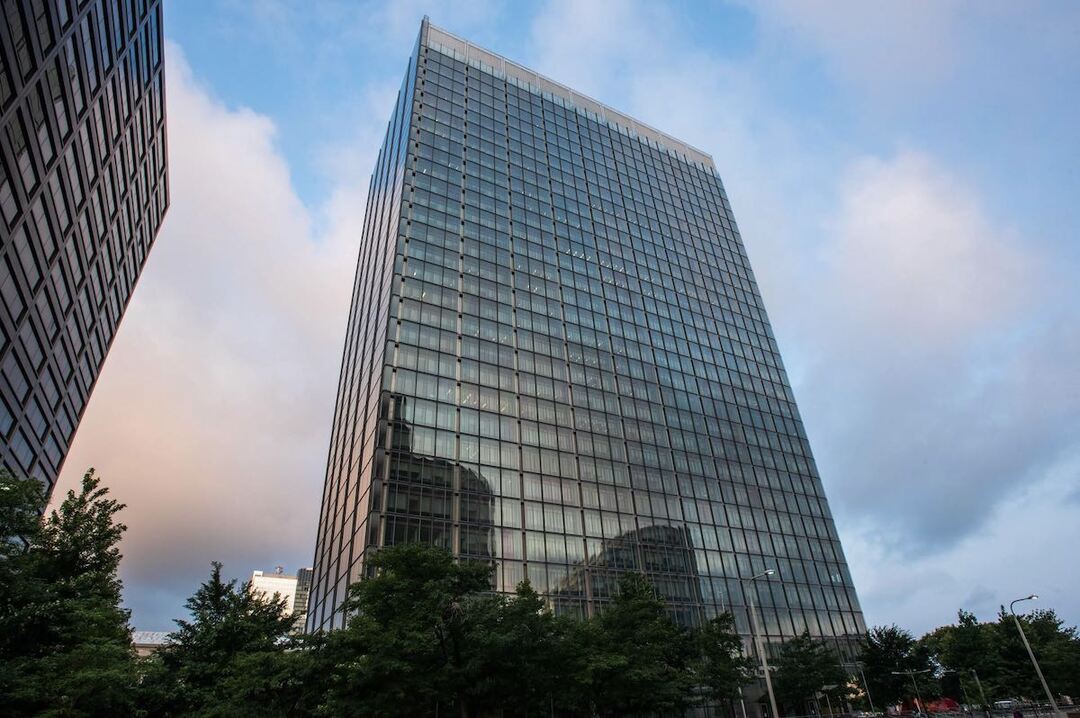
    <summary type="html"><![CDATA[<p><strong><em>When the federal government began planning its new building as part of the Erieview Plan, it departed from I. M. Pei’s original vision and chose a stunning new design that drew from the latest in Modernist thought. Forty years later, that building was showing its age and required a dramatic intervention. The solution was an innovative facade overclad system that changed the building’s appearance but maintained its original purpose and function.</em></strong></p><img src="https://clevelandhistorical.org/files/fullsize/08179223f0e96be7ec08765e524e5ec3.jpg" alt="The Anthony J. Celebrezze Federal Building" /><br/><p>The 1960s were a very active period for the construction of federal buildings in cities across the country, and Cleveland was no exception. As early as 1957, area members of Congress began pushing for the construction of a centrally located downtown federal office building that would consolidate federal services in the city. The site of the building was determined in 1960 as an integral part of the Erieview Urban Renewal Project in downtown Cleveland. This large scale, multi-phased urban planning project was led by renowned architecture firm I. M. Pei and Associates.</p><p>Pei’s 1960 master plan for the Erieview development included a mix of high- and low-rise commercial and residential buildings with more than fifty percent of the land left open for parks and malls. The plan was designed to be completed in two phases; a western area of 96 acres to be designated for primarily commercial use and an eastern area of 67 acres to be designated for residential buildings. The focal point, at the center of the development, was a forty-story office tower. Completed in 1964 and dubbed the Erieview Tower, this was the first part of the Erieview plan to be built. A new six-story federal building that was to occupy an entire city block was also a key part of Pei’s plan. In preparation for the Erieview redevelopment, more than 200 buildings were demolished, including the old Armory that was located on the site of the current Federal Building.</p><p>While I. M. Pei developed the master plan for the Erieview development, other architects were brought in to design the individual buildings, including the new federal building. The General Services Administration (GSA), established in 1949 to meet the needs of the growing federal government, selected three local architecture firms to work together on the design of the federal building: Outcalt, Guenther, Rode, Toguchi & Bonebrake; Schafer, Flynn & Associates; and Dalton & Dalton Associates. However, the GSA did not choose a lead designer for the project and left the three firms to resolve the issue. All three firms wanted to lead the project, so a compromise was reached that they would bring in an outside architect to be the lead designer. The firm principals originally thought about bringing in a famous architect to lead the project, but eventually decided to find an architect that worked for one of these significant architects. Peter van Dijk was working for Eero Saarinen and Associates in Bloomfield Hills, Michigan, at the time and was selected based on a suggestion by one of Calvin Dalton’s employees. Upon speaking with van Dijk, the principals at the three firms quickly decided he was the right person to lead the design of the Federal Building project.</p><p>The design process began in 1961 and continued through 1962. The architectural team was charged with designing a one million square foot federal office building with an “open, flexible, well-planned loft space for offices.” GSA also requested that a two-level parking garage, large cafeteria, and loading dock be included. According to van Dijk, the goal was “to produce a most elegant steel cage. A façade executed with strength and precision. A stressed skin smoothness with machine-like clarity. Good proportion, scale, detail and choice of appropriate materials and colors.”</p><p>After careful consideration and study of the site and GSA programmatic requirements, it was decided that the team would design a tall building, which was in direct contradiction to the concept design in Pei’s Erieview Master Plan. The designers’ decision to abandon the Pei design was based on their belief that a tall structure would relate to the existing Terminal Tower and the other buildings being designed in proximity at the time. In their opinion, the large donut-shaped plan did not conform with the “plans for open space and plazas.” They believed a tall building would provide for more space for outdoor plazas, as well as views of the downtown and lake from the upper floor offices. Following their conclusion, the team convinced Pei and GSA that “a tall, slim structure would be more in keeping” with the other high structures planned in the renewal area. </p><p>The building was designed as a simple rectangular shape and had the proportions of a golden rectangle. The design also contained a definite base, middle, and top and was intended to utilize simple materials (glass and stainless steel). Furthermore, according to van Dijk, the steel frame of the building became “the basis of the architectural expression of the façade.” The siting was also important to the designers. The building was purposely set back from East Ninth Street to provide room for a plaza at the main entrance and set back even farther on East Sixth Street to create a “garden plaza.”</p><p>The design was substantially completed by June 1962 when GSA issued an official press release regarding the new federal building in Cleveland. In the press release, GSA described the thirty-two story building as “an important element in the city’s Erieview Redevelopment Plan” that would “provide the lake-shore metropolis with an imposing landmark.” They also estimated that the building would cost $41.2 million to complete. </p><p>The Celebrezze Building was designed during a period of growing public acceptance of Modernist design. The Modernist movement in architecture, which had roots in Europe, began to flourish in the United States following World War II as architects like Walter Gropius and Mies van der Rohe expanded their influence. As the movement continued to thrive throughout the 1950s and into the 1960s, Modernism became the preferred style of architecture for office buildings across the country. Buildings such as the Seagram Building (1958) in New York City by Mies van der Rohe and Philip Johnson, as well as the Inland Steel Building (1957) in Chicago, Illinois by Bruce Graham and Walter Netsch of SOM, continued to push the envelope in Modernist design. Significant Modernist skyscrapers in Cleveland include the McDonald Investment Center (1968) by Charles Luckman; the Cleveland Trust Tower/Ameritrust Tower (1971) by Marcel Breuer; Earnest J. Bohn Housing Tower (1972) by William Dorsky Associates; the Diamond Building (1972) by SOM; the Holiday Inn Lakeside (1974) by William Bond; and the Sheraton City Centre Hotel (1975) – now the Crowne Plaza Hotel – by Bialosky and Manders.</p><p>The policies of the federal government also reflected the shift toward Modernist design. When John F. Kennedy assumed the presidency in 1961, he found many federal buildings to be lacking in efficient office space and inadequate for modern use. As a result, he requested that an Ad Hoc Committee on Federal Office Space be formed to develop solutions for short- and long-term space needs in federal buildings. In 1962 the committee issued its report, which included the “Guiding Principles for Federal Architecture.” In the “Guiding Principles” the committee recommended new mandates for “high quality architectural designs” for all new federal buildings across the country and developed a three-point system for federal architecture standards. They also encouraged modern principles of architecture through choice words within the standards, such as “contemporary,” “functional,” and “economical.” With the adoption of the new principles, the monotonous architecture of the previous decade gave way to new, innovative, quality design. Although the design of the Celebrezze Building was initiated before the Principles were published, it clearly exemplifies the Principles’ embrace of high-quality modern design.</p><p>The building’s expression of structure on the exterior façade follows the design principles of Mies van der Rohe, which can be seen in many of his works, including the Dirksen Federal Courthouse in Chicago completed in 1965. However, unlike Mies who used protruding mullions on his buildings, Peter van Dijk used only contrasting materials – stainless steel and glass – to emphasize the grid of columns and floor plates. According to van Dijk, the solid of the stainless steel and the void of the glass created a solid and void effect that clearly emphasized the building’s skeletal structure. The idea of an exterior skin with no protruding mullions was a concept van Dijk learned in the office of Eero Saarinen from projects such as the General Motors Technical Center in Warren, MI, and Bell Labs in Holmdel, NJ. It continued to be the subject of experimentation with other Saarinen followers, most notably Anthony Lumsden and Cesar Pelli. </p><p>In 1965, in the midst of the Civil Rights era, the construction of the new federal building in Cleveland became the subject of protests that received nationwide attention. Led by the National Association for the Advancement of Colored People (NAACP), picketers protested discriminatory hiring practices among the predominantly white trades unions involved in the construction of the building. The protest’s leadership also targeted the federal government “for its failure to enforce civil rights laws.” The Erieview plan, of which the federal building was a part, also appears to have strained community relations. Across the country at this time, many cities had undertaken similar projects that resulted in the displacement of their most vulnerable residents and the destruction of their homes, with disproportionate effects being felt by the African American population. In Cleveland, many poor Black residents perceived that the Erieview project, which was located in the heart of the downtown area and treated as a showpiece by politicians and government officials, was diverting badly needed resources from projects in critically underserved east side neighborhoods. This resentment, combined with myriad other factors, burst out into the open the following summer in the Hough Uprisings, an episode of violent unrest comparable to the riots that occurred in Harlem, Watts, and other urban areas during the 1960s. </p><p>The Cleveland Federal Building was substantially completed in the fall of 1966 at a cost of $31,968,000 (substantially less than the budgeted $41.2 million) and officially opened in early 1967. The new building housed more than fifty government agencies that had previously been spread out in buildings throughout the city. In 1973, the building was renamed in dedication of Anthony J. Celebrezze, former Mayor of Cleveland, Ohio Congressman, Secretary of Health, Education and Welfare in the Kennedy Administration, and U.S. Appeals Court Judge. As mayor, Celebrezze was an early proponent of the Erieview Urban Redevelopment Project and helped in the process of bringing the Federal Building project to realization. </p><p>Following its completion, the building underwent relatively few significant alterations until 2009, when GSA utilized funds available through the American Recovery and Reinvestment Act (ARRA) to begin a massive intervention addressing the condition of the curtain wall. Flaws in the original detailing and installation, water infiltration, the action of wind forces, and the harsh Cleveland winters had resulted in advanced deterioration on the façade’s various components. Additional assessments found the curtain wall to be strikingly deficient in terms of modern energy efficiency and security standards. Ultimately GSA decided to install a second skin on top of the existing façade, effectively overcladding the original building with an entirely new window wall system. </p><p>Pursuing this innovative approach allowed GSA to retain the existing building, thereby avoiding the expense and inefficiency of constructing an entirely new building and relocating the current building’s occupants. Additionally, it allowed the agency to preserve a historic asset. In 2011, the Celebrezze Building was determined eligible for listing in the National Register of Historic Places for its exceptional local historic and architectural significance. This determination rests on the Celebrezze Building’s distinguished modernist design and its role in the history of the Erieview plan and the development of the modern Cleveland skyline. It also recognizes Peter van Dijk as a master architect. Comparatively unknown at the time that he designed the Celebrezze Building, van Dijk went on to become one of the Cleveland area’s most celebrated designers. Following the Celebrezze Building, he designed the Blossom Music Center (1968) in Cuyahoga Falls. Subsequently, his firm developed a global reputation for expertise in the design of performance venues. A committed preservationist, van Dijk was also a driving force behind the plan to save Cleveland’s Playhouse Square theaters. Recognizing the need to address issues with the original design and construction of the Celebrezze Building, van Dijk supported and participated in the façade renewal project. Peter van Dijk passed away in 2019 at age 90.</p><p>Following the completion of the facade overcladding, the Celebrezze Building was identified as a contributor to the Erieview Historic District, which was listed in the National Register of Historic Places in 2021.</p><p><em><strong><a href="https://clevelandhistorical.org/items/show/1004">For more (including 13 images) view the original article</a></strong></em></p>]]></summary>
    <published>2023-06-10T14:32:46+00:00</published>
    <updated>2026-04-17T19:17:43+00:00</updated>
    <link rel="alternate" type="text/html" href="https://clevelandhistorical.org/items/show/1004"/>
    <id>https://clevelandhistorical.org/items/show/1004</id>
    <author>
      <name>Jorgen Cleemann</name>
    </author>
  </entry>
  <entry>
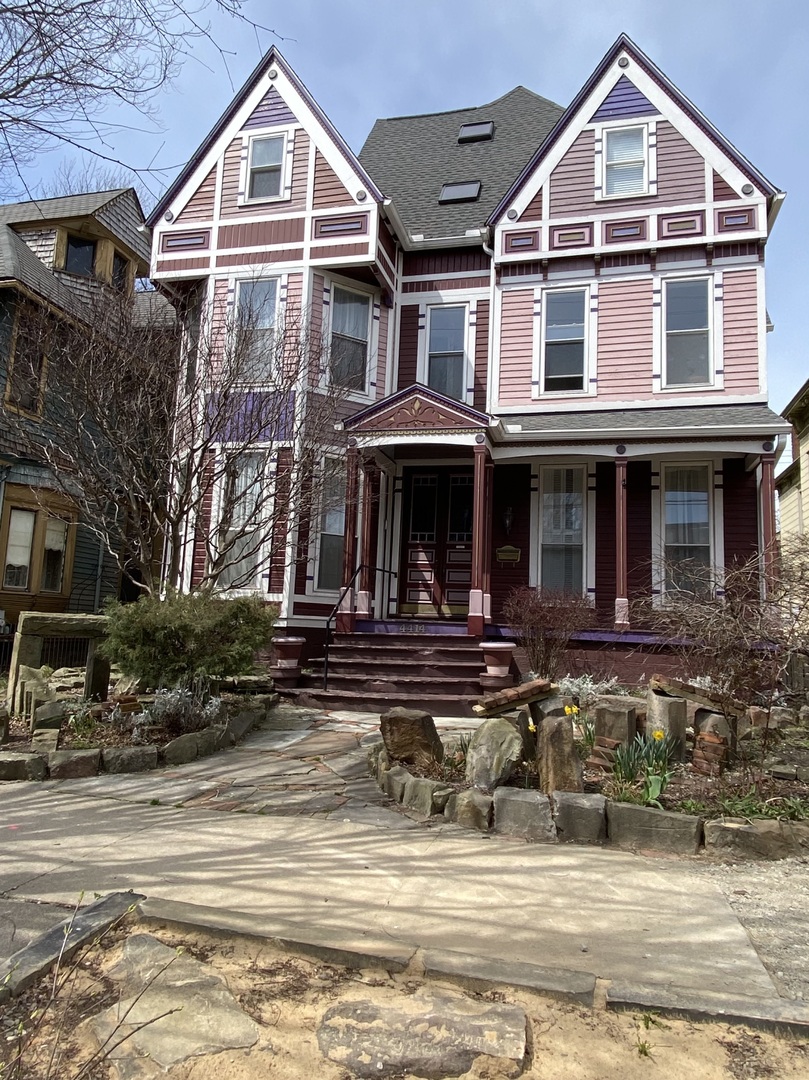
    <title type="html"><![CDATA[M. J. Lawrence House: When Is It Time to Rename a Historic House?]]></title>
    <summary type="html"><![CDATA[<p><strong><em>In February 1886, a reporter from the Cleveland Leader tracked down the estranged wife of wealthy newspaper editor and publisher Mortimer J. Lawrence. He found her staying at the Forest City House on the west side of Public Square, where the Renaissance Cleveland Hotel stands today. She was pale, he noted, except for discoloration beneath her eyes which she confirmed was from injuries suffered at the hands of her husband.</em></strong></p><img src="https://clevelandhistorical.org/files/fullsize/f0f7a629cf9c69eb752b541235ba99b4.jpg" alt="M. J. Lawrence House Today" /><br/><p>Historic houses are often named after the person for whom they were built, especially when that person happens to have been a prominent member of the community.  While  this practice may give historic  houses  a certain cachet, it is not without risk.  With the passage of time and changing societal mores, information about that prominent citizen may come to light which tarnishes their image and that cachet.  Such is the case with naming the house at 4414 Franklin Boulevard after Mortimer J. Lawrence,  a man who in the late nineteenth century built a newspaper empire that was headquartered in Cleveland.   </p><p>Most, if not all,  contemporary biographers of Mortimer J. Lawrence lauded him as they related his rags-to-riches life story.  It is a format that was often used  by Cleveland biographers of the late nineteenth and early twentieth centuries when telling the stories of the men who they believed were responsible for building the city into an industrial powerhouse.  For M. J. Lawrence, the story  went something like this.  He grew up in Wakeman, Ohio, just south of Vermillion.  His father abandoned him when he was a little boy.  He went to work at a young age to help support the family.  When the War between the States broke out in 1861, he lied about his age in order to enlist on the side of the North.  He served  gallantly and, when the war ended, he moved to Cleveland.  He married a local girl, Helen Madison, and together they started a family,  living at first on Cleveland's east side where their three sons were born.  Mortimer worked as a reporter at the  Herald for a time and then at the Leader.  In 1872, when he was just 29 years old, he decided to take a big risk.  He borrowed money to purchase the Ohio Farmer, a struggling agricultural newspaper.  Working tirelessly, he saved the paper from bankruptcy.   It soon became  a successful and profitable paper.  He then proceeded to build around it a chain of agricultural newspapers in neighboring states which created a readership for his papers that eventually stretched from the Midwest all the way to the East Coast.  Within a decade, the long hours, the hard work, and the risk taken made Lawrence  a very wealthy man.  That was the rags-to-riches narrative for Mortimer J. Lawrence.  But there was more to his life and much of it was far from being praiseworthy.</p><p>In March 1882, M. J., as he was known after he became wealthy, purchased a parcel of land on the north side of Franklin Boulevard, just a few lots east of Taylor (West 45th) Street, and arranged for the construction of the house which stands  today at 4414 Franklin.  Designed in the Queen Anne style by up-and-coming young architect Nevins Charlot, it is two and one-half stories tall and today has more than 5,000 square feet of living area.  Once construction was completed in late 1882, M.J.,  Helen and their three sons, who ranged in age from four to fourteen years, moved into the house.  With such a young family, you might expect that the Lawrences would have lived happily in the house for many years to come.  However, less than four years later, M.J.  sold the house and  moved to Denver, Colorado.  Before he departed, he told his employees, according to an article that appeared in the Leader on October 17, 1886, that he was leaving Cleveland  "on account of his health."  This was hardly the true reason for his hasty departure.</p><p>Eight months earlier, in February 1886, a series of articles began to appear in Cleveland and other area newspapers regarding the state of the marriage of  M. J. Lawrence and his wife Helen.  The first reported that, on February 16, Helen Lawrence had filed a petition in the Cuyahoga County Court of Common Pleas  against M. J., seeking a divorce, alleging that the well-known editor and publisher had committed acts of extreme cruelty against her as well as adultery.  Reporters following up on the filing learned from Helen Lawrence's sister that on Saturday evening, February 13, Helen had come to her house on Liberty (West 48th) Street seeking shelter, claiming that M. J. had beaten her.  The sister observed that Helen's face was badly bruised.  She said that it was common knowledge in the family that M. J. had  physically and mentally abused Helen for years, including striking her, spitting on her and throwing hot water in her face.  Finally, Helen could take no more of it and had fled from her home.  Days after speaking with Helen's sister, a reporter from the Leader learned that Helen Lawrence was staying at the Forest City House on Public Square.  He went there and observed for himself the bruises on Helen's face.  The Leader also interviewed M. J. Lawrence who told them he would prove his innocence in court.</p><p>Helen Lawrence wasn't the only woman in Cleveland in the post-Civil War era who was filing for divorce against an abusive husband.  Prompted and pressured by leading feminist activists like Susan B. Anthony , Elizabeth Cady Stanton and others, legislatures and courts across the United States had liberalized the grounds which women could assert in order to obtain a divorce from such husbands.  Moreover, the laws regarding alimony had also been liberalized to better enable women to support themselves after they were divorced.   As a result, the number of divorces sought by and granted to women in the post-Civil War era skyrocketed, causing legislators and others more interested in preserving the family unit than protecting the rights of battered women to push back against further progressive changes.  This then would be the last era to see significant changes in divorce laws that benefited women until the dawn of a new civil rights era for women  in the 1960s.  </p><p>Helen Lawrence was awarded a divorce from M. J. Lawrence in late March 1886, just six weeks after she filed her petition.   It turned out that M. J. Lawrence did not prove his innocence in court as he had told newspaper reporters that he would.   Instead, he did not contest his wife's entitlement to a divorce  and agreed to the court awarding her what in that era would have been considered a substantial alimony settlement.   Helen used a portion of that alimony to buy a house on Franklin, just west of Waverly (West 58th) Street, where she raised her  youngest son and cared for her aged mother.  After he sold the house at 4414 Franklin and moved to Denver, M. J. married the woman--more than 20 years younger than he-- with whom he had been carrying on his extramarital affair.  Nearly a decade would pass  before he and his new wife would return to and once again live in Cleveland.</p><p>After the Lawrence family moved from 4414 Franklin, it became home to several other prominent Clevelanders.  One was Herman Baehr, the owner of a prominent local brewery.  Best known as the man who defeated Cleveland's legendary mayor Tom Johnson, Baehr resided in the house at 4414 Franklin for a decade, including the period of 1910-1911 when he served as Cleveland's mayor.   Another prominent owner was Jacob Laub, who founded  Laub Bakery in Cleveland in 1889.  Laub Bakery was well known to Clevelanders for nearly a century before it went out of business in 1974.  In the 1920s, the house was owned and occupied by a less prominent Clevelander, Gustav Lebozsa, a Hungarian immigrant tailor. After initially occupying it as a single family house, in 1928 he converted it into a rooming house, which it remained, according to Cleveland directory records until at least 1951.  In the 1940 census, nine families were listed as residing in the M. J. Lawrence House.</p><p>By the mid-twentieth century, the M. J. Lawrence House was in deplorable condition.  A photo taken in 1954 for the Cleveland Board of Zoning Appeals revealed that house's third story front dormer was gone; the windows and decorative woodwork on the two front gables had been covered with asphalt shingles; the eaves of the front gables had been removed; several of the house's original five chimneys were missing; and  the house's covered front porch was gone.   Much, if not all, of this damage was caused by the historic 1953 tornado, which damaged this house and many others on Franklin.  In the year following the historic tornado, repairs were completed and the M. J. Lawrence House was converted from a rooming house into a four-suite apartment with two suites on the first floor, and two on the second.  The house continued to be so used during the decades of the 1960s and 1970s.  In the early 1980s,  a new owner was in the process of adding a fifth suite to the third floor of the house, when he abandoned the work and left the house vacant.  As the end of 1980s approached, the City of Cleveland was threatening to condemn  the M. J. Lawrence House when it was saved by Duane and Michaella Drotar.</p><p>According to Duane Drotar, he and his wife were social workers living on West 28th Street in 1989 when they became involved in the controversy surrounding St. Herman's House of Hospitality's application to the City of Cleveland for a zoning variance to add a dining hall onto the house at 4410 Franklin.  St. Herman's, which has provided shelter for homeless men at that location on Cleveland's west side since 1977,  is located next door to the M. J. Lawrence House.  While some in the neighborhood opposed the variance, the Drotars did not.  They learned that, if they were to purchase the vacant M. J. Lawrence House and indicate their non-opposition to St. Herman's variance request, the City of Cleveland would likely approve it.  So, the Drotars sold their house on West 28th and, with the sales proceeds, purchased the M. J. Lawrence House.  They then began what turned out to be a long process to renovate and restore it.  (Meanwhile,  St. Herman's proposed building addition was approved by the City.)  </p><p>Duane and Michaella Drotar first renovated the interior of the M. J. Lawrence House during the 1990s, building first a suite for their family that consisted of the entire first floor of the house and part of the second.   They next built  a separate rental suite on the remaining part of the second floor.  Finally,  they developed the third floor into a temporary residence for, as Duane Drotar put it, "people in transition."  After the interior renovations were completed, the Drotars turned their attention to the exterior of the house.   They did not attempt to restore it to its original design primarily because the cost was prohibitive.  Instead they renovated the exterior to resemble a  "painted lady" Victorian house that one might see in San Francisco.  Their external renovations to the house were completed in 2003.</p><p>The Drotar family lived in the house at 4414 Franklin for nearly 30 years. During these years, Duane and Michaella's three children grew up in the house, and Duane and Michaella continued their social work of ministering to the needy on Cleveland's west side.   While the M. J. Lawrence House may have been built for and first occupied by a newspaper editor who abused his wife, the Drotar family, over the course of their long residency in the house, did much to improve both the appearance and the reputation of the house, if not stigma attaching to its name. The M. J. Lawrence House is now, as a result, known in the Franklin Boulevard neighborhood as a place where innumerable acts of kindness, compassion and charity for neighbors occurred over the course of the decades that the Drotar family lived there.</p><p><em><strong><a href="https://clevelandhistorical.org/items/show/954">For more (including 15 images) view the original article</a></strong></em></p>]]></summary>
    <published>2021-11-21T21:11:56+00:00</published>
    <updated>2026-04-17T19:17:42+00:00</updated>
    <link rel="alternate" type="text/html" href="https://clevelandhistorical.org/items/show/954"/>
    <id>https://clevelandhistorical.org/items/show/954</id>
    <author>
      <name>Jim Dubelko</name>
    </author>
  </entry>
  <entry>
    <title type="html"><![CDATA[Saint Luke&#039;s Hospital: A Struggle for Equitable Healthcare]]></title>
    <summary type="html"><![CDATA[<img src="https://clevelandhistorical.org/files/fullsize/de2ae057a468d9c9e8dc2de9d2c6663b.jpg" alt="Protest at St. Luke&#039;s" /><br/><p>St. Luke’s Hospital was founded on Woodland Avenue in 1894 as Cleveland General Hospital. Soon after being renamed St. Luke's in 1906, the hospital spent two decades on Carnegie Avenue before moving in 1927 to a much larger building on Shaker Boulevard in the Buckeye neighborhood that was styled like Independence Hall, where the founding fathers declared “All men are created equal.” The history of St. Luke’s does not match the architectural symbolism of the building as there are many cases of African American patients and staff being mistreated during the 1950s and 1960s. Some Black patients were physically assaulted, went untreated, or were segregated. St. Luke’s questionable history in its dealings with African American patients and staff remains relevant as events today highlight persistent issues that echo those that African Americans experienced decades ago.</p><p>The mistreatment of African American patients at St. Luke’s Hospital was common throughout the 1950s. For example, in 1957 a thirteen-year-old girl injured in a car accident was brought to St. Luke’s for medical attention. She was unconscious, but nurses and a doctor told her mother to take her home because, they insisted, she was “drunk.” The girl remained in an unconscious state for several days; however, a private doctor treated her at home. After she did not regain consciousness she was brought back to St. Luke’s, which now admitted her. The girl had to receive further treatment at home and the hospital for more than a year after the accident. She was never able to live a normal life after the accident and poor care from St. Luke’s.</p><p>Poor treatment of African American patients continued and in the early part of August 1957, St. Luke’s hospital staff rolled a white patient into an African American ward; however, the white patient had been dead for over a half hour. The woman had received a colostomy right before her death which produced a strong odor. While she was in a different ward, white patients complained about the smell. In an effort to appease white patients, hospital staff moved her to an African American ward, where they left her for over four hours. One patient said, “I’ll bet they wouldn’t bring an alive woman in here and leave her for four or five hours. If they don’t want to integrate the living patients then we don’t want integration because of somebody’s death. Especially when it's a case like this.” Later it became known that there was an empty room where the body could have been placed, but it was on the other side of the hospital.</p><p>Another incident, which involved another Black woman, Louise Ottrix, and her daughter underscores the poor treatment of African Americans. Ottrix took her four-month-old baby to St. Luke’s because the baby had fallen and hurt her head. Once Ottrix arrived her information was taken and she was told to wait. According to Ottrix she waited for about twenty-five minutes and then asked if her child could be seen immediately. She was told no and that she would have to wait her turn. After being denied timely service, she decided to leave and went to St. Vincent’s Charity Hospital where the baby was seen immediately. The baby had suffered from a skull fracture. </p><p>Protests erupted in February 1963 as a response to the treatment that African Americans received during the 1950s and '60s. The Cleveland Chapter of Congress of Racial Equality (CORE) charged St. Luke’s Hospital with segregating its patients. Arthur Evans, CORE’s protest committee chairman, led a protest where forty people were present with pickets on February 22, 1963. The protests involved people of various backgrounds, including white people. The protesters, most of whom carried posters denouncing segregation policies, circled the entrance of the hospital. </p><p>Not only did people protest outside St. Luke’s but prayer pilgrimages were held outside the hospital as well. People from CORE, the NAACP, Job Seekers, Freedom Fighters, and the Afro-American Institute participated in the prayers outside St. Luke’s. Those in attendance prayed to God that St. Luke’s would end its discrimination against those of different races, creeds, or colors. Many people who passed by joined in on the prayer. After the prayers were done people began to hold a traditional protest. Towards the end of March of 1963, CORE ended its protests at St. Luke’s Hospital as its leaders saw improved conditions of integration. St. Luke’s agreed to desegregate its wards and semi-private rooms.</p><p>St. Luke’s was not the only hospital during the 1960s to mistreat African American or minority patients. According to medical historian Rosemary Stevens, Blacks all across the country often received meager medical care during the 1960s. Poor African American patients often identified the impersonality and rudeness of large hospitals like St. Luke’s as the reason they avoided seeking health care. </p><p>St. Luke’s continued to exhibit problems in its treatment of African American patients and employees. During 1967 four hundred non-professional employees went on strike or tried to unionize. Only two of them were white. Joseph E. Murphy, who was in charge of the unionization push and the strike, believed that negotiations would have been easier if more members were white. Indeed, St. Luke’s was insensitive to its African American workers’ calls for pay increases. The NAACP sent volunteers to join the protests, and Congressman Michael A. Feighan called upon the St. Luke’s administration to recognize Local 47, Building Service and Maintenance Union.</p><p>Cleveland Mayor Carl Stokes worked hard to resolve the situation between Local 47 and St. Luke’s; however, by December 1967 he believed that he had “exhausted the maximum resources” of his office. Stokes also said that he could not force either the union or St. Luke’s to the table; however, he wanted to “bring about a settlement amicably and agreeable to all.” </p><p>The strike at St. Luke’s would continue to gain more and more attention as it stretched into the early months of 1968. Rev. Randel T. Osborn, an aide to Martin Luther King Jr., announced a plan to apply pressure on St. Luke’s through Operation Breadbasket. The goal of Operation Breadbasket was to increase African American employment across the country. Not long after Rev. Osborn announced pressure would be applied a deal was reached between Local 47 and St. Luke’s. On March 8, 1968, Mayor Stokes announced that the strike was over. The eleven-month strike ended with Local 47 being recognized as a bargaining agent with four hundred non-professional employees. Negotiations on wages and working conditions began soon thereafter. </p><p>St. Luke’s troubled past regarding its dealings with African American patients and employees have only become more relevant in today’s world. The troubles that Black patients and employees faced at St. Luke’s such as mistreatment, segregation, poor working conditions, and poor pay only touch the surface of what many African Americans experienced during the 1950s and 1960s and still face today.</p><p><em><strong><a href="https://clevelandhistorical.org/items/show/926">For more (including 6 images) view the original article</a></strong></em></p>]]></summary>
    <published>2020-12-13T17:03:07+00:00</published>
    <updated>2026-04-17T19:17:42+00:00</updated>
    <link rel="alternate" type="text/html" href="https://clevelandhistorical.org/items/show/926"/>
    <id>https://clevelandhistorical.org/items/show/926</id>
    <author>
      <name>Seth Lyons</name>
    </author>
  </entry>
  <entry>
    <title type="html"><![CDATA[Liberty Hall: The Universal Negro Improvement Association in Cleveland ]]></title>
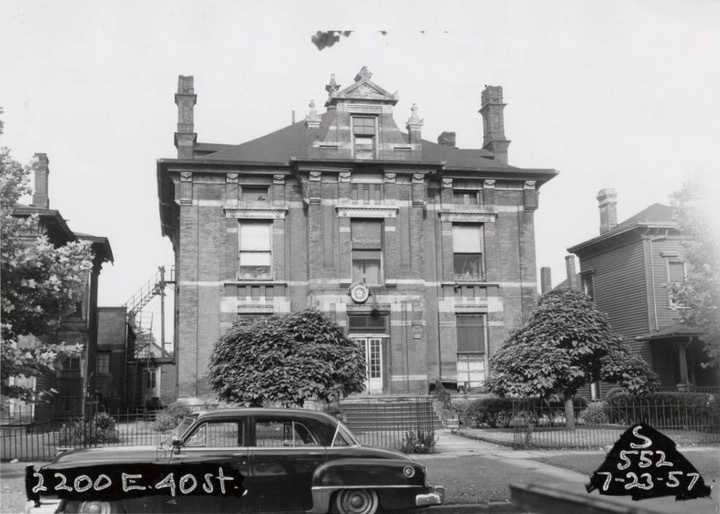
    <summary type="html"><![CDATA[<p><strong><em><div style="text-align:left;">“Cleveland Garveyites regularly paraded through the city’s black belt, proudly wearing their all-black military styled uniforms and carrying the UNIA’s red, black, and green flag. The flag signified black pride and African Liberation.” – Erick McDuffie</div></em></strong></p><img src="https://clevelandhistorical.org/files/fullsize/9f6020557f2245326d7c63447c2b8dce.jpg" alt="&quot;Liberty Hall&quot; / The Jacob Goldsmith House " /><br/><p>After the Great Migration a new nationalist movement arose in African American communities across the U.S., with Marcus Garvey as its spearhead. Founded by Garvey in 1914, the Universal Negro Improvement Movement (UNIA) stressed black pride, community solidarity, connecting the racial struggles in the U.S. to those of black people across the world. Garvey protested white colonization and called for “all men and women within the reach of the blood of Afric[a]" to be proud of their race.” The UNIA by-laws provided a script for each member oath to the organization that included a pledge to “the redemption of my motherland Africa.” This pride in African heritage in the UNIA is evident even in their anthem, “Ethiopia, Thou Land of our Fathers.” Garveyism and the UNIA gained influence in the Midwest, and more specifically in Cleveland, which would house the UNIA headquarters throughout the 1940s and again in the 1970s and 1980s. </p><p>During Marcus Garvey’s visit to Cleveland in May 1920, he spoke to more than 400 people at <a href="https://clevelandhistorical.org/items/show/643">Cory United Methodist Episcopal Church</a>. The audience's exuberant response demonstrates how Garvey’s Pan-African message truly captured the lives of those present. Inspired by Garvey’s message, the UNIA in Cleveland became a major force in local politics, as illustrated in continuous coverage of its Cleveland activates in Garvey’s newspaper <em>Negro World</em>. These efforts helped expand the Cleveland UNIA (Division 59) to more than 5,000 members by 1922, and by 1923 it claimed 15,000. This was the same year that the Cleveland UNIA, through the small donations of organization members, was able to purchase a stately three-story mansion located at 2200 East 40th Street. Liberty Hall, as it was later named, was located in the heart of the Central neighborhood. This building served not only as the headquarters space for the UNIA but also as a bustling African American community center, committed to uplifting black peoples in Cleveland and globally. </p><p>Initially, following Garvey’s mail fraud conviction and deportation, he reorganized the international UNIA at the 1929 convention, forming the Universal Negro Improvement Association and African Communities League, August 1929 of the World (UNIA-ACL). Although some charters fought Garvey on his changes, the Cleveland UNIA remained loyal and received its new charter as Division 133 from the UNIA Parent Body in 1930. It was during this time that the chapter started to face factionalism and decline. Issues with intra-racial strife, sexism, and class issues, among others, caused initial decline for the organization. Debates also focused around the issues of dancing, drinking, smoking, and women’s behavior. The black middle class, which comprised most of the Cleveland chapter, traditionally associated these activities with the recklessness of the black urban working-class. During the Depression many African Americans on Cleveland’s East Side started to migrate toward other black power groups, including the Future Outlook League (FOL) and the National Association for the Advancement of Colored People (NAACP) as a result of this strife within the organization. </p><p>The UNIA-ACL Cleveland branch, however, committed itself to the ideals of Pan-Africanism throughout the 1940s. In August 1940, James R. Stewart, who was serving as a UNIA-ACL commissioner for the state of Ohio and as president of the Cleveland branch, was elected acting president general at the time of Garvey’s death. By October, Stewart had established Cleveland as the new location for the UNIA-ACL Parent Body headquarters. The Parent Body remained in Cleveland until 1949. Part of what led to the chapter's downfall during this time was Stewart's push for voluntary African American repatriation to Liberia. Similar to Garvey, Stewart believed that the repatriation would assist in civilizing Africa and solving the American race issue. In the case of Cleveland, most African Americans were more concerned about obtaining full citizenship and rights in the U.S., rather than emigrating to Africa. These ideas, in conjunction with other black rights organizations like the FOL and NAACP supporting black rights at home, led to a continuing decline in membership. Stewart decided to take Liberian citizenship for himself in 1949, moving the Parent Body to Monrovia, Liberia. After Stewart’s death in 1964, the Parent Body moved to Chicago where it remained until 1975. </p><p>When the Civil Rights and Black Power movements arrived to Cleveland in the 1960s, the Cleveland UNIA-ACL was playing a marginal role at best. Garveyism during this time, however, took on a new life though new local Black Power organizations comprised of young black nationalists who consciously saw themselves as Garveyites. Inspired by Garvey’s defiant call for black self-determination, young black Clevelanders formed other Black Nationalist groups such as the House of Israel and the <a href="https://clevelandhistorical.org/items/show/777">Afro-Set</a>. Most of this new generation of Garveyites was unaware of the UNIA-ACL, but rather had come to Garveyism through the Nation of Islam or other veteran black nationalists. Kwame Nkrumah, the leader during Ghana’s independence, is said to have been greatly inspired by Garvey. In the U.S., Malcolm X is also said to have been influenced by Garvey in his desire to make a unified black pride on an international scale. In Cleveland’s more recent past, and even today, as the struggle for black rights rages on, people remember the influences of Garvey, and the UNIA-ACL, and the role they played in shaping the black power movements still present today.</p><p><em><strong><a href="https://clevelandhistorical.org/items/show/898">For more (including 9 images) view the original article</a></strong></em></p>]]></summary>
    <published>2019-12-09T02:46:38+00:00</published>
    <updated>2026-04-17T19:17:42+00:00</updated>
    <link rel="alternate" type="text/html" href="https://clevelandhistorical.org/items/show/898"/>
    <id>https://clevelandhistorical.org/items/show/898</id>
    <author>
      <name>Rebekah Knaggs</name>
    </author>
  </entry>
  <entry>
    <title type="html"><![CDATA[Wilkins School of Cosmetology : Haircare and Hospitality ]]></title>
    <summary type="html"><![CDATA[<img src="https://clevelandhistorical.org/files/fullsize/b19c6174e4e70b1c644560859fcfb17a.jpg" alt="Wilkins School of Cosmetology Postcard" /><br/><p>In the early 20th century, many African Americans sought refuge in northern cities from the tyranny and violence of the Jim Crow South. For those participating in this Great Migration, a city such as Cleveland seemed a logical choice, with the promise of economic and social benefits, not least a growing African American population to provide a sense of community. In the midst of this influx, African Americans became increasingly channeled into the crowded Cedar-Central neighborhood. Churches, music halls, and even beauty parlors in the community all played a signal role in providing places where black newcomers could come together. The Wilkins School of Cosmetology was one such place that reflected the mixture of entrepreneurship and social service that helped make Cedar-Central a vital community. </p><p>The school's founder Edith Wilkins, the eldest of twelve children, was born in 1893 in a white-washed cabin of the farm of her grandparents in Plumville, Arkansas. After graduating from the Poro College of Cosmetology in St. Louis, she moved to Cleveland with her husband George, a South Carolina-born fireman for White Sewing Machine Co., and two daughters in 1918. After waiting tables at Halle Bros. department store, Wilkins soon established a career as a beautician when she opened her first salon at 3812 Scovill Avenue. </p><p>On the advice of friends, Wilkins became a cosmetology educator when she took over an existing beauty school located on the main floor of the <a href="https://clevelandhistorical.org/items/show/19">Phillis Wheatley</a> building on Cedar Avenue at East 46th Street. The Phillis Wheatley Association provided support and a safe place to live for young, unmarried African American women newly arrived from the South. Although this location seemed to be a fitting spot for the parlor, the business's soaring popularity necessitated an expansion that simply was not possible in the Phillis Wheatley building. Wilkins ultimately purchased her own house on East 46th just north of Cedar Avenue in early 1936. Following renovation, it officially opened as the Wilkins School of Cosmetology. </p><p>Throughout the 1930s and 1940s the Wilkins School of Cosmetology grew further. Wilkins educated students from not only the U.S., but also Canada, Cuba, Africa, and the Caribbean. The school also provided African Americans, especially women, a space in their community where they could connect and grow together. Beauty parlors served as important social spaces for both women and men in the African American community. They were safe spaces, away from the hostilities sometimes faced in the white world around them, which explains why the Wilkins School was regularly featured in the <em>Negro Motorists' Green Book</em>. Moreover, the school gave black women a sense of empowerment while teaching them skills to become financially independent. Wilkins often allowed new students to study tuition-free and in many cases would even cover their room and board until they could pay their own way. Reflective of the school's communitarian nature, Edith Wilkins hosted many social and professional groups at the school such as the Jewelites Social Club, the Venus Club, the Economical Art Club, and the Business and Professional Women's Club. During the depression and war decades the school maintained continuous enrollment. Many of its graduates either found work in other salons, came back to work for the school, or in some instances pursued higher education. </p><p>By the 1950s and 1960s the Civil Rights movement gained steam in Cleveland. Wilkins and the School of Cosmetology, from the beginning, had supported other African American business endeavors in Cleveland. These included not only other salons and beauty parlors, but also the <em>Cleveland Call and Post</em> newspaper, and the Eliza Bryant Home, formerly known as <a href="https://clevelandhistorical.org/items/show/859">The Cleveland Home for Aged Colored People</a>. Wilkins also was able to get the school into the national and even international spotlight through her political work striving for the rights of African Americans and women. As a representative of the Cleveland Council of Negro Women, Wilkins had the opportunity to travel to many countries, including to Belgium to attend the World Brotherhood of Christians and Jews. Wilkins is also considered one of the founding members of the Ohio Association of Beauticians. </p><p>After turning over administration of the school to her daughter Lucille Francis in 1974, Wilkins remained active in the school and in the community. Her daughter continued to run the school in the same way as her mother before her. She maintained its reputation of being a modern, technologically advanced institution while also keeping its programs widely publicized in the press. During her tenure, the graduating classes reached record numbers, and the institution celebrated its thirty-fifth commencement exercise. Lucille, like her mother also had a strong sense of what the School of Cosmetology meant to the community, and frequently asked public figures in the African American community to come and give lectures, as well as to speak at commencement exercises. </p><p>After Edith Wilkins's passing in 1988, the School of Cosmetology started to lose its popularity. Newspaper articles and advertisements slowly decreased, but the School still lived on through the memorialization of Wilkins. She is memorialized at the Eliza Bryant Home hall of fame, as well as the St. James A.M.E. Church in honor of her service to the church's Women’s Day. Although it is unclear when the building at 2112 East 46th Street was demolished, records indicate that the land on which it stood was given to the Lane Metro Christian Methodist Episcopal Church in 1997, with the lot remaining empty today.</p><p><em><strong><a href="https://clevelandhistorical.org/items/show/868">For more (including 10 images) view the original article</a></strong></em></p>]]></summary>
    <published>2019-05-01T02:49:09+00:00</published>
    <updated>2026-04-17T19:17:36+00:00</updated>
    <link rel="alternate" type="text/html" href="https://clevelandhistorical.org/items/show/868"/>
    <id>https://clevelandhistorical.org/items/show/868</id>
    <author>
      <name>Rebekah Knaggs </name>
    </author>
  </entry>
  <entry>
    <title type="html"><![CDATA[The Afro Set: Black Nationalism and Cleveland&#039;s East Side in the Late 1960s]]></title>
    <summary type="html"><![CDATA[<img src="https://clevelandhistorical.org/files/fullsize/ea57c0c0ce31388d691c350622a09504.jpg" alt="Mayor Carl Stokes and Harllel Jones Watch a Drill Team" /><br/><p>The vacant lot at 8127 Superior Avenue N.E. sits quietly in the midst of an East Side neighborhood that has seen a great deal of upheaval and civic unrest. In the late sixties, the lot was the home of the Afro Set Black Nationalist Party for Self Defense storefront as well as the headquarters of the group of the same name. Founded by Harllel Jones (later Harllel X) in late 1968, the Afro Set was largely a response to the rise of Black Nationalist sentiment due to escalating racial and socio-economic tensions that were prevalent not only in Cleveland but across the country. Jones had grown up in the East Side neighborhood of Hough, and his experiences there helped shape the Afro Set’s Nationalist core.  </p><p>Cleveland’s East Side was a victim of the migration to the suburbs that most urban centers suffered in the post-World War II era, and more critically, of the economic policies of the 1950s and 1960s that caused the rapid dereliction of what had become a series of predominantly black neighborhoods, with Glenville and Hough (the neighborhood where the Afro Set was located) suffering some of the worst decay and lack of governmental aid. Administrations prior to the election of Mayor Carl Stokes were marred by a racially conservative tendency to ignore urban neighborhoods, often tying up (or underfunding) desperately needed resources as well as ignoring the overpopulation, poor sanitation, and high unemployment rates in such areas. While Mayor Stokes’ programs such as Cleveland: NOW! were intended to address these issues, tensions in neighborhoods like Hough produced increasing levels of hostility towards even their own residents, with riots breaking out in the late 1960s following racial confrontations. Black Nationalists like those of the Afro Set would argue that such instances were almost inevitable given the charged atmosphere of the era. </p><p>Black Nationalism began as a movement predominantly among urban African Americans who focused on the belief in self-regulated black agency within the larger nation. As with the Civil Rights movement of the same era, Black Nationalists were concerned with the rights and discrimination that dominated postwar America, but the Nationalists were generally convinced that a nonviolent approach to the tensions between black communities and the establishment was ineffectual at best. Therefore Nationalist groups such as the Afro Set, while promoting black community values and a return to African culture, were more militarily inclined and also included a focus not just on black agency but also on separation of black society from the national whole.</p><p>The Afro Set was a beneficiary of the Cleveland: NOW! program, which represented Mayor Carl Stokes’ attempt to help blighted communities through a series of grants that were used in hopes of promoting a more positive urban experience. Jones’ Afro Set was not only a storefront that sold African cultural items and gave urban black youths a place to work, it was also meant to be a community and cultural institution where area people could come and hear lectures on prominent blacks such as Marcus Garvey and Malcolm X, as well as receive lectures on black culture in general. However, the message of black cultural identity tended to get lost in the coverage that men such as Jones received in the press: Black Nationalists were generally seen as overtly violent and communistic militants who threatened the status quo, and interviews from Jones and his compatriots tended to verbally confront the press and authority figures such as the police with thinly veiled threats and rhetoric. That is not to say that all Nationalists were focused on violent revolution, and even Jones did eventually move his focus to helping men reintegrate into the society that he had vehemently opposed; but the legacy of violence, and the bias shown towards groups like the Afro Set means that today’s urban blacks have little to show from an era that caused so much upheaval and social change; there are far too many vacant lots that are fading back into the landscape with their stories fading from memory.        </p><p><em><strong><a href="https://clevelandhistorical.org/items/show/777">For more (including 7 images) view the original article</a></strong></em></p>]]></summary>
    <published>2016-12-11T21:06:44+00:00</published>
    <updated>2026-04-17T19:17:41+00:00</updated>
    <link rel="alternate" type="text/html" href="https://clevelandhistorical.org/items/show/777"/>
    <id>https://clevelandhistorical.org/items/show/777</id>
    <author>
      <name>Toni Berry</name>
    </author>
  </entry>
  <entry>
    <title type="html"><![CDATA[Chester K. Gillespie: The Struggle to End &quot;Jim Crow&quot; in Downtown Cleveland]]></title>
    <summary type="html"><![CDATA[<img src="https://clevelandhistorical.org/files/fullsize/3de83b404dbc5a5767cf23693651808a.jpg" alt="Gillespie in Courtroom, 1958" /><br/><p>Chester K. Gillespie, who moved from Cincinnati to Cleveland as a young boy with his family, often said, "I do not take cases I don't believe in." Gillespie, an African American attorney who would be subjected to numerous incidents of racial discrimination over the course of his career in Cleveland, found no lack of worthy cases to pursue.</p><p>Gillespie earned his law degree from the Cleveland School of Law, now part of Cleveland State University. He started practicing law in 1920 and shortly after was appointed assistant city law director. Gillespie worked on multiple cases in regards to equality. In addition to his longstanding involvement in the Republican Party of Ohio, he was president of the Cleveland Branch of the National Association for the Advancement of Colored People (NAACP) in 1936-37. During his term, Gillespie addressed numerous court cases involving racial discrimination in the Cleveland area.</p><p>Gillespie battled racism not only in the courtroom, but also in his personal life. As a civil rights attorney, he needed a stable office suite to provide a working environment. In 1937, Gillespie was subjected to a very difficult dilemma. Gillespie worked with another attorney named Clayborne George. Gillespie's law firm occupied offices in the Erie Building at East 9th Street and Prospect Avenue from 1922 to 1937. After facing racial discrimination from numerous downtown building owners when they sought new quarters in 1937, the two gentlemen, with help from the State Commerce Department, moved into a suite at 241 Euclid Avenue.</p><p>By 1940 the Telenews modified the building at 241 Euclid, originally constructed as the First National Bank, into a newsreel theater, forcing Gillespie and George to move their law firm to the Hickox Building on the northwest corner of Euclid and East 9th. Gillespie and George remained there until the impending demolition of the building for a new Bond Clothing store again uprooted them in 1945. Their next targeted office space was the Citizens Building across Euclid Avenue. Unfortunately, Gillespie would never move the firm to that location because of racial discrimination. The manager refused in fear he would lose white tenants.</p><p>Unwilling to back down, the attorneys threatened to "pitch a trailer downtown" and practice law on the sidewalk if unable to find a proper office. As Gillespie remarked, "It is unthinkable that we will be unable to find a suitable office space in Cleveland which is rated as being the first city in the United States in civil liberties." After failing to force the Citizens Building owner's hand in court, Gillespie moved his law firm into the Kresge building at East 4th and Euclid-the one building willing to add, in the words of the Call and Post, "a touch of color."</p><p>After more than a decade of repeated brushes with "Jim Crow" in downtown Cleveland, in 1950, Gillespie and George were welcomed into the Public Square Building at 33 Public Square, which was owned by Columbus real estate magnate John Galbreath. Gillespie felt victorious in finding a suitable office suite after facing many years of tribulations regarding racism and demolition. Despite the fact that the Cleveland City Council had spoken out against racial discrimination against black professionals in the late 1930s, several years after World War II securing nondiscriminatory office leases often still relied on the goodwill of national firms or outside property owners.</p><p>Gillespie's struggle mirrored other struggles between the 1940s and early 1960s. African Americans were subjected to unfair working conditions within the city of Cleveland. For instance, Cleveland bank tellers consisted primarily of whites while African Americans held "hidden jobs." blacks were also not allowed to read residential water, electric, or gas meters due to irrational racist fears. Within Cleveland, occupations for blacks were limited to behind-the-scenes jobs. Prior to the 1960s African Americans were hindered from working as clerks on the main floor of downtown department stores. As in banks, they were forced into jobs that kept them hidden away from the public eye.</p><p>With the resolution of World War II happening concurrently with Gillespie's search, it may be suggested some realized how detrimental inequality was. After the war, Americans gradually realized they had fought against inequality and oppression in Nazi Germany while discounting their own nation's issues. Persistent unfair treatment happening at home ultimately sparked a breakthrough. As in the South, in northern cities African Americans would be aided by white supporters in the fight to bring equality within the city of Cleveland.</p><p><em><strong><a href="https://clevelandhistorical.org/items/show/675">For more (including 7 images) view the original article</a></strong></em></p>]]></summary>
    <published>2014-12-04T16:03:40+00:00</published>
    <updated>2026-04-17T19:17:40+00:00</updated>
    <link rel="alternate" type="text/html" href="https://clevelandhistorical.org/items/show/675"/>
    <id>https://clevelandhistorical.org/items/show/675</id>
    <author>
      <name>Rhianna Gordon</name>
    </author>
  </entry>
  <entry>
    <title type="html"><![CDATA[The Cuyahoga Plan: Toward Countywide Open Housing]]></title>
    <summary type="html"><![CDATA[<img src="https://clevelandhistorical.org/files/fullsize/1067d93e1c4caf60636df3d1749f5556.jpg" alt="Breaking Down the Walls of Segregation" /><br/><p>The integration of Cleveland suburbs was a long and controversial process. However, with the influence of the Cuyahoga Plan, many African American families were welcomed into predominantly white neighborhoods. In Bay Village, a black family was contacted before their move by residents of the neighborhood to "let them know they had friends in Bay." Neighbors also provided the family with a home-cooked meal on moving day, and neighborhood children accompanied their new classmates to school. Aside from welcoming new families, the Cuyahoga Plan provided support for families who faced intimidation and less than friendly neighborhood experiences. The Cuyahoga Plan was important to Clevelanders hoping to live in integrated communities because of the services and support it provided.</p><p>The Cuyahoga Plan was formed in 1974 in response to the racially motivated discriminatory practices in the Cleveland real estate market. Prior to the Plan, very few suburbs had any kind of substantial minority population, with the exception of some eastern Cleveland suburbs, like Shaker Heights, Cleveland Heights and Warrensville Heights. Members of all races were steered into particular neighborhoods, and in areas like East Cleveland, the racial make-up of communities was in constant flux. For decades, blacks had been excluded from all-white neighborhoods, in which some residents would resort to bombings and threats in order to intimidate and prevent minorities from buying or renting homes. The Ludlow Community Association, formed in 1957, was the first group to make a concentrated effort to maintain an integrated community. While Ludlow became a national model for its integration efforts, the existence of only one racially welcoming neighborhood in Cleveland placed too much pressure on Ludlow and the surrounding neighborhoods, causing communities to be unstable. Organizations like Fair Housing Inc. (formed in 1962) and Operation Equality (a national program with support from the Urban League of Greater Cleveland, created in 1966) were two later efforts to further the desegregation of suburbs with a reach wider than the Ludlow community. The efforts of the organizations and the fair housing movement were federally solidified with the Fair Housing Act of 1968, but there was no real power to enforce the act, resulting in only modest successes for both Operation Equality and Fair Housing Inc. The Cuyahoga Plan formed to help African American families move to the suburbs by enforcing the laws enacted by the Fair Housing Act.</p><p>The Cuyahoga Plan used "checkers" to monitor fair and unfair real estate and lending practices in Cuyahoga County, and pressed charges against those found guilty of discrimination. Hoping to stabilize communities throughout Cleveland during and after integration, the Cuyahoga Plan monitored real estate companies as well as lenders. The Cuyahoga Plan took an institutional approach to the cause, forming relationships with not only real estate agents, but brokers and lending agencies, as well as other community members, allowing for the creation of a list of preferred agents and brokers who promised to practice fairly. While initial integration was important to the Plan, its board understood the importance of lasting integration, and as a result created resources to support families living in integrated neighborhoods, as well as promoted community activities to create a sense of togetherness. These resources fell under the Plan's "Life Support Systems," which, with their very existence, demonstrate the difficulty in maintaining an integrated neighborhood.</p><p>The Plan was not without resistance from both white and black community members. White families feared plummeting house values (another problem battled by the Cuyahoga Plan) while some black families did not want to place their safety and comfort on the line for the sake of integration. There was resistance from not only the community level, but business and governmental level as well. Even after the passage of the Fair Housing Act, some companies continued their unfair and manipulative methods. If companies were caught disobeying the act, they often entered into a legal battle facilitated or backed by the Cuyahoga Plan, and the discriminating company frequently lost. The Plan's Discrimination Complaint Service provided a place for black families who felt discriminated against to report their problems. One such complaint resulted in a lawsuit which ended with a settlement of $20,000 in favor of an African American couple, according to an article in the Plain Dealer from September 1980.</p><p>Unlike earlier attempts in Ludlow, the Cuyahoga Plan took an open housing approach to the fair housing movement, meaning the organization simply wanted to provide the resources to allow families to move into whatever neighborhoods they chose, rather than persuading white families to move and stay in suburbs with a growing black population, and persuading black families to be "pioneers" in white neighborhoods. The emphasis on fair housing and ensuring free choice set the Cuyahoga Plan apart as a progressive initiative.</p><p><em><strong><a href="https://clevelandhistorical.org/items/show/642">For more (including 3 images&#32;&amp;&#32;4 audio files) view the original article</a></strong></em></p>]]></summary>
    <published>2013-12-04T23:29:20+00:00</published>
    <updated>2026-04-17T19:17:40+00:00</updated>
    <link rel="alternate" type="text/html" href="https://clevelandhistorical.org/items/show/642"/>
    <id>https://clevelandhistorical.org/items/show/642</id>
    <author>
      <name>Elizabeth Culp</name>
    </author>
  </entry>
  <entry>
    <title type="html"><![CDATA[Heights Community Congress: Building an Integrated Cleveland Heights]]></title>
    <summary type="html"><![CDATA[<img src="https://clevelandhistorical.org/files/fullsize/4ed507114243a8a2d665d04d9c9277af.jpg" alt="HCC Protest, 1980" /><br/><p>The Heights Community Congress was a fair housing organization which formed in Cleveland Heights in 1972 in response to racial discrimination practices in the Cleveland real estate and lending markets. After East Cleveland endured a dramatic upheaval in the second half of the 1960s, with its population transforming from predominantly white to predominantly black in a remarkably short period of time, the members of the Heights Community Congress wanted to ensure that Cleveland Heights would not be "another East Cleveland." Their mission was to encourage integration without re-segregation. After a 1972 survey, now known as St. Ann's Audit, members of a social group called Action for a Change found extreme racial steering in Cleveland and Shaker Heights; the group decided to organize and intervene in the unfair housing practices.</p><p>A common myth held that the influx of blacks into a community inevitably led to a decrease in property values; this myth caused many white families to pick up and move at the first sight of an African American family on the block. This phenomenon of panic, known as white flight, was just one of the problems facing the integration of Cleveland suburbs. The Heights Community Congress sought to end the discrimination in suburban integration by attacking the problem from every angle. The myth of decreased property values was perpetuated by lending agencies, who would not give money to suburbs with even a few black families for home improvement purposes. The resulting state of disrepair in integrated and black communities led to the establishment of a subcommittee within the Heights Community Congress which helped black families get funding, as well as created workshops to educate first-time home owners about home improvement and loan options.</p><p>The HCC used "checkers" to audit real estate companies. Checkers were both black and white couples who would each try to inquire, separately, about properties for rent or sale. If the couples were given different information and race was suspected to be the motivator, the HCC would intervene and equip slighted families with the tools necessary to sue. The methods used by the Heights Community Congress were aimed at creating and maintaining integrated neighborhoods, with a focus not only on the racial make up of communities, but on all aspects of community life, like education, code enforcement, and public safety. The HCC was to be a "parallel institution" to the real estate companies to ensure that someone was enforcing fair housing law, according to  Heights Congress member, Lana Cowell. The Heights Community Congress's auditing role transferred to the Heights Housing Service in 1977 when it was brought into City Hall.</p><p>The Heights Community Congress was determined to draw public attention to the successes of integration by showcasing thriving neighborhoods with a wealth of recreational community activities. The HCC also conducted (and continues to lead) Heritage Home Tours, in order to allow the public to view beautiful, well maintained historic homes in the Cleveland Heights area. The tours would not only bring a sense of pride to the community, but showcase the maintained property value levels, despite integration. The HCC would distribute awards to homeowners who took an active role in maintaining the integrity of their home, harboring a sense of pride in the integrated neighborhood. As HCC director Kermit Lind described, the community activities like block parties, planned by the HCC, would not have been nearly as important in the Cleveland Heights community if it were not for the need to showcase black and white families having fun and doing things together. The Heritage Home Tours and other programs led by the Congress were a method of assurance that integration was continuing, and was a positive and valuable aspect of the community.</p><p><em><strong><a href="https://clevelandhistorical.org/items/show/641">For more (including 5 images&#32;&amp;&#32;5 audio files) view the original article</a></strong></em></p>]]></summary>
    <published>2013-12-04T22:18:14+00:00</published>
    <updated>2026-04-17T19:17:40+00:00</updated>
    <link rel="alternate" type="text/html" href="https://clevelandhistorical.org/items/show/641"/>
    <id>https://clevelandhistorical.org/items/show/641</id>
    <author>
      <name>Elizabeth Culp</name>
    </author>
  </entry>
  <entry>
    <title type="html"><![CDATA[Forest Hill Church, Presbyterian]]></title>
    <summary type="html"><![CDATA[<img src="https://clevelandhistorical.org/files/fullsize/a93e38deecc0dd2700023c941a2c2dee.jpg" alt="Forest Hill Church in Springtime" /><br/><p>On November 11, 1903, in a rented house on a brick street now called Radnor Road in the Mayfield Heights allotment of Cleveland Heights, Rev. Albert J. Alexander, pastor of Beckwith Memorial Presbyterian Church (later merged into the Church of the Covenant), led a few dozen people in worship. The "Mayfield Heights Branch" of Beckwith Memorial was born. By 1906, having outgrown the house, the congregation began using the basement of the old Superior Schoolhouse nearby. Just two years later it moved yet again, this time to a dedicated church building erected along Mayfield Road. The new church, renamed Cleveland Heights Presbyterian in 1918, boasted an organ paid for by Andrew Carnegie and John D. Rockefeller.</p><p>By 1935, in the depths of the Depression, the church had dwindled to only 65 members. Under the energetic leadership of a new pastor who added services calculated to attract young families, it began a meteoric rise over the next quarter century. After World War II, under another dynamic pastor, Rev. Yoder Leith, Forest Hill Church grew so large it had to face still another move. The Rockefeller family, whose pre-Depression plans for a first-class residential allotment foundered after only a few dozen homes were built, sold its Forest Hill land across Mayfield Road for new suburban development. The Rockefellers allocated space for a church at the corner of Monticello and Lee boulevards. Forest Hill purchased the parcel in 1946, and in 1950, using souvenir shovels issued by Leith, church members collectively broke ground for a Colonial-style building that opened the following spring as Forest Hill Church, Presbyterian.</p><p>By the early 1960s Forest Hill Church counted some 2,000 members, many drawn from the upscale Forest Hill neighborhood with its enduring restrictive deeds, but it stood on the cusp of wrenching changes. Under the leadership of Rev. Leith and associate pastor Rev. Ned Edwards, the church began to embrace progressive social justice issues, especially civil rights, a commitment that would grow over time. Edwards' nomination as senior pastor in 1970 was literally a point of departure as hundreds of families left the congregation out of dismay at its progressive turn. With associate pastor Rev. Robert H. Barnes, Edwards, a committed activist in many social justice–oriented efforts in the Heights, steered a congregation that by 1980 had shrunk to half its early 1960s size. During the 1970s, Forest Hill played a founding role in the Heights Community Congress, the Forest Hill Housing Corporation (now Heights Home Repair Resource Center), and other organizations. Now several years into its second century, Forest Hill Church has continued to be known for its inclusiveness and its many and varied faith-based commitments to social equity.</p><p><em><strong><a href="https://clevelandhistorical.org/items/show/542">For more (including 9 images&#32;&amp;&#32;6 audio files) view the original article</a></strong></em></p>]]></summary>
    <published>2012-08-24T14:20:13+00:00</published>
    <updated>2026-04-17T19:17:39+00:00</updated>
    <link rel="alternate" type="text/html" href="https://clevelandhistorical.org/items/show/542"/>
    <id>https://clevelandhistorical.org/items/show/542</id>
    <author>
      <name>J. Mark Souther</name>
    </author>
  </entry>
  <entry>
    <title type="html"><![CDATA[Ludlow Community Association: An Experiment in Controlled Integration]]></title>
    <summary type="html"><![CDATA[<img src="https://clevelandhistorical.org/files/fullsize/704905b17bceb1e4f52b8df40a531502.jpg" alt="Ludlow Neighborhood Map" /><br/><p> In 1956, an explosion disturbed the usually quiet suburban neighborhood of Ludlow. Someone had planted a bomb in the garage of John G. Pegg, an African American lawyer who was building a new house on Corby Road. The racial attack sparked a biracial movement in this pastoral corner of Cleveland and was one of the first incidents that brought the neighborhood together to support integration. </p><p>Ludlow straddles the border between Cleveland and Shaker Heights, bounded by Van Aken Boulevard, Milverton and Livingston roads, South Moreland Boulevard, and South Woodland Road. This area of curvilinear streets corresponds with the Ludlow Elementary School district in the Shaker Heights City School District. In the 1950s and 1960s, Shaker Heights was among the nation's most affluent suburbs and was known for its quality of education. As a result of this prestige, more families wanted to move into the school district. Adjacent to the Mt. Pleasant neighborhood of Cleveland, which already had a large black population, Ludlow's location invited the attention of aspiring African American homeowners who hoped to obtain better housing. As in many suburban neighborhoods in the United States at the time, the arrival of the first black families unsettled many white homeowners. Realtors stopped showing houses in Ludlow to whites and warned those who still lived there that their property values would decrease as more African Americans moved in. Accordingly, many whites began scrambling to leave the neighborhood. </p><p>What makes Ludlow's story different is that a determined contingent of its people decided to take an active stance against this "white flight." They founded Ludlow Community Association (LCA) in 1957, a reflection of a newfound communal goal to purposefully and proactively integrate the neighborhood. The founders knew this would not happen without a fight, as Shaker Heights's housing and deed restrictions, which dated back to the time of the Van Sweringen brothers, had been built around policies of exclusivity--and exclusion. In order to integrate Ludlow and effectively work around these restrictions, LCA focused its efforts on real estate. However, LCA did not attack the issues of integration in a conventional way, and began to host multiple open houses to white families only. Ludlow had a steady flow of black house buyers, but lacked white interest in real estate, so LCA contended it was necessary to get white families to move back into Ludlow to counteract white flight. LCA soon aggressively fought with realtors to help dictate who would buy the houses with recent "For Sale" signs. This approach to integration was very controversial, inviting protest from the NAACP--but it succeeded in engineering an integrated neighborhood for at least a generation.</p><p>The Ludlow Community Association hosted an array of fundraisers and events to support its real estate campaigns. Many were hosted at Ludlow Elementary, but others were held at bigger venues. One of the most significant fundraisers included the jazz singer Ella Fitzgerald performing at Severance Hall, and many movie events at Colony Theater in Shaker Heights. All of these activities were highly organized and reflected LCA's integration efforts: an orderly and stable community, even in the "turbulent" 1960s. Ludlow became such a diverse and peaceful neighborhood that soon cities from all over the country were calling for advice about integrating their own communities. Not only did Ludlow set a national example for integration, the Moreland and Lomond neighborhoods in Shaker Heights soon followed suit. However, neither was as successful as Ludlow. Although  the Ludlow neighborhood is now home to an approximately 85 percent black population, the efforts of the Ludlow Community Association assured that the neighborhood never suffered the wrenching shifts that brought panic and disinvestment in so many other communities.</p><p><em><strong><a href="https://clevelandhistorical.org/items/show/534">For more (including 7 images&#32;&amp;&#32;4 audio files) view the original article</a></strong></em></p>]]></summary>
    <published>2012-08-10T15:29:31+00:00</published>
    <updated>2026-04-17T19:17:39+00:00</updated>
    <link rel="alternate" type="text/html" href="https://clevelandhistorical.org/items/show/534"/>
    <id>https://clevelandhistorical.org/items/show/534</id>
    <author>
      <name>Gabriela Halligan&amp;#32;&amp;amp;&amp;#32;Kelsey Smith</name>
    </author>
  </entry>
  <entry>
    <title type="html"><![CDATA[Shiloh Baptist Church: The International Tea and Cleveland&#039;s Civil Rights Struggle]]></title>
    <summary type="html"><![CDATA[<p><strong><em>Shiloh's International Tea hosted an array of prominent and challenging speakers. The annual event reflected the important political and social role that Black churches maintained in Cleveland during the 1960s and 1970s.</em></strong></p><img src="https://clevelandhistorical.org/files/fullsize/6fdb42956ed4045e73e318e69cdc0e8d.jpg" alt="Rev. Waller with Louis Stokes and Jesse Jackson, 1975" /><br/><p>In 1975, Shiloh Baptist Church held its 10th annual International Tea. Dressed in costumes representative of different nations, congregation members had arranged a buffet of ethnic food in the building's basement; upstairs, Reverend Jesse Louis Jackson stood at the church pulpit to address a capacity crowd sitting beneath the stained-glass dome. In an hour-long sermon, the civil rights advocate equated Cleveland and the United States to a wrecked ship—both lacked in socially conscious political leadership, threatening to sink the fight for racial equality. Recalling the influence of the urban African American voting bloc in helping to elect Carl Stokes as Cleveland mayor, he urged the attendees not to dismiss new leaders and to continue effecting change through the ballot box. </p><p>Touching on contentious issues of politics, poverty, and race, Jackson's speech was not atypical for the tea social. A 1969 speech by Congressman Louis Stokes had pointed towards the turmoil of Cleveland's race relations, and denounced violence as a means of implementing social change.  In 1970, the first Black female president of the United Nations General Assembly, Miss Angie Elizabeth Brooks, had spoken to issues of racial inequality in the United States and criticized the Back to Africa movement. And in 1971, ABC News Correspondent to the United Nations, Malvin R. Goode, had denounced the war in Vietnam at the International Tea. Indeed, for ten years, Shiloh's International Tea had hosted an array of prominent and challenging speakers. The annual event reflected the important political and social role that Black churches maintained in Cleveland during the 1960s and 1970s.</p><p>The first International Tea at Shiloh was held in 1966, coinciding with a growing awareness in Cleveland of the political power held by the African American community. The following year, the election of Carl Stokes as mayor held a spotlight to the influence of churches and clergy within Black neighborhoods. Churches such as Shiloh were actively involved in promoting voter registration, and acted as spaces for public meetings and political rallies. While the unity of Cleveland's African American clergy behind Stokes's candidacy may have brought the power of a new voting bloc to the attention of politicians and the media, the influence of the church as a center of social, cultural, and political life for black communities was not new. Shiloh Baptist Church, organized from a mission of First Baptist Church in 1850, had long held an important place in the lives of Cleveland's African American citizenry. Countless mass meetings, social functions, and public gatherings were hosted at the various structures occupied by the congregation throughout its history. Shiloh also sponsored sports teams, missionary services, educational programs, and recreational activities for its congregation and Cleveland residents. </p><p>Intimately tied to Baptist concepts of mission, evangelism and fellowship, the influence of Shiloh in the community had historically extended to the social and cultural lives of Cleveland's African American residents. As the Civil Rights Movement progressed through the 1950s and 1960s, local houses of worship in Cleveland's highly segregated Black neighborhoods played an integral role in the fight for racial equality. Clergy members of black churches throughout the city increasingly became associated with social and political activism. Shiloh Baptist Church was no different; the acceptance of pastoral leadership by Rev. Alfred M. Waller in 1963, compounded by a rising African American population on Cleveland's East Side, helped fuel the expansion and influence of Shiloh Baptist Church during the 1960s.  Coming into his new church, Waller challenged the congregation to both grow the church and broaden their missionary role in the community. Believing the role of the African American church was to "think black, but act colorless," he urged the congregation towards social action in Cleveland's inner city neighborhoods. The mission work of the church was to provide hope to Cleveland's disenfranchised residents and cast the East Side in a more positive light. </p><p>The International Tea was one outgrowth of these efforts. The social event was designed to broaden the outreach and culture of the Black community by familiarizing them with the traditions and heritage of others. Congregation members researched the history and culture of different nationalities, often making contact with persons of different ethnicities from their neighborhood for recipes and costume suggestions. The event was also meant to act as a positive representation of the black community to the outside world; it not only echoed the language of the Civil Rights Movement, but provided a real-life example of its ideals. The International Tea presented themes that drew attention to commonalities between cultures, such as the universality of human rights, the brotherhood of man, the American Dream, and America as a melting pot. The political, social, and cultural commentary provided by prominent guest speakers on these subjects was meant to both challenge and shape the views of Cleveland's African American community. Shiloh Baptist Church, as well as other black houses of worship in Cleveland, continued to play an important role in shaping the politics and culture of Cleveland until the late 1970s. </p><p><em><strong><a href="https://clevelandhistorical.org/items/show/176">For more (including 12 images&#32;&amp;&#32;3 audio files) view the original article</a></strong></em></p>]]></summary>
    <published>2011-03-09T11:24:40+00:00</published>
    <updated>2026-04-17T19:17:37+00:00</updated>
    <link rel="alternate" type="text/html" href="https://clevelandhistorical.org/items/show/176"/>
    <id>https://clevelandhistorical.org/items/show/176</id>
    <author>
      <name>Richard Raponi</name>
    </author>
  </entry>
  <entry>
    <title type="html"><![CDATA[Church of the Covenant]]></title>
    <summary type="html"><![CDATA[<img src="https://clevelandhistorical.org/files/fullsize/e160c1687207ea6241808fc7d77b0baa.jpg" alt="Third Presbyterian Church (Church of the Covenant)" /><br/><p>The Church of the Covenant grew out of the merger of three Presbyterian congregations: Second Presbyterian (established in 1844), Euclid Street Presbyterian (1853), and Beckwith Memorial Presbyterian (1885). In 1903, Beckwith Memorial Presbyterian Church was confronted with financial misfortune. Beckwith’s congregation discovered the church had accumulated $1,200 in debt. In November of 1903, Beckwith pastor James D. Williamson spoke with the congregation in a special meeting about the benefits of merging Beckwith with Euclid Street Presbyterian Church, which was also experiencing tough times as a result of construction-related difficulties. Construction debts did not get paid off until 1871, and the construction itself turned away people who were looking for a new place of worship because of the prolonged project. On November 3, 1906, the two churches finalized the merger and would become known as the Euclid Avenue Presbyterian Church. </p><p>On May 1, 1907, the Euclid Avenue Presbyterian Church’s building committee summoned six architectural firms to design a new church. The church selected Cram, Goodhue, and Ferguson of Boston and New York and hired Cleveland architect John W.C. Corbusier to supervise the construction. In June 1909, the construction of the church commenced. The total cost of the construction of this new church was nearly $400,000. The church was designed in the English Gothic style, built using limestone, and had a grand 140-foot tower. The Euclid Avenue Presbyterian Church was completed in 1911 in its new location at 11205 Euclid Avenue. </p><p>During World War I, Cleveland saw a surge in its African American population. Most newly relocated African Americans to Cleveland settled in the Central and Woodland neighborhoods. This movement into these neighborhoods caused white residents to relocate to Cleveland’s suburbs. These changes affected Second Presbyterian, located at Prospect Avenue and East 30th Street. In 1915 the church achieved its highest membership with 971 members. Even though the church had a record number of members, church leaders contemplated a move to better serve their congregation that was leaving the city. On November 10, 1919, church elders would reevaluate the issue about the church moving. Instead, in 1920, Second Presbyterian and Euclid Presbyterian merged to form the Church of the Covenant. </p><p>The Church of the Covenant wanted to become more community-oriented, and on February 20, 1928, the church installed Philip S. Bird to take charge of this mission. Bird took on the task of bringing the congregations together, but many church members still saw themselves as two separate congregations. With the intention of bringing the church together, Bird built the church’s outreach into the community. Bird believed no matter one’s educational, social, and economic background, all are equal in God’s sight. The church’s outreach was not just for the city of Cleveland; Bird continued the church’s tradition of helping a hospital in rural North Carolina. Bird also expanded the church’s outreach to India. The church gave money to missionaries that taught farming methods in India and opened hospitals in China. </p><p>Amid the Great Depression, the church still helped the community. During the depression, Bird and Gertrude Wheaton spoke about using Covenant’s League for Service to help the community. The church’s League for Service helped some of Cleveland’s social organizations like the Salvation Army, Phillis Wheatley Association, the Woodland Center, Home for Aged Colored People, Alta House, Playhouse Settlement day nursery, and University and City Hospitals. Covenant’s League for Service helped give baths, clean, and feed the people the organization helped. The church started its soup kitchen and passed out food to the needy.     </p><p>In 1947 Bird’s last move as pastor of the church was to create the Covenant Weekday Nursery School. He appointed Eleanor Dotson to lead the school. The majority of the kids came from the surrounding apartments. The school gave these children a chance to play. The school services were available to all kids, no matter their race, economic background, and religious beliefs. The school experienced significant growth over the years and had to expand its days. With the massive growth of enrollment, the school needed more workers. The school helped create jobs for the surrounding community.  After twenty years of service at the Church of the Covenant, Bird retired in 1948. Bird would pass the reins of the church to Pastor Harry Bertrand Taylor in 1949. Under Taylor’s leadership, the Church of the Covenant continued its role in social change. Taylor continued to fund Bird’s outreach programs locally and overseas. Taylor expanded the outreach programs that supported medical missionaries in Asian countries. Under Taylor, the church still supported local hospitals by donating blankets, baked goods, and their services to help people in need. </p><p>The Church of the Covenant became a pioneer during the Civil Rights era by having racially integrated services. In 1951 the church gained its first African American member, J. Harold Brown, who was the Director of Music at Karamu House. Brown asked Dargan Burns to join the church with him. Once Brown and Burns became members, more African Americans joined. Burns received a cold reception at his first service at the church. Some church members were not fond of African Americans who joined the church, but others welcomed the new members. During a meeting of church elders, some elders voiced concern about African Americans being allowed to join. Taylor expressed to church elders that if they had a problem with African Americans joining, they had better find a new pastor. Covenant became home to a widely dispersed congregation as a result of changing neighborhood demographics in the second half of the 20th century. Taylor would open more leadership ventures to women members. In 1957 the Church of the Covenant elected Helen Baldwin to church elder; this move made Baldwin the church’s first woman elder.</p><p>Taylor continued fighting for racial equality and integration in Cleveland. Taylor’s fight against racism would cause trouble for the church. According to an audit of the church, it fell short of reaching its pledge donation goal. Some members said they cut or did not donate money because of Taylor’s and the church’s stance on the civil rights movement. Many believed that the church should stay out of the Civil Rights movement. Nevertheless, Taylor and the church continued the fight against racism. </p><p>On February 15, 1966, Taylor submitted his letter of resignation to the church, and he preached his last sermon on June 27 of that year. After Taylor, the Church of the Covenant would have many more pastors like him with the same community-first mindset, ensuring that the Church of the Covenant would continue to have an instrumental impact on faith-based commitments to social justice.</p><p><em><strong><a href="https://clevelandhistorical.org/items/show/33">For more (including 5 images&#32;&amp;&#32;3 audio files) view the original article</a></strong></em></p>]]></summary>
    <published>2010-09-18T10:14:08+00:00</published>
    <updated>2026-04-17T19:17:36+00:00</updated>
    <link rel="alternate" type="text/html" href="https://clevelandhistorical.org/items/show/33"/>
    <id>https://clevelandhistorical.org/items/show/33</id>
    <author>
      <name>James M. Blockett III</name>
    </author>
  </entry>
  <entry>
    <title type="html"><![CDATA[Outhwaite Homes ]]></title>
    <summary type="html"><![CDATA[<img src="https://clevelandhistorical.org/files/fullsize/3149e3d4ac73dd9efcca00d3b91821bc.jpg" alt="Carl and Louis Stokes, ca. 1930s" /><br/><p>The Outhwaite Homes Estates, along with the Cedar Apartments and Lakeview Terrace, were the first three public housing projects to be completed in Cleveland. The three projects were also among the first in the nation to receive approval and funding from the federal government's newly created Public Works Administration in 1935.  </p><p>Outhwaite's brick Art Deco buildings, grouped around grassy courtyards, originally contained 557 units. Expansion occurred only a few years after Outhwaite's 1937 opening as demand for public housing in Cleveland continued. The need for new housing was particularly great within the African American community, whose growing numbers were leading to overpopulation in the Cedar-Central neighborhood, the city's Black enclave. Initially, African Americans seeking public housing could only live at the Outhwaite Homes – in Cedar-Central – as officials sought to keep each housing project racially homogeneous.  </p><p>In 1938, brothers Louis and Carl Stokes, who went on to noted political careers, moved to the Outhwaite Homes with their mother, Louise. Louis Stokes was a U.S. Congressional Representative for nearly three decades and his brother Carl became the first African American mayor of Cleveland in 1967. Both brothers credited their time at Outhwaite with having a role in their success.</p><p><em><strong><a href="https://clevelandhistorical.org/items/show/11">For more (including 7 images, 3 audio files,&#32;&amp;&#32;1 video) view the original article</a></strong></em></p>]]></summary>
    <published>2010-09-14T08:21:20+00:00</published>
    <updated>2026-04-17T19:17:36+00:00</updated>
    <link rel="alternate" type="text/html" href="https://clevelandhistorical.org/items/show/11"/>
    <id>https://clevelandhistorical.org/items/show/11</id>
    <author>
      <name>CSU Center for Public History and Digital Humanities</name>
    </author>
  </entry>
  <entry>
    <title type="html"><![CDATA[The Hough Uprisings of 1966]]></title>
    <summary type="html"><![CDATA[<img src="https://clevelandhistorical.org/files/fullsize/ee7e77597e5e9b6dddbfd1d3a557dd5d.jpg" alt="National Guard Outside Seventy Niners’ Café" /><br/><p>On July 5, 1966, Mayor Ralph S. Locher unveiled an eight-point peace program meant to alleviate racial tensions in Cleveland. Prepared by Locher’s administration, businessmen, politicians, community activists, and religious leaders, the pact forged a symbolic peace between the city government and Cleveland’s African American community in response to an eruption of violence in the Hough and Glenville neighborhoods. For four nights beginning June 23rd, bands of youths roamed the East Side. Rocks, bottles and fire bombs were thrown from moving vehicles, a handful of pedestrians were assaulted, and vandals targeted businesses near Superior Avenue and East 79th Street. Upwards of 200 policemen patrolled the area. A helicopter loomed overhead, directing police battalions towards congregating youths. Showcasing recently acquired white helmets, riot sticks and tear gas guns, the uniformed squads evoked imagery reminiscent of civil rights unrest in the American South. While some community members considered it a “violent demonstration,” others attributed the outbreak to teenagers blindly striking against society. In reality, racial inequality and the economic disparities endemic in segregated neighborhoods lay at the root of the violence. As reported by Cleveland’s African American newspaper, the <em>Call and Post</em>, the local government was “dealing with dynamite, and ”…a crash program of reform” was necessary to avoid further racial violence.”</p><p>In large part, the unrest grew from distrust of Cleveland’s government, particularly the police force. Longstanding racial tensions with neighboring white communities set the stage; two white men fired a gun from their vehicle into a group of African American boys that had been throwing rocks at passing cars. A ten-year-old child was hit in the groin and admitted to the hospital. Rumors quickly spread that attending police officers refused to take descriptions of the young witness’s assailants. A crowd gathered and began pelting the police with rocks. The ensuing peace pact recommended a full investigation of the shooting, impartial handling by police of all persons involved in the disorder, full integration of the police force, the holding of a mass community meeting, the creation of a committee to investigate the needs of inner-city areas, an investigation into incendiary race hate literature recently circulated on the East Side by white supremacists, and the employment of specially trained police officers in the affected neighborhoods until tensions abated. The efforts proved ineffective in quelling the unrest. By month’s end, Cleveland joined a growing number of U.S. cities that became grounds for violent social uprisings during the 1960s.</p><p>During the week-long uprising, four African Americans died and an incalculable amount of property damage was incurred due to widespread fires and looting. This second revolt, also a response to the inequalities faced by the Black community living on Cleveland’s east side, became known as the Hough Riots. Similar incidents had become increasingly common – and feared – in northern cities. Civil disorder in the form of “race riots” had become a costly bargaining unit for marginalized communities abandoned by governing institutions. Each of these aging industrial centers had previously been remolded in the face of segregation and suburbanization.</p><p>Hough first developed as a product of suburbanization. The area took its name from Oliver and Eliza Hough, who settled there in 1799. Before the Civil War, the area was primarily farmland. Hough became an exclusive community following incorporation into the City of Cleveland in 1873, and housed some of the city’s most prominent residents and private schools. Spanning about two square miles, the Hough neighborhood was bordered by Euclid and Superior avenues and East 55th and 105th streets. As Cleveland industrialized and expanded outward through World War I, wealthy residents of Hough increasingly moved further east to newer suburbs. Many homes were split into apartments, and Hough became densely populated with white working and middle class residents by mid century.</p><p>Much of Cleveland’s African American community concentrated in the Cedar-Central neighborhood to the south of Hough during this time. Previously displaced by downtown housing clearance projects meant to guide business district growth in the early 20th century, the Black community was upended again in the 1940s as city officials pursued highway development and so-called urban renewal in Cedar-Central. Restrictive banking and real estate practices, in combination with segregated public housing placement, steered displaced African Americans towards the Hough and Glenville neighborhoods. With an influx of Black migrants from the South during the Second Great Migration, Hough transitioned from a white to a Black community by 1960. White residents left en masse, moving to Cleveland’s west side and newly developed suburbs. These neighborhoods forged their identities in contrast to emerging communities of color, and systemically excluded African Americans. Even as whites fled Hough, the neighborhood’s population peaked at over 83,000 in 1957 before dropping to about 72,000 in 1966. At the time of the uprisings, 90% of Cleveland’s Black community lived in Black neighborhoods on the city’s east side. Cleveland had become one of the nation’s most segregated cities. As Black residents crowded into Hough, the proximity to available jobs diminished with a concurrent exodus of industry to the suburbs, leaving African Americans in mostly low-paying, unskilled jobs. Inadequate schools and the resistance of local trade unions to integrate only exacerbated the impact of high Black unemployment.</p><p>The influx of new residents moving into Hough taxed available resources. Schools were overcrowded, garbage amassed on side streets and open lots, and the community lacked recreation spaces. Virtually no new homes had been built in Hough since World War II. To accommodate the growing population, aging residences were further broken into units. The city did little to enforce existing housing codes that governed occupancy and living standards. Vacant homes deteriorated, becoming hazards to the community and breeding grounds for vermin. Even as Hough’s physical condition declined, residents were regularly charged high rents due to the limited housing options available to the Black community in Cleveland and the refusal of suburbs to accept Black residents.</p><p>City officials publicly recognized the deteriorating state of Hough, but did little more than offer well-intentioned proposals and plans. The University - Euclid urban renewal project was one of two major redevelopment plans unveiled in 1960. The scope of this massive project included much of the Hough neighborhood. In a move away from the “slum clearance” approach to urban development, the plan emphasized housing rehabilitation and the development of recreation spaces. The project rolled out with fanfare, but soon faced delays and funding setbacks. </p><p>Despite resource inventories and grand promises, only a handful of scattered rehabilitation efforts in Hough came to fruition by 1966. While delays were often tied to federal and local oversight of the massive endeavor, completed work was typically over budget and behind schedule. The city administration appeared to be diverting its resources towards the Erieview renewal area in downtown rather than aiding struggling east side neighborhoods. Speculation also grew that the local authorities were allowing Hough to become blighted in order to lower the cost of acquiring land for a proposed Heights Freeway project. Marred by general disorganization and administrative mismanagement, the federal government eventually froze funding for Cleveland urban renewal projects. Vacant lots littered with dirt and rubbish quickly became the most common evidence of renewal efforts in Hough.</p><p>While city officials did little to stem the impact of suburbanization and segregation on Hough, the administration’s law enforcement branch physically embodied and actively reinforced discriminatory policies and practices that promoted social inequality. A longstanding tradition of hostile relations existed between Black residents and the police. Charges of police brutality and a dual system of law enforcement persisted throughout the 1950s and 1960s, but were dismissed by a predominantly white city administration. An independent report in 1965 found that only 175 of the force’s 2,100 employees were Black. Only two held rank above patrolman, and few were assigned duty to west side neighborhoods.</p><p>Cleveland’s segregated police department was racially unrepresentative of the community it served, and offered no recourse for civilian grievances to be heard. While many residents of Hough advocated for a stronger, integrated police presence in order to deter crime, complaints regularly surfaced concerning the department’s use of excessive force and practice of turning a blind eye toward racial violence against the Black community. Throughout the 1960s, instances of violence perpetrated by African Americans against white victims resulted in public outrage and swift arrests, often with little evidence. In cases of racially motivated attacks against persons of color, police often blamed the victims for inciting violence. In the years leading to the unrest in Hough, Locher’s administration refused to meet with community groups concerning mounting claims of physical and verbal abuse against Cleveland’s Black community. As racial tensions grew, Cleveland’s police department became a symbol of the city administration's alignment with white interests. Beginning on July 18, 1966, and lasting approximately one week, residents clashed with police as discontent over living conditions and systemic racial injustice surfaced in Hough.</p><p>Sparked by a minor racially charged dispute at a neighborhood bar at East 79th Street and Hough Avenue, the July uprising in Hough brought widespread looting, arson and destruction. While impacting the entire community, primary targets were white-owned stores, abandoned buildings, and residences owned by absentee landlords. As symbols of civic authority, police officers and firemen were met with violence; no white civilians were attacked. Conversely, an African American was fatally shot by a patrol of white vigilantes while driving to work. Three additional Black residents of Hough were also killed by unknown assailants during the week.</p><p>Outbreaks of violence diminished in severity beginning July 22nd. Local ministers, civic leaders and community activists met the following morning in an effort to establish peace and address the problems that incited the tragic events. Mayor Locher refused to attend, but was presented with the underlying causes of the uprising on July 25th in City Council by Hough area councilman M. Morris Jackson.</p><p><blockquote>(I)t was not without warning. The warnings were in the broken promises of urban renewal, Mr. Mayor. The warnings were seen in the continued existence of rat-infested buildings that should have been renewed long ago. The warnings, Mr. Mayor, were in the inadequate recreation facilities, insufficient city services, lack of employment, and the failure to integrate the police force. These were the seeds of discontent that exploded last Monday night…where do we go from here, Mr. Mayor?</blockquote>
</p><p>A special session of the Cuyahoga County Grand Jury convened that same day to explore the causes of the riot. Headed by former Cleveland Press editor Louis B. Seltzer, an all-white jury of non-Hough residents presided. Following a bus tour of Hough and interviews with residents, law enforcement, civic leaders and government officials, the fifteen-member committee released their conclusion in a report on August 2, 1966. They determined that the uprising was instigated by a small, organized group of extremist agitators with communist leanings. The police force was exonerated of all wrong-doing and abuses, and stricter sentences for crimes committed during riots were recommended. While acknowledging Hough residents faced social and economic inequalities in their daily life, the committee did not considered these to be causes of unrest. Instead, the jury asserted that radicals had exploited these conditions to provoke teenagers into rioting. The report not only dismissed the possibility that Hough residents had agency in their decision to participate in or support the uprising, but exonerated the city government from culpability in creating conditions that fostered civil disorder. Exemplifying their misreading of the situation, the committee concluded that the “Negro community may be moving too fast for the total community to bear”; Cleveland was not ready to accept African Americans as equal members of society.</p><p>The report, lauded by Mayor Locher, sparked outrage in Cleveland’s Black community. Its findings were quickly refuted by both federal and community sponsored investigations into the unrest. No evidence was found to corroborate the jury’s findings that Communist agitators were responsible for inciting or propelling violence. Instead, a citizen committee organized by the Urban League of Cleveland determined that the city’s disregard of social conditions in Hough “led to frustration and desperation that…finally burst forth in a destructive way.” The committee documented numerous examples of the police exacerbating unrest through use of derogatory slurs and excessive force. These different readings of the uprising in Hough were an ominous predictor of a long and difficult road ahead for efforts to rebuild the neighborhood.</p><p>Despite an influx of federal funds for rehabilitation, the economic and physical condition of Hough did not dramatically improve in the wake of the 1966 uprisings. Social unrest, accompanied by widespread looting and arson, would revisit the area during the summer of 1968 following a shootout between police and Black nationalists. The population of Hough rapidly declined as more suburbs slowly began to open up to Black residency. Even as overcrowding subsided, the inability of local government to address issues of segregation, racial discrimination, economic and social inequality, neighborhood deterioration, and poor police-community relations continued to impact Cleveland’s communities of color. Institutionalized policies and practices that reinforced the underlying causes of the 1966 Hough uprisings had been inscribed into the landscape, and would continue to guide the trajectory of Cleveland’s development over the proceeding decades.</p><p><em><strong><a href="https://clevelandhistorical.org/items/show/7">For more (including 18 images, 3 audio files,&#32;&amp;&#32;2 videos) view the original article</a></strong></em></p>]]></summary>
    <published>2010-09-12T21:16:44+00:00</published>
    <updated>2026-04-17T19:17:36+00:00</updated>
    <link rel="alternate" type="text/html" href="https://clevelandhistorical.org/items/show/7"/>
    <id>https://clevelandhistorical.org/items/show/7</id>
    <author>
      <name>Richard Raponi</name>
    </author>
  </entry>
</feed>