<?xml version="1.0" encoding="UTF-8"?>
<feed xmlns="http://www.w3.org/2005/Atom">
  <title type="text">Cleveland Historical</title>
  <updated>2026-05-09T23:59:35+00:00</updated>
  <generator uri="http://framework.zend.com" version="1.12.20">Zend_Feed_Writer</generator>
  <link rel="alternate" type="text/html" href="https://clevelandhistorical.org/"/>
  <link rel="self" type="application/atom+xml" href="https://clevelandhistorical.org/items/browse?output=rss2"/>
  <id>https://clevelandhistorical.org/</id>
  <author>
    <name>Cleveland Historical</name>
    <uri>https://clevelandhistorical.org</uri>
  </author>
  <link rel="hub" href="http://pubsubhubbub.appspot.com/"/>
  <entry>
    <title type="html"><![CDATA[The Sisters of Notre Dame : A Century of Devotion to Education in Cleveland ]]></title>
    <summary type="html"><![CDATA[<img src="https://clevelandhistorical.org/files/fullsize/638eacb9b17ce16e346da058fa6da22b.jpg" alt="First Wing of Administration Building" /><br/><p>Notre Dame College, a cornerstone of higher education in South Euclid, Ohio, concluded its 102-year journey in 2024. Founded in 1922 by the Sisters of Notre Dame, the college was renowned for its strong academic programs, dedicated faculty, and vibrant campus life. The college's beautiful campus, designed by architect Thomas D. McLaughlin, is a testament to its rich history and commitment to providing a quality education. However, in more recent years, Notre Dame College faced numerous challenges that ultimately led to its closure. Declining enrollment, rising costs, and changing student expectations put significant strain on the institution's finances. Despite efforts to revitalize the college, these challenges proved insurmountable. The closure of Notre Dame College has had a profound impact on the South Euclid community. The college was a major employer, a cultural hub, and a source of pride for the community. Its loss is deeply felt by alumni, faculty, staff, and students.</p><p>The Sisters of Notre Dame trace their roots back to the Netherlands and Belgium, where the order was founded in 1816. In 1850, they became a separate order and began their mission in Germany. In 1874, the Sisters of Notre Dame arrived in Cleveland to teach at St. Peter’s Church. In 1877, they established Notre Dame Academy for girls, providing young women with quality education. The Sisters also served as the Notre Dame Motherhouse, a convent that housed a mother superior of their community, until 1888, further adding to the prestige and legitimacy of the sisters. The Sisters of Notre Dame and <a href="https://clevelandhistorical.org/items/show/304">St. Peter’s Church</a> share a deep-rooted connection to the Catholic faith and a common mission of serving the community. Both institutions have been integral parts of Cleveland’s Catholic community for over a century, contributing to the city’s rich history and cultural fabric. </p><p>One of their most notable contributions was the founding of Notre Dame College for Women in 1922. Initially located in the Notre Dame Academy that had moved to Ansel Road seven years earlier, the college quickly outgrew the space and moved to a forty-acre farm on Green Road in South Euclid, where it built the iconic Administration Building, a five-story structure that has stood as a prominent landmark in South Euclid since its completion in 1927. Its classrooms, spacious halls, and serene chapel provided an ideal learning environment for generations of women. The building's Gothic Revival architecture, with its arches and pointed windows, created an atmosphere of academic strictness and spiritual contemplation. </p><p>In addition to Notre Dame College, the Sisters went on to provide other educational opportunities, further expanding their commitment to Catholic education. They established Regina High School adjacent to the Notre Dame campus in 1953, Julie Billiart School in Lyndhurst in 1954, and Notre Dame Elementary School in Chardon in 1957. As the educational landscape shifted along with the movement of Catholics to the suburbs, the Sisters sold the old Notre Dame Academy building on Ansel in 1962, and it transitioned into a public junior high school. Notre Dame Academy (now Notre Dame-Cathedral Latin School) then relocated to Chardon.</p><p>Beyond their educational endeavors, the Sisters of Notre Dame have been dedicated to serving the needs of the community. They established Mt. St. Mary’s Institute to care for half-orphans and homeless children, operated a health center for the elderly and ill, and engaged in publishing, early childhood and adult education, and pastoral work. Through their dedication to education, community service, and religious life, the Sisters of Notre Dame have left a lasting legacy on the Cleveland area and beyond. </p><p>Meanwhile, Notre Dame College experienced significant growth and expansion. The South Euclid campus grew to include multiple buildings and sports fields, providing students with a modern and conducive learning environment. The college offered traditional on-campus learning, expanding to include Weekend College for teachers and non-traditional students in 1978 and eventually online courses. The college's commitment to student-centered learning was evident in its supportive academic centers, which provided resources and assistance to help students succeed. Beyond academics, Notre Dame College offered a vibrant campus life with a variety of arts and athletic programs, eventually competing in NCAA Division II. </p><p>However, the combination of declining enrollment and rising costs created a perfect storm for Notre Dame College. Despite efforts to cut costs and increase enrollment, the college was unable to overcome these challenges. Notre Dame, a cornerstone of higher education in South Euclid, Ohio, concluded its 102-year journey in 2024. While Notre Dame College may no longer exist, its legacy lives on. The college's alumni continue to make significant contributions to society, carrying forward the values and knowledge they gained during their time at the institution. The former campus, with its distinctive architecture, stands as a reminder of the college’s rich history and its impact on the community. The closure of Notre Dame College serves as a cautionary tale for other small liberal arts colleges. It highlights the challenges they face in an increasingly competitive higher education landscape. As we move forward, it is important to learn from the past and work to ensure the future of these institutions. All-in-all, it is evident that the sisters had such a rich history of education in the area with the college being the main example of their impact.</p><p><em><strong><a href="https://clevelandhistorical.org/items/show/1043">For more (including 20 images) view the original article</a></strong></em></p>]]></summary>
    <published>2024-11-26T21:26:33+00:00</published>
    <updated>2026-04-17T19:17:43+00:00</updated>
    <link rel="alternate" type="text/html" href="https://clevelandhistorical.org/items/show/1043"/>
    <id>https://clevelandhistorical.org/items/show/1043</id>
    <author>
      <name>Michael Griffin </name>
    </author>
  </entry>
  <entry>
    <title type="html"><![CDATA[Saint Patrick on Bridge Avenue: A Memorial to Cleveland&#039;s Irish Immigrants]]></title>
    <summary type="html"><![CDATA[<p><strong><em>In 1903, when William A. Manning wrote his "History of St. Patrick's Parish," the first generation of Irish Catholics who founded St. Patrick parish in 1853 was already slowly beginning to disappear. Manning urged his readers to remember them, not just for the grand church and other buildings they had erected on the parish campus, but just as importantly for the strong and caring community they had created on Cleveland's Near West Side.</em></strong></p><img src="https://clevelandhistorical.org/files/fullsize/e28f264aefdd05e6861aff8d02f74ab6.jpg" alt="St. Patrick Church" /><br/><p>Up until 1852, there was only one Catholic church in Cleveland. It was Our Lady of the Lake—better known as St. Mary of the Flats—located at <a href="https://clevelandhistorical.org/items/show/767">Cleveland Centre</a>. That changed when the Cathedral of St. John the Evangelist on Erie (East Ninth) Street was dedicated and opened for services that year, providing Catholics living east of the Cuyahoga River with a neighborhood church. And that, in turn, gave rise to requests by Irish and German Catholics living in Ohio City—which would soon become Cleveland's West Side—for parishes and churches of their own. Bishop Amadeus Rappe, Cleveland's first Catholic bishop, responded to the German Catholics by granting them permission to form a new parish called St. Mary of the Assumption and giving them temporary possession of St. Mary of the Flats church, pending construction of a church of their own on the southwest corner of Carroll and Jersey (West 30th) Streets, which was completed and dedicated in 1865.   </p><p>The Bishop also gave permission to the Irish Catholics living in Ohio City to form a parish of their own, which they named St. Patrick after their patron saint. In 1853, Rappe appointed Father James Conlan, his vicar general and an immigrant from Ireland, to be the first pastor of the new parish and authorized the parish to build a church on a lot on the south side of Merchant (later, Whitman) Street, between Woodbine and Kentucky (West 38th). It took four years to build and dedicate that church—a small brick Gothic-style building—though services were held in it, according to several sources, as early as Christmas of 1853.  </p><p>The new St. Patrick parish also soon made arrangements for the parochial education of its children. Initially, school-aged boys were taught in a temporary classroom within the nave of the church on Whitman and girls in another diocese-owned building on Franklin Circle where the Franklin Circle Christian Church stands today. More permanent arrangements were made in 1863 when a two-story brick building that held classrooms for boys on the second floor and girls on the first was erected on the lot on Whitman immediately to the west of the church. Two years later, a second two-story brick school building was built on Whitman on the lot immediately to the east of the church. When opened, this second building became the school for girls of the parish, and the building to the west now became exclusively the boys' school.  </p><p>The church and two school buildings on Whitman constituted the entirety of the St. Patrick parish campus on June 15, 1870, when 23-year-old Western Union telegraph operator William A. Manning married Mary Devine, a West Sider and second generation Irish-American, in that church. Manning's parents were Irish, but they had moved to Scotland where he was born in 1847. The family then immigrated to the United States in 1849, living first on the East Coast, before continuing west and eventually settling on Cleveland's East Side. They resided in rental properties until 1867 when Manning's parents purchased a house on Oregon Street (today, Rockwell Avenue) between Dodge (East 17th) and North Perry (East 21st) Streets. After he married, William Manning moved from his family's house on the East Side to the West Side and, in the process, became a member of St. Patrick's parish.    </p><p>The year 1870 was an important one for St. Patrick parish too. As a result of a large population increase on Cleveland's West Side in the decades of the 1850s and 1860s—much of it consisting of Irish Catholics—the parish church on Whitman had become too small to serve the parish. The Cleveland Diocese had addressed this population increase by consenting to the formation of two new West Side Irish Catholic parishes, St. Augustine parish on the South Side in 1860 and St. Malachi on the West Side in 1865. However, despite the formation of these new parishes, membership in St. Patrick parish continued to grow and the parish, still led by its first pastor Father Conlan, and with diocese approval, decided to build a new and larger church. Several lots or parts of lots were purchased on Bridge Street (Avenue), immediately south of the church on Whitman, and, by late summer of 1870, construction was begun on the new church—the one which still stands today on Bridge Avenue.</p><p>The original design of the new St. Patrick's church on Bridge Avenue was created by Samuel Lane of the Cleveland architectural firm of Koehler and Lane. However, in the early years of the project, architect Alfred Green superintended the building of the church. As a result of the Panic of 1872 and ongoing parish financing challenges, it took some 60 years to complete the construction of the church, although enough was finished by 1877 to allow services to be held in the church and enough additional work was completed by 1882 to permit it to be dedicated. Over the course of the years that followed, other architects weighed in and, at times, modified Lane's original design.  </p><p>That design, according to a <em>Plain Dealer</em> article on August 21, 1871, was for a Gothic-style church built with an exterior facade composed of two types of stone—in this case, sandstone and limestone—arranged in a manner known, according to architectural historian Tim Barrett, as polychromatic structuring. The building was to be 132 feet long and 67 feet wide, "exclusive of buttresses and sacristy," which were to be constructed "on the outside of the church." The walls of the church were to be 43 feet high "from table to wall plate, ninety-three from floor to ridge, and 230 feet from street line to top of spire." The interior of the church was "to have a highly enriched grained ceiling, and a main and two side aisles." The plan also called for an "elaborate stained and figured glass window at the back of the altar . . . which [was] to be one of the principal features in the sanctuary." The new church was expected to have a seating capacity for at least twelve hundred persons, which was more than double the seating capacity of the church on Whitman. </p><p>During the foregoing early period of the church's construction, the parish also added other buildings to the parish campus, including a residence on Whitman in 1873 for the Marianist Brothers who taught at St. Patrick's boys school and, in 1878, a parsonage or rectory, west of the new church on Bridge, for the parish priests. In 1890, St. Patrick parish turned its attention to its school buildings which had become overcrowded as the population of the parish continued to grow in this period. In that year, the old church and the two school buildings on Whitman were razed and, in their place, a large three-story school building was erected in 1891 which featured a parish hall on its third floor with seating capacity for 1,200 persons. At the time, as reported in the November 24, 1891 edition of the <em>Catholic Observer</em>, it was reputed to be the largest school building in the United States. According to a 1898 Diocese report, there were more than 900 students attending the school in that year. </p><p>With residences for the parish priests and Marianist brothers acquired, and the new school building on Whitman completed, parish attention turned once again to the uncompleted "new" church on Bridge. In the latter half of the 1890s, a number of improvements were made to the church in preparation for the 1903 celebration of the golden jubilee of the parish. In 1896, during the pastorship of Father James O'Leary, the interior of the church was frescoed; new windows, doors, altars, statues, and carpeting were added; and other various interior improvements made. Three years later, a new organ was installed in the interior of the church and chimes with eleven bells in the church tower. In 1903, during the tenure of new pastor Francis Moran, the tower of the church was finally completed, not with a steeple as contemplated by architect Samuel Lane in his original design, but instead with a pinnacled crown designed by Akron architect William P. Ginther. </p><p>In that golden jubilee year of 1903, William Manning, who had moved in 1897 from the Near West Side to the new streetcar suburb of Lakewood and in 1900 had become a founding member of St. Rose of Lima parish, returned to St. Patrick's to write a history of the first fifty years of the parish. Over the course of the nearly three decades in which he had been a member of St. Patrick's parish, he had been one of its most active members, had held a seat on the parish council for two decades, and, according to pastor Moran, had "charge of financial accounts and prepared the annual report." Manning had been acquainted with every pastor of the parish up to that date, and, as he noted in his history of the parish, was able to call upon a number of the older parishioners to fill in the gaps where his personal knowledge was not sufficient. If, as likely was the case, he had taken the streetcar back to St. Patrick while his history was a work in progress and stood on Bridge Avenue in front of the church to admire the pinnacled crown recently added to its tower, he would have seen nearly the same exterior as anyone who stands before it today—except the pinnacles he would have seen atop the crown are now gone. They were removed years ago when they began to crumble and fall, creating a safety hazard for pedestrians below.   </p><p>When he wrote his parish history, William Manning was very aware, as the lede to this story reveals, that many changes had come to the parish and its campus since its founding in 1853. And there were more to come, a good number of which Manning likely witnessed, as he lived for another 34 years, before dying in 1937 at the age of 90. In 1913, the parish built a 55-foot addition to the rear of the church designed by architect Edwin J. Schneider and within which a sacristy was added and the sanctuary and nave of the church enlarged. In 1931, the old wooden altars in the church were replaced with marble ones, a new pulpit was installed and the interior freshly repainted, leading to the consecration of the church on St. Patrick's Day of that year, an event 83-year-old William Manning would have almost certainly attended, health permitting.    </p><p>Another change to St. Patrick—the beginnings of which William Manning may have witnessed—was the thinning of the Irish population of the parish, which, according to <em>Plain Dealer</em> newspaper articles, may have begun as early as the 1930s. Irish Americans like Manning had been moving west to suburbs like West Cleveland (1871-1894), Lakewood, and others since the 1870s, leading to the creation of new Irish parishes, such as St. Colman on Gordon (West 65th) Street (1880) and St. Rose of Lima near the Cleveland-Lakewood border (1897). However, it is likely that it was the increased movement to the suburbs in the mid-20th century stimulated by the development of the interstate highway system and the post–World War II influx of Appalachian and Puerto Rican migrants to Cleveland's Near West Side that dramatically changed the ethnic composition of the parish. Moreover, in 1945, St. Mary of the Assumption church—located less than a quarter of a mile from St. Patrick's—became a chapel on the St. Ignatius High School campus when its parish apparently dissolved.  While some of its parishioners likely transferred to St. Stephen or St. Michael parish, both also historic German Catholic parishes in Cleveland, a number may have preferred to join St. Patrick parish, because its church was much closer, thereby also contributing to the thinning of the Irish membership there. (The ending of St. Mary parish also had another effect on St. Patrick's parish. Jesuit priests who previously had ministered to St. Mary's parish were reassigned. Included was Father Francis Callan who became pastor of St. Patrick's, and, for the next 35 years, Jesuit priests led the historic Irish parish.)  </p><p>By 1971, when St. Patrick parish celebrated the 100th anniversary of the laying of the cornerstone of the church on Bridge Avenue, it was noted in a March 16, 1971 <em>Plain Dealer</em> article that there were only a few "patches" of Irish left in the parish and that the parish was now one of many different ethnicities, with fifteen percent of it speaking Spanish as a first language. In the 1980s, as Jesuit priests departed and diocesan priests returned to St. Patrick parish, the new pastor, Mark DiNardo, along with co-pastor Edward Camille, became the first diocesan priests in the history of the parish to not have Irish surnames. In 1985, Father DiNardo, sole pastor of St. Patrick parish after the reassignment of Father Camille in 1983, initiated a series of outreach programs, designed to help the inner-city homeless and poor. While Father DiNardo retired in 2017 after serving the parish as its pastor for 37 years, the programs, which include a Hunger Center, Charity of the Month, and Project Afford, have continued.  </p><p>If William A. Manning were alive today to take a tour of the current St. Patrick parish campus, he would note with approval that many of the buildings that existed on the campus when he last visited are still standing, and he would likely be very sorry to hear that the grand school building on Whitman is not. It was razed by the parish in 1978, leading <em>Plain Dealer</em> columnist George Condon, an Irish-American, to advocate for the preservation of St. Patrick church as a "memorial to Irish immigrants." Manning might be most interested, however, to learn about the parish outreach programs and whether the parish had, over the years, reduced poverty, illness, and homelessness, and fostered a greater sense of community, in the Ohio City neighborhood, a feat that he believed the Irish immigrants who founded St. Patrick parish in 1853 had in their day achieved.</p><p><em><strong><a href="https://clevelandhistorical.org/items/show/1007">For more (including 19 images) view the original article</a></strong></em></p>]]></summary>
    <published>2023-11-14T23:07:42+00:00</published>
    <updated>2026-04-17T19:17:43+00:00</updated>
    <link rel="alternate" type="text/html" href="https://clevelandhistorical.org/items/show/1007"/>
    <id>https://clevelandhistorical.org/items/show/1007</id>
    <author>
      <name>Jim Dubelko</name>
    </author>
  </entry>
  <entry>
    <title type="html"><![CDATA[Cathedral of Saint John the Evangelist: The Cornerstone of the Cleveland Roman Catholic Diocese]]></title>
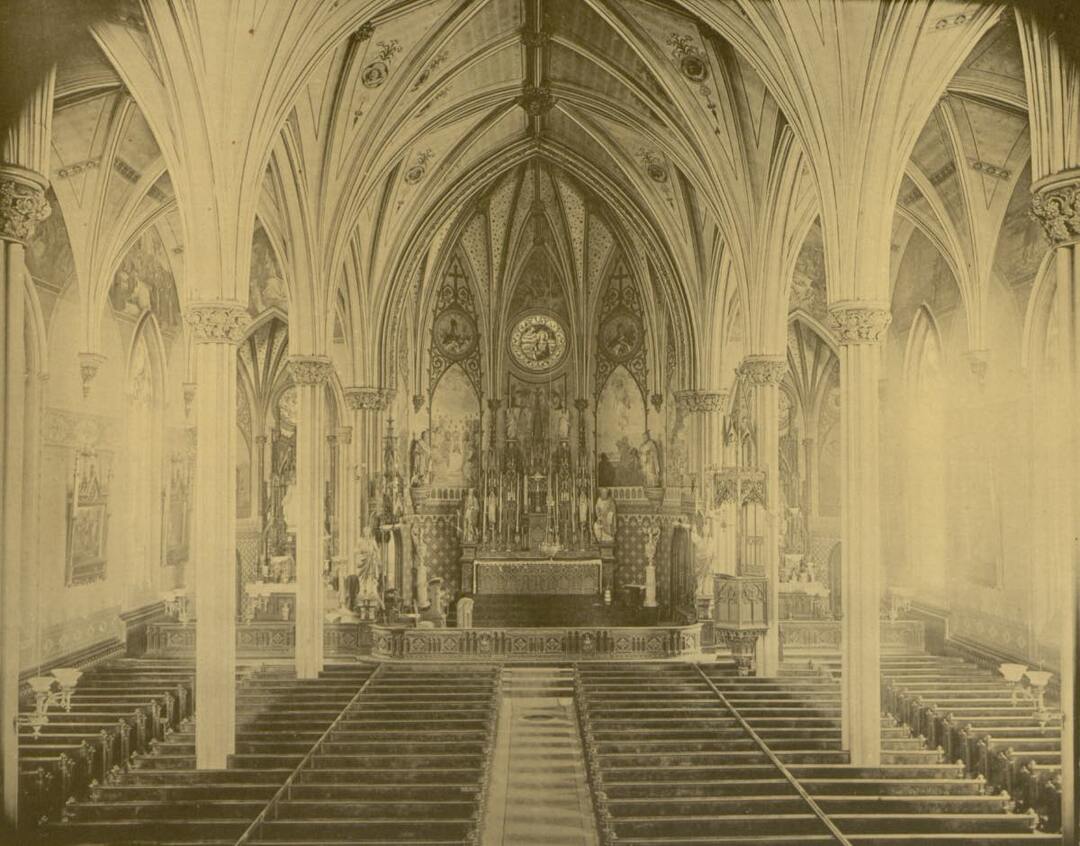
    <summary type="html"><![CDATA[<p><strong><em>Cleveland's cathedral was one of the diocese's first churches established upon its creation in 1847.  A series of renovations and expansions to the cathedral complex reflected the growth of Cleveland's Catholic community and diocesan responses to evolving guidance from the Vatican.</em></strong></p><img src="https://clevelandhistorical.org/files/fullsize/d9eebf4f2141f0d2db1152042c9f5820.jpg" alt="View of the Nave" /><br/><p>Amadeus Rappe was Cleveland's first Roman Catholic Bishop. He was born and ordained in France during the first half of the nineteenth century and recruited to serve in the United States in 1840 by Cincinnati, Ohio, Bishop John Purcell. He led the St. Francis DeSales parish in Toledo until 1847 when the Vatican created the Cleveland Diocese and appointed him Bishop. One of Bishop Rappe's first initiatives was to provide a 'downtown' church for the region's growing Catholic population and to initiate efforts to erect a Cathedral for the new diocese. He began both efforts simultaneously on land acquired by Father Peter McLaughlin, the pastor of Cleveland's existing Catholic parish, St. Mary of the Flats. The property is at the corner of Erie (East 9th) and Superior streets, Cleveland's eastern boundary at the time. A frame chapel, the Church of the Nativity, was consecrated on Christmas Day, 1848, while construction of the Cathedral of St. John the Evangelist was already begun on adjacent land facing Erie Street. During these early years, the Church of the Nativity would be utilized daily as a school, emphasizing the importance of Catholic education that Bishop Rappe  championed. </p><p>Construction of the Cathedral continued while the bishop sought funding in the United States and Europe to complete the project. The brick structure in ornamental Gothic style was designed by Patrick Keely, a noted Catholic church architect, and featured interior columns, delicate stained-glass windows, and a stucco finish. The handcut wood altar came from France. The exterior featured buttresses and pinnacles in the Gothic tradition. The Cathedral was consecrated on November 7, 1852, by Bishop Purcell of Cincinnati who praised the growth and ambition of the Cleveland Catholic community. Cleveland's cathedral also served as a parish for local residents with an appointed pastor. St. John's maintains that role today. </p><p>Schools for boys and girls were added, respectively, in 1857 and 1867 on the property and a separate residence facing Superior Avenue for the Bishop of Cleveland was added in the 1870s. Exterior and interior renovations commenced in 1874. A steeple and spire were added while sandstone facing was completed. By 1884 a thorough interior renovation which included stained-glass windows and black walnut furnishings in the sanctuary was completed and in 1888, a new Cathedral school was built. The boys were taught by the Brothers of Mary, while the Ursuline Sisters continued to educate the girls.</p><p>In 1927, the Cathedral was redecorated and the crypt was rmodified and rededicated to hold the relics of St. Christine and the remains of Cleveland's deceased bishops. Also, the high school division of the Cathedral school had been phased out, and the newly organized Sisters' College (later called St. John's College), for teacher preparation, moved into the school space in 1928.  </p><p>The Cathedral shared in one of the greatest events in the history of the Diocese when the Seventh National Eucharistic Congress was held in Cleveland in 1935. Thousands of people from throughout the United States and the around world came to Cleveland to adore and pledge their fidelity to Our Lord present in the Eucharist. </p><p>The Cathedral was again extensively refurbished and enlarged between 1946 and 1948 under the direction of Bishop Edward F. Hoban in celebration of its centennial. The firm of Stickle, Kelly and Stickle served as the architects with interior work by the local firm of John W. Winterich and Associates. The original brick exterior was replaced with Tennessee crab-orchard sandstone. The existing tower and transcepts were removed and a new tower constructed. Interior colored marbles and oak woodwork complemented the original decor. The newly rebuilt Cathedral was consecrated on September 4, 1948.</p><p>In 1977, yet another phase of Cathedral renovation began. In response to the mandates of the Second Vatican Council, the Cathedral's sanctuary was again redesigned and the main altar moved forward to the same location it occupied in the Cathedral of the 1850s. In 1988, six real bells for the Cathedral's tower were installed and rang for the first time on Christmas Eve. </p><p><em><strong><a href="https://clevelandhistorical.org/items/show/760">For more (including 7 images) view the original article</a></strong></em></p>]]></summary>
    <published>2016-03-24T19:54:43+00:00</published>
    <updated>2026-04-17T19:17:41+00:00</updated>
    <link rel="alternate" type="text/html" href="https://clevelandhistorical.org/items/show/760"/>
    <id>https://clevelandhistorical.org/items/show/760</id>
    <author>
      <name>Jim Lanese</name>
    </author>
  </entry>
  <entry>
    <title type="html"><![CDATA[Cathedral Latin School]]></title>
    <summary type="html"><![CDATA[<img src="https://clevelandhistorical.org/files/fullsize/c0333dca34fc4417c7f01de12e7c42ef.jpg" alt="Cathedral Latin School Postcard" /><br/><p>A growing Cleveland urban and east side community brought increased demand for Catholic educational opportunities for young men after the beginning of the twentieth century.  In 1916 Cleveland Bishop John Farrelly announced the creation of a new Catholic preparatory school for boys to be built at University Circle. Cathedral Latin School opened in the fall of 1916 in temporary quarters in Hitchcock Hall of Western Reserve University at 11105 Euclid Avenue while its permanent home was built on 107th Street between Euclid and Carnegie Avenues.  The new building's cornerstone was set in 1917 to initiate the Italian Renaissance design by Boston Architect E. T. Graham. The first eleven graduates commenced from the school in 1919 at the formal dedication of the new building. Hitchcock Hall stands today; Cathedral Latin does not.</p><p>Thirteen diocesan priests would staff the school for academic courses and five Marianist Brothers would teach the science and business courses. The Society of Mary (Marianist order) of priests and brothers was founded in Bordeaux, France and by 1849, the first Marianists arrived in New York City to pursue their mission of elementary and secondary teaching.  Cleveland Bishop Amadeus Rappe invited Marianists to Cleveland. When Cathedral Latin opened, the brothers withdrew from the parish schools in the city and staffed the new preparatory school. </p><p>Cathedral Latin's historian, Gene Gibbons characterized the state of Cleveland's public school system at the time Latin was founded as struggling with a largely immigrant, non-English speaking population to fit a "working class with cultural values compatible with the requirements of the modern factory." Further, the city's new inhabitants were mostly Catholic; Cleveland's Catholics numbered 60,000 in 1860 and over 440,000 in 1920. </p><p>Latin was modeled after Boston's Latin School and, combined with the Bishop's intent to build a cathedral on the site now occupied by Severance Hall, the school would serve a function for the cathedral community. Bishop Farrelly's plans were never completed following his untimely death in 1921.</p><p>Cathedral Latin prospered, nonetheless, and grew with enrollments and facilities. Residence halls for students and faculty were added as well as an annex to the building to accommodate more than 11,000 men from 1916 through the schools closing in 1979. Peak enrollments of 1200 men were reached in the mid 1960's. Throughout its history, Latin distinguished itself in academics, extra curricular programs, and athletics in the East Senate with Cleveland's public schools and several other Catholic high schools. The demand for parochial education saw the growth of Catholic schools in Cleveland and its suburbs expand in the early 1960's. Thirty-seven Catholic high schools met the demands of 21,000 students. However, in time, the expansion strategy would complicate the system. </p><p>By 1970, Latin's enrollment declined to just over 800 students as neighboring Doan's Corners block deteriorated with urban blight and parents grew wary of neighborhood issues. In 1975, a threatened closing of Cathedral Latin prompted a three week rally of resources including its strong alumni to support the program and manage its future. "Latin is here to Stay" announced a banner on the front of the school. A study to determine future strategies would keep the school open. The effort would only last four years as enrollments continued to fall to 300 students by the end of the decade. In February, 1979, the Marianist provinciate announced the closing of Cathedral Latin following a lengthy study of its current and future status and outlook. Several efforts were undertaken to save the school by the alumni association to reopen the school with a different administration. However, without diocesan support, the effort did not materialize.</p><p>The diocese promptly sold the buildings and land along the west side of East 107th street to the state/city/UCI in 1980. Corresponding actions to legally shut down and seize the Euclid Avenue strip of undesirable establishments owned by Winston Willis made way for a project suited to the desires of the University Circle master plan. In its space stands the former state-owned W.O. Walker Industrial Rehabilitation facility which was grossly underutilized to serve patients until it was jointly 'adopted' by the University Hospitals and the Cleveland Clinic Foundation in 1995.</p><p><em><strong><a href="https://clevelandhistorical.org/items/show/456">For more (including 7 images) view the original article</a></strong></em></p>]]></summary>
    <published>2012-05-10T22:12:35+00:00</published>
    <updated>2026-04-17T19:17:39+00:00</updated>
    <link rel="alternate" type="text/html" href="https://clevelandhistorical.org/items/show/456"/>
    <id>https://clevelandhistorical.org/items/show/456</id>
    <author>
      <name>Jim Lanese</name>
    </author>
  </entry>
  <entry>
    <title type="html"><![CDATA[Shrine Church of Saint Stanislaus: The Heart of Polish Cleveland]]></title>
    <summary type="html"><![CDATA[<img src="https://clevelandhistorical.org/files/fullsize/d5755e96417354d70492a27e3ba5c0c7.jpg" alt="St. Stanislaus Postcard" /><br/><p>The Shrine Church of Saint Stanislaus is dedicated to St. Stanislaus, the bishop, martyr, and patron of Poland. It represents the history of the Polish community in Cleveland, Ohio since the mid 1800s. Cleveland's Bishop asked the Pastor of St. Adalbert in Berea to 'gather and care' for the Poles in Cleveland and Newburg who were living in the Flats and worshiping at the abandoned St. Mary church. </p><p>By the 1870s, the community grew rapidly as Amasa Stone sought to solve a labor dispute by recruiting workers from Poland to staff his Newburg Rolling Mill. Community members soon built the first Saint Stanislaus church on its present site on East 65th Street in 1882. This structure was replaced in the 1890s with a large brick Gothic cruciform design with two magnificent spires. The spires were toppled in an April, 1909 tornado that killed seven people in the neighborhood. The interior of the church remained intact with nearly two dozen stained glass windows, several statues, frescoed walls, and plaster engravings. Forty rows of hand-rubbed red oak pews and a wood carved pulpit adorn the nave of the church.</p><p>The parish and schools grew to serve the Polish community with elementary and high school programs which included language and culture instruction. The high school program merged with three other Cleveland Catholic schools to form Cleveland Central Catholic in 1969. The school remains in operation today.</p><p>St. Stanislaus remains the center of the Polish community in greater Cleveland. It hosts many events celebrating new and old world Polish achievements. Most notably, Cardinal Karol Wojtyla, later to be Pope John Paul II, visited the church in 1969 to present relics of St. Stanislaus as a gift from Poland in thanks for Cleveland's consistent support. Solidarity leader Lech Walesa also visited in 2004. </p><p><em><strong><a href="https://clevelandhistorical.org/items/show/421">For more (including 9 images&#32;&amp;&#32;4 audio files) view the original article</a></strong></em></p>]]></summary>
    <published>2012-03-16T15:42:04+00:00</published>
    <updated>2026-04-17T19:17:39+00:00</updated>
    <link rel="alternate" type="text/html" href="https://clevelandhistorical.org/items/show/421"/>
    <id>https://clevelandhistorical.org/items/show/421</id>
    <author>
      <name>Jim Lanese&amp;#32;&amp;amp;&amp;#32;Ken Valore</name>
    </author>
  </entry>
  <entry>
    <title type="html"><![CDATA[Saint Patrick Catholic Church of West Park]]></title>
    <summary type="html"><![CDATA[<img src="https://clevelandhistorical.org/files/fullsize/d30ed5ad2f0068f693b06422491f6d3b.jpg" alt="The Oldest Parish" /><br/><p>Saint Patrick Catholic Church in Cleveland's West Park is one of the oldest parishes in the Cleveland Catholic Diocese. The parish was established in 1848 by Reverend Amadeus Rappe, the first bishop of Cleveland and the founder of St. Vincent Charity Hospital. The original parish included about thirty families, most of whom were of Irish descent but also included some German families. The first church was built in 1854 on the site of what is now the cemetery at the northeast corner of Rocky River Drive and Puritas Avenue. The first mass was celebrated in the current church on Christmas Day 1898. The original portion of the church, which still stands today, was expanded in 1953 to accommodate the growing parish.  </p><p>One of the unique components of the parish property – which includes the church, rectory, community center, gymnasium, and school buildings – is the cemetery. The cemetery, with a total of 211 plots, is the burial site of many early Rockport Township pioneers, the first being buried in 1861. At several times throughout the history of the cemetery, the City of Cleveland and the Cleveland Catholic Diocese have tried to have all or portions of the cemetery relocated. For instance, in 1949 the diocese wanted to move the cemetery to its own section of the new Holy Cross Cemetery on Brookpark Road, but parishioners insisted it stay on church grounds. Fortunately, this urban cemetery remains intact to this day.  </p><p>Throughout the years St. Patrick Church, which ultimately grew to over 1,100 families, served not only its parishioners, but also the entire West Park community. Outreach included sports programs open to all, fundraisers for police and fire fighter funds, and a space for Alcoholics Anonymous and other community meetings. The church also operated a hunger center for over 30 years which fed about 130 families a month and more around holidays.  </p><p>In May 2009, St. Patrick Church was ordered to close by Bishop Richard Lennon, and the parish was to merge with those of Ascension and Annunciation as part of the Cleveland Catholic Diocese downsizing. After several unsuccessful appeals to the diocese and the Vatican, the church ultimately closed. But, in the summer of 2011, hope for the future of the church was revived when the Vatican panel considering appeals – and investigating the conduct of the Cleveland Diocese – extended St. Patrick's appeal to March 2012. This final appeal was a success. St. Patrick once again opened their doors to the West Park community in July of 2012. </p><p><em><strong><a href="https://clevelandhistorical.org/items/show/375">For more (including 6 images) view the original article</a></strong></em></p>]]></summary>
    <published>2011-12-21T21:05:54+00:00</published>
    <updated>2026-04-17T19:17:38+00:00</updated>
    <link rel="alternate" type="text/html" href="https://clevelandhistorical.org/items/show/375"/>
    <id>https://clevelandhistorical.org/items/show/375</id>
    <author>
      <name>Tim Knapp</name>
    </author>
  </entry>
  <entry>
    <title type="html"><![CDATA[Saint Colman Catholic Church]]></title>
    <summary type="html"><![CDATA[<img src="https://clevelandhistorical.org/files/fullsize/saintcolman-clevelandstateuniveristy-clevelandmemory_brookins028-w65thandlorainintersection-nd_4a6232f0c9.jpg" alt="View From Intersection at W. 65th and Lorain Avenue" /><br/><p>St. Colman Catholic Church, located on West 65th Street near Lorain Avenue, was founded in 1880 as a response to the rapidly growing Irish immigrant population on Cleveland's West Side. Father Eugene M. O'Callaghan, former pastor of the predominately Irish St. Patrick's Catholic Church, held the first mass in a rented home off of Gordon Street (W 65th Street).  Later that year, the first church was constructed on Gordon Street and the home was converted into St. Colman School. With over 1,000 worshipers in 1883, the church was expanding in both its size and the role it played within the surrounding community. A new school was built on Gordon Street in 1885, and a convent was constructed for the Sisters of St. Joseph to begin their residency the following year.  By 1904, a larger three-level schoolhouse opened that included a 1,000 seat auditorium in the basement.</p><p>Taking four years to construct, St. Colman Catholic Church opened its doors in 1918. The classically styled structure could accommodate 2,800 people. St. Colman continued to expand, with a convent added in 1921, and both a second school and rectory constructed in 1930. The Church continued to act as the centerpiece of the neighborhood's Irish community until the middle of the century.</p><p>The West Side Irish community remained stable until the end of World War II. Soon after, however, the community dissolved as a result of the general exodus of Cleveland residents away from the urban core. In this changing environment, St. Colman Church evolved to meet the needs of an increasingly diverse and less prosperous community. With the 1904 school being closed and demolished in 1974, St. Colman opened one of the West Side's first preschools in its 1930 school building. Additionally, the church expanded its role ministering and providing social services to the outlying neighborhood through the development of a recovery program, literacy projects, an outreach ministry, and HUD-supported housing for senior citizens. </p><p>In an effort to downsize the Cleveland Catholic Diocese, Bishop Richard Lennon announced that St. Colman would merge with St. Stephen in March 2009. This order led to local grassroots efforts by the community to get Lennon to reconsider his decision. Rev. Bob Begin visited Lennon on two occasions to make the case for St. Colman. A flurry of appeal letters were sent to Lennon, arguing that the parish's social services had a tremendous impact on the urban poor, and that the church was financially stable. The works done by both Begin and St. Colman’s parishioners convinced Lennon to keep the church open.</p><p>However, not every church was spared closure. St. Emeric Church closed on June 30, 2010, leaving hundreds without a parish. Enter St. Colman; Rev. Begin collaborated with St. Emeric’s parishioner Eva Szabo, to hold monthly masses at St. Colman. Begin started learning Magyar, a Hungarian language, in order to prepare for St. Emeric’s churchgoers. He told the Plain Dealer, “I’ll learn to speak Hungarian enough to do the prayers.” The masses continued while Szabo and others continued to fight for their parish.</p><p>When Rev. Begin turned 75, he had to retire under church law. St. Colman’s parishioners disagreed, wishing Begin could stay longer. In their efforts, they submitted over 3,000 signatures and letters to Lennon to change his mind about Begin’s retirement. Lennon listened and offered to allow Begin to work for one more year, which Begin accepted. Begin officially retired in 2014, but continued to help and assist the church and those in need.</p><p><em><strong><a href="https://clevelandhistorical.org/items/show/185">For more (including 6 images&#32;&amp;&#32;2 audio files) view the original article</a></strong></em></p>]]></summary>
    <published>2011-03-17T04:42:38+00:00</published>
    <updated>2026-04-17T19:17:37+00:00</updated>
    <link rel="alternate" type="text/html" href="https://clevelandhistorical.org/items/show/185"/>
    <id>https://clevelandhistorical.org/items/show/185</id>
    <author>
      <name>Richard Raponi&amp;#32;&amp;amp;&amp;#32;Katherine Gerchak</name>
    </author>
  </entry>
  <entry>
    <title type="html"><![CDATA[Saint Ignatius High School]]></title>
    <summary type="html"><![CDATA[<img src="https://clevelandhistorical.org/files/fullsize/ignatius-circa1890low_dc44d019fe.jpg" alt="St. Ignatius, circa 1890s" /><br/><p>Cleveland's Catholic schoolchildren began attending parochial schools in their neighborhoods during the 1850s, opting to avoid the public school system which many saw as being anti-Catholic.  These first Catholic schools were merely grammar schools, however, and did not offer advanced education. Cleveland's Catholic population continued to grow in the last quarter of the 19th-century with an influx of Catholic immigrants from southern and eastern Europe joining the Irish and Germans already in town. Recognizing the growing need for better and more extensive Catholic education in the city, Bishop Richard Gilmour invited a group of Jesuits priests from Buffalo to start a Catholic college on the city's near west side.</p><p>St. Ignatius College opened with 76 students in 1886 in a wood-framed building at West 30th Street and Carroll Avenue. Its five-story brick main building (which remains standing today) did not open until 1890. Initially, St. Ignatius offered a seven year course of study which ended with the granting of a Bachelor of Arts degree.  A 1905 book on education in Cleveland explained that a student at the college could expect to take courses on "Christian doctrine, the Latin, Greek, and English languages; rhetoric, poetry, elocution, and English literature; mathematics, physics, and chemistry; history and geography; bookkeeping and penmanship."  The seventh year of instruction was dedicated exclusively to the study of philosophy. </p><p>In 1902, the high school and college became separate entities, resulting in a more modern arrangement.  In 1935 the college, which switched its name to John Carroll University in 1923, moved to its own campus in suburban University Heights.  St. Ignatius High School remained in Ohio City and has since expanded outward from its original building, with its campus now clustered along both sides of Lorain Avenue between West 28th and West 32nd Streets.  It is known for its excellent academics, championship-winning sports teams, and community service within Ohio City.  </p><p><em><strong><a href="https://clevelandhistorical.org/items/show/157">For more (including 6 images&#32;&amp;&#32;1 video) view the original article</a></strong></em></p>]]></summary>
    <published>2011-03-08T08:50:44+00:00</published>
    <updated>2026-04-17T19:17:37+00:00</updated>
    <link rel="alternate" type="text/html" href="https://clevelandhistorical.org/items/show/157"/>
    <id>https://clevelandhistorical.org/items/show/157</id>
    <author>
      <name>Mark Pecot</name>
    </author>
  </entry>
</feed>