<?xml version="1.0" encoding="UTF-8"?>
<feed xmlns="http://www.w3.org/2005/Atom">
  <title type="text">Cleveland Historical</title>
  <updated>2026-04-17T14:00:41+00:00</updated>
  <generator uri="http://framework.zend.com" version="1.12.20">Zend_Feed_Writer</generator>
  <link rel="alternate" type="text/html" href="https://clevelandhistorical.org/"/>
  <link rel="self" type="application/atom+xml" href="https://clevelandhistorical.org/items/browse?output=rss2"/>
  <id>https://clevelandhistorical.org/</id>
  <author>
    <name>Cleveland Historical</name>
    <uri>https://clevelandhistorical.org</uri>
  </author>
  <link rel="hub" href="http://pubsubhubbub.appspot.com/"/>
  <entry>
    <title type="html"><![CDATA[St. Mary Cemetery: Cleveland&#039;s First West Side Catholic Cemetery]]></title>
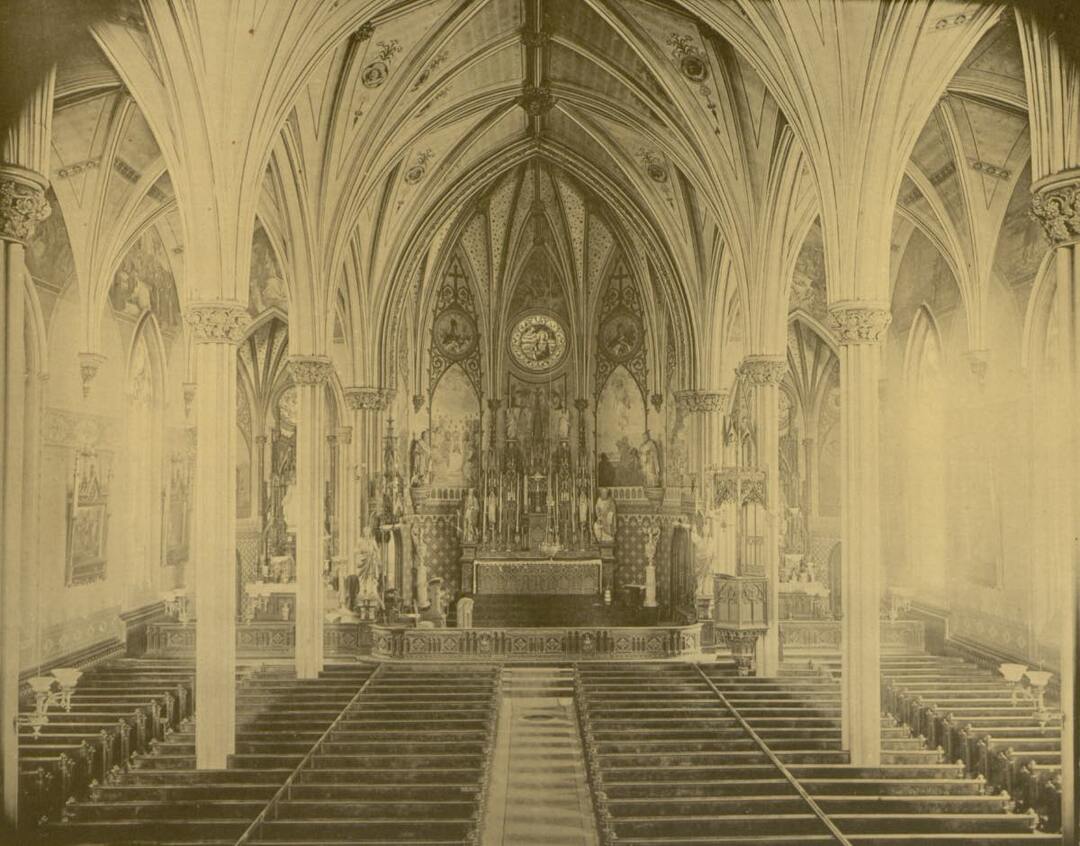
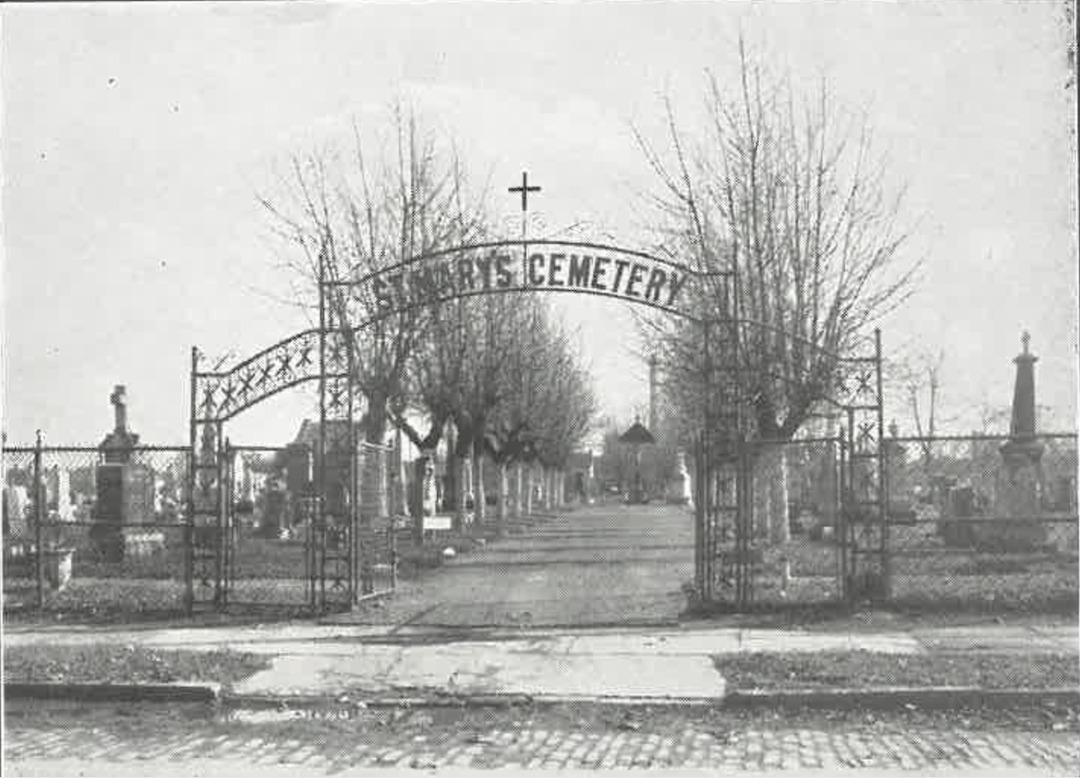
    <summary type="html"><![CDATA[<p><strong><em>St. Mary Cemetery lies in the middle of one of the most densely populated residential areas on Cleveland's west side. Its nine acres of land, dotted with shade trees and beautiful grave stones, is surrounded by a fence, and, at its West 41st Street entrance, a posted sign advises visitors of its visiting hours.  However, neither this entrance nor its other on West 38th is gated. This being the case, St. Mary's almost beckons to neighbors and any other passersby to  visit it at any time, day or night, enjoy its grassy grounds, walk its pretty paths, and, most importantly, respect its magnificent  monuments.</em></strong></p><img src="https://clevelandhistorical.org/files/fullsize/1cc9a1a467673d53392c76e36c48e8e6.jpg" alt="The once ornate West 41st Street entranceway to St. Mary Cemetery." /><br/><p>In 1853, just one year before Ohio City was annexed to the City of Cleveland, thus becoming Cleveland's west side, prolific nineteenth-century real estate developer Hiram Stone platted a new residential subdivision south of Ohio City in Brooklyn Township. He called it "H. Stone's Addition to Ohio City & Cleveland," a remarkably prescient title at the time. The new subdivision stretched west from Pearl (West 25th) Street all the way to Gauge (West 44th) Street, and from Clark Avenue north to <a href="https://clevelandhistorical.org/items/show/659">Walworth Run</a> at Ohio City's southern boundary. </p><p>The platted area contained almost 700 lots for residential houses, but left undeveloped in its midst were thirteen acres located just east of Burton (West 41st) Street and north of Clark Avenue. In 1861, as houses were going up in Stone's subdivision—many of them for German immigrants who were pouring into Cleveland in this period in large numbers—the southernmost six acres of the undeveloped thirteen in the middle of the subdivision were purchased by the Catholic Diocese of Cleveland for, according to the deed of purchase, "cemetery purposes for the benefit of German Catholics on the west side of the Cuyahoga River." </p><p>Many of the early records of St. Mary Cemetery appear to have been destroyed in a fire, making research of the early years of the cemetery difficult.  However, secondary sources tell us that St. Mary Cemetery was established on those six acres of land in 1862 by St. Mary of the Assumption parish, Cleveland's first west side German Catholic parish. The property for St. Mary Cemetery was purchased during the pastorship of Father F. X. Obermueller, a German immigrant, but it appears that it was under a subsequent pastor, Father Stephen Falk, a Swiss immigrant who served the parish from 1862 to 1880, that the cemetery grounds were developed and consecrated. In St. Mary Cemetery's early years, it was often referred to as Burton Street Cemetery, after the street upon which it fronted. That street, in turn, had been named after <a href="https://clevelandhistorical.org/items/show/660">William Burton</a>, an Ohio City pioneer whose summer cottage was built on the street in 1839 and still stands directly across from St. Mary Cemetery.  </p><p>Just a few years after St. Mary Cemetery opened, another German Catholic parish, <a href="https://clevelandhistorical.org/items/show/649">St. Stephen</a>, was established on Cleveland's west side. It began in 1869 as a mission of St. Mary of the Assumption for German Catholics living west of Gauge (West 44th) Street. A decade later, in 1881, another parish, <a href="https://clevelandhistorical.org/items/show/717">St. Michael Archangel</a>, was also founded as a mission of St. Mary's for German Catholics living on Cleveland's southwest side. In the years that followed, German Catholics who belonged to either St. Mary of the Assumption, St. Stephen or St. Michael's parishes were permitted to be buried at St. Mary Cemetery which, by this date, had now become part of Cleveland's west side following the 1867 annexation of an area of Brooklyn Township that included the lands upon which the cemetery was located.</p><p>It is interesting to note that no Cleveland newspaper mentioned St. Mary Cemetery during the first decade of its existence. The first to mention the cemetery, albeit obscurely, was the Plain Dealer on May 30, 1871, when it published an article which noted that, on Decoration Day, Father Falk of St. Mary's German church had, at the west side "Catholic cemetery," decorated the graves of "J. Mayer, J. Schneider, F. Werz, A. Klein, K. Mecil, B. Lais, F. Schwonger, S. Vochatger, C. A. Schmidt, and Jas. Macklin." All of these men presumably were German Catholics who had fought for the Union—and for which some had died—in America's Civil War. Cleveland city directories were even slower in acknowledging the existence of the new cemetery. St. Mary Cemetery was not listed in any Cleveland directory until 1874.</p><p>Thousands of German immigrants and descendants of German immigrants were buried at St. Mary Cemetery in the years that followed its establishment, many of them beneath beautiful gravestones inscribed in the German language. A number of these gravestones are memorials to notable German Catholics who, in the second half of the nineteenth century, operated successful retail businesses on Lorain Avenue near Fulton Road, an intersection that soon became known as <a href="https://clevelandhistorical.org/items/show/966">Lorain-Fulton Square</a>. A number of those gravestones honor members of the related Fridrich and Schmitt families who operated several different businesses in that west side commercial district, including <a href="https://clevelandhistorical.org/items/show/964">Fridrich Bicycle</a>, one of the oldest retail bicycle shops in the United States until it closed its doors in 2024. </p><p>Another example of a notable German immigrant businessman buried at St. Mary Cemetery is Friedlin "Freddie" Hirz (1843-1903), a tailor who for years had a shop on Lorain Avenue, just west of what is today West 45th Street. His shop was so well known that it was featured in the 1874 Atlas of Cuyahoga County. Another is Edward Disler, a German immigrant and jeweler who successfully operated a store on Lorain Avenue near West 25th Street for many years.</p><p>While St. Mary Cemetery was explicitly founded for German Catholic burials, Catholics of other ethnicities were later given permission to bury their dead there too. The first of these were Bohemian Catholics many of whom lived near the cemetery in a west side neighborhood that was known in the second half of the nineteenth century as the <a href="https://clevelandhistorical.org/items/show/646">Isle of Cuba</a>. The early-arriving immigrants likely first worshiped with German Catholics at either St. Mary of the Assumption or St. Stephen, but, by 1872, their numbers were sufficiently large that the Bishop permitted them to form a parish of their own, which they called <a href="https://clevelandhistorical.org/items/show/661">St. Procop</a>, after Bohemia's patron saint. Their first church was built on Burton Street, just south of St. Mary Cemetery in 1874. One of the earliest verifiable burials of a Bohemian Catholic at St. Mary Cemetery occurred in 1892, when 41-year- old Miloslav Holecek, a Cleveland grocer and immigrant from <span>Karlova Huť in Central Bohemia</span>, died and was buried there. His gravestone, as well as those for a number of other Bohemian immigrants buried at St. Mary's, is inscribed entirely in the Czech language.</p><p>In the early years of the twentieth century, Catholic immigrants of other ethnic groups from Central Europe who often tended to settle in urban areas where Germans and/or Bohemians had first settled, including Hungarians, Poles, and Slovaks, became members of the west side German and Bohemian Catholic parishes, and when they died, they were permitted to be buried at St. Mary Cemetery too. Their gravestones were often inscribed in their native languages.</p><p>In 1917, Father Casimer Reichlin, the first pastor of St. Stephen who had served for an incredible 47 years, died.  By this time, there appears to have already been a large circular section near the West 41st Street entrance to St. Mary Cemetery, in the center of which a large cross had been erected. It further appears that it was decided that this beloved pastor should be buried in that section, with a large sculpted monument erected over his grave. Four years later, Father Reichlin's long-time friend and fellow priest, Bishop Joseph Koudelka, who had been a pastor at both St. Procop and St. Michael, died and was buried next to Father Reichlin's grave in the circular section. A similarly sized sculpted monument was placed over his grave too. Soon this circular section of St. Mary Cemetery became known as the Priests Circle. In the years that followed, other notable local priests who had served west side Catholic parishes were accorded the same honor and buried in the Priests Circle, some below large monuments and others below simple flat grave markers. As of October 2025, there were eleven priests buried in the Priests Circle. Father Stephen Falk, whose efforts led to the development of the cemetery and its consecration in 1862, is not buried in the Circle, as he died in 1899 long before the Priests Circle was initiated. A simple flat grave marker in Father Falk's memory, which apparently replaced a more elaborate earlier monument, is located in another section of St. Mary Cemetery.</p><p>By the early 1920s, there were few available burial plots left at St. Mary Cemetery. The parish of St. Mary of the Assumption decided to remedy this by expanding the cemetery's lands, and in 1927 and 1928 it successfully purchased three additional acres of land for the cemetery that abutted the eastern end of the original cemetery grounds.  The additional acres had earlier been developed as residential lots in H. Stone's Additional Subdivision. Houses on the lots were either torn down or moved, and the cemetery grounds were successfully extended all the way to West 38th Street. Along with the additional land, St. Mary Cemetery was further enhanced at this time with a second entrance on West 38th Street and a new walking path that led from that entrance directly to a new circular section in the cemetery.</p><p>On November 15, 1931, the new addition to St. Mary Cemetery was consecrated at a ceremony attended by a representative of Bishop Joseph Schrembs.  Some five years later, on May 17, 1936, the Cuyahoga County Council of the Veterans of Foreign Wars placed a flagpole and a memorial plaque in the center of the new circular section, the plaque inscribed: "Dedicated To The Veterans Who Served . . . Lived . . . Died . . . for their Country."  </p><p>As previously noted, St. Mary Cemetery had long held the graves of a number of German Catholic soldiers who fought and died in the Civil War, and also likely holds graves of soldiers and veterans who had fought in the Spanish-American War and/or in World War I. No veterans from any of these war, however, are buried in this new circular section. The first soldier buried in what became known as the Soldiers Circle, was Charles L. Andrews, a U. S. Navy radio operator who was killed on Easter Sunday, April 5, 1942, during the Battle of Bataan in the Philippine Islands. The remains of sixteen other soldiers or veterans who served in World War II were also buried in the Circle between 1942 and 1948.</p><p>In 1945, as a result of dwindling attendance numbers, St. Mary of the Assumption parish was dissolved and, in 1948, the management, care and maintenance of St. Mary Cemetery was transferred to the Calvary Cemetery Association, an organization which was later renamed the Catholic Cemeteries Association of the Cleveland Diocese. By the early 1950s, the last of the available lots in the cemetery were purchased, and, by 1976, according to a January 21, 1976 Plain Dealer article, the number of annual burials at St. Mary Cemetery had dropped to just fifty.  Today, in 2025, the annual numbers appear to be considerably less. According to findagrave.com—a website at which volunteers create memorials for people whose remains have been buried in cemeteries all around the world—the remains of only nine deceased persons have been buried at St. Mary Cemetery since 2020.  </p><p>St. Mary Cemetery is no longer the active burial place for west side Catholics that it once was. Burials are now few and far between. The cemetery's elaborate gate that once stood at its West 41st Street entrance in 1929 is gone. The sacred monuments to Father Reichlin, Bishop Koudelka and Father Falk have been substantially damaged, likely by vandals. The cross in the middle of the Priests Circle, which stood there for years until recently, is now gone. Acts of vandalism, as noted in a number of Plain Dealer and Press articles over the years, and the effects of exposure of the cemetery's monuments to Cleveland's weather over long periods of time, have left many monuments damaged and unreadable while many others have simply vanished. Still, St. Mary Cemetery remains one of the most historic cemeteries on Cleveland's west side and one which should be visited, respected, and carefully managed and maintained, not only for the descendants whose ancestors are buried there, but also for all Clevelanders who see value in preserving an important piece of their city's history.</p><p><em><strong><a href="https://clevelandhistorical.org/items/show/1072">For more (including 15 images) view the original article</a></strong></em></p>]]></summary>
    <published>2025-11-23T16:18:32+00:00</published>
    <updated>2026-03-04T21:32:06+00:00</updated>
    <link rel="alternate" type="text/html" href="https://clevelandhistorical.org/items/show/1072"/>
    <id>https://clevelandhistorical.org/items/show/1072</id>
    <author>
      <name>Jim Dubelko</name>
    </author>
  </entry>
  <entry>
    <title type="html"><![CDATA[Saint Patrick on Bridge Avenue: A Memorial to Cleveland&#039;s Irish Immigrants]]></title>
    <summary type="html"><![CDATA[<p><strong><em>In 1903, when William A. Manning wrote his "History of St. Patrick's Parish," the first generation of Irish Catholics who founded St. Patrick parish in 1853 was already slowly beginning to disappear. Manning urged his readers to remember them, not just for the grand church and other buildings they had erected on the parish campus, but just as importantly for the strong and caring community they had created on Cleveland's Near West Side.</em></strong></p><img src="https://clevelandhistorical.org/files/fullsize/e28f264aefdd05e6861aff8d02f74ab6.jpg" alt="St. Patrick Church" /><br/><p>Up until 1852, there was only one Catholic church in Cleveland. It was Our Lady of the Lake—better known as St. Mary of the Flats—located at <a href="https://clevelandhistorical.org/items/show/767">Cleveland Centre</a>. That changed when the Cathedral of St. John the Evangelist on Erie (East Ninth) Street was dedicated and opened for services that year, providing Catholics living east of the Cuyahoga River with a neighborhood church. And that, in turn, gave rise to requests by Irish and German Catholics living in Ohio City—which would soon become Cleveland's West Side—for parishes and churches of their own. Bishop Amadeus Rappe, Cleveland's first Catholic bishop, responded to the German Catholics by granting them permission to form a new parish called St. Mary of the Assumption and giving them temporary possession of St. Mary of the Flats church, pending construction of a church of their own on the southwest corner of Carroll and Jersey (West 30th) Streets, which was completed and dedicated in 1865.   </p><p>The Bishop also gave permission to the Irish Catholics living in Ohio City to form a parish of their own, which they named St. Patrick after their patron saint. In 1853, Rappe appointed Father James Conlan, his vicar general and an immigrant from Ireland, to be the first pastor of the new parish and authorized the parish to build a church on a lot on the south side of Merchant (later, Whitman) Street, between Woodbine and Kentucky (West 38th). It took four years to build and dedicate that church—a small brick Gothic-style building—though services were held in it, according to several sources, as early as Christmas of 1853.  </p><p>The new St. Patrick parish also soon made arrangements for the parochial education of its children. Initially, school-aged boys were taught in a temporary classroom within the nave of the church on Whitman and girls in another diocese-owned building on Franklin Circle where the Franklin Circle Christian Church stands today. More permanent arrangements were made in 1863 when a two-story brick building that held classrooms for boys on the second floor and girls on the first was erected on the lot on Whitman immediately to the west of the church. Two years later, a second two-story brick school building was built on Whitman on the lot immediately to the east of the church. When opened, this second building became the school for girls of the parish, and the building to the west now became exclusively the boys' school.  </p><p>The church and two school buildings on Whitman constituted the entirety of the St. Patrick parish campus on June 15, 1870, when 23-year-old Western Union telegraph operator William A. Manning married Mary Devine, a West Sider and second generation Irish-American, in that church. Manning's parents were Irish, but they had moved to Scotland where he was born in 1847. The family then immigrated to the United States in 1849, living first on the East Coast, before continuing west and eventually settling on Cleveland's East Side. They resided in rental properties until 1867 when Manning's parents purchased a house on Oregon Street (today, Rockwell Avenue) between Dodge (East 17th) and North Perry (East 21st) Streets. After he married, William Manning moved from his family's house on the East Side to the West Side and, in the process, became a member of St. Patrick's parish.    </p><p>The year 1870 was an important one for St. Patrick parish too. As a result of a large population increase on Cleveland's West Side in the decades of the 1850s and 1860s—much of it consisting of Irish Catholics—the parish church on Whitman had become too small to serve the parish. The Cleveland Diocese had addressed this population increase by consenting to the formation of two new West Side Irish Catholic parishes, St. Augustine parish on the South Side in 1860 and St. Malachi on the West Side in 1865. However, despite the formation of these new parishes, membership in St. Patrick parish continued to grow and the parish, still led by its first pastor Father Conlan, and with diocese approval, decided to build a new and larger church. Several lots or parts of lots were purchased on Bridge Street (Avenue), immediately south of the church on Whitman, and, by late summer of 1870, construction was begun on the new church—the one which still stands today on Bridge Avenue.</p><p>The original design of the new St. Patrick's church on Bridge Avenue was created by Samuel Lane of the Cleveland architectural firm of Koehler and Lane. However, in the early years of the project, architect Alfred Green superintended the building of the church. As a result of the Panic of 1872 and ongoing parish financing challenges, it took some 60 years to complete the construction of the church, although enough was finished by 1877 to allow services to be held in the church and enough additional work was completed by 1882 to permit it to be dedicated. Over the course of the years that followed, other architects weighed in and, at times, modified Lane's original design.  </p><p>That design, according to a <em>Plain Dealer</em> article on August 21, 1871, was for a Gothic-style church built with an exterior facade composed of two types of stone—in this case, sandstone and limestone—arranged in a manner known, according to architectural historian Tim Barrett, as polychromatic structuring. The building was to be 132 feet long and 67 feet wide, "exclusive of buttresses and sacristy," which were to be constructed "on the outside of the church." The walls of the church were to be 43 feet high "from table to wall plate, ninety-three from floor to ridge, and 230 feet from street line to top of spire." The interior of the church was "to have a highly enriched grained ceiling, and a main and two side aisles." The plan also called for an "elaborate stained and figured glass window at the back of the altar . . . which [was] to be one of the principal features in the sanctuary." The new church was expected to have a seating capacity for at least twelve hundred persons, which was more than double the seating capacity of the church on Whitman. </p><p>During the foregoing early period of the church's construction, the parish also added other buildings to the parish campus, including a residence on Whitman in 1873 for the Marianist Brothers who taught at St. Patrick's boys school and, in 1878, a parsonage or rectory, west of the new church on Bridge, for the parish priests. In 1890, St. Patrick parish turned its attention to its school buildings which had become overcrowded as the population of the parish continued to grow in this period. In that year, the old church and the two school buildings on Whitman were razed and, in their place, a large three-story school building was erected in 1891 which featured a parish hall on its third floor with seating capacity for 1,200 persons. At the time, as reported in the November 24, 1891 edition of the <em>Catholic Observer</em>, it was reputed to be the largest school building in the United States. According to a 1898 Diocese report, there were more than 900 students attending the school in that year. </p><p>With residences for the parish priests and Marianist brothers acquired, and the new school building on Whitman completed, parish attention turned once again to the uncompleted "new" church on Bridge. In the latter half of the 1890s, a number of improvements were made to the church in preparation for the 1903 celebration of the golden jubilee of the parish. In 1896, during the pastorship of Father James O'Leary, the interior of the church was frescoed; new windows, doors, altars, statues, and carpeting were added; and other various interior improvements made. Three years later, a new organ was installed in the interior of the church and chimes with eleven bells in the church tower. In 1903, during the tenure of new pastor Francis Moran, the tower of the church was finally completed, not with a steeple as contemplated by architect Samuel Lane in his original design, but instead with a pinnacled crown designed by Akron architect William P. Ginther. </p><p>In that golden jubilee year of 1903, William Manning, who had moved in 1897 from the Near West Side to the new streetcar suburb of Lakewood and in 1900 had become a founding member of St. Rose of Lima parish, returned to St. Patrick's to write a history of the first fifty years of the parish. Over the course of the nearly three decades in which he had been a member of St. Patrick's parish, he had been one of its most active members, had held a seat on the parish council for two decades, and, according to pastor Moran, had "charge of financial accounts and prepared the annual report." Manning had been acquainted with every pastor of the parish up to that date, and, as he noted in his history of the parish, was able to call upon a number of the older parishioners to fill in the gaps where his personal knowledge was not sufficient. If, as likely was the case, he had taken the streetcar back to St. Patrick while his history was a work in progress and stood on Bridge Avenue in front of the church to admire the pinnacled crown recently added to its tower, he would have seen nearly the same exterior as anyone who stands before it today—except the pinnacles he would have seen atop the crown are now gone. They were removed years ago when they began to crumble and fall, creating a safety hazard for pedestrians below.   </p><p>When he wrote his parish history, William Manning was very aware, as the lede to this story reveals, that many changes had come to the parish and its campus since its founding in 1853. And there were more to come, a good number of which Manning likely witnessed, as he lived for another 34 years, before dying in 1937 at the age of 90. In 1913, the parish built a 55-foot addition to the rear of the church designed by architect Edwin J. Schneider and within which a sacristy was added and the sanctuary and nave of the church enlarged. In 1931, the old wooden altars in the church were replaced with marble ones, a new pulpit was installed and the interior freshly repainted, leading to the consecration of the church on St. Patrick's Day of that year, an event 83-year-old William Manning would have almost certainly attended, health permitting.    </p><p>Another change to St. Patrick—the beginnings of which William Manning may have witnessed—was the thinning of the Irish population of the parish, which, according to <em>Plain Dealer</em> newspaper articles, may have begun as early as the 1930s. Irish Americans like Manning had been moving west to suburbs like West Cleveland (1871-1894), Lakewood, and others since the 1870s, leading to the creation of new Irish parishes, such as St. Colman on Gordon (West 65th) Street (1880) and St. Rose of Lima near the Cleveland-Lakewood border (1897). However, it is likely that it was the increased movement to the suburbs in the mid-20th century stimulated by the development of the interstate highway system and the post–World War II influx of Appalachian and Puerto Rican migrants to Cleveland's Near West Side that dramatically changed the ethnic composition of the parish. Moreover, in 1945, St. Mary of the Assumption church—located less than a quarter of a mile from St. Patrick's—became a chapel on the St. Ignatius High School campus when its parish apparently dissolved.  While some of its parishioners likely transferred to St. Stephen or St. Michael parish, both also historic German Catholic parishes in Cleveland, a number may have preferred to join St. Patrick parish, because its church was much closer, thereby also contributing to the thinning of the Irish membership there. (The ending of St. Mary parish also had another effect on St. Patrick's parish. Jesuit priests who previously had ministered to St. Mary's parish were reassigned. Included was Father Francis Callan who became pastor of St. Patrick's, and, for the next 35 years, Jesuit priests led the historic Irish parish.)  </p><p>By 1971, when St. Patrick parish celebrated the 100th anniversary of the laying of the cornerstone of the church on Bridge Avenue, it was noted in a March 16, 1971 <em>Plain Dealer</em> article that there were only a few "patches" of Irish left in the parish and that the parish was now one of many different ethnicities, with fifteen percent of it speaking Spanish as a first language. In the 1980s, as Jesuit priests departed and diocesan priests returned to St. Patrick parish, the new pastor, Mark DiNardo, along with co-pastor Edward Camille, became the first diocesan priests in the history of the parish to not have Irish surnames. In 1985, Father DiNardo, sole pastor of St. Patrick parish after the reassignment of Father Camille in 1983, initiated a series of outreach programs, designed to help the inner-city homeless and poor. While Father DiNardo retired in 2017 after serving the parish as its pastor for 37 years, the programs, which include a Hunger Center, Charity of the Month, and Project Afford, have continued.  </p><p>If William A. Manning were alive today to take a tour of the current St. Patrick parish campus, he would note with approval that many of the buildings that existed on the campus when he last visited are still standing, and he would likely be very sorry to hear that the grand school building on Whitman is not. It was razed by the parish in 1978, leading <em>Plain Dealer</em> columnist George Condon, an Irish-American, to advocate for the preservation of St. Patrick church as a "memorial to Irish immigrants." Manning might be most interested, however, to learn about the parish outreach programs and whether the parish had, over the years, reduced poverty, illness, and homelessness, and fostered a greater sense of community, in the Ohio City neighborhood, a feat that he believed the Irish immigrants who founded St. Patrick parish in 1853 had in their day achieved.</p><p><em><strong><a href="https://clevelandhistorical.org/items/show/1007">For more (including 19 images) view the original article</a></strong></em></p>]]></summary>
    <published>2023-11-14T23:07:42+00:00</published>
    <updated>2026-03-04T21:32:05+00:00</updated>
    <link rel="alternate" type="text/html" href="https://clevelandhistorical.org/items/show/1007"/>
    <id>https://clevelandhistorical.org/items/show/1007</id>
    <author>
      <name>Jim Dubelko</name>
    </author>
  </entry>
  <entry>
    <title type="html"><![CDATA[Ukrainian Village: Suburban Heir of a Tremont Legacy]]></title>
    <summary type="html"><![CDATA[<img src="https://clevelandhistorical.org/files/fullsize/1e3d7fa8fe82aa3e7087cadc08140c50.jpg" alt="Ukrainian Village Sign" /><br/><p>When you leave Cleveland for the suburbs, perhaps the last thing you expect to find is a slice of another country nestled along the streets. In 2009, the suburban municipality of Parma to the southwest of Cleveland officially recognized its long-standing settlement of Ukrainians, giving them a "village" of their own. Ukrainian Village, located along a two-mile stretch of State Road, had been the vision of Ukrainian Americans since the 1940s. The rise of suburbs began to push them out of their original enclave in Cleveland’s Tremont neighborhood, setting the stage for the emergence of the vibrant community that is present today.  </p><p>In the late nineteenth century, immigrants of all walks of life arrived in Cleveland because of many different factors. Ukrainians were escaping political and economic hardships by coming to the United States, looking for work in any shape they could find. Ordinarily, they took up various jobs in Cleveland’s thriving industrial plants and mills. These jobs helped them to save money to send back to their relatives in the “old country.” They ended up establishing cultural and religious centers that have changed over time yet still stand as strong symbols of Ukrainian pride.   </p><p>Ukrainian settlement in Cleveland began in Tremont. The community began to put down roots in order to keep their memories and customs from home alive. The first of these Ukrainian institutions was the Saints Peter and Paul Ukrainian Church, built in 1910 on West 7th Street. Shortly after, St. Vladimir Church was also established in Tremont. The first few years of worship took place at Craftman’s Hall on West 14th Street.  In 1933 the congregation's original church building was dedicated. It still stands on West 11th Street but it is now the Spanish Assembly of God Church. In 1967, the St. Vladimir Ukrainian Orthodox Cathedral in Parma was opened for worship. Its shift from Tremont to Parma reflected the trend of people moving to the suburbs after an influx of immigration, pushed by the Holodomor (famine) of the 1930s, German occupation of the Ukraine during World War II, and displacement under Stalinist rule in the Cold War era. </p><p>Churches like St. Vladimir’s were the anchor of the Ukrainian community. Not only did they provide a sense of community in a new and strange country, they also kept the cultural of the old country alive. One of the many new organizations was the Ridna Shkola, a school teaching heritage, language, and customs to the youth of the community. Today, classes are held at St. Josaphat Cathedral on State Road.  </p><p>Churches are not the only anchors of Ukrainian culture in the Ukrainian Village today. Many shops, such as Lviv International Foods and State Meats, offer a taste of the ethnic fare unique to many people. These places, among others, serve as the backbone of the Ukrainian community. In 2007, the board of trustees from St. Vladimir’s Church asked the city of Parma to hang decorative banners and to dub State Road Ukrainian Village. First, however, much work had to be done, including landscaping, restoring storefronts, and placing banners and murals to signify the village’s presence. The vision came to life only a year and five months after work began. Ukrainian Village was officially dedicated on September 19, 2009, and was celebrated with a festival, religious services, and a parade.  </p><p>The lasting legacy of the Ukrainian immigrants can be viewed not only through Ukrainian Village, but also in Tremont where some of the original settlements still stand. These institutions, regardless of their locations, stand for the progress of a people and the achievements they have made.  </p><p><em><strong><a href="https://clevelandhistorical.org/items/show/863">For more (including 12 images) view the original article</a></strong></em></p>]]></summary>
    <published>2019-01-23T01:06:06+00:00</published>
    <updated>2026-03-04T21:32:04+00:00</updated>
    <link rel="alternate" type="text/html" href="https://clevelandhistorical.org/items/show/863"/>
    <id>https://clevelandhistorical.org/items/show/863</id>
    <author>
      <name>Olivia Garl</name>
    </author>
  </entry>
  <entry>
    <title type="html"><![CDATA[Saint Agnes Church: From the Devoted Few]]></title>
    <summary type="html"><![CDATA[<img src="https://clevelandhistorical.org/files/fullsize/4a3e6a2e69506f42f0b997b0a4c917bd.jpg" alt="St. Agnes shown from the East" /><br/><p>Soaring above a surfeit of drugstores, convenient marts and fast-food eateries a bell tower stands. The tower looms above the modern conveniences on Euclid Avenue, as testament to a different time. The tower once belonged to the parish of St. Agnes, and although the church has since been demolished, the tower remains on Euclid Avenue. The St. Agnes tower prevails as a reminder of an era when the church was the center of the community. </p><p>In 1893 a group of Catholic women approached the Bishop, Ignatius Frederick Horstmann, and explained the necessity for an English-speaking parish on the east side of Cleveland. Until these women took the initiative, the only English-speaking parishes on the east side were St. Edwards and Immaculate Conception. The others represented a roster of mostly central and eastern European ethnicities who masses were conducted in other languages. The Diocese of Cleveland conducted a survey that accounted for the number of Catholics that resided in the territory. The results indicated the need to restructure parish boundaries. The small, but zealous band of Catholic women received their desired parish. </p><p>The construction of St. Agnes in Cleveland marked the transformation of Catholicism from a predominantly immigrant religion to one of mainstream prominence.  The establishment of St. Agnes symbolized that "the church of immigrants was no longer only 'a mission to the poor.'" In 1893, the Diocese of Cleveland started to purchase land on Euclid Avenue. The Diocese's dream to possibly build a cathedral, a place for the Bishop to reign from an edifice of stone and feather out his decrees among the company of the wealthiest in Cleveland, launched. The purchase of land plots on Euclid Avenue beckoned a new beginning for Catholicism in Cleveland. The construction of St. Agnes proved that Catholicism, built alongside the high-architectural structures on Euclid Avenue, could be incorporated into mainstream American society.</p><p>St. Agnes' cornerstone was set for the permanent stone church on March 19, 1914. At first, the parish was prosperous and thriving. The church collected enough funds in the offering to contribute to various charitable missions directed towards the immediate community and beyond. The new church continued to attract members leading up to World War I, but a massive demographic transformation was afoot on the east side. In the 1910s, thousands of African Americans were migrating to the Cedar-Central neighborhood immediately south of Euclid Avenue, and many of the mansions of the old “Millionaires’ Row” were falling to the wrecking balls as businesses and large apartment buildings rose along the avenue.  The parish was left vastly unprepared for what these changes meant.</p><p>After World War I, the flight to the suburbs quickened, including by many original members of the parish. St. Agnes was the last of the grand church buildings constructed along a Millionaires’ Row whose cachet was fast receding. By the 1930s, St. Agnes' revenue had significantly tapered off and soon the coffers were depleted.  The 1940s only brought further despondency. The first pastor of the parish, Monsignor Jennings, passed away on April 17, 1941. After two years his successor, Father Richard P. Gibbons, also died. </p><p>The high hopes once founded in St. Agnes started to wane. But then, finally, on January 23, 1949, a savior of sorts, Father Floyd L. Begin was assigned to St. Agnes. Fr. Begin attempted to resuscitate St. Agnes. He recognized the demographic change in the parish's territory.  The parish needed a revival. He called on his devoted parishioners to embrace a most incredible change. </p><p>Over his next twelve years of service, Fr. Begin set out to restructure the parish. On his first order of business Fr. Begin headed into the community and encouraged African American community members to join him and the parish. In addition, Fr. Begin made controversial statements and delivered provocative sermons. His sermons and statements occasionally rattled the beliefs of remaining congregants, but Fr. Begin refused to back down. In one sermon he stated that "Adam and Eve were black." On another occasion he was overheard commenting, "God must have given the Negro something extra in virtue because of the way we whites have treated them." These statements shook the foundations of the church; however, Fr. Begin realized that only through a reassessment of an individual's core values could the parish be turned around. For the church to survive, Fr. Begin looked to the parishes southern territory, between Carnegie and Central, for there laid "a vast potential missionary [field] which we have neglected." </p><p>Fr. Begin encouraged many African Americans, from the surrounding community, to start coming to the church. His efforts came too late, however, and by 1958 the parish permanently operated in the red. In a letter to Bishop Edward Francis Hoban, Fr. Begin inquired if St. Agnes annual collection for the Pentecost be instead incorporated into the operating budget for St. Agnes. The church continued to decline, regardless of Fr. Begin's dedication to revival. The committed parishioners struggled to keep the church afloat, especially after losing Bishop Begin to a new assignment. Ultimately, in 1975, ten years after Fr. Begin's departure, St. Agnes was demolished.</p><p>St. Agnes never quite achieved the preeminence its founders desired, but throughout the twentieth century, the church adapted to and advocated social diversity. The parish's social evolution maintained its relevance in the community. St. Agnes never achieved the distinction of a cathedral, but following the demolition of the church a faithful band of parishioners worshiped "together in the basement chapel of the rectory." The Diocese of Cleveland had envisioned a different future for St. Agnes. Perhaps the Diocese's hopes were not dreamed of in vain, for good Catholicism is not measured in grandeur, but in the devotion of a few reverent servants. </p><p><em><strong><a href="https://clevelandhistorical.org/items/show/786">For more (including 8 images) view the original article</a></strong></em></p>]]></summary>
    <published>2017-02-23T19:31:23+00:00</published>
    <updated>2026-03-04T21:32:03+00:00</updated>
    <link rel="alternate" type="text/html" href="https://clevelandhistorical.org/items/show/786"/>
    <id>https://clevelandhistorical.org/items/show/786</id>
    <author>
      <name>Sarah Nemeth</name>
    </author>
  </entry>
  <entry>
    <title type="html"><![CDATA[Saint Thomas Aquinas Catholic Church: The Demise of the &quot;Irish Cathedral&quot;]]></title>
    <summary type="html"><![CDATA[<img src="https://clevelandhistorical.org/files/fullsize/0cd10d4e787e1a232903bb957976bcad.jpg" alt="Exterior View of St. Thomas Aquinas" /><br/><p>To answer the need of the expanding Catholic population, Bishop Ignatius F. Horstmann, the bishop of Cleveland, appointed Reverend Thomas F. Mahon as pastor of St. Thomas Aquinas Parish on June 26, 1898. In 1905, construction finished on the grand Romanesque church, located at 9205 Superior Avenue. The Sisters of St. Joseph had overseen the parish school since 1899, and a formal St. Thomas Aquinas school building opened on November 25, 1929. Irish and German immigrants and first generation Irish and German Americans comprised the congregation. Due to the large Irish influence, this church became known as the “Irish Cathedral.”  </p><p>After a half century, St. Thomas Aquinas Church faced a new challenge. Whites started moving to the suburbs as African Americans moved into the neighborhood. This trend was also happening nationwide. After World War II, an economic boom occurred. White Catholics began to earn more money at the same time as almost 1.5 million African Americans left the South to find better job opportunities and wages in the industrial North. The recent economic prosperity, combined with the movement of African Americans into cities, caused numerous white Catholic families to eventually move to the suburbs. Those white Catholics who remained in the cities had to think about how their parishes would survive after this great exodus.</p><p>The American bishops released a statement in November 1958, arguing that like European immigrants, African Americans would thrive once segregation and prejudice were removed from society. However, many white parishioners did not welcome African Americans. They believed African Americans could be members of the Church, but they did not want them living in their neighborhoods. Since the Church could not discover a way to stop white Catholics from leaving the cities while also advocating for integration in the neighborhoods, many pastors and parishioners had to make these decisions for their own parishes. Without a unified front from church officials, priests could promote their desire for segregation.</p><p>By the 1950s, real estate agents helped to create fear among whites in the neighborhood of St. Thomas Aquinas. They went door to door telling the white families that their houses would lose value if they did not sell now due to the increase in African Americans in the neighborhood. However, African Americans did not want to live in white neighborhoods; they wanted to live in a neighborhood where they received respect. African Americans also had their own reservations regarding whites, but they overcame their hesitations faster than whites by focusing on character rather than race in regards to their neighbors.</p><p>In addition to declining attendance, the deterioration of the physical building of St. Thomas Aquinas Church became a large issue for the parish as well. By the 1970s, the church building was condemned structurally, but the parish did not end. In November 1975, the 70-year-old Cleveland landmark was demolished. Masses continued to be held on Sundays in the nearby St. Mary Seminary on Ansel Road. Rather than build a new church, the parish planned on turning the 30-seat chapel in the priests’ rectory into a 300-seat chapel. The new chapel was located at 1230 Ansel Road. Some African Americans believed the Diocese of Cleveland to be downsizing St. Thomas Aquinas Church due to the large percentage of the congregation being African American. Thus, they blamed the Diocese for not working as diligently to rebuild the church as they would have for a white congregation.  </p><p>By the end of the 20th century, the relationship between African Americans and the Catholic Church in Cleveland showed signs of improvement. In 1981, a former bishop of Cleveland, Bishop James A. Hickey, claimed that the Diocese now represented African Americans in all of its religious orders, including having Bishop James Lyke, the first African American bishop in the Midwest, serving in Cleveland. Progress in this relationship extended to St. Thomas Aquinas Church as well. In 1984, John H. Blackburn became the first African American deacon to serve at St. Thomas Aquinas Church. The parish celebrated its 90th anniversary in 1988. However, it seemed that St. Thomas Aquinas Church would never return to the prosperous “Irish Cathedral.” Unfortunately, the parish of St. Thomas Aquinas Church came to an end with its final mass on October 31, 1993, but the merged school of St. Thomas Aquinas-St. Philip Neri stayed open at the original St. Thomas Aquinas School site. </p><p><em><strong><a href="https://clevelandhistorical.org/items/show/776">For more (including 9 images) view the original article</a></strong></em></p>]]></summary>
    <published>2016-12-11T13:29:23+00:00</published>
    <updated>2026-03-04T21:32:03+00:00</updated>
    <link rel="alternate" type="text/html" href="https://clevelandhistorical.org/items/show/776"/>
    <id>https://clevelandhistorical.org/items/show/776</id>
    <author>
      <name>Katherine Behnke</name>
    </author>
  </entry>
  <entry>
    <title type="html"><![CDATA[Saint Josaphat Church: A Sacred Polish Landmark is Saved by a Croatian Angel]]></title>
    <summary type="html"><![CDATA[<img src="https://clevelandhistorical.org/files/fullsize/aa1c5739f50e2d416509c3665700c8e7.jpg" alt="St. Josaphat - Exterior" /><br/><p>Many would argue that the heart of Cleveland's historic Polish community lies at St. Stanislaus Church and in Slavic Village on the southeast side of the city.  But there is so much more to Cleveland's Polish community than this one church and that one branded neighborhood.  In search of housing located close to where they found work in Cleveland's booming late nineteenth and early twentieth centuries industry, Polish immigrants clustered in at least six distinct neighborhoods in the city, each of which they colorfully named either after the church which they built there or to remember a city in Poland dear to them. One of these Polish neighborhoods was Josephatowa, located on the northeast side of the city--very near to where Asiatown is today.  It was named after the St. Josaphat Roman Catholic parish established there by Polish immigrants in the early twentieth century.</p><p>Polish immigrants began arriving in numbers in this neighborhood in the early 1890s, finding work at a number of factories and mills that were built near the tracks of the Lake Shore and Michigan Southern, and Pennsylvania Railroad lines.  One of these was the mammoth Otis Steel Works (later purchased by Jones & Laughlin) which in the second-half of the nineteenth century built a complex of mills, warehouses, and office buildings that eventually stretched for more than a half mile along the lakefront from East 25th Street to East 40th Street.  Poles who worked at Otis Steel, or at other nearby factories or mills, first found housing on Lakeside and Hamilton Avenues, much of it built and first occupied by other ethnic groups, including Irish, Germans, Slovenians and Croatians.  From there the colony spread to other streets south of Lakeside.  </p><p>In the early years, Poles worshiped with Lithuanians at St. George Lithuanian  Catholic Church at the corner of East 21st and Oregon (Rockwell) Avenue.  But when that parish moved to a new location further east, Poles living in the neighborhood sought and in 1908 received permission from the bishop to form their own parish.  At first named after St. Hedwig, the parish was soon renamed St. Josaphat to distinguish it from the identically-named Polish parish founded in Lakewood's Birdtown neighborhood in the same year.  For almost a decade after the founding of the parish, masses were held in the chapel at St. John's Cathedral.  Then, in 1915, the parish's second pastor, Rev. Joseph Kocinski, undertook to construct a church building on several lots which the parish had purchased several years earlier on the east side of East 33rd Street, between Superior and St. Clair Avenues.  The new church, which was designed to seat 800 at church services, was completed in 1917.  One of its stained glass windows depicted a fifteenth century battle scene in which a Polish army defeated the German Teutonic Knights.  That stained glass window was said to later become a source of irritation for one of Cleveland's bishops who was of German descent.</p><p>Like many other Catholic parishes founded by East European immigrants, St. Josaphat had periods of growth and decline.  Early in its history it experienced a precipitous drop in membership when a number of Polish immigrants returned to Europe, followed by others who departed to attend St. Stanislaus in the Warszawa neighborhood to the south.  But the church persevered, reaching a peak population of approximately 1,000 parishioners in the late 1930s.  But then, as large employers like Otis Steel moved their operations away from lakefront, as small industrial shops "invaded" some of the residential streets, and as people began to move from the neighborhood to the suburbs, the church suffered a decline in its membership from which, this time, it did not recover.  In 1966, the elementary school closed and three decades after that, in 1998, the church itself was closed by the diocese.</p><p>St. Josaphat might have met the fate of other shuttered inner city Catholic Churches, which struggled to find a new use after closing, but fortunately that was not the case.  In the same year that it closed, a Croatian immigrant, Alenka Banco, who had grown up in the neighborhood, happened to drive by the church while furniture was being removed.  Intrigued, she contacted the diocese and learned that the church was for sale.  A patron of the arts who had already opened two art galleries in Cleveland, Banco made an offer to purchase the church.  While, according to church officials, it had received higher dollar offers for the property, Banco’s offer was deemed the best, and was accepted, because she proposed to devote the church property to a community use.  Banco moved into the former rectory on the property and, with a business partner, began making repairs and renovations to the church building which she renamed Josaphat Arts Hall.  In late 2005, she opened Convivium33, an art gallery, in the former church building.  One Cleveland journalist with an eye toward turning a phrase said that the historic Polish church had been purchased, and saved, by an angel.</p><p><em><strong><a href="https://clevelandhistorical.org/items/show/763">For more (including 12 images) view the original article</a></strong></em></p>]]></summary>
    <published>2016-04-07T14:10:22+00:00</published>
    <updated>2026-03-04T21:32:03+00:00</updated>
    <link rel="alternate" type="text/html" href="https://clevelandhistorical.org/items/show/763"/>
    <id>https://clevelandhistorical.org/items/show/763</id>
    <author>
      <name>Jim Dubelko</name>
    </author>
  </entry>
  <entry>
    <title type="html"><![CDATA[Cathedral of Saint John the Evangelist: The Cornerstone of the Cleveland Roman Catholic Diocese]]></title>
    <summary type="html"><![CDATA[<p><strong><em>Cleveland's cathedral was one of the diocese's first churches established upon its creation in 1847.  A series of renovations and expansions to the cathedral complex reflected the growth of Cleveland's Catholic community and diocesan responses to evolving guidance from the Vatican.</em></strong></p><img src="https://clevelandhistorical.org/files/fullsize/d9eebf4f2141f0d2db1152042c9f5820.jpg" alt="View of the Nave" /><br/><p>Amadeus Rappe was Cleveland's first Roman Catholic Bishop. He was born and ordained in France during the first half of the nineteenth century and recruited to serve in the United States in 1840 by Cincinnati, Ohio, Bishop John Purcell. He led the St. Francis DeSales parish in Toledo until 1847 when the Vatican created the Cleveland Diocese and appointed him Bishop. One of Bishop Rappe's first initiatives was to provide a 'downtown' church for the region's growing Catholic population and to initiate efforts to erect a Cathedral for the new diocese. He began both efforts simultaneously on land acquired by Father Peter McLaughlin, the pastor of Cleveland's existing Catholic parish, St. Mary of the Flats. The property is at the corner of Erie (East 9th) and Superior streets, Cleveland's eastern boundary at the time. A frame chapel, the Church of the Nativity, was consecrated on Christmas Day, 1848, while construction of the Cathedral of St. John the Evangelist was already begun on adjacent land facing Erie Street. During these early years, the Church of the Nativity would be utilized daily as a school, emphasizing the importance of Catholic education that Bishop Rappe  championed. </p><p>Construction of the Cathedral continued while the bishop sought funding in the United States and Europe to complete the project. The brick structure in ornamental Gothic style was designed by Patrick Keely, a noted Catholic church architect, and featured interior columns, delicate stained-glass windows, and a stucco finish. The handcut wood altar came from France. The exterior featured buttresses and pinnacles in the Gothic tradition. The Cathedral was consecrated on November 7, 1852, by Bishop Purcell of Cincinnati who praised the growth and ambition of the Cleveland Catholic community. Cleveland's cathedral also served as a parish for local residents with an appointed pastor. St. John's maintains that role today. </p><p>Schools for boys and girls were added, respectively, in 1857 and 1867 on the property and a separate residence facing Superior Avenue for the Bishop of Cleveland was added in the 1870s. Exterior and interior renovations commenced in 1874. A steeple and spire were added while sandstone facing was completed. By 1884 a thorough interior renovation which included stained-glass windows and black walnut furnishings in the sanctuary was completed and in 1888, a new Cathedral school was built. The boys were taught by the Brothers of Mary, while the Ursuline Sisters continued to educate the girls.</p><p>In 1927, the Cathedral was redecorated and the crypt was rmodified and rededicated to hold the relics of St. Christine and the remains of Cleveland's deceased bishops. Also, the high school division of the Cathedral school had been phased out, and the newly organized Sisters' College (later called St. John's College), for teacher preparation, moved into the school space in 1928.  </p><p>The Cathedral shared in one of the greatest events in the history of the Diocese when the Seventh National Eucharistic Congress was held in Cleveland in 1935. Thousands of people from throughout the United States and the around world came to Cleveland to adore and pledge their fidelity to Our Lord present in the Eucharist. </p><p>The Cathedral was again extensively refurbished and enlarged between 1946 and 1948 under the direction of Bishop Edward F. Hoban in celebration of its centennial. The firm of Stickle, Kelly and Stickle served as the architects with interior work by the local firm of John W. Winterich and Associates. The original brick exterior was replaced with Tennessee crab-orchard sandstone. The existing tower and transcepts were removed and a new tower constructed. Interior colored marbles and oak woodwork complemented the original decor. The newly rebuilt Cathedral was consecrated on September 4, 1948.</p><p>In 1977, yet another phase of Cathedral renovation began. In response to the mandates of the Second Vatican Council, the Cathedral's sanctuary was again redesigned and the main altar moved forward to the same location it occupied in the Cathedral of the 1850s. In 1988, six real bells for the Cathedral's tower were installed and rang for the first time on Christmas Eve. </p><p><em><strong><a href="https://clevelandhistorical.org/items/show/760">For more (including 7 images) view the original article</a></strong></em></p>]]></summary>
    <published>2016-03-24T19:54:43+00:00</published>
    <updated>2026-03-04T21:32:03+00:00</updated>
    <link rel="alternate" type="text/html" href="https://clevelandhistorical.org/items/show/760"/>
    <id>https://clevelandhistorical.org/items/show/760</id>
    <author>
      <name>Jim Lanese</name>
    </author>
  </entry>
  <entry>
    <title type="html"><![CDATA[The Conversion of Saint Paul Shrine: &quot;A Church Without Boundaries&quot;]]></title>
    <summary type="html"><![CDATA[<p><strong><em>In 1876, St. Paul Episcopal was a preferred place of worship for Cleveland's political and economic elite. In 1932, as Millionaire's Row was fading away, the campus became a home to cloistered Catholic nuns. From 1949 to 2008, it served as a Catholic parish, under the care of  Capuchin Franciscan friars beginning in 1978. Through its many conversions, the Shrine has continued to respond to its environment and reinvent its service to the larger community.</em></strong></p><img src="https://clevelandhistorical.org/files/fullsize/5806ae27cd68559dacd6f893086eaf40.jpg" alt="St. Paul&#039;s Episcopal Church, ca. 1915" /><br/><p>The Episcopal congregation of St. Paul's in Cleveland made its third stop on its eastbound journey at the southeast corner of Case Avenue (East 40th Street) and Euclid Avenue in 1876. Founded in 1846 at the American House Hotel at Superior Avenue and West 6th Street, St. Paul's held services  in rented rooms until it completed a frame church at Sheriff (East 4th Street) and Euclid Avenue. In 1851 St. Paul's built a brick Gothic church on the same site that served the congregation until 1876, when prominent members convinced church officials to build on the site further east on Euclid Avenue in the middle of Millionaires' Row. </p><p>The new Victorian Gothic structure was designed by architect Gordon Lloyd of Detroit and built by Andrew Dall of Cleveland. Berea sandstone was used to complete the cruciform plan with a 120-foot bell tower complete with exaggerated turrets and pinnacles. The interior features decorative wood trusses in an inverted ship's keel style and Tiffany stained-glass windows. Neighbors' homes at the intersection included John D. Rockefeller on the southwest corner and Jeptha H. Wade and Sylvester T. Everett on the north side of Euclid. </p><p>The first service in the new St. Paul's was held on Christmas Eve, 1876, where the city's aristocracy would come to worship. Notable socially prominent patron services were routine at St. Paul's including weddings and the funeral of Marcus Hanna attended by President Theodore Roosevelt. St. Paul's tower bell tolled to summon Cleveland's nabobs to services but the sound proved too much for some neighbors. "Some arrangement was made," wrote reporter S. J. Kelly of the Plain Dealer, in which an annual $100 contribution to the church would silence the bell for more than 15 years. In 1902, an enthusiastic bridegroom handed the janitor five dollars and the bell pealed thereafter! </p><p>The church served the congregation for 52 years until it moved again eastward to Cleveland Heights. St. Paul's sold its magnificent building to the Cleveland Catholic Diocese which re-dedicated it as the Shrine of the Conversion of St. Paul on October 2, 1931. In 1932 a convent was built on the grounds and Cleveland Bishop Joseph Schrembs invited the Franciscan Order of the Poor Clare nuns, a group that had come to Cleveland about a decade before from Austria, to establish the devotion of Perpetual Adoration and to "pray for the needs of the city" at St. Paul, a devotion which continues today. The millionaire neighborhood dissolved in the 1930s and St. Paul Shrine assumed various ministries during its ensuing 85 years as a Catholic institution. </p><p>The neighborhood surrounding the former Millionaires' Row was heavily populated during and after World War II, and the Shrine drew many worshipers to its services. In 1949, the Diocese declared St. Paul a parish to serve the community north and south of Euclid Avenue. In the early 1950s, many Puerto Rican migrants arriving in Cleveland were drawn to St. Paul's by Fr. Thomas Sebian, a Spanish-speaking priest in residence there. Along with Our Lady of Fatima Parish in Hough, St. Paul Shrine contributed to the expansion of the Puerto Rican community on the East Side before many Puerto Ricans re-centered on the Near West Side in the 1960s. The St. Paul Shrine congregation peaked in 1978 with more than 700 members, who represented a diversity of people. Continued change in the neighborhood brought varied worshipers while St Paul's maintained its vibrancy as a "way station for shorter term parishioners" and a place for those struggling with addictions or homelessness. St. Paul's welcomed the gay community and other marginalized communities to its services, leading one close observer to liken it to the "Island of Misfit Toys." </p><p>The Shrine of the Conversion of St. Paul was decommissioned as a parish in 2008 yet remains a Shrine for Perpetual Adoration of the Blessed Sacrament and a destination for faithful from around the city and the world. In fact, some of its nuns, trained through St. Paul's missions to India, are now cloistered at St. Paul's. The Shrine of the Conversion of St. Paul remains an anchor on Euclid Avenue drawing worshipers from millionaires to the homeless.</p><p><em><strong><a href="https://clevelandhistorical.org/items/show/758">For more (including 9 images&#32;&amp;&#32;4 audio files) view the original article</a></strong></em></p>]]></summary>
    <published>2016-02-16T11:36:02+00:00</published>
    <updated>2026-03-04T21:32:03+00:00</updated>
    <link rel="alternate" type="text/html" href="https://clevelandhistorical.org/items/show/758"/>
    <id>https://clevelandhistorical.org/items/show/758</id>
    <author>
      <name>Jim Lanese</name>
    </author>
  </entry>
  <entry>
    <title type="html"><![CDATA[Saint Vitus Church: A Rocky Start for the Bedrock of the Cleveland Slovenian Community]]></title>
    <summary type="html"><![CDATA[<img src="https://clevelandhistorical.org/files/fullsize/13661d30d869dfdaaa0e1af1c9d337cf.jpg" alt="St. Vitus Church" /><br/><p>Jožef Turk arrived in Cleveland from Slovenia on October 25, 1881, and was soon followed by so many of his fellow countrymen that by the early 20th century Cleveland could be considered the third largest ‘Slovenian’ city in the world. These staunchly Catholic Eastern European immigrants began settling on the northeastern outskirts of the city, working, like Turk, in local industries such as the Otis Steel Company located on nearby Lakeside Avenue. As Turk’s wealth and influence expanded, he opened a saloon, a grocery and boardinghouses along St. Clair Avenue, but the growing Slovenian community also demanded a church of its own. In 1893 he arranged for a young priest named Vitus Hribar to be sent from Kamnik, Slovenia, to minister to this burgeoning community in their mother tongue. Hribar initially held services at the old St Peter’s Church located further west on East 17th and Superior while Turk raised $6,000 to acquire suitable land within the neighborhood. On October 4, 1894, taking less than a month to construct, a small wooden church was opened on the corner of Norwood and Glass (now Lausche) Avenues. It was named St. Vitus Church after the namesake of its founding priest, and was the first Slovenian Roman Catholic parish in Ohio.
In the ten years that followed, however, the congregation began growing less pleased with their priest. By June of 1904 several conflicts arose between Hribar and a segment of his parishioners that would splinter the community and lead to the formation of a breakaway church. Hribar maintained that the dispute stemmed from his refusal to allow beer sales at a lunchtime fundraiser to take place on church grounds—a charge vehemently denied by his opponents. Instead, the disgruntled faction complained that Hribar used the church treasury as his own personal account, further enriched himself by overcharging for such things as weddings and christenings, and refused to make badly needed renovations to the church. Anton Grdina, who was the most prominent member of the congregation, was removed as treasurer of the church after he confronted Hribar over these financial concerns. Together with Louis Lausche, whose son Frank would later become mayor of Cleveland and governor of Ohio, and a group of at least 300 parishioners, Grdina petitioned Bishop Ignatz Horstmann for the removal of Hribar. This conflict would continue to boil for the next four years.
Many incidents required police intervention and legal action during this period. Right from the start Hribar feared for his life and was eventually granted round-the-clock police protection from August 5, 1905. Later that month he stood before a church tribunal of twelve fellow priests, after being charged with the misadministration of church affairs. The day before the trial was set to begin, Hribar arrived at St. Vitus on Sunday August 23 to discover that the door of the church was nailed shut and he was unable to enter. A belligerent mob soon surrounded him and the police arrested 11 men, though Hribar ‘forgave’ them and refused to press charges. Hribar was admonished by the church council regarding his financial improprieties, but returned to his duties while tensions continued to percolate over the next year.
Bishop Horstmann finally recognized the situation was untenable, and on January 5, 1907 he called for a separate, though un-funded, church to be formed for the anti-Hribar coalition. Father Kasimir Zakrajšek had recently arrived in the United States from Ljubljana and was brought to Cleveland to head the new breakaway church—fittingly named Our Lady of Sorrows. It operated out of Ulmann’s Hall, which was attached to a saloon just down the street from St. Vitus on the corner of Stanard and East 55th. Zakrajšek was immediately popular with the new congregation, and they continued to push the Bishop to replace Hribar with him and reunite the church. These protests intensified, culminating with large marches involving thousands of people in the spring of 1907—first to Hortsmann’s residence, and then to Mayor Tom Johnson’s after the Bishop successfully eluded them. As they returned from one such march on June 6, they approached Hribar sitting on the porch of his house beside the church. Angry words were exchanged until a firecracker exploded near his chair. The protesters claimed that Hribar had fired upon them and a melee ensued, which was further fueled by hundreds of interested bystanders flooding from the nearby bars and dance halls. Dozens of arrests followed. Finally, on August 2, Hribar was transferred to a church in Barberton. Unfortunately, he was replaced, not by the beloved Zakrajšek, but by Father Bartholomew Ponikvar, which initially did little to quell the turmoil.
That winter Horstmann attempted to further defuse the situation, this time by removing the popular Zakrajšek, who would go on to become an influential Franciscan monk serving a diocese outside Chicago. He was replaced at Our Lady of Sorrows by Father Casimir Stefanic, but his appointment split that troublesome congregation in half again when 500 members, including Grdina and Lausche, refused to recognize him and demanded the return of Zakrajšek. One of Stefanic’s first actions was to move Our Lady of Sorrows out of Ulmann’s saloon and into a storefront that previously served as a Greek church on East 41st and St Clair. This new church was immediately vandalized on January 16, 1908, with Stefanic accusing the Zakrajšek faction, while they blamed St. Vitus parishioners.
The steady and capable influence of Ponikvar at St. Vitus, along with the realization that Zakrajšek was not coming back, eventually led to a reconciliation beginning later in 1908. By 1930 Ponikvar was leading the largest Slovenian congregation in the United States, and the small wooden church was bursting at the seams. He arranged for the construction of a new church to begin a block away on East 61st and Glass. The new Byzantine-style church made of yellow Falston brick was designed by William Jansen, a prodigious architect responsible for over two dozen Catholic churches in the area, for the cost of $350,000. When it was completed just two years later, it was, and still is, the largest Slovenian Roman Catholic church in America. Despite the shaky origins of St. Vitus Church, it has ever since served as the heart and soul of Cleveland’s vibrant Slovenian community—through good times and bad.</p><p><em><strong><a href="https://clevelandhistorical.org/items/show/737">For more (including 12 images) view the original article</a></strong></em></p>]]></summary>
    <published>2015-09-27T18:36:12+00:00</published>
    <updated>2026-03-04T21:32:03+00:00</updated>
    <link rel="alternate" type="text/html" href="https://clevelandhistorical.org/items/show/737"/>
    <id>https://clevelandhistorical.org/items/show/737</id>
    <author>
      <name>Michael Barkacs</name>
    </author>
  </entry>
  <entry>
    <title type="html"><![CDATA[Saint Wendelin Catholic Church: The West Side&#039;s First Slovak Catholic Parish]]></title>
    <summary type="html"><![CDATA[<img src="https://clevelandhistorical.org/files/fullsize/ea4f6004d86a846259ff8f9ad6f69d7c.jpg" alt="Old Parish Hall" /><br/><p>On July 29, 2012—nine months shy of its 110th birthday—St. Wendelin Catholic Church opened its doors. The Romanesque structure on Columbus Road had been closed since 2010, when Cleveland Bishop Richard Lennon shuttered 50 area churches, citing low attendance, insufficient priests and budget problems. Parishioners of eleven of the affected churches appealed to the Vatican, which subsequently decreed that Lennon had not followed proper procedure when closing the churches. Roughly a dozen churches have subsequently been reopened. "This is a good day, wouldn't you agree?" crowed St. Wendelin’s Reverend Robert Kropac on July 29th. "Welcome home," added parishioner Jeff Koscak.</p><p>St. Wendelin Parish was established on May 3, 1903, by Bishop Ignatius F. Horstmann, with administration of parish by Father Joseph Koudelka, the pastor at St. Michael Parish. St. Wendelin was the first Slovak Roman Catholic parish on Cleveland's west side. Masses initially were said in private homes and a rented hall. On December 6, 1903, Father Koudelka celebrated St. Wendelin’s first mass in its own facility: a wood-framed church built for $14,000 on Columbus Road near West 25th Street (then called Pearl Road). On one side of the property was the Phoenix Brewery. On the other side, a saloon.</p><p>The following March, St. Wendelin welcomed its first pastor, Father J. P. Kunes, who was succeeded shortly thereafter by Father Thomas Wilk. In October 1904, the Sisters of Notre Dame began classroom instruction. There were two schoolrooms in the convent building, staffed by two sisters who were paid $25 per month. In 1905, a new brick school building was built to accommodate the increasing enrollment. The cost of the new school was $7,570. The school grew rapidly. Before long, there were five sisters teaching the children of the parish. By 1928, the school was educating more than 1,000 students annually.</p><p>With a rapidly growing congregation and student population, the need for more land and larger facilities became dire. Parish leaders found a nearby tract of land at Columbus Road and Freeman Avenue. It was on this site that the current church and school, designed by architect William Jansen, were built in 1925. Through wise stewardship, all parish debts were paid off by 1943. The church and school structures were thoroughly renovated. The organ was modernized, the sanctuary was enlarged and new stained glass windows were installed. That same year, people could attend one of six masses weekly; 136 baptisms were performed and 33 couples were married. </p><p>By the 1960s, urban decay and new freeways were taking their toll on virtually every inner city community. The St. Wendelin parish was no exception. Membership slipped and school enrollment declined. Older neighborhoods like Tremont began to thin as parishioners moved to the suburbs. In 1976, the school operation was merged with Urban Community School, and Ursuline Sisters took over from the Sisters of Notre Dame. </p><p>Still, St. Wendelin held on. Buildings were renovated and new social activities frequently drew people from around the Cleveland area. In 2002, parish leaders declared a Year of Jubilee to mark the centennial. A century-old statue of St. Wendelin was taken out of storage, repaired, and placed inside the church where a confessional once stood. The bell, which had been removed from the belfry, was reconditioned and now sits in the church building. Still, the Lennon ax descended in 2009, when 50 churches were closed over a 15-month period, including St. Wendelin in 2010.</p><p>Since St. Wendelin’s re-opening in 2012, both the neighborhood and the pews have enjoyed population increases. Accordingly, St. Wendelin announced a large property-beautification initiative in July 2015. Of particular note is a Parish Prayer Garden which was completed behind the rectory in 2017. The Garden, which includes a walking prayer labyrinth, benches, a bike rack, and new foliage, is accessible to all parishioners and the greater Tremont community. Consistent with the mission of churches worldwide, things at St. Wendelin are looking up. </p><p><em><strong><a href="https://clevelandhistorical.org/items/show/735">For more (including 9 images) view the original article</a></strong></em></p>]]></summary>
    <published>2015-09-15T20:46:07+00:00</published>
    <updated>2026-03-04T21:32:03+00:00</updated>
    <link rel="alternate" type="text/html" href="https://clevelandhistorical.org/items/show/735"/>
    <id>https://clevelandhistorical.org/items/show/735</id>
    <author>
      <name>Chris Roy</name>
    </author>
  </entry>
  <entry>
    <title type="html"><![CDATA[Saint Michael Archangel Catholic Church: Cleveland&#039;s Tallest Church]]></title>
    <summary type="html"><![CDATA[<img src="https://clevelandhistorical.org/files/fullsize/799cab0873f154c19fc9c91d6b0485ab.jpg" alt="A &quot;Holey&quot; Cross, 2015" /><br/><p>Not long ago, the elders of St. Michael Archangel Roman Catholic Church removed a copper cross from atop the structure’s massive 232-foot steeple. Expecting little more than the need for a thorough cleaning, they were surprised to find that the cross was riddled with more than a dozen bullet holes! Stark symbol of a declining neighborhood? Sad reminder of a troubled inner-city community? Not exactly. After a short investigation, it was revealed that a former priest vehemently disliked pigeons and often sought to dispatch them with a shotgun.</p><p>The church’s genesis is less notorious but nonetheless noteworthy: The St. Michael congregation was founded in 1881 as a mission of St. Mary’s On-The-Flats, the first Catholic church in Cleveland. That same year, a frame school was built on St. Michael’s current site (Scranton Rd. and Clark Ave.). By 1883, a small church had been added. The cornerstone of the present church was set in position in 1889 by future Cleveland Mayor Thomas L. Johnson, who would be elected to the U.S. House of Representatives in 1890. Entombed in the cornerstone were, among other things, copies of the Cleveland Plain Dealer and Cleveland Press; photos of Mssr. Johnson, President Harrison, Pope Leo XIII, and the church’s founding pastor Joseph Koudelka; and a collection of American, German and (in an interesting case of foreshadowing) Spanish coins. The old building burned on June 29, 1891, while construction of the new church was underway. </p><p>Designed by Adolph Druiding of Chicago and completed in 1892 for a cost of $148,000, the new St. Michael Archangel is a fine example of High Victorian Gothic architecture. Highlights of the building’s exterior include rock-faced stone walls, two towers of unequal height (in which are housed four tons of bells), three archways and a front-facing rose window. As a tribute to St. Michael, two large archangels crown the central portal. The originally buff (but now black) sandstone was mined in Berea, Ohio. For many years, this was the largest, costliest, and most artistically significant church in the Cleveland Diocese. Not until 1922 was there a taller building in the city (the Keith Building), and St. Michael Archangel remains Cleveland’s tallest church. </p><p>The church’s interior is particularly breathtaking—perhaps even overwhelming in its quantity of religious iconography. The vestibule, nave and side aisles are groin vaulted with myriad ribs. The nave columns (colonettes) are thin and clustered, with naturalistic foliated (flower-like) capitals at their tops. The church is furnished with more than 50 colorful statues, many of which were imported from Germany. The altar is modeled after the altar of the Church of St. Francis in Borgo, Italy. </p><p>Congregation size at St. Michael Archangel reached its peak in the late 1950s although, by this time, only 25 percent of parishioners were of German descent. Hispanic congregants soon dominated and the first Spanish mass was said in 1971. The congregation now is mostly Latin American, with masses spoken in English and Spanish.</p><p><em><strong><a href="https://clevelandhistorical.org/items/show/717">For more (including 6 images) view the original article</a></strong></em></p>]]></summary>
    <published>2015-07-07T23:24:02+00:00</published>
    <updated>2026-03-04T21:32:02+00:00</updated>
    <link rel="alternate" type="text/html" href="https://clevelandhistorical.org/items/show/717"/>
    <id>https://clevelandhistorical.org/items/show/717</id>
    <author>
      <name>Chris Roy</name>
    </author>
  </entry>
  <entry>
    <title type="html"><![CDATA[Saint Rocco Catholic Church: Cleveland&#039;s &quot;Do-It-Yourself&quot; Italian Parish]]></title>
    <summary type="html"><![CDATA[<p><strong><em>It's not unusual to hear of stories where nineteenth or twentieth century working class immigrants scrimped, saved, and did without in order to raise funds to build some of Cleveland's grandest and most enduring sacred landmarks. What is unusual, however, is to learn about a parish where such immigrants did not just scrimp and save, but also actually built the sacred landmark themselves.</em></strong></p><img src="https://clevelandhistorical.org/files/fullsize/ee6e77b0398c8ba63826a3c6daea7bf8.jpg" alt="Early Era Procession (1933)" /><br/><p>In a 1964 article, the Cleveland Plain Dealer called St. Rocco the "Do-It-Yourself" parish. It was an apt nickname for the Italian parish, which celebrated its centennial in 2014, because of the numerous self-build projects it had undertaken over the years, including construction of the current church in the years 1949 to 1952. </p><p>Almost from the start, self-building became a feature of the parish. In 1914, a group of immigrants from the village of Noicattaro in the Apulia region of southern Italy, living in and around Fulton Road and Trent Avenue, met in the grocery store of fellow immigrant John Zaccaro and undertook to establish the first Italian parish on the west side. Believing that building a church would lead to diocesan recognition, they self-built a small brick structure in 1917-1918 on a single lot of land on Trent Avenue, just a stone's throw away from today's Fulton Road campus. The church was named St. Rocco, after the patron saint of the sick, who was especially venerated in southern Italy. Despite their effort, the parish was not officially recognized until 1922, when Cleveland Bishop Joseph Schrembs appointed Father Alphonse Di Maria, the assistant pastor at St. Anthony Italian Church in downtown Cleveland, as the first pastor.
In 1924, the Order of the Blessed Virgin Mary of Mercy (Mercedarian Order) was given charge of the parish and Father Sante Gattuso, a priest from Sicily, appointed second pastor, replacing Father Di Maria, who had resigned for health reasons. Father Gattuso would serve as pastor for the next 42 years. By the time of his appointment, immigrants from Faeto in the Apulia region, Guilianova in the central region, Laganadi in the Calabria region, Floridia in Sicily, and from other villages in southern and central Italy had become members of the fledgling parish. Immigrants from Trento and other towns in northern Italy began joining the parish later in the decade. Father Gattuso almost immediately embarked upon an ambitious building plan for the fast-growing parish. He purchased land on the east side of Fulton Road, south of Clark Avenue, and hired a contractor who in 1926 built a new and larger church with attached school building on the new Fulton Road campus.
In the decade of the 1930s, as the Great Depression crippled the American economy, St. Rocco parish began self-building again. In 1933, the parish self-built an addition to the school and then in 1935 one to the parish house. In 1940, Father Gattuso planned for the parish to build a new and larger church, but World War II intervened. During the war years, the men of the parish--many of them working in the building trades--saved bricks and other materials from building sites, literally creating a brick yard on the church campus. In 1949, construction of the new church finally began. Scores of parishioners volunteered their time, the men excavating, erecting the superstructure, and doing the masonry work, while women brought home-cooked meals to the site. Even retired parishioners contributed. Michael Girardi, Gaetano Farrugia, and Gennaro Di Pasquale, all elderly immigrants from southern Italy, were singled out for special recognition and became known as the Three Musketeers. In 1952, when the church was completed, Father Gattuso estimated that the labor donated by the parish had saved the church hundreds of thousands of dollars.
In the years that followed, additional self-build projects were undertaken by the parish, especially in the decade of the 1950s. In 1955, interior decorations were made to the church. The following year, the old church was converted into a gym for school children. In 1957, a memorial to the members of the parish who had served in World War II was built and, later in the same year, the grade school was remodeled. In 1959, parishioners constructed a one-story addition onto the school. The parish continued to undertake self-build projects throughout the remaining decades of the twentieth century, helping to defray the cost of maintaining an inner city church. Perhaps its history of self-building is one reason why St. Rocco Church is, and will likely always remain, a fixture and one of the most important community assets in the Clark-Fulton neighborhood.</p><p><em><strong><a href="https://clevelandhistorical.org/items/show/687">For more (including 12 images&#32;&amp;&#32;1 audio file) view the original article</a></strong></em></p>]]></summary>
    <published>2014-12-16T06:41:00+00:00</published>
    <updated>2026-03-04T21:32:02+00:00</updated>
    <link rel="alternate" type="text/html" href="https://clevelandhistorical.org/items/show/687"/>
    <id>https://clevelandhistorical.org/items/show/687</id>
    <author>
      <name>Jim Dubelko</name>
    </author>
  </entry>
  <entry>
    <title type="html"><![CDATA[Saint Procop Roman Catholic Church: A Contentious Beginning and Inevitable Ending for a Historic West Side Czech Church]]></title>
    <summary type="html"><![CDATA[<img src="https://clevelandhistorical.org/files/fullsize/3767f036c6ae2c20ce0265ac625009c1.jpg" alt="At its Peak" /><br/><p>They were probably hoping for a better result.  The Czech parishioners, that is.  Especially those who were old enough to remember what had happened three decades earlier.  Back in 1874, after they had completed construction of their first church, that small white wooden structure on Burton Avenue (West 41st Street) on the same grounds as this new church.  First there was the incident in 1878 when the pastor, Father Koudelka, had refused to permit the burial in consecrated grounds of a young man, who had not attended mass or gone to confession regularly enough.  And then there was the pastor's arrest the following year for libel and his hurried departure thereafter from the parish. Followed by the all too short stay of the kindly Father Antl.  And then the acrimonious dispute with Bishop Gilmore in 1884 over the election of a new parish council.  Even Father Furdek, the father of American Slavs, couldn't resolve that dispute.  That was the year the Bishop closed the church, sparking violent confrontations between parishioners, church officials and local police officers, which continued on and off for much of the rest of the decade.  </p><p>But that, they must have thought, was then and this, of course, now.  The year 1903 — an entirely different time, an entirely new century, and now an entirely new and beautiful church.   It had been designed by Godfrey Fugman and Emile Ulhrich, respected Cleveland architects.  Ulhrich, who would design many other beautiful churches in Cleveland over the next several decades, including St. Elizabeth of Hungary on Buckeye Road, was an immigrant from France.  He designed the new St. Procop church to resemble Montmartre's Basilica of the Sacre-Coeur in Paris.  </p><p>The new St. Procop church, like the church it resembled, was built in Byzantine-Romanesque style.  Its exterior facade was constructed of buff pressed brick with Berea Blue Stone trimmings.  It had twin bell towers with unusual octagonal cupolas that flanked the entrance.  Behind those towers was an impressive dome made of steel and glass.  The building was 144 feet long and 88 feet wide at its transepts.  The interior of the church was equally beautiful.  It was the first church in Cleveland designed with a free-standing ceiling, with no columns to obstruct the view of the congregation.  It featured an assortment of frescoes, stained glass windows and statues, including one of the Infant Jesus of Prague and another of the Virgin of Svata Hora ("Holy Mountain").  The interior lit dome was viewed by many as particularly striking. </p><p>But those parishioners who had hoped that dedication of the new church in 1903 would usher in a new era of community and not controversy, must have soon been shaking their heads.  The following April, a burglar broke into the church and blew up the safe behind the altar.  Six months later, a worker painting the interior domed ceiling fell from the scaffolding and plunged to his death.  And just months after that, a mysterious fire broke out in the church's boiler room.  But that was mostly it.  As the years passed, controversy seemed to depart from the new church and it settled down to become a place where people simply came to worship, to exchange their marriage vows, to baptize their children, and sometimes to say final good-byes to their dead.  </p><p>It was not controversy, but numbers which finally ended the church's existence. Since the 1930s, Cleveland's Czech population, had been declining — in part due to the federal government's decision in the 1920s to all but ban immigration from Eastern Europe, and in part due to the migration of Czechs, like Cleveland's other white ethnic groups, to the suburbs. At its peak in the 1930s and 1940s, St. Procop was where over 1000 neighborhood families worshiped.  By 1960, that number was down to less than 600.  And, as if to provide physical proof of that decline, church officials were forced in 1962 to remove the beautiful twin towers and the exterior dome due to years of deterioration that the parish could not afford to repair.  By 2007, despite efforts to convert the historic ethnic church into a regional church,  the number of families in the parish had dropped to just 200.</p><p>In 2009, Bishop Richard Lennon announced the closing of St. Procop, as well as a number of other Cleveland area Catholic churches.  A final mass held in the church on August 30, 2009, was attended by Bishop Lennon, former church pastors, parishioners, and protesters who were holding signs, including one that read, "Keep Our Church Open."</p><p><em><strong><a href="https://clevelandhistorical.org/items/show/661">For more (including 12 images) view the original article</a></strong></em></p>]]></summary>
    <published>2014-06-10T08:41:31+00:00</published>
    <updated>2026-03-04T21:32:02+00:00</updated>
    <link rel="alternate" type="text/html" href="https://clevelandhistorical.org/items/show/661"/>
    <id>https://clevelandhistorical.org/items/show/661</id>
    <author>
      <name>Jim Dubelko</name>
    </author>
  </entry>
  <entry>
    <title type="html"><![CDATA[Saint Stephen Roman Catholic Church]]></title>
    <summary type="html"><![CDATA[<img src="https://clevelandhistorical.org/files/fullsize/5eb0b60371a2cdd29ed74449eceff369.jpg" alt="St. Stephen Tower" /><br/><p>St. Stephen Roman Catholic Church, located on West 54th Street near Lorain Avenue, is considered by many to be one of the most beautiful interiors in Cleveland. Included on the National Register of Historic Places in 1977, its spacious inside is adorned with intricately carved alters and statuary, stained glass windows, and ecclesiastical artwork.</p><p>The highly ornate interior of St. Stephen Roman Catholic Church is a reflection of the German parish that funded and built the church. In 1860, residents of German descent constituted one third of Cleveland's population. They remained the largest ethnic group settling in the city until the mid 1890s. While many of Cleveland's German inhabitants arrived from within the United States, other Germans immigrated from their homeland for reasons including religious persecution, political unrest, and economic depression. Many were professionals and skilled craftsmen, and Cleveland's German population quickly became one of the most influential and prosperous ethnic groups.</p><p>The parish was founded in 1869 in response to the growing German population on Cleveland's West Side. St. Stephen's was the daughter church of St. Mary's of the Assumption of Mary Church on West 30th Street, and was organized to serve the German-speaking residents west of West 44th Street. A two-story building was constructed in 1869 that housed both a school and church. The parish continued to grow, and the cornerstone for a new St. Stephen church was laid in 1873.   Initially delayed due to the Panic of 1873 and the economic depression that followed, finances to resume construction on the church were in part gathered by the mortgaging of personal properties by parishioners. The present church was completed and consecrated in 1881.   </p><p>By the turn of the century, St. Stephen's was home to the largest number of German Catholics in Cleveland.   To meet the educational needs of the growing parish and surrounding German community, a new brick school house was opened in 1897 and construction of a high school was completed in 1916. Enrollment in schools continued to increase through the mid century, and a ten-room addition to the original school was completed in 1952. </p><p>St. Stephen's, like many other urban Catholic churches in Cleveland, found itself facing a shrinking congregation and declining enrollment in its schools throughout the second half of the 20th century. Due to a combination of the pressures for Germans to assimilate following the World Wars and the general exodus of more prosperous residents from the area, much of the German and Catholic population disappeared from the surrounding neighborhood.   The high school was consolidated with Lourdes Academy in 1970 to form Lourdes-St.Stephen's High School for girls, which merged with St. Peter's High School the following year to become Erieview Catholic High School for girls. The elementary school was consolidated with St. Michael's and St. Boniface to form Metro Catholic Parish School in 1988.   While maintaining a variety of organizations and societies associated with German heritage, St. Stephen's expanded its ministry to be inclusive of new Catholic settlers in the Detroit Shoreway neighborhood; in 1970, the church became the headquarters for a Hispanic ministry. Masses are still held in German the first Sunday of every month.</p><p><em><strong><a href="https://clevelandhistorical.org/items/show/649">For more (including 7 images&#32;&amp;&#32;2 audio files) view the original article</a></strong></em></p>]]></summary>
    <published>2014-03-18T16:24:32+00:00</published>
    <updated>2026-03-04T21:32:02+00:00</updated>
    <link rel="alternate" type="text/html" href="https://clevelandhistorical.org/items/show/649"/>
    <id>https://clevelandhistorical.org/items/show/649</id>
    <author>
      <name>Richard Raponi</name>
    </author>
  </entry>
  <entry>
    <title type="html"><![CDATA[The Battle at Saint Ladislas: Hungarians and Slovaks fight for control of their Church]]></title>
    <summary type="html"><![CDATA[<img src="https://clevelandhistorical.org/files/fullsize/34d6ef9688a04bd4b4ec57eb2d2d70d8.jpg" alt="St. Ladislas Church" /><br/><p>On Sunday, August 2, 1891, the congregation of Hungarian (Magyar) and Slovak parishioners gathered in St. Ladislas Roman Catholic Church on the southeast side of Cleveland for mass. Father John Martvon, the church's Slovak pastor, began the mass in Latin, but when the time arrived for him to give his sermon, he began to speak in Slovak. This touched off a riot at the church. The Hungarian parishioners began cursing the priest, which drew an angry response from the Slovak parishioners. Then, someone yelled, "Kill the Slav priest!" Soon, Slovaks and Hungarians were battling one another in the church, while one of the Slovaks, Jacob Gruss, stood by the altar in front of Father Martvon, brandishing a pistol to keep the threatening Hungarians from harming the priest. Eventually, Cleveland police officers from the nearby Fifth Precinct arrived on the scene and dispersed the crowd before anyone was seriously injured.</p><p>The riot at St. Ladislas on August 2, 1891, was the opening salvo in a battle for control of the church which had been built just two years earlier in 1889. The church had been built to serve Roman Catholic immigrants from Hungary—primarily Magyars and Slovaks, who had been moving to the southeast side of Cleveland—near the iron works and other factories, since the early 1880s. While these two ethnic groups were from the same country and shared the same religious faith, they had animosity towards one another as the result of a Hungarian nationalist policy known as "Magyarization," which sought to suppress the language, culture and identity of Slovak and other non-Magyar ethnics living in Hungary. </p><p>Throughout the month of August 1891, Slovaks and Magyars continued to wage their battle. The Cleveland police officers who staffed the Fifth precinct station remained on high alert throughout the month, especially after another riot broke out in front of Father Martvon's residence on South Woodland Avenue (Buckeye Road) on August 15. While Magyar parish leaders deplored the violence, they hired two prominent Cleveland attorneys--Martin A. Foran, a former county prosecutor and former congressman, and Joseph C. Bloch, a Jewish lawyer born in Hungary, in an attempt to convince the Cleveland Catholic diocese to award the church to the Hungarians and to instruct the Slovaks to build another church somewhere else. </p><p>In the twelve day period between August 6 and August 18, at least four meetings were held in which the warring ethnic groups yelled at each other, pleaded with each other, and tried to convince each other to agree to a deal which would give one or the other exclusive control of the church. In the end, the advantage was with the Slovaks. While the Hungarians had hired two of Cleveland's best attorneys to argue their case, the Slovaks, who had not hired legal counsel, instead relied upon their parish priest Father Martvon and Our Lady of Lourdes pastor Stephen Furdek, both Slovak immigrants, to argue their case to the diocese. It was a winning strategy. The Hungarians saw that the Diocese was not going to award them St. Ladislas so they settled with the Slovaks. They relinquished their claim to the church and built a new church, <a href="https://clevelandhistorical.org/items/show/203">St. Elizabeth of Hungary</a>, two blocks away. The Slovaks paid the departing Magyars $1000 and St. Ladislas officially became Cleveland's first Slovak Roman Catholic Church.</p><p><em><strong><a href="https://clevelandhistorical.org/items/show/596">For more (including 11 images) view the original article</a></strong></em></p>]]></summary>
    <published>2013-02-28T23:54:55+00:00</published>
    <updated>2026-03-04T21:32:01+00:00</updated>
    <link rel="alternate" type="text/html" href="https://clevelandhistorical.org/items/show/596"/>
    <id>https://clevelandhistorical.org/items/show/596</id>
    <author>
      <name>Jim Dubelko</name>
    </author>
  </entry>
  <entry>
    <title type="html"><![CDATA[Shrine Church of Saint Stanislaus: The Heart of Polish Cleveland]]></title>
    <summary type="html"><![CDATA[<img src="https://clevelandhistorical.org/files/fullsize/d5755e96417354d70492a27e3ba5c0c7.jpg" alt="St. Stanislaus Postcard" /><br/><p>The Shrine Church of Saint Stanislaus is dedicated to St. Stanislaus, the bishop, martyr, and patron of Poland. It represents the history of the Polish community in Cleveland, Ohio since the mid 1800s. Cleveland's Bishop asked the Pastor of St. Adalbert in Berea to 'gather and care' for the Poles in Cleveland and Newburg who were living in the Flats and worshiping at the abandoned St. Mary church. </p><p>By the 1870s, the community grew rapidly as Amasa Stone sought to solve a labor dispute by recruiting workers from Poland to staff his Newburg Rolling Mill. Community members soon built the first Saint Stanislaus church on its present site on East 65th Street in 1882. This structure was replaced in the 1890s with a large brick Gothic cruciform design with two magnificent spires. The spires were toppled in an April, 1909 tornado that killed seven people in the neighborhood. The interior of the church remained intact with nearly two dozen stained glass windows, several statues, frescoed walls, and plaster engravings. Forty rows of hand-rubbed red oak pews and a wood carved pulpit adorn the nave of the church.</p><p>The parish and schools grew to serve the Polish community with elementary and high school programs which included language and culture instruction. The high school program merged with three other Cleveland Catholic schools to form Cleveland Central Catholic in 1969. The school remains in operation today.</p><p>St. Stanislaus remains the center of the Polish community in greater Cleveland. It hosts many events celebrating new and old world Polish achievements. Most notably, Cardinal Karol Wojtyla, later to be Pope John Paul II, visited the church in 1969 to present relics of St. Stanislaus as a gift from Poland in thanks for Cleveland's consistent support. Solidarity leader Lech Walesa also visited in 2004. </p><p><em><strong><a href="https://clevelandhistorical.org/items/show/421">For more (including 9 images&#32;&amp;&#32;4 audio files) view the original article</a></strong></em></p>]]></summary>
    <published>2012-03-16T15:42:04+00:00</published>
    <updated>2026-03-04T21:32:00+00:00</updated>
    <link rel="alternate" type="text/html" href="https://clevelandhistorical.org/items/show/421"/>
    <id>https://clevelandhistorical.org/items/show/421</id>
    <author>
      <name>Jim Lanese&amp;#32;&amp;amp;&amp;#32;Ken Valore</name>
    </author>
  </entry>
  <entry>
    <title type="html"><![CDATA[Saint Paschal Baylon Parish]]></title>
    <summary type="html"><![CDATA[<img src="https://clevelandhistorical.org/files/fullsize/e29b5f5780dff594f65f4f36af6cd044.jpg" alt="St. Paschal Baylon Church, Highland Heights" /><br/><p>In the early 1950s, Most Reverend Edward Hoban, Bishop of Cleveland, foresaw the need for a new parish east of Cleveland. He contacted the Congregation of the Blessed Sacrament - a religious community of priests and brothers - to staff the parish. The Congregation was interested and a Seminarian called Donald Jette, suggested the name St. Paschal Baylon. Later, Fr.Donald Jette S.S.S. would become the pastor and leader of the parish community. </p><p>In 1953, the Congregation sent Father John O'Brien and Brother Edward Mullen, from St. Jean de Baptiste parish in New York City to establish the parish and take up residence in an old farmhouse on the church's present property. The newcomers initially arranged to have weekend Liturgies at the old Richmond Theatre on Mayfield Road, serving about 100 families in the area. As the parish community began to gather and grow, temporary worship space was built in 1954. The school opened in 1955. </p><p>The next few years proved equally expansive. In 1956, the present parish rectory was completed, and by 1957, more classrooms were added to the school. In 1963, the Blessed Sacrament Congregation began construction of their new seminary on the parish grounds, with a new convent appearing on the western edge of the property the following year. </p><p>In 1969, Fr. O'Brien worked with architect Richard Fleischman on a plan for a new church. Conceived as a hilltop beacon overlooking Lake Erie, the design included a sixty-foot high north wall made of glass. It forms a major segment of the octagonally extended building and provides a vast open space that encourages people to share and value community worship. The design represented a departure from traditional church designs at the time. </p><p>The parish community inaugurated a "new worship space" with First Communion on April 8, 1971. Since then, continued growth of the community has boosted the parish membership to over 2,700 families. The school is also thriving, serving about 500 elementary students.</p><p><em><strong><a href="https://clevelandhistorical.org/items/show/410">For more (including 6 images&#32;&amp;&#32;2 audio files) view the original article</a></strong></em></p>]]></summary>
    <published>2012-02-23T09:16:06+00:00</published>
    <updated>2026-03-04T21:32:00+00:00</updated>
    <link rel="alternate" type="text/html" href="https://clevelandhistorical.org/items/show/410"/>
    <id>https://clevelandhistorical.org/items/show/410</id>
    <author>
      <name>Jim Lanese&amp;#32;&amp;amp;&amp;#32;Ken Valore</name>
    </author>
  </entry>
  <entry>
    <title type="html"><![CDATA[The Feast of the Assumption: Little Italy&#039;s Annual Festival]]></title>
    <summary type="html"><![CDATA[<img src="https://clevelandhistorical.org/files/fullsize/4f6335fa4a750d0bf84bb9628886e3fc.jpg" alt="Holy Rosary Church" /><br/><p>Holy Rosary Church on Mayfield Road was constructed in 1892 to fulfill the need of Cleveland's Italian population for a Catholic institution. The church, located in historic Little Italy, is a staple in the Italian community and has been so since its construction. Not only does the church provide Catholic services to its parishioners. It also sponsors a festival every year that originated back in Italy and is celebrated all over the world. The festival is known as the Feast of the Assumption and celebrates Virgin Mary's passage into Heaven. The festival takes place over three days.</p><p>During the festival, a statue of Virgin Mary is paraded down the streets while crowds of people follow the virgin and put money on it as a donation for the church and its charities. The festival is also a time when the people of Little Italy can show their wares and cooking skills to both the community and to the thousands of other people who come to partake in the festival and festivities. Some of the money raised by the festival goes to various charities in and around the neighborhood as well as the parochial school that was built to accommodate the many inhabitants of Little Italy. </p><p>The Feast of the Assumption continues to this day as people still attend for both the services and the celebration.  It is a time of great celebration but still remains true to its faith and purpose - the materialization of the Assumption of Mary. </p><p>The festival is celebrated in mid-August every year. </p><p><em><strong><a href="https://clevelandhistorical.org/items/show/377">For more (including 7 images&#32;&amp;&#32;1 audio file) view the original article</a></strong></em></p>]]></summary>
    <published>2011-12-21T21:32:40+00:00</published>
    <updated>2026-03-04T21:31:59+00:00</updated>
    <link rel="alternate" type="text/html" href="https://clevelandhistorical.org/items/show/377"/>
    <id>https://clevelandhistorical.org/items/show/377</id>
    <author>
      <name>Michael Sharaba</name>
    </author>
  </entry>
  <entry>
    <title type="html"><![CDATA[Saint Patrick Catholic Church of West Park]]></title>
    <summary type="html"><![CDATA[<img src="https://clevelandhistorical.org/files/fullsize/d30ed5ad2f0068f693b06422491f6d3b.jpg" alt="The Oldest Parish" /><br/><p>Saint Patrick Catholic Church in Cleveland's West Park is one of the oldest parishes in the Cleveland Catholic Diocese. The parish was established in 1848 by Reverend Amadeus Rappe, the first bishop of Cleveland and the founder of St. Vincent Charity Hospital. The original parish included about thirty families, most of whom were of Irish descent but also included some German families. The first church was built in 1854 on the site of what is now the cemetery at the northeast corner of Rocky River Drive and Puritas Avenue. The first mass was celebrated in the current church on Christmas Day 1898. The original portion of the church, which still stands today, was expanded in 1953 to accommodate the growing parish.  </p><p>One of the unique components of the parish property – which includes the church, rectory, community center, gymnasium, and school buildings – is the cemetery. The cemetery, with a total of 211 plots, is the burial site of many early Rockport Township pioneers, the first being buried in 1861. At several times throughout the history of the cemetery, the City of Cleveland and the Cleveland Catholic Diocese have tried to have all or portions of the cemetery relocated. For instance, in 1949 the diocese wanted to move the cemetery to its own section of the new Holy Cross Cemetery on Brookpark Road, but parishioners insisted it stay on church grounds. Fortunately, this urban cemetery remains intact to this day.  </p><p>Throughout the years St. Patrick Church, which ultimately grew to over 1,100 families, served not only its parishioners, but also the entire West Park community. Outreach included sports programs open to all, fundraisers for police and fire fighter funds, and a space for Alcoholics Anonymous and other community meetings. The church also operated a hunger center for over 30 years which fed about 130 families a month and more around holidays.  </p><p>In May 2009, St. Patrick Church was ordered to close by Bishop Richard Lennon, and the parish was to merge with those of Ascension and Annunciation as part of the Cleveland Catholic Diocese downsizing. After several unsuccessful appeals to the diocese and the Vatican, the church ultimately closed. But, in the summer of 2011, hope for the future of the church was revived when the Vatican panel considering appeals – and investigating the conduct of the Cleveland Diocese – extended St. Patrick's appeal to March 2012. This final appeal was a success. St. Patrick once again opened their doors to the West Park community in July of 2012. </p><p><em><strong><a href="https://clevelandhistorical.org/items/show/375">For more (including 6 images) view the original article</a></strong></em></p>]]></summary>
    <published>2011-12-21T21:05:54+00:00</published>
    <updated>2026-03-04T21:31:59+00:00</updated>
    <link rel="alternate" type="text/html" href="https://clevelandhistorical.org/items/show/375"/>
    <id>https://clevelandhistorical.org/items/show/375</id>
    <author>
      <name>Tim Knapp</name>
    </author>
  </entry>
  <entry>
    <title type="html"><![CDATA[Saint Peter Roman Catholic Church]]></title>
    <summary type="html"><![CDATA[<img src="https://clevelandhistorical.org/files/fullsize/eb26a44c0b30f6e0e1e1e7d0ff4c2c38.jpg" alt="St. Peter Church and School, prior to 1900" /><br/><p>St. Peter's Catholic Church has served many of the city's Roman Catholics since its opening in 1853.  Before it closed in 2010, it was the oldest church building in continuous use in the Cleveland Catholic diocese.</p><p>The German Catholic population of Cleveland began to gather at St. Mary's on the Flats in 1852. Father John Luhr had transferred from Canton, Ohio to serve the needs of the German congregation that had grown at St. Mary's. The descent to the flats and crossing the Cuyahoga was difficult for the east side members of the congregation who sought a more convenient location for services, so Fr. Luhr conceived a plan to move east. He gathered funds and purchased land at the corner of Superior Avenue and Dodge (East17th) Street to build St. Peter church and parish. The west side contingent of the congregation were displeased and chose to remain at St. Mary's on the Flats. Fr. Luhr pursued his plan  and constructed a church and school on the site while meeting for services in the basement of the new cathedral on Erie (East 9th) Street. In the fall, 1854 the church and school were ready for occupancy and the German congregation grew rapidly demanding spiritual and educational services. Within two years, additional property was acquired and plans for a new church were realized. The church we see today was dedicated by Cleveland Bishop Rappe on October 23, 1859. </p><p>The parish continued to prosper, Fr Luhr resigned after a dispute in the congregation and was replaced. Fr.Westerholt's efforts were directed toward the improving and beautifying of the interior of St. Peter Church. The organ loft was enlarged in 1883 and a number of beautiful statues were purchased for the various altars. In 1885 the whole interior of the church was frescoed and decorated. It was also provided with new stained glass windows, modern gas lighting and additional furniture. </p><p>During the 1870s, a new school building was constructed and the Sisters of Notre Dame who had to flee Germany were recruited for girls faculty. The Brothers of Mary were enlisted for the boys faculty from Dayton, Ohio. A 2-year commercial high school, begun in 1924, became a 4-year high school during the 1940s. The parish lost members as the area commercialized. The grade school closed in 1962. In 1971 St. Peter High School merged with the combined schools of Lourdes Academy and St. Stephen's High School, renamed Erieview Catholic High School, in the former St. Peter building. In 1993, due to declining enrollment, the school closed. </p><p>The move of many Catholics to the suburbs caused the Cleveland diocese to reconsider the need for multiple downtown churches. By the 1990s, St. Peter Church was composed of families from around the diocese and several counties. Under the direction of Fr. Robert J. Marrone, the worship style of the parish drastically changed. Much of the ornamentation was removed from the sanctuary and nave, and chairs replaced pews. The liturgy took a unique style that included gathering around the altar during the Eucharistic Prayer.   Historic St. Peter's, as it was known, became a hallmark church for Liturgical Renewal. </p><p>In May 2007, Bishop Richard Lennon instructed his parishes to develop plans to either merge or close a minimum of 45 of the 231 parishes of the Cleveland Catholic diocese. By 2008 St. Peter parish faced a merger with St. Johns Cathedral. In April, 2010, St. Peter was closed under the diocesan consolidation plan. Several parish members developed a nonprofit organization to raise money, and continued to meet and worship together. The worshipping community invited Fr. Marrone to lead the community which organized into an independent, intentional Christian community in the Catholic Tradition. Meanwhile, some members from the original St. Peter Parish appealed the Vatican to re-open the parish under the Diocese of Cleveland. The Vatican decrees arrived in March, 2012. On July 10, 2012, Bishop Lennon announced the appointment of Father Robert J. Kropac as Pastor of St. Peter parish, and the parish officially re-opened on September 9, 2012. St. Peter's remains the oldest church in continuous use in the diocese. Ironically, it repeated a congregational split twice in its 160 year history.</p><p><em><strong><a href="https://clevelandhistorical.org/items/show/304">For more (including 11 images) view the original article</a></strong></em></p>]]></summary>
    <published>2011-07-27T13:37:20+00:00</published>
    <updated>2026-03-04T21:31:59+00:00</updated>
    <link rel="alternate" type="text/html" href="https://clevelandhistorical.org/items/show/304"/>
    <id>https://clevelandhistorical.org/items/show/304</id>
    <author>
      <name>Joe Petit</name>
    </author>
  </entry>
  <entry>
    <title type="html"><![CDATA[Saint Helena Romanian Byzantine Catholic Church]]></title>
    <summary type="html"><![CDATA[<img src="https://clevelandhistorical.org/files/fullsize/8ab79bf572168157c3fbdcd0784d20e5.jpg" alt="St. Helena Romanian Byzantine Catholic Church, 1910" /><br/><p>Located on West 65th Street near Detroit Avenue, St. Helena Romanian Catholic Church marks the site of Cleveland's largest Romanian enclave during the early 20th century. St. Helena's was built under the guidance of Father Epaminonda S. Lucaci, the first Romanian priest to serve in the United States.  Responding to requests from Cleveland's growing immigrant population, the Romanian bishop sent Father Lucaciu with instructions to organize a parish and construct a church - plans of which had been discussed within Cleveland's Romanian community since as early as 1902.</p><p>With about 2,000 Romanian immigrants, Cleveland was home to one of the largest immigrant Romanian communities in the United States during the early years of the 20th century.  While the majority of Romanian immigrants were members of the Orthodox church, many belonged to the Catholic Church of the Byzantine Rite.  Commonly referred to as  "Greek Catholics", these Uniates acknowledged the role of the Pope as the head of the Catholic Church.  While essentially sister churches, differences quickly arose between the two religious sects during meetings held in 1902 to discuss the founding of a Romanian church.  This necessitated the construction of two separate churches. St. Mary Romanian Orthodox Church would be built on Detroit Avenue in 1908, claiming the honor of being the first Romanian Orthodox church constructed in America. Established three years prior, in 1905, St. Helena's was the first Romanian Byzantine Rite Catholic parish in America. The site was purchased on West. 65th to serve the Byzantine Rite Catholics, just blocks away from where St. Mary's would construct a church.  While plans were developed and funds raised for the construction of the parish's new home, church services for St. Helena were held at St. Malachi Roman Catholic Church on West 25th Street.   Taking four months to complete, St. Helena's was dedicated in 1906.  This simple frame structure was the first Uniate Romanian Catholic church constructed in the western hemisphere.  </p><p>Since its dedication, St. Helena Romanian Catholic Church has continued to serve Cleveland's Romanian Uniate Catholic community.  The history of the structure reflects the aspirations and experiences of Cleveland's west side Romanian community. From its original minimalist design to the eventual resurfacing of the building with brick in the 1940s, changes to the structure reflect the transition of Cleveland's Romanian enclave from a transient immigrant community into a permanent settlement.  </p><p><em><strong><a href="https://clevelandhistorical.org/items/show/207">For more (including 6 images) view the original article</a></strong></em></p>]]></summary>
    <published>2011-05-29T22:16:10+00:00</published>
    <updated>2026-03-04T21:31:58+00:00</updated>
    <link rel="alternate" type="text/html" href="https://clevelandhistorical.org/items/show/207"/>
    <id>https://clevelandhistorical.org/items/show/207</id>
    <author>
      <name>Richard Raponi</name>
    </author>
  </entry>
  <entry>
    <title type="html"><![CDATA[Saint Elizabeth of Hungary: The Nation&#039;s First Hungarian Catholic Parish]]></title>
    <summary type="html"><![CDATA[<img src="https://clevelandhistorical.org/files/fullsize/50c79479ae91331a0943350491bd10b0.jpg" alt="St. Elizabeth of Hungary Roman Catholic Church" /><br/><p>St. Elizabeth of Hungary Roman Catholic Church sits on the corner of Buckeye Road and East 90th Street in Cleveland's Lower Buckeye neighborhood. In the late nineteenth century, the neighborhood became home to thousands of Hungarian immigrants who were drawn to the area by nearby factories and mills, especially the Cleveland Malleable Iron Company and the Eberhard Manufacturing Company, which were known to these immigrants as, respectively, the "old" factory and the "new" factory. </p><p>Hungarian immigrants initially worshiped alongside Slovak immigrants at St. Ladislas Church, located on the corner of Holton Avenue and East 92nd Street. However, when <a href="https://clevelandhistorical.org/items/show/596">a dispute broke out between Hungarian and Slovak parishioners</a> as to which mass should be said in which ethnic group's native language, the Hungarians were induced to leave St. Ladislas and form a parish of their own. That new parish became St. Elizabeth of Hungary parish, the first Roman Catholic Hungarian parish in the United States. </p><p>The first parish church was built in large part as a result of the efforts of Father Karolyn Boehm. Arriving in America in 1892, Fr. Boehm temporarily held masses for the parish in a nearby hall and led the efforts of the parish in constructing a small wood-framed church on the corner of Buckeye Road (then called South Woodland Avenue) and East 90th Street (then called Bismark Street). </p><p>On June 4, 1893, the cornerstone of the first St. Elizabeth's Roman Catholic Church was laid. This first church provided seating for up to 800 Hungarian immigrants at a single mass. Within a decade, however, it was too small to accommodate the thousands of Roman Catholic Hungarian immigrants arriving in Lower Buckeye. As early as 1907, Father Szepessy, the second pastor of St. Elizabeth began to petition the Bishop of Cleveland for permission to raise money to build a new church that would hold up to 1300 parishioners. Permission was finally granted by the bishop and, in 1918, construction of the new church was begun.</p><p>The new church, designed by French-born architect Emile Uhlrich, was completed in 1922. The church is a large rectangular building with a gable roof and exterior masonry walls composed of large smooth grey blocks of stone. A prominent feature of the Church are its twin bell towers which flank the front of the building, each topped with a brass dome and an internally illuminated cross. The two exterior side walls of the Church are each graced with six large stained glass windows with semicircular arches. The Church has a front entrance way consisting of ten wide and deep stone steps that lead up to three large metal front double doors with semicircular arches above them. Each doorway is flanked by stone columns, and above the doors, arches and columns is a decorative triangular pediment. The facade of the building also features a large ornate circular window with carved stone decoration directly above the front doors.</p><p>De-industrialization and suburbanization induced the Hungarian population to begin leaving the Buckeye neighborhood in the 1960s. Today, few Hungarian-Americans live in the Buckeye neighborhood. A small group of Hungarian-Americans--most of whom live in Cleveland's suburbs, however, continue to worship at St. Elizabeth of Hungary. The church now serves as a symbol and reminder of the once thriving and bustling Hungarian-American population that resided in Cleveland's Buckeye neighborhood for nearly 100 years.</p><p><em><strong><a href="https://clevelandhistorical.org/items/show/203">For more (including 13 images&#32;&amp;&#32;3 audio files) view the original article</a></strong></em></p>]]></summary>
    <published>2011-04-26T21:31:54+00:00</published>
    <updated>2026-03-04T21:31:58+00:00</updated>
    <link rel="alternate" type="text/html" href="https://clevelandhistorical.org/items/show/203"/>
    <id>https://clevelandhistorical.org/items/show/203</id>
    <author>
      <name>Jim Lanese&amp;#32;&amp;amp;&amp;#32;Jim Dubelko</name>
    </author>
  </entry>
  <entry>
    <title type="html"><![CDATA[Saint Colman Catholic Church]]></title>
    <summary type="html"><![CDATA[<img src="https://clevelandhistorical.org/files/fullsize/saintcolman-clevelandstateuniveristy-clevelandmemory_brookins028-w65thandlorainintersection-nd_4a6232f0c9.jpg" alt="View From Intersection at W. 65th and Lorain Avenue" /><br/><p>St. Colman Catholic Church, located on West 65th Street near Lorain Avenue, was founded in 1880 as a response to the rapidly growing Irish immigrant population on Cleveland's West Side. Father Eugene M. O'Callaghan, former pastor of the predominately Irish St. Patrick's Catholic Church, held the first mass in a rented home off of Gordon Street (W 65th Street).  Later that year, the first church was constructed on Gordon Street and the home was converted into St. Colman School. With over 1,000 worshipers in 1883, the church was expanding in both its size and the role it played within the surrounding community. A new school was built on Gordon Street in 1885, and a convent was constructed for the Sisters of St. Joseph to begin their residency the following year.  By 1904, a larger three-level schoolhouse opened that included a 1,000 seat auditorium in the basement.</p><p>Taking four years to construct, St. Colman Catholic Church opened its doors in 1918. The classically styled structure could accommodate 2,800 people. St. Colman continued to expand, with a convent added in 1921, and both a second school and rectory constructed in 1930. The Church continued to act as the centerpiece of the neighborhood's Irish community until the middle of the century.</p><p>The West Side Irish community remained stable until the end of World War II. Soon after, however, the community dissolved as a result of the general exodus of Cleveland residents away from the urban core. In this changing environment, St. Colman Church evolved to meet the needs of an increasingly diverse and less prosperous community. With the 1904 school being closed and demolished in 1974, St. Colman opened one of the West Side's first preschools in its 1930 school building. Additionally, the church expanded its role ministering and providing social services to the outlying neighborhood through the development of a recovery program, literacy projects, an outreach ministry, and HUD-supported housing for senior citizens. </p><p>In an effort to downsize the Cleveland Catholic Diocese, Bishop Richard Lennon announced that St. Colman would merge with St. Stephen in March 2009. This order led to local grassroots efforts by the community to get Lennon to reconsider his decision. Rev. Bob Begin visited Lennon on two occasions to make the case for St. Colman. A flurry of appeal letters were sent to Lennon, arguing that the parish's social services had a tremendous impact on the urban poor, and that the church was financially stable. The works done by both Begin and St. Colman’s parishioners convinced Lennon to keep the church open.</p><p>However, not every church was spared closure. St. Emeric Church closed on June 30, 2010, leaving hundreds without a parish. Enter St. Colman; Rev. Begin collaborated with St. Emeric’s parishioner Eva Szabo, to hold monthly masses at St. Colman. Begin started learning Magyar, a Hungarian language, in order to prepare for St. Emeric’s churchgoers. He told the Plain Dealer, “I’ll learn to speak Hungarian enough to do the prayers.” The masses continued while Szabo and others continued to fight for their parish.</p><p>When Rev. Begin turned 75, he had to retire under church law. St. Colman’s parishioners disagreed, wishing Begin could stay longer. In their efforts, they submitted over 3,000 signatures and letters to Lennon to change his mind about Begin’s retirement. Lennon listened and offered to allow Begin to work for one more year, which Begin accepted. Begin officially retired in 2014, but continued to help and assist the church and those in need.</p><p><em><strong><a href="https://clevelandhistorical.org/items/show/185">For more (including 6 images&#32;&amp;&#32;2 audio files) view the original article</a></strong></em></p>]]></summary>
    <published>2011-03-17T04:42:38+00:00</published>
    <updated>2026-03-04T21:31:58+00:00</updated>
    <link rel="alternate" type="text/html" href="https://clevelandhistorical.org/items/show/185"/>
    <id>https://clevelandhistorical.org/items/show/185</id>
    <author>
      <name>Richard Raponi&amp;#32;&amp;amp;&amp;#32;Katherine Gerchak</name>
    </author>
  </entry>
  <entry>
    <title type="html"><![CDATA[Saint Malachi Roman Catholic Church: A Church, a School, a Community, and Even a Lighthouse]]></title>
    <summary type="html"><![CDATA[<img src="https://clevelandhistorical.org/files/fullsize/a181eb36feb025fdd35f084b73128e6f.jpg" alt="Looking up" /><br/><p>Google “St. Malachi” and you’ll get a hodgepodge of Malachis (with an i) and Malachys (with a y). The distinction is two people and roughly 1,500 years. St. Malachi (with an i) was a minor prophet identified in the last section of the Old Testament. St. Malachy (with a y) was a 12th-century Irish monk and Bishop of Armagh in Northern Ireland. Yet St. Malachi (with an i) Church, the venerable house of worship on Cleveland’s near west side, was named after the monk (the one with a y) and not the prophet (the one with an i). Why the disconnect? No-one knows. But the net effect is that a Roman Catholic Church bears the name of a Hebrew prophet.</p><p>What we do know is that St. Malachi Church is part of a thriving parish on Washington Avenue in Cleveland’s Irishtown Bend neighborhood (what hipsters now call “Hingetown”), and that the parish recently celebrated its 150th birthday. But St. Malachi Church is nowhere close to the parish’s oldest building. That honor goes to the rectory, which was built in 1834. There’s also a St. Malachi School building, which dates to 1885. Replacing an earlier structure built in 1867, it was initially a girl’s school administered by the Ursuline Sisters. It remained a girl’s (and later co-ed) parochial school until 1968 when it merged with St. Patrick School to found Urban Community School. Lastly, there’s Malachi House, a hospice on Clinton Avenue that dates to 1910. The Washington Avenue church we see today—which includes an 18-room convent for the sisters of St. Ursula—is actually a rebuild. Erected in 1947, it replaced the original Gothic-style structure (completed in 1871) which was destroyed by fire in 1943. </p><p>Around 1865, Amadeus Rappe, Cleveland’s first bishop (installed 1847), organized St. Malachi Church to better serve Irish citizens who lived around the “Old Angle” and worked in the manufactories and warehouses that filled the Flats. Father James Molony became the church’s first pastor, serving from 1865 to 1903. Prior to construction of St. Malachi Church, much of the Irish population worshiped at St. Patrick Roman Catholic church on Whitman Avenue in Ohio City. During construction of St. Malachi, parishioners also attended St. Mary’s on the Flats (the colloquial name of the parish of Our Lady of the Lakes) at Columbus and Girard Streets near the present-day site of Rivergate Park. To this day St. Malachi remains part of the St. Patrick parish. </p><p>St. Malachi Church was formally dedicated in March 1871. It soon became known as a “port church,” because the cross on its steeple was illuminated to help guide ships on the lake. The spire that held the lighted cross was destroyed by a storm in the 1870s and never rebuilt. </p><p>The parish grew rapidly, and by the turn of the 20th century St. Malachi Church ministered to roughly 2,000 families. Then came a rapid slide, as myriad homes were constructed on Cleveland’s west side and most residents left the Flats. By 1928 church membership had fallen to 60 families. The 1935 construction of Lakeview Terrace on West 25th Street bolstered membership considerably, and by 1938 St. Malachi's membership had rebounded to 400 families.</p><p>Then came the fire. On December 23, 1943—75 years to the day from its first mass—the church went up in flames, likely the result of a boiler explosion. Church elders immediately decided to rebuild, although construction was delayed until after World War II. The new Romanesque structure, designed by George W. Stickle, was dedicated on June 29, 1947. Built of multi-color Tennessee crab-orchard stone, the church features decorative buttresses, lancet windows and a square tower complete with battlements. Rescued from the old church, the baptismal font and most of the statues were reinstalled in the new structure. </p><p>The parish’s numbers dwindled again in the 1950s and 1960s but then rebounded. By 1995 Father Anthony Schuerger was ministering to more than 1,200 families. The parish school also moved ahead—surviving a severe enrollment drop by merging with St. Patrick to form the Urban Community School in 1968, with campuses at St. Malachi and St. Patrick (by then relocated to Bridge Avenue). In 1976 the school building at St. Wendelin Church on Columbus Avenue in Tremont was incorporated into the Urban Community School, replacing St. Patrick. The St. Malachi school building served as the campus of Urban Community School until a new facility was completed in 2005 at West 48th Street and Lorain Avenue. </p><p>St. Malachi Church has always been about serving neighborhood residents. But as the near west side grew steadily poorer in the latter decades of the 20th century, St. Malachi upped its game. It instituted the Backdoor Sandwich Ministry and a Monday Night Meal program. In 1985 it converted a nearby warehouse into Malachi Center, which continues to assist the homeless, organize after-school and adult-education programs, and provide men’s and women’s support groups. And following the donation of four row houses on Clinton Avenue, Malachi House of Hope (now Malachi House) opened its doors in 1988. Since then, it has served as a final home and care facility for thousands. St. Malachi Church may no longer visible to Lake Erie sailors. But in partnership with sister parishes St. Wendelin and St. Patrick, it and its many satellite facilities remain a beacon of light.</p><p><em><strong><a href="https://clevelandhistorical.org/items/show/158">For more (including 9 images) view the original article</a></strong></em></p>]]></summary>
    <published>2011-03-08T08:52:52+00:00</published>
    <updated>2026-03-04T21:31:58+00:00</updated>
    <link rel="alternate" type="text/html" href="https://clevelandhistorical.org/items/show/158"/>
    <id>https://clevelandhistorical.org/items/show/158</id>
    <author>
      <name>Chris Roy</name>
    </author>
  </entry>
</feed>