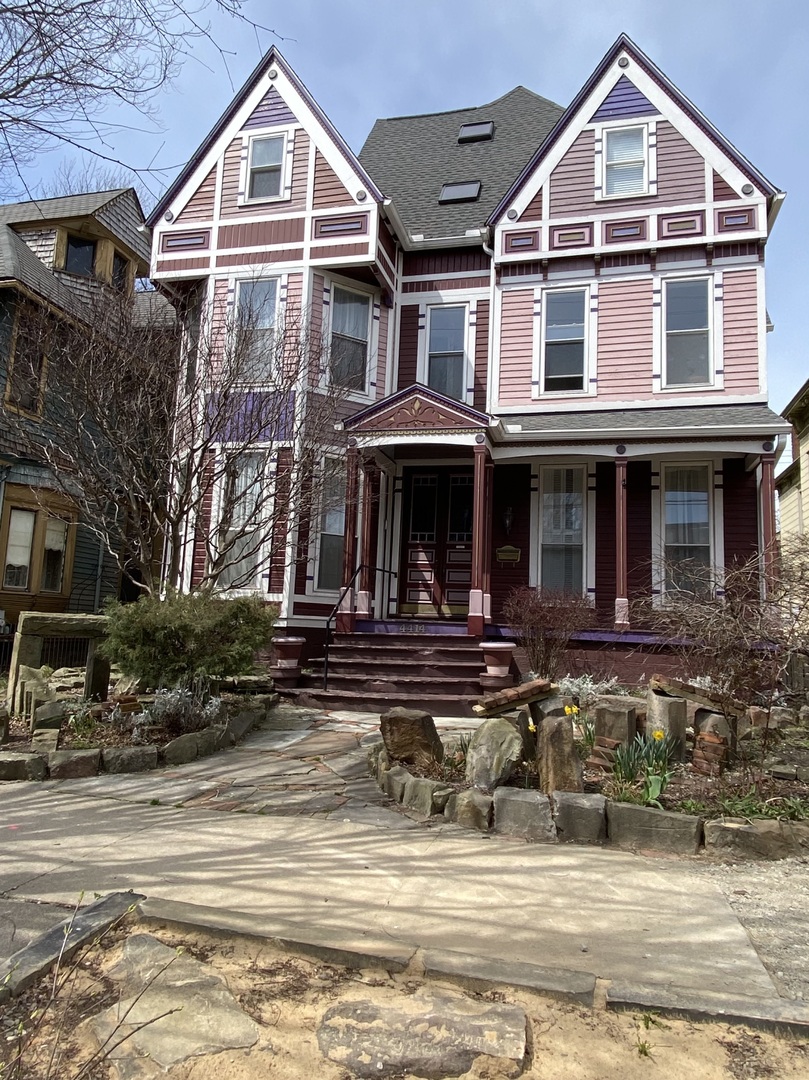
Historic houses are often named after the person for whom they were built, especially when that person happens to have been a prominent member of the community. While this practice may give historic houses a certain cachet, it is not without risk. With the passage of time and changing societal mores, information about that prominent citizen may come to light which tarnishes their image and that cachet. Such is the case with naming the house at 4414 Franklin Boulevard after Mortimer J. Lawrence, a man who in the late nineteenth century built a newspaper empire that was headquartered in Cleveland.
Most, if not all, contemporary biographers of Mortimer J. Lawrence lauded him as they related his rags-to-riches life story. It is a format that was often used by Cleveland biographers of the late nineteenth and early twentieth centuries when telling the stories of the men who they believed were responsible for building the city into an industrial powerhouse. For M. J. Lawrence, the story went something like this. He grew up in Wakeman, Ohio, just south of Vermillion. His father abandoned him when he was a little boy. He went to work at a young age to help support the family. When the War between the States broke out in 1861, he lied about his age in order to enlist on the side of the North. He served gallantly and, when the war ended, he moved to Cleveland. He married a local girl, Helen Madison, and together they started a family, living at first on Cleveland's east side where their three sons were born. Mortimer worked as a reporter at the Herald for a time and then at the Leader. In 1872, when he was just 29 years old, he decided to take a big risk. He borrowed money to purchase the Ohio Farmer, a struggling agricultural newspaper. Working tirelessly, he saved the paper from bankruptcy. It soon became a successful and profitable paper. He then proceeded to build around it a chain of agricultural newspapers in neighboring states which created a readership for his papers that eventually stretched from the Midwest all the way to the East Coast. Within a decade, the long hours, the hard work, and the risk taken made Lawrence a very wealthy man. That was the rags-to-riches narrative for Mortimer J. Lawrence. But there was more to his life and much of it was far from being praiseworthy.
In March 1882, M. J., as he was known after he became wealthy, purchased a parcel of land on the north side of Franklin Boulevard, just a few lots east of Taylor (West 45th) Street, and arranged for the construction of the house which stands today at 4414 Franklin. Designed in the Queen Anne style by up-and-coming young architect Nevins Charlot, it is two and one-half stories tall and today has more than 5,000 square feet of living area. Once construction was completed in late 1882, M.J., Helen and their three sons, who ranged in age from four to fourteen years, moved into the house. With such a young family, you might expect that the Lawrences would have lived happily in the house for many years to come. However, less than four years later, M.J. sold the house and moved to Denver, Colorado. Before he departed, he told his employees, according to an article that appeared in the Leader on October 17, 1886, that he was leaving Cleveland "on account of his health." This was hardly the true reason for his hasty departure.
Eight months earlier, in February 1886, a series of articles began to appear in Cleveland and other area newspapers regarding the state of the marriage of M. J. Lawrence and his wife Helen. The first reported that, on February 16, Helen Lawrence had filed a petition in the Cuyahoga County Court of Common Pleas against M. J., seeking a divorce, alleging that the well-known editor and publisher had committed acts of extreme cruelty against her as well as adultery. Reporters following up on the filing learned from Helen Lawrence's sister that on Saturday evening, February 13, Helen had come to her house on Liberty (West 48th) Street seeking shelter, claiming that M. J. had beaten her. The sister observed that Helen's face was badly bruised. She said that it was common knowledge in the family that M. J. had physically and mentally abused Helen for years, including striking her, spitting on her and throwing hot water in her face. Finally, Helen could take no more of it and had fled from her home. Days after speaking with Helen's sister, a reporter from the Leader learned that Helen Lawrence was staying at the Forest City House on Public Square. He went there and observed for himself the bruises on Helen's face. The Leader also interviewed M. J. Lawrence who told them he would prove his innocence in court.
Helen Lawrence wasn't the only woman in Cleveland in the post-Civil War era who was filing for divorce against an abusive husband. Prompted and pressured by leading feminist activists like Susan B. Anthony , Elizabeth Cady Stanton and others, legislatures and courts across the United States had liberalized the grounds which women could assert in order to obtain a divorce from such husbands. Moreover, the laws regarding alimony had also been liberalized to better enable women to support themselves after they were divorced. As a result, the number of divorces sought by and granted to women in the post-Civil War era skyrocketed, causing legislators and others more interested in preserving the family unit than protecting the rights of battered women to push back against further progressive changes. This then would be the last era to see significant changes in divorce laws that benefited women until the dawn of a new civil rights era for women in the 1960s.
Helen Lawrence was awarded a divorce from M. J. Lawrence in late March 1886, just six weeks after she filed her petition. It turned out that M. J. Lawrence did not prove his innocence in court as he had told newspaper reporters that he would. Instead, he did not contest his wife's entitlement to a divorce and agreed to the court awarding her what in that era would have been considered a substantial alimony settlement. Helen used a portion of that alimony to buy a house on Franklin, just west of Waverly (West 58th) Street, where she raised her youngest son and cared for her aged mother. After he sold the house at 4414 Franklin and moved to Denver, M. J. married the woman--more than 20 years younger than he-- with whom he had been carrying on his extramarital affair. Nearly a decade would pass before he and his new wife would return to and once again live in Cleveland.
After the Lawrence family moved from 4414 Franklin, it became home to several other prominent Clevelanders. One was Herman Baehr, the owner of a prominent local brewery. Best known as the man who defeated Cleveland's legendary mayor Tom Johnson, Baehr resided in the house at 4414 Franklin for a decade, including the period of 1910-1911 when he served as Cleveland's mayor. Another prominent owner was Jacob Laub, who founded Laub Bakery in Cleveland in 1889. Laub Bakery was well known to Clevelanders for nearly a century before it went out of business in 1974. In the 1920s, the house was owned and occupied by a less prominent Clevelander, Gustav Lebozsa, a Hungarian immigrant tailor. After initially occupying it as a single family house, in 1928 he converted it into a rooming house, which it remained, according to Cleveland directory records until at least 1951. In the 1940 census, nine families were listed as residing in the M. J. Lawrence House.
By the mid-twentieth century, the M. J. Lawrence House was in deplorable condition. A photo taken in 1954 for the Cleveland Board of Zoning Appeals revealed that house's third story front dormer was gone; the windows and decorative woodwork on the two front gables had been covered with asphalt shingles; the eaves of the front gables had been removed; several of the house's original five chimneys were missing; and the house's covered front porch was gone. Much, if not all, of this damage was caused by the historic 1953 tornado, which damaged this house and many others on Franklin. In the year following the historic tornado, repairs were completed and the M. J. Lawrence House was converted from a rooming house into a four-suite apartment with two suites on the first floor, and two on the second. The house continued to be so used during the decades of the 1960s and 1970s. In the early 1980s, a new owner was in the process of adding a fifth suite to the third floor of the house, when he abandoned the work and left the house vacant. As the end of 1980s approached, the City of Cleveland was threatening to condemn the M. J. Lawrence House when it was saved by Duane and Michaella Drotar.
According to Duane Drotar, he and his wife were social workers living on West 28th Street in 1989 when they became involved in the controversy surrounding St. Herman's House of Hospitality's application to the City of Cleveland for a zoning variance to add a dining hall onto the house at 4410 Franklin. St. Herman's, which has provided shelter for homeless men at that location on Cleveland's west side since 1977, is located next door to the M. J. Lawrence House. While some in the neighborhood opposed the variance, the Drotars did not. They learned that, if they were to purchase the vacant M. J. Lawrence House and indicate their non-opposition to St. Herman's variance request, the City of Cleveland would likely approve it. So, the Drotars sold their house on West 28th and, with the sales proceeds, purchased the M. J. Lawrence House. They then began what turned out to be a long process to renovate and restore it. (Meanwhile, St. Herman's proposed building addition was approved by the City.)
Duane and Michaella Drotar first renovated the interior of the M. J. Lawrence House during the 1990s, building first a suite for their family that consisted of the entire first floor of the house and part of the second. They next built a separate rental suite on the remaining part of the second floor. Finally, they developed the third floor into a temporary residence for, as Duane Drotar put it, "people in transition." After the interior renovations were completed, the Drotars turned their attention to the exterior of the house. They did not attempt to restore it to its original design primarily because the cost was prohibitive. Instead they renovated the exterior to resemble a "painted lady" Victorian house that one might see in San Francisco. Their external renovations to the house were completed in 2003.
The Drotar family lived in the house at 4414 Franklin for nearly 30 years. During these years, Duane and Michaella's three children grew up in the house, and Duane and Michaella continued their social work of ministering to the needy on Cleveland's west side. While the M. J. Lawrence House may have been built for and first occupied by a newspaper editor who abused his wife, the Drotar family, over the course of their long residency in the house, did much to improve both the appearance and the reputation of the house, if not stigma attaching to its name. The M. J. Lawrence House is now, as a result, known in the Franklin Boulevard neighborhood as a place where innumerable acts of kindness, compassion and charity for neighbors occurred over the course of the decades that the Drotar family lived there.
]]>