<?xml version="1.0" encoding="UTF-8"?>
<feed xmlns="http://www.w3.org/2005/Atom">
  <title type="text">Cleveland Historical</title>
  <updated>2026-05-09T23:56:51+00:00</updated>
  <generator uri="http://framework.zend.com" version="1.12.20">Zend_Feed_Writer</generator>
  <link rel="alternate" type="text/html" href="https://clevelandhistorical.org/"/>
  <link rel="self" type="application/atom+xml" href="https://clevelandhistorical.org/items/browse?output=rss2"/>
  <id>https://clevelandhistorical.org/</id>
  <author>
    <name>Cleveland Historical</name>
    <uri>https://clevelandhistorical.org</uri>
  </author>
  <link rel="hub" href="http://pubsubhubbub.appspot.com/"/>
  <entry>
    <title type="html"><![CDATA[Cleveland Thermal Energy: District Heating in the City]]></title>
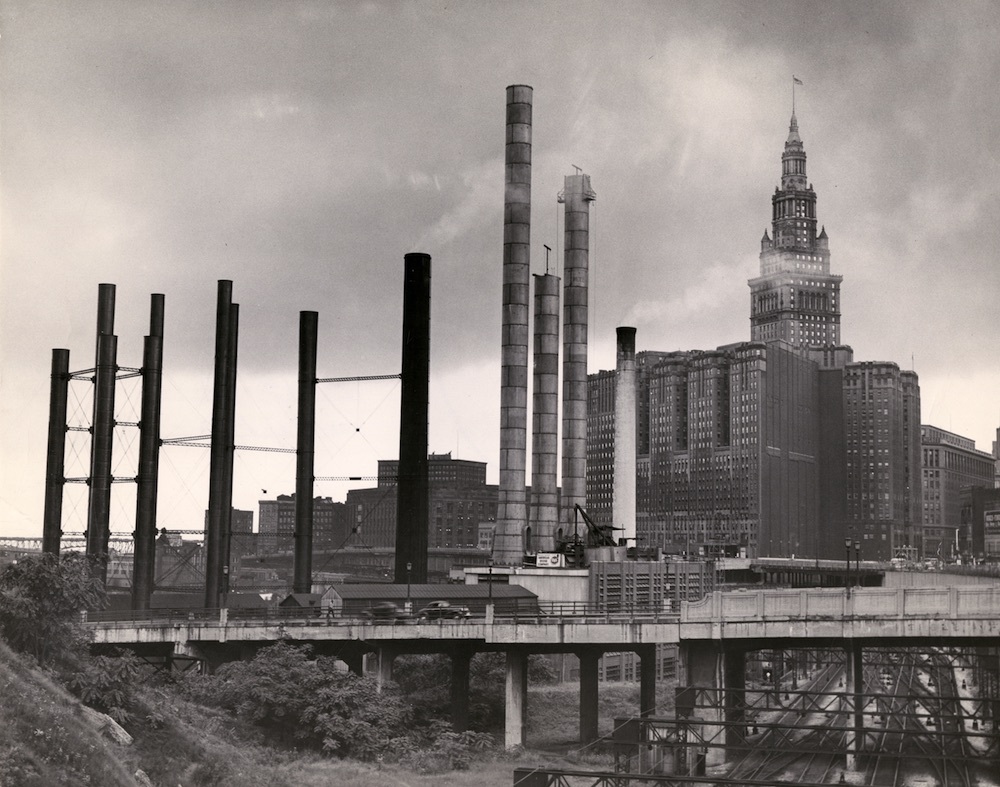
    <summary type="html"><![CDATA[<p><strong><em>A product of electricity generation and innovative engineering at the turn of the century, Cleveland's extensive network of underground pipes supplies steam heat and chilled water to make several downtown facilities comfortable in all seasons.</em></strong></p><img src="https://clevelandhistorical.org/files/fullsize/cd87a92dac07b445b8891ce19d8b42e0.jpg" alt="&quot;A Giant Trio of New Stacks&quot;" /><br/><p>District heating and cooling denotes the network of delivery of thermal energy to a group of proximate buildings or structures from a central source. The concept was first recorded with the use of Roman hypocausts, a hot air furnace, designed to warm a close group of buildings. The design evolved during the Renaissance to tap hot springs’ heat and energy to channel warmth to nearby buildings, inspiring further architectural development to incorporate thermal energy into urban development. By the 17th century, several countries in Europe, England, and Scandinavia relied upon hot water and steam to centrally heat neighboring buildings, both factories and residences. The efficiency of these systems attracted awareness across the Atlantic, and as technology evolved during the 19th century the Exhibition of 1851 marked the heating of several exhibits including the Crystal Palace via a separate boiler. During the next 25 years, European and American cities, including London, New York, Philadelphia, and Springfield, Illinois, boasted district heating. Later in the century, the cooling of structures was added to the district energy distribution concept. More cities throughout the United States incorporated heating and cooling systems into urban developments.</p><p>District heating in Cleveland evolved as part of the pioneering electric generation industry spawned by Charles Brush’s street lamps on the city’s Public Square. During the 1890s Brush Electric joined Cleveland Electric light to form General Electric Light Company which evolved into Cleveland Electric Illuminating Company by 1894 to respond to the increasing demand for electric service throughout the city. Between 1895 and 1906, the design and development of CEI’s Canal Road generation plant attracted worldwide attention via the advanced engineering used to generate electricity and steam at the site. Located on the east bank of the Cuyahoga River, clean water access was available but not ideal as upstream mills and factories polluted the resource as CEI looked to develop the byproduct of coal-fired electricity generation into a district heating business. By 1910, the Canal Road plant switched to city water to generate steam and expand its reach into the downtown area. </p><p>During the second decade of the 20th century, CEI continued to respond to the demand for increased regional electric and local steam power with progress on the infrastructure to deliver the energy. Competition for customers also grew during this period. Other local steam plants arose to supply power to proximate factories and institutions as the area developed. Among these competitors were Bradley, Cleveland, and Cuyahoga Light and Power Companies.   </p><p>A new generation plant was built at East 20th Street and Hamilton Avenue in 1924 to complement Canal Road production of both electricity and steam. The Canal Road plant was re-engineered, demolished, and rebuilt in 1928. Over the next twenty years CEI expanded its steam business to serve more than 660 customers bounded by Prospect Avenue north to Lake Erie and the Cuyahoga River east to East 24th Street. CEI continued to be recognized as a leader in the district heating technology and business, setting a national example. In 1946, the Canal Road plant ceased electric power production and turned to steam only. Two years later, CEI constructed three 235-foot colossal smokestacks at the Canal Road plant to provide greater draft for new boilers at the plant. The stacks were 12 feet inside diameter and 13 feet outside diameter steel and brick construction. During construction, workers ascended and descended the inside of the stacks while standing on a crane ball. The three tall stacks replaced ten smaller stacks and became a ‘landmark’ sight along Ontario Avenue visible from Public Square looking south. Only one remains today.</p><p>CEI continued to operate the steam generation and heating business throughout the next four decades amid legal and political disputes during an era of deregulation of public utilities, fierce competition with Cleveland Public Power (the city owned power company serving local customers), and corporate mergers and acquisitions. In 1982, several steam buildings left CEI for cheaper heat from natural gas sources. By the mid 1980s, Cuyahoga County's downtown facilities were CEI’s number one steam customer and Cleveland State University was second among downtown customers. One notable eight-year dispute between Cleveland State University and CEI over rates was ultimately settled in 1987 when CEI sold both plants and the steam operation to Youngstown’s Catalyst Thermal to operate as Cleveland Thermal Energy Corporation (CleTEC).</p><p>CleTEC operated the steam heating and expanded chilling operations for the next 28 years. During that time, corporate control of CleTEC changed hands twice until it was bought by the Canadian firm Corix in 2015. Corix moved to phase out the less eficient Canal Road plant in favor of the upgraded Hamilton Avenue plant with high-efficiency steam production using clean-burning natural gas. The Canal Road Plant closed in 2017.</p><p>Today, "Cleveland Thermal’s pipeline spans more than 30 million square feet throughout the Downtown Cleveland footprint. This pipeline delivers district steam and chilled water 24 hours a day, 365 days a year to downtown customers."</p><p><em><strong><a href="https://clevelandhistorical.org/items/show/953">For more (including 12 images) view the original article</a></strong></em></p>]]></summary>
    <published>2021-11-15T17:09:31+00:00</published>
    <updated>2026-04-17T19:17:42+00:00</updated>
    <link rel="alternate" type="text/html" href="https://clevelandhistorical.org/items/show/953"/>
    <id>https://clevelandhistorical.org/items/show/953</id>
    <author>
      <name>Jim Lanese</name>
    </author>
  </entry>
  <entry>
    <title type="html"><![CDATA[Baldwin Reservoir: A Hidden Treasure]]></title>
    <summary type="html"><![CDATA[<img src="https://clevelandhistorical.org/files/fullsize/c33c5f8aed44552686af21982568ab4c.jpg" alt="Interior View of Baldwin Reservoir&#039;s Massive Columns" /><br/><p>It is May 4, 1925. A great crowd of men, women, and children huddle together around the lanterns of their guides as they walk through a dark, stone hall beneath the earth.  Somewhere under the arches, music begins to play as young men test their banjos and mandolins in the hallowed space.  However, despite the arches and columns supporting the great stone roof, the place that they tour is no cathedral.  It is not a cave, either.  It is a reservoir, built underground and covered by 14 acres of concrete and dirt.  The 4,000 people that will be ushered through the darkness this day will be some of the last to see the inside of this place.  On July 1st of this same year, the plant and reservoir will be officially opened, and the reservoir will be filled with over a hundred million gallons of fresh, clear water.  That water will then flow from the reservoir to the people that need it, all over Cuyahoga County.  But, until June 7th, young and old alike will be able to stalk through what some have called a “temple”, and a modern marvel of engineering.</p><p>Part of the reason that the reservoir was such an attraction was its sheer size and the amount of material that went into its construction.  The Baldwin Reservoir measures roughly 1,035 feet long by 551 feet wide by 39 feet high.  Each half of the reservoir’s roof is 500 square feet and is held up by 1,104 arched panels.  Each of these panels is about 20 square feet. The panels are themselves supported 1,196 concrete columns that are about 35 feet high and 30 inches in diameter.  The reason that the roof is divided in half is because the reservoir itself is also divided.  A wall splits the reservoir into two basins, which are fed water from the plant by flumes set 21 feet above the reservoir floor.  The attached filtration plant covers an area of 268,000 square feet and was constructed in a Palladian style, according to the designs of architect Herman Kregelius.  The front entrance is covered by bronze doors that are 8 feet tall, with a 27-foot-tall glass arch surrounding the doors.  This arch, combined with the windows set a few feet apart close to the ceiling, allow in plenty of natural light to brighten up the plant during the day.  The plant and reservoir were completed in 1925 at the cost of $5 million, the equivalent of several tens of millions of dollars today.</p><p>However, the reservoir and filtration plant have been more than just an attraction to see or a big cost to the city.  They have also been a source of safe drinking water for thousands of people.  Prior to the construction of the reservoir, three quarters of Cuyahoga County’s population lived in a low-service zone.  For most of Cleveland, and the surrounding county, water was something that had to be rationed, and something that oozed out of the tap.  It was often filthy and filled with random bits of debris and waste that had coated the pipes over the years.  However, when the plant and reservoir were finished, and hooked up to a nearby pumping station, all of those people suddenly had fresh, clear water bursting out from their pipes whenever they turned on the tap.  People could drink their fill, water their lawns, and bathe regularly, without fear of contracting any diseases or being poisoned by industrial runoff.  And they could get this from their hookups at home, with no more need to go to contaminated neighborhood wells and pumps.</p><p>The true value of safe drinking water cannot be overstated.  In the year 1900, more than twenty years before the reservoir was completed, 54 out of every 100,000 people in Cleveland died from typhoid fever.  In 1915, four years after the city began disinfecting its water, that rate had dropped to 8 out every 100,000.  By 1920, the total rate was less than 4 per 100,000.  Most of those cases that still occurred were centered in low-service districts, where water quality and availability were lower.  When the reservoir was completed, and its attached filtration plant was put into action, the rate of typhoid-related deaths went down to near zero.</p><p>Today, the Baldwin Reservoir and Baldwin Filtration plant are practically invisible and tend to stay out of the news.  All that one can see, looking from beyond the fence along Woodhill Road, is a long stretch of lawn that extends to a line of hedges and trees, and some walkways leading up to the filtration plant and administration building.  However, beneath that lawn is one of the world’s largest covered reservoirs, and one of the biggest water supplies in the city of Cleveland.  Despite its invisibility, the Baldwin Reservoir has left a large impact on the city, its people, and its history.  One that is still felt today, every time that someone fills a glass from their tap.</p><p><em><strong><a href="https://clevelandhistorical.org/items/show/890">For more (including 12 images) view the original article</a></strong></em></p>]]></summary>
    <published>2019-11-26T22:32:02+00:00</published>
    <updated>2026-04-17T19:17:42+00:00</updated>
    <link rel="alternate" type="text/html" href="https://clevelandhistorical.org/items/show/890"/>
    <id>https://clevelandhistorical.org/items/show/890</id>
    <author>
      <name>Madison Matuszak</name>
    </author>
  </entry>
  <entry>
    <title type="html"><![CDATA[Cleveland Municipal Light]]></title>
    <summary type="html"><![CDATA[<img src="https://clevelandhistorical.org/files/fullsize/db2cc944c9e5e004307c7104e52a414d.jpg" alt="The Cleveland Municipal Light Plant in 1941" /><br/><p>The Cleveland Municipal Light Plant was the product of Mayor Tom L. Johnson's vision for a city that owned or controlled all of its own public utilities and public transportation companies.  Mayor Johnson's campaign for municipal ownership was pitched under the banner of the "Three Cent Fare," which advocated public transportation and other public services be offered to the public at an affordable $0.03 per ride. The approximate rate of 3 cents per kilowatt-hour lasted until 1957, 54 years after Johnson had proposed it. The city broke ground for the new Municipal Electric plant in 1912, with operation beginning in July 1914.</p><p>During its first six months of operation, the Municipal Light Plant did two very important things for Cleveland citizens: it offered cheaper competition for electricity in a market that had previously been monopolized by the Cleveland Electric Illuminating Company (CEI), and it immediately turned a profit for the city. This benefit to the city was recognized abroad, with major industrial cities such as New York and Chicago making an attempt to copy Cleveland's success. The financial success, however, was a threat to CEI, initiating a business battle that would continue long after the Municipal Light Plant ceased operation.</p><p>The battle between the Cleveland Municipal Light Plant and CEI came to a boil in 1977, as CEI made an offer to the City of Cleveland to purchase the municipal lighting system in an effort to wrest the city from the large debt that it had accumulated. The mayor at the time, Dennis Kucinich, advocated keeping the municipal lighting system in an effort to prevent CEI from attaining a complete monopoly. In a political battle with the City Council, Kucinich agreed to ask the voters to decide: would Cleveland sell the Municipal Light Plant, or nearly triple the income tax rate of residents? The election was an overwhelming landslide in the favor of Kucinich and the Municipal Light Plant. Though this only worsened Cleveland's financial situation and prevented Kucinich's re-election, the decision helped Cleveland maintain its own municipal light system even to this day. (The system is currently called Cleveland Public Power.) Kucinich also used the legacy of his Municipal Light Plant victory to propel his political career into the House of Representatives.</p><p>Today the Municipal Light Plant still stands on East 53rd Street, but it functions in a different capacity than originally intended. In the 1970s the plant began to help ease the burden on the power grid during the hours of peak electrical demand. By the time CEI offered to buy the Municipal Plant, it was already a relic left over from Tom L. Johnson. Today, the building stands not only as an important site in Cleveland's history, but as a work of art as well. In 1997, the Municipal Light Plant became the seventy-fifth Whaling Wall, entitled "Song of the Wales," which is a work of art by Robert Wyland.  The mural was part of a nationwide effort by the Wyland Foundation, a non-profit organization that aims to raise awareness for aquatic environments and habitats. </p><p><em><strong><a href="https://clevelandhistorical.org/items/show/474">For more (including 6 images) view the original article</a></strong></em></p>]]></summary>
    <published>2012-05-23T09:19:57+00:00</published>
    <updated>2026-04-17T19:17:39+00:00</updated>
    <link rel="alternate" type="text/html" href="https://clevelandhistorical.org/items/show/474"/>
    <id>https://clevelandhistorical.org/items/show/474</id>
    <author>
      <name>Dave Braunlich&amp;#32;&amp;amp;&amp;#32;Matthew Sisson</name>
    </author>
  </entry>
  <entry>
    <title type="html"><![CDATA[Avon Lake Power Plant]]></title>
    <summary type="html"><![CDATA[<img src="https://clevelandhistorical.org/files/fullsize/8f3bc520e6bae4f9eb5318e396d87074.jpg" alt="Rotor Installation" /><br/><p>With regard to Cleveland's west side, the addition of the Avon Lake Power Plant on Lake Road in 1926 is arguably the most significant project taken on by Cleveland Electric Illuminating Company (CEI).  Situated 23 miles west of CEI's Public Square headquarters, the plant added another massive range of power and opened "a new industrial area in which electrical power will be available in abundance." Announced in 1924, the Avon Lake plant was built from March 1925 to July 1926 at a cost of approximately $30,000,000.  The plant was constructed in Avon Beach Park in order to make use of the uniquely large, cool source of water in the Great Lakes. Cool water was necessary to condense steam as it left the turbines, and five-hundred tons of water were required for every ton of coal burned by the plant. To put this in perspective, so much water was needed for the Avon Lake plant that it had to pump twice the amount of water that the city water works did. When it opened, the Avon Lake plant became the largest of its kind in the world, capable of producing a magnificent 400,000 horsepower.</p><p>The Avon Lake plant's dependence on water led to an extraordinary dilemma on February 21, 1953. That day, "great masses of gizzard shad" collapsed the plant's water intake screens and caused each of the plan'ts seven generators to instantly shut down. This resulted in a significant power-outage throughout the entire Greater Cleveland area. After hours of scooping out the dead fish with a large crane, it took the work of another 50 men, including welders and divers, to fix the broken water intake screens located 35 feet below the surface. The Ohio Division of Wildlife determined that a sudden and significant drop in temperature had killed the fish, which subsequently created a large aggregation of dead fish on the surface near the plant's intake channel.</p><p>In addition to cool water, the plant also depended on a substantial amount of coal.  In 1950, the Avon Lake plant reportedly processed 4,000 tons of coal a day.  Despite a late-fifties effort by CEI to beautify the immediate area surrounding the Avon Lake power plant, significant backlash over the plant's environmental impact eventually led to its demise. In November of 2011, Ohio Representative Dennis Kucinich publicly addressed the Ohio Environmental Protection Agency, (EPA). Kucinich urged the EPA to take action against the plant, now controlled by GenOn, and limit its toxic air pollution.  Kucinich cited that the "power plant in Avon Lake had released more than two million [tons] of toxic chemicals in 2010."  The EPA determined that the Avon Lake power plant was guilty of excessive ozone emissions, and cited GenOn.  In order to become compliant under stricter EPA regulations, the power plant would have to undergo an overhaul costing hundreds of millions of dollars. This pressured GenOn to announce plans to close the Avon Lake power plant in 2015, but instead the plant changed hands and continued to operate for six more years before finally shutting down in 2021. It was mostly demolished over the next two years as part of a lakefront redevelopment plan.</p><p><em><strong><a href="https://clevelandhistorical.org/items/show/458">For more (including 8 images) view the original article</a></strong></em></p>]]></summary>
    <published>2012-05-15T23:16:03+00:00</published>
    <updated>2026-04-17T19:17:39+00:00</updated>
    <link rel="alternate" type="text/html" href="https://clevelandhistorical.org/items/show/458"/>
    <id>https://clevelandhistorical.org/items/show/458</id>
    <author>
      <name>Matthew Sisson</name>
    </author>
  </entry>
  <entry>
    <title type="html"><![CDATA[Garrett A. Morgan Water Works]]></title>
    <summary type="html"><![CDATA[<img src="https://clevelandhistorical.org/files/fullsize/f4bd8dd40d10f9907d034b5fbe2c62bc.jpg" alt="Garrett A. Morgan Water Works" /><br/><p>The Division Street Pumping Station was the originally planned site for the Cleveland Municipal Light Plant, when the first talks about where the theoretical plant would be placed arose in 1906. The plant has been around in various incarnations since 1850 although the City of Cleveland did not officially form a public water system until 1856. It was rededicated as the Garrett A. Morgan Water Treatment Plant in 1991, due to the <a href="https://clevelandhistorical.org/items/show/736">rescue of several men trapped underneath Lake Erie</a> in 1916 thanks to Morgan's invention of the gas mask.</p><p>The idea of having a complete single municipal plant that would provide water, heat, and electricity to the city had been around for some time before the plans for a pumping station were even discussed. The original plans for the small municipal electric plant in Glenville were initially considered to be built in this combined manner, though it never was considered practical. The idea for the design of the plant was claimed to be taken from a unique plant with this design already in operation in Berlin, Germany, by 1895.</p><p>The idea for this combination plant persisted into early 1912, just months before ground was broken on the Muny Light in October of that year. The plans for the plant were then changed into a filtration and pumping station shortly afterwards, and the final product was finished in 1918. Cleveland soon developed two additional pumping stations too meet the demand for fresh water. All of the stations ensured that there would be adequate water pressure throughout the nearly 1,000-mile system that had formed by 1920. This distance of piping nearly tripled by 1940, though no new pumping stations had been added. The Garrett A. Morgan Water Works was the forerunner for the Cleveland water system, which is currently the tenth largest in the United States. It has survived to this day, where it aids the city in serving some 68 municipalities throughout Northeast Ohio.</p><p><em><strong><a href="https://clevelandhistorical.org/items/show/160">For more (including 9 images) view the original article</a></strong></em></p>]]></summary>
    <published>2011-03-08T08:56:47+00:00</published>
    <updated>2026-04-17T19:17:37+00:00</updated>
    <link rel="alternate" type="text/html" href="https://clevelandhistorical.org/items/show/160"/>
    <id>https://clevelandhistorical.org/items/show/160</id>
    <author>
      <name>David Braunlich</name>
    </author>
  </entry>
  <entry>
    <title type="html"><![CDATA[Cleveland Electric Illuminating Co.: &quot;Convenience-Cleanliness-Brightness-Luxury&quot;]]></title>
    <summary type="html"><![CDATA[<img src="https://clevelandhistorical.org/files/fullsize/da9d9b33fcf9bd94db235ca97999c0a4.jpg" alt="Charles F. Brush" /><br/><p>The firm founded in 1892 as the Cleveland General Electric Co. by Charles F. Brush became the Cleveland Electric Illuminating Company (C.E.I.)  just two years later and established its headquarters offices in the Cuyahoga Building on Public Square. C.E.I.'s stint in the Cuyahoga Building was short-lived, however. The company transferred its headquarters into the 75 Building, on the northwest corner of Public Square in 1914. C.E.I. outgrew its facilities at 75 Public Square as the demand for electrical power rose, and in 1956 broke ground to construct its own Illuminating Building right next door at 55 Public Square. C.E.I. signed a fifteen-year, $408,000 lease to occupy the first five floors of the Illuminating Building. Despite occupying all fourteen floors of the old 75 Building, the Illuminating Building offered 17% more space on those initial five floors alone. The monumental 1958 move included some 800 dolly-loads of office equipment and an additional 500 desks. Nevertheless, the move was completed in less than eighteen hours as workers never stepped foot outdoors thanks to existing pedestrian tunnels connecting one building to the other.</p><p>At the turn of the twentieth century, C.E.I. ran advertisements offering to wire homes with electricity for a price of $38.50, touting the benefits of domestic electricity, "Convenience-Cleanliness-Brightness-Luxury."   Eventually, the company became famous for its 1940s-1960s ad campaign, which promoted Cleveland as "the best location in the nation." This ad campaign aimed to attract major industries to Cleveland, and promoted C.E.I.'s contribution to the overall welfare of Northeast Ohio by emphasizing its own role in expanding business, industry, job opportunities, and improving the overall quality of life.</p><p>A massive workforce strike erupted in the midst of the "best location in the nation" ad campaign. On April 24, 1957 the members of Utility Workers Local 270 voted a resounding 1,754-63 in favor to strike against C.E.I.   Workers demanded that C.E.I. do away with its right to make job changes and transfers without informing the union, as well as re-negotiate wages to obtain a "substantial" increase. The strike ended on May 7 after a grueling fifteen-hour negotiation. The fifteen-day strike became the longest of its kind in C.E.I.'s prominent history, which had only witnessed a single six-hour strike in 1945. Resolutions involved a new two-year contract with a general wage increase of five percent, or the equivalent of ten to fifteen cents per hour.</p><p>During the 1960s, C.E.I. became pressured to respond to the increasing demand for nuclear power, and began to invest in nuclear power plants in collaboration with Toledo Edison in 1970.  The decade of the 1970s witnessed the widespread energy crisis, which drove up the price of coal dramatically. Likewise, domestic energy costs for consumers skyrocketed, and C.E.I. lost a considerable amount of customers. In order to stay afloat, C.E.I. merged with Toledo Edison in 1986 to form Centerior Energy. A little over a decade later in 1997, Centerior Energy combined with Ohio Edison and Penn Power to form FirstEnergy, which controls the electric system for northern Ohio and western Pennsylvania.</p><p><em><strong><a href="https://clevelandhistorical.org/items/show/20">For more (including 10 images&#32;&amp;&#32;1 audio file) view the original article</a></strong></em></p>]]></summary>
    <published>2010-09-15T14:44:34+00:00</published>
    <updated>2026-04-17T19:17:36+00:00</updated>
    <link rel="alternate" type="text/html" href="https://clevelandhistorical.org/items/show/20"/>
    <id>https://clevelandhistorical.org/items/show/20</id>
    <author>
      <name>Matthew Sisson</name>
    </author>
  </entry>
</feed>
