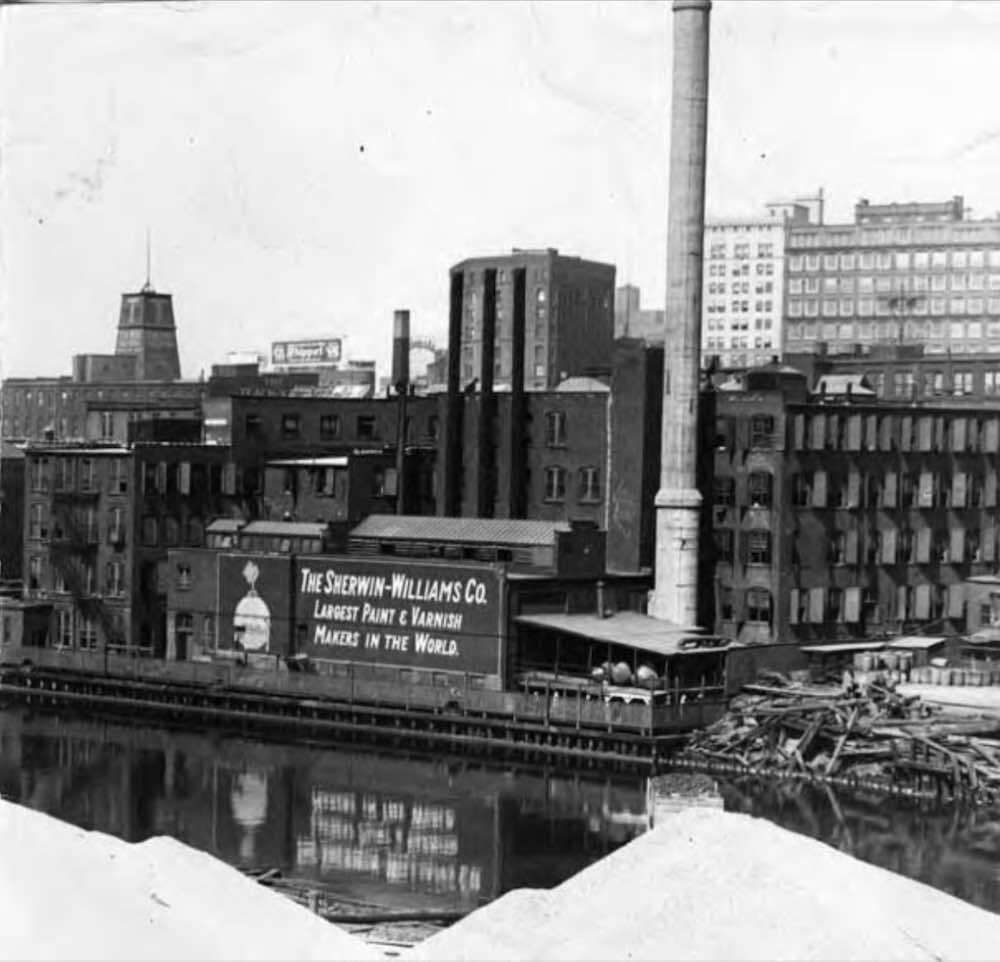
From humble beginnings in 1866, Sherwin-Williams has become increasingly a staple of Cleveland’s economy. Henry Sherwin came to Cleveland looking for work at the request of his uncle, eventually finding his way into the paint industry with his position in Truman Dunham & Co. Following the end of his tenure there, Sherwin took a leap of faith, starting his own paint company with every penny he had saved from his previous jobs. This venture would pay off as the Sherwin-Williams company thrives today, over one hundred and fifty years later. Partnering with Edward Porter Williams the Sherwin-Williams company was born, establishing its first plant along the Cuyahoga River. In its early years the company made many industry-changing moves, including ready mixed paint, created in 1880 and now an industry standard.
Sherwin-Williams gradually established itself as an industry giant as it began to buy more property outside the city of Cleveland. Chicago and Detroit were two of the cities that saw expansion from Sherwin-Williams. Sherwin even went as far as purchasing Berger Sons & Co., the UK’s biggest paint company, in 1905 to cement itself internationally. These global acquisitions make sense for the time as 1905 saw the birth of a slogan everyone in Cleveland should be familiar with, “Cover the Earth.” Spanning much of the company’s history, the slogan and logo show the Earth being covered with paint from a Sherwin-Williams can. Not only is this logo iconic but it exemplifies what the company was attempting to do during its early years: become a global giant in the paint industry. In the early twentieth century, Sherwin began purchasing smaller companies to strengthen its corporate stature. Companies like Martin-Senour and Acme Quality Paints were acquired around 1920 as they caught the eyes of Sherwin-Williams executives as smart investments.
In the 1940s Sherwin-Williams was forced to make more innovations, this time with fewer materials at its disposal. As a result of the wartime shortage of oil, the company had to create a new type of paint, Kem-Tone, which was the world’s first water-based interior paint. Paintbrush materials were also in short supply at this time, meaning Sherwin-Williams would have to innovate new applicator products as well. The first roller brushes were made during this time, a now industry standard as well. During the war, Sherwin-Williams started heavily marketing a “do it yourself” notion, creating a whole new market for the company. By the end of World War II Sherwin-Williams had seen its sales double, despite the uncertainty of world events.
The growth of Sherwin-Williams finally stagnated in the 1970s, as the company began to see exorbitant amounts of debt piling up. Hostile company takeover rumors were swirling around before a new CEO was appointed, Jack Breen. Breen would be credited with bringing the company back from the brink of collapse, but legal battles stemming from this era still haunt the company. Lead paint was banned in 1978 but many homes across the country still have walls covered in it, causing serious health problems, especially for children in urban neighborhoods. Following a long legal battle in which Sherwin had to pay out $305 million for its use of lead paint, its main competitor, Pittsburgh-based PPG, announced it was ceasing all use of lead in its paint. This move may have swayed some customers away from Sherwin-Williams. Another stain on the reputation of the company appeared in 1981, when it purchased struggling Cleveland-based Gray Drug Stores for $55 million, a move meant to stabilize their financial portfolio. Following the acquisition of additional local chains, including 26 Cunningham Drug Stores, Sherwin sold their drug store division to Rite Aid for $165 million in 1987. More recently Sherwin has made many acquisitions of former rivals and industry fixtures, including Minneapolis-based paint and coatings company Valspar, Purdy (a top company for paint applicators), and Minwax (a popular finish company), allowing it to control much of the paint market.
In February of 2020 the company announced that it would build its brand-new headquarters in the center of downtown Cleveland. Cities like Atlanta and Dallas were rumored to be considered for the company’s headquarters but ultimately Sherwin stayed true to their Cleveland roots. Along with its new headquarters, Sherwin-Williams announced that it would build an R&D facility in Brecksville, continuing to invest in the region it has called home for nearly two centuries. Employing nearly 4,500 workers, Sherwin-Williams stands as the largest industrial employer in the city of Cleveland.
]]>