<?xml version="1.0" encoding="UTF-8"?>
<feed xmlns="http://www.w3.org/2005/Atom">
  <title type="text">Cleveland Historical</title>
  <updated>2026-05-10T00:53:52+00:00</updated>
  <generator uri="http://framework.zend.com" version="1.12.20">Zend_Feed_Writer</generator>
  <link rel="alternate" type="text/html" href="https://clevelandhistorical.org/"/>
  <link rel="self" type="application/atom+xml" href="https://clevelandhistorical.org/items/browse?output=rss2"/>
  <id>https://clevelandhistorical.org/</id>
  <author>
    <name>Cleveland Historical</name>
    <uri>https://clevelandhistorical.org</uri>
  </author>
  <link rel="hub" href="http://pubsubhubbub.appspot.com/"/>
  <entry>
    <title type="html"><![CDATA[Scatter&#039;s Barbecue: The Heart of Herman Stephens&#039; Glenville Business Empire ]]></title>
    <summary type="html"><![CDATA[<img src="https://clevelandhistorical.org/files/fullsize/958ac2e397895c4bebbb80fba667987a.jpg" alt="Scatter&#039;s Barbecue, 1954" /><br/><p>Before Hot Sauce Williams and Beckham's B&M Bar-B-Que ruled the east side, Scatter's Barbecue was Glenville's home for ribs, shoulder sandwiches, and fries soaked in Scatter's notable barbecue sauce. Herman "Scatter" Stephens, born in Birmingham, Alabama on June 1, 1920, moved to Cleveland in 1934 with his family. He graduated from Central High School in 1938 and attended West Virginia State College. After his college years, his family assisted in opening Scatter's Barbecue in 1952. It was not unusual to find his relatives, such as his mother, Emma Ricks, and aunt Nancy Stephens, in the restaurant assisting Scatter during the early years of the restaurant.</p><p>Located at 931 East 105th Street in the heart of Glenville's lively strip, Scatter's Barbecue was known for its shoulder sandwiches, where the meat was so tender it would "fall off the bone." The restaurant's walls were covered with framed portraits of prominent African Americans of the day, many of whom Scatter befriended, such as Sugar Ray Robinson and Count Basie. While Scatter's clientele included notable celebrities, many regulars were from the Glenville area. It was common for students from Empire Junior High School, located down the street, to stop by after school for a sauce-soaked paper bag of fries. </p><p>Scatter became an entrepreneur, owning not only a restaurant, but several businesses under the umbrella of Stephens Enterprises Inc. Herman "Scatter" Stephens owned Stephens Cigarette Service Inc., a cigarette and bowling machine servicing company, at 933 East 105th adjacent to Scatter's Barbecue, and the Silver Dollar Lounge. The lounge hosted his annual grandiose birthday parties, for which he issued an open invitation to "the world." By 1967, Stephens Enterprises expanded to include Stephens Real Estate, Stephens Vending Co., and the Lucky Bar. Scatter was a notable high-roller in Glenville, where he was known for having the latest Cadillacs, as well as a world traveler. In the summer of 1967, Scatter accompanied the Count Basie Orchestra to Europe for their tour. Since Scatter knew Count Basie, he was able to assist Cafe Tia Juana in booking jazz shows, featuring acts like saxophonists Eddie Lockjaw Davis and Sonny Stitt.</p><p>On September 10, 1967 at 2:30 A.M., tragedy struck when Scatter was shot in his Stephens Cigarette Service/Vending Co. store by a white assailant with possible mob ties. After being shot twice, Scatter stumbled out of the store and tried to escape to his barbecue restaurant, where the gunman followed him and shot him three more times. </p><p>Scatter's funeral took place September 21 at East Mount Zion Baptist Church. Some witnesses recalled the funeral being among the largest in the neighborhood in decades, with 3,000 mourners attending and traffic backed up for blocks. The funeral was just as impressive as his life; Scatter was buried in an $8,000 copper casket and the procession included 63 Cadillac Eldorados. Some of the attendees were rumored to be Sugar Ray Robinson and Joe Louis, who were able to slip out without being photographed. </p><p>Scatter's family ran the restaurant years after his passing, eventually closing in 1983. Though the only remnant of Scatter's Barbecue is the intact building, Scatter's legacy is still cherished in the Glenville community to this day.</p><p><em><strong><a href="https://clevelandhistorical.org/items/show/654">For more (including 4 images&#32;&amp;&#32;2 audio files) view the original article</a></strong></em></p>]]></summary>
    <published>2014-04-23T15:47:37+00:00</published>
    <updated>2026-04-17T19:17:40+00:00</updated>
    <link rel="alternate" type="text/html" href="https://clevelandhistorical.org/items/show/654"/>
    <id>https://clevelandhistorical.org/items/show/654</id>
    <author>
      <name>Julie A. Gabb</name>
    </author>
  </entry>
  <entry>
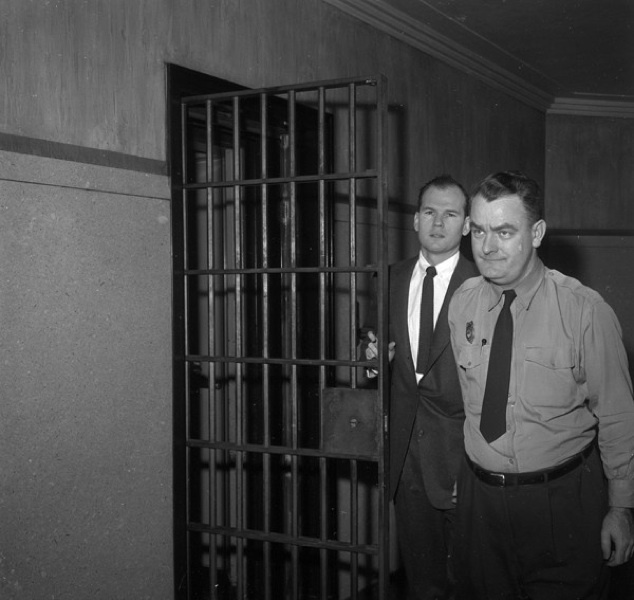
    <title type="html"><![CDATA[Dr. Sam Sheppard ]]></title>
    <summary type="html"><![CDATA[<p><strong><em>Did Dr. Sam Sheppard kill his wife, or didn't he? This ominous question occupied the minds of Clevelanders for decades, and eludes them to this day. Dr. Samuel Sheppard was one of the most popular doctors at Bay View Hospital, yet he quickly became one of the most notorious people in the city of Cleveland after the events that transpired on the night of July 4, 1954. </em></strong></p><img src="https://clevelandhistorical.org/files/fullsize/3fe8860540688b59513b72fc8ce93021.jpg" alt="Dr. Sheppard Escorted from his Prison Cell" /><br/><p>Sam Sheppard was an attractive and well-liked doctor who tended to hundreds of patients throughout his career at Bay View Hospital. Dr. Sheppard's official area of practice was Osteopathic Neurosurgery. Following the murder of his wife Marilyn Sheppard, Bay View Hospital played a vital role in the investigation. The staff members of the hospital were interviewed multiple times in an attempt to gather information that could have potentially given detectives a lead to finding the murderer. The questions the employees were asked covered a variety of different aspects of Dr. Sheppard's life and work, including his family, his overall behavior as an individual and any knowledge of disgruntled former patients or employees of Dr. Sheppard's. Unfortunately, detectives were unable to secure any leads, only concluding that Dr. Sheppard was a well-liked doctor in the community. </p><p>In the early morning hours of July 4, 1954 the nightmare began for the Sheppard family and the entire community of Bay Village. The Sheppard's threw a Fourth of July party each year, but this year, after the party ended and the guests had all gone home, Sam stated that he decided to go for a walk alone on the private beach of Lake Erie that was located behind their home. He arrived home shortly after to a gruesome scene, discovering that his wife Marilyn had been brutally murdered in his absence. Mrs. Sheppard was found lying on her bed in their master bedroom in a provocative manner. She had been "chopped 25 times in the head and chest." The attack on Marilyn Sheppard was atrocious, and her lifeless body was left in a horrific state. </p><p>There was never any hard evidence found that directly tied Dr. Sam Sheppard to the death of his wife, Marilyn. Despite this fact, on July 30, 1954, the Bay Village police arrested Sheppard on the charge of murder. The result of the ensuing murder trial was a guilty verdict. The once respected and admired doctor was now labeled a murderer. Throughout his trial and following his conviction, he continued to profess his innocence. Dr. Sam Sheppard spent ten years in prison before the state of Ohio granted his appeal and awarded him a new trial. The murder conviction was overturned on June 6, 1966 due to a lack of evidence. Dr. Sam Sheppard was a free man from that time until he passed away on April 6, 1970 of liver failure. The unique and notorious murder case was so influential in American society that it is widely believed to have served as the inspiration for the popular 1960s television series and 1993 film, <em>The Fugitive</em>.</p><p><em><strong><a href="https://clevelandhistorical.org/items/show/590">For more (including 6 images) view the original article</a></strong></em></p>]]></summary>
    <published>2013-02-20T16:18:07+00:00</published>
    <updated>2026-04-17T19:17:40+00:00</updated>
    <link rel="alternate" type="text/html" href="https://clevelandhistorical.org/items/show/590"/>
    <id>https://clevelandhistorical.org/items/show/590</id>
    <author>
      <name>Victoria Smith </name>
    </author>
  </entry>
  <entry>
    <title type="html"><![CDATA[Velma West: &quot;The Modern Murderess&quot;]]></title>
    <summary type="html"><![CDATA[<p><strong><em>While gangsters, bootleggers and gamblers were among the cast of interesting characters drawn to the bustling Gordon Square business district during its heyday, the historic Four Corners intersection also has ties to one of the most infamous murderers of the 1920s.  </em></strong></p><img src="https://clevelandhistorical.org/files/fullsize/5cd06ae6aac2fd7c7b18ce80b8b7e965.jpg" alt="Velma West in Court" /><br/><p>On December 7, 1927, Velma West and her mother Catherine Van Woert spent the day Christmas shopping in downtown Cleveland.  Upon their return to Catherine's home in East Cleveland, they were met by the local police and Lake County sheriff.  West was taken into custody and transported to the Lake County jail for questioning in the murder of Thomas Edward West.  After three hours of interrogation, Velma West admitted to the murder of her husband. Local papers quickly picked up on the sensational story of a 21 year old, cigarette-smoking city-girl that beat her husband to death with a claw hammer.</p><p>Hailing from East Cleveland, young Velma Van Woert was employed at Rothman Variety on the corner of West 65th Street and Detroit Avenue at the age of 19. She worked there for about a year before being fired. During this time, she had agreed to marry the 56 year old owner of a nearby restaurant where she regularly spent her lunch breaks. Just weeks before the planned wedding, Velma met Thomas Edward West. She broke off her engagement and married the farmer in 1926, moving to his home in the small, rural community of Perry, Ohio.  The following year, Thomas was found murdered; the young flapper accused of the crime quickly captured the city's attention. </p><p>Velma West's story was intriguing. Her childish persona did not match the callousness of the crime. She was spoiled, prone to extreme mood swing, in fragile mental and physical health, and inclined to faint in public. West also embodied for many readers the strangeness and excesses of city life. Descriptions of her short hair, choice of clothes, cigarette smoking, biting tongue, and care-free attitude were presented as clues to the underlying causes of Velma's violent outburst. </p><p>The mystery surrounding this case was not if West killed her husband, but what led the young woman to commit such an unspeakable act.  New angles to the drama were regularly presented in local papers, including physical abuse, a "strange" love for her girlfriend, and insanity.  West quickly became a Cleveland celebrity.  Reporters fixated on her fashion choices, newspapers were condemned for their sympathetic treatment of an accused murderer, and a local theater even offered the young woman a leading role upon her release.   </p><p>On March 5, 1928, Velma West pleaded guilty to the second degree murder of her husband.  The crime never went to trial. She was sentenced to life in prison, and transported to the Woman's Reformatory at Marysville.</p><p><em><strong><a href="https://clevelandhistorical.org/items/show/216">For more (including 6 images) view the original article</a></strong></em></p>]]></summary>
    <published>2011-06-01T17:41:56+00:00</published>
    <updated>2026-04-17T19:17:37+00:00</updated>
    <link rel="alternate" type="text/html" href="https://clevelandhistorical.org/items/show/216"/>
    <id>https://clevelandhistorical.org/items/show/216</id>
    <author>
      <name>Richard Raponi</name>
    </author>
  </entry>
</feed>
