<?xml version="1.0" encoding="UTF-8"?>
<feed xmlns="http://www.w3.org/2005/Atom">
  <title type="text">Cleveland Historical</title>
  <updated>2026-05-10T00:16:48+00:00</updated>
  <generator uri="http://framework.zend.com" version="1.12.20">Zend_Feed_Writer</generator>
  <link rel="alternate" type="text/html" href="https://clevelandhistorical.org/"/>
  <link rel="self" type="application/atom+xml" href="https://clevelandhistorical.org/items/browse?output=rss2"/>
  <id>https://clevelandhistorical.org/</id>
  <author>
    <name>Cleveland Historical</name>
    <uri>https://clevelandhistorical.org</uri>
  </author>
  <link rel="hub" href="http://pubsubhubbub.appspot.com/"/>
  <entry>
    <title type="html"><![CDATA[The Vitrolite: Cleveland&#039;s Showcase for Structural Glass]]></title>
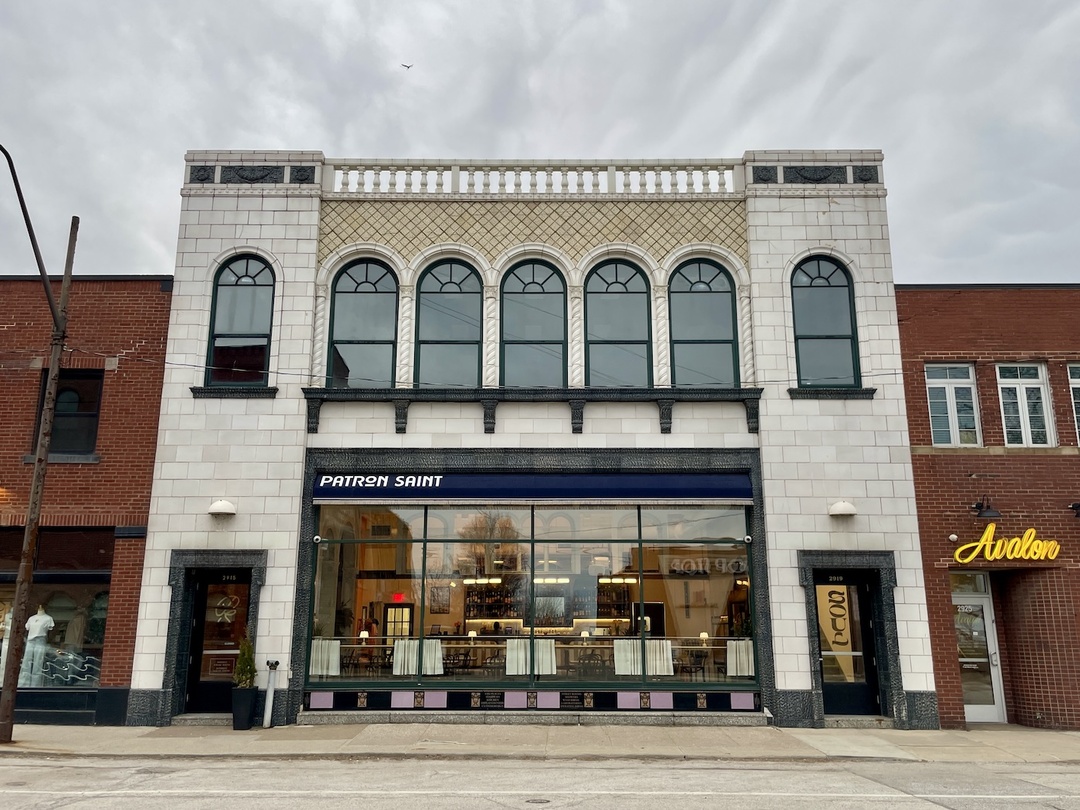
    <summary type="html"><![CDATA[<p><strong><em>Passersby often turn their heads as they pass the Vitrolite, a historic building located at 2915 Detroit Avenue. The striking 18,000-square-foot building stretches a full city block southward to Church Street. But rather than its exterior, the building's interior explains its name. A step inside the original showroom, currently occupied by Patron Saint Cafe, reveals a wall of Vitrolite glass tiles manufactured by the company through much of the twentieth century. </em></strong></p><img src="https://clevelandhistorical.org/files/fullsize/ec2eb4c5b5b5e47d3f56eb3fb25865a1.jpg" alt="&quot;The Vitrolite&quot;" /><br/><p>The Vitrolite was originally constructed in 1926 as a showroom and service space for the Vitrolite Company, which serviced the region with a revolutionary structural glass product that shaped architectural and interior design trends nationally and internationally for nearly four decades. </p><p>Vitrolite was a brand of pigmented structural glass in the form of tiles and sheets known for a clean, shiny, colorful appearance. It was originally produced in 1908 in Parkersburg, West Virginia, by the Meyercord-Carter Company, whose founder George Meyercord of Chicago was anxious to expand his advertising sign business. Meyercord gathered investors and experienced glass manufacturers to guide the production of ‘milk’ glass. Parkersburg was in the middle of the ‘glass belt’ spanning northeastern West Virginia, southern Ohio, and western Pennsylvania. Several glass manufacturers in this area relied on the abundant energy provided by coal and natural gas in West Virginia and the ease of transport afforded by the Ohio River. Meanwhile, technological advances in the early twentieth century transformed the glass industry from a labor-intensive, manual process to machine-driven mass production. Instant business success prompted Meyercord to change the company’s name in 1910 to the Vitrolite Company with a second factory in nearby Vienna, West Virginia. </p><p>Thanks to its affordability and versatility, Vitrolite rapidly became popular throughout the U.S. and even abroad, and by 1923 it boasted representatives in 32 North American cities plus London, Sydney, Osaka, Shanghai, and Bombay. The company had established a Cleveland presence by 1912, when it operated out of 650 Woodland Avenue, but by 1921, the company had moved to 2909 Detroit, the building immediately east of where it established its new showroom in 1926. The product found many applications that fit the popular Art Deco, Streamline, and Moderne architectural styles of the 1920s through the 1950s. It typically served as a marble substitute for building design and applications. While it originated in oil-whie (milk glass), Vitrolite ranged in color from black, beige, and ivory to greens, blues, jade, and gray. One very popular application, storefront remodeling, was seen most everywhere in the country and involved the application of Vitrolite panels directly over masonry walls to ‘glamorize’ the presentation of window goods via clean, shiny, marble-like surroundings. Interior applications featured colorful etched and engraved Vitrolite glass-paneled lobbies and elevators in many American downtown buildings. </p><p>In addition to wall veneers, the glass was utilized in decorated lobbies, restroom partitions, and tabletops and countertops in restaurants, including in downtown Cleveland's Hippodrome Cafeteria and Mills Cafeteria. Hospitals, barber shops, and beauty parlors also found Vitrolite panels and fixtures conducive to cleanliness and ease of maintenance. By the 1920s, the product was so common in the kitchens and bathrooms of residential homes that its name was lowercased as “vitrolite.” Ultimately, artistic applications of Vitrolite emerged, including sculpted and etched paperweights, ash trays, glass figurines, and knick-knacks. </p><p>Vitrolite’s popularity convinced other manufacturers to make other brands of structural glass. These included Marietta Manufacturing in Marietta, Ohio, which produced the Sani-Onyx and Sanirox brands, and Pittsburgh Plate Glass, makers of the Carrera brand. And Vitrolite itself caught the eye of another Ohio manufacturer. In 1935, Libbey-Owens-Ford (LOF), of Toledo, (“Glass City”) Ohio bought Vitrolite. However, World War II marked the beginning of the end of Art Deco design and with it the reduced popularity of the structural glass applications. Though LOF continued production of Vitrolite into the 1950s, the firm became better known as a leading producer of sheet and automotive glass. In contrast, Pittsburgh Plate Glass, headquartered in Pittsburgh and now known as PPG Industries, remains in the structural glass industry.</p><p>Although Vitrolite has not been publically displayed inside Cleveland’s Vitrolite building for several decades, the building’s distinctive Vitrolite-clad interior showroom has remained. The building was listed in the National Register of Historic Places in 2004, and from 2003 to 2022 it was home to the Intermuseum Conservation Association (ICA–Art Conservation), one of the world’s leading art conservation laboratories. The current owners and tenants acquired the property in 2022 to renovate the space. Architect Jonathon Kurtz designed a facade for the Church Street building entrance to mimic the historic design of the Detroit side with the endorsement of Cleveland’s Landmark Commission. Today the Vitrolite building houses the Harness Collective, a mixed-use building with a cycle spinning studio, cafe, yoga studio, children’s play area, and collaborative space for start-ups.</p><p><em><strong><a href="https://clevelandhistorical.org/items/show/1055">For more (including 16 images) view the original article</a></strong></em></p>]]></summary>
    <published>2025-04-01T18:40:50+00:00</published>
    <updated>2026-04-17T19:17:43+00:00</updated>
    <link rel="alternate" type="text/html" href="https://clevelandhistorical.org/items/show/1055"/>
    <id>https://clevelandhistorical.org/items/show/1055</id>
    <author>
      <name>Jim Lanese</name>
    </author>
  </entry>
  <entry>
    <title type="html"><![CDATA[The Sapirstein Family: A Greeting Card Company Grows in Glenville]]></title>
    <summary type="html"><![CDATA[<p><strong><em>In 1930, a year after the start of the Great Depression, 21-year old Irving Sapirstein, oldest son of postcard jobber Jacob Sapirstein, came to the conclusion that the Sapirstein family could make more money manufacturing and selling their own greeting cards rather than only selling those manufactured by others. To help make his point,  he  wrote some greeting card verses and then had printing plates made for them.  When he  approached his father and began telling him his idea, his father grabbed the metal plates from his  hands and smashed them on the ground, declaring, "We're jobbers, not manufacturers."  </p></strong></p><img src="https://clevelandhistorical.org/files/fullsize/422644a32d53a85c64ee25a8b6f68028.jpg" alt="The Jacob and Jennie Sapirstein Family" /><br/><p>The website of the American Greetings Corporation contains scant information — more corporate legend than historical fact — regarding the founding of the company by Jacob Sapirstein, a Polish Jew who immigrated to the United States in 1906. A review of news articles, deeds, directory listings, census sheets, and other records available online, provides a fuller view into the early years of the business that, in Cleveland's Glenville neighborhood, began to grow into the world's second largest manufacturer of greeting cards.</p><p>Jacob Sapirstein was born in 1884, in the village of Wasosz in northeastern Poland. His parents were Rabbi Isaac Sapirstein and Marion (Mollie) Berenson. He grew up in nearby Grajewo, which, like Wasosz, was located in a region of Poland that had been seized by Russian Empress Catherine the Great during one of the partitions of Poland in the late 18th century. When he was 21 years old, Jacob decided to leave the village and his family, and immigrate to the United States. Sources differ as to exactly why he decided to leave Poland when he did, but they all agree that it was related to the harsh conditions to which Jews were subjected while living under Russian rule. </p><p>With financial assistance from the Hebrew Immigrant Aid Society, Jacob booked passage on a ship bound for America. He landed in Boston in late December 1906 and then continued on to Chicago where he had been offered a job as an apprentice tailor. However, he found that the job was not at all to his liking, and, within days after starting, he made the life-changing decision to quit the job and head for Cleveland where another job, and another future, awaited him. </p><p>Jacob's new job in Cleveland was working in the card shop at the Hollenden Hotel. For many years, this legenday hotel stood on the southeast corner of Superior Avenue and East 6th Street where the Fifth Third Center stands today. The card shop in the hotel was then operated by Moses Fenberg, variously described as a relative or friend of the Sapirstein family. He not only gave Jacob a job, but also a place to stay—in Fenberg's house on the West Side. As it turned out, Sapirstein wasn't very happy with the card shop job either, and complained to Fenberg that he wasn't making enough money. Fenberg responded with what Jacob Sapirstein later said was the best advice he ever received — "If you want to make more money, become a postcard jobber." And so that was exactly what he did.</p><p>In the early twentieth century, postcard jobbing — wholesaling cards of manufacturers to retail stores — was a tough job with long hours. In his early years of jobbing, young Sapirstein used streetcars to travel to the commercial areas of the east and west sides of Cleveland, carrying with him boxes containing an assortment of postcards. At each stop near drug stores, candy shops, and other retail businesses that he thought might buy his cards, he got off and peddled them. Then, after he had visited all the stores in one area, he caught another streetcar that took him to the next commercial area of the city. And so his work days went, traveling the streets of Cleveland, peddling from the time stores opened in the morning, until they closed in the evening. And when he returned home in the evening, he spent more hours doing the work necessary to fill the card orders he had procured that day.</p><p>In time, just as Moses Fenberg had told him, Sapirstein was making more money than he had at the card shop — in fact so much more that, by 1908, he could afford to marry Jennie Kanter, a young woman from his home village in Poland. After they married, they moved out of Fenberg's house and into a Woodland Avenue apartment in the East Side's Cedar-Central neighborhood. At the time, it was a working-class neighborhood and home to many Jewish immigrants. Jacob and Jennie's first son, Isaac (later known as Irving), was born there in 1909. Their second son, Moses (later called Morris) was born there two years later. Both sons, as well as third son Harry (born in 1917), would come to play important roles in the early growth of the company that eventually became the American Greetings Corporation.</p><p>In 1914, World War I began. Soon after the start of hostilities, the United States imposed an embargo on the import of German goods, including the then-popular German-made postcards and greeting cards. This embargo, as well as the increased demand for cards that occurred during the war years, benefitted not only America's domestic card manufacturing industry but also jobbers like Jacob Sapirstein who sold those cards to retail businesses. Soon, Jacob could afford to purchase a horse and wagon with which he could more easily travel the streets of Cleveland peddling his cards, especially the new folded greeting cards which had become popular during the war. In time, as his jobbing business grew, Sapirstein exchanged that horse and wagon for a new Ford automobile. </p><p>With the growth of his business, Jacob and his wife and children were also able by 1918 to move out of the Cedar-Central neighborhood and into the more upscale Glenville neighborhood, one in which they would live for the next two decades and during which time Jacob's jobbing business would see substantial growth before transforming into a card manufacturing business. The first house the Sapirsteins bought in Glenville was a two-family house at 856-858 East 95th Street, near St. Clair Avenue. However, after living in this house for only a year, they sold it and purchased the house right next door — also a two-family — at 852-854 East 95th. Why the family would sell the first and buy the second is somewhat of a mystery, but it may have been related to the so-called first business expansion of the company described below.</p><p>As earlier noted, Jacob Sapirstein's jobbing business now included the new and popular folded greeting cards, as well as the more traditional postcards. As a result of this enlargement of his inventory and other growth in his jobbing business, Sapirstein at some point found it necessary to move all of his inventory out of the house and into the family garage. Different articles published by different newspapers in different years assign different addresses and dates to this first so-called expansion of the business, but the article that was published in the <em>Cleveland Jewish News</em> on May 24, 1985, which was based on an interview with Jacob's son Irving, is the most detailed and convincing. It also featured a photograph of Irving standing in front of what is clearly the garage at 852-854 East 95th Street. The caption below that photograph reads: "The company's first expansion — in 1917 — to Jacob Sapirstein's garage on East 95th Street." (The expansion at that address actually most likely occurred not in 1917, but instead in 1919 when the Sapirsteins purchased the second house on E. 95th Street.)</p><p>It was not only the expansion of the business into the family garage that was a marker of the growth of Sapirstein's jobbing business in the early years of the family's residency in Glenville. During the Influenza Pandemic of 1918-1920, Jacob Sapirstein contracted the virus and became so ill that he couldn't work. According to several articles, his sons Irving and Morris — though then not yet even teenagers — had to perform many of their father's jobbing duties, including jumping on streetcars in order to deliver cards to customers and keeping the books of the business at home. This inevitably led, in the decade of the 1920s, to both Irving and Morris becoming jobbers like their father. This, in turn, likely resulted in a large increase in the customer base of the business. Notable of the sons' early efforts, in 1928, Irving and Morris successfully procured a large order of postcards and greeting cards for Euclid Beach Park. This sale produced $48,000 in revenues for the family jobbing business — the equivalent of almost one million dollars in today's money.</p><p>By the time the Great Depression arrived in 1929, both Irving and Morris were jobbing full time with their father in the family business that was now known, according to Cleveland directories, as "The Sapirstein Greeting Card Company." It was at about this time, according to Jacob's son Irving, that he had the conversation with his father about going into the greeting card manufacturing business that led to his father shattering Irving's printing plates. However, while, according to Irving, Jacob (who later became known at American Greetings as "J.S.") was a hard sell, he "finally came around." While the exact year that the Sapirstein family began manufacturing their own greeting cards is difficult to determine, it may well have been in 1932 when, for the first time since 1919, the family business address was listed not at 852 East 95th Street but instead at 9313 Yale Avenue, then the site of a brick commercial building located less than a quarter mile from the Sapirstein home. </p><p>In 1934, the Sapirsteins incorporated their new manufacturing business under the name of the Sapirstein Greeting Card Company, and, in 1935, Jacob's third son Harry joined the company as a full-time employee. Meanwhile, his oldest son, Irving, who exhibited an artistic bent, became involved in the creation of the company's first greeting cards. His most notable early verse, which became the company's slogan, was: "From someone who wants to remember someone too nice to forget." </p><p>In 1938, the Sapirsteins changed the name of their company to the American Greeting Publishing Company, after expanding outside the Cleveland area by opening a manufacturing facility and branch office in Detroit, Michigan in 1936. (The company name would later be simplified to the American Greetings Corporation.) Several years after this, in 1941, the Sapirsteins moved their company out of Glenville and into a large commercial building complex on West 78th Street on Cleveland's West Side. And, several years after the business left Glenville, Jacob and Jennie Sapirstein left too, selling their house in the neighborhood and moving to University Heights. </p><p>Since the 1940s, American Greetings has grown and expanded numerous times, and now has manufacturing facilities and offices in many locations across the United States and around the world. Its headquarters today are located in Westlake. It is unlikely that many current employees of American Greetings are even aware of the company's humble beginnings in the Glenville neighborhood. Nevertheless, this is exactly where, over the course of more than two decades, that the Sapirstein family grew Jacob Sapirstein's postcard jobbing business into the second-largest manufacturer of greeting cards in the world.</p><p><em><strong><a href="https://clevelandhistorical.org/items/show/1035">For more (including 19 images) view the original article</a></strong></em></p>]]></summary>
    <published>2024-10-31T18:21:09+00:00</published>
    <updated>2026-04-17T19:17:43+00:00</updated>
    <link rel="alternate" type="text/html" href="https://clevelandhistorical.org/items/show/1035"/>
    <id>https://clevelandhistorical.org/items/show/1035</id>
    <author>
      <name>Jim Dubelko</name>
    </author>
  </entry>
  <entry>
    <title type="html"><![CDATA[Fairmont Creamery]]></title>
    <summary type="html"><![CDATA[<img src="https://clevelandhistorical.org/files/fullsize/596e8347012cdf776c9e159500b94900.jpg" alt="Fairmont Creamery Delivery Drivers, 1941" /><br/><p>Fairmont Creamery Company was founded in Fairmont, Nebraska, near Omaha, in 1884—an early “national dairy” with operations stretching from the Dakotas to Buffalo, New York. Fairmont was a pioneer in milk can pickup and one of the first creameries to provide farmers with their own hand-operated cream separators. In 1948 the company was re-branded as Fairmont Foods. It also became a Fortune 500 company and was granted a seat on the New York Stock Exchange in 1959.</p><p>Fairmont Creamery’s Cleveland operation opened in 1930 in a five-story building at 2306 West 17th Street, directly across Willey Avenue from what is now the Animal Protective League. Designed with two floors of manufacturing space and room for 75 delivery trucks, the facility also could accommodate railcar delivery input and output through its lower floor receiving room. For decades, a variety of dairy products were processed and distributed at the Cleveland facility. Local residents bought ice cream cones at a retail window. Employees from Tremont and Ohio City enjoyed short walks to work. </p><p>In the early 1980s all of Fairmont Foods’ properties and subsidiaries were either sold or closed, including the Cleveland operation. The West 17th Street building stayed largely empty for roughly 30 years, save for a small nickel-chrome-plating business that worked out of the basement. Dust, debris and an occasional squatter were all that occupied the remaining spaces.</p><p>In 2013, a trio of aggressive young developers—recent graduates of Oberlin College—stepped in and brought new life to the old building. Ben Ezinga, Josh Rosen and Naomi Sabe, founders of Sustainable Community Architects, purchased the building for $450,000. Comprising federal New Markets Tax Credits; state and federal historic preservation tax credits; a JobsOhio grant; city vacant property initiative funds; private equity investment; and a Goldman Sachs construction loan, $15 million was poured into a residential/commercial renovation, which was completed in 2015. The repurposed creamery includes 30 apartments and several ground-floor businesses. </p><p>Sustainable Community Architects worked to retain and celebrate the building’s history. Walk-in coolers were transformed into bedrooms and gym locker rooms. Huge concrete columns and beams, along with brick interior walls (originally glazed for food safety) became interior highlights. Windows, doors and signs were rebuilt in the 1930s style. According to Josh Rosen “the building is a reminder that people make stuff in this city; we wanted to expose the building’s original features rather than hide them.” </p><p>At the same time, the property also incorporates the best of the new. Natural light permeates living spaces. Each apartment has a unique design and layout. A 3,500-square-foot rooftop deck offers a place to lounge, garden, picnic and enjoy panoramic views of downtown Cleveland. However, the best juxtaposition of old and new may be that Fairmont Creamery is concurrently a Cleveland Landmark and a site on the National Register of Historic Places, and conforms to modern eco-friendly standards such as Leadership in Energy and Environmental Design (LEED) and Enterprise Green Communities. </p><p><em><strong><a href="https://clevelandhistorical.org/items/show/751">For more (including 5 images) view the original article</a></strong></em></p>]]></summary>
    <published>2015-12-10T07:42:17+00:00</published>
    <updated>2026-04-17T19:17:41+00:00</updated>
    <link rel="alternate" type="text/html" href="https://clevelandhistorical.org/items/show/751"/>
    <id>https://clevelandhistorical.org/items/show/751</id>
    <author>
      <name>Chris Roy</name>
    </author>
  </entry>
  <entry>
    <title type="html"><![CDATA[Union Gospel Press]]></title>
    <summary type="html"><![CDATA[<img src="https://clevelandhistorical.org/files/fullsize/1d0690b86d088d358bf7a2c4344c8e04.jpg" alt="Union Gospel Press Building" /><br/><p>The Union Gospel Press building—now known as Tremont Place Lofts—looms over Tremont like a holy ghost. It is more than 160 years old and comprises 300,000 square feet, two acres, four stories and 15 linked buildings. Like no other structure in the neighborhood, it is a larger-than-life presence and a constant reminder of Tremont’s elaborate history.  </p><p>On June 3, 1850, The Herald, a Cleveland newspaper, announced that a national university would be built in Cleveland. Patterned after Brown University in Rhode Island, the new institution would be called Cleveland University (CU): 275 acres stretching northeast from what we now know as Lincoln Park to the lip of Cleveland’s Flats. Accordingly, the name of the area morphed from Cleveland Heights to University Heights, which explains the preponderance of academically oriented street names—College, Professor, University and Literary—all of which are located within the boundaries of the proposed university. CU’s (unimplemented) plans also called for a female seminary, an orphan asylum and a home for the aged. Unfortunately, Thirza Pelton, the prime mover and benefactor of “CU” died in 1853 and the University soon folded, having graduated only 11 students. Only a small number of CU structures were actually built. A few of the buildings that now compose Union Gospel Press (Tremont Place Lofts) are all that remain of Cleveland University. </p><p>In 1858, Professor Ransom Humiston opened the Humiston Institute, a co-ed college preparatory school, in several of the CU buildings. During the Civil War, the Institute provided free educational services to disabled soldiers, many of whom trained or mustered out at Camp Cleveland, just a stone’s throw away. Humiston Institute closed in 1869 (in its final year it had an enrollment of 196 pupils) and the site soon became the Cleveland Homeopathic Hospital College, one of many sites that eventually combined to become Huron Road Hospital. When the latter facility opened in East Cleveland in 1880, the Cleveland Homeopathic property was no longer needed. </p><p>In 1907, the Herald Publishing House and the Gospel Workers Society relocated its headquarters from Williamsport, PA, to the CU site at Jefferson Avenue and West 7th Street. The organizations were rechristened Union Gospel Press when they merged in 1922. For the next quarter century, the company added buildings, housed workers and missionaries in on-site dormitories, and became the largest producer of religious materials in the world. According to a 2003 oral history, “Many [workers would don] the Gospel Worker Society navy-blue dress uniform to join sidewalk singing and preaching efforts on Public Square.” In 1950, Union Gospel Press left Tremont and took up residence at its present location at Brookpark and Broadview Roads.</p><p>After Union Gospel Press’ closing, the buildings were used at various times for offices, light manufacturing, a thermo electrical company, a lithography school, a church, and a rooming house. For a time, books were printed for the Cleveland Catholic Diocese. By the mid 1960s, only 10,000 square feet—less than 5 percent of the complex was rented. Squatters often occupied the many vacant spaces.</p><p>The building(s) fell further into disrepair for several more decades. In 1987, Joe Scully, a former iron worker, longshoreman, boxer and metal sculptor, bought the complex for $74,000. Scully resided in one of the attached buildings—an 1870s house facing Jefferson Avenue—and worked (for the most part unsuccessfully) to turn the complex into an artists’ colony. </p><p>In June, 2003, Scully sold the buildings to Corvallis Development Company for $1.4 million. Corvallis launched a $21 million renovation, with the aid of Sandvick Architects and a $4 million tax credit from the state of Ohio. The end product, completed in 2009, was a high-end 102-apartment community called Tremont Place Lofts. </p><p>Six years later, Will Hollingsworth opened a 60-seat bar at the base of Tremont Place Lofts. Hollingsworth named it The Spotted Owl, noting the legend that a spotted owl “is wisely infused with spirits of nuns and poets.” For the bar’s edgy, old-world feel, Hollingsworth channeled the “Dead Rabbit” cocktail bar in New York, where he had once worked. The Dead Rabbits were a notorious 19th Century Irish-American street gang. The floor of The Spotted Owl once lined a barn in central Ohio. </p><p>Students. Bibles. Artists. Yuppies. Owls. Rabbits. Clearly, this odd amalgam of buildings epitomizes the strange historical patchwork that is Tremont.</p><p><em><strong><a href="https://clevelandhistorical.org/items/show/747">For more (including 6 images) view the original article</a></strong></em></p>]]></summary>
    <published>2015-11-16T12:07:36+00:00</published>
    <updated>2026-04-17T19:17:41+00:00</updated>
    <link rel="alternate" type="text/html" href="https://clevelandhistorical.org/items/show/747"/>
    <id>https://clevelandhistorical.org/items/show/747</id>
    <author>
      <name>Dennis Keating&amp;#32;&amp;amp;&amp;#32;Chris Roy</name>
    </author>
  </entry>
  <entry>
    <title type="html"><![CDATA[W. J. Roberts House: The Restoration of a Grand Franklin Boulevard Home]]></title>
    <summary type="html"><![CDATA[<img src="https://clevelandhistorical.org/files/fullsize/ff37f7dbef0e6f7914d4e6f5ff31dc5f.jpg" alt="The W. J. Roberts House" /><br/><p>Many of the houses on Franklin Boulevard tell a story of the wealth that could be accumulated in Cleveland in the late nineteenth and early twentieth centuries as the City became an industrial powerhouse in the Midwest.  The house at 5005 Franklin Boulevard is one such house.  But this house--like others along the Boulevard, also tells a story of renewal and restoration.  </p><p>Built in 1874 by Dudley Baldwin, a wealthy nineteenth century Cleveland railroad man, banker, and real estate developer, the house was first owned and occupied by Harvey and Alice Murray, before it was purchased in 1882 by Teresa Roberts, the wife of William J. Roberts, an up and coming industrialist in  Cleveland's early industrial era.  Born in 1844 in Cincinnati, "W. J.," as he was known, left the Queen City and came to Cleveland when he was about 30 years old to find his fortune.  It was an era when Cleveland was beginning to catch (and would later surpass) Cincinnati in both population and industrial might.</p><p>Robertsin  became associated with two Clevelanders, Samuel Gibson and Fred Beckwith.   In 1874, the three started the Gibson, Roberts and Beckwith Lead Works  on Champlain Street, where the Terminal Tower Complex sits today. Later, the company moved its manufacturing operations to the Flats on the east bank of the Cuyahoga River, in an area then known as Cleveland Centre.  There, the company built a new factory  for its lead piping and other lead products manufacturing.  The business rapidly grew and continued to operate at this location well into the twentieth century when it merged with several other companies to form the United Lead Co.  Roberts continued his involvement in the business, and later, once his reputation as a businessman was firmly established, also became involved in Cleveland's banking industry, becoming President of Brooklyn Savings & Loan Association.</p><p>By all accounts, the Roberts were very happy in their grand Italianate house at 5005 Franklin Boulevard.  One story that has been passed down in the family is that, at one point, W. J. and Teresa Roberts decided to sell the house--possibly to move to an even grander address, but, after making the deal, were so unhappy at the prospect of leaving the house, that they bought it back--at a higher price than what they sold it for!  The couple and their children lived in the house for nearly 40 years, until his death in 1919.  The following year, Teresa sold the house and moved into an apartment.</p><p>After the Roberts family left, and as Franklin Boulevard became a less desirable location in the first half of the twentieth century for Cleveland's wealthy West Siders, the house, like many on Franklin Boulevard, searched for a new use and, like many others, became a boarding house.  Elida Humphrey, a widow, operated the house as such from the late 1920s until her death in 1957.  By this time, two new problems threatened neighborhood houses as deindustrialization and flight to the suburbs hit the City of Cleveland hard.  Many of the grand old homes on Franklin Boulevard began to deteriorate from age, neglect and disrepair.  </p><p>In the 1970s, as Ohio City began to experience re-gentrification and Detroit-Shoreway activists to the west began their efforts to revitalize historic Gordon Square, a number of the grand old homes on Franklin Boulevard experienced renewal and restoration.   Henry Kinicki and Tillie Tybuszewski, who purchased the W. J. Roberts house in 1976, converted it back to a single-family dwelling and lived in it for nearly three decades.  In 2005, they sold the house to Russell Cendrowski and Roger Scheve, who then painstakingly restored it remarkably to its original nineteenth century grandeur.  Next trip down Franklin Boulevard, be sure to pay attention to the beautiful Italianate house on the southwest corner of the Boulevard and West 50th Street.</p><p><em><strong><a href="https://clevelandhistorical.org/items/show/716">For more (including 12 images) view the original article</a></strong></em></p>]]></summary>
    <published>2015-07-04T07:23:56+00:00</published>
    <updated>2026-04-17T19:17:40+00:00</updated>
    <link rel="alternate" type="text/html" href="https://clevelandhistorical.org/items/show/716"/>
    <id>https://clevelandhistorical.org/items/show/716</id>
    <author>
      <name>Jim Dubelko</name>
    </author>
  </entry>
  <entry>
    <title type="html"><![CDATA[Joseph and Feiss Company: A Pioneer in Progressive Industrialism]]></title>
    <summary type="html"><![CDATA[<img src="https://clevelandhistorical.org/files/fullsize/300f5c5c5235cd6dc5fcebf0b47c2d09.jpg" alt="Moving to the West Side" /><br/><p>If your ancestor was a Czech or Italian immigrant who lived on the west side of Cleveland, there's a good chance he or she worked at the Joseph & Feiss Company, or at least had a relative or close friend who worked there.  A Cleveland business since the mid-nineteenth century, Joseph & Feiss was by 1930 the oldest garment manufacturer in the United States.  It employed thousands of immigrants and second and third generation Americans at its mammoth plant on West 53rd Street.  They worked there until Hugo Boss, the large German concern which had purchased the company in 1989, closed the Cleveland plant in 1998, transferring the remaining workers to another plant in the Cleveland suburb of Brooklyn.</p><p>Joseph & Feiss was founded in 1841 by Caufman Koch, a Jewish immigrant from Bavaria who moved his clothing business from Meadville, Pennsylvania to Cleveland in 1845--at a time when a lot of merchants, following the completion of the Ohio Erie canal a decade earlier, were moving to the fast-growing city on Lake Erie.  In the early years, he operated a small shop at various locations downtown, procuring  the garments he sold from immigrant tailors who worked out of their homes in nearby Cleveland neighborhoods. </p><p>One of those early contract workers was Frank Jindrak (1850-1926), a Bohemian immigrant who came to Cleveland with his parents in 1854 when he was just 4 years old.  In 1860,  when he was 10, his father pulled him out of school and put him to work at home making garments for Mr. Koch's business.  This was the beginning of Jindrak's 60-year association with Joseph & Feiss.  For the first ten years he worked out of his house, and, then when the company began to transition to the factory method of operation in 1870, Frank became a cutter in a factory for the next 50 years.  The company honored him  with a dinner in 1920, and there he told those present a story about the early years of the company.  During the Civil War, when he was just a little boy, Frank would travel downtown to the company's offices then on Superior Avenue near West 6th Street, bringing with him clothing that he and his father had made.   Caufman Koch would greet him at the door, take the clothing from him and say:  "Well, Frank, what do you want now?"  "All the money," young Frank would respond.  Koch would then laugh and feign indignation: "Oh, no!  You can't have it all.  We need some of it for ourselves."  </p><p>Frank Jindrak's story probably got some good laughs at that 1920 dinner.  But, in addition to being humorous, it was allegorical for one of the most important issues for industrial businesses like Joseph & Feiss in the late nineteenth and early twentieth centuries, Labor-Management relations.  Prior to 1909, Joseph & Feiss was a typical garment manufacturer of that era, paying its employees as little as possible and working them for as many hours as hard it reasonably could.  But in that year, Richard Feiss, son of Julius Feiss (the "Feiss" in Joseph & Feiss), became factory manager.  While living in Boston from 1897-1904 and obtaining his undergraduate and law degrees from Harvard University, Feiss had become a disciple of Frederick Taylor, the well-known industrial efficiency engineer of the late nineteenth century.  When Feiss returned to Cleveland, he set out to manage the company's work force in a manner that would maximize productivity but at the same time create a humane work environment that would keep workers healthy and happy.  According to Cleveland State University historian David Goldberg, Feiss accomplished this by joining together Taylor's principles of scientific management with Progressive era welfare capitalism, establishing a work environment at Joseph & Feiss that many at the time viewed as the most progressive in America.</p><p>Feiss, with the assistance of Progressive era reformer Mary Barnett Gilson whom Feiss made head of the company's employment and services department, redesigned the chairs employees sat on and the tables they worked upon to reduce injury and fatigue; provided employees with well-lit and well-ventilated work areas; sponsored employee dances, picnics, choral societies, clubs, orchestras, and athletic programs; provided medical and counseling services; established employee savings programs; awarded promotions based on performance; and increased wages. In addition, in 1917, Feiss introduced the five-day work week for employees at the company's plant, several years before Henry Ford, often cited as the first industrial employer in the United States to do so.</p><p>Perhaps it was progressive policies like the above that kept Joseph & Feiss a non-union shop in the decades of the 1910s and 1920s--a time when garment manufacturers in New York, Chicago, and elsewhere were fast becoming union shops.  It wasn't until 1934, during the Great Depression and almost a decade after Richard Feiss was forced out of the company in 1925 by his father and older brother, that the American Clothing Workers of America, finally won the right to bargain for and represent the garment workers of Joseph & Feiss.</p><p>Joseph & Feiss would remain one of Cleveland's largest employers for another five decades, employing over 2,000 employees at its West 53rd Street plant throughout this period.  Eventually, however, new plant technology, cheaper labor sources, and changing markets ended the company's 150-year run in Cleveland.  In 2003-2004, several years after the plant closed operations, the main factory building was razed, leaving on the site today only the company's office building on West 53rd Street and its massive warehouse building near the intersection of Walworth Avenue and Junction Road.  In 2015, the warehouse received new life when it was purchased with the intent to make it the new home of Menlo Park Academy, a public charter school for gifted children.  After $17 million in repairs and renovations, the school opened its doors in the historic building in the Fall of 2017.</p><p><em><strong><a href="https://clevelandhistorical.org/items/show/653">For more (including 12 images) view the original article</a></strong></em></p>]]></summary>
    <published>2014-04-20T16:47:14+00:00</published>
    <updated>2026-04-30T16:26:39+00:00</updated>
    <link rel="alternate" type="text/html" href="https://clevelandhistorical.org/items/show/653"/>
    <id>https://clevelandhistorical.org/items/show/653</id>
    <author>
      <name>Jim Dubelko</name>
    </author>
  </entry>
  <entry>
    <title type="html"><![CDATA[The Huletts]]></title>
    <summary type="html"><![CDATA[<img src="https://clevelandhistorical.org/files/fullsize/d3af91dcceddf94bbda98001c63bdee1.jpg" alt="The Huletts at Whiskey Island" /><br/><p>In an era of industrial expansion and technological advances, the Hulett Ore-Unloader helped Cleveland become one of the greatest steel manufacturing cities of the twentieth century. The invention, designed by George Hulett, was vital to the production and processing of iron ore into steel. </p><p>In 1844, rich iron ore deposits were discovered in the Upper Peninsula of Michigan. The ore was originally very expensive to transport, especially from places like the upper Great Lakes region to the Lake Erie coast. The high prices did not affect the demand for ore very much. Instead, the high demand encouraged investments and innovations in both transportation and handling techniques. New technologies and practices could give a company a vital edge in the growing iron ore industry. By 1853, the Cleveland Iron Mining Company shipped 152 tons of iron to the Sharon Iron Company in Pennsylvania.  At this time, the ore was manually loaded and unloaded by men using shovels and wheelbarrows. It took about a week to unload a 300-ton shipment of iron ore using this method of raw manpower.</p><p>Before Hulett developed his invention, there were many men who realized that the existing method of unloading ships was not ideal nor very efficient. In the 1860s, a steam-hoisting engine was developed to lift and lower metal tubs in and out of the cargo holds. The metal tubs were filled with iron ore, but a group of men was still needed to shovel the ore into the vessels. Later, in the 1880s, a man named Alexander Brown improved upon the steam-hoist and named it the Brownhoist. The Brownhoist utilized a self-filling grab bucket, which could grab 1.5 tons of ore with each pass. Brown's invention significantly reduced the time and cost of unloading the ore. This helped lower the price of the product from 30-50 cents a ton to as little as 18 cents a ton. The Brownhoist thus increased the production of steel. Even so, large numbers of men were still needed to move the ore around the holds in order for the bucket to grab its full capacity.</p><p>Further developing on the ideas of others, George Hulett invented a machine that would forever change the production of steel in the United States. Born in 1846 in Conneaut, Ohio, Hulett moved to Cleveland with his family at an early age. After graduating from the Humiston Institute in 1864, he ran a general store in Unionville, Ohio, but returned to Cleveland in 1881. His return to the coast of Lake Erie prompted a string of ideas and innovations, leading to the development of several patents between the years of 1887 and 1906. Hulett secured more than two dozen of these patents, which included a variety of conveying and hoisting machinery. His greatest patent was developed in 1898 and would be in service a year later in his hometown of Conneaut, Ohio. It was to be known as the Hulett Ore-Unloader.</p><p>George Hulett secured a patent for his unloader and a patent for the bucket the machine needed to revolutionize the industry. The first-generation Hulett was steam powered and its bucket had a 10-ton "bite."  In 1912, four second-generation Huletts were built on Whiskey Island. These Huletts were electrically powered and their buckets could grab 17 tons of ore at one time–a vast improvement on the Brownhoist's 1.5 tons from the 1880s. The price of ore now dropped below five cents a ton and helped launch Cleveland as one of the major steel producers in the world. The Huletts worked the docks of the Great Lakes for almost a century until self-unloading freighters appeared in the late 1970s. As late as 1999, six Huletts were still standing, including the four on Whiskey Island. However, despite a preservation effort that led to their historic designation, all but two Huletts were destroyed, and the other two were carefully disassembled so that they might be reconstructed in the future.</p><p><em><strong><a href="https://clevelandhistorical.org/items/show/470">For more (including 5 images&#32;&amp;&#32;1 audio file) view the original article</a></strong></em></p>]]></summary>
    <published>2012-05-22T14:18:09+00:00</published>
    <updated>2026-04-17T19:17:39+00:00</updated>
    <link rel="alternate" type="text/html" href="https://clevelandhistorical.org/items/show/470"/>
    <id>https://clevelandhistorical.org/items/show/470</id>
    <author>
      <name>Gabriela Halligan&amp;#32;&amp;amp;&amp;#32;J. Csykes</name>
    </author>
  </entry>
  <entry>
    <title type="html"><![CDATA[Jack &amp; Heintz Co.]]></title>
    <summary type="html"><![CDATA[<img src="https://clevelandhistorical.org/files/fullsize/jahco-billjackgivesturkeydec24-42low_89c851fbd8.jpg" alt="Christmas Turkeys, 1942" /><br/><p>Bill Jack and Ralph Heintz formed Jack & Heintz in 1940 in Palo Alto, California. They soon moved their company to the Cleveland area, building a small plant at 17600 Broadway Avenue in Maple Heights.  The company made airplane parts, and it soon received a military contract to produce airplane starters. After their initial work orders were fulfilled on time and at a lower cost than other contractors, Jack and Heintz soon received more military contracts, including a significant one for the production of autopilot devices. </p><p>By 1944, Jack and Heintz employed over 8700 workers (including several thousand women) at their expanded Maple Heights location and several other new plants around the area.  This number is staggering when one considers that at its inception in 1940 the company only employed about 50 people. </p><p>While its name may have been Jack & Heintz, it was Bill Jack who became the charismatic public face of the company.  Before founding Jack & Heintz , Jack had been a  machinist, then became a leader in the machinist's union, and eventually opened his own plant, making him a wealthy man.  </p><p>Jack believed that a company should take good care of its employees -- or "associates," as he preferred to call them. Everyone -- even Jack himself -- was called by their first name, and the titles "sir" and "mister" were strictly forbidden. More significantly, workers at JAH-CO (as the company was popularly known) received free health care, paid sick leave, free meals, access to a sauna and massages, frequent cash bonuses, and two weeks of paid vacation at no-cost company resorts.  Smoking on the job was permitted, as was the hanging up of pin-up girls. Workers even received complimentary donuts, coffee (in a personal mug embossed with their name!), and vitamins. The company had a music collection totaling nearly 5000 records, which it played from during working hours.  In return, associates agreed to work 12-hour shifts, 7 days a week with only one day off a month. Despite these long hours, worker morale was high and absenteeism remained well below the national average. In terms of the speed and efficiency at which the company fulfilled its military contracts, the working conditions at the plant were deemed to be wildly successful. Eventually, the company's unique treatment of its employees received national publicity, and Jack savored the spotlight. Workers seemed to support Jack, as well -- literally singing his praises in the "JAH-CO Victory Song" </p><p>JAH-CO -- On to VIC-TO-RY!</p><p>Working ev'ry hour for our LI-BER-TY!</p><p>JAH-CO -- That means you and me!</p><p>Ev'ry one must fight for VIC-TO-RY!</p><p>"Bill" and "Ralph," You've stood by us,</p><p>We're all in back of YOU</p><p>Anything you care to ask,</p><p>We're waiting here to do.</p><p>When the war ended, however, the lucrative military contracts that allowed JAH-CO to take such good care of its workers came to an end as well. In 1946, the company merged with Precision Products. Both Jack and Heintz sold all their stock after the acquisition, making millions but giving up their voting control in the new company. While Precision Products vowed to make no changes to JAH-CO's unique personnel practices, little by little the new owners of Jack & Heintz scaled back Jack's way of doing things. </p><p><em><strong><a href="https://clevelandhistorical.org/items/show/153">For more (including 8 images&#32;&amp;&#32;1 video) view the original article</a></strong></em></p>]]></summary>
    <published>2011-03-03T12:18:25+00:00</published>
    <updated>2026-04-17T19:17:37+00:00</updated>
    <link rel="alternate" type="text/html" href="https://clevelandhistorical.org/items/show/153"/>
    <id>https://clevelandhistorical.org/items/show/153</id>
    <author>
      <name>Michael Rotman</name>
    </author>
  </entry>
</feed>