<?xml version="1.0" encoding="UTF-8"?>
<feed xmlns="http://www.w3.org/2005/Atom">
  <title type="text">Cleveland Historical</title>
  <updated>2026-04-17T14:57:06+00:00</updated>
  <generator uri="http://framework.zend.com" version="1.12.20">Zend_Feed_Writer</generator>
  <link rel="alternate" type="text/html" href="https://clevelandhistorical.org/"/>
  <link rel="self" type="application/atom+xml" href="https://clevelandhistorical.org/items/browse?output=rss2"/>
  <id>https://clevelandhistorical.org/</id>
  <author>
    <name>Cleveland Historical</name>
    <uri>https://clevelandhistorical.org</uri>
  </author>
  <link rel="hub" href="http://pubsubhubbub.appspot.com/"/>
  <entry>
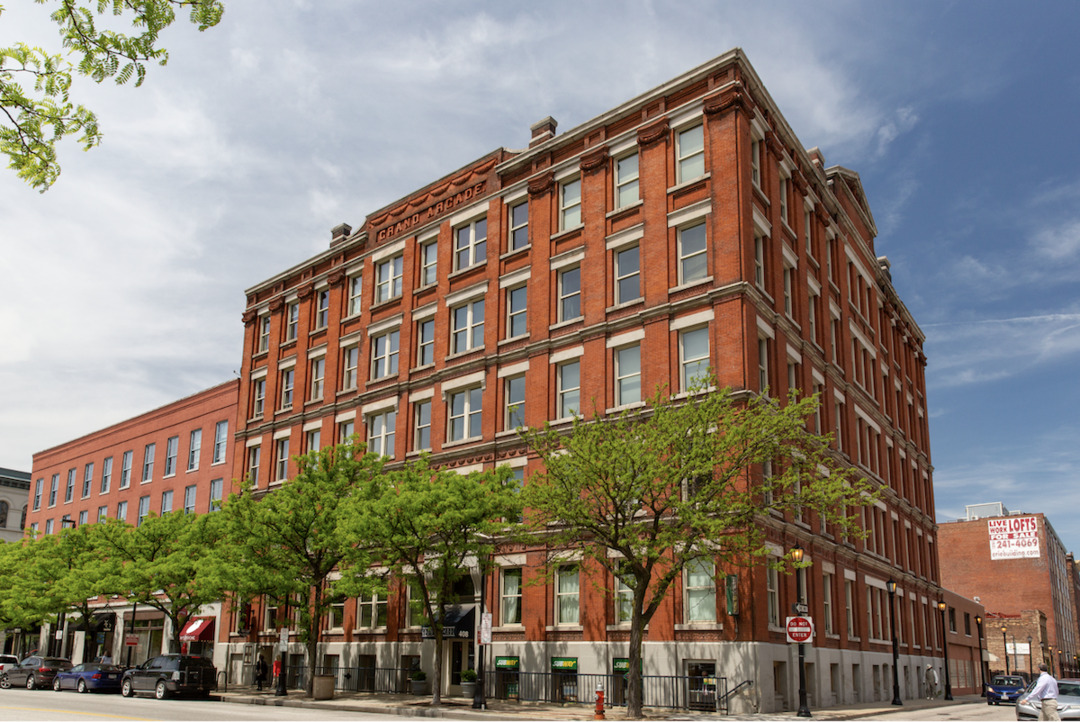
    <title type="html"><![CDATA[The Grand Arcade: W. C. Scofield&#039;s Enduring Building]]></title>
    <summary type="html"><![CDATA[<p><strong><em>When its construction was completed in 1883, the six-story Grand Arcade on the northwest corner of St. Clair and West 4th was the tallest commercial building and most prestigious business address in Cleveland.  Iron works, oil refineries and other industrial businesses rushed to lease offices in it.  However, when the even taller and more prestigious Perry-Payne Building opened on Superior Avenue  six years later, these businesses just as quickly left the Grand Arcade.  This wouldn't be the last occupancy challenge this historic building would face .</em></strong></p><img src="https://clevelandhistorical.org/files/fullsize/d392fd4e40264971599e4ebad93b154c.jpg" alt="The Grand Arcade" /><br/><p>William Charles Scofield, the person for whom the Grand Arcade Building at 408 West St. Clair Avenue was built, was one of Cleveland's most prominent industrialists in the second half of the nineteenth century.  He and John Alexander, reputedly the first person to refine oil in Cleveland, co-founded the Great Western Oil  Works which, in the 1860s, was one of the chief competitors of John D. Rockefeller's Standard Oil  Company.  When, in 1872,  Standard Oil Company engaged in anti-competitive acts and forced virtually all of Cleveland's oil refiners, including John Alexander and William Scofield, to sell their refineries to it at discounted prices, Alexander retired from the refinery business and returned to England. Scofield, however, did not.  He not only survived the so-called "Cleveland Massacre," but thrived after it.</p><p>In 1872,  the same year that he was forced out of the oil refining industry by Rockefeller's Standard Oil Company, W. C., as Scofield was known, entered the iron manufacturing industry, purchasing the historic Otis Iron Works on Whiskey Island.  He renamed it Lake Erie Iron Company, expanded its operations to include a new facility for the manufacture of nuts and bolts on land located between East 63rd Street and Addison Avenue close to the tracks of the Lake Shore and Michigan Southern Railroad, and made it a very successful business.  In 1874, two years after the Cleveland Massacre, Scofield formed a new partnership, built a new oil refinery on Willson Avenue (East 55th Street), north of Broadway and near the tracks of the Atlantic and Great Western Railroad, and re-entered the oil refining business, operating once again as Great Western Oil. </p><p>In 1882, W. C. Scofield decided to construct the Grand Arcade.  Yet, it wasn't his first presence on St. Clair or even the first building he had erected on that street.  After immigrating from England and arriving in Cleveland in about 1844, he and his wife Ann had settled on St.  Clair Street, where their first two children were born. In 1850, they had moved  east to Hamilton Street as the neighborhood northwest of Public Square (today known as the Warehouse District) began its mid nineteenth century transformation into a commercial district. Despite moving his residence, Scofield retained a presence on St. Clair, starting up several small manufacturing businesses there in the 1850s and early 1860s.</p><p>In 1864, the same year in which he formed his partnership with John Alexander, William Scofield had  expanded his business presence on St. Clair by purchasing the former homestead of pioneer Cleveland grocer and wholesale liquor merchant Nelson Monroe, which was located nearly directly across the street from where the Grand Arcade would be built almost two decades later.  The offices of the Great Western Oil  Company were located on this property from 1864 to 1868. In 1878, Scofield had further solidified his presence on St Clair by building the four-story brick and stone Scofield Block on the property.  A number of industrial tenants, including Scofield's Lake Erie Iron Company, soon moved their offices into that building.</p><p>So why did W. C. Scofield decide in 1882 to build the Grand Arcade across the street from the Scofield Block built just four years earlier?   It is not clear from recorded sources why he did so, but it may have been to expand his influence in the industry in which he was most personally and financially invested—coal and iron.  Whatever the reason, in February 1882, Scofield purchased the lot on the northwest corner of St. Clair and Academy (West 4th) and hired Cleveland architect Levi T. Scofield to design an office building for that lot which had 100 feet of frontage on St. Clair and 97 feet of frontage on Academy. Levi Scofield, who does not appear to have been a relative of W. C. Scofield—at least not a close relative—is best known to Clevelanders today as the architect of both the Soldiers and Sailors Monument on Public Square and the Schofield Building on the southwest corner of East 9th Street and Euclid Avenue. </p><p>Like some of the  other buildings Levi Scofield designed, the Grand Arcade was designed to be grand and notable.  Years after it was built, it was referred to by at least one newspaper as Cleveland 's first "modern" office building.  Designed in the Neoclassical Revival style with elements of Neo-Grec, it is a brick and stone building that stands six stories tall (five floors above ground with a raised basement).  Its exterior walls fronting St. Clair Avenue and West 4th Street are decorated with  pilasters, capitals, belt courses, entablatures, ornamental swags and other details formed from cut sandstone and unglazed terra cotta. The construction cost of the building was $100,000 ($3 million+ in 2024 dollars).</p><p>One of the most notable features of the Grand Arcade's original design was its approximately 100 by 20 foot,  five-story-tall interior court which had an ornate triangular prism-shaped glass skylight above it.  All of the building's interior offices had direct access to this court from iron balconies and descending stairs.  Regrettably, that interior court no longer exists.  Although no record has been found that documents when it was removed, it likely occurred during one of the several renovations of the building that took place between 1902 and 1962.</p><p>Another mystery associated with the Grand Arcade is: Why did W. C. Scofield decide to call this building an "arcade?"  That term traditionally refers to a building with a covered passageway lined with retail shops on both sides.  An article in the Cleveland Leader, on December 7, 1912, noted that "the building actually is not an arcade and received its name from  the court and its many balconies opening from the inner office suites."  However, there is no indication that the newspaper had obtained that explanation from W. C. Scofield who was still living at the time the article was published, and there may have been a reason, other than the explanation offered by the Leader, why Scofield used the term.  There were, in fact, retail shops located on the first floor of the building  in the decades of the 1880s and 1890s and some of these could have had interior storefronts and entrance ways on the court.</p><p>When the Grand Arcade opened in 1883, it notably drew as its first tenants a large number of companies from the coal and iron industries, some of which had previously been tenants in the Hilliard Building on Water (West 9th) Street which had been known since 1875 as the Coal and Iron Exchange Building.  According to information gleaned from the 1884-1885 Cleveland Directory,  the Grand Arcade in its first full year leased office suites to 14  iron manufacturing  companies and five coal companies.  However, when the Perry-Payne building opened in 1889, all of the iron manufacturing tenants, except Scofield's Lake Erie Iron Company, and all but two of the coal tenants left the Grand Arcade. </p><p>It appears, again from a survey of tenant listings in Cleveland directories, that W. C. Scofield attempted to address the departure of coal and iron companies from his building by seeking, in the 1890s, to attract  oil and railroad companies.  For a time he was successful in that effort, helped by the fact that so many railroads and streetcar companies had located their offices in buildings on St. Clair between Seneca (West 3rd) and Water (West 9th) that that stretch of St. Clair was known as Railroaders' Row.  But just as the opening of the Perry-Payne Building in 1889 had impacted the Grand Arcade's efforts to attract and keep coal and iron companies as tenants, the opening of additional new downtown office buildings in the 1890s, including the Society for Savings Building and the Arcade in 1890, the Western Reserve Building in 1892, the Garfield Building in 1893 and the New England Building in 1896, similarly impacted the Grand Arcades's efforts to attract tenants from other industries.  By 1899, only one oil company and just three railroad companies remained as tenants in the Grand Arcade.  In that same year, W. C. Scofield, who was already in his late seventies—although he would live to be 95 years old—turned over ownership and control of the building to his sons Charles and Frank.  They, likely with their father's blessing, took a new approach to dealing with the building's growing occupancy problem.</p><p>In 1902, the Grand Arcade was remodeled and transformed from an office building into what was then called a "power block," i.e., a building occupied by a single tenant.  It was a good decision for the Scofield family which would continue to own the Grand Arcade and lease it to a series of single tenants until they sold the property in 1955.  From 1902 until 1912, the building was leased to North Electric Company,  a telephone manufacturing company.  Then, from 1913 until 1926, it was leased to Clawson and Wilson, a wholesale drug company headquartered in Buffalo, New York. Finally, from 1926 until 1961, the building was occupied by the Standard Drug Company, a Cleveland  retail and wholesale company, which used it as a warehouse and  purchased the building from the Scofield family in 1955.  Standard Drug sold the Grand Arcade in 1961  to a realty company.  The following year, the building was purchased by the non-profit City Mission which remodeled  and converted it into a homeless shelter.  </p><p>After occupying the building for almost three decades, the City Mission sold the Grand Arcade  in 1991 to a for-profit limited partnership which restored and renovated the building, converting it to a new  residential use, first as market-rate apartments and later as condominiums. In the second phase of the project, three other historic Warehouse District buildings were added to the Grand Arcade condominium development—the Waring Building, built in 1855 and located on St. Clair adjacent to the Grand Arcade;  the Klein-Marks Building, built in 1881 and located on West 6th Street just north of the Waring Building; and the Blair Building, built circa 1868 and located just north of the Klein-Marks Building.</p><p>From Cleveland's tallest office building and most prestigious address; to a "power block" for single commercial tenants; to a wholesale drug warehouse; to a shelter for Cleveland's homeless; to market-rate apartments; and finally to residential condominiums, the Grand Arcade has endured more use changes than most  of Cleveland's other historic buildings. Through it all, the Grand Arcade, much like the nineteenth century industrialist who built it, has not only survived, but has thrived.</p><p><em><strong><a href="https://clevelandhistorical.org/items/show/1023">For more (including 17 images) view the original article</a></strong></em></p>]]></summary>
    <published>2024-04-16T16:33:30+00:00</published>
    <updated>2026-03-04T21:32:05+00:00</updated>
    <link rel="alternate" type="text/html" href="https://clevelandhistorical.org/items/show/1023"/>
    <id>https://clevelandhistorical.org/items/show/1023</id>
    <author>
      <name>Jim Dubelko</name>
    </author>
  </entry>
  <entry>
    <title type="html"><![CDATA[Van Dorn Iron Works: Makers of Decorative Fences, Jail Cells, Armored Cars, and More]]></title>
    <summary type="html"><![CDATA[<img src="https://clevelandhistorical.org/files/fullsize/0f0a46cac10087b5299c32bd143865da.jpg" alt="Van Dorn Iron Works Aerial View" /><br/><p>The Van Dorn Iron Works Company was one of the leading companies in the iron industry and later plastic molding industry throughout the twentieth century. J. H. Van Dorn started his business in 1872 from the basement of his Akron home where he created a unique style of wrought iron fencing that he displayed in his own front yard which was said to be “such an interesting exhibit that it became town talk.” In 1878, Van Dorn moved his expanding business to Cleveland renaming it the Cleveland Wrought Iron Fence Company.</p><p>With the expansion of their product line into ornamental iron objects, Van Dorn renamed the company the Van Dorn Iron Works and became incorporated under The Van Dorn Iron Works Company in 1891. The company produced a variety of different products including ornamental iron products, metal office furniture, structural steel, and automobile parts.</p><p>By the 1910s, Van Dorn Iron Works became best known for manufacturing jail cells, which J. H. Van Dorn claimed to be no more than “fences built indoors.” The company became the largest manufacturer of jail cells in the world for several decades in the twentieth century, assembling nearly 28,000 jail cells from 1918 to 1938 that it sold throughout the U.S. and foreign countries. Van Dorn supplied cells for a variety of prisons across the U.S., including the Connecticut State Prison, Nebraska State Prison, West Virginia State Prison, Maryland State Penitentiary, and the Tombs Prison in New York. Van Dorn also assembled jail cells throughout Ohio, including for the Cuyahoga County Jail and the city jails in Cleveland, East Cleveland, and North Royalton.</p><p>One of Van Dorn’s unique contributions to the city of Cleveland was the company’s role in constructing the superstructure of the Detroit-Superior Bridge, which was among the world's largest steel and concrete reinforced bridges at the time. Van Dorn built the steel frame of the Williamson Building in 1899 situated on Public Square, which was long considered to be the city’s largest and best building. The Van Dorn Iron Works also constructed the steel crib that was sunk in Lake Erie to supply the city’s fresh water. Other notable contributions made by the Van Dorn Iron Works were contracts to supply iron work to the Cleveland Arcade, the central police station, and the new city hall.</p><p>Van Dorn Iron Works was contracted by companies throughout the entire country for their iron products. In 1905, Van Dorn was contracted by the United States government to manufacture 8,000 mailboxes, which offered the company approximately $25,000 in profit. Van Dorn supplied metallic furniture to the Library of Congress and the Post Office Department in Washington D.C.</p><p>Van Dorn became an important wartime production company to supply the United States military. During World War I, the Van Dorn Iron Works Company produced Renault six-ton tanks and was only one of three companies in Ohio to produce tanks. Van Dorn also produced a variety of marine furniture for the navy including cots, desks, lockers, and mess tables all of which had to be specially enameled and lacquered. Van Dorn also produced armor plating for military vehicles and aircraft during both World Wars. The Van Dorn Iron Works Company was rated one hundred percent for their wartime production during the First World War, while they received a pennant for outstanding performance in wartime production during World War II.</p><p>Following the end of World War II, Van Dorn began diversifying their manufacturing production into the container and plastics fields with the purchase of the Davies Can Company and the Colonial Plastics Mfg. Co. The company also expanded by creating a plastic molding division as early as 1946, which would dominate the company's future success. Throughout the 1950s, Van Dorn grew to become one of the nations leaders in the plastics and container industries. The 1960s was a prosperous decade for Van Dorn as it continued to expand its product line. Van Dorn’s new direction towards producing containers and plastic injection molds led the company to change its name in 1964 to simply the Van Dorn Company.</p><p>During the 1970s, Van Dorn participated in the Woodland East Community Organization, or WECO, one of Cleveland’s neighborhood revival programs that intended to revitalize the neighborhood. The Van Dorn Company led the efforts of WECO as Van Dorn’s industrial planning coordinator was the WECO project director. By 1980, the Van Dorn Company was the largest neighborhood employer out of the 26 members of WECO.</p><p>During the 1980’s, the Van Dorn Company began to consolidate their subsidiaries due to pressure from Cleveland’s deindustrialization. By 1985, the Van Dorn Company had 19 plants throughout the world following their consolidation and reorganization efforts. The Van Dorn Company closed its East 79th plant in 1991 after being in Cleveland for over one hundred years. The effects of deindustrialization ultimately struck the Van Dorn Company in 1993 when the company was sold to the Crown Cork and Seal Company.</p><p>Van Dorn’s survival in Cleveland for over one hundred years contributed substantially to the overall growth of the city. Van Dorn prospered throughout Cleveland’s industrial revolution and did not suffer from the effects of deindustrialization until the late 1980s. The Van Dorn Company led a variety of different industries including the wrought iron fence, jail cell, plastic injection molding, and container industries throughout the twentieth century. Van Dorn’s long existence was due to their successful ability to expand their lines of production into different industries. The Van Dorn Company saw the potential in a variety of different products and maintained a diverse line of production.</p><p><em><strong><a href="https://clevelandhistorical.org/items/show/883">For more (including 11 images) view the original article</a></strong></em></p>]]></summary>
    <published>2019-11-20T20:08:37+00:00</published>
    <updated>2026-03-04T21:32:01+00:00</updated>
    <link rel="alternate" type="text/html" href="https://clevelandhistorical.org/items/show/883"/>
    <id>https://clevelandhistorical.org/items/show/883</id>
    <author>
      <name>Paul Spencer</name>
    </author>
  </entry>
  <entry>
    <title type="html"><![CDATA[The Huletts]]></title>
    <summary type="html"><![CDATA[<img src="https://clevelandhistorical.org/files/fullsize/d3af91dcceddf94bbda98001c63bdee1.jpg" alt="The Huletts at Whiskey Island" /><br/><p>In an era of industrial expansion and technological advances, the Hulett Ore-Unloader helped Cleveland become one of the greatest steel manufacturing cities of the twentieth century. The invention, designed by George Hulett, was vital to the production and processing of iron ore into steel. </p><p>In 1844, rich iron ore deposits were discovered in the Upper Peninsula of Michigan. The ore was originally very expensive to transport, especially from places like the upper Great Lakes region to the Lake Erie coast. The high prices did not affect the demand for ore very much. Instead, the high demand encouraged investments and innovations in both transportation and handling techniques. New technologies and practices could give a company a vital edge in the growing iron ore industry. By 1853, the Cleveland Iron Mining Company shipped 152 tons of iron to the Sharon Iron Company in Pennsylvania.  At this time, the ore was manually loaded and unloaded by men using shovels and wheelbarrows. It took about a week to unload a 300-ton shipment of iron ore using this method of raw manpower.</p><p>Before Hulett developed his invention, there were many men who realized that the existing method of unloading ships was not ideal nor very efficient. In the 1860s, a steam-hoisting engine was developed to lift and lower metal tubs in and out of the cargo holds. The metal tubs were filled with iron ore, but a group of men was still needed to shovel the ore into the vessels. Later, in the 1880s, a man named Alexander Brown improved upon the steam-hoist and named it the Brownhoist. The Brownhoist utilized a self-filling grab bucket, which could grab 1.5 tons of ore with each pass. Brown's invention significantly reduced the time and cost of unloading the ore. This helped lower the price of the product from 30-50 cents a ton to as little as 18 cents a ton. The Brownhoist thus increased the production of steel. Even so, large numbers of men were still needed to move the ore around the holds in order for the bucket to grab its full capacity.</p><p>Further developing on the ideas of others, George Hulett invented a machine that would forever change the production of steel in the United States. Born in 1846 in Conneaut, Ohio, Hulett moved to Cleveland with his family at an early age. After graduating from the Humiston Institute in 1864, he ran a general store in Unionville, Ohio, but returned to Cleveland in 1881. His return to the coast of Lake Erie prompted a string of ideas and innovations, leading to the development of several patents between the years of 1887 and 1906. Hulett secured more than two dozen of these patents, which included a variety of conveying and hoisting machinery. His greatest patent was developed in 1898 and would be in service a year later in his hometown of Conneaut, Ohio. It was to be known as the Hulett Ore-Unloader.</p><p>George Hulett secured a patent for his unloader and a patent for the bucket the machine needed to revolutionize the industry. The first-generation Hulett was steam powered and its bucket had a 10-ton "bite."  In 1912, four second-generation Huletts were built on Whiskey Island. These Huletts were electrically powered and their buckets could grab 17 tons of ore at one time–a vast improvement on the Brownhoist's 1.5 tons from the 1880s. The price of ore now dropped below five cents a ton and helped launch Cleveland as one of the major steel producers in the world. The Huletts worked the docks of the Great Lakes for almost a century until self-unloading freighters appeared in the late 1970s. As late as 1999, six Huletts were still standing, including the four on Whiskey Island. However, despite a preservation effort that led to their historic designation, all but two Huletts were destroyed, and the other two were carefully disassembled so that they might be reconstructed in the future.</p><p><em><strong><a href="https://clevelandhistorical.org/items/show/470">For more (including 5 images&#32;&amp;&#32;1 audio file) view the original article</a></strong></em></p>]]></summary>
    <published>2012-05-22T14:18:09+00:00</published>
    <updated>2026-03-04T21:32:00+00:00</updated>
    <link rel="alternate" type="text/html" href="https://clevelandhistorical.org/items/show/470"/>
    <id>https://clevelandhistorical.org/items/show/470</id>
    <author>
      <name>Gabriela Halligan&amp;#32;&amp;amp;&amp;#32;J. Csykes</name>
    </author>
  </entry>
  <entry>
    <title type="html"><![CDATA[Rose Iron Works: The Nation&#039;s Oldest Decorative Metalwork Company]]></title>
    <summary type="html"><![CDATA[<img src="https://clevelandhistorical.org/files/fullsize/lg_rose-paul-feher-art-deco-screen-cma-3521996_f248b68887.jpg" alt="Art Deco Screen (1930)" /><br/><p>The Rose Iron Works, opened in 1904 on Cleveland's east side. The oldest continually-operating decorative metalwork company in the United States, it was founded by Martin Rose, a Hungarian immigrant who worked in Budapest and Vienna before moving to Cleveland. </p><p>Rose provided craft metalwork that adorned many of Cleveland's notable dwellings and buildings during the height of the city's growth. The works included fanciful dividing screens at Halle's as well as the decorative iron gates that guarded many of the Millionaires' Row estates on Euclid Avenue. Informed by European ornamental Beaux-Arts architecture, Rose worked in the tradition of other craft ironworkers such as Samuel Yellin.</p><p>Even as the market for ornamental ironwork began to decline as a result of changing styles and the Depression, Rose Iron Works thrived. During the 1930s, the Rose Iron Works produced some of the most notable Art Deco ironwork in the nation, including styling recognized internationally for their uniquely American characteristics.  </p><p>The company turned to the production of industrial products during World War II (an activity that now dominates its business) but it never forsook the craft and metalworking traditions of nineteenth-century Europe. </p><p><em><strong><a href="https://clevelandhistorical.org/items/show/13">For more (including 9 images, 3 audio files,&#32;&amp;&#32;3 videos) view the original article</a></strong></em></p>]]></summary>
    <published>2010-09-14T15:17:51+00:00</published>
    <updated>2026-04-04T22:10:23+00:00</updated>
    <link rel="alternate" type="text/html" href="https://clevelandhistorical.org/items/show/13"/>
    <id>https://clevelandhistorical.org/items/show/13</id>
    <author>
      <name>Emma Yanoshik-Wing, James Calder,&amp;#32;&amp;amp;&amp;#32;Mark Tebeau</name>
    </author>
  </entry>
</feed>
