<?xml version="1.0" encoding="UTF-8"?>
<feed xmlns="http://www.w3.org/2005/Atom">
  <title type="text">Cleveland Historical</title>
  <updated>2026-05-10T00:53:52+00:00</updated>
  <generator uri="http://framework.zend.com" version="1.12.20">Zend_Feed_Writer</generator>
  <link rel="alternate" type="text/html" href="https://clevelandhistorical.org/"/>
  <link rel="self" type="application/atom+xml" href="https://clevelandhistorical.org/items/browse?output=rss2"/>
  <id>https://clevelandhistorical.org/</id>
  <author>
    <name>Cleveland Historical</name>
    <uri>https://clevelandhistorical.org</uri>
  </author>
  <link rel="hub" href="http://pubsubhubbub.appspot.com/"/>
  <entry>
    <title type="html"><![CDATA[Moreland Elementary School: Historic Focal Point of the Moreland Neighborhood]]></title>
    <summary type="html"><![CDATA[<p><strong><em>Built in the Roaring Twenties to provide an elementary school education for the children of the families that were moving into the fast-growing, southwesternmost neighborhood of Shaker Heights, Moreland Elementary School not only lent its name to that neighborhood, but also became the neighborhood's iconic  landmark and its enduring symbol of heritage, transition, and renaissance.  </em></strong></p><img src="https://clevelandhistorical.org/files/fullsize/c0f8664caa0c0ed039e3e2bec1bdea26.jpg" alt="Moreland Elementary School (1926-1987)" /><br/><p>The Van Sweringen brothers knew that a premier suburb required a premier public school system.  So, it was not surprising that, in 1913, just one year after the incorporation of Shaker Heights, its Board of Education began implementing the Vans' vision, undertaking an ambitious building program that proposed to place a new elementary school in every neighborhood of the village. When neighboring East View Village was annexed in 1920, the school building program was extended to that new territory, which soon became home to Shaker Heights' southernmost residential neighborhoods.</p><p>Prior to the annexation, children in East View Village had attended elementary school in a small, four-classroom building located on the west side of Lee Road between South Moreland (Van Aken) Boulevard and Kinsman Road (now Chagrin Boulevard). That school building continued to be used by the Shaker Heights Board of Education for several years as an elementary school for children living in Shaker's southwesternmost neighborhood--later known as the Moreland neighborhood. By 1924, however, the Board recognized that the building had become inadequate to accommodate all of the school-age children living in this fast-growing area of Shaker Heights. Accordingly, in that year, the Board decided to build a new, larger elementary school just to the west of East View School, on a parcel of land sold to it by the Van Sweringens.</p><p>Charles Winning Bates, an architect from Wheeling, West Virginia, who had designed other school buildings in Shaker Heights, was awarded a contract by the Board of Education to design this new school.  Bates designed it in the neo-Georgian style, matching all other Shaker school buildings of its era. Three stories tall, brick, and with a grand entrance facing South Moreland (Van Aken) Boulevard, the new building was to have 28 classrooms — seven times as many as old East View School, as well as a teacher's restroom, a principal's office, a medical room, and an auditorium-gymnasium. After the Shaker Heights electorate approved a bond issue in November 1924 which had earmarked $425,000 for the new school building, construction commenced in 1925. By 1926, the building was completed, and on March 15 of that year the first children moved out of East View School and marched a few hundred feet into the new building, which was initially called Lee-Moreland School.</p><p>From the late 1920s until the late 1950s, Lee-Moreland School, which was by 1940 simply called Moreland School, served a largely Jewish population living in the Moreland neighborhood. In addition to providing a quality public education to the neighborhood's children, the school building also served as a meeting place for many Jewish organizations, as a place where sacred Jewish days were celebrated or commemorated, and even as a religious school for Temple Emanu El and the Cleveland Hebrew School. Beginning around 1960, as many Moreland neighborhood Jewish families moved to suburbs north and east of Shaker Heights, they were replaced largely by African American families, many of whom were moving out of Cleveland and its overcrowded school system, and into Shaker Heights with its nationally recognized, excellent school system.  </p><p>Racial transition in Shaker Heights presented challenges to many institutions in many places throughout the city, but perhaps none greater or more important to the city's future than those faced by Moreland Elementary School. Fortunately, the school was headed in this era by a principal who was more than up to the task. Orville Jenkins, who grew up in southern Ohio, attended college at Bowling Green University, taught as a teacher for a number of years, and then became principal of an elementary school in the Toledo, Ohio, area. In 1956, the Shaker Heights Board of Education hired him as the principal of Moreland Elementary School. Jenkins, who purchased a home on Scottsdale Boulevard in the Moreland neighborhood, was soon recognized as an excellent principal, and, as well, a fiery advocate for integrated schools. When the Moreland neighborhood began undergoing racial transition in the 1960s, Jenkins was among the leaders of the neighborhood who engaged in concerted efforts to stop blockbusting, to keep the neighborhood stable, and to preserve the high standard of community life there. He helped found the Moreland Community Association (MCA) in 1962 and he permitted the new organization to hold its meetings and functions at Moreland Elementary school. He instituted an individualized instruction program at the school, designed to help children to learn at a pace most appropriate for them. And, he became a friend to all children in the school.  Jenkins was said to have known the first name of every child in the school. He served as school principal, as well as a trustee of the MCA and other community organizations, including the Shaker Historical Society, until his untimely death at age 46 in October 1969.</p><p>Despite the efforts of Principal Jenkins, and many others in Shaker Heights, to keep Moreland an integrated neighborhood, by 1969 its population had become overwhelmingly African American, and, according to a November 18, 1969 Plain Dealer article, the number of African American children attending Moreland Elementary School had reached ninety-five percent. The Moreland Community Association, with a goal of seeing Moreland Elementary School re-integrate, petitioned the Shaker School Board of Education to initiate a program to bring in white children from other neighborhoods of Shaker Heights to achieve that.  Ultimately, Shaker Heights BOE, after a series of public meetings, instituted a voluntary busing program (the "Shaker Plan") in the city, which, with modifications in the mid-1970s, resulted in a somewhat improved racial balance at Moreland in that decade.</p><p>At about the same time that the voluntary busing program was instituted in Shaker Heights, the city began suffering a decline in the number of school-age children in its public school system and the Board of Education began experiencing financial difficulties in maintaining all of the existing school buildings. To remedy this problem, the Board of Education ultimately adopted a school reorganization plan that led to the closing of Moreland Elementary school in 1987, despite vigorous protests from the Moreland neighborhood. While Shaker Heights initially considered selling the old school building for private redevelopment, it was eventually persuaded to preserve it because of its importance to the Moreland neighborhood's history and identity. In 1993, after a renovation process was completed, the former Moreland Elementary School became the new main branch of the Shaker Heights Public Library.  </p><p>More than two decades have now passed since Moreland Elementary School was transformed into the new Shaker Heights Public Library.  While the historic building now serves a different purpose in the community, the purpose it serves is still an educational one. And, perhaps more importantly, at least to the Moreland neighborhood, the building continues to be a focal point for the neighborhood, a beloved landmark, and an enduring symbol of the neighborhood's heritage, transition, and renaissance.</p><p><em><strong><a href="https://clevelandhistorical.org/items/show/835">For more (including 12 images) view the original article</a></strong></em></p>]]></summary>
    <published>2018-05-09T15:06:42+00:00</published>
    <updated>2026-04-17T19:17:41+00:00</updated>
    <link rel="alternate" type="text/html" href="https://clevelandhistorical.org/items/show/835"/>
    <id>https://clevelandhistorical.org/items/show/835</id>
    <author>
      <name>Jim Dubelko</name>
    </author>
  </entry>
  <entry>
    <title type="html"><![CDATA[The Desegregation of Cleveland Public Schools: A 40-Year Struggle for Public School Equity]]></title>
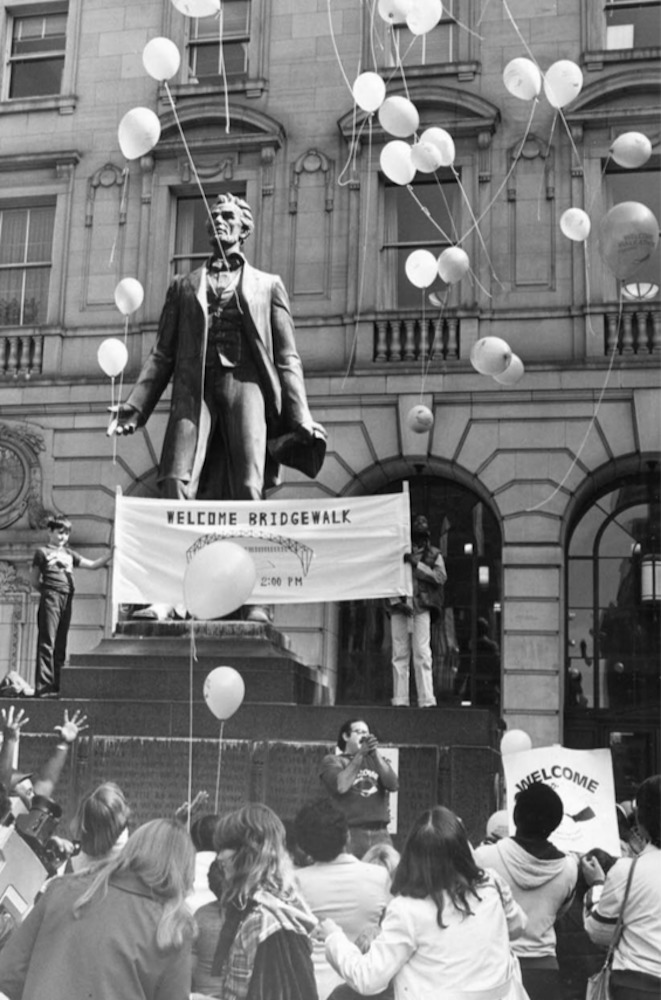
    <summary type="html"><![CDATA[<p><strong><em>A 1976 landmark federal court ruling challenged Cleveland to take long-overdue action to desegregate its public school system. Although slowed by  litigation and disputes, the school district implemented crosstown busing to try to offset longstanding residential segregation patterns rooted in discriminatory real estate and lending practices. Compared to some other cities such as Boston, Cleveland's busing program was relatively peaceful, but it nonetheless produced its share of anxiety and unrest. While most Clevelanders agreed that change was necessary, the reality of transporting students away from neighborhood schools to unknown ones across the city challenged students, parents, educators, and the greater community to weigh the costs and benefits of personal comfort and social justice.</em></strong></p><img src="https://clevelandhistorical.org/files/fullsize/7e8b5eb2d920e1b57695cfbf3a8ba9e4.jpg" alt="Bridgewalk, 1980" /><br/><p>Gathering at the Lincoln Statue in front of the Board of Education building, members of WELCOME (West-East Siders Let’s Come Together) rallied to promote a safe and peaceful start of busing to achieve racial balance in the Cleveland Schools. The federal court order and plans were in place amid community unrest concerning the transporting of students to desegregate the schools beginning in the 1979-80 school year. However the reality of transporting students to achieve integrated schools throughout the city challenged students, parents, activists, and educators to meet on Cleveland’s major east-west bridge to mount an effort to insure student safety and keep the process peaceful. Members of CORK (Citizens Opposed to Rearranging Kids) also called for the uninterrupted and peaceful implementation of the initial phases of desegregation. These rallies marked the beginning of each of three phases of student transportation during the year. Despite their feelings, citizens of Cleveland wanted a peaceful school atmosphere. </p><p>The effort that began fifteen years earlier was inspired in part by activism in the South. Yearlong protests of discriminatory student assignment policies in the Cleveland Public Schools culminated with the tragic death of a protester at <a href="https://clevelandhistorical.org/items/show/254">Stephen E. Howe Elementary School</a> in 1964. School system scrutiny and debate continued over the ensuing decade and a lawsuit known as <em>Reed v. Rhodes</em> was filed with the Federal Court in Cleveland in 1973. </p><p>  The litigation was long and complicated. Two years after the suit was filed on December 12, 1973, the late Judge Frank J. Battisti presided over a lengthy bench trial in 1975 and 1976. On August 31, 1976, Judge Battisti concluded that “the District and other Defendants, including the state board of education, had contributed, by both commission and omission, to an unconstitutional segregation of the Cleveland Public Schools.” The court permanently enjoined defendants “from discriminating on the basis of race in the operation of the public schools of the City of Cleveland, and from creating, promoting, or maintaining racial segregation in any school or other facility in the Cleveland Public Schools.” Both the state and local defendants were ordered to submit plans to desegregate the school district, which failed the court’s approval. A Special Master was appointed to develop a plan and later, on February 6, 1978, the court reaffirmed its earlier conclusion that the defendants were constitutionally liable for having maintained a de jure segregated public school system, and that these numerous constitutional violations demanded a system-wide remedy.      </p><p>The court issued a remedial order directing Defendants to implement, beginning in September 1978, a “comprehensive, system-wide plan of actual desegregation which eliminates the systematic pattern of schools substantially disproportionate in their racial composition to the maximum extent feasible.” The broad remedial order required the defendants to desegregate administrative, supervisory and teaching personnel, to desegregate the schools, to develop creative educational curriculums, and to develop methods of monitoring compliance. The district court also ordered racial balance:  “the racial composition of the student body of any school within the system shall not substantially deviate from the racial composition of the system as a whole.” Additional guarantees of student safety, counseling, extra curricular programs, transportation services were ordered among others.    </p><p>Work then began to devise a method to remedy segregation in the Cleveland schools; plans were prepared to respond to all aspects of the court ruling. Also, the court re-appointed a Special Master, retained two experts on school desegregation, established the Office of School Monitoring and Community Relations (which it charged with rigorous monitoring of desegregation implementation), and ordered the appointment of an official Desegregation Administrator to be paid by the defendants.    </p><p>In order to comply with the plus/minus 15% racial benchmark, students were assigned and bused to schools across town to achieve the requisite racial balance in each individual school. When imbalances resurfaced, they were corrected by administrative orders and students were reassigned as needed. Following additional litigation and challenges in 1977, the court ordered implementation to begin. A limited number of junior high students were transported in 1978-79 school year followed by a three-phase system-wide implementation from September 1979 to September 1980.   </p><p>Meanwhile, an unhappy community continued to protest the court approved remedies to be implemented. Pro and anti-busing advocates frequently picketed the school district headquarters, but the Court prevailed with its charge to proceed. Annually, throughout the 1980s, students were reassigned and bused to satisfy the court order. Bus rides for some students exceeded 80 minutes each way as east and west side students were assigned to cross-town destinations to balance the school populations. Despite the ongoing debate within the community, student transportation and assignments were never interrupted by civil disobedience. The intention to carry out court orders in a peaceful manner prevailed. In 1987, Judge Battisti authorized changes in pupil assignments without prior court approval if such changes were agreeable to the following three parties:  the school district, the State Superintendent, and Plaintiffs' legal counsel. During the initial six years of full implementation, the district, the monitoring agency, and the court remained engaged in detailed review of the progress and the reorganization of district management. </p><p>In the 1980s, the city school system became predominantly nonwhite as a result of white flight out of the city and school boundaries. The Cleveland School District operated approximately 130 schools, 90% of which satisfied the 15% limitation every year. Dr. Gordon Foster, who had previously served as the plaintiffs' expert witness during the liability phase of this case, issued a report in 1988 that stated the district had ended any overt segregation or discrimination and was “the only majority black, large city system in the country which is totally desegregated.” In addition, as ordered, the Office of School Monitoring and Community Relations conducted a detailed assessment of the state of compliance with all outstanding remedial orders and concluded that the defendants had substantially complied with the 15% limitation and that any deviations could not be attributed to discriminatory student assignments. While a relatively small proportion of district schools each year had enrollments that exceed the maximum deviation, no evidence suggested that this was the result of discrimination on the basis of race in the assignment of students. The Monitoring Office's assessment recommended that the parties continue to work together to move the case forward.   </p><p>In March 1992, the district court vacated over 500 orders upon joint motion of all the parties. However, there was a sense that the quality of public education had declined while the cost of operation had increased. The court thus urged the parties “not to hesitate to think about innovative programs and undertakings” that might ameliorate the situation in the school system. Judge Battisti further noted “the Court [had] not set out to run a busing company,”  and directed the parties to address whether they believed “the interests of the students in Cleveland would be better served by an alternative student assignment plan,”  and further suggested that parental and student choice become an important factor in student assignment within the Cleveland School District.    </p><p>By 1998, U.S. District Chief Judge George W. White concluded that it was time to end the quarter-century court battle over integrating the 76,500-student district, saying "the purposes of this desegregation litigation have been fully achieved." In declaring the system "unitary," the judge found that the state and district had done all that could be expected to remedy the harm created by past segregation in the changing urban district. The persistent gap in student performance between black and white students, he found, "is the result of socioeconomic status and factors directly related to it, not race." In doing so, the judge also began the process to determine how much longer state education officials would keep day-to-day control of the district. He would hold hearings soon to consider lifting the 1995 order in the desegregation case that declared the district in crisis and stripped the elected school board of authority and arrange the control of the school district under the city’s mayor-appointed school board. Nonetheless the community, though grudgingly, had also cooperated during the twenty years to maintain a peaceful desegregation process in Cleveland.</p><p><em><strong><a href="https://clevelandhistorical.org/items/show/813">For more (including 14 images&#32;&amp;&#32;1 audio file) view the original article</a></strong></em></p>]]></summary>
    <published>2017-10-03T16:37:39+00:00</published>
    <updated>2026-04-17T19:17:41+00:00</updated>
    <link rel="alternate" type="text/html" href="https://clevelandhistorical.org/items/show/813"/>
    <id>https://clevelandhistorical.org/items/show/813</id>
    <author>
      <name>Jim Lanese</name>
    </author>
  </entry>
</feed>