<?xml version="1.0" encoding="UTF-8"?>
<feed xmlns="http://www.w3.org/2005/Atom">
  <title type="text">Cleveland Historical</title>
  <updated>2026-05-02T04:45:02+00:00</updated>
  <generator uri="http://framework.zend.com" version="1.12.20">Zend_Feed_Writer</generator>
  <link rel="alternate" type="text/html" href="https://clevelandhistorical.org/"/>
  <link rel="self" type="application/atom+xml" href="https://clevelandhistorical.org/items/browse?output=rss2"/>
  <id>https://clevelandhistorical.org/</id>
  <author>
    <name>Cleveland Historical</name>
    <uri>https://clevelandhistorical.org</uri>
  </author>
  <link rel="hub" href="http://pubsubhubbub.appspot.com/"/>
  <entry>
    <title type="html"><![CDATA[Carling Brewery: How Canadian Beer Saved a Faltering Auto Plant]]></title>
    <summary type="html"><![CDATA[<p><strong><em>The Great Depression had been its downfall, but the end of Prohibition promised a fresh start for a Cleveland luxury automaker. Three years after the last car—a single aluminum-bodied, V16-powered Peerless sedan—rolled out of its plant, the factory-turned-brewery was bottling Carling Red Cap Ale.</em></strong></p><img src="https://clevelandhistorical.org/files/fullsize/499058d69779adf1e6e194de0b08fcde.jpg" alt="Carling Brewery North Facade" /><br/><p>Carling Brewery is a story of a company that took the opportunity to use the power of Cleveland as a home of production to reach markets across America and grow its business exponentially. Founded in 1840 by English immigrant Thomas Carling in London, Ontario, Canada, the Carling Brewing Company first entered the U.S. market in 1898 when the Cleveland & Sandusky Brewing Company purchased rights to the Carling name. This lasted only thirteen years. </p><p>The brand returned two decades later under much different circumstances. Following the repeal of Prohibition in 1933 the Canadian company saw new opportunity south of the broder and turned to Cleveland. Cleveland proved to be a good choice as Carling’s famous “Black Label Beer” dominated markets for decades. The Carling Brewery and the city of Cleveland benefited from one another and each had a lasting impact on the other. Born of industrial adversity in the Great Depression, the Carling plant itself would become a victim of a new round of economic hardship in the 1970s. </p><p>In 1933, Peerless Motor Car Company president James A. Bohannon faced America’s Great Depression head on. Because demand for his luxury cars had collapsed due to the sharp economic downturn, the company’s plant on Quincy Avenue at East 93rd Street, once used to produce these cars, was no longer viable. Bohannon's problem presented an opportunity for him and for Carling. He entered a joint venture that helped Carling expand while promising a new direction for his plant. After incorporating as the Brewing Corporation of America, by 1934, Bohannon's plant that once made luxury vehicles was producing ales that had previously been made only in Canada since the 1840s. In a <i>Plain Dealer</i> article from that year, Harry Smith referred to Cleveland as one of the most modern homes for manufacturing in the world. </p><p>After Bohannon acquired the rights from the brewery, Canadian engineers and brewmasters helped transform the auto plant to a brewery, as well as instruct the new employees on how to make the beer. Though the plant was originally intended for cars, it seems that its transition to brewing was rather seamless, and in no time Carling was selling Cleveland-made beer, first Red Cap Ale and soon Black Label Beer. The plant's transition from car manufacturing to brewing beer essentially proved to be its salvation. </p><p>The Cleveland plant, which consisted of a series of long, low-slung brick buildings, was the biggest of Carling’s nine locations throughout Canada and the United States. Cleveland produced an average of 2.2 million barrels of beer annually, which amounted to 68.2 million gallons a year. The Cleveland location also employed 800 people, making it one of the industry’s biggest employers. Not only did the people in the factories make the beer, they had the responsibility of tasting it at every step in the process to ensure it met the expectations of quality.</p><p>By 1946, Carling was expanding in Cleveland and rumors arose that the company had planned to buy up a large amount of land in the area and force out homeowners in this corner of the Fairfax neighborhood, which was mostly African American. In a <i>Plain Dealer</i> article that year, an executive from the Cleveland brewery dispelled the rumors by explaining that only thirteen families would be affected by the brewery’s expansion. The Cleveland brewery was proving to be a success, and from 1933 to the start of the 1960s, the company was seeing growth in sales that allowed it to expand to meet demand. </p><p>As the Carling brand became increasingly popular, the Brewing Company of America changed its name to Carling Brewing Company in 1954 and began expanding to multiple cities across the country. Opening manufacturing plants in almost every region, the Cleveland plant continued to be the home of the Black Label beer. Through the mid-20th century, brewing local beer was a huge success for the city of Cleveland, sometimes called “the brewery capital of the United States.” As late as 1971, the <i>Plain Dealer</i> could point to over 25 breweries that were at one time producing beer in our own backyard. However, Carling Brewing Company was struggling to keep up with competitors like Miller and Anheuser-Busch, which had emerged as macro breweries, meaning their beer was manufactured and sold in large volume across the United States. These huge brewing companies continued to expand due to their low costs and through acquiring more smaller breweries to expand their command of the beer market. </p><p>To maintain their market share, the smaller brewing companies that hoped to remain independent continually had to reduce their prices and spend more on advertising each year. For example, Carling paid dearly for key endorsements like being the main beer sponsor of the Browns and the Indians. As sales declined, Carling had to shut down brewing locations around the country even though many people loved their products. In 1971, the Cleveland plant was among the casualties of insurmountable competition, although another firm, C. Schmidt & Sons of Philadelphia, bought the plant and operated it for another twelve years. </p><p>Although Cleveland’s many older breweries like Carling failed to survive the restructuring of the industry, brewing has been picking up again in the area in recent decades, and the larger companies that have emerged since the 1980s – notably the Great Lakes Brewing Company and Market Garden Brewery – have enjoyed success not only in Cleveland but also in the entire Midwest. Breweries such as Carling exemplified that Cleveland can still be a major player in beer production. The local breweries in Cleveland today, while smaller in scale than older ones like Carling, carry on the city’s great brewing heritage.</p><p><em><strong><a href="https://clevelandhistorical.org/items/show/922">For more (including 10 images) view the original article</a></strong></em></p>]]></summary>
    <published>2020-12-12T21:47:02+00:00</published>
    <updated>2026-04-17T19:17:42+00:00</updated>
    <link rel="alternate" type="text/html" href="https://clevelandhistorical.org/items/show/922"/>
    <id>https://clevelandhistorical.org/items/show/922</id>
    <author>
      <name>Olivia Robinson</name>
    </author>
  </entry>
  <entry>
    <title type="html"><![CDATA[A Public Service Message from David Blaushild Chevrolet: &quot;Let’s Stop Killing Lake Erie!&quot;]]></title>
    <summary type="html"><![CDATA[<p><strong><em>In July of 1964, motorists were greeted by the newest billboard from Shaker Heights auto dealer David L. Blaushild.  Bold letters declared: “Let’s Stop Killing Lake Erie, have your council vote Anti-Pollution!"  Learn how one car salesman  helped initiate an environmental movement in Cleveland that pushed lawmakers to publicly recognize and respond to the lax enforcement of antipollution laws.  </em></strong></p><img src="https://clevelandhistorical.org/files/fullsize/b52b771ceac298f1e9f52ffb08a7719e.jpg" alt="Future Home Of Blaushild Chevrolet / Peugeot" /><br/><p>In July of 1964, motorists traveling along the Inner Belt Freeway south of Memorial Shoreway were greeted by the newest billboard from Shaker Heights auto dealer David L. Blaushild. Bold letters spanning a giant 80- by 20-foot sign declared: “Let’s Stop Killing Lake Erie, have your council vote Anti-Pollution! write…David Blaushild 16003 Chagrin.” The environmentally conscious car salesman acquired free use of 15 billboards in the Cleveland area, and was using them to draw attention to the issue of lake pollution. A series of advertisements in Cleveland’s newspapers complemented the imposing signage, and called on the citizenry to join the crusade. Blaushild asked Clevelanders to express their support for the cause by filling out and mailing in a coupon to his dealership, which would be forwarded to public officials. An overflow of public response prompted the salesman to expand his efforts. He began sending both petitions and an antipollution resolution to those that replied to his ads. The respondents could then circulate the petitions within their communities throughout the greater Cleveland area, and submit with the proposed statement of position to local governing bodies for adoption. By some accounts, over half a million signatures were gathered between June and August. Twenty-six towns along Lake Erie passed Blaushild’s resolution calling on the Ohio Governor to take steps towards preventing industrial and sanitary pollution from reaching public waters. </p><p>David Blaushild’s Moreland-based Chevrolet dealership served as headquarters for the petition drive. Both his surname and automobile promotions had long been known in the Cleveland and Shaker Heights area. Just one year prior, he had caused a minor stir with another billboard located near Fairhill (Stokes Boulevard) and Petrarca Roads. As described by Cleveland Plain Dealer, “Tired businessmen driving home…have been met by the sight of two scantily clad young women cavorting on the catwalk of a billboard.” Police intervened after receiving complaints, which Blaushild chalked up to the doings of rival auto dealers. Beyond enlisting bikini-models to sell cars, he was also known for imaginative radio and print advertisements. In 1963, Blaushild employed the Cleveland Orchestra to record a minute-long jingle promoting a “classically, classical deal at David Blaushild Chevrolet.” </p><p>Beyond his sometimes-questionable promotional tactics, Blaushild’s name carried weight in the auto sales industry. Lester Blaushild, David’s father, opened a franchise of the Star-Durant car line around 1921 at 12100 Kinsman Road. Keeping up with the rapidly changing automobile industry, Lester switched to the Hudson-Essex line before finally settling with a Chrysler dealership in 1931. The Latvian immigrant brought members of his family to Cleveland during this time, including his brother Bennie. Bennie started working for Lester in 1924, and soon after opened B.W Blaushild Motors, Inc. at 15215 Kinsman Road. The Dodge-Plymouth dealership relocated within Mount Pleasant at 14307 Kinsman Road in 1932, and eventually opened a showroom at the Kinsman-Lee intersection in Shaker Heights at 16333 Kinsman Road by 1948. All the while, Lester’s dealership grew by bounds. Regularly touted as the largest Chrysler dealership in the region, at one time it was the third largest in the country. In 1949, Lester opened a new Chrysler-Plymouth showroom at 16005 Kinsman Road. </p><p>David Blaushild worked for his father’s auto dealership beginning in 1938. With the advent of World War II, David enlisted in the U.S Army Air Forces. Joining in 1942, he served as a photo intelligence officer in Europe for nearly the duration of the war. Upon his discharge, Lester offered David the choice to work in the mechanic shop or frontroom. David chose the latter, at which point his father removed himself from the business’ daily operations. Following the relocation of both the Dodge-Plymouth and Chrysler-Plymouth auto dealerships to Shaker Heights at midcentury, the Blaushild name became a fixture in the emerging Kinsman-Lee auto row. A year after Lester’s death in 1958, David transitioned the business into a Chevrolet dealership. The Chevrolet dealership expanded to include a showroom across the street at 16222 Chagrin Boulevard in 1963.</p><p>A trip to Shaker Lakes in the summer of 1963 drastically altered the trajectory of David Blaushild’s life for the next decade. Hoping to share fond childhood memories of visiting the recreation grounds with his young daughter, David Blaushild arrived to find the body of water emitting a rancid odor and littered with garbage. Similar to most cities situated along Lake Erie, both Shaker Heights’ and Cleveland’s sewage infrastructure was outdated and ineffective. With excessive rain, the sewer systems regularly failed and raw waste flowed into the surrounding rivers and lakes. He quickly discovered that Lake Erie was in just as bad of shape. In addition to being a final destination for much of the region’s sewage overflow, the lake was used as a dumping ground for untreated chemical waste by local industries. </p><p>Blaushild immediately began working to raise public awareness about the sad state of the region’s water supply. He was not alone in advocating for the modernization of sewage systems or holding industries accountable for breaking antipollution laws. Increasingly since the early 1960s, scientists and environmental activists voiced their concerns over the alarming levels of pollution in Lake Erie. Blaushild, however, effectively used his skills as an advertiser, salesperson and showman to bring this crisis to light and build a base of support that could influence policymakers. In addition to his billboard and print campaign, Blaushild booked television appearances, radio interviews and a speaking tour to spread his message. Local newspapers similarly began to call on lawmakers to take action on water pollution issues. </p><p> As support for Blaushild’s cause grew, governing bodies of communities along Lake Erie were quick to adopt his resolution. Cleveland Mayor Ralph Locher initially rejected the non-binding proposal, however, citing the potential negative economic impact on local industry if antipollution laws were strictly enforced. Following public outcry, the resolution passed in the fall of 1964. The following year, Ohio’s Governor requested a federal government conference be held concerning Lake Erie pollution. Blaushild used the opportunity to present state officials over 200,000 signed petitions and letters that had been collected over the course of his campaign. </p><p>The Woods and Water Club of Cleveland named Blaushild their Man of the Year in 1964, noting that he had “single-handedly…done more than any other person to fight pollution of our lake and waterways.” The highly visible media campaign, however, only marked the beginnings of a nearly decade-long battle waged by Blaushild to raise public awareness about the region’s water pollution crisis. In 1965, Blaushild sued the City of Cleveland for failing to enforce water pollution laws. He asserted that the local government turned a blind eye to local industries that dumped untreated chemical waste into the Cuyahoga River. </p><p> The case was drawn out over seven years, eventually making it to the Supreme Court. In the end, Blaushild lost. It was determined that the City was not the appropriate regulatory authority for enforcement of the antipollution laws. Despite its outcome, the lawsuit had served its purpose. The harmful and illegal dumping practices employed by a number of Cleveland industries were brought out into the open. Coinciding with the national media coverage of the 1969 Cuyahoga River fire, the work of environmental activists such as Blaushild attracted attention to the dire state of Lake Erie and set the stage for future regulatory protections of the region’s water supply. </p><p>Blaushild stepped away from his public role in the fight against water pollution during the early 1970s. Since the eye-opening visit to Shaker Lake in 1963, the crusade to save Lake Erie had taken over much of his life. Reflecting a tenacity and flare for salesmanship that is often disparagingly associated with used car dealers, Blaushild instigated lawmakers to publicly recognize and respond to the lax enforcement of antipollution laws. His campaign mobilized residents living near Lake Erie into action by offering a platform from which they could express their concerns.</p><p><em><strong><a href="https://clevelandhistorical.org/items/show/845">For more (including 16 images) view the original article</a></strong></em></p>]]></summary>
    <published>2018-07-20T06:04:10+00:00</published>
    <updated>2026-04-17T19:17:39+00:00</updated>
    <link rel="alternate" type="text/html" href="https://clevelandhistorical.org/items/show/845"/>
    <id>https://clevelandhistorical.org/items/show/845</id>
    <author>
      <name>Richard Raponi</name>
    </author>
  </entry>
  <entry>
    <title type="html"><![CDATA[Baker Electric Building: An Auto Showroom for the &quot;Showplace of America&quot;]]></title>
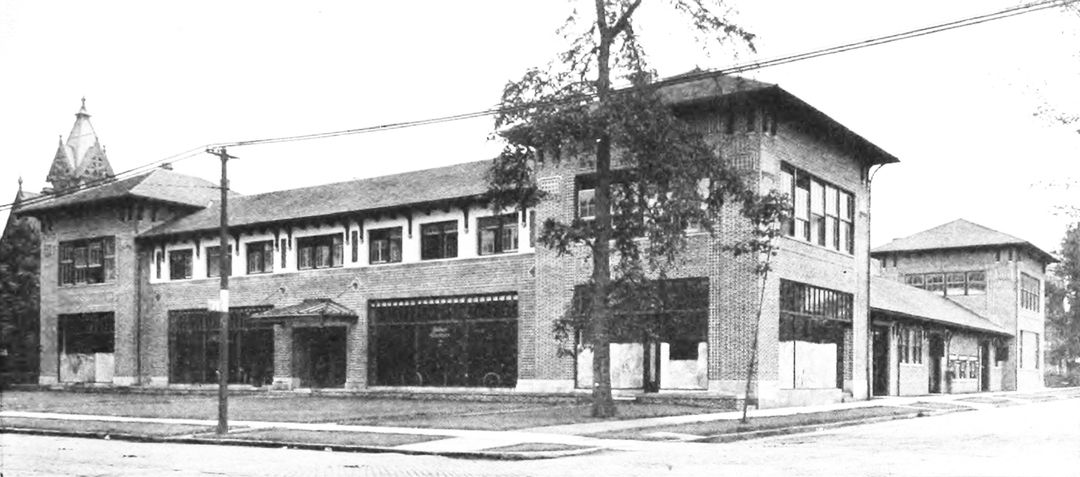
    <summary type="html"><![CDATA[<p><strong><em>In the Great Depression, used-car lots began to replace the sweeping front lawns of some of the deteriorating mansions that were once the pride of Cleveland's famed Millionaires' Row. By the 1950s, Euclid Avenue was a veritable "Motorists' Row" with as many car lots, filling stations, garages, and motels as mansions. Yet, long before this turn, the "Showplace of America," as <em>Baedeker's Travel Guide</em> had recently dubbed Euclid Avenue, was a fitting place for a showroom for innovative—and expensive—new cars made in Cleveland.</em></strong></p><img src="https://clevelandhistorical.org/files/fullsize/7071c4ab7e003ce4b8bab9e8c0df038e.jpg" alt="The Baker Electric Showroom in 1911" /><br/><p>More than a century before Elon Musk's Tesla Roadster was launched into space, the first crude electric carriage was produced by the Scottish inventor Robert Anderson in 1832. In 1891, William Morrison built the first successful electric automobile in the United States. Tesla's electric cars are a luxury item by today's standards, but electric cars have always been items of wealth. The Baker Motor Vehicle Company was founded in 1898 by the engineer Walter Baker to produce electric automobiles. Prior to this, Walter Baker helped found the American Ball Bearing Co. in 1895, which began to develop and produce automobile parts.</p><p>The vehicles at this time were extremely heavy and operated on large batteries that were very expensive. Baker built an electric automobile for his private use but wished to create a lighter machine with a smaller battery for mass consumption. The battery Baker invented used twelve cells, whereas other batteries during that time contained forty to forty-eight cells. By 1905, the success of Baker's lighter, simpler, and lower-maintenance electric automobile had created a demand for other styles including runabouts, stanhopes, four-passenger surreys, depot carriages, and broughams.</p><p>The Baker Motor Vehicle Company continued to adopt advanced technology for its vehicles. In 1909 the company implemented the bevel gear shaft drive as a more efficient transmission over the chain drive. The bevel gear shaft was both light and strong, suitable for small vehicles. The batteries used by the Baker Motor Vehicle Company were praised by their creator Thomas Edison. On July 29th, 1907 a Baker Electric car was driven for 106.8 miles on one charge on a standard lead battery. The record-setting car was shown in the sales room of the Baker Electric Motor Car Building.</p><p>The Baker Electric Motor Car Building was built in 1910. The Arts & Crafts-styled brick building served as Baker's first car showroom. It was designed by the prominent Cleveland architect Frank B. Meade and decorated by Rohrheimer-Brooks. Because only the wealthy could afford automobiles at the time, the showroom was built on Millionaires' Row at Euclid Avenue and East 71st Street (7100 Euclid Avenue). The Baker garages were well-regarded for their electric car services, and the building became a national model for automobile dealerships.</p><p>In 1912, Baker invented a new transmission, which proved to be the greatest revolution in the auto industry since the automobile itself. The new electric transmission was powered by a gasoline motor and eliminated many of the complicated processes in running automobiles such as the gear-driven transmission, clutch, flywheel, heavy self-starter, and the generator to charge the battery. Baker drove a car with this new transmission daily.</p><p>Of the three different models displayed in the Baker Electric Motor Car Building showroom in 1913, the most affordable model was the two-passenger Victoria model, which cost $2,000. The four-passenger coupe cost $2,800. The five-passenger brougham's cost came to $3,100. Adjusted for inflation, these vehicles would cost between $100,00 to $200,000 today.</p><p>In 1915 another Cleveland automaker, Rauch & Lange Carriage Company, merged with the Baker Motor Vehicle Company to form Baker Rauch & Lange Co. By 1915, the light Baker electric coupe launched into increased production. In doing so, they were able to lower the price of the both the couple, the double drive brougham, and the roadster. By the 1920s, Baker R. & L. Co. sold its electric car division to focus on industrial vehicles and equipment. The Otis Elevator Company bought Baker in 1954, and Otis merged with United Technologies in 1975. The latter company sold the Baker Division to German multinational company Linde-Akiengesellschaft in 1977. Baker Materials Handling, the Baker division under Linde-AG, became Linde Lift Truck Corporation in 1999.</p><p>Though the company itself has long ceased to exist, the Baker Electric Motor Car Building still stands on Euclid Avenue today. The building has been occupied over the years by a grinding and finishing shop and various printing companies, and the large picture windows were filled in by bricks to better accommodate the changing needs of the occupants. Ivy covered the building, concealing the aesthetic details of the architecture, when Cumberland Development LLC and Aril Ventures partnered together the buy the building in 2006. The Baker Electric Motor Car Building underwent a $7.1 million restoration project to convert the building into bio-tech labs and medical business offices to take advantage of its location on the newly christened "Health-Tech Corridor" near the Cleveland Clinic. Meade's Early Commercial/Mission Revival mixed-style Baker building was added to the National Register of Historic Places in 2007, which enabled historic tax credits for the restoration project.</p><p>Dick Pace, the real estate developer from Shaker Heights, led the project. Interestingly, Pace is an architect and former partner of Van Dijk Pace Westlake Architects of Cleveland, which was founded by Abram Garfield in 1905. Garfield had often partnered with Baker Electric Building designer Frank Meade on other projects.</p><p>The 50,000-square-foot Baker Electric Building's restoration revealed much of the original showroom. The large windows were recovered. Oak panel walls and showroom lamps were uncovered from drywall and drop ceilings. The showroom's original ceramic tile floor lay underneath asphalt floor tiles and concrete. The original, century-old ceramic tiles were laid out in a checked pattern with an intricate border design.</p><p>The building had room for a dozen tenants, and Pace was getting interest from international companies. In the hopes of being granted a Leadership in Energy and Environmental Design Silver Certificate, or LEED, the renovation implemented green and sustainable practices. There is an electric charging station on the outside of the building and energy companies occupy the building in search of new environmentally safe ways to harness energy. The Baker Electric building is a site of sustainable innovation which has promoted neighborhood growth along Euclid Avenue. </p><p><em><strong><a href="https://clevelandhistorical.org/items/show/826">For more (including 10 images) view the original article</a></strong></em></p>]]></summary>
    <published>2017-12-06T09:56:45+00:00</published>
    <updated>2026-04-17T19:17:41+00:00</updated>
    <link rel="alternate" type="text/html" href="https://clevelandhistorical.org/items/show/826"/>
    <id>https://clevelandhistorical.org/items/show/826</id>
    <author>
      <name>Natalie Neale</name>
    </author>
  </entry>
  <entry>
    <title type="html"><![CDATA[Ford Model T Plant: When Cars Were Assembled in University Circle]]></title>
    <summary type="html"><![CDATA[<img src="https://clevelandhistorical.org/files/fullsize/02a3dc63e4c42cec0f1adf65f0213d66.jpg" alt="Factory Viewed from Euclid Avenue" /><br/><p>Ford produced over 15 million Model T cars, making it the most widely sold car in history.  Although most were made in Highland Park, Michigan, more than 100,000 Model Ts were produced  in Cleveland. The Ford Motor Company established a sales and service office on Euclid Avenue in 1906. In 1911, it moved its Cleveland operations to a facility at  East 72nd Street and St. Clair Avenue. And, in 1914, an assembly plant, located at 11610 Euclid Avenue, took parts made in Michigan and assembled Model Ts. </p><p>The Euclid Avenue assembly plant included a showroom and sales office on the first floor, facing onto Euclid Avenue. The second, the third, and fourth floors served as the assembly area. The plant was offered to the War Department during World War I and served as a storage depot for war materiel through 1918. By the next year the plant was again producing Model Ts. </p><p>In 1923, Ford updated the Cleveland plant to the "improved moving assembly" process, which was already being used in its Highland Park plant. The plant achieved its peak production in 1925, producing 225 vehicles per day while employing 1,600 people. The last Model T rolled off the line on May 31, 1927. Later that year the factory was retooled to produce the new Ford Model A. </p><p>In 1932, Ford began producing the Model B, but because of a large drop in sales and large company wide losses, Ford closed its Cleveland branch plant in December 1932. The building continued to serve as a Ford sales office until the beginning of World War II, at which point the company gave the factory to the federal government. The building was sold after the war and used as a warehouse. It has also been used as office space, artists' studios, and a public storage site. It is currently being used by the Cleveland Institute of Art as a studio and classroom space.</p><p><em><strong><a href="https://clevelandhistorical.org/items/show/269">For more (including 4 images) view the original article</a></strong></em></p>]]></summary>
    <published>2011-07-19T16:33:04+00:00</published>
    <updated>2026-04-17T19:17:38+00:00</updated>
    <link rel="alternate" type="text/html" href="https://clevelandhistorical.org/items/show/269"/>
    <id>https://clevelandhistorical.org/items/show/269</id>
    <author>
      <name>Rory Fabian</name>
    </author>
  </entry>
  <entry>
    <title type="html"><![CDATA[Ford Engine Plant]]></title>
    <summary type="html"><![CDATA[<img src="https://clevelandhistorical.org/files/fullsize/8c25161867d5e511808d5026de05262b.jpg" alt="Casting Plant" /><br/><p>In the late 1940s, the Ford Motor Company decided to expand its engine production facilities. Ford intended to build more manufacturing plants outside of the Detroit area, with this project calling for a new engine plant and foundry. Five states and hundreds of communities attempted to attract the project. In the end,  Ford decided that a 204 acre site in the Village of Brook Park, Ohio would be the ideal place. The site lies along the main line of the New York Central Railroad which certainly made it attractive. The clinching argument, however, was that the nearby city of Cleveland was a port city on the Great Lakes, making it even more convenient  to import raw materials into the plant and sending finished products out of it.</p><p>Therefore, In 1951, Ford built the Cleveland Engine plant, which was the first Ford engine plant in Ohio. The plant was the center of production for Ford's first overhead valve engine, the Lincoln V8. The engine foundry opened in 1952 to produce cast iron engine blocks. Also, in 1955, Ford built Engine Plant 2 on the site. Plant 2 was opened to produce the Y-block V8 for the Ford Thunderbird. Indeed, the plants have produced a wide variety of V6 and V8 engines throughout the years. The engines were used in cars, including everything from the Edsel to the Mustang, and in trucks like the F-100 and the F-150.  By 1955, the Brook Park facility was the second largest Ford complex in the world behind only the River Rouge complex in Dearborn, Michigan. Over 34 million engines have been built in Brook Park since 1951. </p><p>The plant has gone through a variety of changes in the nearly 60 years it has been in operation. During the 1960s the plant employed over 15,000 workers. Of that number, more than 10,000 worked in the casting plant's foundry. Yet, markets, economies, and techniques change, and the foundry closed in October 2010, leading to the loss of a number of jobs. The plant was no longer needed since most of Ford's engine blocks are now made of aluminum. The few iron engine blocks that Ford currently uses are produced by a company in Mexico.  </p><p>Also, Engine Plant 1 was idled in 2007 and for a time employed only 72 workers. After a $350 million investment by Ford in 2009, the plant rebounded and employment numbers rose. In 2011, the plant was producing about 900 engines per day during its two shifts. However, in 2012 Engine Plant 2 shut down, leaving Engine Plant 1, with some 1,600 workers, as the only operational facility. The second plant site was more recently redeveloped as Forward Innovation Center, offering speculative facilities to lure new industry. </p><p><em><strong><a href="https://clevelandhistorical.org/items/show/268">For more (including 5 images&#32;&amp;&#32;4 audio files) view the original article</a></strong></em></p>]]></summary>
    <published>2011-07-19T15:45:32+00:00</published>
    <updated>2026-04-17T19:17:38+00:00</updated>
    <link rel="alternate" type="text/html" href="https://clevelandhistorical.org/items/show/268"/>
    <id>https://clevelandhistorical.org/items/show/268</id>
    <author>
      <name>Rory Fabian</name>
    </author>
  </entry>
  <entry>
    <title type="html"><![CDATA[Winton Motor Carriage Co.: Making America&#039;s First Motor City]]></title>
    <summary type="html"><![CDATA[<img src="https://clevelandhistorical.org/files/fullsize/cc619c41b59fd844f0a3306f32fbd458.jpg" alt="The First Winton" /><br/><p>When people think of the auto industry, they usually think of Henry Ford and Detroit. What most people don't know is that in the 1890s Cleveland was the automobile capital of America. One reason for this was a Scottish immigrant and bicycle company owner named Alexander Winton. </p><p>The Winton Motor Carriage Company went into business on March 15, 1897. Their first automobiles were built by hand. Each vehicle had fancy painted sides, padded seats, a leather roof, and gas lamps. B.F. Goodrich made the tires for Winton.  By 1897, Winton had already produced two fully operational prototype automobiles. In May of 1897, the 10 horsepower model achieved the astonishing speed of 33.64 mph on a test around a Cleveland horse track. However, people were still skeptical of the new invention. To prove his automobile's durability and usefulness, Alexander Winton had his car undergo an 800-mile endurance run from Cleveland to New York City.</p><p>On March 24, 1898 Robert Allison of Port Carbon, Pennsylvania became one of the first men to buy an American-built automobile when he bought a Winton for around $1,000. Allison had seen an advertisement for the car in Scientific American. Later that year the Winton Motor Carriage Company sold twenty-one more vehicles. One of those customers was James Ward Packard, who would later become the founder of Packard automobile company. It is believed that Packard was not satisfied with his car and complained to Winton. The story goes that Winton challenged him to do better. That same year, Leo Melanowski, Winton's Chief Engineer, invited Henry Ford to come to Cleveland for an interview at the Winton Company. Alexander Winton was not impressed with Henry and decided not to hire him. Henry went back to Detroit to continue working on his second Quadricycle.  These miscues would eventually come back to haunt Winton.</p><p>More than one hundred Winton vehicles were sold in 1898, making the company the largest manufacturer of gas-powered automobiles in the United States.  By 1901, widespread publicity continued to increase interest in the Wintons. That year, news that members of the wealthy Vanderbilt family had purchased Winton automobiles boosted the company's image substantially. It was around this time that Winton built a new factory complex at 10601 Berea Road, on Cleveland's far west side. Later that year, however, a Winton automobile lost a race near Detroit to one of Henry Ford's cars. Winton vowed to come back and defeat Ford. He produced the 1902 Winton Bullet, which set an unofficial land speed record of 70 mph in Cleveland that year. Despite its speed, 'The Bullet' was defeated by another Ford later in  the year.  The company received some positive publicity In 1903, though, when Dr. Horatio Nelson Jackson made the first successful automobile drive across the United States in a Winton. The trip took 64 days, including breakdowns, delays while waiting for parts to arrive, and the time it took hoisting the Winton up and over rocky terrain and mudholes.</p><p>In the 1910s Winton continued to market his expensive, custom-made cars primarily to wealthy consumers. This would eventually lead to the company's downfall, as by the 1920s Winton was unable to compete with the less expensive, mass produced cars like those made on Henry Ford's assembly lines. In 1922, Winton made only 690 cars, and on February 11, 1924, the Winton Motor Car Co. ceased car production.</p><p><em><strong><a href="https://clevelandhistorical.org/items/show/267">For more (including 6 images) view the original article</a></strong></em></p>]]></summary>
    <published>2011-07-19T14:52:55+00:00</published>
    <updated>2026-04-17T19:17:38+00:00</updated>
    <link rel="alternate" type="text/html" href="https://clevelandhistorical.org/items/show/267"/>
    <id>https://clevelandhistorical.org/items/show/267</id>
    <author>
      <name>Matthew Sisson</name>
    </author>
  </entry>
  <entry>
    <title type="html"><![CDATA[Winton Place]]></title>
    <summary type="html"><![CDATA[<img src="https://clevelandhistorical.org/files/fullsize/edbcfb4787b346480b538b3d551591ba.jpg" alt="Winton &amp; Shanks" /><br/><p>Alexander Winton was a Scottish immigrant. In 1897, established the Cleveland-based Winton Motor Carriage Co. The company was a success, enabling Winton to build a large estate for himself and his family at the current location of Winton Place at 12700 Lake Avenue in Lakewood. He named the estate Roseneath. Built in 1903, Roseneath boasted 25 rooms, beautiful gardens, and picturesque views of Lake Erie. </p><p>Winton enjoyed a banner year in 1903. Not only did he see his family estate completed. His auto plant located on Berea Road also became the largest in the world that year, after operations had outgrown its previous location on East 45th in 1902. The list of accomplishments attributed to the Winton Motor Carriage Co. is too long to include in its entirety, but some of its most notable accomplishments include: </p><p>(1) Making the first commercial sale of a standard domestic automobile in 1898; (2) producing the first vehicle to have the moniker "automobile" ascribed to it (The term was used first by Charles Shanks, a <em>Plain Dealer</em> reporter who Alexander Winton drove from Cleveland to New York in 1899); (3) producing the first mail truck to successfully serve the United States Postal Service; (4) achieving a speed of 70mph on a newly paved Clifton Boulevard in 1902, an unofficial land speed record at the time; and (5) producing the first automobile which traveled the continental United States coast-to-coast (San Francisco to New York City) in 1903.</p><p>Interestingly enough, Winton was encouraged by one of his engineers to hire a young Henry Ford, but Winton denied him a position. Ford would go on to produce the comparatively inexpensive Model T roadster. Costing around $390, Ford's widely successful Model T was partially responsibly for the demise of Winton's automobile production in 1924, as Winton's least expensive model cost $2,295. Although Winton automobile production ceased in 1924, the Winton Engine Corporation, established in 1912 as the Winton Engine Company, would continue on and eventually be integrated into the General Motors Corporation in 1930. </p><p>The decline of the Winton Motor Carriage Co. depleted Winton's personal fortune significantly, leading him to sell Roseneath and move to a smaller home in Clifton Park. Roseneath itself was destroyed by fire in 1962, laying the groundwork for the construction of Winton Place luxury apartments on the Gold Coast. Completed in 1963, the 30-story Winton Place became the tallest high-rise apartment building between New York and Chicago and the tallest building in the Greater Cleveland area outside downtown. Currently, all that remains of the mansion is a yellow-brick wall bearing an inscription of the name "Roseneath."</p><p><em><strong><a href="https://clevelandhistorical.org/items/show/237">For more (including 9 images) view the original article</a></strong></em></p>]]></summary>
    <published>2011-06-28T19:15:25+00:00</published>
    <updated>2026-04-17T19:17:37+00:00</updated>
    <link rel="alternate" type="text/html" href="https://clevelandhistorical.org/items/show/237"/>
    <id>https://clevelandhistorical.org/items/show/237</id>
    <author>
      <name>Matthew Sisson</name>
    </author>
  </entry>
</feed>