<?xml version="1.0" encoding="UTF-8"?>
<feed xmlns="http://www.w3.org/2005/Atom">
  <title type="text">Cleveland Historical</title>
  <updated>2026-05-10T00:36:25+00:00</updated>
  <generator uri="http://framework.zend.com" version="1.12.20">Zend_Feed_Writer</generator>
  <link rel="alternate" type="text/html" href="https://clevelandhistorical.org/"/>
  <link rel="self" type="application/atom+xml" href="https://clevelandhistorical.org/items/browse?output=rss2"/>
  <id>https://clevelandhistorical.org/</id>
  <author>
    <name>Cleveland Historical</name>
    <uri>https://clevelandhistorical.org</uri>
  </author>
  <link rel="hub" href="http://pubsubhubbub.appspot.com/"/>
  <entry>
    <title type="html"><![CDATA[Blossom Music Center: A Summer Home for the Cleveland Orchestra]]></title>
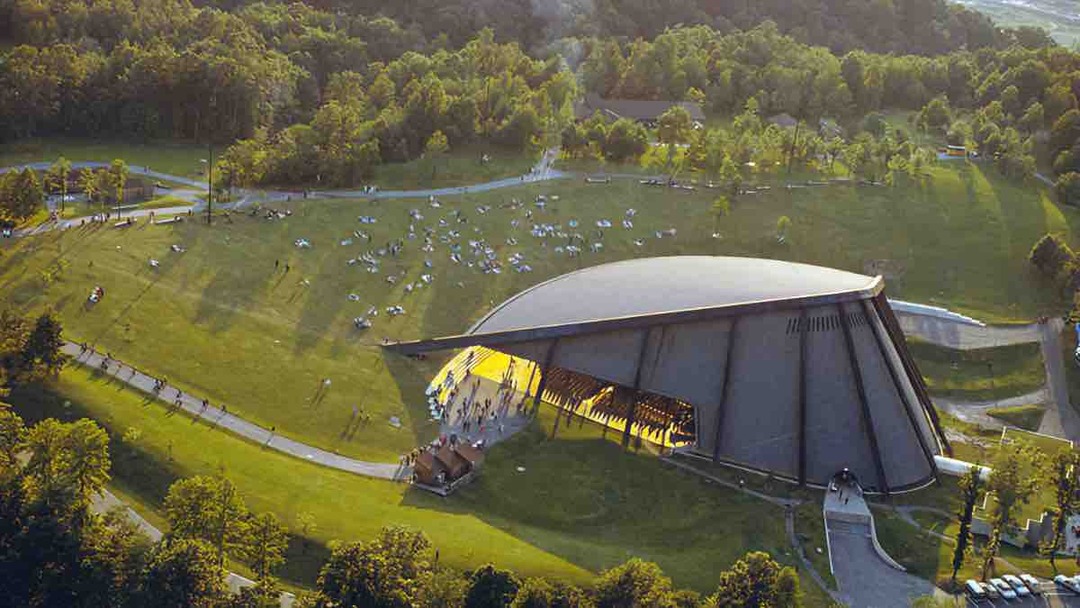
    <summary type="html"><![CDATA[<p><strong><em>Music fills the air in the Cuyahoga Valley National Park as Blossom’s summer concerts draw many into the heart of the forest. Meticulous research and conscientious attention to location and architectural design within a natural environment allowed for the creation of a summer home for the Cleveland Orchestra and a venue for many different types of music.</em></strong></p><img src="https://clevelandhistorical.org/files/fullsize/e67c3aa3ffcca26787c72b8b101f636d.jpg" alt="Aerial Photo of Blossom" /><br/><p>Blossom Music Center is located approximately 33 miles south of downtown Cleveland and 10 miles north of Akron on a plot of land surrounded by wildlife and trees, one of the only venues in Cleveland where one can listen to music under the stars. The amphitheater obtained its name from Dudley Blossom, who served as the Musical Arts Association president from 1936 to 1938. Before this summer home, the Orchestra performed at local venues such as the Public Auditorium and less frequently at Cleveland Municipal Stadium before baseball games. Since Blossom’s first opening season in 1968, the amphitheater has served as a place for people to gather and enjoy concerts for over 50 years.
George Szell, the conductor of the Cleveland Orchestra from 1946 to 1970, desired a permanent summer home for the orchestra and helped identify the Cuyahoga Valley as a viable option. The need for a summer venue for the Orchestra was due to its successful reputation; the summer festival was the only way to keep the skilled musicians in Cleveland. Despite everything—winter concerts, the pops, and country club dates—the Cleveland Orchestra's season could only be expanded with the Blossom amphitheater. Including the summer concert dates at Blossom would ensure the musicians could have full-time occupations.
Considering parcels of land fit for a location for Blossom was challenging. Szell consulted William A. Gould Associates on the search for sites. More than 80 properties were studied for development and eleven were even offered as gifts, but none met Gould's standards. Topographical needs helped narrow down the site options. The orchestra settled on a 500-acre plot of land between West Steels Corners Road and Akron-Peninsula Road. The rugged contours of its ground made it unsuitable for industry, but the natural bowl made it perfect for the orchestra. The land's natural slope helped influence the clam-like design of the Blossom Music Center amphitheater. 
Successful funding made the amphitheater eligible for a Ford Foundation grant, which required local organizations to raise $4 million within five years. $4,360,000 of the Half Century Fund's goal was used to construct the center. Through Szell's push to create Blossom Music Center and keep the musicians in Cleveland, their union was happy with the full-time opportunities.
The amphitheater was of modern design by a local architect Peter van Dijk, the son of Dutch immigrants. He worked on many projects throughout the Cleveland-Akron area, such as the restoration of Huntington Bank in downtown Cleveland. Van Dijk left his mark through the 1981 conversion of the old Akron post office into the Akron Art Museum and the construction of E.J. Thomas Hall.
Van Dijk thoroughly researched and visited successful amphitheaters, such as Ravinia, the summer home of the Chicago Symphony Orchestra, before he designed the Blossom Music Center. His dedication to researching and perfecting the design of Blossom allowed the incorporation of many modern linear elements reflected in the surrounding landscape. Materials used in this structure were concrete and weathering steel, which helped reinforce this venue's longevity and natural properties. The venue's clamshell-like shape had the acoustic advantage of allowing the sound to carry and reverberate throughout the crowd for up to three seconds, which was attractive to the Cleveland Orchestra. The form was also visually impressive.
Gearing up for breaking ground at the site of the new Blossom Music Center, the venue populated the <em>Cleveland Plain Dealer</em> almost daily, leading up to the first opening-season event. The turning of soil occurred on July 2, 1967, and on the same day, the <em>Plain Dealer</em> noted that this date also marked the orchestra's 50th anniversary. 
In 1968, Blossom Music Center's first opening season tune was Beethoven's overture, <em>Consecration of the House</em>, conducted by George Szell. With Blossom's capacity of 6,051 in the pavilion and 15,000 in the general admission lawn, this show was able to reach a large crowd, as the Orchestra desired.
Over the years, Blossom has had many concerts that appeal to the music community in Cleveland and Northeastern Ohio. Many artists have come to Blossom Music Center. Carole King, arguably the most successful female songwriter of all time, made an appearance Thursday, July 20, 1989, at Blossom Music Center. She is known for “Will You Love Me Tomorrow?" and "Tapestry" in 1971. For over 50 years, the Cleveland Orchestra has performed roughly 1,000 summer concerts at Blossom.</p><p>After many successful decades of Blossom Music Center's music season, there was a call for expansion with more significant revenue opportunities. By 2003, a $17 million updating of Blossom was completed. It created an addition for larger audiences of 3,624 lawn seats and 1,106 reserved seats, increasing the venue's total capacity to 23,500, helping ensure the venue's continuing importance as a leading performing arts center.</p><p><em><strong><a href="https://clevelandhistorical.org/items/show/980">For more (including 8 images) view the original article</a></strong></em></p>]]></summary>
    <published>2022-11-23T21:37:40+00:00</published>
    <updated>2026-04-17T19:17:42+00:00</updated>
    <link rel="alternate" type="text/html" href="https://clevelandhistorical.org/items/show/980"/>
    <id>https://clevelandhistorical.org/items/show/980</id>
    <author>
      <name>Catherine Reitz</name>
    </author>
  </entry>
  <entry>
    <title type="html"><![CDATA[Cain Park: From Wooded Ravine to Home of the Arts]]></title>
    <summary type="html"><![CDATA[<img src="https://clevelandhistorical.org/files/fullsize/8469841c79ab79bf0ab9bceeb6e1c8ef.jpg" alt="Covering Dugway Brook, ca. 1937" /><br/><p>Before it became Cain Park, the ravine between Taylor and Lee roads was merely a wet, overgrown gully visited by only the most adventurous of hikers.  In 1914,  the Central Improvement Association of Cleveland Heights (then still a village) formed a committee to look into the possibility of turning the Dugway Brook ravine into a more formal public park.  It was not until the 1930s, however, that Cain Park began to take shape.  </p><p>Much of the credit for the development of Cain Park in the 1930s can be given to Dr. Dina Rees Evans, who taught drama and English at Cleveland Heights High School. In 1932 "Doc" Evans became the first person in the United States to receive a Ph.D. in theater. She was an adamant believer in the ability of drama education to have a positive effect on students.  In the summer of 1934, the drama club she ran at Heights High, called the Heights Players, collaborated with the Civic Theater of Allied Arts (the city's adult stage group) to put on a production of Shakespeare's "A Midsummer Night's Dream." The show took place on a hastily assembled wooden stage at the foot of the sledding hill, along which spectators gathered.  The production proved to be wildly successful and spurred the further development of Cain Park.  </p><p>Frank Cain, for whom the park is named, served as Mayor of Cleveland Heights from 1914 to 1946. After witnessing the success of the 1934 production, Cain threw his support fully behind the construction of a 3,000-seat amphitheater in the park. Besides constructing the amphitheater, workers from the Great Depression-era Works Progress Administration (WPA) also helped drain the ravine which Cain Park is situated in, covering up and culverting the creek that ran through its center. Attractive landscaping, tennis courts, ball fields, and walking paths completed the transformation of the former "wild" land into a public park.  </p><p>The amphitheater had its grand opening in August 1938 with the staging of "A Midsummer Night's Dream."  Plays, operas, concerts, and other cultural events have been held at Cain Park ever since.  Evans, meanwhile, continued to serve as managing director of Cain Park Theater until 1950. She attracted top-flight young talent to the theater company, including music director Jack Lee, producer Ross Hunter, and actors Hal Holbrook, Dom DeLuise, Carol Kane, Jack Weston and Pernell Roberts.  Evans retired from teaching in 1958. The amphitheater was renamed in her honor in 1989. </p><p><em><strong><a href="https://clevelandhistorical.org/items/show/193">For more (including 9 images, 3 audio files,&#32;&amp;&#32;1 video) view the original article</a></strong></em></p>]]></summary>
    <published>2011-04-21T14:08:21+00:00</published>
    <updated>2026-04-17T19:17:37+00:00</updated>
    <link rel="alternate" type="text/html" href="https://clevelandhistorical.org/items/show/193"/>
    <id>https://clevelandhistorical.org/items/show/193</id>
    <author>
      <name>Michael Rotman</name>
    </author>
  </entry>
</feed>
