<?xml version="1.0" encoding="UTF-8"?>
<feed xmlns="http://www.w3.org/2005/Atom">
  <title type="text">Cleveland Historical</title>
  <updated>2026-04-17T15:26:54+00:00</updated>
  <generator uri="http://framework.zend.com" version="1.12.20">Zend_Feed_Writer</generator>
  <link rel="alternate" type="text/html" href="https://clevelandhistorical.org/"/>
  <link rel="self" type="application/atom+xml" href="https://clevelandhistorical.org/items/browse?output=rss2"/>
  <id>https://clevelandhistorical.org/</id>
  <author>
    <name>Cleveland Historical</name>
    <uri>https://clevelandhistorical.org</uri>
  </author>
  <link rel="hub" href="http://pubsubhubbub.appspot.com/"/>
  <entry>
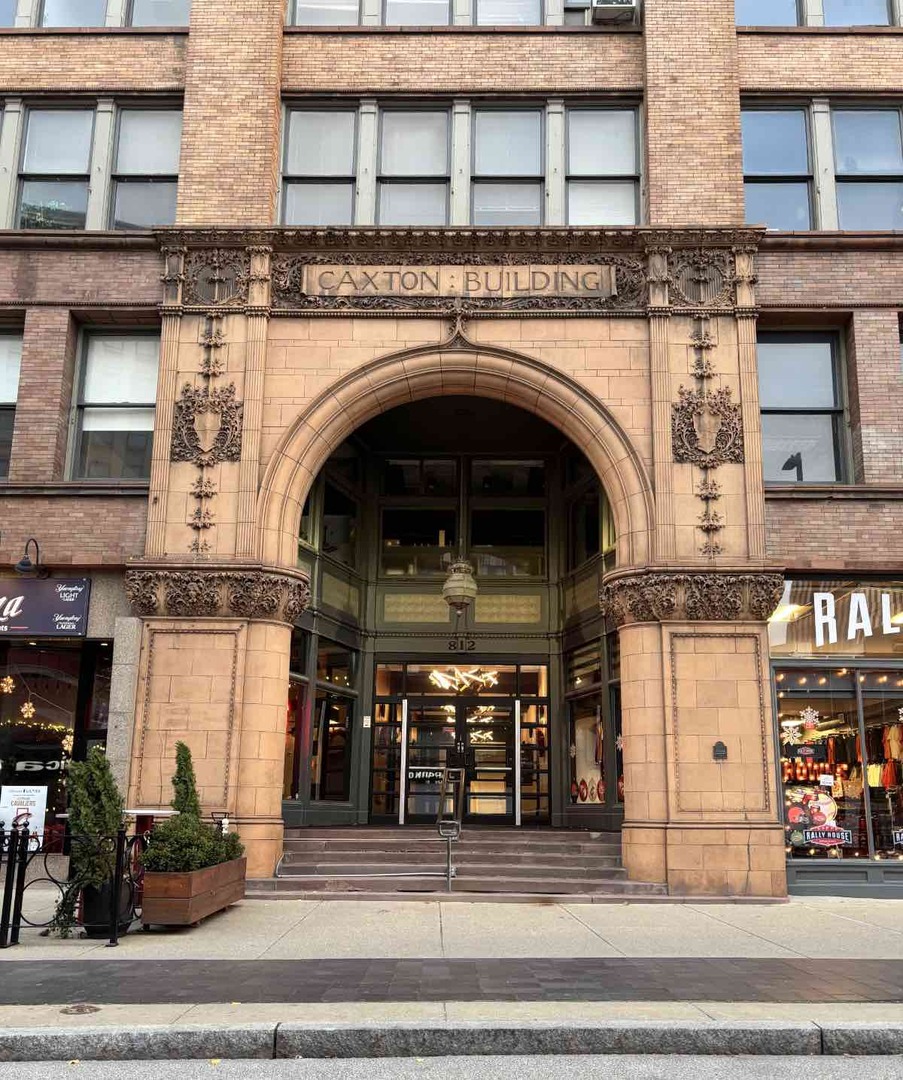
    <title type="html"><![CDATA[Caxton Building: Cleveland’s Historic Printing and Publishing Hub]]></title>
    <summary type="html"><![CDATA[<p><strong><em>The Caxton Building, located in downtown Cleveland, is a historic landmark that embodies the city's industrial past. Constructed in 1898-1900, the eight-story structure was designed by the architect F. S. Barnum as one of the nation’s earliest fireproof office buildings, tailored for printing and publishing businesses. Today, the Caxton Building stands as a testament to Cleveland’s rich history, housing a variety of modern offices while maintaining its vintage character through preserved architectural details.</em></strong></p><img src="https://clevelandhistorical.org/files/fullsize/1494a8988e3d83f1bc0ace442fef0381.jpg" alt="Caxton Building Entrance" /><br/><p><span>The Caxton Building is named after William Caxton, a 15th-century British printer who was the first person to introduce the printing press to England. Caxton was known for printing the earliest English-language version of the Bible, along with other classical works. The Caxton Building’s namesake reflected the original motivation for its construction. Stockholders of the Caxton Building Co., Worcester R. Warner, Ambrose Swasey, Samuel T. Wellman, Rollin C. White, Luther Allen, and Wilson M. Day were behind the building's planning and construction. (Warner and Swasey were already widely known as the principals of a major Cleveland machine-tool and telescope manufacturing company bearing their name; Allen was a founder of Cleveland's White Motor Corp.) Their leadership and vision helped the Caxton Building develop as an aggregated space for printing and publishing businesses by providing the necessary infrastructure to attract such firms. The creation of nodes or hubs of aligned businesses, including so-called "power block" buildings like the Caxton, was a common practice during the rise of American downtowns.</p><p>Designed by architect Frank Seymour Barnum, the Caxton Building is an outstanding example of Chicago School architecture, which was popular in the late 19th and early 20th centuries. Completed in 1900, the building stands eight stories tall and is noted for its steel-frame construction, one of the earliest uses of this Chicago-born technology in Cleveland. This architectural style allowed for larger windows, a lighter appearance, and more flexibility in interior space, and the building’s reinforced concrete floors were especially suited to support the heavy equipment used by printing, publishing, and graphic design firms.</p><p>The arrival of enterprise publishers establishing their quarters in the Caxton Building soon fulfilled its developers’ hopes for it to become the recognized center for printing and publishing in Cleveland. The movement of the Chautauqua Assembly’s headquarters and publication office from Buffalo, New York, to the Caxton Building was a major milestone in the building's history and it brought a unique book publishing and magazine business in the city. Among the famous products developed at the Caxton Building were the <em>Chautauquan </em>(magazine), <em>Engineers’ Magazine</em>, <em>Iron Trade Review</em>, and the <em>Jesuit Relations</em> book series. Other notable printing businesses located there were the Cleveland Printing and Publishing Company and Arthur H. Clark Company, which specialized in historical and geographical publications. Perhaps the most famous Caxton Building business was the World Publishing Company, a major publisher of Bibles, dictionaries, and children's books, which was begun in 1902 by Alfred H. Cahen.</p><p>The Caxton Building was listed in the National Register of Historic Places in 1973 and a Cleveland Landmark three years later, solidifying its reputation as a historic building. As many publishing and printing firms closed or moved away, however, the building became largely vacant by the early 1990s. When the Gateway sports and entertainment complex arrived soon afterward, it spurred new business interest in the surrounding blocks. A well-timed renovation in 1994 gave the Caxton Building many much-needed modern updates while preserving its historic architectural features and well-lit interiors. In the years since, the building’s adaptability has enabled it to attract and new tenants, including architectural firms, law offices, digital media firms, design studios, and civic organizations. The Caxton Building is an excellent but rare example of how a building constructed for a specialized purpose adapted to changing needs while remaining a commercial and civic hub.</p></p><p><em><strong><a href="https://clevelandhistorical.org/items/show/1041">For more (including 5 images) view the original article</a></strong></em></p>]]></summary>
    <published>2024-11-26T07:51:18+00:00</published>
    <updated>2026-03-04T21:32:05+00:00</updated>
    <link rel="alternate" type="text/html" href="https://clevelandhistorical.org/items/show/1041"/>
    <id>https://clevelandhistorical.org/items/show/1041</id>
    <author>
      <name>Ansh Doshi</name>
    </author>
  </entry>
  <entry>
    <title type="html"><![CDATA[Warner and Swasey Building: In Search of a Repurpose]]></title>
    <summary type="html"><![CDATA[<img src="https://clevelandhistorical.org/files/fullsize/d88f4f911a19abbebdacd82968fc2cf5.jpg" alt="Warner and Swasey Building" /><br/><p>According to one website, it is one of Cleveland's most popular places for urban exploring.  In a building where world wars were once won, young people now creep through dark hallways, clamber up rusted metal stairways, and walk carefully through debris-filled rooms.  </p><p>Well, perhaps it's a bit of a stretch to say that wars were won in this building.  But it is a fact that, in the long-vacant Warner & Swasey building at 5701 Carnegie Avenue, critical armament parts were once manufactured that helped the United States and its allies win two world wars during the twentieth century.  </p><p>The five-story building made of reddish-brown stone was constructed over a six-year period from 1904 to 1910.  It replaced the original Warner & Swasey building that had been erected on the site in the early 1880s.  That was just shortly after Worcester Warner and Ambrose Swasey, two young New England machinists, had come to Cleveland to build a machine shop -- to Cleveland, because they thought Chicago was just too far west.  </p><p>Warner & Swasey built telescopes and machine lathes in the new, as well as the old, building on Carnegie Avenue.  And in wartime, when the company built those armament parts that helped America win two world wars, thousands of Clevelanders worked there.  They built parts for tommy guns in World War I.  And in World War II, when 7000 Clevelanders worked for Warner & Swasey, they built parts for planes, ships and tanks.</p><p>From World War I, through World War II, and into the 1950s and the 1960s, the building on Carnegie Avenue was one of Cleveland's most important work places.  People talked about Warner & Swasey in the same breath and in the same way that they talked about the city's other big employers, like Republic Steel, TRW, and Ford Motors.  But then the building on Carnegie Avenue began its downward slide, much like the City of Cleveland did in the same period.  In the end it was a victim of high technology, and when it closed its doors for good in 1985, only a few hundred employees were still left to be sent elsewhere.</p><p>More than three decades have passed since Warner & Swasey left Cleveland.  Its iconic early twentieth century industrial building is now owned by the City of Cleveland, which is looking to put it to a new use.  In 1988, the County had considered the building as a possible site for its Department of Human Services and Child Support Enforcement Agency.  That fell through.  In 1992, Cleveland, which was deeded the building in the prior year, talked about making it the Charles V. Carr municipal center.  It never happened.  And in 2010 another proposal was put on the table.  The Geis brothers, sons of German immigrants who came to Cleveland in the 1960s, proposed to convert the building into a high tech office, lab and manufacturing facility. We'll see.  As of 2013, the year this story was written, their proposal has been pending for three years.</p><p>In the meantime, the Warner & Swasey building at 5701 Carnegie Avenue continues to awe the young urban explorers who visit it.  In 2019, the buildng was added to the National Register of Historic Places.</p><p><em><strong><a href="https://clevelandhistorical.org/items/show/623">For more (including 9 images) view the original article</a></strong></em></p>]]></summary>
    <published>2013-11-01T08:47:21+00:00</published>
    <updated>2026-03-04T21:32:01+00:00</updated>
    <link rel="alternate" type="text/html" href="https://clevelandhistorical.org/items/show/623"/>
    <id>https://clevelandhistorical.org/items/show/623</id>
    <author>
      <name>Jim Dubelko</name>
    </author>
  </entry>
  <entry>
    <title type="html"><![CDATA[Warner and Swasey Observatory: Cleveland&#039;s &quot;Plumb Line to the Heavens&quot;]]></title>
    <summary type="html"><![CDATA[<img src="https://clevelandhistorical.org/files/fullsize/362fedbc7e018dc02fb3a0d47268db26.jpg" alt="Warner and Swasey Observatory" /><br/><p>On a high, grassy knoll overlooking East Cleveland stands the Warner & Swasey Observatory. Once a scientific landmark, today it is a bleak sentinel.  Although it operated for more than sixty years, offering what the Plain Dealer called "a plumb line to the heavens," light pollution from a growing Cleveland reduced its usefulness with each passing year so that by midcentury it was no longer a reliable resource for astronomical research. </p><p>The Warner and Swasey Company, maker of machine tools and precision instruments, got its start in 1880 when Connecticut machinists Worcester Reed Warner and Ambrose Swasey decided to go into business for themselves. Moving to Cleveland, eventually they built a large factory on Carnegie Avenue at East 55th Street to manufacture turret lathes and telescopes. Their products found military uses during both world wars, and they built a number of telescopes for leading observatories, including the University of California's Lick Observatory, which reigned as the world's largest refracting telescope for about a decade in the late 19th century, and the U.S. Naval Observatory. Warner and Swasey operated in Cleveland until being bought out in 1980 by the Bendix Corporation.</p><p>Warner and Swasey became trustees of Case Institute of Technology. Among their many gifts to the institution was the Warner and Swasey Observatory. Designed by the renowned Cleveland firm of Walker and Weeks and situated some 270 feet above the level of Lake Erie, the observatory, which opened in 1920, was equipped with a Warner and Swasey-built 9.5-inch refractor. Unlike today's telescopes, which use mirrors to reflect light from objects in space to form an image, older refracting telescopes utilized a lens to refract, or bend, light and render an image. </p><p>The initial telescope was used until 1941, when the company delivered a much more powerful, 24-inch telescope, the Burrell Schmidt, housed in a second dome. The observatory mounted groundbreaking studies in the early 1950s, including one to prove the theory that the Milky Way was a spiral galaxy and another that found that cooler stars (red giants) were mainly near the center of the Milky Way. But these discoveries marked the twilight of the observatory's short-lived heyday. When light pollution--a common problem for observatories located near cities--became insurmountable in the 1950s, Case acquired a new site for the Burrell Schmidt telescope near the "chimney" of Geauga County, some thirty miles east of its original location. There it operated from 1957 until 1979, when it was again moved to Kitt Peak National Observatory in Arizona. </p><p>Meanwhile, the Warner and Swasey Observatory was outfitted with a 36-inch telescope. Hailed as the nation's finest for public viewing, it operated for more than twenty years until the observatory closed permanently in 1980, the same year that Warner and Swasey sold out to Bendix. Just as its maker's success led to a corporate takeover that ultimately brought its liquidation, the observatory itself succumbed to a byproduct of the relentless expansion of the city that had attracted two young machinists westward a century before.</p><p>Today one can still find the original refracting telescope built for the observatory. Since 1982 it has operated in a small dome atop Case Western Reserve University's Albert W. Smith Building. </p><p><em><strong><a href="https://clevelandhistorical.org/items/show/551">For more (including 8 images&#32;&amp;&#32;1 audio file) view the original article</a></strong></em></p>]]></summary>
    <published>2012-09-14T21:22:21+00:00</published>
    <updated>2026-03-04T21:32:01+00:00</updated>
    <link rel="alternate" type="text/html" href="https://clevelandhistorical.org/items/show/551"/>
    <id>https://clevelandhistorical.org/items/show/551</id>
    <author>
      <name>J. Mark Souther</name>
    </author>
  </entry>
</feed>
