<?xml version="1.0" encoding="UTF-8"?>
<feed xmlns="http://www.w3.org/2005/Atom">
  <title type="text">Cleveland Historical</title>
  <updated>2026-04-17T13:55:03+00:00</updated>
  <generator uri="http://framework.zend.com" version="1.12.20">Zend_Feed_Writer</generator>
  <link rel="alternate" type="text/html" href="https://clevelandhistorical.org/"/>
  <link rel="self" type="application/atom+xml" href="https://clevelandhistorical.org/items/browse?output=rss2"/>
  <id>https://clevelandhistorical.org/</id>
  <author>
    <name>Cleveland Historical</name>
    <uri>https://clevelandhistorical.org</uri>
  </author>
  <link rel="hub" href="http://pubsubhubbub.appspot.com/"/>
  <entry>
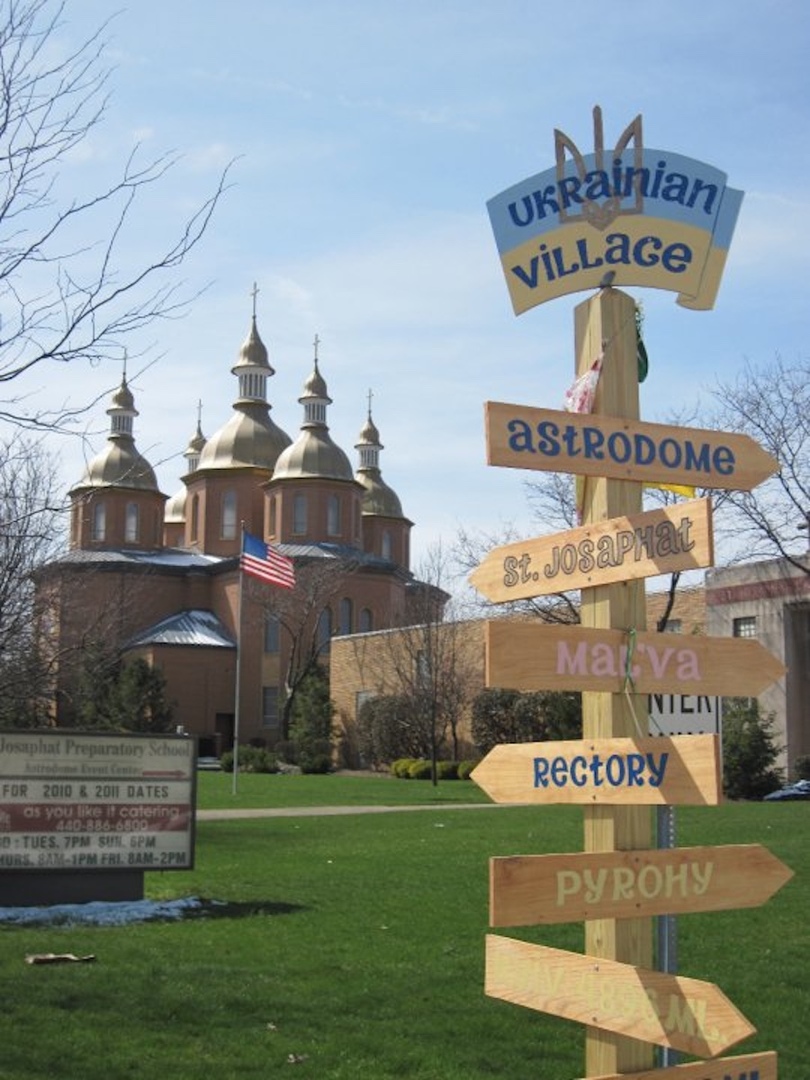
    <title type="html"><![CDATA[Saint Josaphat of Parma: From Mission to Parish to Cathedral]]></title>
    <summary type="html"><![CDATA[<p><strong><em>Like the Ukrainian population itself in Parma, Saint Josaphat Ukrainian Catholic Church had an inauspicious start—a simple brick and stone schoolhouse built in 1949 on ten acres of land on State Road.  However, less than forty years later, as the Ukrainian population in Parma was growing into the largest in the State of Ohio, Saint Josaphat became a Cathedral church and  the seat of  a new Ukrainian Catholic eparchy whose territory includes Ohio, part of Pennsylvania and most of the South.</em></strong></p><img src="https://clevelandhistorical.org/files/fullsize/dd208222bed267ab663c6c38be39d65e.jpg" alt="Saint Josaphat Cathedral in the Shadow of Parma Ukrainian Village Signage" /><br/><p>The first generation of Catholic Ukrainians to come to Cleveland in the late nineteenth and early twentieth centuries were Ruthenians, who had immigrated from a mountainous area within Galicia known as Ruthenia. Their lands were then located within the Austro-Hungarian Empire. Today, they are part of Ukraine and Poland. Religiously, these Ruthenians were Byzantine or Greek Catholics, or sometimes called Uniates. They were spiritual descendants of Eastern Orthodox Ruthenians and other Eastern European groups who, through the Union of Brest in 1596, had sworn allegiance to the Roman Catholic pope, while retaining a right to practice most of their historic Eastern Orthodox customs, rituals, and liturgy.</p><p>Settling in the Tremont neighborhood, the immigrant Ruthenians, in 1910, built a church of their own that still stands today on West 7th Street, near College Avenue. It was first called Saints Peter and Paul Ruthenian Catholic Church, but was renamed <a href="https://clevelandhistorical.org/items/show/738">Saints Peter and Paul Ukrainian Catholic Church</a> at the conclusion of World War I when the first modern Ukrainian state was established.</p><p>For most of the first half of the twentieth century, the children of the parishioners at Saints Peter and Paul Church attended school either in the basement of their church in Tremont or at other places in Cleveland. In 1947, Pastor Dmytro Gresko and his parishioners decided that they would build an elementary school for the parish children on land located in the suburb of Parma. Their decision was likely influenced by the number of parishioners who, since the end of World War II, had been moving out of Tremont and into that fast growing suburb.</p><p>The land selected for the new elementary school was a 10-acre parcel that lay on the west side of State Road between Kenmore Avenue and Liggett Drive. It was located just two blocks north of Saint Francis de Sales Catholic Church, and almost directly across the street from the Saint Stanislaus Novitiate, later renamed the Jesuit Retreat House. In the 1920s, the Order of the Polish Sisters of Saint Joseph had planned to construct a convent and school on this land. However, the Sisters later decided to instead construct those buildings—the latter of which was later known for many years as Marymount High School—on Granger Road in Garfield Heights. The Sisters then sold the land in Parma in 1929. </p><p>The land's new owners agreed, in October 1947, to sell it to Saints Peter and Paul Ukrainian Catholic Church for $17,500. In April 1949, construction began on the new two-story, brick and stone Saints Peter and Paul school building. Completed that fall, it had eight classrooms for students on its north end and a large assembly hall on its south end that could hold 500 persons and also serve as a chapel. On November 6, 1949, a dedication ceremony was held at the new school, led by Ukrainian Catholic Archbishop Constantine Bohachevsky of the Philadelphia Archeparchy, with assistance from Cleveland Bishop Edward F. Hoban and other Catholic church officials. At the ceremony, it was noted that this was the first Ukrainian Catholic grade school built in the Cleveland area. </p><p>Two years after dedicating the new school, Archbishop Bohachevsky returned to Parma on May 12, 1951 to bless the chapel in the school building which was named Saint Josaphat Chapel, after Josaphat Kuntsavych, a Ukrainian priest who had been murdered in 1623 because of his efforts, consistent with the tenets of the Union of Brest, to bring together Eastern Orthodox Christians and Roman Catholics living in Galicia, which in that period was part of the Polish-Lithuanian Commonwealth. </p><p>Classes began at Saints Peter and Paul grade school on November 15, 1949, with a total of 135 students attending only grades one through three in that first year. Because many of those students still lived in Tremont, the parish also purchased a bus to transport children to and from the school in Parma. One of those bus drivers was Father Myroslav Lubachivsky, then an assistant pastor at Saints Peter and Paul. Some thirty-five years later, in 1985, he would be appointed a Cardinal of the Ukrainian Catholic Church by Pope John Paul II. </p><p>During the period 1950-1960, the number of people of Ukrainian, and other Eastern and South European ethnicities, moving into Parma more than tripled, as that city became one of the fastest growing suburbs in America. In order to address the increases in the Ukrainian Catholic population, Saints Peter and Paul added several new buildings to the Parma campus, including another classroom building, a rectory and a convent, and expanded the grades taught at the school to include from kindergarten to eighth grade. </p><p>In August 1959, recognizing the significant increase in the Ukrainian Catholics living in Parma, Archbishop Bohachevsky announced the creation of a new Ukrainian Catholic parish in Parma, to be sited on the grounds of Saints Peter and Paul grade school. The new parish was named—and the grade school renamed—like the chapel, Saint Josaphat. Father Andrew Ulicky, an assistant pastor at Saints Peter and Paul, was appointed the first pastor of this new Ukrainian Catholic parish. </p><p>Shortly after his appointment as pastor, Father Ulicky initiated plans to build a high school on the State Road campus. Construction of the building began in 1961, largely funded through the efforts of parishioners who not only gave money to the project, but also volunteered to do much of the skilled construction work. The new circular-shaped high school building was designed by architect and engineer Michael Stefanyk, who volunteered his services to the parish. </p><p>The building featured a wooden domed roof with a 141-foot diameter. However, because of mounting costs and limitations on the amount of time that could be spent on construction by parish volunteers, construction of the building lagged for years, taking many more years to complete than the two years initially anticipated. In the interim, while it sat unfinished, the building became a favorite haunt of Parma teenagers, who visited it often at night, conducting what might be called an early form of urban (or suburban) exploration. </p><p>The proposed high school building was finally completed in 1969 and blessed by Metropolitan Archbishop Ambrose Senshyn on April 20 of that year. By that time, however, the plan to use the building as a high school had been abandoned, largely due to the establishment of Saint Andrew Ukrainian Catholic parish on the south end of Parma in 1965. The creation of the new parish prompted the departure of about 500 families from Saint Josaphat. </p><p>When the circular, domed building was blessed, it was given the name Saint Josaphat Astrodome Hall—commonly known as the "Astrodome" in reference to Houston's recently completed domed stadium. Rather than serving students as their new high school, the building was repurposed as an assembly hall for the use of the Saint Josaphat parish. Since its completion, it has been the venue for many parish events, as well as serving as a venue for the events of other organizations, such as ethnic festivals, and for individual events, including weddings. </p><p>After the completion of the Astrodome, Father Ulicky and the parish's second pastor, Father Yaroslav Sirko, who succeeded Father Ulicky in 1971, turned their attention to building a church on the State Road campus. The need to do so became pressing when, on April 11, 1973, a horrific fire at Saint Josaphat grade school destroyed the chapel within the school building. As a temporary measure, masses were thereafter held in the Astrodome. Father Sirko, who was the pastor at the time of the 1973 fire, wanted to immediately construct a new church, but was unable to do so due to the state of parish finances at the time. </p><p>As a result, the challenge to build the new church fell to the parish's third pastor, Father Michael Fedorowich, who came to Saint Josaphat in 1979. By 1981, the parish finances had sufficiently improved to enable Father Fedorowich to begin construction. By the summer of 1983, when construction was almost completed, word was received by the parish that the new Saint Josaphat church was to become a Ukrainian Catholic cathedral and seat of a new eparchy—the equivalent of a Roman Catholic diocese—for the Ukrainian Catholic Church in the United States. As a result of this development, additional construction was required in order to render the building's interior suitable as a cathedral. The following year, Father Robert Moskal was appointed the first bishop of the new Ukrainian Catholic Eparchy of Parma, Ohio.</p><p>When the 1990 federal census was taken—the first one following the completion of Saint Josaphat Cathedral and creation of the new Parma Ukrainian Catholic Eparchy, the results of the community questionnaires for Parma showed that the city's Ukrainian population, which in 1950, had been one of the smallest for residents of East European ancestry, had now become one of the largest, behind only the Polish and Slovak populations. In subsequent years, the Parma Ukrainian community continued to grow until it became, according to an article appearing in the Cleveland Plain Dealer on March 24, 2022, the largest in the State of Ohio. </p><p>Along the way of their journey as one of the most important Ukrainian institutions in Parma, Saint Josaphat and its parishioners have experienced their share of joys and sorrows at their now historic State Road campus. In 2008, Saint Josaphat Ukrainian Catholic grade school,which had served children of the parish for nearly 60 years, closed its doors for good. However, in what must have been somewhat consoling to the parish, several years later the school building became home to a new K-8 public community school called the Global Village Academy, which offers language and cultural programs to students in every grade. </p><p>On an even more positive note, in 2008 the Parma City Council passed a resolution recognizing the many contributions that Ukrainians at Saint Josaphat and other institutions in the City had made, and honoring the Ukrainian community with the establishment of <a href="https://clevelandhistorical.org/items/show/863">Ukrainian Village</a>, a section of State Road beginning at Tuxedo Avenue on its north end and extending south all the way to Grantwood Drive, with signs alerting drivers of the existence of the Village. </p><p>Today, visitors to Parma, who drive to the suburb on State Road will, as they cross Brookpark Road, immediately take notice of the colorful signage which announces that they are entering Ukrainian Village. Within moments thereafter, they will see the five majestic onion domes of the beautiful Saint Josaphat Cathedral. The signs and the domes inform visitors not only of the historical importance of Saint Josaphat to Parma's Ukrainian community, but also of its importance to the City of Parma itself.</p><p><em><strong><a href="https://clevelandhistorical.org/items/show/1078">For more (including 16 images) view the original article</a></strong></em></p>]]></summary>
    <published>2026-01-08T16:48:20+00:00</published>
    <updated>2026-04-15T14:57:24+00:00</updated>
    <link rel="alternate" type="text/html" href="https://clevelandhistorical.org/items/show/1078"/>
    <id>https://clevelandhistorical.org/items/show/1078</id>
    <author>
      <name>Jim Dubelko</name>
    </author>
  </entry>
  <entry>
    <title type="html"><![CDATA[Ukrainian Village: Suburban Heir of a Tremont Legacy]]></title>
    <summary type="html"><![CDATA[<img src="https://clevelandhistorical.org/files/fullsize/1e3d7fa8fe82aa3e7087cadc08140c50.jpg" alt="Ukrainian Village Sign" /><br/><p>When you leave Cleveland for the suburbs, perhaps the last thing you expect to find is a slice of another country nestled along the streets. In 2009, the suburban municipality of Parma to the southwest of Cleveland officially recognized its long-standing settlement of Ukrainians, giving them a "village" of their own. Ukrainian Village, located along a two-mile stretch of State Road, had been the vision of Ukrainian Americans since the 1940s. The rise of suburbs began to push them out of their original enclave in Cleveland’s Tremont neighborhood, setting the stage for the emergence of the vibrant community that is present today.  </p><p>In the late nineteenth century, immigrants of all walks of life arrived in Cleveland because of many different factors. Ukrainians were escaping political and economic hardships by coming to the United States, looking for work in any shape they could find. Ordinarily, they took up various jobs in Cleveland’s thriving industrial plants and mills. These jobs helped them to save money to send back to their relatives in the “old country.” They ended up establishing cultural and religious centers that have changed over time yet still stand as strong symbols of Ukrainian pride.   </p><p>Ukrainian settlement in Cleveland began in Tremont. The community began to put down roots in order to keep their memories and customs from home alive. The first of these Ukrainian institutions was the Saints Peter and Paul Ukrainian Church, built in 1910 on West 7th Street. Shortly after, St. Vladimir Church was also established in Tremont. The first few years of worship took place at Craftman’s Hall on West 14th Street.  In 1933 the congregation's original church building was dedicated. It still stands on West 11th Street but it is now the Spanish Assembly of God Church. In 1967, the St. Vladimir Ukrainian Orthodox Cathedral in Parma was opened for worship. Its shift from Tremont to Parma reflected the trend of people moving to the suburbs after an influx of immigration, pushed by the Holodomor (famine) of the 1930s, German occupation of the Ukraine during World War II, and displacement under Stalinist rule in the Cold War era. </p><p>Churches like St. Vladimir’s were the anchor of the Ukrainian community. Not only did they provide a sense of community in a new and strange country, they also kept the cultural of the old country alive. One of the many new organizations was the Ridna Shkola, a school teaching heritage, language, and customs to the youth of the community. Today, classes are held at St. Josaphat Cathedral on State Road.  </p><p>Churches are not the only anchors of Ukrainian culture in the Ukrainian Village today. Many shops, such as Lviv International Foods and State Meats, offer a taste of the ethnic fare unique to many people. These places, among others, serve as the backbone of the Ukrainian community. In 2007, the board of trustees from St. Vladimir’s Church asked the city of Parma to hang decorative banners and to dub State Road Ukrainian Village. First, however, much work had to be done, including landscaping, restoring storefronts, and placing banners and murals to signify the village’s presence. The vision came to life only a year and five months after work began. Ukrainian Village was officially dedicated on September 19, 2009, and was celebrated with a festival, religious services, and a parade.  </p><p>The lasting legacy of the Ukrainian immigrants can be viewed not only through Ukrainian Village, but also in Tremont where some of the original settlements still stand. These institutions, regardless of their locations, stand for the progress of a people and the achievements they have made.  </p><p><em><strong><a href="https://clevelandhistorical.org/items/show/863">For more (including 12 images) view the original article</a></strong></em></p>]]></summary>
    <published>2019-01-23T01:06:06+00:00</published>
    <updated>2026-03-04T21:32:04+00:00</updated>
    <link rel="alternate" type="text/html" href="https://clevelandhistorical.org/items/show/863"/>
    <id>https://clevelandhistorical.org/items/show/863</id>
    <author>
      <name>Olivia Garl</name>
    </author>
  </entry>
  <entry>
    <title type="html"><![CDATA[Saints Peter and Paul Ukrainian Catholic Church]]></title>
    <summary type="html"><![CDATA[<img src="https://clevelandhistorical.org/files/fullsize/a032baef9a3c25c18c1e1fc13cf3c2bd.jpg" alt="Statues" /><br/><p>Saints Peter & Paul Ukrainian Catholic Church on West 7th Street and College Avenue projects a somewhat ghostly vibe — an impression that this handsome building and nearby parish house were more vibrant in some bygone era. The church’s stained glass windows are covered by semi-opaque protective glass. Landscaping is minimal. A forlorn wrought-iron fence separates the sidewalk from the hilltop church. The area almost seems asleep, as if it were a scene from “Sleeping Beauty” or perhaps “Rebecca.” </p><p>The reality, however, is that Saints Peter & Paul is very much alive. Congregants recently celebrated the structure’s 105th birthday, as well as the 40th anniversary of the installation of Father Dennis Morrow. Every September, the church grounds are particularly effervescent, with a Ukrainian Carnival that features games, concessions, raffles, and ethnic foods and beer. The somber yellow-brick church on the hill lives on. </p><p>A branch of the Ruthenian (East Slavic) National Association, the Brotherhood of Saints Peter & Paul was founded in 1902, when Ukrainian Byzantine Rite Catholics from Galicia withdrew from Saint John the Baptist Byzantine Rite Cathedral. Located in a part of Tremont that was largely Ukrainian, the new congregation’s first Holy Liturgy was held at the German Association at Jefferson Avenue and West 10th Street. Saints Peter & Paul’s current facility on West 7th Street was completed in 1910. It was designed by architect Stephen Paliwoda and originally featured a single central tower topped by an onion dome. The building’s style is somewhat Byzantine, although semicircular arches and a front rose window suggest a Romanesque influence. </p><p>Throughout most of the 20th century, Saints Peter & Paul served the community, offering adult education, fine arts classes and Ukrainian language lessons. Numerous renovations also were undertaken: Murals depicting scenes in the life of Christ were installed in 1943. A new convent was built in 1953. The onion dome was replaced with a bell tower during a 1956 renovation that also included major renovations to the facility’s interior. More renovations were undertaken in 1978. A highlight of this makeover was new stained glass windows commemorating the Millennium of Ukrainian Christianity. </p><p>Like most parishes in the Tremont area and throughout Cleveland, the congregation of Saints Peter & Paul is smaller than in previous decades. But despite its sleepy appearance, the church continues to serve the community. In fact, it is the mother church of three area parishes: Saint Mary's in Solon (originally on Kinsman Rd.) and Saint Josaphat and Saint Andrew in Parma. According to one recently interviewed congregant of Saints Peter & Paul, “We love attending liturgy at this parish. [The] sermons are interesting and thought provoking. The parishioners are wonderfully friendly and supportive, like a large family who always welcomes someone new.” </p><p><em><strong><a href="https://clevelandhistorical.org/items/show/738">For more (including 3 images) view the original article</a></strong></em></p>]]></summary>
    <published>2015-09-29T22:20:37+00:00</published>
    <updated>2026-03-04T21:32:03+00:00</updated>
    <link rel="alternate" type="text/html" href="https://clevelandhistorical.org/items/show/738"/>
    <id>https://clevelandhistorical.org/items/show/738</id>
    <author>
      <name>Chris Roy</name>
    </author>
  </entry>
  <entry>
    <title type="html"><![CDATA[Holodomor Ukrainian Famine Memorial]]></title>
    <summary type="html"><![CDATA[<img src="https://clevelandhistorical.org/files/fullsize/6f264539621601e8a16867494bde5ced.jpg" alt="Holodomor Monument In Parma, Ohio" /><br/><p>The word genocide conjures disturbing images of the Holocaust. Yet, another massive but often overlooked extermination of human life also occurred on the European continent. This little known genocide, orchestrated by Josef Stalin's Soviet regime, is called the Ukrainian Holodomor Famine. The name Holodomor literally translates into "death by forced starvation," and the death toll from this manmade famine was high--approximately 3,000 to 10,000 deaths, and 7 million victims. The official number however, is unknown today due to cover-ups orchestrated by the Soviet Union. The Holodomor Famine occurred between the years 1932 and 1933, and recently has been recognized as genocide by several nations including the United States, Canada and Mexico. </p><p>With the dissolution of the Soviet Union and the reemergence of Ukraine as an autonomous nation, the Ukrainian people have sought to remember the victims of this tragedy by building monuments dedicated to it all over the world. One such monument can be found in Parma, Ohio, on the grounds of a church named Saint Vladimir Ukrainian Orthodox Cathedral. Parma, Ohio may seem like an unlikely destination for a monument dedicated to those who lost their lives in the Holodomor Famine in 1932 and 1933. Yet upon further inspection, it seems to make more sense. The most important reason is tied into immigration. The City of Parma saw a large wave of Ukrainian immigrants during the years between the World Wars, and again after the collapse of the Soviet Union. Furthermore, there are a large number of Ukrainian immigrants the Parma, Ohio that might have been directly affected by the Holodomor Famine. Many knew or were related to someone who was a victim of this tragedy. The monument was created in October 1993 in order to mark the 60th anniversary of the famine.</p><p>Monuments commemorating the Holodomor Famine have popped up all over the country and the world. The most notable is in Kiev, Ukraine, but there are also monuments in Edmonton, Canada, and Washington, D.C.</p><p><em><strong><a href="https://clevelandhistorical.org/items/show/600">For more (including 4 images) view the original article</a></strong></em></p>]]></summary>
    <published>2013-03-27T03:15:07+00:00</published>
    <updated>2026-03-04T21:32:01+00:00</updated>
    <link rel="alternate" type="text/html" href="https://clevelandhistorical.org/items/show/600"/>
    <id>https://clevelandhistorical.org/items/show/600</id>
    <author>
      <name>Nicholas Anthony&amp;#32;&amp;amp;&amp;#32;John Horan</name>
    </author>
  </entry>
  <entry>
    <title type="html"><![CDATA[Ukrainian Museum-Archives]]></title>
    <summary type="html"><![CDATA[<img src="https://clevelandhistorical.org/files/fullsize/5d59fc64c3c821a21c9e030c25db70d4.jpg" alt="Ukrainian Museum-Archives" /><br/><p>While much of Tremont's Ukrainian population moved to the suburbs in the decades following World War II, the Ukrainian-Museum Archives remains a presence—drawing international recognition for its extensive collections. The museum started in 1952 when Leonid Bachynsky, a scholar-turned-machinist who left Ukraine to escape Communism after World War II, began collecting materials relating to Ukrainian immigration to America. He was later joined by Alexander Fedynsky, another post-World War II Ukrainian immigrant, and the museum's collection continued to grow. It now contains more than 20,000 books, thousands of newspapers and sound recordings, as well as documents, photographs, artwork, clothing, pysanky (Ukrainian Easter eggs), and other artifacts relating to Ukrainian culture. The facility is one of the largest Ukrainian archives in North America.</p><p>The museum officially opened to the public in 1977. The 3-story house across from Lincoln Park was once a convent for Ukrainian nuns and later served as home to a Ukrainian Boy Scouts organization. Alexander Fedynsky's son Andrew became the museum's director in 1986 and, with the help of volunteers, began organizing its collections and rehabilitating the old house. Today, the museum continues to grow. An annex recently opened behind the main building—providing additional archival space and a gallery for special exhibitions. The museum regularly hosts educational events and has collaborated with other institutions in Ohio and throughout the world to further the study of Ukrainian culture and history.</p><p><em><strong><a href="https://clevelandhistorical.org/items/show/313">For more (including 6 images) view the original article</a></strong></em></p>]]></summary>
    <published>2011-08-01T16:46:18+00:00</published>
    <updated>2026-03-04T21:31:59+00:00</updated>
    <link rel="alternate" type="text/html" href="https://clevelandhistorical.org/items/show/313"/>
    <id>https://clevelandhistorical.org/items/show/313</id>
    <author>
      <name>Michael Rotman</name>
    </author>
  </entry>
  <entry>
    <title type="html"><![CDATA[Ukrainian Cultural Garden]]></title>
    <summary type="html"><![CDATA[<img src="https://clevelandhistorical.org/files/fullsize/cmp-ukrainian-40dedication_b9115f6399.jpg" alt="Garden Dedication, 1940" /><br/><p>Located along Martin Luther King Jr. Boulevard, and opposite the Greek Garden, the Ukrainian Garden was inaugurated in 1940. The garden is composed of a series of brick and stone courts connected by paved walks. The South Court of this formal place is accessed by a stone and iron gateway with two bronze plaques and portrait reliefs sculpted by Frank L. Jirouch. The portraits represent Bohdan Khmelnytsky, leader of a revolt against the Poles in 1614 (1593-1657), and Mykhailo Serhiyovych Hrushevsky, an historian, teacher and author (1866-1934). There is also a statue of poet Larysa Petrivna Kosach-Kvitka (Lesya Ukrainka) in the garden, as well as three bronze busts that celebrate significant nationalist leaders in Ukraine history: poet and writer Ivan Franko (1856-1916); Grand Prince of Kyiv Volodymyr the Great (c. 956-1015); and Taras Hryhorovych Shevchenko, a poet, teacher and artist (1814-1861).</p><p>The three major busts were the work of Kyiv-born Alexander Archipenko who immigrated to the United States in the 1920s. Archipenko was a part of the cubist movement. His work departed from classical sculptural design, using negative space in creative ways. The busts disappeared from the garden In the 1970s, making many believe that they had been destroyed or stolen. It wasn't until the 1990s that the missing busts were found in a Cleveland municipal garage where they had been placed for safekeeping. Since then, fiberglass copies of the busts have been made for the Garden whereas the originals have found a new home in the Ukrainian Museum & Archives in Cleveland's Tremont neighborhood. </p><p>The first Ukrainians arrived in the Cleveland area in the mid-1880s and settled in the Tremont area. Early numbers are difficult to determine because they were counted as being part of the ethnic groups that at one time or another occupied what is now Ukraine. A hundred years later, in 1986, the Ukrainian community of Greater Cleveland was centered in Parma and numbered over 35,000. A strong Ukrainian presence remains in the Parma area in 2012. Cultural education is still a focal point of community life with 'Saturday Schools' (Ridna Shkola) teaching language, history, geography and culture. This schooling is accredited by the Parma Board of Education. </p><p>Large Ukrainian collections exist in the local and university libraries through the contributions of Ukrainian professors. The Ukrainian Museum & Archive, Inc., located on Kenilworth Avenue in Tremont, was organized in 1952. It has attracted scholars from all over the world. Other organizations have been dedicated to preserving Ukrainian culture through summer camps, dance ensembles, choirs, percussion bands, mandolin ensembles, private orchestras, soccer teams, and skiing clubs.</p><p><em><strong><a href="https://clevelandhistorical.org/items/show/139">For more (including 6 images) view the original article</a></strong></em></p>]]></summary>
    <published>2011-01-06T11:49:58+00:00</published>
    <updated>2026-03-04T21:31:58+00:00</updated>
    <link rel="alternate" type="text/html" href="https://clevelandhistorical.org/items/show/139"/>
    <id>https://clevelandhistorical.org/items/show/139</id>
    <author>
      <name>Mark Tebeau</name>
    </author>
  </entry>
  <entry>
    <title type="html"><![CDATA[Ukrainian National Home]]></title>
    <summary type="html"><![CDATA[<img src="https://clevelandhistorical.org/files/fullsize/omeka-olneygallery_490689f9d7.jpg" alt="Exterior of Ukrainian National Home" /><br/><p>Ukrainians began arriving in Cleveland in the mid-1880s and made Tremont their primary settlement. The first Ukrainian Catholic parish in Cleveland was organized in the neighborhood in 1902.  By 1910, the parish had constructed SS. Peter and Paul Church at 2280 West 7th Street. The church served as a focal point for the community. </p><p>The Ukrainian National Home on West 14th Street, which opened in the 1920s, was another key meeting place for Ukrainians in Tremont. Located in a mansion that had once belonged to industrialist Thomas Lamson of Lamson & Sessions Co., the home held a variety of educational, social, and recreational events until it closed in 1967. It served, too, as a temporary refuge for Ukrainian political emigres and displaced persons who came to Cleveland following World Wars I and II. By the time of its closure, much of the Ukrainian community had moved to Parma and other western suburbs.</p><p>Despite suburbanization, a Ukrainian presence remains in Tremont today. Displaced scholars founded the Ukrainian Museum-Archives (located at 1202 Kenilworth Avenue) after World War II, seeking to preserve Ukrainian history and culture while their homeland was under Soviet occupation. Since its creation in 1952, the museum, its mission, and its collections have garnered worldwide recognition and support.</p><p>In later years, the old site of the Ukrainian National Home became a Puerto Rican social hall. This transition reflects the changing nature of Tremont's community, with new waves of immigrants and ethnic groups arriving in neighborhood.</p><p><em><strong><a href="https://clevelandhistorical.org/items/show/100">For more (including 7 images&#32;&amp;&#32;2 audio files) view the original article</a></strong></em></p>]]></summary>
    <published>2010-11-27T13:51:51+00:00</published>
    <updated>2026-03-04T21:31:58+00:00</updated>
    <link rel="alternate" type="text/html" href="https://clevelandhistorical.org/items/show/100"/>
    <id>https://clevelandhistorical.org/items/show/100</id>
    <author>
      <name>Michael Rotman</name>
    </author>
  </entry>
</feed>
