<?xml version="1.0" encoding="UTF-8"?>
<feed xmlns="http://www.w3.org/2005/Atom">
  <title type="text">Cleveland Historical</title>
  <updated>2026-04-17T14:57:01+00:00</updated>
  <generator uri="http://framework.zend.com" version="1.12.20">Zend_Feed_Writer</generator>
  <link rel="alternate" type="text/html" href="https://clevelandhistorical.org/"/>
  <link rel="self" type="application/atom+xml" href="https://clevelandhistorical.org/items/browse?output=rss2"/>
  <id>https://clevelandhistorical.org/</id>
  <author>
    <name>Cleveland Historical</name>
    <uri>https://clevelandhistorical.org</uri>
  </author>
  <link rel="hub" href="http://pubsubhubbub.appspot.com/"/>
  <entry>
    <title type="html"><![CDATA[Prosperity Social Club: Neighborhood History On Tap]]></title>
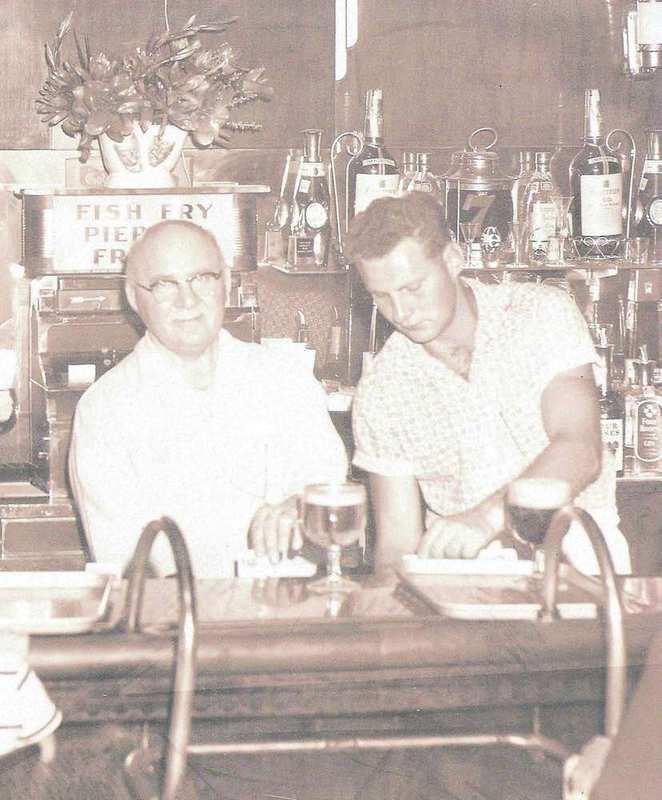
    <summary type="html"><![CDATA[<p><strong><em>In 1938, Stanley Dembowski opened a small pub called Dempsey's Oasis at 1109 Starkweather Avenue. The establishment would become one of Cleveland's most enduring taverns.</em></strong></p><img src="https://clevelandhistorical.org/files/fullsize/147f95cac83399229036103c7a930207.jpg" alt="Stanley and Richard Dembowski Exemplifying the &quot;Family Business&quot;" /><br/><p>What kind of pub gets shout-outs from national media ranging from Maxim and GQ to Huffington Post and Better Homes and Gardens? The answer is Prosperity Social Club—one of Tremont’s, and Cleveland’s, homiest and most storied spots for drinking and dining. </p><p>Prosperity Social Club, formerly known as Dempsey's Oasis, has a history that comprises almost 80 years. That history started with Jack Dempsey, heavyweight boxing champion of the world from 1919 to 1926, and namesake of the pub's original incarnation. Stanley Dembowski, born in Dulsk, Poland, in 1896 (one year after Jack Dempsey was born in Manassa, CO), opened Dempsey’s Oasis on Starkweather Avenue in 1938. Dembowski fought in France in World War I and was discharged on June 18, 1919. Sixteen days later, Dempsey won the heavyweight crown, knocking out Jess Willard. In a 1982 interview with The Plain Dealer, Stanley Dembowski recalled betting $500 that Dempsey would defeat Gene Tunney in their 1926 fight. Dempsey lost, but from then on “Everyone began calling me Dempsey. So when I started this business [at 1109 Starkweather, which previously hosted an establishment called Hot Dog Bill’s], I called it Dempsey’s. The Oasis part was added because an oasis is where thirsty people go to get dethirsted.” Stanley retired in 1967 and his son Richard, together with wife Theresa, took over. They remained until 2000 when the pub was sold to a pair of Irish businessmen. Veteran restaurateur Bonnie Flinner purchased the establishment five years later and renamed it Prosperity Social Club—a salute to the sardonic optimism that pervaded the Great Depression. </p><p>In a 2015 interview, Richard Dembowski stated that one of the restaurant’s keys to success was its ability to attract a diverse clientele: Tremont residents, downtown businesspeople, steelworkers, healthcare workers from Metro General and so on. He noted sanitation as another cornerstone—that the family made such a strong commitment to cleanliness that the local health inspector became a regular patron. According to Dembowski, “The inspector knew where he could get a good, safe meal.” The Dembowskis also gained a place in the neighborhood’s heart by actually being “locals” (they lived next door) and by being exceptional citizens. The family worked on Saint Augustine Church’s Food for the Poor campaigns and spearheaded Coats for Kids programs. In the 1980s, Stanley and Richard became local spokesmen for the Polish Solidarity campaign—the first independent labor union in a Soviet-bloc country and a key contributor to the eventual collapse of the Soviet Union. </p><p>A final success factor, recalled Dembowski, was that Dempsey’s was the first public house in the neighborhood to have a television. Good food, drinks, camaraderie and TV: a winning combination in any decade. Small wonder that people occasionally refer to Dempsey’s/Prosperity as a real-world “Cheers.” </p><p>Like any great old pub, Prosperity Social Club has changed little in appearance. Art Deco influences, wormy chestnut walls, a walnut bar, and vintage beer memorabilia abound. Most of the tables and chairs are original. A flickering television quietly displays shows from the 1950s and 1960s. A kitschy game room includes an old-fashioned bowling machine and vintage board games. One thing the pub lacks, however, is clichéd celebrity photos, although there certainly have been enough notable visitors. Over the years, Dempsey’s/Prosperity has been patronized by notables ranging from Dennis Kucinich and George Voinovich to John Glenn and Robert De Niro (the latter showed up in full “army greens” during the 1977 filming of The Deer Hunter). </p><p>Not only is Prosperity Social steeped in history, it also is surrounded by history. Immediately to the west is the Lincoln Park Baths (c. 1921), the last of 10 bathhouses erected in Cleveland to provide sanitary services to the working poor. Next to the Baths is the building that once housed the Royal movie theater, one of several theaters in or near the Tremont neighborhood. And across the street is Lincoln Park, public green space whose “roots” date to the 1850s. But in that special way that only pubs can be, Prosperity Social Club is truly ”living history.”</p><p><em><strong><a href="https://clevelandhistorical.org/items/show/743">For more (including 6 images) view the original article</a></strong></em></p>]]></summary>
    <published>2015-10-28T21:53:13+00:00</published>
    <updated>2026-03-04T21:32:03+00:00</updated>
    <link rel="alternate" type="text/html" href="https://clevelandhistorical.org/items/show/743"/>
    <id>https://clevelandhistorical.org/items/show/743</id>
    <author>
      <name>Chris Roy</name>
    </author>
  </entry>
  <entry>
    <title type="html"><![CDATA[Lemko Hall]]></title>
    <summary type="html"><![CDATA[<img src="https://clevelandhistorical.org/files/fullsize/11d4782592985335cb6f68175b49c7c9.jpg" alt="Lemko Hall, ca. 1970s" /><br/><p>Lemko Hall may be best known as the location of the wedding reception in the 1978 film "The Deer Hunter." The facility’s rich non-Hollywood history is less well known. In fact, few people know the meaning of the word Lemko, which refers to a Slavic ethnic group whose people came from a part of the Austro-Hungarian Empire that is now southeastern Poland. </p><p>Lemkos began immigrating to Cleveland in the late 19th-century (around the same time as other Central and Eastern Europeans) and settled in Tremont in large numbers. Immigrant Andrew Koreny constructed "Koreny Hall" in 1911, and it became a social center with a saloon and a ballroom for special events and performances. For a time, a savings and loan serving Rusyn immigrants also was located in the building.</p><p>Cleveland's Lemko population continued to grow and, by the early 1930s, it was the largest of any city in the nation. Until it moved to Yonkers, New York, in 1939 the Lemko Association of the USA and Canada (founded in Cleveland in 1931) had its headquarters in Cleveland and published its newspaper in the city.</p><p>In the 1930s, the local branch of the Lemko Association purchased Koreny Hall and renamed it Lemko Hall. For almost six decades, the building continued to serve as a community and cultural center for Lemkos, hosting theatrical performances, concerts, lectures, weddings, language classes, and several of the Lemko Association's national congresses. Neighborhood residents continued to frequent its bar, as well. The Lemko Association sold the building to a developer in 1987. It now contains a mix of condominiums and ground-floor commercial spaces.</p><p><em><strong><a href="https://clevelandhistorical.org/items/show/325">For more (including 5 images) view the original article</a></strong></em></p>]]></summary>
    <published>2011-08-15T15:57:27+00:00</published>
    <updated>2026-03-04T21:31:59+00:00</updated>
    <link rel="alternate" type="text/html" href="https://clevelandhistorical.org/items/show/325"/>
    <id>https://clevelandhistorical.org/items/show/325</id>
    <author>
      <name>Michael Rotman</name>
    </author>
  </entry>
  <entry>
    <title type="html"><![CDATA[Holy Ghost Byzantine Catholic Church]]></title>
    <summary type="html"><![CDATA[<img src="https://clevelandhistorical.org/files/fullsize/press-holyghost1949_1fd3139cdd.jpg" alt="Holy Ghost, 1949" /><br/><p>Holy Ghost Byzantine Catholic Church opened in Tremont in 1910 to serve Rusyn (also spelled Rusin) immigrants from Central Europe. Rusyns (not to be confused with Russians) are a Slavic ethnic group with a distinct language and culture. They hailed from the Carpathian Mountains in east Slovakia, west Ukraine, southeast Poland and the northern tip of Romania. The Byzantine Catholicism that many Rusyns practice originated with the successful efforts of the Roman Catholic Church to convert the Eastern Orthodox peoples of the Austro-Hungarian Empire in the 16th and 17th centuries. </p><p>Rusyns first immigrated to the Hungarian community on Cleveland’s east side in the 1890s and later to Tremont—often working in the steel mills and other industries that dotted the Flats. By 1909, two Greek Catholic churches (they weren't referred to as "Byzantine" until the mid-20th century) had been built in Cleveland, but most parishioners had to travel across the Cuyahoga River and the railroad track to attend liturgies on Sundays and holy days. To meet the growing parish’s needs, Holy Ghost Greek Catholic (now called Byzantine Catholic) Church was granted a charter by the state of Ohio on October 8, 1909. When it opened the next year, Holy Ghost—built for a cost of $15,000—was the first Byzantine Catholic church on the city's west side. Within ten years, parish families numbered 400. Around that time, an orphanage was established to provide for victims of the great influenza epidemic. Holy Ghost also became the first U. S. Home for the Sisters of St. Basil the Great, who staffed the orphanage until its closing in 1923.</p><p>By 1938, Holy Ghost had grown to nearly nine hundred families and some 150 of these formed St. Mary Church on West 35th St., now State Road and Biddulph Avenue. Some 3,000 souls were nurtured by Holy Ghost at the time of its Golden Jubilee celebration in 1959, but the changing neighborhood and exodus of many parishioners to the suburbs were beginning to take their toll. The church closed in 2009.</p><p><em><strong><a href="https://clevelandhistorical.org/items/show/96">For more (including 8 images) view the original article</a></strong></em></p>]]></summary>
    <published>2010-11-22T13:51:44+00:00</published>
    <updated>2026-03-04T21:31:58+00:00</updated>
    <link rel="alternate" type="text/html" href="https://clevelandhistorical.org/items/show/96"/>
    <id>https://clevelandhistorical.org/items/show/96</id>
    <author>
      <name>Michael Rotman</name>
    </author>
  </entry>
  <entry>
    <title type="html"><![CDATA[Saint Theodosius Cathedral]]></title>
    <summary type="html"><![CDATA[<img src="https://clevelandhistorical.org/files/fullsize/press-theodosius1962_0b886c26e4.jpg" alt="St. Theodosius, 1962" /><br/><p>St. Theodosius Russian Orthodox Cathedral opened in 1913 and cost approximately $70,000 to construct. Most of the land-acquisition and building funds came from parishioners. However, it is believed that Russia's Czar Nicholas II—the one whose entire family was murdered during the Revolution of 1917—also contributed. Cleveland architect Frederick C. Baird designed the church, modeling it after the Church of our Savior Jesus Christ in Moscow. St. Theodosius's thirteen onion-shaped domes–actually one onion dome and 12 cupolas–represent Jesus and the 12 Apostles, and are a prominent part of the Tremont skyline. St. Theodosius was the site for a number of scenes in the 1978 movie <em>The Deer Hunter</em>. </p><p>The first Orthodox parish in Cleveland, St. Theodosius was founded in 1896 by a small group of Carpatho-Rusyns whose religion was called Greek Catholic. These people were not Greek, but rather emigrants from Austria-Hungary who changed their religious loyalty from the Pope in Rome to the patriarch of the Russian Orthodox Church—thus re-aligning themselves with Russian, rather than Rusyn, Orthodox Christianity. In the same year that the parish was founded, the group's religious society, the Russian Saint Michael Rosko Orthodox Society, purchased land at the corner of Literary Road and McKinstry Street (West 6th Street) and constructed a small, wood-framed building on the site that served as the parish's first church. The church's first pastor was Rev. Victor Stepanoff, a Russian priest sent to Cleveland by the Bishop of the Russian Orthodox Church of North America.</p><p>While the church was founded by Rusyns, St. Theodosius also ministered in the early twentieth century to several other ethnic groups that had not yet established their own ethnic churches. According to a 1901 article in the <em>Cleveland Plain Dealer</em>, parish membership including several hundred Rusyns, as well as "ten Russians, a few Greeks, and about 30 Syrians." Romanians also worshiped at the original building at Literary and McKinstry prior to the construction of St. Mary Romanian Orthodox Church on Warren Road in 1908. </p><p>The move to St. Theodosius's new home in 1913 symbolized the parish's rapid growth at the beginning of the 20th-century. The new cathedral, which has a cornerstone identifying the building as a Greek Catholic Russian Orthodox parish—that is, no longer under the auspices of Rome—was built during the tenure of the church's third pastor, Rev. William Lisenkovsky. The second pastor, who followed Rev. Stepanoff, was Rev. Jason Kappandze, whose grandson with the same name served the church as pastor in the 1990s. The first Rev. Kappandze served the parish from 1902-1908. In 1904, Rev. Kappandze, who was said to have come from a military family in Russia, received permission from the Czar of Russia to serve as a chaplain for Russian troops fighting in the Russo-Japanese War.</p><p><em><strong><a href="https://clevelandhistorical.org/items/show/92">For more (including 8 images&#32;&amp;&#32;1 audio file) view the original article</a></strong></em></p>]]></summary>
    <published>2010-11-20T11:31:30+00:00</published>
    <updated>2026-03-04T21:31:58+00:00</updated>
    <link rel="alternate" type="text/html" href="https://clevelandhistorical.org/items/show/92"/>
    <id>https://clevelandhistorical.org/items/show/92</id>
    <author>
      <name>Michael Rotman, Tremont History Project,&amp;#32;&amp;amp;&amp;#32;Jim Dubelko</name>
    </author>
  </entry>
</feed>
