<?xml version="1.0" encoding="UTF-8"?>
<feed xmlns="http://www.w3.org/2005/Atom">
  <title type="text">Cleveland Historical</title>
  <updated>2026-05-02T02:56:14+00:00</updated>
  <generator uri="http://framework.zend.com" version="1.12.20">Zend_Feed_Writer</generator>
  <link rel="alternate" type="text/html" href="https://clevelandhistorical.org/"/>
  <link rel="self" type="application/atom+xml" href="https://clevelandhistorical.org/items/browse?output=rss2"/>
  <id>https://clevelandhistorical.org/</id>
  <author>
    <name>Cleveland Historical</name>
    <uri>https://clevelandhistorical.org</uri>
  </author>
  <link rel="hub" href="http://pubsubhubbub.appspot.com/"/>
  <entry>
    <title type="html"><![CDATA[Bohemian National Hall: A Cultural Center for Cleveland&#039;s Czechs]]></title>
    <summary type="html"><![CDATA[<img src="https://clevelandhistorical.org/files/fullsize/14357e3222464abd464b26c96346de2c.jpg" alt="Bohemian National Hall" /><br/><p>In the early 1880s, an idea arose in the Lodge Bratri v Kruhu of the Czech Slovak Benevolent Association that people of Bohemian nationality needed a community building dedicated to their societies and culture. In August 1887, Bohemian representatives met to discuss the possibility of creating such a space. </p><p>The cornerstone for Bohemian National Hall was laid on December 20, 1896, and was dedicated the following September. During the dedication ceremonies, all local Bohemian communities and societies were invited to participate, but every other ethnic group was excluded to make this a distinctly Bohemian celebration.  Bohemians attended the celebrations from Chicago, Detroit, Pennsylvania, Toledo, and even New York. The hall served as a meeting place for over 40 lodges, societies, and clubs. In 1911, classrooms were added to teach language skills. </p><p>In the late summer of 1900, the Bohemian National Turners Association held their annual convention in Cleveland. A number of tournaments took place at area locations such as Forest City Park and Central Armory with about 400 members in Cleveland alone and 800 visiting delegates. On August 23, the award banquet for the convention was held in the Bohemian National Hall. </p><p>The hall also brought large crowds for its annual celebration of Jan Hus Day. Hus was a Bohemian reformer burned at the stake on July 6, 1415, for heresy and is considered a national hero. The Bohemians would have large celebrations including plays and various performances. In 1915, events at Gordon Park brought 20,000 Bohemians to the area with many attending later events at the hall. </p><p>Also in 1915, representatives for the Czech and Slovak people met in the hall to discuss the need for a common sovereign state. This meeting, now known as the Cleveland Agreement, sparked the idea of creating what would come to be Czechoslovakia. On May 10, 1945, celebrations were held for the liberation of Czechoslovakia from German occupation with speeches by Louis Krch, president of the Slovak National Alliance and Joseph Novy, of the Czechoslovakian Consul. The celebration called for unity among Czechs and their European neighbors--Poland, Hungary, and Austria. Cleveland area Czechs also began a collection drive of clothing and household goods that would be dropped off at the hall and later sent to war torn Czechoslovakia. </p><p>In May 1975, Bohemian National Hall was added to the National Register of Historic Places. The next month, the hall was sold to the American Sokol Inc. Sokol is a program dedicated to the idea of a strong mind and body, emphasizing the importance of physical fitness. After the sale, the hall continued to host Sokol meetings, gymnastic events, lodge functions, Czech classes, and other Czech-oriented cultural events. A major renovation and restoration project in the early 2000s added an athletic facility and museum, now used as the Czech Cultural Center. </p><p>Today, the hall still teaches classes, holds events and meetings, and serves as a source of information and pride for the Cleveland Czech population. </p><p><em><strong><a href="https://clevelandhistorical.org/items/show/739">For more (including 6 images) view the original article</a></strong></em></p>]]></summary>
    <published>2015-10-09T13:50:21+00:00</published>
    <updated>2026-04-17T19:17:41+00:00</updated>
    <link rel="alternate" type="text/html" href="https://clevelandhistorical.org/items/show/739"/>
    <id>https://clevelandhistorical.org/items/show/739</id>
    <author>
      <name>Danielle Rose</name>
    </author>
  </entry>
  <entry>
    <title type="html"><![CDATA[Saint Wendelin Catholic Church: The West Side&#039;s First Slovak Catholic Parish]]></title>
    <summary type="html"><![CDATA[<img src="https://clevelandhistorical.org/files/fullsize/ea4f6004d86a846259ff8f9ad6f69d7c.jpg" alt="Old Parish Hall" /><br/><p>On July 29, 2012—nine months shy of its 110th birthday—St. Wendelin Catholic Church opened its doors. The Romanesque structure on Columbus Road had been closed since 2010, when Cleveland Bishop Richard Lennon shuttered 50 area churches, citing low attendance, insufficient priests and budget problems. Parishioners of eleven of the affected churches appealed to the Vatican, which subsequently decreed that Lennon had not followed proper procedure when closing the churches. Roughly a dozen churches have subsequently been reopened. "This is a good day, wouldn't you agree?" crowed St. Wendelin’s Reverend Robert Kropac on July 29th. "Welcome home," added parishioner Jeff Koscak.</p><p>St. Wendelin Parish was established on May 3, 1903, by Bishop Ignatius F. Horstmann, with administration of parish by Father Joseph Koudelka, the pastor at St. Michael Parish. St. Wendelin was the first Slovak Roman Catholic parish on Cleveland's west side. Masses initially were said in private homes and a rented hall. On December 6, 1903, Father Koudelka celebrated St. Wendelin’s first mass in its own facility: a wood-framed church built for $14,000 on Columbus Road near West 25th Street (then called Pearl Road). On one side of the property was the Phoenix Brewery. On the other side, a saloon.</p><p>The following March, St. Wendelin welcomed its first pastor, Father J. P. Kunes, who was succeeded shortly thereafter by Father Thomas Wilk. In October 1904, the Sisters of Notre Dame began classroom instruction. There were two schoolrooms in the convent building, staffed by two sisters who were paid $25 per month. In 1905, a new brick school building was built to accommodate the increasing enrollment. The cost of the new school was $7,570. The school grew rapidly. Before long, there were five sisters teaching the children of the parish. By 1928, the school was educating more than 1,000 students annually.</p><p>With a rapidly growing congregation and student population, the need for more land and larger facilities became dire. Parish leaders found a nearby tract of land at Columbus Road and Freeman Avenue. It was on this site that the current church and school, designed by architect William Jansen, were built in 1925. Through wise stewardship, all parish debts were paid off by 1943. The church and school structures were thoroughly renovated. The organ was modernized, the sanctuary was enlarged and new stained glass windows were installed. That same year, people could attend one of six masses weekly; 136 baptisms were performed and 33 couples were married. </p><p>By the 1960s, urban decay and new freeways were taking their toll on virtually every inner city community. The St. Wendelin parish was no exception. Membership slipped and school enrollment declined. Older neighborhoods like Tremont began to thin as parishioners moved to the suburbs. In 1976, the school operation was merged with Urban Community School, and Ursuline Sisters took over from the Sisters of Notre Dame. </p><p>Still, St. Wendelin held on. Buildings were renovated and new social activities frequently drew people from around the Cleveland area. In 2002, parish leaders declared a Year of Jubilee to mark the centennial. A century-old statue of St. Wendelin was taken out of storage, repaired, and placed inside the church where a confessional once stood. The bell, which had been removed from the belfry, was reconditioned and now sits in the church building. Still, the Lennon ax descended in 2009, when 50 churches were closed over a 15-month period, including St. Wendelin in 2010.</p><p>Since St. Wendelin’s re-opening in 2012, both the neighborhood and the pews have enjoyed population increases. Accordingly, St. Wendelin announced a large property-beautification initiative in July 2015. Of particular note is a Parish Prayer Garden which was completed behind the rectory in 2017. The Garden, which includes a walking prayer labyrinth, benches, a bike rack, and new foliage, is accessible to all parishioners and the greater Tremont community. Consistent with the mission of churches worldwide, things at St. Wendelin are looking up. </p><p><em><strong><a href="https://clevelandhistorical.org/items/show/735">For more (including 9 images) view the original article</a></strong></em></p>]]></summary>
    <published>2015-09-15T20:46:07+00:00</published>
    <updated>2026-04-17T19:17:41+00:00</updated>
    <link rel="alternate" type="text/html" href="https://clevelandhistorical.org/items/show/735"/>
    <id>https://clevelandhistorical.org/items/show/735</id>
    <author>
      <name>Chris Roy</name>
    </author>
  </entry>
  <entry>
    <title type="html"><![CDATA[Ceska Sin Sokol Hall: The Birthplace of Northeast Ohio College Gymnastics ]]></title>
    <summary type="html"><![CDATA[<img src="https://clevelandhistorical.org/files/fullsize/ee95bcb053785c6c4cae587c1fb5f8e5.jpg" alt="Ceska Sin Sokol Hall" /><br/><p>In the early 1940s, before he was even old enough to cross the street, young Joe Bachna gazed at Ceska Sin Sokol Hall  from his father's photography studio at 4203 Clark Avenue.  The three and one-half story building located down and across the street at 4314 Clark Avenue, loomed large, both in the immediate neighborhood and in his imagination.  Joe dreamed about the day when he too, like his older brothers Alfred, Rudy and Gilbert, could go to the Hall and become a Sokol member, a gymnast.</p><p>At the time that Joe Bachna was growing up in this west side neighborhood of Cleveland which was then heavily populated by Czech, Slovak and German-Americans, Ceska Sin Sokol Hall had been home to a number of west side Sokol organizations for nearly 40 years.  The Sokols ("Falcons"), a physical education and cultural program founded in Prague in 1862 to promote national solidarity and pride, was part of the culture that Czech immigrants brought with them to America in the second half of the nineteenth century.  The first Sokol in America was organized in St. Louis in 1865, and by the 1870s Sokols were being founded among the growing Czech population living in Cleveland.  </p><p>In the 1890s, Cleveland's west side Czech Sokols--Nova Vlas ("New Country") and Ceska-Zbavny ("Czech Entertainment")-- began purchasing property and building gyms in the Clark-Fulton area.  In 1903, they and a number of lodges, clubs and other men's and women's ethnic organizations pooled their resources for the purpose of acquiring a single large hall for all of their activities.  Forming a patronat ("board of managers"), they  purchased Hungaria Hall in 1907.  The hall, which had been built in 1890 by wealthy Hungarian-American magnate Theodore Kundtz, was renamed Ceska Sin Sokol Hall.   </p><p>During the the years that followed the purchase, thousands of west side neighborhood boys and girls undertook gymnastic training at Ceska Sin Sokol Hall.  They also imbibed the Sokol creed of developing strong minds and sound morals to go along with their strong bodies.  They practiced, put on exhibitions, engaged in competitions, and, on special occasions, participated in slets (literally "rallies," but actually festivals), where hundreds and sometimes even thousands of Sokol members performed elaborately choreographed gymnastic routines.  The Bachna family became involved in these and other Hall activities starting in the 1920s.  Joseph Bachna, Sr. and his wife Angela, immigrants from what became Czechoslovakia, were members of a number of clubs and other organizations at the Hall, and their boys at early ages became members of the Slovak Gymnastic Union Sokol.</p><p>While all of the Bachna boys developed life-long relationships with Sokol organizations and with Ceska-Sin Sokol Hall, the relationship that one of them developed was to have an enormous impact on the development of college gymnastics in northeast Ohio.  Rudy Bachna, whose competitive career was derailed at age 9 when he suffered a crippling injury to his left hand, founded the gymnastic program at Kent State University in 1959.  It was the first such college program in northeast Ohio and it quickly became successful, serving as a model for college gymnastic programs across the country.  Rudy trained a number of Pan-American and Olympic gymnasts, including Betty Jean Maycock, who won a gold medal at the 1960 Pan-American games and participated in the 1960 Olympics in Rome.  In 1980, in recognition of his contributions to college gymnastics, Rudy Bachna was inducted into the Greater Cleveland Sports Hall of Fame.  In 1993, two years after his retirement, he and his wife Janet, also a gymnastics coach, were inducted into the Kent State University Hall of Fame.</p><p>Today, Sokol gymnasts still train at Ceska Sin Sokol Hall and are still competitive, much like the Bachna boys were more than a half-century earlier.  And while their numbers are smaller, these Sokol-trained gymnasts have continued over the years to contribute to northeast Ohio, sometimes in fields other than gymnastics.   In 1969, when 17-year-old Peter Sikora, a west side Sokol member of Ceska Sin Sokol Hall, suffered a trampoline accident at St. Ignatius High School that left him a quadriplegic for life, his days as a gymnast were over.  But in the Sokol tradition of developing a sound mind as well as a sound body, Peter went on to college and then to law school.  He became a lawyer and then a Cuyahoga County Juvenile Court judge in 1989, where he served for 23 years until his death in 2012.  Like Rudy Bachna, Judge Sikora too found a way to contribute to his community despite his physical limitations, just as his early gymnastic training at Ceska Sin Sokol Hall would have taught him to do.</p><p><em><strong><a href="https://clevelandhistorical.org/items/show/655">For more (including 13 images) view the original article</a></strong></em></p>]]></summary>
    <published>2014-05-07T08:41:23+00:00</published>
    <updated>2026-04-17T19:17:40+00:00</updated>
    <link rel="alternate" type="text/html" href="https://clevelandhistorical.org/items/show/655"/>
    <id>https://clevelandhistorical.org/items/show/655</id>
    <author>
      <name>Jim Dubelko</name>
    </author>
  </entry>
  <entry>
    <title type="html"><![CDATA[Milan R. Stefanik Statue: Finding a New Home for a Slovak Cultural Hero]]></title>
    <summary type="html"><![CDATA[<img src="https://clevelandhistorical.org/files/fullsize/8d0b4f244614dc0ec8e8d2509f59eb66.jpg" alt="Cleveland Stefanik Statue " /><br/><p>In years past, when you traveled Martin Luther King Jr. Drive to the Cleveland Museum of Art, you likely noticed the formidable-looking bronze statue towering over the road's intersection with Jeptha Drive, the little road that takes you up to the Museum parking lot.  The statue was erected as a memorial to Milan R. Stefanik, Slovakia's greatest and most treasured national hero.  It had been a featured monument in Wade Park for nearly 90 years and was a source of pride for Cleveland's Slovak community.  However, on your next trip to University Circle, don't going searching for this statue in Wade Park.  It's  no longer there.  As a result of extensive road and sewer construction work in Wade Park, the statute was removed in 2013 from its site at this intersection and, in a somewhat controversial move, eventually relocated to to the Slovak Cultural Garden, down the road in Rockefeller Park.</p><p>It's easy to understand why the memory of Milan Stefanik is so treasured by Cleveland's Slovak-American community and why even after 90 years moving his statue to a new location created some controversy in this ethnic community.  Stefanik, son of a Lutheran minister, was born in 1880 in a village in what is today western Slovakia.  In his youth, he was a brilliant student.  He attended Charles University in Prague where he earned a PhD in Philosophy.  In 1904, he immigrated to France where in the space of a decade he achieved an international reputation as a Renaissance man who excelled in a number of different fields of scientific endeavor.  In 1914, when World War I broke out in Europe, Stefanik joined the French Army becoming a military pilot, flying missions against Axis forces in Europe.  Within a short time, he was promoted to the rank of general.  In addition to his military duties, he traveled extensively in Europe and in the United States with future first president Tomas Masaryk and others lobbying for the creation of Czechoslovakia.  After the war ended, Stefanik was returning to the new republic in May 1919 to become its first minister of defense, when the plane he was piloting--just after it had crossed over the border into Czechoslovak airspace,  mysteriously crashed, killing him. </p><p>Within months of Stefanik's death, Cleveland's Slovak community undertook plans to have a statue sculpted in his honor.  It was not an easy project to complete.  Slovak-American leaders in New York and in other U.S. cities argued that the statue should be sited in a more important venue, Washington, D.C.   Back in Cleveland, some members of City Council wanted the statue to be located in a park in Garfield Heights.  Cleveland's Slovak community, however, led by ethnic journalist and civic leader, John Pankuch, was persistent and succeeded in 1924 in erecting the statue in Wade Park--where, according to Pankuch, it would be visible to thousands of members of the general public who "would pass by [it] every hour." </p><p>In 1929, just five years after the statue was placed in Wade Park, a proposal was made to move it to the new Slovak Cultural Garden that was being planned in Rockefeller Park.  Drawings were made, footers were laid, and preliminary work to raise the statue off its pedestal was started.  But then John Pankuch and others stepped in and persuaded the Slovak community to keep the statute in Wade Park where it remained ever since until its relocation in 2013.  Now as the centerpiece of the Slovak Cultural Garden, the Milan R. Stefanik statue sits on a pedestal that was built upon the same footers that the Slovak Civic League had poured for it in the early 1930s.  It is situated between the busts and pedestals of two other Slovak cultural heroes, poet Jan Kollar and Stephen Furdek, the father of American Slavs.  While, as noted, this move was not without controversy, many in the Slovak community shrug it off and say that the statue has simply finally come home.</p><p><em><strong><a href="https://clevelandhistorical.org/items/show/611">For more (including 13 images) view the original article</a></strong></em></p>]]></summary>
    <published>2013-05-18T06:04:14+00:00</published>
    <updated>2026-04-29T16:14:44+00:00</updated>
    <link rel="alternate" type="text/html" href="https://clevelandhistorical.org/items/show/611"/>
    <id>https://clevelandhistorical.org/items/show/611</id>
    <author>
      <name>Jim Dubelko</name>
    </author>
  </entry>
  <entry>
    <title type="html"><![CDATA[The Slovak Institute]]></title>
    <summary type="html"><![CDATA[<img src="https://clevelandhistorical.org/files/fullsize/380fd9de66845b068b785d549d2c26bf.jpg" alt="Founding of the Slovak Institute" /><br/><p>The Slovak Institute is a library, archive and museum of Slovak books, newspapers, journals, photographs, paintings and other Slovak cultural items at St. Andrew Svorad Abbey located at 10510 Buckeye Road, on the southeast side of Cleveland.  Founded in 1952, the major part of the Institute's library had its genesis in an extraordinary trip that four Slovak intellectuals from Matica Slovenska (pronounced "Mah-teet'-sa Slow-ven'-ska")--the Slovak Institute of Arts and Sciences, made to Cleveland in 1936.</p><p>Arriving in Cleveland on April 16, 1936, the four intellectuals (an historian, a writer, an artist, and a film director) brought with them almost 3,000 books which had been published in Slovakia since 1918--the year in which the first Czechoslovak Republic had been created. Jozef Ciger Hronsky, the writer and president of the delegation, later wrote about the purpose of the group's trip that year to Cleveland, as well as to other American cities which had large Slovak populations.  Bringing these books, he wrote, was in part to thank Slovak-Americans for their support of the Slovak independence cause in  World War I which had led to the creation of the first Czechoslovak Republic.  However, he added, there was a second purpose to the trip.  Matica Slovenska, which is Slovakia's national cultural organization, was concerned that, by 1936, many Slovak-Americans were losing their cultural ties to their ancestral homeland.  It was hoped that this gift of books would help to re-establish those cultural ties between Slovak-Americans and Slovakia.</p><p>The four delegates from Matica Slovenska spent almost a month in Cleveland, attending banquets in their honor, enjoying the Great Lakes Exposition and capping off their visit by participating in a May 10, 1936 ceremony at the site of the Milan Stefanik statue at Wade Park, commemorating the seventeenth anniversary of the death of this World War I national hero of Slovakia.  After the delegates departed from Cleveland, most of the 3,000 books that had formed the centerpiece of their visit to Cleveland eventually ended up in the library at St. Andrew Svorad Abbey.  This was a logical place for them.  Not only had the Abbey been founded by a Benedictine Order of Slovak priests in 1922, but the Abbey's grounds had also been home since 1927 to Benedictine High School, the first Catholic Slovak boy's high school established in the United States.</p><p>Not without a small amount of irony, at the end of World War II and following the takeover of the Czechoslovak government by the Communist party, the 3,000 books at the Abbey became the centerpiece of a new mission.  In 1943, during the War, the Slovak League of America had donated funds to St. Andrew Svorad Abbey for the purpose of creating a Slovak museum in Cleveland.  Once the war ended, the museum became a gathering place for Slovak refugees fleeing from communism and communist control of Czechoslovakia.  In 1952, Abbot Theodore Kojis converted the museum at the abbey into the Slovak Institute, citing the importance of having a Slovak cultural organization in the United States to serve in the stead of Matica Slovenska, which by 1952 was under the control of the communist party in Slovakia.   </p><p>For the next nearly four decade period-- from 1952 to 1989, the Slovak Institute in Cleveland fulfilled the mission of serving as a Matica Slovenska abroad, conducting various Slovak cultural activities here in Cleveland that had international impact, including publishing and surreptitiously shipping back to Slovakia books authored by post-World War II Slovak refugees living in exile in the United States.</p><p>With the end of communist party control in Czechoslovakia in 1989 and following the creation of an independent democratic Slovak state in 1993, the main purpose of the Slovak Institute--to serve as a Matica Slovenska abroad, ceased to exist.  Accordingly, since 1993, and especially during the tenure of the Institute's current director-- from 2002 to the present, the Institute has instead focused on achieving other cultural goals, including strengthening the cultural ties between Slovakia and Slovak-Americans--a goal that had sparked Matica Slovenska's trip to the United States, and to Cleveland, in 1936.  In addition to pursuing this goal, the Slovak Institute also continues to this day to preserve and maintain its extensive library of Slovak books, journals and archival materials for the benefit of the Slovak-American community, scholars, and the interested general pubic.  </p><p><em><strong><a href="https://clevelandhistorical.org/items/show/609">For more (including 10 images) view the original article</a></strong></em></p>]]></summary>
    <published>2013-04-25T07:57:49+00:00</published>
    <updated>2026-04-17T19:17:40+00:00</updated>
    <link rel="alternate" type="text/html" href="https://clevelandhistorical.org/items/show/609"/>
    <id>https://clevelandhistorical.org/items/show/609</id>
    <author>
      <name>Jim Dubelko</name>
    </author>
  </entry>
  <entry>
    <title type="html"><![CDATA[Slovak Journalist Jan Pankuch: &quot;The Pen is Mightier than the Sword&quot;]]></title>
    <summary type="html"><![CDATA[<img src="https://clevelandhistorical.org/files/fullsize/06eb8667b30ba9c189fe8aec153a45d5.jpg" alt="John Pankuch (1869-1852)" /><br/><p>In 1926, this may not have been a reassuring adage for John Pankuch, long-time editor and publisher of Hlas ("The Voice"), Cleveland's only weekly Slovak newspaper.  Pankuch had just lost his publishing company located at 634-38 Huron Road in downtown Cleveland, because, according to one of his grandsons, he had refused to publish certain articles in his paper that his major advertisers demanded he publish.  However, as a result of this business loss, Pankuch now had some extra time on his hands.  Ever the active journalist, he used this time judiciously, writing and then publishing in 1930 a book entitled "History of the Slovaks of Cleveland and Lakewood."   The book, which draws in large part upon oral histories and written recollections of Cleveland's first Slovak immigrants--many of whom were still living at the time, is today an invaluable resource for learning about life in Cleveland's immigrant communities of the late nineteenth and early twentieth centuries.</p><p>Pankuch's own Slovak immigrant story is a compelling one.  He became a newspaper editor, and consequently a leader in the Cleveland Slovak community, by accident--literally.  In 1883, as a 13-year old, he had immigrated to the United States and joined his father, working as a coal miner in western Pennsylvania.  A year after arriving in America, young John was involved in a mine accident in which he suffered a severe injury to one of his legs, nearly resulting in its amputation.  When he finally recovered from that injury a year later, his mother refused to allow him to return with his father to the mines.  Instead, the family gave the 15-year old boy the name of a Slovak immigrant friend living Cleveland and sent him there to study business.</p><p>Arriving in Cleveland, John Pankuch found a small, but closely-knit Slovak community.  He never forgot the caring nature of this early community.  As a result, "unity" became a theme that he would preach to the Slovaks of Cleveland and Lakewood for the rest of his life.  While Pankuch was compelled to leave Cleveland and return to Hungary in 1888, after the death of his father in a coal mine accident, Pankuch returned to Cleveland just one year later in June 1889, bringing with him his soon-to-be wife, Rose Gasgaber, and a renewed determination to make his life in Cleveland. In October 1892, John Pankuch became a naturalized citizen of the United States, and was already beginning to become  involved in local politics, his church, and in the printing and publishing businesses in Cleveland.  </p><p>The story of John Pankuch's leadership in his immigrant community is a lesson in the importance of ethnic journalists to nineteenth century immigrant communities.  Newspapermen, along with clerics, were often the most important leaders in these immigrant communities.  While publishing "Hlas," Pankuch also served as a lay leader of Holy Trinity Lutheran Church, Cleveland's first Slovak Lutheran church.  He founded the Slavonian Republican Club of Cleveland in 1897 and became a precinct committeeman. As a member of the Association of Slovak Journalists, Pankuch was instrumental in organizing the Congress that met at Cleveland's Grays Armory on May 26, 1907 to create the Slovak League of America--an organization subsequently of critical importance to the formation of the first Czechoslovak Republic in 1918.  </p><p>After World War I ended, Pankuch remained active in the Slovak community.  In 1923-1924, he chaired the committee which completed the purchase of and erected the General Milan Stefanik memorial statue in Wade Park near the Cleveland Museum of Art.  Throughout the 1920s and 1930s, he was a featured speaker at almost every important event in the Cleveland Slovak community, always preaching his theme of ethnic success through ethnic unity.  In 1937, Pankuch capped his civic career by serving as the national president of the National Slovak Society.  Having resurrected his newspaper Hlas in 1932, he continued to publish the weekly Slovak paper in Lakewood until 1946.  He died in that suburb in 1952 at the age of 82 years old.</p><p><em><strong><a href="https://clevelandhistorical.org/items/show/598">For more (including 12 images) view the original article</a></strong></em></p>]]></summary>
    <published>2013-03-12T21:26:57+00:00</published>
    <updated>2026-04-17T19:17:40+00:00</updated>
    <link rel="alternate" type="text/html" href="https://clevelandhistorical.org/items/show/598"/>
    <id>https://clevelandhistorical.org/items/show/598</id>
    <author>
      <name>Jim Dubelko</name>
    </author>
  </entry>
  <entry>
    <title type="html"><![CDATA[The Battle at Saint Ladislas: Hungarians and Slovaks fight for control of their Church]]></title>
    <summary type="html"><![CDATA[<img src="https://clevelandhistorical.org/files/fullsize/34d6ef9688a04bd4b4ec57eb2d2d70d8.jpg" alt="St. Ladislas Church" /><br/><p>On Sunday, August 2, 1891, the congregation of Hungarian (Magyar) and Slovak parishioners gathered in St. Ladislas Roman Catholic Church on the southeast side of Cleveland for mass. Father John Martvon, the church's Slovak pastor, began the mass in Latin, but when the time arrived for him to give his sermon, he began to speak in Slovak. This touched off a riot at the church. The Hungarian parishioners began cursing the priest, which drew an angry response from the Slovak parishioners. Then, someone yelled, "Kill the Slav priest!" Soon, Slovaks and Hungarians were battling one another in the church, while one of the Slovaks, Jacob Gruss, stood by the altar in front of Father Martvon, brandishing a pistol to keep the threatening Hungarians from harming the priest. Eventually, Cleveland police officers from the nearby Fifth Precinct arrived on the scene and dispersed the crowd before anyone was seriously injured.</p><p>The riot at St. Ladislas on August 2, 1891, was the opening salvo in a battle for control of the church which had been built just two years earlier in 1889. The church had been built to serve Roman Catholic immigrants from Hungary—primarily Magyars and Slovaks, who had been moving to the southeast side of Cleveland—near the iron works and other factories, since the early 1880s. While these two ethnic groups were from the same country and shared the same religious faith, they had animosity towards one another as the result of a Hungarian nationalist policy known as "Magyarization," which sought to suppress the language, culture and identity of Slovak and other non-Magyar ethnics living in Hungary. </p><p>Throughout the month of August 1891, Slovaks and Magyars continued to wage their battle. The Cleveland police officers who staffed the Fifth precinct station remained on high alert throughout the month, especially after another riot broke out in front of Father Martvon's residence on South Woodland Avenue (Buckeye Road) on August 15. While Magyar parish leaders deplored the violence, they hired two prominent Cleveland attorneys--Martin A. Foran, a former county prosecutor and former congressman, and Joseph C. Bloch, a Jewish lawyer born in Hungary, in an attempt to convince the Cleveland Catholic diocese to award the church to the Hungarians and to instruct the Slovaks to build another church somewhere else. </p><p>In the twelve day period between August 6 and August 18, at least four meetings were held in which the warring ethnic groups yelled at each other, pleaded with each other, and tried to convince each other to agree to a deal which would give one or the other exclusive control of the church. In the end, the advantage was with the Slovaks. While the Hungarians had hired two of Cleveland's best attorneys to argue their case, the Slovaks, who had not hired legal counsel, instead relied upon their parish priest Father Martvon and Our Lady of Lourdes pastor Stephen Furdek, both Slovak immigrants, to argue their case to the diocese. It was a winning strategy. The Hungarians saw that the Diocese was not going to award them St. Ladislas so they settled with the Slovaks. They relinquished their claim to the church and built a new church, <a href="https://clevelandhistorical.org/items/show/203">St. Elizabeth of Hungary</a>, two blocks away. The Slovaks paid the departing Magyars $1000 and St. Ladislas officially became Cleveland's first Slovak Roman Catholic Church.</p><p><em><strong><a href="https://clevelandhistorical.org/items/show/596">For more (including 11 images) view the original article</a></strong></em></p>]]></summary>
    <published>2013-02-28T23:54:55+00:00</published>
    <updated>2026-04-17T19:17:40+00:00</updated>
    <link rel="alternate" type="text/html" href="https://clevelandhistorical.org/items/show/596"/>
    <id>https://clevelandhistorical.org/items/show/596</id>
    <author>
      <name>Jim Dubelko</name>
    </author>
  </entry>
  <entry>
    <title type="html"><![CDATA[First Catholic Slovak Union]]></title>
    <summary type="html"><![CDATA[<img src="https://clevelandhistorical.org/files/fullsize/88d8ce4b046d074871313a6d09b37fc4.jpg" alt="An Art-Deco Style Headquarters for Jednota" /><br/><p>If you are driving south on East 55th Street near its intersection with Broadway Avenue, you will notice on the left at 3289 East 55th Street a beautiful art-deco style grey limestone building that seems oddly out of place with the single family houses that surround it.  The building, which has above its front entrance the single word "Jednota," was built during the Great Depression as headquarters for the First Catholic Slovak Union, one of the largest and oldest ethnic fraternal organizations in the United States.  </p><p>Founded in Cleveland in 1890, the First Catholic Slovak Union ("FCSU") is  often referred to as the "Jednota" which, in the Slovak language, means "Union."  The original purpose of the organization was to provide insurance and other benefits to immigrant Slovaks and their families living and working in America, especially in and near Pennsylvania's dangerous mines and Cleveland's factories.   In 1892, the organization also began publishing a newspaper in English and Slovak--similarly called "Jednota."  It continues to be published to this day as a bi-weekly newspaper with a masthead motto: "Za Boha a Narod"--for God and Nation.  </p><p>From its very beginning, the First Catholic Slovak Union has  had strong ties to the Roman Catholic Church.  Its founder, Father Stephen Furdek, was a Slovak immigrant priest and long-time pastor at Our Lady of Lourdes parish in Cleveland.  Father Furdek founded the organization because of his concerns that the National Slovak Society ("NSS"), founded in Pittsburgh earlier that same year, was too secular in its approach to addressing issues and problems in the American Slovak community.  More than a century later after he founded "Jednota," Father Furdek is still respectfully referred to in the Cleveland Slovak community as the father of their community.</p><p>Incorporated with the State of Ohio in 1892, the FCSU grew quickly and by 1928 had 58,000 members nationally, as well as an additional 38,000 members in its junior organization.  By the early 1930s, membership in the national organization exceeded 100,000.  Meetings of the organization were originally held and the organization's records and files were originally kept in the homes of its officers who lived in the lower Buckeye Road area of Cleveland.  But as the organization grew as above noted, it soon became apparent that the organization required larger and more professional administrative offices.  In 1919, a step was taken in that direction when the FCSU purchased a large house in Slavic Village at 3289 East 55th Street.   The house both served as the residence of its president and provided the organization with the additional space it needed for its growing business.</p><p>In 1932, while the United States was in the depth of the Great Depression, the FCSU undertook a major renovation of the house at 3289 East 55th Street, converting it from a single family  residence into the art-deco style office building, which is the centerpiece of this story. Cleveland architects Warner, Katonka and Miller designed the new structure to have "mankato hone-finished stone of golden tint"  and increased the floor plan of the building to 51 feet by 57 feet. The interior of the new addition, which was labeled "modernistic" by the news media, featured marble floors of two alternating colors and walls, ceilings and cornices made of American walnut.  </p><p>The art-deco style renovation and building expansion was completed in 1933 and the new headquarters was dedicated by Cleveland Bishop James A. McFadden in September of that same year.  The building served as headquarters for the First Catholic Slovak Union for the next half century plus-- from 1933 until 1988.  In that latter year, the FCSU sold the building and moved to a new headquarters building located in the Cleveland suburb of Independence, Ohio.</p><p><em><strong><a href="https://clevelandhistorical.org/items/show/593">For more (including 10 images) view the original article</a></strong></em></p>]]></summary>
    <published>2013-02-26T19:49:09+00:00</published>
    <updated>2026-04-17T19:17:40+00:00</updated>
    <link rel="alternate" type="text/html" href="https://clevelandhistorical.org/items/show/593"/>
    <id>https://clevelandhistorical.org/items/show/593</id>
    <author>
      <name>Jim Dubelko</name>
    </author>
  </entry>
  <entry>
    <title type="html"><![CDATA[Monsignor Francis Dubosh: Balancing Slovak Identity with American Patriotism]]></title>
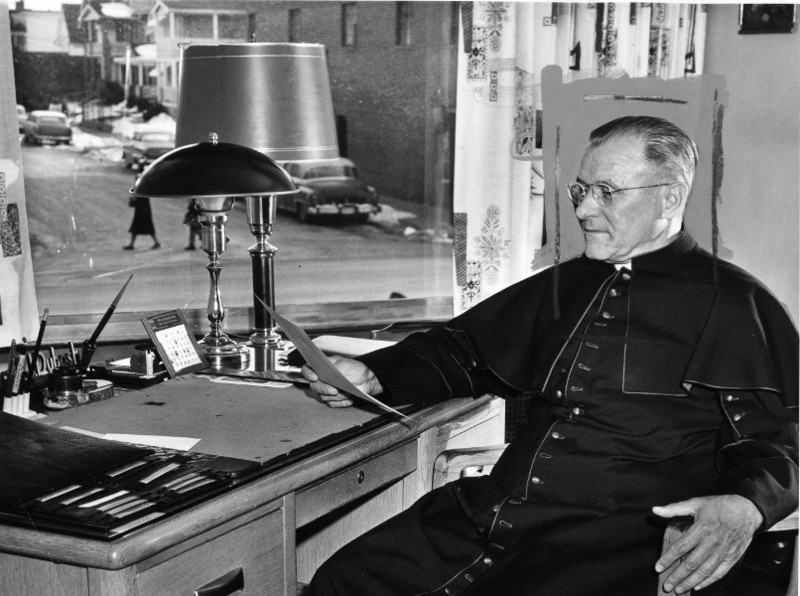
    <summary type="html"><![CDATA[<p><strong><em>Monsignor Francis J. Dubosh did not suffer a fool gladly.  When he wasn't satisfied with the speed exhibited by the editor of one national Slovak newspaper in publishing articles about Slovak American patriotism during World War II, he didn't mince his words.  "Please don't muff this," he wrote the editor, "as you did with the naming of the three Liberty Ships."   </em></strong></p><img src="https://clevelandhistorical.org/files/fullsize/096e5d11e275ec99ed900caf6ebce980.jpg" alt="Overseeing Birdtown" /><br/><p>World War II was a challenging time for many of America's Eastern European ethnic communities whose homelands were allied during the war with Hitler's Nazi Germany.  Because of the close ties which many in these ethnic communities maintained with family and friends in the old homelands, their civic organizations often engaged in concerted action to demonstrate to the United States government that, despite overseas ties, their members were still loyal and patriotic Americans.  One of America's foremost leaders during World War II who led such a concerted organizational effort for the national Slovak-American community was Monsignor Francis J. Dubosh, long-time pastor of Saints Cyril and Methodius Catholic Church in Lakewood, Ohio and the son of Slovak immigrants.</p><p>Francis J. Dubosh was born in the Tremont neighborhood of Cleveland on September 27, 1890.  He was a graduate of St. Ignatius high school, Loyola College (now John Carroll University), and St. Mary's Seminary.  In 1916, he was ordained as a Cleveland diocesan priest, and two decades later, in 1935, he was appointed a domestic prelate with the title of Monsignor.  During the years leading up to World War II, Monsignor Dubosh was engaged in an active and fruitful career as pastor at Saints Cyril and Methodius.  In addition to his cleric duties there, however, Dubosh, became an activist in a number of Slovak civic and religious organizations, and in the years leading up to World War II he attained leadership positions in several of these organizations, including the First Catholic Slovak Union, which had been founded in Cleveland in 1890, and the Slovak Catholic Federation, founded in Wilkes-Barre, Pennsylvania in 1911.  </p><p>In 1943, as America entered into its second year of World War II, Monsignor Dubosh was elected President of the Slovak League of America, one of the most important Slovak national civic organizations.  The Slovak League-- founded in Cleveland in 1907,  had been instrumental in forging the Cleveland Agreement of 1915 and the Pittsburgh Agreement of 1918, which led to the creation of Czechoslovakia in 1918.  As the new president of the Slovak League, Monsignor Dubosh traveled around the country during World War II promoting Slovak patriotism in America, but at the same time lobbying for an independent democratic Slovak state in post-war Europe.   </p><p>Through Monsignor Dubosh's organizational efforts as President of the Slovak League, tens of millions of dollars were raised in war bonds purchases by Slovak-Americans.  The "Slovak Record," a national newspaper published by the League, was strategically circulated to targeted government officials, creating a compelling record of the many acts of sacrifice and patriotism both at home and in the military overseas that Slovak-Americans performed during the war.  And, although Slovakia did not emerge from World War II as an independent democratic state as he had worked and prayed for,  his speeches, trips, and correspondence as president of the Slovak League of America during the war kept the vision alive.  </p><p>After World War II ended and his tenure as President of the Slovak League came to an end,  Monsignor Dubosh continued to give public speeches--some of them controversial, all of them passionate, and campaign for an independent democratic Slovak state in Europe.  His vision finally materialized on January 1, 1993 when the Slovak Republic was created--an event that took place two and one-half decades after Monsignor Dubosh's death in Cleveland on Christmas day 1967.</p><p><em><strong><a href="https://clevelandhistorical.org/items/show/583">For more (including 11 images) view the original article</a></strong></em></p>]]></summary>
    <published>2013-02-13T00:24:22+00:00</published>
    <updated>2026-04-17T19:17:39+00:00</updated>
    <link rel="alternate" type="text/html" href="https://clevelandhistorical.org/items/show/583"/>
    <id>https://clevelandhistorical.org/items/show/583</id>
    <author>
      <name>Jim Dubelko</name>
    </author>
  </entry>
  <entry>
    <title type="html"><![CDATA[Our Lady of Mercy Church: &quot;The Little Cathedral&quot;]]></title>
    <summary type="html"><![CDATA[<img src="https://clevelandhistorical.org/files/fullsize/355e77464c2be520ebb60e4b441fbf08.jpg" alt="Our Lady of Mercy Church" /><br/><p>According to an article in the Cleveland Plain Dealer, when the new Our Lady of Mercy church opened in October 1949, its Slovak-American parishioners called it "The Little Cathedral on the South Side." The exterior of the small church does, in fact, bear a resemblance to St. John Cathedral in downtown Cleveland. Designed in the Romanesque style, Our Lady of Mercy is constructed with crab orchard stone — similar to what was used in the 1946-1948 reconstruction of St. John's Cathedral. Our Lady of Mercy was designed during that same time period by the same architectural firm —Stickle, Kelly and Stickle—that oversaw reconstruction of St. John Cathedral.</p><p>The history of Our Lady of Mercy parish tracks to the early twentieth century. At that time, the Tremont neighborhood, then called South Side, was home to myriad immigrants from Eastern Europe, including Poles, Ukrainians, Rusyns, and Slovaks. By 1915, neighborhood Poles, Ukrainians and Rusyns could worship at a neighborhood church, but Catholic Slovaks had to travel to St. Wendelin Church on Columbus Road. The trip was lengthy and potentially dangerous, especially for children, who had to cross three streetcar lines and either cross the railroad tracks or negotiate the Abbey Avenue bridge to reach St. Wendelin.</p><p>In 1915, Catholic Slovaks living in Tremont petitioned the Bishop of the Catholic Diocese to grant them a parish of their own in Tremont. Their petition was denied, leading to a brief schism within the Diocese. In 1917, a small wood-frame church was built on West 11th Street which, from 1917 to 1922 was known as St. John the Baptist. In 1922, the rift between Tremont's Slovak Catholics and the Diocese was mended, and permission was granted to worship at the small church whose name was changed to Our Lady of Mercy.</p><p>Over the next quarter century, a number of improvements — including enlargement of the sisters' house and construction of a new school building, were made by Rev. John Krispinsky, the parish's long-serving second pastor. During this era, Father Krispinsky also became active in the Tremont neighborhood — assisting at the Merrick Settlement House and supporting the 1939 Valleyview Homes public housing project. Building on the church grounds was completed in 1949 with the dedication of the "The Little Cathedral on the South Side."</p><p>In 2010, Our Lady of Mercy Church was closed as part of Bishop Lennon's parish-reorganization plan. Only a few years later, however, the three-building complex became a textbook example of adaptive reuse.  Following a $5 million renovation, Our Lady of Mercy is now home to Hermes Cleveland (a sports- and events-management firm) and MCM Company (historic renovation specialists), which together purchased the three-building property from the Diocese of Cleveland. A third tenant, The Historic Preservation Group, has also signed on and others are expected soon.</p><p><em><strong><a href="https://clevelandhistorical.org/items/show/493">For more (including 9 images) view the original article</a></strong></em></p>]]></summary>
    <published>2012-06-10T16:54:15+00:00</published>
    <updated>2026-04-17T19:17:39+00:00</updated>
    <link rel="alternate" type="text/html" href="https://clevelandhistorical.org/items/show/493"/>
    <id>https://clevelandhistorical.org/items/show/493</id>
    <author>
      <name>Tremont History Project&amp;#32;&amp;amp;&amp;#32;Jim Dubelko</name>
    </author>
  </entry>
  <entry>
    <title type="html"><![CDATA[Lee-Scottsdale Building]]></title>
    <summary type="html"><![CDATA[<img src="https://clevelandhistorical.org/files/fullsize/24369525a932b9cbe4a858a4e4ffa3cc.jpg" alt="The Lee-Scottsdale Building" /><br/><p>The Lee-Scottsdale Building, located at 3756 Lee Road in Shaker Heights' Moreland neighborhood, is one of the oldest commercial buildings in that neighborhood of the city.  Over the years, visitors to this four-story Romanesque and Renaissance motiffed building located near Shaker Heights' southern boundary line with Cleveland may have noticed and wondered about the meaning of the non-English words that are prominently carved into the stone entrance way to the building: "Uradoven Prvej Katolickej Slovenskej Zenskej Jednoty."  The words, written in the Slovak language, translate in English to "Office of the First Catholic Slovak Ladies Association," and they identify the organization which erected the building in 1930.</p><p>The First Catholic Slovak Ladies Association (FCSLA) is one of the oldest still existent ethnic fraternal benefit societies in the United States.  It was founded in 1892 by Anna Hurban at St. Ladislas Church, a Slovak Catholic Church located on Holton Avenue in the Buckeye Road neighborhood of Cleveland.  Hurban was a Slovak immigrant who had settled in the Slovak ethnic enclave of this southeast side Cleveland neighborhood in the late nineteenth century.  The FCSLA was organized to provide insurance benefits to Slovak women who sought financial security from the many environmental risks that faced Slovak immigrants working in and living near the industrial factories that at this time dotted the landscape in Cleveland's Lower Buckeye Road area.</p><p>The FCSLA for several decades conducted its business out of the homes of the women who served in the organization's various executive positions.  However, in the 1920s, the organization's leadership decided that it was important to the organization's efficiency to establish a central office. In 1929, land was purchased on the southwest corner of Scottsdale and Lee Roads and the architectural firm of Fox, Duthie and Foose was hired to design a headquarters building for the FSCLA.  Construction of the building began in 1929 and was completed in 1930.</p><p>The building, which included first floor retail shops, an auditorium, and residential units on the upper floors, served as the headquarters of the FCSLA from 1930 until 1968.  In that latter year, the organization moved into its new headquarters on Chagrin Boulevard. Since the late1960s, the Lee-Scottsdale building has served a variety of other retail, office and residential uses in Shaker Heights.  Interestingly, in the 1970s, the Cleveland Modern Dance Association (now DANCECleveland), which is another long-standing organization managed by and devoted primarily to serving the interests of Cleveland area women, operated its dance studio out of this building at 3756 Lee Road.</p><p>The Lee-Scottsdale Building was designated an historic landmark by the Shaker Heights Landmark Commission in 1988.</p><p><em><strong><a href="https://clevelandhistorical.org/items/show/398">For more (including 8 images) view the original article</a></strong></em></p>]]></summary>
    <published>2012-01-20T11:04:12+00:00</published>
    <updated>2026-04-17T19:17:38+00:00</updated>
    <link rel="alternate" type="text/html" href="https://clevelandhistorical.org/items/show/398"/>
    <id>https://clevelandhistorical.org/items/show/398</id>
    <author>
      <name>Jim Dubelko</name>
    </author>
  </entry>
  <entry>
    <title type="html"><![CDATA[Birdtown: A Company Town in Lakewood]]></title>
    <summary type="html"><![CDATA[<p><strong><em>In the southeast corner of Lakewood, the National Carbon Company charted a novel alternative to the more common, rigidly top-down approach to company towns. Unlike industrial firms that built, maintained, and regulated residential compounds to encourage or even compel worker adherence to their prescribed expectations for productivity, loyalty, and even morality, National Carbon collaborated with its workers to fashion a diminutive "village within the city" close to work but free from company control. The small, self-contained, and well-bounded neighborhood made its original nickname — the Bird’s Nest — fitting indeed.</em></strong></p><img src="https://clevelandhistorical.org/files/fullsize/7a8598959052e50a212af78d35ff6364.jpg" alt="The Robin Tavern " /><br/><p>In 1891 the National Carbon Company (now GrafTech) occupied the corner of Madison Avenue and West 117th Street at the Cleveland-Lakewood border. It manufactured batteries and developed the carbon filtered gas mask. The company employed recent immigrants, primarily Slovaks and eastern Europeans in its growing manufacturing business. Often workers were encouraged to bring family members to work to join the force. Most of the employees lived in Cleveland neighborhoods and would travel muddy and icy roads to the site. The lack of any public transportation made the trip challenging to arrive to work on time. In 1892, National Carbon sought a solution to the problem.</p><p>The company acquired 155 acres to the west of the factory to Halstead Avenue and developed over 400 residential parcels to accommodate factory employees and their families. The Pleasant Hill Land Company worked with company employees to develop homes in the area by offering reduced down payments and favorable financing. Many families built their homes personally during their time away from the factories. By 1910, nearly 2200 residents called this area home. The neighborhood was reminiscent of company towns like Pullman, Illinois and Homestead, Pennsylvania. Pullman was entirely company-owned and provided housing, markets, a library, churches and entertainment for  employees who were required to live there. Homestead, was a steel town which grew among workers around the burgeoning steel industry along the Monongahela river in the late 1800s. Birdtown, a neighborhood within Lakewood, represented a community fostered by the company but built and owned by the residents.</p><p>The names 'Bird's Nest' and 'Birdtown' were derived from several streets named for birds believed to be indigenous to the area including robin, plover, lark, and thrush among others. The district was also referred to as "the village" by its original residents. A facet of Birdtown is evident when one walks along the tree-lined streets. Multiple uses of land and buildings for homes, stores, churches, domestic farm gardens, animals, and dairies provided a self sustaining village within Lakewood. Several properties reflect the ingenuity of the early residents who built or added to their structures.  The residents completed and maintained their properties meticulously, a feature which remains visible today.</p><p>A visit to the area today reveals a very tidy neighborhood bounded by factories: Graftech at the 117th end and Lake Erie Screw Corporation on the west end (site of the former Templar Motor Corporation) on Halstead Avenue.  Madison Avenue on the north and railroad tracks to the south enclose the community.  Harrison Elementary School sits in the middle of the neighborhood which also is home to several ethnically connected churches and schools. More than eight churches within the district served the Slovak, Polish, Ukrainian, and Carpatho-Rusyn people in the neighborhood. Two churches, both named Sts. Peter and Paul (one Russian Orthodox  and  the other Lutheran) illustrate the ethnic and religious varieties in the neighborhood.  Immigrant families kept their language, worship, and traditions preserved through parish and school programs well into the 1900s. Birdtown is listed on the National Register of Historic Places.</p><p><em><strong><a href="https://clevelandhistorical.org/items/show/219">For more (including 8 images) view the original article</a></strong></em></p>]]></summary>
    <published>2011-06-06T09:46:46+00:00</published>
    <updated>2026-04-17T19:17:37+00:00</updated>
    <link rel="alternate" type="text/html" href="https://clevelandhistorical.org/items/show/219"/>
    <id>https://clevelandhistorical.org/items/show/219</id>
    <author>
      <name>Jim Lanese</name>
    </author>
  </entry>
  <entry>
    <title type="html"><![CDATA[Slovak Cultural Garden]]></title>
    <summary type="html"><![CDATA[<img src="https://clevelandhistorical.org/files/fullsize/cmp-slovak-stefanik1934_6afdb8c243.jpg" alt="General Stefanik Memorial, 1934" /><br/><p>Slovaks began immigrating to Cleveland in the late 1870s, settling first around E. 9th Street near the Cuyahoga River. As the community grew some members moved to the lower Buckeye Road neighborhood between E. 78th Street and Woodhill Road. Others moved to the west side, settling in Tremont and in Lakewood's "Birdtown." </p><p>Because the Slovak state existed for only a brief time during WWII and only became a modern state in 1993, the Slovak community does not consider the recorded population data of Slovaks in Cleveland to be accurate. Many Slovak immigrants were identified by their country,  which was Austria-Hungary before WWI and Czechoslovakia after WWI, rather than by their ethnicity. It is estimated that 35,000 Slovak immigrants were living in Cleveland by 1918. This number grew to an estimated total of 48,000 living in the Greater Cleveland area by 1970. By 1980, most Slovaks had moved to the suburbs, many to Parma. With the creation of The Slovak Republic on January 1, 1993, Cleveland Slovaks engaged in a series of cultural contacts with their now-independent homeland, including tours and trade missions. This activity reflects the Cleveland Slovak community's interest in preserving cultural traditions and ethnic identity. </p><p>The Slovak Cultural Garden is comprised of three acres, spanning two levels, from East Boulevard to Martin Luther King Boulevard. At its heart is a sandstone terrace that opens onto an oval-shaped lawn that sits between busts of famous Slovakian community leaders Stefan Furdek and Jan Kollar. Initially dedicated in 1932, the Slovak Garden was rededicated in 1934, and again in 1939. </p><p>In the Slovak Cultural Garden the busts of Furdek and Kollar reflect the complexity of the story of Slovakian identity. A Catholic priest and a Lutheran minister, respectively, Furdek and Kollar embody both of Slovakia's primary religious traditions. Furdek served as priest in Cleveland's Our Lady of Lourdes Catholic Church, where he ministered for 32 years until his death in 1915. He organized the First Catholic Slovak Union and the First Slovak Ladies Union in 1889. He was also a prolific author, writing an important reader that was used widely in Slovakian schools. Born in the 18th century, Kollar was a Lutheran minister who defended the language rights of both Lutheran and Catholic Slovaks against the encroachment of the Austro-Hungarian Empire. His poetry predicted Slovakian independence.</p><p><em><strong><a href="https://clevelandhistorical.org/items/show/108">For more (including 7 images) view the original article</a></strong></em></p>]]></summary>
    <published>2010-12-29T13:27:09+00:00</published>
    <updated>2026-04-17T19:17:37+00:00</updated>
    <link rel="alternate" type="text/html" href="https://clevelandhistorical.org/items/show/108"/>
    <id>https://clevelandhistorical.org/items/show/108</id>
    <author>
      <name>Bill Jones&amp;#32;&amp;amp;&amp;#32;Jim Dubelko</name>
    </author>
  </entry>
</feed>
