<?xml version="1.0" encoding="UTF-8"?>
<feed xmlns="http://www.w3.org/2005/Atom">
  <title type="text">Cleveland Historical</title>
  <updated>2026-05-02T04:42:30+00:00</updated>
  <generator uri="http://framework.zend.com" version="1.12.20">Zend_Feed_Writer</generator>
  <link rel="alternate" type="text/html" href="https://clevelandhistorical.org/"/>
  <link rel="self" type="application/atom+xml" href="https://clevelandhistorical.org/items/browse?output=rss2"/>
  <id>https://clevelandhistorical.org/</id>
  <author>
    <name>Cleveland Historical</name>
    <uri>https://clevelandhistorical.org</uri>
  </author>
  <link rel="hub" href="http://pubsubhubbub.appspot.com/"/>
  <entry>
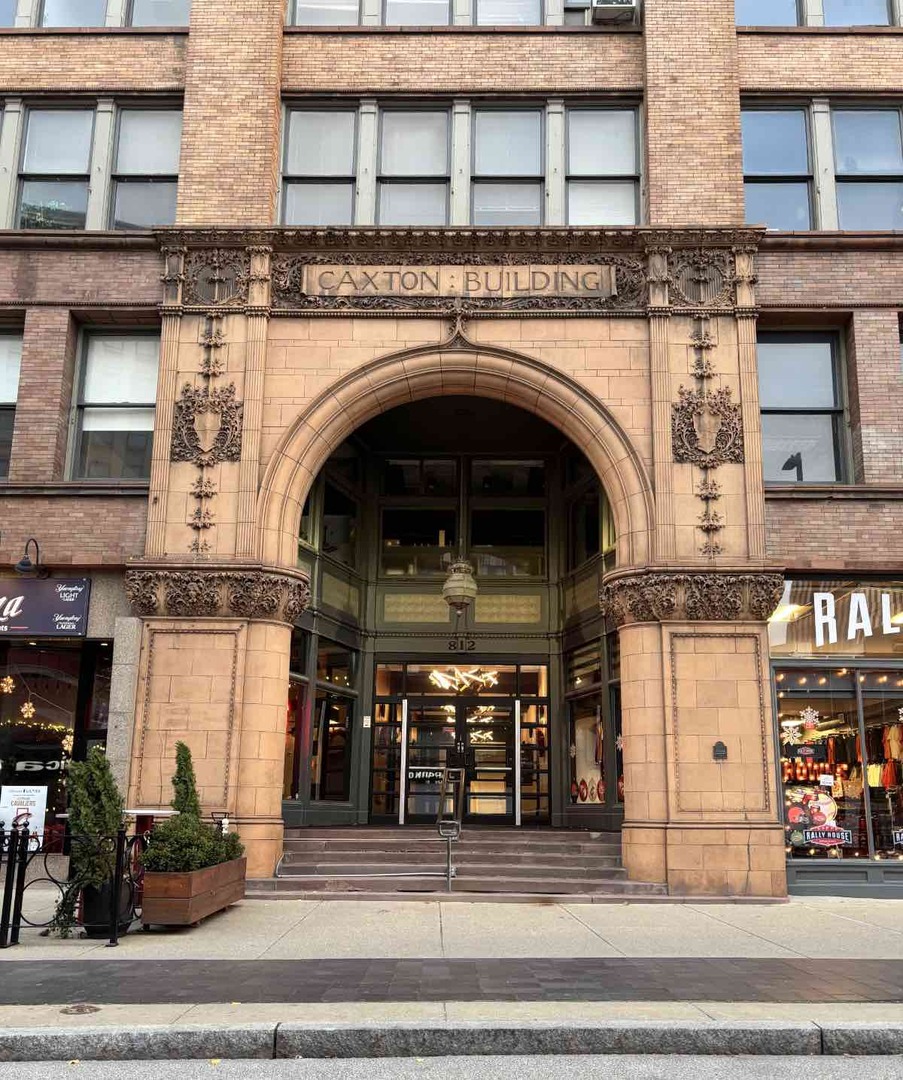
    <title type="html"><![CDATA[Caxton Building: Cleveland’s Historic Printing and Publishing Hub]]></title>
    <summary type="html"><![CDATA[<p><strong><em>The Caxton Building, located in downtown Cleveland, is a historic landmark that embodies the city's industrial past. Constructed in 1898-1900, the eight-story structure was designed by the architect F. S. Barnum as one of the nation’s earliest fireproof office buildings, tailored for printing and publishing businesses. Today, the Caxton Building stands as a testament to Cleveland’s rich history, housing a variety of modern offices while maintaining its vintage character through preserved architectural details.</em></strong></p><img src="https://clevelandhistorical.org/files/fullsize/1494a8988e3d83f1bc0ace442fef0381.jpg" alt="Caxton Building Entrance" /><br/><p><span>The Caxton Building is named after William Caxton, a 15th-century British printer who was the first person to introduce the printing press to England. Caxton was known for printing the earliest English-language version of the Bible, along with other classical works. The Caxton Building’s namesake reflected the original motivation for its construction. Stockholders of the Caxton Building Co., Worcester R. Warner, Ambrose Swasey, Samuel T. Wellman, Rollin C. White, Luther Allen, and Wilson M. Day were behind the building's planning and construction. (Warner and Swasey were already widely known as the principals of a major Cleveland machine-tool and telescope manufacturing company bearing their name; Allen was a founder of Cleveland's White Motor Corp.) Their leadership and vision helped the Caxton Building develop as an aggregated space for printing and publishing businesses by providing the necessary infrastructure to attract such firms. The creation of nodes or hubs of aligned businesses, including so-called "power block" buildings like the Caxton, was a common practice during the rise of American downtowns.</p><p>Designed by architect Frank Seymour Barnum, the Caxton Building is an outstanding example of Chicago School architecture, which was popular in the late 19th and early 20th centuries. Completed in 1900, the building stands eight stories tall and is noted for its steel-frame construction, one of the earliest uses of this Chicago-born technology in Cleveland. This architectural style allowed for larger windows, a lighter appearance, and more flexibility in interior space, and the building’s reinforced concrete floors were especially suited to support the heavy equipment used by printing, publishing, and graphic design firms.</p><p>The arrival of enterprise publishers establishing their quarters in the Caxton Building soon fulfilled its developers’ hopes for it to become the recognized center for printing and publishing in Cleveland. The movement of the Chautauqua Assembly’s headquarters and publication office from Buffalo, New York, to the Caxton Building was a major milestone in the building's history and it brought a unique book publishing and magazine business in the city. Among the famous products developed at the Caxton Building were the <em>Chautauquan </em>(magazine), <em>Engineers’ Magazine</em>, <em>Iron Trade Review</em>, and the <em>Jesuit Relations</em> book series. Other notable printing businesses located there were the Cleveland Printing and Publishing Company and Arthur H. Clark Company, which specialized in historical and geographical publications. Perhaps the most famous Caxton Building business was the World Publishing Company, a major publisher of Bibles, dictionaries, and children's books, which was begun in 1902 by Alfred H. Cahen.</p><p>The Caxton Building was listed in the National Register of Historic Places in 1973 and a Cleveland Landmark three years later, solidifying its reputation as a historic building. As many publishing and printing firms closed or moved away, however, the building became largely vacant by the early 1990s. When the Gateway sports and entertainment complex arrived soon afterward, it spurred new business interest in the surrounding blocks. A well-timed renovation in 1994 gave the Caxton Building many much-needed modern updates while preserving its historic architectural features and well-lit interiors. In the years since, the building’s adaptability has enabled it to attract and new tenants, including architectural firms, law offices, digital media firms, design studios, and civic organizations. The Caxton Building is an excellent but rare example of how a building constructed for a specialized purpose adapted to changing needs while remaining a commercial and civic hub.</p></p><p><em><strong><a href="https://clevelandhistorical.org/items/show/1041">For more (including 5 images) view the original article</a></strong></em></p>]]></summary>
    <published>2024-11-26T07:51:18+00:00</published>
    <updated>2026-04-17T19:17:43+00:00</updated>
    <link rel="alternate" type="text/html" href="https://clevelandhistorical.org/items/show/1041"/>
    <id>https://clevelandhistorical.org/items/show/1041</id>
    <author>
      <name>Ansh Doshi</name>
    </author>
  </entry>
  <entry>
    <title type="html"><![CDATA[Slovak Journalist Jan Pankuch: &quot;The Pen is Mightier than the Sword&quot;]]></title>
    <summary type="html"><![CDATA[<img src="https://clevelandhistorical.org/files/fullsize/06eb8667b30ba9c189fe8aec153a45d5.jpg" alt="John Pankuch (1869-1852)" /><br/><p>In 1926, this may not have been a reassuring adage for John Pankuch, long-time editor and publisher of Hlas ("The Voice"), Cleveland's only weekly Slovak newspaper.  Pankuch had just lost his publishing company located at 634-38 Huron Road in downtown Cleveland, because, according to one of his grandsons, he had refused to publish certain articles in his paper that his major advertisers demanded he publish.  However, as a result of this business loss, Pankuch now had some extra time on his hands.  Ever the active journalist, he used this time judiciously, writing and then publishing in 1930 a book entitled "History of the Slovaks of Cleveland and Lakewood."   The book, which draws in large part upon oral histories and written recollections of Cleveland's first Slovak immigrants--many of whom were still living at the time, is today an invaluable resource for learning about life in Cleveland's immigrant communities of the late nineteenth and early twentieth centuries.</p><p>Pankuch's own Slovak immigrant story is a compelling one.  He became a newspaper editor, and consequently a leader in the Cleveland Slovak community, by accident--literally.  In 1883, as a 13-year old, he had immigrated to the United States and joined his father, working as a coal miner in western Pennsylvania.  A year after arriving in America, young John was involved in a mine accident in which he suffered a severe injury to one of his legs, nearly resulting in its amputation.  When he finally recovered from that injury a year later, his mother refused to allow him to return with his father to the mines.  Instead, the family gave the 15-year old boy the name of a Slovak immigrant friend living Cleveland and sent him there to study business.</p><p>Arriving in Cleveland, John Pankuch found a small, but closely-knit Slovak community.  He never forgot the caring nature of this early community.  As a result, "unity" became a theme that he would preach to the Slovaks of Cleveland and Lakewood for the rest of his life.  While Pankuch was compelled to leave Cleveland and return to Hungary in 1888, after the death of his father in a coal mine accident, Pankuch returned to Cleveland just one year later in June 1889, bringing with him his soon-to-be wife, Rose Gasgaber, and a renewed determination to make his life in Cleveland. In October 1892, John Pankuch became a naturalized citizen of the United States, and was already beginning to become  involved in local politics, his church, and in the printing and publishing businesses in Cleveland.  </p><p>The story of John Pankuch's leadership in his immigrant community is a lesson in the importance of ethnic journalists to nineteenth century immigrant communities.  Newspapermen, along with clerics, were often the most important leaders in these immigrant communities.  While publishing "Hlas," Pankuch also served as a lay leader of Holy Trinity Lutheran Church, Cleveland's first Slovak Lutheran church.  He founded the Slavonian Republican Club of Cleveland in 1897 and became a precinct committeeman. As a member of the Association of Slovak Journalists, Pankuch was instrumental in organizing the Congress that met at Cleveland's Grays Armory on May 26, 1907 to create the Slovak League of America--an organization subsequently of critical importance to the formation of the first Czechoslovak Republic in 1918.  </p><p>After World War I ended, Pankuch remained active in the Slovak community.  In 1923-1924, he chaired the committee which completed the purchase of and erected the General Milan Stefanik memorial statue in Wade Park near the Cleveland Museum of Art.  Throughout the 1920s and 1930s, he was a featured speaker at almost every important event in the Cleveland Slovak community, always preaching his theme of ethnic success through ethnic unity.  In 1937, Pankuch capped his civic career by serving as the national president of the National Slovak Society.  Having resurrected his newspaper Hlas in 1932, he continued to publish the weekly Slovak paper in Lakewood until 1946.  He died in that suburb in 1952 at the age of 82 years old.</p><p><em><strong><a href="https://clevelandhistorical.org/items/show/598">For more (including 12 images) view the original article</a></strong></em></p>]]></summary>
    <published>2013-03-12T21:26:57+00:00</published>
    <updated>2026-04-17T19:17:40+00:00</updated>
    <link rel="alternate" type="text/html" href="https://clevelandhistorical.org/items/show/598"/>
    <id>https://clevelandhistorical.org/items/show/598</id>
    <author>
      <name>Jim Dubelko</name>
    </author>
  </entry>
</feed>
